Artificial Fire-Works, (continued 3)
Reading edition
To fire Sky Rockets under water.
To fire sky rockets, under water, you must have stands made as usual, only the rails must be placed flat, instead of edge ways, and have holes in them for the rocket sticks to go through; for if they were hung upon hooks, the motion of the water, would throw them off; the stands being made, if the pond is deep enough, sink them at the sides, so deep, that when the rockets are in, their heads, may just appear above the surface of the water; to the mouth of each rocket, fix a leader, which put through the hole with the stick; then a little above 173 the water, must be a board, supported by the stand, and placed along one side of the rockets, then the ends of the leaders, are turned up through holes made in this board, exactly opposite the rockets. By this means, you may fire them singly, or all at once. Rockets may be fired by this method, in the middle of a pond, by a Neptune, a swan, a water wheel, or any thing else you chuse.
To represent Neptune in his Chariot.
In order to represent this, to perfection, you must have a Neptune made (of wood, or basket work), as big as life, fixed on a float, large enough to bear his weight; on which must be two horses heads, and necks, so as to seem swiming, as they are shown by Fig. 35. For the wheels of the chariot, there must be two vertical wheels, of black fire, and on Neptune’s head a horizontal wheel, of brilliant fire, with all its cases to play upwards. When this wheel is made, cover it with paper, or, paste board, cut and painted like Neptune’s 174 coronet; then let the trident be made without prongs, but instead of them, fix three cases of a weak grey charge, and on each horse’s head, put an eight ounce case of brilliant fire, and on the mouth of each, fix a short case of the same diameter, filled with the white flame receipt, enough to last out all the cases on the wheels; these short cases must be open at bottom, that they may light the brilliant fires; for the horses eyes, put small port fires, and in each nostril, put a small case filled half with grey charge, and the rest with port fire composition.
If Neptune is to give fire, to any building on the water; at his first setting out, the wheels of the chariot, and that on his head, together with the white flames on the horses head, and the port fires in their eyes and nostrils, must all be lighted at once; then from the bottom of the white flames, carry a leader, to the trident. As Neptune is to advance by the help of a block and cord, you must manage it so as not to let him turn about, till the brilliant fires on the horses, and the trident, begins, for it is by the fire from the horses, (which plays almost upright) that the building, or work, is 175 lighted; which must be thus prepared. From the mouth of the case, which is to be first fired, hang some loose quick match, to receive the fire from the horses. When Neptune, is only to be shewn by himself, without setting fire to any other works; let the white flames on the horses, be very short, and not to last longer than one case of each wheel, and let two cases of each wheel burn at a time.
To represent Swans and Ducks in the water.
If you would have the swans, or ducks, discharge rockets into the water, they must be made hollow, and of paper, and filled with small water rockets, with some blowing powder, to throw them out; but if this is not done, they may be made of wood, which will last many times. Having made and painted some swans, fix them on floats, then in the places where their eyes should be, bore holes, two inches deep, inclining downwards, and wide enough to receive a small port fire; the port fire cases for 176 this purpose, must be made of brass, two inches in length and filled with a slow bright charge; in the middle of one of these cases, make a little hole, then put the port fire, in the eye hole of the swan, leaving about half an inch to project out, and in the other eye put another port fire, with a hole made in it; then in the neck of the swan, within two inches of one of the eyes, bore a hole slantways, to meet that in the port fire; in this hole put a leader, and carry it to a water rocket, that must be fixed under the tail with its mouth upwards; on the top of the head, place two one ounce cases, four inches in length each, drove with brilliant fire; one of these cases must incline forwards, and the other backwards; these must be lighted at the same time as the water rocket; to do which, bore a hole between them, in the top of the swans head, down to the hole in the port fire, to which carry a leader; if the swan be filled with rockets, they must be fired, by a pipe, from the end of the water rocket under the tail. When you set the swan a swiming light the two eyes.
177
Of fire Fountains for the Water.
To make a fire fountain, you must first have a float made of wood, three feet diameter, then in the middle of it, fix a round perpendicular post, four feet in height, and two inches diameter; round this post, fix three circular wheels, made of thin wood, without any spokes. The largest of these wheels must be placed, within two, or three inches of the float, and must be nearly of the same diameter. The second wheel must be two foot two inches diameter, and fixed at two feet distance from the first wheel. The third wheel must be one foot four inches diameter, and fixed within six inches of the top of the post: the wheels being fixed, take eighteen four, or eight ounce cases, of brilliant fire, and place them round the first wheel, with their mouths outwards, and inclining downwards; on the second wheel place, thirteen cases of the same sort, and in the same manner, as those on the first wheel; on the third wheel, place eight more of this sort of cases, in the same manner 178 as before, and on the top of the post, fix a gerbe, then cloath all the cases, with leaders, so that both they and the gerbe may take fire at the same time. Before you fire this work, try it in the water, to see if the float be properly made, so as to keep the fountain upright.
179
SECT. VI.
To make Crackers.
Cut some cartridge paper, into pieces, three inches and a half broad, and one foot long; one edge of each of these pieces, fold down lengthwise about three quarters of an inch broad; then fold the double edge down a quarter of an inch, and turn the single edge back half over the double fold; then open it, and lay all along the channel which is formed, by the folding of the paper, some meal powder, then fold it over and over, till all the paper is doubled up, rubbing it down every turn; this being done, bend it backwards and forwards, two inches and a half, or thereabouts, at a time, as often as the paper will allow; then hold all these folds 180 flat and close, and with a small pinching cord, give one turn round the middle of the cracker, and pinch it close, then bind it with pack-thread, as tight as you can then in the place where it was pinched, prime one end of it, and cap it with touch paper. When these crackers are fired they will give a report, at every turn of the paper: if you would have a great number of bounces, you must cut the paper longer, or join them after they are made; but if they are made very long before they are pinched, you must have a piece of wood, with a groove in it, deep enough to let in half the cracker, this will hold it straight, while it is pinching. Fig. 36. represents a cracker compleat.
Of Single Reports.
Cases for reports are generally rolled on one and two ounce formers, and are seldom made larger, but on particular occasions; they are made from two, to four inches long, and very thick of paper; having rolled a case, pinch one end quite close, and drive it down, then fill the case with corn powder, only leaving 181 room to pinch it at top, but before you pinch it, put in a piece of paper at top of the powder: Reports are fired, by a vent, bored in the middle, or at one end, just as required.
Of Marrons.
Formers for marrons, are from three quarters of an inch, to one and a half diameter; cut the paper for the cases, twice the diameter of the former broad, and long enough to go three times round; when you have rolled a case, paste down the edge, and tie one end close, then with the former drive it down to take away the wrinkles and make it flat at bottom, then fill the case with corn powder one diameter and a quarter high, and fold down the rest of the case tight on the powder; the marron being thus made, wax some strong pack-thread, with shoemakers wax; this thread wind up in a ball, then unwind two, or three yards of it, and that part which is near the ball, make fast to a hook; then take a marron, and stand as far from the hook as the pack-thread will reach, and wind it lengthwise round 182 marron, as close as you can, till it will hold no more that way; then turn it, and wind the pack-thread on the short way, then lengthwise again, and so on till the paper is all covered; then make fast the end of the pack-thread, and beat down both ends of the marron, to bring it in shape. The method of firing marrons, is by making a hole at one end with an awl and putting in a piece of quick-match, then take a piece of strong paper, in which wrap up the marron, with two leaders, which must be put down to the vent, and the paper tied tight round them with small twine; these leaders are bent on each side, and their loose ends tied to other marrons, and are nailed in the middle to the rail of the stand, as may be seen by Fig. 37. The use of winding the pack-thread in a ball, is, that you may let it out as you want it, according to the quantity, the marron may require; and that it may not be tied in knots, which would spoil the marron.
183
Of Marron Batteries.
Those batteries, if well managed, will keep time to a march, or a slow piece of musick. Marron batteries are made of several stands, with a number of cross rails, for the marrons, which are regulated by leaders, by cutting them of different lengths, and nailing them tight, or loose, according to the time of the musick. In marron batteries you must use the large and small sort of marrons, and the nails for the pipes, must have flat heads.
Of Line Rockets.
Line rockets are made and drove in the same manner as sky rockets, but have no heads, and the cases must be cut close to the clay; they are sometmies made with six, or seven changes, but in general not more than four, or five; the method of managing those rockets, is as follows; first have a piece of light wood, the length of one of the rockets, turned round about two inches and a half diameter, with a hole through the middle 184 lengthwise, large enough for the line to go easily through; if you design four changes, have four grooves cut in the swivel, one opposite the other, to lay the rockets in.
The mouths of the rockets being rubbed with wet meal powder, lay them in the grooves, head to tail, and tie them fast; from the tail of the first rocket, carry a leader to the mouth of the second, and from the second to the third, and so on to as many as there are on the swivel, making every leader very secure, but in fixing these pipes take care, that the quick-match does not enter the bores of the rockets; the rockets being fixed on the swivel, and ready to be fired, have a line of a hundred yards in length, stretched and fixed up tight, at any height from the ground, but be sure to place it horizontal; this length of line will do for rockets of half a pound, but if larger, the line must be longer, before you put up the line, put one end of it through the swivel, and when you fire the line rocket, let the mouth of that rocket which you fire first, face that end of the line where you stand, then the first rocket will carry the rest to the other end of the line, and the second will bring them 185 back again, and so they will run out and in according to the number of rockets: at each end of the line, there must be a piece of flat wood, for the rocket to strike against, or its force would cut the line. Let the line be well soaped, and the hole in the swivel very smooth.
Of the different Decorations for Line Rockets.
To line rockets may be fixed many sorts of things, such as flying dragons, mercuries, ships, &c. Or they may be made to run on the line like a wheel, which is done in this manner; have a flat swivel, made very exact, and on it, tie two rockets obliquely, one on each side, which will make it turn round all the way it goes, and form a circle of fire; the charge for these rockets, should be a little weaker than common; if you would shew two dragons fighting, get two swivels made square, and on each tie three rockets together, on the under side; then have two flying dragons made of tin, and fix one of them on the top of each swivel, so as to stand upright; in the mouth of each dragon put a small 186 case of common fire, and another at the end of the tail; you may put two or three port fires of a strong charge, on one side of their bodies, in order to shew them. This being done put them on the line, one at each end; but let there be a swivel in the middle, of the line, to keep the dragons from striking together; before you fire the rockets light the cases on the dragons, and if care be taken in firing both at the same time, they will meet in the middle of the line, and seem to fight. Then they will run back, and return again, with great violence, which will have a very pleasing effect. The line for these rockets must be very long, or they will strike too hard together.
Of Chinese Flyers.
Cases for flyers, may be made of different sizes, from one to eight ounces; they must be made thick of paper, and eight interior diameters long; they are rolled in the same manner as tourbillons, with a straight pasted edge, and pinched close at one end; the method of filling them is thus; the case being put in a mould, whose cylinder, or foot, must be 187 flat at top, without a nipple; fill it within half a diameter of the middle, then ram in half a diameter of clay, and on that as much composition as before, on which drive half a diameter of clay, then pinch the case close, and drive it down flat; after this is done, bore a hole, exactly through the center of the clay in the middle, then in the opposite sides at both ends make a vent, and in that side you intend to fire first make a small hole to the composition near the clay in the middle, from which carry a quick match covered with a single paper, to the vent at the other end; then when the charge is burnt on one side, it will, by means of the quick match communicate to the charge in the other, (which may be of a different sort). The flyers being thus made, put an iron pin, that must be fixed in the work on which they are to be fired, and on which they are to run; through the hole in the middle, on the end of this pin, must be a nut to keep the flyer from running off. If you would have them turn back again after they are burnt; make both the vents at the ends on the same side, which will alter its course, the contrary way.
188
Of Table Rockets.
Table rockets are designed merely to shew the truth of driving, and the judgment of a fireworker, they having no other effect, when fired, than spinning round in the same place, where they begin; till they are burnt out, and shewing nothing more than an horizontal circle of fire.
The method of making these sort of rockets, is as follows: Have a cone turned out of hard wood, two inches and a half diameter, and as much in height; round the base of it draw a line, on this line fix four spokes, two inches in length each, so as to stand one opposite the other; then fill four nine inch one pound cases, with any strong composition, within two inches of the top, these cases are made like tourbillons, and must be rammed with the greatest exactness.
Your rockets being filled, fix their open ends on the short spokes, then in the side of each case bore a hole near the clay; all these holes, or vents, must be made in such a manner, that the fire 189 of each case may act the same way; from these vents carry leaders to the top of the cone, and tie them together. When you would fire the rockets set them on a smooth table, and light the leaders in the middle, and all the cases will fire together (See fig. 38.) and spin on the point of the cone.
These rockets may be made to rise like tourbillons, by making the cases shorter, and boring four holes in the under side of each at equal distances from one another: this being done they are called double tourbillons.
Note, all the vents in the under side of the cases must be lighted at once; and the sharp point of the cone cut off, at which place make it spherical.
To make Wheels and other Works incombustible.
It being necessary, when your works are new, to paint them of some dark colour; therefore, if instead of which, you make use of the following composition, it will give them a good colour, and in a great measure prevent their taking fire so soon, as if painted. Take brick-dust, 190 coal ashes, and iron filings, of each an equal quantity, and mix them together, with a double size, made hot. With this wash over your works, and when dry wash them over again; this will preserve the wood greatly against fire. Let the brick-dust, and ashes, be beat to a fine powder.
Of Single Vertical Wheels.
There are different sorts of vertical wheels, some having their fells of a circular form, others of an hexagon, octagon, or decagon form, or any number of sides, according to the length of the cases, you design for the wheel: your spokes being fixed in the nave, nail slips of tin, with their edges turned up, so as to form grooves for the cases to ly in, from the end of one spoke to another; then tie your cases in the grooves, head to tail, in the same manner as those on the horizontal water wheel, so that the cases successively taking fire from one another, will keep the wheel in an equal rotation. Two of these wheels are very often fired together, one on each side of a building, and both lighted at 191 the same time, and all the cases filled alike, to make them keep time together, which they will do if made by the following directions. In all the cases of both wheels, except the first, on each wheel, drive two, or three ladles full of slow fire, in any part of the cases, but be carefull to ram the same quantity in each case, and in the end of one of the cases, on each wheel, you may ram one ladle full of dead fire composition, which must be very lightly drove; you may also make many changes of fire, by this method.
Let the hole in the nave of the wheel be lined with brass, and made to turn on a smooth iron spindle. On the end of this spindle let there be a nut, to screw off and on; when you have put the wheel on the spindle, screw on the nut, which will keep the wheel from flying off. Let the mouth of the first case be a little raised. See fig. 39. Vertical wheels are made from ten inches to three feet diameter, and the size of the cases must differ accordingly; four ounce cases, will do for wheels, of fourteen, or sixteen inches diameter, which is the proportion generally used. The best wood for wheels of all sorts, is a light, and dry beech.
192
Of Horizontal Wheels.
Horizontal wheels are best when their fells are made circular; in the middle of the top of the nave, must be a pintle, turned out of the same piece as the nave, two inches long, and equal in diameter to the bore of one of the cases of the wheel; there must be a hole bored up the center of the nave, within half an inch of the top of the pintle; the wheel being made, nail at the end of each spoke (of which there should be six or eight) a piece of wood, with a groove cut in it to receive the case. These pieces fix in such a manner, that half the cases may incline upwards, and half downwards, and that when they are tied on, their heads and tails may come very near together; from the tail of one case, to the mouth of the other carry a leader, which secure with pasted paper. Besides these pipes, it will be necessary, to put a little meal powder inside the pasted paper, in order to blow off the pipe, that there may be no obstruction to the fire, from the cases. By means of these pipes, the cases, will successively take, burning 193 one upwards, and the other downwards. On the pintle, fix a case of the same sort as those on the wheel; this case must be fired by a leader, from the mouth of the last case on the wheel, which case must play downwards: instead of a common case in the middle, you may put a case of Chinese fire, long enough, to burn as long as two or three of the cases on the wheel.
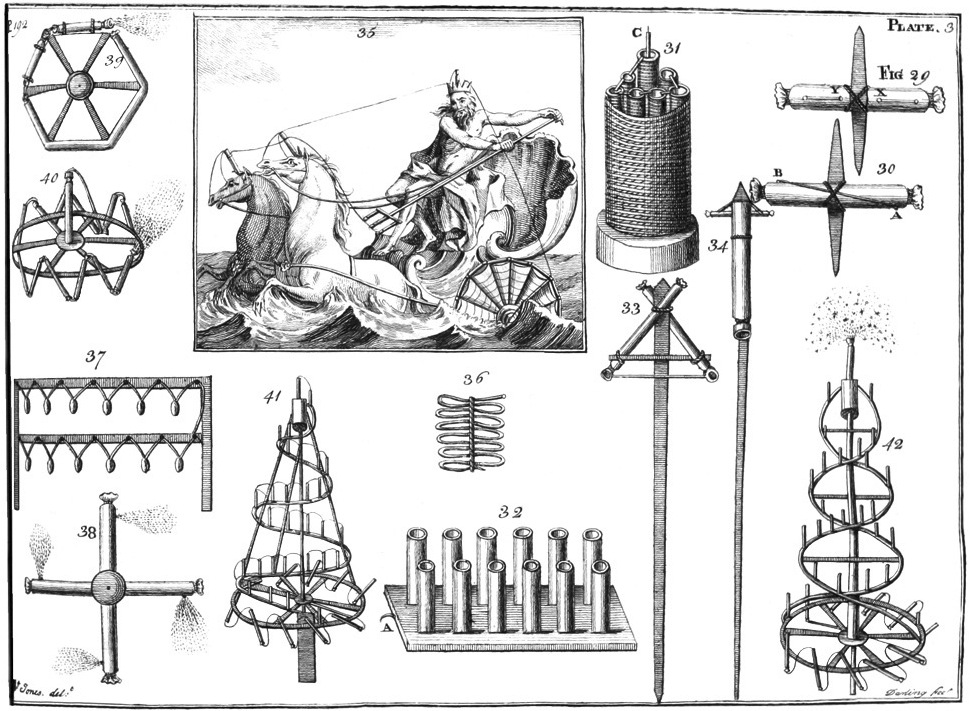
Plate. 3
Horizontal wheels are often fired two at a time, and made to keep time, like vertical wheels, only they are made without any slow or dead fire; ten or twelve inches will be enough for the diameter of wheels, with six spokes. Fig. 40. represents a wheel on fire, with the first case burning.
Of Spirali Wheels.
Spirali wheels are nothing more than double horizontal wheels, and are thus made: The nave must be about six inches long, and somewhat thicker than the single sort; instead of the pintle at top, there must be a hole for the case to be fixed in; there must also be two sets of spokes, one set near the top of the 194 nave, and the other near the bottom. At the end of each spoke cut a groove, wherein you tie the cases, there being no fell; the spokes should not be more than three inches and a half in length each from the nave, so that the wheel may not be more than eight or nine inches diameter; the cases are placed in such a manner, that those at top play down, and those at bottom to play up, but let the third or fourth case play horizontally. The case in the middle may begin with any of the others, you please; six spokes will be enough for each set, so that the wheel may consist of twelve cases, besides that on the top: the cases for these sort of wheels need not be more than six inches in length each.
Of Plural Wheels.
Plural wheels are made to turn horizontally, and to consist of three sets of spokes, placed in the following manner, six at top, six at bottom, and four in the middle, which must be a little shorter than the rest; let the diameter of the wheel be ten inches; the cases must be tied on the ends of the spokes, in grooves 195 cut on purpose, or in pieces of wood, nailed on the ends of the spokes, with grooves cut in them as usual; in cloathing these wheels, make the upper set of cases play obliquely downwards, and them at bottom obliquely upwards, and them in the middle horizontally. In placing the leaders, you must order it so that the cases may burn thus: viz. first up, then down, then horizontal, and so on with the rest, but another change may be made, by driving in the end of the eighth case, two, or three ladles full of slow fire, to burn till the wheel has stopped its course; then let the other cases be fixed the contrary way, which will make the wheel run back again: for the case at top, you may put a small gerbe; and let the cases on the spokes be short, and filled with a strong brilliant charge.
Of the Illuminated Spiral Wheel.
First have a circular horizontal wheel made two feet diameter, with a hole quite through the nave; then take three thin pieces of deal, three feet in length each, and three quarters of an inch in breadth each; one end of each of these 196 pieces, nail to the fell of the wheel, at an equal distance from one another, and the other ends nail to a block with a hole in its bottom, which must be perpendicular, with that in the block of the wheel, but not so large. The wheel being thus made, have a hoop planed down very thin and flat, then nail one end of it to the fell of the wheel, and wind it round the three sticks in a spiral line, from the wheel to the block at top; on the top of this block fix a case of Chinese fire; on the wheel you may place any number of cases, which must incline downwards and burn two at a time. If the wheel should consist of ten cases, you may let the illuminations and Chinese fire begin with the second cases; the spindle for this wheel must be a little longer than the cone, and made very smooth at top, on which the upper block is to turn, and the whole weight of the wheel to rest, see fig. 41.
Of the Double Spiral Wheel.
For this wheel, the block, or nave, must be as long as the height of the worms, or spiral lines, but must be made 197 very thin, and as light as possible. In this block must be fixed several spokes, which must diminish in length, from the wheel to the top, so as not to exceed the surface of a cone of the same height. To the ends of these spokes nail the worms, which must cross each other several times; these worms cloath with illuminations, the same as those on the single wheels, but the horizontal wheel, you may cloath as you like. At top of the worm, place a case of spur-fire, or an amber light, see fig. 42. This figure is shewn without leaders, to prevent a confusion of lines.
Of Ballóón Wheels.
Ballóón wheels are made to turn horizontally, they must be made two feet diameter, without any spokes, and very strong, with any number of sides. On the top of a wheel range and fix tin pots, three inches diameter and seven inches in height each, as many of these as there are cases on the wheel; near the bottom of each pot, make a small vent, into each of these vents carry a leader from the tail of each case; some of the 198 pots load with stars, and some with serpents, crackers, &c. As the wheels turn, the pots will successively be fired, and throw into the air a great variety of fires.
Of Fruiloni Wheels.
First have a nave made nine inches in length, and three in diameter, near the bottom of this nave fix eight spokes, with a hole in the end of each large enough to receive a two, or four ounce case. Each of these spokes may be fourteen inches in length from the block; near the top of this block, fix eight more, of the same sort of spokes, exactly over the others, but not so long by two inches; as this wheel is to run horizontally, all the cases in the spokes, at top, must play obliquely upwards, and all them in the spokes at bottom obliquely downwards. This being done, have a small horizontal wheel made with eight spokes, each five inches in length from the block; on the top of this wheel, place a case of brilliant fire; all the cases on this wheel must play in an oblique direction downwards, and burn two at a 199 time, and those on the large wheel, four at a time, that is, two of those in the top set of spokes, and two of them in the bottom set of spokes.
The four first cases on the large wheel, and the two first on the small wheel, must be fired at the same time, and the brilliant fire at top, at the beginning of the last cases. The cases of the wheels may be filled with a grey charge; when these wheels are compleated, you must have a strong iron spindle, made four feet six in length, and fixed perpendicular on the top of a stand; on this put the large wheel, whose nave must have a hole quite through from the bottom to the top. This hole must be large enough to turn easy round the bottom of the spindle, at which place there must be a shoulder, to keep the wheel from touching the stand; at the top of the spindle, put the small wheel, and join it to a large one with a leader, in order to fire them both together.
200
Of Port fires for Illuminations.
These sort of port fires, have their cases made very thin of paper, and rolled on formers, from two to five eighths of an inch diameter, and are made from two, to six inches in length; they are pinched close at one end, and left open at the other; when you fill them, put in but a little composition at a time, and ram it in lightly, so as not to break the case. Three or four rounds of paper, with the last round pasted, will be strong enough for these sort of cases.
Of Common port fires.
Common port fires are intended purposely to fire the works, their fire being very slow, and the heat of the flame so intense, that, if applyed to rockets, leaders, &c., it will fire them immediately. Port fires may be made of any length, but are seldom made more than twenty one inches in length; the interior diameter of port fire moulds, should be ten sixteenths of an inch, and the diameter of the former, half an inch. The cases 201 must be rolled wet with paste, and one end of them pinched, or folded down. The moulds should be made of brass, and to take in two pieces lengthwise; then when the case is in the two sides, they are held together by brass rings, or hoops, which are made to fit over the outside. The bore of the mould must not be made quite through, so that there will be no occasion for a foot. Those port fires when used, are held in copper sockets, fixed on the end of a long stick; these sockets are made like port crayons, only with a screw, instead of a ring.
Of Cascades of Fire.
Cascades are made of any size, but one made according to the dimensions of that shewn in plate 4. fig. 43. will be large enough for eight ounce cases. Let the distance from A to B, be three feet; from B to C, two feet six inches; and from C D, two feet; and let the cross piece, at A, be four feet in length; then from each end of this piece, draw a line to D; then make the other cross pieces of such a length as to come 202 within those lines. The top piece D, may be of any length so as to hold the cases, at a little distance from one another, all the cross pieces are fixed horizontally, and supported by brackets; the bottom cross piece should be about one foot six inches broad in the middle, the second one foot, the third nine inches, and the top piece four inches; the cases may be made of any length, but must be filled with a brilliant charge; on the edges of the cross pieces must be nailed bits of wood, with a groove cut in each piece, large enough, for a case to lie in, These bits of wood are fixed so as to incline downwards, and that the fire from one teer of cases may play over the other; all the cases being tied fast on, carry leaders from one to the other, and let there be a pipe, hang from the mouth of one of the cases, covered at the end with a single paper, which you burn to fire the cascade.
Of the Fire-Tree.
To make a fire-tree, as shewn by fig. 44. you must first have a piece of wood six feet in length, and three inches 203 square, then at E, nine inches from the top, make a hole in the front, and in each side, or instead of holes you may fix short pegs, to fit the inside of the cases. At F, nine inches from E, fix three more pegs; at G, one foot nine inches from F, fix three pegs; at H, nine inches from G, at I, nine inches from H, fix three pegs, inclining downwards, but all the other pegs, must incline upwards, in order that the cases may have the same inclination as you see in the figure; then at top place a four inch mortar, loaded with stars, rains, or crackers. In the middle of this mortar, place a case filled with any sort of charge, but let it be fired with the other cases: a brilliant charge will do for all the cases, but the mortar may be made of any diameter, and the tree of any size, and on it any number of cases, provided they are placed in the manner described.
Of Chinese Fountains.
To make a Chinese fountain, you must have a perpendicular piece of wood, seven feet in length, and two inches and a half square. Sixteen inches 204 from the top; fix on the front, a cross piece, one inch thick, and two and a half broad, with the broad side upwards; below this, fix three more pieces, of the same width and thickness, at sixteen inches distance from each other; let the bottom rail be five feet in length, and the others of such a length, as to allow the fire pumps to stand in the middle of the intervals of each other. The pyramid being thus made, fix in the holes made in the bottom rail, five fire pumps, at equal distances; on the second rail place four pumps; on the third, three; on the fourth, two; and on the top of the post, one; but place them all to incline a little forwards, that when they throw out the stars, they may not strike against the cross rails; having fixed your fire pumps, cloath them with leaders, so that they may all be fired together, see fig. 45.
205
Of Illuminated Globes with Horizontal Wheels.
The hoops for these sort of globes, may be made of wood, tin, or iron wire, about two feet diameter; for a single globe take two hoops, and fasten them together, one within the other at right angles; then have a horizontal wheel made, whose diameter must be a little wider than the globe, and its nave six inches long, on the top of which the globe is fixed, so as to stand three or four inches from the wheel; on this wheel you may put any number of cases, fill’d with what charge you like, but let two of them burn at a time; they may be placed horizontally or to incline downwards just as you chuse. Now when the wheel is cloathed, fix on the hoops as many illuminations as will stand within two inches and a half of one another; these you fasten on the hoops, with small iron binding wire, and when they are all on, put on your pipes of communication, which must be so managed, as to light 206 them all with the second or third case on the wheel; the spindle on which the globe is to run must go through the block of the wheel, up to the inside of the top of the globe, where must be fix’d a bit of brass or iron, with a hole in it to receive the point of the spindle, on which the whole weight of the wheel is to bear, as is shewn by fig. 46. which represents a globe on its spindle. By this method may be made a crown, which is done by having the hoops bent in the form of a crown. Sometimes globes and crowns, are ordered so as to stand still, and the wheel only to turn round; but when you would have the globe or crown to stand still, and the wheel to run by itself, the block of the wheel must not be so long, nor the spindle any longer than to just raise the globe a little above the wheel; and the wheel cases, and the illumination must begin together.
207
Of the Dodecaedron.
This piece is called a dodecaedron, because it nearly represents a twelve sided figure, and is made thus. First have a ball turned out of some hard wood, fourteen inches diameter, when done, divide its surface into fourteen equal parts, from which bore holes, one inch and a half diameter, perpendicular to the center, so that they may all meet exactly in the middle; then let there be turned in the inside of each hole a female screw, and to all the holes but one, must be made a round spoke, five feet in length, with four inches of the screw at one end, to fit the holes; then in the screw end of all the spokes, bore a hole, five inches up, which must be bored slanting, so as to come out at one side, a little above the screw; from which cut a small groove along the spoke, within six inches of the other end, where you make another hole through to the other side of the spoke; in this end fix a spindle, on which put a small wheel, of three, or four sides, each side six or seven inches 208 in length; these sides must have grooves cut in them large enough to receive a two or four ounce case; when these wheels are cloathed, put them on the spindles, and at the end of each spindle, put a nut to keep the wheel from falling off; the wheels being thus fixed, carry a pipe from the mouth of the first case on each wheel, through the hole in the side of the spoke, and from thence along the groove and through the other hole, so as to hang out at the screw end, about an inch. The spokes being all prepared in this manner, you must have a post, on which you intend to fire the work, with an iron screw in the top of it, to fit one of the holes, in the ball; on this screw fix the ball, then in the top hole of the ball, put a little meal powder, and some loose quick match; then screw in all the spokes, and in one side of the ball bore a hole, in which put a leader, and secure it at the end, and your work will be ready to be fired. By this leader the powder and match in the center is fired, which will light the match at the ends of the spokes, all at once, whereby all the wheels will be lighted at one and the same time; there may be an addition to this piece, by fixing a small globe, on 209 each wheel, or one on the top wheel only. A grey charge will be proper for the wheel cases.
Of the Yew Tree of Brilliant Fire.
A yew tree of fire is represented by fig. 47. as it appears when burning; first, let A be an upright piece of wood, four feet in length, two inches broad and one thick; at top of this piece, on the flat side, fix a hoop, fourteen inches diameter, and round its edge and front place illuminations, and in the center a five pointed star; then at E, which is one foot and a half from the edge of the hoop, place two cases of brilliant fire, one on each side; these cases should be one foot in length each; below these, fix two more cases of the same size, and at such a distance that their mouths may almost meet them at top; then, close to the ends of these cases, fix two more of the same sort of cases; these must stand parallel to them at E. The cases being thus fixed, cloath them with leaders; so that they, with the illuminations and star at top, may all take fire together.
210
Of Stars with Points for Regulated Pieces, &c.
These sort of stars are made of different sizes, according to the work for which they are intended; they are made with cases, from one ounce to one pound, but in general are made with four ounce cases, four or five inches in length; the cases must be rolled with paste, and twice as thick of paper as a rocket of the same bore. Having rolled a case, pinch one end of it quite close, then drive in half a diameter of clay, and when the case is dry, fill it with composition, two or three inches, according to the length of the cases, with which it is to burn; at top of the charge drive some clay; for, as the ends of these cases are seldom punched, they would be liable to take fire. Having filled a case, divide the circumference of it at the pinched end close to the clay into five equal parts; then bore five holes with a gimblet about the size of the neck of a common four ounce case into the composition; from one hole to the other, carry a quick match, and 211 secure it with paper; this paper must be put on in the manner of that on the ends of wheel cases, so that the hollow part, which projects from the end of the case, may serve to receive a leader from any other work, in order to give fire to the points of the star. These sort of stars may be made with any number of points.
Of the Fixed Sun with a Transparent Face.
To make a sun of the best sort, there should be two rows of cases, as in fig. 48, which will shew a double glory, and make the rays strong and full; the frame or sun wheel, must be made after the following manner; have a circular flat nave made very strong, twelve inches diameter; to this fix six strong flat spokes, A, B, C, D, E, F. On the front of these fix a circular fell, five feet diameter. Within which fix another fell, the length of one of the sun cases less in diameter; within this fix a third fell, whose diameter must be less than the second, by the length of one case and one third; the wheel being made, 212 divide the fells into as many equal parts as you would have cases (which may be done from twenty four, to forty four;) at each division, fix a flat iron staple; these staples must be made to fit the cases, so as to hold them fast on the wheel; let the staples be so placed, that one row of cases may lay in the middle of the intervals of the other.
In the center of the block of the sun, drive a spindle, on which put a small hexagon wheel, whose cases must be filled with the same charge, as the cases of the sun; two cases of this wheel must burn at a time, and begin with them on the fells; having fixed on all the cases, carry pipes of communication from one to the other, as you see in the figure, and from one side of the sun to the wheel in the middle, and from thence to the other side of the sun. These leaders will hold the wheel steady while the sun is fixing up, and will also be a sure method of lighting both cases of the wheel together. A sun thus made is called a brilliant sun, because the wood work is entirely covered with fire from the wheel in the middle, so that there appears nothing but sparks of brilliant fire; but if you would have a transparent 213 face in the center, you must have one made of paste board, of any size; the method of making a face is, by cutting out the eyes, nose, and mouth, for the sparks of the wheel to appear through; but, instead of this sort of face, you may have one painted on oiled paper, or Persian silk, strained tight on a hoop, which hoop must be supported by three or four pieces of wire, at six inches distance from the wheel in the center, so that the light of it may illuminate the face; by this method you may have in the front of a sun Vivat rex, cut in paste board, or Apollo painted on silk, but for a small collection of fire-works, a sun with a single glory, and a wheel in front, will be most suitable. Half pound cases, filled ten inches with composition, will be a good size for a sun of five feet diameter; but if larger, the cases must be greater in proportion.
214
Of three Vertical Wheels Illuminated, which turn on their own Naves upon a Horizontal Table.
A plan of this is shewn by fig. 49. Let D be a deal table three feet six inches diameter; this table must be fixed horizontally on the top of a post; on the top of this post must be a perpendicular iron spindle, which must come through the center of the table; then let A, B, C, be three spokes joined to a triangular flat piece of wood, in the middle of which make a hole to fit easily over the spindle; let E, F, G, be pieces of wood, four or five inches in length each, and two inches square, fixed on the under sides of the spokes; in these pieces make holes lengthwise to receive the thin part of the blocks of the wheels, which when in, are prevented from coming out by a small iron pin being run through the end of each; K, L, M, are three vertical octagon wheels, eighteen inches diameter each; the blocks of these wheels must be long 215 enough for three or four inches to rest on the table, round which part drive a number of sharp points of wire, which must not project out of the blocks more than one sixteenth of an inch; the use of these points is, that when the blocks run round, they will stick in the table, and help the wheels forward; if the naves be made of strong wood, one inch will be enough for the diameter of the thin part, which should be made to turn easy in the holes in the pieces E, F, G. On the front of the wheels, make four or five circles of strong wire, or flat hoops, and tie on them as many illuminations as they will hold at two inches from one another; instead of circles, you may make spiral lines cloathed with illuminations at the same distance from one another, as those on the hoops: when illuminations are fixed on a spiral line in the front of a wheel, they must be placed a little on the slant, the contrary way that the wheel runs: the cases for these wheels may be filled with any coloured charge, but must burn only one at a time.
The wheels being thus prepared, you must have a globe, crown, or spiral wheel, to put on the spindle in the middle 216 of the table; this spindle should be just long enough to raise the wheel of the globe, crown, or spiral wheel, so high that its fire may play over the three vertical wheels; by this means, their fires will not be confused, nor will the wheels receive any damage from the fire of each other; in cloathing this work, let the leaders be so managed, that all the wheels may light together, and the illuminations after two cases of each wheel are burnt.
Of the Illuminated Chandelier.
Illuminated works are much admired by the Italians, and indeed are a great addition to a collection of works; for in a grand exhibition an illuminated piece should be fired after every two, or three wheels, or fixed pieces of common and brilliant fires, and likewise illuminated works may be made cheap, quick, and easy.
To make an illuminated chandelier, you must first have one made of thin wood; see fig. 50. The chandelier being made, bore in the front of the branches, and in the body, and also in 217 the crown at top, as many holes for illuminations as they will contain, at three inches distance from each other; in these holes put illuminations filled with white, blue, or brilliant charge; having fixed in the port fires, cloath them with leaders so that the chandelier and crown may light together. The small circles on this figure represent the mouths of the illuminations, which must project straight from the front.
Of the Illuminated Yew Tree.
First have a tree made of wood, such as is shewn by fig. 51. The middle piece or stem, on which the branches are fixed, must be eight feet six inches in height; at the bottom of this piece draw a line, at right angles, two feet six inches in length at each side; then from L, which is one foot six inches from the bottom, draw a line on each side to C and D; these lines will give the length of the two first branches. Then put on the two top branches parallel to them at bottom; let the length of each of these branches be one foot from the stem; from the ends of these two 218 branches, draw a line to C and D; then fix on five more branches at an equal distance from each other, and their length will be determined by the lines A C and E D; when the branches are fixed, place illuminating port fires on the top of each, as many as you chuse: behind the top of the stem fasten a gerbe, or white fountain, which must be fired at the beginning of the illuminations on the tree.
Of Flaming Stars with Brilliant Wheels.
To make a flaming star, you must first have made a circular piece of strong wood, about one inch thick and two feet diameter; round this block fix eight points, two feet six inches in length each; four of these points must be straight, and four flaming; these points being joined on very strong and even with the surface of the block, nail tin or paste board on their edges, from the block to the end of each, where they must be joined; this tin must project in front eight inches, and be joined where they meet at the block; round 219 the front of the block fix four pieces of thick iron wire, eight inches in length each, equally distant from each other; this being done, cut a piece of paste board round two feet diameter, and draw on it a star, as may be seen in fig. 52. This star cut out, and on the back of it paste oiled paper, then paint each point half red, and half yellow, lengthwise; but the body of the star must be left open, wherein must run a brilliant wheel, which is made as follows: Have a light block turned nine inches long; at each end of it, fix six spokes, at the end of each spoke put a two ounce case of brilliant fire; the length of these cases must be in proportion to the wheel, and the diameter of the wheel when the cases are on must be a little less than the diameter of the body of the small star; the cases on the spokes in front must have their mouths incline outwards, and them on the inside spokes must be placed so as to form a vertical circle of fire. When you place your leaders, carry the first pipe from the tail of one of the cases in front to the mouth of one of the inside cases, and from the tail of that to another in front, and so on to all the cases; your 220 wheel being made, put it on a spindle, exactly in the center of the star; this spindle must have a shoulder at bottom, to keep the wheel at a little distance from the block. This wheel must be kept on the spindle by a nut at the end; having fixed on the wheel, fasten the transparent star to the four pieces of wire; then when you fire the wheel, you will first see nothing more than a common horizontal wheel; but when the first case is burnt out, it will fire one of the vertical cases, which will shew the transparent star, and fill the large flames and points with fire; then it will again appear like a common wheel, and so on for twelve changes.
Of Touch Paper for Capping of Serpents, Crackers, &c.
Dissolve, in some spirits of wine or vinegar, a little salt petre, then take some purple or blue paper, and wet it with the above liquor, and when dry it will be fit for use; when you paste this paper, on any of your works, take care that the paste does not touch that part which is to burn. The method of using 221 this paper is by cutting it into slips, long enough to go once round the mouth of a serpent, cracker, &c. When you paste on these slips, leave a little above the mouth of the case not pasted; then prime the case with meal powder, and twist the paper to a point.
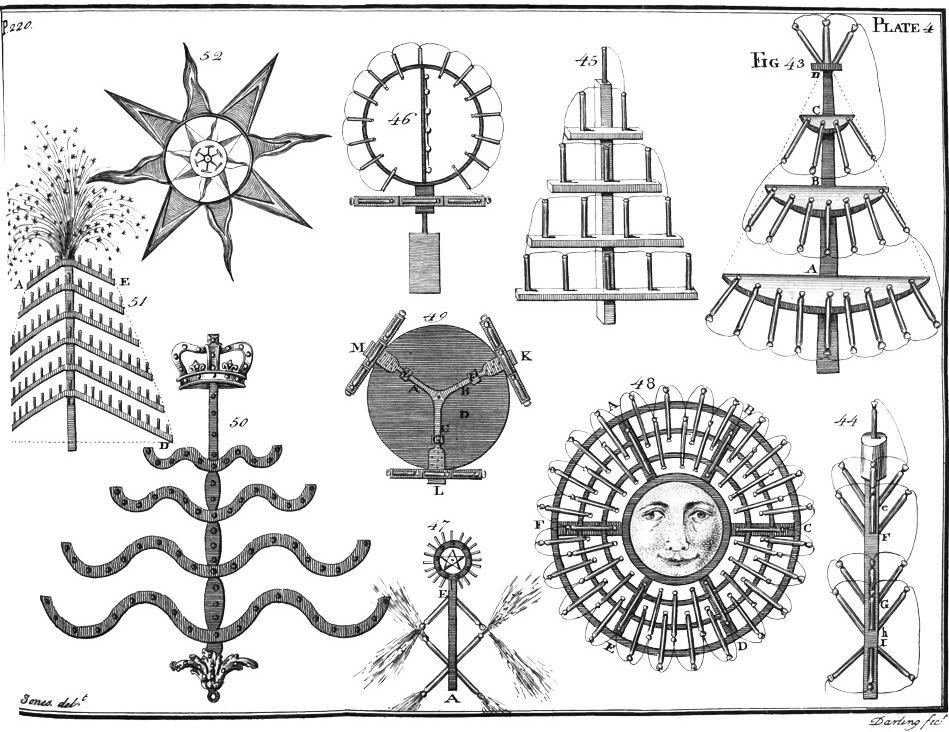
Plate 4
Of a Projected Regulated Piece of Nine Mutations.
A regulated piece, if well executed, is as curious a work as any in fireworks; for it consists of fixed and moveable pieces on one spindle, representing various sorts of figures, which take fire successively one from another, without any assistance after lighting the first mutation; but, for the better explanation of this piece, I shall give a full description of the method of communicating the fire from one mutation to the other, with a figure of each as they stand on the spindle. Regulated pieces are made of many sorts, and of any number of mutations, from two to nine, which is the greatest number I ever knew a piece to consist of, except one of my own making, which was composed of fifteen 222 mutations, all different fires, and figures. But, as an explanation of so large a piece would be very difficult to comprehend, I shall omit it, leaving so many changes to those who have made a great progress in this art, and only teach the manner of making a piece of nine mutations, as shewn in Plate V, fig. 53. As it will be necessary that every mutation should be separately explained, I will first give the name of each, with the colour of fire, and size of the case belonging to it: after which shall proceed, with the proportion of each mutation, together with the nature of the spindle, and manner of placing the leaders.
First Mutation
Is a hexagon vertical wheel, illuminated in front with small port fires tied on the spokes; this wheel must be cloathed with two ounce cases, filled with black charge; the length of these cases are determined by the size of the wheel, but must burn singly.
223
Second Mutation
Is a fixed piece called a golden glory, by reason of the cases being filled with spur-fire; the cases must stand perpendicular to the block on which they are fixed, so that, when they are burning, they may represent a glory of fire; this mutation is generally composed of five, or seven two ounce cases.
Third Mutation
Is moveable, and is nothing more then an octagon vertical wheel, cloathed with four ounce cases, filled with brilliant charge; two of these cases must burn at a time: in this wheel you may make changes of fire.
Fourth Mutation
Is a fixed sun of brilliant fire, consisting of twelve four ounce cases; the necks of these cases must be a little larger than those of four ounce wheel cases; in this mutation may be made a change of fire, 224 by filling the cases half with brilliant charge and half with grey.
Fifth Mutation
Is a fixed piece called the porcupine’s quills; this piece consists of twelve spokes, standing perpendicular to the block in which they are fixed; on each of these spokes, near the end, must be placed a four ounce case of brilliant fire; all these cases must incline either to the right or left, so that they may all play one way.
Sixth Mutation
Is a standing piece called the cross fire. This mutation consists of eight spokes fixed in a block; near the end of each of those spokes, must be tied two four ounce cases of white charge, one across the other, so that the fires from the cases on one spoke, may intersect the fire from cases on the other.
Seventh Mutation
Is a fixed wheel, with two circular fells, on which are placed sixteen eight 225 ounce cases of brilliant fire, in the form of a star: this piece is called a fixed star of wild fire.
Eighth Mutation.
This is a beautiful piece, called a brilliant star piece, it consists of six spokes, which are strengthened by two fells of a hexagon form at some distance from each other; at the end of each spoke, in the front, is fixed a brilliant star of five points; and on each side of every star is placed a four ounce case of black or grey charge; these cases must be placed with their mouths side ways, so that their fires may cross each other.
Ninth Mutation
Is a wheel piece; this is composed of six long spokes, with a hexagon vertical wheel at the end of each; these wheels run on spindles in the front of the spokes; all the wheels are lighted together: two ounce cases will do for these wheels, and may be filled with any coloured charge.
226
After having spoke of the several parts of the regulated piece, each by their proper names and colour of fire, I shall next proceed with the proportion of every mutation, together with the method of conveying the fire from one to the other, and the distance they stand one from the other on the spindle.
First Mutation
Must be a hexagon vertical wheel, fourteen inches diameter; on one side of the block, whose diameter is two inches and a quarter, is fixed a tin barrel A, see fig. 53, Nᵒ. 1; this barrel must be a little less in diameter than the nave; let the length of the barrel and block be six inches. Having fixed the cases on the wheel, carry a leader from the tail of the last case into the tin barrel through a hole made on purpose two inches from the block; at the end of this leader let there be about an inch or two of loose match, but take care to well secure the hole wherein the pipe is put, to prevent any sparks falling in, which would light the second mutation before its time, and confuse the whole piece.
227
Second Mutation
Is thus made. Have a nave turned two inches and a half diameter, and three long; then let half an inch of that end which faces the first wheel be turned so as to fit easy into the tin barrel of the first mutation, which must turn round it without touching; on the other end of the block, fix a tin barrel B, Nᵒ. 2, this barrel must be six inches in length, and only half an inch of it to fit on the block. Round the nave fix five spokes, one inch and a half in length each; the diameter of the spokes must be equal to a two ounce former; on these spokes put five seven inch two ounce cases of spur fire, and carry leaders from the mouth of one to the other, that they may all light together; then from the mouth of one of the cases, carry a leader, through a hole bored slantways in the nave, from between the spokes, to the front of the block near the spindle hole; the end of this leader must project out of the hole into the barrel of the first mutation, so that when the pipe which comes from the end of the last case on the first wheel flashes, 228 it may take fire and light the second mutation. To communicate the fire to the third mutation bore a hole near the bottom of one of the five cases, to the composition, and from thence carry a leader into a hole made in the middle of the barrel B; this hole must be covered with pasted paper.
Third Mutation
May be either an octagon or hexagon wheel, twenty inches diameter; let the nave be three inches and a quarter diameter, and three and a half in length; one inch and a half of the front of the nave must be made to fit in the barrel B. On the other end of the block fix a tin barrel C, Nᵒ. 3; this barrel must be six inches and a half in length, one inch of which must fit over the block. The cases of this wheel must burn two at a time; and from the mouths of the two first cases carry a leader, through holes in the nave into the barrel of the second mutation, after the usual manner; but besides these leaders let there be a pipe go across the wheel from one first case to the other, then from the tail of one of the last cases, carry a pipe into a hole 229 in the middle of the barrel C; at the end of this pipe, let there hang some loose quick match.
Fourth and Fifth Mutation.
We shall here speak of those two mutations under one head, as their naves are made of one piece, which from E to F is fourteen inches; E, a block four inches diameter, with ten or twelve short spokes, on which are fixed eleven inch eight ounce cases; let the front of this block be made to fit easy in the barrel C, and cloath the cases so that they may all light together; and let a pipe be carried through a hole in the block into the barrel C, in order to receive the fire from the leader brought from the last case on the wheel. G, the nave of the fifth mutation, whose diameter must be four inches and a half; in this nave fix ten or twelve spokes one foot and a half in length each; these spokes must stand seven inches distance from the spokes of the fourth mutation; and at the end of each spoke tie a four ounce case, as shewn by Nᵒ. 5; all these cases are to be lighted together, by a leader brought from the end of one of 230 the cases on Nᵒ. 4. Let F and H be of the same piece of wood as E and G; but as much thinner as possible, in order to make the work light.
Sixth and Seventh Mutation.
The blocks of these two mutations, are turned out of one piece of wood, whose length from F to P is fifteen inches. L a block five inches diameter, in which are fixed eight spokes, each two feet four inches in length; at the end of each spoke tie two four ounce cases as shewn by Nᵒ. 6; all these cases must be fired at the same time, by a pipe brought from the end of one of the cases on the fifth mutation. Let the distance between the spokes at L and those in the fifth mutation be seven inches. M, the nave of the seventh mutation, whose diameter must be five inches and a half; in this nave fix eight spokes, and on the front of them two circular fells, one of four feet eight diameter, and one of three feet eleven inches diameter; on these fells, tie sixteen eight ounce or pound cases, in the same manner as represented by Nᵒ. 7, 231 and carry leaders from one to the other, so that they may be all fired together; this mutation must be fired by a leader brought from the tail of one of the cases on the sixth mutation.
Eighth and Ninth Mutation.
The blocks of these may be turned out of one piece, whose length from P to D must be twelve inches. O, the block of the eighth mutation, which must be six inches diameter, and in it fixed six spokes, each three feet in length; these spokes must be strengthened by a hexagon fell within three or four inches of the ends of the spokes; close to the end of each spoke, in the front, fix a five-pointed brilliant star; then seven inches below each star tie two ten inch eight ounce cases, so that the upper ends of the cases may rest on the fells, and their ends on the spokes; each of these cases must be placed parallel to the opposite fell, see Nᵒ. 8. NNN, &c. are the cases, and kkk, &c. the stars.
The ninth mutation must be thus made; let D be a block seven inches diameter; in this block must be screwed 232 six spokes, six feet in length each, with holes and grooves in them for leaders, in the same manner as those in the dodecaedron; at the end of each spoke, in the front, fix a spindle for a hexagon vertical wheel, ten inches diameter, as shewn by Nᵒ. 9. When these wheels are on, carry a leader from each into the block, so that they may all meet together; then lead a pipe from the end of one of the cases of the eighth mutation, through a hole bored in the block D, to meet the leaders from the vertical wheels, so that they may all be fired together.
The spindles for large pieces are required to be made very strong, and as exact as possible; for a piece of nine mutations, let the spindle be at the large end one inch diameter, and continue that thickness as far as the seventh mutation, and from thence to the fifth; let its diameter be three quarters of an inch; from the fifth to the fourth, five eighths of an inch; from the fourth to the second, half an inch; and from the second to the end, three eighths of an inch: at the small end must be a nut to keep on the first wheel, and at the thick end must be a large nut, as shewn 233 by the figure, so that the screw part of the spindle being put through a post, and a nut screwed on tight, the spindle will be held fast and steady; but you are to observe, that that part of the spindle, on which the moveable pieces are to run, be made long enough for the wheels to run easy without sticking; the fixed pieces being made on different blocks, the leaders must be joined, after they are fixed on the spindle. The best method of preventing the fixed mutations from moving on the spindle, is, to make that part of the spindle which goes through them square; but as it would be difficult to make square holes through such long blocks as are sometimes required, it will be best to make them in the following manner; which is, to bore a round hole a little larger than the diameter of the spindle, and at each end of the block over the hole, fasten a piece of brass with a square hole in it to fit the spindle.
234
To make a Horizontal Wheel change to a Vertical Wheel with a Sun in Front.
The sudden change of this piece is very pleasing, and gives great surprize to those who are not acquainted with the contrivance. A wheel for this purpose should be about three feet diameter, and its fell circular, on which tie sixteen half pound cases filled with brilliant charge; two of these cases must burn at a time, and on each end of the nave must be a tin barrel of the same construction as those on the regulated piece; the wheel being compleated, prepare the post or stand after the following manner: first have a stand made of any height, about three or four inches square, then saw off from the top, a piece two feet in length; this piece join again at the place where it was cut, with a hinge on one side, so that it may lift up and down in the front of the stand, then fix on the top of the bottom part of the stand, on each side a bracket; these brackets must project at right angles with the stand, one 235 foot from the front, for the short piece to rest on; but these brackets must be placed a little above the joint of the post, so that when the upper stand falls, it may lay between them at right angles with the bottom stand, which may be done by fixing a piece of wood, one foot in length, between the brackets and even with the top of the bottom stand; then, as the brackets rise above the bottom stand, they will form a channel for the short post to lay in, and at the same time keep it steady without straining the hinge: on the side of the short post opposite the hinge, nail a piece of wood; this piece must be of such a length, that, when the post is perpendicular, it may reach about one foot and a half down the long post, to which being tied, it will hold the short stand upright; the stand being thus prepared, in the top of it fix a spindle ten inches in length; on this spindle put the wheel, then fix on a brilliant sun with a single glory; the diameter of this sun must be six inches less than that of the wheel. When you fire this piece, light the wheel first, and let it run horizontally till four cases are consumed; then from the end of the fourth case carry a leader 236 into the ten barrel that turns over the end of the stand; this leader must be met by another brought through the top of the post, from a case filled with a strong port-fire charge, and tied to the bottom post, with its mouth facing the pack-thread which holds up the stand, so that when this case is lighted, it will burn the pack-thread, and let the wheel fall forward, by which means it will become vertical; then from the last case of the wheel, carry a leader into the barrel next the sun, which will begin as soon as the wheel is burnt out.
Of the grand Volute illuminated with a projected Wheel in Front.
First have two hoops made of strong iron wire, one of six feet diameter, and one of four feet two inches; these hoops must be joined to scroles A, A, A, &c. as shewn by fig. 54. These scroles must be made of the same sort of wire as the hoops; on these scroles, tie with iron binding wire as many illuminating port fires as they will hold, at two inches distance from each other; these port 237 fires cloath with leaders, so that they may all take fire together; then let C be a circular wheel of four spokes, three feet six inches diameter, and on its fell tie as many four ounce cases head to tail, as will compleat the circle, only allowing a sufficient distance between the cases, that the fire may pass free, which may be done by cutting the upper part of the end of each case a little shelving: on each spoke fix a four ounce case about three inches from the fell of the wheel; these cases are to burn one at a time, and the first of them to begin with those on the fell, of which four are to burn at a time, so that the wheel will last no longer than one fourth of the cases on the fell, which in number should be sixteen or twenty; on the front of the wheel form a spiral line, with strong wire, on which tie port fires, placing them on a slant, with their mouths to face the same way as the cases on the wheel; all these port fires must be fired with the second cases of wheel. Let D, D, D, &c. be spokes of wood, all made to screw into a block in the center; each of these spokes may be in length about four feet six inches; in the top of each fix a spindle, and on each 238 spindle put a spirali wheel of eight spokes, such as are represented by E, E, E, &c. The blocks of these wheels must have a hole at top for the center cases, and the spindle must have nuts screwed on their ends, which nuts should fit in the holes at top of the blocks, so that all the wheels, must be put on before you fix in the center cases: as some of these wheels by reason of their situation will not bear on the nut, it will be necessary to have smooth shoulders made on the spindles for the blocks to run on; the cases of these wheels are to burn double, and the method of firing them is, by carrying a leader from each down the spokes into the block in the center, in the same manner as those in the dodecaedron, but the center case of each wheel, must begin with the two last cases as usual; it is to be observed, that the large circular wheel in front must have a tin barrel on its block, into which a pipe must be carried, from one of the second cases on the wheel; this pipe being met by another from the large block, in which the eight spokes are screwed, will fire all the spirali wheels and the illuminating port fires at the same time. The cases of the projected 239 wheel may be filled with a white charge, and those of the spirali wheels, with a grey.
Of the Moon and Seven Stars.
Let fig. 55, be a smooth circular board, six feet diameter; out of the middle of it cut a circular piece twelve or fourteen inches diameter, and over the vacancy put white Persian silk, on which paint a moon’s face, then let I, I, I, &c. be stars each four or five inches diameter, cut out with five points, and covered with oiled silk: on the front of the large circular board, draw a seven-pointed star, as large as the circle will allow; then on the lines which form this star, bore holes, wherein fix pointed stars. When this piece is to be fired, it must be fixed upon the front of a post, on a spindle, with a wheel of brilliant fire behind the face of the moon; so that while the wheel burns, the moon and stars will appear transparent, and when the wheel has burnt out, they will disappear, and the large star in front, which is formed of pointed stars, will begin, being lighted 240 by a pipe of communication from the last case of the vertical wheel, behind the moon; this pipe of communication must be managed in the same manner as those in regulated pieces.
Of the Double Cone Wheel illuminated.
This piece is represented by fig 56. Let A, be a strong decagon wheel, two feet six inches diameter; then on each side of it fix a cone B and C; these cones are to consist of a number of hoops, supported by three or four pieces of wood, in the manner of the spiral wheels; let the height of each cone be three feet six inches, and on all the hoops tie port fires horizontally, with their mouths outwards, and cloath the wheel with eight ounce cases, all to play horizontally, two at a time: the cones may be fired with the first or second cases. The spindle for this piece must go through both the cones, and rise three feet above the point of the cone at top, so that its length will be ten feet four inches from the top of the post H, in which it is fixed, allowing 241 four inches for the thickness of the block of the wheel; the whole weight of the wheel and cones must bear on a shoulder in the spindle, on which the block of the wheel must turn; near the top of the spindle, must be a hole in the front, into which screw a small spindle, after the cones are on; then on this small spindle fix a sun D, composed of sixteen nine inch four ounce cases of brilliant fire, which cases must not be placed on a fell, but only stuck into a block of six inches diameter; then in the front of this sun must be a circular vertical wheel, sixteen inches diameter; on the front of this wheel form with iron wire a spiral line, and cloath it with illuminations, after the usual method; as this wheel is not to be fired till the cones are burnt out, the method of firing it is as follows; let the hole in the block, at the top of the uppermost cone, be a little larger than the spindle which passes through it; then from the first case of the vertical wheel before the sun, carry a leader down the side of the spindle to the top of the block of the horizontal wheel, on which must be a tin barrel; then this leader, being met by another brought from the end of the 242 last case of the horizontal wheel, will give fire to the vertical wheel, as soon as the cones are extinguished; but the sun D must not be fired, till the vertical wheel is quite burnt out.
Of Fire Pumps.
Cases for fire pumps, are made in the same manner as those for tourbillons, only they are parted instead of being rolled dry. Having rolled and dryed your cases, fill them in the following manner: first put in a little meal powder, and then a star, on which ram lightly a ladle or two of composition, then a little meal powder, and on that a star, then again composition, and so on till you have filled the case. Stars for fire pumps should not be round, but must be made either square, or flat and circular, with a hole through the middle; the quantity of powder for throwing the stars must increase as you come near the top of the case, for if much powder be put at the bottom, it will burst the case. The stars must differ in size, in this manner; let the star which you put in first, be about one fourth less than the bore 243 of the case, but let the next star be a little larger, and the third star a little larger than the second, and so on; let them increase in diameter, till within two of the top of the case, which two must fit in tight. As the loading of fire pumps is somewhat difficult, it will be necessary to make two or three trials, before you depend on their performance: when you fill a number of pumps, take care not to put in each an equal quantity of charge between the stars, so that when they are fired they may not throw up too many stars together. Cases for fire pumps should be made very strong, and rolled on four or eight ounce formers, ten or twelve inches in length each.
Of the Vertical Scroll Wheel.
This wheel may be made of any diameter, but must be constructed as shewn by fig. 57, to do which proceed thus; have a block made of a moderate size, into which fix four flat spokes, and on them fix a flat circular fell of wood; round the front of this fell place port-fires; then on the front of the spokes 244 form a scrole, either with a hoop or strong iron wire; on this scrole tie cases of brilliant fire, in proportion to the wheel, head to tail, as in the figure; when you fire this wheel, light the first case near the fell; then, as the cases fire successively, you will see the circle of fire gradually diminish; but whether the illuminations on the fell begin with the scrole or not, is immaterial, that being left intirely to the maker.
N. B. This wheel may be put in the front of a regulated piece, or fired by itself, occasionally.
Of Pin Wheels.
First roll some paper pipes, about fourteen inches in length each; these pipes must not be made thick of paper, two or three rounds of elephant paper being sufficient; when your pipes are thoroughly dryed, you must have made a tin tube, twelve inches in length, to fit easy into the pipes; at one end of this tube fix a small conical cup, which being done, it is called a funnel, then bend one end of one of the pipes, and put the funnel in at the other, as far as it will 245 reach, and fill the cup with composition; then draw out the funnel by a little at a time, shaking it up and down, and it will fill the pipe as it comes out; having filled some pipes, have made some small blocks, about an inch diameter, and half an inch in thickness; round one of these blocks wind and paste a pipe, and to the end of this pipe join another, which must be done by twisting the end of one pipe to a point, and putting it into the end of the other, with a little paste; in this manner join four or five pipes, winding them one upon the other, so as to form a spiral line; having wound on your pipes, paste two slips of paper across them, to hold them together; besides these slips of paper, the pipes must be pasted together.
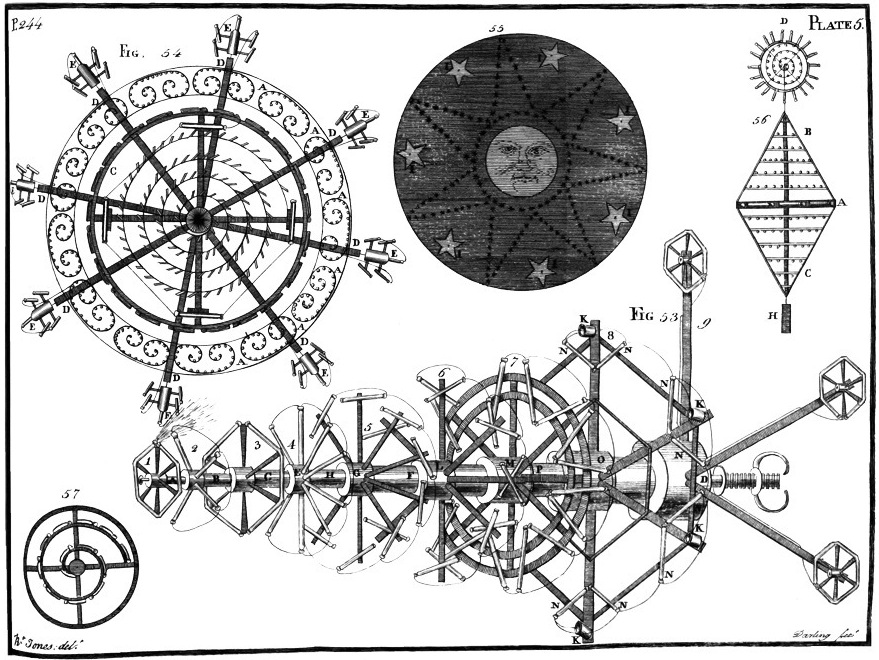
Plate 5.
Plate 6.
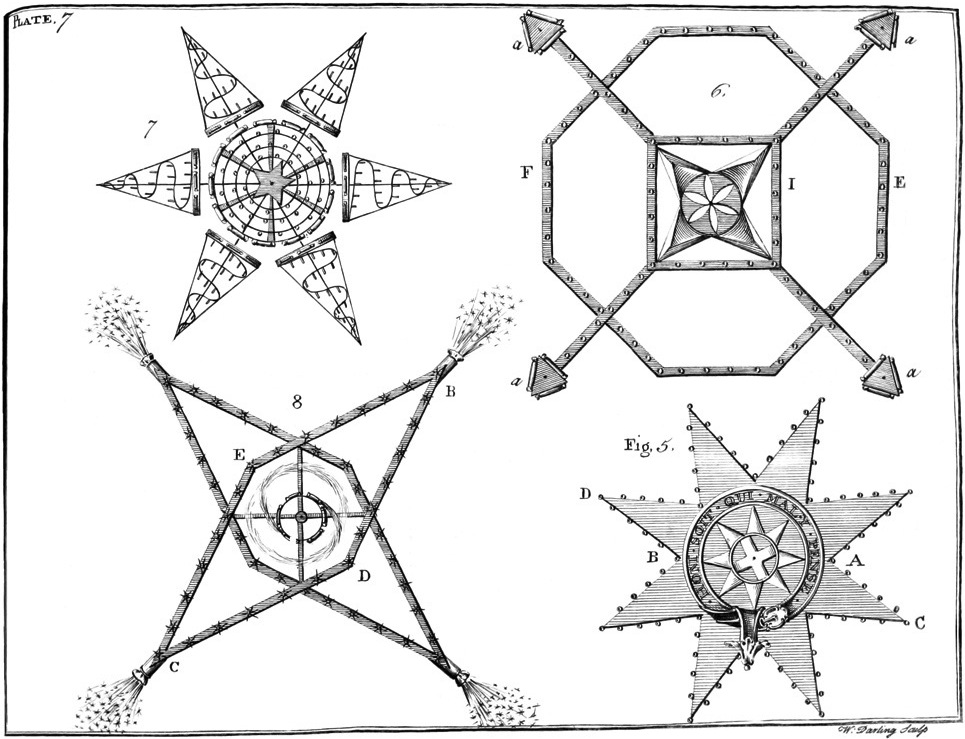
Plate. 7
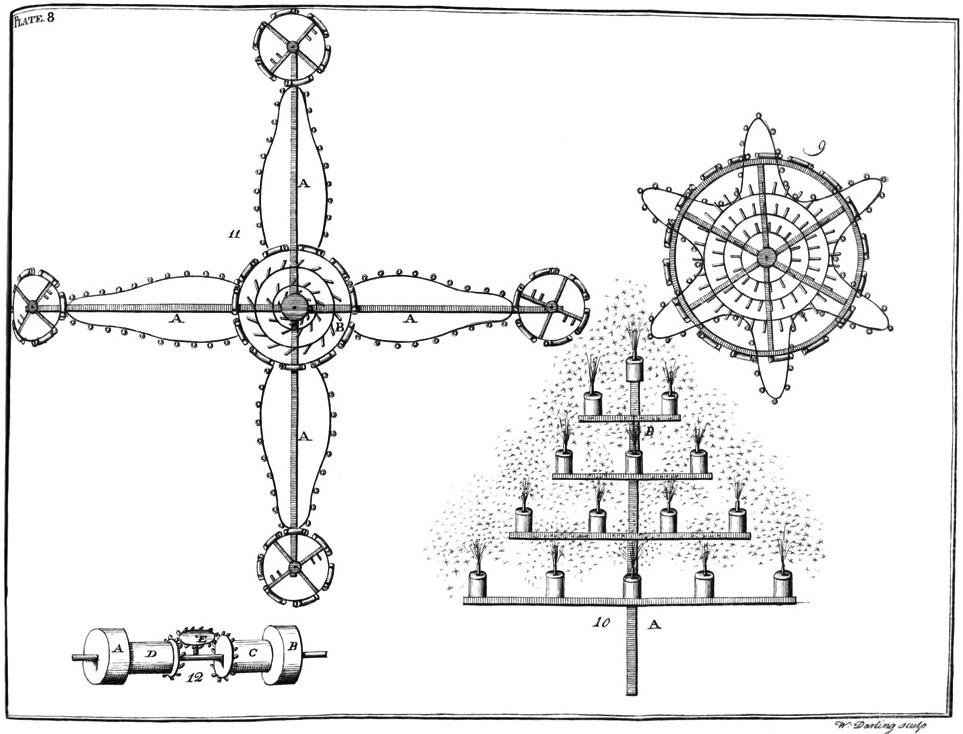
Plate. 8
There is another method of making these wheels, called the French method; which is, by winding on the pipes without paste, and sticking them together with sealing wax, at every half turn; so that when they are fired, the end will fall loose every time the fire passes the wax, by which means the circle of fire will be considerably increased. The formers for these pipes are made from one and a half to four sixteenths of an 246 inch diameter, and the composition for them as follows; meal powder eight ounces, salt petre two ounces, and sulphur one; among these ingredients, may be mixed a little steel-filings, or the dust of cast-iron; this composition should be very dry, and not made too fine, or it will stick in the funnel. These wheels may be fired on a large pin, and held in the hand with safety.
Of Fire Globes.
There are two sorts of fire globes, one with projected cases, and the other with the cases concealed in the following manner; have a globe made of wood, of any diameter you chuse, and divide the surface of it into fourteen equal parts, and at each division bore a hole perpendicular to the center; these holes must be in proportion to the cases intended to be used; in every hole, except one, put a case filled with brilliant, or any other charge, and let the mouths of the cases be even with the surface of the globe; then cut in the globe a groove, from the mouth of one case to the other, for leaders, which must be carried from 247 case to case, so that they may all be fired together; this being done, cover the globe with a single paper, and paint it. These sort of globes may be used to ornament a building.
Fire-globes with projected cases are made thus; your globe being made with fourteen holes bored in it as usual, six in every hole, except one, a case, and let each case project from the globe two thirds of its length; then cloath all the cases with leaders, so that they may all take fire at the same time. Fire-globes are supported by a pintle, made to fit the hole in which there is no case.
To thread and join Leaders, with the method of placing them on different Works.
Joining and placing of Leaders is a very essential part of fireworks, as it is on the leaders, that the performance of all complex works depend; for which reason I shall endeavour here to explain the method of conducting pipes of communication, in as plain a manner as possible. Your works being ready to be cloathed, proceed thus; cut your pipes 248 of a sufficient length to reach from one case to the other, then put in the quick match, which must always be made to go in very easy; when the match is in, cut it off within about an inch of the end of the pipe, and let it project as much at the other end; then fasten the pipe to the mouth of each case with a pin, and put the loose ends of the match into the mouths of the cases, with a little meal powder; this being done to all the cases, paste over the mouth of each two or three bits of paper; the preceding method is used for large cases, and the following for small cases and illuminations; first thread a long pipe, then lay it on the tops of the cases, and cut a bit off the under side, exactly over the mouth of each case, so that the match may appear; then pin the pipe to every other case, but before you put on the pipes, put a little meal powder in the mouth of each case; if the cases thus cloathed be port-fires on illuminated works, cover the mouth of each case with a single paper; but if they are choaked cases, situated so that a number of sparks from other works may fall on them before they are fired, secure them with 249 three or four papers, which must be pasted on very smooth, that there may be no creases for the sparks to lodge in, which often set fire to the works before their time; avoid, as much as possible, placing the leaders too near together, or one across the other so as to touch, as it sometimes happens that the flash of one will fire the other; therefore if your works should be so formed, that the leaders must cross or touch, be sure to make them very strong, and secure them well at the joints and at every opening.
When a great length of pipe is required, it must be made by joining several pipes together, in this manner; having put on one length of match as many pipes as it will hold, paste paper over every joint; but if a still greater length be required, more pipes must be joined, by cutting off about an inch of one side of each pipe near the end, and laying the quick match together, and tieing them fast with small twine; after which, cover the joining with pasted paper.
250
The manner of placing Fireworks to be exhibited, with the order of Firing.
Nothing adds more to the appearance of fireworks, than the placing them properly; though the manner of placing them chiefly depends on the judgment of the maker. I shall give such rules here, as have been generally observed; for example, whether your works are to be fired on a building, or on stands; if they are a double set, place one wheel of a sort on each side of the building, and next to each of them towards the center, place a fixed piece, then wheels, and so on, leaving a sufficient distance between them, for the fire to play from one without burning the other; having fixed some of your works thus in front, place the rest behind them, in the center of their intervals; the largest piece, which is generally a regulated or transparent piece, must be placed in the center of the building, and behind it a sun, which must always stand above all the other works: a little 251 before the building or stands place your large gerbes, and at the back of the works, fix your marron batteries, pots des aigrettes, pots des brins, pots des saucissons, air ballóóns, and flights of rockets; the rocket stands may be fixed behind or any where else, so as not to be in the way of the works.
Single collections are fired on stands, which stands are made in the same manner as theodolite stands, only the top part must be long or short occasionally; these sort of stands may be fixed up very soon without much trouble. Having given sufficient instructions for placing of fireworks, I shall proceed with the manner of firing them.
252
Order of Firing.
1. Two signal rockets,
2. Six sky rockets,
3. Two honorary rockets,
4. Four caduceus rockets,
5. Two vertical wheels illuminated,
6. Two spiral wheels illuminated,
7. Two transparent stars,
8. A line rocket of five changes,
9. Four tourbillons,
10. Two horizontal wheels,
11. Two air ballóóns illuminated,
12. Two Chinese fountains,
13. Two regulating pieces of four mutations each,
14. Two pots des aigrettes,
15. Three large gerbes,
16. A flight of rockets,
17. Two ballóón wheels,
18. Two cascades of brilliant fire,
19. Twelve sky rockets,
20. Two illuminated yew-trees,
21. Two air ballóóns of serpents, and two compound,
22. Four tourbillons, 253
23. Two Fruiloni Wheels,
24. Two Illuminated Globes with Horizontal Wheels,
25. One Pot des Saucissons,
26. Two Plural Wheels,
27. A Marron Battery,
28. Two Chandeliers Illuminated,
29. A Range of Pots des Brins,
30. Twelve Sky Rockets,
31. Two Yew-Trees of Fire,
32. A Nest of Serpents,
33. Two Double Cones Illuminated,
34. A Regulating Piece of Seven Mutations, viz.,
1. A Vertical Wheel Illuminated,
2. A Golden Glory,
3. An Octagon Vertical Wheel,
4. Porcupines Quills,
5. Cross Fires,
6. A Star Piece with Brilliant Rays,
7. Six Vertical Wheels,
35. A Brilliant Sun,
36. A Large Flight of Rockets.
When water-works are to be exhibited, divide them into several sets, and fire one set after every fifth or sixth change of land and air-works; and observe this rule in firing in a double set of works, always to begin with sky-rockets, then two moveable pieces, then two fix’d pieces, and so on, ending with a large flight of rockets, or a marron battery; if a single collection, fire a fixed piece after every wheel or two, and now and then some air and water-works.
Fountain of Sky-Rockets.
Plate 6th. Fig. 1st, represents a fountain of thirty rockets; let A, be a perpendicular post, sixteen feet high from the ground, and four inches square. Let the rail or cross piece C, be one foot six inches in 254 length, three inches broad, and one thick. The rail D, at bottom, must be six feet in length, one foot broad, and an inch thick. F, and G, are the two sides which serve to supply the rails D, E, H, I, C; these sides are one foot broad at bottom, and cut in the front with a regular slope, to three inches at top, but their back edges must be parallel with the front of the pots A. The breadth of the rails E, H, I, will be determined by the breadth of the sides; all the rails must be fixed at two feet distance from each other, and at right angles with the pots; having placed the rails thus; bore in the bottom rail, ten holes at equal distances from each other, large enough to receive easily the stick of a one pound rocket; in the back edge of this rail cut a groove from one end to the other, fit to contain a quick-match, then cut a groove in the top of the rail, from the edge of each hole, into the groove in the back; in the same manner cut in the second rail E, eight holes and grooves; in the third rail H, six holes and grooves; in the fourth rail I, four holes and grooves; and in the top rail two holes and grooves; B, a rail with holes in it to guide the ends of the rocket sticks, this rail must be fixed six feet from the rail D; the fountain frame being thus made, prepare your rockets thus; tie round the mouth of each a piece of thin paper, large enough to go twice round, and to project about an inch and a half from the mouth of the rocket, which must be rubbed with wet meal-powder; in the mouth of each Rocket put a leader, which secure well with the paper that projects from the mouth of the case; these leaders must be carried into the grooves in the back of the rails, in which lay a quick-match from one end to the other, and cover it with pasted paper; holes must be made in the rail D, to receive the ends of the sticks of the rockets, in the rail E, and so on to the fourth rail, so that the sticks of the rockets at top, will go through all the rails; the rockets being so prepared, fix a gerbe or white flower-pot on each rail before the post, with their mouths inclining a little forwards; these gerbes must be lighted all at once; 255 behind or before each gerbe, fix a case of brilliant or slow fire, these cases must be filled so that they may burn out one after the other, to regulate the fountain, which may be done by carrying a leader, from the end of each slow or brilliant fire, into the groove in the back of each rail; different size rockets may be used in these fountains, but it will be best to fill the heads of the rockets on each rail with different sorts of things, in this manner, those at top with crackers, the next with rains, the third with serpents, the fourth with tailed stars, and the last flight with common or brilliant stars.