Artificial Fire-Works, (continued 2)
Reading edition
84
Melt in a glazed earthen pan some brimstone over a slow fire, and when melted throw in some filings; which keep stirring about till they are covered with brimstone, this you must do while it is on the fire; then take it off, and stirr it very quick till cold, when you must roll it on a board with a wooden roller, till you have broke it as fine as corn powder; after which sift from it as much of the brimstone as you can. There is another method of preparing filings, so as to keep two or three months in winter; this may be done by rubbing them between the strongest sort of brown paper, which before has been moistened with linseed oil.
N. B. If the brimstone should take fire, you may put it out, by covering the pan close at top: it is not of much signification what quantity of brimstone you use, so that there is enough to give each grain of iron a coat, but as much as will cover the bottom of a pan, of about one foot diameter, will do for five or six pound of filings: cast iron for gerbes may be preserved by the above method.
85
The Method of Driving or Ramming Sky Rockets, &c.
Rockets which are drove over a piercer must not have so much composition put in them at a time, as when drove solid, for the piercer, taking up great part of the bore of the case, would cause the rammer to rise too high: so that the pressure of it would not be so great on the composition, nor would it be drove every where equal: to prevent which, observe the following rule; that for those rockets, that are rammed over a piercer, let the ladle[5] hold as much composition as when drove, will raise the drift one half the interior diameter of the case, and for those drove solid to contain as much as will raise it half the exterior diameter of the case: ladles are generally made to go easy in the case, and the length of the scoop about one and a half of its own diameter.
The charge of rockets must always be drove one diameter above the piercer, 86 and on it must be rammed one third of a diameter of clay, through the middle of which bore a small hole to the composition, in order that, when the charge is burnt to the top, it may communicate its fire, through the hole, to the stars in the head: great care must always be taken, to strike with the mallet, and with an equal force, the same number of strokes to each ladle-ful of charge; otherwise the rockets will not rise with an uniform motion, nor will the composition burn equal and regular; for which reason they cannot carry a proper tail, for it will break before the rocket has got half way up; instead of reaching from the ground to the top, where the rocket breaks and disperses the stars, rains, or whatever is contained in the head. When you are ramming, keep the drift constantly turning or moving; and when you use the hollow rammers, knock out of them the composition now and then, or the piercer will split them: to a rocket of four ounces, give to each ladle-ful of charge sixteen strokes: to a rocket of eight ounces twenty-one strokes: to a rocket of one pound, twenty eight: to a two pounder, thirty-six: to a four 87 pounder forty-two: and to a six pounder fifty strokes; but rockets of a larger sort cannot be drove well by hand, but must be rammed with a machine made in the same manner as those for driving piles, which are so very common to be seen, that I shall here omit giving a description of them.
The method of ramming of wheel cases, or any other sort, in which the charge is drove solid, is much the same as sky rockets; for the same proportion may be observed in the ladle, and the same number of strokes given, according to their diameters, all cases being distinguished by their diameters; in this manner, a case whose bore is equal to a rocket of four ounces is called a four ounce case, and that which is equal to an eight ounce rocket an eight ounce case, and so on, according to the different rockets.
Having taught the method of ramming cases in moulds; we shall here say something concerning those filled without moulds, which method, for strong pasted cases, will do extremely well, and save the expence of making so many moulds. The reader must here 88 observe, when he fills any sort of cases, to place the mould on a perpendicular block of wood, and not on any place that is hollow, for we have found by experience, that when cases were rammed on driving benches, which were formerly used, the works frequently miscarried, on account of the hollow resistance of the benches, which often jarred and loosened the charge in the cases; but this accident has never happened since the driving blocks[6] have been used.
When cases are to be filled without moulds, proceed thus; have some nipples made of brass or iron, of several sorts and sizes, in proportion to the cases, and to screw or six in the top of the driving block; when you have fixed in a nipple, make, at about one inch and a half from it, a square hole in the block, six inches deep and one inch diameter; then have a piece of wood, six inches longer than the case intended to be filled and two inches square; on one side of it cut a groove almost the length 89 of the case, whose breadth and depth must be sufficient to cover near half the case; then cut the other end to fit the hole in the block, but take care to cut it so that the groove may be of a proper distance from the nipple: this half mould being made and fixed tight in the block, cut, in another piece of wood nearly of the same length as the case, a groove of the same dimensions as that in the fixed piece; then put the case on the nipple, and with a cord tie it and the two half moulds together, and your case will be ready for filling.
The dimensions of the above described half moulds, are proportionable for cases of eight ounces; but notice must be taken, that they differ in size in proportion to the cases.
Note, the clay, mentioned in this article, must be prepared after this manner; get some clay, in which there is no stones nor sand, and bake it in an oven till quite dry; then take it out and beat it to a powder, and afterwards sift it through a common hair sieve, and it will be fit for use.
90
Of the Proportion of Mallets.
The best wood for mallets is dry beech, though some have preferred other sorts of woods and have likewise pretended to determine their exact weight, which is not of much signification; however, for the better instruction of those who have not made a great progress in this art, I shall here give a good proportion for mallets; but at the same time would have every practitioner know, that if he makes use of a common mallet, of a moderate size, in proportion to the rocket, according to his judgment, and if that rocket succeeds, he may depend on the rest, by using the same mallet; yet it will be necessary that cases of different sorts be drove with mallets of different sizes.
The following proportion of the mallets for rockets of any size, from one ounce to six pound, may be observed; but as rockets are seldon made less than one ounce, or larger than six pound, I shall leave the management of them to the curious; but all cases under one ounce, may be rammed with an ounce 91 rocket mallet. Your mallets will strike more solid, by having their handles turned out of the same piece as the head, and made in a cylindrical form: let their dimensions be worked by the diameters of the rockets: for example; let the thickness of the head be three diameters, and its length four, and the length of the handle five diameters, whose thickness must be in proportion to the hand.
Of the Proportion of Sky Rockets, with the Manner of heading them.
Fig. 13. represents a rocket compleat without its stick, whose length from the neck is five diameters one sixth; the cases should always be cut to this length, after they are filled: M the head, which is two diameters high, and one diameter one sixth and a half in breadth; N the cone or cap, whose perpendicular height must be one diameter one third. Fig. 14. is the collar to which the head is fixed; this is turned out of deal or any light wood, and its exterior diameter 92 must be equal to the interior diameter of the head; one sixth will be sufficient for its thickness, and round the outside edge must be a groove; the interior diameter of the collar must not be quite so wide as the exterior diameter of the rocket; when this is to be glued on the rocket, you must cut two or three rounds of paper off the case, which will make a shoulder for it to rest upon. Fig. 15, a former for the head; two or three rounds of paper well pasted will be enough for the head, which, when rolled, put the collar on that part of the former marked O, which must fit the inside of it; then with the pinching cord, pinch the bottom of the head into the groove, and tie it with small twine. Fig. 16, represents a former for the cone. To make the caps, cut your paper in round pieces, equal in diameter to twice the length of the cone you intend to make; which pieces being cut into halves, will make two caps each, without wasting any paper; having formed the caps, paste over each of them a thin white paper, which must be a little longer than the cone, so as to project about half an inch below the bottom; 93 this projection of paper, being notch’d and pasted, serves to fasten the cap to the head.
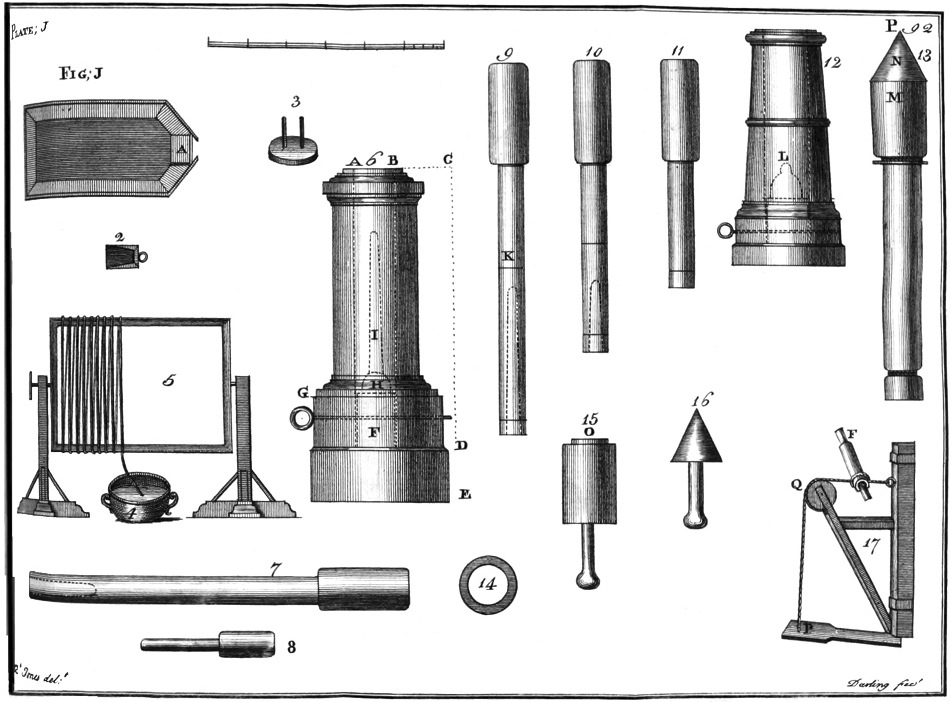
Plate. 1
When you load the heads of your rockets with stars, rains, serpents, crackers, scroles, or any thing else, according to your fancy; remember always to put one ladle-ful of meal powder, into each head, which will be enough to burst the head, and disperse the stars or whatever is contained therein: when the heads are loaded with any sort of cases, let their mouths be placed downwards; and after the heads are filled, paste on the top of them a piece of paper, before you put on the caps. As the size of stars often differ, it would be needless to give an exact number for each rocket, but this rule may be observed, that the heads may be nearly filled with whatever they are loaded.
Of the Decorations for Sky Rockets.
Sky rockets bearing the pre-eminence of all fireworks, it will not be improper to treat of their various kinds of decorations which are directed according to 94 fancy; some are headed with stars of different sorts, such as tailed stars, brilliant stars, white stars, blue and yellow stars, &c. some with gold and silver rain; others with serpents, crackers, fire-scroles, marrons; and some with small rockets, and many other devices, as the maker pleases.
Dimensions and Poise of Rocket Sticks.
Weight of the rocket. Length of the stick. Thickness at top. Breadth at top. Square at bottom. Poize from the point of the cone.
lb. oz. ft. in. Inches. Inches. Inch. ft. in.
6 0 14 0 1· 5 1· 85 0· 75 4 1· 5
4 0 12 10 1· 25 1· 40 0· 625 3 9·
2 0 9 4 1· 125 1· 0· 525 2 9·
1 0 8 2 0· 725 0· 80 0· 375 2 1·
8 6 6 0· 5 0· 70 0· 25 1 10· 5
4 5 3 0· 3750 0· 55 0· 35 1 8· 5
2 4 1 0· 3 0· 45 0· 15 1 3·
1 3 6 0· 25 0· 35 0· 10 11 0·
½ 2 4 0· 125 0· 20 0· 16 8 0·
¼ 1 10½ 0· 1 0· 15 0· 5 5 0· 5
The last column on the right in the above table, expresses the distance from the top of the cone, where the stick, when tied on, should ballance the rocket, 95 so as to stand in an equilibrium on one’s finger or the edge of a knife. The best wood for the sticks is dry deal, made after the following manner; when you have cut and planed the sticks according to the dimensions given in the table, cut on one of the flat sides at top, a groove the length of the rocket, and as broad as the stick will allow; then on the opposite flat side, cut two notches for the cord, which ties on the rocket, to lay in; one of these notches must be near the top of the stick, and the other facing the neck of the rockets; the distance between these notches may easily be known, for the top of the stick should always touch the head of the rocket. When your rockets and sticks are ready, lay the rockets in the grooves in the sticks and tie them on. Those who, merely for curiosity, may chose to make rockets of different sizes, to what I have expressed in the table of dimensions, may find the length of their sticks, by making them for rockets, from half an ounce to one pounds sixty diameters of the rocket long; and for rockets above one pound, fifty or fifty-two diameters will be a good length; their thickness at top 96 may be about half a diameter, and their breadth a very little more; their square at bottom is generally equal to half the thickness at top. But, although the dimensions of the sticks be very nicely observed, you must depend only on their ballance: for, without a proper counterpoise, your rockets, instead of mounting perpendicularly, will take an oblique direction, and fall to the ground before they are burnt out.
The Method of Boring Rockets which have been drove solid.
Plate 2, Fig. 18, represents the plan of an apparatus, or lath, for boring of rockets; A the large wheel which turns the small one B, that works the reammer C: these reammers are of different sizes according to the rockets; they must be of the same diameter as the top of the bore intended, and continue that thickness a little longer than the depth of the bore required, and their points must be like that of an auger; the thick end of each reammer must be made square and all of the same size, so as to fit into 97 one socket, wherein they are fastened by a screw D: E the guide for the reammer, which is made to move backwards and forwards; so that after you have marked the reammer three diameters and a half of the rocket from the point, set the guide, allowing for the thickness of the fronts of the rocket boxes, and the neck and mouth of the rocket, so that when the front of the large box is close to the guide, the reammer may not go too far up the charge; F, boxes for holding the rockets, which are made so as to fit one in another; their sides must be equal in thickness to the difference of the diameters of the rockets, and their interior diameters equal to the exterior diameters of the rockets. To prevent the rockets turning round while boring, a piece of wood must be placed against the end of the box in the inside, and pressed against the tail of the rocket; this will also hinder the reammer from forcing the rocket backwards. G, a rocket in the box. H, a box that hides under the rocket boxes to receive the borings from the rockets, which falls through holes made on purpose in the boxes; these holes must be just under 98 the mouth of the rocket, one in each box, and all to correspond with each other.
Fig. 19, is a front view of the large rocket box. I, an iron plate, in which are holes of different sizes, through which the reammer passes; this plate is fastened with a screw in the center, so that when you change the reammer, you turn the plate round, but always let the hole you are going to use be at the bottom; the fronts of the other boxes must have holes in them to correspond with them in the plate. K, the lower part of the large box, which is made to fit the inside of the lathe, in order that all the boxes may move quite steady.
Fig. 20, is a perspective view of the lathe. L, the guide for the reammer, which is set by the screw at bottom.
Fig. 21, a view of the front of the guide facing the reammer. M, an iron plate, of the same dimensions as that on the front of the box, and placed in the same direction, and also to turn on a screw in the center. N, the rocket box, which slides backwards and forwards: when you have fixed a rocket in the box, push it forwards against the reammer; 99 and when you think the scoop of the reammer is full, draw the box back, and knock out the composition; this you must do till the rocket is bored, or it will be in danger of taking fire; and if you bore in a hurry, wet the end of the reammer now and then with oil to keep it cool.
Having bored a number of rockets, you must have taps of different sorts according to the rockets. These taps are a little longer than the bore, but when you use them, mark them three diameters and a half from the point, allowing for the thickness of the rocket’s neck; then, holding the rocket in one hand, you tap it with the other. In order to explain these taps, I have represented one by Fig. 22. They are made in the same proportion as the fixed piercers, and are hollowed their whole length.
Of a Hand Machine used for boring of Rockets instead of a Lathe.
Those sort of machines answer very well, but not so expeditious as the lathe, nor are they so expensive to make; they 100 may be worked by one man; but the lathe will require three. Fig. 23, represents the machine. O, the rocket boxes, which are to be fixed and not to slide as those in the lathe. P Q, are guides for the reammers, that are made to slide together, as the reammer moves forward: the reammers for these sort of machines must be made of a proper length, allowing for the thickness of the front of the boxes, and the length of the mouth and neck of the case: on the square end of these reammers, must be a round shoulder of iron, to turn against the outside of the guide Q, by which means the guides are forced forwards. R, the stock which turns the reammer, and while turning must be pressed towards the rocket, by the body of the man who works it; all the reammers are to be made to fit one stock. This machine as well as the lathe is made by the scale in the same plate.
101
The Manner of making large Gerbes.
Fig. 24, represents a wooden former; 25, a gerbe compleat, with its foot or stand. The cases for gerbes are made very strong, on account of the strength of the composition; which, when fired, comes out with great velocity; therefore, to prevent their bursting, the paper should be pasted, and the cases made as thick at the top as at the bottom; they ought also to have very long necks, for this reason; first, that the particles of iron will have more time to be heated, by meeting with greater resistance in getting out, than with a short neck, which would be burnt too wide before the charge be consumed, and spoil the effect: Secondly, that with long necks the stars will be thrown to a great height, and will not fall before they are spent, or spread too much; but, when made to perfection, will rise and spread in such a manner as to form exactly a wheat-sheaf.
102
In the ramming of gerbes, there will be no need of a mould, the cases being sufficiently strong to support themselves; but you are to be careful, before you begin to ram, to have a piece of wood made to fit in the neck; for if this be not done, the composition will fall into the neck, and leave a vacancy in the case, which, as I said before, will cause the case to burst as soon as the fire arrives at the vacancy: you must likewise observe, that the first ladle of charge, or two, if you think proper, be of some weak composition. When the case is filled, take out the piece of wood, and fill the neck with some slow charge. Gerbes are generally made about six diameters long, from the bottom to the top of the neck; their bore must be one fifth narrower at top than at bottom. The neck S is one sixth diameter and three fourths long. T, a wooden foot or stand, on which the gerbe is fixed. This may be made with a choak or cylinder, four or five inches long, to fit the inside of the case, or with a hole in it to put in the gerbe; both these methods will answer the same. Gerbes produce a most brilliant fire, and are very 103 when a number of them are fixed in the front of a building, or a collection of fireworks.
N. B. Gerbes are made by their diameters, and their cases at bottom one fourth thick. The method of finding the interior diameter of a gerbe is thus: Supposing you would have the exterior diameter of the case, when made, to be five inches, then, by taking two fourths for the sides of the case, there will remain two inches and a half for the bore, which will be a very good size. These sort of gerbes ought to be rammed very hard.
Of small Gerbes or White Fountains.
Small gerbes may be made of four, eight ounces, or one pound cases, pasted and made very strong, of what length you please; but, before you fill them, drive in dry clay one diameter of their orifice high, and when you have filled a case, bore a vent through the center of the clay to the composition; the common proportion will do for the vent, which must be primed with a slow 104 charge. These sort of cases without the clay, may be filled with Chinese fire.
To make Paste-board and Paper Mortars.
Fig. 26, a former, and 27, an elm foot for the mortar; 28, a mortar compleat; these mortars are best when made with paste-board; your paste-board must be well pasted before you begin; or, instead of paste, you may use glue. For a coehorn mortar, which is four inches two fifths diameter, roll the paste-board on the former one sixth of its diameter thick; and, when dry, cut one end smooth and even, then nail and glue it on the upper part of the foot; when done, cut off the paste-board at top, allowing for the length of the mortar two diameters and a half from the mouth of the powder chamber; then bind the mortar round with a strong cord wetted with glue. U, the bottom part of the foot, is one diameter two thirds broad, and one diameter high; and that part which goes into the mortar is two thirds of it’s diameter high. W, is a copper 105 chamber for powder, made in a conical form, and is one third of the diameter wide, and one and a half of its own diameter long; in the center of the bottom of this chamber, make a small hole a little way down the foot; this hole must be met by another of the same size made in the side of the foot, as is shewn in Fig. 28. If these holes are made true, and a copper pipe fitted into both, the mortar when loaded will prime itself, for the powder will naturally fall to the bottom of the first hole; then, by putting a bit of quick-match in the side hole, your mortar will be ready to be fired.
Mortars of five and a half, eight, and ten inches diameter, may be made of paper, or paste-board, by the above method, and in the same proportion; but if larger, it will be best to have them made of brass. N. B. The copper chamber, must have a small rim round its edge with holes in it, for screws to make it fast in the foot.
106
SECT. IV.
The Manner of loading Air Ballóóns, with the Number of Stars, Serpents, Snakes, Rain-falls, &c. contained in Shells of each Nature.
As ballóóns are held in great esteem, by most admirers of fire works, I shall here give a full description of them in every particular, in so clear a manner, that a young practitioner may, by taking a little pains, be pretty certain of succeeding the first trial.
When you fill your shells, you must first put in the serpents, rains, stars, &c. or whatever they are composed of; then the blowing powder; but the shells must not be quite filled; all those things must be put in at the fuze hole; but marrons, 107 being too large to go in at the fuze hole, must be put in before the inside shell be joined. When the shells are loaded, glue and drive in the fuzes very tight. Of these fuzes we shall say more hereafter; but shall here give the diameter of the fuze hole in ballóóns of each nature, which are as follows. For a coehorn ballóón, let the diameter of the fuze hole be seven eighths of an inch. For a royal ballóón, which is near five inches and a half diameter, make the fuze hole one inch one eighth diameter. For an eight inch ballóón, one inch three eighths: and for a ten inch ballóón, one inch five eighths.
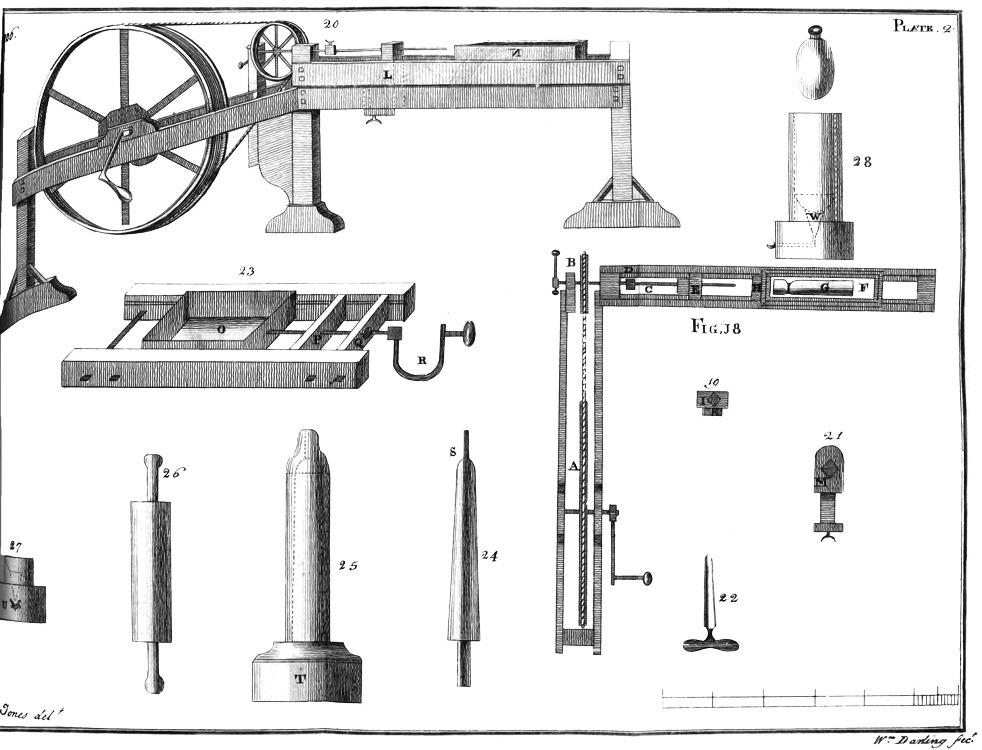
Plate. 2
Having proceeded thus far with the directions of loading ballóóns, I shall in the second place give an account of the quantities and number of each article, proper for shells of each nature; but it is to be observed, that air-ballóóns are divided into four sorts, viz. first, illuminated ballóóns; second, ballóóns of serpents; third, ballóóns of reports, marrons, and crackers; and fourth, compound ballóóns.
108
For a Coehorn Ballóón illuminated.
oz.
Meal powder 1½
Corn powder 0½
Powder for the mortar 2
Length of the fuze composition three quarters of an inch; one ounce drove or rolled stars, as many as will nearly fill the shell.
For a Coehorn Ballóón of Serpents.
oz.
Meal powder 1¼
Corn powder 1
Powder for the mortar 2¼
Length of the fuze composition thirteen sixteenths of an inch; half ounce cases drove three diameters and bounced three diameters; and half ounce cases drove two diameters and bounced four; of each an equal quantity, and as many of them as will fit in easily, placed head to tail.
109
For a Coehorn Ballóón of Crackers and Reports.
oz.
Meal powder 1¼
Corn powder 0¾
Powder for the mortar 2
Length of the fuze composition three quarters of an inch; reports four, and crackers of six bounces, as many as will fill the shell.
For Compound Coehorn Ballóóns.
oz. dr.
Meal powder 1 4
Corn powder 0 12
Powder for the mortar 2 4
Length of the fuze composition thirteen sixteenths of an inch; half ounce cases drove three diameters and a half and bounced two, sixteen. Half ounce cases drove four diameters and not bounced, ten. Blue strung stars, ten. Rolled stars as many as will compleat the ballóón.
110
For Royal Ballóóns illuminated.
oz. dr.
Meal powder 1 8
Corn powder 0 12
Powder for the mortar 3 0
Length of the fuze composition fifteen sixteenths of an inch; two ounce strung stars, thirty-four: Rolled stars as many as the shell will contain, allowing room for the fuze.
For Royal Ballóóns of Serpents.
oz. dr.
Meal powder 1 0
Corn powder 1 8
Powder for the mortar 3 8
Length of the fuze composition one inch; one ounce cases drove three and a half and four diameters, and bounced two, of each an equal quantity, sufficient to load the shell.
111
Royal Ballóóns of Crackers and Marrons.
oz. dr.
Meal powder 1 8
Corn powder 1 4
Powder for firing the mortar 3 0
Length of the fuze composition fourteen sixteenths of an inch; reports twelve, and compleated with crackers of eight bounces.
For Compound Royal Ballóóns.
oz. dr.
Meal powder 1 5
Corn powder 1 6
Powder for the mortar 3 12
Length of the fuze composition one inch; half ounce cases drove and bounced two diameters, eight. Two ounce cases filled three eighths of an inch with star composition, and bounced two diameters, eight. Silver rain-falls, ten. Two ounce tailed stars, sixteen. Rolled brilliant 112 stars, thirty. If this should not be sufficient to load the shell, you may compleat it with gold rain falls.
For eight inch Ballóóns illuminated.
oz. dr.
Meal powder 2 8
Corn powder 1 4
Powder for the mortar 9 0
Length of the fuze composition one inch one eighth; two ounce drove stars, forty-eight. Four ounce cases drove with star composition three eighths of an inch and bounced three diameters, twelve; and the ballóón compleated with two ounce drove brilliant stars.
For eight inch Ballóóns of Serpents.
oz. dr.
Meal powder 2 0
Corn powder 2 0
Powder for the mortar 9 8
113
Length of the fuze composition one inch three sixteenths. Two ounce cases drove one diameter and a half, and bounced two; and one ounce cases drove two diameters, and bounced two and a half; of each an equal quantity sufficient for the shell.
N. B. The star composition which is drove in cases that are bounced, must be managed thus; first the cases must be pinched close at one end, then the corn powder put in for a report, and the case pinched again close to the powder, only leaving a small vent for the star composition, which is drove at top, to communicate to the powder at the bounce end.
REMARKS.
Ballóóns filled with crackers, reports, and marrons, make no great show of themselves, nor are they very pleasing to the eye, for they represent nothing more than a number of pale white flashes, followed by a variety of reports; which altogether make but a very indifferent appearance when fired with illuminated ballóóns, which are so beautiful and 114 brilliant, as to cast forth such lustre that will dazzle the eyes of the spectators for some time; on this consideration, I do not think it worth while loading shells of a large nature, with things that afford so little pleasure: but they have a pretty good effect in royal shells, when thrown among a number of air works, such as pots des brins or flights of rockets, in order to alarm the people with a thundering in the air. For they will not know from whence the reports came, if fired exactly at the same time with the other works, and the fuze made to carry a small fire. But if any one thinks proper to make large ballóóns of this sort, it is only observing a proportion of the blowing and firing powder, and the length of the fuze, for shells of the same dimensions as those you intend to make. These kind of ballóóns are lighter than any other sort, by reason of the crackers being light of themselves, and not lying close in the shells. It must be observed, when you fire light ballóóns, not to put so much powder in the mortar as for heavy ones.
115
Compound Eight-inch Ballóóns.
oz. dr.
Meal powder 2 8
Corn powder 1 12
Powder for the mortar 9 4
Length of the fuze composition one inch one eighth; four ounce cases drove with star composition three eighths of an inch, and bounced three diameters, sixteen. Two ounce tailed stars, sixteen. Two ounce drove brilliant stars, twelve. Silver rain-falls, twenty. One ounce drove blue stars, twenty: and one ounce cases drove and bounced two diameters, as many as will fill the shell.
Another of Eight-inches.
oz. dr.
Meal powder 2 8
Corn powder 1 12
Powder for the mortar 9 4
Length of the fuze composition one inch one eighth; crackers of six reports, ten. Gold rains, fourteen. Two ounce 116 cases drove with star composition three eighths of an inch, and bounced two diameters, sixteen. Two ounce tailed stars, sixteen. Two ounce drove brilliant stars, twelve. Silver rains, ten: one ounce drove blue stars, twenty: and one ounce cases drove with a brilliant charge two diameters and bounced three, as many as the shell will hold.
Another of Eight-inches.
oz. dr.
Meal powder 2 12
Corn powder 2 0
Powder for the mortar 9 0
Length of the fuze composition one inch one sixteenth; crackers of six reports, ten. Gold rains, twenty. Two ounce cases drove with star composition half an inch, and bounced two diameters sixteen. Two ounce drove brilliant stars, two ounce drove blue stars, two ounce drove coloured stars, two ounce drove tailed stars, large strung stars, and rolled stars, of each an equal quantity, sufficient for the ballóón.
117
For a compound Ten-inch Ballóón.
oz. dr.
Meal powder 3 4
Corn powder 2 8
Powder for the mortar 12 8
Length of the fuze composition fifteen sixteenths of an inch; one ounce cases drove and bounced three diameters, sixteen. Crackers of eight reports, twelve. Four ounce cases drove half an inch with star composition, and bounced two diameters, fourteen. Two ounce cases drove with brilliant fire one diameter and a quarter, and bounced two diameters, sixteen. Two ounce drove brilliant stars, thirty. Two ounce drove blue stars, thirty. Gold rains, twenty. Silver rains, twenty: after all these are put in, fill the remainder of the case with tailed and rolled stars.
118
For a Ten-inch Ballóón of three Changes.
oz. dr.
Meal powder 3 0
Corn powder 3 2
Powder for the mortar 13 0
Length of the fuze composition one inch; the shell must be loaded with two ounce cases, drove with star composition a quarter of an inch, and on that one diameter of gold fire, then bounced three diameters; or with two ounce cases first filled one diameter with gold-fire, then a quarter of an inch with star composition, and on that one diameter and a quarter of brilliant fire. These cases must be well secured at top of the charge, lest they should take fire at both ends, but their necks must be larger than the common proportion.
To make Ballóón Fuzes.
Fuzes for air ballóóns are sometimes turned out of dry beech, with a cup at 119 top, to hold the quick-match, as you see in Plate II. Fig. 28, but if made with pasted paper, they will do as well: the diameter of the former for fuzes for coehorn ballóóns, must be half an inch; for a royal fuze, five eighths of an inch; for an eight inch fuze, three quarters of an inch; and for a ten inch fuze, seven eighths of an inch. Having rolled your cases, pinch and tie them almost close at one end; then drive them down, and let them dry; before you begin to fill them, mark, on the out side of the case, the length of charge required, allowing for the thickness of the bottom; and when you have rammed in the composition, take two pieces of quick-match, about six inches long, and lay one end of each on the charge, and then a little meal powder, which ram down hard; the loose ends of the match double up into the top of the fuze, and cover it with a paper cap to keep it dry. When you put the shells in the mortars, uncap the fuzes, and pull out the loose ends of the match, and let them hang on the sides of the ballóóns; the use of the match is, to receive the fire from the powder in 120 the chamber of the mortar, in order to light the fuze: the shell being put in the mortar with the fuze uppermost, and exactly in the center; sprinkle over it a little meal-powder, and it will be ready to be fired. Fuzes made of wood must be longer than those of paper, and not bored quite through, but left solid about half an inch at bottom; and when you use them, saw them off to a proper length, measuring the charge from the cup at top.
Of Tourbillons.
Having filled some cases within about one diameter and a half, drive in a ladle full of clay, then pinch their ends close, and drive them down with a mallet; when done, find the center of gravity of each case, where you nail and tie a stick which should be half an inch broad at the middle, and run a little narrower to the ends these sticks must have their ends turned upwards, so that the cases may turn horizontally on their centers: at the opposite sides of the cases at each end, bore a hole close to the clay with 121 a gimblet, the size of the neck of a common case of the same nature; from these holes draw a line round the case, and at the under part of the case bore a hole, with the same gimblet, within half a diameter of each line towards the center; then from one hole to the other draw a right line. This line divide into three equal parts, and at X and Y, Fig. 29, Plate III. bore a hole, then from these holes to the other two, lead a quick-match, over which paste a thin paper. Fig. 30, represents a tourbillon as it should lay to be fired, with a leader from one side hole A, to the other B. When you fire tourbillons, lay them on a smooth table, with their sticks downwards, and burn the leader thro’ the middle with a port fire. They should spin three or sour seconds on the table before they rise, which is about the time the composition will be burning, from the side holes to those at bottom.
To tourbillons may be fixed reports, in this manner; in the center of the case at top, make a small hole, and in the middle of the report make another; then place them together, and tie on the report, and with a single paper secure 122 it from sire, this being done your tourbillon is compleated. By this method you may fix on tourbillons, small cones of stars, rains, &c. but be careful not to load them too much. One eighth of an inch will be enough for the thickness of the sticks, and their length equal to that of the cases.
The Manner of making Mortars, for throwing Aigrettes and loading and firing the same.
Mortars used for throwing aigrettes are generally made of paste-board, of the same thickness as ballóón mortars, and two diameters and a half long in the inside from the top of the foot; the foot must be made of elm without a chamber, but flat at top, and in the same proportion as those for ballóón mortars; these sort of mortars must also be bound round with cord as before mentioned; sometimes eight or nine of these sort of mortars, of about three or four inches diameter, are bound all together so as to appear but one; but when they are made for this purpose, the bottom of 123 the foot must be of the same diameter as the mortars; and only half a diameter high. Your mortars being bound well together, fix them on a heavy solid block of wood: to load these mortars, first put on the inside bottom of each, a piece of paper, and on it spread one ounce and a half of meal and corn powder mixed; then tie your serpents up in parcels with quick-match, and put them in the mortar with their mouths downwards; but take care that the parcels do not sit too tight in the mortars, and that all the serpents have been well primed with powder, wetted with spirit of wine; on the top of the serpents in each mortar lay some paper or tow; then carry a leader from one mortar to the other all round, and then from all the outside mortars into that in the middle; these leaders must be put between the cases, and the sides of the mortar down to the powder at bottom: in the center of the middle mortar, fix a fire-pump or brilliant fountain, which must be open at bottom, and long enough to project out of the mouth of the mortar; then paste paper on the tops of all the mortars.
124
Mortars thus prepared are called a nest of serpents, as represented by Fig. 31. When you would fire these mortars, light the fire-pump C, which when consumed will communicate to all the mortars at once, by means of the leaders. For mortars of six, eight, or ten inches diameter, the serpents should be made in one and two ounce cases, six or seven inches long, and fired by a leader, brought out of the mouth of the mortar, and turned down the outside, and the end of it covered with paper, to prevent the sparks of the other works from setting it on fire. For a six inch mortar, let the quantity of powder for firing be two ounces; for an eight inch, two ounces and three quarters; and for a ten inch, three ounces and three quarters; care must be taken in these as well as small mortars, not to put the serpents in too tight, for fear of bursting the mortars. These sort of mortars may be loaded with stars, crackers, &c.
If the mortars, when loaded, are to be sent any distance, or liable to be much moved, the firing powder should be secured from getting amongst the serpents, which would endanger the mortars, as 125 well as hurt their performance; to prevent which, load your mortars after this manner; first put in the firing powder and spread it equally about; then cut a round piece of blue touch-paper, equal to the exterior diameter of the mortar, and draw on it a circle, equal to the interior diameter of the mortar, and notch it all round as far as that circle; then paste that part which is notched, and put it down the mortar close to the powder, and stick the pasted edge to the mortar; this will keep the powder always smooth at bottom, so that it may be moved or carried any where, without receiving any damage. The large single mortars are called pots des aigrettes.
The Manner of making, loading, and firing of Pots des Brins.
These pots are made of paste-board, and must be rolled pretty thick; they are usually made three or four inches diameter, and four diameters long, and pinched with a neck at one end, like common cases; a number of these are 126 placed on a plank in the following manmer: having fixed on a plank, two rows of wooden pegs, cut, in the bottom of the plank, a groove the whole length under each row of pegs; then, through the centre of each peg, bore a hole down to the groove at bottom, and on every peg fix and glue a pot, whose mouth must fit tight on the peg; thro’ all the holes run a quick-match, one end of which must go into the pot, and the other into the groove, which must have a match laid in it from end to end, and covered with paper, so that when lighted at one end, it may discharge the whole almost instantaneously: in all the pots put about one ounce of meal and corn powder; then in some put stars, and others rains, snakes, serpents, crackers, &c. when they are all loaded, paste paper over their mouths. Two or three hundred of these pots being fired together, make a very pretty show, by affording so great a variety of fires. Fig. 32, is a range of pots des brins, with the leader A, by which they are fired.
127
Of Pots des Saucissons.
Saucissons are generally fired out of large mortars without chambers, the same as those for aigrettes, only somewhat stronger: saucissons are made of one and two ounce cases, five or six inches long, and choaked in the same manner as serpents; half the number which the mortar contains, must be drove one diameter and a half with composition, and the other half two diameters, so that when fired they may give two volleys of reports; but if the mortars be very strong, and will bear a sufficient charge, to throw the saucissons very high, you may make three volleys of reports, by dividing the number of cases into three parts, and making a difference in the height of the charge: after they are filled, pinch and tie them at top of the charge, almost close; only leaving a small vent to communicate the fire to the upper part of the case, which must be filled with corn powder very near the top; then pinch the end quite close, and tie it; after this is done, bind the case very tight with waxed pack-thread, 128 from the choak at top of the composition, to the end of the case; this will make the case very strong in that part, and cause the report to be very loud: saucissons should be rolled a little thicker of paper than the common proportion. When they are to be put in the mortar, they must be primed in their mouths, and fired by a case of brilliant fire, fixed in their center.
The charge for these sort of mortars should be one sixth, or one eighth, more than for pots des aigrettes of the same diameter.
To fix one Rocket on the Top of another.
When sky rockets are thus managed, they are called towering rockets, on account of their mounting so very high. Towering rockets are made after this manner; fix on a pound rocket a head without a collar; then take a four ounce rocket, which may be headed or bounced, and rub the mouth of it with meal powder wetted with spirit of wine, when done put it in the head of the large rocket 129 with its mouth downwards; but before you put it in, stick a bit quick-match in the hole in the clay of the pound rocket, which match should be long enough to go a little way up the bore of the small rocket, in order to fire it, when the large one is burnt out; the four ounce rocket being too small to fill the head of the other, roll round it as much tow as will make it stand upright in the center of the head: the rocket being thus fixed, paste a single paper round the opening of the top of the head of the large rocket. The large rocket must have only half a diameter of charge rammed above the piercer, for if filled to the usual height, it would turn before the small one takes fire, and entirely destroy the intended effect; when one rocket is headed with another, there will be no occasion for any blowing powder; for the force with which it lets off, will be sufficient to disingage it from the head of the first fired rocket. The sticks for these sort of rockets, must be a little longer than for those headed with stars, rains, &c.
130
Of Caduceus Rockets.
Caduceus rockets in rising form two spiral lines, or double worm, by reason of their being placed obliquely, one opposite the other; and their counterpoise in their center, which causes them to rise in a vertical direction. Rockets for this purpose, must have their ends choaked close, without either head or bounce; for a weight at top, would be a great obstruction to their mounting; though I have known them sometimes to be bounced, but then they did not rise so high as those that were not, nor do any Caduceous rockets ascend so high as single ones; because of their serpentine motion, and likewise the resistance of air, which is much greater than two rockets of the same size would meet with, if fired singly.
By Fig. 33. you see the method of fixing these rockets: the sticks for this purpose, must have all their sides equal, which sides should be equal to the breadth of a stick, proper for a sky rocket of the same weight as those you intend to use, and to taper downwards 131 as usual, long enough to ballance them, one length of a rocket, from the cross stick; which must be placed from the large stick, six diameters of one of the rockets, and its length seven diameters so that each rocket when tied on, may form with the large stick an angle of sixty degrees. In tying on the rockets, place their heads on the opposite sides of the cross stick; and their ends on the opposite sides of the long stick, then carry a leader from the mouth of one, into that of the other. When these rockets are to be fired, suspend them between two hooks or nails, then burn the leader through the middle, and both will take fire at the same time. Rockets of one pound, are a good size, for this use.
Of Honorary Rockets.
Honorary rockets are the same as sky rockets, except that they carry no head nor report, but are closed at top, on which is fixed a cone, then on the case, close to the top of the stick, you tie a two ounce case, about five or six inches long, filled with a strong charge, and pinched close at both ends; then in the 132 reverse sides at each end, bore a hole, in the same manner as in Tourbillons; from each hole, carry a leader, into the top of the rocket. When the rocket is fired, and arrived to its proper height, it will give fire to the case at top, which will cause both rocket and stick, to spin very fast, in their return, and represent a worm of fire, descending to the ground.
There is another method of placing the small case, which is by letting the stick rise a little above the top of the rocket, and tying the case to it, so as to rest on the rocket: these sort of rockets have no cones.
There is also a third method, by which these kind of rockets are managed, which is thus: In the top of the rocket fix a piece of wood, in which drive a small iron spindle, then make a hole in the middle of the small case, through which put the spindle; then fix on the top of it a nut, to keep the case from falling off; when this is done, the case will turn very fast, without the rocket: but this method does not answer so well, as either of the former.
133
Fsg. 34. is a honorary rocket compleat. The best sized rockets for this purpose are those of one pound.
To divide the Tail of a Sky Rocket, so as to form an Arch when ascending.
Having some rockets made, and headed according to fancy, and tied on their sticks; get some sheet tin, and cut it into round pieces, about three or four inches diameter, then on the stick of each rocket, under the mouth of the case, fix one of these pieces of tin; sixteen inches from the rockets neck, and support it by a wooden bracket, as strong as possible: the use of this, is, that when the rocket is ascending, the fire will play with great force on the tin, which will divide the tail in such a manner, that it will form an arch, as it mounts, (and will have a very good effect if well managed) if there be a short piece of port-fire, of a strong charge, tied to the end of the stick, it will make a great addition; but this must be lighted, before you fire the rocket.
134
To make several Sky Rockets, rise together, in the same direction, and equally distant from each other.
Take six or any number of sky rockets, of what size you please; then cut some strong pack-thread, into pieces of three or four yards long, and tie each end of these pieces to a rocket in this manner. Having tied one end of your pack-thread, round the body, of one rocket, and the other end to another; take a second piece of pack-thread and make one end of it fast to one of the rockets already tied, and the other end to a third rocket, so that all the rockets except the two outside ones will be fastened to two pieces of pack-thread; the length of thread, from one rocket to the other, may be what the maker pleases; but the rockets must be all of a size, and their heads filled with the same weight of stars, rains, &c.
Having thus done, fix in the mouth of each rocket, a leader of the same length; and, when you are going to 135 fire them, hang them almost close together, then tie the ends of the leaders together, and prime them; this prime being fired, all the rockets will mount at the same time, and divide themselves as far as the firings will allow; which division they will keep, provided they are all rammed alike, and well made. These sort of rockets, are called by some, chained-rockets.
Of Signal Sky Rockets.
Signal-rockets are made of several sorts, according to the different signals intended to be given: but in Artificial Fireworks, two sorts are only made use of, which are one with reports, and the other without any thing, except the charge; but those for the use of the Navy and Army, are headed with stars, serpents, &c.——Rockets which are to be bounced, must have their cases made one and a half or two diameters longer, than the common proportion, and after they are filled, drive in a double quantity of clay, then bounce and pinch them, after the usual manner, and fix on each a cap.
136
Signal sky rockets without bounces, are nothing more than common sky rockets, closed and caped: rockets of this sort are very light, therefore do not require such heavy sticks as those with loaded heads, for which reason, you may cut one length of the rocket, off the stick, or else make them thinner.
Signal rockets with reports, are sometimes fired in small flights, and often both these and those without reports, are used, for a signal, to begin firing a collection of works; and occasionally, for many other purposes.
How to fix two or more Sky Rockets on one stick.
Two, three, or six sky rockets, fixed on one stick, and fired together, make a grand and beautiful appearance; for the tails of all will seem but as one of an immense size, and the breaking of so many heads at once, will resemble the bursting of an air ballóón; but the management of this device, requires a skilful hand; therefore for the encouragement of those who are fond of curious performances, I shall give such instructions, 137 that, if well observed, even by those who have not made a great progress in this art, there will be no doubt, of the rockets having the desired effect.
Rockets for this purpose, must be made with the greatest exactness, all rammed by the same hand, in the same mould, and out of the one proportion of composition; and after they are filled and headed, must all be of the same weight; the stick must also be well made, (and proportioned) according to the following directions: first supposing your rockets to be half pounders, whose sticks are six feet six inches long, then if two, three, or six of these are to be fixed on one stick, let the length of it, be nine feet nine inches, then cut the top of it, into as many sides, as there are rockets, and let the length of each side be equal to the length of one of the rockets without its head; and in each side, cut a groove (as usual,) then from the grooves, plane it round, down to the bottom, where its thickness must be equal to half the top of the round part. As the thickness of these sort of sticks, cannot be exactly ascertained, I shall give a rule which generally answers, for any number of rockets above two: 138 the rule is this; that the stick at top, must be thick enough when the grooves are cut, for all the rockets to lay, without pressing each other, though as near together as possible.
When only two rockets, are to be fixed on one stick, let the length of the stick be, according to the last given proportion, but shaped after the common method, and the breadth and thickness, double the dimensions, given in the table page, 94. The point of poise, must be in the usual place, (let the number of rockets be what they will): if sticks made by the above directions, should be too heavy, plane them thinner; and if too light, make them thicker; but always make them of the same length.
When more than two rockets, are tied on one stick, there will be some danger, of their flying up without the stick, unless the following precaution be taken, for cases being placed on all sides, there can be no notches, for the cord which ties on the rockets, to lay in; therefore instead of notches, drive a small nail, in each side of the stick, between the necks of the cases; and let the cord which goes round their necks, be 139 brought close under the nails; by this means, the rockets will be as secure, as when tied on singly. Your rockets being thus fixed, carry a quick-match without a pipe, from the mouth of one rocket to the other; this match being lighted will give fire to all the rockets at once.
Notwithstanding the directions already given, may be sufficient, for the management of those sort of rockets; I shall here add an improvment, of my own, on a very essential part of this device, which is, that of hanging the rockets, to be fired; for before I hit upon the following method, many of my essays, proved unsuccessful; but to prevent such perplexities, instead of the old and common manner of hanging them on nails or hooks, make use of this contrivance, have a ring made of strong iron wire, large enough for the stick to go in, as far as the mouths of the rockets, then let this ring be supported by a small iron, at some distance, from the post or stand, to which it is fixed; then have another ring, fit to receive and guide the small end of the stick; rockets thus suspended will have nothing to obstruct their fire; but when they are 140 hung on nails or hooks, in such a manner, that some of their mouths, are against or upon a rail, there can be no certainty of their rising, in a vertical direction.
Of Sky Rockets without sticks.
To fire rockets without sticks, you must have a stand made in this manner; get a block of wood, one foot diameter or there abouts, and make the bottom of it flat, so that it may stand steady; in the center of the top of this block, draw a circle two inches and a half diameter, and divide the circumference of it into three equal parts; then take three pieces of thick iron wire, each about three feet in length, and drive them into the block, one at each point made on the circle; when these wires, are drove in, deep enough to hold them fast, and upright, so that the distance from one to the other, be the same at top, as at bottom, the stand is compleat.
The stand being thus made, prepare your rockets after the following method; take some common sky rockets, of any size, and head them as you please, then 141 get some balls of lead, and tie to each a small wire, two, or two feet and a half long, and the other end of each wire, tie to the neck of a rocket; these balls answer the purpose of sticks, when made of a proper weight, which is about two thirds the weight of the rocket; but when they are of a proper size, they will ballance the rocket in the same manner as a stick, at the usual point of poize. To fire these sort of rockets, hang them, one at a time, between the tops of the wires, letting their heads rest on the points of the wires, and the balls hang down between them; if the wires should be too wide, for the rockets, press them together, till they sit, and if too close, force them open: the wires for this purpose, must be softened, so as not to have any spring, or they will not keep their position, when pressed close or opened.
Of Rain-falls for Sky Rockets, Double and Single.
Gold and silver rain composition, are drove in cases, that are pinched quite close at one end; if you roll them dry, 142 four or five rounds of paper will be strong enough, but if the are pasted, three rounds will do, and the thin sort of cartridge paper is best for those small cases; which in rolling you must not turn down the inside edge, as in other cases, for a double edge would be too thick for so small a bore; the moulds for rain falls, should be made of brass, and turned very smooth in the inside; or the cases, which are so very thin, would tear in coming out, for the charge must be drove in tight; and the better the case sits the mould, the more driving it will bare. These moulds have no nipple, but instead of which they are made flat; as it would be very tedious and troublesome, to shake the composition out of such small ladles, as are used for these cases; it will be necessary to have a funnel made of thin tin, to fit on the top of the case, by the help of which you may fill them very fast; for single rain falls for four ounce rockets, let the diameter of the former be two sixteenths of an inch, and the length of the case two inches; for eight ounce rockets, four sixteenths, and two diameters of the rocket long; for one pound rocket five sixteenths, and two diameters of the 143 rocket long; for two pound rockets, five sixteenths, and three inches a half long; for four pound rockets, six sixteenths, and four inches and a half long; and for six pounders, seven sixteenths diameter, and five inches long.
Of double rain falls, there are two sorts; as for example, some appear first like a star, and then as rain; and some appear first as rain and then like a star: when you would have stars first; you must fill the cases within half an inch of the top, with rain composition, and the remainder with star composition; but when you intend the rain should be first, drive the case half an inch with star composition, and the rest with rain. By this method, may be made many changes of fire; for in large rockets, you may make them first burn as stars, then rain, and then again as stars, or they may first shew rain, then stars, and afterwards finish with a report, but when they are thus managed, cut open the first rammed end, after they are filled and bounced, at which place prime them; the star composition for this purpose must be a little stronger than for rolled stars.
144
Of Strung Stars.
First take some thin paper, and cut it into pieces of an inch and a half square, or therabouts, then on each piece lay as much dry star composition as you think the paper will easily contain; then twist up the paper as tight as you can; when done, rub some past on your hands, and roll the stars between them, then set them to dry; your stars being thus made, get some flax or fine tow, and roll a little of it over each star, then paste your hands and roll the stars as before, and set them again to dry; when they are quite dry, with a piercer, make a hole through the middle of each, into which run a cotton quick-match, long enough to hold, ten or twelve stars, at three or four inches from one another: but any number of stars may be strung together by joining the match.
Of Tailed Stars.
Those sort of stars are called tailed stars, because there are a great number of sparks issue from them, which represent 145 a tail like that of a comet; of those stars there are two sorts, which are rolled, and drove; when they are rolled they must be moistened, with a liquor made of half a pint of spirit of wine, and half a gil of thin size, of this as much as will wet the composition enough, to make it roll easy; when they are rolled, sift meal powder over them, and set them to dry.
When tailed stars are drove, the composition must be moistened with spirit of wine only, and not made so wet as for rolling; one and two ounce cases rolled dry, are best for this purpose; and when they are filled, unroll the case within three or four rounds of the charge, and all that you unroll cut off, then paste down the loose edge; two or three days after the cases are filled, cut them in pieces five or six eighths of an inch in length, then melt some wax, and dip one end of each piece into it, so as to cover the composition; the other end must be rubbed with meal powder wetted with spirit of wine.
146
Of Drove Stars.
Cases for drove stars, are rolled with paste, but are made very thin of paper; before you begin to fill them, damp the composition, with spirit of wine that has had some camphor dissolved in it; you may ram them indifferently hard, so that you do not break, or sack the case, and to prevent which they should fit tight in the mould: they are drove in cases of several sizes, from eight drams to four ounces; when they are filled in half ounce cases, cut them in pieces, of three quarters of an inch in length; if one ounce cases, cut them in pieces of one inch; if two ounce cases, cut them in pieces of one inch and a quarter in length, and if four ounce cases, cut them in pieces one inch and a half in length; having cut your stars of a proper size, prime them at both ends, with wet meal powder; stars of this sort are seldom put in rockets, they being chiefly intended for air ballóóns, and drove in cases, to prevent the composition from being broke by the force of the blowing powder in the shell.
147
Of Rolled Stars.
Rolled stars are commonly made about the size of a musket ball, though they are rolled of several sizes, from the bigness of a pistol ball, to one inch diameter; and sometimes they are made very small, but then they are called sparks; great care must be taken in making of stars, first, that the several ingredients be reduced to a fine powder; secondly, that the composition be well worked and mixed together. Before you begin to roll, take about a pound of composition, and wet it with the following liquid, enough to make it stick together and roll easy; spirit of wine, one quart, in which dissolve a quarter of an ounce of isinglass; if a great quantity of composition be wetted at once, the spirit, will evaporate, and leave it dry, before you can roll it into stars; having rolled up one proportion, shake the stars in meal powder, and set them to dry, which they will do in three or four days. But if you should want them for immediate use, dry them in an earthen pan over a slow heat, or, in an oven: it being 148 very difficult to make the stars all of an equal size, when the composition is taken up promiscuously with the fingers; therefore I shall here set down a method by which you may make them very exact, which is thus: When the mixture is moistened properly, roll it on a flat smooth stone, and cut it into square pieces, making each square, large enough for the stars you intend; there is another method used by some to make stars, which is by rolling the composition, in long pieces, and then cutting off the star, so that each star will be of a cylindrical form; but this method is not so good as the former, for to make the composition roll this way, it must be made very wet, which makes the stars heavy as well as weaken them. All stars must be kept as much from air, as possible, otherwise they will grow weak and bad.
Of Scrolls for Sky Rockets.
Cases for scrolls, should be made four or five inches in length, and their interior diameter three eighths of an inch; one end of these cases must be pinched 149 quite close, before you begin to fill, and and when filled, close the other end, then in the opposite sides make a small hole at each end, to the composition, in the same manner as in Tourbillons; and prime them with wet meal powder: you may put in the head of a rocket, as many of these cases as it will contain; these cases being fired turn very quick in the air, and form a scroll or spiral line. They are generally filled with a strong charge, as that of serpents, or brilliant fire.
Of Swarmers or small Rockets.
Rockets which go under the denomination of swarmers, are those from two ounces downards. These small rockets are fired sometimes, in flights, and in large water-works, &c. Swarmers of one and two ounces, are bored, and made in the same manner as large rockets, except when headed, their heads must be put on without a collar; the number of strokes, for driving one ounce rockets, must be eight; and for two ounce rockets, twelve.
150
All rockets under one ounce, are not bored, but must be filled to the usual height, with composition, which is generally composed, of fine meal prowder four ounces, and charcoal or steel dust two drams; the number of strokes for ramming these small swarmers, is not very material, so as they are rammed true, and moderately hard. The necks of unbored rockets, must be in the same proportion, as in common cases.
Of the cause of sky Rockets rising.
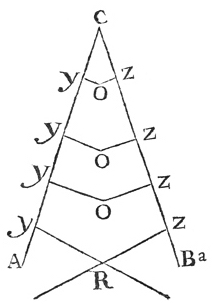
Having promised in the second section, to prove that the effect of sky rockets, and proportion of their charge, depends on the size of the cavity in the composition; I shall here endeavour to give a mathematical demonstration thereof.
151
Let ABC be the hollow cone for the fire, AYCZB, the superficies of that cone, all the lines OZ at right angles with BC, all the lines OY at right angles with AC: now all the angles ZOY being towards R, whether the angles ZOY are obtuse or acute, but the more acute the better. The rays of fire ZO and YO issuing from the sides of the cone BC and AC, and continually acting with the greater force one upon another at O, forcing the whole BCA upward from the point R; and the wider the cone is, (so as not to exceed one third at bottom, and one sixth at top, of the exterior diameter of the rocket,) the greater velocity will the rocket rise with.
Of Stands for Sky Rockets.
Care must be taken, in placing the rockets, when they are to be fired, in order to give them a vertical direction at their first setting out; which may be managed thus. Have two rails of wood, of any length, supported, at each end, by a perpendicular leg, so that the rails be horizontal, and let the distance from one to the other, be almost equal to the 152 length of the sticks of the rockets, intended to be fired; then in the front of the top rail, drive square hooks at eight inches distance from one another, with their points turning sideways, so that when the rockets are hung on them, the points will be before the sticks, and keep them from falling, or being blown off by the wind; in the front of the rail at bottom, must be staples, drove perpendicular under the hooks at top; through these staples, put the small ends of the rocket sticks. Rockets are fired by applying a lighted port fire, to their mouths.
N. B. When sky rockets are made to perfection, and fired, they will stand two or three seconds on the hook before they rise, and then mount up briskly, with a steady motion, carrying a large tail from the ground all the way up, and just as they turn, break and disperse the stars.
Of Girandole Chests, for flights of Rockets.
Girandole chests, are generally composed of four sides, of equal dimensions, 153 but may be made of any diameter, according to the number of rockets, designed to be fired; its height must be in proportion to the rockets, but must always be a little higher than the rockets, with their sticks; when the sides are joined, six in the top, as far down the chest as the length of one of the rockets with its cap on. In this top, make as many square or round holes, to recieve the rocket sticks, as you intend to have rockets, but let the distance between them, be sufficient for the rockets to stand without touching one another; then from one hole to another, cut a groove, large enough for a quick-match to lay in: the top being thus fixed, put in the bottom, at about one foot and a half distance from the bottom of the chest; in this bottom must be as many holes, as in the top, and all to correspond, but these holes need not be so large, as those in the top.
To prepare your chest, you must lay a quick-match, in all the grooves, from hole to hole; then take some sky rockets, and rub them in the mouth, with wet meal powder, and put a bit of match up the cavity of each, which match, must be long enough, to hang, a little below 154 the mouth of the rocket; your rockets and chest being prepared, according to the above directions, put the sticks of the rockets, through the holes in the top and bottom of the chest, so that their mouths may rest on the quick-match in the grooves; by which all the rockets, will be fired at once; for by giving fire to any part of the match, it will communicate to all the rockets, in an instant. As it would be rather troublesome, to direct the sticks from the top, to the proper holes in the bottom, it will be necessary to have a small door in one of the sides, which when opened, you may see how to place the sticks. Flights of rockets, being seldom fired at the beginning of any fireworks, for which reason, they are in danger of being fired, by the sparks from wheels, &c. Therefore to preserve them, a cover should be made to sit on the chest, and the door in the side kept shut.
155
Of Serpents or Snakes for Pots des Aigrettes, Small Mortars, Sky Rockets, &c.
Serpents for this use, are made from two inches and an half, to seven inches in length, and their formers from three sixteenths, to five eights of an inch diameter, but the diameter of the cases, must always be equal to two diameters of the former: they are rolled and choaked like other cases, and filled with composition from five eights of an inch, to one inch and an half high, according to the size of the mortars, or rockets, they are designed for, and the remainder of the cases, bounced with corn-powder, and afterwards their ends pinched and tied close: before they are used their mouths must be primed with wet meal-powder.
Of Leaders, or Pipes of Communication.
The best paper for leaders, is a large sort of white paper, called Elephant, 156 which you cut into long slips, two or three inches broad, so that they may go three or four times round the former, (but not more) for when they are very thick, they are too strong for the paper which fastens them to the works, and will sometimes fly off, without leading the fire: the formers for these leaders, are made from two, to six sixteenths of an inch diameter, but four sixteenths is the size generally made use of; the formers are made of smooth brass wire; when you use them, rub them over with grease, or keep them wet with paste, to prevent their sticking to the paper, which must be pasted all over; in rolling of pipes, make use of a rolling board, but use it lightly; having rolled a pipe, draw out the former with one hand, holding the pipe, as light as possible with the other, for if it press against the former, it will stick and tear the paper.
N. B. Make your leaders of different lengths, or in cloathing of works, you will cut a great many to waste. Leaders for marron Batteries must be made of strong cartrige paper.
157
SECT. V.
Of Aquatick Fireworks.
All works that shew themselves in the water, are much admired by most people who are fond of fireworks, particularly water rockets; but as these seem of a very extraordinary nature to those who are acquainted with this art, I shall endeavour to explain the method of making them, in as full and easy a manner as possible, as well as other devices for the water.
Of Water Rockets.
Water rockets may be made from four ounces, to two pound, but if larger they are too heavy, so that it will be 158 difficult to make them keep above waters without a cork float, which must be tied to the neck of the case, but the rockets will not dive so well with, as without floats.
Cases for water rockets, are made in the same manner and proportion as sky rockets, only a little thicker of paper; when you fill these rockets which are drove solid, put in first, one ladle full of slow fire, then two of the proper charge, and on that one or two ladles of sinking charge, then the proper charge, then the sinking charge again, and so on, till you have filled the case within three diameters; then drive on the composition, one ladle full of clay, through which make a small hole to the charge, then fill the case, within half a diameter with corn powder, on which turn down two or three rounds of the case in the inside, then pinch and tie the end very tight; having filled your rockets, (according to the above directions) dip their ends in melted rosin, or sealing wax, or else secure them well with grease. When you fire these rockets, throw in six, or eight at a time; but if you would have them all sink, or swim, at the same time, you must drive them with an equal 159 quantity of composition, and fire them all together.
To make Pipes of Communication, which may be used under Water.
Pipes for this purpose, must be a little thicker of paper, than those for land works; having rolled a sufficient number of pipes, and kept them till thoroughly dry, wash them over with drying oil, and set them to dry; but when you oil them, leave about an inch and a half, at each end dry, for joints; for if they were oiled all over, when you come to join them, the paste would not stick, where the paper is greasy; after the leaders are joined, and the paste dry, oil the joints. These sort of pipes will lay many hours under water, without receiving any damage.
Of Horizontal Wheels for the Water.
First get a large wooden bowl without a handle, then have an octogon wheel 160 made of a flat board, eighteen inches diameter, so that the length of each side will be near seven inches; in all the sides cut a groove for the cases to lie in, this wheel being made, nail it on the top of the bowl, then take eight four ounce cases, filled with a proper charge, each about six inches in length. Now to cloath the wheel with these cases, get some whitish-brown paper, and cut it into slips, four or five inches broad, and seven or eight long, these slips being pasted all over on one side, take one of the cases, and roll one of the slips of paper, about an inch and a half on its end, so that there will remain about two inches and a half of the paper hollow from the end of the case, this case tie on one of the sides of the wheel, near the corners of which, must be holes bored, through which you put the pack-thread to tie the cases; having tied on the first case at the neck and end, put a little meal-powder in the hollow paper, then paste a slip of paper on the end of another case, the head of which put into the hollow paper on the first, allowing a sufficient distance from the tail of one, to the head of the other, for the pasted paper, to bend without tearing; the second case tie on 161 as you did the first, and so on with the rest, except the last, which must be closed at the end, unless it is to communicate to any thing on top of the wheel; such as fire-pumps or brilliant fires, fixed in holes, cut in the wheel, and fired by the last or second case, as the fancy directs: six, eight, or any number may be placed on the top of the wheel, so that they are not too heavy for the bowl.
Before you tie on the cases cut the upper part of all their ends, except the last, a little shelving, that the fire from one, may play over the other, without being obstructed by the case. Wheel cases, have no clay drove in their ends nor pinched, but are always left open, only the last, or those which are not to lead fire, which must be well secured.
Of Mines for the Water.
For these sort of mines you must have a bowl, with a wheel on it, made in the same manner, as the water wheel, only in the middle of the wheel must be a hole, of the same diameter you design to have the mine; those mines are nothing more than a tin pot, with a strong bottom, 162 and a little more than two diameters in length; your mine must be fixed in the hole in the wheel, with its bottom resting on the bowl; then loaded with serpents, crackers, stars, small water rockets, &c. In the same manner as pots des aigrettes, but in their center, fix a case of Chinese fire, or a small gerbe, which must be lighted at the beginning of the last case on the wheel. These sort of wheels are to be cloathed as usual.
Of Fire Globes for the Water.
Bowls for water globes, must be very large, and the wheels on them of a decagon form, on each side of which nail a piece of wood four inches long, and on the outside of each piece cut a groove, wide enough to receive about one fourth of the thickness of a four ounce case; these pieces of wood must be nailed, in the middle of each face of the wheel, and fixed in an oblique direction, so that the fire from the cases may incline upwards; the wheel being thus prepared, tie in each groove a four ounce case, fill’d with a grey charge, then carry a leader 163 from the tail of one case to the mouth of the other.
Globes for these wheels, are made of two tin hoops, with their edges outwards, fixed one within the other, at right angles. The diameter of these hoops must be somewhat less than that of the wheel. Having made a globe, drive in the center of a wheel, an iron spindle, which must stand perpendicular, and its length, four or six inches more than the diameter of the globe.
This spindle serves for an axis, on which the globe is fixed, which, when done, must stand four or six inches from the wheel; round one side of each hoop, must be soldered, little bits of tin, two inches and a half distance from each other, which pieces must be two inches in length each, and only fastened at one end, the other ends being left loose, to turn round the small port fires and hold them on: these port fires must be made of such a length, as will last out the cases on the wheel. You are to observe that there need not be any port fires, at the bottom of the globe within four inches of the spindle, for if there were, they would have no effect, but only burn the wheel; all the port fires, must 164 be placed perpendicular from the center of the globe, with their mouths outwards; and must all be cloathed with leaders, so as all to take fire with the second case of the wheel; which cases must burn two at a time, one opposite the other. When two cases of a wheel begin together, two will end together; therefore the two opposite end cases, must have their ends pinched and secured from fire. The method of firing wheels of this sort, is, by carrying a leader from the mouth, of one of the first cases, to that of the other, which leader being burnt through the middle, will give fire to both at the same time.
Of Odoriferous Water Ballóóns.
These sort of Ballóóns, are made in the same manner, as air Ballóóns, but very thin of paper, and in diameter one inch and three quarters, with a vent of half an inch diameter. The shells being made, and quite dry, fill them with any of the following compositions, which must be rammed in tight: these sort of Ballóóns, must be fired at the vent, and put into a bowl of water. Odoriferous works, are generally fired in rooms.
165
Composition I.
Salt petre two ounces, flower of sulphur one ounce, camphor half an ounce, yellow-amber half an ounce, charcoal-dust, three quarters of an ounce, flower of benjamin, or assa odorata half an ounce, all powdered very fine; and mixed well together.
Composition II.
Salt petre twelve ounces, meal powder three ounces, frankincense one ounce, myrrh half an ounce, camphor half an ounce, charcoal three ounces, all moistened with the oil of spike.
Composition III.
Salt petre two ounces, sulphur half an ounce, antimony half an ounce, amber half an ounce, cedar raspings a quarter of an ounce, all mixed with the oil of roses, and a few drops of bergamot.
166
Composition IV.
Salt petre four ounces, sulphur one ounce, saw-dust of juniper half an ounce, saw-dust of cypress one ounce, camphor a quarter of an ounce, myrrh two drams, dryed rosemary a quarter of an ounce, cortex-elaterii half an ounce, all moistened a little with the oil of roses.
N. B. Water rockets, may be made with any of the above compositions, with a little alteration, to make them weaker, or stronger, according to the size of the cases.
Of Water Ballóóns.
Having made some thin paper shells, of what diameter you please, fill some with the composition for water ballóóns, and some after this manner. Having made the vent of the shells pretty large, fill them almost full with water rockets, marrons, squibs, &c. Then put in some blowing powder, sufficient to burst the shells, and afterwards fix in the vent a water rocket, long enough to reach the bottom of the shell, and its neck to project 167 a little out of the vent; this rocket must be open at the end, in order to fire the powder in the shell, which will burst the shell, and disperse the small rockets, &c. in the water. When you have well secured the large rocket, in the vent of the shell; take a cork float, with a hole in its middle, which fit over the head of the rocket, and fasten it to the shell: this float, must be large enough to keep the ballóón above water.
Of water Squibs.
Water squibs, are generally made of one ounce serpent cases, seven or eight inches long, filled two thirds with charge, and the remainder bounced; the common method of firing them, is thus: Take a water wheel, with a tin mortar in its center, which load with squibs, after the usual method, but the powder in the mortar, must be no more than will just throw the squibs out, (easily into the water), you may place the cases on the wheel, either obliquely, or horizontally; and on the top of the wheel, round the mortar, fix six cases of brilliant fire, perpendicular to the wheel; 168 these cases, must be fired, at the beginning of the last case of the wheels and the mortar, at the conclusion of the same.
To represent a sea fight with small ships, and to prepare a fire-ship for the same.
Having procured four, or five, small ships, of two, or three feet in lenghth, (or as many as you design to fight) make a number of small reports, which are to serve for guns. Of these, range as many as you please, on each side of the upper decks; then at the head and stern of each ship, fix a two ounce case, eight inches long, filled with a slow port-fire receipt, but take care to place it, in such a manner, that the fire may fall in the water, and not burn the rigging; in these cases, bore holes at unequal distances, from one another, but make as many in each case, as half the number of reports, so that one case may fire the guns, on one side, and the other those on the opposite. The method of firing the guns, is, by carrying a leader, from the holes in the cases, to the reports on the decks; you 169 must make these leaders very small, and be careful in calculating the burning of the slow fire, in the regulating cases, that more than two guns, be not fired at a time. When you would have a broad-side given, let a leader be carried to a cracker, placed on the outside of the ship, which cracker must be tied loose, or the reports will be too slow; in all the ships put artificial guns, at the port holes.
Having filled, and bored holes, in two port fires, for regulating the guns, in one ship; make all the rest exactly the same; then when you begin the engagement, light one ship first, and set it a sailing, and so on with the rest, sending them out singly, which will make them fire regularly, at different times, without confusion, for the time between the firing of each gun, will be equal to that of lighting the slow fires.
The fire ship, may be of any size, and need not be very good, for it is always lost in the action. To prepare a ship for this purpose, make a port fire equal in size, with them in the other ships, and place it at the stern; in every port, place a large port fire, filled with a very strong composition, and painted in imitation of 170 a gun, and let them all be fired at once by a leader from the slow fire, within two, or three diameters of its bottom; all along both sides, on the top of the upper deck, lay star composition about half an inch in thickness, and one in breadth, which must be wetted with thin size, then primed with meal powder, and secured from fire, by pasting paper over it; in the place where you lay this composition, drive some little tacks with flat heads, in order to hold it fast to the deck, this must be fired just after the sham guns, and when burning will shew a flame all round the ship; at the head take up the decks, and put in a tin mortar loaded with crackers, which mortar must be fired by a pipe, from the end of the slow fire; the firing of this mortar will sink the ship, and make a pretty conclusion. The regulating port fire of this ship, must be lighted at the same time, with the first fighting ship.
Having prepared all the ships for fighting; we shall next proceed with the management of them, when on the water. At one end of the pond, just under the surface of the water, fix two running blocks, at what distance you chuse the 171 ships should fight; and at the other end of the pond, opposite to each of these blocks, under the water, fix a double block; then on the land, by each of the double blocks, place two small windlass’s; round one of them, turn one end of a small cord, and the other end, put through one of the blocks; then carry it through the single one, at the opposite end of the pond, and bring it back through the double block, again, and, round the other windlass; to this cord, near the double block, tie as many small strings, as half the number of the ships, at what distance you think proper, but these strings, must not be more than two feet in length each; the loose end of each of these cords, make fast, to a ship, just under her bow-sprit; but if tied to the keel, or too near the water, it will overset the ship. Half the ships, being thus prepared, near the other double block, fix two more windlass’s, to which fasten a cord, and to it tie the other half of the ships, as before directed: when you fire the ships, pull in the cord, with one of the windlass’s, in order to get all the ships together; and when you have set fire to the first, turn that windlass, which draws them out, 172 and so on with the rest, till they are all out, in the middle of the pond; then by turning the other windlass, you will draw them back again, by which method you may make them change sides, and tack about, backwards and forwards, at pleasure. For the fire-ship, fix the blocks and windlass’s, betwixt the others, so that when she sails out, she will be between the other ships: you must not let this ship, advance, till the guns, at her ports take fire.