III. ON THE CRYSTALS OF SNOW AS APPLIED TO THE PURPOSES OF DESIGN. By JAMES GLAISHER, F.R.S.
Reading edition
I.
NOW, in the ordinary acceptation of the word, is suggestive of a soft flocculent matter of considerable opacity, falling in flakes, and, as compared with water, of little density—a foot of fresh-fallen snow producing but from a tenth to a twelfth part of water. Snow, however, does not always fall in flakes; under certain conditions of atmosphere and temperature it occasionally falls in groups of slender needle-like particles or spiculæ, which under the microscope exhibit no structural detail worthy of remark, but are irregular and jagged in outline. This is one of the most imperfect forms of snow crystallization, and occurs generally at a temperature but little above freezing, and at the commencement of a severe and continued frost, or immediately preceding a general thaw.

At other times a light feathery snow may be seen to fall, composed almost entirely of stars of six spiculæ or radii, united in the centre by a white molecule. These are seldom less than from four to five tenths of an inch in diameter, and are generally collected in tufts of half-a-dozen or more together, which in calm weather waft uninjured to the ground. Sometimes these are mixed with other stars of more intricate figure, to be spoken of presently. Fig. 1 illustrates this variety, and is enlarged to double the proportions of the original.
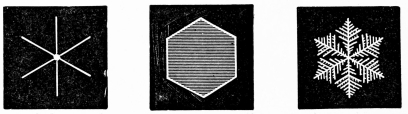
Fig. 1. Fig. 2. Fig. 3.
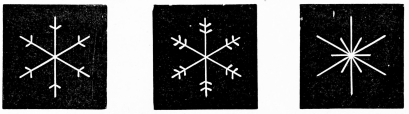
Fig. 4. Fig. 5. Fig. 6.
Sometimes a heavy fall of ordinary snow may be accompanied by a number of minute specks, glistening among the flakes like fragments of talc or mica, as seen sparkling in a mass of granite. On careful investigation these prove to be thin laminated hexagons of the most perfect delicacy and symmetry of form, as shown in Fig. 2.
The hexagon and star being the base of all the crystals of snow yet observed, we will proceed to show how the more elaborate figures are compounded of these two primary elements.
To explain various peculiarities of structure which occur in several of the larger drawings, we will refer to the process of crystallization as carried on at low temperatures on the surface of still or gently-moving water.
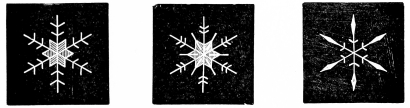
Fig. 7. Fig. 8. Fig. 9.
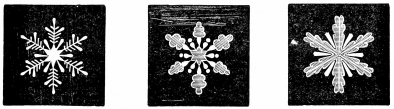
Fig. 10. Fig. 11. Fig. 12.
Water freezes at an angle of 60°. On its first congelation, under favourable circumstances for observation, we perceive in parts, generally about the centre and around the margin, a corrugation of its surface. This corrugation presently discovers a series of distinct figures, needle-like in form, and analogous to the spiculæ of snow. As the process continues, to each of these needles, while yet forming, a serrated incrustation of leafy or arborescent character is attaching itself, so that in time the greater number of them become each the centre of a crystalline pinna, not unlike a frond of the lady fern. Fig. 25 (page 140) is a sketch of one, the size of the original, as observed by T. G. Rylands, Esq., of Warrington, and sent to us during the severe winter of 1855. The overlapping observable on one side of the pinna is a peculiarity generally to be found in three out of the six leaves forming the entire crystal.
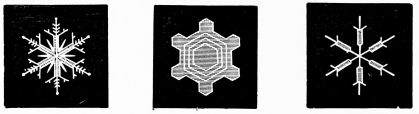
Fig. 13. Fig. 14. Fig. 15.
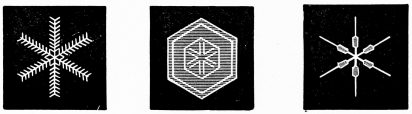
Fig. 16. Fig. 17. Fig. 18.
Fig. 26 (page 141) represents the crystal when complete; the drawing was made by ourselves, and gives with great exactitude the figure of the needles, which, it will be observed, diverge from the main stem uniformly at an angle of 60°. The position maintained by them around the centre of the crystal is beautifully adaptive, and well worth examination.
It is not always that the primitive spiculæ are divergent in groups of six. At times they arrange themselves irregularly in clusters, and crystallization proceeds with results of a character
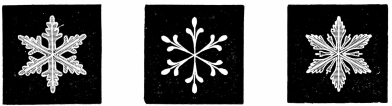
Fig. 19. Fig. 20. Fig. 21.
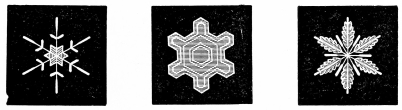
Fig. 22. Fig. 23. Fig. 24.
somewhat different, but scarcely less beautiful, of which Fig. 27 (page 142) may be considered a type. This is analogous to the fanciful forms of frost seen on the interior of a pane of glass, and is frequently to be found where the water is very shallow, and where its mixture with some gritty substance, or blade of grass, or other obstruction, has in all probability interfered with a more geometric arrangement. By degrees the whole surface of the water becomes interlaced with needles and pinnæ, whether singly or in groups, and thin laminated surfaces of ice which cover all interstices. Then, according to external influences, the ice either thickens, obliterating all this beautiful tracery, or it melts away before the rising temperature of the day. It often happens, however, that these processes occur after dark, or that the water freezes so rapidly as to disappoint the wishes of the observer. At moderate temperatures these changes are best observed; but, in our opinion, they are somewhat dependent on other atmospheric conditions. The formation of the needles is common to the freezing of water under all circumstances, and they vary from a few inches to a few feet in length.
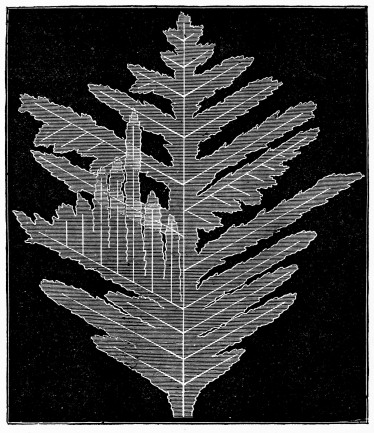
Fig. 25.
To return to the crystals of snow. Fig. 3 (page 136) is another elementary figure, common to temperatures about the freezing-point; it is not often less than half an inch in diameter, and is a miniature copy of the water crystal.
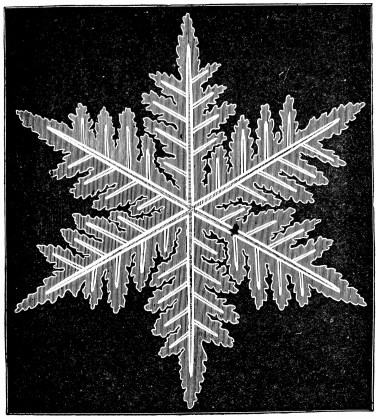
Fig. 26.
Another simple order of figures, and containing within themselves the germ of the most symmetrical combinations, is that of which Fig. 4 and 5 (page 136) are types; they exhibit secondary spiculæ diverging from the principal radii at an angle of 60°.
Around the simple it frequently happens that a secondary and smaller star is arranged, as in Fig. 6 (page 136), the radii of which are intermediate between those of the former. An angle of 30° is, however, of unfrequent occurrence, and it seems probable that in this and similar cases it is the union of two crystals of distinct hexagonal formation.
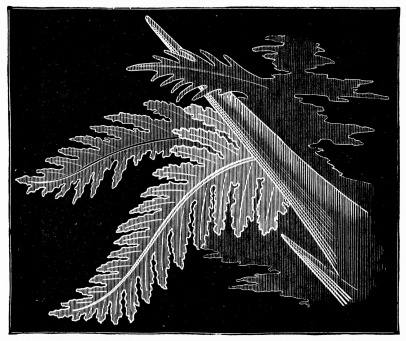
Fig. 27.
Sometimes it happens that the secondary spiculæ, which we see in Fig. 4 and 5, are continued down the main radii until they form a contact with each other, as in Fig. 7 (page 137). The star thus enclosed about the centre generally becomes laminated and of great transparency. In other varieties, as in Fig. 8 (page 137), it is intersected by the rays of the secondary or intermediate crystal.
Having traced the elementary principles of these figures to the first formation of a simple nucleus, we will proceed to the consideration of the more compound varieties, in which the nucleus is a conspicuous element of construction.
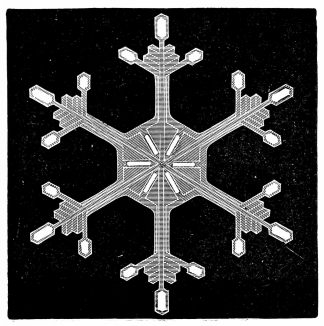
Fig. 28.
The figures we have been considering, although possessed of unity of design in a high degree, are found to exhibit no great perfection of structural detail when examined beneath a lens; those that we are about to inquire into belong to a more perfect order, much more minute and very compound.
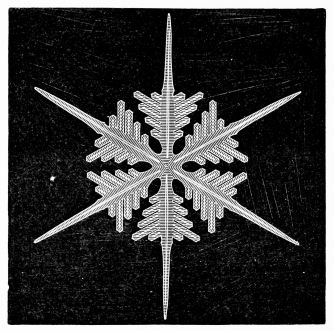
Fig. 29.
Fig. 28 is a figure of this class, much enlarged and drawn as seen beneath a microscope. It was highly crystallized, and the angles and planes of which it is composed were sharply and well defined. The prisms at the end of the radii were cut into facets, and glistened with brilliancy, as did the six prisms around the centre. The radial arms were sharply cut, six-sided shafts, very different from the snowy rounded spiculæ of the elementary figures. It was easily discernible to the naked eye, and principally those parts which are white in the engraving, and which communicate to the copy very much the effect of the original when under the full influence of direct light. The centre is laminated, hexagonal in form, and within it we perceive the secondary star of prisms; also that each addition to the radii diverges at an angle of 60°.
Fig. 29 is another, highly crystallized, and composed of parallel prisms, divergent from the radial arms at an angle of 60°, and without nucleus. The irregular blade-like terminations arise from an ill-advised eagerness in the observation of their originally very complicated structure, by which they were in a moment dissolved, without injury, however, to the symmetry of the figure.
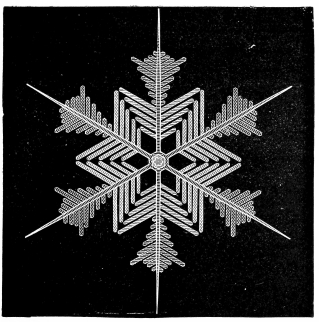
Fig. 30.
Fig. 30 is a beautiful compound of the higher order of crystallized bodies with the more elementary, the nucleus belonging to the former, and the radii at their extremities to the
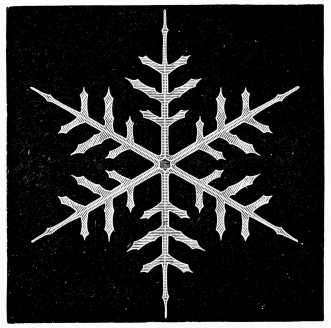
Fig. 31.
latter. This at first sight appears an anomaly; but we explain it on the supposition that the entire structure of the original crystal has been of a high order, the shafts six-sided, as they remain still at their base, and the leafy incrustrations to have been regularly distributed prisms, as in the preceding figure; that the crystal, in its descent, has passed through various temperatures of intense cold, probably exchanged for a warmer at one instant of time, in which it has partially thawed, and again passing into a cold stratum in approaching the ground, has been once more congealed, giving rise to the white opacity and irregular form of its terminations. And this explanation is the more reasonable, as will be gathered from a description of the dissolving or thawing of these bodies.
Fig. 31 is a crystal seen just previous to its returning to the primitive drop of water. Originally composed of the ordinary radial arms, each supporting prisms of the form seen in Fig. 29, and with a simple hexagonal nucleus, under the influence of a very slightly increased temperature the rigidity of each line has become relaxed, whilst the crystalline matter, all but fluid and no longer heaped up into prisms, is distributed over a wider area, according to the laws of attraction and corresponding area of surface.
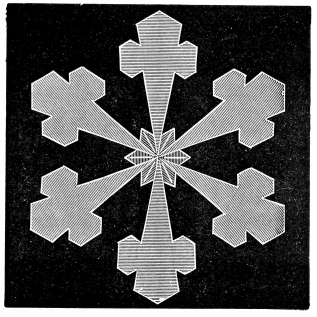
Fig. 32.
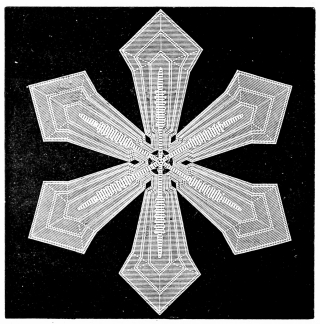
Fig. 33.
A very different order of figures are those of which Fig. 32, 33, 34, and 35 are types. The originals were exceedingly small—so minute, indeed, that the specks containing all these beauties of detail were almost inappreciable to the naked eye. It will readily be perceived that they differ greatly from the order arising out of the primitive star or its secondary radii. The base of these must be referred to the hexagon, as shown at Fig. 2.The most highly elaborate of our illustrations, shown at Fig. 33, exhibited a succession of planes raised one above another, the centre of each radial arm intersected by a slender crystalline shaft laden with delicate prisms. Fig. 35 preserves more the form of the ordinary hexagon, and was cut very regularly into facets. Of Fig. 34 and 35 we were unable to observe the exact disposition of the raised surfaces, and have delineated the outline only: these figures fell, with several others far more complicated, during the continuance of a very unusual degree of cold for these latitudes.
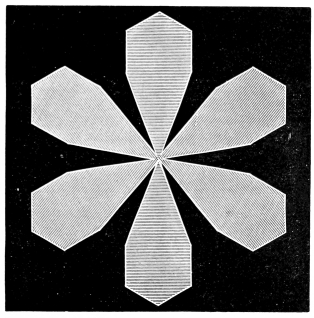
Fig. 34.
II.
We have thus far endeavoured to show the true bases of construction, and how that crystallization proceeds onwards from the simple forms to the more complex, and have selected from numerous varieties a few of the best types illustrative of this progress. Our limits will scarcely permit us further to individualise these beautiful creations; yet, not to mislead, it is necessary to refer to an intermediate order, in which the hexagon star is laden with divergent spiculæ between groups of prisms. Fig. 36, selected from this very numerous class of figures, was one of several observed during the cold weather, following upon the general thaw, which terminated the long-continued and severe frost of 1855. The spiculæ were icicle-like, of the utmost delicacy, opaque, and well defined; the prisms, on the contrary, were watery, almost rounded, and, as it seemed, on the verge of dissolution. The entire figure had the appearance of two distinct orders of formation—the prisms which belong to a very low temperature, and the spiculæ which are commonly formed at and about the freezing-point. Fig. 37 is another of the same class, and in a very intermediate state; the additions to the main radii are neither prisms nor spiculæ, yet partaking of the character of both: its peculiarity consists in the tertiary incrustations being placed downwards towards the centre. This form has been observed only during very severe cold.
Fig. 38 is somewhat analogous to the crystals of water; its centre is hexagonal, but the prisms are irregular crystalline incrustations of the utmost delicacy and transparency; it was of large size, fully half an inch in diameter, and glistening like a fragment of talc among the snow-flakes, was discernible at a considerable distance.
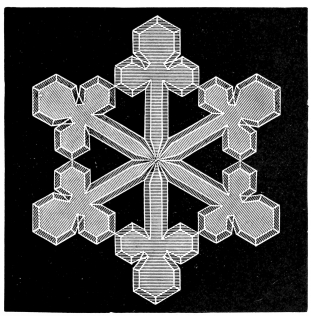
Fig. 35.
Fig. 39 (page 156) is a specimen of a double crystal; that is, two similar crystals united by an axis at right angles to the plane of each. It is highly complex, and the effect of each is more than doubled by the arrangement. Crystals so united are not unfrequent in severe weather.
During one winter our observations numbered nearly two hundred varieties.
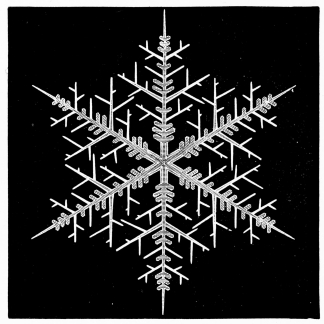
Fig. 36.
The series of small drawings given on pages 137, 138, and 139, were made with a lens of moderate power, but they are not equal in value or structural detail to those drawn beneath the microscope. They are among the most elementary figures observed; and, as illustrative of the first principles of formation, are chiefly worthy of consideration. Of more elaborate figures drawn beneath the microscope, besides those more immediately referred to in the text, examples are given in Fig. 40, 41, and 42.
The idea of observing snow crystals is by no means original. We know for certain that Aristotle observed them; also Descartes, Greu, Kepler, and Drs. Nettes and Scoresby of modern times. Sir Edward Belcher also devoted a considerable degree of attention to the study of the crystals of snow in the Arctic regions. There the radial arms were seldom less than an inch in length, and might be seen, according to Sir Edward Belcher, drifted in heaps into the crannies and recesses of the ice. They were seldom to be obtained in a perfect condition, generally separating, by reason of their weight and size, on descending to the ground.
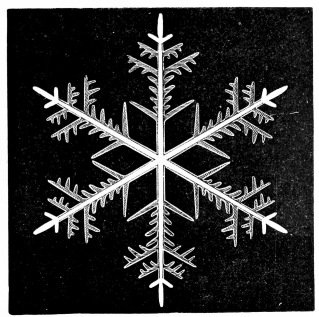
Fig. 37.
III.
Having brought to a close all that is here necessary to say respecting the formation of these bodies, and the position they occupy in regard to scientific inquiry, we may now turn to a consideration of their capabilities to suggest new forms in decorative design, as applied to the industrial arts. Being ourselves desirous to promote the adoption of the appropriate as well as the simple beauty of truth in ornament, we will first inquire how far these figures are in accordance with those general principles of arrangement of form which in all ages and countries have constituted the truly beautiful in art.
These are summed up briefly in the propositions contained in the opening chapter of Mr. Owen Jones’s “Grammar of Ornament.” We extract the following:—
“Proposition 3.—As Architecture, so all works of the Decorative Arts should possess fitness, proportion, harmony, the result of all which is repose.
“Proposition 5.—Decoration should never be purposely constructed: that which is beautiful is true, that which is true is beautiful.
“Proposition 8.—All ornament should be based upon a geometrical construction.
“Proposition 9.—As in Architecture, so in the Decorative Arts, every assemblage of forms should be arranged on certain definite proportions; the whole and each particular member should be a multiple of some particular unit.
“Proposition 10.—Harmony of form consists in the proper balancing and contrast of the straight, the inclined, and the curved.”
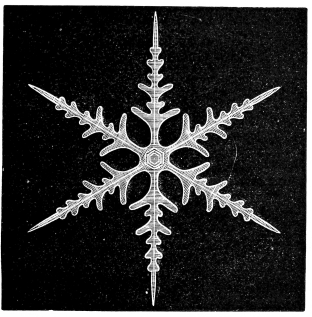
Fig. 38.
Further on, from the same high authority, we receive as an axiom—“That there can be no perfect composition where either of the three primary elements is wanting—the straight, the inclined, and the curved, or where they are not so harmonized that the one preponderates over the other two.” In the crystals of snow we perceive these last conditions are implicitly fulfilled, inasmuch as they include the varieties, straight, angular, and curved, of which the angular has a decided preponderance.
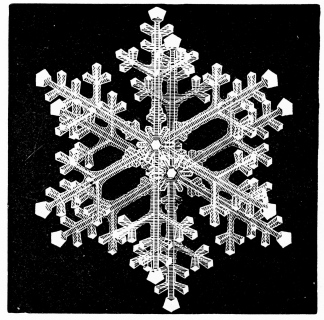
Fig. 39.
With regard to the proportions of number on which these figures are based, we shall find them almost all deficient in the maintenance of a ratio, water crystallizing at an angle of 60°, a fact exemplified in the radial arms and the secondary and tertiary additions, which, always produced at the same angle, are characteristic of the greater number of these crystals. Thus they can be considered suggestive only of more complete designs—the centre, in fact, of a bordering or pattern-work, to be completed round them according to the intended application, and with due reference to those ratios of number which are found most acceptable in composition.
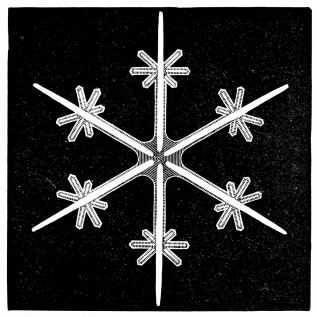
Fig. 40.
Founded upon a strictly geometric base, and a uniform repetition of a certain concordant irregularity of parts, bound together in one harmonious unity by the laws of circular composition, which serve to lend beauty to their constructive details, and constitute the archeus of the figure, we are impressed with a conviction of their truth and conformity to the natural principles of beauty.
The impulse created in their favour is thus subsequently confirmed on rational and acknowledged grounds of admiration. This is the more satisfactory that, belonging to no school of architecture or design, they may be considered as originating a new order of forms for the further supply or extension of those so long acknowledged and admired. We do not, however, consider that they will equally well assimilate with all or any of the orders of decorative art. It appears to us, according to the means placed at our disposal for arriving at a conclusion, that they are analogous in many respects to the numerous specimens of angular composition which belong to the mediæval period of Byzantine art.
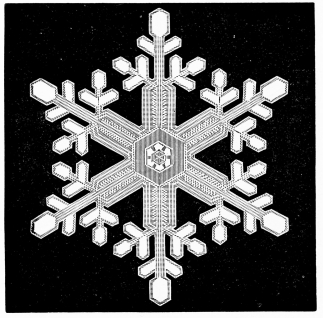
Fig. 41.
It may not be altogether foreign to the subject briefly to consider the united power of geometric figures, in conjunction with colour, to produce the striking and beautiful effects which form so important a feature in Byzantine and Moresque mosaic (but particularly the former) specimens of art.
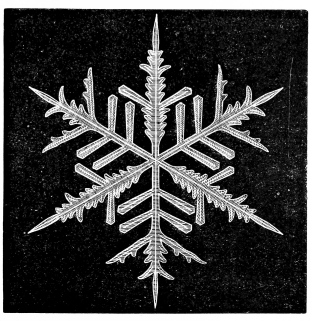
Fig. 42.
The base of Byzantine mosaic is principally the relation of the hexagon to the triangle, upon which base almost innumerable combinations have been constructed. These Byzantine mosaics are always extremely simple in structure, some being made up entirely of the triangle, others of stars either six or eight rayed, singly or enclosed in a hexagon or octagon placed at intervals, and united by the more simple figure of the triangle, which, arranged in groups, serve as connecting links from one to the other. The whole composition is rendered either sparkling or monotonous according to the employment of contrasted effects or a limited and uniform range of colour, and is admirably illustrative of how the uniformity of the geometric figure may be broken up and destroyed, its very character changed, indeed, according to the system of colouring adopted—an illustration still further confirmed by a study of the varied and evolved designs on a part of the encaustic pavement of the Byzantine Court at the Crystal Palace, which, described in shades of neutral tint throughout, upon a ground of the same colour, renders it difficult for the eye to detect any variation of pattern.
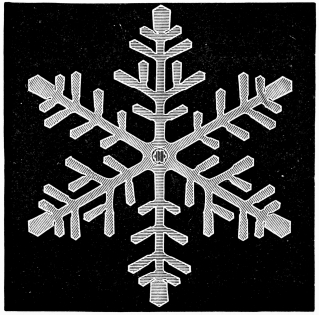
Fig. 43.
The specimens of Moresque mosaic with which we are acquainted differ somewhat in character from that which we have been considering. Based upon the square and its affinities, it is constructed mainly with reference to the ratios of eight, four, and twelve. It is less glittering in colour than the Byzantine, and attracts the eye more to masses than to fragments.
The figures of snow are nearly allied to the principles of these decorative styles of art, based as they are upon a system of angular geometry. We perceive, also, that the primitive base of the crystals is the leading figure of mosaic, founded, as most of it is, upon the hexagon and its combinations, though occasionally admitting, with great effect, the employment of the octagon. Thus they seem naturally suggestive of an extension of the forms common to mosaic, and may be the means of eliciting fresh combinations scarcely less beautiful than those transmitted to us from the past.
The fitness of mosaic for the purposes of decoration is evident, on the ground of its conformity to certain fixed principles of truth which scarcely permit of deviation. One of the oldest of the mechanical arts, originating in experimental combinations with cubes solid and transparent, subsequently improving as the science of geometry became more generally understood, it is now, in the hands of some of our most eminent manufacturers, not the least important among the industrial agents of the present day, as may be seen in the beautiful encaustic and painted tiles for pavements and decorative purposes generally, executed by Messrs. Minton & Co., of Stoke-upon-Trent.
One great fault of the decorative designs of the present day is the want of “appropriate” ornament to the purposes in view, and the mixture of schools or styles of art, which characterize so many of the patterns commonly produced for domestic and even higher applications—a mixture too often involving the entire destruction of truth, fitness, and proportion, the three essential elements of beauty. In the magnificent work on the “Principles of Ornament,” by Mr. Jones, we have an entire history of the past in architectural design, classified into schools, the origin and progress of each, either traced or traceable in connection with the period at which it flourished, and the people who gave it birth. We may therefore anticipate that the pure and beautiful so made known amongst us may exercise an important and beneficial influence on design, from its highest to its lowest applications.
We do not forget, however, that the art of mosaic, taking its rise beneath the sunny skies of Italy and Greece, and glittering even now on the walls and beneath the cloisters of the Byzantine churches of Italy and Sicily, and within the mosques and palaces of the East, accords rather with the genius of the South and the gorgeous taste of the East than with the less florid tone of more northern lands; and a thorough understanding of the conditions under which it so long assimilated with, and continued to constitute a dazzling feature in, the decoration of two, if not three, of the highest styles of architecture—the Moresque, Byzantine, and Arabian—is necessary to enable us to profit to the full by its capabilities as an industrial agent. Nor do we forget that the rise of mosaic (we are speaking of its conventional varieties) was accompanied by, or was rather the result of, the decline of art, when for a period a mechanical process usurped the place of higher efforts of design and fancy.
For the very reason, however, that the art and its imitations must be to a great extent mechanical, we could wish to see its range of utility still further extended. Not admitting of wide deviations from fixed principles, we would prefer to see it substituted for the large mass of nondescript patterns to which we have already made allusion. And our facilities are great for introducing it into more general use; for in the same way that the painter’s art has, with the utmost truthfulness of effect, reproduced for our study and admiration representations of the elaborate inlayings of marble and glass, with which the originals, centuries ago, were constructed, we may carry its imitation successfully into almost every branch of manufacture or decoration; and, whilst preserving the spirit of the combinations, unfettered by the constructive difficulties of the original work, we may engraft new figures, and originate new styles of pattern, perhaps available for a variety of applications.
IV.
An attempt to adapt a revival of Byzantine glass mosaic to various household elegancies has within the last few years been made by Mr. George Stephens, of Pimlico, who, after considerable study of the mosaics of antiquity, has designed a large variety of elaborate and beautifully executed patterns for tables, stands, panellings, candelabra, &c. In the specimens that we have seen his combinations have been based, many of them upon the hexagon and its varieties, and several upon the octagon, which is necessarily more removed from the simplicity of the Byzantine school. In the opinion of Mr. Stephens the figures of snow are highly suggestive of a still further extension of the forms known in mosaic, and he considers that they will materially aid in the construction of new figures. We believe that it is his intention shortly to attempt an adaptation of some of them to the purposes of his art.
We feel that we cannot sufficiently admire the structural detail of the greater number of these productions, and the rich effects of colour united in their composition. But here we may remark, that to render the ancient Byzantine mosaic an appropriate decorative agent, it is necessary that the artist should not copy implicitly from the works of the past, but seek most to maintain between it and surrounding influences the same relation that formerly existed between it and the people under whose hands it attained such distinguished pre-eminence. As we have already said, the art originated beneath the skies of Italy and Greece, and with it the system of bright and glittering colours which rendered it so perfect in itself, and in its relation to all surrounding things. Deprived of these bright influences of climate, we find it in our own country no less beautiful in itself, but wanting in a due harmonious relation to the tone of colour it is brought in contact with. To remedy this—to naturalise the art, in fact—the artist should be content to trust rather to harmony of design than to chromatic effects; so that the eye, uncaught by a general sensation of brilliancy and glitter, may repose upon the quiet harmony of the design; and this remark we make as applying more or less to all mosaic, and entering as a matter of consideration into every application of which it is capable in this country, though more particularly in reference to the especial description executed by Mr. Stephens.
In rejecting strong chromatic effects, however, we would not be understood to sanction neglect of the very material aid afforded by colour in giving life and purpose to mosaic; but we would have it studied with a view to its creating as many varieties of pattern as can possibly result from the introduction of a limited range of colour upon a uniform series of designs. For instance, how many varieties of pattern the eye is able to trace from the simple repetition of a six-rayed star of uniform colour upon a ground broken into triangles by the introduction of two other colours to complete the triple harmony! This is an unfailing charm in mosaic: however simple or however complex the construction of the design, viewed from a distance, the eye is constantly discovering, without mental effort, fresh combinations which, arising out of natural and fixed laws, communicate pleasure to the beholder.
To encaustic tile-work and its imitations the figures of snow appear peculiarly suggestive; and it is remarkable that a few of the patterns preserved to us from antiquity are exactly similar to the nuclei of some of the snow crystals. In this application, far more than in the conventional glass mosaic and its imitations of which we have been speaking, we are compelled to seek effect in symmetry of design. Necessarily excluded from imparting the idea of raised surfaces, such being inconsistent with the intention of flooring, which is to present a level surface to the eye and feet, we are also confined to a very limited range of colour, in order not to interfere with the decorations of the walls and ceilings, and the manufacture of encaustic tiles being in itself limited to the employment of but few colours. Thus excluded from the rich and subtle harmonies of colour, and the relievo of light and shade, our attention is principally directed to the design which, in regard to this application, should combine simplicity with uniformity of outline, and be easily referable to a purely geometric base. And here we may add, in regard to the figures of snow, that, whether in outline or in relievo, they are equally symmetrical. In the one case they are simply enlarged copies of the general effect to the naked eye; in the other they present to us structural details only visible by the employment of a high-power lens, or as seen by the aid of a microscope.
An equal range of adaptation is likewise open to them in regard to floor-cloth, which involves attention to the conditions above mentioned as referring to tile-work, but in a less degree, inasmuch as its more household and domestic applications allow a somewhat greater latitude in fancy and colour. As suitable for canvas, they will admit of various supplementary borderings and intricacies of pattern, conceived around them in the spirit of the original design, and serving as a means for the introduction of the colours most commonly employed in this branch of manufacture.
In regard to the figures of snow we have two distinct suggestive ideas in reference to their application,—the one, that of ingrafting them into different styles of ornament for their further extension into new forms; the other, that of their adoption to various decorative purposes now usurped by designs or patterns which, in part sanctioned by use, are greatly censurable on the grounds of fitness and taste. In the latter spirit we consider that they may be most usefully applied to paper-hangings, although of late in this branch of design there has been a manifest improvement. Not long ago the “artist” who presided over this department, and whose influence was felt more or less in every home of the kingdom, had no guide but his own ill-educated and distorted will; he threw things together without the least regard to harmony of colour, fitness of proportion, or form of any kind, and called the heterogeneous mass “a design.” Latterly he has had better opportunities for the acquisition of knowledge; but what is of far more importance, he has had better-informed critics. In some instances his task has preceded, in others it has followed, that of his customers; but assuredly we do not now often see upon our walls the monstrous perpetrations which disgraced those of our childhood. If the paper-hanger will examine this collection of suggestions from Nature—from Nature as she exhibits only one phase of grace and beauty—we feel sure that he will be at once convinced that their adoption will be of immense value to him.
There is one application yet to mention, which we have reserved to this place as involving somewhat lengthy consideration—that of their adaptation to the manufacture of earthenware and porcelain. The ungainly and unmeaning spots that are so often put upon plates, and the distorted ornament which so frequently degrades cups and saucers and jugs for ordinary domestic use, we hope may, to a great extent, be displaced by these snow crystals, which, varied to infinity, would cause the eye and mind to receive that refreshment which arises from the true and beautiful; nor are we without hope that they may ultimately be received into the higher application to porcelain. We all know that porcelain has long enjoyed a monopoly of the most tasteful designs that art could suggest, whether of birds, flowers, medallions of figures, or arabesques; but we are in hopes that they may suggest a few novelties of designs to this the most favoured medium for the display of the natural and beautiful in art. This hope of itself suggests the question, How far have the beauty and symmetry of the geometric figure been acknowledged and employed hitherto in their designs? The answer to this question involves an inquiry into the history of designs as applied to pottery, from its first crude attempts at the delineation of natural objects to the present time, when, both in England and abroad, it has attained to such great perfection. As a distinct inquiry this is scarcely less interesting than instructive, leading, as it does, the student in design to a correct knowledge of that which is beautiful and appropriate rather than conventional. As an important aid to such knowledge, the Ceramic collection at the South Kensington Museum offers a means of study to the student in ceramic design. The most crude attempts, dating from the conclusion of the fifteenth and the beginning of the sixteenth centuries, are easily distinguishable by the rude outlines they exhibit of men and animals and flowers: in some cases strictly imitative, so far as the skill of the workman has permitted; in others, fanciful and grotesque. In some specimens belonging to this period of art are attempts at creative design in the geometric precision with which similar forms of leaves and interlaced patterns are represented, chiefly described in shades of the same colour upon a uniform ground, and differing much in regard to the accuracy with which they are executed. Some of the subjects chosen are religious, including representations of our Saviour; some allegorical; and others, again, heraldic devices. The rude, but flowing, and sometimes evolved, designs of the interlaced and outline patterns are chiefly borrowed from leaves and flowers, rather than based on principles of geometry; the colouring also is bold and prominent, in conformity with the spirit of the design, and exhibits the primaries blue, red, and yellow, but slightly tempered by the milder and subsidiary tints, upon which, at a later time, the painters of Majolica knew so well how to rest their most soft and agreeable effects.
Of the Raphael ware, so well known and so highly prized by connoisseurs, little here need be said. Raphael, in his early youth, is supposed to have devoted some time to the painting of Majolica, and hence its name at this period and for some time beyond. Whether or not the easy grace and spirited style of these paintings, chiefly allegorical, though representing sometimes passages from history, and the harmonious softness of the colouring, give intrinsic value to the most trifling specimens of the art, whether for ornament or domestic use (and many rich specimens still remain to attest their value, and the exuberant taste and imagination of those painters who were content to trust their creations of fancy to so brittle a medium), to them the designers of the present day remain indebted for a certain freedom and unconventional display of art, which, restrained and modified, long exercised an influence on design, and is traceable even now.
A few years later an entirely new class of designs was originated by Palissy, master potter to Francis I. This eminent ceramic artist, born in France, was the originator of the Palissy ware, scarcely less known than that of Raphael. His works are executed in relievo, and are distinguished from others of the period in the choice of subjects, which are chiefly drawn from natural objects, such as plants, reptiles, fishes, &c. Among the specimens known by the name of Palissy ware are rustic baskets designed on a strictly geometric base of divergent lines from the centre to the circumference, partly in relievo, and very effective in style and composition. The chief merit of this artist consists in his fidelity to Nature, and an original whimsicality of conception. Passing on from Palissy, we come, many years later, to specimens of china of a tasteful degree of ornament, that would do no discredit to the porcelain works of the present day. Here, in the central medallion, is a group of figures, Raphaelesque in their easy grace of outline, yet highly studied, and claiming the rank of a finished picture.
The Berlin porcelain illustrates the perfection of that union which combines the imitation of the beautiful in Nature with the less sensuous beauty of the geometric figure. In the Sèvres porcelain, in the same collection, the geometric figure rises to higher importance, forming in the beautiful “Versailles Service” a framework for the jewels which enrich the exquisite centre medallions.
The impression we derive from retracing the history of the past is, that the geometric figure has rarely been employed as a principal agent in decoration. We are speaking still in reference to the period we have been considering, and which is one calculated to trace with effect the progress we have in view. Prominent among the earlier specimens is the delineation of simple forms borrowed from Nature, repeated with indifferent fidelity of execution, and spread over the entire surface of the piece; whilst in later times, when the mechanical processes improved and admitted of greater accuracy, we find it restricted to light and artificially constructed borderings, so arranged as to lend additional beauty to the freedom of colour and design elsewhere displayed; and we gather, also, that if in the works of high art we find it nowhere unmixed with designs of a less formal character, there is scarcely a work that is not indebted to the grave and conventional arrangement of pattern founded upon a genuine knowledge and elucidation of its principles.
It has ever been greatly against the very general adoption of geometrically constructed figures to the purposes of porcelain, that the unaided hand of the draftsman is insufficient to insure the requisite accuracy of outline—a difficulty which even at the present day limits to a very great extent their employment in this department of art. Still, we are led to hope that the figures of snow may prove suggestive of a new basis on which to construct designs no less symmetrical than those which we have seen to proceed from other and better-known sources; whilst the rate of modern improvement in most branches of industry leads us to hope that this difficulty before long may become less formidable, and that improvements in printing will enable manufacturers to repeat with tolerable cheapness patterns which have been confined to the more costly articles of luxury. Of modern applications one in particular occurs to us—it is that they may aid in the formation of a set of ice-plates for the dessert or supper table. We can imagine the ground of the plates a clear light blue; in the centre may be the crystal, selecting in preference from those forms which are most crystalline and arborescent; among them, that most graceful of all, the water crystal, distinguishing it from the ground by shades of grey, which should be so distributed as to impart to the copy the frosted effect of the original. Around the centre, and immediately beneath or upon the raised margin of the plate, might be arranged a circular bordering, similar to that we have described as surrounding the margin of a pond on its first congelation, when the needles, becoming incrusted with crystalline deposit, assume the appearance of frosted ferns.
There is yet another application that suggests itself to us, although the beautiful designs on porcelain executed by Messrs. Copeland & Co. scarcely leave anything to be desired by the most fastidious; we refer to the painting of tiles or slabs of porcelain, to be mounted in frames of silver, or wood, for ornamental or domestic purposes, and for which, of late, there has been a large and increasing demand. Fig. 44 (page 174) is designed for this application from one of the snow crystals.
To turn to yet another and far wider scope which may hence be given to the cotton-printer, millions of “dresses” issue every year from Manchester. For those which are intended to clothe “the masses” there is usually little attempt at design. A simple form of a single colour is all that is sought for, and the puzzle is, how to obtain variety. Here is a book of patterns, no one of which has ever been used; leaf after leaf may be turned over, “and still find something new”—something that may be copied as it presents itself, something that will be suggestive.
Our references have been made to but a few of the arts which may be—which must be—largely influenced by this power to
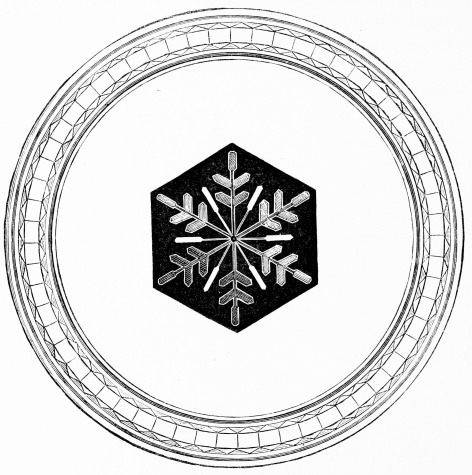
Fig. 44.
resort to another means of teaching; but it is obvious that there is no branch of manufacture which may not, to some extent, be benefited by it. Let the student give the subject a moment’s thought, and he will be convinced of this; let him look down to his carpet, or up at his ceiling; let him turn to the cover of the book he is perusing, notice any part of a lady’s dress, or of his own, where ornamentation is admissible; let him, in short, consider any object, anywhere, under any circumstances, and then examine the few examples we set before him in these pages, and he will at once perceive how much of harmony, of truth, of beauty, may be obtained by an intellectual study of these forms, which are neither more nor less than Nature’s teachings from a book hitherto unopened.