I. THE ADAPTABILITY OF OUR NATIVE PLANTS TO THE PURPOSES OF ORNAMENTAL ART. By EDWARD HULME, F.L.S., F.S.A. (continued 2)
Reading edition
King-cup, or Marsh Marigold (Caltha palustris), a plant by no means uncommonly met with in marshy ground, water-courses, and such-like localities. It may frequently be found in tidal streams, growing in such a position that at high tide it is completely covered; we have thus seen it by the side of the Thames, flourishing in great vigour and beauty, and at full tide swaying with the force of the stream at a depth of from one to two feet from the surface. In such situations the plant grows with luxuriance, and from the large size and brilliant yellow of its star-like flowers, the vigorous growth of the rich green foliage, and the long succulent stems, it becomes a striking feature even in the mass of bold healthy vegetation so commonly found by the edges of a water-course: these, therefore, are the characters which, in embodying the plant in any design, we must endeavour to enforce. We are unacquainted with any early examples of the use of the marsh marigold, except in one page of a fifteenth-century illustration. This is the more curious since the name marigold has reference to its use in the church-decorations of the Middle Ages, upon those days more especially devoted to the festivals associated with the Virgin Mary; we should naturally, therefore, have thought that, thus brought before the attention, its ornamental features would have been perceived and permanently embodied in some capital or spandrel. The generic name, Caltha, is derived from a Greek word signifying cup, and expressively points out a beautiful feature in the form of the flower; while the specific name, palustris, is drawn from the Latin palus, a marsh, and clearly indicates the localities naturally chosen by the plant. The plant will be found in flower in the spring, remaining for a considerable time in full bloom, and from its perennial nature will, when once established in any locality, soon become a permanent addition to the flora of the district. Representations of the natural growth of the marsh marigold will be found in E. B. 40; P. F. 54.
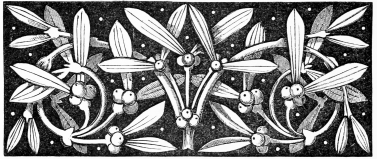
The Mistletoe—Anglo-Saxon, mistelta (Viscum album)—is so well known that it would appear strange that so familiar a plant has been but little employed in mediæval art, did we not remember that its pagan associations had placed it under a ban. The only example of its use that has come under our observation is in one of the spandrels of a tomb in Bristol Cathedral. The natural growth will be found portrayed in M. B. 270; W. H. H., Plate A, Fig. 3; P. F. 88. The lightness of the plant, and its association with Christmas, seem features that render a knowledge of it desirable to the ornamentist. It appears to us a plant capable of very extensive use in the various developments of decorative art. We need only mention a few—the backs of playing-cards, earthenware, muslins, chintzes, wall-papers. Many other uses will, no doubt, readily suggest themselves to our readers.
Mistletoe.
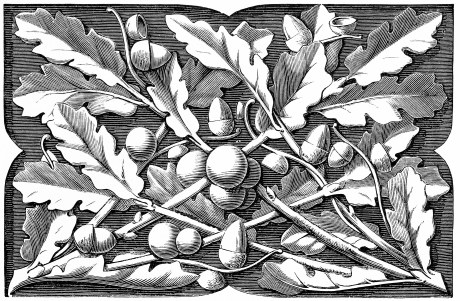
The Oak (Quercus robur), while perhaps our best-known indigenous tree, from its wealth of legendary, religious, and historic associations, has also been one of the favourite subjects of the ornamentist, being abundantly found in carving, stencilling, draperies, glass, &c., both in England and on the Continent,
Oak.
throughout the whole range of the Decorated and Perpendicular styles of Gothic, and the corresponding periods in France, Spain, and Germany, and also afterwards in the various modifications of the Renaissance. To refer at any length to the varied associations surrounding it would be foreign to our present purpose, though its sacred character in the Druidical rites of the ancient Britons, the importance of its timber for the purposes of the shipwright and architect, the commercial value of the bark for use in tanning, leading to the felling of thousands of trees every year, its use in medicine, the bark being a powerful astringent, and an infusion from the galls so frequently found upon the oak being an excellent antidote in cases of poisoning by the tartrate of antimony, are all points of interest or utility in connection with it. It has also been one of the favourite trees of the poets—Dryden, Pope, Cowper, Wordsworth, and many others, having referred to it in their writings; while to the artist the rugged majesty and vigour of the branches in winter, the brilliant bronze red of the early spring foliage, the deep mass of dark green leaves in summer-time, or the fiery glow it bears when touched by the frosts of advancing winter, render it at all times a beautiful and striking object in the landscape. The galls so generally met with upon the leaves of the oak are caused by a small insect, the Cynips Quercus-folii, which, by puncturing the leaf and laying an egg in the wound, causes a diseased and abnormal growth of the part: on cutting one of these galls open the grub will generally be found within. The galls chiefly used in medicine and commerce, though similar in their origin, are the work of another little insect on a different and foreign species of oak.
Though the oak is so familiar a tree in our woods and hedgerows, it must at one time, when England was extensively covered by forests, have been still more abundant. We are led to this conclusion from the great number of places whose names, handed down to us from our early history, derive their force and meaning from this abundance: thus Ockham, in Surrey, is literally Ocham, the place of oaks, a title which it still well deserves. Ockley, Acton, Acworth, and many more examples, might be cited. Superstition, too, with its usual fertility of invention, has not failed to detect the strange and marvellous in the oak. Of this, did space permit, and were it not somewhat foreign to our subject, we could quote many curious instances.
In the works of the ornamentist, to the best of our knowledge, the Q. robur form of the oak has been exclusively used. To give an extended list of the places where illustrations of its use in design occur would be to devote far more space to it than is really needful: as an example of its use in stonework, we would instance a small, but good capital at Ely, where one pleasing, natural, and ornamental feature, the empty cup of the acorn contrasting with the other forms, is very well introduced. We see this same attention to natural detail in some flowing foliage in a hollow moulding at Henry VII.’s Chapel, Westminster: the leaves are so deeply cut into lobes, and so modified in form, that except for the presence of the acorns, we should not recognise the foliage as being that of the oak at all. A very clear and good piece of oak is introduced in some wood-carvings at the ends of the stalls at Wells Cathedral; again, in crockets at Exeter, in the Lady Chapel; in a stone boss, St. Cuthbert’s screen, St. Alban’s Abbey Church; in wooden spandrels at Winchester, and Northfleet Church, Kent; as a diaper in glass quarries at Fulbourne and Waterbeach Churches, in Cambridgeshire; and as a carving at the arch-springing at Southwell Minster, Nottinghamshire. On the Continent, in Burgos Cathedral, we meet with several exceedingly beautiful carvings of the maple, plane, vine, and many other plants—among them a square panel filled with oak, and a very graceful running band of leaves and acorns round the tomb of Don Juan II.; and in Paris, in the Sainte Chapelle, we also find a hollow moulding filled with running oak foliage. In the South Kensington Museum many excellent fragments of wood-carving are preserved, and among these the oak is very often visible; while in the ceramic collection we frequently see the borders of the Majolica dishes and plates entirely composed of interlaced branches of oak. The oak is, in this latter series of examples, of heraldic significance as the badge of the Dukes of Urbino. Representations of the natural growth of the oak may be seen in E. B. 1288; M. B. 126; P. F. 9; S. C. 151; G. O. 95; T. N. O. 127.
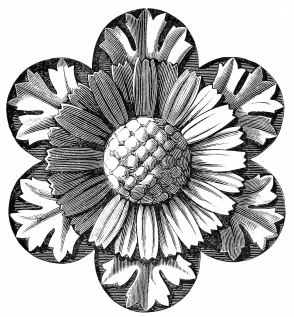
Ox-eye Daisy (Chrysanthemum leucanthemum). The impressions we at once derive on seeing the natural plant are—first, the size and brilliant star-like character of the flowers, as we view it growing amidst the long grass; secondly, the beautiful contrast of form, colour, and light and shade between the deep yellow, convex central portion and the brilliant white and concave rays surrounding it; and thirdly, the comparative smallness and insignificance of the leaves: hence it appears to us that in any adaptation of the plant to the purposes of the designer, these are salient points to be observed. We find it growing very freely in meadows, on the sunny side of railway banks, &c., and, where found at all, generally in great profusion. During the past summer, by the side of the river Wey, we came across a plant that had firmly established itself, and was growing and flowering in full health and vigour in the crown of a pollard willow tree, about eight feet from the ground. It is one of the plants regarded by the farmer with dislike, as it generally indicates great dryness of soil, and,
Ox-eye Daisy.
from its abundance and the perennial nature of the root, can scarcely be dislodged where it has once fairly taken possession. The whole plant varies from one to two feet in height, blossoming in June and July. The garden chrysanthemum is a Japanese allied species, considerably modified by cultivation. It may be seen painted on Japanese plates, screens, &c. So far as we are aware, the ox-eye seems to have been but little used in ornamental art, the following examples being the only cases of its occurrence with which we are acquainted:—On a label termination to one of the windows in the presbytery, Winchester, where we find the flower in the centre of the boss very clearly and unmistakably rendered, but surrounded by the ordinary type of leaf of the Early English Gothic period; in some twelfth-century glass at Rheims, where it is introduced as the flower dedicated to St. John, and where, by a poetical symbolism, all the flowers turn towards our Saviour on the cross, as the Sun of Righteousness, the true Light of the world; again met with in the celebrated MS., “The Hours of Anne of Brittany,” now in the Bibliothèque du Roi, Paris. This illumination dates from the close of the fifteenth century, the flowers introduced being very naturalistic in character, and with their shadows thrown upon a golden ground—a marked characteristic of the illumination of that time. It also occurs in a missal in the Library of the Arsenal, Paris, where, on a golden ground similar to that last cited, detached flowers are scattered over the borders—the pea, iris, heartsease, and many others being represented, and among them the ox-eye daisy. Drawings of the natural plant will be found in S. B. 158; E. B. 714; P. F. 42.
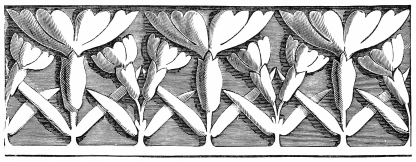
The Campion (Lychnis diurna) is another plant well adapted to the need of the ornamentist, the form of the flower and the sheathing of the stem by the pairs of leaves being valuable and characteristic ornamental features. The Lychnis diurna is to be met with in moist hedge-banks, and more especially those that are shaded by overhanging trees; the flowers are of a delicate pink, scentless, and opening in the early morning; differing in all these respects from the Lychnis vespertina, a very similar plant in general appearance, but having the flowers white, with a slight odour, and opening in the evening. The white campion has generally a more robust and coarser character of growth than the pink campion, and appears to delight in more open situations. By many botanists, however, these two plants are considered as closely allied, the pink campion being regarded as merely a variety of the white, and both referred to as the Lychnis dioica. The specific names, diurna and vespertina, refer to the times of flowering, the morning and evening respectively; while the generic name, Lychnis, common to all the species, is derived from the Greek word for lamps, the thick downy covering on the leaves of the white campion having at one time been employed in the manufacture of wicks for use in lamps. Refer to F. L. vol. ii. 32; T. N. O. 69; P. F. 53.
Campion.
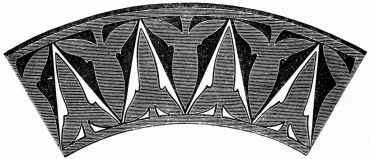
Sorrel (Rumex acetosa). Though from its inconspicuous character the sorrel may very readily be passed over, it will, we think, be found to repay the attention of the ornamentist, since the lightness and grace of its growth, its brilliant colour, and the rich form of the leaf, are all characteristics that should render it valuable to those engaged in decorative art. The leaves have a pleasant acid flavour, and are occasionally employed in salads. The English name is derived from the Anglo-Saxon sur, sour. The present plant must not, from similarity of name, be confused with the wood-sorrel (Oxalis acetosella), as the two plants are very different in appearance, the wood-sorrel having large white flowers, and a beautiful trefoil character of leaf. Illustrations of the natural growth of R. acetosa may be seen in E. B. 1223; F. L. vol. v. 29; M. B. 69.
Sorrel.
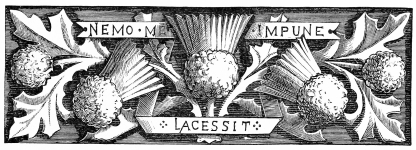
The Spear-plume Thistle (Carduus lanceolatus) has been selected as the subject of our next example. It may very commonly be met with in hedge-banks and waste ground, attaining to a height of from three to four feet, and forming a very ornamental and conspicuous object. Its employment in heraldry with the motto NEMO ME IMPUNE LACESSIT, as the badge of Scotland, is so well known that the mere mention of the fact will suffice to recall it to the memory of our readers; but this application of it, and its frequent recurrence in all circumstances where the national emblems are introduced, render it necessary that the designer should be familiar with the plant he will thus have to treat. There are several indigenous species of thistle, some one or two of them laying claim to their right to be considered the true Scottish badge, but the balance of evidence will, we think, be found to point to the spear-plume thistle as that most entitled to the honour. The C. marianus, or milk-thistle, one of our rarer native, or at least naturalised species, has a particularly ornamental effect from the veins upon the leaves being of a clear milky white, the rest of the leaf being of the normal green colour. A drawing of the spear-plume thistle may be seen in E. B. 686.
Thistle.
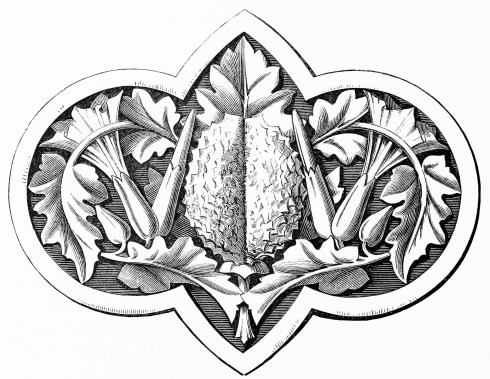
The Thorn-apple, though not a common wild plant, may occasionally be met with, growing on waste spots, rubbish heaps by the roadside, and similar places. The large size and brilliant whiteness of the flowers, the bulk and peculiar character of the spiny fruit, make it a very striking object, and admirably fitted for a share of the ornamentist’s regard. It is a plant of Eastern origin, and was unknown here until the reign of Elizabeth; we therefore do not find it in any of the art-work before that date, nor, indeed, do we remember to have ever seen it
Thorn-apple.
in any way introduced in later designs: this, no doubt, is partly owing to the comparative rarity of the plant. Its scientific name is Datura stramonium, the generic name being derived from tatorah, the name of the plant in Arabic. The whole plant is powerfully narcotic in its effects. In the quaint pages of Gerarde, published A.D. 1636, we learn the history of its introduction into England. Gerarde was the director of the botanical garden of Lord Burleigh; hence he received many rare plants from abroad for cultivation. In speaking of the Datura, he says, “whose seeds I have received of the Right Honourable the Lord Edward Zouch, which he brought from Constantinople, and of his liberalitie did bestow them vpon me; and it is that thorn-apple that I have disposed through this land.” In some botanical works we find it asserted that the thorn-apple was introduced into Europe in the Middle Ages by the gypsies, who, in their wanderings, brought it from Asia; but the declaration of Gerarde is so positive and explicit, that it seems difficult to admit any other belief, more especially as he accompanies his statement by an illustration which, though very rough and quaint, is quite sufficiently like the natural plant to prove that it was not some other species introduced by him and wrongly named. Drawings of the thorn-apple may be consulted in E. B. 935; F. L. vol. vi. 17; M. B. 124; S. C. 6; P. F. 13.
The Tormentil (Potentilla tormentilla) has already, to some extent, been referred to when speaking of an allied species, the cinquefoil. The flowers, though typically composed of four petals, are frequently to be found with the petals five in number, the calyx in that case being cleft into ten segments instead of the normal arrangement. We are not acquainted with any example of the use of the tormentil in ornament, but the wood-strawberry (Fragaria vesca), an allied genus of the same natural order, has a similar form of calyx, the segments being alternately large and small, and twice as numerous as the petals; and this beautiful ornamental feature is very carefully shown in a sixteenth-century MS. at the British Museum, where the plant is introduced in one of the borders. Consult E. B. 430; F. L. vol. v. 35; or P. F. 94, for illustrations of the natural growth of the tormentil.
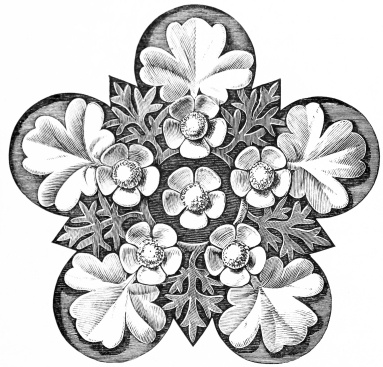
Our remaining illustration has been suggested by the Water Crowfoot (Ranunculus aquatilis), one of the numerous species of buttercups, but distinguished from its allies by the petals of the flowers being white, not yellow, as in the case of the other members of the family, and also from the habitat of the plant, the blossoms being found floating upon the surface of quiet water-courses. The crowfoot may be met with in flower throughout the summer, and, where seen at all, is ordinarily very abundant, so that at a little distance the whole surface of a large pond will tell upon the eye as a mass of white, from the innumerable blossoms thickly scattered over the water. The English name crowfoot has arisen, like many similar names, from the supposed resemblance of the plant, or some portion of it, to some other natural object; thus we get crane’s-bill, cock’s-foot grass, lark’s-spur, bee-orchis, pheasant’s-eye, and many other such examples among our common names for plants. As a family, the buttercups must be regarded with suspicion on account of their strongly developed acrid qualities; thus the leaves of the R. flammula, if applied to the skin, will, in a very short time, cause large and painful blisters. The R. acris is equally poisonous; and the R. arvensis, or corn crowfoot, is extremely injurious to cattle and sheep. The R. aquatilis does not possess these dangerous qualities; on the contrary, it may be collected and given as fodder in times of scarcity or drought, and the animals will not only eat it, but thrive upon it. It is a very
Water Crowfoot.
widely spread species: the placid waters of regions so different from each other in climate as Lapland and Abyssinia are equally favourable to its growth, and the lakes and slowly running streams of California are powdered over with its brilliant blossoms, as we see them in our English pools. The water crowfoot affords us also a beautiful example of that adaptability of form to the circumstances of the plant’s existence which we may so frequently trace in the works of nature. It will be noticed in the illustration that two very distinct forms of leaf are represented; and, on examining the natural plant, it will be found that the simpler form of leaf floats upon the surface of the water, while the lower and more minutely divided leaves are submerged. Imagine the respective positions of these leaves reversed, and it would speedily be apparent that the finely cut leaves were unable to support the blossoms, and to expose them to the vivifying rays of the sun, while the simpler form of leaf would, by the action of the water, speedily be torn into long shreds, the principal veins alone remaining, and very much resembling the actual form that we meet with in the case of the submerged leaves. In employing the water crowfoot in ornamental art, it appears to us that the two great features most highly characteristic of it, and therefore to be embodied in a design, are, first, the number of its blossoms; and, secondly, the two distinct kinds of leaf; the simpler form being the most prominent, but the other, though subordinate, as in the case of the natural plant, to be indicated, and its presence felt. The R. bulbosus is the species so frequently met with in the carvings of the Decorated period of Gothic art, an especially beautiful example of its use being seen in a capital in the doorway in the Chapter-house at Southwell Minster, Notts. The R. aquatilis, so far as we have had opportunity of observation, appears to have been entirely overlooked. Illustrations of the water crowfoot will be met with in V. W. 95; E. B. 18.
Having thus briefly indicated some few points of interest in the foregoing British plants, we draw our remarks to a close; it must not, however, be supposed that all the material at our disposal was exhausted. We fear rather to weary the reader than to exhaust the stores which nature affords; hence we limit our remarks to fifty plants, leaving many equally valuable ones untouched; such plants as the bird’s-foot trefoil, chicory, cowslip, forget-me-not, meadow vetchling, silver-weed, and stork’s-bill, being fully as well adapted to the various purposes of ornamental art as those we have, in the body of our text, referred to; in fact, the whole of those just mentioned were, together with many more, indexed as a portion of our plan, and were only cut out when it was found that a catalogue thus amplified would stretch to an inordinate length. Though we have, in the course of our remarks on each plant, been careful to indicate to our readers the books he should consult for illustrations of the natural growth of the flower in question, we cannot conclude without again strongly advising the designer, wherever it is at all practicable, to go direct to nature, as a series of sketches of even the roughest character has an ornamental value and variety which are not always found in book-illustrations, and, moreover, the knowledge of the plant acquired in actually delineating it is worth far more than any study of the written descriptions of others. These sketches should of course be made when the plant is available, and not left till an emergency arises, and when, very possibly, the plant, if found at all, may not be in satisfactory condition for ornamental work. Whenever, therefore, a plant possessing valuable properties for decorative work is met with, a drawing of the general growth and enlarged details of its more artistically valuable parts should be made and stored up for future use. A designer cannot have too many such reserves of material, though he may very easily have too few. Those who have never fairly searched may, however, be under the impression that but little practical good could come of any such seeking, as, for want of experience, they unknowingly underrate the wealth that, at the expense of a short railway journey into the country, is theirs for the gathering. To test this we set out one day in June, and the result of a stroll of barely two and a half hours was conclusive on this point. In addition to many plants in seed, or which, from their foliage, were worthy of introduction into art-work, no less than seventy-four were met with in flower; many of these, as the dog-rose, blackberry, white bryony, comfrey, mallow, hawthorn, and silver-weed, being excellent for carving; while the bladder campion, forget-me-not, meadow cranesbill, ground-ivy, meadow vetchling, cinquefoil, oxalis, and honeysuckle, would be valuable for lighter work—muslins, papers, or lace. We cannot doubt that the interest thus evolved from a direct study of nature would be a growing one; that not only would the actual result in art-work be the better for it, but also that the enjoyment derived from the study would be such as to render the pursuit one of far more interest than those who have not yet experienced it can realise.
“Happy is he who lives to understand, Not human nature only, but explores All natures—to the end that he may find The law that governs each; and where begins The union, the partition where, that makes Kind and degree, among all visible beings; The constitutions, powers, and faculties, Which they inherit—cannot step beyond, And cannot fall beneath; that do assign To every class its station and its office, Through all the mighty commonwealth of things; Up from the creeping plant to sovereign man. Such converse, if directed by a meek, Sincere, and humble spirit, teaches love: For knowledge is delight; and such delight Breeds love; yet, suited as it rather is For thought and to the climbing intellect, It teaches less to love than to adore: If that be not indeed the highest love.” Wordsworth.