Book 1 — CHAPTER IV. Of the Power of Celestial Bodies over Men and Women.
Reading edition
Having spoken thus largely of Physiognomy, and the judgments given thereby concerning the dispositions and inclinations of men and women, drawn by the said art, from every part of the bodies of men and women, it will be convenient here to show how all these things come to pass; and how it is that the secret inclinations and future fate of men and women may be known from the consideration of the several parts of the bodies. They arise from the power and dominion of superior powers over bodies inferior; by superior powers I understand the 12 Signs of the Zodiac, whose signs, characters, and significations are as follow.
304
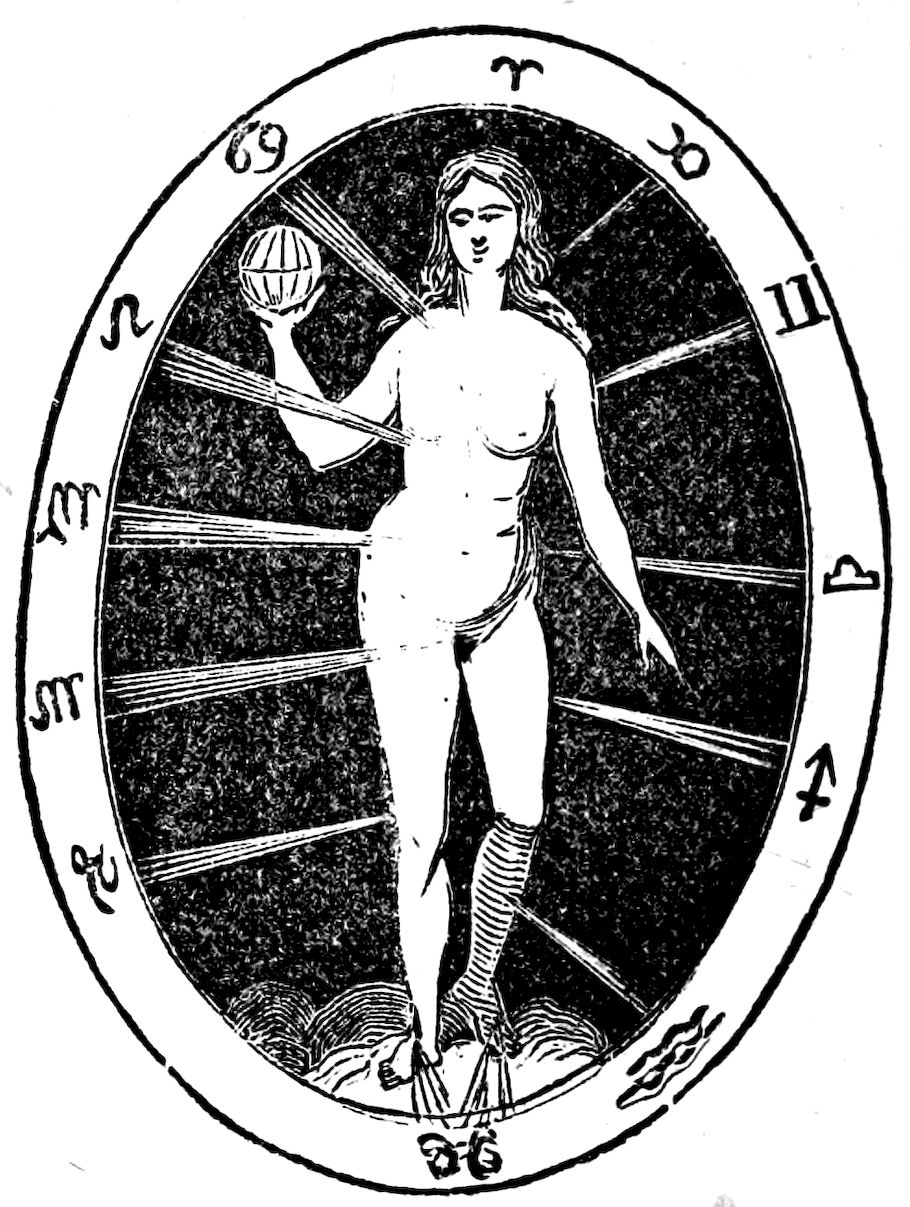
Aris, the Ram, which governs the head and face.
Taurus, the Bull, which governs the neck.
Gemini, the Twins, governs the hands and arms.
Cancer, the Crab, governs the breast and stomach.
Leo, the Lion, governs the back and heart.
Virgo, the Virgin, governs the belly and bowels.
Libra, the Balances, governs the reins and loins.
Scorpio, the Scorpion, governs the secret parts.
305Sagittary, the Centaur, governs the thighs.
Capricorn, the Goat, governs the knees.
Aquarius, the Water-Bearer, governs the legs and ancles.
Pisces, the Fish, governs the feet.
It is here furthermore necessary to let the reader know, that the ancients have divided the Celestial Sphere into twelve parts, according to the number of these signs, which are termed houses; and have placed the twelve signs in their houses, as in the first house Aries, in the second Taurus, in the third Gemini, &c. And besides their assigning the twelve signs to the twelves houses, they allot to each house its proper business.
To the first house they give the signification of life.
The second house has the signification of wealth, substance, or riches.
The third is the mansion of brethren.
The fourth is the house of parentage. _
The fifth is the house of children.
The sixth is the house of sickness or disease.
The seventh is the house of wedlock, and also of enemies, because oftentimes a wife or husband proves the worst enemy.
The eighth is the house of death.
The ninth is the house of religion.
The tenth is the signification of honour.
The eleventh of friendship.
The twelfth is the house of affliction and woe.
Now, astrologically speaking, a house is a certain space in the heaven or firmament, divided by certain degrees, through which the planets have their motion, and in which they have their residence, and are situated. And these houses 306are divided by thirty degrees, for every sign has so many degrees. And these signs or houses are called the houses of such and such planets as make their residence therein, and are such as delight in them, and as they are deposited in such and such houses are said to be either dignified or debilitated. For though the planets in their several revolutions go through all the houses, yet there are some houses which they are more properly said to delight in: As, for instance, Aries and Scorpio are the houses of Mars; Taurus and Libra, of Venus; Gemini and Virgo, of Mercury; Sagittarius and Pisces are the houses of Jupiter; Capricorn and Aquarius are the houses of Saturn; Leo is the house of the Sun; and Cancer is the house of the Moon.
Now to sum up the whole, and show how this concerns physiognomy, is thus: as the body of man, as we have shown, is not only governed by the signs and planets, but every part is appropriated to one or another of them, so according to the particular influence of each sign or planet, so governing, is the disposition, inclination, and nature of the person governed. For such and such tokens and marks do show a person to be born under such and such a planet; so according to the nature, power, and influences of the planets, is the judgment to be made of that person. By which the reader may see that the judgments drawn from physiognomy are grounded upon a certain veracity.
307