Book 1 — CHAPTER II. OF DISEASES RELATING TO WOMEN’S MONTHLY TERMS.
Reading edition
Sect. I. Of Women’s Monthly Terms in General.
That divine Providence, which with a wisdom peculiar to itself has appointed woman to conceive, and to bear and bring forth children, has provided for the nourishment of children during their recess in the womb of their mother, by that redundancy of the blood which is natural to all women; and which, flowing out at certain periods of time (when they are not pregnant), are from thence called terms and menses, from their monthly flux of excrementitious and unprofitable blood. Now, that the matter flowing forth is excrementitious, is to be understood only with respect to the redundancy and overplus thereof, being an excrement only with respect 196to its quality; for as to its quality, it is as pure and incorrupt as any blood in the veins; and this appears from the final cause of it, which is the propagation and conservation of mankind; and also, from the generation of it, being the superfluity of the last aliment of the fleshy parts. If any ask, if the menses be not of a hurtful quality, how can they cause such venomous effects? If they fall upon trees and herbs, they make one barren and mortify the other. I answer, this malignity is contracted in the womb; for the woman wanting native heat to digest the superfluity, sends it to the matrix, where seating itself till the mouth of the womb be dilated, it becomes corrupt and mortified; which may easily be, considering the heat and moistness of the place; and so this blood being out of its proper vessels, offends in quality.
Sect. II. Of Terms coming out of order, either before or after the usual Time.
Having, in the former part of this work, treated of the suppression and overflow of the monthly terms, I shall content myself with referring the reader thereto, and proceed to speak of their coming out of order, either before or after the usual time.
Both these proceed from an ill constitution of body. Every thing is beautiful in its order, in nature, as well as in mortality; and if the order of nature be broke it shows the body to be out of order. Of each of these effects briefly.
When the monthly terms come before their 197time, showing a depraved excretion, and flowing sometimes twice a month, the cause is in the blood, which stirs up the expulsive faculty of the womb, or else in the whole body, and is frequently occasioned by the person’s diet, which increases the blood too much, making it too sharp or too hot. If the retentive faculty of the womb be weak, and the expulsive faculty strong, and of a quick sense, it brings them forth the sooner. Sometimes they flow sooner by reason of a fall, stroke, or some violent passion, which the parties themselves can best relate. If it be from heat, thin and sharp humours, it is known by the distemper of the whole body. The looseness of the vessels, and weakness of the retentive faculty, is known from a moist and loose habit of the body. It is more troublesome than dangerous. If it proceed from a sharp blood, let her temper it by a good diet and medicines. To which purpose, let her use baths of iron water, that correct the distemper of the bowels, and then evacuate. If it proceed from the retentive faculty, and looseness of the vessels, it is to be corrected with gentle astringents.
As to the menses flowing after the usual time, the causes are, thickness of the blood and the smallness of its quantity, with the straitness of the passage, and the weakness of the expulsive faculties. Either of these singly may stop the menses, but if they all concur, they render the distemper worse. If the blood abounds not in such a quantity as may stir up nature to expel it, its purging must necessarily be deferred till there be enough. And if the blood be thick, 198the passage stopped, and the expulsive faculty weak, the menses must needs be out of order, and the purging of them retarded.
For the cure of this, if the quantity of blood be small, let her use a larger diet, and very little exercise. If the blood be thick and foul, let it be made thin, and the humours mixed therewith be evacuated. It is good to purge after the menses have done flowing, and to use calamint; and indeed the oftener she purges the better. She may also use fumes and pessaries, apply cupping-glasses without scarification to the inside of the thighs, and rub the legs and scarify the ancles, and hold the feet in warm water four or five days before the menses come down. Let her also anoint the bottom part of her abdomen with things proper to provoke the terms.
Remedies for Disorders in Women’s Paps.
Make a cataplasm of bean meal and salad oil, and lay it to the place affected. Or anoint with the juice of papilaris. This must be done when the paps are very sore.
If the paps be hard and swelled, take a handful of rue, colewort roots, horehound and mint; if you cannot get all these conveniently, any two will do; pound the handful in honey, and apply it once every day till healed.
If the nipples be stiff and sore, anoint twice a day with Florence oil till healed.
If the paps be flappy and hanging, bruise a little hemlock, and apply it to the breast for three days; but let it not stand above seven 199hours. Or, which is safer, rusæ juice well boiled, with a little smapios added thereto, and anoint.
If the paps be hard and dead, make a plate of lead pretty thin, to answer the breasts; let this stand nine hours each day, for three days. Or sassafras bruised, and used in like manner.
Receipt for Procuring Milk.
Drink arpleni, drawn as tea, for twenty-one days. Or eat aniseeds. Also the juice of arbor vitæ, a glassful once a day for eleven days, is very good, for it quickens the memory, strengthens the body, and causeth milk to flow in abundance.
Directions for Drawing of Blood.
Drawing of blood was at first invented for good and salutary purposes, although often abused and misapplied. To bleed in the left arm removes long-continued pains and head-aches. It is also good for those who have got falls and bruises.
Bleeding is good for many disorders, and generally proves a cure, except in some very extraordinary cases; and in these cases bleeding is hurtful.
If a woman be pregnant, to draw a little blood will give her ease, good health and a lusty child.
Bleeding is a most certain cure for no less than twenty-one disorders, without any outward or inward applications; and for many more, with application of drugs, herbs and flowers.
When the moon is on the increase, you may let blood at any time, day or night; but when 200she is on the decline, you must bleed only in the morning.
Bleeding may be performed from the month of March to November. No bleeding in December, January, or February, unless an occasion require it. The months of March, April, and November, are the three chief months of the year for bleeding in; but it may be performed with safety from the 9th of March to the 19th of November.
To prevent the dangers that may arise from the unskilful drawing of blood, let none open a vein but a person of experience and practice. There are three sorts of people you must not let draw blood: first, ignorant and inexperienced pretenders. Secondly, those who have bad sight and trembling hands, whether skilled or unskilled. For when the hand trembles, the lancet is apt to startle from the vein, and the flesh be thereby damaged, which may hurt, canker, and very much torment the patient. Thirdly, let no woman bleed you, but such as has gone through a course of midwifery at college; for those who are unskilful may cut an artery, to the great damage of the patient. Besides, what is still worse, those pretended bleeders, who take it up at their own hand, generally keep unedged and rusty lancets, which will prove hurtful even in a skilful hand. Accordingly, you ought to be cautious in choosing your physician: a man of learning knows what vein to open for each disorder; he knows how much blood to take as soon as he sees the patient; and he can give you suitable advice concerning your disorder.
201
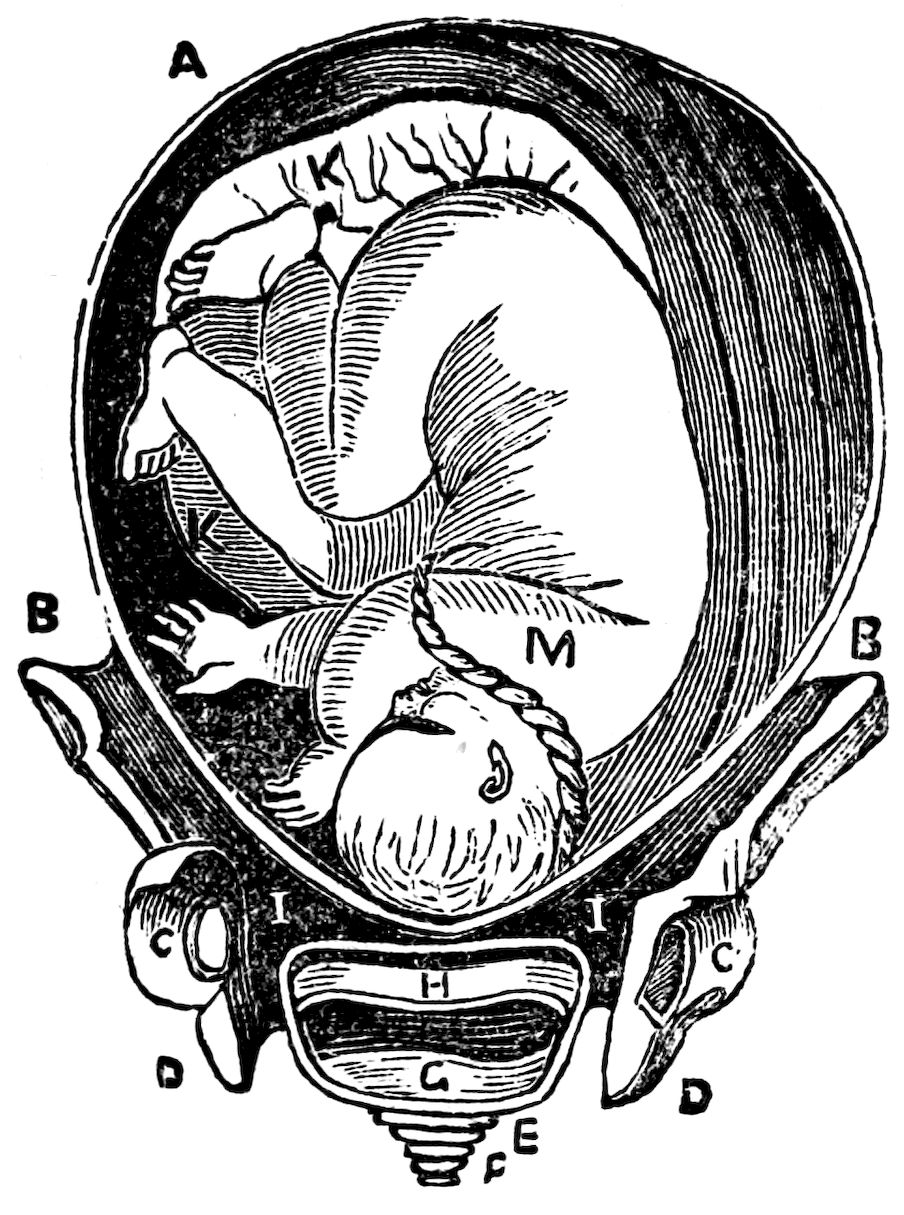
FORM OF A MALE CHILD IN THE WOMB. EXPLANATION. A The uterus, as stretched to near its full extent, containing the fœtus entangled in the funis.—B. B. The superior part of the ossa ilium.—C. C. The actebula. D. D. The remaining posterior parts of the ossa ischium.—E. The coccyx.—F. The inferior part of the rectum.—G. G. The vagina stretched on each side.—H. The os uteri, stretching to its full extent.—I. I. Part of the vesica urinaria.—K. K. The placenta at the superior and posterior parts of the uterus.—L. The Membranes.—M. The funis umbilicalis.
202