WHG Kingston (continued 3)
Reading edition
Ewen was about to open the door, when Sandy stopped him.
“Let us see how many of these gentlemen there are outside, for I’ve a notion there are more than we should wish to tackle,” he observed.
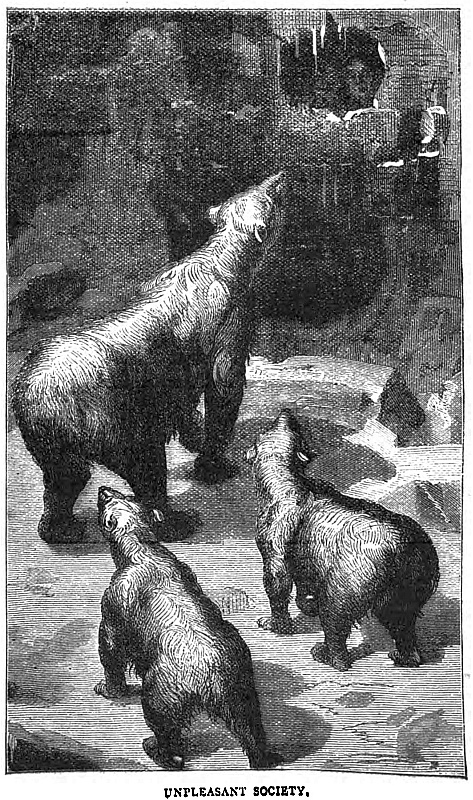
He and I looked out of the window, when we saw no less than three huge bears close to the hut, while the fellow we had wounded and several others were visible further off, watching the proceedings of their friends, whose evident intention it was to break in if they could, to eat the savoury steaks we were cooking, and us into the bargain. Notwithstanding our intention of not using our fire-arms, we must either kill the baars if we could not drive them off, or run the risk of being torn to pieces by them.
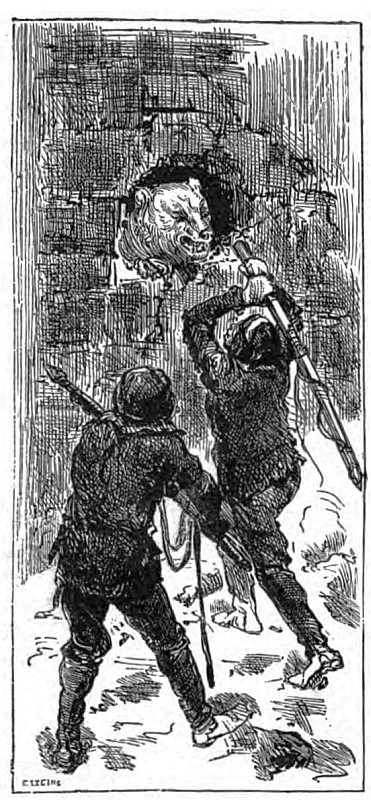
As they seemed resolved to pull our hut down for the sake of getting at us, we loaded our fire-arms and prepared for the defence of our fortress. Sandy desired me to take my post at the window, and to shoot down as many as I could, while he with the rest of the party opened the door and sallied out to attack the invaders. I advised him, however, to wait and see the result of my shots, unless the bears should actually begin to tear down the walls. Taking aim at the nearest, I fired. The thick smoke prevented me for some seconds from seeing the effect of my shot. Great was my satisfaction when I perceived the bear struggling on his back in the snow.
Ewen then handed me up his rifle, and while he reloaded mine, I took aim at the next bear, which I knocked over in the same fashion as I had the first; but strange to say, their companions, instead of being frightened and running away, came growling up as if resolved to revenge their deaths.
On seeing this, Sandy, who was looking over my shoulder, calling the rest of the party, opened the door, and fired a volley, all hands shouting at the same time at the top of their voices.
One of the bears fell; the rest, terrified and pursued by the dogs, who bolted out, took to flight. We called off our canine attendants, who were, however, very unwilling to return, coming slowly back, and every now and then facing round and barking furiously at the retreating bears.
Four of the animals had been killed, and we had made, as Sandy observed, “a good morning’s work.” It took us some time to cut them up and stow the flesh away in our pit, while the preparation of the skins gave us abundant occupation, though not a pleasant one in the confined hut.
Day after day went by; the sun remained longer and longer above the horizon; while the warmth sensibly increased, when there happened to be no wind, although the air was still cold enough to make our thick clothing indispensable.
We now began to make preparations for our journey southward, which must be performed before the land-ice should begin to break up.
I suggested that some of the party should first make a trip with part of our provisions, sufficient for three or four days, to the south, and there form a depot, so that we might not run the risk of starving should we fail to kill any animals, and this was agreed to.
Sandy and I drew lots which of us should go, and which remain at the hut.
The lot fell on him to go, and he chose Hans and Croil to accompany him. I confess that I would far rather have gone, but having agreed to the proposal, I felt bound to yield to his wishes.
The party set off the next morning with the tent, and as much bear’s meat as they chose to carry, and a portion of the remainder of our other stores. Ewen and I saw them off, not without some forebodings of evil, and then returned to our hut to employ ourselves as usual.
We never allowed the time to hang heavily on our hands, though we would have given a great deal for a book of any description, especially for a Bible, for that could have been read over and over again with advantage, whereas any other book would have been quickly got through. We calculated that Sandy would be absent a week or ten days at the utmost. The ten days had elapsed, and Sandy had not appeared; a fearful snow-storm, with a violent wind, had, however, come on, and confined us to the hut, and we concluded that he and his companions had pitched their tent, and had halted until it should be over, and that we might thus expect to see them at any hour.
Still days went by after this, and they did not come.
“Can they have deserted us?” asked Ewen.
“I am sure that they have not willingly done so,” I replied. “Some serious accident I fear may have happened to prevent them from returning.”
Our position had now become critical in the extreme. In a short time the ice might leave the shore, and our escape from the bay would be impossible.
We resolved at once to set out. Should the party be returning, we might perhaps meet them. If not, we must push on as long as our strength lasted. Having accordingly packed up our meat, our lamp, our stock of oil, and our ammunition, we set out.
We might find shelter in some cavern in the cliffs, or if not we could build a snow-hut of sufficient size to contain us. We might even venture to sleep out on calm nights, covered up in our blankets.
Before quitting the spot we closed the door of our hut, to prevent the ingress of bears, for we might possibly have to return to it, though as the warmth of the sun increased it would melt away.
We trudged on manfully, both feeling in better spirits than we had done for some days. On our right rose lofty cliffs, and occasionally vast masses of ice formed into glaciers a mile or more in extent, while on the left stretched out a vast field of ice, out of which rose numerous bergs of fantastic shapes, but no open water could we discover.
For the first day we got on very well. As the light decreased we built a snow-hut in which we could comfortably rest, with an entrance so small that no bear could have suddenly pounced upon us, while we kept our rifles ready to shoot the intruder should one appear. Next night we did the same, though we felt very tired when the work was over, and but little inclined to start the next morning at sunrise. We had, indeed, miscalculated our strength. It seemed easy enough to walk straight ahead over the ice for several hours a day; but we found that, though the ice was sometimes smooth, we had frequently to clamber over hummocks, so that our progress was slower than we had expected. At last Ewen declared that, unless we could take a whole day’s rest, he could go no farther.
My fear was lest, while we were inside our hut, Sandy and his companions might pass us. I agreed to take a short journey only, and offered to watch while Ewen slept. This he did not like to let me do, but I over persuaded him, and, while he turned in, I walked about the outside of the hut, sometimes climbing to the top of a hummock near at hand in the hopes of seeing our friends. The day closed in, however, without a single object appearing, and the next morning, Ewen saying that he felt stronger after his rest, we continued our journey.
We had been travelling for a couple of hours or more, when we reached a point beyond which a deep bay appeared. Should we go round it, or cross from one side to the other? As far as we could discern, there was nothing to tempt us to go out of our course. The cliffs were more precipitous and lofty than those we had hitherto seen, with intervals of vast glaciers of equal height.
We had hitherto had the cliffs to guide us, but now should the snow fall, or the weather become thick, we should not be able to distinguish them. Clear weather was, therefore, of the utmost importance, so, praying that it might continue, we pushed forward.
Though we travelled all day, with but a few minutes’ rest to take our food, the opposite side of the bay appeared no nearer than at first. Darkness came on, and not the faintest outline of the cliffs could we discover. It seemed to us, as we crept into our hut, that we were in the midst of the frozen sea. Fatigue happily brought us sound sleep. When we got up in the morning, what was our dismay to find that a violent storm was blowing, and that the snow was falling so thickly that we had great difficulty in forcing our way out of the hut. In a short time we should have been enclosed in what might have proved our tomb. To travel was next to impossible; although on starting we knew the direction to take, we were aware that we might very soon go wrong should the wind change. We therefore remained in our hut, occasionally digging away the snow to keep the passage clear.
At last the snow ceased, and as we could make out the faint outlines of the cliffs to the southward, we at once, shouldering our packs, pushed forward. It seemed, however, that we had made no progress when again we had to halt and build a hut.
The three next days were but a repetition of those I have described; but now our provisions had greatly decreased, as had our strength. The cliffs on the other side of the bay had not been reached, and when we got there, what were we likely to find? We had to confess to each other that we should not have strength to go much farther. Still, we resolved to struggle on as long as life remained. The snow had again begun to fall, but not with sufficient thickness to compel us to stop. At last Ewen suddenly declared that not another step could he stir. I offered to take his rifle and his pack, but, when I made the attempt to carry them, I found that I was unable to bear an additional load to my own.
Poor Ewen sank down. “Go on,” he said; “you may reach human beings, but I fear that you will not.” I could not bear the thought of leaving my friend. Even should I reach the shore and find a settlement, he would be dead before I could return. I proposed again encamping, but he had not strength even to assist in building a hut.
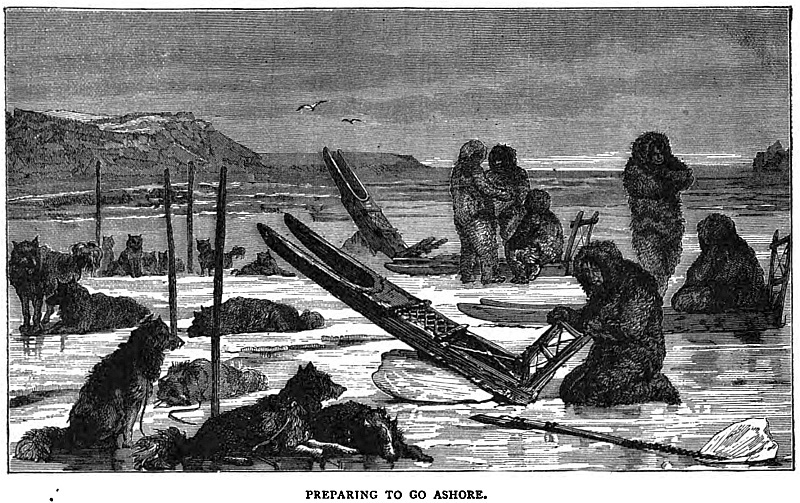
While I was endeavouring to encourage him, I fancied that I saw in the distance to the westward some objects moving over the ice. They might be bears—reindeers would scarcely have left the land. I looked more attentively. While I was gazing, the snow almost ceased falling.
“Look, Ewen, look!” I shouted, “those are men and sledges. They must be Sandy’s party, but they are too far off to see us. They are coming nearer, however. Rouse up, old fellow; let us try to meet them.”
Ewen’s strength seemed suddenly to return. We hurried forward, but we both feared that they might pass by without discovering us. As we got nearer to them we shouted, but our voices were hollow and low, and too probably would not be heard.
“I’ll fire my rifle!” I exclaimed. “I wonder that I did not think of doing so at first.”
The report had the desired effect. As we watched the strangers, to our joy we saw that they were directing their course towards us. In a short time we were among a party of Esquimaux, who seemed very much surprised at seeing us, though what they said we could not make out.
From the direction they had been travelling, we concluded that they were bound to some place on the north side of the bay for the purpose of spending the summer there. We tried to make them understand that if they would turn back and carry us to some place where we should find Europeans, we would give them our rifles, and anything else in our power. After holding a consultation, during which they looked frequently at the sky, they agreed to my proposal. Two of the party, unloading one of the smaller sledges, made signs that Ewen should get upon it. They then packed some provisions they had brought, together with some of our loads and rifles, and signified that they were ready to set off.
Having rubbed noses with their friends, who continued their route to the northward, we started in the opposite direction.
Chapter Nine.
Having no load to carry, I was able to keep up with the Esquimaux and their dog-sledge till it was time to encamp, when Ewen, who had recovered his strength more rapidly than I could have supposed possible, offered to assist me in building a snow-hut. We tried in vain to learn from the Esquimaux whether they had seen Sandy and his party, but they failed to understand our signs as we did theirs. They were merry fellows, though not pleasant companions in a snow-hut in one sense. Notwithstanding this, we spent the night with a feeling of greater security than we had enjoyed for some time.
The following day we were passing close to an iceberg which, from its appearance, I should have supposed could have withstood the fury of the most violent storms. I was admiring its fantastic form, when one of the Esquimaux seized my arm, while the other urged on the dogs at redoubled speed. We had got a hundred yards from it, when without any warning it suddenly capsized, and shivered into fragments, which glided along the ice towards us. In an instant we were surrounded by pieces of ice, pools of water and fissures, into which it required the greatest care to avoid falling. We pushed on without stopping to look behind us, until we were at a considerable distance from the spot. The Esquimaux did not appear to think the occurrence at all unusual; but after this they kept at a respectful distance from other icebergs of similar appearance. It was a sign to us that the sun was gaining strength, and we could not help fearing that the whole field of ice might before long break up.
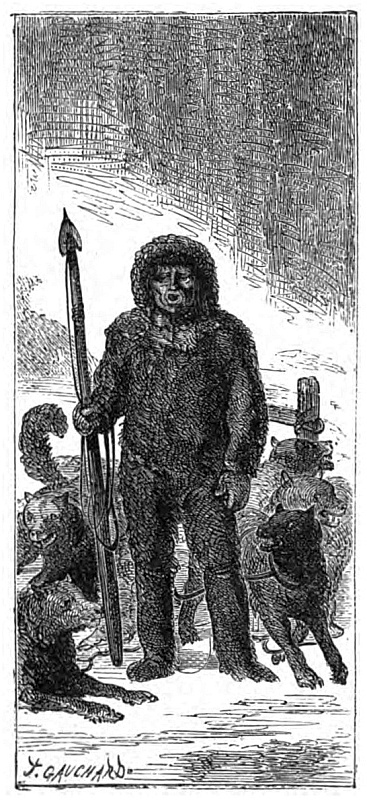
At length we approached the shore, the cliffs which had hitherto fringed the coast running back some distance inland before they again appeared to the southward.
The Esquimaux pointed to the land towards which they directed the sledge.
We could, however, see no signs of dwellings, though we discovered some objects moving about, which we supposed were human beings. On approaching we saw a number of dogs in front of a snow-hut which rose just above the ground.
On seeing our canine friends they rushed forward, barking a welcome, though I am not certain how they would have treated us had not our Esquimaux guides driven them off. Directly afterwards a number of men, women, and children came out of their huts in the neighbourhood, and appeared to be enquiring who we were and what had brought us to their settlement.
The replies seemed to be satisfactory, for they began forthwith to rub noses with us and then led us up to their dwellings.
We tried to make them understand that it was our object to proceed further south, where we could meet with our countrymen and other Europeans. The cunning fellows, however, did not, as far as we could make out, wish to go to the southward, but gave us to understand that we were welcome to remain with them as long as we liked.
Our guides having delivered us over to their friends, immediately set off to rejoin the party we had met proceeding northward. This made us believe that they expected the ice would soon break up, and that the object of their journey was to secure summer quarters, when the rest would rejoin them in their kayaks.
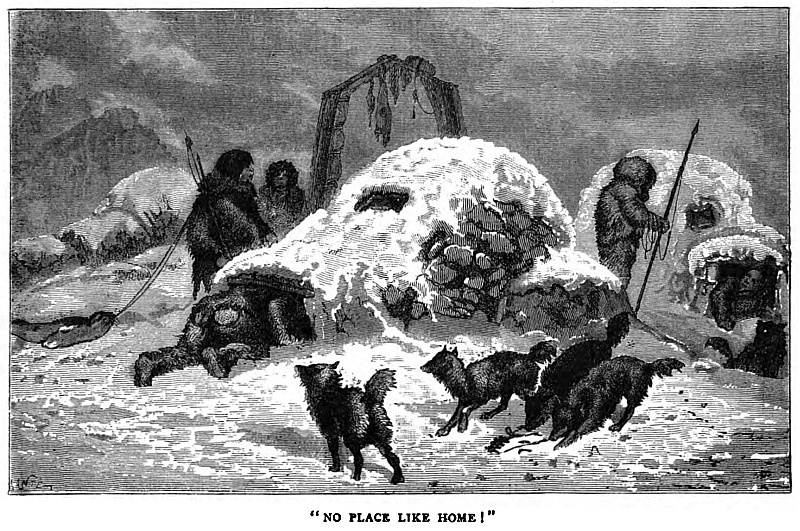
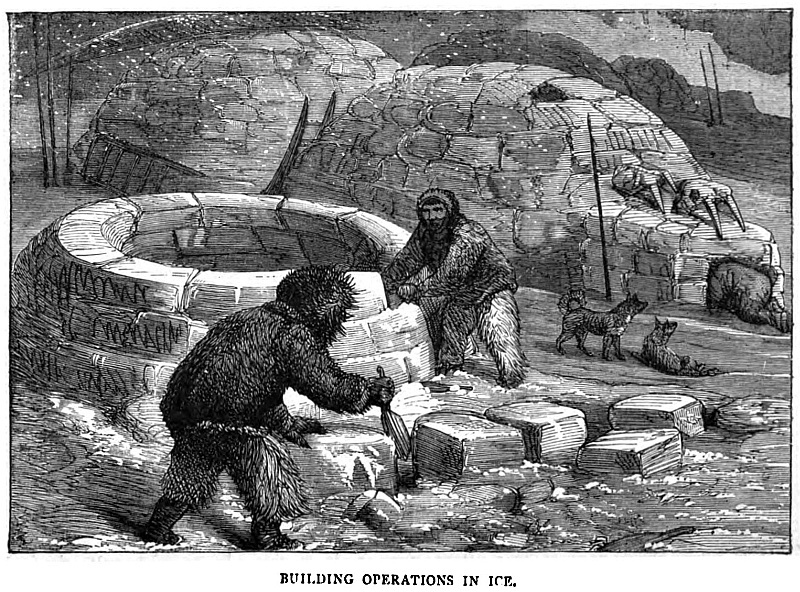
Our new friends at once set to work to build for us an igloo, or hut of ice, each block being about six inches in thickness, and a couple of feet in length, cemented by snow. The domed roof was made of snow, the key piece at the top being a large square slab. Our dwelling was about sixteen feet in diameter and seven in height, with a passage of about twenty feet, of sufficient height to allow a person to creep in on his knees, having a small chamber at the end.
While four of the men were engaged in building our hut, two others set off into the interior, and soon returned with a large piece of fresh-water transparent ice which was placed over the door to serve as a window.
The whole was completed within an hour, and a very comfortable abode it was when lined with skins of bears and deer. We judged from the advancing temperature, however, that it would not last very long.
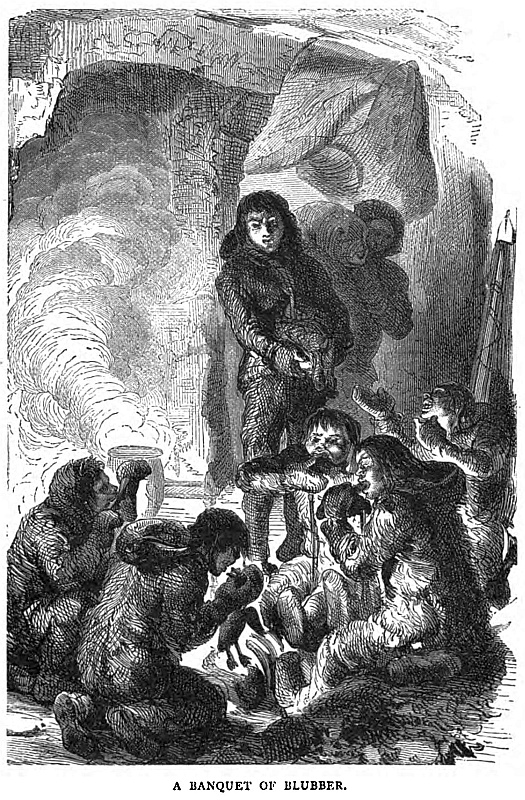
After we had been settled in our abode, our hosts invited us to come into one of their huts of still larger dimensions to enjoy a banquet, as we understood by the signs they made. Not wishing to offend them we accepted their invitation, though we would gladly have remained away.
The hut was crowded, and we could barely find sitting-room. A large mass of meat and blubber from a walrus which had just before been caught, was placed in the centre, when our friends, seating themselves, cut off long strips of blubber, and applied the ends to their mouths. It was wonderful to see the enormous quantity they swallowed, cutting off with their knives the portion they were unable to engulf between their teeth. With smiles they invited us to imitate their example.
Hungry as we were, it was some time before we could bring ourselves to put the horrible morsels into our mouths; but, finding that we were not likely to get any other sort of food, we at length managed to eat a few small pieces, our hosts appearing as much astonished at the smallness of our appetites as we were at the huge quantities of the oleaginous food they managed to consume.
After eating a few pieces, we overcame the nausea we had at first felt, and contrived to get down a tolerable meal. For an hour or more our hosts continued eating, when each took a draught of some greasy looking soup which had been boiling over the lamp in the centre of the hut. It was offered to us, but we preferred some plain water which had been produced from snow melted over their lamp.
Observing that we declined to take any more of their dainty fare, they made signs that they intended to go to sleep, by stripping off their outer garments and stretching themselves on the skin-covered couches which surrounded the hut. We gladly took the hint, and retired to our own abode, which, although very much colder than the one we left, had a decided advantage in being free from the horrible odour pervading the other. When our door was closed our lamp soon brought the temperature up to a comfortable warmth, and we slept with a sense of security we had not for long enjoyed.
The next day we tried to induce our hosts to accompany us to the south. They could understand our signs, but had evidently made up their minds not to go. They were very friendly, however, and allowed us to move about as we pleased. We, being unwilling to become a burden to them, determined if possible to kill a bear, or a deer, or walrus should we fail to find any of the former animals. We accordingly started off with our guns, leaving our packs behind us to show that we intended to return.
As the country to the southward appeared less rugged than that to the north, we proceeded in the former direction, but found after a short time that we could make but slow progress, so we descended to the ice, intending to strike inland should we observe no more practicable country. We had not proceeded far, however, before a heavy snow-storm came on, which not only obliterated our tracks, but shut out even the land from our sight.
“We shall be wise to turn back,” observed Ewen, “for if we don’t we may easily become bewildered.”
I agreed with him, and we at once determined to retrace our steps. We walked on and on, supposing that we had the land on our left side. The ice was tolerably level. We fancied that we had gone far enough to reach the Esquimaux settlement. Still though we listened attentively, we could not hear the voices of the inhabitants. We had scarcely taken note of time, and we now, somewhat to our dismay, found that it was rapidly growing dark. We hurried on, every now and then uttering a shout in the expectation of hearing a reply. No reply came, however, and we arrived at the alarming conclusion that we should have to spend the night on the barren shore. To reach it we turned to the left, but after going on some distance, we still failed to see the cliffs.
“We must stop here, for I can go no further,” exclaimed Ewen. “It would be better to build a hut than to wander about and at last perish with cold.”
I agreed with him, and although without any instruments save the butts of our rifles, from which we withdrew the charges, we commenced operations. As there was by this time abundance of snow, we were not long in forming a hut of sufficient size to hold us both, either lying down or sitting up. It would at all events prevent us being frozen to death; though there was the risk, should the snow continue to fall, that we might be buried alive. To prevent this, we agreed that one of us should sit up and keep open a hole by thrusting through it the barrel of a rifle.
After I had had my sleep, Ewen roused me up. Endeavouring to keep awake I every now and then seized my rifle and thrust the barrel through the hole, when I was startled by hearing a creature scratching away at the entrance of our hut. That it was a bear I had no doubt, and should the animal succeed in breaking in, it might seize one or both of us, as, lying down with our weapons unloaded, we should be completely at its mercy.
I roused up Ewen and advised him to reload his rifle while I did the same, and I hoped that we should have time to shoot the intruder, before he could seize us. We were, however, completely in the dark, though I expected to get sight of our assailant directly it had torn away the front of the hut.
“Perhaps if we shout we may drive it off,” said Ewen.
I agreed with him, and we together raised our voices, but scarcely had we done so than they were replied to by a loud bark, while the scratching was continued with increased vehemence.
“Why, that must be a dog!” cried Ewen.
“And I know the voice,” I said; “it is that of Bruno, our own Saint Bernard.”
I called his name, when I was answered by a peculiar bark and whine of recognition.
No sooner had we arrived at this conclusion than, seconding the efforts of the dog, we soon made an opening in the snow, and Bruno crept in and began licking our faces and uttering barks to show his delight.
“He must have scented us out in spite of the snow, and followed us here,” I exclaimed. “Can our shipmates be near?”
That such was the case we had little doubt, and we agreed that should Bruno show a wish to conduct us, we would accompany him. Scarcely had we resolved on this, than Bruno ran out of the hut, and then came back pulling at our trousers and leaving no doubt as to his intentions. We therefore kept up alongside him as fast as we could move. He regulated his pace to suit ours, otherwise in his delight he would evidently have bounded away before us. At length, however, through the still falling snow, we caught sight of what we concluded was the land, though in the indistinct light we could not be certain that it was not a berg.
We shouted, expecting to hear a reply from our shipmates; but, instead, a voice answered which we knew to be that of an Esquimaux. Presently we found ourselves at the village we had left. Several of our friends came out of their huts, uttering exclamations of surprise at Bruno, and driving back their dogs, who began furiously barking at him. He had evidently conducted us to the nearest human habitations. Still we were convinced that Sandy’s party could not be far off.
As verbal explanations were impossible, we tried to show by signs that we had lost our way, and that the dog had found us. They then, guessing that we must be starving, brought us a large piece of walrus flesh, the greater portion of which, as may be supposed, we afterwards bestowed on our faithful dog, who crept after us into our hut. Having eaten enough of the meat to satisfy the cravings of hunger, we lay down and were soon fast asleep. In the morning I was awakened by hearing the loud sound of the rending and crashing of ice. On looking out I saw that the part of the ice on which we had wandered was separated from that attached to the shore, and was, with all the pieces beyond, in violent commotion. Had we remained on it a few hours longer, we should inevitably have perished.
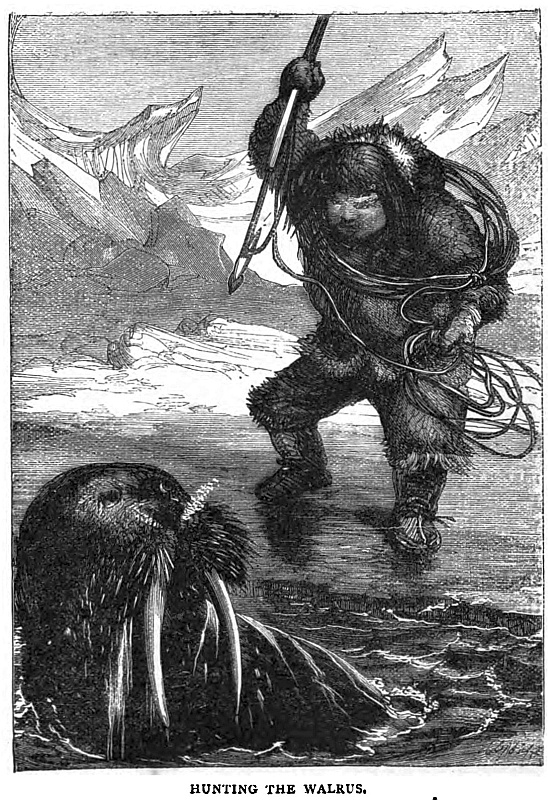
Our friends seemed highly pleased. We saw them preparing their harpoons and lines. Some dark objects appeared on the edge of the ice, and several of them immediately started off, one of whom we followed, keeping, however, at some distance, so as not to interfere with his proceedings.
The objects we had seen were walruses. Though they immediately afterwards slid off into the water, the Esquimaux continued his course towards the spot with his eyes fixed on the water. He stopped; we saw him lift his harpoon, and immediately afterwards the head of a huge walrus appeared above the surface. It was but for a moment. The hunter darted his weapon with all his force, and then unwound a long line which he carried on his shoulder. With wonderful dexterity he played the monster as a fisherman does the salmon he has hooked. Sometimes the creature dived, and at others came up to the surface and looked as if he intended to get on the ice and charge his enemy, but the hunter retreated, keeping his line taut.
The hunter, seeing we were watching his proceedings, made a sign to us to approach. As I did so, having my rifle in my hand, I fired, and the shot entering the creature’s head its struggles ceased. The Esquimaux, highly delighted, thanked me for the assistance I had given him. It was not until several of his companions arrived that we were able to haul the walrus upon the ice. Soon afterwards Ewen shot another in the same manner, thus raising us high in the estimation of our hosts. The other hunters were equally successful, and there was great rejoicing in the village at the abundance of meat which had been brought on shore.
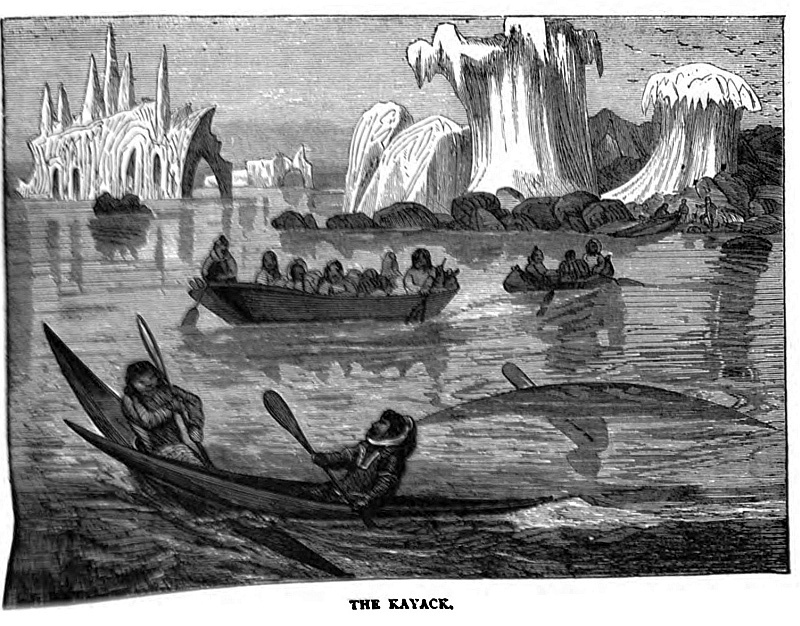
Several kayaks were now brought out of a hut, where they had been sheltered during the winter, and, being carried over the ice, were launched into the open water. They were made of skins and entirely covered over, with the exception of a small hole large enough to admit a man’s legs and the lower part of his body. Each hunter was provided with a double paddle and harpoon. To the harpoon was attached by a line a float made of a leathern bag inflated with air.
One end of the harpoon line was secured just below it, the other end being made fast to the head of the harpoon. About half-a-dozen hunters had taken their seats, for they had observed, what we had not, a whole shoal of seals not far off. They immediately made chase. We eagerly watched their proceedings. Presently the seals came to the surface, when the Esquimaux, paddling on, soon got into their midst. The harpoon being darted, the shaft, which was shaken out of the head, was allowed to be towed with the float after the seal.
One after the other the hunters launched their weapons, and the seals were seen swimming away in a vain endeavour to escape. The nimble kayaks quickly overtook them, and the second harpoon seldom failed to wound them mortally. Although they sank on being killed, the floats served to show where they had gone down. One of the most wonderful parts of the performance was the way in which the Esquimaux hauled up the big seals and placed their bodies across their canoes; when, singing songs of triumph, they returned to the ice, where friends stood by to take possession of their prey.
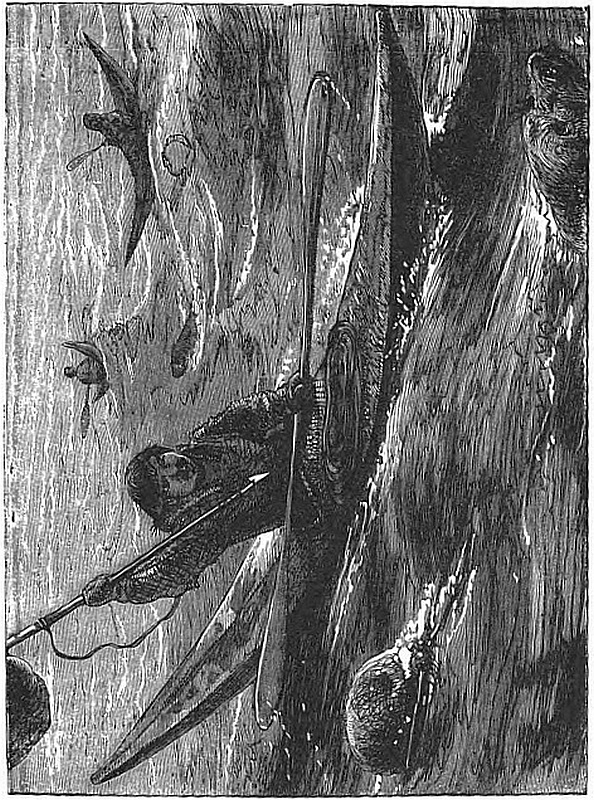
Without even getting out of their canoes, they again darted off, and few returned without another seal.
When we expressed our admiration of their kayaks, our friends showed us several wonderful feats which they could perform in them. Two of them started off together, one at right angles to the other, and almost in a moment, without upsetting, the latter forced his canoe directly over it. We saw a still more extraordinary feat. A man, having secured himself tightly in his canoe with an apron fastened round his body, with a blow of his paddle upset it, and with another brought it right again; and thus he continued, turning round and round full twenty times or more, so rapidly, that we could just catch sight of his paddle in the air before it disappeared.
Our friends had another kind of boat which they called an “oomiak.” It was straight-sided, flat, and square-ended. The framework was made of whalebone and covered over with seal-skin, almost transparent. It was three feet deep, about twenty-five long, and eight wide. It was propelled by two paddles, while an old man sat with another paddle in the stern to steer. On seeing this primitive sort of boat, the idea struck us that by its means we might be conveyed southward. We tried by every means in our power to induce our friends either to lend us one or to go with us.
We had already promised them our rifles, the value of which was greatly increased now that they had seen their power. They had also taken a great fancy to Bruno, and they at length gave us to understand that, if we would make him over to them and give them a couple more rifles with powder and shot, they would convey us as far as we wished to go.
We were sorry to have to part with Bruno, but, at the same time, we were convinced that he would be perfectly happy and well-fed in the realms of snow, where he might revel to his heart’s delight.
We accordingly started the next morning with two men to paddle, and a third to steer. The boat was also fitted with a very short mast, stepped in the fore-part, and a sail composed of the intestines of the walrus split open so as to form strips about four inches wide. These strips were sewn together, and thus made a sail of great strength and lightness. When the wind was favourable we were able to hoist it, and it drove the oomiak along at a far greater speed than I should have supposed possible.
The people allowed us to take our rifles, having no doubt, apparently, that we would give them up at the end of the voyage. The whole tribe stood ready on the ice to see us off, and vociferously uttered their farewells, which we returned in like manner.
The weather was remarkably fine, and, although icebergs and floes innumerable covered the surface of the water, we had no difficulty in making our way between them. When one floe approached another, we with ease jumped out and carried our light boat beyond the power of our assailant. As we proceeded the floes became fewer and fewer, and we made more rapid progress. At night we either landed on the shore or on a fixed floe, and, creeping under the oomiak, slept on our bear-skins.
We harpooned a couple of seals and shot a bear, which afforded us abundance of food. We were standing along the shore one evening when, under a cliff, what was our astonishment to see a light. The Esquimaux were inclined to avoid the place; for, pulling away, evidently alarmed, they assured us that the spot would not afford comfortable camping-ground.
We, however, were anxious to ascertain by what the light was produced, feeling certain that some person must be on the shore who was making a signal. At last we persuaded them to turn the boat’s head towards the beach.
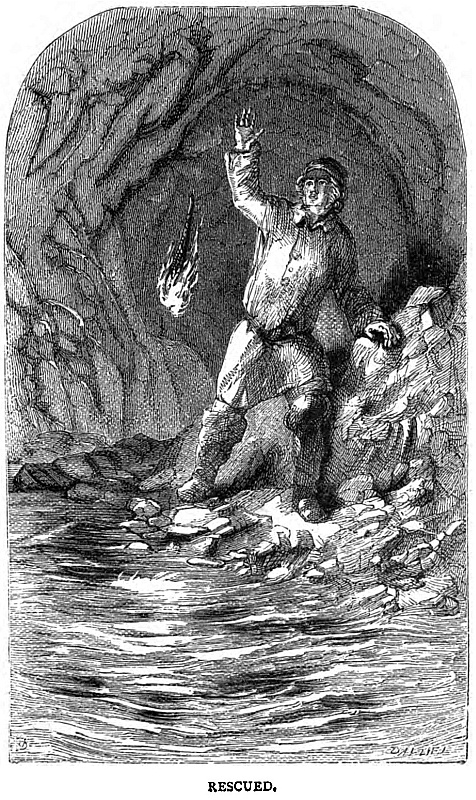
As we approached, what was our astonishment to see a man standing at the mouth of a cave, and holding a torch which, in his eagerness, as we drew near, he flung into the air.
“Who are you?” shouted Ewen.
“An Englishman,” was the answer.
We quickly leaped on the beach, and the stranger, advancing to meet us, stretched out his hands.
“Thank Heaven you have come, for I was very near perishing,” he exclaimed. “My powder and shot were expended, and I had consumed the last remnant of the meat of the last deer I had killed.”
I replied that we had sailed in the Hardy Norseman, that she had been lost on the ice, and that we had been separated from our companions.
“Why, that ship belonged to Dundee, the port I sailed from in the Barentz.”
“Are you, then, her surgeon, David Ogilvy?” I asked in a trembling voice.
“I am,” he answered.
“Then I am your younger brother,” was my reply, and we threw ourselves into each other’s arms.
After recovering ourselves, I introduced Ewen, when my brother invited him and the Esquimaux into his cavern. Though the entrance was small, the interior was of considerable size, and had been made habitable by means of skins and the wreck of the very sloop in which he had escaped. Most of her crew, he told us, had left her in search of walruses, when a storm arose, and she was driven among the ice on to the coast, the remainder of his people perishing. He had providentially been able to save two rifles and all the ammunition on board, together with the larger part of her provisions. After finding shelter in the cavern, he had discovered a path which led to the heights above. From thence he had been able to make excursions into the interior, where he found reindeer and musk-oxen in considerable numbers, together with mosses and several herbs, with the qualities of which being acquainted he was able to vary his food.
The next morning we loaded the oomiak with as many of the skins as she could carry, and proceeded on our voyage. To our disappointment we found our further progress stopped by a large field of ice, which had been driven against the shore or had remained fixed to it since the winter. We must either cross it—and it might extend for several miles, besides being covered with hummocks—or we must paddle out seawards and try to get round it. The latter proceeding did not appear to suit the ideas of the Esquimaux. Rather than be delayed, however, they consented to make the attempt, as we persuaded them that a passage might be found further out. After we had gone a short distance, on looking seaward, great was our astonishment to catch sight of a flag. Presently afterwards we saw some dark dots on the floe, which had apparently come in contact with the field of ice at present impeding our progress.
“Can it be possible that those are our shipmates?” exclaimed Ewen.
“I have no doubt about it,” I answered. “I see three persons; perhaps they are Sandy, Croil, and Hans. I trust that the poor fellows have escaped.”
To make sure I fired off my rifle, when the shot was replied to, though the sound but faintly struck our ears. The Esquimaux had now not the slightest hesitation of paddling out.
As we drew nearer other figures appeared who came to the edge of the floe. Among them was my brother Andrew.
“It is our crew. The whole have escaped then,” exclaimed Ewen, as we made him out.
To our infinite satisfaction, Sandy himself was the next person we distinguished, and several others who had seen the oomiak came hurrying across the ice.
I have not time to describe the meeting of us three brothers, thus so wonderfully preserved and reunited. Sandy had come upon the floe while for a short time it remained fixed to the land-ice, and had arranged to return the next morning to rescue us, when, to his dismay, he found that it was in motion, and that any communication with the land was impossible. The boats, being damaged, were unfit at present to be launched, but the carpenters were very busily employed in repairing them. It was the captain’s intention to land as soon as they could get opposite the settlement of Friedrichsthal, should the floe hold together so long, or, should its disruption be threatened, to make the voyage in the boats. We, of course, were willing to share the fortunes of our friends.
On returning to the oomiak we bestowed the rifles and ammunition we had promised on the honest Esquimaux, to which we added several other articles of a sort they valued.
David, Ewen, and I were cordially welcomed by the captain, Sandy, and the rest of the crew, who appeared to have suffered little from their long exposure on the floe. The wreck of the Hardy Norseman, however, had broken off and gone to the bottom. We had now the boats alone to depend upon. Scarcely had the Esquimaux taken their departure and paddled away than the floe began to move. As it did so I could not help seeing our perilous position, for at any moment it might drive against a berg, which might topple over and crush us. The wind, too, which had until now been favourable, changed, and there appeared great probability of our being again driven northward. Two days had thus passed, when the look-out, who was stationed at a flag-staff on the top of a hummock, shouted, “A sail, a sail!”
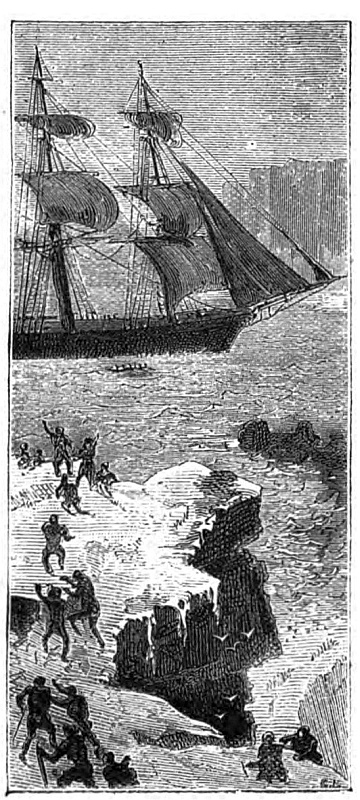
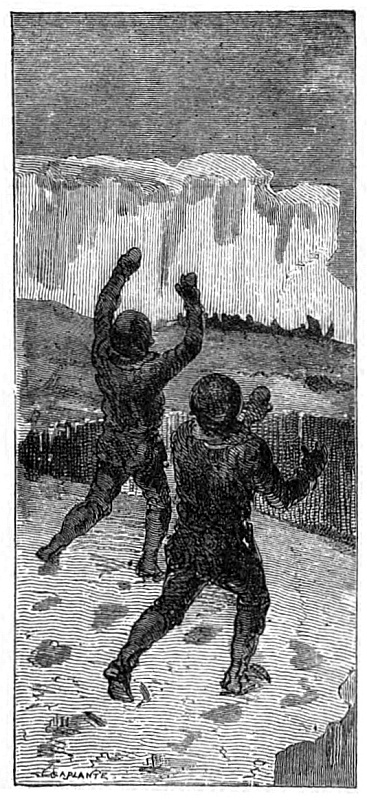
All hands quickly joined him, when we beheld the joyful sight of a ship standing towards us, some way to the southward. She could not possibly fail, we thought, to see our flag. We were not mistaken. On she came. As if to hasten her progress, some of us fired off our guns, others shouted. Several of the men danced and clapped their hands, and others wept and rushed into each other’s arms. Then, as the ship approached and began to shorten sail, we ran down to the side of the floe on which she was approaching, and waved our caps and cheered. As the floe was steady, she glided up alongside, and threw her ice-anchors on to it.
“She’s the Barentz!” exclaimed David, “though her appearance has changed greatly for the better since I last saw her.”
The Barentz she was. Having been refitted, she had been the first ship to sail from Dundee in search of us, her captain calculating that, having escaped with our lives, we should be found not far off from the spot where providentially he had fallen in with us.
The remaining stores and skins, together with those belonging to my brother, and everything of value, were quickly hoisted on board, and the Barentz, having already caught several whales, before long obtained a full ship. Her head was then turned southward, and, after all our wonderful adventures and hairbreadth escapes, we reached in safety the port of Dundee.
The End.
|
Chapter 1
| |
Chapter 2
| |
Chapter 3
| |
Chapter 4
| |
Chapter 5
| |
Chapter 6
| |
Chapter 7
| |
Chapter 8
| |
Chapter 9
|