WHG Kingston (continued 2)
Reading edition
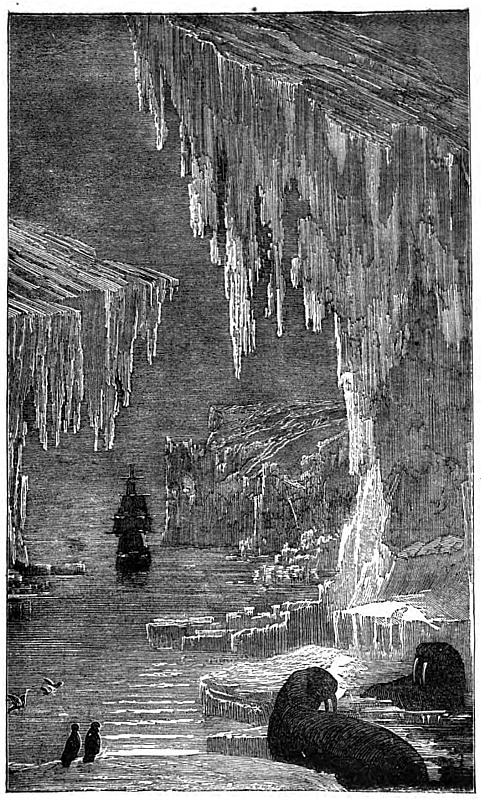
As the sun rising in the heavens sent down his warm rays, we could see numerous seals basking on the floes, or on some projecting point of a berg. Some of the boats were constantly engaged in shooting or harpooning the creatures, while others were kept in readiness to go in chase of the walruses which frequently made their appearance, though we did not always succeed in getting near them, as, diving beneath a ’berg, they did not rise again until the opposite side was reached.
The mate and Croil were now perfectly recovered, and enabled to take a part in everything going forward. Their services were required, for, in consequence of the hands we had lost, we all had work enough to do. I went in one of the boats, whenever I could get a chance. I was bound otherwise to remain on board and assist in managing the ship while they were away. Frequently we had enough to do, as we floated among the bergs and floes, to escape those which came drifting towards us, driven on by some under-current, more than by the wind. The broken state of the ice induced our captain to believe that we should as easily get out of it as we had made our way into its midst. He was more inclined to this opinion, when we suddenly found ourselves in the open sea with scarcely a floe or berg in sight. Had we met with whales we might have cruised about in chase of them, and not proceeded further, but only a few appeared ahead to the northward, and those we failed to kill.
“Never fear, lads,” said the captain as the boats returned on board, the men looking blank at their want of success. “We shall fall in with plenty more in the course of a day or so, or it may be in a few hours, and we may still get a full ship, and be south again before the summer days begin to shorten.”
The pack-ice, Captain Hudson told us, was this year much further north than he had ever known it, but he thought that a good sign, and he hoped to find lanes through which we might make our way into ponds seldom reached by whalers, where we might kill the fish faster than we could flense them.
Voyagers during the Arctic summer day require sleep as much as at other times, though often it has to be obtained at very unequal intervals. Having been awake for the best part of twenty hours, I had turned in—I don’t know whether to call it one night or one day—when I was aroused by a tremendous blow on the ship’s bows, which made her quiver from stem to stern. I was rushing on deck with my clothes in my hands, not knowing what might happen, when I found that she was forcing her way through a stream of ice, and that ice surrounded her on every side. A strongish breeze was blowing, and the canvas was being reduced to prevent another such encounter, which might produce serious consequences. Finding that nothing was really the matter, I quickly dived below again to put on my clothes, when I once more hurried on deck. As I was looking round my eye was attracted by a dark object at some distance on the starboard bow. I pointed it out to the captain, whose glass was directed towards it. “It is a vessel of some sort. A Russian or Norwegian sloop. She has been nipped probably, for she seems to lie on the ice, out of the water; but whether her crew are still on board, or have made their escape in their boats, it is hard to say.”
“We must go and ascertain,” exclaimed Andrew; “our brother David was taken off by a vessel of that description, and for what we can tell, he may be on board.”
“It will be impossible to reach her,” answered the captain; “there is no lane leading in that direction. If you attempt to cross the ice it may open at any moment, giving you little chance of escaping with your lives.”
Still Andrew entreated that he might go, and proposed making an expedition, three or four of us joining ourselves together by a long rope. We consulted the boatswain, who at once volunteered to form one of the party, as did Ewen and Croil. The captain, after ascending to the crow’s nest to examine the ice, gave us leave, and allowed us to take one of the boats which would carry us part of the way, charging us, however, not to delay a moment longer than was necessary. Quickly procuring a long rope, we jumped into the boat and pulled ahead of the ship, along a lane which opened out to the eastward. Our further progress was soon stopped. Having fastened ourselves together at the distance of four or five fathoms, each provided with a long pole, we leapt on the ice, Sandy taking the lead, we three lighter ones followed, and my brother brought up the rear. We had some hummocks to climb over, but generally the surface was level, and we made rapid progress, but still the sloop appeared much farther off than I had supposed. I saw Sandy try the ice when he was doubtful of its consistency, as he went along; but, satisfied that it would bear him and consequently any of us, he pushed forward.
I eagerly looked out expecting to see some people appear on the deck of the sloop. As we drew nearer I uttered a loud shout in which my companions joined, but no one replied. Could all those on board be dead, or had she, as the captain supposed, been deserted? I asked myself; and the dread seized me that we should find David frozen or starved to death. Such things had too often occurred before, and might have happened in this instance. In my eagerness I could not help shouting to Sandy to go on faster.
“More speed the less chance we shall have of getting there, my boy,” he answered, stopping to strike the ice in front of him with his pole. He drove it through. “There, you and I should probably have had a cold bath,” he observed as he turned aside to find more secure footing.
We had to make a considerable round to a sort of bridge, where two floes had overlapped. We crossed safely, and now the sloop appeared not a quarter of a mile ahead, her dark hull partly heeling over, and her shattered mast standing out sharply against the white back-ground. The distance was soon passed over. Once more we shouted out before we began to clamber on her deck. Sandy and I, being the first up, eagerly looked down into her after cabin. It was half full of water. No one could be seen; so hurrying on to the other hatchways, we peered down them. It was tolerably evident that no one, alive or dead, was there. So far, then, our worst fears were not realised.
“Look here!” said Sandy to me, “the crew may have made their escape in their boats and have been picked up by another craft. See, the sails are unbent and all the ropes carried off. If it was worth while getting a wetting we should find that nothing remains of value below, either fore or aft.”
That such was the case, a further examination fully convinced us. Still Andrew and I would have been thankful if we could have discovered some traces of our brother, should this have been the sloop he had got on board. The boatswain, however, remarked that numbers of vessels of the same description came northward during the summer, that it was just as likely he had never set foot on her deck, and that we might find he had got home safe before us.
According to our promise, the instant our inspection was over, we commenced our return journey. As the ice was becoming firm, we cast off the ropes and separated from one another, each man taking his own course. I thus got to a considerable distance from my companions. I was still some way off the edge of the floe, though in sight of the ship, and could make out the boat approaching to take us off, when up started from behind a hummock a huge polar bear, which probably mistook me for a walrus or seal, and therefore its lawful prey. My first impulse was to run, instead of Standing still and facing my enemy as I ought to have done. I had very nearly gained the edge when what was my horror to see that the bear was within twenty paces of me. A glance round showed me the boat, still some way off, while my companions were at too great a distance to afford me assistance. I now did what I should have done at first, stopped and rammed a bullet into my rifle. The bear stopped also, sitting up on its haunches, to examine me more particularly. Could I have got off my shaggy coat, I would have thrown it at him, to attract his attention, for I guessed his next movement would be to bound upon me and press me in his terrific embrace. All I could do, however, was to throw my cap at him, when, dropping down on all fours, he began to smell at it. Now was my time to fire a shot which I hoped might kill him. Should I miss, I knew too well that I had not the remotest chance of escape. Mustering all my nerve, I levelled my rifle and pulled the trigger. The bullet must have gone through his brain, for, without making another move, he rolled over and giving one struggle was dead.
I should have fallen on the ice and rendered thanks to heaven for my preservation, but in reality I could not for some seconds move a muscle. I could scarcely persuade myself that the huge monster, which had just before appeared so terrible, was now a mass of flesh.
The shouts of my companions in the boat who had seen the occurrence aroused me, and, soon arriving, with the rest of the party, they hauled the huge carcase on board the boat, and we returned in triumph to the ship.
Chapter Five.
After visiting the unfortunate sloop, a fair lead appeared, with a pool of considerable size to the northward. Making all sail we stood on, hoping to find whales sporting within it. Before, however, we reached the pool the wind dropped, and the boats were sent ahead to tow the ship. This mode of progression was, however, before long rendered impossible, by the closing of the floes. We had continued to warp her along by carrying out ice-anchors, and working the windlass. We looked anxiously ahead, for the lane was becoming closer and closer, and it seemed not impossible that we should be compelled to form a dock to save the ship from being nipped. Saws were got ready, and every other preparation made for cutting a space in the ice sufficient to hold the ship. At length the captain seeing that the pool itself was contracting, gave the word to commence the work. All hands were required for the task, some used the saws, and others hauled away the blocks as they were cut out. It was hard work, but no one grumbled, as our lives might depend upon our getting it accomplished in time. Scarcely was it finished, than the floes closed, not with such force as we expected, but with quite enough to have crushed our stout ship into a pancake. Instead of such being the case, we floated free from harm in the basin we had formed. Here we were doomed to lie until the ice should open again and set us free. Some dark objects, which we guessed were seals, were seen on the edge of the pool. To employ our time, we set off to try and kill some of them.
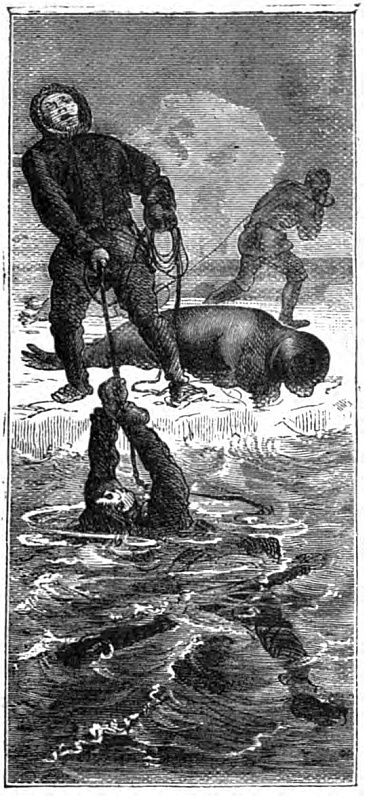
Ewen had been eager to distinguish himself as a harpooner, and he and I went together. Observing a couple of seals, we crawled towards them so cautiously, that we got near enough, without waking them, to dart our weapons. As we rose to our feet, I struck mine with all my force into the head of the animal nearest me, almost pinning it to the ice. Ewen was not so fortunate, for although he fixed his harpoon into the animal’s body, before he had time to take a turn with the line round a rough point of ice near at hand, the seal plunged into the water, and he, holding on to the rope, was dragged after it.
I shouted out to him to let go, which, as may be supposed, he right willingly did, and fortunately was able to catch hold of my line which I threw to him, when I hauled him up safe again on the ice. His first impulse was to look over the edge, hoping to recover the line, but that, with the harpoon, had disappeared.
“Thank you, Hugh, for saving my life,” he said, “but I wish you could have caught the harpoon and line, for I shall be laughed at as a bungler.”
I did my best to console him, and Sandy, who soon afterwards came up, assured him that many a now famed walrus and seal hunter had commenced his career with equal want of success.
Several other seals had been killed, and the rest having been frightened away, as there was no chance of capturing any more, we commenced our return, Ewen assisting me in dragging our prize to the boat. A few hours after we got on board, once more the ice opened, and all sail being made we stood on, our hopes renewed of being able to capture as many whales as we required.
“We shall have a full ship!” cried the captain, rubbing his hands as we lay in the pool with a whale on each side, which had been killed within an hour after we reached the open water. Others were spouting in all directions, and two boats being away, it was hoped that we should have a couple of fish ready to take the place of the others, the moment the flensing was finished. But as I had already seen the rapid way in which the ice changes its position in those regions, I was not too sanguine. Scarcely had the blubber from the two whales been stored below, than the ice was seen to be moving, and as the boats were towing up a third whale, it began to close in on us, the large pool becoming a broad lane, while other channels disappeared altogether. Notwithstanding this the whale was brought alongside, and every effort was made to flense it rapidly. Still the ice was coming closer and closer. A favourable breeze just then sprang up, and a narrow lead which ran towards an expansive pool opened out before us. By remaining where we were we might get crushed before we could flense the whale, and with great reluctance the captain ordered it to be cast off and sail made.
We had not got a quarter of a mile, when, looking astern, we saw that the spot where we had floated was one sheet of ice.
“Better luck, next time,” said our skipper, who was always anxious to encourage the men.
That luck however was not for us. The lead as we advanced became blocked up with floating masses, some of them monster icebergs, amid which we forced our way until the wind dropped.
The boats were now sent ahead, some to tow, others to shove away with long poles the ice which impeded our progress. At length we reached an ice-hole, when the boats being hoisted on board, we made sail, hoping to find a lead on the opposite side, but we were to be disappointed—no opening could be discovered.
We, as usual, made fast to a floe, and the captain after a visit to the crow’s nest, expressed his intention of returning southward.
The announcement was received with a cheer by the crew, but there was no wind, and we had to wait for a breeze to carry us back the way we had come. That way was, however, no longer open: the pools were lessening in size, and in a few hours not a single spot of clear water could be seen.
Again and again the crow’s nest was visited, but each time the same report was brought. It was very evident that we were closely beset. Still our brave captain did not despair, and promised that, should the ice open again, it would not be his fault if the ship failed to make her way through it.
The object of the voyage, for the time, was entirely forgotten, all we thought of was to effect our escape. Never for a minute night or day was the crow’s nest empty, some one being always on the look-out to report the state of the ice. I frequently went aloft. Ice alone was visible in whichever way I looked: here piled into immense masses, huge fragments of glaciers detached from the neighbouring shores either of Greenland or Spitzbergen; there broken hummocky slabs resting against each other in every variety of form; or else vast level plains, over which it appeared that a sleigh might travel for miles without impediment; but water there was none, and I could scarcely hope that that frozen expanse would ever again break up sufficiently to allow us to force our way through. We knew that at all events we should have to encounter, to the southward, the numberless icebergs and the dense floes through which we had before passed. Had we found my brother David I fancied that I should have been happy, but his fate was still shrouded in mystery, and even if we escaped we should have to return without him.
The sun now remained between two and three hours below the horizon, but, short as was the night, the holes we had bored to obtain water were frozen over in the morning. Still we hoped that an equinoctial storm might break up the ice-fields and set us free. Before, however, we had been many days in this position, a dark streak was seen to the southward.
“There’s water there,” observed the captain with confidence in his tone; “it may be the open ocean.”
Almost immediately afterwards other tracks were seen indicating leads through the ice, and at length some appeared so near that the captain determined to open a passage through our floe to reach them by blasting and sawing. Hope revived within us that we should get through. Laborious as was the process, we persevered. Every fathom gained made us fancy that we were so much nearer liberty. The wished-for storm at length began to blow; the ice broke up. All the sail the ship could bear was spread, and away we steered with her head to the southward. What cared we now for the thundering blows received on her stout bows. We were determined to be free. Freedom we believed we should obtain, when to our dismay the first mate, who had gone aloft, announced a dense floe with icebergs ahead: to run against, it would have ensured our destruction, and we were compelled to steer to leeward of a floe, when, furling all sail, we made fast to it. The wind falling, a dense fog came on. The sounds which reached us showed that the ice was still in violent commotion, and, in the hopes that a passage might be found, the captain dispatched two of the boats to try and find a way.
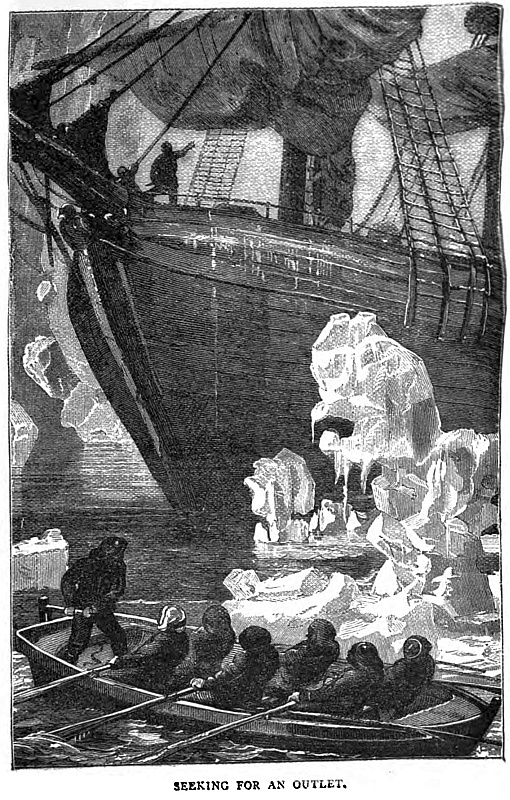
I went with the first mate. We had gone some distance, when he announced that he saw an opening, and immediately headed the boat towards it. Looking up we could see a huge iceberg towering above our heads. We had great hopes that we had entered a lane through which the ship might pass, but the thickness of the atmosphere prevented us from seeing far ahead. The mate however was convinced that he was right, and we were about to put back when again the wind began to blow with a violence far greater than before, and the sea tossed and tumbled, moving the mass of ice about in a manner which threatened our destruction. The turbulence of the waters proved that the mate was correct in regard to there being an open sea to the southward, and we bent to our oars with all our strength, that we might return to the ship, and take advantage of the opening.
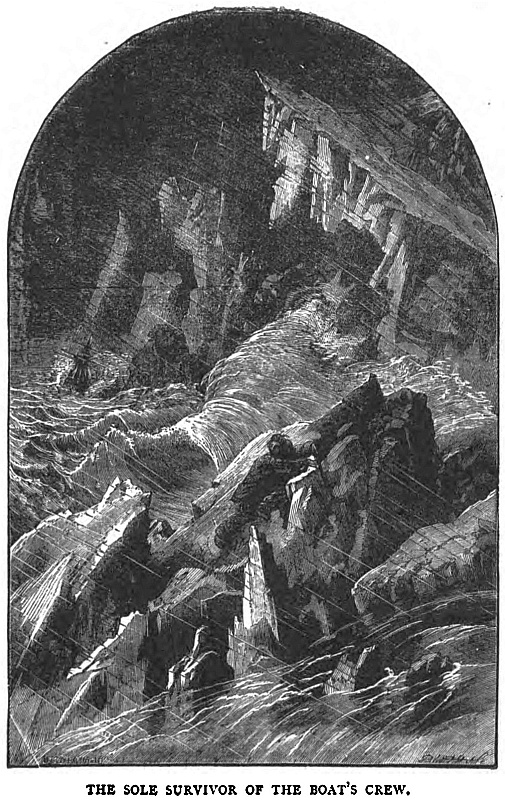
I remember that we were passing close under an iceberg, when I heard a terrific crash, and all was dark, and I knew that I was beneath the water. By a violent effort I rose to the surface, and the next instant found I was clinging to the ice. The force of the sea threw me still further on the berg until I was beyond the reach of the waves.
My position was awful in the extreme. The snow began to fall, driving against me with fearful force. I looked round but could nowhere see the boat or my companions. I alone had been saved from instant death, to perish, I believed, in a more lingering manner.
I expected ere long to drop off into the sea or to be frozen to death, still I resolved to struggle for life. How the time passed I could not judge. Every moment seemed an hour. Looking round, the fall of snow seemed lessened, and I caught sight of the ship. It appeared to me in the indistinct light that she was being dashed furiously against the berg, and that her destruction was inevitable. Should she founder I knew that my chance of life was slight indeed. I felt inclined to slip off and terminate my suffering at once, rather than attempt to cling on until overpowered by the cold; but I felt that it was my duty to prolong my existence to the last, and I did my best to secure myself by placing my feet on a ledge below me. I was conscious, however, that my mental and physical powers were both failing me. I looked for the ship, but could nowhere see her. Had she, with my brother and all hands, foundered? Such appeared too probable. Dreadful was the thought. I was fast sinking into insensibility when I heard a hail, and on looking down saw Sandy with an ice-pole in his hand, clambering up the berg towards me. In another moment his arm was around my waist, and I knew no more until I found myself in the boat and heard my preserver shout—
“Shove off, lads, he’ll come round in time.”
Opening my eyes I saw that the boat was pulling away from the berg, but I could nowhere perceive the ship. Were my fears then for her realised? I wanted to ask Sandy, but it seemed as if the power to speak had left me. Again and again I tried, but my lips refused to move.
“What is it, laddie?” asked Sandy, perceiving the efforts I was making, as he bent down his ear for a moment to my mouth.
I managed to utter “The ship.”
“She’s all right,” he returned; “she managed to weather the berg, and is now brought up to leeward of the floe, but she had a narrow scrape of it, and we thought for certain that she’d be knocked to pieces.”
My mind felt greatly relieved, but Sandy having to attend to the steering of the boat I could not again attract his attention. I was anxious to know what had become of the boat. I did not suppose it possible that she could have escaped. After some time I managed to utter the word “boat” loud enough for him to hear me.
“It is a sad business, the poor fellows are all lost. We saw the wreck dashing against the base of the floe, and that drew our attention to you. Although we saw you at a distance we at first took you for a seal.”
I asked no further questions. Some twenty minutes or more passed away before we reached the side of the ship. It was surprising that during the time I did not perish from cold. I was hoisted on board, and Andrew had me carried below immediately and put to bed with warm appliances to my feet and chest. At first I suffered great pain, but at length I began to feel a sensation of comfort and dropped off to sleep. I afterwards found that Sandy’s boat had not gone back to the ship as I supposed, but that the foggy weather clearing off she had got under weigh, hoping to find some channel, and that she had discovered the one we were attempting to pass through when the mass of ice had fallen upon us.
On awaking I felt greatly recovered, but my brother would not allow me to leave my bed. I observed that he looked very grave. I inquired if anything had happened.
“The loss of the first mate and the boat’s crew is a serious matter,” he answered, “but our own position is critical in the extreme. We have failed to get through among the icebergs, and are now passing through a lead to the westward. It is possible that we may get out by it, but if not we shall, too probably, be beset for the winter.”
“We’ll get through, doctor, don’t be cast down,” exclaimed the captain, who had overheard my brother’s remark. “We must keep up the spirits of the men, they’re rather low at having lost so many of our shipmates.”
I knew from the sounds that the ship was still making way. Sooner than Andrew had expected I was all to rights. On once more going on deck, I found that the captain was in the crow’s nest, looking out for a further lead, of which, from where I stood, nothing could be seen. There were a few water-holes and openings in the ice, none of them, except the one in which we floated, being wide enough to admit the ship. The sun was sinking towards the horizon, and a night of three hours’ duration was approaching. The captain on coming down ordered the ice-anchors to be carried to the floe to windward, and the ship to be made fast.
“We shall be out of this in a few hours, lads, I hope,” he said. “The ice will open again soon, though at present I see no lead to follow.”
Andrew sent me below soon after this. I was struck, when awaking at night, with the perfect silence which prevailed everywhere. It was evident we were not moving. The next morning when I went on deck, to my dismay I found that the pool in which we floated was completely frozen over. The crew were cutting away the ice from round the ship. It was thick enough to bear them. While they were thus employed, the floes around them began to move, emitting a rustling sound, or perhaps I might liken it to a suppressed roar. The ice in the pool cracked in all directions, and one slab was forced over another. The violence of the movement increased on every side. We could see huge masses of ice rushing together, one being piled over the other, until the appearance of the surface became completely changed. Every moment it seemed as if the ship herself would be nipped. The ice tumbled and tossed about in a most fearful manner, filling the air with shrieks and howls, for I can liken the noise it produced to nothing else. The hitherto level floes became piled up into mountainous masses, towering many fathoms above the deck. We could do nothing to preserve the ship. The captain, believing that any moment might be her last, ordered the crew to bring their bags and the provisions which we always kept ready for such a catastrophe up on deck. Should the ship be crushed where could we go for safety? The boats would be destroyed if placed on the ice. Though we might escape to it, we could only expect to be utterly overwhelmed.
We could now see water round us in various directions, but we were too closely beset to obtain any chance, unless some lane should unexpectedly open by which we might reach one of the pools to the southward. In about a couple of hours, however, the commotion ceased, but as it did so our chance of escape lessened. The cold became greater than we had yet felt it, and every floe and mass of ice was soon securely bound together. Although we had not had time to form a dock, one made by nature had preserved us.
Next day there was no change, except that the distant lanes and pools appeared to be closed. Although our captain must have seen that there was a great probability of our having to winter in the ice, he was unwilling to dishearten the crew by preparations until it was absolutely necessary. We, in the meantime, for the sake of taking exercise, made excursions over the ice, generally accompanied by some dogs.
Of course we carried our rifles, and Sandy, with some of the men, took their harpoons, on the chance of finding a seal or walrus on the ice or coming up to breathe through a water-hole. Ewen and Croil and I set off from the ship one morning, expecting to shoot some snow-buntings or other birds, or perhaps, should we get near a water-hole, to kill a seal. We carried provisions with us, as the air invariably made us hungry. The captain had charged us not on any account to lose sight of the ship. We had gone on and on, looking back every now and then, seeing her clearly enough. At last Ewen proposed that we should sit down under the lee of a huge hummock and take our lunch. Croil and I were perfectly willing to do this. We had finished our repast, which as may be supposed did not take us very long, when Ewen, looking up, exclaimed, “Where is the ship?”
She was not to be seen.
“Stay! I’ll climb to the top of this ice-hill, and I shall soon make her out from thence,” said Ewen, placing his rifle against a block of ice near the spot where he commenced his ascent. He found the task a pretty hard one.
“Perhaps we shall find it more easy on the other side,” I observed to Croil.
We both moved on, looking out for a part which we could both more readily climb up. We were not disappointed; it seemed so easy, indeed, that, slinging our rifles over our backs, we made our way up, expecting to meet Ewen at the top. We had nearly reached it, when we heard him shout out—
“Hugh, Croil, take care. I see a large bear coming along; he’ll be up to us presently.”
We looked in the direction Ewen pointed, and there, sure enough, we saw a large shaggy monster coming along leisurely, and sniffing the air as if he had scented us. Croil and I waited until Ewen joined us.
“We must shoot him, or perhaps he’ll manage to make a dinner off one of us,” I exclaimed.
“Dear me, and I left my rifle at the bottom of the hummock,” cried Ewen.
“Then stay where you are, and Croil and I will see what we can do,” I answered. “Should I miss, Croil, do you take a steady aim, while I retreat and reload.”
This was agreed on, and we descended the hummock to a spot whence we thought we could take a better aim at the bear. Just as we reached it, what was our surprise to see Master Bruin seize Ewen’s rifle and begin to walk off with it, looking round cunningly as he did so, as if perfectly aware that he was carrying off the means we possessed of injuring him.
“Fire! fire!” cried Ewen, “or I shall lose my gun.”
Ewen’s voice made the bear stop, and I advanced as fast as I could, being partially concealed by a projection of the hummock. Taking a steady aim, I pulled the trigger. My bullet struck the bear on the shoulder. He instantly dropped the rifle, and, turning round with a fierce growl, bit at the wound, but did not attempt to run off. This enabled me to reload. Fortunate it was that I had time to do so, for Croil, not being a good shot, missed; when the bear, growling horribly, and showing his teeth, began to move towards us; then, sitting up on his hind paws, he looked about him to make us out more clearly. I told Croil to reload and to stand by me with his rifle, that I might use it should my next shot not take effect. I prayed that my aim might be steady, and fired. Croil and Ewen raised a shout of joy as they saw the bear roll over, kicking his legs in the air. We let him kick, while I again got my rifle ready for action. We then advanced, intending to put the bear out of its misery, while Ewen, slipping down from the top of the ice-hill, ran to possess himself of his gun. The bear’s struggles, however, soon ceased, and we had not to expend any further powder and shot upon him.
“How are we to get him to the ship?” exclaimed Croil.
“Where is the ship, rather?” I asked.
“I saw her clearly enough from the top of the hummock,” said Ewen. “I was going to cry out when I saw the bear. We may drag the carcase part of the way, and then get some of the men to come and cut it up, and transport the remainder on their shoulders,” said Ewen.
This plan was agreed to; by going round the hummock we could see the ship, though she appeared a long way off. We hoped, however, by returning with so valuable a prize, we should be excused for having gone further than we ought to have done. We found that it was no easy matter to drag along the huge carcase over the ice, even where the surface of the floe was perfectly smooth. At last we had to give up the task, but how we were to find our way back to where we had left the bear was the difficulty, as the fur could not be distinguished at any great distance. At last Croil produced a red handkerchief from his pocket, which we secured to the end of a pole we had carried for the purpose of trying the ice. He then stuck it through the bear’s body, with the iron head fixed in the ice. Though the bear could not be seen, the handkerchief could be distinguished at a long distance off. We were pretty well tired when we got back to the ship, and the captain was beginning to find fault with us for having gone so far, when we told him of the bear, and he immediately sent four hands, under the command of Sandy, to bring it in, or at all events the skin, and as much of his flesh as they could carry. We three offered to set off with them, but I was secretly not sorry when the captain remarked that we had taken enough exercise for one day, and ordered us to go below and get some rest.
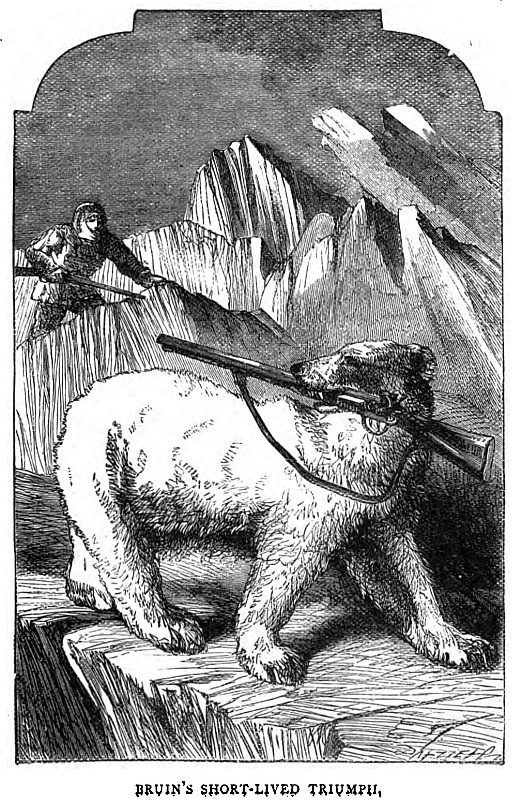
It was getting dark when Sandy’s party returned with our prize, cut up, however, into bits. They were received with a cordial welcome, as all hands were glad to get some fresh meat, which we had not tasted for many a long day.
Chapter Six.
Pretty well tired with the day’s exertions, I turned into my berth. Silence reigned round the ship: not a sea-bird’s cry, not the slightest sound from the ice reached us. I dreamed that I was once more at home, climbing over the heathery hills of my native land, when I felt the ship heaving and rolling, her stout timbers creaking and groaning, as blow after blow was dealt on her sides and bows, while noises resembling shrieks and howls came from every direction, filling the air.
Slipping into my clothes I rushed on deck, where everyone else had gone. Dawn had broken. A furious gale was blowing, and the ice, as far as the eye could reach, was in violent commotion, while long lanes or broad pools were opening out to the westward and southward. The captain ordered as much sail as the ship could carry to be set.
“We may yet get free, lads!” he cried.
The announcement was received by shouts from the crew. They were willing to encounter the onslaught of the floes, so that we could force our way out through their midst into open water. The captain or Mr Patterson were constantly aloft looking out for leads, but I observed that in spite of their anxiety to find these openings to the southward, the ship’s head was generally pointed to the west. At any moment, however, we might find a channel open to the southward. We had long lost sight of the coast of Spitzbergen, and were approaching that of Greenland. Sometimes the lines led us even more to the northward, towards some wide pool, from which no other channel was seen by which we might escape to the open ocean. The course of the ship reminded me of that of a hare, turning now to one side, now to the other, in her attempt to escape from the dogs. Frequently we rushed against the ice with a force which made every timber quiver. But the stout bows were prepared for the shock, and the ice bounded off and the way was clear.
Several days we continued to sail on, sometimes gliding smoothly through the narrow lanes, at others rushing like a battering ram against the floes which impeded our progress. Still, at the end of the time, we appeared to be no nearer the moment of our escape than at first. Masses of ice lay to the southward which closed up directly we began to entertain hopes of reaching them, forming an impenetrable barrier across the course we had to steer.
Again the wind fell. For another day we struggled manfully, sawing and blasting the ice to reach a pool beyond which clear leads were seen. The night came down on us while we were secured to a floe. The next morning the ice had closed round our ship, and we were once more in its vice-like grasp. Observations were taken, and it was found that, instead of being nearer the south after all our exertions, we, with the whole mass of ice in which we were locked up, were drifting to the northward. All hopes of escaping were abandoned. The broken and rugged state of the ice prevented the possibility of our traversing it with sleighs or dragging boats over it, either to the southward or to the coast of Greenland. Between us and the far-distant shore we should probably find an open space of water which, without the boats, it would be impossible to cross.
We had now to make up our minds to spend the winter in the ice, and wait for the summer to get free, should the ship in the meantime escape being crushed, a fate we knew full well might at any moment overtake her. We were fast to a level floe of great thickness, almost smooth enough in some places for skating, had we possessed skates to amuse ourselves. The inevitable being known, our spirits rose; we formed plans for passing our time and preparing the ship to enable us to endure the cold of an Arctic winter; we even joked on our condition. Ewen suggested that if we were to drift at the rate we were now going we might become discoverers of the North Pole.
So solid was the ice everywhere around it appeared to us that no further damage could happen to the ship, and that all we had to do was to wait patiently until she was liberated during the next summer.
Cold as were the nights, the sun during the day made the air pleasant when the weather was calm, if not almost too hot for exercise in our Arctic clothing. As before, excursions were undertaken in search of walruses and seals, with a slight hope of meeting with a whale, which might come up to breathe in a pool.
Sandy, Ewen, and I, with two other men, started from the ship; Ewen and I carrying our guns, Sandy his trusty harpoon and line, the men additional harpoons and spears, with a small sledge for dragging back any large game we might kill. It was of the greatest importance to obtain fresh meat to keep away that dreadful complaint, scurvy.
We had crossed our floe, as we called the mass to which we were attached, and were making our way westward in the direction of the land, hoping that from the top of some hummock we might chance to see it. Should the worst come to the worst, we must contrive to get there, and look out for some of the people, who we had heard say are good natured enough, though rather too fond of blubber to make them pleasant messmates in a small hut.
Ewen and I had dropped some way behind our companions, when we saw them turn to the northward towards an ice-hole, which we had shortly before discovered from the top of a hummock. We were about to follow, when Ewen declared that he saw a bear in an opposite direction stealing along amid the broken ice.
We hurried on in the direction he had seen the animal, hoping soon again to catch sight of it. An extensive hummock was before us: I agreed to go round one side, while he took the other. I had parted from him scarcely five minutes when I heard him utter a loud cry for help. I hurried back, expecting to find that he had been attacked by the bear. What was my dismay then to see neither him nor the bear, but I distinguished a black spot just above the ice near where I had left him. I rushed on, when I saw Ewen’s head projecting out of a water-hole while his hands were holding on to the ice.
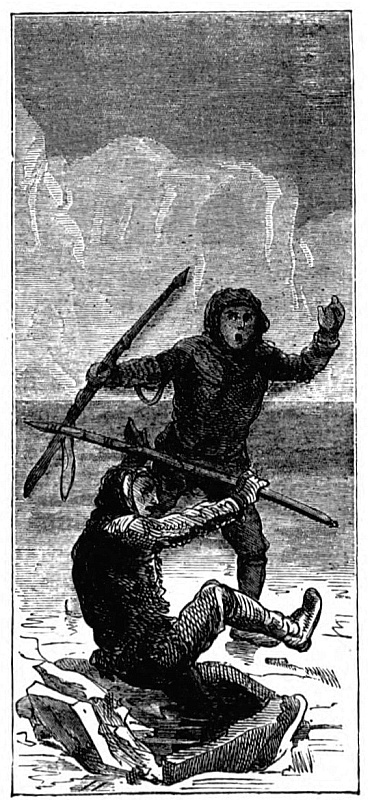
“Help me, help me, or I must let go,” he shouted. Fortunately I had brought a coil of light rope, which I carried over my shoulder. Undoing it, I drew as near to the hole as I could venture. To tell him to catch hold of the end would have been mockery; in attempting to do so he might have sunk. I therefore made a bow-line knot, which I jerked over his shoulders, he then first let go one hand, then the other, and while he clung tightly to it, with considerable exertion, I managed to draw him up out of the water. His rifle, when he fell, he had thrown from him, so that except for the discomfort of being wet and the ill effects which might arise, he was not the worse for the accident. Unwilling to lose the bear, we continued our pursuit after it. If it had been in the neighbourhood it had taken itself off, and we could nowhere discover it.
We accordingly pushed on in the direction Sandy had taken, keeping at the same time a look out for the bear, examining the nature of the ice as we went along, to avoid another tumble through it. There had been a slight fall of snow which enabled us to follow in his track, which we fortunately discovered when at length reaching a hummock, we climbed to the top to look out and ascertain how far he had got from us.
“I see a black spot on the ice. It must be a man. Can anything have happened to the others?” exclaimed Ewen. “He is coming this way.”
We descended and ran on to meet him. It was one of the men who had been sent back, he said, to look for us, as the boatswain had become anxious at our non-appearance. When he saw Ewen’s condition, he advised that we should go back to the ship, as it might be dangerous for him to remain in his wet clothes. Ewen, however, insisted on going forward, declaring that as long as he was in exercise he did not feel the cold.
On crossing another hummock, we caught sight of Sandy with his companions. They were bending over a hole in the ice, Sandy with his harpoon prepared to strike at some object in the water. One of the men made a signal to us to keep back. We guessed at once that Sandy expected to find either a seal or a walrus rise to the surface, and was eagerly waiting to harpoon it. We accordingly halted to see what would happen. Presently Sandy stood up, holding his weapon ready to strike; then down it came, and he and his companions seized the end of the line and held fast. We rushed forward to their assistance, and arrived just in time to prevent their being drawn into the water-hole or having to let go the line. “Hold on, lads, hold on!” cried Sandy. “It’s a big bull walrus I suspect from the way the fellow tugs.” Taking a spear he advanced to the edge of the hole, when he plunged it into the body of an object invisible to us; he then sprang back, and in another instant a huge head and shoulders, with an enormous pair of tusks and flappers, appeared above the surface.
“Haul away, lads, haul away,” he shouted, putting his hand to the rope to give us his assistance, when out came, with a loud flop, a large walrus. The creature on seeing us endeavoured to work its way on, opening wide its jaws and threatening us with its tusks; but as it advanced we ran back, until Sandy, taking the third spear, sprang towards its side, into which he deeply buried the weapon, almost pinning the animal to the ice. It still struggled violently, and as we had no more spears I advanced towards it with my rifle, and shot it through the head, when it rolled over perfectly dead. It was a prize worth having. The difficulty would be to get it back to the ship. We rolled the body on the sleigh, to which we secured it.
We got on very well over the smooth ice, but when we arrived at a hummock we had to exert all our strength to get the carcase up to the top. We then let it roll down again to the opposite side. As we had a good many hummocks to pass, our progress was slow, and the day was waning when we caught sight of the ship. Sandy asked Ewen and me to go forward and obtain assistance. This we very gladly did, for all the party were pretty well worn out, and we felt that we could haul no longer.
I was also particularly anxious to get Ewen into his bed, as his underclothing was still wet. On our arrival the doctor took charge of him; and I volunteered to lead back four of the men, whom the Captain had directed to go and assist Sandy. There was no time to be lost. The sky had become overcast, and there was every appearance that we should have a heavy snow-storm. We little knew, however, what was coming. Tired as I was, I set off with the men to try to find Sandy. I felt pretty sure that I could steer a course to the spot where I had left him, from having taken the exact bearings of the ship. Though we had seen the ship in the distance, it was not so easy to distinguish three men surrounded by hummocky ice. In a short time after we had set out, the expected snow began to fall, and very heavily it came down. I was afraid that, although we might find Sandy, we should be unable to drag back the body of the walrus. This would be provoking after the exertions we had already made. I was truly thankful when we at length caught sight of our shipmates amid the falling snow. They gave a cheer as we approached. The ship was no longer to be seen, and they, not without reason, feared that they might have missed her; and they were indeed, when we found them, steering a course which would have carried them some way to the westward of her. It was a lesson to us in future not to go far from home, unless in the finest weather, without a compass. All hands immediately tackled on to the sledge, and we set off as fast as we could move. I went ahead trying to make out the ship, but the thickening gloom and the fast falling snow concealed her from sight. At last I thought of firing off my rifle. No reply came. I fired again and again.
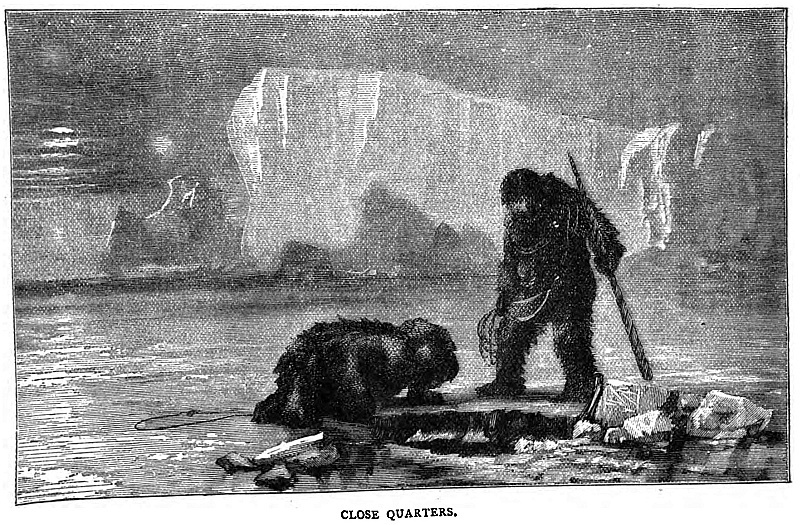
At length I heard the report of a musket followed by the boom of a big gun. Both appeared much farther off than I expected, though I thought I could judge the direction from which they came. I waited until my companions approached and then led them on. I fired again and was replied to from the ship.
I was thankful when we got alongside and our prize was hoisted on deck. Coarse as was the meat it was eaten with as much gusto as if it had been some delicate luxury.
While we were in the act of stowing away the blubber, the ship began to move and the ice round us to heave. Every instant the motion increased, and the scene I have before described was enacted but in a more fearful degree. The ship groaned and strained, and the masts quivered as if about to fall. The masses of ice on the outer floe began to break up, and in a few seconds rushed over the more level parts, some remaining with their edges towards the sky, others falling with tremendous crashes and shivering into pieces. We could see some through the gloom rising high above our decks, and we knew at any moment that they might come toppling down upon us and crush the stout ship. Our sense of hearing, indeed, told us more clearly than our eyes what was taking place. The captain, in a calm voice, ordered the crew to make preparations for quitting the ship. The boats were swung out on the davits, so that they could be lowered in a moment, with sails, provisions, and tools ready to put into them, while the men brought up their bags and blankets, and put on their warm clothing. The doctor got his medicine chest ready; the armourer opened the magazine and divided the arms and ammunition. Sacks for sleeping in were added to the articles, and all stood waiting for the order we expected every moment to receive to quit the ship. We stamped about the decks in vain attempting to keep ourselves warm, for no fires had been lighted, lest the stoves being overturned might set the ship in flames.
All night long the fearful uproar continued, the ice pressing with greater and greater force against the sides of the ship. The carpenter was ordered to sound the well. He reported that the water was rushing in through unseen leaks.
Should the ship sink our fate would be sealed. Our hope was that she might be pressed up on the ice, and that the wreck might preserve us during the winter. At daylight the pressure ceased, but out hope of saving the ship was gone. On examination it was found that many of her stout ribs were broken and her planks forced in, while she herself was lifted several feet above the level of the ice. This made it probable that instead of sinking, should a further pressure ensue, she would be forced up altogether our of the water. We spent the rest of that anxious day in making further preparations for quitting the ship. Yet another night we remained on board, when in the middle watch we were aroused by the boatswain’s voice, summoning the men to leave the ship. The fearful commotion of the ice showed that there was no time to lose. The boats were lowered and dragged off towards the centre of the floe. Every man knew what he had to do and worked steadily, and the articles which had been prepared were placed near the boats. The crew worked like a party of ants toiling backwards and forwards, struggling on with loads on their backs, which under ordinary circumstances they could scarcely have attempted to carry. Our fear was that the masts might fall before our task was accomplished. Mercifully, time was given us. Nothing of absolute necessity remained, and we were engaged in setting up a couple of tents which might afford us shelter until we could erect ice houses.
As day broke we saw the masts of our ship swaying to and fro, while the huge hull, as if by some mighty force below, was lifted up, and then down they came, the foremast first, dragging the mainmast and mizen mast, and the vessel lay a forlorn wreck on the top of the ice.
“It is far better to have her so, than at the bottom of the sea, lads,” exclaimed Sandy, “so don’t let us despair; though she’ll not carry us home, she’ll give us stuff to build a house, and enough firewood to last us through the winter. We’re a precious deal better off than many poor fellows have been.”
Not allowing the men a moment to think of their misfortunes, the captain at once set them the task of building a house, partly from the planking of the ship, and partly with ice. It consisted of an inner chamber with two outer ones, and a long passage leading to it, and several doors, so that the outer could be closed before the inner were opened. We had a sky-light, made from a piece of double glass on the top, and a chimney to afford ventilation and to allow the smoke to escape. While the men were engaged in forming it, the captain, my brother, Ewen and I set off to reach the summit of a berg with our sextants and spy-glasses, hoping that from thence, while we took observations we might catch sight of the Greenland coast. We carried with us also a small flag and staff, which we might plant on the top should our expedition prove successful.
The labour of walking over the hummocky ice was great, for though at a distance it looked tolerably level, we had constantly to be climbing up and sliding down elevations of considerable height. As the days were getting short, we had little time to spare. We had to keep a look-out also for holes which exist often in thick ice, kept open by whales and other monsters of the deep which come up to breathe.
“I hope that we may fall in with bears,” said Ewen; “the chances are, some old fellow will scent us out.”
“I shall be very glad to see them,” answered the captain. “It would prove that the moveable floes are already connected with the land-ice, as bears very seldom swim across a broad channel; but I fear that this immense field on which we stand is still drifting northward, and that none will venture off to us.”
At last we got to the foot of the berg for which we were aiming, and commenced its ascent.
“Why it’s a mountain and not an iceberg!” cried Ewen. “I see rocks projecting out of it.”
The captain laughed.
“Those are mere stones sticking to it,” observed Andrew; “they were torn off when the berg was separated from the glacier of which it once formed a part. Vast rocks, far larger than those we see, were at one period of our globe’s history, carried over the surface to great distances, and deposited in spots where they are now found, while the marks produced by the bergs are still visible in many localities. If this berg were to be stranded on some distant shore, it would gradually melt leaving the rocks it carries behind it, which a geologist would perceive had no connection with any strata in the neighbourhood, and he would, therefore, at once justly conclude that the rocks had been brought to the spot by a berg.”
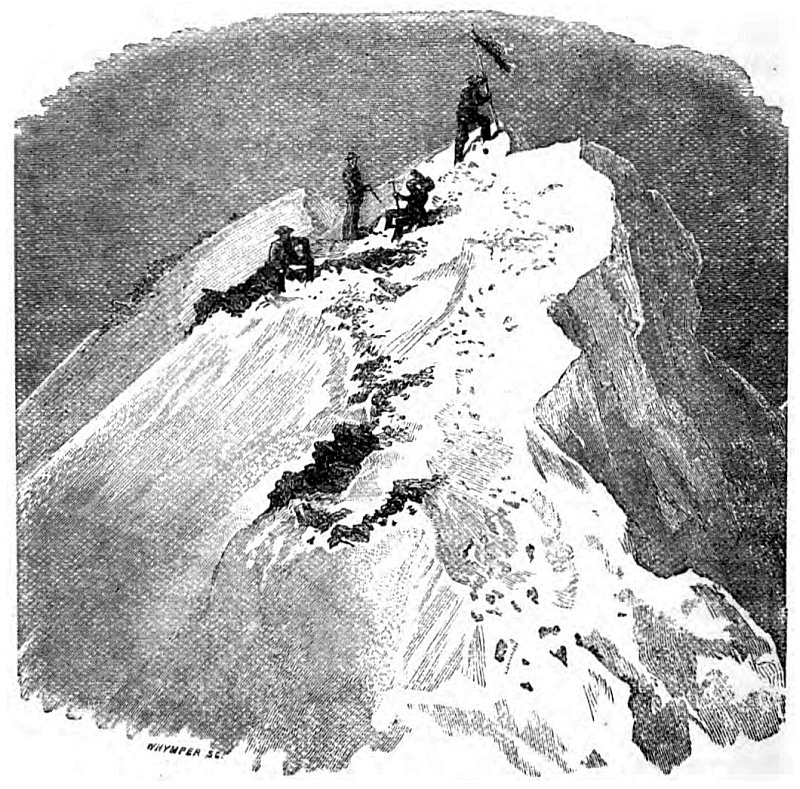
These remarks were made as we stopped to rest on our way up. We quickly, however, continued the ascent. Andrew, who carried the flag, was first to reach the top, and, waving it above his head, shouted “Land, land!” then, working away with an axe, he dug a hole in which he planted the staff.
We all soon joined him, when, descending a short distance, the captain surveyed the distant coast, now turning his glass horizontally, now up at the sky. I asked him what he was looking at.
“Curious as it may seem, I can see the shape of the mountains in the sky better than by directing my glass at them; besides which I observe a dark line which indicates a broad channel running between us and the land-ice. It shows that I am right in my conjectures, and that the field is still moving northward. It must come to a stop one day, and when it does we must be prepared for even more violent commotions than we have yet experienced.”
The captain calculated that the land we saw was nearly thirty miles off, and that the channel ran about midway between us and it.
It was a question whether we should attempt this long journey during the autumn, or wait for the return of spring, spending our winter in our houses on the ice. The point could only be decided when the field ceased to move. One thing was certain, it would be impossible to get the boats over the hummocky ice, and thus we must depend upon our feet to reach the shore, while we dragged our stores after us.
“We must wait no longer here, lads,” said the captain who had just finished his observation. “If we do we shall be benighted, and may have to spend a long night without shelter.”
We hurried down the berg and directed our course towards the ship, but whether or not we should reach her appeared doubtful.
Chapter Seven.
It was evening when we got back to the encampment. On casting our eyes towards the ship, her appearance, as she lay overlapped with masses of ice on her beam ends, could not fail to produce a melancholy feeling.
“She’ll never float again!” exclaimed the captain with a sigh. “We must make the best of things, however, as they are.”
The men had progressed with the house. It was already habitable, though much more was to be done to enable us to bear the piercing cold of an arctic winter.
Next day was employed in getting everything out of the ship, which could be reached, likely to be useful, as she could no longer afford us a safe shelter. We began to cut away the bulwarks, the upper planks, and indeed all the wood we could get at, to serve for fuel as well as to strengthen the house. While thus employed, the fearful sounds from which we had for some time been free, again assailed our ears. There was a sudden movement of our floe, while all around us, and especially to the northward, we could see the ice heaving and tumbling, huge masses falling over, and floes rising one above another. Should our floe be subject to the same violent pressure, a slab might slide over it and sweep us to destruction. Even should some of the more active manage to climb to the top, our house and boats and stores must inevitably be lost, and those who might have escaped at first would, ere long, be frozen to death.
The hours we thus passed, not knowing at what moment the catastrophe might occur, were terrible in the extreme. To work was impossible. At length, however, the disturbance ceased. The intense cold quickly congealed the broken masses together, and we were able to turn in and sleep soundly.
The next day all was quiet. The captain was of opinion that we should move no further north, and that, should our floe become detached, we might expect to drift to the southward.
The captain’s observations showed that at present we were stationary, but it was still doubtful whether our floe was or was not united to the main body. The captain, Mr Patterson, my brother, the boatswain and I, had been discussing the subject one evening as we sat in the hut, and were afterwards talking of the Aurora Borealis when I agreed to go out and ascertain if any of peculiar brilliancy was visible.
On emerging from the hut, I gazed up at the sky. An Aurora was blazing brilliantly, forming an irregular arch, from which showers of rays of many colours spread in every direction. I was watching it with intense admiration, and was intending to go back and call my companions, when one of the dogs which had followed me gave a loud bark. It was answered by a growl. Looking over the ice I saw two enormous shaggy monsters, who, sniffing the air, advanced cautiously towards me. The brave dog dashed forward. In vain I called him to return.
Satisfied that our visitors were Polar bears which must have come from the main land, I hurried back, closing the door behind me to prevent them from entering. The captain, mate, and my brother seized their rifles, as I did mine, hoping to kill one or both of the intruders. As we opened the door, a loud cry uttered by a dog reached our ears. One of the bears had seized the animal and was carrying him off, satisfied with his prize. The other was creeping on towards the hut. Our bullets quickly settled him, and he rolled over. We then gave chase to the other who was carrying off the dog, but we were compelled to stop and reload, and by the time we had done this, so rapidly did the animal run that he was far beyond our reach, and all hope of rescuing our canine companion was over. We regretted the loss of the brave dog. It was a lesson to us not to let the others loose until we were ready to assist in attacking any similar visitors. The bear was quickly skinned and cut up. The skin would serve us for clothing, the fat for fuel, the meat for food. This visit of the bears showed us that the field of which our floe formed part must be attached to the land-ice. Our captain being anxious to visit the shore, intending, should a favourable spot be found, to form our winter quarters on it—we agreed to set out the next morning.
Much to our disappointment, when the time came, the captain was unable to go. He was very unwell, and my brother forbade him to take the journey. As he did not improve, Andrew was unable to leave him, and it was finally settled that the mate, Sandy, Ewen, Croil, another man, and I should form the party to proceed to the land. We had a small sledge which had been manufactured some time before. To this we attached our remaining dogs, and loaded it with stores of ammunition and provisions, including food for the dogs. Each of us carried also a small load as well as our rifles and long poles to assist our progress. Our companions cheered us as we set off, several accompanying us part of the way from the camp. We were by this time pretty well accustomed to travelling over the ice, but we had great difficulty in making our dogs, who had not been well trained, pull together, and the mate, losing patience, declared that he would rather drag the sledge himself, and that he wished the dogs back again.
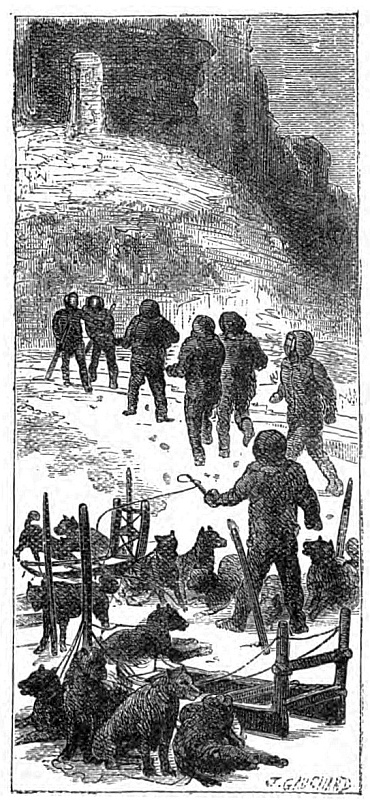
“If he were to try it for half an hour he would change his tone,” observed Sandy to me; “the doggies will get along well enough in a few days.”
“In a few days!” I exclaimed, “I thought that we should get to the shore by nightfall.”
“Many a night will fall before we reach it,” answered Sandy. “If we could go in a straight line over smooth ice, at a jog trot, the case would be different. We shall have to make our way in and out among the bergs and hummocks, and maybe to take a long circumbendibus to avoid any waterholes in our course; we are very likely to fall in with some, solid as the ice appears hereabouts.”
I soon found that Sandy was perfectly correct in his prognostications. For the early part of the first day we got on well enough. We had our choice of climbing over numerous ridges from ten to twenty feet in height, or going round until we could find a passage between them. We had thus made less than three miles when the night closed in on us. We then put up our tent, lighted our lamp, and crept into our sleeping sacks. Though our quarters were rather close, we were more comfortable than I could have supposed possible. We had a long night, and with the first streaks of dawn, having breakfasted inside our tent on coffee boiled over the lamp, we again proceeded. Our dogs, I should have said, slept outside, and they formed a sufficient guard to give us notice should any bears approach.
The next day we made even less progress than on the first, though we met with no accident to hinder us. Sometimes we dragged the sledge over the hummocks, and sometimes we went round them, the dogs preferring the former method, as while we toiled they sat up on their tails watching our proceedings with infinite satisfaction.
The next night I was awakened by hearing a rustling sound, which I guessed was snow falling, but I soon dropped asleep again forgetting all about it. In the morning I saw that the sides of the tent were considerably pressed in, and on drawing aside the curtain which closed the front, a mass of snow fell inside. Looking out, what was our dismay to find that we were entirely surrounded. Travelling which was before difficult would now be doubly so. However, on further examination we found that, having chosen a sheltered spot under a hummock, the snow had drifted round us.
We easily, therefore, forced our way out, roused up the half-buried dogs, whose noses showed their whereabouts, and having taken our morning meal doubled up our tent and then trudged forward, Sandy leading. We followed in line, thus making a path for the dogs who without difficulty kept up with us. Before long we came to a berg from which extended north and south a line of hummocks. It seemed to bar further progress. To ascertain which course to pursue, we agreed to climb to the top of the berg, leaving Ewen and Croil to take charge of the sledge. The mate, Sandy, and I, at once commenced the ascent. It was no easy work, and we ran great risk of slipping down again and breaking our limbs. Still, by persevering, the top at length was gained. We could see the land very clearly to the westward, and between it and us the ice appeared far more level than any we had hitherto passed over. To the north it was utterly impracticable. To the southward we discovered a passage which we hoped to reach in the course of the day. The mate’s belief was that we were close upon the land-ice, and that by pushing on we could reach it by nightfall.
Having made these observations we prepared to descend, but we found that the chance of falling when doing so would be far greater than when ascending. It appeared, however, from where we stood, that there was a slope on the southern side where we might get down with comparative ease. There was, however, a projecting ledge which must be knocked away before we could reach the slope. We had brought ropes with us, and Sandy passing one round his waist, begged the mate and me to hold it at the other end while he advanced with his staff at the point of which he had secured a huge lump of ice. Using this us a sledge hammer, he began knocking away at the ledge, and after a few blows the whole mass giving way went thundering down the slope.
“It’s just as well to clear that off,” he observed, “or it might have come down on our heads.”
This was the more likely when he told us that he had observed a deep crack, which had induced him to make the attempt to knock the ledge away.
We now descended and rejoined Ewen and his companions, who had been greatly alarmed at seeing the mass of ice come rattling down, supposing that some accident had happened to us, while they had with difficulty restrained the dogs from galloping away from them.
We now directed our course southward, and were not disappointed in finding a passage through the hummocks, which enabled us to get on the smoother land-ice. We had, however, soon to camp. To render our tent warm, having cleared away the snow, we built a wall round it which sheltered us from the wind.
On the evening of the second day after this, we reached the shore, which rose bleak and barren before us. Yet it was a satisfaction to set our feet on firm ground. We landed in a small bay, the shore for a short distance shelving up to the foot of the cliffs, which—as they extended round to the east—would, we agreed, afford us shelter from the more bitter blasts of winter. The rocks were bare and rugged. Here and there a few lichens appeared, which to our eyes, long unaccustomed to anything of a green tint, seemed very pleasant.
“This will do!” cried the mate, “if our shipmates can reach this, we may pass the winter far better than we should have done on the open floe.”
As we had but a few more minutes of daylight, we hurriedly pitched our tent on a level spot close under the rocks, piling up the snow around it as before.
The mate was anxious to return at once with the news of our success, and to guide the party to the shore. He hoped, with a good night’s rest, to be able to set off early in the morning, and to perform a great part of the distance before nightfall.
Sandy suggested, that it would be as well if some of us remained, as it would be necessary to carry but few articles on the sledge, and the dogs would the more easily perform the journey. He offered to go with Ewen and Croil, but to this the mate would not agree, and announced his intention to set off with Croil, leaving the rest of us to build a snow-hut for the reception of the party.
We had brought, I should have said, a couple of lamps with sufficient oil. We were therefore provided with one of the chief necessaries of life. We hoped also to shoot a bear, or perhaps some birds, to increase our stock of provisions.
When morning returned, however, a storm was blowing outside the bay, though within we were tolerably sheltered from its fury. To have attempted to cross the ice while it continued would have been madness.
The mate and Sandy therefore assisted us in putting up a hut. We had abundance of snow from a drift collected on the opposite side of the bay, though we soon exhausted that which lay immediately round us. The storm, however, increased to such an extent that we were compelled to take shelter within our tent, which, had it not been surrounded by a snow wall, would inevitably have been blown down. As we sat crowded together in our tent, waiting for the cessation of the storm, the howling and roaring of the wind among the rocks in no way served to raise our spirits, but rather increased the gloomy forebodings of evil which stole over us.
The mate announced his intention of taking a look round, to see what prospect there was of the weather clearing.
“Stay here, lads,” he said, taking up his gun, “there’s no reason why you should be exposed to the cold. I’m more accustomed to it than you are.”
“Not more than me, sir,” said Sandy; “I’ll go with you, if you like.”
“No, no, boatswain. You stay and look after the others. You are older than I am, at all events, and require more rest.”
Saying this the mate went out and closed the door of the tent.
Ewen, Croil, and the seaman were asleep. Sandy and I talked on for some time.
“Wonder the mate doesn’t come back,” said the boatswain. “I’m afraid something has happened to him. He can’t have lost his way on the ice, but he may have slipped over a rock, or into a seal hole, if any are to be found close in shore.”
We waited a little longer, and at length Sandy, starting up, exclaimed, “We must go and look for him.”
Just then our ears were saluted by a loud roar, which made the rest of the party jump up. We all hastened out. No one was to be seen.
“Where did the sound come from?” asked Sandy. “I thought it was quite near.”
“From the other side of the rock,” I answered.
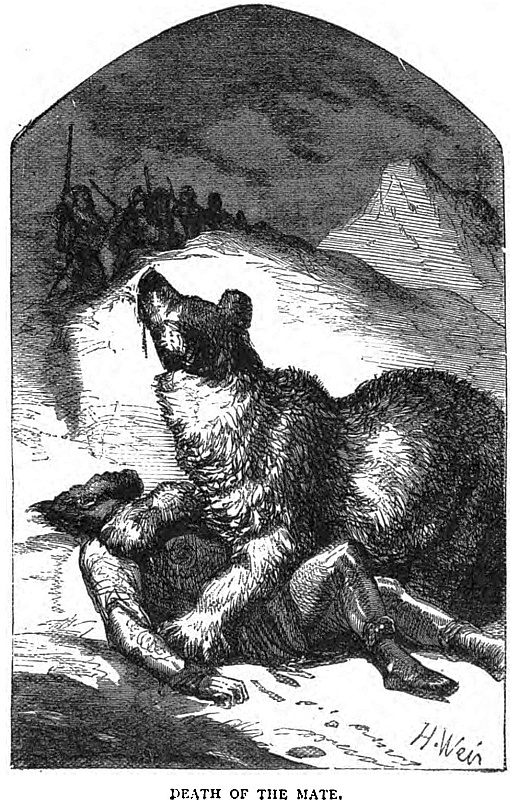
We hastened towards the spot, in the direction to which I pointed. We all had our guns in our hands ready for an encounter with a bear, which we expected to see. What was my horror on getting round the rock to discover the mate on the ground, a huge shaggy monster standing over him. We crept on, afraid, should we shout, that the bear might carry off his victim. Whether the mate was dead or alive, we could not tell, but he lay perfectly still. Sandy was leading, but he was not a first-rate shot, and I would rather have trusted to my own rifle. At last the bear made a movement, and Sandy, thinking he was going to bite the mate, fired, but he only wounded the animal in the back. What was my horror to see it seize the mate by the body and scamper off with him. We all fired, but dared not aim at the animal’s head, believing that the mate was still alive, for fear of killing him. I stopped to reload, as did Ewen.
“After him, lads,” shouted Sandy, but the bear was far too fleet for us to overtake, and to our grief and dismay disappeared with his victim behind the rocks to the northward.
We searched in vain for our companion. Though we traced the way the bear had gone by the crimson stains on the white snow, it convinced us that the poor mate was killed. To follow further would have been useless. With sad hearts we returned to our tent, almost frozen by the cold blast, to spend the most melancholy night we had yet passed.
We had now to settle on our future proceedings. Sandy had become the leader of the party. He proposed returning to the ship, but none of us wished to be left behind, and preferred rather to undergo the toils and risks of the journey than to remain on shore. But of this Sandy would not hear. He declared that he could go very well with only one of us, and that the other three by remaining—I acting as officer—could manage well enough by ourselves.
At last I gave in, and Sandy with the seaman set off as soon as the wind had abated. We watched them as they made their way over the plain of ice, their forms diminishing into mere dots, then finally disappearing. We in the meantime were working away to complete our hut and to render it as habitable as possible. The flesh of the bear we had killed afforded us an ample supply of food, while the fat served to increase our stock of fuel. There was probably drift-wood on the shore, but except a few pieces which stuck up above the snow, we could obtain none. We took care of every scrap we could find, not to burn, but to manufacture into such articles as we might require. In the crevices of the rocks we discovered some low creeping plants which in any other region would have been bushes, but were here a mere collection of twigs, no thicker than our little fingers, just appearing above the ground. We agreed that each should take certain duties, and it was settled that Croil should stay at home and look after the hut, employing himself in either cooking or scraping the bear’s skin to make it fit for use as a covering. Should we kill a sufficient number of bears, we intended to fasten the skins of some of them together so as to form a roof to our hut, while others would make great-coats or bed coverings.
Soon after Sandy and his companion had departed, Ewen and I took our guns both for the sake of exercise and to try and shoot bears, reindeers, or musk-oxen which we thought it possible might be found in that region. We were not aware that the latter animals had migrated southward by that time, or indeed that they were likely to be found only on level ground where the depth of the snow was not sufficient to prevent them from getting at the moss or lichens beneath. I was thankful to have Ewen as my companion. He had greatly improved since he came on board and showed that he possessed qualities which I did not before suspect, so that I felt for him as I should for a brother. The atmosphere had become calm and comparatively warm though the snow remained hard and crisp.
Ewen and I kept under the cliffs and were tempted to make our way much further south than we had hitherto gone, in the hopes of discovering some opening into the interior of the country. We at last reached a part of the cliffs where, though very rugged, they were less precipitous than in other parts. The sun was sinking behind them, but we still had abundance of daylight for exploring. Ewen offered to climb to the top in the hopes of obtaining an extensive view and perhaps of finding level ground where we should have the chance of finding deer or oxen. There was no reason why we should both run the risk, for a risk there was, though a slight one.
“Let me make the attempt alone, while you remain below, and point out to me the best path to take,” he said.
I did not much like to do this, but he declared that if I insisted on going he would give up the expedition. As I saw the sense of his proposal, I consented, and he commenced climbing up, rifle in hand. He had gone some distance when I saw a creature creeping along the rocks above his head, and directly afterwards, as it came more into sight, I saw that it was a huge bear. I shouted to him, to draw his attention to it, should he not have discovered the animal. He stopped and began to descend to a position from whence he could take a steady aim at the monster, should it come within his reach. What was my horror directly afterwards to see two other bears crawling out from among the rocks by which they had hitherto been concealed, evidently having discovered him. It seemed impossible that he should escape. I shouted to him, when he again began clambering up the rock. To my dismay, as he did so the first bear crawled down and seated itself on a point so as to intercept him.
The two other creatures got closer and closer with the evident intention of seizing him. I trembled for his safety, and hurried to the nearest spot from which I could take a steady aim.
“Never mind the fellow above you,” I shouted. “If you will shoot the ere nearest to you, I will manage the other, and we will then tackle the third if he attempts to come down.”
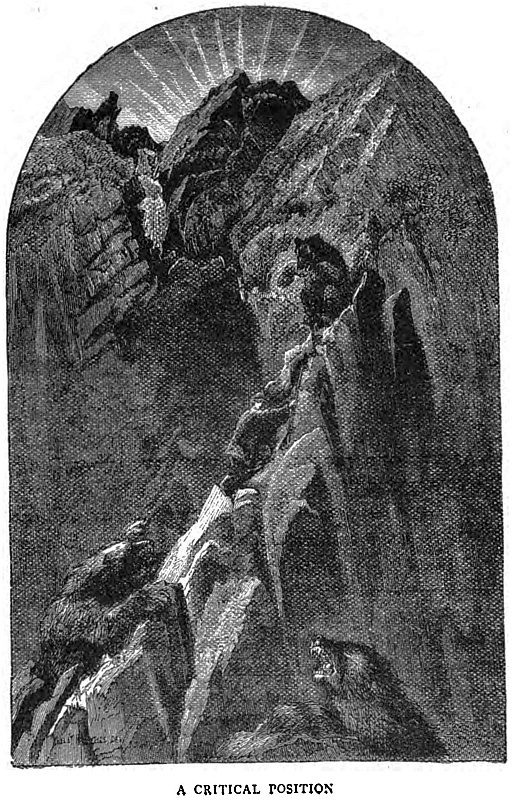
I could well enter into Ewen’s feelings. It was surprising, in the perilous position in which he was placed, that he should have retained any presence of mind.
Following my advice, he sat himself down on the rock and took aim, waiting until I should fire.
“Now!” I cried, and we both pulled our triggers at the same moment.
I own that I trembled lest either one or both of us might miss, in which case it seemed impossible that he should escape destruction. As the smoke cleared away from before my eyes, I saw the bears in motion, but instead of advancing they both fell back and came tumbling down the cliff close to where I was standing. I rapidly loaded, as did Ewen. We had still another antagonist to contend with, whom he must tackle alone, for I could not help him.
Just as I expected to see the bear crawling down the rocks to seize my friend, to my infinite satisfaction, the creature, alarmed by the reports, turned tail and began clambering up the cliff.
I shouted to Ewen not to shoot, as, should he only wound the bear, it might in its rage turn and attack him. I also had to look after one of the others, who though wounded, was not dead, and recovering from its fall, was looking about apparently for the foe who had injured it. On espying me it began to advance, growling furiously. As blood was flowing from behind its shoulder, I hoped that it might soon drop, but in the meantime it might tear me to pieces, and perhaps treat Ewen in the same way. To run from a bear is at all times very dangerous, unless to gain protection of some sort at no great distance; for the bear—clumsy as it looks—can run much faster than a man. I, therefore, having reloaded my rifle, stood with it ready to send a shot through the animal’s head. I waited until the wounded bear was almost close upon me, and I could not refrain from uttering a shout of satisfaction as it rolled over perfectly dead. Ewen in the meantime, approaching the other, had finished it by firing a bullet through its head.
“I wish that we had the sledge to take home the meat and skins,” observed Ewen, “but we must carry as much as we can.”
Our fear was that, should we leave the meat, other bears, of whom there appeared to be a whole colony in the neighbourhood, would come and devour it. We managed to get off the skins, which were likely to prove most valuable to us; and, loaded with them and a portion of the meat, we returned to the hut, where we found Croil anxiously looking out for us. He too, had seen a couple of bears moving across the bay, and was afraid that we might have been attacked by them, and suffered the fate of the poor mate.
Chapter Eight.
We now waited in anxious expectation for the arrival of our shipmates, but they did not appear. The days were getting shorter, the nights longer. The cold was increasing. Often and often we gazed out over the ice. As far as we could judge no change had taken place in it. A vast snow-covered plain, with here and there mountainous heights of ice could be seen extending as far as the horizon. Unfortunately we had not brought a telescope, or we thought that we might have discovered our friends. At length we began to entertain the most serious apprehensions as to their fate.
We had one evening turned in, and, having closed the door of the hut, had lighted our lamp and composed ourselves to sleep, when Ewen roused me up.
“I heard a shout!” he exclaimed, “they must be coming.”
We slipped into our day clothing, and hurried out, carrying our rifles in our hands, for we never moved without them.
Again there was a shout: we replied to it with all our might. Some one was evidently approaching. More clearly to show our position, I fired off my rifle, and sent Croil in to light a small piece of drift-wood the only thing we possessed to serve as a torch. Again and again we shouted: at length we caught sight through the gloom of night of some dark spots moving over the snow.
“Hurrah!” cried Ewen, “there are our shipmates!” Soon after he had spoken I discovered three of the dogs dragging the sledge and two men following them. The one was Sandy, the other Hans the seaman.
Hurrying forward we led them up to the hut. Sandy could scarcely speak.
“We are well-nigh starved, and I thought we should never get back,” he said at length.
“Where are our shipmates? Why haven’t they come?” I asked.
“I’ll tell you all about it when we have had some food and rest. Can you give us something to eat?”
“Plenty,” I answered, leading him and Hans into the hut, while Ewen and Croil unharnessed the poor dogs, who looked well-nigh famished. Ewen gave them some bears’ flesh, and they devoured it with a greediness which showed that they had gone long without a meal.
We soon had some slices of meat frying on our stove and some snow melting. After the two weary travellers had eaten, and drank some hot coffee, Sandy gave us the alarming intelligence that he had been unable to reach the camp. On arriving at the edge of the land-ice, what was his dismay to discover a wide gap between it and the field in the midst of which our friends were encamped, and which was in motion drifting southward. Still, hoping that it might again come in contact with the land-ice, he determined to move in the same direction. He caught sight indeed of a flag and what he took to be a portion of the wreck, though at so great a distance that he did not suppose the sound of his rifle, which he fired off, would be heard. No object indeed would have been gained had it been so, as it would have been impossible for one party to communicate with the other. For two days he followed the floe, but the distance between it and the land-ice increased. At length the ice over which he was travelling became so rough that he could proceed no further; he lost sight of the floe and its living freight, and was reluctantly compelled to return for want of food. One of the dogs gave in and it was killed and eaten. The last morsels had been consumed the day before he and Hans reached the hut. Their joy at finding us still there may be imagined, for had we by any chance fallen in with natives and accompanied them to the south, they fully expected to perish.
As soon as the meal was over, the two weary travellers lay down to sleep. Croil imitated their example, while Ewen and I sat up by the light of the lamp, I mending clothes and my friend engaged in preparing a small tub for holding bear’s grease to serve us for fuel. Our conversation naturally took a melancholy turn. The thought that the floe on which were my brother and his companions might be dashed to pieces, and that they would perish miserably, was painful in the extreme. We thought more of them, indeed, than of ourselves, though our position was truly perilous. Our only shelter during the intense cold of an Arctic winter was an ice hut. Hitherto the bears we had shot had afforded us food and fuel; but they might take their departure, and we should then have no other food on which to depend, until the return of spring should enable us to kill walruses and seals. No ships, even in the summer, were likely to penetrate so far north, for few whalers had got so near the pole as the Hardy Norseman had done, and destruction had overtaken her.
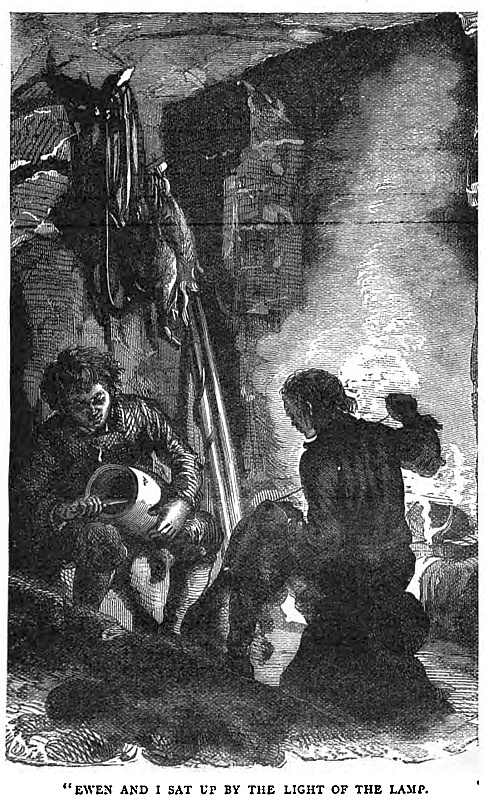
“Still I have heard that people have wintered in Nova Zembla and Spitzbergen, even with fewer means of supporting themselves than we possess,” observed Ewen. “We must not despair, Hugh, but trust in God; Sandy’s return to us is greatly to our advantage; for with his harpoon, when our powder is expended, he will be able to kill seals, and furnish us with food.”
“I am thinking of my brother Andrew, and the hopelessness of finding David,” I replied.
“But we do not know that he and the rest of the party are lost, and if your brother David is alive he may still make his escape wherever he may be.”
At last Ewen and I, having trimmed the lamp that it might keep alight, and maintain sufficient warmth in the hut, carefully closed the door and lay down to sleep.
There was no necessity for keeping a watch as was the case on the floe, nor had we the dread of an attack from hostile natives, for no human beings were likely to come near us. We should have been heartily ready to welcome any Esquimaux should they find us out.
I awoke at the usual hour, just before day-break, and getting up trimmed the lamp which had almost gone out, and set to work to prepare breakfast for my companions.
After a time I called up Ewen and Croil, but we allowed Sandy and Hans to sleep on, keeping the breakfast ready to give them the moment they should awake. It was noon before they opened their eyes, when having taken the food we offered them they fell asleep again. It was several days, indeed, before they got over the fatigue of their journey.
Sandy, when once himself again, was as anxious as any of us to make preparations for passing the winter. We talked of pushing southward to seek a more level region, but the lofty hills in the distance, without the appearance of any spot on which we could land, made us hesitate. As the days were now only of three hours’ duration, we feared that we should not have light for more than a very short journey, and it was impossible to endure the cold for any length of time after the sun had gone down. We had already a good supply of bear’s meat, but it was important to get more. Our store we had buried in a pit close to the hut, so that no roving bears could get at it. They are in no way particular, and would quite as readily feast on the flesh of their relatives as on any other meat. We had frequently seen their tracks made during the night close outside the hut, but they must have taken their departure, like spirits of another world, before dawn. They were not as hungry at this time of the year as they would be further on, when no seals were to be caught and the deer and other animals had migrated southward. At length the sun sank beneath the horizon, not again to rise until the end of a long winter’s night. The cold too had become so intense that we could only keep ourselves warm in the hut with the door closed and the lamp alight, but then it was almost too hot. We had, therefore, to make a window through which we could admit fresh air, without the necessity of opening the door; but when there was any wind we were obliged to fill up the aperture with snow, for the smallest orifice admitted a draught of air which pierced the hand like a needle when held up to it. The poor dogs had to be taken inside, for though we had built kennels for them close to the hut, there was a great risk of their being carried off by bears while we were asleep. Those “monarchs of the realms of ice,” as they are poetically called, had scented us out, and scarcely an hour passed but one made his appearance. Sometimes they got off, though we killed no inconsiderable number, thus adding to our stock of food, while their skins enabled us to make our beds as warm as we could desire. At length, however, they became more daring and troublesome, so that none of us could go out of the hut alone lest we should be carried off.
We had expended by this time so much of our powder that we had resolved to use no more of it until the return of spring, when we should require it on our journey southward.
How the winter went by I can scarcely describe. We had no books, but were never idle, being always employed in manufacturing articles with our knives, either from bones or pieces of drift-wood, or making shoes and clothing from the bears’ skins.
We were thus employed, having opened the window to admit some fresh air, and a few rays of the returning light of day, when, looking up, what should I see but the snout of a bear poked through the aperture, evidently enjoying the odours arising from some steaks frying on our stone.
Not at all disconcerted by the shouts we raised, for the sake of getting the savoury morsels, he began scraping away at the snow walls, in which, with his powerful claws, he could speedily have made an alarming breach.
Sandy, jumping up with his harpoon, which he had been polishing, in his hand, darted it with all his might at the bear. Fortunately his weapon did not stick in the animal’s throat, or he might, I confidently believe, have pulled down the whole structure in his struggles.
Uttering a roar of pain, the bear started back. His roar was repeated by several other bears outside, who must have joined it from sympathy, echoed by the dogs from the inside, who jumped about eager to attack their foes.