APPLETONS' POPULAR SCIENCE MONTHLY.
Reading edition
NOVEMBER, 1899.
THE REAL PROBLEMS OF DEMOCRACY.
By FRANKLIN SMITH.
Much has been written of late about "the real problems of democracy." According to some "thinkers," they consist of the invention of ingenious devices to prevent caucus frauds and the purchase of votes, to check the passage of special laws as well as too many laws, and to infuse into decent people an ardent desire to participate in the wrangles of politics. According to others, they consist of the invention of equally ingenious devices to compel corporations to manage their business in accordance with Christian principles, to transform the so-called natural monopolies into either State or municipal monopolies, and to effect, by means of the power of taxation, a more equitable distribution of wealth. According to still others, they consist of the invention of no less ingenious devices to force people to be temperate, to observe humanity toward children and animals, and to read and study what will make them model citizens. It is innocently and touchingly believed that with the solution of these problems, by the application of the authority that society has over the individual, "the social conscience" will be awakened. But such a belief can not be realized. It has its origin in a conception of democracy that has no foundation either in history or science. What are supposed to be the real problems of democracy are only the problems of despotism—the problems to which every tyrant from time immemorial has addressed himself, to the moral and industrial ruin of his subjects.
If democracy be conceived not as a form of political government under the régime of universal suffrage, but as a condition of freedom under moral control, permitting every man to do as he likes, so long as he does not trench upon the equal right of every other man, deliverance from the sophistries and absurdities of current social and political discussion becomes easy and inevitable. Its real problems cease to be an endless succession of political devices that stimulate cunning and evasion, and countless encroachments upon individual freedom that stir up contention and ill feeling. Instead of being innumerable and complex, defying the solvent power of the greatest intellects and the efforts of the most enthusiastic philanthropists, they become few and simple. While their proper solution is beset with difficulties, these difficulties are not as hopeless as the framing of a statute to produce a growth of virtue in a depraved heart. Indeed, no such task has ever been accomplished, and every effort in that direction has been worse than futile. It has encouraged the growth of all the savage traits that ages of conflict have stamped so profoundly in the nervous system of the race. But let it be understood that the real problems of democracy are the problems of self-support and self-control, the problems that appeared with the appearance of human life, and that their sole solution is to be found in the application of precisely the same methods with which Nature disciplines the meanest of her creatures, then we may expect a measure of success from the efforts of social and political reformers; for freedom of thought and action, coupled with the punishment that comes from a failure to comply with the laws of life and the conditions of existence, creates an internal control far more potent than any law. It impels men to depend upon their own efforts to gain a livelihood; it inspires them with a respect for the right of others to do the same.
Simple and commonplace as the traits of self-support and self-control may seem, they are of transcendent importance. Every other trait sinks into insignificance. The society whose members have learned to care for themselves and to control themselves has no further moral or economic conquests to make. It will be in the happy condition dreamed of by all poets, philosophers, and philanthropists. There will be no destitution, for each person, being able to maintain himself and his family, will have no occasion, except in a case of a sudden and an unforeseen misfortune, to look to his friends and neighbors for aid. But in thus maintaining himself—that is, in pursuing the occupation best adapted to his ability and most congenial to his taste—he will contribute in the largest degree to the happiness of the other members of the community. While they are pursuing the occupations best adapted to their ability and most congenial to their tastes, they will be able to obtain from him, as he will be able to obtain from them, those things that both need to supplement the products of their own industry. Since each will be left in full possession of all the fruits of his own toil, he will be at liberty to make just such use of them as will contribute most to his happiness, thus permitting the realization, in the only practicable way, of Bentham's principle of "the greatest happiness of the greatest number." Since all of them will be free to make such contracts as they believe will be most advantageous to them, exchanging what they are willing to part with for what some one else is willing to give in return, there will prevail the only equitable distribution of the returns from labor and capital. No one will receive more and no one less than he is entitled to. Thus will benefit be in proportion to merit, and the most scrupulous justice be satisfied.
But this régime of equity in the distribution of property implies, as I have already said, the possession of a high degree of self-control. Not only must all persons have such a keen sense of their own rights as will never permit them to submit to infringement, but they must have such a keen sense of the rights of others that they will not be guilty themselves of infringement. Not only will they refrain from the commission of those acts of aggression whose ill effects are immediate and obvious; they will refrain from those acts whose ill effects are remote and obscure. Although they will not, for example, deceive or steal or commit personal assaults, they will not urge the adoption of a policy that will injure the unknown members of other communities, like the Welsh tin-plate makers and the Vienna pearl-button makers that the McKinley Bill deprived of employment. Realizing the vice of the plea of the opponents of international copyright that cheap literature for a people is better than scrupulous honesty, they will not refuse to foreign authors the same protection to property that they demand. They will not, finally, allow themselves to take by compulsion or by persuasion the property of neighbors to be used to alleviate suffering or to disseminate knowledge in a way to weaken the moral and physical strength of their fellows. But the possession of a sense of justice so scrupulous assumes the possession of a fellow-feeling so vivid that it will allow no man to refuse all needful aid to the victims of misfortune. As suffering to others will mean suffering to himself, he will be as powerfully moved to go to their rescue as he would to protect himself against the same misfortune. Indeed, he will be moved, as all others will be moved, to undertake without compulsion all the benevolent work, be it charitable or educational, that may be necessary to aid those persons less fortunate than himself to obtain the greatest possible satisfaction out of life.
But the methods of social reform now in greatest vogue do not contribute to the realization of any such millennium. They are a flagrant violation of the laws of life and the conditions of existence. They make difficult, if not impossible, the establishment of the moral government of a democracy that insures every man and woman not only freedom but also sustentation and protection. In disregard of the principles of biology, which demand that benefit shall be in proportion to merit, the feeble members of society are fostered at the expense of the strong. Setting at defiance the principles of psychology, which insist upon the cultivation of the clearest perception of the inseparable relation of cause and effect and the equally inseparable relation of aggression and punishment, honest people are turned into thieves and murderers, and thieves and murderers are taught to believe that no retribution awaits the commission of the foulest crime. Scornful of the principles of sociology, which teach in the plainest way that the institutions of feudalism are the products of war and can serve no other purpose than the promotion of aggression, a deliberate effort, born of the astonishing belief that they can be transformed into the agencies of progress, is made in time of peace to restore them to life.
To the American Philistine nothing is more indicative of the marvelous moral superiority of this age and country than the rapid increase in the public expenditures for enterprises "to benefit the people." Particularly enamored is he of the showy statistics of hospitals, asylums, reformatories, and other so-called charitable institutions supported by public taxation. "How unselfish we are!" he exclaims, swelling with pride as he points to them. "In what other age or in what other country has so much been done for the poor and unfortunate?" Naught shall ever be said by me against the desire to help others. The fellow-feeling that thrives upon the aid rendered to the sick and destitute I believe to be the most precious gift of civilization. Upon its growth depends the further moral advancement of the race. As I have already intimated, only as human beings are able to represent to themselves vividly the sufferings of others will they be moved to desist from the conduct that contributes to those sufferings. But the system of public charity that prevails in this country is not charity at all; it is a system of forcible public largesses, as odious and demoralizing as the one that contributed so powerfully to the downfall of Athens and Rome. By it money is extorted from the taxpayer with as little justification as the crime of the highwayman, and expended by politicians with as little love as he of their fellows. What is the result? Precisely what might be expected. He is infuriated because of the growing burden of his taxes. Instead of being made more humane and sympathetic with every dollar he gives under compulsion to the poor and suffering, he becomes more hard-hearted and bitter toward his fellows. The notion that society, as organized at present, is reducing him to poverty and degradation takes possession of him. He becomes an agitator for violent reforms that will only render his condition worse. At the same time the people he aids come to regard him simply as a person under obligations to care for them. They feel no more gratitude toward him than the wolf toward the victim of its hunger and ferocity.
Akin to public charity are all those public enterprises undertaken to ameliorate the condition of the poor—parks, model tenement houses, art galleries, free concerts, free baths, and relief works of all kinds. To these I must add all those Federal, State, and municipal enterprises, such as the post office with the proposed savings attachment, a State system of highways and waterways, municipal water, gas and electric works, etc., that are supposed to be of inestimable advantage to the same worthy class. These likewise fill the heart of the American Philistine with immense satisfaction. Although he finds, by his study of pleasing romances on municipal government in Europe, that we have yet to take some further steps before we fall as completely as the inhabitants of Paris and Berlin into the hands of municipal despotism, he is convinced that we have made gratifying headway, and that the outlook for complete subjection to that despotism is encouraging. But it should be remembered that splendid public libraries and public baths, and extensive and expensive systems of highways and municipal improvements, built under a modified form of the old corvée, are no measure of the fellow-feeling and enlightenment of a community. On the contrary, they indicate a pitiful incapacity to appreciate the rights of others, and are, therefore, a measure rather of the low degree of civilization. It should be remembered also, especially by the impoverished victims of the delusions of the legislative philanthropist, that there is no expenditure that yields a smaller return in the long run than public expenditure; that however honest the belief that public officials will do their duty as conscientiously and efficiently as private individuals, history has yet to record the fact of any bureaucracy; that however profound the conviction that the cost of these "public blessings" comes out of the pockets of the rich and is on that account particularly justifiable, it comes largely out of the pockets of the poor; and that by the amount abstracted from the income of labor and capital by that amount is the sum divided between labor and capital reduced.
"But," interposes the optimist, "have the Americans not their great public-school system, unrivaled in the world, to check and finally to end the evils that appear thus far to be inseparably connected with popular government? Is there any truth more firmly established than that it is the bulwark of American institutions, and that if we maintain it as it should be maintained they will be able to weather any storm that may threaten?" Precisely the same argument has been urged time out of mind in behalf of an ecclesiastical system supported at the expense of the taxpayer. Good men without number have believed, and have fought to maintain their belief, that only by the continuance of this form of aggression could society be saved from corruption and barbarism. Even in England to-day, where freedom and civilization have made their most brilliant conquests, this absurd contention is made to bolster up the rotten and tottering union of Church and state, and to justify the seizure of the property of taxpayers to support a particular form of ecclesiastical instruction. But no fact of history has received demonstrations more numerous and conclusive than that such instruction, whether Protestant or Catholic, Buddhist or Mohammedan, in the presence of the demoralizing forces of militant activities, is as impotent as the revolutions of the prayer wheel of a pious Hindu. To whatever country or people or age we may turn, we find that the spirit of the warrior tramples the spirit of the saint in the dust. Despite the lofty teachings of Socrates and Plato, the Athenians degenerated until the name of the Greek became synonymous with that of the blackest knave. With the noble examples and precepts of the Stoics in constant view, the Romans became beastlier than any beast. All through the middle ages and down to the present century the armies of ecclesiastics, the vast libraries of theology, and the myriads of homilies and prayers were impotent to prevent the social degradation that inundated the world with the outbreak of every great conflict. Take, for example, a page from the history of Spain. At the time of Philip II, who tried to make his people as rigid as monks, that country had no rival in its fanatical devotion to the Church, or its slavish observance of the forms of religion. Yet its moral as well as its intellectual and industrial life was sinking to the lowest level. Official corruption was rampant. The most shameless sexual laxity pervaded all ranks. The name of Spanish women, who had "in previous times been modest, almost austere and Oriental in their deportment," became a byword and a reproach throughout the world. "The ladies are naturally shameless," says Camille Borghese, the Pope's delegate to Madrid in 1593, "and even in the streets go up and address men unknown to them, looking upon it as a kind of heresy to be properly introduced. They admit all sorts of men to their conversation, and are not in the least scandalized at the most improper proposals being made to them." To see how ecclesiastics themselves fall a prey to the ethics of militant activities, becoming as heartless and debauched as any other class, take a page from Italian history at the time of Pope Alexander VI. "Crimes grosser than Scythian," says a pious Catholic who visited Rome, "acts of treachery worse than Carthaginian, are committed without disguise in the Vatican itself under the eyes of the Pope. There are rapines, murders, incests, debaucheries, cruelties exceeding those of the Neros and Caligulas." Similar pages from the history of every other country in Europe given up to war, including Protestant England, might be quoted.
But what is true of ecclesiastical effort in the presence of militant activities is true of pedagogic effort in the presence of political activities. For more than half a century the public-school system in its existing form has been in full and energetic operation. The money devoted to it every year now reaches the enormous total of one hundred and eighty million dollars. Simultaneously an unprecedented extension of secondary education has occurred. Since the war, colleges and universities, supported in whole or in part at the public expense, have been established in more than half of the States and Territories of the Union. To these must be added the phenomenal growth of normal schools, high schools, and academies, and of the equipment of the educational institutions already in existence. Yet, as a result, are the American people more moral than they were half a century ago? Have American institutions—that is, the institutions based upon the freedom of the individual—been made more secure? I venture to answer both questions with an emphatic negative. The construction and operation of the greatest machine of pedagogy recorded in history has been absolutely impotent to stem the rising tide of political corruption and social degeneration. If there are skeptics that doubt the truth of this indictment let them study the criminal history of the day that records the annual commission of more than six thousand suicides and more than ten thousand homicides, and the embezzlement of more than eleven million dollars. Let them study the lying pleas of the commercial interests of the country that demand protection against "the pauper labor of Europe," and thus commit a shameless aggression upon the pauper labor of America. Let them study the records of the deeds of intolerance and violence committed upon workingmen that refuse to exchange their personal liberty for membership of a despotic labor organization. Let them study the columns of the newspapers, crowded with records of crime, salacious stories, and ignorant comment on current questions and events that appeal to a population as unlettered and base as themselves. Let them study, finally, the appalling indictment of American political life, in a State where the native blood still runs pure in the veins of the majority of the inhabitants, that Mr. John Wanamaker framed in a great speech at the opening of his memorable campaign in Lancaster against the most powerful and most corrupt despotism that can be found outside of Russia or Turkey. "In the fourth century of Rome, in the time of Emperor Theodosius, Hellebichus was master of the forces," he said, endeavoring to describe a condition of affairs that exists in a similar degree in every State in the Union, "and Cæsarius was count of the offices. In the nineteenth century, M. S. Quay is count of the offices, and W. A. Andrews, Prince of Lexow, is master of forces in Pennsylvania, and we have to come through the iron age and the silver age to the worst of all ages—the degraded, evil age of conscienceless, debauched politics.... Profligacy and extravagance and boss rule everywhere oppress the people. By the multiplication of indictments your district attorney has multiplied his fees far beyond the joint salaries of both your judges. The administration of justice before the magistrates has degenerated into organized raids on the county treasury.... Voters are corruptly influenced or forcibly coerced to do the bidding of the bosses, and thus force the fetters of political vassalage on the freemen of the old guard. School directors, supervisors, and magistrates, and the whole machinery of local government, are involved and dominated by this accursed system."
But Mr. Wanamaker might have added that the whole social and industrial life of the country is involved and dominated by the same system. It is a well-established law of social science that the evil effects of a dominant activity are not confined to the persons engaged in it. Like a contagion, they spread to every part of the social organization, and poison the life farthest removed from their origin. Yet the public-school system, so impotent to save us from social and political degradation and still such an object of unbounded pride and adulation, is, as Mr. Wanamaker, all unconscious of the implication of his scathing criticism, points out in so many words, an integral part of the vast and complex machinery that political despotism has seized upon to plunder and enslave the American people. As in the case of every other extension of the duties of government beyond the limits of the preservation of order and the enforcement of justice, it is an aggression upon the rights of the individual, and, as in the case of every other aggression, contributes powerfully to the decay of national character and free institutions. It adds thousands upon thousands to the constantly growing army of tax eaters that are impoverishing the people still striving against heavy odds to gain an honest livelihood. It places in the hands of the political despots now ruling the country, without the responsibility that the most odious monarchs have to bear, a revenue and an army of mercenaries that make more and more difficult emancipation from their shackles. It is doing more than anything else except the post-office department to teach people that there is no connection between merit and benefit; that they have the right to look to the State rather than to themselves for maintenance; that they are under no obligations to see that they do not take from others, in the form of salaries not earned nor intended to be earned, what does not belong to them. In the face of this wholesale destruction of fellow-feeling such as occurred in France under the old régime and is occurring to-day in Italy and Spain, and the inculcation of the ethics of militant activities, such as may be observed in these countries as well as elsewhere in Europe, is it any wonder that the mind-stuffing that goes on in the public schools has no more effect upon the morals of the American people than the creeds and prayers of the mediæval ecclesiastics that joined in wars and the spoliation of oppressed populations throughout Europe?
Since the path that all people under popular government as well as under forms more despotic are pursuing so energetically and hopefully leads to the certain destruction of the foundations of civilization, what is the path that social science points out? What must they do to prevent the extinction of the priceless acquisition of fellow-feeling, now vanishing so rapidly before the most unselfish efforts to promote it? The supposition is that the social teachings of the philosophy of evolution have no answer to these questions. Believing that they inculcate the hideous laissez-faire doctrine of "each for himself and the devil take the hindmost," so characteristic of human relations among all classes of people in this country, the victims of this supposition have repudiated them. But I propose to show that they are the only teachings that give the slightest promise of social amelioration. Although they are ignorantly stigmatized as individualistic, and therefore necessarily selfish and inconsiderate of the welfare of others, they are in reality socialistic in the best sense of the word—that is, they enjoin voluntary, not coercive, co-operation, and insure the noblest humanity and the most perfect civilization, moral as well as material, that can be attained.
Why a society organized upon the individualistic instead of the socialistic basis will realize every achievement admits of easy explanation. A man dependent upon himself is forced by the struggle for existence to exercise every faculty he possesses or can possibly develop to save himself and his progeny from extinction. Under such pitiless and irresistible pressure he acquires the highest physical and intellectual strength. Thus equipped with weapons absolutely indispensable in any state of society, whether civilized or uncivilized, he is prepared for the conquest of the world. He gains also the physical and moral courage needful to cope with the difficulties that terrify and paralyze the people that have not been subjected to the same rigid discipline. Energetic and self-reliant, he assails them with no thought of failure. If, however, he meets with reverses, he renews the attack, and repeats it until success finally comes to reward his efforts. Such prolonged struggles give steadiness and solidity to his character that do not permit him to abandon himself to trifles or to yield easily, if at all, to excitement and panic. He never falls a victim to Reigns of Terror. The more trying the times, the more self-possessed, clear-headed, and capable of grappling with the situation he becomes, and soon rises superior to it. With every triumph over difficulties there never fails to come the joy that more than balances the pain and suffering endured. But the pain and suffering are as precious as the joy of triumph. Indelibly registered in the nervous system, they enable their victim to feel as others feel passing through the same experience, and this fellow-feeling prompts him to render them the assistance they may need. In this way be becomes a philanthropist. Possessed of the abundant means that the success of his enterprises has placed in his hands, he is in a position to help them to a degree not within the reach nor the desires of the member of the society organized upon the socialistic basis.
In the briefest appeal to history may be found the amplest support for these deductions from the principles of social science. Wherever the individual has been given the largest freedom to do whatever he pleases, as long as he does not trench upon the equal freedom of others, there we witness all those achievements and discover all those traits that indicate an advanced state of social progress. The people are the most energetic, the most resourceful, the most prosperous, the most considerate and humane, the most anxious, and the most competent to care for their less fortunate fellows. On the other hand, wherever the individual has been most repressed, deterred by custom or legislation from making the most of himself in every way, there are to be observed social immobility or retrogression and all the hateful traits that belong to barbarians. The people are inert, slavish, cruel, and superstitious. In the ancient world one type of society is represented by the Egyptians and Assyrians, and the other by the Greeks and Romans. In the modern world all the Oriental peoples, particularly the Hindus and Chinese, represent the former, and the Occidental peoples, particularly the Anglo-Saxons, represent the latter. So superior, in fact, are the Anglo-Saxons because of their observance of the sacred and fruitful principle of individual freedom that they control the most desirable parts of the earth's surface. If not checked by the practice of a philosophy that has destroyed all the great peoples of antiquity and paralyzed their competitors in the establishment of colonies in the New as well as the Old World, there is no reason to doubt that the time will eventually come when, like the Romans, there will be no other rule than theirs in all the choicest parts of the globe.
It is the immense material superiority of the Anglo-Saxon peoples over all other nations that first arrests attention. No people in Europe possess the capital or conduct the enterprises that the English and Americans do. They have more railroads, more steamships, more factories, more foundries, more warehouses, more of everything that requires wealth and energy than their rivals. Though the fact evokes the sneers of the Ruskins and Carlyles, these enterprises are the indispensable agents of civilization. They have done more for civilization, for the union of distant peoples, and the development of fellow-feeling—for all that makes life worth living—than all the art, literature, and theology ever produced. Without industry and commerce, which these devotees of "the higher life" never weary of deprecating, how would the inhabitants of the Italian republics have achieved the intellectual and artistic conquests that make them the admiration of every historian? The Stones of Venice could not have been written. The artists could not have lived that enabled Vassari to hand his name down to posterity. The new learning would have been a flower planted in a barren soil, and even before it had come to bud it would have fallen withered. May we not, therefore, expect that in like manner the wealth and freedom of the Anglo-Saxon race will bring forth fruits that shall not evoke scorn and contempt? Already their achievements in every field except painting, sculpture, and architecture eclipse those of their rivals. Not excepting the literature of the Greeks, is any so rich, varied, powerful, and voluminous as theirs? If they have no Cæsar or Napoleon, they have a long list of men that have been of infinitely greater use to civilization than those two products of militant barbarism. If judged by practical results, they are without rivals in the work of education. By their inventions and their applications of the discoveries of science they have distanced all competitors in the race for industrial and commercial supremacy. In the work of philanthropy no people has done as much as they. The volume of their personal effort and pecuniary contributions to ameliorate the condition of the poor and unfortunate are without parallel in the annals of charity. Yet Professor Ely, echoing the opinion of Charles Booth and other misguided philanthropists, has the assurance to tell us that "individualism has broken down." It is the social philosophy that they are trying to thrust upon the world again that stands hopelessly condemned before the remorseless tribunal of universal experience.
In the light thus obtained from science and history, the duty of the American people toward the current social and political philosophy and all the quack measures it proposes for the amelioration of the condition of the unfortunate becomes clear and urgent. It is to pursue without equivocation or deviation the policy of larger and larger freedom for the individual that has given the Anglo-Saxon his superiority and present dominance in the world. To this end they should oppose with all possible vigor every proposed extension of the duty of the state that does not look to the preservation of order and the enforcement of justice. Regarding it as an onslaught of the forces of barbarism, they should make no compromise with it; they should fight it until freedom has triumphed. The next duty is to conquer the freedom they still lack. Here the battle must be for the suppression of the system of protective tariffs, for the transfer to private enterprise and beneficence, the duties of the post office, the public schools, and all public charities, for the repeal of all laws in regulation of trade and industry as well as those in regulation of habits and morals. As an inspiration it should be remembered that the struggle is not only for freedom but for honesty. For the truth can not be too loudly or too often proclaimed that every law taking a dollar from a man without his consent, or regulating his conduct not in accordance with his own notions, but in accordance with those of his neighbors, contributes to the education of a people in idleness and crime. The next duty is to encourage on every hand an appeal to voluntary effort to accomplish all tasks too great for the strength of the individual. Whether those tasks be moral, industrial, or educational, voluntary co-operation alone should assume them and carry them to a successful issue. The government should have no more to do with them than it has to do with the cultivation of wheat or the management of Sunday schools or the suppression of backbiting. The last and final duty should be to cheapen and, as fast as possible, to establish gratuitous justice. With the great diminution of crime that would result from the observance of the duties already mentioned there would be much less occasion than now to appeal to the courts. But, whenever the occasion arises, it should involve no cost to the person that feels that his rights have been invaded.
Thus will be solved indirectly all the problems of democracy that social and political reformers seek in vain to solve directly. With the diminution of the duties of the state to the preservation of order and the enforcement of justice will be effected a reform as important and far reaching as the suppression of chronic warfare. When politicians are deprived of the immense plunder now involved in political warfare, it will not be necessary to devise futile plans for caucus reform, or ballot reform, or convention reform, or charter reform, or legislative reform. Having no more incentive to engage in their nefarious business than the smugglers that the abolition of the infamous tariff laws banished from Europe, they will disappear among the crowd of honest toilers. The suppression of the robberies of the tax collectors and tax eaters, who have become so vast an army in the United States, will effect also a solution of all labor problems. A society that permits every toiler to work for whomsoever he pleases and for whatever he pleases, protecting him in the full enjoyment of all the fruits of his labor, has done for him everything that can be done. It has taught him self-support and self-control. In thus guaranteeing him freedom of contract and putting an end to the plunder of a bureaucracy and privileged classes of private individuals, the beneficiaries of special legislation, it has effected the only equitable distribution of property possible. At the same time it has accomplished a vastly greater work. As I have shown, the indispensable condition of success of all movements for moral reform is the suppression not only of militant strife, but of political strife. While they prevail, all ecclesiastical and pedagogic efforts to better the condition of society must fail. Despite lectures, despite sermons and prayers, despite also literature and art, the ethics controlling the conduct of men and women will be those of war. But with the abolition of both forms of militant strife it becomes an easy task to teach the ethics of peace, and to establish a state of society that requires no other government than that of conscience. All the forces of industrialism contribute to the work and insure its success.
"This thirst for shooting every rare or unwonted kind of bird," says the author of an article in the London Saturday Review, "is accountable for the disappearance of many interesting forms of life in the British Islands."
AN ENGLISH UNIVERSITY.
By HERBERT STOTESBURY.
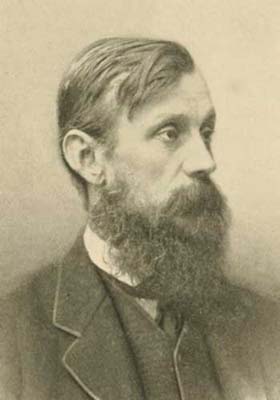
Michael Foster, K. C. B., M. A., F. R. S., Trinity. Professor of Physiology.
Most minds in America, as in England, if they think about the subject at all, impute to the two ancient centers of Anglo-Saxon learning—Oxford and Cambridge—an unquestionable supremacy. A halo of greatness surrounds these august institutions, none the less real because to the American mind, at least, it is vague. Half the books students at other institutions require in their various courses have the names of eminent Cambridge or Oxford men upon the fly leaf. Michael Foster's Physiology, Sidgwick's Methods of Ethics, and Bryce's American Commonwealth are recognized text-books wherever the subjects of which they treat are studied; while Sir G. G. Stokes, Jebb, Lord Acton, Caird, Max Müller, and Ray Lankester are as well known to students of Leland Stanford or Princeton as they are to Englishmen. One can scarcely read a work on English literature or open an English novel which does not make some reference to one or other of the great universities or their colleges, inseparably associated as they are with English life and history, past and present. Our oldest college owes its existence to John Harvard, of Emmanuel, Cambridge, and the name of the mother university still clings to her transatlantic offspring. The English institutions have become firmly associated in the vulgar mind with all that is dignified, venerable, and thorough in learning, but, beyond a vague sentiment of admiration, little adequate knowledge on the subject is abroad. American or German universities are organizations not very difficult to comprehend, and a vague knowledge of them is perhaps sufficient. The understanding, however, of those complicated academic communities, Oxford and Cambridge, is a matter of intimate experience. They differ widely from their sister institutions in other countries, and in attempting to give some conception of their peculiarities the writer proposes to restrict himself chiefly to Cambridge, because there are not very many striking differences between the latter and Oxford, and because the scientific supremacy of Cambridge is sufficiently established to render her an object of greater interest to the readers of the Science Monthly.
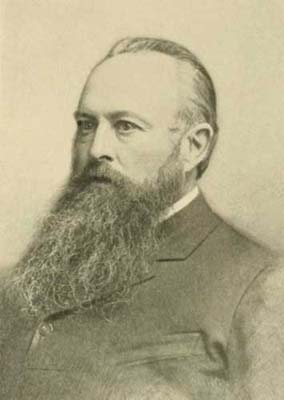
The Right Hon. Lord Acton, M. A., LL. D., Trinity. Professor of Modern History.
First of all, it must be borne in mind that throughout most of their history these institutions have been closely related, not to the body of the people, but to the aristocracy. This was not so much the case at first, before the university became an aggregate of colleges. Then a rather poor and humble class were enabled, through the small expense involved, to acquire the rudiments of an education, and even to become proficient in the scholastic dialectic. But ere long, and with the gradual endowment of different colleges, the expenses of a student became much greater, and, save where scholarships could be obtained, it required some affluence before parents could afford to give their sons an academic training. Hence, the more fortunate or aristocratic classes came in time to contribute the large majority of the student body. Those whose intellectual attainments were so unusual as to constitute ways and means have never been debarred, but impecunious mediocrity had and still has little place or opportunity. It is well to remember, in addition, that the Church fostered these universities in their infancy, that it deserves unqualified credit for having nursed them through their early months, and that it continues to have some considerable influence over the modern institutions. Finally, the growth of Cambridge and Oxford has largely been occasioned by lack of rivals in their own class. In this branch or that, other institutions have become deservedly famous. Edinburgh has a high reputation in moral science; Manchester is renowned for her physics, chemistry, and engineering; and London for her medical schools. But Oxford and Cambridge are strong in many branches. Financially powerful, they are able to attract the majority of promising and eminent men, whence has resulted that remarkable coterie of unrivaled intellects through whom the above-named universities are chiefly known to the outer and foreign world. This characteristic has its opposite illustrated in the United States, where the tendency is centrifugal, no one or two universities or colleges having advantages so decided as inevitably to attract most of the best minds, and where, in consequence, the best minds are found scattered from California to Harvard and Pennsylvania.
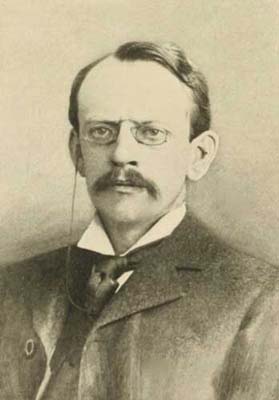
J. J. Thomson, M. A., F. R. S., Trinity. Professor of Experimental Physics.
The characteristic peculiar to Cambridge and Oxford, and which distinguishes them not only from American but also from all other universities in England and elsewhere, is the college system. Thus Cambridge is a collection of eighteen colleges which, though nominally united to form one institution, are really distinct, inasmuch as each is a separate community with its own buildings and grounds, its own resident students, its own lecturers, and Fellows—a community which is supported by its own moneys without aid from the university exchequer, and which in most matters legislates for itself. The system is not unlike the American Union on a small scale, with its cluster of governments and their relation to a supreme center. The advantages of this scheme might theoretically be very great. With each college handsomely endowed and, though managing its own affairs, entering freely, in addition, into those relations of reciprocity which make for the good of the whole, one can readily imagine an ideal academic commonwealth. And while the present condition of the university can scarcely be said to approximate very closely to such an academic Utopia, it yet derives from its constitution numerous obvious advantages which universities otherwise constituted would and do undoubtedly lack. The chief evils besetting the university are perhaps more adventitious than inherent; they are largely financial, and arise from carrying the system of college individualism too far. A description of the college and university organization may make this apparent. By its endowment a college must support a certain number of Fellows and scholars. The latter form a temporary body, while the former are more or less permanent, and therefore upon them devolves the management of the college. Business is usually done by a council chosen from the Fellows, and the election of new Fellows to fill vacancies is made by this select body. The head of a college is known as the master; he is elected by the Fellows save in one or two cases, where his appointment rests with the crown or with certain wealthy individuals. He lives in the college lodge especially built for him, draws a salary large in proportion to the wealth of his college, and exerts an influence corresponding to his intelligence.
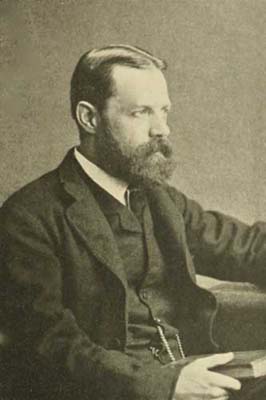
G. H. Darwin, M. A., F. R. S., Trinity. Plumian Professor of Astronomy.
The Fellows are in most cases chosen from those men who have achieved the greatest success in an honor course. At Cambridge College individualism has progressed so far that the Fellows of, say, Magdalen must be Magdalen men, the students of Queens', St Catherine's, or any other being ineligible save for their own fellowships. Oxford obtains perhaps better men on the whole by throwing open the fellowships of each particular college to the graduates of all, thus producing a wider competition. A fellowship until recently was tenable for life, but it has been reduced to about six years, the Fellows as a whole, however, retaining the power to extend the period of possession. And, further, the holding of a college office for fifteen years in general qualifies for the holding of a fellowship for life, and for a pension as lecturer or tutor. Thus a man is able to devote himself to research with little fear that at the latter end of his career he will lack the means of support. It is perhaps not too much to say that the offices of college dean, tutor, and lecturer are more perquisites than anything else. They are meant to keep and attract men of ability and parts. However, their existence reacts upon the student body by augmenting the expenses of the latter out of proportion to the benefits to be obtained. For instance, instead of utilizing one set of lecturers for one class of subjects, which all students could attend for a small fee, each of the larger colleges, at any rate, pays special lecturers, drawn from its own Fellows, to speak upon the same subjects each to a mere handful of men from their own college only. The tutor is another luxury inherited from the middle ages and therefore retained, and one for which the students have to pay dearly. The chief business of the tutor is not to teach, but to "look after" a certain number of students who are theoretically relegated to his charge. He looks up their lodgings for them, pays their bills at the end of the term, gets them out of scrapes, and draws a large salary. The tutorships seem to the writer to be a good illustration of how an office necessary to one period persists after that for which it was instituted has ceased to exist. When the students of Oxford and Cambridge were many of them thirteen and fourteen years of age, as in the fourteenth century, nurses were doubtless necessary, but they are still retained when the greater maturity of the students renders them not only unnecessary but at times even an impertinence.
The dean is not, as with us, the head of a department; his functions are not so many, his tasks far less onerous. It is before a college dean that students are "hauled" for such offenses as irregularity at chapel, returning to the college after 12 P. M., smoking in college precincts, bringing dogs into the college grounds, and other villainous offenses against regulations. A dean must also attend chapel. Some colleges require two deans to struggle through these complicated and laborious duties, though some possessing only a few dozen students succeed in getting along with one.
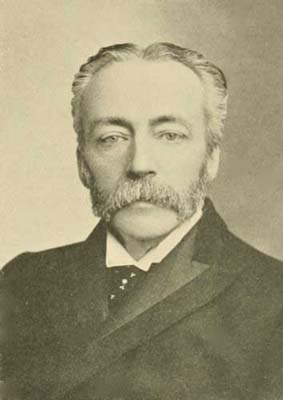
R. C. Jebb, Litt. D., M. P., Trinity. Regius Professor of Greek.
The line of demarcation between the university and the colleges is very distinct. The legislative influence of the former extends over a comparatively restricted field. All professorial chairs and certain lectureships belong to and are paid by the university; the latter has the arranging of the curricula, the care of the laboratories, the disposition of certain noncollegiate scholarships; but, broadly speaking, its two functions are the examination of all students and the conferring of degrees. The supreme legislative body is the senate, and it is composed of all masters of arts, doctors, and bachelors of divinity whose names still remain on the university books—that is, who continue to pay certain fees into the university treasury. In addition to the legislative body there is an executive head or council of nineteen, including the chancellor—at present the Duke of Devonshire—and the vice-chancellor. Both these bodies must govern according to the statutes, no alteration in which can be effected without recourse being had to Parliament. The senate is a peculiar body, and on occasions becomes somewhat unwieldy. It consists at present of some 6,800 members, of whom only 452 are in residence at Cambridge. Upon ordinary occasions only these 452 vote upon questions proposed by the council; but on occasions of great moment, as when the question of granting university degrees to women came up, some thousands or more of the nonresident members, who in many cases have lost touch with the modern university and modern systems of education, swarm to their alma mater, annihilate the champions of reform, and are hailed by their brethren as the saviors of their university.
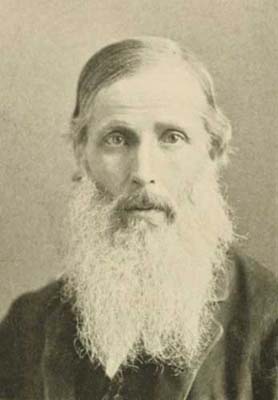
Henry Sidgwick, Litt. D., Trinity. Knightbridge Professor of Moral Philosophy.
The university's exchequer is supplied partly by its endowment, but chiefly by an assessment on the college incomes, a capitation tax on all undergraduates, and the fees attending matriculation, examinations, and the granting of degrees. The examinations are numerous. Every student on entering is required to pass, or to claim exemption from, an entrance examination. In either case he pays £3 to the university, and upon admission to any honor course or "tripos" to qualify for the degree of Bachelor of Arts £3 more is exacted. The income of the university from these examination fees alone amounts to £9,400 per annum, £4,600 of which goes to pay the examiners. In America this is supposed to be a part of the professor's or instructor's duty, no additional remuneration is allowed, and hence it does not become necessary to make an additional tax upon the students' resources. The conferring of degrees is also made a very profitable affair. Each candidate for the degree of B. A. pays out £7 to the voracious 'varsity chest, and upon proceeding to the M. A. a further contribution of £12 is requested. In this way the university makes about £12,000 a year, and, as though this was not sufficient, she requires a matriculation fee of £5 for every student who becomes a member. By this means another annual £5,000 is obtained. It must be remembered that these fees are entirely separate from the college fees. When the £5 matriculation for the latter is taken into consideration and the £8 a term (at Trinity) for lectures, two thirds of which the student does not attend, when it is understood that all this and more does not include living expenses, which are by no means slight, and that there are three terms instead of two, as with us, it will be obvious that Cambridge adheres very closely to the rule that to them only who have wealth shall her refining influence be given. That the greatest universities in existence should render it almost totally impossible for aught but the rich to obtain the advantages of their unusual educational facilities jars with that idea of democracy of learning which an American training is apt to foster. But, as we shall point out later, an aristocracy of learning may also have its uses.
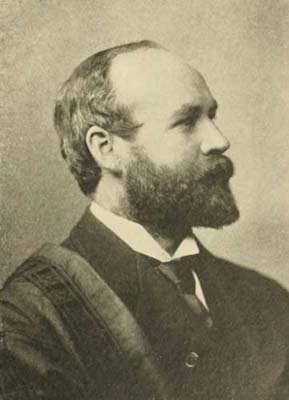
Donald MacAlister, M. A., M. D., St. Johns. Linacre Lecturer of Physics.
With all the revenues the university collects from colleges and students, amounting in all to about £65,000, Cambridge still finds herself poor. Some of the colleges, notably King's and Trinity, are extremely wealthy, but the university remains, if not exactly impecunious, at least on the ragged edge of financial difficulties. The various regius and other professorships, inadequately endowed by the munificence of the crown and of individuals, have each to be augmented from the university chest. The continual repairing of the old laboratories and scientific apparatus, the salaries to lecturers, to proctors, bedells, and other officers, cause a continual drain on the exchequer, which, with the rapidly growing need for larger laboratories and newer apparatus, has finally resulted in an appeal to the country for the sum of half a million pounds.
It has been seen that the drains on a student's pocket are very considerable at Cambridge, owing to the number of perquisites showered by the colleges on their Fellows, and it may appear that this state of things is unjust and wrong. At present Oxford and Cambridge are practically within the reach of only the moneyed population. According, however, to a plausible and frequently repeated theory, it is not the function of these universities to meet the educational needs of the mediocre poor. The writer's critical attitude toward the financial system in vogue at Cambridge is a proper one, only on the assumption that a maximum of education to all classes alike at a minimum of expense is the final cause and desideratum of a university's existence. But if one assumes that Oxford and Cambridge exist for a different purpose, that the chief end they propose to themselves is individual research, and the advancement, not the promulgation, of learning, it must be admitted that their system has little that is reprehensible. According to this standpoint the students only exist by courtesy of the dons (a name for the Fellows), who have a perfect right to impose upon the students, in return for the condescension which is shown them, what terms they see fit. And they argue that this view is the historic one. The colleges were originally endowed solely for the benefit of a certain limited number of Fellows and scholars. The undergraduate body, as it at present exists, is a later growth, whose eventual existence and the importance of which to the university was probably not anticipated by the college founders. Starting with this, the defenders of the present régime would point out, in addition, that there are other English institutions where the poorer classes may be educated, that Cambridge and Oxford are not only not bound to take upon themselves this task, but that they actually subserve a higher purpose and one just as necessary to the development of English science and letters and to the education of the English intellect by specializing in another direction. The good of a philosopher's lifelong reflections, they would say, is not always manifest, but the teachers who instruct the nation's youth are themselves dependent for rational standpoints upon the labor of the greater teacher, and they act as the instruments of communication between the most learned and the unlettered. So Oxford and Cambridge are the sources from whose fountains of wisdom and culture flow streams supplying all the academic mills of Britain, which in their turn are enabled to feed the inhabitants. It would be absurd, they maintain, to insist that the streams and the mills could equally well fulfill the same functions. Cambridge and Oxford instruct just so far as so doing is compatible with what for them is the main end—the furthering of various kinds of research and the offering of all sorts of inducements in order to keep and attract the interested attention of classical butterflies and scientific worms. How well they succeed in this noble ambition is known throughout the civilized world.
Mr. G. H. Darwin, a son of Charles Darwin, has recently had occasion to mention the enormous scientific output of Cambridge University. After saying that the Royal Society is the Academy of Sciences in England, and that in its publications appear accounts of all the most important scientific discoveries in England and most of those in Scotland, Ireland, and other parts of Europe, he goes on to state that he examined the Transactions of this society for three years and discovered that out of the 5,480 pages published in that time 2,418 were contributed by Cambridge men and 1,324 by residents.
In view of these facts, and despite the shortcomings of this university as a teaching institution, it is to be hoped that private generosity will answer her appeal for financial assistance. Her laboratories are a mine of research, and it is in them and in the men who conduct them that Cambridge is perhaps most to be admired.
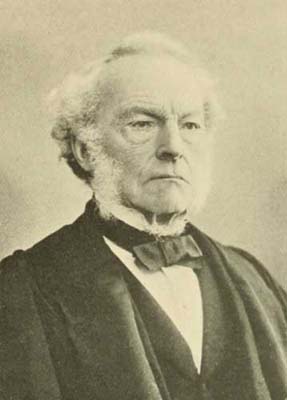
Sir G. G. Stokes, Bart., M. A., LL. D., Sc. D., F. R. S., Pembroke. Lucasian Professor of Mathematics.
The Cavendish Laboratory of Physics, where Clerk-Maxwell and afterward Lord Rayleigh taught, and which is at present in the hand of their able successor, J. J. Thomson, is a building of considerable size and admirably fitted out, but the rapidly increasing number of young physicists who are being allured by the working facilities of the place, and by the fame of Professor Thomson, is rendering even this splendidly equipped hall of science inadequate. The physiological laboratories are many, they are completely furnished with appliances, and a large number of students are there trained annually under the supervision of one of England's most eminent living scientists, Michael Foster, and his scarcely less able associates—Langley, Hardy, and Gaskell. Chemistry, zoölogy, botany, anatomy, and geology have each their well-appointed halls and masterly exponents. The names MacAlister, Liveing, Dewar, Newton, Sedgwick, Marshall Ward, and Hughes are not easily matched in any other one institution. Indeed, it is when one stops to consider the intellects at Cambridge that it becomes a dangerous matter to institute comparisons, and to say that this discipline or that is most rich in eminent interpreters. In science, at any rate, and in all branches of science, Cambridge stands alone. Not even Oxford can be considered for a moment as in the same class with her. And of all the sciences it is undoubtedly in mathematics and astronomy that the supremacy of Cambridge is most pronounced. The names of Profs. Sir G. G. Stokes and Sir R. S. Ball will be familiar to every reader, while those of Profs. Forsythe and G. H. Darwin and Mr. Baker will be familiar to all mathematicians. In classics Cambridge, while not possessing a similar monopoly of almost all the talent, still holds her own even with Oxford. Professors Jebb, Mayor, and Ridgeway, and Drs. Verrall, Jackson, and Frazer constitute a group of men second to none in the subjects of which they treat. Professor Jebb is also one of the university's two representatives in Parliament. In philosophy Cambridge has two men, Henry Sidgwick and James Ward, the former of whom is perhaps by common consent the first living authority on moral science, while the latter ranks among the first of living psychologists. These men, while representing very different philosophical standpoints, unite in opposition not only to the Hegelian movement, which, led by Caird and Bradley of Oxford, Seth and Stirling of Edinburgh, threatens the invasion of England, but also to the Spencerian philosophy. The latter system has not many adherents at either university, but the writer has been told by Professor Sully that the ascendency of the neo-Hegelian and other systems is by no means so pronounced elsewhere in England. The Spencerian biology, on the contrary, has been largely defended at Cambridge, while Weismannism, for the most part, is repudiated there and at Oxford.
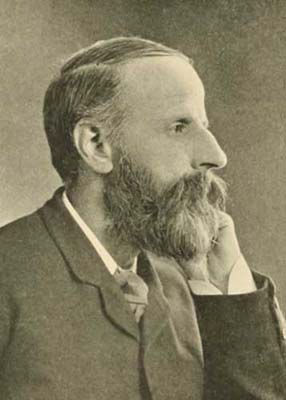
James Ward, Sc. D., Trinity. Professor of Mental Philosophy and Logic.
The teaching at Cambridge, as at all universities, is of many grades. In many subjects the lectures are not meant to give a student sufficient material to get him through an examination, and a "coach" becomes requisite, or at any rate is employed. This system of coaching has attained large dimensions; its results are often good, but it means an additional expense and seems an incentive to laziness, making it unnecessary for a student to exert his own mental aggressiveness or powers of application as he who fights his own battles must do. The Socratic form of instruction, producing a more intimate and unrestricted relation between instructor and student, and which is largely in operation in the States, is little practiced in England. In science the methods of instruction at Cambridge are ideal. That practical acquaintance with the facts of Nature which Huxley and Tyndall taught is the only true means of knowing Nature, is the key according to which all biological and physical instruction at these institutions is conducted.
In the last half dozen years two radical steps have been taken by both Oxford and Cambridge—steps leading, to many respectable minds, in diametrically opposite directions. The step backward (in the writer's view) occurred when the universities, after much excitement, defeated with slaughter the proposition granting university degrees to women. It was simply proposed that the students of Newnham and Girton, who should successfully compete with male students in an honor course, should have an equal right with the latter to receive the usual degrees from their alma mater. After industrious inquiry among those who were foremost in supporting and opposing this movement the writer has unearthed no objection of weight against the change. "If the women were granted degrees they would have votes in the senate," and "It never has been done"—these are the two reasons most persistently urged in defense of the conservative view; while justice and utility alike appear to be for once, at any rate, unequivocally on the side of the women. Prejudice defeated progress, and students celebrated the auspicious occasion with bonfires. The step forward was taken when the universities and their colleges decided to throw open their gates to the graduates of other universities in England, America, and elsewhere for the purpose of advanced study. But here, as in other things, Cambridge leads the way, and Oxford follows falteringly. The advanced students at Cambridge are treated like Cambridge men, they have the status of Bachelors of Arts, and possess in most respects the advantages, such as they are, of the latter; while at Oxford the advanced students are a restricted class, with restricted advantages, and their relation to the university is not that of the other students. In Cambridge the movement which has resulted in the present admirable condition of affairs was largely brought about by the zeal and enterprise of Dr. Donald MacAlister, of St. John's College, the University Lecturer in Therapeutics, a man of wide sympathies and ability, and whose name is closely associated with this university's metamorphosis into a more modern institution.
THE WONDERFUL CENTURY.[1]
A REVIEW BY W. K. BROOKS,
PROFESSOR OF ZOÖLOGY IN THE JOHNS HOPKINS UNIVERSITY.
Every naturalist has in his heart a warm affection for the author of the Malay Archipelago, and is glad to acknowledge with gratitude his debt to this great explorer and thinker and teacher who gave us the law of natural selection independently of Darwin. When the history of our century is written, the foremost place among those who have guided the thought of their generation and opened new fields for discovery will assuredly be given to Wallace and Darwin.
Few of the great men who have helped to make our century memorable in the history of thought are witnesses of its end, and all who have profited by the labors of Wallace will rejoice that he has been permitted to stand on the threshold of a new century, and, reviewing the past, to give us his impressions of the wonderful century.
We men of the nineteenth century, he says, have not been slow to praise it. The wise and the foolish, the learned and the unlearned, the poet and the pressman, the rich and the poor, alike swell the chorus of admiration for the marvelous inventions and discoveries of our own age, and especially for those innumerable applications of science which now form part of our daily life, and which remind us every hour of our immense superiority over our comparatively ignorant forefathers.
Our century, he tells us, has been characterized by a marvelous and altogether unprecedented progress in the knowledge of the universe and of its complex forces, and also in the application of that knowledge to an infinite variety of purposes calculated, if properly utilized, to supply all the wants of every human being and to add greatly to the comforts, the enjoyments, and the refinements of life. The bounds of human knowledge have been so far extended that new vistas have opened to us in nearly all directions where it had been thought that we could never penetrate, and the more we learn the more we seem capable of learning in the ever-widening expanse of the universe. It may, he says, be truly said of the men of science that they have become as gods knowing good and evil, since they have been able not only to utilize the most recondite powers of Nature in their service, but have in many cases been able to discover the sources of much of the evil that afflicts humanity, to abolish pain, to lengthen life, and to add immensely to the intellectual as well as the physical enjoyments of our race.
In order to get any adequate measure for comparison with the nineteenth century we must take not any preceding century, but the whole preceding epoch of human history. We must take into consideration not only the changes effected in science, in the arts, in the possibilities of human intercourse, and in the extension of our knowledge both of the earth and of the whole visible universe, but the means our century has furnished for future advancement.
Our author, who has borne such a distinguished part in the intellectual progress of our century, shows clearly that in means for the discovery of truth, for the extension of our control over Nature, and for the alleviation of the ills that beset mankind, the inheritance of the twentieth century from the nineteenth will be greater than our own inheritance from all the centuries that have gone before.
Some may regret that, while only one third of Wallace's book is devoted to the successes of the wonderful century, the author finds the remaining two thirds none too much for the enumeration of some of its most notable failures; but it is natural for one who has borne his own distinguished part in all this marvelous progress to ask where the century has fallen short of the enthusiastic hopes of its leaders, what that it might have done it has failed to do, and what lies ready at the hand of the workers who will begin the new century with this rich inheritance of new thoughts, new methods, and new resources.
The more we realize the vast possibilities of human welfare which science has given us the more, he says, must we recognize our total failure to make any adequate use of them.
Along with this continuous progress in science, in the arts, and in wealth-production, which has dazzled our imaginations to such an extent that we can hardly admit the possibility of any serious evils having accompanied or been caused by it, there has, he says, been many serious failures—intellectual, social, and moral. Some of our great thinkers, he says, have been so impressed by the terrible nature of these failures that they have doubted whether the final result of the work of the century has any balance of good over evil, of happiness over misery, for mankind at large.
Wallace is no pessimist, but one who believes that the first step in retrieving our failures is to perceive clearly where we have failed, for he says there can be no doubt of the magnitude of the evils that have grown up or persisted in the midst of all our triumphs over natural forces and our unprecedented growth in wealth and luxury, and he holds it not the least important part of his work to call attention to some of these failures.
With ample knowledge of the sources of health, we allow and even compel the bulk of our population to live and work under conditions which greatly shorten life. In our mad race for wealth we have made gold more sacred than human life; we have made life so hard for many that suicide and insanity and crime are alike increasing. The struggle for wealth has been accompanied by a reckless destruction of the stored-up products of Nature, which is even more deplorable because irretrievable. Not only have forest growths of many hundred years been cleared away, often with disastrous consequences, but the whole of the mineral treasures of the earth's surface, the slow productions of long-past eras of time and geological change, have been and are still being exhausted with reckless disregard of our duties to posterity and solely in the interest of landlords and capitalists. With all our labor-saving machinery and all our command over the forces of Nature, the struggle for existence has become more fierce than ever before, and year by year an ever-increasing proportion of our people sink into paupers' graves.
When the brightness of future ages shall have dimmed the glamour of our material progress he says that the judgment of history will surely be that our ethical standard was low and that we were unworthy to possess the great and beneficent powers that science had placed in our hands, for, instead of devoting the highest powers of our greatest men to remedy these evils, we see the governments of the most advanced nations arming their people to the teeth and expending most of the wealth and all the resources of their science in preparation for the destruction of life, of property, and of happiness.
He reminds us that the first International Exhibition, in 1851, fostered the hope that men would soon perceive that peace and commercial intercourse are essential to national well-being. Poets and statesmen joined in hailing the dawn of an era of peaceful industry, and exposition following exposition taught the nations how much they have to learn from each other and how much to give to each other for the benefit and happiness of all.
Dueling, which had long prevailed, in spite of its absurdity and harmfulness, as a means of settling disputes, was practically abolished by the general diffusion of a spirit of intolerance of private war; and as the same public opinion which condemns it should, if consistent, also condemn war between nations, many thought they perceived the dawn of a wiser policy between nations.
Yet so far are we from progress toward its abolition that the latter half of the century has witnessed not the decay, but a revival of the war spirit, and at its end we find all nations loaded with the burden of increasing armies and navies.
The armies are continually being equipped with new and more deadly weapons at a cost which strains the resources of even the most wealthy nations and impoverishes the mass of the people by increasing burdens of debt and taxation, and all this as a means of settling disputes which have no sufficient cause and no relation whatever to the well-being of the communities which engage in them.
The evils of war do not cease with the awful loss of life and destruction of property which are their immediate results, since they form the excuse for inordinate increase of armaments—an increase which has been intensified by the application to war purposes of those mechanical inventions and scientific discoveries which, properly used, should bring peace and plenty to all, but which when seized upon by the spirit of militarism directly lead to enmity among nations and to the misery of the people.
The first steps in this military development were the adoption of a new rifle by the Prussian army in 1846, the application of steam to ships of war in 1840, and the use of armor for battle ships in 1859. The remainder of the century has witnessed a mad race between the nations to increase the death-dealing power of their weapons and to add to the number and efficiency of their armies, while all the resources of modern science have been utilized in order to add to the destructive power of cannon and both the defensive and the offensive power of ships. The inability of industrious laboring men to gain any due share of the benefits of our progress in scientific knowledge is due, beyond everything else, to the expense of withdrawing great armies of men in the prime of life from productive labor, joined to the burden of feeding and clothing them and of keeping weapons and ammunition, ships, and fortifications in a state of readiness, of continually renewing stores of all kinds, of pensions, and of all the laboring men who must, besides making good the destruction caused by war, be withdrawn from productive labor and be supported by others that they may support the army.
And what a horrible mockery is this when viewed in the light of either Christianity or advancing civilization! All the nations armed to the teeth and watching stealthily for some occasion to use their vast armaments for their own aggrandizement and for the injury of their neighbors are Christian nations, but their Christian governments do not exist for the good of the governed, still less for the good of humanity or civilization, but for the aggrandizement and greed and lust of the ruling classes.
The devastation caused by the tyrants and conquerors of the middle ages and of antiquity has been reproduced in our times by the rush to obtain wealth. Even the lust of conquest, in order to obtain slaves and tribute and great estates, by means of which the ruling classes could live in boundless luxury, so characteristic of the earlier civilization, is reproduced in our time.
Witness the recent conduct of the nations of Europe toward Crete and Greece, upholding the most terrible despotism in the world because each hopes for a favorable opportunity to obtain some advantage, leading ultimately to the largest share of the spoil.
Witness the struggles in Africa and Asia, where millions of foreign people may be enslaved and bled for the benefit of their new rulers.
The whole world, says Wallace, is but a gambling table. Just as gambling deteriorates and demoralizes the individual, so the greed for dominion demoralizes governments. The welfare of the people is little cared for, except so far as to make them submissive taxpayers, enabling the ruling and moneyed classes to extend their sway over new territories and to create well-paid places and exciting work for their sons and relatives.
Hence, says Wallace, comes the force that ever urges on the increase of armaments and the extension of empire. Great vested interests are at stake, and ever-growing pressure is brought to bear upon the too-willing governments in the name of the greatness of the country, the extension of commerce, or the advance of civilization. This state of things is not progress, but retrogression. It will be held by the historian of the future to show that we of the nineteenth century were morally and socially unfit to possess the enormous powers for good and evil which the rapid advance of scientific discovery has given us, that our boasted civilization was in many respects a mere superficial veneer, and that our methods of government were not in accord with either Christianity or civilization.
Comparing the conduct of these modern nations, who call themselves Christian and civilized, with that of the Spanish conquerors of the West Indies, Mexico, and Peru, and making some allowances for differences of race and public opinion, Wallace says there is not much to choose between them.
Wealth and territory and native labor were the real objects in both cases, and if the Spaniards were more cruel by nature and more reckless in their methods the results were much the same. In both cases the country was conquered and thereafter occupied and governed by the conquerors frankly for their own ends, and with little regard for the feelings or the well-being of the conquered. If the Spaniards exterminated the natives of the West Indies, we, he says, have done the same thing in Tasmania and about the same in temperate Australia. Their belief that they were really serving God in converting the heathen, even at the point of the sword, was a genuine belief, shared by priests and conquerors alike—not a mere sham as ours is when we defend our conduct by the plea of "introducing the blessings of civilization."
It is quite possible, says Wallace, that both the conquest of Mexico and Peru by the Spaniards and our conquest of South Africa may have been real steps in advance, essential to human progress, and helping on the future reign of true civilization and the well-being of the human race. But if so, we have been and are unconscious agents in hastening the "far-off divine event." We deserve no credit for it. Our aims have been for the most part sordid and selfish, and our rule has often been largely influenced and often entirely directed by the necessity of finding well-paid places for young men with influence, and also by the constant demands for fresh markets by the influential class of merchants and manufacturers.
More general diffusion of the conviction that while all share the burdens of war, such good as comes from it is appropriated by the few, will no doubt do much to discourage wars; but we must ask whether there may not be another incentive to war which Wallace does not give due weight—whether love of fighting may not have something to do with wars.
As we look backward over history we are forced to ask whether the greed and selfishness of the wealthy and influential and those who hope to gain are the only causes of war. We went to war with Spain because our people in general demanded war. If we have been carried further than we intended and are now fighting for objects which we did not foresee and may not approve, this is no more than history might have led us to expect. War with Spain was popular with nearly all our people a year ago, and, while wise counsels might have stemmed this popular tide, there can be no doubt that it existed, for the evil passions of the human race are the real cause of wars.
The great problem of the twentieth century, as of all that have gone before, is the development of the wise and prudent self-restraint which represses natural passions and appetites for the sake of higher and better ends.
SPIDER BITES AND "KISSING BUGS."[2]
By L. O. HOWARD,
CHIEF OF THE DIVISION OF ENTOMOLOGY, UNITED STATES DEPARTMENT OF AGRICULTURE.
On several occasions during the past ten years, and especially at the Brooklyn meeting of the American Association for the Advancement of Science in 1894, the writer has endeavored to show that most of the newspaper stories of deaths from spider bite are either grossly exaggerated or based upon misinformation. He has failed to thoroughly substantiate a single case of death from a so-called spider bite, and has concluded that there is only one spider in the United States which is capable of inflicting a serious bite—viz., Latrodectus mactans, a species belonging to a genus of world-wide distribution, the other species of which have universally a bad reputation among the peoples whose country they inhabit. In spite of these conclusions, the accuracy of which has been tested with great care, there occur in the newspapers every year stories of spider bites of great seriousness, often resulting in death or the amputation of a limb. The details of negative evidence and of lack of positive evidence need not be entered upon here, except in so far as to state that in the great majority of these cases the spider supposed to have inflicted the bite is not even seen, while in almost no case is the spider seen to inflict the bite; and it is a well-known fact that there are practically no spiders in our more northern States which are able to pierce the human skin, except upon a portion of the body where the skin is especially delicate and which is seldom exposed. There arises, then, the probability that there are other insects capable of piercing tough skin, the results of whose bites may be more or less painful, the wounds being attributed to spiders on account of the universally bad reputation which these arthropods seem to have.
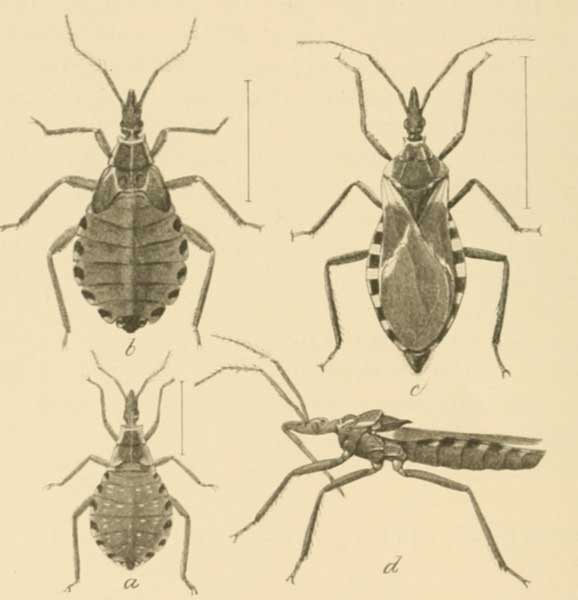
Different Stages of Conorhinus sanguisugus. Twice natural size. (After Marlatt.)
These sentences formed the introduction to a paper read by the writer at a meeting of the Entomological Society of Washington, held June 1st last. I went on to state that some of these insects are rather well known, as, for example, the blood-sucking cone-nose (Conorhinus sanguisugus) and the two-spotted corsairs (Rasatus thoracicus and R. biguttatus), both of which occur, however, most numerously in the South and West, and then spoke of Melanotestis picipes, a species which had been especially called to my attention by Mr. Frank M. Jones, of Wilmington, Del., who submitted the report of the attending physician in a case of two punctures by this insect inflicted upon the thumb and forefinger of a middle-aged man in Delaware. I further reported upon occasional somewhat severe results from the bites[3] of the old Reduvius personatus, now placed in the genus Opsicostes, and stated that a smaller species, Coriscus subcoleoptratus, had bitten me rather severely under circumstances similar to some of those which have given rise in the past to spider-bite stories. In the course of the discussion which followed the reading of this paper, Mr. Schwarz stated that twice during the present spring he had been bitten rather severely by Melanotestis picipes which had entered his room, probably attracted by light. He described it as the worst biter among heteropterous insects with which he had had any experience, and said he thought it was commoner than usual in Washington during the present year.
No account of this meeting was published, but within a few weeks thereafter several persons suffering from swollen faces visited the Emergency Hospital in Washington and complained that they had been bitten by some insect while asleep; that they did not see the insect, and could not describe it. This happened during one of the temporary periods when newspaper men are most actively engaged in hunting for items. There was a dearth of news. These swollen faces offered an opportunity for a good story, and thus began the "kissing-bug" scare which has grown to such extraordinary proportions. I have received the following letter and clipping from Mr. J. F. McElhone, of the Washington Post, in reply to a request for information regarding the origin of this curious epidemic:
"Washington, D. C., August 14, 1899.
"Dr. L. O. Howard, Cosmos Club, Washington, D. C.
"Dear Sir: Attached please find clipping from the Washington Post of June 20, 1899, being the first story that ever appeared in print, so far as I can learn, of the depredations of the Melanotestis picipes, better known now as the kissing bug. In my rounds as police reporter of the Post, I noticed, for two or three days before writing this story, that the register of the Emergency Hospital of this city contained unusually frequent notes of 'bug-bite' cases. Investigating, on the evening of June 19th I learned from the hospital physicians that a noticeable number of patients were applying daily for treatment for very red and extensive swellings, usually on the lips, and apparently the result of an insect bite. This led to the writing of the story attached.
"Very truly yours, "James F. McElhone."
The Washington Post. TUESDAY, JUNE 20, 1899. BITE OF A STRANGE BUG. Several Patients Have Appeared at the Hospitals Very Badly Poisoned. Lookout for the new bug. It is an insidious insect that bites without causing pain and escapes unnoticed. But afterward the place where it has bitten swells to ten times its normal size. The Emergency Hospital has had several victims of this insect as patients lately and the number is increasing. Application for treatment by other victims are being made at other hospitals, and the matter threatens to become something like a plague. None of those who have been bitten saw the insect whose sting proves so disastrous. One old negro went to sleep and woke up to find both his eyes nearly closed by the swelling from his nose and cheeks, where the insect had alighted. The lips seems to be the favorite point of attack. William Smith, a newspaper agent, of 327 Trumbull street, went to the Emergency last night with his upper lip swollen to many times its natural size. The symptoms are in every case the same, and there is indication of poisoning from an insect's bite. The matter is beginning to interest the physicians, and every patient who comes in with the now well-known marks is closely questioned as to the description of the insect. No one has yet been found who has seen it.
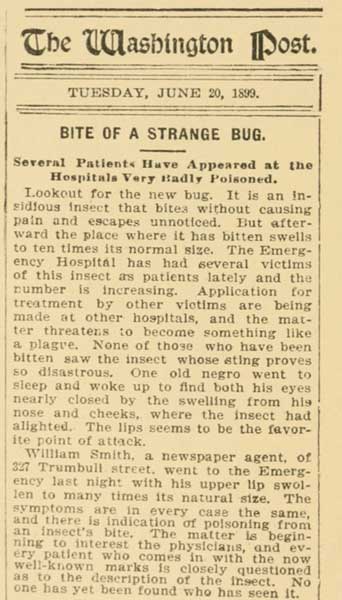
It would be an interesting computation for one to figure out the amount of newspaper space which was filled in the succeeding two months by items and articles about the "kissing bug." Other Washington newspapers took the matter up. The New York, Philadelphia, and Baltimore papers soon followed suit. The epidemic spread east to Boston and west to California. By "epidemic" is meant the newspaper epidemic, for every insect bite where the biter was not at once recognized was attributed to the popular and somewhat mysterious creature which had been given such an attractive name, and there can be no doubt that some mosquito, flea, and bedbug bites which had by accident resulted in a greater than the usual severity were attributed to the prevailing osculatory insect. In Washington professional beggars seized the opportunity, and went around from door to door with bandaged faces and hands, complaining that they were poor men and had been thrown out of work by the results of "kissing-bug" stings! One beggar came to the writer's door and offered, in support of his plea, a card supposed to be signed by the head surgeon of the Emergency Hospital. In a small town in central New York a man arrested on the charge of swindling entered the plea that he was temporarily insane owing to the bite of the "kissing bug." Entomologists all through the East were also much overworked answering questions asked them about the mysterious creature. Men of local entomological reputations were applied to by newspaper reporters, by their friends, by people who knew them, in church, on the street, and under all conceivable circumstances. Editorials were written about it. Even the Scientific American published a two-column article on the subject; and, while no international complications have resulted as yet, the kissing bug, in its own way and in the short space of two months, produced almost as much of a scare as did the San José scale in its five years of Eastern excitement. Now, however, the newspapers have had their fun, the necessary amount of space has been filled, and the subject has assumed a castaneous hue, to Latinize the slang of a few years back.
The experience has been a most interesting one. To the reader familiar with the old accounts of the hysterical craze of south Europe, based upon supposed tarantula bites, there can not fail to come the suggestion that we have had in miniature and in modernized form, aided largely by the newspapers, a hysterical craze of much the same character. From the medical and psychological point of view this aspect is interesting, and deserves investigation by competent persons.
As an entomologist, however, the writer confines himself to the actual authors of the bites so far as he has been able to determine them. It seems undoubtedly true that while there has been a great cry there has been very little wool. It is undoubtedly true, also, that there have been a certain number of bites by heteropterous insects, some of which have resulted in considerable swelling. It seems true that Melanotestis picipes and Opsicostes personatus have been more numerous than usual this year, at least around Washington. They have been captured in a number of instances while biting people, and have been brought to the writer's office for determination in such a way that there can be no doubt about the accuracy of this statement. As the story went West, bites by Conorhinus sanguisuga and Rasatus thoracicus were without doubt termed "kissing-bug" bites. With regard to other cases, the writer has known of an instance where the mosquito bite upon the lip of a sleeping child produced a very considerable swelling. Therefore he argues that many of these reported cases may have been nothing more than mosquito bites. With nervous and excitable individuals the symptoms of any skin puncture become exaggerated not only in the mind of the individual but in their actual characteristics, and not only does this refer to cases of skin puncture but to certain skin eruptions, and to some of those early summer skin troubles which are known as strawberry rash, etc. It is in this aspect of the subject that the resemblance to tarantulism comes in, and this is the result of the hysterical wave, if it may be so termed.
Six different heteropterous insects were mentioned in the early part of this article, and it will be appropriate to give each of them some little detailed consideration, taking the species of Eastern distribution first, since the scare had its origin in the East, and has there perhaps been more fully exploited.
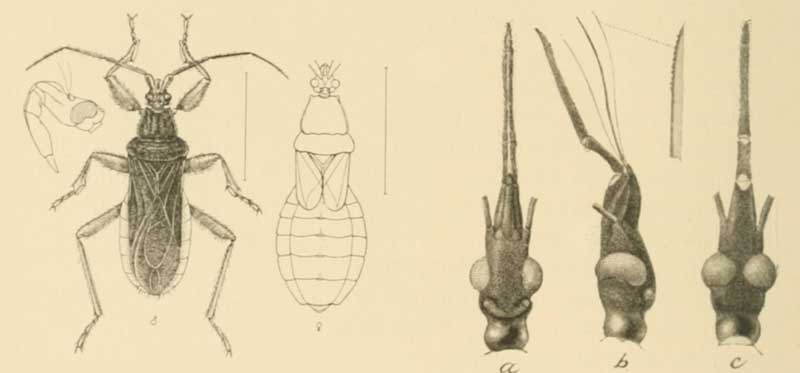
Melanotestis abdominalis. Female at right; male at left, with enlarged beak at side. Twice natural size. (Original.)
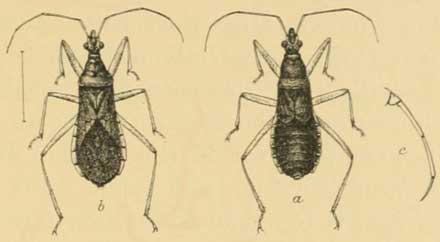
Head and Proboscis of Conorhinus sanguisugus. (After Marlatt.)
Opsicostes personatus, also known as Reduvius personatus, and which has been termed the "cannibal bug," is a European species introduced into this country at some unknown date, but possibly following close in the wake of the bedbug. In Europe this species haunts houses for the purpose of preying upon bedbugs. Riley, in his well-known article on Poisonous Insects, published in Wood's Reference Handbook of Medical Science, states that if a fly or another insect is offered to the cannibal bug it is first touched with the antennæ, a sudden spring follows, and at the same time the beak is thrust into the prey. The young specimens are covered with a glutinous substance, to which bits of dirt and dust adhere. They move deliberately, with a long pause between each step, the step being taken in a jerky manner. The distribution of the species, as given by Reuter in his Monograph of the Genus Reduvius, is Europe to the middle of Sweden, Caucasia, Asia Minor, Algeria, Madeira; North America, Canada, New York, Philadelphia, Indiana; Tasmania, Australia—from which it appears that the insect is already practically cosmopolitan, and in fact may almost be termed a household insect. The collections of the United States National Museum and of Messrs. Heidemann and Chittenden, of Washington, D. C., indicate the following localities for this species: Locust Hill, Va.; Washington, D. C.; Baltimore, Md.; Ithaca, N. Y.; Cleveland, Ohio; Keokuk, Iowa.
The bite of this species is said to be very painful, more so than that of a bee, and to be followed by numbness (Lintner). One of the cases brought to the writer's attention this summer was that of a Swedish servant girl, in which the insect was caught, where the sting was upon the neck, and was followed by considerable swelling. Le Conte, in describing it under the synonymical name Reduvius pungens, gives Georgia as the locality, and makes the following statement: "This species is remarkable for the intense pain caused by its bite. I do not know whether it ever willingly plunges its rostrum into any person, but when caught or unskillfully handled it always stings. In this case the pain is almost equal to that of the bite of a snake, and the swelling and irritation which result from it will sometimes last for a week. In very weak and irritable constitutions it may even prove fatal."[4]
Coriscus subcoleoptratus: a, wingless form; b, winged form; c, proboscis. All twice natural size. (Original.)
The second Eastern species is Melanotestis picipes. This and the closely allied and possibly identical M. abdominalis are not rare in the United States, and have been found all along the Atlantic States, in the West and South, and also in Mexico. They live underneath stones and logs, and run swiftly. Both sexes of M. picipes in the adult are fully winged, but the female of M. abdominalis is usually found in the short-winged condition. Prof. P. R. Uhler writes (in litt.): "Melanotestis abdominalis is not rare in this section (Baltimore), but the winged female is a great rarity. At the present time I have not a specimen of the winged female in my collection. I have seen specimens from the South, in North Carolina and Florida, but I do not remember one from Maryland. I am satisfied that M. picipes is distinct from M. abdominalis. I have not known the two species to unite sexually, but I have seen them both united to their proper consorts. Both species are sometimes found under the same flat stone or log, and they both hibernate in our valleys beneath stones and rubbish in loamy soils." Specimens in Washington collections show the following localities for M. abdominalis: Baltimore, Md.; Washington, D. C.; Wilmington, Del.; New Jersey; Long Island; Fort Bliss, Texas; Louisiana; and Keokuk, Iowa;, and for M. picipes, Washington, D. C.; Roslyn, Va.; Baltimore, Md.; Derby, Conn.; Long Island; a series labeled New Jersey; Wilmington, Del.; Keokuk, Iowa; Cleveland and Cincinnati, Ohio; Louisiana; Jackson, Miss.; Barton County, Mo.; Fort Bliss, Texas; San Antonio, Texas; Crescent City, Fla.; Holland, S. C.
This insect has been mentioned several times in entomological literature. The first reference to its bite probably was made by Townend Glover in the Annual Report of the Commissioner of Agriculture for 1875 (page 130). In Maryland, he states, M. picipes is found under stones, moss, logs of wood, etc., and is capable of inflicting a severe wound with its rostrum or piercer. In 1888 Dr. Lintner, in his Fourth Report as State Entomologist of New York (page 110), quotes from a correspondent in Natchez, Miss., concerning this insect: "I send a specimen of a fly not known to us here. A few days ago it punctured the finger of my wife, inflicting a painful sting. The swelling was rapid, and for several days the wound was quite annoying." Until recent years this insect has not been known to the writer as occurring in houses with any degree of frequency. In May, 1895, however, I received a specimen from an esteemed correspondent—Dr. J. M. Shaffer, of Keokuk, Iowa—together with a letter written on May 7th, in which the statement was made that four specimens flew into his window the night before. The insect, therefore, is attracted to light or is becoming attracted to light, is a night-flier, and enters houses through open windows. Among the several cases coming under the writer's observation of bites by this insect, one has been reported by the well-known entomologist Mr. Charles Dury, of Cincinnati, Ohio, in which this species (M. picipes) bit a man on the back of the hand, making a bad sore. In another case, where the insect was brought for our determination and proved to be this species, the bite was upon the cheek, and the swelling was said to be great, but with little pain. In a third case, occurring at Holland, S. C., the symptoms were more serious. The patient was bitten upon the end of the middle finger, and stated that the first paroxysm of pain was about like that resulting from a hornet or a bee sting, but almost immediately it grew ten times more painful, with a feeling of weakness followed by vomiting. The pain was felt to shoot up the arm to the under jaw, and the sickness lasted for a number of days. A fourth case, at Fort Bliss, Texas, is interesting as having occurred in bed. The patient was bitten on the hand, with very painful results and bad swelling.
The third of the Eastern species, Coriscus subcoleoptratus, is said by Uhler to have a general distribution in the Northern States, and is like the species immediately preceding a native insect. There is no record of any bite by this species, and it is introduced here for the reason that it attracted the writer's attention crawling upon the walls of an earth closet in Greene County, New York, where on one occasion it bit him between the fingers. The pain was sharp, like the prick of a pin, but only a faint swelling followed, and no further inconvenience. The insect is mentioned, however, for the reason that, occurring in such situations, it is one of the forms which are liable to carry pathogenic bacteria.

Rasatus biguttatus.Reduvius (Opsicostes) personatus.
Twice natural size. (Original.)Twice natural size. (Original.)
There remain for consideration the Southern and Western forms—Rasatus thoracicus and R. biguttatus, and Conorhinus sanguisugus.
The two-spotted corsair, as Rasatus biguttatus is popularly termed, is said by Riley to be found frequently in houses in the Southern States, and to prey upon bedbugs. Lintner, referring to the fact that it preys upon bedbugs, says: "It evidently delights in human blood, but prefers taking it at second hand." Dr. A. Davidson, formerly of Los Angeles, Cal., in an important paper entitled So-called Spider Bites and their Treatment, published in the Therapeutic Gazette of February 15, 1897, arrives at the conclusion that almost all of the so-called spider bites met with in southern California are produced by no spider at all, but by Rasatus biguttatus. The symptoms which he describes are as follows: "Next day the injured part shows a local cellulitis, with a central dark spot; around this spot there frequently appears a bullous vesicle about the size of a ten-cent piece, and filled with a dark grumous fluid; a small ulcer forms underneath the vesicle, the necrotic area being generally limited to the central part, while the surrounding tissues are more or less swollen and somewhat painful. In a few days, with rest and proper care, the swelling subsides, and in a week all traces of the cellulitis are usually gone. In some of the cases no vesicle forms at the point of injury, the formation probably depending on the constitutional vitality of the individual or the amount of poison introduced." The explanation of the severity of the wound suggested by Dr. Davidson, and in which the writer fully concurs with him, is not that the insect introduces any specific poison of its own, but that the poison introduced is probably accidental and contains the ordinary putrefactive germs which may adhere to its proboscis. Dr. Davidson's treatment was corrosive sublimate—1 to 500 or 1 to 1,000—locally applied to the wound, keeping the necrotic part bathed in the solution. The results have in all cases been favorable. Uhler gives the distribution of R. biguttatus as Arizona, Texas, Panama, Pará, Cuba, Louisiana, West Virginia, and California. After a careful study of the material in the United States National Museum, Mr. Heidemann has decided that the specimens of Rasatus from the southeastern part of the country are in reality Say's R. biguttatus, while those from the Southwestern States belong to a distinct species answering more fully, with slight exceptions, to the description of Stal's Rasatus thoracicus. The writer has recently received a large series of R. thoracicus from Mr. H. Brown, of Tucson, Arizona, and had a disagreeable experience with the same species in April, 1898, at San José de Guaymas, in the State of Sonora, Mexico. He had not seen the insect alive before, and was sitting at the supper table with his host—a ranchero of cosmopolitan language. One of the bugs, attracted by the light, flew in with a buzz and flopped down on the table. The writer's entomological instinct led him to reach out for it, and was warned by his host in the remarkable sentence comprising words derived from three distinct languages: "Guardez, guardez! Zat animalito sting like ze dev!" But it was too late; the writer had been stung on the forefinger, with painful results. Fortunately, however, the insect's beak must have been clean, and no great swelling or long inconvenience ensued.