APPLETONS' POPULAR SCIENCE MONTHLY. (continued 2)
Reading edition
Perhaps the best known of any of the species mentioned in our list is the blood-sucking cone-nose (Conorhinus sanguisugus). This ferocious insect belongs to a genus which has several representatives in the United States, all, however, confined to the South or West. C. rubro-fasciatus and C. variegatus, as well as C. sanguisugus, are given the general geographical distribution of "Southern States." C. dimidiatus and C. maculipennis are Mexican forms, while C. gerstaeckeri occurs in the Western States. The more recently described species, C. protractus Uhl., has been taken at Los Angeles, Cal.; Dragoon, Ariz.; and Salt Lake City, Utah. All of these insects are blood-suckers, and do not hesitate to attack animals. Le Conte, in his original description of C. sanguisugus,[5] adds a most significant paragraph or two which, as it has not been quoted of late, will be especially appropriate here: "This insect, equally with the former" (see above), "inflicts a most painful wound. It is remarkable also for sucking the blood of mammals, particularly of children. I have known its bite followed by very serious consequences, the patient not recovering from its effects for nearly a year. The many relations which we have of spider bites frequently proving fatal have no doubt arisen from the stings of these insects or others of the same genera. When the disease called spider bite is not an anthrax or carbuncle it is undoubtedly occasioned by the bite of an insect—by no means however, of a spider. Among the many species of Araneidæ which we have in the United States I have never seen one capable of inflicting the slightest wound. Ignorant persons may easily mistake a Cimex for a spider. I have known a physician who sent to me the fragments of a large ant, which he supposed was a spider, that came out of his grandchild's head." The fact that Le Conte was himself a physician, having graduated from the College of Physicians and Surgeons in 1846, thus having been nine years in practice at the time, renders this statement all the more significant. The life history and habits of C. sanguisugus have been so well written up by my assistant, Mr. Marlatt, in Bulletin No. 4, New Series, of the Division of Entomology, United States Department of Agriculture, that it is not necessary to enter upon them here. The point made by Marlatt—that the constant and uniform character of the symptoms in nearly all cases of bites by this insect indicate that there is a specific poison connected with the bite—deserves consideration, but there can be no doubt that the very serious results which sometimes follow the bite are due to the introduction of extraneous poison germs. The late Mr. J. B. Lembert, of Yosemite, Cal., noticed particularly that the species of Conorhinus occurring upon the Pacific coast is attracted by carrion. Professor Toumey, of Tucson, Arizona, shows how a woman broke out all over the body and limbs with red blotches and welts from a single sting on the shoulders. Specimens of C. sanguisugus received in July, 1899, from Mayersville, Miss., were accompanied by the statement—which is appropriate, in view of the fact that the newspapers have insisted that the "kissing bug" prefers the lip—that a friend of the writer was bitten on the lip, and that the effect was a burning pain, intense itching, and much swelling, lasting three or four days. The writer of the letter had been bitten upon the leg and arm, and his brother was bitten upon both feet and legs and on the arm, the symptoms being the same in all cases.
More need hardly be said specifically concerning these biting bugs. The writer's conclusions are that a puncture by any one of them may be and frequently has been mistaken for a spider bite, and that nearly all reported spider-bite cases have had in reality this cause, that the so-called "kissing-bug" scare has been based upon certain undoubted cases of the bite of one or the other of them, but that other bites, including mosquitoes, with hysterical and nervous symptoms produced by the newspaper accounts, have aided in the general alarm. The case of Miss Larson, who died in August, 1898, as the result of a mosquito bite, at Mystic, Conn., is an instance which goes to show that no mysterious new insect need be looked for to explain occasional remarkable cases. One good result of the "kissing-bug" excitement will prove in the end to be that it will have relieved spiders from much unnecessary discredit.
THE MOSQUITO THEORY OF MALARIA.[6]
By Major RONALD ROSS.
I have the honor to address you, on completion of my term of special duty for the investigation of malaria, on the subject of the practical results as regard the prevention of the disease which may be expected to arise from my researches; and I trust that this letter may be submitted to the Government if the director general thinks fit.
It has been shown in my reports to you that the parasites of malaria pass a stage of their existence in certain species of mosquitoes, by the bites of which they are inoculated into the blood of healthy men and birds. These observations have solved the problem—previously thought insolvable—of the mode of life of these parasites in external Nature.
My results have been accepted by Dr. Laveran, the discoverer of the parasites of malaria; by Dr. Manson, who elaborated the mosquito theory of malaria; by Dr. Nuttall, of the Hygienic Institute of Berlin, who has made a special study of the relations between insects and disease; and, I understand, by M. Metchnikoff, Director of the Laboratory of the Pasteur Institute in Paris. Lately, moreover, Dr. C. W. Daniels, of the Malaria Commission, who has been sent to study with me in Calcutta, has confirmed my observations in a special report to the Royal Society; while, lastly, Professor Grassi and Drs. Bignami and Bastianelli, of Rome, have been able, after receiving specimens and copies of my reports from me, to repeat my experiments in detail, and to follow two of the parasites of human malaria through all their stages in a species of mosquito called the Anopheles claviger.
It may therefore be finally accepted as a fact that malaria is communicated by the bites of some species of mosquito; and, to judge from the general laws governing the development of parasitic animals, such as the parasites of malaria, this is very probably the only way in which infection is acquired, in which opinion several distinguished men of science concur with me.
In considering this statement it is necessary to remember that it does not refer to the mere recurrences of fever to which people previously infected are often subject as the result of chill, fatigue, and so on. When I say that malaria is communicated by the bites of mosquitoes, I allude only to the original infection.
It is also necessary to guard against assertions to the effect that malaria is prevalent where mosquitoes and gnats do not exist. In my experience, when the facts come to be inquired into, such assertions are found to be untrue. Scientific research has now yielded so absolute a proof of the mosquito theory of malaria that hearsay evidence opposed to it can no longer carry any weight.
Hence it follows that, in order to eliminate malaria wholly or partly from a given locality, it is necessary only to exterminate the various species of insect which carry the infection. This will certainly remove the malaria to a large extent, and will almost certainly remove it altogether. It remains only to consider whether such a measure is practicable.
Theoretically the extermination of mosquitoes is a very simple matter. These insects are always hatched from aquatic larvæ or grubs which can live only in small stagnant collections of water, such as pots and tubs of water, garden cisterns, wells, ditches and drains, small ponds, half-dried water courses, and temporary pools of rain-water. So far as I have yet observed, the larvæ are seldom to be found in larger bodies of water, such as tanks, rice fields, streams, and rivers and lakes, because in such places they are devoured by minnows and other small fish. Nor have I ever seen any evidence in favor of the popular view that they breed in damp grass, dead leaves, and so on.
Hence, in order to get rid of these insects from a locality, it will suffice to empty out or drain away, or treat with certain chemicals, the small collections of water in which their larvæ must pass their existence.
But the practicability of this will depend on circumstances—especially, I think, on the species of mosquito with which we wish to deal. In my experience, different species select different habitations for their larvæ. Thus the common "brindled mosquitoes" breed almost entirely in pots and tubs of water; the common "gray mosquitoes" only in cisterns, ditches, and drains; while the rarer "spotted-winged mosquitoes" seem to choose only shallow rain-water puddles and ponds too large to dry up under a week or more, and too small or too foul and stagnant for minnows.
Hence the larvæ of the first two varieties are found in large numbers round almost all human dwellings in India; and, because their breeding grounds—namely, vessels of water, drains, and wells—are so numerous and are so frequently contained in private tenements, it will be almost impossible to exterminate them on a large scale.
On the other hand, spotted-winged mosquitoes are generally much more rare than the other two varieties. They do not appear to breed in wells, cisterns, and vessels of water, and therefore have no special connection with human habitations. In fact, it is usually a matter of some difficulty to obtain their larvæ. Small pools of any permanence—such as they require—are not common in most parts of India, except during the rains, and then pools of this kind are generally full of minnows which make short work of any mosquito larvæ they may find. In other words, the breeding grounds of the spotted-winged varieties seem to be so isolated and small that I think it may be possible to exterminate this species under certain circumstances.
The importance of these observations will be apparent when I add that hitherto the parasites of human malaria have been found only in spotted-winged mosquitoes—namely, in two species of them in India and in one species in Italy. As a result of very numerous experiments I think that the common brindled and gray mosquitoes are quite innocuous as regards human malaria—a fortunate circumstance for the human race in the tropics; and Professor Grassi seems to have come to the same conclusion as the result of his inquiries in Italy.
But I wish to be understood as writing with all due caution on these points. Up to the present our knowledge, both as regards the habits of the various species of mosquito and as regards the capacity of each for carrying malaria, is not complete. All I can now say is that if my anticipations be realized—if it be found that the malaria-bearing species of mosquito multiply only in small isolated collections of water which can easily be dissipated—we shall possess a simple mode of eliminating malaria from certain localities.
I limit this statement to certain localities only, because it is obvious that where the breeding pools are very numerous, as in water-logged country, or where the inhabitants are not sufficiently advanced to take the necessary precautions, we can scarcely expect the recent observations to be of much use—at least for some years to come. And this limitation must, I fear, exclude most of the rural areas in India.
Where, however, the breeding pools are not very numerous, and where there is anything approaching a competent sanitary establishment, we may, I think, hope to reap the benefit of these discoveries. And this should apply to the most crowded areas, such as those of cities, towns and cantonments, and also to tea, coffee, and indigo estates, and perhaps to military camps.
For instance, malaria causes an enormous amount of sickness among the poor in most Indian cities. Here the common species of mosquitoes breed in the precincts of almost all the houses, and can therefore scarcely be exterminated; but pools suitable for the spotted-winged varieties are comparatively scarce, being found only on vacant areas, ill-kept gardens, or beside roads in very exceptional positions where they can neither dry up quickly nor contain fish. Thus a single small puddle may supply the dangerous mosquitoes to several square miles containing a crowded population: if this be detected and drained off—which will generally cost only a very few rupees—we may expect malaria to vanish from that particular area.
The same considerations will apply to military cantonments and estates under cultivation. In many such malaria causes the bulk of the sickness, and may often, I think, originate from two or three small puddles of a few square yards in size. Thus in a malarious part of the cantonment of Secunderabad I found the larvæ of spotted-winged mosquitoes only after a long search in a single little pool which could be filled up with a few cart-loads of town rubbish.
In making these suggestions I do not wish to excite hopes which may ultimately prove to have been unfounded. We do not yet know all the dangerous species of mosquito, nor do we even possess an exhaustive knowledge of the haunts and habits of any one variety. I wish merely to indicate what, so far as I can see at present, may become a very simple means of eradicating malaria.
One thing may be said for certain. Where previously we have been unable to point out the exact origin of the malaria in a locality, and have thought that it rises from the soil generally, we now hope for much more precise knowledge regarding its source; and it will be contrary to experience if human ingenuity does not finally succeed in turning such information to practical account.
More than this, if the distinguishing characteristics of the malaria-bearing mosquitoes are sufficiently marked (if, for instance, they all have spotted wings), people forced to live or travel in malarious districts will ultimately come to recognize them and to take precautions against being bitten by them.
Before practical results can be reasonably looked for, however, we must find precisely—
(a) What species of Indian mosquitoes do and do not carry human malaria.
(b) What are the habits of the dangerous varieties.
I hope, therefore, that I may be permitted to urge the desirability of carrying out this research. It will no longer present any scientific difficulties, as only the methods already successfully adopted will be required. The results obtained will be quite unequivocal and definite.
But the inquiry should be exhaustive. It will not suffice to distinguish merely one or two malaria-bearing species of mosquito in one or two localities; we should learn to know all of them in all parts of the country.
The investigation will be abbreviated if the dangerous species be found to belong only to one class of mosquito, as I think is likely; and the researches which are now being energetically entered upon in Germany, Italy, America, and Africa will assist any which may be undertaken in India, though there is reason for thinking that the malaria-bearing species differ in various countries.
As each species is detected it will be possible to attempt measures at once for its extermination in given localities as an experiment.
I regret that, owing to my work connected with kala-azar, I have not been able to advance this branch of knowledge as much during my term of special duty as I had hoped to do; but I think that the solution of the malaria problem which has been obtained during this period will ultimately yield results of practical importance.
FOOD POISONING.
By VICTOR C. VAUGHAN,
PROFESSOR OF HYGIENE IN THE UNIVERSITY OF MICHIGAN.
Within the past fifteen or twenty years cases of poisoning with foods of various kinds have apparently become quite numerous. This increase in the number of instances of this kind has been both apparent and real. In the first place, it is only within recent years that it has been recognized that foods ordinarily harmless may become most powerful poisons. In the second place, the more extensive use of preserved foods of various kinds has led to an actual increase in the number of outbreaks of food poisoning.
The harmful effects of foods may be due to any of the following causes:
1. Certain poisonous fungi may infect grains. This is the cause of epidemics of poisoning with ergotized bread, which formerly prevailed during certain seasons throughout the greater part of continental Europe, but which are now practically limited to southern Russia and Spain. In this country ergotism is practically unknown, except as a result of the criminal use of the drug ergot. However, a few herds of cattle in Kansas and Nebraska have been quite extensively affected with this disease.
2. Plants and animals may feed upon substances that are not harmful to them, but which may seriously affect man on account of his greater susceptibility. It is a well-known fact that hogs may eat large quantities of arsenic or antimony without harm to themselves, and thus render their flesh unfit for food for man. It is believed that birds that feed upon the mountain laurel furnish a food poisonous to man.
3. During periods of the physiological activity of certain glands in some of the lower animals the flesh becomes harmful to man. Some species of fish are poisonous during the spawning season.
4. Both animal and vegetable foods may become infected with the specific germs of disease and serve as the carriers of the infection to man. Instances of the distribution of typhoid fever by the milkman are illustrations of this.
5. Animals may be infected with specific diseases, which may be transmitted to man in the meat or milk. This is one of the means by which tuberculosis is spread.
6. Certain nonspecific, poison-producing germs may find their way into foods of various kinds, and may by their growth produce chemical poisons either before or after the food has been eaten. This is the most common form of food poisoning known in this country.
We will briefly discuss some foods most likely to prove harmful to man.
Mussel Poisoning.—It has long been known that this bivalve is occasionally poisonous. Three forms of mussel poisoning are recognized. The first, known as Mytilotoxismus gastricus, is accompanied by symptoms practically identical with those of cholera morbus. At first there is nausea, followed by vomiting, which may continue for hours. In severe cases the walls of the stomach are so seriously altered that the vomited matter contains considerable quantities of blood. Vomiting is usually accompanied by severe and painful purging. The heart may be markedly affected, and death may result from failure of this organ. Examination after death from this cause shows the stomach and small intestines to be highly inflamed.
The second form of mussel poisoning is known as Mytilotoxismus exanthematicus on account of visible changes in the skin. At first there is a sensation of heat, usually beginning in the eyelids, then spreading to the face, and finally extending over the whole body. This sensation is followed by an eruption, which is accompanied by intolerable itching. In severe cases the breathing becomes labored, the face grows livid, consciousness is lost, and death may result within two or three days.
The most frequently observed form of mussel poisoning is that designated as Mytilotoxismus paralyticus. As early as 1827 Combe reported his observations upon thirty persons who had suffered from this kind of mussel poisoning. The first symptoms, as a rule, appeared within two hours after eating the poisonous food. Some suffered from nausea and vomiting, but these were not constant or lasting symptoms. All complained of a prickly feeling in the hands, heat and constriction of the throat, difficulty of swallowing and speaking, numbness about the mouth, gradually extending over the face and to the arms, with great debility of the limbs. Most of the sufferers were unable to stand; the action of the heart was feeble, and the face grew pale and expressed much anxiety. Two of the thirty cases terminated fatally. Post-mortem examination showed no abnormality.
Many opinions have been expressed concerning the nature of harmful mussels. Until quite recently it was a common belief that certain species are constantly toxic. Virchow has attempted to describe the dangerous variety of mussels, stating that it has a brighter shell, sweeter, more penetrating, bouillonlike odor than the edible kind, and that the flesh of the poisonous mussel is yellow; the water in which they are boiled becomes bluish.
However, this belief in a poisonous species is now admitted to be erroneous. At one time it was suggested that mussels became hurtful by absorbing the copper from the bottoms of vessels, but Christison made an analysis of the mussels that poisoned the men mentioned by Combe, with negative results, and also pointed out the fact that the symptoms were not those of poisoning with copper. Some have held that the ill effects were due wholly to idiosyncrasies in the consumers, but cats and dogs are affected in the same way as men are. It has also been believed that all mussels are poisonous during the period of reproduction. This theory is the basis of the popular superstition that shellfish should not be eaten during the months in the name of which the letter "r" does not occur. At one time this popular idea took the form of a legal enactment in France forbidding the sale of shellfish from May 1st to September 1st. This widespread idea has a grain of truth in it, inasmuch as decomposition is more likely to alter food injuriously during the summer months. However, poisoning with mussels may occur at any time of the year.
It has been pretty well demonstrated that the first two forms of mussel poisoning mentioned above are due to putrefactive processes, while the paralytic manifestations seen in other cases are due to a poison isolated a few years ago by Brieger, and named by him mytilotoxin. Any mussel may acquire this poison when it lives in filthy water. Indeed, it has been shown experimentally that edible mussels may become harmful when left for fourteen days or longer in filthy water; while, on the other hand, poisonous mussels may become harmless if kept four weeks or longer in clear water. This is true not only of mussels, but of oysters as well. Some years ago, many cases of poisoning from oysters were reported at Havre. The oysters had been taken from a bed near the outlet of a drain from a public water closet. Both oysters and mussels may harbor the typhoid bacillus, and may act as carriers of this germ to man.
There should be most stringent police regulations against the sale of all kinds of mollusks, and all fish as well, taken from filthy waters. Certainly one should avoid shellfish from impure waters, and it is not too much to insist that those offered for food should be washed in clean water. All forms of clam and oyster broth should be avoided when it has stood even for a few hours at summer heat. These preparations very quickly become infected with bacteria, which develop most potent poisons.
Fish Poisoning.—Some fish are supplied with poisonous glands, by means of which they secure their prey and protect themselves from their enemies. The "dragon weaver," or "sea weaver" (Trachinus draco), is one of the best known of these fish. There are numerous varieties widely distributed in salt waters. The poisonous spine is attached partly to the maxilla and partly to the gill cover at its base. This spine is connected with a poisonous gland; the spine itself is grooved and covered with a thin membrane, which converts the grooves into canals. When the point enters another animal its membrane is stripped back and the poison enters the wound. Men sometimes wound their feet with the barbs of this fish while bathing. It also occasionally happens that a fisherman pricks his fingers with one of these barbs. The most poisonous variety of this fish known is found in the Mediterranean Sea. Wounds produced by these animals sometimes cause death. In Synanceia brachio there are in the dorsal fin thirteen barbs, each connected with two poison reservoirs. The secretion from these glands is clear, bluish in color, and acid in reaction, and when introduced beneath the skin causes local gangrene and, if in sufficient quantity, general paralysis. In Plotosus lineatus there is a powerful barb in front of the ventral fin, and the poison is not discharged unless the end of the barb is broken. The most poisonous variety of this fish is found only in tropical waters. In Scorpæna scrofa and other species of this family there are poison glands connected with the barbs in the dorsal and in some varieties in the caudal fin.
A disease known as kakke was a few years ago quite prevalent in Japan and other countries along the eastern coast of Asia. With the opening up of Japan to the civilized world the study of this disease by scientific methods was undertaken by the observant and intelligent natives who acquired their medical training in Europe and America. In Tokio the disease generally appears in May, reaches its greatest prevalence in August, and gradually disappears in September and October. The researches of Miura and others have fairly well demonstrated that this disease is due to the eating of fish belonging to the family of Scombridæ. There are other kinds of fish in Japanese waters that undoubtedly are poisonous. This is true of the tetrodon, of which, according to Remey, there are twelve species whose ovaries are poisonous. Dogs fed upon these organs soon suffered from salivation, vomiting, and convulsive muscular contractions. When some of the fluid obtained by rubbing the ovaries in a mortar was injected subcutaneously in dogs the symptoms were much more severe, and death resulted. Tahara states that he has isolated from the roe of the tetrodon two poisons, one of which is a crystalline base, while the other is a white, waxy body. From 1885 to 1892 inclusive, 933 cases of poisoning with this fish were reported in Tokio, with a mortality of seventy-two per cent.
Fish poisoning is quite frequently observed in the West Indies, where the complex of symptoms is designated by the Spanish term siguatera. It is believed by the natives that the poisonous properties of the fish are due to the fact that they feed upon decomposing medusæ and corals. In certain localities it is stated that all fish caught off certain coral reefs are unfit for food. However, all statements concerning the origin and nature of the poison in these fish are mere assumptions, since no scientific work has been done. Whatever the source of the poison may be, it is quite powerful, and death not infrequently results. The symptoms are those of gastro-intestinal irritation followed by collapse.
In Russia fish poisoning sometimes causes severe and widespread epidemics. The Government has offered a large reward for any one who will positively determine the cause of the fish being poisonous and suggest successful means of preventing these outbreaks. Schmidt, after studying several of these epidemics, states the following conclusions:
(a) The harmful effects are not due to putrefactive processes. (b) Fish poisoning in Russia is always due to the eating of some member of the sturgeon tribe. (c) The ill effects are not due to the method of catching the fish, the use of salt, or to imperfections in the methods of preservation. (d) The deleterious substance is not uniformly distributed through the fish, but is confined to certain parts. (e) The poisonous portions are not distinguishable from the nonpoisonous, either macroscopically or microscopically. (f) When the fish is cooked it may be eaten without harm. (g) The poison is an animal alkaloid produced most probably by bacteria that cause an infectious disease in the fish during life.
The conclusion reached by Schmidt is confirmed by the researches of Madame Sieber, who found a poisonous bacillus in fish which had caused an epidemic.
In the United States fish poisoning is most frequently due to decomposition in canned fish. The most prominent symptoms are nausea, vomiting, and purging. Sometimes there is a scarlatinous rash, which may cover the whole body. The writer has studied two outbreaks of this kind of fish poisoning. In both instances canned salmon was the cause of the trouble. Although a discussion of the treatment of food poisoning is foreign to this paper, the writer must call attention to the danger in the administration of opiates in cases of poisoning with canned fish. Vomiting and purging are efforts on the part of Nature to remove the poison, and should be assisted by the stomach tube and by irrigation of the colon. In one of the cases seen by the writer large doses of morphine had been administered in order to check the vomiting and purging and to relieve the pain; in this case death resulted. The danger of arresting the elimination of the poison in all cases of food poisoning can not be too emphatically condemned.
Meat Poisoning.—The diseases most frequently transmitted from the lower animals to man by the consumption of the flesh or milk of the former by the latter are tuberculosis, anthrax, symptomatic anthrax, pleuro-pneumonia, trichinosis, mucous diarrhœa, and actinomycosis. It hardly comes within the scope of this article to discuss in detail the transmission of these diseases from the lower animals to man. However, the writer must be allowed to offer a few opinions concerning some mooted questions pertaining to the consumption of the flesh of tuberculous animals. Some hold that it is sufficient to condemn the diseased part of the tuberculous cow, and that the remainder may be eaten with perfect safety. Others teach that "total seizure" and destruction of the entire carcass by the health authorities are desirable. Experiments consisting of the inoculation of guinea pigs with the meat and meat juices of tuberculous animals have given different results to several investigators. To one who has seen tuberculous animals slaughtered, these differences in opinion and in experimental results are easily explainable. The tuberculous invasion may be confined to a single gland, and this may occur in a portion of the carcass not ordinarily eaten; while, on the other hand, the invasion may be much more extensive and the muscles may be involved. The tuberculous portion may consist of hard nodules that do not break down and contaminate other tissues in the process of removal, but the writer has seen a tuberculous abscess in the liver holding nearly a pint of broken-down infected matter ruptured or cut in removing this organ, and its contents spread over the greater part of the carcass. This explains why one investigator succeeds in inducing tuberculosis in guinea pigs by introducing small bits of meat from a tuberculous cow into the abdominal cavity, while another equally skillful bacteriologist follows the same details and fails to get positive results. No one desires to eat any portion of a tuberculous animal, and the only safety lies in "total seizure" and destruction. That the milk from tuberculous cows, even when the udder is not involved, may contain the specific bacillus has been demonstrated experimentally. The writer has suggested that every one selling milk should be licensed, and the granting of a license should be dependent upon the application of the tuberculin test to every cow from which milk is sold. The frequency with which tuberculosis is transmitted to children through milk should justify this action.
That a profuse diarrhœa may render the flesh of an animal unfit food for man was demonstrated by the cases studied by Gärtner. In this instance the cow was observed to have a profuse diarrhœa for two days before she was slaughtered. Both the raw and cooked meat from this animal poisoned the persons who ate it. Medical literature contains the records of many cases of meat poisoning due to the eating of the flesh of cows slaughtered while suffering from puerperal fever. It has been found that the flesh of animals dead of symptomatic anthrax may retain its infection after having been preserved in a dry state for ten years.
One of the most frequently observed forms of meat poisoning is that due to the eating of decomposed sausage. Sausage poisoning, known as botulismus, is most common in parts of Germany. Germans who have brought to the United States their methods of preparing sausage occasionally suffer from this form of poisoning. The writer had occasion two years ago to investigate six cases of this kind, two of which proved fatal. The sausage meat had been placed in uncooked sections of the intestines and alternately frozen and thawed and then eaten raw. In this instance the meat was infected with a highly virulent bacillus, which resembled very closely the Bacterium coli.
In England, Ballard has reported numerous epidemics of meat poisoning, in most of which the meat had become infected with some nonspecific, poison-producing germ. In 1894 the writer was called upon to investigate cases of poisoning due to the eating of pressed chicken. The chickens were killed Tuesday afternoon and left hanging in a market room at ordinary temperature until Wednesday forenoon, when they were drawn and carried to a restaurant and here left in a warm room until Thursday, when they were cooked (not thoroughly), pressed, and served at a banquet in which nearly two hundred men participated. All ate of the chicken, and were more or less seriously poisoned. The meat contained a slender bacillus, which was fatal to white rats, guinea pigs, dogs, and rabbits.
Ermengem states that since 1867 there have been reported 112 epidemics of meat poisoning, in which 6,000 persons have been affected. In 103 of these outbreaks the meat came from diseased animals, while in only five was there any evidence that putrefactive changes in the meat had taken place. My experience convinces me that in this country meat poisoning frequently results from putrefactive changes.
Instances of poisoning from the eating of canned meats have become quite common. Although it may be possible that in some instances the ill effects result from metallic poisoning, in a great majority of cases the poisonous substances are formed by putrefactive changes. In many cases it is probable that decomposition begins after the can has been opened by the consumer; in others the canning is imperfectly done, and putrefaction is far advanced before the food reaches the consumer. In still other instances the meat may have been taken from diseased animals, or it may have undergone putrefactive changes before the canning. It should always be remembered that canned meat is especially liable to putrefactive changes after the can has been opened, and when the contents of the open can are not consumed at once the remainder should be kept in a cold place or should be thrown away. People are especially careless on this point. While every one knows that fresh meat should be kept in a cold place during the summer, an open can of meat is often allowed to stand at summer temperature and its contents eaten hours after the can has been opened. This is not safe, and has caused several outbreaks of meat poisoning that have come under the observation of the writer.
Milk Poisoning.—In discussing this form of food poisoning we will exclude any consideration of the distribution of the specific infectious diseases through milk as the carrier of the infection, and will confine ourselves to that form of milk poisoning which is due to infection with nonspecific, poison-producing germs. Infants are highly susceptible to the action of the galactotoxicons (milk poisons). There can no longer be any doubt that these poisons are largely responsible for much of the infantile mortality which is alarmingly high in all parts of the world. It has been positively shown that the summer diarrhœa of infancy is due to milk poisoning. The diarrhœas prevalent among infants during the summer months are not due to a specific germ, but there are many bacteria that grow rapidly in milk and form poisons which induce vomiting and purging, and may cause death. These diseases occur almost exclusively among children artificially fed. It is true that there are differences in chemical composition between the milk of woman and that of the cow, but these variations in percentage of proteids, fats, and carbohydrates are of less importance than the infection of milk with harmful bacteria. The child that takes its food exclusively from the breast of a healthy mother obtains a food that is free from poisonous bacteria, while the bottle-fed child may take into its body with its food a great number and variety of germs, some of which may be quite deadly in their effects. The diarrhœas of infancy are practically confined to the hot months, because a high temperature is essential to the growth and wide distribution of the poison-producing bacteria. Furthermore, during the summer time these bacteria grow abundantly in all kinds of filth. Within recent years the medical profession has so urgently called attention to the danger of infected milk that there has been a great improvement in the care of this article of diet, but that there is yet room for more scientific and thorough work in this direction must be granted. The sterilization and Pasteurization of milk have doubtlessly saved the lives of many children, but every intelligent physician knows that even the most careful mother or nurse often fails to secure a milk that is altogether safe.
It is true that milk often contains germs the spores of which are not destroyed by the ordinary methods of sterilization and Pasteurization. However, these germs are not the most dangerous ones found in milk. Moreover, every mother and nurse should remember that in the preparation of sterilized milk for the child it is not only necessary to heat the milk, but, after it has been heated to a temperature sufficiently high and sufficiently prolonged, the milk must subsequently be kept at a low temperature until the child is ready to take it, when it may be warmed. It should be borne in mind that the subsequent cooling of the milk and keeping it at a low temperature is a necessary feature in the preparation of it as a food for the infant.
Cheese Poisoning.—Under this heading we shall include the ill effects that may follow the eating of not only cheese but other milk products, such as ice cream, cream custard, cream puffs, etc. Any poison formed in milk may exist in the various milk products, and it is impossible to draw any sharp line of distinction between milk poisoning and cheese poisoning. However, the distinction is greater than is at first apparent. Under the head of milk poisoning we have called especial attention to those substances formed in milk to which children are particularly susceptible, while in cheese and other milk products there are formed poisonous substances against which age does not give immunity. Since milk is practically the sole food during the first year or eighteen months of life, the effect of its poisons upon infants is of the greatest importance; on the other hand, milk products are seldom taken by the infant, but are frequent articles of diet in after life.
In 1884 the writer succeeded in isolating from poisonous cheese a highly active basic substance, to which he gave the name tyrotoxicon. The symptoms produced by this poison are quite marked, but differ in degree according to the amount of the poison taken. At first there is dryness of the mouth, followed by constriction of the fauces, then nausea, vomiting, and purging. The first vomited matter consists of food, then it becomes watery and is frequently stained with blood. The stools are at first semisolid, and then are watery and serous. The heart is depressed, the pulse becomes weak and irregular, and in severe cases the face appears cyanotic. There may be dilatation of the pupil, but this is not seen in all. The most dangerous cases are those in which the vomiting is slight and soon ceases altogether, and the bowels are constipated from the beginning. Such cases as these require prompt and energetic treatment. The stomach and bowels should be thoroughly irrigated in order to remove the poison, and the action of the heart must be sustained.
At one time the writer believed that tyrotoxicon was the active agent in all samples of poisonous cheese, but more extended experimentation has convinced him that this is not the case. Indeed, this poison is rarely found, while the number of poisons in harmful cheese is no doubt considerable. There are numerous poisonous albumins found in cheese and other milk products. While all of these are gastro-intestinal irritants, they differ considerably in other respects.
In 1895 the writer and Perkins made a prolonged study of a bacillus found in cheese which had poisoned fifty people. Chemically the poison produced by this germ is distinguished from tyrotoxicon by the fact that it is not removed from alkaline solution with ether. Physiologically the new poison has a more pronounced effect on the heart, in which it resembles muscarin or neurin more closely than it does tyrotoxicon. Pathologically, the two poisons are unlike, inasmuch as the new poison induces marked congestion of the tissues about the point of injection when used upon animals hypodermically. Furthermore, the intestinal constrictions which are so uniformly observed in animals poisoned by tyrotoxicon was not once seen in our work with this new poison, although it was carefully looked for in all our experiments.
In 1898 the writer, with McClymonds, examined samples of cheese from more than sixty manufacturers in this country and in Europe. In all samples of ordinary American green cheese poisonous germs were found in greater or less abundance. These germs resemble very closely the colon bacillus, and most likely their presence in the milk is to be accounted for by contamination with bits of fecal matter from the cow. It is more than probable that the manufacture of cheese is yet in its infancy, and we need some one to do for this industry what Pasteur did for the manufacture of beer. At present the flavor of a given cheese depends upon the bacteria and molds which accidentally get into it. The time will probably come when all milk used for the manufacture of cheese will be sterilized, and then selected molds and bacteria will be sown in it. In this way the flavor and value of a cheese will be determined with scientific accuracy, and will not be left to accident.
Canned Foods.—As has been stated, the increased consumption of preserved foods is accountable for a great proportion of the cases of food poisoning. The preparation of canned foods involves the application of scientific principles, and since this work is done by men wholly ignorant of science it is quite remarkable that harmful effects do not manifest themselves more frequently than they do. Every can of food which is not thoroughly sterilized may become a source of danger to health and even to life. It may be of interest for us to study briefly the methods ordinarily resorted to in the preparation of canned foods. With most substances the food is cooked before being put into the can. This is especially true of meats of various kinds. Thorough cooking necessarily leads to the complete sterilization of the food; but after this, it must be transferred to the can, and the can must be properly closed. With the handling necessary in canning the food, germs are likely to be introduced. Moreover, it is possible that the preliminary cooking is not thoroughly done and complete sterilization is not reached. The empty can should be sterilized. If one wishes to understand the modus operandi of canning foods, let him take up a round can of any fruit, vegetable, or meat and examine the bottom of the can, which is in reality the top during the process of canning and until the label is put on. The food is introduced through the circular opening in this end, now closed by a piece which can be seen to be soldered on. After the food has been introduced through this opening the can and contents are heated either in a water bath or by means of steam. The opening through which the food was introduced is now closed by a circular cap of suitable size, which is soldered in position.
This cap has near its center a "prick-hole" through which the steam continues to escape. This "prick-hole" is then closed with solder, and the closed can again heated in the water bath or with steam. If the can "blows" (if the ends of the can become convex) during this last heating the "prick-hole" is again punctured and the heated air allowed to escape, after which the "prick-hole" is again closed. Cans thus prepared should be allowed to stand in a warm chamber for four or five days. If the contents have not been thoroughly sterilized gases will be evolved during this time, or the can will "blow" and the contents should be discarded. Unscrupulous manufacturers take cans which have "blown," prick them to allow the escape of the contained gases, and then resterilize the cans with their contents, close them again, and put them on the market. These "blowholes" may be made in either end of the can, or they may be made in the sides of the can, where they are subsequently covered with the label. Of course, it does not necessarily follow that if a can has "blown" and been subsequently resterilized its contents will prove poisonous, but it is not safe to eat the contents of such cans. Reputable manufacturers discard all "blown" cans.
Nearly all canned jellies sold in this country are made from apples. The apples are boiled with a preparation sold under the trade name "tartarine." This consists of either dilute hydrochloric or sulphuric acid. Samples examined by the writer have invariably been found to consist of dilute hydrochloric acid. The jelly thus formed by the action of the dilute acid upon the apple is converted into quince, pear, pineapple, or any other fruit that the pleasure of the manufacturer may choose by the addition of artificial flavoring agents. There is no reason for believing that the jellies thus prepared are harmful to health.
Canned fruits occasionally contain salicylic acid in some form. There has been considerable discussion among sanitarians as to whether or not the use of this preservative is admissible. Serious poisoning with canned fruits is very rare. However, there can be but little doubt that many minor digestive disturbances are caused by acids formed in these foods. There has been much apprehension concerning the possibility of poisoning resulting from the soluble salts of tin formed by the action of fruit acids upon the can. The writer believes that anxiety on this point is unnecessary, and he has failed to find any positive evidence of poisoning resulting from this cause.
There are two kinds of condensed milk sold in cans. These are known as condensed milk "with" and "without" sugar. In the preparation of the first-mentioned kind a large amount of cane sugar is added to condensed milk, and this acting as a preservative renders the preparation and successful handling of this article of food comparatively easy. On the other hand, condensed milk to which sugar has not been added is very liable to decomposition, and great care must be used in its preparation. The writer has seen several cases of severe poisoning that have resulted from decomposed canned milk. Any of the galactotoxicons (milk poisons) may be formed in this milk. In these instances the cans were "blown," both ends being convex.
One of the most important sanitary questions in which we are concerned to-day is that pertaining to the subject of canned meats. It is undoubtedly true that unscrupulous manufacturers are putting upon the market articles of this kind of food which no decent man knowingly would eat, and which are undoubtedly harmful to all.
The knowledge gained by investigations in chemical and bacteriological science have enabled the unscrupulous to take putrid liver and other disgusting substances and present them in such a form that the most fastidious palate would not recognize their origin. In this way the flesh from diseased animals and that which has undergone putrefactive changes may be doctored up and sold as reputable articles of diet. The writer does not believe that this practice is largely resorted to in this country, but that questionable preservatives have been used to some extent has been amply demonstrated by the testimony of the manufacturers of these articles themselves, given before the Senate committee now investigating the question of food and food adulterations. It is certainly true that most of the adulterations used in our foods are not injurious to health, but are fraudulent in a pecuniary sense; but when the flesh of diseased animals and substances which have undergone putrefactive decomposition can be doctored up and preserved by the addition of such agents as formaldehyde, it is time that the public should demand some restrictive measures.
WIRELESS TELEGRAPHY.
By Prof. JOHN TROWBRIDGE,
DIRECTOR OF JEFFERSON PHYSICAL LABORATORY, HARVARD UNIVERSITY.
I never visit the historical collection of physical apparatus in the physical laboratory of Harvard University without a sense of wonderment at the marvelous use that has been made of old and antiquated pieces of apparatus which were once considered electrical toys. There can be seen the first batteries, the model of dynamo machines, and the electric motor. Such a collection is in a way a Westminster Abbey—dead mechanisms born to new uses and a great future.
There is one simple piece of apparatus in the collection, without which telephony and wireless telegraphy would be impossible. To my mind it is the most interesting skeleton there, and if physicists marked the resting places of their apparatus laid to apparent rest and desuetude, this merits the highest sounding and most suggestive inscription. It is called a transformer, and consists merely of two coils of wire placed near each other. One coil is adapted to receive an electric current; the other coil, entirely independent of the first, responds by sympathy, or what is called induction, across the space which separates the coils. Doubtless if man knew all the capabilities of this simple apparatus he might talk to China, or receive messages from the antipodes. He now, by means of it, analyzes the light of distant suns, and produces the singular X rays which enable him to see through the human body. By means of it he already communicates his thoughts between stations thousands of miles apart, and by means of its manifestations I hope to make this article on wireless telegraphy intelligible. My essay can be considered a panegyric of this buried form—a history of its new life and of its unbounded possibilities.
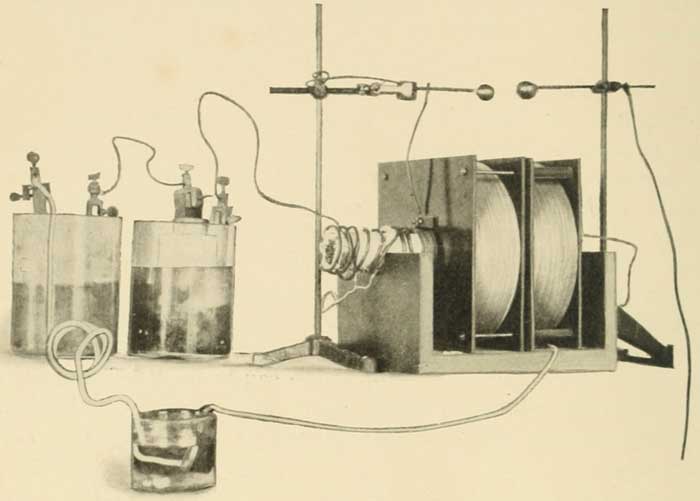
Fig. 1.—Disposition of batteries and coils at the sending station, showing the arrangement of the vertical wire and the spark gap.
For convenience, one of the coils of the transformer is placed inside the other, and the combination is called a Ruhmkorf coil. It is represented in the accompanying photograph (Fig. 1), with batteries attached to the inner coil, while the outer coil is connected to two balls, between which an electric spark jumps whenever the battery circuit is broken. In fact, any disturbance in the battery circuit—a weakening, a strengthening, or a break—provided that the changes are sudden, produces a corresponding change in the neighboring circuit. One coil thus responds to the other, in some mysterious way, across the interval of air which separates them. Usually the coils are placed very near to each other—in fact, one embraces the other, as shown in the photograph.
The coils, however, if placed several miles apart, will still respond to each other if they are made sufficiently large, if they are properly placed, and if a powerful current is used to excite one coil. Thus, by simply varying the distance between the coils of wire we can send messages through the air between stations which are not connected with a wire. This method, however, does not constitute the system of wireless telegraphy of Marconi, which it is the object of this paper to describe. Marconi has succeeded in transmitting messages over forty miles between points not connected by wires, and he has accomplished this feat by merely slightly modifying the disposition of the coils, thus revealing a new possibility of the wondrous transformer. If the reader will compare the following diagram (Fig. 2) with the photograph (Fig. 1), he will see how simple the sending apparatus of Marconi is.
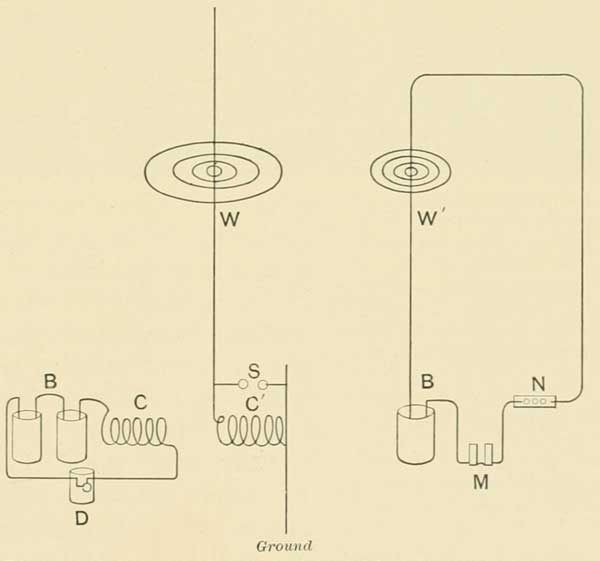
Fig. 2.—Diagram of the arrangement of wires and batteries at the receiving station.
S is a gap between the ends of one coil, across which an electric spark is produced whenever the current from the batteries B flowing through the coil C is broken by an arrangement at D. This break produces an electrical pulsation in the coil C', which travels up and down the wire W, which is elevated to a considerable height above the ground. This pulsation can not be seen by the eye. The wire does not move; it appears perfectly quiescent and dead, and seems only a wire and nothing more. At night, under favorable circumstances, one could see a luminosity on the wire, especially at the end, when messages are being transmitted, by a powerful battery B.
It is very easy to detect the electric lines which radiate from every part of such a wire when a spark jumps between the terminals S of the coil. All that is necessary to do is to pass the wire through a sensitive film and to develop the film. The accompanying photograph (Fig. 3) was taken at the top of such a wire, by means of a very powerful apparatus at my command. When the photograph is examined with a microscope the arborescent electric lines radiating from the wire, like the rays of light from a star, exhibit a beautiful fernlike structure. These lines, however, are not chiefly instrumental in transmitting the electric pulse across space.
There are other lines, called magnetic lines of force, which emanate from every portion of the vertical wire W just as ripples spread out on the surface of placid water when it is disturbed by the fall of a stone. These magnetic ripples travel in the ether of space, and when they embrace a neighboring wire or coil they produce similar ripples, which whirl about the distant wire and produce in some strange way an electrical current in the wire. These magnetic pulsations can travel great distances.
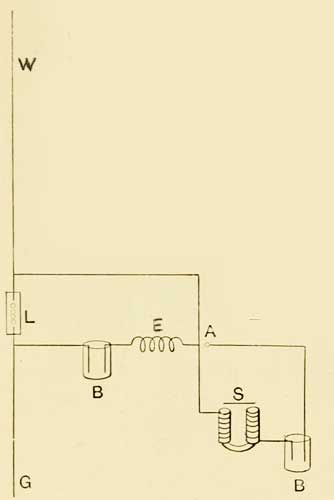
Fig. 2a represents a more complete electrical arrangement of the receiver circuit. The vertical wire, W', is connected to one wire of the coherer, L. The other wire of the coherer is led to the ground, G. The wires in the coherer, L, are separated by fine metallic particles. B represents a battery. E, an electro-magnet which attracts a piece of iron, A (armature), and closes a local battery, B, causing a click of the sounder (electro-magnet), S. The magnetic waves (Fig. 5) embracing the wire, W', cause a pulsation in this wire which produces an electrical disturbance in the coherer analogous to that shown in Fig. 3, by means of which an electrical current is enabled to pass through the electro-magnet, E.
In the photographs of these magnetic whirls, Fig. 4 is the whirl produced in the circuit C' by the battery B (Fig. 2), while Fig. 5 is that produced by electrical sympathy, or as it is called induction, in a neighboring wire. These photographs were obtained by passing the circuits through the sensitive films, perpendicularly to the latter, and then sprinkling very fine iron filings on these surfaces and exposing them to the light. In order to obtain these photographs a very powerful electrical current excited the coil C (Fig. 2), and the neighboring circuit W' (Fig. 5) was placed very near the circuit W.
When the receiving wire is at the distance of several miles from the sending wire it is impossible to detect by the above method the magnetic ripples or whirls. We can, however, detect the electrical currents which these magnetic lines of force cause in the receiving wire; and this leads me to speak of the discovery of a remarkable phenomenon which has made Marconi's system of wireless telegraphy possible. In order that an electrical current may flow through a mass of particles of a metal, a mass, for instance, of iron filings, it is necessary either to compress them or to cause a minute spark or electrical discharge between the particles. Now, it is supposed that the magnetic whirls, in embracing the distant receiving circuit, cause these minute sparks, and thus enable the electric current from the battery B to work a telegraphic sounder or bell M. The metallic filings are inclosed in a glass tube between wires which lead to the battery, and the arrangement is called a coherer. It can be made small and light. Fig. 6 is a representation in full size of one that has been found to be very sensitive. It consists of two silver wires with a few iron filings contained in a glass tube between the ends of the wires. It is necessary that this little tube should be constantly shaken up in order that after the electrical circuit is made the iron filings should return to their non-conducting condition, or should cease to cohere together, and should thus be ready to respond to the following signal. My colleague, Professor Sabine, has employed a very small electric motor to cause the glass tube to revolve, and thus to keep the filings in motion while signals are being received. Fig. 7 shows the arrangement of the receiving apparatus.
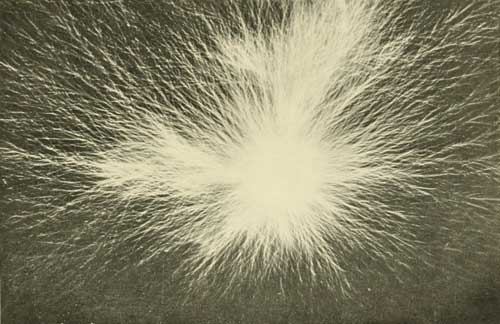
Fig. 3.—Photograph of the electric lines which emanate from the end of the wire at the sending station, and which are probably reproduced among the metallic filings of the coherer at the receiving station.
The coherer and the motor are shown between two batteries, one of which drives the motor while the other serves to work the bell or sounder when the electric wire excites the iron filings. In Fig. 2 this receiving apparatus is shown diagrammatically. B is the battery which sends a current through the sounder M and the coherer N when the magnetic whirls coming from the sending wire W embrace the receiving wire W'.
The term wireless telegraphy is a misnomer, for without wires the method would not be possible. The phenomenon is merely an enlargement of one that we are fully conscious of in the case of telegraph and telephone circuits, which is termed electro-magnetic induction. Whenever an electric current suddenly flows or suddenly ceases to flow along a wire, electrical currents are caused by induction in neighboring wires. The receiver employed by Marconi is a delicate spark caused by this induction, which forms a bridge so that an electric current from the relay battery can pass and influence magnetic instruments.
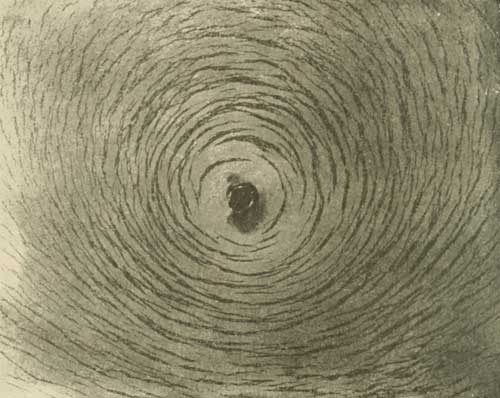
Fig. 4.—Magnetic whirls about the sending wire.
Many investigators had succeeded before Marconi in sending telegraphic messages several miles through the air or ether between two points not directly connected by wires. Marconi has extended the distance by employing a much higher electro-motive force at the sending station and using the feeble inductive effect at a distance to set in action a local battery.
It is evident that wires are needed at the sending station from every point of which magnetic and electric waves are sent out, and wires at the receiving station which embrace, so to speak, these waves in the manner shown by our photographs. These waves produce minute sparks in the receiving instrument, which act like a suddenly drawn flood gate in allowing the current from a local battery to flow through the circuit in which the spark occurs, and thus produce a click on a telegraphic instrument.
We have said that messages had been sent by what is called wireless telegraphy before Marconi made his experiments. These messages had also been sent by induction, signals on one wire being received by a parallel and distant wire. To Marconi is due the credit of greatly extending the method by using a vertical wire. The method of using the coherer to detect electric pulses is not due, however, to Marconi. It is usually attributed to Branly; it had been employed, however, by previous observers, among whom is Hughes, the inventor of the microphone, an instrument analogous in its action to that of the coherer. In the case of the microphone, the waves from the human voice shake up the particles of carbon in the microphone transmitter, and thus cause an electrical current to flow more easily through the minute contacts of the carbon particles.
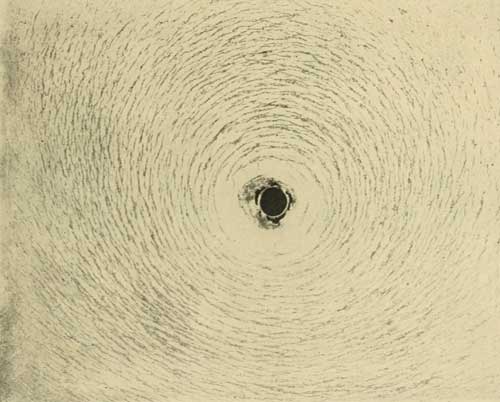
Fig. 5.—Magnetic whirls about the receiving wire.
The action of the telephone transmitter, which also consists of minute conducting particles in which a battery terminals are immersed, and the analogous coherer is microscopic, and there are many theories to account for their changes of resistance to electrical currents. We can not, I believe, be far wrong in thinking that the electric force breaks down the insulating effect of the infinitely thin layers of air between the particles, and thus allows an electric current to flow. This action is doubtless of the nature of an electric spark. An electric spark, in the case of wireless telegraphy, produces magnetic and electric lines of force in space, these reach out and embrace the circuit containing the coherer, and produce in turn minute sparks. Similia similibus—one action perfectly corresponds to the other.
The Marconi system, therefore, of what is called wireless telegraphy is not new in principle, but only new in practical application. It had been used to show the phenomena of electric waves in lecture rooms. Marconi extended it from distances of sixty to one hundred feet to fifty or sixty miles. He did this by lifting the sending-wire spark on a lofty pole and improving the sensitiveness of the metallic filings in the glass tube at the receiving station. He adopted a mechanical arrangement for continually tapping the coherer in order to break up the minute bridges formed by the cohering action, and thus to prepare the filings for the next magnetic pulse. The system of wireless telegraphy is emphatically a spark system strangely analogous to flash-light signaling, a system in which the human eye with its rods and cones in the retina acts as the coherer, and the nerve system, the local battery, making a signal or sensation in the brain.

Fig. 6.—The coherer employed to receive the electric waves. (One and a third actual size.)
Let us examine the sending spark a little further. An electric spark is perhaps the most interesting phenomenon in electricity. What causes it—how does the air behave toward it—what is it that apparently flows through the air, sending out light and heat waves as well as magnetic and electric waves? If we could answer all these questions, we should know what electricity is. A critical study of the electric spark has not only its scientific but its practical side. We see the latter side evidenced by its employment in wireless telegraphy and in the X rays; for in the latter case we have an electric discharge in a tube from which the air is removed—a special case of an electric spark. In order to understand the capabilities of wireless telegraphy we must turn to the scientific study of the electric spark; for its practical employment resides largely in its strength, in its frequency in its position, and in its power to make the air a conductor for electricity. All these points are involved in wireless telegraphy. How, then, shall we study the electric spark? The eye sees only an instantaneous flash following a devious path. It can not tell in what direction a spark flies (a flash of lightning, for instance), or indeed whether it has a direction. There is probably no commoner fallacy mankind entertains than the belief that the direction of lightning, or any electric spark, can be ascertained by the eye—that is, the direction from the sky to the earth or from the earth to the sky. I have repeatedly tested numbers of students in regard to this question, employing sparks four to six feet in length, taking precautions in regard to the concealment of the directions in which I charged the poles of the charging batteries, and I have never found a consensus of opinion in regard to directions. The ordinary photograph, too, reveals no more than the eye can see—a brilliant, devious line or a flaming discharge.
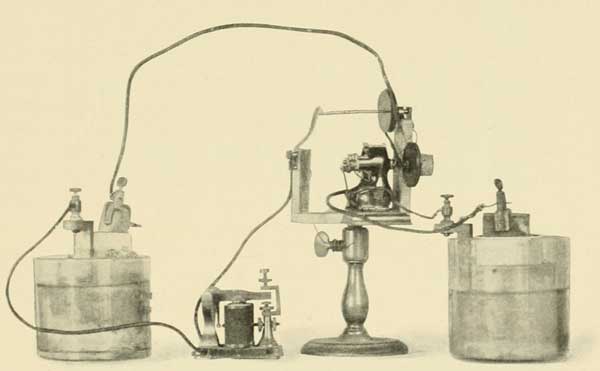
Fig. 7.—Arrangement of batteries of motor (to disturb the coherer) and the sounder by which the messages are received.
A large storage battery forms the best means of studying electric sparks, for with it one can run the entire gamut of this phenomenon—from the flaming discharge which we see in the arc light on the street to the crackling spark we employ in wireless telegraphy, and the more powerful discharges of six or more feet in length which closely resemble lightning discharges. A critical study of this gamut throws considerable light on the problem of the possibility of secret wireless telegraphy—a problem which it is most important to solve if the system is to be made practical; for at present the message spreads out from the sending spark in great circular ripples in all directions, and may be received by any one.
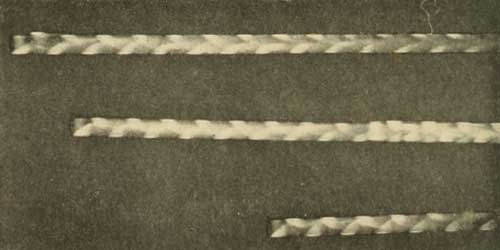
Fig. 8.—Photograph of electrical pulses. The interval between the pulses is one millionth of a second.
Several methods enable us to transform electrical energy so as to obtain suitable quick and intense blows on the surrounding medium. Is it possible that there is some mysterious vibration in the spark which is instrumental in the effective transmission of electrical energy across space? If the spark should vibrate or oscillate to and fro faster than sixteen times a second the human eye could not detect such oscillations; for an impression remains on the eye one sixteenth of a second, and subsequent ones separated by intervals shorter than a sixteenth would mingle together and could not be separated. The only way to ascertain whether the spark is oscillatory, or whether it is not one spark, as it appears to the eye, but a number of to-and-fro impulses, is to photograph it by a rapidly revolving mirror. The principle is similar to that of the biograph or the vitoscope, in which the quick to-and-fro motions of the spark are received on a sensitive film, which is in rapid motion. One terminal of the spark gap, the positive terminal so called, is always brighter than the other. Hence, if the sensitive film is moved at right angles to the path of the discharge, we shall get a row of dots which are the images of the brighter terminal, and these dots occur alternately first on one terminal and then on the other, showing that the discharge oscillates—that is, leaps in one discharge (which seems but one to the eye) many times in a hundred thousandth of a second. In practice it is found better to make an image of the spark move across the sensitive film instead of moving the film. This is accomplished by the same method that a boy uses in flashing sunlight by means of a mirror. The faster the mirror moves the faster moves the image of the light. In this way a speed of a millionth of a second can be attained. In this case the distance between the dots on the film may be one tenth of an inch, sufficient to separate them to the eye. The photograph of electric sparks (Fig. 8) was taken in this manner. The distance between any two bright spots in the trail of the photographic images represents the time of the electric oscillation or the time of the magnetic pulse or wave which is sent out from the spark, and which will cause a distant circuit to respond by a similar oscillation.
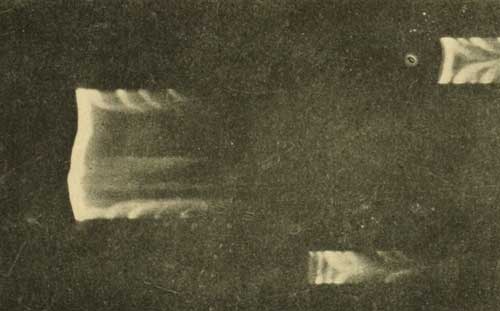
Fig. 9.—Photograph of a pilot spark, which is the principal factor in the method of wireless telegraphy.
At present the shortest time that can, so to speak, be photographed in this manner is about one two-millionth of a second. This is the time of propagation of a magnetic wave over four hundred feet long. The waves used in wireless telegraphy are not more than four feet in length—about one hundredth the length of those we can photograph. The photographic method thus reveals a mechanism of the spark which is entirely hidden from the eye and will always be concealed from human sight. It reveals, however, a greater mystery which it seems incompetent to solve—the mystery of what is called the pilot spark, the first discharge which we see on our photograph (Fig. 9) stretching intact from terminal to terminal, having the prodigious velocity of one hundred and eighty thousand miles a second. None of our experimental devices suffice to penetrate the mystery of this discharge. It is this pilot spark which is chiefly instrumental in sending out the magnetic pulses or waves which are powerful enough to reach forty or fifty miles. The preponderating influence of this pilot spark—so called since it finds a way for the subsequent surgings or oscillations—is a bar to the efforts to make wireless telegraphy secret. We can see from the photograph how much greater its strength is than that of the subsequent discharges shown by the mere brightening of the terminals. A delicate coherer will immediately respond to the influence of this pilot spark, and the subsequent oscillations of this discharge will have little effect. How, then, can we effectively time a receiving circuit so that it will respond to only one sending station? We can not depend upon the oscillatory nature of the spark, or adopt, in other words, its rate of vibration and form a coherer with the same rate.
It seems as if it would be necessary to invent some method of sending pilot sparks at a high and definite rate of vibration, and of employing coherers which will only respond to definite powerful rates of magnetic pulsation. Various attempts have been made to produce by mechanical means powerful electric surgings, but they have been unsuccessful. Both high electro-motive force and strength of current are needed. These can be obtained by the employment of a great number of storage cells. The discharge from a large number of these cells, however, is not suitable for the purpose of wireless telegraphy, although it may possess the qualifications of both high electrical pressure and strength of current.
The only apparatus we have at command to produce quick blows on the ether is the Ruhmkorf coil. This coil, I have said, has been in all our physical cabinets for fifty years. It contained within itself the germ of the telephone transmitter and the method of wireless telegraphy, unrecognized until the present. In its elements it consists, as we have seen, of two electrical circuits, placed near each other, entirely unconnected. A battery is connected with one of these circuits, and any change in the strength of the electrical current gives a blow to the ether or medium between the two circuits. A quick stopping of the electrical current gives the strongest impulse to the ether, which is taken up by the neighboring circuit. For the past fifty years very little advance has been made in the method of giving strong electrical impulses to the medium of space. It is accomplished simply by a mechanical breaking of the connection to the battery, either by a revolving wheel with suitable projections, or by a vibrating point. All the various forms of mechanical breaks are inefficient. They do not give quick and uniform breaks. Latterly, hopes have been excited by the discovery of a chemical break, called the Weynelt interrupter, shown in Fig. 1. The electrical current in passing through a vessel of diluted sulphuric acid from a point of platinum to a disk of lead causes bubbles of gas which form a barrier to its passage which is suddenly broken down, and this action goes on at a high rate of speed, causing a torrent of sparks in the neighboring circuit. The medium between the two circuits is thereby submitted to rapid and comparatively powerful impulses. The discovery of this and similar chemical or molecular interruptions marks an era in the history of the electrical transformer, and the hopes of further progress by means of them is far greater than in the direction of mechanical interruptions.
We are still, however, unable to generate sufficiently powerful and sufficiently well-timed electrical impulses to make wireless telegraphy of great and extended use. Can we not hope to strengthen the present feeble impulses in wireless telegraphy by some method of relaying or repeating? In the analogous subject of telephony many efforts have also been made to render the service secret, and to extend it to great distances by means of relays. These efforts have not been successful up to the present. We still have our neighbors' call bells, and we could listen to their messages if we were gossips. The telephone service has been extended to great distances—for instance, from Boston to Omaha—not by relays, but by strengthening the blows upon the medium between the transmitting circuit and the receiving one, just as we desire to do in what is called wireless telegraphy, the apparatus of which is almost identical in principle to that employed in telephony. The individual call in telephony is not a success for nearly the same reasons that exist in the case of wireless telegraphy. Perfectly definite and powerful rates of vibration can not be sent from point to point over wires to which only certain definite apparatus will respond. There are so many ways in which the energy of the electric current can be dissipated in passing over wires and through calling bells that the form of the waves and their strength becomes attenuated. The form of the electrical waves is better preserved in free space, where there are no wires or where there is no magnetic matter. The difficulty in obtaining individual calls in wireless telegraphy resides in the present impossibility of obtaining sufficiently rapid and powerful electrical impulses, and a receiver which will properly respond to a definite number of such impulses.
The question of a relay seems as impossible of solution as it does in telephony. The character of speech depends upon numberless delicate inflections and harmonies. The form, for instance, of the wave transmitting the vowel a must be preserved in order that the sound may be recognized. A relay in telephony acts very much like one's neighbor in the game called gossip, in which a sentence repeated more or less indistinctly, after passing from one person to another, becomes distorted and meaningless. No telephone relay has been invented which preserves the form of the first utterance, the vowel a loses its delicate characteristics, and becomes simply a meaningless noise. It is maintained by some authorities that such a relay can not be invented, that it is impossible to preserve the delicate inflections of the human voice in passing from one circuit to another, even through an infinitesimal air gap or ether space. It is well, however, to reflect upon Hosea Bigelow's sapient advice "not to prophesy unless you know." It was maintained in the early days of the telephone that speech would lose so many characteristics in the process of transmission over wires and through magnetic apparatus that it would not be intelligible. It is certain that at present long-distance transmission of speech can only be accomplished by using more powerful transmitters, and by making the line of copper better fitted for the transmission—just as quick transportation from place to place has not been accomplished by quitting the earth and by flying through space, but by obtaining more powerful engines and by improving the roadbeds.
The hopes of obtaining a relay for wireless telegraphy seem as small as they do in telephony. The present method is practically limited to distances of fifty or sixty miles—distances not much exceeding those which can be reached by a search-light in fair weather. Indeed, there is a close parallelism between the search-light and the spark used in Marconi's experiments: both send out waves which differ only in length. The waves of the search-light are about one forty-thousandth of an inch long, while the magnetic waves of the spark, invisible to the eye, are three to four feet—more than a million times longer than the light waves. These very long waves have this advantage over the short light waves: they are able to penetrate fog, and even sand hills and masonry. One can send messages into a building from a point outside. A prisoner could communicate with the outer world, a beleaguered garrison could send for help, a disabled light-ship could summon assistance, and possibly one steamer could inform another in a fog of its course.
Wireless telegraphy is the nearest approach to telepathy that has been vouchsafed to our intelligence, and it serves to stimulate our imagination and to make us think that things greatly hoped for can be always reached, although not exactly in the way expected. The nerves of the whole world are, so to speak, being bound together, so that a touch in one country is transmitted instantly to a far-distant one. Why should we not in time speak through the earth to the antipodes? If the magnetic waves can pass through brick and stone walls and sand hills, why should we not direct, so to speak, our trumpet to the earth, instead of letting its utterances skim over the horizon? In regard to this suggestion, we know certainly one fact from our laboratory experiences: that these magnetic waves, meeting layers of electrically conducting matter, like layers of iron ore, would be reflected back, and would not penetrate. Thus a means may be discovered through the instrumentality of such waves of exploring the mysteries of the earth before success is attained in completely penetrating its mass.
EMIGRANT DIAMONDS IN AMERICA.
By Prof. WILLIAM HERBERT HOBBS.
To discover the origin of the diamond in Nature we must seek it in its ancestral home, where the rocky matrix gave it birth in the form characteristic of its species. In prosecuting our search we should very soon discover that, in common with other gem minerals, the diamond has been a great wanderer, for it is usually found far from its original home. The disintegrating forces of the atmosphere, by acting upon the rocky material in which the stones were imbedded, have loosed them from their natural setting, to be caught up by the streams, sorted from their disintegrated matrix, and transported far from the parent rock, to be at last set down upon some gravelly bed over which the force of the current is weakened. The mines of Brazil and the Urals, of India, Borneo, and the "river diggings" of South Africa either have been or are now in deposits of this character.
The "dry diggings" of the Kimberley district, in South Africa, afford the unique locality in which the diamond has thus far been found in its original home, and all our knowledge of the genesis of the mineral has been derived from study of this locality. The mines are located in "pans," in which is found the "blue ground" now recognized as the disintegrated matrix of the diamond. These "pans" are known to be the "pipes," or "necks," of former volcanoes, now deeply dissected by the forces of the atmosphere—in fact, worn down if not to their roots, at least to their stumps. These remnants of the "pipes," through which the lava reached the surface, are surrounded in part by a black shale containing a large percentage of carbon, and this is believed to be the material out of which the diamonds have been formed. What appear to be modified fragments of the black shale inclosed within the "pipes" afford evidence that portions of the shale have been broken from the parent beds by the force of the ascending current of lava—a common enough accompaniment to volcanic action—and have been profoundly altered by the high temperature and the extreme hydrostatic pressure under which the mass must have been held. The most important feature of this alteration has been the recrystallization of the carbon of the shale into diamond.
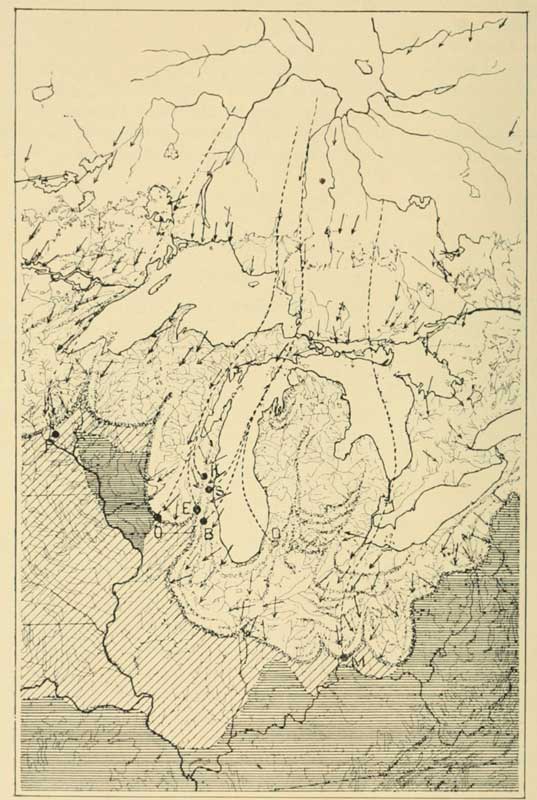
GLACIAL MAP OF THE GREAT LAKES REGION
shaded ////////clear
Driftless Areas.Older Drift.Newer Drift.
Moraines.Glacial Striae.Track of Diamonds.
Diamond Localities.E. Eagle.O. Oregon.
K. Kohlsville D. Dowagiac M. Milford. P. Plum Crk. B. Burlington.
We are indebted to the University of Chicago Press for the above illustration.
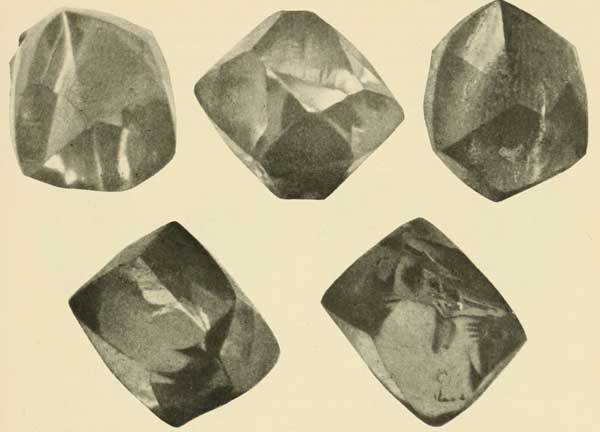
Copyright, 1899, by George F. Kunz.
Five Views of the Eagle Diamond (sixteen carats); enlarged about three diameters. (Owned by Tiffany and Company.)
We are indebted to the courtesy of Mr. G. F. Kunz, of Tiffany and Company, for the illustrations of the Oregon and Eagle diamonds.
This apparent explanation of the genesis of the diamond finds strong support in the experiments of Moissan, who obtained artificial diamond by dissolving carbon in molten iron and immersing the mass in cold water until a firm surface crust had formed. The "chilled" mass was then removed, to allow its still molten core to solidify slowly. This it does with the development of enormous pressures, because the natural expansion of the iron on passing into the solid condition is resisted by the strong shell of "chilled" metal. The isolation of the diamond was then accomplished by dissolving the iron in acid.
The prevailing form of the South African diamonds is that of a rounded crystal, with eight large and a number of minute faces—a form called by crystallographers a modified octahedron. Their shapes would be roughly simulated by the Pyramids of Egypt if they could be seen, combined with their reflected images, in a placid lake, or, better to meet the conditions of the country, in a desert mirage. It is a peculiar property of diamond crystals to have convexly rounded faces, so that the edges which separate the faces are not straight, but gently curving. Less frequently in the African mines, but commonly in some other regions, diamonds are bounded by four, twelve, twenty-four, or even forty-eight faces. These must not, of course, be confused with the faces of cut stones, which are the product of the lapidary's art.
Geological conditions remarkably like those observed at the Kimberley mines have recently been discovered in Kentucky, with the difference that here the shales contain a much smaller percentage of carbon, which may be the reason that diamonds have not rewarded the diligent search that has been made for them.
Though now found in the greatest abundance in South Africa and in Brazil, diamonds were formerly obtained from India, Borneo, and from the Ural Mountains of Russia. The great stones of history have, with hardly an exception, come from India, though in recent years a number of diamond monsters have been found in South Africa. One of these, the "Excelsior," weighed nine hundred and seventy carats, which is in excess even of the supposed weight of the "Great Mogul."
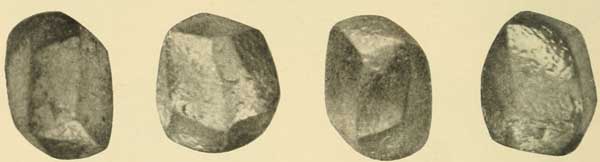
Copyright, 1899, by George F. Kunz.
Four Views of the Oregon Diamond; enlarged about three diameters. (Owned by Tiffany and Company.)
Occasionally diamonds have come to light in other regions than those specified. The Piedmont plateau, at the southeastern base of the Appalachians, has produced, in the region between southern Virginia and Georgia, some ten or twelve diamonds, which have varied in weight from those of two or three carats to the "Dewey" diamond, which when found weighed over twenty-three carats.
It is, however, in the territory about the Great Lakes that the greatest interest now centers, for in this region a very interesting problem of origin is being worked out. No less than seven diamonds, ranging in size from less than four to more than twenty-one carats, not to mention a number of smaller stones, have been recently found in the clays and gravels of this region, where their distribution was such as to indicate with a degree of approximation the location of their distant ancestral home.
In order clearly to set forth the nature of this problem and the method of its solution it will be necessary, first, to plot upon a map of the lake region the locality at which each of the stones has been found, and, further, to enter upon the same map the data which geologists have gleaned regarding the work of the great ice cap of the Glacial period. During this period, not remote as geological time is reckoned, an ice mantle covered the entire northeastern portion of our continent, and on more than one occasion it invaded for considerable distances the territory of the United States. Such a map as has been described discloses an important fact which holds the clew for the detection of the ancestral home of these diamonds. Each year is bringing with it new evidence, and we may look forward hopefully to a full solution of the problem.
In 1883 the "Eagle Stone" was brought to Milwaukee and sold for the nominal sum of one dollar. When it was submitted to competent examination the public learned that it was a diamond of sixteen carats' weight, and that it had been discovered seven years earlier in earth removed from a well-opening. Two events which were calculated to arouse local interest followed directly upon the discovery of the real nature of this gem, after which it passed out of the public notice. The woman who had parted with the gem for so inadequate a compensation brought suit against the jeweler to whom she had sold it, in order to recover its value. This curious litigation, which naturally aroused a great deal of interest, was finally carried to the Supreme Court of the State of Wisconsin, from which a decision was handed down in favor of the defendant, on the ground that he, no less than the plaintiff, had been ignorant of the value of the gem at the time of purchasing it. The other event was the "boom" of the town of Eagle as a diamond center, which, after the finding of two other diamonds with unmistakable marks of African origin upon them, ended as suddenly as it had begun, with the effect of temporarily discrediting, in the minds of geologists, the genuineness of the original "find."
Ten years later a white diamond of a little less than four carats' weight came to light in a collection of pebbles found in Oregon, Wisconsin, and brought to the writer for examination. The stones had been found by a farmer's lad while playing in a clay bank near his home. The investigation of the subject which was thereupon made brought out the fact that a third diamond, and this the larges of all, had been discovered at Kohlsville, in the same State, in 1883, and was still in the possession of the family on whose property it had been found.
As these stones were found in the deposits of "drift" which were left by the ice of the Glacial period, it was clear that they had been brought to their resting places by the ice itself. The map reveals the additional fact, and one of the greatest significance, that all these diamonds were found in the so-called "kettle moraine." This moraine or ridge was the dumping ground of the ice for its burden of bowlders, gravel, and clay at the time of its later invasion, and hence indicates the boundaries of the territory over which the ice mass was then extended. In view of the fact that two of the three stones found had remained in the hands of the farming population, without coming to the knowledge of the world, for periods of eleven and seven years respectively, it seems most probable that others have been found, though not identified as diamonds, and for this reason are doubtless still to be found in many cases in association with other local "curios" on the clock shelves of country farmhouses in the vicinity of the "kettle moraine." The writer felt warranted in predicting, in 1894, that other diamonds would occasionally be brought to light in the "kettle moraine," though the great extent of this moraine left little room for hope that more than one or two would be found at any one point of it.
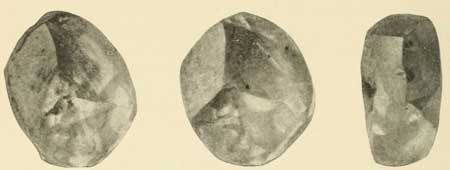
Three Views of the Saukville Diamond (six carats); enlarged about three diameters. (Owned by Bunde and Upmeyer, Milwaukee.)
We are indebted to the courtesy of Bunde and Upmeyer, of Milwaukee, for the illustrations showing the Burlington and Saukville diamonds.
In the time that has since elapsed diamonds have been found at the rate of about one a year, though not, so far as I am aware, in any case as the result of search. In Wisconsin have been found the Saukville diamond, a beautiful white stone of six carats' weight, and also the Burlington stone, having a weight of a little over two carats. The former had been for more than sixteen years in the possession of the finder before he learned of its value. In Michigan has been found the Dowagiac stone, of about eleven carats' weight, and only very recently a diamond weighing six carats and of exceptionally fine "water" has come to light at Milford, near Cincinnati. This augmentation of the number of localities, and the nearness of all to the "kettle moraines," leaves little room for doubt that the diamonds were conveyed by the ice at the time of its later invasion of the country.
Having, then, arrived at a satisfactory conclusion regarding not only the agent which conveyed the stones, but also respecting the period during which they were transported, it is pertinent to inquire by what paths they were brought to their adopted homes, and whether, if these may be definitely charted, it may not be possible to follow them in a direction the reverse of that taken by the diamonds themselves until we arrive at the point from which each diamond started upon its journey. If we succeed in this we shall learn whether they have a common home, or whether they were formed in regions more or less widely separated. From the great rarity of diamonds in Nature it would seem that the hypothesis of a common home is the more probable, and this view finds confirmation in the fact that certain marks of "consanguinity" have been observed upon the stones already found.
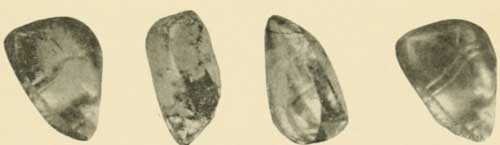
Four Views of the Burlington Diamond (a little over two carats); enlarged about three diameters. (Owned by Bunde and Upmeyer, Milwaukee.)
Not only did the ice mantle register its advance in the great ridge of morainic material which we know as the "kettle moraine," but it has engraved upon the ledges of rock over which it has ridden, in a simple language of lines and grooves, the direction of its movement, after first having planed away the disintegrated portions of the rock to secure a smooth and lasting surface. As the same ledges have been overridden more than once, and at intervals widely separated, they are often found, palimpsestlike, with recent characters superimposed upon earlier, partly effaced, and nearly illegible ones. Many of the scattered leaves of this record have, however, been copied by geologists, and the autobiography of the ice is now read from maps which give the direction of its flow, and allow the motion of the ice as a whole, as well as that of each of its parts, to be satisfactorily studied. Recent studies by Canadian geologists have shown that one of the highest summits of the ice cap must have been located some distance west of Hudson Bay, and that another, the one which glaciated the lake region, was in Labrador, to the east of the same body of water. From these points the ice moved in spreading fans both northward toward the Arctic Ocean and southward toward the States, and always approached the margins at the moraines in a direction at right angles to their extent. Thus the rock material transported by the ice was spread out in a great fan, which constantly extended its boundaries as it advanced.
The evidence from the Oregon, Eagle, and Kohlsville stones, which were located on the moraine of the Green Bay glacier, is that their home, in case they had a common one, is between the northeastern corner of the State of Wisconsin and the eastern summit of the ice mantle—a narrow strip of country of great extent, but yet a first approximation of the greatest value. If we assume, further, that the Saukville, Burlington, and Dowagiac stones, which were found on the moraine of the Lake Michigan glacier, have the same derivation, their common home may confidently be placed as far to the northeast as the wilderness beyond the Great Lakes, since the Green Bay and Lake Michigan glaciers coalesced in that region. The small stones found at Plum Creek, Wisconsin, and the Cincinnati stone, if the locations of their discovery be taken into consideration, still further circumscribe the diamond's home territory, since the lobes of the ice mass which transported them made a complete junction with the Green Bay and Lake Michigan lobes or glaciers considerably farther to the northward than the point of union of the latter glaciers themselves.
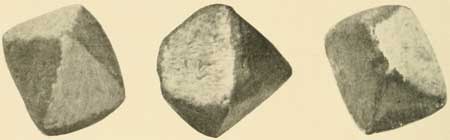
Three Views of a Lead Cast of the Milford Stone (six carats); enlarged about three diameters.
We are indebted to the courtesy of Prof. T. H. Norton, of the University of Cincinnati, for the above illustrations.
If, therefore, it is assumed that all the stones which have been found have a common origin, the conclusion is inevitable that the ancestral home must be in the wilderness of Canada between the points where the several tracks marking their migrations converge upon one another, and the former summit of the ice sheet. The broader the "fan" of their distribution, the nearer to the latter must the point be located.
It is by no means improbable that when the barren territory about Hudson Bay is thoroughly explored a region for profitable diamond mining may be revealed, but in the meantime we may be sure that individual stones will occasionally be found in the new American homes into which they were imported long before the days of tariffs and ports of entry. Mother Nature, not content with lavishing upon our favored nation the boundless treasures locked up in her mountains, has robbed the territory of our Canadian cousins of the rich soils which she has unloaded upon our lake States, and of the diamonds with which she has sowed them.
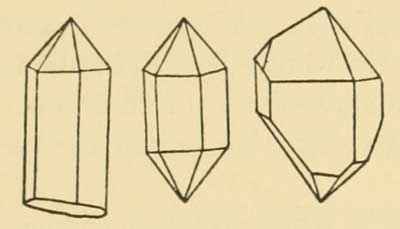
Common Forms of Quartz Crystals.
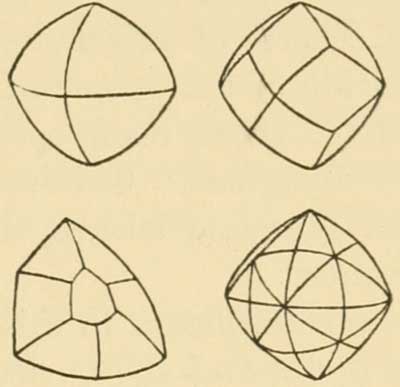
Common Forms of Diamonds. The African stones most resemble the figure above at the left (octahedron). The Wisconsin stones most resemble the figure above at the right (dodecahedron).