VOLUME XIII (continued 4)
George Burnham Ives translation
"It is useless for you to wait here for your carriage," he said; "it probably will not arrive for some time."
"How do you know?"
"I was at the Comédie-Française this evening."
"Did you see me there?"
"Were you there, madame? I did not know it."
"In that case——"
"In that case I can understand my meeting with Monsieur Antoine Thierry and his words. He must have known that you were to be there. He was on the watch; he made an ironical remark which I did not understand, but which gave me something to think about. As I returned to the pavilion, I stopped, being somewhat uneasy, in front of your hôtel. Your servants were in great commotion. It seems that your coachman could not be found. I accosted the concierge, who knows my face, and, seeing that he was greatly disturbed, I asked him if any accident had happened to you. He told me of the Marquis d'Estrelle's death, and that you had driven here with my cousin Marcel. Your coachman appeared at last, dead drunk and unable to understand any of the orders you had left for him. The concierge left me, saying that when Bastien was once on his box, he would go all right. That did not seem very reassuring to me. I am not so phlegmatic as your concierge, and I came here as fast as I could. I hoped to find Marcel still here and to tell him not to trust you unattended to the care of a drunken coachman; but I arrived a few moments too late. You are alone and you have been frightened."
"It is all over," said Julie, "and I am calm again; take me home on foot. You are my Providence!"
"On foot, it is too far," replied Julien, "and you are not properly shod for walking. This cab here will take us, willingly or by force, I give you my word, and I will get up behind and accompany you."
Julien returned with Madame d'Estrelle to the cab. He put her in and ordered the driver to start. The driver refused. Julien jumped up beside him and seized the reins, swearing that he would throw him into the gutter if he resisted. The young man's manly bearing and determined air awed the cab-driver, who submitted; but he had not driven a hundred yards when he stopped, yelling thief and murder. A party of men had just come out of a house, and the poor devil hoped to find some aid against the violence he was undergoing.
As luck would have it these men were young dandies fresh from a sumptuous supper, and a little the worse for wine. The adventure presented itself at that moment of excitement when one gladly constitutes himself a redresser of wrongs, especially when the odds are four to one in his favor. They abruptly stopped the horses, and one of them opened the door, for the cabman was yelling at the top of his voice:
"Help! here's a villain carrying off a nun!"
"Let us see if she's worth the trouble!" replied the party with one voice.
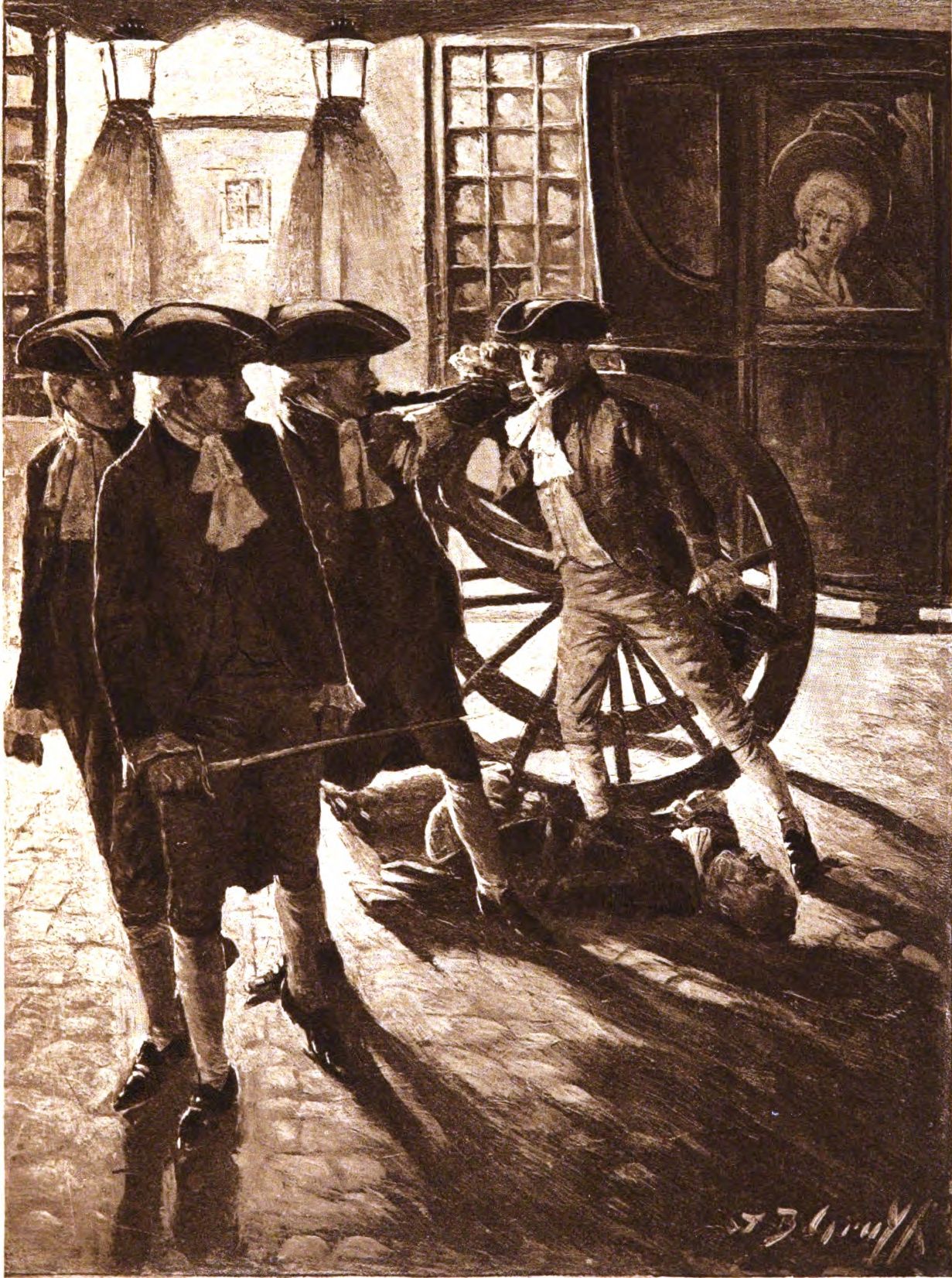
JULIEN ESCORTS MADAME D'ESTRELLE
Julien defended himself with his cane, and used it with such self-possession, skill and strength, that one of the assailants fell and the others retreated.
Before the door was open Julien was on his feet and vigorously repelled the most zealous of the intruders. The young man thus roughly treated drew his sword, calling him a clown, and his companions followed his example. Julien did not take the time to draw his. He defended himself with his cane, and used it with such self-possession, skill and strength, that one of the assailants fell and the others retreated. Julien, who had not left the step, took advantage of this respite to enter the cab and take Julie out by the opposite door. He took her in his arms and carried her some distance. Then he turned to await his adversaries; but, whether because some one of them had received a serious wound, or because the approach of the watch sobered them, they made off as rapidly as possible in the opposite direction.
"Let us walk, madame," said Julien. "Let us avoid the curiosity of the police."
Julie walked rapidly and well. If fear had paralyzed her for an instant, the sight of the danger to which her protector was exposed had restored her energy. After taking a somewhat roundabout course to throw the watch off the scent, they arrived safely on the Nouveau Cours, now Boulevard des Invalides. It was completely deserted and dimly lighted by lanterns. Julie did not notice a stain on her glove, but she felt the moisture of blood on her wrist, and stopped abruptly, exclaiming:
"Oh! Mon Dieu! you are wounded!"
Julien felt nothing, he was very sure that nothing serious had happened to him; he wrapped his bruised hand in his handkerchief and offered Julie his other arm.
"I swear to you that I am not wounded," he said; "and suppose I were! Unfortunately those fellows were not very formidable, and I deserve little credit for ridding you of them. Coxcombs, dandies! And they bear titles of nobility in all likelihood!"
"Do you detest the nobility so very bitterly?"
"I, detest them? No! but I abhor impertinence, and as such fellows are not always willing to fight a duel with plebeians, I am very glad to have beaten them as a bargeman might have done."
"Alas!" said Julie, thinking aloud, "nevertheless they are at liberty to insult and trample on the weak!"
"The weak! Who are the weak, pray?" rejoined Julien, mistaking the meaning of her words. "People without a name? Undeceive yourself, madame; they are the ones to whom the future belongs, because they have the right, true justice on their side, and, withal, the determination to put an end to the abuses of the past."
Julie did not understand, but she trembled anew; this time, however, she was not afraid of disagreeable encounters, but of an indefinable mysterious force which seemed to emanate from Julien. She glanced furtively at him; she fancied that she could see his face glow in the darkness, and that her feeble hand was resting on the arm of a giant.
But Julien was a simple-hearted youth, an artist without ambition in the practical affairs of life on his own account. He did not feel called upon to play a conspicuous part in the revolutionary tempests; he looked forward to no other labor for himself than that of studying the charms of nature all his life. That awe-inspiring power with which he was endowed in Julie's eyes was simply the reflection of the divine power on the mind of the new class. He was one of the hundred thousand among the millions of disappointed and soured men who were about to say on the first opportunity: "The cup is full, the past has had its day." The brief allusion he had just made to this general frame of mind among men of his class—a subject which was in every mouth at that time—seemed to Madame d'Estrelle a most impressive prophecy from the lips of an exceptional man. It was the first time that she had ever heard anyone speak defiantly and contemptuously of what she had always considered invincible. The species of superstitious terror which she felt was blended with fervent trust, with a longing to lean the more heavily on that sturdy arm which, under the impulsion of a noble heart, had fought alone, in her cause, against four swords.
"So you think," she said, still walking rapidly, "that one can shake off the yoke of this unjust world which oppresses men's consciences, and condemns true principles? I would like to agree with you that is likely to happen!"
"You believe it already, since you desire to believe it."
"Possibly; but when will it happen?"
"No one can say when or by what means; what is just and right cannot fail to happen; but what does it matter to you, madame, whether all this lasts fifty or a hundred years longer? Are you not one of those who profit innocently by the misfortunes of others?"
"Oh! I profit by nothing. I have nothing of my own, and I am nobody in society."
"But you are of society, you belong to it, it owes you protection, and it will never wound you in your own person."
"Who knows?" said Julie.
Then, fearing that she had said too much, she changed the subject by recurring to the scene which had just taken place.
"When I think," she said, "that a great disaster might have happened to you just now! Ah! your poor mother—how she would have cursed me if I had been the cause—"
"No, madame, that could not have happened," replied Julien; "I had right on my side."
"And you believe that Providence interposes in such cases?"
"Yes, since Providence is with us. It gives us strength and presence of mind. A man who defends a woman's honor against scoundrels has all the chances on his side. Courage comes very easy to him; he feels that he cannot succumb."
"What faith you have!" exclaimed Julie, deeply touched. "Yes, I remember you said at my house the other day that faith would move mountains, and that you were faith personified."
"The other day!" Julien repeated ingenuously. "That was more than a month ago."
Julie dared not pretend not to know how many days and nights had passed since that brief interview. So she said nothing. Julien carried his respect for her so far as not to continue the conversation himself, and the longer the silence endured the less able was Julie to summon the presence of mind to break it without betraying the emotion she felt. At last they reached the pavilion.
"Do you not think," he said, "that you should take your arm from mine now, so that your people may not see me? then I will follow you at a little distance until I have seen your door close behind you."
"Yes," she replied; "but what will my people think to see me returning alone and on foot at such an hour? The best way is for me to go through the pavilion and through my garden; then they will think that Monsieur Marcel brought me back that way."
That seemed in truth the best plan. Julien had his key in his pocket.
"I will go and wake my mother," he said, "and tell her to get up; for I told her, as I passed, not to sit up for me. She thinks that I have been to take supper with Marcel."
"Don't wake her, I forbid it. To tell her all our adventures would take too long now. She would be distressed, perhaps, being half asleep. To-morrow you can tell her everything. Open the garden door for me, and I will run home without making any noise. Thanks, and adieu!"
To pass through the narrow passage way leading from the street door to the garden door, inside the pavilion, they had to walk several seconds in absolute darkness. In that straitened household no lamps were kept burning needlessly, and Babet came for the day only and did not sleep in the house. Julien went first, opened the garden, bowed low to Madame d'Estrelle and immediately closed the door, to prove to her that he never used it and that he should not presume to follow her, even with his eyes, along the paths through which she glided like a ghost.
Such perfect discretion, such unswerving respect, such delicate, thoughtful, untiring, really serviceable devotion touched Madame d'Estrelle profoundly. It was a magnificent June night. She knew that by knocking on the window of her bedroom, which was on the ground floor, looking on the garden, she could summon Camille, who was sitting up for her. She knew too that Camille's vigil consisted in enjoying a good nap on the best couch in the apartment. She thought that she might without unkindness allow her to keep vigil in that way a few moments more; and feeling that her heart was overflowing with emotion, her mind fairly drowned by conflicting thoughts, she could not resist the temptation to sit down beside the basin in which the moon was reflected, clear and motionless, as in a Venetian mirror.
The nightingale had ceased to sing. It was sleeping on its young brood. All was still, and the young zephyr (the night breeze of those days) was slumbering so sweetly that it did not even stir a blade of grass. Paris too was asleep, at all events the tranquil quarter of which the hôtel D'Estrelle marked the outer limit. The sounds of the country were more audible there than those of the city; at that hour they were confined to an occasional cock-crow and the barking of a dog in the distance at long intervals. The clocks rang out in clear tones, answering one another from convent to convent; then everything relapsed into blissful silence; and if one could hear the distant rumbling of a carriage on the pavement of the real Paris, it resembled the dull murmur of the waves rather than a sound produced by human activity.
Julie, tired out and slightly bewildered, breathed deep of the tranquillity of the night, of that perfume of solitude, with the keenest pleasure. She fixed her eyes on a great white star, which shone near the moon and was reflected in the same basin. At first she sat there without thinking, oblivious of everything, enjoying absolute repose; soon her heart began to beat so violently that it pained her; first she felt hot, then cold. She rose to go away. She went to her bedroom window, but she did not knock. She returned to the stone bench. She sat down and wept. Then she rose and walked around the basin like a soul in torment; at last she stopped, smiling like a soul at peace. She consented to question herself, and when her heart replied: I love, she was frightened and forbade it to speak. Then she called her conscience to account for that terror, that shrinking austerity, opposed to the laws of nature and useless to God. Her conscience replied that it had nothing to do with it, and that the obstacle was not due to it but to the reason, a sort of artificial conscience wherein God and nature gave precedence to conventional ideas, fear, selfish scheming, precautions due to misapprehension of one's real interests. In this order of reasoning everything was expressed in terms of six-franc pieces. Marcel had reason on his side in view of the actual facts. So the heart must be sacrificed to the most sordid of facts, to the implacable menace of poverty.
"No," said Julie to herself, "that shall not be! If necessary I will sell everything, I will have nothing of my own, I will work; but I will love, even though I have to ask alms! Besides, he will work for three, he who works now for two! He will undertake that burden, he will be overjoyed to do it if he loves me! In his place, I should be so overjoyed!"
Julie began to walk again with increasing agitation.
"Does he love me as much as that? Does he love me with the passion that I thought that I detected the first day?—Ah! that is the question that I ask myself incessantly, that is all that troubles me, that is something that neither my conscience nor my reason, nor my heart can tell me. Perhaps he has only a friendly feeling for me, for he is a good son, and he is grateful to me for what I tried to do for his mother. He owes me gratitude and he proves his gratitude by admirable devotion. And what then? Why should he love me madly? why should he want to pass his life at my feet? He has no craving for it, for he is never at hand except on occasions when I may need him. The rest of the time he gives his mind to his real duties, his work, his mother, perhaps to some girl of his own station who will bring him a comfortable dowry—whereas I, a poor, ruined—But am I ruined?—If my husband's father has provided for my future, I am still a grande dame—and in that case—in that case everything in my dream is changed; I forget this young man who is not suited to me, I marry a man in society, at my choice, I am proud and happy, I love without perplexity and without shame.—Oh, yes! But now it is he, no stranger, no other than he, whom I love; it is he alone, and I do not know whether one can be cured of that. I do not know if one ever forgets. I fear not, since the more I try, the more utterly I fail; the more I defend myself, the more completely I am beaten. My God, my God! in all this there is but one real fear, one real torture: and that is the fear that he does not love me! How shall I find out? Perhaps I shall never find out. Can I live without it?"
Tormenting herself thus, she found herself quite near the pavilion, having no idea how she came there. The door was open, a black figure stood in the doorway. Julien, as if he had overheard her thoughts, as if he were irresistibly impelled to answer them, came straight to her side.
Julie at once recovered her reason and her pride. Taken by surprise, she was about to speak in the character of an insulted queen. He did not give her time.
"Why are you here, madame?" he said. "Can you not get in? Are your servants asleep, or are they all expecting you to come from the street? You cannot pass the night in the garden, dressed as you are. It is two o'clock. The dew is falling, you will be frozen, you will be ill. And your hood is over your shoulder, your head bare, your arms hardly covered. Here, take this heavy mantle of my mother's at once, and forgive me for being here."
"But how did you know?"
"I heard you walking on the gravel—a very light step which could be nobody's but yours, and constantly stopping and going on again. I was in the studio, then I came here and held the door ajar, saying to myself: 'She is still out-of-doors, she can't get in, she will take cold, she is tired, she is suffering, perhaps she is afraid!' I could not stand it any longer; indeed, it was my duty. And this must not go on, you know; whatever people may say or think, I do not propose that you shall kill yourself; no, I do not!"
Julien was profoundly moved, his voice trembled, and so did his hands as he placed his mother's cloak over Julie's shoulders; but he did not struggle against the surprises of passion; he chided rather, like a father who sees his child in danger. It did not occur to him that he could be accused of selfish love or of a treacherous exploit. So that he forgot all considerations of propriety, and there was in his solicitude a passionate intonation which overpowered Julie. She grasped both his hands and, carried away herself by an outburst of exalted passion, the first in her life, the least expected and the most unconquerable, she exclaimed wildly:
"You love me, you love me, I am sure! Then tell me so, that I may hear it and know it! You love me—as I want to be loved!"
Julien stifled a cry, lost his head completely and carried Julie into his studio; but she had led so chaste a life that the alarm of her modesty inevitably caused her lover's respect, momentarily submerged, to rise again to the higher regions of his heart. He fell at her feet and covered the tips of her ice-cold fingers with kisses, imploring her to have perfect confidence in him.
"Confidence!" he exclaimed, "confidence! I have sworn that I would be your brother. It is your brother who is here beside you, do not doubt it, and your confidence will save me. I told you that I adored you; that is truer than I can possibly tell you, stronger than you can dream, more terrible than I myself imagined; but I will not cause you to shed a tear, I would kill myself first! Have no fear; you shall never need to blush for having ordered me to love you."
Could he have kept his word? He believed that he could, even at the height of his delirious joy. Julie increased his strength by her own boldness.
"No, I do not propose to blush," she said, with the frankness of a serious resolution; "I propose to be your wife, for to be your mistress would degrade you. Commonplace love affairs are not becoming to a man like you; to a woman like me, dissolute conduct is impossible. I too would kill myself first! Julien, let us take our oath here and now to marry, whatever happens, whether I am rich or destitute, for there is as much chance of one as of the other. If I am poor, your determination will never weaken, you will sustain and support me. If I am rich, you will have no vain pride, you will share my destiny. This must be decided, agreed upon, sworn to. I am not brave, I warn you; that is why I insist upon pledging myself irrevocably, and then I know that I shall look neither to the right hand nor to the left. My love will become a duty; then I shall be strong, resolute and self-possessed. I was able to endure despair in marriage, because I have principles and true piety; with all the more reason I shall accept happiness, and I will struggle to be happy as I struggled formerly not to desire to be. Swear, my friend; we must be everything to each other, or we must never meet again; for this is certain, we love each other and our love is stronger than we are. Society can have nothing to say. For a fortnight past I have ceased to live, I have felt that I was dying. To-day, I went mad; I should have run after you just now if you had said to me: 'I do not love you.'—Or no, I should have thrown myself into the basin, with the moon and the star that shine in its depths. Julien, I am losing my mind, I never said such things before, I did not think that I should ever dare to say them, but here am I saying them to you, and I am not sure that it is myself who speaks. Have pity on me, sustain me, preserve my honor, which is yours, preserve your wife's purity for your own sake."
"Yes, my wife! yes, I swear it!" cried Julien, in an ecstasy of joy. "And do you too, Julie, swear it before God!"
"Mon Dieu!" said Julie, bewildered and suddenly becoming a little cowardly, "we have known each other a month——"
"No, not a month," replied Julien. "Only an hour; for we met a month ago for a quarter of an hour here, a quarter of an hour at your house, and this evening in the street for half an hour. We may as well say, Julie, that, so far as appearances go, we do not know each other at all, and yet we love each other. God above hears us and knows it well, for it was He who wished it, who still wishes it!"
"Yes, you are right," she replied excitedly, for she felt recreated by her lover's exalted faith; "we know nothing of each other but our love. Is not that enough? is not that everything? What is all the rest? You are a clever artist, an estimable young man, a good son; that is what everybody knows about you; but is it because of those things that I love you? I am a virtuous person, not ungenerous and of a gentle disposition, or so you may have heard; but that is not what made you love me. There are other good men, other estimable women, to whom we should never have thought of becoming attached; we love each other because we love each other, that is the whole story!"
"Yes, yes," said Julien, "love is like God, it is because it is, it is the alkahest! What does it matter that we discover in each other this or that peculiar development of mind or character? The great, the only business of our lives is to love, and since we possess each other's love, we have known each other a hundred years, forever—our love has neither beginning nor end!"
They hyperbolized thus for more than an hour in the studio, talking in low tones, by the vague light of the moon shining through the trees; Julie seated, Julien on his knees, hand in hand, but refraining from the kiss which would have been their ruin. Suddenly the moon, which was sinking toward the horizon, seemed to shine so brightly, that they were forced to conclude that the dawn was lending its light. Julie rose and fled, after making Julien swear a hundred times that their union was indissoluble.
Camille was greatly surprised, when she opened the door for her mistress, to find that it was nearly three o'clock.
"Are the servants still waiting for me?" inquired Madame d'Estrelle.
"Yes, madame; they think that madame has decided to pray all night by monsieur le marquis's body. The carriage went to fetch madame. Madame must have found it at the gate of the hôtel D'Ormonde?"
"No, I did not wait for it; it was too slow in coming. Monsieur Marcel Thierry brought me home by way of the pavilion, where I had to stop and talk business with him. Tell the servants to go to bed; the carriage will return when the coachman is sober."
"Ah! mon Dieu! so madame knows? Poor Bastien! I can take my oath, madame, that he got tipsy from vexation because madame had taken a cab."
If this explanation made Julie smile, her own explanations seemed strange to the soubrette; but she suspected nothing wrong. Julie's life was so regular and so pure! Camille concluded simply that her financial position must be in great danger, since she passed the night talking with the solicitor; and she imparted her solicitude to the other servants, who were distressed by it, even while thinking that they must not allow their wages to go unpaid. The footman, who was a friend of Camille, and as such inclined to shield Bastien, went to the hôtel D'Ormonde, but did not find him there. Bastien had understood that his orders were to go back to the wineshop, and thither he had gone; he was sleeping the sleep of the angels, the only slumber supposed to be delicious enough to be compared with that of a drunken man. The carriage was waiting for him at the door, and the groom, his subordinate, had consented to watch the horses on condition that he was supplied with something to warm him on the box every fifteen minutes. The rascals did not reappear at the hôtel until daylight and did not recover their senses for twenty-four hours. Under other circumstances Julie would have dismissed them; but she foresaw that the bacchanalian episode would introduce confusion into the accounts of the romantic episode, in the gossip of the servants' hall and the porter's lodge. That is what actually happened, and as the people in Madame d'Estrelle's service were not ill-disposed toward her, it seemed that nothing was likely to transpire of her actions during that extraordinary night.
On the next night, as a matter of prudence the lovers held aloof from each other; but on the night following that, although they had made no appointment, they found themselves once more among the shrubbery in the garden, and repeated with renewed delight all that they had said two days before. They continued in this way, undisturbed and without apparent danger, nothing being easier than for Madame d'Estrelle to steal out of her apartments, even without very great precaution, her people being accustomed to see her go out alone for a breath of fresh air, at a late hour on summer nights.
What a delightful existence if it could have lasted! Those meetings had all the charm of mystery, with no remorse to disturb their joys. Both perfectly free, and aspiring only to the most sacred union, sustained by a love strong enough to be able to wait, they sat there in the darkness, amid bushes laden with flowers, in the splendor of the early summer which retains all the charm of spring; they were like two fiancés, who are permitted to love each other, and who, without abusing the permission, keep out of sight in order to arouse no jealousy. It was the honeymoon of sentiment preceding the honeymoon of passion. Passion was already awake, but they fought against it, or rather held it in reserve, by mutual consent, for the time when they would be forced to fight and display their courage; for well they knew what they would have to face, and Julien said to his friend:
"You will suffer terribly for my sake, I know; and I shall suffer to see you suffer; but then we shall belong to each other, and love will afford us ineffable joys which will make us invulnerable to assaults from outside. Even if you were not guarded here by your own modesty and my veneration, it seems to me that my selfish interests, rightly understood, would enjoin upon me not to exhaust all my happiness at once."
At other times Julien was more agitated and less resigned to wait. Then Julie would pacify him by imploring him to remember what he had said the day before.
"I have been so happy since we have loved each other thus!" she would say to him. "Let us not change this blissful condition of affairs. Remember that on the day when I shall say to you aloud that I have chosen you for my life companion, people will laugh and cry out and accuse me of a vulgar infatuation; and I know virtuous women who will say to me cynically: 'Keep him for a lover, since you must have a lover; but see him in secret and don't marry him!' With what sort of a countenance could I endure such impertinences, if my conscience were not clear, and if I no longer felt that I had the right to reply: 'No, he is not my lover! he is my fiancé, whom I love, and who has proved his respect for me as no other man could ever have proved it!' Let us keep all our weapons, Julien; truth is the most powerful of all weapons in the struggle against false ideas."
Julien submitted, because he was entirely devoted to her, and also because his spirit was loyal to that indefinable strain of heroism which had guided his life and restrained the first impulses of his youth. He was still able to conquer his passions, having never allowed them to dominate him entirely. Moreover, this romance of pure love, in the perfume-laden darkness, appealed to his imagination, and to the artist those poetic nights were intoxicating festivals. That garden had dark recesses and imposing masses of foliage, such as we see in Watteau's pictures. The appearance of Julie, charmingly dressed, not over tall, and of graceful outline in her simple gown, was in harmony with that distinctive savor which makes of Watteau a serious painter, a realistic and thoroughly alive Italian, amid conventional surroundings and in an age of affectation. There was a secluded nook where a tall white marble urn, standing high upon an ivy-wreathed pedestal, stood forth vaguely in the darkness, like a spectre, against the black background of the trees. Bluish, indistinguishable lights flitted over the foliage, and the shadows of the branches played about the marble, whose outlines constantly disappeared, although its shape was always graceful and majestic.
Thither Julien repaired to wait for Julie, as soon as his mother had gone to bed, and, when she approached, as smiling and tranquil as happiness itself, with her silk petticoats shimmering in the darkness and her lovely bare arms holding up her skirts, Julien fancied that he was looking upon some modern muse who ruled his destiny, bringing him promises of future bliss with all the charms and fascinations of present real life.
They must enjoy the present without giving too much thought to the morrow, for the uncertainty of future events made it impossible for them to form definite plans. They did not know yet whether they could live on thus, deserted by society, forgotten and at peace in that garden which had become an earthly paradise for love; or whether, ejected from the pavilion by inexorable creditors, they would go to seek an attic chamber in some suburb, with a garden on the window-sill. They proposed to face everything together; that was the only absolute certainty, the only irrevocable determination.
VI
Two weeks had passed since the Marquis d'Estrelle's death, and, after search had been made in every conceivable place, there was no trace of a will. It was generally believed that there was one; no one dared say aloud that the marchioness had persuaded him not to make one. There were divers indications that Marcel believed that to be a fact, but it was of no use to suspect, they could prove nothing, and the consequences were enforced with overbearing placidity; that is to say, the marchioness, while holding fast to the rights guaranteed by her marriage contract, also inherited all the property of the deceased, and made no suggestion of any sum being set aside to pay the late count's debts. And yet such a provision seemed to be implied by the terms of Julie's marriage contract. It was a matter for judicial settlement, and Marcel advised Julie to appeal to the courts, if for no other purpose than to delay the suits with which she was threatened. Julie would not consent. It was her idea that lawsuits were always lost by both parties, and Marcel agreed that she was not very far astray.
"I am well aware," she said, "that the marchioness does not love me, and it is very possible that she owes me nothing; but she is a very great lady, and it is not possible that, rich as she is, she will allow a person who bears her name to be entirely denuded. Let us wait a little longer. It would not be becoming to begin so soon to talk to her about money, and it would be most imprudent, as you yourself said, to appear to be in too much of a hurry. When the time has come, I will take that step, let it cost what it may; you must advise me of the fitting opportunity."
"Go there at once," said Marcel to her one day. "There is no time to lose, your creditors propose to take action to-morrow."
Julie, undeterred by the ill-success of her first visit, had called upon the dowager on the morning following the marquis's decease. On that occasion she was received very coldly, but courteously. Perhaps, the marquis's testamentary provisions having been put out of the way, her presence was no longer dreaded. There was a sort of bitter-sweet comment upon the worldly pleasures in which Madame d'Estrelle indulged at the close of her period of mourning, in allusion to her absence from home on the preceding evening. Julie had given the explanation agreed upon with Marcel. It was received with a decidedly incredulous air of curiosity, and then the marchioness observed:
"I am very sorry for you, countess, but you are obliged to wear mourning again!"
Julie had paid other visits to the dowager, without mentioning her pecuniary troubles. When the moment had come to do so, she summoned all her courage, began the interview with her usual gentleness of manner, and laid bare her position in a few words, which she could not succeed in making very humble.
"I beg your pardon, madame," the marchioness replied, "but I do not at all understand these matters of business, as I have not enjoyed the advantage of living on terms of intimacy with solicitors. If you will be good enough to send your solicitor to my notary, he will be informed of my rights as well as my duties, and will be convinced that you are not included among the burdens left for me to bear."
"That is not the reply which I expected from your sense of honor, madame la marquise. It may be that you owe me nothing; it must be so, since you so declare."
"I thought that for family reasons——"
"I have not the honor to be of your family," rejoined the marchioness dryly.
"You mean," replied Julie, excited by the sneer, "that Monsieur le Comte d'Estrelle made something of a misalliance when he married a young woman of a family whose nobility was partly of the sword and partly of the gown. That does not wound me, for I am not ashamed of those of my ancestors who were magistrates, and I do not consider myself inferior to anyone; but I did not come here to discuss my right to the honor of bearing the name which you also bear. It is a fact that I am the Comtesse d'Estrelle; am I to lose the status which was promised me, and which seemed to be secured to me? If monsieur le marquis forgot me when he was dying, does it not result from the intentions which he must have communicated to you, that you will pay his son's debts, in part, at least?"
"No, madame, that does not follow from any intention that he ever made known to me. I simply know his opinion, and it was this: that you must absolutely abandon your dower, since it is insufficient to pay the debts in question, and that he would then attend to the balance."
"That has often been proposed to me, madame, and I have asked whether, in exchange for that sacrifice, any allowance would be made me."
"Are you absolutely penniless? did your family leave you nothing?"
"Twelve hundred francs a year, madame, no more, as you know."
"Well, one can live with that, my dear; that is enough to enable one to ride in cabs, to see the play from a closed box, consort with solicitors' wives, and walk about the streets at midnight on a sign-painter's arm. Those are your tastes, I am told; gratify them, renounce your rights, or allow the property which you hold from the Estrelle family to be sold at any price; it makes little difference to me! All that I desire is that you should marry somebody or other, so that your name will be changed and I shall never be confounded with you by those who do not know us."
"You shall have that satisfaction, madame, for I am more anxious than you to avoid that unpleasant confusion."
She bowed and went out.
Marcel was waiting at her house. When she returned with pale cheeks and eyes blazing with indignation, he said:
"All is lost, I can see that! Speak quickly, madame, you frighten me."
"My dear Thierry, I am hopelessly ruined," she replied; "but that is not what is suffocating me with rage. She insults me, she tramples me under her feet; at the very outset, without any presumption or provocation on my part, she hurls insults in my face! I am surrounded by spies, who carry tales to her and poison the most innocent things. Thierry," she added, sinking into a chair, "you are an honest man; I swear to you that I am an honest woman."
"Only a miserable villain could deny that!" cried Marcel. "Come, have courage, tell me what you mean."
When Marcel knew everything, excepting only the understanding between Julien and the countess, for they had thought it best to keep their secret temporarily, even from Madame André Thierry, he was much cast down and considered the situation very desperate.
"Here you are," he said, "between sudden, absolute destitution, a terrible thing to a woman with your habits, and a lawsuit of which the result is very doubtful. I no longer know what to advise you. I see that my anticipations are being realized. She can strip you bare and obtain the approval of society, by trying to besmirch your reputation. She has weapons all sharpened for you, she laid in a store of them when she saw that the marquis was sinking, and, feeling sure that he was on his death-bed, she used them; she has manœuvred in cold blood to ruin you, she has set spies upon you and had you followed."
"One moment, Monsieur Thierry; hasn't Monsieur Antoine had a hand in all this?"
"Julien thinks so; I still doubt it; I will find out, and, if necessary, I will set up a counter-system of espionage; but the most urgent thing is not to find out who is betraying you, but to determine what you will do."
"No lawsuits, in any event!"
"No; but let us not make that announcement; we will threaten to make trouble; I will attend to that. They insist that you shall abandon your dower; I propose that they shall purchase that sacrifice, and I will make a stout fight over the conditions."
"Meanwhile," said Julie, "I am at odds with my husband's family, for you can imagine that I shall never set foot inside the marchioness's doors again."
"In view of her very evident determination to drive you to extremities, I do not pretend to advise you to be patient. War is declared, the hostilities are not of our making. Our proper course is to avoid retreating."
But Marcel had no time to fight. He had at his heels two or three solicitors of decidedly unsavory renown, who talked of selling at auction, and who would grant no further delay. He thought that they must submit to the marchioness's demands. He went to Julie and told her so.
"They are robbing you," he said; "indeed I fear that they may force you, in case you resist, to part with the slender capital you inherit from your own family. It is absolutely certain that the count's debts, with the accumulated interest, will absorb much more than what you still retain of his fortune. The Marquise d'Estrelle desires to occupy, or at all events to own, the hôtel D'Estrelle."
"And its appurtenances?" queried Julie; "the pavilion too?"
"The pavilion too. My aunt must have something to indemnify her for moving; another point to fight over, but one in which you are not interested."
Julie made no reply, but became profoundly sad. The idea of being ruined, of being reduced to twelve hundred francs a year, had not hitherto presented itself very clearly to her mind: but to leave forever that lovely house and that delightful garden, which had become so dear to her in the past few weeks; to lose that proximity to the pavilion, the fascination and the perfect security of those nocturnal interviews—that was a genuine catastrophe! A whole world of bliss crumbled to dust behind her. One phase of the purest happiness she had ever known was brutally closed, before she had any time to prepare for it.
Marcel returned at once to the marchioness's notary. He found him very domineering in face of the countess's concessions—not as a man, for he was a most gallant individual, but as the agent engaged to contest his client's cause foot by foot. Moreover he had been warned against Julie, and he saw in her only a foolish young woman, determined to sacrifice everything to illicit passions. Marcel could not contain himself; he lost his temper, swore on his honor that there were no secret relations between the countess and his cousin, that they hardly knew each other, and that Julie was the purest of women and the most worthy of respect and compassion. Marcel had the reputation of an exceedingly upright man: the warmth of his convictions shook the notary; but, recurring to the marchioness's rights, he showed that she was mistress of the situation, and that the countess would be very fortunate to extricate herself in any way that the other chose to allow.
However, he promised to do his utmost to bring her to a more generous frame of mind toward her stepson's widow. The next day he announced, in a letter to Marcel, that the marchioness desired to inspect the hôtel D'Estrelle, which she had not entered for a long time. She desired to see for herself the condition of the property and then to have an appraisal made and discussed in her presence by her advisers and the countess's. It was easy to see, from the tone of this letter, that the notary had displeased his client by pleading the moral side of Julie's cause, as he had promised to do, and that he himself was far from pleased with the dowager's suspicions and harsh dealing.
He appeared with her on the same day. Julie, preferring not to see her heartless enemy again, locked herself into her boudoir, leaving the doors of all the other rooms open.
The Marquise d'Estrelle was a shrewish Norman. In Madame d'Ancourt's circle she was called Madame de Pimbeche, Orbeche, etc. She was accused of borrowing money by the year to lend secretly at usurious rates. This may have been an exaggeration; but it is certain that, if she expended a considerable sum to set Julie free, she proposed to recoup herself on the details. The promptness with which she came to make this sort of expert inspection demonstrated that purpose.
She went through the house, examined everything with a keen, unerring eye, made her comments and her deductions on account of the slightest crumbling of the walls, cried down the furniture and the fixtures as much as she possibly could, and talked and acted with a cynicism born of avarice and aversion, which fairly sickened Marcel and made the notary blush more than once. When she came to the boudoir where Julie had taken refuge, she demanded that the door be opened. It was opened instantly. Julie had heard her approaching, and being unwilling to undergo the supreme affront of receiving a hateful visitor against her will, she had gone out through the garden, bidding Camille open the door as soon as the demand was made. Camille was proud, she could point to sheriffs among her ancestors! She could not resist the temptation to give the dowager a lesson: she walked to a chest of drawers in which she had hastily and designedly placed a few trifles, and said in a tone of sarcastic resignation:
"Perhaps madame desires to count the linen? There are some of my mistress's ribbons and neckerchiefs here."
The dowager cared little for the chatter of a lady's maid; but her hatred of Julie was lashed into fury. She cast a rapid glance through the window and saw Madame d'Estrelle crossing the garden toward the pavilion.
Doubtless that was a great mistake on Julie's part; but she too was exasperated. She felt as if she were driven from her house, from her bedroom, from her most sacred retreat, by the shamelessness of persecution. She longed for a refuge, her brain was in a whirl, and she bent her steps, without reflection, as if by instinct, toward Madame Thierry and Julien.
"She will not come to their house to rout me out," she thought; "she will not dare. I am still the owner of the place, and I alone have the right to enter the premises of my lessees. Moreover, it is time for me to acknowledge my friendly relations with Madame Thierry, and after to-day I propose to go to her house as I go to the houses of other women who have sons or brothers."
As she resolutely entered the pavilion, the marchioness, impelled by a no less sudden resolution, rushed from the boudoir into the garden.
"Where are you going, madame?" asked Marcel, who had not seen Julie fleeing, but who distrusted the gleaming eyes and the jerky gait of the vigorous and active old woman.
The marchioness did not deign to answer, but hopped on like a plucked magpie. Marcel and the notary followed her, being unable to stop her.
She knew the place very well, although she had not shown herself there for a long while, having had a falling-out with her step-son the count at the time of her second marriage. She arrived at the pavilion a few minutes after Julie, and entered the studio like a bombshell.
Julien was alone; he was not even aware that Madame d'Estrelle had come in and gone up to his mother's room. Since he had been seeing Julie in secret, he had ceased to be on the lookout for her. They were so entirely agreed that they would not meet by chance! He was working and singing over his work. Julie, as she passed through the little porch, had had an indefinable sudden presentiment of the danger of being followed; so she had gone upstairs, convinced that the widow's bedroom was an inviolable refuge.
Surprised by the sudden appearance of the old dowager, Julien, who had never seen her, rose from his chair, thinking that she had come from the street and that she wished to give him an order. That red-faced, panting apparition, angular and repellent, caused him more displeasure than hope.
"Here is a person who will haggle like a pawnbroker," he thought rapidly, "unless indeed she is a female pawnbroker herself."
The lady's shabby costume in nowise indicated her rank and her wealth.
"Are you alone here?" she asked, without any sort of salutation.
Marcel and the notary appeared, and Julien's wondering eyes questioned the former, who made haste to reply:
"Madame desires to purchase this pavilion, and——"
"I don't need to be introduced to this gentleman," retorted the marchioness, sharply, "and I am quite able to explain myself."
"In that case, madame," laughed Julien, "this gentleman awaits your orders."
"I asked you a question," continued the marchioness in nowise disconcerted; "I will make it more distinct. Where did the Comtesse d'Estrelle go?"
Julien started back; Marcel, seeking to avoid an absurd scene, hastily motioned to him and touched his forehead with his finger, to indicate that the woman's mind was deranged.
"Ah! very good," said Julien, speaking in the tone which one adopts with children and madmen. "Madame la Comtesse d'Estrelle? I don't know her."
"A silly answer, master painter, and altogether useless. I desire to speak to that lady, and I know that she lives here—from time to time!"
"Marcel," said Julien, turning to his cousin, "was it you who brought this lady to me?"
Marcel, in dire distress, shook his head.
"Then it was you, monsieur?" Julien asked the notary.
"No, monsieur," the notary replied with decision; "I followed madame, and I have absolutely no idea why she came here."
"Then you would have done better not to have followed me," replied the marchioness with calm asperity; "I had a reason for coming to this picture-shop, you have none. Do me the favor to allow me to conduct myself here as I please."
"I wash my hands of the affair," replied the notary, saluting Julien with much courtesy; and he took his leave, cursing the shrewish and capricious humor of his client.
"As for you, monsieur le procureur,—" said the marchioness to Marcel.
"As for me, madame," retorted Marcel, "this house is occupied by members of my own family, and I receive orders from no one except the mistress of the house, who is my aunt."
"I know all that. I know your relationship and the understanding between you as between good friends, and your neighborly relations with the Comte d'Estrelle's widow. Remain if you choose, or turn me out if you dare."
"Let us have done with this, madame," said Julien, losing patience. "I am not in the habit of failing in respect to a woman, however extraordinary her conduct may appear to me; but I am an artist, a mechanic if you choose; I am on my own premises, in my picture-shop, as you well describe it; I am working, I have no time to waste. You talk to me of subjects which I do not understand and of a person whom I have not the honor to receive; if you have no other motive for interrupting me, permit me to leave you."
With that he picked up his palette and his sketch and left the studio, with an expressive glance at Marcel, which seemed to say: "Get me out of this as best you can."
"Very good!" said the marchioness, not at all crushed by this dismissal in due form. "I will remember the shepherd's ballad. Let us look about this hovel a bit. I will spare you nothing; I want to see the whole pavilion, inside, upstairs and down, as I saw the hôtel."
"Come, madame," said Marcel, "since you insist upon it. Simply allow me to warn my aunt, who lives upstairs!"
"No, not at all," replied the dowager, walking toward the door, "I will warn her myself, and if she turns me out—why, I shall be very well pleased, monsieur le procureur!"
"Ah! this is enough to drive one mad!" cried Marcel involuntarily; "is it possible that you really believe that Madame d'Estrelle is in hiding here? In that case, come, madame; I will show you the way. When your mind is at rest—"
Marcel was a hundred leagues from imagining that Julie was in his aunt's room. Suddenly, as he hastily opened the studio door, he saw Madame d'Estrelle and Madame Thierry before him, and stood still, in the most painful attitude one can attribute to disappointment.
Julie had heard the marchioness's noisy arrival in the studio. Julien had gone up to tell his mother that a madwoman was below talking nonsense. He had been first of all amazed to see Julie, then sorely distressed by her presence, on learning from her that the madwoman was the dowager in person. Julie recognized her at last, and knew that she would ferret her out if she had to go to the garret. She at once made up her mind what to do, and, taking Madame Thierry's arm, said to her:
"Come! it is not becoming for me to be surprised in your room, like a guilty person in hiding; I prefer to brave the storm, and I feel that I can do it because it is my duty."
Julien, bewildered and ready to explode, remained at the top of the stairs, listening and wondering if Marcel single-handed could save the two women whom he loved and respected above all the world from being insulted by a fury.
But, strangely enough, as soon as the dowager saw those two women before her, her countenance brightened and her anger seemed to vanish. What was her real purpose? To ascertain with her own eyes that she had not been deceived by those who told her that Julie had formed a friendship with the widow Thierry, and consequently that she was her son's mistress. The consequence was slightly forced; but, as Julien had told the marchioness that he did not know Julie, the marchioness had some excuse for believing what she wished to believe. This satisfaction appeased her, as the possession of a victim appeases the excitement of the vulture. She laughed a wicked laugh, glancing at Marcel triumphantly; and said to him, without bowing to anyone, without waiting to be spoken to:
"Come, monsieur le procureur, I am satisfied; I have seen all I want to see here; let us go about our business."
Julie felt the sarcasm and was about to reply to it. She was desperate—so desperate that she desired to tell her secret in presence of everybody. In her view that was the opportunity, or it would never come. Since the tongue of calumny chose to call her a degraded sinner, she proposed to reassert her dignity by avowing a serious passion soon to be consummated by marriage. It was a most courageous act on the part of a woman who had never known how to be brave; so that she was not perfectly cool when she formed that extreme resolution, hastily and without Julien's knowledge.
But she was not allowed to carry it out in that way. Marcel and Madame Thierry each grasped one of her hands, saying almost in unison:
"Don't answer; let the insult fall at your feet!"
And, while they detained her thus, the dowager passed on without deigning to look at her, and took the path leading to the hôtel, while the honest notary, who was awaiting her outside, and accompanied her, saluted Julie with most significant deference.
"You see," said Marcel, "her own adviser protests against the unworthiness of such conduct; and now that woman has taken off her mask, no one will be on her side against you; but, in God's name, madame, how did you allow yourself to be caught here, where you never come? You are most imprudent I am bound to tell you!"
"My dear Thierry, I have something to say to you," replied Julie. "Go and arrange matters with the marchioness; yield everything in the matter of money, but save my own tiny fortune. I will wait for you here."
"Why here?" said Marcel.
"I will tell you that when you return," Julie replied.
"Really, madame," said Julien, as soon as Marcel had gone, "by what unlucky chance do you honor my mother with a visit on the very day when your deadly enemy is watching you? And why do you remain here now, as if to confirm her in her extraordinary suspicions?"
Despite Julien's affectionate and respectful tone, his words contained a sort of rebuke which surprised Madame Thierry.
"Julien," said Madame d'Estrelle earnestly, "the moment to be sincere has arrived. It has arrived sooner than I expected, but it cannot be avoided, and I do not propose to retreat before my destiny. My excellent friend," she cried, throwing her arms about Madame Thierry's neck, "listen to the whole truth. I love Julien. I am bound to him by the most sacred pledges. Embrace and bless your daughter."
"O mon Dieu!" cried Madame Thierry in utter bewilderment, pressing Julie to her heart, "are you married?"
"Surely not, never without your consent," said Julien, embracing his mother in his turn; "but we solemnly promised each other to ask your consent when the time came that there would be nothing in this disclosure likely to alarm your affection. Julie has spoken sooner than I could have wished, but she has spoken, and what can I add? I deceived you, dear mother, I love her madly, and I am the happiest of men because she loves me too!"
Madame Thierry was so profoundly moved by these revelations that it was a long time before she was able to speak. She overwhelmed Julie and Julien with the most loving caresses, and, trembling from head to foot, with cold hands and streaming eyes, she felt a curious mixture of terror and joy. The first feeling was the more powerful, perhaps, for her first words were to ask Julien why, amid his happiness, he seemed to reproach Julie for acting a little too quickly.
"Ah! there you are!" said Julie. "Last evening—for we talk together every evening, dear mother—we agreed to await the final decision as to my fate before revealing our secret to our friends and to you. I saw that I was marching to my destruction. Julien was content. But he would have liked, for my sake, that all the wrong should be on the marchioness's side; and it is quite certain that my resolution, when known and published, will give her numerous partisans in her circle of pious hypocrites and evil-tongued prudes; but for my part I cannot endure the thought of being represented to be a lewd woman, and that would happen if I were afraid to tell the whole truth."
"Yes, of course," replied Julien; "now, we must tell it; but you put forward the hour, my dear Julie! For that rash act I adore you more than ever; but it was my duty not to assent to it. Love and destiny carried the day over my prudence; they made my devotion entirely useless. A truce to reflections! Bless your children, dear mother; Julie has said it, Julie wishes it, and I know that you wish it as much as she does."
While the occupants of the pavilion were thus pouring out their hearts, the marchioness, installed in the salon of the hôtel, proceeded to make a rigidly exact appraisal of both properties. Marcel fought, the notary made sincere but vain efforts to adjust the respective claims. At last they reached a conclusion intensely disappointing to Marcel—that Julie could not hope to save her furniture from the enemy's clutches. It was a great concession to allow her to retain her diamonds and her laces. She had no choice but to submit to those harsh terms, because otherwise she might get nothing; nobody had appeared to outbid the marchioness. Marcel had written to Uncle Antoine, hoping that he would feel a longing for the garden and would not haggle overmuch, for all his wrath; but Uncle Antoine had held aloof.
After a final half hour of discussion concerning the articles, which were already drawn up, divers erasures were made and divers blank spaces filled up. The dowager signed, and as Marcel, still complaining and protesting, started to take the document and submit it to Julie for her ratification, the dowager demanded roughly:
"Why isn't she here? The matter is of sufficient importance for her to leave her dear pavilion for a few moments!"
"You will admit, madame," rejoined Marcel, "that you are not treating the Comtesse d'Estrelle so generously as to make her feel inclined to come into your presence."
"Bah! she is very susceptible! Go to fetch her, Master Thierry! I am in haste to be off, and if, on reading the document, she makes any fuss over it, I am not one of the sort to wait for her. Let her come and state her views here, that will be the shortest way. What is she afraid of? I have nothing more to say to her about her conduct, which I care very little about now, and which I didn't reprove her for after all. Did I say a single word to her just now? If I did touch her a little the other day, it was because she undertook to appeal to feelings which I do not owe her; but let her abstain from recriminations, and I will agree not to humiliate her."
"If you authorize me to go to her with words of peace, and to repeat them in mild and becoming sentences," said Marcel, "I will try to bring her here."
"Moreover," observed the notary, "madame la marquise doubtless has something to say to her outside of the terms of the contract. Madame certainly intends to give her time to find somewhere to go on leaving the hôtel?"
"Yes, yes, to be sure," said the marchioness; "that is my intention. Go, Master Thierry!"
Marcel ran to the pavilion and persuaded Julie to return with him. It had seemed to him that the marchioness, satisfied with her bargain, proposed to try to make some slight amends for her harshness; and it would be more generous of Julie, and perhaps more prudent as well, not to reject that sort of patching up process with which society is accustomed to be content.
Time was pressing, and Marcel was not admitted to the secret at the pavilion; but Julie whispered to Madame Thierry:
"You know now what my marriage portion is; I bring a very small income; but by selling my jewels, we may be able to buy the house at Sèvres. So I am a suitable match for Julien, and everything can be arranged in that direction as nicely as possible."
The marchioness concealed the impatience caused by having to wait a few moments. She was almost polite as she requested Julie to read and sign. Julie took the pen; but as she found that the conciliatory words which Marcel had led her to expect were not forthcoming, she hesitated an instant and glanced at the notary, as if to ask his opinion. Her deferential air did not escape the keen eye of the lawyer, who had a decidedly sympathetic feeling for her.
"This would be the fitting moment," he said to his pitiless client, "to inform madame of your generous intentions with regard to the question still left open."
"Oh! yes, of course," replied the marchioness, "I wish to enter into possession of the hôtel at once, to-morrow at the latest; but I will allow madame to retain the pavilion for two or three months."
"The pavilion?" said Marcel in amazement. "Why, the pavilion is let! Surely madame la marquise knows that it is let for nine years?"
"But the lease is void, Master Thierry, for I did not sign it, and by the provisions of our matrimonial agreements, Monsieur le Marquis d'Estrelle was not empowered to do any act without my express assent."
"So that Madame Thierry will be compelled to give up her lease without indemnity?"
"I am very sorry for her; but you know my contract by heart; look at the lease and you will be satisfied that it is of no validity."
She produced the lease, which was in her pocket, and showed it. There was nothing to be said.
"What difference does this make to you?" said the marchioness, laughing at Marcel's consternation. "Madame la comtesse is still in a position to compensate Madame Thierry for this annoyance. We don't count the expense with our friends!"
"You are right, madame," replied Julie with dignity, "and I thank you for the opportunity you give me of showing my devotion to Madame Thierry. But I decline your gracious offer. Madame Thierry and I will go from your house together in an hour."
"Together?" said the marchioness. "So much frankness was not necessary, madame!"
Julie was about to reply when a loud ring in the antechamber made the marchioness start.
"Come, no useless quarrels!" she said, suddenly changing her tone; "here are visitors. Sign, my dear; let us have done!"
And, as the footman was about to announce someone, she called to him:
"Say that we are not receiving yet; let the person wait!"
"Excuse me, madame," said Julie, offended by this authoritative tone in her presence, "I am still still in my own house."
Marcel, who had noticed the marchioness's sudden impatience, was conscious of an ill-defined but imperative impulse. He took the pen from Julie's hand. The marchioness turned pale, Marcel kept his eyes upon her.
"Shall I announce the visitor?" the footman asked Julie.
"Yes," replied Marcel, hastily, for he had seen the visitor's face through the open door.
"Yes," echoed Julie, impelled by Marcel's excitement.
"Monsieur Antoine Thierry!" said the servant in a loud voice.
Julie rose with a gesture of surprise. The marchioness, who was standing, sat down again with an angry exclamation. The horticulturist entered, embarrassed, awkward as usual, but none the less holding his head erect, with the irascible countenance which always presented such a curious contrast to his timid manners. Without a direct salutation to anyone, he walked forward in a zigzag line, but very quickly, to the table, to the document, to the inkstand, and, looking at Julie, said in a sullen tone, in which an indefinable trace of anxiety could be detected:
"Have you concluded anything?"
"Nothing is concluded, since you are here," replied Marcel. "Do you happen to have come to make a bid, monsieur my uncle?"
"No one can bid," said the marchioness, in great excitement. "Everything is settled. I appeal to the good faith of——"
"Good faith is safe enough," retorted Marcel. "We were subjected to harsh conditions. No one ever blamed a man condemned to death, however resigned he might be, for accepting a pardon when it came to him as a surprise. Come, monsieur my uncle, speak! You want the hôtel D'Estrelle. I say more, you need it; you can pull down the wall and make a fine addition to your garden. The hôtel De Melcy is old and dismal and depressing and badly located. This one is cheerful, cool in summer, warm in winter. You want it, you claim it, do you not?"
"This is an outrageous proceeding!" cried the marchioness. "Madame's consent is equivalent to a signature, and an agreement is never retracted at the last moment."
"I beg your pardon, madame," rejoined Marcel, "you were warned. I resisted to the very last minute, and I said to you three times during the discussion: if the door should open at this moment, and a new bidder appear, I don't care who he might be, I would tear up this draft of an agreement which I consider most lamentable for my client. I submitted, I did not consent; I invoke the testimony of my colleague here present. Uncle, everyone knows that you are infallible on questions of honor; tell me, have I the right to object to my client's signing before you have spoken?"
"To be sure," replied Monsieur Antoine, "especially as my rights antedate madame la marquise's. Let us look over this paper!"
He ran his eye over it and said:
"That is not my appraisal, madame la marquise; you pluck your victim too close, and you compel me to remind you of our little agreements."
"Go on, monsieur, overbid me!" replied the dowager. "I am unable to contend against you who have millions. I throw the whole thing over and give up my place to you."
"Wait, wait!" replied Antoine, "we can still agree with a word, madame! I can act here in a way to satisfy everybody. It depends on you!"
"Never!" cried the marchioness indignantly; "you are a lunatic and I am ashamed to have accepted your services!"
She went out, forgetting her notary, and Antoine stood abashed, with contracted brows, buried in mysterious meditation, and with eyes fixed on the door.
"They had agreed to act against me," Julie whispered to Marcel; "now what are they going to do?"
"Be patient," Marcel replied; "I think that I can guess."
He had no time to explain himself. Monsieur Antoine emerged from his reverie and said, addressing the notary:
"Well, how far have we gone, and what is our decision?"
"For my own part, monsieur," replied the notary, putting his papers together and looking for his spectacles, "what took place between the marchioness and yourself is a mystery. My client apparently abandoned the object she was pursuing, and I shall await further orders from her before taking part in this affair."
"It is between us two then?" said Monsieur Antoine to Julie, while the notary made his exit.
"No, monsieur," she replied, pointing to Marcel; "I ask your permission to leave you together."
"Why so," said Antoine, with a peculiarly distressed air, putting out his hand to detain her, but not daring to touch her sleeve. "You bear me a grudge, Madame d'Estrelle! You are wrong; everything that I have done is in your interest. Why don't you want me to tell you?"
"Yes, indeed," said Marcel, "why should she refuse to find out what you have on your stomach? Pardon the expression, madame la comtesse, for I am a little irritated; but, pray set me the example of patience. Let us listen, since this is the day to defy the enemy all along the line."
Julie resumed her seat, with a cold and severe glance at Monsieur Antoine, which put the finishing touch to his confusion. He stuttered and stammered, and was incomprehensible.
"Come, come," interposed Marcel, "you don't succeed in making your confession, my poor uncle! It becomes my duty to question you. Let us proceed in order. Why did you leave Paris mysteriously on the day following a certain tragic adventure which happened to one of your plants?"
"Ah! you propose to talk about that, do you?" cried the horticulturist, his little eyes glaring wrathfully.
"Yes, I propose to talk about everything! Answer, or I take the judge away, and your condemnation stands."
"Condemnation to what?" said Antoine, glancing at Julie; "to her hatred?"
"No, monsieur, to my reprobation and my pity," replied Madame d'Estrelle, despite the mute remonstrances of Marcel, who wished to induce his uncle to mend his ways.
"Your pity, pity for me!" he retorted in high dudgeon. "No one ever used that word to me before, and if you were not a woman!"—Then he turned to Marcel. "Pity! why that is contempt! If it was you who advised her to talk like that, you shall pay me for it!"
"Justify yourself if you can," retorted Marcel, boldly; "for if you have behaved as you seem to have done, you are a detestable fellow, and every honorable woman insulted by you has the right to tell you so."
"In what have I insulted her? I have insulted nobody. I saw that she was ruining herself; I tried to prevent her from——"
"From ruining herself! You are talking nonsense, my dear uncle. There are some dangers which a woman like her in whose presence we are does not know and never will know."
"Ah, yes! that is all talk! I am not to be put off with phrases learned in books, I tell you! When a woman makes appointments with a young man——"
"Appointments? Where did you pick up such foolish stuff? The man who told you that lied in his throat!"
"You are the one who lies! you are the confederate—the obliging friend!"
"Be careful, uncle! Death of my life, you'll make me lose my temper!"
"Lose your temper, if you choose. I saw you myself coming out of the theatre."
"Well, what then? My wife——"
"Oh! your wife—your wife's a fool! I saw Julien come out too."
"Julien was not with us; he had no more idea that we were downstairs than we had that he was in the gallery. Besides, even if he had been with us, what is this mania of yours for incriminating——"
"Encriminating!" interposed Monsieur Antoine, all whose errors in language we do not attempt to reproduce; "I encriminate what is encriminatable! And what about the long walk at night, arm-in-arm, from the hôtel d'Ormonde to the pavilion, where madame remained, by the way, till three o'clock in the morning? Madame André may have been present at the conversation. I don't deny that; but that's another reason for encriminating, as you call it, you ass of an attorney! And all the meetings in the garden in the evening, when madame never goes in till two o'clock—often later?"
"Where do you pick up this servants' gossip?" cried Marcel, indignantly—"these antechamber slanders?"
"I don't go into antechambers, and I don't get my information from servants; I have my own little police. I am rich enough to pay shrewd ones who watch and tell me the truth. As to that, I don't make any secret of it. I wanted to find out madame's sentiments, the reasons for the affront she put upon me by employing Master Julien to show me the door; that was my right; and, if I revenged myself as I could, that, too, was my right."
Madame d'Estrelle, being determined to tell everything and to take all the consequences, listened to Uncle Antoine with proud impassibility. The brutality of his language, which she attributed to chronic madness, and excused because of his lack of education, did not wound her like the premeditated, deliberate impertinence of the marchioness. Marcel, who watched her during his uncle's fine discourse, mistook the disdainful serenity of her smile for a denial more eloquent than any words could be.
"Why, look at her," he cried, shaking the rich man to make him hold his peace; "observe the paltry effect of the fables and lies you have been made to swallow! You cannot bring the faintest flush to her brow, and her silence confounds your brutal eloquence!"
"I will speak in a moment," said Julie; "let Monsieur Thierry go on. As you see, he does not anger me, and I am waiting until he has finished his account of my conduct and has given me an account of his. You are under the ban of my indignation, Monsieur Antoine Thierry, do not forget it. You claim that you do not deserve it; it remains for you to prove that to my satisfaction."
The old man was confounded for a moment; then, having determined upon his course, he replied:
"Very well, despise me if you choose; I don't care much about that. I have my own esteem and that's enough for me! I was angry, true! I talked about you angrily, vindictively, I don't deny it—and yet I don't hate you, and it rests with you whether you will have me for a friend."
"Confess before imploring absolution," said Marcel; "what has happened? what have you done? Tell us!"
"What has happened? this is what has happened, Mordi! chance helped me to vent my bile. The dowager Madame d'Estrelle sent to beg a favor of me. Two or three days before her husband's death, they sent to ask me to come to her house. I had known her a long while, because she once sold me some land, none too dear. She wasn't so shrewd in business then as she is to-day. She said to me: 'My husband won't last long; I inherit his property; but I don't pay his son's debts unless the countess turns over her dower to me; and to force her to do it I propose to buy up the claims. Lend me the money and you shall have part of the plunder. I will pay you well for obliging me.'—'Excuse me, madame,' I said, 'I want to make that lady feel that I have her in my power; but I want to be able to forgive her if it suits me.'—At that it was: 'Aha! what have you got against her?'—And to that I answered; 'I have what I have!'—'Indeed!'—'No.'—'Tell us,' etc., etc. In short from one thing to another, from one word to another, I unbosomed myself, I told her that I tried to be your friend and that you treated me like a pirate, and all because you had let yourself be drawn into the intrigues of Madame André Thierry, who wanted to marry her son to a great lady from vanity, and to have somebody else do as she did, like the wolf in the fable who had his tail cut off, so they say. And the marchioness was very glad to learn of the adventure, and made me say more than I meant to perhaps, although I took pleasure in telling it to her. At last, to wind up, she said: 'Monsieur Thierry, you must let this fine marriage go on, it suits me!'—'But it don't suit me!' said I.—'Bah! you are in love with her at your age!—Spite, jealousy, can you think of such things?'—'No, madame, I am not in love at my age; but at any age it makes a man angry to be fooled, and I have been fooled. I am not a bad man, but I am powerful, and I propose that they shall find it out. It isn't proper for me to persecute her myself, but when you have worried her well, since it amuses you, I propose to pardon her, if she asks me to.'—'Very well! very well!' said the marchioness. 'I swear to deal fairly with you as a good friend. Lend me the money. Here's my note, and you have my word.'—The lady sent for me again after the marquis was buried. I knew some fine stories about the goings-on here, and I told her everything, and it relieved us both to slaughter the countess. Then the dowager said to me: 'Revenge yourself. I am going to hunt her down to the last ditch.'—And I still said: 'All right, but let me know. I intend to redeem, if she mends her ways.'—Now, the excellent dowager deceived me; but I arrived in time. Everything's at an end between us; she's a crafty woman, she shall pay me for it; that's all I say!"
"You don't tell us everything, uncle. There was something else between you. You said to her just now: 'It depends on you whether everything is settled!'"
"That's my affair, it doesn't concern you."
"Pardon me; she answered never with such evident temper——"
"She's an old fool!"
"But what question did that answer?"
"Oh! go to the devil! why do you put your nose in?"
"Come, admit that the affair is complicated by another scheme——"
"No, I tell you!"
Marcel persisted.
"Uncle," said he, "the thing is clear enough to me; as you were unable to marry a countess, you concluded to marry a marchioness. Well, that scheme was more sensible than the other; your ages and your fortunes are more in harmony; but I see that you failed there also. She led you on by some sort of hope in order to get a little of your money, but she went on working on her own account, underhandedly and without your knowledge, to obtain possession of the countess's property, and if you had arrived a minute later, the thing would have been done and you would be neither married nor revenged."
Antoine listened to this homily with his head dropped on his breast, in the attitude of meditation, but furtively watching the smile of surprise and irony which Madame d'Estrelle could not hide.
"As far as not being married to that old shark goes," he said, rising, "I thank the good Lord with all my heart; but, as to the revenge I propose to have here, why, I'll have it, and the devil himself should not deprive me of it."
"Tell us about your revenge," said Julie with the utmost tranquillity.
"Who told you that it concerned you?" cried Uncle Antoine, whose tongue always became loosened sooner or later. "Look you, there are three of you women who have gulled me as if I was a little boy. Women can't do anything else! The first was Madame André long ago, who called me her brother and her friend, and that gave me confidence; the second was you, who called me your good friend and excellent neighbor, so as to coax me to give your lover something to marry on; the third—oh! she called me her dear monsieur and her generous creditor, but she's the worst of the three, because she only wanted to pluck me, like the avaricious vixen she is: so she will have to pay for the other two. As for you, Madame d'Estrelle, I excuse you and forgive you. Love makes people do idiotic things, but at all events it's love, a thing which, so far as I can see, muddles the brain and makes the reason limp. Well, let it go; give me back your friendship, and let us hear no more of marriage, with me or with the other. I still wish you well, and I will prevent you from taking my nephew the painter, because my nephew the painter betrayed me, and because it isn't suitable for you to marry a painter."
"Come, come!" said Marcel, interrupting him, "you were beginning to talk sense; but now your mania is taking hold of you again. That seems to be a fixed idea with you! Where the devil did you fish up that fancy?"
"Stay!" said Julie, "let us put an end to this. You and I are at cross purposes, Monsieur Marcel; I am tired of pretending, when my heart is sincere, and when I have already told the marchioness my intentions clearly enough, in your presence. So let me speak now, and inform you both that my marriage to Julien Thierry is a thing determined and that we are irrevocably pledged to each other. Yes, Marcel, you will be my cousin; and you, Monsieur Antoine, will be my uncle. You have been very accurately informed, and you can pay your spies handsomely. Now that my statement is made, you will see that I am forced to withdraw the expressions I used to characterize your conduct toward me. Whatever you may do henceforth, my respect for our relationship must close my mouth. You are at liberty to abuse me, to slander me and to ruin me. I shall no longer say a word in reply to you, but I shall not implore your favor either; I have nothing to ask at your hands, and the more you oppress me, the more you will increase my gratitude and esteem for the man who is willing to bear the burden of my destiny."
Surprise had struck Marcel dumb. His uncle, who had glanced at him at first with an air of triumph and had seen that his amazement was entirely sincere, became gloomy and irritated anew when Madame d'Estrelle defied him thus to his face.
"So it's all over, is it?" he said, rising; "you have made up your mind and you don't choose to listen to my last propositions?"
"Yes, indeed!" replied Marcel, "say on. I do not myself approve of all Madame d'Estrelle's ideas, and I notify her in your presence that I shall fight against the idea of this marriage. So speak, supply me with arguments."
"You are on the right side this time," rejoined Monsieur Antoine. "Very well; as she turns her head away with an air of obstinacy and contempt—for she is a contemptuous creature, that she is! a niece who will treat me as my honored sister-in-law did—do you tell her what I will do if she will give up her dauber of tulips. I will take care of all her debts, I will let her keep her hôtel, her garden, her pavilion, her diamonds, her farm in Beauvoisis, in fact everything she has left now."
"Wait, wait a moment!" said Marcel to Julie, seeing that she was about to reply.
"No," said Julie; "I will accept nothing from the man who treats Julien and Madame Thierry with such disdain and aversion. I care nothing for his insults to me personally. I forgive monsieur for having exposed me to the sarcasms and slanders of the marchioness and her set; but the enemies of those whom I love can never be my friends, and any benefactions from them are an affront which I spurn."
"Wait, I tell you!" cried Monsieur Antoine, stamping on the floor; "have you the devil in you? Do you think that I propose to ruin your friends? Not at all. I will give them the house at Sèvres, which is mine to-day, if you please! I will make them an allowance, I will assure them a good share of my property when I am dead, for I propose to divide it between you and Julien and this ass of an attorney here! So, you see, I make you all rich and happy, but on one condition: that the pavilion is to be vacated instantly, and that you swear on your honor, and put your oath in writing, that Madame d'Estrelle will never see Monsieur Julien again."
This time Julie was speechless. Even if that inexorable old man were really mad, there was a sort of wild grandeur in that munificence, which recoiled at no sacrifice in the effort to assure the triumph of his jealousy. It was a shrewd move, too, to put Madame d'Estrelle in a position where her refusal would sacrifice Julien's interests, Madame Thierry's and Marcel's. The last-named at once expressed his views in noble language.
"Uncle," he said, "you can take what measures you please with regard to my future. You know me too well to believe that prospects of that sort will ever have any influence on my conscience! I said just now that I was opposed to Madame d'Estrelle's determination: I have some ideas thereupon which it is my duty to submit to her even now; but understand this, that if she does not feel disposed to yield to them, I shall never remind her that her resistance may injure me in your mind, that I shall never allow my dealings with her to be influenced by my personal interests, and finally that, if madame and Julien persist in their purpose of marrying, I shall assist them with my advice and my services, and shall be their friend, kinsman and servant for all time."
Julie silently offered the solicitor her hand. Tears came to her eyelids. She looked at Antoine and saw immovable obstinacy written on his shrivelled, sunburned face.
"Let us go back to Madame Thierry and Julien," she said, rising; "it is for them to decide."
"No!" cried Monsieur Antoine; "I don't propose to have you take them by surprise. At first blush I know very well that the painter will play the great man, and his mother will put on her grand manners, especially in my presence. And then they'll be on their honor before madame, they won't want to be left behind in the matter of pride; they will say just what she did, with the right to repent an hour later; but I will wait to see what you all say to-morrow morning! I will come again. Take then my last word, attorney; do you reflect, also, my fine fellow, and then we shall see if the four of you will agree in refusing my present gifts and what I leave behind me hereafter. Au revoir, Madame d'Estrelle. To-morrow, at twelve o'clock, here!"
Julie, when he had gone, fell back, pale and crushed, on her chair. He turned as he was leaving the salon, and satisfied himself that he had succeeded in shaking that haughty courage. Then he went away in triumph.
VII
By nature, as by profession, Marcel was a foreseeing man. A man may be both practical and generous. Under the inspiration of those two qualities he considered the situation of the lovers and talked to Julie.
"Madame," he said, taking both her hands with an affectionate kindliness in which there was nothing offensive, "begin by disregarding me entirely in this matter. If Julien and his mother are as brave and self-sacrificing as you, I shall admire the sacrifice instead of dissuading them. And first of all do not exaggerate the future consequences of your action. Monsieur Antoine is a man of his word, that is certain; in good as in evil, he does what he promises. But the matter of his last will is a great problem, because he is now on the downward slope of marriage. Surely it is a most extraordinary thing to see that old bachelor, a confirmed foe of women and of love, rush headlong into this matrimonial caprice in his declining years; as it bears the stamp of monomania, no promise, no resolution that he may make can protect him from it. He will find what he is seeking, be sure of that: some titled woman or other, young or old, virtuous or not, beautiful or ugly, will allow herself to be tempted by his cash and will swallow all his property. So this simplifies the question, and you may put aside the consideration of our inheritance. There is nothing certain beyond the present facts, and you see I am not at all interested. So let us consider these present facts which are submitted for our consideration. They are of very serious consequence. I know Uncle Antoine; what he proposes to do, he does in twenty-four hours or never. To-morrow he will be here with documents all prepared, drawn up by himself in more or less barbarous style, but with not a dot over an i missing that would make them good and binding, incontestable in the eye of the law, which he knows better than I do myself. These documents will not set forth in any form of words the strange provision, unforeseen in legislation, that you shall formally break off relations with a certain person; but they may very well impose the condition that you are not to marry again without Monsieur Antoine's assent, and that they shall be revocable at once in case of rebellion on your part. So we must not hope to evade the stipulation which he demands; moreover, your character is an assurance that you would not think of doing so."
"You are right, monsieur," said Julie with a sigh, "I shall never make a promise and not keep it."
"Here we are then," continued Marcel, "face to face with an incredible, but very real, closely impending fact, conclusive concerning the existence of two persons who are dear to you, my aunt and Julien, since my reasoning places me outside of the reckoning. You must reflect seriously. Do you wish me to leave you alone for that purpose, or will you allow me to say to you at once what I would have said to you an hour ago if you had taken me for a confidant before Monsieur Antoine appeared?"
"Say it now, Marcel; you must tell me everything."
"Very well, madame; let us suppose that, despite his anger, Monsieur Antoine outbids the marchioness; see how straitened your circumstances will be; two or three thousand francs a year! You marry Julien, who has nothing in the world but his arms, and soon you will be a mother, with Madame Thierry to support and care for, a servant for her, and a nurse for yourself, and a manservant, unless Julien lays aside his brushes when the heavy work of the household is to be done, however modest it may be. You will certainly live honorably, for he will work; Madame Thierry will knit all the stockings for the family, and you will be economical. You will have a single silk dress and will wear calicoes. You will always walk when you go out, and you will not indulge yourself in a bit of ribbon without counting on your fingers to see if your little savings will stand it. That is how my wife began life when I purchased my office. Well, I can tell you, madame, that we were not very happy then, and yet we loved each other dearly; my wife was not vain, we had never been well-to-do, and we did not know what luxury was. We knew how to go without; but we were anxious,—my wife because I worked half the night and trotted about, tired out and with a cold in my head, at all hours and in all weathers; and I, because she had to go without fresh air and good food, forever harnessed to household duties and the labors of maternity. Each of us suffered from constant, painful solicitude for the other. I give you my word that the more dearly we loved each other, the more worried we were and the more we lacked real happiness. We lost two children; one that we had to put out to nurse in the country where he was not well cared for; the other we decided to keep at home, and the foul air of Paris, combined with the poor health he inherited from his mother, prevented him from developing. If we have succeeded in raising the third, it is only because we were in somewhat easier circumstances by dint of economy and industry. To-day we are very happy and free from anxiety; but we are forty years old and we have suffered terribly! Our earlier years were a constant struggle, and often a martyrdom. Such is the life of the petty bourgeois of Paris, madame la comtesse; that of the poor artist is even worse, for his profession is less reliable than mine. People constantly have matters in dispute, which cause them to have recourse to the solicitor; but they don't always need pictures, and most people never need them. They are pure luxuries. Julien will not make a small fortune, as his father did. His character and talent are even more highly esteemed perhaps; but he has not the attractive frivolity, the taste for society and the brilliant external qualities which cause a certain sort of people to become infatuated with an artist, bring him out, sing his praises, and make him shine resplendent. Let me tell you that my Uncle André's talent, genuine as it was, would never have extricated him from poverty, if he had not been a fine table-singer, a great man for clever remarks and piquant anecdotes, and if certain influential but volatile ladies had not from time to time made him unfaithful to his wife, whom he adored none the less, but of whom he said under his breath, innocently enough, that he must needs deceive her a little, in her own interest.—You lose color!—Julien will not follow that example of a time which has gone by; but it will be of no use for Julien to produce masterpieces, he will remain poor. Society does not become infatuated with modest merit, and does not travel about in quest of unknown virtue. His marriage with you will make a certain noise, a little scandal which will bring him into notice. His father's marriage had that result at the time; but, once more I say, times have changed: the world is more austere or more hypocritical to-day than in La Pompadour's day. Then, too, the same sort of adventure doesn't succeed twice. People will say that youngster is very presumptuous to try to mimic his father; and you will raise up more enemies than patrons for him. There will be a great outcry against you. I don't suppose that the marchioness will try to have you put in a convent and him in the Bastille, for the crime of misalliance: she has no rights over you; but she will injure you much more by crying you down, and you will not have the rigors of persecution to make you interesting. People know you, they know that you are rigidly virtuous; the reaction will be all the more violent and implacable, the old prudes will go about everywhere saying that as such marriages threaten to become common in society, they cannot be endured and must be severely condemned. Even the liberally-minded—some of whom are Julien's patrons now—will not dare to defend you. They too belong to society to-day. They are no longer persecuted but are caressed and flattered, and Paris is still quivering over the triumph awarded Monsieur de Voltaire after his long exile. People laugh at Jean-Jacques Rousseau, who believed that he was still a victim of the machinations of bigots, and who might have lived in peace and honor, so they say, if his heart had not been soured and his mind diseased. The philosophers have the upper hand to-day; they are no longer over-solicitous to fight against prejudice, and the remnant of the great crusade of free-thinkers will not mend its pen and sharpen its tongue to sustain your cause against the outcry of the salons. All these cowardly blows, all these insults will eventually fall on Julien's heart. He will live in never-ending anxiety, always on the quivive; he will fall out with all his friends; he may fight with some of them——"