VOLUME XIII (continued 2)
George Burnham Ives translation
"At last!" said Marcel, "now I know where we are. But Julien? Why do you bear Julien a grudge, for he wasn't born at the time of your grievance?"
"I don't bear Julien a grudge; but he is his mother's son, and I am sure that he hates me."
"Upon my honor, Julien knows nothing of what you have told me, and he knows you only by your conduct of late. Do you think that he can possibly approve it? Shouldn't you have redeemed his mother's house, when he swore by all that is most sacred that he would devote his life to the payment of his debt to you?"
"A fine security, the life of a painter! Where did painting land his father, who was famous?"
"And suppose you had lost a matter of fifty thousand francs, you who certainly have more than——"
"Hush! you should never mention the amount of a man's fortune. When such figures are in the air, the walls and trees, even the flower-pots, have ears."
"You agree that the amount is so large that the Sèvres affair would have been a mere trifle, don't you?"
"Do you propose to make me out a miser?"
"I know that you are not one, but I shall believe that you are cruel, and that you like to see people suffer whom you believe to be your enemies."
"Well, isn't that my right? Since when have we been forbidden to seek revenge?"
"Since we began to be something more than savages."
"Am I a savage then?"
"Yes."
"Be off, you are tiresome after a while! Look out that I don't set myself against you too?"
"I defy you to do it."
"Why so?"
"Because you know that I am the only person on earth who is just a little attached to you and devoted to you, in spite of all your shortcomings."
"You see! You admit now that Julien detests me."
"Make him love you; then you will have two friends instead of one."
"Ah! yes! you want me to redeem the house! Very good, when Julien is an orphan, I will look after him, on condition that he never mentions his mother to me."
"Perhaps you would like to have him kill her, would you? I tell you, uncle, you are mad, nothing more nor less. You are immeasurably vain, and you have the prejudices of the nobility in a more virulent form than any of the people who have ancestors. You were not in love with Mademoiselle de Meuil, I am sure; but her rank made you long to supplant your brother with her. You were frantically jealous of poor André, not because of that lovely and lovable young woman, but because of the parchments which she brought him with her dowry, and because of the sort of lustre that was reflected on him. In a word, you do not hate the nobles, you adore them, you envy them, you would give all your millions to have been born somebody, and your outbreaks of rage against them on every occasion are simply the spleen of a discarded lover, just as your hatred of my aunt is the spleen of a wounded and humiliated plebeian. That is your mania, my poor uncle; every man has his own, they say, but this one makes you cruel, and I am very sorry for you."
Perhaps the ex-armorer felt that Marcel was right; consequently he was about to get more angry than ever, but Marcel turned his back on him with a shrug, and went away, paying no heed to his invectives.
In reality Marcel was very glad to be in possession at last of the ideas and recollections which underlay his uncle's actions. He promised himself that he would take advantage of his knowledge to induce him to mend his ways. Did he succeed? The sequel will tell us.
"Madame," said Marcel to the Comtesse d'Estrelle the next morning, "you must sell the pavilion."
"Why?" said Julie. "It is so old and such a paltry affair, and of such trifling value too!"
"It has a value due to its location, which you must not overlook. My uncle will give you thirty thousand francs for it, perhaps more."
"This is the first time, my dear adviser, that you have advised me ill. I am very reluctant to extort money from a neighbor. What is it but speculating on the need he may have of that old building?"
"Wait a moment, my noble client! My uncle does not need the pavilion; he wants it, which is a very different matter. He is rich enough to pay for his whims. And what would you say if he were grateful to you for your extortion?"
"How can that be?"
"Enter into personal relations with him and he will offer you a bonus over and above the price."
"Fie! Monsieur Thierry! you would have me pay court to his gold?"
"No, but simply bestow upon it a kindly, patronizing smile, and it will come to you of itself. Moreover, you will do a kind deed."
"Tell me what you mean."
"You will show my uncle that you have much esteem and affection for my aunt and cousin, and thus you will induce the old Crœsus to assist them seriously in their distress."
"Then I will do it with all my heart, Monsieur Thierry; but, while I am already able to appreciate the worth of madame your aunt, what can I say of your cousin, whom I do not know?"
"No matter, speak of him with perfect confidence. My Julien has a heart of gold, the high spirit of a man of birth, and a mind above his condition; he is the best of sons, the truest of friends, the most honorable of men, and the most reasonable of artists. Say all that, madame la comtesse, and if Julien's life ever offers the slightest contradiction to your words, drive me from your presence, and never again give me your esteem or confidence."
Marcel spoke so vehemently that Julie was impressed. She abstained from asking questions, but she listened, without losing a word, to what followed this eulogy, when Marcel entered into details by which only the hardest of hearts could have failed to be moved. He told of Julien's care of his mother, of the privations which he endured without her knowledge, even going without proper food so that she might have enough. Therein Marcel, like Madame Thierry, unwittingly said what was not true. Julien had lost his appetite because he was in love, and Marcel, who had no suspicion of it, thought that he had divined the cause of that involuntary abstemiousness. But Julien was capable of doing much more for his mother than holding his appetite in check. He would have given the last drop of his blood for her; thus, while he did not tell the exact truth at that moment, Marcel said far less than the truth.
His panegyric of Julien was so generous and so affecting that the countess authorized Marcel to say to Uncle Antoine from her that she would like very much to see his rare flowers and inspect his extensive and interesting grounds. Uncle Antoine received this message with a haughty and sceptical air.
"I see," said he, "she wants to sell at a high price, and this condescension will cost me the eyes out of my head."
Marcel allowed him to talk, but was not deceived. The rich man's gratification was too evident.
On the appointed day Madame d'Estrelle resumed her deep mourning, entered her carriage and drove to the hôtel de Melcy. Marcel was at the door awaiting her. He offered her his hand, and as they went up the steps Uncle Antoine appeared in all his glory, in gardening costume. That was by no means ill-advised on the part of so stupid a man. He had duly considered, without mentioning it to Marcel, the plan of appearing in magnificent array; he was rich enough to have every seam stitched with gold; but the dread of ridicule deterred him, and, as he prided himself on being a great horticulturist before everything, he had the wit to appear in a strictly rustic costume.
Despite the asperity of his disposition and of his ordinary manners, despite his secret longing to assert his independence of mind and his philosophical pride before Marcel, he suddenly lost countenance before the fair Julie's gracious salutation and her sincere and limpid glance, and for the first time in thirty years removed his three-cornered hat and, instead of replacing it at once on his head, held it awkwardly, but respectfully, under his arm throughout the visit.
Julie did not resort to the vulgar ruse of trying to flatter his caprice; she was really interested in the treasures of horticulture which were exhibited to her. Herself a flower, she loved flowers. This is no madrigal,—to use a phrase then in vogue. There is a natural affinity between all divine creations, and in all ages symbols have been used to express realities.
The rich man, although he had little of the rose about him, bloomed resplendent at the sincere admiration bestowed on his beloved plants. Little by little his assumed haughtiness vanished before the sylph whose feet hardly grazed his lawns, and who flitted among his flower-beds like a caressing breeze. He awaited with entire resignation the announcement of the price fixed for the pavilion.
"Come, my dear uncle," said Marcel, seeing that Madame d'Estrelle had apparently forgotten the affair, "tell madame la comtesse of your desire to purchase—"
"True," said the rich man, careful not to commit himself too far, "I have had some idea of buying the pavilion; but now if madame does not wish to part with it——"
"I have but one reason for not wishing to part with it. It is occupied by some people whom I esteem, and whom I would not disturb on any consideration."
"They have a lease, I suppose?" said Monsieur Thierry, who knew all about it.
"Why, of course," said Marcel; "you would have to pay them a fair indemnity in case they should consent to cancel the lease, for you know they took it very recently."
"A fair indemnity!" repeated the uncle, with a frown.
"I would gladly undertake to pay that," said Madame d'Estrelle, "if——"
"If I would pay more for the place in proportion!"
"That is not what I was about to say," rejoined Julie, in a dignified tone which cut short all discussion. "I intended to say, and I say now that, if Madame Thierry, your sister-in-law, has the slightest objection to leaving that house, I propose to uphold her right to remain throughout the term of the lease; and that is a condition which the purchaser cannot evade on any pretext."
"That will delay the transaction and make it less advantageous to madame," said Monsieur Antoine, who, was consumed with longing to utter the fascinating title of countess, but could not quite make up his mind to do it.
"I do not say no to that, Monsieur Thierry," replied Julie, with an indifference which the rich man considered a fair artifice.
"However," he began after a pause, "what price does——"
Marcel was about to reply. Julie, who evidently knew nothing about business, paid no heed to him, but answered ingenuously:
"Oh! I know nothing about that. You are well-known to be a shrewd and fair-minded man; you may fix the price yourself."
Regardless of her solicitor's reproachful glance, she continued:
"You cannot believe, Monsieur Thierry, that the purpose of my visit to your garden was to haggle with you over the price of my small property. I know that it will probably be of advantage to you to own it, and you know that I am in straitened circumstances; that is no reason why we should be unreasonable in our demands upon each other; but in justice to myself I must tell you this, that I would not for a million francs consent to distress madame your sister-in-law, because I love and honor her especially. That being understood, you can think it over and let me know your decision; for you owe me a call now, my dear neighbor, and I shall not release you from the debt, whether we come to terms or not."
The countess withdrew, leaving the rich man dazzled by her charms; but, as he did not choose to allow Marcel to see his emotion, he pretended to exult for another reason.
"Well, attorney," he said triumphantly, "so you are fairly caught, and sheepish enough! What did you say about that lady's demands? She has more sense than you, and is willing to take my valuation——"
"Very good, very good, rejoice at her charming manners," replied Marcel, "and make the most of the praise which you owe to her politeness; but try to understand and to rise to the level of the rôle which she ascribes to you!"
"After all," rejoined Antoine, who was a very shrewd man of business, "when you say to a man like me: 'Pay what you choose,' it means: 'Pay like a great nobleman!' Very good, I will pay you a good price, mordi! and the great lady shall see whether I'm an old curmudgeon like her father-in-law the marquis! There is one thing that surprises me on the part of a woman who seems to be no fool: and that is the fuss she makes about my sister-in-law! I am not quite sure whether she meant to be agreeable to me or to make sport of me when she was talking about her."
"She meant to be agreeable to you."
"Of course, as she needs me; but then my sister-in-law must have made me out a miser?"
"My aunt has not mentioned you. Act in such a way that she will have no reason to complain."
"Let her complain if she chooses! what do I care? What do I want of this countess's esteem and friendship?"
"True," said Marcel, taking his hat, "it is all a matter of the utmost indifference to you! No matter, don't try to make yourself out a boor, and let us agree on a day so that I can announce your visit."
Antoine selected the second day thereafter, and they parted; but on the next day, without a word to Marcel, he took measures, indirectly but adroitly, to repurchase the house at Sèvres without loss to himself. Had he decided to make his nephew that present, to give his sister-in-law that pleasure? No indeed. There never was a more vindictive man, because nothing had occurred to wear out his passions, good or evil. There had been nothing in his narrow life of sufficient importance to soften the asperities of his nature. But a blow had been dealt at his secret vanity, and Julie d'Estrelle, without artifice, without scheming to that end, had subdued that savage spirit. He found in her an irresistible charm and an unaffected tone of equality, which, to be sure, he attributed to her need of money, but which flattered him as he had never been flattered in his life before. He had determined therefore to pretend to feel something like compassion for Madame Thierry. He was afraid that she would really do him an injury in Julie's estimation, and by purchasing the house at Sèvres in his own name, he persuaded himself that he would hold his foe in respect by the hope that that transaction would prove to be for Julien's benefit.
Meanwhile Marcel continued his efforts to relieve Madame d'Estrelle gradually from her burden, and on the evening of the day of her visit to Monsieur Antoine, he called upon her to scold her for her recklessness, and to insist that she should make the purchaser jump high for the sugar-plum. He found her disinclined to assent to any manœuvring to secure the desired result.
"Do as you think best, my dear Monsieur Thierry," she said; "but do not ask me to assist you. You told me that your uncle was a little vain, that I could easily gain some influence over him by virtue of my title, and that, by means of that influence, I could arouse his interest in his sister-in-law's lot. I made haste to test my power. You tell me that you hope for some good result; I did what my heart dictated, do not ask me to do anything more. Why are you in such a hurry to sell the pavilion? Didn't you tell me that my husband's creditors would be patient when they found that I was provided with an additional piece of real estate, that the marquis would never allow the hôtel d'Estrelle to be sold, and that I might venture to forget my troubles for some time? Keep your word and let your uncle hover about the pavilion, for that will give me an excuse for pleading Madame Thierry's cause. I told the truth when I said that I did not propose that she should be turned out of her present quarters against her will, and I tell you now that I should regret exceedingly to lose her as a neighbor."
Marcel, being unable to shake her determination, went to see his aunt Thierry and told her and Julien of the countess's generous action and of her kindly feeling for them. Madame Thierry was affected to tears, and, as Julien was careful to play his part well, so that certain suspicions might be dissipated, she ventured to express herself freely in praise of Julie d'Estrelle. Her heart was overflowing with gratitude which she had with difficulty restrained for two days past. Thus did the poor mother herself pour oil on the flame.
However, her suspicions came to life again more than once. She watched Julien furtively at every word that she uttered, and he seemed always perfectly tranquil; but suddenly there came a revelation. As she was saying to Marcel that she did not wish to stand in the way of Julie's selling the pavilion, and that she would pretend not to regret the necessity of moving, Julien warmly remonstrated.
"Move again?" he said. "We cannot do it. We spent a great deal, considering our income, in getting settled here."
"Our uncle will attend to that," said Marcel; "if he makes you move, I will undertake to make him pay——"
"My dear fellow," replied Julien, still very earnest, "you are full of zeal and kindness for us; but you know very well that my mother does not like your appeals to Uncle Antoine, that you have made them in a measure against her will, and that, if my interests were not involved, she would have peremptorily forbidden them. Whether she is right or wrong in considering Monsieur Thierry a detestable creature is not for us to judge. For my own part, however painful it may be to me, I will make all possible concessions to our kinsman's extraordinary character; but I do not propose that my mother's pride shall be wounded in her relations with him."
"No, no! I have no pride," cried Madame Thierry. "I have none now, Julien! You work too hard, you will surely be sick if we refuse to treat with Monsieur Antoine. Whatever Marcel does, I approve, and if I must humble myself, I shall be happy to do it! Let us do our duty, pay all our debts before everything. Let us say to the countess that it makes little difference to us whether we live here or somewhere else, so that she can sell at once; and let Marcel say to Monsieur Thierry that we demand our rights or that we appeal to his generosity—anything will satisfy me that will restore your health and peace of mind."
"My health is excellent," replied Julien warmly, "and nothing except moving again would disturb my peace of mind. I like my studio, I have a picture under way."
"But you are talking selfishly, my child! You forget that the countess is having trouble with her creditors as we are, even more than we are just now."
"And do you think that Monsieur Antoine will save her by buying this old barrack? Marcel knows better."
"What I think," said Marcel, "is that Uncle Antoine will submit to any conditions that the Comtesse d'Estrelle chooses to impose on him; he will pay a high price and he won't turn you out. Leave it to me and I may bring him to something even better."
"To what, pray?"
"That is my secret. You shall know later, if I do not fail."
"Bless my soul!" said Madame Thierry, abruptly changing the subject, "I forgot to bring my snuff-box; go and get it for me, Julien."
Julien went upstairs and his mother took advantage of the opportunity to say hastily to Marcel:
"Be careful, my dear child! a great disaster is hanging over us: Julien is in love with the countess!"
"Nonsense!" cried Marcel in utter stupefaction; "you are dreaming, my dear aunt, it isn't possible!"
"Speak lower. It is possible, it is a fact. Arrange for us to leave these dangerous quarters at once. Find some way without letting him suspect what I say. Save him and save me! Hush! he is coming down again!"
Julien had done the errand in a moment. He was in a hurry to resume the conversation; but he noticed a shade of constraint in his mother's glance, a suggestion of bewilderment and surprise in Marcel's manner. He suspected that he had betrayed himself, and he at once assumed a cheerful and indifferent air, which did not deceive Madame Thierry, but which reassured the solicitor. So Marcel took his leave, saying to himself that he would sound his cousin some day, but fully persuaded that his aunt was losing her wits a little, in the midst of all her excitement.
But Marcel made a much more astonishing discovery, a discovery so truly astonishing that we beg our readers to prepare themselves for it a long while beforehand.
Uncle Antoine paid his visit to Madame d'Estrelle. Madame d'Estrelle, without preparation or effort, was as charming, perhaps more charming than at their first interview. She received the horticulturist with neither more nor less affability than a person of her own station. Being gifted with a penetration which made up for his lack of experience, he realized that his reception was unexceptionable, and felt that he had never been so well treated by a person of such high rank. He recognized, moreover, that she was entirely indifferent to the question of money, and that her condescension concealed no ulterior motive, not even the motive of effecting a reconciliation between himself and Madame Thierry, as she avowed it frankly and with a most earnest and confident expression of her desire.
Marcel, seeing the gratification which his uncle derived from that interview, and which he almost forgot to conceal, realized that perfect sincerity was in some cases the shrewdest diplomacy, and that Madame d'Estrelle had accomplished more for her protégés and herself than if she had attempted to use craft.
"Now," said Monsieur Antoine, without waiting to be questioned, "we must settle this business of the pavilion. It is worth forty thousand francs to me, I know; I will give that amount, and as I propose to take possession at once, I owe it to Madame Thierry to submit to any claims she may make. I don't propose to have any discussion with that woman. So tell her that I will pay the six thousand francs for which I made myself responsible, and release her from any claim on that account; here is my receipt. And if she needs a few more francs to pay the expenses of moving, I won't refuse to let her have them. Go, and don't let me hear any more of her troubles; but, first of all, take the countess my offer, which I think is rather generous, and tell her of my promise to indemnify her protégés to their satisfaction."
Marcel, amazed but overjoyed, carried the good news first to Madame Thierry, who thanked heaven, and was very near blessing her brother-in-law for his determination to make her move instantly and at any price.
Madame d'Estrelle was not so well pleased; she had seen the attractive widow again, and had already become very fond of talking with her; moreover, she had some scruples; Monsieur Antoine's munificence seemed to her the foolish act of a parvenu and therefore humiliating to her.
"He will think," she said, "that I schemed to induce him to make this sacrifice, and that idea is abhorrent to me. No, I will accept only half of that sum. I much prefer to retain his esteem and my influence in behalf of the poor Thierrys. Go and tell him that I want but twenty thousand francs and a renewal of your aunt's lease."
"But my aunt is most anxious to move," Marcel replied. "Remember that a sum of considerable importance to her is involved."
"In that case give no more attention to her affairs in my name, but take special care of my dignity, which I place in your hands."
This reply, being duly transmitted to Monsieur Antoine, caused an explosion which astonished Marcel.
"So she declines my services," cried the rich man, "for I did intend to do her a service, knowing her embarrassment, and I went to her as a friend, since she had treated me like a friend! Ah! you see, Marcel, she is proud, she despises me, and she lied when she told me that she esteemed me! Very good, if that's how it is, I'll have my revenge. Yes, I'll have a cruel revenge, and she shall have only what she deserves, and, death of my life! I'll force her to go on her knees to me!"
Marcel silently scrutinized the angry rich man's still handsome and decidedly cruel face.
"What is this new mystery?" he said to himself, as he watched the black eyes, made larger by the fierce wrath which caused them to emit threatening flames. "Can wounded vanity cause such an outbreak? Can it be that my uncle is on the verge of madness? Is this solitary, monotonous, preoccupied life too much for his strength, and has his persistent turning of his back on everything that gives light and warmth to the lives of other men finally caused derangement in his brain?"
Antoine continued vehemently, heedless of Marcel's careful study of his person:
"I see what the game is! She wants my sacrifices to help Madame Thierry. Well, I tell you that I snap my fingers at Mademoiselle de Meuil! It's a long time since I ceased to have either hatred or affection for her. Let her go to the devil, and don't let me hear her name again! I will pay forty thousand francs for the pavilion, or I won't buy it. That's my way of thinking."
Matters remained in this position for several days; Madame d'Estrelle laughing at what she considered an attack of madness on the part of the old parvenu, and he, without Marcel's knowledge, acting in such a way as to put the finishing touch to that madness.
He purchased secretly all the debts which were hanging over the Comte d'Estrelle's widow, and, without saying a word, placed himself in a position where he could ruin her or save her, according to the attitude she might assume with respect to him. He purchased on his own account, but under a fictitious name, and with a deed of defeasance, the house at Sèvres with all its beautiful and costly contents. He did not let it, but placed a caretaker there to keep it in order. All this was done in a few days and without regard to cost; then, having artfully made inquiries of Marcel as to Madame d'Estrelle's intimate friends, he called upon the Baronne d'Ancourt, who received him with her grandest manner, but condescended to listen attentively when she learned that he had come to place her in a position to save Madame d'Estrelle from certain ruin.
Their interview was long and mysterious. The servants at the hôtel d'Ancourt, who were exceedingly puzzled by such a conference between their haughty mistress and a man dressed like a peasant, heard the baroness's shrill tones, then the rustic voice in labored and emphatic declamation—a dispute, in short, with intervals of raillery or merriment; for at times the baroness laughed until the windows shook.
An hour later the baroness hurried to Madame d'Estrelle.
"My dear," she said in great excitement, "I bring you five millions or poverty; choose."
"Ah! an old husband, I suppose?" said Julie; "you cling to your idea, do you?"
"A very old husband; but five millions!"
"With a great name, of course?"
"Not the faintest shadow of a name! a downright plebeian; but five millions, Julie!"
"An honorable man, at all events?"
"He is so considered. Have you decided?"
"Yes, I refuse. Wouldn't you do as much? Would you think well of me if I should accept?"
"I said just what you say: I sent my man about his business, I laughed at him. He replied obstinately; 'Five millions, madame, five millions!'"
"And he must have convinced you, since you are here?"
"Convinced or not, I was surprised, dazzled. I said, like the queen: 'You persuade me strongly!'"
"Then you advise me to say yes?"
"Don't say yes, say perhaps; then you can reflect and I will reflect for you; for at this moment my brain is a little confused: those millions intoxicated me. What would you have? The man is old, and before long you will be free and people will have done crying out against the misalliance; besides, everybody knows that your own descent is not very distinguished. You will open a salon which will eclipse all Paris, and where all Paris will trample upon itself to take part in your entertainments; for, when all is said, all Paris has only one thing in its head, which is to be amused and to go where people are amused. You will give balls, concerts and theatricals; you will have artists, fine singers and fine talkers; in a word, bright people to stir up and amuse the people of quality, who are not bright. Ah! if I had millions—if I had just two—I should know what to do with them! Come, don't think I am mad, and don't be cowardly. Accept the plebeian and opulence."
"And what about the husband's old age?"
"An additional reason!"
Julie was indignant, Amélie was offended; they had a falling-out. Madame d'Ancourt had not mentioned the suitor's name—it had not occurred to Julie to inquire. She placed the matter in Marcel's hands, desiring that her refusal should be placed beyond question. She was afraid that her impulsive friend, in her anger, would compromise her by giving her protégé some reason to hope. Marcel went to Madame d'Ancourt to learn the name of the man with the five millions.
"Ah! she thinks better of it, does she?" cried the baroness.
"No, madame, quite the reverse."
"Very well, I shall not tell you. I gave my word of honor not to mention any names, if the offer was rejected."
Marcel went to his uncle; he had a suspicion of the truth, but he had not dared suggest it to Madame d'Estrelle, thinking justly that she would reproach him for having brought her into relations with an insane old man. Moreover, he knew nothing of his uncle's fortune beyond the two millions which he admitted, and that figure, which had been often repeated to Julie, and so had prevented her from suspecting the truth, went far to destroy Marcel's suspicions.
"Well, my little uncle," he said abruptly as soon as he entered the room "so you have five millions, have you?"
"Why not thirty?" retorted the old man with a shrug; "have you gone mad?"
Marcel worried him with questions to no purpose; the uncle was inscrutable. Moreover, a most momentous event had come to pass on his domain, and his thoughts were completely diverted from his dreams of marriage. The mysterious lily, at which he had so often gazed, which he had watched and nurtured and watered so carefully, in the hope of being able to give it his name, had unexpectedly, during those few days of forgetfulness and neglect, put forth a sturdy shoot, which was already laden with swelling buds; indeed, one of the buds had partly opened, displaying a corolla soft as satin, of an incomparable sheeny white, with bright red stripes. That exotic plant surpassed in oddity and in beauty all its congeners, and the frantic horticulturist, endowed with new life and almost consoled for his matrimonial mishap, exclaimed again and again, as he paced his hothouse floor in intense excitement, pausing at intervals to gloat over the budding of his plant:
"There it is! there it is! my reputation is made. That shall be the Antonia Thierrii, and all the collectors in Europe may burst with rage if they choose."
"Well, well!" said Marcel to himself, "is it the Antonia or the countess that my uncle is in love with?"
III
Marcel, seeing that his uncle's vanity as a horticulturist had resumed the upper hand, and thinking that he might exploit his delight to the advantage of his aunt and cousin, lavished the most fulsome praise on the future Antonia.
"You intend, of course, to present it to the Royal Garden. The learned professors will hold you in the greatest esteem!"
"Oh! as to that, not much!" replied Monsieur Antoine; "they can look at it to their heart's content, describe it in their fine language, specificize it as they say; but it's the only specimen of its kind, and I won't part with it until I have a lot of bulbs."
"But what if it dies without offspring?"
"Why, then my name will live in the catalogues!"
"That isn't enough! If I were in your place I would have it painted, in case of accident."
"How painted? do you mean to say that they paint flowers now? Ah! I understand, you mean that I ought to have a portrait made of it? I have thought of that for some of my other rare plants; but I was on bad terms with my brother, and when I went to other painters I was never satisfied with their crazy daubing. I paid big prices and then slashed the canvas or tore the paper."
"And you have never thought of Julien?"
"Bah! Julien! an apprentice!"
"Have you ever seen any of his work?"
"No, nothing, faith!"
"Do you want me to bring——"
"No, nothing, I tell you. We are not on good terms."
"Yes you are! He has always called on you on the first of January every year, and you have never had any fault to find with his manner toward you."
"True, he is well brought up, he isn't stupid or bad-looking; but since I refused to advance him the money to redeem the house at Sèvres——"
"Julien has never uttered a word of blame or dissatisfaction, I give you my word of honor."
"All that doesn't prove that he has the necessary talent!"
"Look! a small specimen tells the story as well as a large one. Take your magnifying glass and look at this."
Marcel took from his pocket a pretty little tortoise-shell snuff-box, on the lid of which was a bouquet painted in miniature by Julien. Although it was not in his regular line of work, he had made a microscopic reproduction of one of his large canvases to decorate this gift for Marcel, and it was in truth a little chef-d'œuvre.
Uncle Antoine did not know enough about painting to appreciate its artistic qualities; but he knew the structure of every detail of a plant as well as the most accomplished botanist, and, armed with his magnifying glass, if he could not count the stamens of each flower and the veins of each leaf, he could at all events assure himself that, in the sacrifices which the artist had made in favor of the general effect, there was involved no error, no caprice of the imagination, no offence, however slight, against the unchangeable laws of creation.
He looked a long while, then ingenuously inquired if Julien was capable of painting flowers as large as life, and upon Marcel's replying in the affirmative he decided that Julien should paint the portrait of the Antonia Thierrii, but that it must be done under his eyes, so that he could see to it that it was absolutely exact in the smallest details.
"I know what these painters are!" he said; "they always want to invent, to improve on the original. They talk to you about style and light and effect! Oh! I remember all their foolish words! If Julien chooses to obey me, between us we may perhaps succeed in producing something fine! Go and tell him, so that he will be ready to come and pass an hour here the day after to-morrow; it will be in full flower then."
Marcel went to consult Julien, then returned and told his uncle that he would require at least two days to study his model, and that he must let him work at it without making any suggestions until he should ask for them, when he would comply with them if they seemed judicious to him.
"He is very proud!" said the uncle angrily. "Here he is, raising objections already, like his father! Does he think that I ask him to do this as a favor? I intend to pay him, and to pay him as well as any other man would. What is a day of any gentleman's work worth?"
"He doesn't want to be paid. If you are satisfied with what he does, he will ask you for your custom."
"I know what that means; he will ask me——"
"Nothing. You can settle everything yourself. We know that you are generous with people you don't hate, and you won't hate Julien when you know him better."
"Very well, let him come at once; let him begin."
"No, he has some work that is urgent; he will give you a few hours to-morrow for a beginning."
On the following day Julien began to study the plant, and made several sketches of it, taking them from different points of view. Monsieur Antoine, faithful to the conditions exacted, did not see these sketches until they were submitted to him. He was more pleased with them than he chose to say. That conscientious method of studying the structure and bearing of the plant surprised and gratified him. Julien said little, but kept his eyes constantly on his model and seemed to love it passionately. The horticulturist began to feel some esteem for him, and as Madame Thierry had never mentioned to her son her brother-in-law's strange conduct toward her, as nothing in the young man's face or manners betrayed the slightest feeling of aversion, Antoine, who had the greater longing to become attached to some one as he became more selfish, conceived a latent, and if we may say so, an underground sort of friendship for him.
On the second day Julien began to paint; thereupon the uncle ceased to understand what he was doing and began to be uneasy. It was much worse when Julien informed him that he must finish the work in his studio, where the light was arranged as he wanted it, and where he had a multitude of little things which he could not carry back and forth without forgetting some of them. It was some distance from the pavilion to the hôtel de Melcy, and he would have no time to waste going to and fro the next day, for it was most essential to seize on the wing the plant's expression when it was in full bloom.
But to transport the model was to put it in peril, to hasten its blooming, weaken its stalk, deaden its lustre! Uncle Antoine, finding the artist immovable, determined to carry the priceless Antonia to the studio himself, with the greatest possible care, even at the risk of meeting Madame Thierry and being obliged to salute her.
In forcing this unpleasant sacrifice upon Uncle Antoine, Julien was not governed by the petty crotchets of a finical artist. He was following Marcel's advice, who was bent upon bringing about some sort of reconciliation between the relations, and who, having abandoned all hope of inducing Madame Thierry to make the slightest advance, had considered it necessary to surprise her by an unexpected meeting with her enemy.
Madame Thierry, whom we have represented to you as perfect in every respect, and who was as perfect as a woman can be, had nevertheless one little failing. Although she was not coquettish, although she did not pretend or believe herself to be still young, she had never said to herself: "I am an old woman."—What woman in her day was more sensible or more clear-sighted? Her youth had burst into flower among madrigals and gallant speech and manners. She had been so pretty, and she was so well preserved! Her husband, although he ruined her by his recklessness, had been in love with her to his last day, and it really seemed as if that old couple were destined to reproduce the legend of Philemon and Baucis. By dint of being told that she was still charming, which was perfectly true considering her age, good Madame Thierry still thought and felt herself to be all a woman, and after thirty-five years she had not forgotten how deeply the ex-armorer's proposal had wounded her pride and her self-esteem. That brutal man, who had had the audacity to say to her: "I am here, I am rich, you may as well love me instead of my brother," had caused her the only real mortification connected with what society in those days called "her fault." Later, her charm and loyalty had caused her husband's admirers to seek her society. She was able to hold her head erect, to triumph over prejudice, to occupy a place apart, an exceptional and most desirable place in public opinion. She was happy therefore except for a single wound, still bleeding, in the depths of her heart. It seemed to her that her honor had been sullied once in her life, by Monsieur Antoine's offers and aspirations.
Marcel was unable to penetrate this labyrinth of feminine refinements. He believed that time had wiped out the last trace of that absurd episode, and that Madame Thierry told the truth when she declared that she was ready to forgive everything in order to obtain for Julien his wealthy kinsman's favor.
Julien was not the man to covet Uncle Antoine's wealth. He had never said to himself that by fawning upon him he might make sure of a goodly share of his inheritance. For a long time he had fought against the idea of asking him for a slight service; but the longing to recover for his mother, by hard work, the house in which she had been so happy, had overcome his pride. Determined to devote his whole life, if necessary, to the task of paying his debt, he no longer blushed at the measures which Marcel took to induce Antoine to advance the necessary funds.
But, when it was time for his uncle to appear, Julien had some scruples about deceiving his mother. He was afraid that the surprise would be too great, and he tried to prepare her for the visit he expected. Madame Thierry made the best of it; but she had hardly saluted Monsieur Antoine when she went up to her room on the first pretext that occurred to her, and there remained, unable to make up her mind to face that antipathetic individual. Antoine, who had not seen her for thirty years or more, did not recognize her at once, and had not the presence of mind to apologize. He had walked across his grounds, which had a servants' gate opening on Rue de Babylone, near the pavilion. As he would trust no one but himself to touch his beplumed lily, he had brought it in with his own hands. He placed it with his own hands on the table in the little studio. He removed with his own hands the enormous horn of white paper which protected it; and when he saw that the artist was fairly at work, he took a newspaper which Madame d'Estrelle sent to Madame Thierry every morning, and dozed in a corner of the studio.
Julien expected Marcel, who had promised to attempt to effect the reconciliation which he had planned; but Marcel was detained by unexpected business and did not appear. Madame Thierry did not come down. Julien felt that he could not break the ice unassisted by his cousin; so he did not speak, but worked on, did his best, and thought of Julie.
Uncle Antoine slept with one eye open. He felt agitated, excited, constrained, in the house of the woman he hated, and in sight of the hôtel d'Estrelle, where his new inamorata lived. He rose, walked back and forth in his squeaking shoes, sat down again, and, forgetting his lily for a moment, tried to talk with Julien.
"Do you have much work?" he asked.
"A good deal."
"And people pay you well?"
"Well enough. I have no reason to complain."
"How much do you earn a day?"
"About thirty francs, taking one day with another," said Julien, with a smile.
"That's not very much; but your father at your age didn't earn so much as that, and you will increase your prices from year to year, I suppose?"
"I hope so and expect so."
"You lead a temperate and regular life, so I am told?"
"I am forced to do so, uncle."
"You don't go into society, I imagine?"
"I have no time for that."
"But you know some people of quality?"
"Those who were friends of my father have not forgotten me."
"Do you sometimes pay visits?"
"Rarely, and only when it is necessary."
"Do you know the Baronne d'Ancourt?"
"I know her name, nothing more."
"Isn't she a friend of Madame d'Estrelle?"
"I have no idea."
"But you know Madame d'Estrelle?"
"No, uncle."
"You have never seen her?"
"Never."
Julien told this lie with resolution. It seemed to him that everybody was trying to pry into his secret, and he had determined to conceal it more securely with a cloak of savage distrust.
"That's funny," continued Uncle Antoine, who may have conceived some suspicions of his own in order to remain true to his habit of suspecting everybody. "Your mother passes hours and days in her garden, even in her salon, they say, and you——"
"I am not my mother."
"You mean that you are not noble?"
"I mean that I am not old enough to call on a person who receives only older people."
"Perhaps you regret that you are too young, eh?"
"I am very glad that I am young, I assure you!" replied Julien, laughing at his uncle's peculiar reflections.
The uncle, foiled in his attack, began to pace the floor again with a jerky, nerve-wearing step; then he said to Julien:
"Will it take you much longer?"
"Two or three hours."
"May I look?"
"If you choose."
"Oho! that's not bad; that begins to look like something. But you're painting the whole background; where will you put the plant's name? I want it in big gold letters."
"Then I won't put it anywhere. It would spoil my effect."
"Ah! upon my word! But I will have my name!"
"You can have it put in large black letters on a raised plate at the top or bottom of the gilt frame."
"Good! that's a good idea! If you give me a masterpiece, I'll invite you to the ceremony of baptism."
"Pshaw! a ceremony?"
"Oh! yes, the gentlemen from the Royal Garden are coming to breakfast with me to-morrow. I have invited them. I expect they'll come, and, as it tires me to sit in one place with folded arms, I'll just go home and see if everything is going on all right, for I mean to have a sort of party. Take good care of my lily, don't let anyone disturb you, work without stopping. I will come back in an hour."
And as each touch of the brush, wielded by Julien with an enthusiastic and unerring hand, seemed to make the marvellous plant actually live on the canvas, the uncle was profoundly impressed, smiled, and softened so far as to pat the young man's shoulder, saying:
"Courage, my boy, courage! Satisfy me, and perhaps you won't be sorry."
He went out, but, instead of returning to his own house, he bent his steps mechanically in the direction of the hôtel d'Estrelle. A confused multitude of ideas, alluring, disturbing, audacious, caused a mad whirl in that poor brain, at once enfeebled and excited by isolation, wealth, ennui and vanity.
"I made a mistake," he said to himself, "in entrusting my proposal to that rattle-pated baroness. She went about it the wrong way; she didn't even mention my name! She said that I was an old roturier—that was all; and the little countess never guessed that she was referring to a well-preserved man, whom she herself praised for his excellent health and fine appearance; a man she knows to be generous and big-hearted, and whose talents as an amateur gardener and producer of varieties are not to be despised. I propose to straighten matters out. I am going to declare myself, and find out whether I am to love her or hate her."
He resolutely entered the house, and asked for an interview with the countess on business. She hesitated a little about receiving him; she knew that he was queer and she considered him a sort of maniac. She would have liked Marcel to be present at the interview; but she knew her old neighbor's sensitiveness, and she was afraid that she might impair Madame Thierry's interests by refusing to see him. So she bade her servant show him in. She was alone, but she thought that it would be the most absurd prudery to take alarm at a tête-à-tête with an old man whose rigid morals were well-known.
The rich man arrived prepared for a struggle; he imagined that he would have to fight to obtain this tête-à-tête. When he found that it was accorded him with no other obstacle than about two minutes of waiting, when he saw the slightly reserved but always courteous and affable greeting of his fair neighbor, his courage failed him. Like all those who have no opportunity to exchange their thoughts and no one to contradict them, he was as bold as any man could be in his projects; it was that boldness which had made him rich, and he had full confidence in it; but as he had never acted except behind the scenes, he was as incapable of taking a step in his own person on the stage of the world and of speaking to a lady, as he would have been of commanding a ship and negotiating with the Algonquin Indians. He turned pale, stammered, replaced his hat on his head, and fell into such dire confusion that Madame d'Estrelle, surprised and disturbed, was forced to come to his assistance by broaching the subject which, in her mind, was the motive of his visit.
"So we seem to be treading on delicate ground, my dear neighbor," she said to him in an amiable tone, "with respect to that wretched pavilion, which, I fondly hoped, was to establish a good understanding between us and put us on a neighborly footing. Do you know that I consider you unreasonable and that I am inclined to scold you?"
"I am mad, everyone knows that," rejoined Antoine sulkily. "If people keep on telling me so, they will end by making me believe it!"
"I ask nothing better than to be proved in the wrong," replied Julie; "but give me some good reason for accepting the gift you offer. I defy you to do it."
"You defy me? Then you wish me to speak? The reason is plain enough. I am interested in you."
"You are very kind!" said Julie, with an imperceptible smile of irony; "but——"
"But it's a fact, madame la comtesse, that you are made to make people think about you—and I was thinking about you, deuce take me! I said to myself: 'It's a pity that a person so—a lady who—in fact, a good woman should be hunted by bailiffs. I am only a vulgar fellow, but I have an idea that I'm not such a curmudgeon as the fine gentlemen and ladies of her family.'—That is why I said what I said; and you took offence at it, which shows that you look down on me."
"Oh! not that, no indeed!" cried the countess. "Look down on you because you wanted to do a kind deed? No, a hundred times, no! You know that that is impossible!"
"Then why refuse?"
"Listen, Monsieur Thierry; will you give me your word as a man of honor that you fully understand me, that you are quite sure of the sincerity and unselfishness of my behavior toward you?"
"Yes, madame, I give you my word of honor. If that wasn't so, mordié! do you suppose I would have come to see you again?"
"Very well, then I accept," said Julie, offering him her hand; "but on one condition, and that is that you give me back your good will."
Old Antoine lost his head when he felt that soft little hand in his hard dry one. He had a sort of dizzy feeling, and, in his uncertainty what to do with that hand, which he thought that he ought not to kiss, and which he dared not press, he let it fall again, and stammered out his thanks incoherently, but with something like warmth.
"Since you treat me as if you were my debtor," continued Madame d'Estrelle, "I warn you that I shall be very exacting. As a matter of fact, I need only twenty thousand francs for the moment. Authorize me to offer the other twenty thousand to Madame Thierry as from you."
"Oh! that isn't possible!" said Antoine angrily. "She will refuse.—There's a person who detests me! I have just been to call on her. She turned tail and ran up into her garret!"
"Is it that you have wronged her in some way then, neighbor?"
"Never! If she chooses to think otherwise—But let her say what she will, I am an honorable man."
"She has never said that you weren't."
"Has she never spoken to you about me? Come, on your word of honor?"
"On my honor, never!"
"In that case—look you! tell her to respect me as she ought, and don't talk about giving her money that belongs to you; for, deuce take me! if you choose to think well of me and not blush at my friendship, I'll toss her a pretty little present! I'll redeem her house at Sèvres. What would you say to that, eh?"
"I should say, my dear neighbor," exclaimed Madame d'Estrelle, deeply touched, "that you are the best of men!"
"The best, honor bright?" said the rich man, flattered to the last degree in his pride; "the best, you say?"
"Yes, the best rich man whom I know."
"Then it's as good as done! Will you come to breakfast at my house to-morrow with some scientific men, very famous men of intellect, and attend a christening? Will you be godmother and stand up with me?"
"Yes, at what hour?"
"Twelve o'clock."
"I will come! but I must come with some one, as you are to have men there who do not know me. I will come with——"
"With my sister-in-law; I see what you are coming at!"
"Do you forbid me?"
"Forbid you? Do you know that you talk as if I were your master?" he rejoined, with a fatuous, mysterious air.
"As if you were my father," replied Julie artlessly.
An old man of impure morals would have been wounded by that remark; but Antoine was virtuous in his madness, and we have no hesitation in asserting that he was not in love with Julie. The countess alone, not the woman, was the object of his passion. It mattered little to him whether she was his adopted daughter or his wife. Provided that he could show her to his grave and learned guests on the morrow, to Marcel, to Julien, to Madame Thierry above all, and to all his gardeners, leaning on his arm or seated at his table, and manifesting a sort of filial affection for him, undisturbed by any thought of what people might say, it seemed to him that he should be perfectly happy.
"And if I am not satisfied yet," he mused, speaking to himself of himself with boundless affection, "I shall be in time to tame her and lead her on to marriage, to sacrifice her title for the name of Thierry senior, which will then be quite as illustrious as that of my brother, Thierry the painter!—Since you are so polite," he said to Julie, "I will not be outdone. I will do all that you want me to do. For instance, be kind enough to invite Madame André Thierry in my name, and say to her that if you should fail to keep your appointment to-morrow through her fault, I will never forgive her as long as I live."
"I will answer for her, neighbor. Until to-morrow, and have no fear!"
"Would it trouble you to say my friend?" said Antoine, whose tongue was loosened under the influence of internal well-being.
"It would not trouble me at all," replied Julie, laughingly; "I will call you that to-morrow, if you keep your word."
"You will call me that—in public?"
"In public, with all my heart."
The old man took his leave, staggering like a drunken man. In the street he muttered to himself, with gleaming eyes and vehement gestures. The people he met took him for an escaped lunatic.
He followed the wall of the Estrelle garden, instinctively turning to see if Julien was still working and if his lily was uninjured. Suddenly it occurred to him that Madame d'Ancourt might ruin everything if she should reveal to Madame d'Estrelle the name of the suitor she had described. Julie evidently had no suspicion; evidently she saw no ulterior purpose behind her old neighbor's attachment. There was no reason why she should not come around gradually to the point of accepting him for a husband as she had more experience of his munificence; but he had undertaken to progress too rapidly; he had come within an ace of spoiling everything. As the baroness was not opposed to his success, he must hasten to her before thinking of anything else, tell her how matters had progressed and enjoin silence upon her. He jumped into an empty cab which happened to pass, and ordered the cabman to take him to the hôtel d'Ancourt.
Julie was profoundly moved; like every generous heart which has set on foot and carried through a good action, she was happy in absolute forgetfulness of self. That forgetfulness of self was so complete that she threw over her shoulders a light cape of violet silk and ran to the pavilion, impatient to announce the great news to Madame André, and to make her promise to chaperone her at the banquet at the hôtel de Melcy. She was thinking no more of Julien than if he had never existed, or, if she did think of him, she had no conception of the danger she ran in meeting him. That danger, of the gravity of which she was entirely ignorant, seemed to her a trifle in comparison with the great event which led her to go to his mother. Moreover, she was alone. No one in her salon, no one in the garden. Would the roses be scandalized by her action, would the nightingales cry out over the walls that Madame d'Estrelle was going into a house where there might be a young man whom she had never seen?
At that moment Julien had no leisure to watch for Julie's approach. He must paint rapidly and without distraction. The lily could not promise not to fade and curl at the edges before the last stroke of the brush. Madame Thierry was in her room with Marcel, who, after exchanging a few words with Julien, was attempting to confess and convince his aunt by lecturing her in private, as the subject of his homily had thus far been kept from the young artist, and it was thought best to keep him in ignorance of it.
Madame d'Estrelle tapped gently at the door of the pavilion. A huge dray laden with stone was passing along the street at that moment. The creaking of the wheels, the shouts of the drayman and the cracking of his whip drowned the faint sound of her knocking. Being most anxious to see Madame Thierry before she was informed of what had happened, and offended by some gruff message from the eccentric Antoine, Madame d'Estrelle resolutely opened the outer door, then a second one, and found herself in Julien's studio, face to face with him; for his model was placed in the light that shone through the window upon that door, and Julie appeared to the artist in a flood of radiance, as if she had come to him in a sunbeam.
He was so unprepared for that vision that he nearly fell senseless. All his blood rushed to his heart and his face turned whiter than Monsieur Antoine's lily. He could neither speak nor bow; he stood rooted to the floor, palette in hand, with staring eyes and as if actually turned to stone.
What analogous process was taking place in the lovely countess's heart and senses? It is certain that at the sight of that wonderfully beautiful young man, of a type of beauty wherein nobility of outline was surpassed only by intelligence of expression, she had a sort of instinctive feeling of respect; for he was not really a stranger to her. She knew the whole story of his upright, noble labor, his persistence in working earnestly and regularly, his filial love, his generous aspirations, the esteem and affection which he deserved, and which nobody who knew him could deny him. It may be that she had sometimes been curious to see him, but if so she had forbidden herself to give way to curiosity, whether because it seemed childish to her, or because she had a vague presentiment of some danger to herself.
Let us not attempt to dissect her feelings farther. She was apparently all ready for the invasion of the sentiment which was to decide her fate. She received a terrible shock; the confusion which paralyzed Julien took complete possession of her, and for a moment she was as silent and motionless as he.
If anyone had seen that beautiful couple, fashioned by the hands of God, in some region inaccessible to social prejudices, coming together under the natural and awe-inspiring conditions of the all-governing logic, he would have said unhesitatingly that logic, born of God, had made that magnificent man for that fascinating woman, and that sensible, genuine woman for that high-spirited and earnest man. All was charm and gentleness in Julie's grace; all was passion and unselfishness in Julien's beauty. As at last their glances met in the bright radiance of that May sun, redolent with the fragrance of nature's new light, each one uttered mentally, as it were an outcry of irresistible love, the names which chance had given them—Julie, Julien—as if they were destined to have but one name between them.
Thus it required a mighty effort of will for them to remember the distance that separated them socially.
"Of course, it is the young painter," thought Julie; "I fancied for a moment that I saw a demi-god."
"Alas!" said Julien to himself, "it is the grande dame; I fancied for a moment that I saw the half of myself."
She bowed first, and asked him if he were Monsieur Julien Thierry. He bowed to the ground as he said with a hypocritical expression of doubt:
"Madame la Comtesse d'Estrelle?"
What trifling! as if they had any occasion to ask questions before taking possession of each other.
"Is madame your mother out?"
"No, madame, I will call her."
And he did not stir; his feet seemed to be nailed to the floor.
"She is with my cousin Marcel Thierry," he added; "shall I tell him to come down and receive his orders?"
"Do not call anybody. I will go up if you will show me the way. But stay," she added, seeing that Julien was incapable of moving. "Perhaps it will be well to notify madame your mother. I did not see her yesterday; perhaps she is not well?"
"She is a little indisposed," said Julien.
"Then—yes, you must prepare her for a—pleasant surprise, thank God! which might, however, give her too great a shock. Tell her gently that I bring great and good news from Monsieur Antoine Thierry in relation to the house at Sèvres."
Julien could not nor did not think that he should resist the desire to thank Madame d'Estrelle. As he had recovered his presence of mind to some extent, he blessed her for what she was doing for his mother, in terms so overflowing with emotion and delicacy of sentiment, that she was profoundly touched, but not surprised. With such a nature as his and such an irresistible face Julien could not express himself otherwise. Thereupon the ice was broken and all the rigid rules of etiquette were forgotten, as if distrust would have been a mutual insult; and they talked for a moment with an extraordinary absence of constraint.
"I am overjoyed to have been of assistance to your mother," said Julie, "as you must know. She cannot have failed to tell you how dearly I love her!"
"You are quite right to love her, you will never repent it. Her heart is worthy of yours."
"I should be very glad if I could say that my heart is worthy of her confidence. Oh! she has told me about you! You adore her, I know; and God will bless you for that boundless filial love."
"He blesses me already, since it is you who say so."
"And I do say so with all my heart. Why should I not say so to you? There are so few persons whom one can esteem without reserve!"
"There are some whose esteem is so great a blessing, that, in order to obtain it one would accept the hatred and contempt of all the rest of mankind."
"Oh! that is mere politeness; you do not know me well enough——"
"I know you, madame, by your acts of kindness, by the nobleness and delicacy of your heart. One must needs be deaf not to know you, blind not to understand you; and the calling down of one more blessing on your head cannot surprise you, provided that it be done humbly by one forever prostrate at your feet."
Julie felt that the atmosphere she breathed was beginning to glow. She instinctively tried to recover her self-possession, but could not find the necessary courage to run away from that perilous interview.
"Are you also pleased," she said, "to recover the house in which you grew up?"
"Pleased for my poor mother's sake, oh! yes, madame; but on my own account—no!"
"Are you attached to Paris?"
"No, not at all; but——"
Julien's glowing, melting eyes said plainly enough what his thoughts were. Julie understood only too well. She tried to change the subject; she looked at the artist's pictures, she praised his talent, which was revealed to her simultaneously with his love, and she thought that she was telling him that she understood his art; but really it was his passion that she understood, and each word they uttered betrayed the all-absorbing thought that was in their minds. They both suddenly became so confused that they had no idea what they were talking about, and Madame d'Estrelle pounced upon Monsieur Antoine's lily in order to seem to be talking about something.
"Ah! what a lovely flower," she said, "and how sweet it smells!"
"Do you like it?" cried Julien.
And with the heedless impetuosity of a lover drunk with joy, he broke the stalk of the Antonia Thierrii, and presented the superb flower to Julie.
Julie knew nothing whatever of the affair in which that plant played so important a part; she had not seen Marcel for three days, and as Madame Thierry carefully avoided any mention of Monsieur Antoine's name, nothing had been told her. When she was invited to a christening at the hôtel de Melcy on the following day, she naturally supposed that the subject was the child of some favorite gardener. In short she was a hundred leagues from imagining that by breaking that stalk Julien broke off all relations with his uncle, and cast, it might be, a whole lifetime of affluence at the feet of his idol.
And yet she uttered a cry of surprise and terror when she saw the artist's impulsive act.
"Ah! mon Dieu!" she exclaimed, "what are you doing? Your model!"
"I have finished," Julien replied hastily.
"No, you have not finished, I can see that plainly enough!"
"I can finish without a model: I know it by heart!"
And as he cast a last glance of mental possession on the lily, yielding for a moment to his love for his art, Julie replaced it on its stalk and held it there, saying with playful and utterly unconscious grace:
"I will hold it, finish your work; it will not wither at once. Come, make haste. The painting is so lovely! I should never forgive myself if I were the cause of your giving it up. Work away, I insist upon it!"
"You insist?" said the bewildered Julien.
And as there was another fresh piece of canvas behind his picture, he drew and painted with furious ardor Madame d'Estrelle's shapely and beautiful hand. The lily did not progress. It stood on its stalk to no purpose, while the unconscious Julie held it there waiting until it should droop never to rise again.
O Uncle Antoine! where were you while such a crime was being committed, fearlessly and remorselessly, under the eye of a drowsing or evil-minded Providence?
A noise on the stairs recalled Julie to herself; it was Marcel coming down to tell Julien that his mother had agreed to see Monsieur Antoine when he returned to the pavilion. Madame d'Estrelle, ashamed to be surprised in that tête-à-tête and on such extraordinarily familiar terms with the artist, hurriedly pushed the stalk of the Antonia into the light, moist earth in the pot. The Antonia seemed to have noticed nothing and preserved its freshness and beauty, Marcel entered and did not discover the catastrophe.
The countess's presence was enough of a surprise for him. She felt exceedingly shamefaced before him, and Julien observed it. He at once, with true manliness, surmounted all emotion, and with imperturbable self-possession informed Marcel that madame la comtesse had just arrived and wished to speak with his mother. At the same time he brought a chair forward for Julie, as if she had not been seated at all, then left the room to tell Madame Thierry, saluting his visitor with respectful dignity.
Madame d'Estrelle was infinitely grateful to the artist for this sudden resolution. Even that slight indication showed her that he was no child capable of compromising her by ill-timed ingenuousness, but a man fully armed and ready to protect her against all the world, to save her at need from the consequences of her own rashness. She loved him altogether for it, but she felt at the same time that he was the master of her destiny, since there was already a secret between them to be concealed from the searching glances of their common friends.
While she tried to give Marcel a rapid résumé of her conversation with Monsieur Antoine, Julien entered his mother's room. She saw such a radiant expression on his face that she cried out:
"Mon Dieu! how beautiful your eyes are this morning! What on earth has happened?"
"Madame d'Estrelle is downstairs," said Julien. "She brings you joy and comfort. She has induced Monsieur Antoine to redeem your dear little cabin. Come quickly! put up your hair and come down to thank your good angel."
Madame Thierry, surprised, overjoyed, and at the same time dismayed—for the mother's eye could not be deceived, but saw clearly the restrained passion under Julien's apparent frankness,—was so overwhelmed that she burst into tears.
"Well, well," said Julien, "what does this mean? Poor mother! you are so stout-hearted in misfortune; can't you endure joy? Come, let your hair hang down, if you can't put it up and come down just as you are. Madame d'Estrelle will see you weeping for joy, and that will not make her feel hurt, I promise you!"
"Julien! Julien! there is pain blended with my pleasure! yes, and fear too!"
"You are afraid you will have to thank Monsieur Antoine? Nonsense, you unforgiving creature! that is too childish!"
Madame Thierry was on the point of swooning. Julien almost lost patience with her, for her agitation caused him to lose minutes, seconds which he might have passed with Julie. Marcel, who was delighted by the good news she had brought, was also vexed by his aunt's delay, and went upstairs to hurry her. So that Julie was left alone in the studio for several moments.
Those moments, swiftly as they passed, seemed afterward like a century in her memory, for the light shone into her heart in a single dazzling ray. "Your happiness is found," said an inward voice in a tone of sovereign authority: "it is here. It consists in nothing less than the possession of a boundless love concealed in the bosom of a narrow, straitened existence. Julien's mother knew and enjoyed that happiness throughout her youth. Intercourse with the world and opulence added nothing to her happiness. They rather diminished it by introducing ideas foreign to love. Forget society, you will be the better for it. Break with your whole past, which deceived you and set you at odds with yourself. Become reconciled to your own beginnings, which are more nearly connected with the third estate than with the nobility; and to your conscience, which reproaches you for having listened to the advice of false glory and for having yielded to the threats of your ambitious kinsfolk; seek to be received back into favor by the God who abandons souls which are enamored of false joys; be true, be strong like this young man who adores you, and who has just revealed to you in a glance the greatest and noblest passion you will ever inspire!"
As she listened to this mysterious voice in her own heart, Julie looked about her and was surprised to find that a divine tranquillity succeeded to the agitation which had overwhelmed her. She thoroughly relished the charm of a very simple little phenomenon. Short-sighted though she was, she was able to see everything in a room so much smaller than those to which she was accustomed. A very humble dwelling was that Louis XIII. pavilion; but it was embellished by a tastefulness of arrangement which revealed the artist whose love of refinement was not lessened by poverty. The building was not ugly in itself. The deep, broad window-recess where the widow had installed her arm-chair as in a little sanctum, with her spinning-wheel, her little table and the cushion for her feet, imparted a sort of homelike Flemish aspect to that part of the studio; the rest had been recently restored, but with the strictest economy. Plain gray wainscoting with raised borders to the panels; straight lines everywhere, but nothing out of proportion; a white ceiling, rather low, but devoid of any crushing effect; above the doors, oval spaces with very simple garlands of foliage carved on wood and painted, as was the beading of the panels, a deeper shade of gray than the rest; two or three beautiful fruit and flower pieces, highly prized specimens of André Thierry's work, with several sketches and one or two small studies by Julien; a large bowl of Rouen porcelain, standing on a console in front of a mirror, and filled with wild flowers and green branches gracefully arranged and hanging to the floor; a small rug before the couch, two or three easels, shells, boxes of insects, statuettes and engravings on a large table; cane-seated oak chairs, and a small harp, whose old gilded frame glistened in a dark corner, the only brilliant object in the whole room: surely there was nothing in all this to denote great affluence; but over it all there was a varnish of exquisite neatness, an atmosphere of freshness and a soft light most conducive to revery. The studio was darkened a little by the lilacs in the garden, which were too near and too dense; but there was a strange fascination in that greenish light, and there was in the air an indefinable invitation to rapt contemplation, which Julie felt most profoundly. What more did one need than that humble and unpretentious retreat to taste the pure joy and unending bliss of moral security? Of what benefit was it to Julie to have magnificent furniture, a thousand trinkets on her what-nots at which she never looked, blue ceilings starred with gold over her head, Gobelin carpets under her feet, Sèvres vases to hold her bouquets, lackeys in gold lace to announce her friends, her pockets full of Chinese fans, and her jewel-cases of diamonds? All those things had amused her but a single day, and what playthings can divert a heart that is bored? Julien's austere and laborious life, his pathetic, never-ending tête-à-tête with his mother, his love, concealed and prostrate as he himself had said,—these were surely purer and nobler than the existence, surrounded by flattery, of a frivolous or blasé nobleman.
A sparrow which Julien had tamed, and which lived among the neighboring trees, entered the studio and lighted familiarly on Julie's shoulder. She was surprised for a moment and thought that it was a miracle, a presage of happiness or of victory. She was really bewildered with emotion.
At last Madame Thierry appeared, sorely perturbed and deeply moved. She had insisted upon being left alone with the countess for an instant. She threw herself at her feet, and, being at once compelled by her to rise, spoke thus to her:
"You are as kind as the angels, my lovely neighbor. I bless you a thousand times! But I must tell you of my sorrow as well as my joy: my son, my dear Julien, is lost if he does not abandon all hope of ever seeing you again. He loves you, madame, he loves you madly! He deceived me, he told me that he had hardly seen you in the distance; but he sees you every day, he gazes at you stealthily, he is driving himself wild, he is killing himself, by looking at you. He doesn't eat, he doesn't sleep, he has lost all his cheerfulness, his eyes are hollow, his voice rings with fever. He has never loved before, but I know how he will love, how he loves already. Alas! he has an excitable temperament, with a mind of extraordinary constancy. Discourage him if possible, madame, by not looking at him, by not speaking to him, by never seeing him again. Have mercy on him and on me, and do not come to our house again! In a few days we shall go away; absence will cure him perhaps. If it does not cure him, I do not know what I shall do to avoid dying of grief."
Madame Thierry sobbed bitterly, and there was in her tears an eloquence born of conviction which dealt Julie the last blow. Her whole dream of happiness seemed destined to vanish in face of this mother's despair. That delicious revery which had poured such balm into her heart was a mere vagary at which she herself would smile when she returned home. Had she decided to break all social bonds in order to throw herself into the arms of a man whom she had just seen for the first time? That was a most absurd idea, and Madame Thierry was a thousand times right in looking upon it as impossible. Julie made an effort to agree with her and to drive away the vertigo that had assailed her; but the charm must have been exceedingly potent, for it seemed to her that reason had torn the heart out of her breast, and, instead of devising some dignified and sensible response to encourage the poor mother, she threw herself into her arms and followed her example by bursting into tears.
These tears so surprised Madame Thierry that she nearly lost her head. She dared not ask for an explanation of them; nor indeed had she any time to do so, for Julien and Marcel entered the room.
"Come, come, my dear mother," said the former, "you weep too much, and I am sure that you have forgotten to thank madame and make up your mind what to do. Marcel tells me that you ought also to thank Monsieur Thierry in person, and to go to his house to-morrow to——"
At that moment Julien, who was trying to see Julie's face, which was turned toward the window, detected the furtive movement she made to conceal and wipe away her tears. He forced back an exclamation, and involuntarily stepped toward her. Marcel, who saw the extraordinary confusion of the two women, but could not understand it at all, unless it meant that Madame Thierry had had an attack of hysterics and had said something too affecting to the countess, tried to take up Julien's interrupted sentence and continue the conversation.
"Yes, yes," he said, "to-morrow we are to attend the christening of——"
But he followed Julien's example, and stood with staring eye and parted lips, unable to utter another word; for he had glanced, not at Julie, but at the plant which he was about to name, and saw that it was reduced to a parcel of leaves from which protruded a broken stalk, wet with the sap that dropped from it like tears.
"Where is it?" he cried in dismay. "Great God, Julien, what have you done with it? where is the Antonia?"
Nobody answered. Madame Thierry looked at Julien, who looked at nobody but Madame d'Estrelle, and Madame d'Estrelle, who knew nothing about the lily, did not know what to think of her solicitor's unaffected dismay.
"What are you looking for, pray?" she said, rising.
And as she rose she dropped at her feet the Antonia, which, when she was left alone, she had taken from the vase again and laid lovingly on her knees.
Madame Thierry understood at once. Marcel simply noticed the fact; he had no suspicion of the real explanation.
"Ah! madame," he exclaimed, "to any other than you I should say that you have ruined us! But what can I say to you? And, after all, why need we fear, when you are the culprit? Uncle Antoine cannot possibly be angry with you, as you did not know. Did not Julien tell you?"
"Evidently Julien did not explain matters to our benefactress," said Madame Thierry; "but she must see that everybody here is not in his right mind, and that, by seeking to assist us, she runs the risk of adding to our woes."
"You are the one who is not in her right mind, mother," cried Julien, vehemently. "Really I don't understand you to-day! You are over-excited; your words betray your thoughts. It seems that, instead of thanking Madame d'Estrelle, you have been confiding to her some dreams or other."
Julien continued to scold his mother, who began to weep afresh. Marcel, observing Madame d'Estrelle's stupefaction, led her aside and gave her in three words the key to the mystery, and with it tangible proof, so to speak, of the young artist's ardent passion. She was profoundly affected at first, but she recovered her presence of mind and summoned all her strength to turn aside the blow which threatened the family.
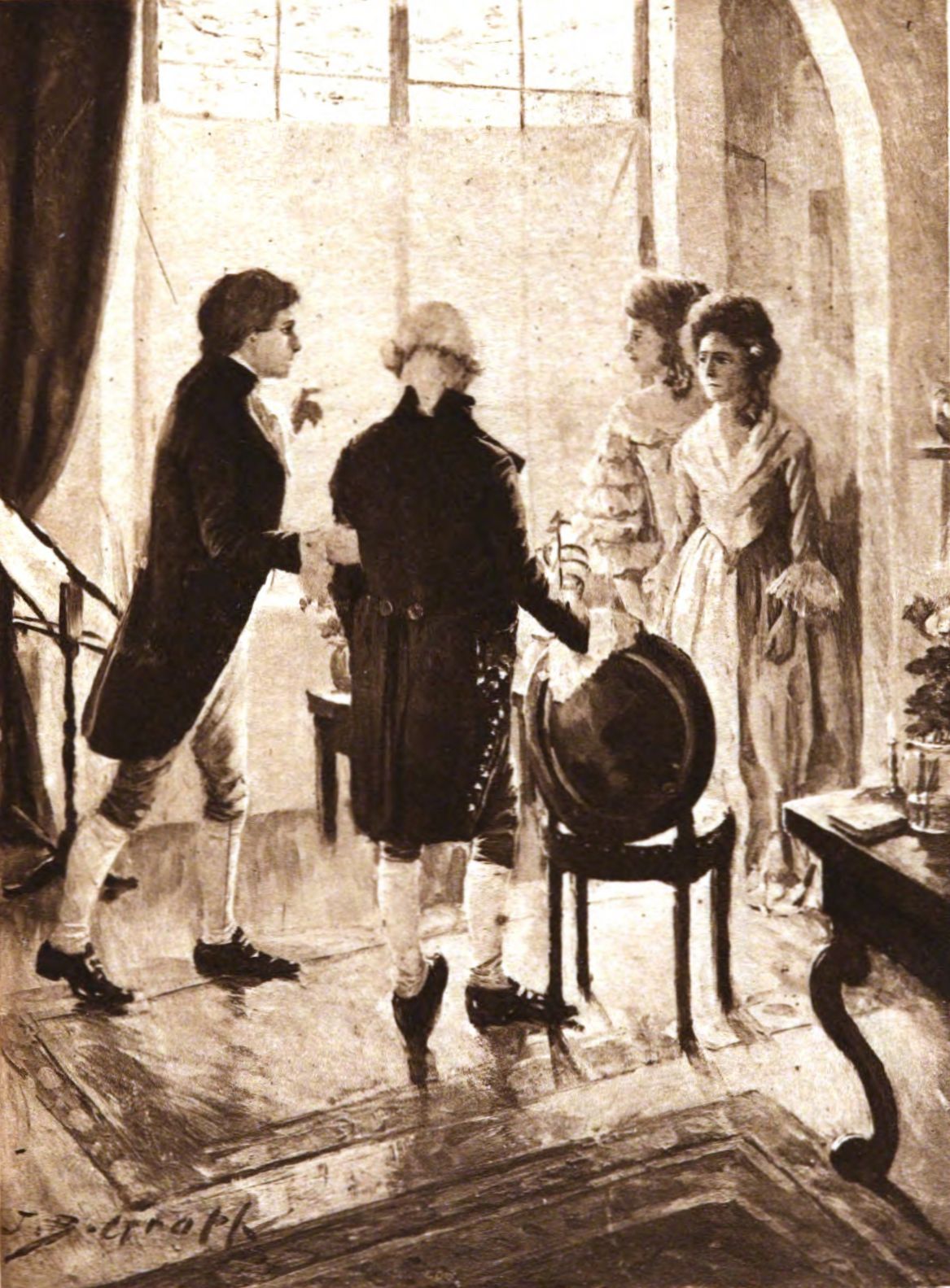
A DISTURBED CONFERENCE Julien roughly enjoined silence on Marcel, grasping his arm and whispering: "For God's sake, hush! there is somebody outside listening!"
"Leave it to me," she said to Madame Thierry, striving to be cheerful; "I take everything on myself. It was I who committed the sin, it is for me to repair it."
"The sin! What sin?" cried Julien.
"Yes, yes, I took a fancy to that flower and asked you for it! No, no! what am I saying? I am losing my mind! It was I who broke it, a foolish caprice—in a fit of absent-mindedness! You were not here. I am awkward, I can't see very well—However, I will explain it all to your uncle. Mon Dieu! what do you expect that he will do? He won't beat me. I will humbly beg his forgiveness; he is not so hard-hearted!"
"Alas!" said Madame Thierry, "unfortunately he is very hard-hearted when he is injured, and if he knew that Julien had committed this sacrilege——"
"So it was really Julien who did it?" said Marcel, utterly dumbfounded. "This is very strange!"
"Well, yes, it was I, I alone!" replied Julien, vehemently, "and there is nothing strange about it."
"Yes indeed there is!" said Marcel in an undertone, his eyes suddenly opened to the secret of the catastrophe. "You are a little too mad, my boy, and your heart must be as fickle as your brain to sacrifice your mother's future and your own in this way; to say nothing of the fact that Madame d'Estrelle is too kind, and that she would have done much better to teach you your place."
"Hush, Marcel, hush!" said Julien, "you are talking nonsense; you don't understand."
"I understand too well," replied Marcel, "and, on my word, I agree with your mother now, I say that you are losing your wits!"
This dialogue in undertones was carried on in the window-recess, while the two women stood together near the vase in which Madame Thierry was trying to replant the stalk of the beheaded lily, talking at random, and saying nothing which had the slightest meaning; for her greatest source of perturbation was not the Antonia, but the storm of passion which had caused its destruction. Suddenly Julien, who was in the habit of handling the curtain and examining the slit through which he looked into the garden, roughly enjoined silence on Marcel, grasping his arm and whispering:
"For God's sake, hush! there is somebody outside listening!"
IV
There was someone there in truth, and it was too late to keep silent. Uncle Antoine had overheard all. How he came to be there, prowling about and spying, in Madame d'Estrelle's garden, we shall soon learn. Marcel felt Julien's gesture, discovered the slit in the curtain, and, looking out in his turn, saw the ogre listening. He left the window and warned Madame d'Estrelle. They talked together for a moment in pantomime. They had not been able to decide what course they should pursue, when Antoine, hearing nothing more, knocked at the garden door.
It was a good deal like the arrival of the statue at Pierre's festival. Julien was about to open the door, when Madame d'Estrelle, with a rapid forecast of the absurd scene to which her presence would give rise and of the deplorable outbreak which might follow if she were not present, instantly made up her mind as to her own course, detained Julien authoritatively by placing her hand on the young artist's quivering arm, and, motioning to him and to the others not to stir, she went into the vestibule, opened the door herself, and found herself face to face with Monsieur Antoine. Although he had prepared his part, he was a little surprised himself, whereas he expected to surprise everybody.
"You, neighbor?" said Julie, feigning astonishment. "What are you doing here? Did you come back to my house? Who told you where I was? and what induced you to pass through my garden?"
And, without waiting for his reply, she passed her arm through the horticulturist's and led him some distance from the pavilion to the shore of the little pond in the centre of the lawn in front of the mansion.
"Why—I was going to the pavilion," stammered Monsieur Antoine.
"So I assume, as I found you at the door."
"I was going there—with kindly intentions; but——"
"Who doubts it? Not I certainly, my friend."
"Ah! at last you call me what I want you to call me! Very good, then you are willing to talk with me alone, I see—The same with me; I want to talk to you about an idea of mine——"
"Let us sit down on this bench, neighbor, and I will listen to you; but first you must listen to me, for I have a confession to make to you."
"Pshaw! pshaw! I know what your confession is; you plucked my lily, didn't you?"
"Ah! mon Dieu! how did you know it?"
"I overheard a few words and I guessed the rest. Why need you have broken the poor flower? Couldn't you have asked me for it? couldn't you wait till to-morrow? I intended to give it to you."
"But—suppose I did not do it on purpose?"
"You didn't do it on purpose?"
Julie felt that she was blushing, for Antoine scrutinized her closely, and there was a half bitter, half tender irony in his little black eyes.
"Really," she replied, trying to save herself by a Jesuitical expedient, "the accident happened against my desire."
"Good," rejoined Antoine, still staring at her, "put it that way, I like that better."
"You like that better—than what?"
"Mordié! yes, I like it better. Come, abandon the worthless cause you are trying to plead; condemn Master Julien's madness and disloyalty without reserve; let me punish him as I think best."
"But what makes you think that Master Julien——"
"Oh! don't try to lie any more," cried Monsieur Antoine, springing to his feet as if impelled by the quivering of his whole irritable and passionate little being; "it isn't becoming in you to lie, you know! And then it's no use, for I tell you I heard everything, and as I'm no fool I concluded—Julien has taken a fancy to you, and the rascal would tell you so if he dared!"
"What do you say, Monsieur Thierry?"
"I say—I say things as they are. Mademoiselle de Meuil was as proud as you can possibly be; my brother André told her fairy stories, and he ended by making her listen to him. All men and all women are made of the same stuff, I tell you! There's only one question of any importance now: does Julien take your fancy, yes or no?"
"Monsieur Thierry, if I did not know that you have a kind heart, your wretched manners would disgust me! Be kind enough to adopt a different tone, or I shall leave you."
"Ah! you propose to be angry, do you? Your pride has taken hold of you again, and you are going to turn your back on me? Why? All this is no concern of yours! Julien did the crazy thing, it is for him to pay for it."
"No, Monsieur Thierry, that is my place. My bungling caused the accident; if I had not admired and praised the flower too enthusiastically—He felt obliged to offer it to me—courtesy——"
"Poor reasons, poor reasons, my fair lady! The rascal knew perfectly well that I would have thrown the flower, the plant, the garden, aye, and the gardener to boot, at your feet. If he didn't know it, he should have guessed it, and, in any event, he had no right to play the gallant with my property; it's kidnapping, it's an abuse of confidence and a theft. He will live to rue it and his dear mamma will find out what it costs to have an ill-bred son play the courtier to great ladies at just the wrong time."
"Come, come, my good neighbor," cried Madame d'Estrelle, deeply distressed and annoyed, "surely you do not propose to withdraw your favor from them; you are not going to give me the lie, for I placed you on a pedestal; you are not going to break off the friendship which you and I contracted to-day, just for a flower more or less in your collection? Your fortune makes a loss so easily repaired of little consequence."
"You talk very jauntily about it! There are some things which millions can't replace, and which a man of taste considers beyond all price!"
"Oh! mon Dieu! mon Dieu! who could have guessed that?"
"Julien knew it."
"Impossible!"
"I tell you he knew it."
"Then he is mad; but that is not his mother's fault: she was not there."
"It is his mother's fault! She encourages him to love you, she scrapes acquaintance with you in order to induce you to do what she did for her husband."
"No! as to that, I give you my word of honor you are wrong, Monsieur Thierry! She is in despair——"
"At what? Ah! you see, she has spoken to you about it, and you knew of the young man's presumption."
Madame d'Estrelle struggled to no purpose. All the prudence of her sex, all the pride of her rank, all her natural shrewdness, and all her familiarity with society went for naught against the rich man's narrow and uncompromising logic. She was as if caught in a vise, and felt shamefaced, awkward, helpless, at the end of a no thoroughfare. What should she do? Turn out this boor who forced her to submit to a distasteful examination, and thereby abandon the cause of the poor Thierrys and turn them over to his vengeance; or restrain herself, defend herself as best she could, and submit to the humiliation of the most untimely of reprimands?
"It seems," she said with sorrowful resignation, "that I made a very great mistake in going into that pavilion! I was very far from having any such idea, I had never seen Master Julien Thierry, and I started out with my mind full of your fine promises, to carry joy to his poor mother! I am well punished now for being so enthusiastic about you, Monsieur Thierry, since you consider that you are entitled to lecture me as if I were a little girl, and to call me to account for the most innocent if not the most honorable step that one woman can take toward another!"
"For that reason you are not the one whom I blame," replied Monsieur Antoine, softened in one direction and proportionately more irritated in the other; "the true culprits are the ones I blame without appeal. Do you know what would have happened if I had entered just at the moment when Master Julien was breaking my lily? Why, I would have broken Master Julien! Yes, as sure as I am talking to you, the head of this cane would have broken his painter's head!"