Same date. Night.
Reading edition
I CALLED for Heloise at a quarter past nine this morning, and sent up my card.
It was returned to me in a few minutes. Heloise had written on it—“Come up.”
Her door was ajar. I stepped in. Her steamer trunk and hand bags were piled there, ready to go.
“Be ready in a moment, Anthony,” she said. Then, “You were coming up, weren't you?”
She was busy doing a last bit of sewing on her coat, and spoke without looking up.
“No,” said I, “I was n't.”
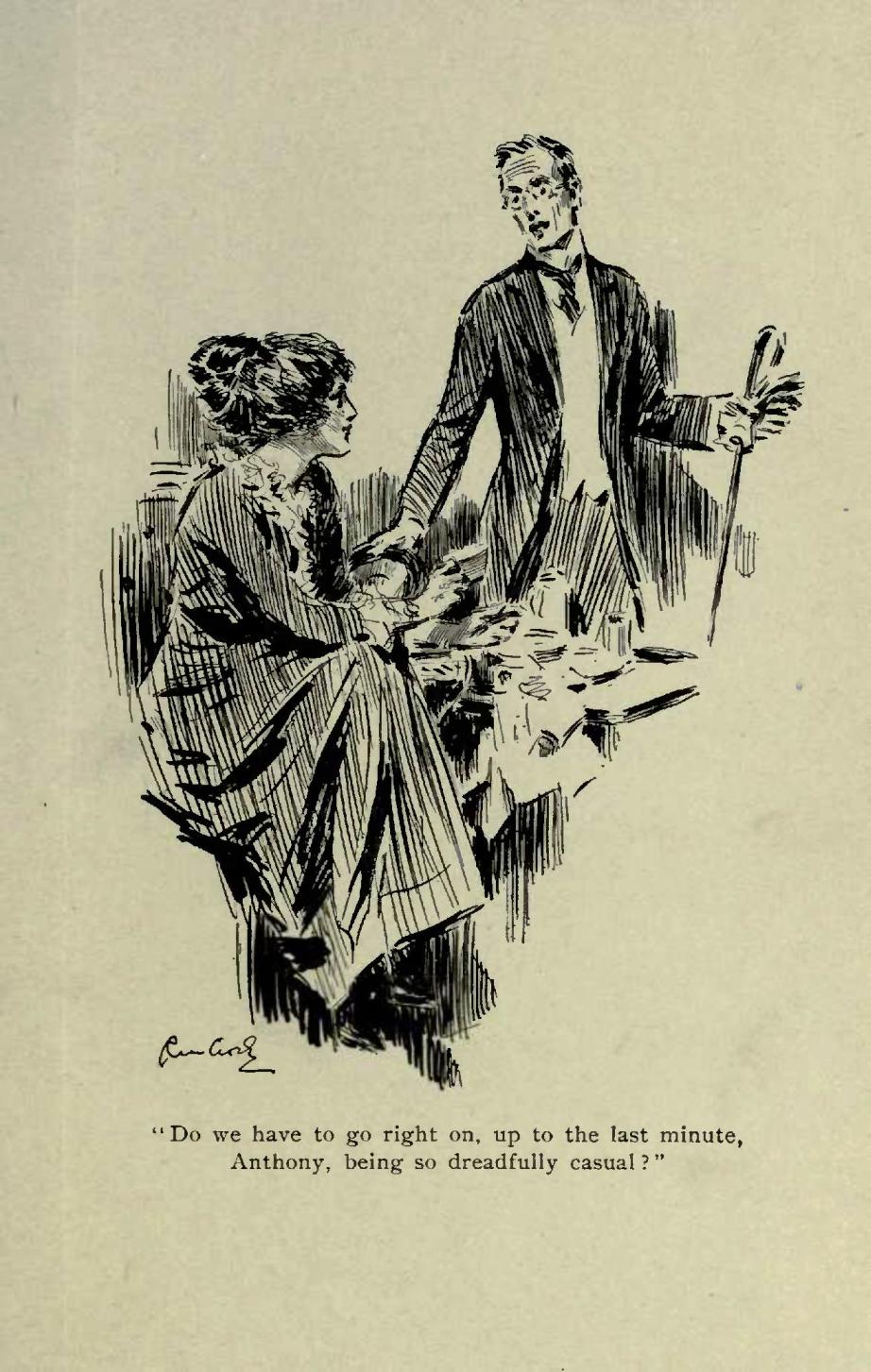

She worked on in silence for a moment. Then she said—“Do we have to go right on, up to the last minute, Anthony, being so dreadfully casual?” I hardly knew how to answer this. It had seemed to me that we had to do precisely that. I dropped into a chair by the bare center table, and held my hat in my two hands.
“Oh. don't worry, Anthony,” she went on. I had never heard her speak in just that tone. It disturbed me. “Don't worry. I'm going. To Harbin—and Moscow—and Paris. In less than an hour I shall be gone. But it did seem to me that we could say good-by up here.”
She went right on sewing until the little task was done. Then she bent over and bit off the thread with a jerk of her head. She put the needle in her shopping bag; then pursed her lips and studied the little gold watch on her wrist.
Finally she looked up, and our eyes met.
“Anthony,” she said, very quietly, “what if I should n't go?”
I got up and walked back and forth between the table and the door.
“Oh, Heloise,” I broke out, “why do you say this now?”
“Why not?” said she.
“Can't you see that our judgment is worth nothing now—nothing at all. We've made our plans.”
“Do you want me to go?” she persisted, her eyes half hidden behind drooping lashes, but on me every instant.
“Do I want you to go?” I almost mimicked her. My voice was rising, and she got up and slipped swiftly past me, closing the door and leaning back against it, still watching me. “Do I want to give up the most wonderful thing in my life, and turn back, all alone to my work?” I choked. “You know better than to ask such a question. It is foolish. You must not say such things to me. I can not bear it.”
“Then,” said she, “why on earth are we doing it?”
She came to the chair on the other side of the table and sank into it, still watching me.
“You are afraid of happiness,” she said.
“No, no—I am not! It is not that!”
“But Anthony, I can't believe that you are afraid of unhappiness. I know you too well.”
“I am not. I am choosing unhappiness.”
She knit her brows. “Probably,” she said slowly and thoughtfully, “it is something of both.”
“No,” I answered, “you are wrong. You know well enough what it is. It is your freedom. That is the one thing I will not, can not take.”
“My what?” she queried, with a curious, faint smile.
“Your freedom!” I cried, standing over her, with clenched hands.
“But Anthony, I am not free. There never was a woman less free—than I am—now—this minute!”
“That is absurd, Heloise.”
“It is not absurd. Oh, Anthony, Anthony, will you ever come down out of the clouds! Do you really suppose that I will be free just because you say so—off there in Paris, knowing every moment of the day and night that nothing on earth but your generosity keeps me alive—that every step of my growth will be due to you—that—”
“Stop, dear! You must not—”
“—that I am not even paying my way? Oh, Anthony, bless your dear heart, sometimes, in thinking about you, I laugh—and sometimes I cry. Can't you see that I shall not move a mile toward Paris of my own desire, that I go only because you tell me to—yes, because you order me to? Can't you see that this has been your idea all along, not mine—that you have made every decision, down to the minutest detail of my poor life.... Freedom? Why, Anthony dear, I'm a million miles from freedom and traveling the other way! I don't want that kind of freedom. I want to work with you—right by your side. I want to earn some real freedom, the right kind. I want to—yes, to make good with you, Anthony.... Oh, I've tried to be good. I've tried to accept your judgment in everything. My life is yours anyway, so there was no harm in that. I love you as I never knew a woman could love a man. I worship you.... You must not stop me, Anthony!—Even so, I would give you up.
“If it was best for you. That is all I have asked myself—What would be best for you? And then you've ordered me about so, Anthony, and what on earth could I say. I had to plan as you told me to plan. I ought not to be saying this now. I ought to be going away, very quietly, saying—'Yes, Anthony. I will go, Anthony.' But now you tell me that in your heart you want me to stay. And I can see that it is true. I know you want me.... And yet, Anthony, you have the hardihood, you assume the wisdom, to decide for us both—squarely against the dictates of both our hearts. You assume not only to decide for us now—you are deciding what the future would be if we should stay together. And that is—why, that is silly, Anthony. There never was a man and woman who needed each other more than you and I need each other.” Her voice dropped, and softened. “I don't think a man and woman ever loved more wonderfully, Anthony. We are n't children. We have suffered. And I think we know.... You see, dear, I have come to distrust your judgment about some very human things. Every marriage is a risk. People seldom marry who know each other as you and I do, who have tested each other.... Oh, I've tried so hard to accept your judgment. I kept waking up last night, and it all raced through and through my head; and still I felt I must do as you say.”
My world was falling about me.
“But your work, child,” I cried. “All that stands just as it stood before, when we—well, when I—made the plans. The problem is still there. We can't escape that, not even by the easy process of following our hearts.”
She had dropped her eyes. She was smiling.
“There is n't any problem, Anthony,” she said.
“Oh, come, Heloise—”
“There is n't, dear. If I spend these next two years just in learning by heart the operas that I've got to know, they will be years very well invested. I could do that out here as well as in Paris.”
“But you are begging the question, dear. It is n't just that. You know it is n't just that.”
“What is just that?” she asked, still smiling.
It was hard to answer this directly. But I had to. I dropped on my knees beside her. I gripped her shoulders. I tried to make her look at me. For it would not do for us to go all to pieces—we must face this thing.
“Heloise, dear—you are making me say it, but you knew the problem is there. You have not forgotten what those three great singers said?”
“No,” she murmured, “I remember well enough.” But still she would not look up.
“You know what they said... the art of the opera singer is the most exacting thing in the world. There is no place in it for a husband, a home... and children, dear. For these things are exacting, too. It was the three greatest sopranos in the world who said that.”
“Oh, I know all that, Anthony,”—I could not make her lift her eyes,—“but people are so different. There is n't any problem, really. There are only different persons. That's all, Anthony. I could tell you of three other great singers that have husbands, homes and splendid families.... Only one thing bothers me—they all happen to be contraltos. Do you suppose there is any such difference as that between contraltos and sopranos, Anthony?”
Now she looked up. That smile was still hovering about her eyes and the corners of her mouth. But when I drew her dear head against my shoulder and pressed my lips to her forehead, it faded.
I kissed her eyes, slowly, one after the other.
Then her hand slid hesitatingly upon my shoulder, as it had once before. Her head nestled back in the hollow of my arm. I bent close. Our lips met.
We said many things. It hardly matters now what they were.
Excepting this. She held my face in her two hands and looked into my eyes.
“Dear, dear boy,” she said, “you have lived all your life with theories. Don't you think it is time you lived with a fact. For I'm afraid that's what I am—a fact. And facts are stubborn things, Anthony.”
But then she worried a little. “You must n't let me sweep you off your feet, Anthony. We must sit up and think. We must decide this thing.”
So she sat up straight. And I leaned back, still kneeling beside her.
For a little space we were very sober. Then she said—
“Anthony! what are you smiling at? What makes you look like that?”
It was a moment before I could compose my features. She had folded her hands in her lap. Her eyes followed mine to the watch on her wrist as I said—
“Your train left the East Station sixteen minutes ago.”
She drew her under lip in a little way between her teeth, as I had seen her do so many times when she was startled. Then, “Oh, Anthony!” she said, laughing a little—“the big trunk has gone with it.”
We shall get the trunk back all right. It was just a matter of telegraphing Tientsin. The baggage master here attended to it for me.
The refunding of Heloise's ticket money proves to be a more complicated matter. There is no Public-Service Commission to direct the Trans-Siberian in such matters—nothing but the Russian and Chinese Governments. Hindmann thinks that they may be willing to give back half of it. He says that is a common rule among the big steamship companies. Half the railway fare, that is; there will be no refunding of what was paid for the berth, of course. Anyway, Hindmann has taken the ticket and says he can probably get something done within the week.
For myself, I find it difficult to take this matter seriously. I could cheerfully let the money go. But Heloise, I can see, is a little disturbed over it.
We discussed the question of a marriage, this afternoon, she and I. We both want some sort of ceremony. Mainly, I suppose, for the effect on ourselves. And since we are here, with nothing to do but go ahead with our work and our lives, neither Heloise nor I can see any sound reason for delaying. If we were back home, or if she were among friends, it might be well to wait. Though I doubt even that. It would be merely a conventional observance, and would serve no healthy purpose. No, our job now is to go straight ahead with the life that we are to share. And we may as well be about it. So we shall be married, quietly and soberly, sometime within the next few days.
I had thought of the Consulate. But some telephoning on the part of Hindmann drew out the information that our consular and diplomatic officials are not permitted to solemnize marriages, nor to advise regarding the legality of the arrangements. The Consul-General is willing to witness the ceremony officially, but we should have to go down to Tientsin for that, and we both want to be married here in Peking if it is possible.
The peculiar complication is, of course, that China, as an Oriental, non-Christian country, does not solemnize marriages in any way that is recognized in the West. If we were in a European country now, all that would be necessary would be to conform to local customs. But international observances, as among Western peoples, do not hold where China is concerned.
Finally Hindmann said,
“What's the matter with a missionary brother?”
“Why, of course!” replied Heloise. “Aren't we stupid? They are ministers. And I don't think it matters what particular place they happen to be in when they say the words.”
Hindmann is inclined to think that we had best go down after all to the Tientsin Consulate and be married there, either by a missionary or by a minister of one of the Settlements. “There's several thousand white folks there,” said he. “Pretty sure to be some preachers among 'em. Then, you see, the Consul-General will give you each a certificate, and besides he'll have the marriage put on record at the State Department at Washington. That way, it 'll hold all right, I guess.”
Heloise and I covertly exchanged glances. We know what is in our hearts Certificates!...