April 14, (continued).
Reading edition
CROCKER opened his door at my knock.
He was half dressed, with a quilted gown drawn about his big frame.
He gripped my hand. I permitted this, which was perhaps an odd thing to do; but it came about so easily and swiftly that I could not think how to prevent it without appearing merely childish.
Then I went on into the room, and stood, with some sense of inner tension, while he drew an easy chair to the table and with a paper cutter pried open a box of cigars.
He has changed, even in the fortnight since our parting in the railway station at Yokohama. He is putting on weight pretty rapidly, and his face distinctly exhibits the ravages of drink. It was pale this morning. His eyeballs were crisscrossed with red veins, and there was an incipient puffiness under them. His hands were unsteady, too; I noted that fact when he opened the cigars. And afterward, when he dropped on the sofa and settled back against the cushions, he extended his right hand as I had seen him do once or twice before, back at Yokohama, and make an unsuccessful effort to hold it still. Then he let it fall across his knee, and for a moment stared gloomily at the carpet.
I observed, too, that he was more nervous. He moved with a jerky abruptness. And when he glanced up at me, it was suddenly, with a perceptible start, as if I had spoken sharply, though in reality I had not spoken at all. It made me think of the torturing confusion of moods that was racking his nervous system, and of the merciless voices of unrest that were so evidently whispering every moment at his inner ear. A few days ago I would not have observed his condition with any sympathetic understanding; but now that I, too, have been torn between the exaltation of love and the degradation of jealousy, I can only shake my head in a sad sort of wonder at the mysterious strength of these forces that drive men and women together, and apart, and that linger even after a mismating and a subsequent separation to stir and bewilder the spirit.... Yes, I can, in a way, feel with Crocker now. To live with memories of magical hours passed with a woman one has since lost—elusive, poignant memories, that come in the still hours of night to triumph over the brutal facts of the day that is gone and the day that is to come—this is the stuff of tragedy.
My feelings soared far, as I sat there—all in a moment. I was thinking of strong passions and of elemental things. It came to me, oddly, that I had never really understood certain of the great poems and the greater music dramas. I told myself that I must seize the first opportunity to hear “Tristan” again. I would understand if now. Yes, surely... there was the surging, heartbreaking climax of the “Liebestod,” for example—it was surging in my feelings now, and in my brain. I could hear the swelling of the violins. And I knew all at once that it was not the mere heartbreak of Isolde and her Tristan that surged and swelled with them, I knew that it was the universal story of man and woman everywhere. Underneath the trivial vulgarity of the daily newspaper, with its commonplace recital of petty dramas and pettier tragedies, I suddenly knew, surge and swell the hopes and dreams and casual disasters of a million Tristans and a million Isoldes. It is men like Crocker and myself, I thought, and women like Heloise, who enact, all unconsciously, tossed helplessly about on great billows of feeling, the heroic drama of life.
It was the inner man that dwelt on these stirring things. The outer me was declining a cigar, and taking the easy chair, and for a moment letting my eyes w ander about the room. It was going to be pretty difficult to broach the subject. I could see that. Yet it had somehow to be done.
There was a bottle half full of whisky on the table, and glasses. Evidently the embargo had been raised. I could not help staring at that bottle for a moment. And, though he did not raise his eyes, I felt that Crocker knew what was in my thoughts.
His suit-case, with the cover thrown back, rested on a chair by the wall. The contents were rumpled about; but among them, right on top, I saw a knife-handle of Japanese lacquer and silver projecting from a lacquered sheath with a silver tip.
He caught me looking at it, sprang up—with an abruptness that made me jump—and slammed down the cover of the suit-case.
Then he came back to the sofa with a short laugh that was plainly designed to cover inner embarrassment, and poured out a good three fingers of the whisky. He drank it neat.
“Have some?” he said.
I shook my head.
“It settles my stomach,” he continued, with an air of apology. “I have n't been at all well lately.”
I watched him while he poured out another, and tossed it down.
He lighted a cigar.
“Where you stopping?” he asked. “Have n't seen you around here, have I?”
I shook my head.
“There's another hotel here, then?” said he. And his eyes narrowed craftily.
“Oh, yes,” I replied, “two or three.”
Then I hesitated. But after all, why evade the man? I had come to his room with precisely the opposite intent. So, with a nervous abruptness not unlike his own, I gave him the name of my hotel—and Heloise's. And at the same time I watched him closely to see if it conveyed anything to him.
Plainly it didn't. He merely blew out a long spear of smoke, followed it for a moment with his eyes, and then glanced down at the cigar that he was turning slowly round and round between his fingers.
But he could not sit quietly for any length of time. He got up again, with that same jerky abruptness, and, muttering something about the room being close, strode to the window and threw it open.
He knew that he was acting rather uncivilly, for he turned to me then and said, with a fairly good imitation of a casual manner—“Mind a little air?”
“Not at all,” I replied. It was depressing to be talking thus about nothing, knowing so well what was in his heart and what was in mine. But I only mumbled the stereotyped phrase, “Not at all.”
He took another drink—neat again. Then he drummed on the table with the fingers of one hand.
If there is one thing above another that I abominate, it is that kind of idle drumming. He made it worse by whistling softly between his teeth a crude song of the streets. I knew that I must keep myself in hand, but could not help fidgeting a little in my chair.
Nervously self-centered as he was, my discomfort quite escaped him, of course. What stopped his whistling and drumming appeared to be a sudden thought that came to him with the tune.
He looked down at me. His eyes narrowed again. He opened his mouth, then abruptly closed it on the words that were so close to utterance.
When he did speak, I felt certain that his question was not the one he had meant at first to ask.
“How's the phonograph business?” he said, and tried to smile.
“It's all right,” I replied shortly.
He sat down on the edge of the sofa, elbows on knees, and smoked fast.
“What sort of place is that hotel of yours?” he inquired, after a little.
“Middling. Not so good as this.”
“Near by?”
“Not far.”
“I suppose any rickshaw man would know the way,” he mused.
He fell silent again. Then, finally, he put the question that was on his mind, not looking at me, trying to speak casually; but his voice was not quite steady, and I could see the cigar shake in his hand:—
“Have you happened to see a woman over there—young, good looking, rather slender, blue eyes? Could n't say what name she'd be using.”
In a flash I knew that this was my opening. And on a great wave of relief—for we had to come to the issue—I leaned back in my chair and said, “There is such a woman there. She is using the name of Crocker.” Then I watched him.
I have never seen a man's face go so blank. His jaw dropped—literally. And his eyes were wide.
I found myself returning his gaze, and nodding rather emphatically. I kept on nodding.
Then I said, holding his eyes with mine—
“See here, Crocker, I know all about that. You told me yourself. Have you forgotten?” Slowly the recollection came to him. “Oh, yes,” he replied, “at Yokohama.”
“And you told Sir Robert at Nagasaki. Have you forgotten that?”
This seemed to sting him. “How do you know I did?” he asked sharply.
“He told me. We talked you over. I asked him about the legal possibility of placing you under some sort of restraint.”
Curiously, this didn't anger him. He merely looked puzzled. I wonder if I am doomed to remain ineffectual to the last—an odd, scientific little person, to be humored by the practical men of this rough-and-ready world, even in their least practical moments.
“I don't get you, Eckhart,” said he. “What have you to do with my affairs?”
“At this moment—everything,” I answered him, feeling suddenly very sad.
Sad, because it came to me that you can not talk intelligently with another human being without a common language. And this, I knew all at once, Crocker and I did not have. I had thought of many things that I should say to him; now I had lost confidence in all of them, for I realized that the word which means one thought to me would mean another and different thought to him. Each of us would have to interpret words and phrases in the light of his own mental images. And the mental images of each were outgrowths of his individual philosophy of life.
Yes, my arguments, that had, on the way over, seemed so potent, would not do now. In order to reach that mind of his, I must think in his terms and not in my own. And I tried, desperately, to piece together something like his code, as I sat there.... That man is a free and dominant creature, half god, half beast; that a small, sheltered section of womankind is of superior, almost divine stuff, designed to comfort and elevate man on his god side, to bear his children and, under his own general government, “keep his house,” while the other and greater section of this same womankind is mysteriously of poorer stuff, and is worthy only to do his rougher work at such a wage as can be wrung from him or (in a pitifully matter-of-fact way) to cater to the vices of his beast side—something like this was surely Crocker's sort of philosophy.
I tried to bring myself to realize what this meant. Holding so curious a faith, it was surely natural enough that he should have tried to force poor Heloise's life into his own hard mold of thought and habit. Nor is it unnatural that he should have been outraged when this lovely possession turned in despair from the atmosphere of suppression and inactivity in which he had been so determined to keep her and tried, blunderingly, all wrong, to find an outlet for the fine spirit stirring in the depths of her being.
For this was rebellion. And Crocker, I can see, hates rebellion. His sort always do. He is profoundly a conventional man, even in his vices.
I thought all this in a swift moment, as I sat there, wondering, wondering, how I could say the things that must somehow be said.
Crocker waited as long as he could for me to go on, keeping himself busy with his cigar. Once I thought I detected a furtive expression on his face, as if he dreaded what was to come.
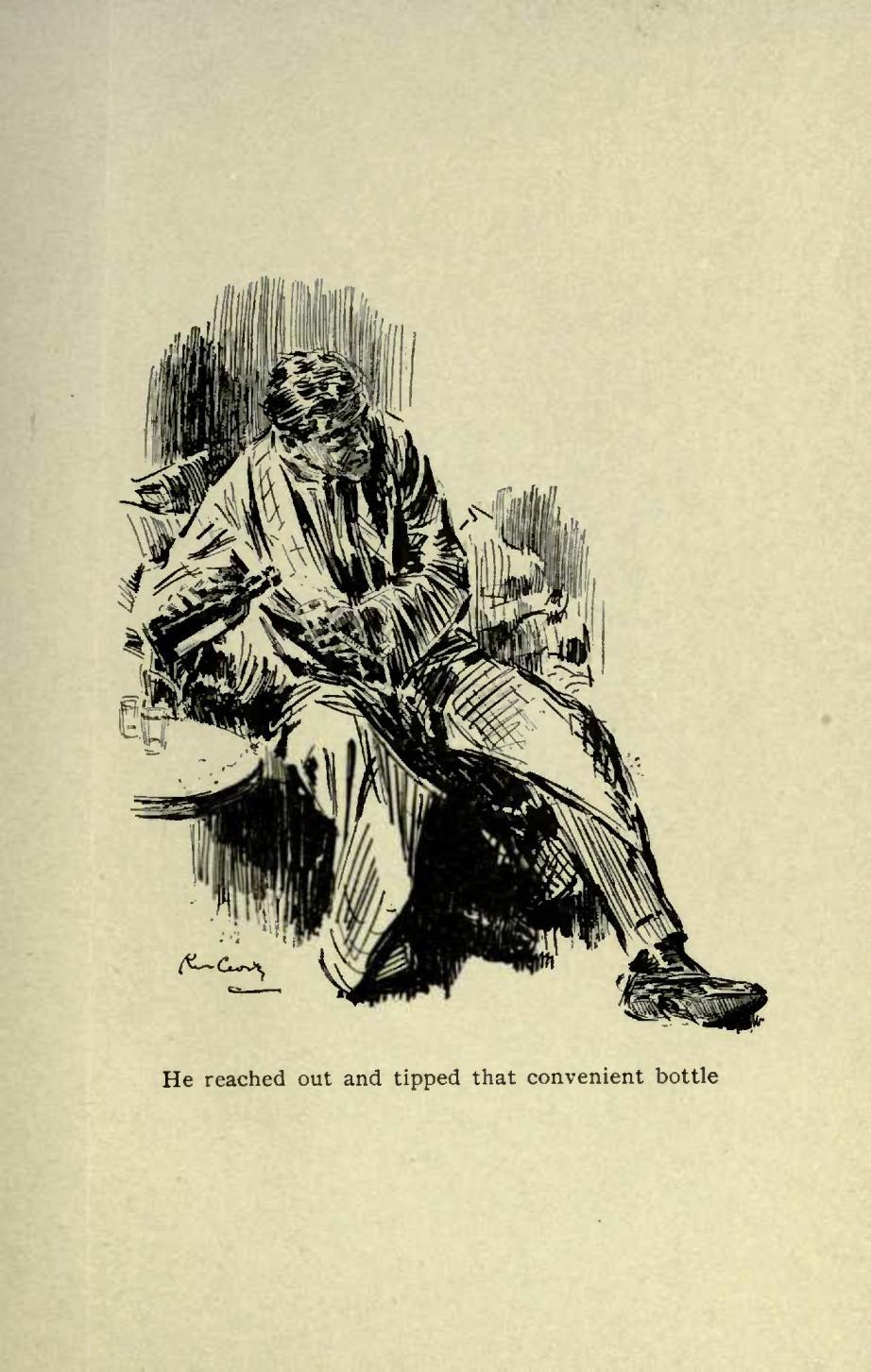

The man was conscious of his own inner weakness, of course. He must have been. Perhaps he remembered telling me of his solemn resolution to give up liquor. Even as this thought occurred to me, he reached out and again tipped that convenient bottle. It seemed to me that there was an extra set to his chin as he did this, a slightly overemphasized casualness that bordered on bravado.
Then he sprang to his feet and moved about the room behind me.
As for myself, I was cool enough. And, once I could hit on the proper beginning to the talk, I felt pretty sure that I could handle the situation. It is evident to me now that the plan I arrived at last night, there in Heloise's room, had cleared the air for me. For I knew—deep, deep in my heart I knew—that I stood ready to give Heloise up. There is selfishness enough in me, God knows. There will be moments of weakness, when the touch of her hand, the blue of her eyes or the shadow of her long lashes on her skin—perhaps even the mention of her name by some common acquaintance—will stir that strange magic that has, in such different ways, torn Crocker's heart and mine. But I believe I shall never again forget that the woman I love, has a life to build, and that the finest duty I have is to help her build it.
I heard a rustling behind me. I turned. Crocker had thrown aside his lounging robe, and was getting into his street clothes. While I sat there watching him, he put on his waistcoat and coat. He put on his hat, pushing it back on his head. Then he busied himself transferring his pocketbook, a handful of small change, some papers and a key ring from the pockets of another suit that hung from a hook on the closet door.
I got right up and stood there, by the table.
“Tell you what, old man,” said he, rather apologetically. “I'm all out of sorts. Guess I need the outside air. You don't mind, do you?”
“Yes,” I replied, with a ring in my voice that was surprising even to myself. “I do mind. I've got something to say to you.”
“Don't talk about that,” said he, and walked to the open window, with his hands thrust deep into his pockets.
“But I will talk about it, Crocker. It is what I came here to talk about. And I propose to make you talk about it, also.”
He offered no reply; just stood there, staring out the window. I went on. I don't know now where the words were coming from that rushed so unexpectedly to my lips; but I knew, as I uttered them, that before either of us should leave that room he would be taking me seriously.
“There is a woman over yonder, in the Hôtel de Chine,” I said “From your own confession to me, you have followed her here to kill her. There is nobody but me to talk to you, but you are not going to dispose of me so easily. This thing is going to be settled. It is going to be settled to-day—and without any killing, We are not living in that sort of an age, Crocker. Not quite.”
“What do you mean—settled?” he muttered, without turning.
“Settled. Just that. And there won't be any murder. You and I are going to arrange terms of separation between Heloise and yourself. Then you are going home. You will leave this city before night. You may go either way—Tientsin or Hankow; it is the same to me. But you've got to go.... Will you please sit down here and try to discuss this thing like a rational man?”
Now he did turn.
“I suppose you think you can talk to me like this,” he said, with something of a sneer.
“I think just that,” I replied. “Sit down, please. We shall see if I can drive a little sense into that fuddled mind of yours.”
I stood there waiting. He did not move, except, it seemed to me, to square his shoulders. And there was the same set to his chin that I had noted a few moments earlier, when he was drinking.
“I'm standing a good deal from you, Eckhart,” he said. “But after all, I've got nothing against you. You can't be expected to understand these things.” This evidently struck him as a happy idea, and he repeated it: “You can't be expected to understand these things.”
Suddenly he frowned. “How'd you know her name was Heloise?” he asked.
“How did I know?” I repeated. “I will tell you how. I will tell you much that you yourself do not understand.” My voice was rising. I had to struggle to control myself. But I knew that I must, for it was not myself I was fighting for now. “We will not waste words, you and I. We are past that, Crocker—far past it, if you only knew. I have seen”—the words “your wife” had come to my tongue, but I could not say them; it was a profanation even to think of that fine woman as “his”—“I have seen Heloise. I have come to know her. I have seen how sad she is, and what a struggle she has been making to begin doing something with her life. For she has been alone, Crocker—”
“Alone?”
“Yes. She did not stay with that other man. She could not. And she has been struggling all alone.” I fought back the emotion that was breaking into my voice. “I know you both now, Crocker—pretty well. And knowing you both, I can see, oh, so clearly, that she could never, never be happy with a man like you. She has ability, she has spirit, she has what they call temperament. She is an artist. And do you not know, man, that the artist must always be struggling toward expression, that his whole life is nothing but that struggling? You can not make a domestic drudge of such a woman. Of some women—yes. But not of the artist. You tried to do just that. You chose the woman who was beautiful to your eyes, and whose spirit made her most desirable, and then you tried to crush that spirit. I have no doubt she tried to submit, that she fought her own finest qualities, for years, in the hopeless effort to make of herself what you demanded. And then she broke—all helpless, all dependent on you as she was—and risked everything to get away from you because it was worse than death to her to be with you. And now you hound her around the world like the savage beast that you are.... Good God, man, can't you see that she was right in leaving you! Can't you see that it was the finest, bravest thing she could have done!”
I stood, strung up, all blazing with the fire that was in me. I knew I had broken bounds. I thought that now, surely, he would turn on me and fight me; and I did not care. I even thought wildly of settling it all with him then and there, with blows, as men do. For I had the fire and the will within me; while he, with all his height and strength and native vigor, was palsied with that poison that eats away a man's will and leaves but a shell of bluster.
But instead of anger on his face, as I stared into it, I saw only bewilderment. He seemed to be groping after the ends of a new concept, with a mind that had lost something of its power to grasp new concepts.
“Good Lord,” he said then, “you're talking as if you were in love with her yourself.”
I nodded at him, breathless and deeply solemn. “I am,” I said. “I love Heloise, and I shall love her with all my heart until I die.”
Perhaps I was guilty of a tactical blunder in giving him this information. He was so evidently not himself that he should have been handled with tact and not further confused. As it stood, I had laid the train of a profounder confusion than I could possibly have foreseen. But I had to say it.
He was still groping to comprehend this amazing thought.
“I don't get you,” he said. He was not looking at me now, and seemed to be talking more to himself than to me. “You have n't known her—it's only a few days—”
“It is nearly two weeks.”
“But you don't mean”—he fell to walking about the room, and I followed him with my eyes—“you don't mean to say—”
He stopped short, and pondered. Then he turned toward me; and it seemed to me he appeared more like his normal self than at any time since I had entered the room.
“So you 're talking for yourself,” he observed, coldly.
“No,” I replied, “I am not.”
“But you tell me you love her—”
“That does not stand in the way of my doing precisely what I insist that you shall do—give her up.”
“That's easy to say, Eckhart.”
“It is not easy to do, Crocker. But Heloise must go to Europe, and take up her study. Her gifts, her hopes, all lead her straight toward opera. Neither you nor I has the right to stop her. It is the instinct for expression, nothing else. You have followed that instinct freely in your own life and work. I have followed it freely in mine. Now let her do the same. Work—the sort of work that will give scope to his own peculiar sort of energy—is what every human being needs. It is, above all, what Heloise needs. It will be her salvation, if anything will. Can't you get that into your head? She doesn't need any application of the punitive frenzy that we men call justice. She does n't need the easy moralizing of men like you—and me. She needs work!... As regards my giving her up—she goes to Paris; I stay here in China for at least two years. If you can think of any way in which I can put more miles than that between us, tell me, and I'll promptly give up my own plans and do it.” And I snapped my finger.
Some of my phrases were over his head, I suppose. But he came back at me with a good deal of vigor, ignoring my intense mood:—
“You tell me you love her,” he said; “and you talk about giving her up. You don't mean to say that you think she is in love with you?”
This sobered me—suddenly. I felt my eyes drop, and the hot color coming back into my face.
The talk was turning on me in a way I had not precisely foreseen. But after all—it was only fair. Certainly I had shown no hesitation at exposing his hurt places. So I raised my eyes and looked squarely at him, knowing that, though it would be torture, I should tell him the truth as I had been coming to see it during these morning hours.
I shook my head.
“I should hope not!” he muttered.
I paid no heed to him. The thing now was to get the truth out and have it over with.
“There have been one or two moments when I dared think she was beginning to love me,” I went on. “But I was reasoning from my hopes. She was alone. She was destitute—desperate. There was no one she could turn to, except myself. She knew that I had come to love her. And hurt and crushed as she was—with all the gratitude that the biggest heart I have ever known could—But what is the good of this! What fault there has been, is mine. She is a buoyant, vital thing, an artist, all spirit and fire. Even in her suffering I can see that. There have been glimpses, when we were working and she could forget for a moment. I am a quiet man, a man of the study, a narrow man.”
“Yes, you are narrow,” he put in.
“She must have variety. She must have stirring moments, strong reactions. She could not possibly be happy with me. And as for you, Crocker—well, we know about that. You are quite impossible. You thought you could possess her. Finding that you couldn't, you would kill her.”
He winced. I was glad to see it. I must make him wince. I must show him that he was not only a brute, but an absurd one.
He went over to the bureau and rummaged nervously in the top drawer. I could see, in the mirror, that his face was working, in the way it has when he is deeply stirred. Then, after a moment of hesitation, he came back to the table, and with a fair assumption of an offhand manner reached for the whisky bottle.
I snatched it away from him, sprang to the window, and threw it out, hard. I heard it break on the pavement below.
Then I turned and faced him, wondering, with a swift uprush of excitement, what he would do. I had taken him quite by surprise, which was a point for me. His great strength had not enabled him to keep that bottle.
His first expression was a sort of hurt bewilderment. He took a step toward me, but without any particular evidence of anger—more as if he meant to protest.
Next he turned, slowly and heavily, in the direction of the bell. This was over by the hall door. I ran toward it. A chair stood in the way, and I remember throwing it over in my rush. I had my back against the bell before he had got to the middle of the room.
He just stood there, trying to think. Then, abruptly, he turned back, dropped on the sofa, and buried his face in his hands.
I came across the room, as far as the table, and stood over him until he lifted his head. He was evidently fighting to keep from going to pieces. And his pride was not yet wholly gone, for he said—
“See here, Eckhart, I'm not feeling well at all. Just let me ring for a drink, and I'll talk with you. I will. I 'll talk. This thing has driven me wild. But you're right enough, I suppose. Just push the bell, will you? The thing has got to be settled. We'll settle it, you and I. If you think there's really any show for her, on her own, I'll be reasonable. It's been the thought of that fellow—of other men—Oh, God!” His face dropped again on his hands.
It was at this point that I began to feel discouraged over the prospect of arriving at any real settlement of the business. The man could not be counted on to remain in the same state of mind for two consecutive hours. I told him, in good round language, that he could not have another drop of whisky; and he exhibited self-respect enough (for the moment) to stop his whining.
Then for a little while I just sat on the edge of the table and looked at him. This was Heloise's husband. My spirit revolted at the thought. Her husband! The crude law under which we live actually gives such a man “rights” over that fine woman. It was unthinkable. And it was so.
“Come out with it,” I heard him saying. “What's your proposition?”
I had to think quickly. For this, after all, was the opportunity I had been so desperately seeking. I must talk straight.
“You are to let her have a divorce. If I know her at all, she will not accept alimony—”
“Stuff!” said he. “Did you ever see anybody that would n't take money!”
They were as far apart as that, those two. I pushed right on—“but she will have to accept something. A lump sum, say, on the ground that you have held back her training and limited her immediate earning capacity. I think, if that point is made very clear to her, she will be reasonable about accepting enough to carry her through her two or three years of study and the getting up of a repertoire. I would not ask her to agree to more than that. Not from you.”
There, that was plain talk enough, surely, even for Crocker!
He took it pretty calmly. In fact, I am not sure that it wasn't something of a relief to his hard head to get down to what he would call “brass tacks”—meaning money, and the traffic in money.
“That's your proposition?” he said.
“That's my proposition.”
“And when do you want an answer?”
I must admit that he surprised me here. “Why,” I replied, “now. On the spot.”
He shook his head.
“No,” said he. “You are asking me to agree to a plan that would change my whole life.”
“For the better!” I interrupted eagerly.
“Perhaps,” said he. “Do you think I have traveled from New York to Peking for the purpose of changing my mind in one minute, because you ask me to?”
He had stiffened up, as he sat there, and was talking, all of a sudden, quite like a responsible business man. Whether this change was merely a momentary outcropping of self-respect, or whether there was man enough in him to bring that drink-fuddled brain so swiftly under control, I could not imagine.
“What else can you do?” I asked, as quietly and reasonably as I could manage. “At this moment you seem more like your real self, Crocker, than at any other time since I came in here—”
“I'm myself, all right,” he broke in gruffly. “Never you mind about that. Let me hear your arguments.”
“—and you can't sit here, and look me in the eye, and tell me that you seriously consider carrying out the insane purpose that brought you here. You can't, man!”
“Cut that talk out!” he cried angrily. “Stick to your own side of it.”
“There is no other side of it, Crocker. You're not going to kill her. She'll never go back to you. Your only possible course is to give her up. And my guess is that you'll show yourself a reasonably good sport.”
This touched him. At last I had hit on a phrase that he could understand, in all this ugly talk that I was driving so desperately at him.
“Never mind that, either,” he growled.
I stood up, and looked at him. It seemed to me that I had him. Certainly, he was avoiding my eyes.
He jerked out his watch, and stared at it, turning the stem around and around between his fingers.
“It's eleven-fifteen,” he said, then slowly let the watch drop back in his pocket.
He had smoked the last of his cigar. Now he lighted a fresh one.
“I'll give you my answer at two,” he added.
For a moment I did not know what to say to this.
“What's the matter,” he said, in that rough voice.
It was such a voice, I imagined, as he would employ with business subordinates. “What's the matter? Isn't that reasonable? You've stated your proposition. I'll think it over and give you my answer after lunch. If I accept it, I'll pack up and leave Peking on the first train.”
Still I hesitated. He just sat and smoked.
“You know what's the matter,” I replied, finally. I decided to stick to my policy of talking in his own blunt way. “How do I know that you will be sober at two?”
“I'll be sober,” said he. He thought this over, and added, “After all, Eckhart, I suppose you have a right to ask that question. I'll admit that I've been making a dam' fool of myself. I've been drunk ever since I got here.”
“Yes,” said I, “I know it.”
This disturbed him a little, but he went on—“I'm glad you threw that bottle out. It was what I needed to bring me to my senses. I'm all right now. You 'll see. Tell you what I 'll do—I'll take a cold bath. That always sets me up. Then I'll order up a lot of coffee with my lunch, and only a light wine.” He got up, and stood over me. “There's my assurance that you'll find me here, O. K., at two. I'm not a common drunkard, Eckhart. You're not a man of the world, and you don't see these things quite as they are. I've been stewed, that's all. I'm through. Now for the coldest bath they've got.” He began stripping off his clothing. “Come right in at two. Don't bother to send your name up.”
For a moment I could only look up at him. I must admit that he was convincing. What he said was quite true—disordered as he had been, through passion and drink, he was not yet a common drunkard. There was yet stuff in the man Besides if, as I was beginning to hope, he really meant to accept my plan, the less than three hours he asked for was a quite reasonable concession to his pride.
I had to make the decision. I did make it.
“All right,” I said, “I'll come at two.”
He looked straight at me, and held out his hand.
“You've helped me, I think,” he said, in a very decent spirit. Then he glanced down at his big hand, and added—“Better take it, Eckhart.”
I took it. Then, stirred by doubts and hopes so extreme and so confused that I hardly knew what I was thinking, I went out. The last I saw of him, then, he was throwing aside his under-wear, and exposing a deep chest, with big muscles curving down over the shoulders, and smaller ridges of muscle in rows on either side. And on his face was that set look.
I ran up the stairs (at the Hôtel de Chine) and burst into my own room. Then I stopped short, and took off my hat.
For there, by the window—in my room—stood Heloise. She wore a simple but very beautiful frock of her favorite color, blue. It made her look taller, and slimmer, and more exquisitely womanly.
The room itself was changed. She had picked it up, and given it what few cheerful touches she could. On the bureau, in the toothbrush holder from my washstand, stood a spray of white cherry or pear blossoms. I can't imagine where she got them; I did not think to ask, when we were together, for we had so much else on our minds.
On the bureau, also, in a neat little pile, were the pieces of my ten broken cylinders. She had gathered them all and put them there.
It was the first time she had ever tidied up my room like that. It touched me. I stood motionless for a moment, looking about.
“Did you see him?” she asked, very low.
“Yes,” said I, still looking about the room, “I saw him. It is going to be all right, Heloise—all right. We are to meet again at two.” Then I indicated the white blossoms. “You have made it seem almost like a home.”
“Oh—that?” she murmured. “It was hard to wait. I had to keep myself busy.” She said it very gently. And it thrilled me to realize that, whatever strange event might come to her and to me, we had at last arrived at a fine spirit of companionship.
Just to think that she could do this friendly act, feeling in her heart that I would not misinterpret it or in some crude masculine way take the advantage—I like that, even though I distinctly do not deserve it.
But she was speaking, still in that low voice, but breathlessly, I thought:—
“How will it be 'all right,' Anthony? What do you mean? What have you done?”
I felt that I must be very gentle. But with her, as with that man over yonder in the other hotel, it was the time for frank talk. For as I had insisted with Crocker, her life was her own to live; and I could not go on now without her approval.
I drew my one comfortable chair to the window for her. She took it. Then I explained to her, just as briefly as I could, that Crocker had agreed to consider setting her legally free, on condition that she go to Paris and work out her career independently of myself or any other man.
She heard me without a word, sitting there, her hands folded in her lap. I could not make out the expression of her face. It was grave, of course, but composed—with no sign of the hysteria that I had considered as a possibility. Indeed, I am not certain but what she was rather calmer than I.
When I had said it all, and had paused, looking anxiously at her, she asked:—
“How long have you known about him? Did he”—she indicated the room across the hall with a slight movement of her head—“tell you?”
I explained to her that I had been with Crocker on the ship and at Yokohama, and that he himself had talked to me of his difficulties.
This surprised her, I could see, but she made no comment regarding it. Her next question was uttered with hesitation:—
“Was he—did he seem—”
I caught her drift. “To-day, you mean?”
She nodded, with compressed lips.
“He has been pretty bad, but I really think he is sobering up. When I left him, he seemed to have himself under control. And he gave me his word that he would be sober at two, when I go back.”
She seemed to be musing, in a depressed fashion. Then she glanced up, met my eye, and tried to look brighter. “The trouble with him is,” she said, “you can never be sure.”
“I know,” I replied, “but I could n't refuse to give him three hours—less than three hours. You see, dear, there is no pressure I could bring upon him. I have n't even the advantage of physical strength. And, really, you know, when you come right down to it, my whole position was the weakest possible—I had absolutely no right to talk to him like that.”
We fell silent again. Finally she turned squarely around, and leaned against the casement, and gave me her hand. I saw then that there were tears in her eyes, and deep sorrow, but about her mouth there were evidences of a strong determination that explained why the tears did not come.
We looked at each other.
“Tell me,” she said, “what becomes of you in this arrangement?”
“Oh,” I replied, “I stay here and do my work. There is just one thing I am going to ask of you, Heloise—will you help me make the scales again?”
She looked surprised, I thought: and her mouth twisted 'nto the faintest of smiles. Then she nodded. “Yes,” she said, “we will make the scales.”
“Don't you see,” she went on, “that what you are trying to do brings us closer together than years of ordinary, selfish love-making?”
“Yes,” said I, “in a way.”
“In every way,” said she. “Are you blind, Anthony? Can't you see how you are making me love you?”
I tore my hands away from her. I could not stand it. But my brain was still dear, thank God!
“Heloise—dear!” I cried, “this only makes it harder. We must play fair. We must see it through. If he goes back to America, then you must go to Paris, and I must stay here.”
“What if I should refuse to go to Paris?” said she, still looking at me.
“You will not do that,” I answered her. “For it is the condition on which he will set you free.”
“Then what is to prevent my waiting for you there—one year, two years?”
“You will be too busy to wait—you will be working, growing, changing—yes, you will change. You will not need me then. Your life must not stand still because of a man who loved you away out here in Peking,”—I said this as steadily as I could,—“it must go on, and on, and—”
“Oh,” said she, “you think I would do that. You think I would change.”
I nodded. “Life is change. And you are full of life. Sad as you have been, dear, I can see that. I am a narrow man. If you came to me, I would be weak enough to want you by me, in my home. I should want—children. I should want you to be my wife, my helpmate, my—”
“Well...” she breathed, with shining eyes.
“No, Heloise, whatever you may think now, I could never forget what I should be shutting you out from, and it would make me unhappy. Don't you see, dear? You must follow your own genius. That is what I am trying to help you do.” And I added sadly, “It is the only way out for you, anyway, because it is the only course that he will agree to—if he should agree to anything.”
“Oh, Anthony,” she said, “is all that true? Is it just the old conflict between one's own personal life and the career that one is drawn to? Don't you suppose I could give my life to helping you and be happy in it—so happy that it would make you happy too? Thinking of those days that we spent working together, it has seemed that way to me. Just to-day it has seemed so.”
I shook my head. “You have a great gift in your voice, Heloise. It must be used. It must grow greater. You are unsubmissive, a rebel; which is precisely what an artist must be. You have the spirit of a fine artist. You must cultivate and expand that spirit. There is nothing ahead of you, Heloise, but work—hard, hard work. And loneliness. That is the lot of the artist. But it will bring its compensations. And even the work itself is a great opportunity.”
“Oh, yes,” she said, “I know that.”
“And you must not weaken, dear. You have headed that way—you must go straight on now. And I will live in your success.”
“Does it really come down to that, Anthony?”
“It comes down to that. You've got to do it, anyway—you have no choice. I am only bringing up these reasons now because they may help you to think it out.”
“Perhaps this is my real punishment,” she observed, “losing you just when I have found you.” And then the tears came to her eyes again.
“Perhaps,” said I. “Perhaps not. If so, it is a punishment for being alive, since, one way or another, every human being must face it. Every life has to be lived, you know, dear. It is hard to live a life—straight through to its end. It is still harder if one fails to live it.... And then, this applies to me, as to you. There is no more reason that you should give up the proper direction of your life than there is that I should give up mine and follow you.”
“Oh,” she said, with a little gasp, “I never thought of that!”
“It is so, Heloise. We are both positive natures. We have each a life to live. Let us try to live them honestly and thoroughly. Perhaps, in doing that, each will one day make the other happy and proud.”
We paused. And then Heloise, being a woman, turned swiftly back to the practical aspect of the problem.
“But, Anthony,” she broke out, “you don't for a minute suppose that I would let you undertake all that expense for me? You don't really think I would accept it?”
Now it had to come; the money business, that I had shrunk from mentioning when I told her of my talk with Crocker.
I hesitated, then blurted it out—
“He must pay you a reasonable sum to cover that expense.”
“Oh—Anthony!” Her eyes flashed fire. “I won't touch a cent of his money!”
“But—but—”
“Not one cent!”
Somehow I felt very sordidly masculine as I stood there trying to explain. I gave her the reasons, as I had thought them out—that it was mere justice to recompense her for the time he had forced her to lose.
But my voice began to falter, as I ran on with the jargon; for I saw that she was not listening. She had become very white. She leaned against the casement, all limp and sad, gazing out over the roofs. Her breath was coming more quickly. And I saw her draw her under lip in a little way between her teeth.
My voice trailed off into silence. For I suddenly knew that she was thinking of her own utter helplessness. And as the fact tortured her nne, free spirit, so also it tortured mine. I reached my hand toward hers; then, since she did not see, withdrew it. There could be no help for either of us in that contact—nothing but a deeper confusion. Then I turned and walked away across the room, and sat gloomily on the edge of the bed.
We must have remained silent for several minutes. It seemed an hour to me, as I sat there, brooding, and struggling against the tendency to brood.
Then I heard her step, and her voice; and looked up to find her standing over me. She was actually smiling—a resolute smile.
“Forgive me, Anthony,” she said. And then, before I could exclaim at this, she added, enthusiastically, like the girl she often seems—
“Let's make the new scales now!”
For a moment I could only look at her, wondering at her astonishing buoyancy of spirit. Then, as she was herself carrying my phonograph to the table and adjusting the horn, I got up—still heavy and a thought bewildered—and brought a box of cylinders.
While I was at this, she walked a few times to the window and back, swinging her arms freely, like a boy, and inhaling deep breaths. Her collar evidently confined her throat, for she tore it open with an unconscious vigor that displaced a hook and sent it flying against the window. She seemed not to notice this. She swung up on the balls of her feet and ran through a number of vocal exercises. It thrilled me to hear again that wonderful voice, with the firm resonance and the fine quality that always, to me, makes her seem something more than woman.
“It's a wonder I can bring the tones out at all,” she observed, half to herself. “I have n't sung a note for days.”
Next she began running scales; very carefully and precisely, her eyebrows puckered into an intent frown. And I watched her white throat, and round chin, and delicately curving mouth.
She caught me looking at her, and flashed a smile at me. Then, with her eyes on mine, took in a quick deep breath that filled her chest out solidly, and, full voice, broke into the old familiar waltz song from “Romeo and Juliet.”
I knew then that I had never really heard her sing before. She saw the surprise on my face, I know, for her eyes suddenly sparkled anti sprung away from mine and she flushed with pleasure; but she went right on with the song—sang it clear through, managing the lace-like coloratura work with perfect ease and precision, unconsciously throwing her whole body into the glorious, swaying rhythm of the waltz, and letting out a volume of tone—of sheer, luscious tone, without a particle of “wood” in it—that filled the room, that would have filled the greatest opera house in the world, that throbbed about my ears and set my emotions vibrating in harmony with it and with the mood of the singer that animated it.
When she had done, I stood motionless there. It seemed to me that echoes of that wonderful voice were still floating to my sense-consciousness from every quarter of the shabby little room. I know that I hail to look out for a moment at the sunlight on the roofs beyond the window, and myself take in a deep breath that, I fear, was half a sigh.
She was standing by me.
“We must get to work,” she said.
I put a cylinder on the machine. First I looked at her and tried to speak, but could not. I don't know what it could have been that I thought I wanted to say. Probably it was nothing more than the inarticulate emotions her singing had stirred, groping for some outward expression in words.
Her eyes were very bright. I motioned her to go ahead.
“You have n't wound it up,” she said, and chuckled softly. I can not account for her moods. But, for that matter, I think I chuckled with her.
We made twelve records. I believe they will prove to be even better, on the whole, than the ten I destroyed. So, whatever happens, I have again my close-interval scale; again I have the selfish gratification of knowing that I have been enabled to establish a basis of scientific interval comparison for the use of all students of primitive music. It is Heloise's last gift to me, done in a strange sort of joy that, even to-night, breaks triumphantly through the shadow that lies on her life and mine.
She watched me while I removed the last of the twelve cylinders, and carefully sealed it in its separate box, and wrote the label. Then she said:
“Oh, Anthony, it is so—worth while!”
All I could say in reply—so full was my heart—was:
“Yes, dear. Work is the answer.”
And so close were we now, that I knew she did not think my reply inept.
She looked at her watch, then soberly reflected. “It is half past one, Anthony,” she said. Conscious that I still found some difficulty in talking, she added: “Would it do any good for me to go—with you, or alone?”
“No,” said I, shaking my head. “Not now. It would only excite him. And that would help nobody.”
“I know,” said she. “I hate to be passive, this way. I feel as if I were shirking—”
“You are n't. It will take some courage to do what you must do.”
“I know,” she said again. “Be patient, keep steady; help you that way I know, Anthony.”
It had occurred to me, when I left Crocker in the morning, that, in the event of any actual physical encounter, there would be a quite unnecessary danger to me in wearing my glasses. I thought of this again, now; and going to the bureau I got my spectacle case and slipped it into my coat pocket.
Heloise watched me, but asked no questions. I put on my hat, and took my stick from the corner by the door.
“Good-by, Heloise,” I said. I knew that unless we parted swiftly my will would weaken and I should take her in my arms. So I only said good-by, and opened the door.
But she came right forward, and took my hand. Our eyes met. What I saw in hers reassured me. She seemed very steady and strong.
“Anthony,” she said, “I have been selfish, and weak. I have made it hard for you. But you can count on me now.”
I tried to murmur a protest to this, but she swept on: “I am going to do whatever you decide for me. I shan't make any more difficulties. Now go. God bless you, Anthony.”
She dropped my hand, and stepped back.
I stood there and fumbled the door knob. I felt that I was almost certainly going to draw her to me and kiss those wonderful eyes that are the light of my soul.
But she still looked strong.
“I wonder,” she said, musingly, “if there was ever, anywhere in the world, a man exactly like you.”
Then she turned away. “You'd better go,” she said, with a little gesture.
I went then.
Crocker was not in his room, at the Wagon-lits. I knocked several times; then, turning the knob and finding that the door was unlocked, walked in and looked around.
I was about to leave when the thought of that sheath knife came to me. It was an unpleasant thought; but once it had got into my mind I could not, it: seemed, get it out. I stood there in the middle of the room, thinking about it. The suitcase was still on the chair by the wall, closed.
I took a step toward it. Then another. Then, suddenly conscious of my weakness, I went over to it and threw back the cover.
The knife was not there. I rummaged through the garments and the odds and ends that filled the suit-case. But the knife was gone.
I rushed out of the room and ran the length of the corridor. I hurried down the stairs; looked about the office and lounge; went to the bar. There was no sign of him.
I was turning away from the barroom door, when I realized that a fat man was beckoning to me from a table by the opposite wall. He was sitting alone, an empty liqueur glass before him. Across the table was another empty glass.
He was beckoning violently, with his whole arm. I had seen that round face somewhere. Then I remembered. He was on the ship with us, crossing the Pacific—the vaudeville manager from Cincinnati—played fan-tan all the lime. I never did know his name. He wore a genial grin now. Perhaps he would have some information for me. At least, I could ask him. So I crossed over.
He wrung my hand. “How's little Mr. Music Master,” he cried. “Sit down. Oh, sure you can—sit right down there!”
I looked at my watch. It was ten minutes of two. I had said that I would be at Crocker's room at two. It was pretty important that I should keep my word. Why could n't I think more clearly? He might be somewhere about the hotel, of course. If only the knife hadn't disappeared! Suddenly I wanted to rush back upstairs and look through that suit-case again. The knife might have slipped down one side. Yes, he might have done that in getting something else cut of the suit-case.... Come to think of it, I had n't looked in the dining-room!
Then I heard what the fat vaudeville manager was saying:
“Remember the Port Watch? Big fellow—walked the deck so much—and kept a sort o' slow bun sizzling all the time? Well—”
“Have you seen him?” I asked quickly.
“Sure, right here. Not five minutes back. Had a couple of drinks with me. But say, I don't think he knew me. He acted funny—walked and sat very erect—looked solemn and did n't say much.”
“Which way did he go?” said I, trying to appear composed. But I felt him looking quizzically at me, as if saying to himself, “Well, here's another of 'em.”
“Did he have his hat?” said I, on the heels of my other question.
“No. I think he went up to get it. Funny thing. I did n't make out what was the matter until he pulled out a big knife—in a lacquered sheath, it was—and said—what was it he said?—Oh, yes—'They pretty near put it over on me, but I'm too smart for them.' That was it. He whispered it, real mysterious—'They pretty near put it over on me, but I'm too smart for them.' Do you know, he made me feel damn uncomfortable. I think the man ain't safe.”
I listened to all this, in a way. At least, I seem to recall it now, word for word. But I was trying to decide whether to go upstairs on the chance of heading him off there, or to hurry directly back to the Hôtel de Chine.
I decided on the latter course. I think the vaudeville man had just about uttered the last sentence recorded above when I turned and ran out of the room. He must have been puzzled.
Yes, I ran. One or two of the drinking crowd shouted after me, I think. I ran down the corridor, through the lounge, and out to the street. T remember that two Chinese hall boys stood gaping as I passed. And parties of tourists looked up from their after-tiffin coffee and their drinks—always the drinks.
I leaped into a rickshaw, and called—
“Two plecee coolie! Two piecee coolie!” And then, when one brown-legged ragamuffin had picked up the shafts and another had fallen in behind the seat, added, still in a shrill voice, “Hôtel de Chine—chop, chop!”
It was incongruous, that absurd pidgin-English at such a time.
But it was effective. I have never traveled so rapidly through the streets of Peking. I found two Mexican dollars in my pocket, and held them up, one in each hand.
“Chop, chop! Chop, chop!” I cried again. And the coolies put their heads down and ran with all the strength that was in them.
They pulled up in my shabby little street, with a jerk that nearly threw me out. I sprang down, threw the two dollars on the seat, and ran into the hotel.
Then I stopped short.
For standing by the clerk's desk, looking over the board that hung there with our names—Hel-oise's and mine—in plain view, stood Crocker. He was peering closely from line to line down the first column of names, guiding his eye with an unsteady forefinger. He stood up very straight, with feet placed a little way apart. From the side pocket of his coat projected the silver tip of the knife handle, beneath which I could see a half-inch of black lacquer.
I drew my spectacle case from my pocket, took off my glasses, and carefully put them away.
He was intent on the list of names and room numbers. Behind the counter stood the little French manager, leaning forward and watching him rather coldly. But Crocker was oblivious to all but the one idea; his finger wobbled slowly downward from name to name.
My first impulse was to go directly up to him. But what then? What could I say or do? He was past reason, surely; but not past the use of his physical strength. He had been every bit as drunk as this when he knocked the waiter down in the hotel at Yokohama. What if he were to knock me down in the same way—with that sudden, short swing of his fist to the chin? I would of course drop as the waiter had dropped, and, like him, would lie inert, leaving Crocker free to rove at will.
My eyes turned to the stairway, up and down which I have walked or run so many times during this eventful week.
That was the place. I would at least be above him there... if I could pass him and reach it safely.
I stepped forward, cautiously
The manager was watching me as well, now, with knit brows. But this was no time to consider him.
Crocker was having some difficulty in reading the list of names. His finger went back to the top of the board, and again began wobbling slowly down from line to line.
I tiptoed past him. He did not turn.
I went on up the stairs, but not quite to the top. T hank God, Heloise did not know—not yet.
From this point I could not see him. I waited.
Finally—it seemed a long time, but I suppose it was not more than two or three minutes, really—he appeared at the foot of the stairs. He was swaying a very little. On his face was the crafty expression I had seen there once or twice during our talk in the morning; his eyes had narrowed down to slits. Curiously enough, he was still pale, not red, as I should naturally expect in the case of a man as drunk as he. If he saw me at all, waiting there a little way from the top of the stairway, the sight of me meant nothing to his disordered mind.
He placed one foot on the bottom step, stopped and put his hand to his mouth (standing motionless, as if trying to think), then brought out his knife. He drew it from the sheath. It had a wicked blade—designed for desperate, primitive uses, I should say. The sheath he returned to his pocket.
Then, with a curiously set, almost businesslike expression on his face, he came running up the stairs.
I blocked the way, holding out both arms.
He brushed me aside. But I clung to his arm.
He made an effort to jerk away from me. I said something to him; I don't know now what it was, but I remember that I was very careful not to raise my voice. I think he didn't reply at all; just kept on pulling away from me.
But I clung. I did n't know what on earth I could do. There could be no agreement, no arrangement, with this wild man. Everything had gone to pieces. All my hopes for Heloise had been snuffed out in a moment. And the thought that my grip on his arm was the only thing intervening between her and a fate that I can not even bring myself to think about, almost stops my heart, right now. Then, of course, there was no time to consider even that; I just clung to him.
I think he must have caught hold of the rail at first with his right hand, to steady himself as he silently tugged and jerked; for it was a moment later that he struck me. I had swung around partly behind him, fortunately, and the blow glanced off my head. It made me feel giddy for a moment, but it was not effective. We tottered, and I think he caught again at the rail to keep from falling.
I hung desperately to his thrashing arm, pillowing my head behind it to keep out of his reach.
Then, looking down, I saw his feet, the left a step below the right. I hooked my right foot around his left ankle, and, with all my strength, pulled it toward me. I felt his leg give. I pulled harder; made one great convulsive effort.
He tottered, and fell slowly backward, carrying me a little way with him. Then I found myself sitting jammed against the wall, with a dazed, aching head, while he slid clear to the ground floor and lay there, on his back, his left leg doubled under him in a curiously unnatural way. The manager, I remember, stood over him, very white, pulling with rapid little jabs at his mustache, and saying nothing at all.
It was an oddly silent affair, from beginning to end. I remember looking anxiously upward in the fear that Heloise had heard and run out. I dreaded the look of anguish that would surely be on her face. But she was not there.
I drew myself to my feet. A few steps below me lay the knife. I picked it up, then went on down.
Some China boys were bringing a cot. They lifted Crocker, very carefully, and laid him on it, then carried him into the office. He must have been suffering intense pain; but he only set his teeth hard, and once or twice drew in a quick, hissing breath.
I followed them in, and stood over him. After a moment he rolled his head around and looked at me. I could see that he was puzzled.
“Where am I, Eckhart?” he asked.
“At the Hôtel de Chine.”
“The Hôtel de—That's where—”
“It is where I am stopping,” said I.
He whitened, and winced; whether in physical or mental pain I am unable to say.
“My leg is broken,” he observed, a little later.
I nodded.
“Who did it?”
“I did.”
He knit his brows. Then he saw the knife in my hand, and bit his lip. It did not occur to me, then, to put the knife away.
We were silent again. Then—“Take me to the Wagon-lits,” he said.
“Oh, no,” I cried, “we will take care of you here,”
He shook his head, and again bit his lip. “I want to go to the Wagon-lits,” he repeated.
“In one moment, sir.” It was the manager, talking over my shoulder. I stared; for I had not heard him approach. “In a moment, sir. The automobile, it will be here.”
After all, it was better so, if he could stand it. And doubtless he could.
He was looking again at the knife in my hand. I held it up and stared at it. There was a little blood on it, near the point. He reached out, and I gave it to him. It was his property, not mine Very deliberately he drew the sheath from his pocket, put the knife into it, and thrust it into his side pocket. But he thought differently of this; for a moment later, when he thought I was not looking, he transferred it to his inside breast pocket. I wondered a little at this. Then it occurred to me that he feared it might be observed by others, there in the side pocket.
An automobile drew up before the building.
“I have telephone for the doctor,” said the manager. “It is that he will await us at the Wagon-lits.”
Then we carried Crocker out on his cot—the manager, three Chinamen, and I. He was very heavy. And they took him away. He did not look at me again, or speak to me. And I, of course, said nothing.
I hesitated outside the door of my room, trying to think out what I should say to Heloise. But I could not think very clearly. Neither could I stand there indefinitely.
I went in, opening the door very softly, and closing it softly behind me. My principal thought, at the moment, was of getting across to my bureau and brushing my hair and straightening my tie before Heloise should see me. I could not bear to think of coming before her with these visible evidences of the struggle upon me.
But I could not get beyond the bed. I sank down on it, leaning against the footboard. I was sitting this way when Heloise came in.
She came swiftly toward me, a hundred questions in her eyes. She never before looked so lovely to me as standing there before me, blue of gown and eye—all blue, it seemed to me—something flushed with excitement, her under lip drawn in a little way between her teeth.
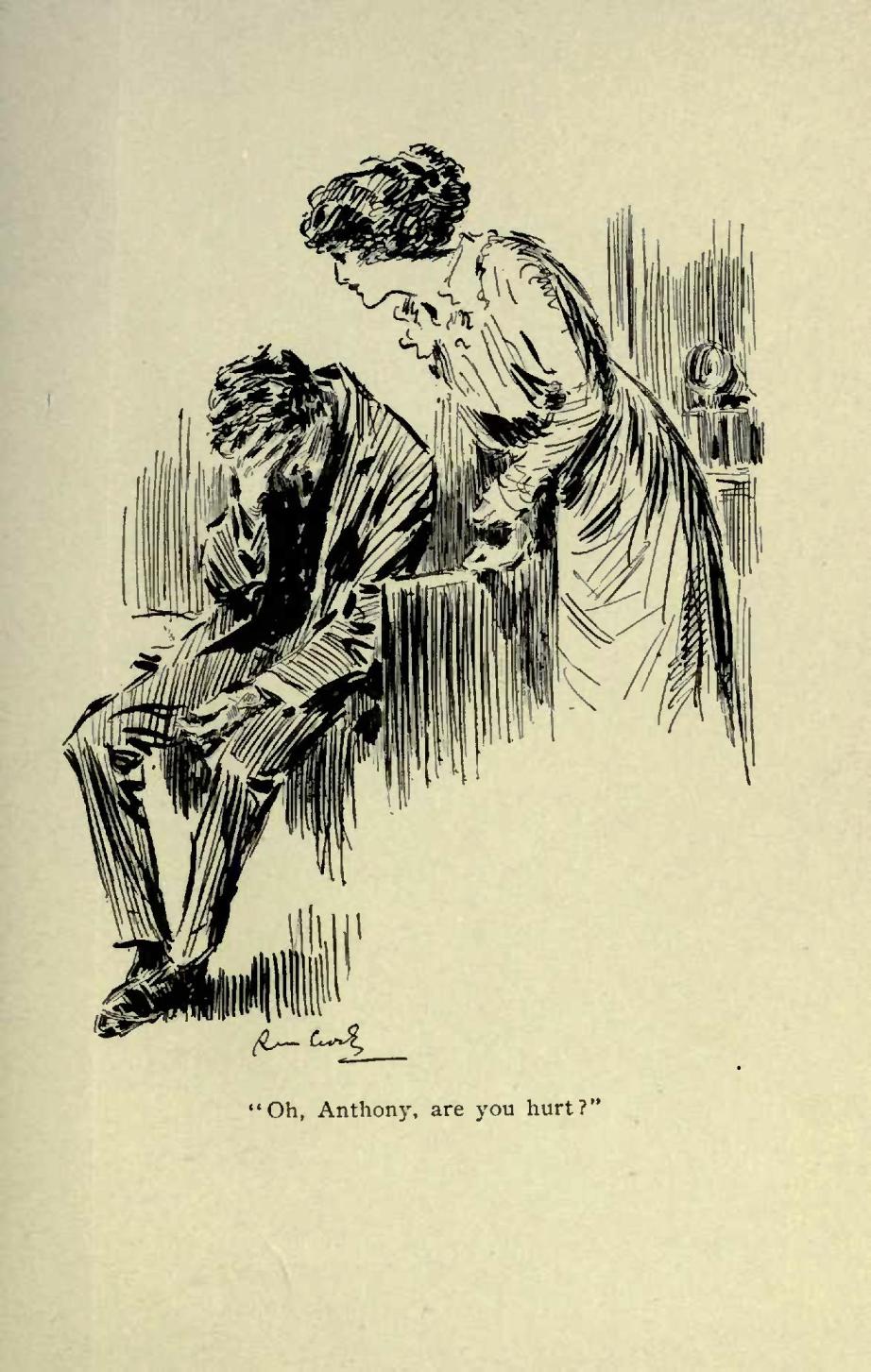
“Oh, Anthony,” she said, low and breathless, “you are hurt!”
I shook my head. But she was staring down at my left hand, that lay on my knee. My gaze followed hers. There was blood on my wrist. It must have run down my arm.
She helped me take off my coat, and with a small pair of scissors that she got from her room cut off my shirt sleeve at the shoulder. It was wet and stained with red.
There was a gash in my upper arm.
She held up the arm and looked closely at it. I liked the direct, practical way she went about it.
“It is n't an artery,” she mused, studying the wound. “Not a big one, anyway.” And she washed it, and drew it together with plaster from my emergency kit, and bandaged it very neatly. Then she helped me to lie down—brought pillows from her own room to place behind my head.
She did not ask one question; just worked to make me comfortable. Finally she sat on the edge of the bed, and critically looked me over.
“You'll be all right,” she said thoughtfully. “I know one thing that is the matter. We both forgot all about luncheon.”
I had not thought of it.
“Well,” she went on, “I feel a little faint myself. I couldn't think what on earth was the matter until it came over me all at once that I've eaten nothing to-day but one very small breakfast.”
I let her ring for the waiter and order food. During this space of time I lay still, trying to think how I should tell her. Every moment it grew harder. But at last I caught her hand, when she was passing the bed, and drew her down beside me. She knew well enough what was on my mind, but she only stroked my forehead with her soft, cool fingers.
In this time, so pregnant for her, and so painful, she was thinking how she might spare me!
I told her exactly what had taken place; clumsily enough but, at least, clearly.
She had been there in her room all the time, and had not heard a single unusual sound.
She did not say much, beyond a thoughtful question or two. The tray came, and she arranged the little meal as attractively as she could, there on the edge of the bed. But we both grew more and more sober as the moments went by. The thought of poor Crocker in acute physical pain, that once splendid body of his crippled and useless, disturbed us both. I was glad to see that there were tears in Heloise's eyes.
After the belated luncheon I felt distinctly better. At four o'clock I got up. Heloise, who was doing her best to keep busy about her own room, came to the door and suggested a walk.
“It won't hurt either of us,” she added, with a wan smile.
So we went out and strolled over to that great thoroughfare, the Hata High Street, where the yellow people swarm, and the uniformed police direct the traffic with an almost Occidental sense of order, and the long brown camel trains from Mongolia and Kansu pad softly over the very modern pavement and under the electric street lights.
We stayed out until nearly six. But our spirits did not rise as we had hoped. For whatever way our thoughts turned, they found no light. We did not have to talk about this; now and then our eyes met, and that was enough. Heloise was strangely, almost completely passive. Even in such trivial matters as picking our way through the traffic—where, I know, it would be natural for her to look out for herself in that brisk, self-reliant way that young American women have—she would turn to me for guidance, and press against my arm. She watched me a good deal, too, to make sure that I was not becoming tired.
At last we came back to the hotel. As we ascended the stairs I slipped my arm through hers. She looked up at my touch, and tried to smile; and her eyes seemed to cling to mine for a moment. In the dim light I could feel them as well as I could see them.
I opened my door, and stepped aside to let her pass in. Then we both stopped and looked down at a white envelope that lay on the sill. I picked it up, then entered and closed the door while she switched on the light.
I turned the envelope over and over in my hand. She watched me for a fleeting second, almost timidly, then went into her own room to take off her hat.
The envelope bore the imprint of the hotel. I opened it, and read the following:
“It is with regret that the management begs to inform you of a previous engagement of rooms 16 and 18 for the 15th instant, necessitating that the rooms be vacated by that date.”
Heloise came to the door, and stood there observing me. She was tucking back a rebellious strand of hair; and she looked very slim and girlish, standing that way with both arms raised.
I went over to the casement window, and threw it open. Then I sat down by it, on one of the chairs of bent iron.
She came toward me, disturbed but hesitant.
I handed her the paper. She read it, standing very st ill. Then she looked up. Her face twisted a little.
“Why, Anthony,” she said, with a catch in her voice, “we 're put out of the hotel!”
The sentence ended in an odd, explosive little laugh. Then, abruptly, she slipped to the floor beside me, threw her arms across my knees, hid her face on them, and sobbed.
There was nothing I could say, of course. The matter was absurdly unimportant compared with the grimmer uncertainties before us. Yet it had hit me with almost the same force.
I laid my hand on her shoulder. I stroked her head. After a little she groped for my hand with one of hers and, when she found it, clung tightly to it.
And all the time I was thinking how like a child she seemed. I believe that is the supreme quality of the artist—childlikeness. It is a quality that carries the adult worker through hells of suffering and heavens of unearthly joy; and it is a quality for which small allowance is made in this particular world.
It will soon be dawn. I have written almost all night. Probably now I had better try to get some sleep.
She came to the door—hours ago. There was on her face that new passive quality; I can not define it exactly, even in my own thinking.
“Anthony,” she said, with choirs of suppressed music in her low voice, “would it be better, tomorrow you know, for us to...” She had to begin again. “Do you wish me to go away from you? You must tell me—not what you want, but what you believe is best.”
I could only look at her for a moment. I could n't think at all.
“Heloise dear,” I said finally, “I don't know what is best. But I know I can't let you go. Not yet. Not with everything uncertain, like this. We'll look up another hotel in the morning.”
She pursed her lips. Then, with a look of sober relief that she could not altogether control she slipped back into her own room. And I closed the shrunken door behind her, and hung my raincoat over the narrow opening that was left.