Book 9 — CHAPTER 8
Reading edition
We have thus developed the origin and progress of the Kachhwaha tribe, as well as its scions of Shaikhavati and Macheri. To some, at least, it may be deemed no uninteresting object to trace in continuity the issue of a fugitive individual, spreading, in the course of eight hundred years, over a region of fifteen thousand square miles; and to know that forty thousand of his flesh and blood have been marshalled in the same field, defending, sword in hand, their country and their prince. The name of ‘country’ carries with it a magical power in the mind of the Rajput. The name of his wife or his mistress must never be mentioned at all, nor that of his country but with respect, or his sword is instantly unsheathed. Of these facts, numerous instances abound in these Annals; yet does the ignorant Pardesi (foreigner) venture to say there are no indigenous terms either for patriotism or gratitude in this country.
Boundaries and Extent.
—The boundaries of Amber and its dependencies are best seen by an inspection of the map. Its greatest breadth lies between Sambhar, touching the Marwar frontier on the west, and the town of Suraut, on the Jat frontier, east. This line is one hundred and twenty British miles, whilst its greatest breadth from north to south, including Shaikhavati, is one hundred and eighty. Its form is [430] very irregular. We may, however, estimate the surface of the parent State, Dhundhar or Jaipur, at nine thousand five hundred square miles, and Shaikhavati at five thousand four hundred; in all, fourteen thousand nine hundred square miles.
Population.
—It is difficult to determine with exactitude the amount of the population of this region; but from the best information, one hundred and fifty souls to the square mile would not be too great a proportion in Amber, and eighty in Shaikhavati; giving an average of one hundred and twenty-four to the united area, which consequently contains 185,670; and when we consider the very great number of large towns in this region, it may not be above, but rather below, the truth. Dhundhar, the parent country, is calculated to contain four thousand townships,
1429
exclusive of
purwas
, or hamlets, and Shaikhavati about half that number, of which Lachhman Singh of Sikar and Khandela, and Abhai Singh of Khetri, have each about five hundred, or the half of the lands of the federation.
Classification of Inhabitants.
—Of this population, it is still more difficult to classify its varied parts, although it may be asserted with confidence that the Rajputs bear but a small ratio to the rest,
whilst they may equal in number any individual class, except the aboriginal Minas, who, strange to say, are still the most numerous. The following are the principal tribes, and the order in which they follow may be considered as indicative of their relative numbers. 1. Minas; 2. Rajputs; 3. Brahmans; 4. Banias; 5. Jats; 6. Dhakar, or Kirar (qu. Kirata?); 7. Gujars.
The Mīna Tribe.
—The Minas are subdivided into no less than thirty-two distinct clans or classes, but it would extend too much the Annals of this State to distinguish them. Moreover, as they belong to every State in Rajwara, we shall find a fitter occasion to give a general account of them. The immunities and privileges preserved to the Minas best attest the truth of the original induction of the exiled prince of Narwar to the sovereignty of Amber; and it is a curious fact, showing that such establishment must have been owing to adoption, not conquest, that this event was commemorated on every installation by a Mina of Kalikoh marking with his blood the
tika
of sovereignty on the forehead of the prince. The blood was obtained by incision of the great toe, and though, like many other antiquated usages, this has fallen into desuetude here (as has the same mode of inauguration of the Ranas by the Oghna Bhils), yet both in the one case and in the other, there cannot be more convincing evidence that these now outcasts were originally the masters. The Minas still enjoy the
1430
most confidential posts about the persons of the princes of Amber, having charge of the archives [431] and treasure in Jaigarh; they guard his person at night, and have that most delicate of all trusts, the charge of the
rawala
, or seraglio. In the earlier stages of Kachhwaha power, these their primitive subjects had the whole insignia of state, as well as the person of the prince, committed to their trust; but presuming upon this privilege too far, when they insisted that, in leaving their bounds, he should leave these emblems, the nakkaras and standards, with them, their pretensions were cancelled in their blood. The Minas, Jats, and Kirars are the principal cultivators, many of them holding large estates.
Jāts.
—The Jats nearly equal the Minas in numbers, as well as in extent of possessions, and are, as usual, the most industrious of all husbandmen.
Brāhmans.
—Of Brahmans, following secular as well as sacred employments, there are more in Amber than in any other State in Rajwara; from which we are not to conclude that her princes were more religious than their neighbours, but, on the contrary, that they were greater sinners.
Rājputs.
—It is calculated that, even now, on an emergency, if a national war roused the patriotism of the Kachhwaha feudality, they could bring into the field thirty thousand of their kin and clan, or, to repeat their own emphatic phrase, “the sons of one father,” which includes the Narukas and the chiefs of the Shaikhawat federation.
Although the Kachhwahas, under their popular princes, as Pajun, Raja Man, and the Mirza Raja, have performed exploits as brilliant as any other tribes, yet they do not now enjoy the same reputation for courage as either the Rathors or Haras. This may be in part accounted for by the demoralization consequent upon their proximity to the Mogul court, and their participation in all enervating vices; but still more from the degradations they have suffered from the Mahrattas, and to which their western brethren have been less exposed. Every feeling, patriotic or domestic, became corrupted wherever their pernicious influence prevailed.
Soil, Husbandry, Products.
—Dhundhar contains every variety
1431
of soil, and the
kharif
and
rabi
, or autumnal and spring crops, are of nearly equal importance. Of the former
bajra
predominates over
juar
, and in the latter barley over wheat. The other grains, pulses, and vegetables, reared all over Hindustan, are here produced in abundance, and require not to be specified [432]. The sugar-cane used to be cultivated to a very great extent, but partly from extrinsic causes, and still more from its holding out such an allurement to the renters, the husbandman has been compelled to curtail this lucrative branch of agriculture; for although land fit for
ikh
(cane) is let at four to six rupees per bigha, sixty have been exacted before it was allowed to be reaped. Cotton of excellent quality is produced in considerable quantities in various districts, as are indigo and other dyes common to India. Neither do the implements of husbandry or their application differ from those which have been described in this and various other works sufficiently well known.
Farming System.
—It is the practice in this State to farm its lands to the highest bidder; and the mode of farming is most pernicious to the interests of the State and the cultivating classes, both of whom it must eventually impoverish. The farmers-general are the wealthy bankers and merchants, who make their offers for entire districts; these they underlet in
tappas
, or subdivisions, the holders of which again subdivide them into single villages, or even shares of a village. With the profits of all these persons, the expenses attending collections, quartering of
barkandazes
, or armed police, are the poor Bhumias and Ryots saddled. Could they only know the point where exaction must stop, they would still have a stimulus to activity; but when the crops are nearly got in, and all just demands satisfied, they suddenly hear that a new renter has been installed in the district, having ousted the holder by some ten or twenty thousand rupees, and at the precise moment when the last toils of the husbandman were near completion. The renter has no remedy; he may go and “throw his turban at the door of the palace, and exclaim
dohai, Raja Sahib!
” till he is weary, or marched off to the Kotwal’s
chabutra
, and perhaps fined for making a disturbance.
Knowing, however,
1432
that there is little benefit to be derived from such a course, they generally submit, go through the whole accounts, make over the amount of collections, and with the host of vultures in their train, who, never unprepared for such changes, have been making the most of their ephemeral power by battening on the hard earnings of the peasantry, retire for this fresh band of harpies to pursue a like course. Nay, it is far from uncommon for three different renters to come upon the same district in one season, or even the crop of one season, for five or ten thousand rupees, annulling the existing engagement, no matter how far advanced. Such was the condition of this State; and when to these evils were superadded the exactions called
dand
, or
barar
, forced contributions to pay those armies of robbers who swept the lands, language cannot exaggerate the extent of misery. The love of country must be powerful indeed which can enchain man to a land so misgoverned, so unprotected [433].
Revenues.
—It is always a task of difficulty to obtain any correct account of the revenues of these States, which are ever fluctuating. We have now before us several schedules, both of past and present reigns, all said to be copied from the archives, in which the name of every district, together with its rent, town and transit duties, and other sources of income, are stated; but the details would afford little satisfaction, and doubtless the resident authorities have access to the fountain-head. The revenues of Dhundhar, of every description, fiscal, feudal, and tributary, or impost, are stated, in round numbers, at one crore of rupees, or about a million of pounds sterling, which, estimating the difference of the price of labour, may be deemed equivalent to four times that sum in England.
Since this estimate was made, there have been great alienations of territory, and no less than sixteen rich districts have been wrested from Amber by the Mahrattas, or her own rebel son, the Naruka chief of Macheri.
The following is the schedule of alienations:—
1. Kama[10] Taken by General Perron, for his master Sindhia; since rented to the Jats, and retained by them.

2. Khori
3. Pahari1433
4. Kanti Seized by the Macheri Rao [now in Alwar State]

5. Ukrod
6. Pandapan
7. Ghazi-ka-thana
8. Rampara (karda)
9. Ganwnri
10. Reni
11. Parbeni
12. Mozpur Harsana
13. Kanod or Kanaund[11] 14. Narnol Taken by De Boigne and given to Murtaza Khan, Baraich, confirmed in them by Lord Lake.

15. Kotputli Taken in the war of 1803-4, from the Mahrattas, and given by Lord Lake to Abhai Singh of Taken in the war of 1803-4, from the Mahrattas, Khetri.

16. Tonk 17. Rampura Granted to Holkar by Raja Madho Singh; confirmed in sovereignty to Amir Khan by Lord Hastings.

It must, however, be borne in mind, that almost all these alienated districts had but for a comparatively short period formed an integral portion of Dhundhar; and that the major part were portions of the imperial domains, held in jaedad, or ‘assignment,’ by the princes of this country, in their capacity of lieutenants of the emperor. In Raja Prithi Singh’s reign, about half a century ago, the rent-roll of Amber and her tributaries was [434] seventy-seven lakhs: and in a very minute schedule formed in S. 1858 (A.D. 1802), the last year of the reign of Raja Partap Singh, they were estimated at seventy-nine lakhs: an ample revenue, if well administered, for every object. We shall present the chief items which form the budget of ways and means of Amber.
Schedule of the Revenues of Amber for S. 1858, (A.D. 1802-3),
the year of Raja Jagat Singh’s accession.
Khalisa, or Fiscal Land.
1434
Rupees.
Managed by the Raja, or rented 2,055,000
Deori taluka, expenses of the queen’s household 500,000
Shagirdpesha, servants of the household300,000
Ministers, and civil officers200,000
Jagirs for the Silahposh, or men-at-arms150,000
Jagirs to army, namely, ten battalions of infantry with cavalry 714,000
Total Fiscal Land 3,919,000
Feudal lands (of Jaipur Proper) 1,700,000
Udak,[12] or charity lands, chiefly to Brahmans 1,600,000
Dan and Mapa, or transit and impost duties of the country 190,000
Kachahri, of the capital, includes town-duties,fines, contributions, etc., etc. 215,000
Mint 60,000
Hundi-bara, insurance, and dues on bills of exchange 60,000
Faujdari, or commandant of Amber (annual fine) 12,000
Do. do. of city Jaipur 8,000
Bid’at, petty fines from the Kachahri, or hall of justice 16,000
Sabzimandi, vegetable market 3,000
Total Lakhs 7,783,000
Tribute Shaikhavati350,000
Rajawat and other feudatories of Jaipur[13] 30,000
Kothris of Haraoti[14] 20,000
Total Tribute 400,000
Add Tribute 400,000
Grand Total Rs. 8,183,000
[435].
1435If this statement is correct, and we add thereto the Shaikhawat, Rajawat, and Hara tributes, the revenues fiscal, feudal, commercial, and tributary, of Amber, when Jagat Singh came to the throne, would exceed eighty lakhs of rupees, half of which is khalisa, or appertaining to the Raja—nearly twice the personal revenue of any other prince in Rajwara. This sum (forty lakhs) was the estimated amount liable to tribute when the treaty was formed with the British Government, and of which the Raja has to pay eight lakhs annually, and five-sixteenths of all revenue surplus to this amount. The observant reader will not fail to be struck with the vast inequality between the estates of the defenders of the country, and these drones the Brahmans,—a point on which we have elsewhere treated:[15] nor can anything more powerfully mark the utter prostration of intellect of the Kachhwaha princes, than their thus maintaining an indolent and baneful hierarchy, to fatten on the revenues which would support four thousand Kachhwaha cavaliers. With a proper application of her revenues, and princes like Raja Man to lead a brave vassalage, they would have foiled all the efforts of the Mahrattas; but their own follies and vices have been their ruin.
Foreign Army.
—At the period (
A.D.
1803) this schedule was formed of the revenues of Amber, she maintained a foreign army of thirteen thousand men, consisting of ten battalions of infantry with guns, a legion of four thousand Nagas, a corps of Aligols
for police duties, and one of cavalry, seven hundred strong. With these, the regular contingent of feudal levies, amounting to about four thousand efficient horse, formed a force adequate to repel any insult; but when the
kher
, or
levée en masse
, was called out, twenty thousand men, horse and foot, were ready to back the always embodied force.
A detailed schedule of the feudal levies of Amber may diversify the dry details of these annals, obviate repetition, and present a perfect picture of a society of clanships. In this list we shall give precedence to the kothriband, the holders of the twelve great fiefs (barah-kothri) of Amber—
1436Schedule of the names and appanages of the twelve sons of Raja Prithiraj, whose descendants form the Barah-kothri, or twelve great fiefs of Amber[18] [436].
Sons of Prithiraj. Names of Families. Names of Fiefs. Present Chiefs. Revenues. Personal Quotas.
1. Chhattarbhuj Chhattarbhujot Pinar and
Bhagru Bagh Singh 18,000 28
2. Kalyan Kalyanot Lotwara Ganga Singh 25,000 47
3. Nathu Nathawat Chaumun Kishan Singh 115,000 205
4. Balbhadar Balbhadarot Achrol Kaim Singh 28,850 57
5. Jagmall his son Khangar } Khangarot Thodri Prithi Singh 25,000 40
6. Sultan Sultanot Chandsar — — —
7. Pachain Pachainot Sambra Sali Singh 17,700 32
8. — Gugawat Dhuni Rao Chand Singh 70,000 88
9. Kaim Kumbhani Banskoh Padam Singh 21,535 31
10. Kumbha Kumbhawat Mahar Rawat Sarup Singh 27,538 45
11. Surat Sheobaranpota Nindar Rawat Hari Singh 10,000 19
12. Banbir Banbirpota Balkoh Sarup Singh 19,000 35
1437It will be remarked that the estates of these, the chief vassals of Amber, are, with the exception of two, far inferior in value to those of the sixteen great chiefs of Mewar, or the eight of Marwar; and a detailed list of all the inferior feudatories of each Kothri, or clan, would show that many of them have estates greater than those of their leaders: for instance, Kishan Singh of Chaumun has upwards of a lakh, while Beri Sal of Samod, the head of the clan (Nathawat), has only forty thousand; again, the chief of Balaheri holds an estate of thirty-five thousand, while that of the head of his clan is but twenty-five thousand. The representative of the Sheobaranpotas has an estate of only ten thousand, while the junior branch of Gura has thirty-six thousand. Again, the chief of the Khangarots has but twenty-five thousand, while no less than three junior branches hold lands to double that amount; and the inferior of the Balbhadarots holds upwards of a lakh, while the superior of Achrol has not a third of this rental. The favour of the prince, the turbulence or talents of individuals, have caused these inequalities; but, however disproportioned the gifts of fortune, the attribute of honour always remains with the lineal descendant and representative of the original fief.
We shall further illustrate this subject of the feudalities of Amber by inserting a general list of all the clans, with the number of subdivisions, the resources of each, and the quotas they ought to furnish. At no remote period this was held to be correct, and will serve to give a good idea of the Kachhwaha aristocracy. It was my [437] intention to have given a detailed account of the subdivisions of each fief, their names, and those of their holders, but on reflection, though they cost some diligence to obtain, they would have little interest for the general reader.
1438Schedule of the Kachhwaha clans; the number of fiefs or estates in each; their aggregate value, and quotas of horse for each estate.[19]
Names of Clans. Number of Fiefs in each Clanship or Clan. Aggregate Revenue. Aggregate Quotas.
12[20] Chhattarbhujot 653,80092

Kalyanot 19245,196422
Nathawat 10220,800371
Balbhadarot 2130,850157
Khangarot 22402,806643
Sultanot ———
Pachainot 324,70045
Gugawat 13167,900278
Kumbhani [or Kumani] 223,78735
Kumbhawat 640,73868
Sheobaranpota 349,50073
Banbirpota 326,575648
4[21] Rajawat 16198,137392

Naruka[21] 691,06992
Bankawat 434,60053
Puranmallot 134,60019
10[22] Bhatti 4104,039205

Chauhan 430,50061
Bargujar 632,00058
Chandarawat 114,00021
Sakarwar 24,5008
Gujars 315,30030
Rangras 6291,105549
Khatris 4120,000281
Brahmans 12312,000606
Musalman 9141,400274
Ancient Towns.
—We shall conclude the annals of Amber with the names of a few of the ancient towns, in which research may recover something of past days.
1439Mora.—Nine coss east of Dausa or Daosa; built by Mordhwaj, a Chauhan Raja.
Abhaner.—Three coss east of Lalsont; very ancient; capital of a Chauhan sovereignty.
Bangarh.—Five coss from Tholai; the ruins of an ancient town and castle in the hills, built by the old princes of Dhundhar, prior to the Kachhwahas.
Amargarh.—Three coss from Kushalgarh; built by the Nagvansa.
Bairat.[23]—Three coss from Basai in Macheri, attributed to the Pandus.
Patan and Ganipur.—Both erected by the ancient Tuar kings of Delhi.
Kharar, or Khandar.—Near Ranthambhor.
Utgir.—On the Chambal.
Amber, or Ambikeswara, a title of Siva, whose symbol is in the centre of a kund or tank in the middle of the old town. The water covers half the lingam; and a prophecy prevails, that when it is entirely submerged the State of Amber will perish! There are inscriptions [439].
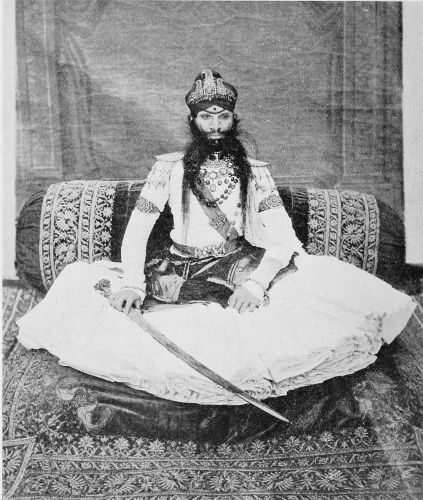
RAGHUBĪR SINGH, MĀHĀRAO RĀJA OF BŪNDI. To face page 1441.
1441