Chapter VII · THE SENSES OF ANIMALS. (continued 2)
Reading edition
The interesting observations of Sir John Lubbock seem to show that insects can distinguish between different colours. "Amongst other experiments," he says,[FK] "I brought a bee to some honey which I placed on a slip of glass laid on blue paper, and about three feet off I placed a similar drop of honey on orange paper. With a drop of honey before her a bee takes two or three minutes to fill herself, then flies away, stores up the honey, and returns for more. My hives were about two hundred yards from the window, and the bees were absent about three minutes or even less. After the bee had returned twice, I transposed the papers; but she returned to the honey on the blue paper. I allowed her to continue this for some time, and then again transposed the papers. She returned to the old spot, and was just going to alight, when she observed the change of colour, pulled herself up, and without a moment's hesitation darted off to the blue. No one who saw her at that moment could have the slightest doubt about her perceiving the difference between the two colours."
Passing now to the crustacea, we find in them eyes of the same type as in insects; but in the higher crustacea ocelli are absent. In the crabs and lobsters the eyes are seated on little movable pedestals; in the former the crystalline cones are very long, in the latter they are short. There can be little doubt that vision is by no means wanting in acuteness in an animal which, like the lobster, can dart into a small hole in the rocks with unerring aim from a considerable distance. The experiments of Sir John Lubbock have shown that the little water-flea (Daphnia) can distinguish differences of colour, yellows and greens being preferred to blues or reds.
Among the molluscs there are great differences in the power of sight. Most bivalves, like the mussel, are blind. Interesting stages in the development of the eye may be seen in such forms as the limpet, Trochus and Murex. The limpet has simply an optic pit, the Trochus a pit nearly closed at the orifice and filled with a vitreous mass, and the Murex a spherical organ completely closed in with a definite lens. The snail has a well-developed eye on the hinder and longer horn or tentacle. But it does not seem to be aware of the presence of an object until it is brought within a quarter of an inch or less of the tentacle. In all probability the eye does little more than enable the snail to distinguish between light and dark. And the same may be said of the eye of many of the molluscs. In some, however, the cuttle-fishes and their allies, the eye is so highly developed that it has been compared with that of the vertebrate. There is an iris with a contractile pupil. And the ganglion with which it is connected forms a large part of the so-called brain. The powers of accurate vision in these higher forms are probably considerable.
It is interesting to note that whereas in the cuttle-fishes and most molluscs, the rods of the retina are turned towards the light, in Pecten, Onchidium (a kind of slug), and some others, they are, as in vertebrates, turned from the light. In Pecten the nerve to supply the retina bends round its edge at one side. But in Onchidium it pierces the retina as in vertebrates.
In worms, eyes are sometimes present, sometimes absent. In star-fishes and their allies they often occur. In medusæ (jelly-fish) they are sometimes found on the margin of the umbrella. Even in lowly organisms, like the infusoria, eye-spots not unfrequently occur. We must remember, however, that, in these lower forms of life, the organs spoken of as eyes or eye-spots merely enable the possessor to distinguish light from darkness.
Even when eyes or eye-spots are not developed, the organism seems to be in some cases sensitive to light—using the word "sensitive," once more, in its merely physical acceptation. The earthworm, for example, though it has no eyes, is distinctly sensitive to light; and the same has been shown to be the case with other eyeless organisms. Graber holds that his experiments demonstrate that the eyeless earthworm can distinguish between different colours—in other words, is differentially sensitive to light-waves of different vibration-period—preferring red to blue or green, and green to blue. And the same observer has shown that animals provided with eyes—the newt, for example—can distinguish between light and darkness by the general surface of the skin. M. Dubois, by a number of experiments on the blind Proteus of the grottoes of Carniola, has shown that the sensitiveness of its skin to light is about half that of its rudimentary eyes; and, further, that this sensibility varies with the colour of the light employed, being greatest for yellow light.[FL]
We have not been able to do more than make a rapid survey of the sense of sight as it seems to be developed in the invertebrates and lower animals. The visual organs differ, not only in structure, but in principle. We may, I think, distinguish four types.
1. Organs for the mere appreciation of light or darkness (shadow), exemplified by pigment-spots, with or without concentrating apparatus.
2. Organs for the appreciation of the direction of light or shadow, with or without a lens. The simple retinal eyes of gasteropods, and perhaps in some cases the ocelli of insects, probably belong to this class.
3. True eyes, or organs in which a retinal image is formed, through the instrumentality of a lens, as in vertebrates and cephalopods.
4. The facetted eyes of insects, in which a stippled image is formed, on the principle of mosaic vision.
Unfortunately, all these are called indiscriminately eyes, or organs of vision. An infusorian or a snail is said to see. But the terms "eye," "vision," "sight," imply that final excellence to which only the higher animals, each on its own line, have attained.
This final excellence probably has its basis and earliest inception in the fact that the functional activity of protoplasm is heightened in the presence of ætherial vibrations. If, then, we imagine, as a starting-point, a primitive transparent organism with a general susceptibility to the influence of light-vibrations, the formation within its tissues of pigment-granules absorbent of light will render the spots where they occur specially sensitive to the ætherial vibrations. Special refraction-globules would also act as minute lenses, focussing the light, and thus concentrating it upon certain spots.
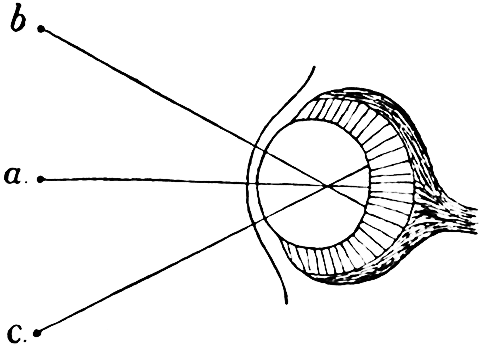
Fig. 39.—Direction-retina.
Simple retina for distinguishing the direction of the source of light or of shadow.
In many of the lower animals we find such organs, belonging to our first category, and constituting either eye-spots of pigmented material or simple lenses covering a pigmented area. If we call these eyes, we must remember that in all probability they have no power of what we call vision—only a power of distinguishing light from dark. Where, however, there exists beneath the lens a so-called retina, that is, a layer of rod-like endings of a nerve, it might, at first sight, be thought that there, at any rate, we have true vision. But in all probability, in a great number of cases the retinal rods are simply for the purpose of rendering the organism sensitive, not only to the presence of light, but to its direction. Light straight ahead (a) stimulates the middle rods; from one side (b, c) it is focussed on the rods of the opposite side of the retina; and similarly for intermediate positions. The presence of a retinal layer is thus no infallible sign of a power of vision as apart from mere sensibility to light. Indeed, in a great number of cases, from the convexity and position of the lens, the formation of an image is impossible. Only when it can be shown that a more or less definite image can be focussed on the retina, or can be formed on the principle of mosaic vision, can we justly surmise that a power of true vision is present. I doubt whether this can be shown to be unquestionably the case in any forms but the higher arthropods, the cuttle-fishes and their allies, and the vertebrates.
There is one more point for consideration before we leave the sense of sight—Are the limits of vision the same in the lower forms of life as they are in man? or, to put the question in a more satisfactory form—Are the limits of sensibility to light-vibrations the same in them as in us? M. Paul Bert concluded that they are. But Sir John Lubbock has, I think, conclusively shown that they are not. For the full evidence the reader is referred to his "Senses of Animals."[FM] His experiments on ants, with which those of M. Forel are in complete accordance, satisfied him that these little animals are sensitive to the ultra-violet rays which lie beyond the range of our vision. Other experiments with fresh-water fleas (Daphnia) showed that they have colour-preferences, green and yellow being the favourite colours.
The daphnias were placed in a shallow wooden trough, divided by movable partitions of glass into divisions. Over this was thrown a spectrum of rainbow colours. The partitions were removed, and the daphnias allowed to collect in the differently illuminated parts of the trough. The partitions were then inserted, and the number of crustaceans in each division counted. The following numbers resulted from five such experiments:—
Dark. Violet. Blue. Green. Yellow. Red.
0 3 18 170 36 23
Special experiments seem to show that their limits of vision at the red end of the spectrum coincide approximately with ours; but at the violet end their spectrum is longer than ours. Sir John covered up the visible spectrum, so as to render it dark, and gave the daphnias the option of collecting in this dark space or in the ultra-violet. To human eyes both were alike dark. But not so to the daphnian eye; for while only 14 collected in the covered part, 286 were found in the ultra-violet. The width of the violet visible to man was two inches. Sir John divided the ultra-violet into three spaces of two inches each. Of the 286 daphnias, 261 were in the space nearest the violet, 25 in the next space, and none in the furthest of the three spaces. From which it would seem that, though these little creatures are sensitive to light of higher vibration-period than that which affects the human eye, their limits do not very far exceed ours. We have seen that human beings differ not a little in their limits of violet-susceptibility. We may presume that Sir John Lubbock and those who assisted him in these experiments were normal in this respect. But it is possible that some individuals could have perceived a faint purple where there was darkness to them, and that the majority of the 261 daphnias were collected in the region just beyond the partition between ultra-violet and darkened violet. Still, there is no cause for doubting the general conclusion that daphnias are sensible to ultra-violet rays beyond the limits of human vision.
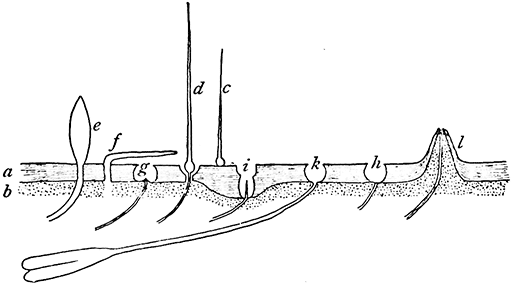
Fig. 40.—Antennary structures of hymenoptera. (After Lubbock.)
a., cuticle; b., hypodermis; c., ordinary hair; d., tactile hair; e., cone; f., depressed hair lying over g. cup with rudimentary hair at the base; h., simple cup; i., champagne-cork-like organ of Forel; k., flask-like organ; l., papilla, with a rudimentary hair at the apex.
Sir John Lubbock has an interesting chapter on problematical organs of sense. In the antennæ of ants and bees there are modified hairs and pits in the integument (at least eight different types, according to Sir John Lubbock), the sensory nature of which is undoubted. But what the sensory nature in each case may be is more or less problematical. Many worms have sense-hairs or bristles of the use of which we are ignorant. Some organs described as tactile or olfactory in the lower invertebrates are so described on a somewhat slender basis of evidence. The sense-value of the bright marginal beads of sea-anemones is unknown. Even in animals as high in the scale of life as fishes, there is a complete set of sense-organs—the muciparous canals, in the head and along the lateral line down the side, the function of which we can only guess. By some they are regarded as olfactory; by others, as fitted to respond to vibrations or shocks of greater wave-length than the auditory organ can appreciate; by others, as of importance for the equilibration or balancing of the fish.
It will thus be seen that, apart from the possibility of unknown receptive organs as completely hidden from anatomical and microscopic scrutiny as the end-organs of our temperature-sense, there are in the lower animals organs which may be fitted to receive modes of influence to which we human folk are not attuned.
And what are the physical possibilities? We have seen that, through the telæsthetic senses—hearing, vision, and the temperature-sense—we are made aware of the vibrations of distant bodies, the effects of which are borne to us on waves of air or of æther. The limits of hearing with us are between thirty and about forty thousand (or perhaps, in very rare cases, fifty thousand) vibrations per second. But these are by no means the limits of vibrations of the same class. By experiments with sensitive flames,[FN] Lord Rayleigh has detected vibrations of fifty-six thousand per second; and Mr. W. F. Barrett has shown that a sensitive flame two feet long is sensitive to vibrations beyond the limit of his own hearing and that of several of his friends who were present at the experiment. We have some reason to suppose that vibrations too rapid to be audible by man are audible by insects, but not much is known with regard to the exact limits.
The following table shows what is known concerning the æther-vibrations. The figures are those given by Professor Langley:—
Quality of radiations. Wave-lengths in thousandths of a millimetre. Number of vibrations per second in billions. Effects on man.
Limit of photography, artificial source0.185160none known
Limit of photography,solar source0.295 none known
Limit of violet to normal eyes0.36833}vision.
Limit of red to normal eyes0.81370
Probable inferior limit of temperature-sensations 9.25[FO]30temperature-sense
Longest waves hitherto recognised with bolometer30.01none known
From this table it will be seen that, apart from the possible extension of sight beyond human limits, there are possibilities of another sense for the ultra-violet actinic vibrations as different from sight as is the infra-red temperature-sense. Moreover, the temperature-sense for us has no scale; there is nothing corresponding to pitch in sound or colour in sight. It may not be so with lower organisms. Insects, for example, may be sensitive to tones of heat. The bee may enjoy a symphony of solar radiance. I am not saying that it is so; I am merely suggesting possibilities which we have not sufficient knowledge to authoritatively deny. We have no right to impose the limits of human sensation on the entire organic world. Insects may have "permanent possibilities of sensation" denied to us.
Even within our limits there may be, as we have already seen, great and inconceivable differences. We saw that our own colour-sensations are probably due to the blending and overlapping in different proportions of three primitive monochromatic bands, but that in all probability in birds the bands are different, and overlapping is largely prevented. Their colour-phenomena must be inconceivably different from ours. And what shall we say of the colour-vision of invertebrates? Are we justified in supposing that for them, as for us, R., G., and V. are the unstable explosives, and that they are present in the same proportions as with us? If not, their colour-world cannot be the same as ours. Of the same order it probably is. And all that we can hope to do is to show, as has been shown, that colours which differently affect us affect them also differently.
In conclusion, we may return to the point from which we set out. The organism is fitted to respond to certain influences of the external world. The organs for the reception of these influences are the sense-organs. When they are stimulated waves of change are transmitted inwards to the great nerve-centres; they are there co-ordinated, and issue thence to muscles or glands. Thus the organism is fitted to respond to the influences from without. The activities of organisms are in response to stimulation.
We have seen that the cells of the organic tissues are like little packets of explosives, and that the changes which occur in the organism may be likened to their explosion and the setting free of the energy stored up in them. The end-organs of the special senses may be regarded as charged with explosives of extreme sensitiveness. Some are fired by a touch; the molecular vibrations of sapid or odorous particles explode others; yet others are fired by the coarser vibrations of sound; others, once more, by the energy of the ætherial waves. The visual purple is a highly unstable chemical compound of this kind; expose it for a moment to light, and it topples over to a new molecular arrangement, the colour being at the same time discharged. If the retina has been removed from the body, this is all that happens. But if (in the frog) it be replaced on the choroid layer from which it has been stripped, the visual purple is reformed. The explosive is thus reconstructed and the sensibility is restored. Thus, as fast as the explosives are fired off by sense-stimuli, so fast in normal life are they reconstituted and the sensibility restored. Meanwhile the explosion at the end-organs has fired the train of explosives in the nerve, and created molecular explosive disturbances in the brain. Thence the explosive waves pass down other nerves to muscles or glands, and, giving rise therein to further explosions, take effect in the activities of the organism.
We shall have to consider these activities hereafter. We must now turn to the psychical or mental accompaniments of the explosive disturbances in the brain or other aggregated mass of nerve-cells.