Chapter III
Reading edition
ANTS.
Within the last ten or twelve years our information on the habits and intelligence of these insects has been so considerably extended, that in here rendering a condensed epitome of our knowledge in this most interesting branch of comparative psychology, it will be found that the chapter is constituted principally of a statement of observations and experiments which have been conducted during the short period named. The observers to whom we are mainly indebted for this large increase of our knowledge are Messrs. Bates, Belt, Müller, Moggridge, Lincecum, MacCook, and Sir John Lubbock. From the fact that these naturalists conducted their observations in different parts of the world and on widely different species of ants, it is not surprising that their results should present many points of difference; for this only shows, as we might have expected, that different species of ants differ considerably in habits and intelligence. Therefore, in now drawing all these numerous observations to a focus, I shall endeavour to show clearly their points of difference as well as their points of agreement; and in order that the facts to be considered may be arranged in some kind of order, I shall deal with them under the following heads:—Powers of special sense; Sense of direction; Powers of memory; Emotions; Powers of communication; Habits general in sundry species; Habits peculiar to certain species; General intelligence of various species.
Powers of Special Sense.
Taking first the sense of sight, Sir John Lubbock made a number of experiments on the influence of light coloured by passing through various tints of stained glass, with the following results. The ants which he observed greatly dislike the presence of light within their nests, hurrying about in search of the darkest corners when light is admitted. The experiments showed that the dislike is much greater in the case of some colours than in that of others. Thus under a slip of red glass there were congregated on one occasion 890 ants, under green 544, under yellow 495, and under violet only 5. To our eyes the violet is as opaque as the red, more so than the green, and much more so than the yellow. Yet, as the numbers show, the ants had scarcely any tendency to congregate under it: there were nearly as many under the same area of the uncovered portion of the nest as under that shaded by the violet glass. It is curious that the coloured glasses appear to act on the ants in a graduated series, which corresponds with the order of their influence on a photographic plate. Experiments were therefore made to test whether it might not be the actinic rays that were so particularly distasteful to the ants; but with negative results. Placing violet glass above red produces the same effect as red glass alone. Obviously, therefore, the ants avoid the violet glass because they dislike the rays which it transmits, and do not prefer the other colours because they like the rays which they transmit. Sodium, barium, strontium, and lithium flames were also tried, but not with so much effect as the coloured glass.
It has just been observed that the relative dislike which Sir John Lubbock's ants showed to lights of different colours seems to be determined by the position of the colour in the spectrum—there being a regular gradation of intolerance shown from the red to the violet end. As these ants dislike light, the question suggests itself that the reason of their graduated intolerance to light of different colours may be due to their eyes not being so much affected by the rays of low as by those of high refrangibility. In this connection it would be interesting to ascertain whether ants of the genus Atta show a similarly graduated intolerance to the light in different parts of the spectrum; for both Moggridge and MacCook record of this genus that it not only does not shun the light, but seeks it—coming to the glass sides of their artificial nests to enjoy the light of a lamp. Possibly, therefore, the scale of preference to lights of different colours would be found in this genus to be the reverse of that which Sir John Lubbock has found in the case of the British species.
As regards hearing, Sir John Lubbock found that sounds of various kinds do not produce any effect upon the insects. Tuning-forks and violin notes, shouting, whistling, &c., were all equally inefficient in producing the slightest influence upon the animals; and experiments with sensitive flames, microphone, telephone, &c., failed to yield any evidence of ants emitting sounds inaudible to human ears.
Fig. 1.
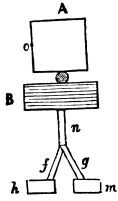
Lastly, as regards the sense of smell, Sir John Lubbock found that on bringing a camel's-hair brush steeped in various strong scents near where ants were passing, "some went on without taking any notice, but others stopped, and evidently perceiving the smell, turned back. Soon, however, they returned, and passed the scented pencil. After doing this two or three times, they generally took no further notice of the scent. This experiment left no doubt on my mind." In other cases the ants were observed to wave about and throw back their antennæ when the scented pencil was brought near.
That ants track one another by scent was long ago mentioned by Huber, and also that they depend on this sense for their power of finding supplies which have been previously found by other ants. Huber proved their power of tracking a path previously pursued by their friends, by drawing his finger across the trail, so obliterating the scent at that point, and observing that when the ants arrived at that point they became confused and ran about in various directions till they again came upon the trail on the other side of the interrupted space, when they proceeded on their way as before. The more numerous and systematic experiments of Sir John Lubbock have fully corroborated Huber's observations, so far as these points are concerned. Thus, to give only one or two of these experiments; in the accompanying woodcut (Fig. 1) A is the nest, B a board, n f g slips of paper, h and m similar slides of glass, on one of which, h, there was placed pupæ, while the other, m, was left empty. Sir John Lubbock watched two particular (marked) ants proceeding from A to h and back again, carrying the pupæ on h to the nest A. Whenever an ant came out of A upon B he transposed the slips f and g. Therefore at the angle below n there was a choice presented to the ant of taking the unscented pathway leading to the full glass h, or the scented pathway leading to the empty glass m. The two marked ants, knowing their way, always took the right turn at the angle; but the stranger ants, being guided only by scent, for the most part took the wrong turn at the angle, so going to the empty glass m. For out of 150 stranger ants only 21 went to h, while the remaining 129 went to m. Still the fact that all the stranger ants did not follow the erroneous scent-trail to m, may be taken to indicate that they are also assisted in finding treasure by the sense of sight, though in a lesser degree. Therefore Sir John Lubbock concludes that in finding treasure 'they are guided in some cases by sight, while in others they track one another by scent.'
Fig. 2.
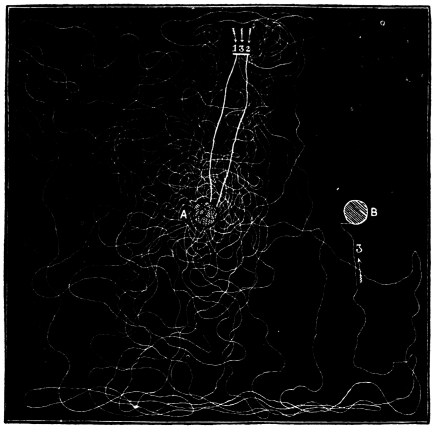
As further evidence showing how much more ants depend upon scent than upon sight in finding their way, the following experiment may be quoted. In the accompanying woodcut (Fig. 2) the line marked 1, 2, 3 represents the edge of a paper bridge leading to the nest; A the top of a pencil which is standing perpendicularly upon a board, represented by the general black surface; B the top of the same pencil when moved a distance of a few inches from its first position A. On the top of this pencil were placed some pupæ. Sir John Lubbock, after contriving this arrangement, marked an ant and put it upon the pupæ on the top of the pencil. After she had made two journeys carrying pupæ from the pencil to the nest (the tracks she pursued being represented by the two thick white lines), while she was in the nest he moved the pencil to its position at B. The thin white line represents the course then pursued by the ant in its endeavours to find the pencil, which was shifted only a few inches from A to B. That is, 'the ants on their journey to the shifted object travelled very often backwards and forwards and round the spot where the coveted object first stood. Then they would retrace their steps towards the nest, wander hither and thither from side to side between the nest and the point A, and only after very repeated efforts around the original site of the larvæ reach, as it were, accidentally the object desired at B.' Therefore the ants were clearly not guided by the sight of the pencil.
Fig. 3.
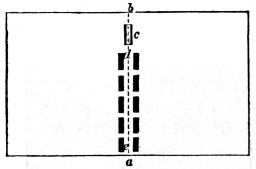
Fig. 4.
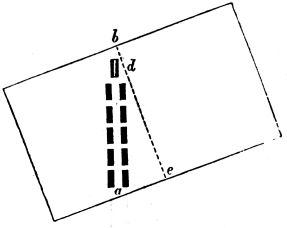
Fig. 5.
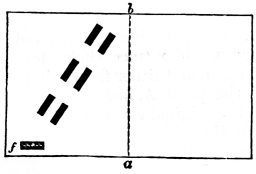
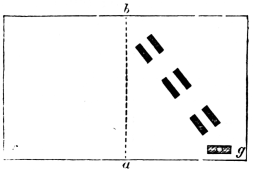
The same thing is well shown by another form of experiment. 'Some food was placed at the point a (Figs. 3 and 4) on a board measuring 20 inches by 12 inches, and so arranged that the ants in going straight from it to the nest would reach the board at the point b, and after passing under the paper tunnel c, would proceed between five pairs of wooden bricks, each 3 inches in length and 1¾ inches in height. When they got to know their way they went quite straight along the line d e to a. The board was then twisted as shown in Fig. 4. 'The bricks and tunnel being arranged exactly in the same direction as before, but the board having been moved, the line d e was now outside them. The change, however, did not at all discompose the ants; but instead of going, as before, through the tunnel and between the rows of bricks to a, they walked exactly along the old path to e.' Keeping the board steady, but moving the brick pathway to the left-hand corner of the board where the food was next placed (Fig. 5), had the effect of making the ant first go to the old position of the food at a, whence it veered to a new position, which we may call x. The bricks and food were then moved towards the right-hand corner of the board—i.e. over a distance of 8 inches (Fig. 6). The ant now first went to a, then to x, and not finding the food at either place, set to work to look for it at random, and was only successful after twenty-five minutes' wandering.
Fig. 6.
And, as evidence how much more dependence they place upon scent in finding their way than upon any other of their faculties, it is desirable to quote yet one further experiment, which is of great interest as showing that when their sense of smell is made to contradict their sense of direction, they follow the former, notwithstanding, as we shall presently see, the wonderful accuracy of the information which is supplied to them by the latter. 'If, when F. niger were carrying off larvæ placed in a cup on a piece of board, I turned the board round so that the side which had been turned towards the nest was away from it, and vice versâ, the ants always returned over the same track on the board, and, in consequence, directly away from home. If I moved my board to the other side of my artificial nest, the result was the same. Evidently they followed the road, not the direction.'
There can be little doubt that ants have a sense of taste, as they are so well able to distinguish sugary substances; and it is unquestionable that in their antennæ they possess highly elaborated organs of touch.
Sense of Direction.
As evidence of the accuracy and importance of the sense of direction in the Hymenoptera, we must here adduce Sir John Lubbock's highly interesting experiments on ants—leaving his experiments in this connection on bees and wasps to be considered in the next chapter. He first accustomed some ants (Lasius niger) to go to and fro to food over a wooden bridge. When they had got quite accustomed to the way, he watched when an ant was upon a bridge which could be rotated, and while she was passing along it, he turned it round, so that end b was at c, and c at b. 'In most cases the ant immediately turned round also; but even if she went on to b or c, as the case might be, as soon as she came to the end of the bridge she turned round.' Next, between the nest and the food he placed a hat-box twelve inches in diameter and seven inches high, cutting two small holes, so that the ants in passing from the nest to the food had to pass in at one hole and out at the other. The box was fixed upon a central pivot, so as to admit of being rotated easily without much friction or disturbance. When the ants had well learnt their way, the box was turned half round as soon as an ant had entered it, 'but in every case the ant turned too, thus retaining her direction.' Lastly, Sir John took a disk of white paper, which he placed in the stead of the hat-box between the nest and the food. When an ant was on the disk making towards the food, he gently drew the disk to the other side of the food, so that the ant was conveyed by the moving surface in the same direction as that in which she was going, but beyond the point to which she intended to go. Under these circumstances 'the ant did not turn round, but went on' to the further edge of the disk, when she seemed 'a good deal surprised at finding where she was.'
These experiments seem to show that the mysterious 'sense of direction,' and consequent faculty of 'homing,' are in ants, at all events, due to a process of registering, and, where desirable, immediately counteracting any change of direction, even when such change is gently made by a wholly closed chamber in which the animal is moving, and not by any muscular movements of the animal itself. And the fact that drawing the moving surface along in the same direction of advance as that which the insect is pursuing does not affect the movements of the latter, seems conclusively to show that the power of registration has reference only to lateral movements of the travelling surface; it has no reference to variations in the velocity of advance along the line in which the animal is progressing.[19]
Powers of Memory.
Little need here be said to prove that ants display some powers of memory; for many of the observations and experiments already detailed constitute a sufficient demonstration of the statement that they do. Thus, for instance, the general fact that whenever an ant finds her way to a store of food or larvæ, she will return to it again and again in a more or less direct line from her nest, constitutes ample proof that the ant remembers the way to the store. It is of considerable interest, however, to note that the nature of this insect-memory appears to be, as far as it goes, precisely identical with that of memory in general. Thus, a new fact becomes impressed upon their memory by repetition, and the impression is liable to become effaced by lapse of time. More evidence on both these features of insect-memory will be adduced when we come to treat of the intelligence of bees; but meanwhile it is enough to refer to the fact that in his experiments on ants, Sir John Lubbock found it necessary to teach the insects by a repetition of several lessons their way to treasure, if that way was long or unusual.
With regard to the duration of memory, it does not appear that any experiments have been made; but the following observation by Mr. Belt on this point in the case of the leaf-cutting ant may here be stated. In June 1859 he found his garden invaded by these ants, and following up their paths he found their nest about a hundred yards distant. He poured down their burrows a pint of common brown carbolic acid, mixed with four buckets of water. The marauding parties were at once drawn off from the garden to meet the danger at home, and the whole formicarium was disorganised, the ants running up and down again in the utmost perplexity. Next day he found them busily employed bringing up the ant-food from the old burrows, and carrying it to newly formed ones a few yards distant. These, however, turned out to be only intended as temporary repositories; for in a few days both the old and the new burrows were entirely deserted, so that he supposed all the ants to have died. Subsequently, however, he found that they had migrated to a new site, about two hundred yards from the old one, and there established themselves in a new nest. Twelve months later the ants again invaded his garden, and again he treated them to a strong dose of carbolic acid. The ants, as on the previous occasion, were at once withdrawn from the garden, and two days afterwards he found 'all the survivors at work on one track that led directly to the old nest of the year before, where they were busily employed in making fresh excavations. Many were bringing along pieces of ant-food' from the nest most recently deluged with carbolic acid to that which had been similarly deluged a year before, and from which all the carbolic acid had long ago disappeared. 'Others carried the undeveloped white pupæ and larvæ. It was a wholesale and entire migration;' and the next day the nest down which he had last poured the carbolic acid was entirely deserted. Mr. Belt adds: 'I afterwards found that when much disturbed, and many of the ants destroyed, the survivors migrate to a new locality. I do not doubt that some of the leading minds in this formicarium recollected the nest of the year before, and directed the migration to it.'
Now, I do not insist that the facts necessarily point to this conclusion; for it may have been that the leaders of the migration simply stumbled upon the old and vacant nest by accident, and finding it already prepared as a nest, forthwith proceeded to transfer the food and pupæ to it. Still, as the two nests were separated from one another by so considerable a distance, this hypothesis does not seem probable, and the only other one open to us is that the ants remembered the site of their former home for a period of twelve months. And this conclusion is rendered less improbable from a statement of Karl Vogt in his 'Thierstaaten,' to the effect that for several successive years ants from a certain nest used to go through certain inhabited streets to a chemist's shop 600 mètres distant, in order to obtain access to a vessel filled with syrup. As it cannot be supposed that this vessel was found in successive working seasons by as many successive accidents, it can only be concluded that the ants remembered the syrup store from season to season.
I shall now pass on to consider a class of highly remarkable facts, perhaps the most remarkable of the many remarkable facts connected with ant psychology.
It has been known since the observations of Huber that all the ants of the same nest or community recognise one another as friends, while an ant introduced from another nest, even though it be an ant of the same species, is known at once to be a foreigner, and is usually maltreated or put to death. Huber found that when he removed an ant from a nest and kept it away from its companions for a period of four months it was still recognised as a friend, and caressed by its previous fellow-citizens after the manner in which ants show friendship, viz., by stroking antennæ. Sir John Lubbock, after repeating and fully confirming these observations, extended them as follows. He first tried keeping the separated ant away from the nest for a still longer period than four months, and found that even after a separation of more than a year the animal was recognised as before. He repeated this experiment a number of times, and always with the same invariable difference between the reception accorded to a foreigner and a native—no matter, apparently, how long the native had been absent.
Considering the enormous number of ants that go to make a nest, it seems astonishing enough that they should be all personally known to one another, and still more astonishing that they should be able to recognise members of their community after so prolonged an absence. Thinking that the facts could only be explained, either by all the ants in the same nest having a peculiar smell, or by all the members of the same community having a particular pass-word or gesture-sign, Sir John Lubbock, with the view of testing this theory, separated some ants from a nest while still in the condition of pupæ, and, when they emerged from that state as perfect insects, transferred them back to the nest from which they had been taken as pupæ. Of course in this case the ants in the nest could never have seen those which had been removed, for a larval ant is as unlike the mature insect as a grub is unlike a beetle; neither can it be supposed that a larva, hatched out away from the nest, should retain, when a perfect insect, any smell belonging to its parent nest—more especially as it had been hatched out by ants in another nest;[20] nor, lastly, is it reasonable to imagine that the animal, while still a larval grub, can have been taught any gesture-signal used as a pass-word by the matured animals. Yet, although all these possible hypotheses seem to be thus fully excluded by the conditions of the experiment, the result showed unequivocally that the ants recognised their transformed larvæ as native-born members of their community.
Lastly, Sir John Lubbock tried the experiment of going still further back in the life-history of the ants before separating them from the nest. For in September he divided a nest into two halves, each having a queen. At this season there were neither larvæ nor eggs. The following April both the queens began to lay eggs, and in August—i.e. nearly a year after the original partitioning of the nest—he took some of the ants newly hatched from the pupæ in one division, and placed them in the other division, and vice versâ. In all cases these ants were received by the members of the other half of the divided nest as friends, although if a stranger were introduced into either half it was invariably killed. Yet the ants which were thus so certainly recognised by their kindred ants as friends had never, even in the state of an egg, been present in that division of the nest before. On this highly remarkable fact Sir John Lubbock says:—
These observations seem to me conclusive as far as they go, and they are very surprising. In my experiments of last year, though the results were similar, still the ants experimented with had been brought up in the nest, and were only removed after they had become pupæ. It might therefore be argued that the ants, having nursed them as larvæ, recognised them when they came to maturity; and though this would certainly be in the highest degree improbable, it could not be said to be impossible. In the present case, however, the old ants had absolutely never seen the young ones until the moment when, some days after arriving at maturity, they were introduced into the nest; and yet in all ten cases they were undoubtedly recognised as belonging to the community.
It seems to me, therefore, to be established by these experiments that the recognition of ants is not personal and individual; that their harmony is not due to the fact that each ant is individually acquainted with every other member of the community.
At the same time, the fact that they recognise their friends even when intoxicated, and that they know the young born in their own nest even when they have been brought out of the chrysalis by strangers, seems to indicate that the recognition is not effected by means of any sign or pass-word.
We must, therefore, conclude with reference to this subject that the mode whereby recognition is undoubtedly effected is as yet wholly unintelligible; and I have introduced these facts under the heading of memory only because this heading is not more inappropriate than any other that could be devised for their reception.
It ought here to be added also that the power of thus recognising members of their community is not confined by the limits of blood-relationship, for in an experiment made by Forel it was shown that Amazon ants recognised their own slaves almost instantaneously after an absence of four months.
Under this heading I may also adduce the evidence as to enormous masses, or, as we might say, a whole nation of ants recognising each other as belonging to the same nationality. New nests often spring up as offshoots from the older ones, and thus a nation of towns gradually spreads to an immense circumference around the original centre. Forel describes a colony of F. exsecta which comprised more than two hundred nests, and covered a space of nearly two hundred square mètres. 'All the members of such a colony, even those from the furthermost nest, recognise each other and admit no stranger.'
Similarly, MacCook describes an 'ant town' in the Alleghany Mountains of North America ('Trans. Amer. Entom. Soc.,' Nov. 1877) which was inhabited by F. exsectoïdes. It consists of 1,600 to 1,700 nests, which rise in cones to a height of from two to five feet. The ground below is riddled in every direction with subterranean passages of communication. The inhabitants are all on the most friendly terms, so that if any one nest is injured it is repaired by their united forces.
It remains to be added in connection with this subject that the recognition is not automatically invariable, but when 'ants are removed from a nest in the pupa state, tended by strangers, and then restored, some at least of their relatives are certainly puzzled, and in many cases doubt their claims to consanguinity. I say some, because while strangers under the circumstances would have been immediately attacked, these ants were in every case amicably received by the majority of the colony, and it was sometimes several hours before they came across one who did not recognise them.'
It may also be added that Lasius flavus behaves towards strangers quite differently and much more hospitably than is the case with L. niger. The stranger shows no alarm, but, on the contrary, will voluntarily enter the strange nest, and she is there received with kindness; although from the attention she excites, and the numerous communications which take place between her and her new friends, Sir John was 'satisfied that they knew she was not one of themselves. . . . . Very different is the behaviour of L. niger under similar circumstances. I tried the same experiment with them. There was no communications with the antennæ, there was no cleaning, but every ant which the stranger approached flew at her like a little tigress. I tried this experiment four times; each stranger was killed and borne off to the nest.'
Emotions.
The pugnacity, valour, and rapacity of ants are too well and generally known to require the narration of special instances of their display. With regard to the tenderer emotions, however, there is a difference of opinion among observers. Before the researches of Sir John Lubbock it was the prevalent view that these insects display marked signs of affection towards one another, both by caressing movements of their antennæ, and by showing solicitude for friends in distress. Sir John, however, has found that the species of ants on which he has experimented are apparently deficient both in feelings of affection and of sympathy—or, at least, that such feelings are in these species much less strongly developed than the sterner passions.
He tried burying some specimens of Lasius niger beneath an ant-road; but none of the ants traversing the road made any attempt to release their imprisoned companions. He tried the same experiment with the same result on various other species. Even when the friends in difficulty are actually in sight, it by no means follows that their companions will assist them. Of this, he says, he could give almost any number of instances. Thus, when ants are entangled in honey, their companions devote themselves to the honey, and entirely neglect their friends in distress; and when partly drowned, their friends take no notice. When chloroformed or intoxicated their own companions either do not heed them, or else 'seem somewhat puzzled at finding their intoxicated fellow-creatures in such a condition, take them up, and carry them about for a time in a somewhat aimless manner.' Further experiments, however, on a larger scale, went to show that chloroformed ants were treated as dead, i.e. removed to the edge of the parade-board and dropped over into the surrounding moat of water; while intoxicated ants were generally carried into the nest, if they were ants belonging to that community; if not, they were thrown overboard. This care shown towards intoxicated friends appears to indicate a dim sense of sympathy towards afflicted individuals; but that this emotion or instinct does not in the case of these species extend to healthy individuals in distress seems to be proved, not only by the experiments of burying already described, but also by the following:—
On Sept. 2, therefore, I put two ants from one of my nests of F. fusca into a bottle, the end of which was tied up with muslin as described, and laid it down close to the nest. In a second bottle I put two ants from another nest of the same species. The ants which were at liberty took no notice of the bottle containing their imprisoned friends. The strangers in the other bottle, on the contrary, excited them considerably. The whole day one, two, or more ants stood sentry, as it were, over the bottle. In the evening no less than twelve were collected round it, a larger number than usually came out of the nest at any one time. The whole of the next two days, in the same way, there were more or less ants round the bottle containing the strangers; while, as far as we could see, no notice whatever was taken of the friends. On the 9th the ants had eaten through the muslin, and effected an entrance. We did not chance to be on the spot at the moment; but as I found two ants lying dead, one in the bottle and one just outside, I think there can be no doubt that the strangers were put to death. The friends throughout were quite neglected.
Sept. 21.—I then repeated the experiment, putting three ants from another nest in a bottle as before. The same scene was repeated. The friends were neglected. On the other hand, some of the ants were always watching over the bottle containing the strangers, and biting at the muslin which protected them. The next morning at 6 A.M. I found five ants thus occupied. One had caught hold of the leg of one of the strangers, which had unwarily been allowed to protrude through the meshes of the muslin. They worked and watched, though not, as far as I could see, with any system, till 7.30 in the evening, when they effected an entrance, and immediately attacked the strangers.
Sept. 24.—I repeated the same experiment with the same nest. Again the ants came and sat over the bottle containing the strangers, while no notice was taken of the friends.
The next morning again, when I got up, I found five ants round the bottle containing the strangers, none near the friends. As in the former case, one of the ants had seized a stranger by the leg, and was trying to drag her through the muslin. All day the ants clustered round the bottle, and bit perseveringly, though not systematically, at the muslin. The same thing happened all the following day.
On repeating these experiments with another species (viz., Formica rufescens) the ants took no notice of either bottle, and showed no sign either of affection or hatred. One is almost tempted to surmise that the spirit of these ants is broken by slavery [i.e. by the habit of keeping slaves]. But the experiments on F. fusca seem to show that in these curious insects hatred is a stronger passion than affection.
We must not, however, too readily assent to this general conclusion, that ants as a whole are deficient in the tenderer emotions; for although the case is doubtless so with the species which Sir John examined, it appears to be certainly otherwise with other species, as we shall presently see. But first it may be well to point out that even the hard-hearted species with which Sir John had to do seem not altogether devoid of sympathy with sick or mutilated friends, although they appear to be so towards healthy friends in distress. Thus the care shown to intoxicated friends seems to indicate, if not, as already observed, a dim sense of sympathy, at least an instinct to preserve the life of an ailing citizen for the future benefit of the community. Sir John also quotes some observations of Latreille showing that ants display sympathy with mutilated companions; and, lastly, mentions an instance which he has himself observed of the same thing. A specimen of F. fusca congenitally destitute of antennæ was attacked and injured by an ant of another species. When separated by Sir John, another ant of her own species came by. 'She examined the poor sufferer carefully, then picked her up tenderly, and carried her away into the nest. It would have been difficult for any one who witnessed this scene to have denied to this ant the possession of humane feelings.' Moggridge is also of opinion that the habit of throwing sick and apparently dead ants into the water, is 'in part to be rid of them, and partly, perhaps, with a view to effecting a possible cure; for I have seen one ant carry another down the twig which formed their path to the surface of the water, and, after dipping it in for a minute, carry it laboriously up again, and lay it in the sun to dry and recover.'
But that some species of ants display marked signs of what we may call sympathy even towards healthy companions in distress, is proved by the following observation of Mr. Belt. He writes:[21]—
One day, watching a small column of these ants (i.e. Eciton humata), I placed a little stone on one of them to secure it. The next that approached, as soon as it discovered its situation, ran backwards in an agitated manner, and soon communicated the intelligence to the others. They rushed to the rescue; some bit at the stone and tried to move it, others seized the prisoner by the legs and tugged with such force that I thought the legs would be pulled off, but they persevered until they got the captive free. I next covered one up with a piece of clay, leaving only the ends of its antennæ projecting. It was soon discovered by its fellows, which set to work immediately, and by biting off pieces of the clay soon liberated it. Another time I found a very few of them passing along at intervals. I confined one of these under a piece of clay at a little distance from the line, with his head projecting. Several ants passed it, but at last one discovered it and tried to pull it out, but could not. It immediately set off at a great rate, and I thought it had deserted its comrade, but it had only gone for assistance, for in a short time about a dozen ants came hurrying up, evidently fully informed of the circumstances of the case, for they made directly for their imprisoned comrade and soon set him free. I do not see how this action could be instinctive. It was sympathetic help, such as man only among the higher mammalia shows. The excitement and ardour with which they carried on their unflagging exertions for the rescue of their comrade could not have been greater if they had been human beings.
This observation seems unequivocal as proving fellow-feeling and sympathy, so far as we can trace any analogy between the emotions of the higher animals and those of insects. That insects with such highly organised social habits, and depending so greatly on the principles of co-operation, should manifest emotions or instincts of an incipiently altruistic character, is no more than we should antecedently expect on the general principle of survival of the fittest. Our only surprise should be that these emotions, or instincts, should appear to be so feebly developed in some species of ants, and, as we shall subsequently see, also of bees. But it may be worth while in this connection to point out that the valuable observation of Mr. Belt above quoted refers to the species of ant which, as we shall subsequently find, presents the most highly organised instincts of co-operation that are to be met with among ants, and therefore the greatest dependence of the welfare of the individual on that of the community. And the same remark is applicable to our native species, F. sanguinea, which the Rev. W. W. F. White has repeatedly seen rescuing buried companions very much in the manner described by Mr. Belt; and he does not appear to be acquainted with Mr. Belt's observations. He figures one case in which he saw three ants co-operating to dig out a buried comrade.[22]
Powers of Communication.
Huber, Kirby and Spence, Dugardin, Burmeister, Franklin, and other observers have all expressed themselves as more or less strongly of the opinion that members of the same community of ants, and other social Hymenoptera, are able to communicate information to one another by some system of language or signs. The facts, however, on which their opinion rests have not been stated with that degree of caution and detail which the acceptance of the conclusion requires. Thus, Kirby and Spence give only one instance of supposed communication between ants,[23] and even this one is inconclusive, as the facts described admit of being explained by supposing that the ants simply tracked one another by scent; while Huber merely deals in general statements as to 'contact of antennæ,' without narrating any particulars of his observations. Therefore, until within the last few years there was really no sufficient evidence to sustain the general opinion that ants are able to communicate with one another; but the observations which I shall now detail must be regarded as fully substantiating that general opinion by facts as abundant and conclusive as the most critical among us can desire. I shall first narrate in his own words the more important of Sir John Lubbock's experiments in this connection:—
I took three tapes, each about 2 feet 6 inches long, and arranged them parallel to one another and about 6 inches apart. An end of each I attached to one of the nests (F. niger), and at the other end I placed a glass. In the glass at the end of one tape I placed a considerable number (300 to 600) of larvæ. In the second I put two or three larvæ only, in the third none at all. The object of the last was to see whether many ants would come to the glasses under such circumstances by mere accident, and I may at once say that scarcely any did so. I then took two ants, and placed one of them to the glass with many larvæ, the other to that with two or three. Each of them took a larva and carried it to the nest, returning for another, and so on. After each journey I put another larva in the glass with only two or three larvæ, to replace that which had been removed. Now, if several ants came under the above circumstances as a mere matter of accident, or accompanying one another by chance, or if they simply saw the larvæ which were being brought, and consequently concluded that they might themselves find a larva in the same place, then the numbers going to the two glasses ought to be approximately equal. In each case the number of journeys made by the ants would be nearly the same; consequently, if it was a matter of scent, the two glasses would be in the same position. It would be impossible for an ant, seeing another in the act of bringing a larva, to judge for itself whether there were few or many left behind. On the other hand, if the strangers were brought, then it would be curious to see whether more were brought to the glass with many larvæ than to that which only contained two or three. I should also mention that every stranger was imprisoned until the end of the experiment.
The results of these experiments were that during 47½ hours the ants which had access to a glass containing numerous larvæ brought 257 friends to their assistance; while during an interval 5½ hours longer those which visited the glass with only two or three larvæ brought only 82 friends; and, as already mentioned, no single ant came to the glass which contained no larvæ. Now, as all the glasses were exposed to similar conditions, and as the roads to the first two must, in the first instance at all events, have been equally scented by the passage of ants over them, these results look very conclusive as proving some power of definite communication, not only that larvæ are to be found, but even where the largest store is to be met with.
To this interesting account Sir John Lubbock adds,—
One case of apparent communication struck me very much. I had had an ant (F. niger) under observation one day, during which she was occupied in carrying off larvæ to her nest. At night I imprisoned her in a small bottle; in the morning I let her out at 6.15, when she immediately resumed her occupation. Having to go to London, I imprisoned her again at 9 o'clock. When I returned at 4.40 I put her again to the larvæ. She examined them carefully, and went home without taking one. At this time no other ants were out of the nest. In less than a minute she came out again with eight friends, and the little heap made straight for the heap of larvæ. When they had gone two-thirds of the way I again imprisoned the marked ant; the others hesitated a few minutes, and then with curious quickness returned home. At 5.15 I put her again to the larvæ. She again went home without a larva, but after only a few seconds' stay in the nest, came out with no less than thirteen friends. They all went towards the larvæ, but when they had got about two-thirds of the way, although the marked ant had on the previous day passed over the ground about 150 times, and though she had just gone straight from the larvæ to the nest, she seemed to have forgotten her way, and considered; and after she had wandered about for half an hour, I put her to the larvæ. Now, in this case, the twenty-one ants must have been brought out by my marked one, for they came exactly with her, and there were no other ants out. Moreover, it would seem that they must have been told, because (which is very curious in itself) she did not in either case bring a larva, and consequently it cannot have been the mere sight of a larva which had induced them to follow her.
Further experiments proved, as we might have expected, that although an ant is able to communicate to her friends in the nest that she has found treasure somewhere outside, she is not able to describe to them its precise locality. Thus, having exposed larvæ and placed an ant upon them as before, Sir John watched every time she came out of the nest with friends to assist her, but instead of allowing her to pilot the way, he took her up and carried her to the larvæ, allowing her to return with a larva upon her own feet. Under these circumstances the friends, although evidently coming out with the intention of finding some treasure, were never able to find it; but wandered about in various directions for a while, and then returned to the nest. Thus, during two hours she brought out in her successive journeys altogether no less than 120 ants, of which number only 5 in their unguided wanderings happened to find the sought-for treasure. This result seems to prove, as we might have expected, that the communication is of the nature of some sign amounting to no more than a 'follow me.' Other experiments confirmed this result, and also brought out the fact that 'some species act much more in association than others—Formica fusca, for instance, much less than Lasius niger.' Thus Sir John Lubbock placed some honey before a marked specimen of the former species; but although she visited and revisited the honey during an entire day, she brought out no friends to share it; and although in her journeys to and from the nest she happened to pass and repass many other individuals, they took no notice of each other.
The obvious objection to these experiments, that an ant observing a friend bringing home food or a pupa might infer, without being told, that by accompanying the friend on the return journey she 'might participate in the good things,' has been partly met by the fact already stated, viz., that there is so very marked a difference in the result if, on experimenting on two ants, one had access to a large treasure and the other only to a small one. But to put this matter beyond question, Sir John Lubbock tried the experiment of pinning down a dead fly, so that the ant which found it was unable, with all her tugging, to move it towards the nest. At length she went back to the nest for assistance, and returned accompanied by seven friends. So great was her excitement, however, that she outran these friends, 'who seemed to have come out reluctantly, as if they had been asleep, and were only half awake;' and they failed to find the fly, slowly meandering about for twenty minutes. After again tugging for a time at the fly, the first ant returned a second time to the nest for assistance, and in less than a minute came out with eight friends. They were even less energetic than the first party, and having lost sight of their guide in the same manner as happened before, they all returned to the nest. Meanwhile several of the first party, which had all the while been meandering about, found the fly, and proceeded to dismember it, carrying the trophy to the nest, and calling out more friends in the ordinary way. This experiment was repeated several times and on different species, always with the same result. Now, as Sir John remarks, 'the two cases (i.e. those in which the ant brought out friends to her assistance even when she had no booty to show) surely indicate a distinct power of communication. . . . . It is impossible to doubt that the friends were brought out by the first ant; and as she returned empty-handed to the nest, the others cannot have been induced to follow her by merely observing her proceedings. I conclude, therefore, that they possess the power of requesting their friends to come and help them.'
In order to ascertain whether the signs which communicating ants make to one another are made by means of sound, Sir John Lubbock placed near a nest of Lasius flavus six small upright pillars of wood about 1½ inch high, and on one of these he put a drop of honey. 'I then put three ants to the honey, and when each had sufficiently fed, I imprisoned her, and put another; thus always keeping three ants at the honey, but not allowing them to go home. If, then, they could summon their friends by sound, there ought soon to be many ants at the honey.' The result showed that the ants were not able thus to call to one another from a distance.
As additional proof of the general fact that at all events some ants have the power of communicating information to one another, it will be enough here to quote an exceedingly interesting observation of the distinguished geologist Hague. The quotations are taken from his letters written to Mr. Darwin, and published in Nature:[24]—
On the mantelshelf of our sitting-room my wife has the habit of keeping fresh flowers. A vase stands at each end, and near the middle a small tumbler, usually filled with violets. Some time ago I noticed a pile of very small red ants on the wall above the left-hand vase, passing upward and downward between the mantelshelf and a small hole near the ceiling, at a point where a picture nail had been driven. The ants, when first observed, were not very numerous, but gradually increased in number, until on some days the little creatures formed an almost unbroken procession, issuing from the hole at the nail, descending the wall, climbing the vase directly below the nail, satisfying their desire for water or perfume, and then returning. The other vase and tumbler were not visited at that time.
As I was just then recovering from a long illness it happened that I was confined to the house, and spent my days in the room where the operations of these insects attracted my attention. Their presence caused me some annoyance, but I knew of no effective means of getting rid of them. For several days in succession I frequently brushed the ants in great numbers from the wall down to the floor; but as they were not killed the result was that they soon formed a colony in the wall at the base of the mantel, ascending thence to the shelf, so that before long the vase was attacked from above and below.
One day I observed a number of ants, perhaps thirty or forty, on the shelf at the foot of the vase. Thinking to kill them, I struck them lightly with the end of my finger, killing some and disabling the rest. The effect of this was immediate and unexpected. As soon as those ants which were approaching arrived near to where their fellows lay dead and suffering, they turned and fled with all possible haste. In half an hour the wall above the mantelshelf was cleared of ants.
During the space of an hour or two the colony from below continued to ascend until reaching the lower bevelled edge of the shelf, at which point the more timid individuals, although unable to see the vase, somehow became aware of trouble, and turned about without further investigation, while the more daring advanced hesitatingly just to the upper edge of the shelf, when, extending their antennæ and stretching their necks, they seemed to peep cautiously over the edge until beholding their suffering companions, when they too turned and followed the others, expressing by their behaviour great excitement and terror. An hour or two later, the path or trail leading from the lower colony to the vase was almost entirely free from ants.
I killed one or two ants on their path, striking them with my finger, but leaving no visible trace. The effect of this was that as soon as an ant ascending towards the shelf reached the spot where one had been killed, it gave signs immediately of great disturbance, and returned directly at the highest possible speed.
A curious and invariable feature of their behaviour was that when such an ant, returning in fright, met another approaching, the two would always communicate, but each would pursue its own way, the second ant continuing its journey to the spot where the first had turned about, and then following that example.
For some days after this there were no ants visible on the wall, either above or below the shelf.
Then a few ants from the lower colony began to reappear, but instead of visiting the vase which had been the scene of the disaster, they avoided it altogether, and following the lower front edge of the shelf to the tumbler standing near the middle, made their attack upon that. I repeated the same experiment here with precisely the same result. Killing or maiming a few of the ants and leaving their bodies about the base of the tumbler, the others on approaching, and even before arriving at the upper surface of the shelf where their mutilated companions were visible, gave signs of intense emotion, some running away immediately, and others advancing to where they could survey the field and then hastening away precipitately.
Occasionally an ant would advance towards the tumbler until it found itself among the dead and dying; then it seemed to lose all self-possession, running hither and thither, making wide circuits about the scene of the trouble, stopping at times and elevating the antennæ with a movement suggestive of wringing them in despair, and finally taking flight. After this another interval of several days passed, during which no ants appeared. Now, three months later, the lower colony has been entirely abandoned. Occasionally, however, especially when fresh and fragrant violets have been placed on the shelf, a few 'prospectors' descend from the upper nail-hole, rarely, almost never, approaching the vase from which they were first driven away, but seeking to satisfy their desire at the tumbler. To turn back these stragglers and keep them out of sight for a number of days, sometimes for a fortnight, it is sufficient to kill one or two ants on the trail which they follow descending the wall. This I have recently done as high up as I can reach, three or four feet above the mantel. The moment this spot is reached, an ant turns abruptly and makes for home, and in a little while there is not an ant visible on the wall.
In a subsequent volume of 'Nature' (viii. p. 244), Mr. Darwin publishes another letter which he received from Mr. Hague upon the same subject. It seems that Mr. Moggridge suggested to Mr. Darwin that, as he and others had observed ants to be repelled by the mere scent of a finger drawn across their path, the observation of Mr. Hague might really resolve itself into a dislike on the part of the ants to cross a line over which a finger had been drawn, and have nothing to do with intelligent terror inspired by the sight of their slaughtered companions. The following is Mr. Hague's reply to Mr. Darwin's request for further experiments to test this point:—
Acting on Mr. M——'s suggestion, I first tried making simple finger-marks on their path (the mantel is of marble), and found just the results which he describes in his note as observed by himself at Mentone, that is, no marked symptoms of fear, but a dislike to the spot, and an effort to avoid it by going around it, or by turning back and only crossing it again after an interval of time. I then killed several ants on the path, using a smooth stone or piece of ivory, instead of my finger, to crush them. In this case the ants approaching all turned back as before, and with much greater exhibition of fear than when the simple finger-mark was made. This I did repeatedly. The final result was the same as obtained last winter. They persisted in coming for a week or two, during which I continued to kill them, and then they disappeared, and we have seen none since. It would appear from this that while the taint of the hand is sufficient to turn them back, the killing of their fellows with a stone or other material produces the effect described in my first note. This was made clear to me at that time, from the behaviour of the ants the first day I killed any, for on that occasion some of them approaching the vase from below, on reaching the upper edge of the mantel, peeped over, and drew back on seeing what had happened about the vase, then turned away a little, and after a moment tried again at another and another point along the edge, with the same result in the end. Moreover, those that found themselves among the dead and dying went from one writhing ant to another in great haste and excitement, exhibiting the signs of fright which I described.
I hardly hope that any will return again, but if they do, and give me an opportunity, I shall endeavour to act further on Mr. M——'s suggestion.
With this quotation I shall conclude the present division of the chapter; for, looking to all the other observations previously mentioned, there can be no question concerning the general fact that ants have the power of communicating with one another. And under subsequent headings abundant additional evidence on this point will be found implicated with the other facts detailed.
Habits General in Sundry Species.
Swarming.—The precise facts with regard to the swarming of ants are not yet certainly established. As regards some of the facts, however, there is no doubt. The winged males and females first quit the nest in enormous numbers, and choose some fine afternoon in July or August for their wedding flight. The entrances to the nest are widened by the workers and increased in number, and there is a great commotion on the surface of the nest. The swarm takes place as a thick cloud of all the male and female insects, rising together to a considerable height. The flight continues for several hours, usually circling round some tree or tower, and it is during the flight that fertilisation is effected. After it is effected, the swarm returns to the ground, when the males perish, either from falling a prey, in their shelterless condition, to birds or spiders, or, on account of not being able to feed themselves, from starvation. 'The workers, or neuter ants, of their own colony have lost all interest in them from the moment of their return, and trouble themselves no more about them, for they well know that the males have now fulfilled their vocation.' The great majority of the fertilised females share the same fate as the males. But a small proportion find concealment in holes, which they either dig for themselves, or happen to find ready made, and there found a new colony. The first thing they do is to pull off their now useless wings, by scratching and twisting them, one after the other, with the clawed ends of their feet. They then lay their eggs, and become the queens of new colonies.
Forel says that no fertilised female ever returns to her original home; but that the workers keep back a certain number of females which are fertilised before the swarming takes place; in this case the workers pull off the wings of the fertilised females. The majority of observers, however, maintain that some of the females composing the swarm return to their native home to become mothers where they had been children. Probably both statements are correct. A writer in the 'Groniger Deekblad' for June 16, 1877, observes that, looking to the injurious effects of in-breeding, the facts as related by Forel are less probable than those related by other observers, and that, if they actually occur, the females fertilised before flight are probably kept by the ants as a sort of 'reserve corps to which the workers resort only in case of need, and if they fail to secure any returning queens.'
Nursing.—The eggs will not develop into larvæ unless nursed. The nursing is effected by licking the surface of the eggs, which under the influence of this process increase in size, or grow. In about a fortnight, during which time the workers carry the eggs from higher to lower levels of the nest, and vice versâ, according to the circumstances of heat, moisture, &c., the larvæ are hatched out, and require no less careful nursing than the eggs. The workers feed them by placing mouths together and regurgitating food stored up in the crop or proventriculus into the intestinal tract of the young. The latter show their hunger by 'stretching out their little brown heads.' Great care is also taken by the workers in cleaning the larvæ, as well as in carrying them up and down the chambers of the nest for warmth or shelter.
When fully grown the larvæ spin cocoons, and are then pupæ, or the 'ants' eggs' of bird-fanciers. These require no food, but still need incessant attention with reference to warmth, moisture, and cleanliness. When the time arrives for their emergence as perfect insects, the workers assist them to get out of their larval cases by biting through the walls of the latter. It is noticeable that in doing this the workers do not keep to any exact time, but free them sometimes earlier and sometimes later, in accordance with their rate of development. 'The little animal when freed from its chrysalis is still covered with a thin skin, like a little shirt, which has to be pulled off. When we see how neatly and gently this is done, and how the young creature is then washed, brushed, and fed, we are involuntarily reminded of the nursing of human babies. The empty cases, or cocoons, are carried outside the nest, and may be seen heaped together there for a long time. Some species carry them far away from the nest, or turn them into building materials for the dwelling.'[25]
Education.—The young ant does not appear to come into the world with a full instinctive knowledge of all its duties as a member of a social community. It is led about the nest, and 'trained to a knowledge of domestic duties, especially in the case of the larvæ.' Later on the young ants are taught to distinguish between friends and foes. When an ants' nest is attacked by foreign ants, the young ones never join in the fight, but confine themselves to removing the pupæ; and that the knowledge of hereditary enemies is not wholly instinctive in ants is proved by the following experiment, which we owe to Forel. He put young ants belonging to three different species into a glass case with pupæ of six other species—all the species being naturally hostile to one another. The young ants did not quarrel, but worked together to tend the pupæ. When the latter hatched out, an artificial colony was formed of a number of naturally hostile species all living together after the manner of the 'happy families' of the showmen.
Habit of keeping Aphides.—It is well known that various species of ants keep aphides, as men keep milch cows, to supply a nutritious secretion. Huber first observed this fact, and noticed that the ants collected the eggs of the aphides and treated them exactly as they treated their own, guarding and tending them with the utmost care. When these eggs hatch out the aphides are usually kept and fed by the ants, to whom they yield a sweet honey-like fluid, which they eject from the abdomen upon being stroked on this region by the antennæ of the ants. Mr. Darwin, who has watched the latter process, observes with regard to it,—
I removed all the ants from a group of about a dozen aphides on a dock plant, and prevented their attendance during several hours. After this interval, I felt sure that the aphides would want to excrete. I watched them for some time through a lens, but not one excreted; I then tickled them with a hair in the same manner, as well as I could, as the ants do with their antennæ; but not one excreted. Afterwards I allowed an ant to visit them, and it immediately seemed, by its eager way of running about, to be well aware what a rich flock it had discovered; it then began to play with its antennæ on the abdomen, first of one aphis and then of another; and each, as soon as it felt the antennæ, immediately lifted up its abdomen and excreted a limpid drop of sweet juice, which was eagerly devoured by the ant. Even quite young aphides behaved in this manner, showing that the action was instinctive, and not the result of experience.
The facts also show that the yielding of the secretion to the ants is, as it were, a voluntary act on the part of the aphides, or, perhaps more correctly, that the instinct to yield it has been developed in such a relation to the requirements of the ants, that the peculiar stimulation supplied by the antennæ of the latter is necessary to start the act of secretion; for in the absence of this particular stimulation the aphides will never excrete until compelled to do so by the superabundance of the accumulating secretion. The question, therefore, directly arises how, on evolutionary principles, such a class of facts is to be met; for it is certainly difficult to understand the manner in which this instinct, so beneficial to the ants, can have arisen in the aphides, to which it does not appear, at first sight, to offer any advantages. Mr. Darwin meets the difficulty thus: 'Although there is no evidence that any animal performs an action for the exclusive good of another species, yet each tries to take advantage of the instincts of others;' and 'as the secretion is extremely viscid, it is no doubt a convenience to the aphides to have it removed; therefore probably they do not excrete solely for the good of the ants.'[26]
Some ants which keep aphides build covered ways, or tunnels, to the trees or shrubs where the aphides live. Forel saw a tunnel of this kind which was taken up a wall and down again on the other side, in order to secure a safe covered way from the nest to the aphides. Occasionally such covered ways, or tubes, are continued so as to enclose the stems of the plants on which the aphides live. The latter are thus imprisoned by the walls of the tube, which, however, expand where they take on this additional function of stabling the aphides, so that these insects are really confined in tolerably large chambers. The doors of these chambers are too small to allow the aphides to escape, while large enough for the ants to pass in and out. Forel saw such a prison or stable shaped like a cocoon, and about a centimètre long, which was hanging on the branch of a tree, and contained aphides carefully tended by the ants. Huber records similar observations.
Sir John Lubbock has made an interesting addition to our knowledge respecting this habit as practised by a certain species of ant (Lasius flavus), which departs in a very remarkable manner from the habit as practised by other species. He says: 'The ants took the greatest care of these eggs, carrying them off to the lower chambers with the utmost haste when the nest was disturbed.' But the most interesting of Sir John Lubbock's observations in this connection is new, and reveals an astonishing amount of method shown by the ants in farming their aphides. He says:—
When my eggs hatched I naturally thought that the aphides belonged to one of the species usually found on the roots of plants in the nests of Lasius flavus. To my surprise, however, the young creatures made the best of their way out of the nest, and, indeed, were sometimes brought out by the ants themselves. In vain I tried them with roots of grass, &c.; they wandered uneasily about, and eventually died. Moreover, they did not in any way resemble the subterranean species. In 1878 I again attempted to rear these young aphides; but though I hatched a great many eggs, I did not succeed. This year, however, I have been more fortunate. The eggs commenced to hatch the first week in March. Near one of my nests of Lasius flavus, in which I had placed some of the eggs in question, was a glass containing living specimens of several species of plants commonly found on or around ants' nests. To this some of the young aphides were brought by the ants. Shortly afterwards I observed on a plant of daisy, in the axils of the leaves, some small aphides, very much resembling those from my nest, though we had not actually traced them continuously. They seemed thriving, and remained stationary on the daisy. Moreover, whether they had sprung from the black eggs or not, the ants evidently valued them, for they built up a wall of earth round and over them. So things remained throughout the summer, but on October 9 I found that the aphides had laid some eggs exactly resembling those found in the ants' nests; and on examining daisy plants from outside, I found on many of them similar aphides, and more or less of the same eggs.
I confess these observations surprised me very much. The statements of Huber have not, indeed, attracted so much notice as many of the other interesting facts which he has recorded, because if aphides are kept by ants in their nests, it seems only natural that their eggs should also occur. The above case, however, is much more remarkable. Here are aphides, not living in the ants' nests, but outside, on the leaf-stalks of plants. The eggs are laid early in October on the food-plant of the insect. They are of no direct use to the ants, yet they are not left where they are laid, where they would be exposed to the severity of the weather and to innumerable dangers, but brought into their nests by the ants, and tended by them with the utmost care through the long winter months until the following March, when the young ones are brought out and again placed on the young shoots of the daisy. This seems to me a most remarkable case of prudence. Our ants may not perhaps lay up food for the winter, but they do more, for they keep during six months the eggs which will enable them to procure food during the following summer.
The following, which is taken from Büchner's 'Geistesleben der Thiere' is perhaps a still more striking performance of the same kind as that which Sir John Lubbock observed:—
The author is debtor to Herr Nottebohm, Inspector of Buildings at Karlsruhe, who related the following on May 24, 1876, under the title, 'Ants as Founders of Aphides' Colonies:'—'Of two equally strong young weeping ashes, which I planted in my garden at Kattowitz, in Upper Silesia, one succeeded well, and in about five or six years showed full foliage, while the other regularly every year was covered, when it began to bud, with millions of aphides, which destroyed the young leaves and sprouts, and thus completely delayed the development of the tree. As I perceived that the only reason for this was the action of the aphides, I determined to destroy them utterly. So in the March of the following year I took the trouble to clean and wash every bough, sprig, and bud before the bursting of the latter, with the greatest care, by means of a syringe. The result was that the tree developed perfectly healthy and vigorous leaves and young shoots, and remained quite free from the aphides until the end of May or the beginning of June. My joy was of short duration. One fine sunny morning I saw a surprising number of ants running quickly up and down the trunk of the tree; this aroused my attention, and led me to look more closely. To my great astonishment I then saw that many troops of ants were busied in carrying single aphides up the stem to the top, and that in this way many of the lower leaves had been planted with colonies of aphides. After some weeks the evil was as great as ever. The tree stood alone on the grass plot, and offered the only situation for an aphides' colony for the countless ants there present. I had destroyed this colony; but the ants replanted it by bringing new colonists from distant branches, and setting them on the young leaves.[27]
Again—
MacCook noticed, of the mound-making ants, that of the workers returning to the nest from the tree on which the milking was going on, a far smaller number had distended abdomens than among those descending the tree itself. A closer investigation showed that at the roots of the trees, at the outlets of the subterranean galleries, a number of ants were assembled, which were fed by the returning ants after the fashion already described in feeding the larvæ, and which were distinguished by the observer as 'pensioners.' MacCook often observed the same fact later, among, with others, the already described Pennsylvanian wood-ant. Distinguished individuals in the body-guard of the queen were fed in like fashion. MacCook is inclined to think that the reason of this proceeding is to be found in the 'division of labour' so general in the ant republic, and that the members of the community which are employed in building and working within the nest, leave to the others the care of providing food for themselves as well as for the younger and helpless members; they thus have a claim to receive from time to time a reciprocal toll of gratitude, and take it, as is shown very clearly, in a way demanded by the welfare of the community.[28]
Aphides are not the only insects which ants employ as cows, several other insects which yield sweet secretions being similarly utilised in various parts of the world. Thus, gall insects and cocci are kept in just the same way as aphides; but MacCook observed that where aphides and cocci are kept by the same ants, they are kept in separate chambers, or stalls. The same observer saw caterpillars of the genus Lycœna kept by ants for the sake of a sweet secretion which they supply.
Habit of making Slaves.—This habit, or instinct, obtains among at least three species of ant, viz., Formica rufescens, F. sanguinea, and strongylognathus. It was originally observed by P. Huber in the first-named species. Here the species enslaved is F. fusca, which is appropriately coloured black. The slave-making ants attack a nest of F. fusca in a body; there is a great fight with much slaughter, and, if victorious, the slave-makers carry off the pupæ of the vanquished nest in order to hatch them out as slaves. Mr. Darwin gives an account of a battle which he himself observed.[29]
When the pupæ hatch out in the nest of their captors, the young slaves begin their life of work, and seem to regard their master's home as their own; for they never attempt to escape, and they fight no less keenly than their masters in defence of the nest. F. sanguinea content themselves with fewer slaves than do F. rufescens; and the work that devolves upon the slaves differs according to the species which has enslaved them. In the nests of F. sanguinea the comparatively few captives are kept as household slaves; they never either enter or leave the nest, and so are never seen unless the nest is opened. They are then very conspicuous from the contrast which their black colour and small size present to the red colour and much larger size of F. rufescens. As the slaves are by this species kept strictly indoors, all the outdoor work of foraging, slave-capturing, &c., is performed by the masters; and when for any reason a nest has to migrate, the masters carry their slaves in their jaws. F. rufescens, on the other hand, assigns a much larger share of labour to the slaves, which, as we have already seen, are present in much larger numbers to take it. In this species the males and fertile females do no work of any kind; and the workers, or sterile females, though most energetic in capturing slaves, do no other kind of work. Therefore the whole community is absolutely dependent upon its slaves. The masters are not able to make their own nests or to feed their own larvæ. When they migrate, it is the slaves that determine the migration, and, reversing the order of things that obtains in F. sanguinea, carry their masters in their jaws. Huber shut up thirty masters without a slave and with abundance of their favourite food, and also with their own larvæ and pupæ as a stimulus to work; but they could not feed even themselves, and many died of hunger. He then introduced a single slave, and she at once set to work, fed the surviving masters, attended to the larvæ, and made some cells.
In order to confirm this observation, Lespès placed a piece of sugar near a nest of slave-makers. It was soon found by one of the slaves, which gorged itself and returned to the nest. Other slaves then came out and did likewise. Then some of the masters came out, and, by pulling the legs of the feeding slaves, reminded them that they were neglecting their duty. The slaves then immediately began to serve their masters with the sugar. Forel also has confirmed all these observations of Huber. Indeed, in the case of F. rufescens, the structure of the animal is such as to render self-feeding physically impossible. Its long and narrow jaws, adapted to pierce the head of an enemy, do not admit of being used for feeding, unless liquid food is poured into them by the mouth of a slave. This fact shows of how ancient an origin the instinct of slave-making must be; it has altered in an important manner a structure which could not have been so altered prior to the establishment of the instinct in question.
Mr. Darwin thus sums up the differences in the offices of the slaves in the nests of F. sanguinea and F. rufescens respectively:—
The latter does not build its own nest, does not determine its own migrations, does not collect food for itself or for its fellows, and cannot even feed itself; it is absolutely dependent on its numerous slaves. Formica sanguinea, on the other hand, possesses much fewer slaves, and in the early part of the summer extremely few; the masters determine when and where a new nest shall be formed, and when they migrate, the masters carry the slaves. Both in Switzerland and England the slaves seem to have the exclusive care of the larvæ, and the masters alone go on slave-making expeditions. In Switzerland the slaves and masters work together, making and bringing materials for the nest; both, but chiefly the slaves, tend and milk, as it may be called, their aphides; and thus both collect food for the community. In England the masters alone usually leave the nest to collect building materials and food for themselves, their slaves and larvæ. So that the masters in this country receive much less service from their slaves than they do in Switzerland.
Mr. Darwin further observes that 'this difference in the usual habits of the masters and slaves in the two countries probably depends merely on the slaves being captured in greater numbers in Switzerland than in England;' and records that he has observed in a community of the English species having an unusually large stock of slaves that 'a few slaves mingled with their masters leaving the nest, and marched along the same road to a tall Scotch fir tree, twenty-five yards distant, which they ascended together, probably in search of aphides or cocci.' And, according to Huber, the principal office of the slaves in Switzerland is to search for aphides.
Mr. Darwin also made the following observation:—'Desiring to ascertain whether F. sanguinea could distinguish the pupæ of F. fusca, which they habitually make into slaves, and which are an unwarlike species, from F. flava, which they rarely capture, and never without a severe fight,' he found 'it was evident that they did at once distinguish them;' for while 'they eagerly and instantly seized the pupæ of F. fusca, they were much terrified when they came across the pupæ, or even the earth from the nest, of F. flava, and quickly ran away; but in about a quarter of an hour, shortly after the little yellow ants had crawled away (from their nest having been disturbed by Mr. Darwin), they took heart and carried off the pupæ.'
Concerning the origin of this remarkable instinct, Mr. Darwin writes:—
As ants which are not slave-makers will, as I have seen, carry off pupæ of other species if scattered near their nests, it is possible that such pupæ originally stored as food might become developed, and the foreign ants thus unintentionally reared would then follow their proper instincts, and do what work they could. If their presence proved useful to the species which had seized them—if it were more advantageous to the species to capture workers than to procreate them—the habit of collecting pupæ, originally for food, might by natural selection be strengthened and rendered permanent for the very different purpose of raising slaves. When the instinct was once acquired, if carried out to a much less extent even than in our British F. sanguinea, which, as we have seen, is less aided by its slaves than the same species in Switzerland, natural selection might increase and modify the instinct, always supposing such modification to be of use to the species, until an ant was found as abjectly dependent on its slave as is the Formica rufescens.
Ants do not appear to be the only animals of which ants make slaves; for there seems to be at least one case in which these wonderful insects enslave insects of another species, which therefore may be said to stand to the ants in the relation of beasts of burden. The case to which I allude is one that is recorded in Perty's 'Intellectual Life of Animals' (2nd ed. p. 329), and is as follows:—
According to Audubon certain leaf-bugs are used as slaves by the ants in the Brazilian forests. When these ants want to bring home the leaves which they have bitten off the trees, they do it by means of a column of these bugs, which go in pairs, kept in order on either side by accompanying ants. They compel stragglers to re-enter the ranks, and laggards to keep up by biting them. After the work is done the bugs are shut up within the colony and scantily fed.
Wars.—On the wars of ants a great deal might be said, as the facts of interest in this connection are very numerous; but for the sake of brevity I shall confine myself to giving only a somewhat meagre account.
One great cause of war is the plundering of ants' nests by the slave-making species. Observers all agree that this plundering is effected by a united march of the whole army composing a nest of the slave-making species, directed against some particular nest of the species which they enslave. According to Lespès and Forel, single scouts or small companies are first sent out from the nest to explore in various directions for a suitable nest to attack. These scouts afterwards serve as guides to the marauding excursion. Forel saw several of these scouts of the species F. rufescens or Amazon carefully inspecting a nest of F. fusca which they had found, investigating especially the entrances. These are purposely made difficult to find by their architects, and it not unfrequently happens that after all precautions and inspections on the part of the invaders, an expedition fails on account of not finding the city gates.
When the scouts have been successful in discovering a suitable nest to plunder, and have completed their strategical investigations of the locality to their satisfaction, they return straight to their own nest or fortress. Forel has then seen them walking about on the surface of their nest for a long time, as if in consultation, or making up their minds. Then some of them entered the nest, soon after which hosts of warriors streamed out of the entrances, and ran about tapping each other with their heads and antennæ. They then formed into column and set out to pillage the nest of the slave ants. The following is the account which Lespès gives of such expeditions:—
They only take place towards the end of the summer and in autumn. At this time the winged members of the slave species (F. fusca and F. cunicularia) have left the nest, and the Amazons will not take the trouble to bring back useless consumers. When the sky is clear our robbers leave their town in the afternoon at about three or four o'clock. At first no order is perceptible in their movements, but when they are all gathered together they form a regular column, which then moves forward quickly, and each day in a different direction. They march closely pressed together, and the foremost always appear to be seeking for something on the ground. They are each moment overtaken by others, so that the head of the column is continually growing. They are in fact seeking the traces of the ants which they propose to plunder, and it is scent that guides them. They snuff over the ground like hounds following the track of a wild animal, and when they have found it they plunge headlong forward, and the whole column rushes on behind. The smallest armies I saw consisted of several hundred individuals, but I have also seen some four times as large. They then form columns which may be five mètres long, and as much as fifty centimètres wide. After a march, which often lasts a full hour, the column arrives at the nest of the slave species. The F. cuniculariæ, which are the strongest, offer keen opposition, but without much result. The Amazons soon penetrate within the nest, to come out again a moment later, while the assailed ants at the same time rush out in masses. During the whole time attention is directed solely to the larvæ and pupæ, which the Amazons steal while the others try to save as many as possible. They know very well that the Amazons cannot climb, so they fly with their precious burdens to the surrounding bushes or plants, whereto their enemies cannot follow them. They then pursue the retreating robbers and try to take away from them as much of their booty as possible. But the latter do not trouble themselves much about them, and hasten on home. On their return they do not follow the shortest road, but exactly the one by which they came, finding their way back by smell. Arrived at their nest, they immediately hand over their booty to the slaves, and trouble themselves no more about it. A few days afterwards the stolen pupæ or nymphæ emerge, without memory of their childhood, and immediately and without compulsion take part in all tasks.
According to Büchner's account,[30]—
From time to time the army makes a short halt, partly to let the rearguard close up, partly because different opinions arise as to the direction of the host, or because the place at which they are is unknown to them. Forel several times saw the army completely lose its way—an incident only once observed by Huber. Forel puts the number of warriors in such an army at from one hundred to more than two thousand. Its speed is on an average a mètre per minute, but varies much according to circumstances, and is naturally least when returning laden with booty. If the distance be very great, such bodily fatigue may at last be felt that the whole attack on the hostile nest is given up, and a retreat is begun; Forel once saw this happen after they had passed over a distance of two hundred and forty yards. Sometimes it seems as though, on coming within sight of the hostile nest, a kind of discouragement took possession of them, and prevented their making the attack. If the nest cannot at once be found, the whole army halts, and some divisions are sent forward to search for it, and these are gradually seen returning towards the centre. Forel also saw such an army only searching the first day, advancing zigzag, and with frequent halts, whereas on the following day it went forward to its aim swiftly and without delay, having found out the road. It seems that a single ant, even if it knows the way and the place, is not able alone to lead a large army, but that a considerable number must be employed in this duty. Mistakes as to the road occur with special ease during the return journey, because the several ants are laden with booty and cannot readily understand each other. Individual ants are then seen to wander about in every direction often for a long time, until they at last reach a spot known to them, and then advance swiftly to their goal. Many never come back at all. These mistakes easily occur when the robbers which have passed into a hostile nest do not come out again at the same holes whereby they entered, but by others at some distance—for instance, by a subterranean canal. Coming out thus in a strange neighbourhood, they do not know which way to take, and only some chance to find the right road during their aimless wanderings about, and recognise and follow it by smell. On the other hand, such mistakes scarcely ever happen to individuals in an unladen train, kept in good array. Other species of ants (F. fusca, rufa, sanguinea) know better how to manage under such circumstances than do the Amazons. The laden ones lay down their loads, first find where they are, and only take them up again after they have found their way. If the booty seized in the nest first attacked is too large to be all taken at once, the robbers return once, or oftener, so as to complete their work. . . . . The ants, as already said, have no regular leaders nor chiefs, yet it is certain that in each expedition, alteration of road, or other change, the decision during that event comes from a small knot of individuals, which have previously come to an understanding, and carry the rest and the undecided along with them. These do not always follow immediately, but only after they have received several taps on the head from the members of the 'ring.' The procession does not advance until the leaders have convinced themselves by their own eyesight that the main part of the army is following.
One day Forel saw some Amazons on the surface of a nest of the F. fusca seeking and sounding in all directions, without being able to find the entrance. At last one of them found a very little hole, hardly as large as a pin's head, through which the robbers penetrated. But since, owing to the smallness of the hole, the invasion went on slowly, the search was continued, and an entrance was found further off, through which the Amazon army gradually disappeared. All was quiet. About five minutes later Forel saw a booty-laden column emerge from each hole. Not a single ant was without a load. The two columns united outside and retreated together.
A marauding excursion of the Amazons against the F. rufibarbis, a sub-species of the F. fusca, or small black ants, took place as follows:—The vanguard of the robber army found that it had reached the neighbourhood of the hostile nest more quickly than it had expected; for it halted suddenly and decidedly, and sent a number of messengers which brought up the main body and the rearguard with incredible speed. In less than thirty seconds the whole army had closed up, and hurled itself in a mass on the dome of the hostile nest. This was the more necessary as the rufibarbes during the short halt had discovered the approach of the enemy, and had utilised the time to cover the dome with defenders. An indescribable struggle followed, but the superior numbers of the Amazons overcame, and they penetrated into the nest, while the defenders poured by thousands out of the same holes, with their larvæ and pupæ in their jaws, and escaped to the nearest plants and bushes, running over the heaps of their assailants. These looked on the matter as hopeless, and began to retreat. But the rufibarbes, furious at their proceedings, pursued them, and endeavoured to get away from them the few pupæ they had obtained, by trying to seize the Amazons' legs and to snatch away the pupæ. The Amazon lets its jaws slip slowly along the captive pupa, as far as the head of its opponent, and pierces it, if it does not, as generally happens, draw back. But it often manages to seize the pupa at the instant at which the Amazon lets it go and flies with it. This is managed yet more easily when a comrade holds the robber by the legs, and compels it to loose its prey in order to guard itself against its assailant. Sometimes the robbers seize empty cocoons and carry them away, but they leave them on the road when they have discovered their mistake. In the above case the strength of the rufibarbes proved at last so great that the rearguard of the retreating army was seriously pressed, and was obliged to give up its booty. A number of the Amazons also were overpowered and killed, but not without the rufibarbes also losing many people. None the less did some individuals, as though desperate, rush into the thickest hosts of the enemy, penetrated again into the nest, and carried off several pupæ by sheer audacity and skill. Most of them left their prey to go to the help of their comrades when assailed by the rufibarbes. Ten minutes after the commencement of the retreat all the Amazons had left the nest, and, being swifter than their opponents, they were only pursued for about halfway back. Their attack had failed on account of a short delay!