Book D
Reading edition
Page 42—5,000 acres for $2,500, “in the Middle District on the Middle fork of Elk River,” bought of Elijah Robertson, May 14, 1796.
Page 43—5,160 acres for $6,000, composed of twelve tracts of land, much of which had been granted to Elijah Robertson by the State of North Carolina, May 14, 1796.
Page 48—“One undivided half or moiety of a tract of land on Chickasaw Bluff, beginning about one mile below the mouth of Wolf River, which sd tract was granted to John Rice by patent bearing date the 25th day of April 1789,” bought of John Overton for $100, February 28, 1796.
Page 108—640 acres for $540, in Sumner County on South Side of the Cumberland and on “Spencer’s Creek, including the Lick,” bought of Joseph Hendricks, February 18, 1797.
Page 454—2,560 acres for $2,000, four tracts of 640 acres each in Sumner County, bought of Martin Armstrong and Stockley Donelson, May 9, 1796.
20
Page 455—3200 acres from $3,000, five tracts in Sumner County, bought of Martin Armstrong and Stockley Donelson, May 9, 1796.
Page 455—1,000 acres for $1,000, “in the middle district on the North side of Duck River, Opposite the mouth of Lick Creek, known by some by the name of Sugar Creek ...” bought of Stockley Donelson, May 9, 1796.
Book F
Page 70—10,000 acres for $182. On April 19, 1802, “at the Court House in the Town of Nashville 85,000 acres of land contained in grants for 5,000 acres each ... lying and being on Duck River in the Middle District and within the District of West (now Middle) Tennessee aforesaid which sixteen tracts were granted to John Gray Blount and Thomas Blount by them conveyed to David Allison deceased and by said David Allison in his lifetime mortgaged to Norton Pryor and ordered and decreed by said court to be sold to pay the mortgage money and Interest with Costs, and whereas Andrew Jackson Esquire at said sale became purchaser of two of said tracts for five thousand acres each ... for the sum of $182 ... he being the highest and last bidder ... and whereas the said Andrew Jackson has sold and transferred all his right in and to one of said tracts of 5,000 acres ... to John Overton and Jenkin Whiteside for the Consideration of $1,666.66 to him paid and secured ... upon the condition 21 that the said Andrew is not to be answerable in any way or manner for Damages or the Consideration Money in case the Land should be Lost or Taken away by any Claim or Title whatever....” April 25, 1802.
Page 188—Sold to Edward Ward 640 acres for $10,000, July 6, 1804. (This was the Hunter’s Hill tract bought from John Shannon on March 7, 1796, for $700.)
Page 241—425 acres for $3,400, bought of Nathaniel Hays (ancestor of the late John Hays Hammond), August 23, 1804. (The Hermitage tract, which sold to the State of Tennessee in 1856 for the sum of $48,000.)
Book E records the purchase of 1,000 acres for $500, and this with the deals mentioned in Book F adds 11,425 acres to the total of 27,825 acres mentioned in deeds between 1793 and 1797, making a grand total of 39,250 acres. These eighteen transactions show that for most of the land Jackson paid a reasonably good price for the period, and that sometimes he made a fabulous profit. This study by no means gives a complete picture of his land deals, but it gives an idea of his major deals at the period of his greatest activity in this field. There never was a time in his life when records of his personal business would not show some activity in the purchase or sale of land.
His mercantile business, which is quite as interesting, was confined to the earlier period of his life in 22 Tennessee. It began about 1795 and ended, tradition says, in 1809, when as a wedding gift to General John Coffee, his former partner, he tore up the notes which he held on the Clover Bottom store.
As early as 1795 we find Andrew Jackson in partnership with David Allison in a shipment of goods from Philadelphia to Nashville. Five years earlier Allison, Jackson, Overton, and others were licensed to practice law in the new territory by Governor William Blount, and various records show Allison’s activities in Davidson County, as well as in Philadelphia, where he was a well-known merchant. From this connection and subsequent associations in both land and mercantile deals developed a relationship which was finally to force Jackson to sell his handsome Hunter’s Hill tract in order to meet his obligations. It is a long and complicated story, and its chief importance in the present connection is that responsibility for Jackson’s loss of Hunter’s Hill and his removal to more humble quarters on the Hermitage estate is usually attributed to the Allison deal. It is a significant fact, however, that Allison’s failure, which occurred about 1795, did not result in the sale of Hunter’s Hill until July 6, 1804. It is reasonable, then, to suppose that it by no means crippled Jackson, as most writers contend; although it undoubtedly marked the beginning of a long struggle through a period of financial unrest and depression which resulted finally in a plan of retrenchment and reorganization.
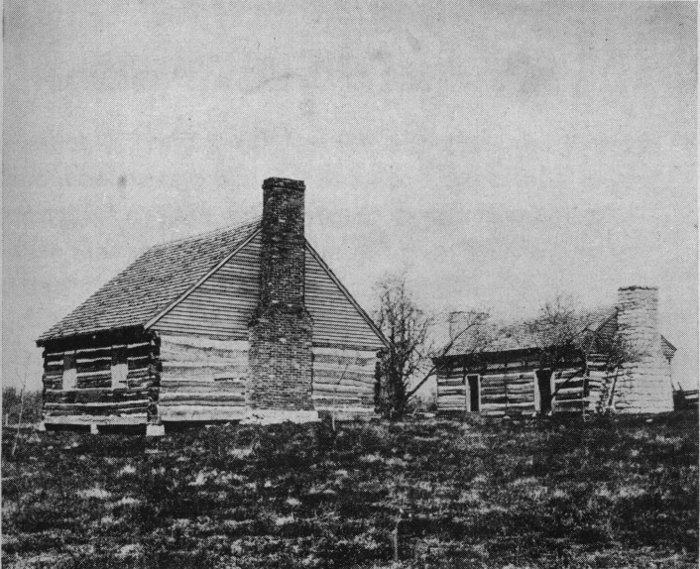
The Log Hermitage—1805
The building in the foreground was once a two-story block-house.
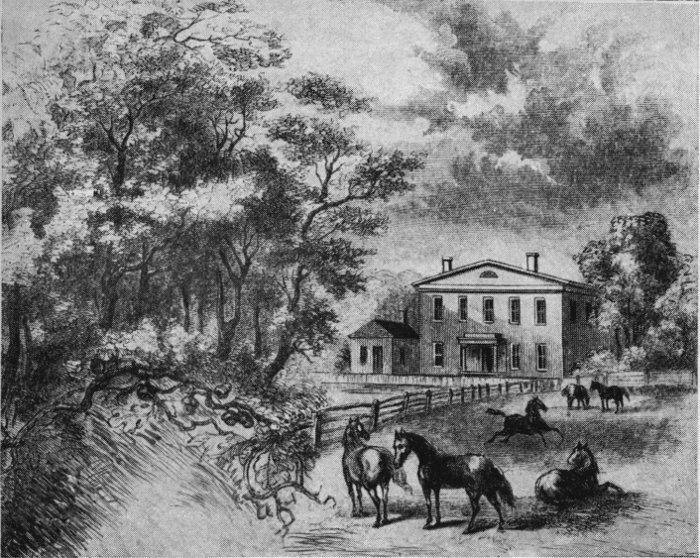
The Brick Hermitage—1819
Wings were added in 1831, and the small building was removed. From Harper’s Magazine of January, 1855
23
On the twenty-third of August, 1804, Jackson paid Nathaniel Hays $3,400 for the 425-acre tract, “with its appurtenances,” which was to be known later as the Hermitage.[1] This reference to appurtenances would indicate that some kind of a building or “improvements” stood on the property when Jackson bought it. This theory is strengthened by the fact that the present study has revealed no records which prove definitely that Andrew Jackson erected a log building at the Hermitage in 1804 or 1805, and by the tradition in the Hays family that one of its members built the Hermitage. Another point which strengthens it is that both of the log houses now standing on the Hermitage estate have in their walls the customary holes for rifles which were 24 made in the days of Indian fighting. This was not necessary at the time Jackson bought the Hermitage, for Indian hostilities were ended by 1795.
There must have been, however, considerable remodeling of the buildings, even though no new house was erected. Account books of the Hunter’s Hill store, which form a valuable part of the collection of historic documents at the Hermitage, show that in November, 1804, “17 window lights” are charged to Jackson’s personal account. It is possible that as time goes by a letter or other record may come to light which will tell something more definite on the building or remodeling of the log Hermitage. These account books are especially important in placing the removal from Hunter’s Hill to the Hermitage. The last entry at the Hunter’s Hill store was made on April 5, 1805, and the first at the Clover Bottom store on April 9. It is interesting to observe in this connection that the first letter in Bassett’s Correspondence of Andrew Jackson, headed at the Hermitage, was dated April 7, 1805. There is a lapse of several months in the letters, however, since the last one Bassett quotes from Hunter’s Hill is dated August 25, 1804. It is probable, although not a definitely established fact, that the removal of the store and residence took place simultaneously.
It is known, of course, that Hunter’s Hill was a commodious, two-story frame building—a marked contrast with the usual log houses of the period. In later years it was burned, and there remains to-day on the 25 site of the Hunter’s Hill residence nothing more than a few scant traces of houses which may, or may not, have been a part of the dwellings, slave quarters, store, or other buildings used while the Jacksons lived there.[2] The spring, of course, remains; the Cumberland flows gently along its distant, tree-lined banks; and fertile fields still yield up their annual tribute to careful husbandry. But marks of Jackson’s occupation of the land are obliterated and, except as the story is pieced together from bits of information gathered here and there, its history is lost in obscurity.
More is known of the log Hermitage, although its history is far from complete. Most of the letters of people who were guests of the Jacksons during this period are tantalizing for their lack of detail. The best and more than likely the most authentic description of the interior of the log Hermitage is that given in Buell’s History of Andrew Jackson. The author, in a series of interviews with Mrs. James K. Polk, wife of President Polk, has preserved much important material relating to the Jackson household. In his preface to Mrs. Polk’s narrative he says:
“In the early seventies of the 19th Century the author of this work visited Nashville more than once in the capacity of a newspaper correspondent. On those occasions he enjoyed the honor and pleasure of calling upon Mrs. Sarah Childress Polk, widow of the 26 President. Mrs. Polk was in her seventy-first year then. Her fund of historical and social reminiscences was exhaustless, and the best efforts to reproduce in print her faculty of relation would be feeble. Born in 1803, about twenty-eight or thirty miles from Nashville and not over twenty miles from the Hermitage, she had known the Jacksons from her earliest childhood. When she grew up and married Mr. Polk, the intimacy became still closer, and the relations between General Jackson and her husband in public life on the most important scale gave her recollections a quality of historical value not equalled by those of any other woman of her time....
“Mrs. Polk said that Mrs. Jackson—or ‘Aunt’ Rachel—was literally the childless mother of the whole neighborhood.... In their vicinage General and Mrs. Jackson were, of course, by far the most important persons. But no one would suspect it from observing the way and manner of their intercourse with the neighbors. In this respect the General was the most democratic of men, while Mrs. Jackson was at once the soul of merry-making and the embodiment of benevolence and charity.
“Their home manners, Mrs. Polk said, were the most charming concert of simplicity with dignity. The General always in their earlier life said ‘Mrs. Jackson,’ both in the second and third persons; though, when their little adopted son began to talk, he got into the habit of addressing her as ‘mother.’ On her part, Mrs. 27 Jackson invariably spoke of and to him as ‘Mr. Jackson,’ until after the War of 1812, she yielded to the universal fashion and began to call him ‘General.’ But no one ever heard either address the other by the first name or by any term of endearment or familiarity whatever. In fact, though more winning kindliness than that which marked the manners of both could not be imagined, there was yet an atmosphere of quiet self-respect and calm dignity about them which gently, though none the less imperatively, commanded scrupulous courtesy in their presence....
“The Hermitage of the period now under consideration, Mrs. Polk said, was not the commodious country house so familiar to devout Democrats in pilgrimages of later years. It was a group of log houses in close proximity to each other. The principal one had been built for a block-house in the days of Indian alarms, afterwards used as a store and, about 1804, converted into a dwelling. It, like all block-houses, was two stories high. Near it were three smaller log houses, one story high with low attics. These were used as lodgings for members of the family or guests. The main building—the former block-house—had on the first floor one very large room with a huge fireplace capable of taking in a good-sized load of wood at a time. A lean-to had been built on at the back containing two rooms, one of which was used as the family sleeping quarters, the other as a pantry—or ‘buttery’ as the 28 phrase was then. But the great room, about twenty-four feet by twenty-six, was at once kitchen, dining-room, sitting-room and parlor, and the large table that stood in the middle of it, capable of seating twelve to fourteen people comfortably, was always ‘set.’
“... General Jackson was a wonderful adept in the art of anecdote, and particularly delighted in incidents having a spice of wit or humor. Mrs. Jackson’s observations and experience were, of course, much more limited, but she, too, was a fluent talker and always entertaining.... She was an insatiable reader and was always far better informed upon current topics than the average woman of her time, even those who had been well educated. She was also a prolific writer, keeping up a close correspondence with her numerous relatives and with the General whenever he was absent from home. Her letters were simply her conversation on paper, with no effort at eloquence. As for grammar and orthography, Mrs. Polk said, neither in those days was the exact science it has since become, and she declared that while in the White House she had received notes from ‘leaders in society’ in Washington that would not compare favorably with the most hurried or careless of Mrs. Jackson’s letters.”
Mrs. Polk was excellently educated for her time. As a very young girl she was sent to the Moravian Female Academy at Salem, North Carolina, and later she was 29 placed in a girls’ school in Nashville. She came, of course, a generation after Mrs. Jackson and enjoyed privileges which were not known in frontier days. Mrs. Polk’s estimate of the Jacksons is especially important, not only because she knew them intimately from her childhood, but also because by training and long contact with the nation’s leaders and the great from other parts of the world, she had a background which qualified her for unbiased judgment.
Another child destined for future greatness visited the Hermitage when the log buildings were the family dwellings. He was Jefferson Davis, future president of the Confederate States of America. What would “Old Hickory” have said, when little “Jeff” Davis raced ponies and played with Andrew Jackson, Jr., and other little boys at the Hermitage, had he been able to foretell the future of his small guest? Fortunately for the children, no shadow crossed their pathway, and even “Old Hickory” had not been forced to declare in thunderous tones: “Our Federal Union—it must be preserved.”
[Let it always be remembered, however, that Andrew Jackson’s passionate loyalty to the Union was based upon an equally passionate devotion to the Rights of the States. He said in a rough draft of his second inaugural address, dated March 1, 1833 (Bassett, Correspondence of Andrew Jackson, Vol. V, p. 26): “In proportion, therefore, as the general government encroaches 30 upon the rights of the states, in the same proportion does it impair its own power and detract from its ability to fulfil the purposes of its creation.”]
The story of Jefferson Davis’ journey from Mississippi to the Hermitage is told briefly in his Memoirs.
“When I was seven years old,” he states, “I was sent on horseback through what was then called ‘The Wilderness’—by the country of the Choctaw and the Chickasaw nations—to Kentucky, and placed in a Catholic institution then known as St. Thomas, in Washington County, near the town of Springfield. In that day (1815) there were no steamboats, nor were there stage-coaches traversing the country. The river trade was conducted on flat and keel-boats. The last named only could be taken up the river. Commerce between the Western States and the Lower Mississippi was confined to the water routes. The usual mode of travel was on horseback or afoot. Many persons who had gone down the river in flat-boats walked back through the wilderness to Kentucky, Ohio, and elsewhere. We passed many of these, daily, on the road....
“The party with which I was sent to Kentucky consisted of Major Hinds (who had command of the famous battalion of Mississippi dragoons at the battle of New Orleans), his wife, his sister-in-law, a niece, a maid-servant, and his son Howell, who was near my own age, and, like myself, mounted on a pony. A servant 31 had a sumpter mule with some supplies, besides bed and blankets for camping out. The journey to Kentucky occupied several weeks.
“When we reached Nashville we went to the Hermitage. Major Hinds wished to visit his friend and companion-in-arms, General Jackson. The whole party was so kindly received that we remained several weeks. During that period I had the opportunity a boy has to observe a great man—a standpoint of no small advantage—and I have always remembered with warm affection the kind and tender wife who then presided over his house....
“General Jackson’s house at that time was a roomy log-house. In front of it was a grove of fine forest trees, and behind it were his cotton and grain fields. I have never forgotten the unaffected and well-bred courtesy which caused him to be remarked by court-trained diplomats, when President of the United States, by reason of his very impressive bearing and manner. Notwithstanding the many reports that have been made of his profanity, I remember that he always said grace at his table and I never heard him utter an oath. In the same connection, although he encouraged his adopted son, A. Jackson, Jr., Howell Hinds, and myself in all contests of activity, pony-riding included, he would not allow us to wrestle; for, he said, to allow hands to be put on one another might lead to a fight. He was always very gentle and considerate.... Our stay with General Jackson was enlivened by the visits 32 of his neighbors, and we left the Hermitage with great regret and pursued our journey. In me he inspired reverence and affection that has remained with me through my whole life.”
These intimate glimpses of the Jackson household during the period of residence in the log Hermitage throw an interesting light upon the customs and surroundings of the family at this time. These years—from 1805 to 1819—were tremendously important in Jackson’s career. They were not entirely happy years, for they included such unfortunate events as the Dickinson duel in 1806, the shooting affray with the Bentons in 1814, the delightful, but misunderstood visits of Aaron Burr, and the public expressions of disapproval which these affairs produced. Through it all ran the unhappy references to the Robards’ divorce and the unfortunate circumstances attending the first marriage of the Jacksons. It was a period of Herculean struggle against material odds, as well as against public opinion, but it was not without a brighter side in which gayety, color, and genuine happiness stand out.
Relatives, neighbors and, often, distinguished guests from a distance, composed a brilliant and congenial company—in spite of the fact that their rank varied from the simplest backwoodsman to a former vice president of the United States, and their common background was a log house in the far west. Most charming 33 and gracious of all was Aaron Burr, but lately vice president, who first visited the Hermitage May 29, 1805. He was received by the entire community in a manner which befitted his importance and his high rank in national affairs. Public dinners were given for him, and he was received cordially by the leading citizens. He returned to Nashville in August, 1805, and spent a few days as a guest of General Jackson. Little is known of the details of this visit, but from the Hermitage at this time he wrote to his daughter, Theodosia:
“For a week I have been lounging at the house of General Jackson, once a lawyer, after a judge, now a planter; a man of intelligence, and one of those prompt, frank, ardent souls whom I love to meet. The General has no children, but two lovely nieces made a visit of some days, contributed greatly to my amusement, and have cured me of all the evils of my wilderness jaunt....” (Parton’s Life of Andrew Jackson.)
The nieces were, of course, nieces of Mrs. Jackson—part of that bevy of charming Donelson girls which throughout the history of the Hermitage household lent grace and gayety to its social affairs. Many of them married young men who were closely associated with the General in his military and political activities, and in this way strengthened by ties of kinship the relationship which common public interest had created. 34 General Jackson had no kin of his own in Tennessee, but he took Mrs. Jackson’s family to his heart as if it were his own.
Burr’s final visit to Nashville in December, 1806, was the one around which the storm of public disapproval centered. His reception at this time was courteous, but somewhat cool, for rumors of his proposed invasion of the West had already begun to filter in. The Impartial Review and Cumberland Repository of December 20 carried the announcement that “Colo. Burr arrived on Wednesday last and intends proceeding to Natchez in a few days.”
His departure was recorded almost as briefly in the same paper, issue of Saturday, December 27: “Colo. Burr embarked from this place for New Orleans on Monday last, with two large flat boats, which did not appear to be loaded.”
The papers of these and subsequent dates carried, however, many communications which show the national alarm at Burr’s presence in the Western country and indicate that while Nashville was slow to condemn him, it was ready to rise to a man to march against him should reports that he was planning an invasion of the Western country prove true. For the most part, however, he was given the benefit of the doubt, and while he was in Nashville he was received as an interesting and charming acquisition to its social circle.
There are many interesting stories of Burr’s visits to Nashville, of his elegant manners, his wit, and his 35 personal magnetism as well as his alleged duplicity. Some of them were revived in the Jackson presidential campaign of 1828 in an effort to prove that he and Andrew Jackson were united in intrigue against the United States. These arguments brought forth a letter which was not only important in the campaign, but is especially valuable at present, for its picture of Nashville social life and the participation of the master and mistress of the Hermitage in it. This letter, written by T. G. Watkins, at Charlottesville, on May 14, 1828, reads:
“In the winter of 1806 or ’7, to the best of my recollection as to time, I was a member of the dancing assemblies for the season, in Nashville. On one of the evenings preceding a stated meeting for the night, it was communicated to the managers for the season, two of whom I distinctly recollect were the present John Overton, LLD, of Travellers’ Rest, near Nashville, and the late Dr. Hansen Catlett, that Col. Burr was in town. He was immediately ticketed, as Judge Overton informed me, nem. con., I think, by the managers. Some one, I do not now recollect who, objected to this act of the managers. Judge Overton remarked that he had concurred in the invitation from a conviction of its propriety—but, as he acted upon delegated authority, he wished a meeting as full and general as practicable, of the subscribers to the assemblies to be convened; and if a majority of them disapproved of the act of the 36 managers, the invitation to Mr. Burr should be promptly withdrawn. A meeting, a very full meeting, was called, and a majority sanctioned the act of the managers. The ball went on very harmoniously; Col. Burr, though somewhat distrusted by some, was considered an elegant acquisition to it, and was treated accordingly: a hospitable and gracious smile from the ladies, in return for his very general, and very elegant salutations, proved their happy acquiescence in the general arrangement. Gen. Jackson resided about 14 miles from Nashville at that time: if he and his amiable lady attended on that occasion, as they often did on others, I have lost all distinct recollection of it, which I think I should not, if there had been anything more marked in the attention of either to Col. Burr than seemed to be generally awarded to him by the company. While on this subject I will remark that some time previous to this ball, a young gentleman who resided in my family in Nashville, appeared anxious to go with Col. Burr—he afterwards cooled off. And questioned on the subject by myself or someone in my presence, he stated that a Mr. Caffrey, I think was the name, had been about that time advised, verbally or by letter, I am not certain which, by Gen. Jackson, to have nothing to do with Col. Burr’s expedition. Respectfully Th. G. Watkins.” (Nashville Whig.)
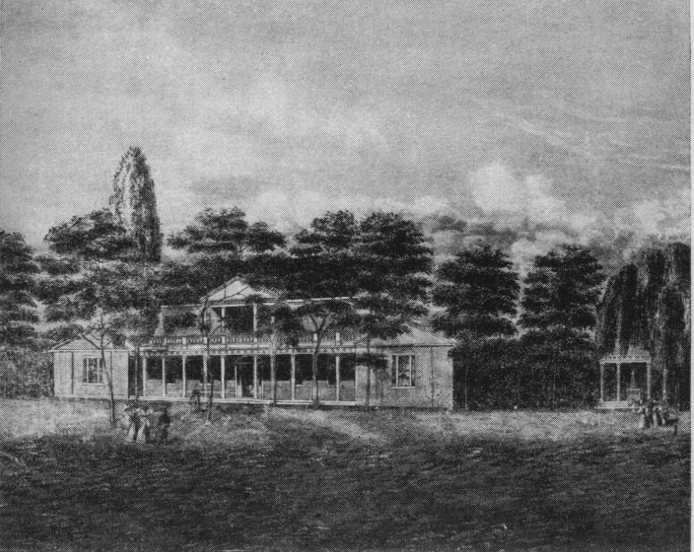
Above: The Hermitage After the Remodelling in 1831
From Ayres’ Map of Nashville Courtesy of the late Dr. W. A. Provine
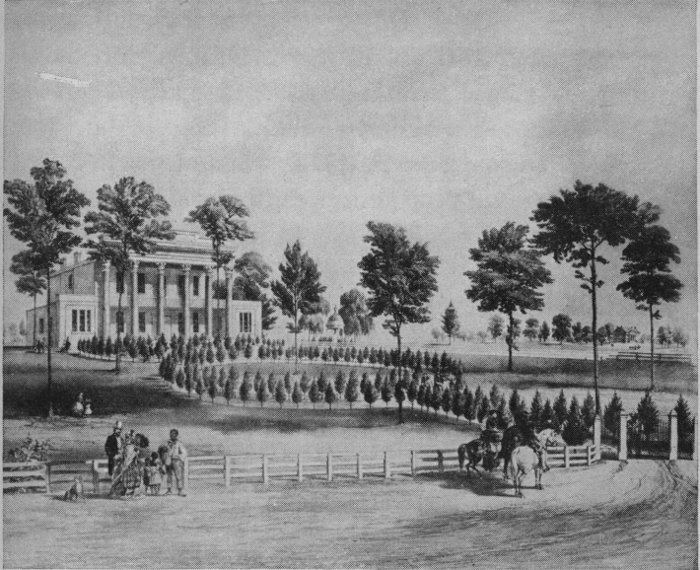
Below: The Hermitage After the Final Remodelling Which Followed the Fire of 1834
From drawing dated 1856 Original in Hermitage museum
37
Burr, on his last visit to Nashville, resided at least a part of the time at the Clover Bottom tavern, which, with a store, a race track, and a boat yard, formed the establishment developed by Andrew Jackson, John Hutchings, a nephew of Mrs. Jackson, and John Coffee, who in 1809 married one of Mrs. Jackson’s nieces, Mary Donelson. It was here that Burr obtained the boats which brought down such a storm of criticism upon the head of Jackson. A careful examination of the orders for boats and related dealings between Jackson and Burr do not justify the accusation of conspiracy—particularly in view of General Jackson’s activities in complying with orders from the Secretary of War regarding a military force to protect the West against Burr’s anticipated invasion.
After Burr’s departure with his two visibly empty flat-boats, feeling in certain circles began to mount higher and higher. He was publicly denounced as a traitor and on January 2, 1807, was burned in effigy by a group of Nashville’s citizens. This event is described in the Impartial Review of Saturday, January 3, 1807, as follows:
“Last night at the hour of nine, commenced the burning of the Effigy of Col. Aaron Burr, by the citizens of this town. This proceeding is justified by the ardent emotions of patriotism felt by the people, and excited by a deep conviction that the said Burr is a TRAITOR. This conviction is produced from the conduct of Col. Burr himself in these western states, and even in this town—the proclamation of the President—his 38 message to both houses of Congress, and the statement of Gen. Eaton. And we have the utmost confidence in assuring our Atlantic brethren, that the idea of separation is spurned with indignation and horror. That our lives and our property are pledged to support the General Government of the United States, as the safeguard of our personal security, and as the only asylum for oppressed humanity.”
Subsequent events proved that the Burr alarm was very much of a tempest in a teapot, but the incident was used, long afterwards, against General Jackson by his political opponents. Similar use was made of the Robards’ divorce and of the tragic story of his duel with Charles Dickinson.
The log house was the home of the Jacksons at the time of the Dickinson duel, May 29, 1806; but the scene of events which led to it was Clover Bottom, the site of Jackson’s race track, store, and tavern, about two miles from the Hermitage. The direct cause of the duel was the race between Jackson’s celebrated Truxton and Capt. Joseph Erwin’s Ploughboy—a race which was arranged in the fall of 1805, but was not run. Ploughboy’s lameness caused his owner to withdraw him from the race and pay the $800 forfeit. There are a number of stories about events which followed the withdrawal of Ploughboy. Judge Guild, in his Old Times in Tennessee, probably gives the most accurate account of the matter as it concerns Mrs. Jackson.
39
“I have been informed,” Judge Guild wrote, “by a relative of Mrs. Jackson, a gentleman of high character, still living, that she was present, in her carriage, on the track, to witness the race, and when the forfeit was declared, she remarked with an air of pardonable exultation, to some of her friends, that ‘Truxton would have left Ploughboy out of sight.’ This was repeated to Dickinson, who, being somewhat excited by his losses, and probably under the influence of liquor, rejoined, ‘Yes, about as far out of sight as Mrs. Jackson left her first husband when she ran away with the General.’”
This was followed by some gentlemen’s gossip about the value of notes put up by Capt. Erwin for the forfeit, and one incrimination led to another until a situation which had but one remedy was created. Jackson, by the repeated insults heaped upon him by the Erwin faction, was forced to challenge Charles Dickinson to a duel. Since the laws of Tennessee prohibited dueling, the meeting was carried across the line into Kentucky, where, on the morning of May 29, 1806, the duel was fought. The results are well known. Dickinson, crack pistol shot of the West, who had left behind him along the road to the meeting place evidences of his expert marksmanship, fired—and the shot entered his adversary’s breast. His opponent fired, but the pistol stopped at half-cock. With superhuman effort he drew himself to full height, folded his coat closer across his breast to hide the wound which he believed fatal, and with cool 40 deliberation took the second fire to which he was entitled. Dickinson’s wound proved fatal and Jackson’s very nearly so, but the bitter enemies who had driven Jackson into the duel were not satisfied—they entered upon a relentless tirade of abuse, and the public, shuddering, turned its sympathy to the young widow of Dickinson. Rachel, in her little log house, wept out her own heartache as she nursed the General back to health—and through it all prayed and wept for the young wife of Charles Dickinson and her unborn babe.
(The first edition of the present work referred to the Dickinson child as an “unborn babe”—a statement which had long been accepted by Jackson historians. Charles Dickinson’s will in Wills and Inventories of Davidson County, (1807) pp. 141-142, states, however, that “... half of my Estate I give devise & bequeath to my son Henry who is now about Ten weeks old ...”)
As time passed the wound healed. Jackson retired to his Hermitage and devoted himself to his business, his farm, and his blooded stock. Truxton, the innocent cause of this tragedy, blossomed under the friendly skies of Tennessee, but neither he nor his master were destined to remain long in retirement. Life stretched out temptingly before them, and it was not long until Truxton was the acknowledged king of the turf, and upon his master’s brow were the laurels won in his defense of New Orleans.
No history of the Hermitage could be complete without a rather detailed account of Truxton. He was 41 bought by General Jackson in the spring of 1805 from Maj. John Verrell, of Virginia. After the first race with Ploughboy was announced and the forfeit declared, another race, which is less known, was run and Truxton was the winner. This race took place on April 3, 1806—something over a month before the Dickinson duel.
The best authority on this race and upon Truxton himself is Andrew Jackson. His statement was written for the American Farmer and was reprinted in the American Turf Register of December, 1833. This account reads:
“Truxton is a beautiful bay, full of bone and muscle; was got by the imported horse old Diomed, and came out of the thoroughbred mare, Nancy Coleman, the property of Maj. John Verrell, of Virginia. Truxton is, however, too well known to require a minute description. His performances on the turf have surpassed those of any horse of his age that has ever been run in the western country; and, indeed, it might be said with confidence, that he is equal, if not superior, to Mr. Ball’s Florizel horse, who was got by the same Diomed, and who now stands unrivalled in Virginia as a race horse.
“Truxton, by old sportsmen and judges, is admitted to be amongst the best distance horses they ever run or had to train. His speed is certainly unknown to all those who have run against him. He has, on the most unequal terms, started against the very best mile horses in Kentucky and Tennessee, and beat them with great 42 ease; and in no one instance has ever run with any horse, when he himself was in order, but he either could or did distance him with ease. Although the four mile heats is the real and true distance for Truxton to run, he has beaten Mr. Gordon’s fine mile horse, Jack of Clubs, and Mr. Cotton’s Greyhound, both aged horses, with equal weights of 100 pounds on each, the single mile heats.
“And lastly, to crown the much doubted speed of Truxton, he beat, on only two sound legs, on the 3d of April, 1806, over the Clover Bottom Turf, the celebrated horse, Ploughboy, who was never before beaten, and beating him without the assistance of whip or spurs. It is now no longer difficult for the numerous concourse of people who were present on that day to say ‘whether or not Truxton be the true bred racer.’
“Truxton’s winnings, from time to time, from the most correct information, amount to at least twenty thousand dollars, and his colts are not inferior to any on the continent. Andrew Jackson.”[3]
Truxton was, undoubtedly, Jackson’s pride, but the Hermitage was noted for many famous horses. There 43 was Pacolet, the dapple gray six-year-old, which the General had bought from Col. William R. Johnson, of Kentucky, about 1813. His immediate object in acquiring a new racer was, according to Marquis James, in his Andrew Jackson, the Border Captain, to defeat “Jesse Haynie’s chestnut mare Maria just as soon as he could send the British about their business.” This neither Pacolet, nor Truxton’s boasted colts could accomplish, and to Haynie’s Maria is awarded the distinction of being almost the only thing which Andrew Jackson, when he set his head to it, could not conquer.
To tell the story of Jackson’s horses would be to write the history of racing and breeding of thoroughbreds from the early days of the settlements in Middle Tennessee until after the Civil War. There was a close association between General Jackson and the owners of thoroughbreds in Sumner County, where, for a long period of years such men as Bailie Peyton, Barry, Carter, the Rev. Hardy Cryer and others produced magnificent horses.
There is a tradition that Andrew Jackson arrived in Nashville riding one fine horse and leading another—which was loaded in the customary manner with his personal belongings. Early in the spring after his arrival he purchased another, for we find at the Davidson County Court House a record showing that on April ninth, 1789, he bought of Thomas Smith “one Sorrell horse About fourteen hands high known by the name 44 of Saml Martin’s Sorrel: Which sd Horse the sd Smith purchased from the sd Samuel Martin for the consideration of the Sum of One hundred pounds....”
The punctuation of this record is somewhat scant, but from the general context one gathers that Andrew Jackson paid one hundred pounds for the Horse, rather than that Thomas Smith paid this sum to Samuel Martin. At any rate “Samuel Martin’s Sorrel” was valued at one hundred pounds—a rather goodly sum for young Attorney Jackson to be paying. Throughout his long life he continued to buy the best horses he could afford—they were a passion with him—and, unlike many devotees of the turf, he made money, rather than lost it, in his deals.
One of General Jackson’s choice saddle horses was Duke, who is said to have been his favorite during the New Orleans campaign. If we credit the story of Uncle Alfred, the slave who for many years was his faithful bodyservant, he was mounted upon Duke on the day of victory. Mrs. Mary C. Dorris, in her Preservation of the Hermitage, quotes Uncle Alfred as saying:
“General Jackson is ridin’ Juke (Duke) dat day; he warn’t ridin’ Sam Patch, dat ’ar white horse standin’ in de parlor.... He’s ridin’ Juke. An’ Juke he dance Yankee-Doodle on three legs; and he dance it so plain dat de ban’ struck up an’ play ‘Jackson, Jackson, yer’s de man for me.’”
45
General Jackson, in a letter written to Mrs. Jackson during the Florida campaign of 1818, shows his affection for Duke.
“I am advised there are a few red sticks (hostile Indians) west of Appelachecola, should this be true, I will have to disperse them, this done I shall commence my journey home. I am almost on foot, I almost despair of getting my favourite Old Duke home.” (Bassett, Correspondence of Andrew Jackson, Vol. II.)
Uncle Alfred referred to the portrait in the Hermitage parlor, a work of the artist Earl, which shows General Jackson mounted on the white charger presented to him by the citizens of Philadelphia. He was a graceful and daring horseman and, like Washington and other great generals, had a passion for horses. He had also a country gentleman’s interest in the breeding of blooded stock, and a sportsman’s interest in their speed and bottom. There came a time, however, when he was forced to give up the turf—although never, for a moment, did he relinquish his interest in the breeding of fine horses at his Hermitage estate. The severe criticism of his horse-racing proclivities by his political enemies caused him, after his elevation to the Presidency, to discontinue training his colts for the track at the Hermitage.
* * * * * * * *
But the log cabin days were ending. Fame came 46 slowly, but certainly, to the humble dwelling in the midst of the fertile acres of the Hermitage. It was not sought by the master of the household, and it certainly was not welcomed by its mistress. It was impossible, however, for such a dynamic nature as Jackson’s to avoid following an active and forceful course in the events of the period. He could no more stay at home when his presence was needed in the field than he could avoid taking a leader’s place when he got into action. Each event in which he participated led him farther and farther from the simple life which he and his household had been leading, for with each success came promotions which gave the public greater and greater claims upon him.
The log cabin years, in spite of the struggles and tragedies sprinkled through them, were, on the whole, happy and eventful ones. The financial structure of the Hermitage household was strengthened, the public affairs of its master prospered, and his personal contacts with those who disagreed with him became less violent. Children had always been a part of the household. Rachel’s brothers and sisters lived near by and their children, from babyhood to maturity, were her delight as well as General Jackson’s. Added to these were the Butler children who, in the years of 1804 and 1805, became General Jackson’s wards. In 1809, when twin boys were born to Severn Donelson’s wife, the mother was quite frail, so Rachel carried one of her tiny 47 nephews home with her and claimed him for her own. He was legally adopted and given the General’s own name. After 1813 the Indian boy, Lincoya, orphaned at the Battle of Talluschatches, was taken into the friendly shelter of the Hermitage. A great favorite through the years was Andrew Jackson Donelson, who grew into a brilliant statesman under the General’s fond care. Another valuable acquisition to the household was the young artist, Ralph E. W. Earl, who in 1818 married Jane Caffrey, one of Mrs. Jackson’s numerous nieces.
Among the others who married Rachel’s nieces were Abraham Green, of Natchez, who married Patsey Caffrey in January, 1801; General John Coffee, who married Mary Donelson in 1809; William Eastin, who married Mrs. Coffee’s sister, Rachel Jackson Donelson, in the same year; and John C. McLemore, of Nashville. General Coffee’s daughter, Mary, who as a young lady was a member of the Jackson household at the White House, married Andrew Jackson Hutchings, ward and grand-nephew of General Jackson. Through all the years the Jackson household knew the happy confusion which is common to large families—love, laughter, tears, and all of the things which go to make life full and interesting. No one reveled in these relationships more than the master, whose own near kin had been snatched from him by a series of tragic incidents of the Revolutionary War.
48
Mrs. Jackson had not been confined entirely, however, to her own family circles and the log Hermitage. After the victory at New Orleans she went south to join her husband. In the same year she accompanied him on a visit to Washington and to Virginia, and at all places she shared with him the honors showered upon him by an adoring populace. She accompanied him, too, when he went to Pensacola to assume the office of Governor of the Floridas, and from these trips returned laden with gifts and purchases which were somewhat out of place in the humble quarters to which they were brought. The time had come, obviously, for the building of a home more in keeping with the station of its master. Fortunately his financial status justified it. Otherwise the family would have undoubtedly remained in the log dwelling, for Andrew Jackson’s good sense and determination to live within his means far outweighed any personal vanity. He was solicitous, however, of Mrs. Jackson’s welfare, and was for her sake particularly interested in building a more suitable home.
The new Hermitage was built for Rachel, upon the spot which she selected. Major Lewis, Parton says, suggested it be built upon another more elevated site, but that General Jackson said to him:
“No, Major, Mrs. Jackson chose this spot, and she shall have her wish. I am going to build this house for her. I don’t expect to live in it myself.”
49
General Jackson’s health at this period was even worse than usual—and he was seldom well. The one thought uppermost in his mind when the new house was built was the comfort of the one person whom he loved above all other things in the world.
As houses go, the Hermitage of this period was by no means pretentious. It was a square-looking, home-like building, made of red bricks manufactured on the place by the slaves—spacious, comfortable, and liveable, but by no means elaborate. Many of the visitors who were thronging from all parts of the country to visit the “Hero of New Orleans” thought it a surprisingly simple abode for a man of such prominence. It was not, however, out of keeping with its local setting. Davidson County, according to the census of 1820, had a population of only 20,154 people. The section now known as Middle Tennessee was sparsely settled and still called “West Tennessee.”
The period of transition from the log cabin to the ante-bellum mansion had begun, but most of the men who had fought their way to a financial security which justified the mansions still remembered their early days in pioneer cabins. Society was young and unexacting, and in the West they took Jeffersonian democracy literally. Andrew Jackson was himself the democrat of all democrats, but he had a poise and assurance which made him at home in all companies, and made all classes of people at ease in his presence. Neither his manner nor Mrs. Jackson’s changed, however, with their 50 removal to more handsome quarters. Both of them had long been known for their gracious hospitality and for a bearing which was at once simple and dignified.
Thomas Hart Benton, in writing of Mrs. Jackson, declared:
“She had a faculty—a rare one—of retaining names and titles in a throng of visitors, addressing each one appropriately, and dispensing hospitality to all with a cordiality which enhanced its value. No bashful youth, or plain old man, whose modesty sat them down at the lower end of the table, could escape her cordial attentions any more than the titled gentleman on her right and left. Young persons were her delight, and she always had her house filled with them—clever young women and clever young men—all calling her affectionately ‘Aunt Rachel.’ I was young then, and was one of that number. I owe it to early recollections and to cherished convictions—in this last notice of the Hermitage—to bear this faithful testimony to the memory of its long mistress—the loved and honored wife of a great man.” (From Benton’s Thirty Years’ View.)
It was Benton who gave to the world the picture of Andrew Jackson sitting before his fireside in the twilight with a child and its pet lamb on his knees.
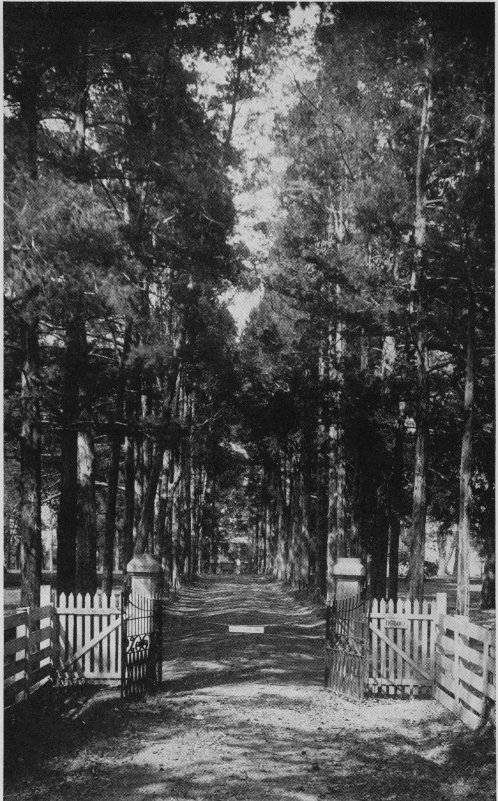
The Stately Avenue of Cedars As It Appears Today
When President Theodore Roosevelt visited the Hermitage in 1907 he alighted from his carriage at the entrance of the avenue and walked with bared head to the historic old mansion.
51
It was for gay groups such as those that Benton mentioned that the new Hermitage was built. In spite of the storm and stress the years were passing pleasantly with its mistress. Fame turned its spotlight upon the household, but the simple hospitality of the log cabin period was not abandoned. The spacious rooms of the new Hermitage rang with the laughter of a great bevy of nieces, of nephews, and neighbors’ children. General Jackson’s “military family,” friends, and associates came from here, there, and everywhere, bringing with them members of their families and staying for weeks at a time. But the Hermitage acres were broad and fertile, the slaves were numerous and contented—and the mistress an excellent manager.
Years afterwards General Jackson wrote to young Andrew Jackson Hutchings (letter of April 18, 1833, Bassett, Correspondence of Andrew Jackson, Vol. V): “Recollect the industry of your dear aunt, and with what economy she watched over what I made, and how we waded thro’ the vast expence of the mass of company we had. Nothing but her care and industry, with good economy could have saved me from ruin. If she had been extravagant the property would have vanished and poverty and want would have been our doom. Think of this before you attempt to select a wife.”
The years in which this building was occupied were colorful and eventful ones in the Jackson saga. Unfortunately little is known of the actual details which attended its erection, the beginning of the garden, and other little intimate things concerning it. Even such a tireless student as the late John Spencer Bassett was not able to place exactly the time of its completion and 52 occupation. Everything seems to indicate that it was started in 1818, about the close of General Jackson’s Florida campaign, and that it was ready for occupancy, most likely, prior to June, 1819, the date of President Monroe’s visit to Nashville and the Hermitage. The story is being pieced together, bit by bit, and it is gradually becoming complete.
A letter from Sir John Jackson, mentioned by Bassett, but secured in full from the manuscripts of the New York Public Library, by the Tennessee State Library, shows that in 1819 the Jacksons had secured the services of an English gardener. This letter reads:
“Philadelphia, April 30th, 1819.
“Major Genl A Jackson
“Dear General
“On the 26th Inst I wrote a few lines to you by William Frost a regular bred english Gardener who has been well recommended and from what I can judge from conversation with him am in hopes he will be found capable of whatever he undertakes—I engaged him for you as Gardener without any stipulation as to terms merely holding out that on his own capacity and industry his success and welfare depended—like others of his situation of life required an advance to bear his expense and had to give him 30 dollars on your account.
“I have seen a Nashville paper announcing your arrival and the congratulations of your Friends and fellow 53 citizens testified by a Public dinner, it seems by the english Papers the english people are mad with the Citizens of N. York, this City and Baltimore for the respect shown you—with best respects to your Lady I remain with sincere respect and esteem, “Yours, “John Jackson.”
In the same connection Bassett quotes a letter to William B. Lewis, which, though not dated, is placed sometime in 1819. It reads, in part:
“Sir, Mr. Wilson who was employed by Mr. Decker to paint my house has disappointed me, he was to have been here on the 15th he has not arrived. I will therefore now engage with the gentleman you spoke to me about, I have a Dearborn waggon in Town to day to bring up the tubes to convey water from my roof, and the ballance of the paint. will you have the goodness to see him for me. get him to go to Mr. Berkmans examine the bill of paints laid in, and if any wanting to add them, and to say to Mr. Berkman whether he prefers the Whitelead in oil or dry, and let it be brought up to day.
“I shall be down to day, to ride, but I am taken with an acute soreness in my left side, I cannot say pain, that is very troublesome when I bend, or is touched, perhaps it may with exercise disappear.
54
“I heard last evening that Mr. Rhea is in town I wish to see him, and if I can ride without great inconvenience I will be down for that purpose....”
The Nashville Whig and Tennessee Advertiser, of May 15, 1819, carried the announcement that the Hon. John Rhea was a candidate for Congress from the First District—it may have been that he was in Nashville at the time. The connection between his announcement and Jackson’s letter is somewhat vague, but it may prove a small link in the chain which will eventually establish the date of the completion of this building.
Bassett mentions also a receipted bill for china and silver plate to the amount of $200, dated June 12, 1818, which, in 1922, was in the possession of Albert M. and Andrew Jackson, of Los Angeles. This, Jackson’s letter about the paint, and Sir John’s letter about the English gardener, indicate that the Hermitage household was to be conducted upon a more elaborate scale.
There is a strongly prevalent local tradition that the artist, R. E. W. Earl, laid out the Hermitage garden. It is quite possible that he worked with the English gardener in laying it out. He was established in Nashville as early as the latter part of the year 1817, for in the announcement of the Eighth of January Ball, 1818, some of his portraits were used in the decorations. The Nashville Whig of January 10, in describing the event, states:
55
“The Ballroom was decorated with much taste, elegance and splendor. At the upper end of the room, were suspended three paintings, the portraits of Generals Jackson, Carroll and Coffee. Two of which, Generals Jackson and Coffee, were executed by a young artist now in this place, which, for boldness of design, accuracy of execution, judiciousness, and delicacy of shading would not lose in comparison with the finest paintings of modern times....”
An important visitor at the Hermitage that year was Isaac Shelby, “late governor of Kentucky,” who stopped with the Jacksons while he and the General were preparing to go into the Chickasaw country to hold a treaty. Both men were popular, and their proposed mission was important enough to offer a sufficient incentive for an elaborate public dinner at the Nashville Inn.
At this dinner Col. Edward Ward, president, proposed the toast: “Isaac Shelby, late governor of Kentucky. The only governor in our Union who, during our late war, showed himself qualified for both the cabinet and the field.”
John H. Eaton, Esq., vice president, proposed: “General Jackson, His military greatness commands our admiration—his private virtues our esteem.”
Soon the generals and their suite were off for the Chickasaw country. They encountered some difficulty, for the Nashville Whig of October 10 reported that 56 “but four chiefs attended on October 2nd”—they were alarmed at parting with any of their territory. On October 19, however, General Jackson wrote the following letter, announcing a successful conclusion of the mission:
“Treaty Ground, October 19, 1818.
“To the Editors of the Whig:
“We have just closed a treaty with the Chickasaw Indians, for all their claims in the states of Tennessee and Kentucky, containing about seven millions of acres, of the best lands in the western country, and washed by the Tennessee, Ohio, and Mississippi Rivers, for at least three hundred and fifty miles: for an annuity of twenty thousand dollars for fifteen years.
“I am respectfully, Your most obedient serv’t, Andrew Jackson.”
A month later, according to a paragraph in the Whig, the signing of the treaty was celebrated in Nashville:
“A Tribute of Respect—A splendid Ball was given to General Jackson and staff, at the Nashville Inn, last Evening, in honor of the late Chickasaw Treaty.”
Governor Shelby was not present, but he had found time to sit for the young artist at the Hermitage. General Jackson wrote him on November 24:
57
“On the 20th the citizens of Nashville and its vicinity gave myself and Staff a Ball in commemoration of the late Chickasaw Treaty where I had the pleasure to see your Portrait suspended at the head of the assembly room and I was gratified to find that Mr. Earl had been so fortunate—for I can with truth say that there never came from the hands of an artist a better likeness....”
Earl married Jane Caffrey, niece of Mrs. Jackson, on May 19, 1818. The ceremony was performed by the Rev. William Hume. In less than a year the Reverend Mr. Hume was called upon to perform the sad duty of preaching her funeral sermon. The Nashville Whig, of March 13, 1819, carried the announcement:
“The Rev. Mr. Hodge, assisted by the Rev. Mr. Hume, will preach the funeral sermon of the late Mrs. Earle, at the residence of Col. Stockely D. Hays on to-morrow.”
Mrs. Jackson mothered and comforted the young man, and from that time, until his death in 1838, the Hermitage was his home. During the passing of the years he painted innumerable portraits of General and Mrs. Jackson, of the various kin, and of prominent visitors both at the Hermitage and the White House, where he was also a member of the household—so much a member, in fact, that he was dubbed “The King’s Painter.”
58
An intriguing, but forgotten, chapter in Earl’s history was discovered by the writer a few years ago in the April 10th, 1822, issue of the Nashville Whig. A short article, headed quite casually, “Napoleon Buonaparte and Marshal Ney,” announced: “Original portraits of these great men, taken by Mr. Earl, shortly after the return of Napoleon from the Island of Elba, were a few days since received and deposited by him in the Nashville Museum. Judging by his strikingly correct portraits of Gen. Jackson, of the President of the United States, of Shelby, of Haywood, and of a number of others, which likewise grace and ornament the Museum, we have no hesitation in believing them to be very exact likenesses....”
Where are these portraits of Napoleon and Marshal Ney, taken from life during the brief, but dramatic “one hundred days”?
One of the prominent visitors who sat for the young artist in his early days at the Hermitage was President Monroe, who visited Nashville and the Hermitage in June, 1819. The Nashville Whig, of Saturday, July 12, 1819, states:
“The citizens having learned through the committee that the President had reached the residence of General Jackson, and that he would dine with them on Wednesday, last, set out on that day to meet and conduct him to this place. They met him four miles from town accompanied by Maj. Gen. Jackson and suite and Brevet 59 Maj. Gen. Gaines. Three miles from town he was received by a large collection of the Tennessee Volunteers, armed and dressed as they were when they were in the several campaigns in which they had been engaged....”
The reception by this colorful procession which thronged the highway to the Hermitage to greet General Jackson and his distinguished guest was but the beginning of the festivities. A dinner followed at the Nashville Inn. President Monroe was entertained at the Nashville Female Academy on Thursday, June 10, and on the evening of that day the crowning event of his visit, a ball at the old Nashville Inn, took place.
“A numerous assemblage of elegance and beauty attended,” said the editor of the Nashville Whig. “We have never seen more taste and beauty than was displayed in arranging the room, or a more numerous and brilliant assemblage of ladies. The arrangements were largely creditable to the managers. At the head of the room was a large transparency exhibiting an Eagle displayed and encircled in a ray of glory, bearing in his beak a transparent painting of our Chief Magistrate. Fronting at the lower end of the room, was suspended the portrait of Gov. Shelby of Kentucky. On the right side of the hall was a full length portrait of Maj. Gen. Jackson, with a distant view of the British encampment before New Orleans; fronting him were Genls. Coffee and Carroll. These inimitable paintings (with 60 the exception of the transparency) were executed by our artist, Mr. Earl; and are highly honourable to the talents and profession aquirements of that gentleman. Over the paintings and around the room, were rich and beautiful festoons of evergreen and roses....”
A ray of glory—how the unknown artist of the transparency depicted it is a matter of conjecture, but the yellowed pages of the Nashville Whig bear testimony to its reality. It takes but small imagination to reconstruct the picture—men in handsome military uniforms, ladies in their gay-colored silks, dancing and conversing in the stately manner of the period, and paying due homage to the President of the United States and the Hero of New Orleans. At the Hermitage they found time, no doubt, to wander about in the moonlit, magnolia-scented grounds and to stroll along the paths of the new garden. Rachel, as she played the rôle of gracious, warm-hearted hostess, could not know that a long, lonely path, illuminated only by the cold rays of fame stretched before her adored husband, and that she, before a decade had passed, would rest under the friendly sod of her garden. Nor could President Monroe foretell the future of the distinguished soldier at his side. A great drama, of which the new Hermitage was to be the chief setting, was beginning.
It was not long until General Jackson was appointed governor of the Floridas, and he and Rachel moved their household temporarily to Pensacola.
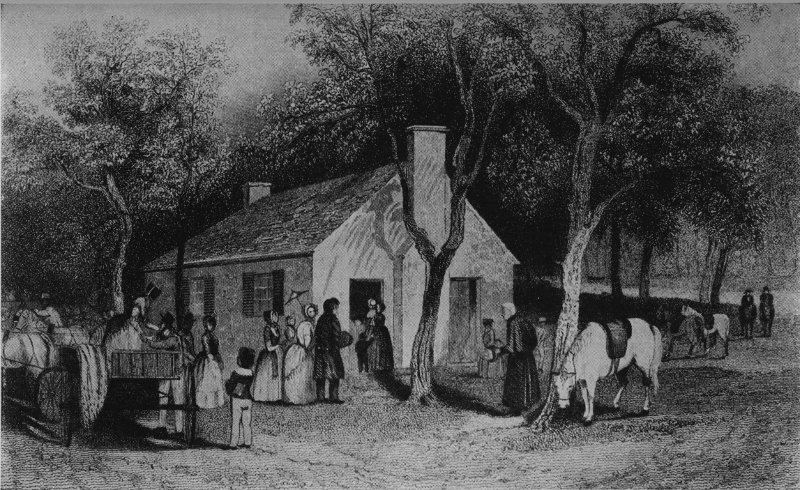
“The Church Where Jackson Worships”
A quaint old print of the church which General Jackson had built near the Hermitage in 1823-24 for the convenience of his pious wife and her neighbors.
61
“Gen. Jackson and family left town Saturday evening last in the Steam Boat Cumberland, on his way to Pensacola,” says the Nashville Whig of April 18, 1821.
A little later it stated: “Gen. Jackson and family arrived at Natchez on April 21, on board the Steam Boat Rapide, having left Cumberland on account of some accident having happened to her machinery.” The journey was completed in seven days, despite the accident! From Natchez, New Orleans, Blakely, Montpelier, and Mobile came echoes of a triumphant and leisurely progress. But even at that it was several weeks before the General and his suite were finally established in Pensacola—the Spanish governor was inclined to be a bit difficult about relinquishing his sway.
Rachel, however, did not like Pensacola. To her friend, Mrs. Eliza Kingsley, she wrote: “Believe me, this country has been greatly overrated.... One acre of our fine Tennessee land is worth a thousand.... The General, I believe, wants to get home again as much as I do....”
The General was not overly pleased with the situation and, as soon as he was able to settle certain little difficulties, he was determined to return to his beloved Hermitage. Marquis James, in his Andrew Jackson, the Border Captain, writes of this period:
“How peaceful the Hermitage! ‘Our place looks like it had been abandoned for a season, But we have a cheirful 62 fire for our friends, and a prospect of living at it for the ... ballance of our lives. I have sent on my resignation by Doctor Brunaugh.’
“It was over, this uncertain adventure into which Andrew Jackson had been drawn by an unreciprocated sense of loyalty to the President and a wish to help his young friends.... Rachel ... and Andrew undertook to make their home comfortable for the rest of their days. In the great hall stood seven cases of furniture and table silver purchased at New Orleans. However Rachel might deplore the wicked luxury of the complaisant Creole town there was no denying the comfort of good French beds. ‘1 Bedstead, of Mahogany, fluted, $100,’ was for her own and Andrew’s tall south chamber; likewise ‘1 Matress of fine ticking, $45, 1 moschette Bar of Muslin, $16, 1 Counterpane knotted, Marseilles, $24.’ There was also a new sideboard and something to fill the decanters....”
There was dancing in the hallways in these days—dancing to the sound of a flute which “Old Hickory” himself may have played. Horace Holley, writing from Nashville on August 14, 1823, to his father, Luther Holley, Esq., in Salisbury, Connecticut (copy given to the author by the late Judge John H. De Witt), related:
“We have just returned from the Hermitage, ... The General called upon us in town on the evening of 63 our arrival and he is one of the most hospitable men in the state. Mrs. Jackson is not a woman of cultivation, but has seen a great many people, has fine spirits, entertains well, and is benevolent. She is short in her person and quite fat. The General is lean and has been in ill health but is now invigorated and promises to live out his three-score and ten. He has built him a good brick house within the last two years and has finished it handsomely. Mary has taken three views of it in her sketch book. We looked at all the presents which have been made to the old warrior in honour of his military achievements and were gratified not a little.... The General has papers from most parts of the Union, and his study is loaded with piles of them. Considerable company was at his house every day, and our ladies danced every evening in the entry to the sound of the flute....” (“Mary” was Mary Austin Holley, author and cousin of Stephen Austin. Where are the sketches she made of The Hermitage?)
Andrew Jackson was content, Mr. James says, and “the measure of his contentment was in proportion to the sincerity of his resolution to exchange a brilliant career for a quiet one.”
His peace was to be short-lived. On December 5, 1823, he took his seat in the Senate of the United States, to which he had been appointed by the Tennessee legislature. For six weary months he remained in Washington and Rachel, with her usual efficiency, kept 64 the Hermitage household going. She was busy, for the little church which the General was building for her and her pious friends near the Hermitage was being completed. His letter, written in Washington, January 29, 1824 (which has been presented to the Ladies’ Hermitage Association by the late Mr. Leland Hume, a descendant of the Rev. William Hume), states:
“I am truly happy to hear that our church is about to be finished, and that pious good man Mr. Hume, is to dedicate it. If such a mans prayers cannot obtain a blessing upon the neighborhood, I would despair of the efficacy of prayer from any other....”
The church was completed and the General returned home—this time with the avowed intention of carrying Rachel with him when he returned to Washington the following autumn. In the meantime the presidential campaign of 1824 was in full swing, and the Marquis de Lafayette arrived with his son and suite to be the “nation’s guest.” On October 18 the distinguished Frenchman wrote to Jackson:
“My dear General, With all the feelings of affectionate Gratitude I Have Received your kind and Highly Valued Letter: this is not However the first and greatest obligation that Binds me to general Jackson; Had you witnessed my anxiety when on a Sudden all Europe was pacified, and the flower of the British army were on their way to Louisiana, you would still Better 65 judge what I felt of relief, joy, and pride, on Receiving the Glorious Account of your Victory: I Have long Anticipated the pleasure to take you by the Hand, and whatever Be your future movements I will Express in person my High Regard and Sincer friendship....” (Bassett, Correspondence of Andrew Jackson, Vol. III.)
Late autumn and winter took the Jacksons to Washington, where they put up at Gadsby’s, which was also the quarters of the distinguished Lafayette. Here, on December 23, Mrs. Jackson wrote to her friend describing the meeting between the famous Frenchman and General Jackson.
“We are boarding in the same house with the nation’s guest, Lafayette. I am delighted with him.... When we first came to this house, the General said he would go and pay the Marquis the first visit. Both having the same desire, and at the same time, they met on the entry of the stairs. It was truly interesting. The emotion of revolutionary feeling was aroused in them both. At Charleston, General Jackson saw him on the field of battle; the one a boy of twelve, the Marquis, twenty-three. He wears a wig, and is a little inclined to corpulency. He is very healthy, eats hearty, goes to every party, and that is every night....” (From Parton, Vol. II.)
Rachel, too, for that matter was “a little inclined to corpulency.” She did not attempt to attend all the parties, 66 for Washington was unusually gay and her health was none too good. She paid calls, received large numbers of new acquaintances and old friends, and attended, of course, such important affairs as the eighth of January ball and Mrs. Monroe’s drawing-room.
They stayed in Washington long enough to see General Jackson miss, by a hairbreadth, becoming President of the United States and to witness the pomp and ceremony of Mr. Adams’ inauguration. They were home by the latter part of April, ready to take charge of their household again and to play host and hostess to Lafayette when he arrived in Nashville on the fourth of May. Never was there such a celebration!
Twenty-five thousand Tennesseans crowded into Nashville to welcome him. The military organizations of the state were out in full force, the ladies wore their finest dresses, and the streets were decorated with great triumphal arches of flowers. There were dinners and public programs of various types, but most important of all was the ball which was given for him in the Masonic Hall. Guild, in his Old Times in Tennessee, says:
“The dance was opened by Gen. Jackson and the beautiful Miss McNairy. It was difficult to tell which was most to admire, the beauty and sylph-like grace of Miss McNairy, or the stately step and courtly manners of Gen. Jackson.”
Mrs. Thomas Martin, whose narrative is quoted by Guild, in describing the ball said:
67
“The old and the young were there, and the scene was one of beauty, fashion, and smiles. On a dais at one end of the hall were the guests and the old ladies—Gen. Lafayette with Mrs. Rachel Jackson, Gov. Carroll, with Mrs. Shelby, Gen. Jackson, with Mrs. Priestly and Mrs. Carroll, George W. Lafayette with Mrs. Stewart and Mrs. McNairy, and Mr. Shelby with Mrs. Minnick and myself....”
Stories of the ball are still recounted with delight in Nashville, and in many of the old families are fans, combs, dresses, and the gay little slippers of belles who “danced with Lafayette.” But most interesting of all is the description of Lafayette’s reception at the Hermitage, from the pen of his secretary, M. Levasseur:
“At one o’clock we embarked with a numerous company to proceed to dine with General Jackson, whose residence is a few miles up the river. We there found numbers of ladies and farmers from the neighborhood, whom Mrs. Jackson had invited to partake of the entertainment she had prepared for General Lafayette. The first thing that struck me on arriving at the General’s was the simplicity of his house. Still somewhat influenced by my European habits, I asked myself if this could really be the dwelling of the most popular man in the United States, of him whom the country proclaimed one of her most illustrious defenders; of him, finally, who by the will of the people was on the point of becoming her Chief Magistrate....
68
“General Jackson,” Levasseur continues, “successively showed us his garden and farm, which appeared to be well cultivated. We everywhere remarked the greatest order and most perfect neatness; and we might have believed ourselves on the property of one of the richest and most skillful German farmers, if, at every step, our eyes had not been afflicted by the sad spectacle of slavery. Everybody told us that General Jackson’s slaves were treated with the greatest humanity....”
In this setting Rachel was at her best. She was now fifty-eight years old. Stout, kindly, motherly, and frankly growing old; but always the gracious hostess and always deeply interested in the gay doings of the young people who were drawn into the charmed circle of her hospitable household. Her garden had taken deeper root. Her house was more elegantly furnished and her acquaintance with the outside world had been greatly extended; but aside from the fact that she took her religion a little more solemnly and that she had been saddened by the malicious attacks made upon her, her nature had changed but little with the passing years. She never lost her love of people, her keen interest in things about her, nor her gentle sympathy.
The famous Frenchman and his entourage had hardly left when the Hermitage became the gathering place for a great corps of notables, who entered heart and soul into the campaign which placed its master in the President’s chair and which completely vindicated its 69 mistress. Never in the history of the nation has such a bitter, unscrupulous attack been waged against a candidate for public office; and never, under any circumstances, has an American woman received such shameful treatment at the hands of a political party. It is a page in history which is best overlooked.
However the storms raged on the outside, they did not change the happy atmosphere of the Hermitage. If the mistress suffered—as of course she did—she kept up a brave front for the General and the other members of her household. Henry A. Wise, later governor of Virginia, who was a guest at the Hermitage of this period, gives in his Seven Decades of the Union, an interesting picture of the house itself, as well as the social life which centered about it. This description is especially important, for it supplies the only known description of the interior of the brick house which was erected in 1819.
Wise had just been married to Anne Jennings, daughter of the Rev. Obadiah Jennings, Jackson’s Presbyterian minister in Nashville, and the bride and groom, with their bridal party, had been invited to spend the honeymoon at the Hermitage.
“We arrived at the Hermitage to dinner,” Wise wrote, “and were shown to a bridal chamber magnificently furnished with articles which were the rich and costly presents of the city of New Orleans to its noble defender.
70
“Had we not seen General Jackson before, we would have taken him for a visitor, not the host of the mansion. He greeted us cordially and bade us feel at home, but gave us to distinctly understand that he took no trouble to look after any but his lady guests; as for the gentlemen, there were the parlor, the dining-room, the library, the side-board and its refreshments; there were the servants, and, if anything was wanting, all that was necessary was to ring. He was as good as his word. He did not sit at the head of his table, but mingled with his guests, and always preferred a seat between two ladies, obviously seeking a chair between different ones at various times. He was very easy and graceful in his attentions; free, and often playful, but always dignified and earnest in his conversation. He was quick to perceive every point of word or manner, was gracious in approval, but did not hesitate to dissent with courtesy when he differed. He obviously had a hidden vein of humor, loved aphorism, and could politely convey a sense of smart travesty. If put upon his mettle he was very positive, but gravely respectful. He conversed freely, and seemed to be absorbed in attention to what the ladies were saying; but if a word of note was uttered at any distance from him audibly, he caught it by a quick and pertinent comment, without losing or leaving the subject about which he was talking to another person—such was his ease of sociability, without levity or lightness of activity, and without being oracular or heavy in his remarks. He had a great power of attention and concentration, without being prying, curt, or brusque. Strong good sense and warm kindness of manner put every word of his pleasantly and pointedly in its right place.
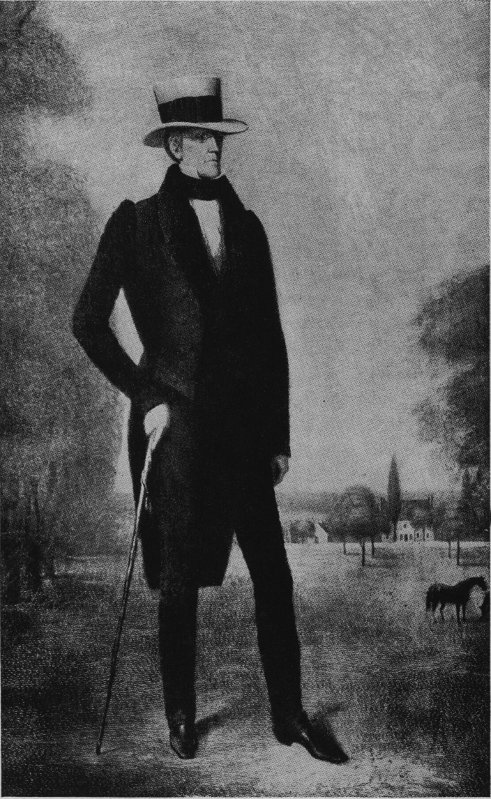
Andrew Jackson, the Country Gentleman at the Hermitage
(Original presented to the Ladies’ Hermitage Association in 1944 by Mrs. C. W. Frear, of Troy, N. Y., in memory of her husband.)
71
“To illustrate him in a scene: The Hermitage house was a solid, plain, substantial, commodious country mansion, built of brick, and two stories high. The front was south. You entered through a porch, a spacious hall, in which the stairs ascended, airy and well lighted. It contained four rooms on the lower floor, each entering the passage and each on either side opening into the one adjoining. The northwest room was the dining room, the southeast and southwest rooms were sitting rooms, and the northeast room had a door entering into the garden. The house was full of guests. There were visitors from all parts of the United States, numbering from twenty to fifty a day, constantly coming and going, all made welcome, and all well attended to.
“The cost of the coming Presidency was even then very great and burdensome; but the general showed no signs of impatience, and was alive and active in his attentions to all comers and goers. He affected no style, and put on no airs of greatness, but was plainly and simply, though impulsively, polite to all. Besides his own family he had his wife’s relatives, Mr. Stokely and Andrew J. Donelson, around him every day, and his adopted son, Andrew Jackson, relieved him of all the minute attentions to guests.
“Henry Lee, of Virginia, was, we may say, resident 72 for the time with him, as he was engaged in writing for his election some of the finest campaign papers ever penned in this country. One of Lee’s fugitive pieces, on the death of an Indian youth, the son of a chief who was killed at the battle of the Horseshoe, whom the general had taken as a godson, an orphan of one of his victories, is a precious pearl of poetry in prose. (This refers to Lincoya and places his death about 1828. Where is Lee’s article on his death? Both the Lee Foundation and the Ladies’ Hermitage Association are interested in finding it.)... He was not as handsome as his half-brother, General Robert E. Lee....
“The first or second evening of our stay, Mr. Lee had drawn around him his usual crowd of listeners; but we were the more special guests of Mrs. Jackson. She was a descendant of Colonel Stokely of our native county, Accomack, Virginia, and we had often seen his old mansion, an old Hanoverian hip-roofed house, standing on the seaside, not far above Metompkin; and she had often heard her mother talk of the old Assawaman Church, not very far above Colonel Stokely’s house, pulled down long before our day, endowed with its silver communion-service by our grandfather, George Douglas, Esq., of Assawaman. Thus she was not only a good Presbyterian too, but the groom was from the county of her ancestors, in Virginia, and could tell her something about the traditions she had heard from which she sprung....”
73
When there is added to Wise’s description of the interior of the Hermitage of this period the view of the building and grounds included in Earl’s 1831 portrait of General Jackson, the picture of the house as it was from 1819 to 1831 is complete. The Nashville Republican and Tennessee Gazette, on Thursday, August 25, 1831, repeated a criticism of this portrait which had appeared in the Washington Globe.
It reads, in part: “The artists of Boston announce it a ‘first rate work,’ and the intimate friends of the President consider it the most perfect likeness ever taken of him. It is not only recommended by this circumstance, but it is rendered doubly interesting as a sort of historical picture, in which the taste and talent of the designer is, in high degree manifested. The President stands alone in the solitude of the Hermitage. The scene is most accurately delineated. The house and surrounding grounds, although thrown somewhat in the distance, are identified to all acquainted with the spot, by its most striking features....”
To the west is seen a small square building which may have been used by General Jackson as an office. There is a tradition that it was Earl’s studio and, since the artist was a member of the household in 1818 and 1819, it is more than likely true. There is a remote possibility that it was the kitchen, for the dining room, according to Wise’s description, was “the northwest room,” but it is more probable that the old kitchen was located near 74 the present one, on the north side of the building. (Since 1933 a brick building, in the style of the period, has been erected on this foundation.) Traces of the foundation of this small building are still visible. It is important to observe further in this portrait which, in 1831, was accepted by the public and Nashville and in Washington as a historically accurate view of the Hermitage, there was still no evidence of the famous cedar-lined, guitar-shaped drive.
This portrait, which from an historical standpoint is probably the most important of the Jackson portraits, was presented to the Ladies’ Hermitage Association in 1944 by Mrs. Charles W. Frear, of Troy, New York, in memory of her husband. For many years the Association did not know the location of the original, although it had long used a reproduction in its catalogue which, it appears, had been given to the organization about 1901 by McClure’s Magazine. It is interesting that the acquisition of this famous portrait by the Ladies’ Hermitage Association was perhaps due, in part, to the interest of a member of the artist Earl’s family.
Mr. Ralph Earl Prime, Jr., of Yonkers and New York City, New York, writing to the author on October 8th, 1936, said:
“I have borne in mind your interest in the 1831 portrait of Gen. Jackson with the Hermitage as a background, which was painted by Ralph E. W. Earl. I followed up the clue afforded by the article in the issue of 75 McClure’s Magazine in 1897, to which you called my attention, with the result that I have just received a letter, of which the following is a copy:—
“‘In reply to your letter of October 2, 1936, with reference to portrait of Andrew Jackson painted by Ralph E. W. Earl, will say the portrait was for many years in possession of the late Wm. H. Frear. It is now in my possession. The information you have in regard to the portrait is substantially correct to the best of my belief. Yours very truly, C. W. Frear.’
“If he (Mr. Frear) could visit the Hermitage in person,” Mr. Prime continued, “as I and some of my friends have done with so much satisfaction, and catch the spirit which actuates its custodians, I am sure that he would realize how appropriate it would be to restore the painting to its former setting as a gift to posterity, either presently or by his will....”
Happily, through Mrs. Frear’s generosity, this treasure has been restored to The Hermitage, where it will remain through the years as a memorial to her husband.
This was Rachel Jackson’s Hermitage—the Hermitage in which she entertained Monroe, Lafayette, and all that gay and distinguished company which, as stars in the great Jackson constellation, were destined, for a time, to dazzle the nation. And how many of them had known the kindly hospitality of the mistress of the Hermitage ... the quiet, studious, James K. Polk, who as “young Hickory” was to carry the Jackson banner 76 again to the president’s chair; Sam Houston, gay, lovable, and erratic, who was to be president of the Lone Star Republic; “Jeff” Davis, future president of the Confederate States of America; Thomas Hart Benton, destined to a powerful career in the United States Senate; John Eaton, John Coffee, William Carroll, and a score of others who shared the Jackson military and civil honors. All of them spent happy days under her roof and all of them, at some time during their career, took time to pay public tribute to her beloved memory.
As the year of 1828 drew to a close General Jackson’s victory was assured. There was no personal elation in it for Rachel, however, just as there was no bitterness toward her persecutors during their most severe attacks upon her. Her reply when news of victory was brought to the Hermitage was: “For Mr. Jackson’s sake, I am glad; for my own part, I never wished it. I had rather be a doorkeeper in the House of my Lord than to live in that palace in Washington.”
She had always preferred the quiet of her own home and had resented the demands which fame made upon her husband. Her friends, though, were greatly elated for her sake, as well as for the General’s. John H. Eaton, writing her from Washington, December 7, 1828, said:
“The storm has now abated—the angry tempest has ceased to howl. A verdict by the American people has been pronounced of that high and grateful character, 77 that for the honor of your husband, you cannot but look back upon the past as an idle fading vision carrying in it nothing substantial—nothing that should produce to you one moments feeling, or a moments pain. No man has ever met such a triumph before.... The Ladies from distance—from remote parts of the Union will be here—brought essentially and altogether on your account and to manifest to you their feelings and high regard: they will be present to welcome and congratulate you....” (Bassett, Vol. III p. 449.)
Nashville ladies were already busy doing their part to honor her—they were preparing a handsome wardrobe for her to carry to Washington with her, and the entire town was arranging a magnificent celebration for December 23, the anniversary of the night battle at New Orleans. Jackson leaders in Washington, Philadelphia, and other important places were preparing elaborate programs honoring the president-elect ... but on December 22 the rejoicing was turned into mourning. Rachel Jackson quietly slipped beyond the reach of cruel tongues.
Her illness came suddenly and unexpectedly a few days before the anticipated celebration. There are many versions of its origin. Some say that while in Nashville she was resting at the Nashville Inn and accidentally overheard some unpleasant remarks about her part in the past campaign. Others carry the story still farther and say that she wept and that, in returning 78 to the Hermitage, she stopped her carriage at a creek to bathe her swollen eyes, and thus caught a cold. There could have been little shock connected with anything which she may have overheard, for she had been familiar with the attacks made on her throughout the past campaign. One thing which may be accepted as certain is that in some way she caught cold. Wise quotes a young Dr. Heiskell, of Winchester, Virginia, who was just starting as a physician in the neighborhood, and was the first doctor to reach her, as saying: “We learned that she had caught cold and pleuritic symptoms supervened upon her constitutional nervous affections. She was sitting smoking her corncob pipe when she caught her last malady....”
Wise further explains that “a pipe was prescribed by her physician for her phthisis, and she often rose in the night to smoke for relief.” Whatever the explanation of the pipe may be, its only importance was its use in the caricatures used by her husband’s opponents in the presidential campaign. She had long been subject to the bronchial trouble which was, undoubtedly, the chief cause of her death.
No words can describe the tragedy which stalked at the Hermitage during her illness. The General would not leave her side. The servants stood about in stricken silence, with the exception of old Hannah, who nursed her, and the few who were allowed to perform little duties to assist her. Friends and relatives gathered—and 79 on the late afternoon of the twenty-second her condition seemed greatly improved. She had persuaded General Jackson to lie down on a sofa in the next room in order that he might be rested for the coming celebration—which, she insisted, he must attend. He obeyed and Mrs. Jackson was removed from her bed that it might be prepared for the night. As she sat in a chair, supported by the arms of the faithful Hannah, she suddenly uttered a cry and her head fell forward.... The General rushed to her and for a time, neither he nor his stricken household would believe that she was dead. At his command they placed her upon a table, the physician made an effort to bleed her, and they worked with her for hours before the desperate old man could understand that there was no hope. All night he remained by her side.
Early on the morning of the twenty-third the citizens of Nashville were informed of her death. It was ordered that on the following day, from one until two o’clock, the hour set for her funeral, that the church bells be tolled. The scene was rapidly changed from one of festivity to deep mourning, and on the next day the road was crowded with people on their way to the Hermitage to pay their last respects to a sainted woman. The Reverend William Hume preached her funeral sermon.
A gentleman from Philadelphia who was present wrote to a relative:
80
“Such a scene I never wish to witness again. The poor old gentleman was supported to the grave by General Coffee and Major Rutledge. I never pitied any person more in my life. The road to the Hermitage was almost impassable, and an immense number of persons attended the funeral. The remains were interred in the lower part of the garden. I never before saw so much affliction among the servants in the death of a mistress. Some seemed completely stupified by the event; others wrung their hands and shrieked aloud. The woman who had waited on Mrs. Jackson had to be carried from the ground....”
The funeral service was, in fact, delayed because she had thrown herself upon her mistress’ grave and refused to move. General Jackson would not allow her to be torn away by force, but waited patiently until her associates could persuade her to allow them to remove her.
So ended all thoughts of victory for Andrew Jackson. All that had made victory sweet, all that had made life worth while, had passed away. The only thing to which the broken old man looked forward was his return to their beloved Hermitage. His body, his mind, and his indomitable will he carried to Washington—but his heart he left buried with Rachel in their garden.
Although for a time after her death Rachel Jackson’s Hermitage—the building as it appeared from 1819 to 81 1831—remained unchanged, the period was, to all intents and purposes, ended. The household and its followers centered about the White House, and the lonely resting place of its mistress was left to the tender care of relatives and the slaves whose grief was still inconsolable. General Coffee, R. E. W. Earl, Andrew Jackson Donelson and his wife, Emily, who was for a time mistress of the White House; Andrew Jackson, Jr., and later his bride, Sarah York Jackson; Major Lewis, and others formed a part of the household. Some of the time three Marys—Mary Coffee, Mary McLemore, and Mary Eastin—daughters of Rachel’s nieces, added gayety to the Washington household. Mary Eastin was married in the White House to Lucius Polk, and Mary Coffee married General Jackson’s ward, Andrew Jackson Hutchings.
A new phase in the history of the Hermitage began in 1831. Andrew Jackson, Jr., married the beautiful and cultured Miss Sarah York, of Philadelphia, on November 24, 1831. Some interest in the future began to live in the heart of Andrew Jackson. Since his wife’s death he had contemplated his son’s marriage with more than ordinary concern.
“It is,” he wrote to a friend in May, 1829, “the only hope by which I look to a continuation of my name....”
It proved to be more than that for it was the beginning of a beautiful relationship destined to last from the time he welcomed Sarah York Jackson, as a 82 bride, to the White House, until she stood at his deathbed at the Hermitage in 1845. The President, because of pressing duties and ill health, had not been able to make the journey to Philadelphia to attend the wedding, but he sent Col. Earl with a cluster of pearls for the bride. It was in the form of a ring, and there was a lock of his hair on the under side of the setting. With it he sent the message that from his son’s description of her he thought “pearls the most fitting gift, as emblematic of the purity of her character and the beauty of her face.” (From the notebook of Mrs. Rachel Jackson Lawrence—State Library.)
The wedding took place at the home of Mrs. Samuel Wetherill, Sarah York’s sister, who lived on Chestnut Street, in Philadelphia. Mrs. Jackson, Mrs. Wetherill, and another sister, Mrs. Adams, were left orphans in early childhood, and, at the request of their dying father, were cared for and educated at Mrs. Malland’s boarding school. They were well-bred, charming, and well connected. Andrew Jackson himself—and he was a noted matchmaker—could not have made a better choice for the future mistress of the Hermitage.
Before Andrew Jackson, Jr., brought his bride to the red brick mansion in Tennessee, extensive remodeling was done. This period in the history of the Hermitage had been completely overlooked until a letter in the Hermitage collection was recently brought to light. This letter (Published for the first time in the 1933 edition of the present work) which is quoted in full, gives complete data on the remodeling of the Hermitage 83 in 1831, as well as the building of the tomb in the garden. It reads:
“Nashville, December 6, 1831.
“Dear sir: I have the satisfaction to inform you that the additions and improvements to the Hermitage are compleated. I have in addition to the improvements, as exhibited on the plan furnished you a neat and appropriate Portico on the back side of the center building, which adds very much to the comfort & convenience of your dwelling.
“The Hermitage as improved presents a front of 104 feet, the wings project 9 feet in front the center building and are connected by a colonnade of the same breadth. The colonnade consists of 10 lofty columns of the Doric order the entablature is carried through the whole line of the front, and has wreaths of laurel leaves in the frieze, on the cornice is a blocking corse that support an appropriate balustrade. The upper story consists of a Portico surmounted by a pediment which breaks the monotony of the composition in a very satisfactory manner.
“The material employed in the emprovements are all of the best quality the neighborhood affords, the colonnade is covered with the best copper the sheets weighing from 12 to 14 lbs. each sheet, and the gutters that convey the water from front to back are also of copper. The wing buildings and Porticos are roofed with good ceader shingles. The old Kitchen is removed and the matereals employed in the erection of a large and 84 comodeus smoke house which is placed on a line with the new kitchen. The internal arrangements are almost to my mind. The dining room is large and will dine 100 persons at one time comfortable. The wing at the East end contains the library a large and comodeous room and overseer room, and a covered way that protects the three doors leading to the library the overseer room and to the back parlor.
“In the progress of the emprovements I adhered as closely to the plan furnished you as circumstances would admit. The only alteration I have made is in adding 2 feet to the length of the Kitchen, and 20 feet to the length of the East wing. The latter was done at the request and with the advice of Gen. Coffee which additions I hope will meet with your approbation.
“The following is the amount that has been expended independent of what has been done by your one (own) hands—
Cash to stone-cutters, mason & bricklayers 491.00
“ to carpenters and joiners 678.00
“ to painters and glazers 187.00
“ plasterers 168.00
“ copper smith and tinner 350.00
“ Lumber and shingles 468.50
“ Hardware glass &c. 110.00
“ Lurners (?) bill 25.00
“ Halling lumber from Nashville 11.00
$2488.50
85
“You will perceive by this amount notwithstanding the several additions, the back Portico, and many additional expenses incident to such emprovements I have been able to effect it with a less sume than the original estimate which to me is a source of gratulation without respect to any hope of pecuniary emolument. I must entreat you to believe that no such sordid matire entered into my views. To merit your approbation has been my ambition, to succeed in obtaining it is my best reward—I have received in addition to the fifteen hundred Dollars the amount of your chieck, Five hundred dollars from Mr. Josiah Nicholl, making two thousand dollars, leiving a ballance of Four hundred and eighty-eight Dollars.