Book D (continued 2)
Reading edition
“On receipt of your letter of the 18th August for which I return you my thanks for the expressions of kindness it contains, I employed an expereanced stone-cutter in whome I have entire confidence who is progressing with the Temple & Monument it will be composed intire of stone. The massivenes of the parts of the Grecian Doric order require a material of great strength such as the white stone of this neighborhood and when this can be obtained it must always be a subject of regret that recourse should be had to any imitation of it however exact: but I found it impossible to get ceader timber large enough to be wrought into the forms required. The principle cost of this substantial and highly ornamental emprovement consists of the hire of stone cutters, and the purchase of copper 86 for the covering of the doom. I expect in the progress of this work to have the ade of your one hands & teems in quarry & halling the stone, which will enable me to bestoe an additional quantity of labor on the building, in order that it may fully meet publick expectation. I am anxious to have it finished as soon in the spring as possible, in as much as I will be necessary detained hear to direct the operation of the workmen in order that it may be in conformity to the plan furnished you.
“I have made a drawing of the Hermitage as emproved, which is in the hands of an experanced engraver, it will make a splendid picture and as soon as it is finished I will send you a copy which will give you a better idea of the building than any written discription I can give—my best respects to your son—Mrs. M joins with me in tendering you, not our complements, but our kindest & best wishes,
“I am your most obldge D Morrison.”
Notes in Andrew Jackson’s own hand on the back of the letter read: “Mr. Morrison rec’d & answered. A bill for $300 inclosed to Mr. Morrison or Josiah Nichol. A. J. To be preserved. A. J.”
The picture which Mr. Morrison mentioned has been preserved. It appears on Ayres’ Map of Nashville, which was published in 1832. An announcement of the plans for this map appeared in the Nashville Republican and State Gazette, of December 6, 1831—strangely 87 enough, the exact date of Mr. Morrison’s letter. This notice reads:
“Map of Nashville—Sketches of the embellishments which are to be attached to this work have been politely submitted to our inspection. They consist of three different views of the City—one from the bank of the Cumberland near the ruins of the Old Steam Mill; another from a hill on the South near the residence of Dr. Overton, and the third from a commanding height about two miles to the North—the Penitentiary from an iminence in front, with its beautiful back-ground scenery of hill and wood and cultivated field—a portion of College Street including Yeatman and Woods’ Bank—the U.S. Branch Bank—a group consisting of the Court House, Inn and Hotel—a part of the Public Square including the upper end of the Market House—the University and background—the Presbyterian, the Baptist, and the Episcopal churches—the Female Academy and other buildings in the neighborhood. To these is added a view of the Hermitage in its present newly finished state, than which there is not to be found west of the Allegany a more beautiful and splendid private residence.”
A comparison of the engraving on Ayres’ map with Mr. Morrison’s letter proves the authenticity of the picture. There are ten columns instead of the six stately ones of the present, and the exterior of the 88 building corresponds in other details with his description. The tomb, for the artist’s convenience, more than likely, is placed nearer the house than it is in reality.
Andrew Jackson Baker, present caretaker of the Hermitage, who has made a careful study of the building, points out a number of irregularities in the doors of the east wing which are due, undoubtedly, to the remodeling. The brick walls themselves show where the east wing was added and where there was once a little roof or porch extending over the entrance to the cellar. The kitchen and smoke-house, as Morrison’s letter states, are on line with each other.
The handsome remodeled Hermitage which was Mr. Morrison’s and Nashville’s pride was destined, however, to a career of short duration. In October, 1834, it caught fire and was, with the exception of the dining-room wing and its sturdy brick walls, destroyed. The catastrophe is described in the Nashville Republican of October 14, 1834, as follows:
“The Hermitage Burnt—Yesterday evening about 4 o’clock the roof of the Hermitage was discovered to be on fire, and all attempts to arrest the progress of the flames proving unavailing, the entire edifice, with the exception of the room attached to the northern end and used as a dining room, was in a few hours consumed. The valuable furniture in the lower story was fortunately saved, though much broken and otherwise injured in getting it out. That in the second story was, 89 we understand, chiefly destroyed. The fire is supposed to have been communicated to the roof by the falling of a spark from one of the chimneys, and there being a breeze from the northwest, the progress of the flames was proportionably rapid. The numerous and valuable private papers of the President were probably all preserved.
“We need not add that the event has occasioned to this community deep and universal regret.”
Letters from Bassett’s Correspondence of Andrew Jackson, give further details of the fire. On October 14, 1834, Col. Robert Armstrong, Nashville’s postmaster, wrote:
“My dear Genl. Your son and Majr. Donelson have both written you the perticulars of the unfortunate burning of the Hermitage House. We heard the news Last evening but not the extent of the Damage. I sent One of the Young men Out of the Office up After supper who returned by Sun up this morning. I learned from Majr. D. and the Young man I sent up that all the furniture and valuables with the papers, letter Books, etc., have been with the exception of some furniture upstairs (the Wardrobe and Large bedstead) saved. Some few things were singed in getting out but on the whol I expect everything was done that could be done and I have no doubt it was purely accidental. The House can be rebuilt on the Old Site for $2,000 or 2,500. The dineing room wing is but Little 90 injured. I will go up this evening to see your Son and also Mr. Rife, the Carpenter doing Majr. D. work, and the one who built my House and will write you in a day or two. I will see what will be his estimate and Austins for its Complete Rebuilding and inform you....”
Stockley Donelson, General Jackson’s nephew, wrote on the same day, giving details of the fire.
“A fire was kindled in the old dining room,” he stated, “and the chimney caught on fire, which not being observed immediately, and the wind being from the North west, the fire was communicated to the roof. The flame however had not spread very far before it was discovered by Squire and Charles and the alarm given. Cousin Sarah at this moment was in the house having just returned from a short ride and Andrew was in the field, but a short distance from the House, The fire was soon discovered by Wm. Donelson hands who were working near at hand, by A. J. Donelson work men and hands, as well as by your own hands. They were all on the ground before the roof fell in, etc. Mr Rife by his own exertions succeeded in getting on the dining Room roof and extinguishing the flames, etc. Others were employed in getting out the furniture, etc., which was nearly all saved, except some bedsteads up stairs.... Cousin Sarah acted with firmness and gave every necessary direction to save the furniture, and Her and Andrew though much Hurt, I am happy to add bear the misfortune with fortitude.
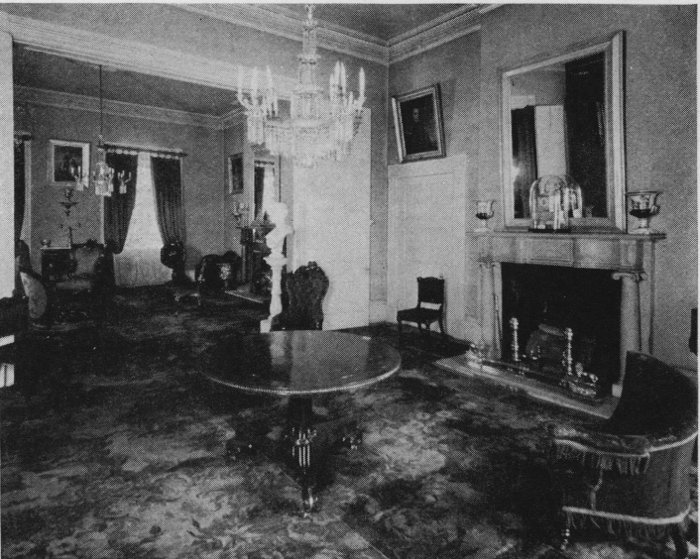
Parlors at the Hermitage
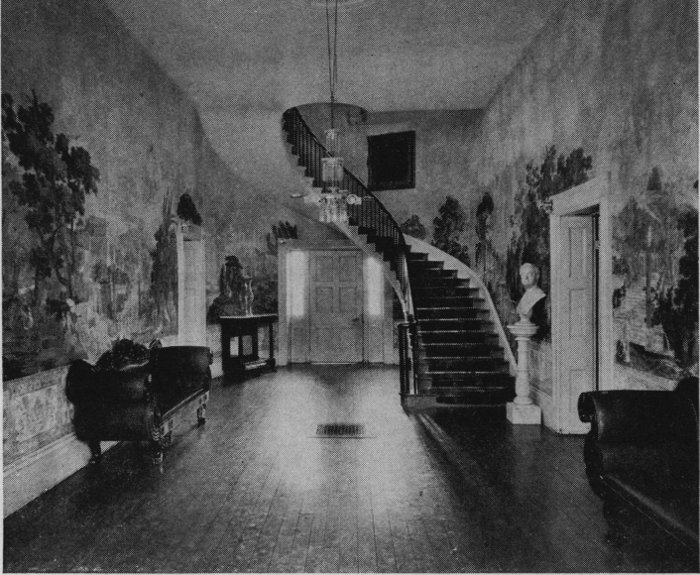
Below: The Front Hall
Showing the stairway and the historic Telemachus wall paper.
91
“The walls of the House being originally well built are not much damaged. The workmen Austin, Rife, etc say there will be no difficulty in rebuilding, etc. Some of the petition walls and arches over the windows, and some other repairing of the walls all of which Mr. Austin can furnish brick to do by deferring the building of some of Maj Donelson back buildings.... Andrew requested me to say to you that he would move to the Baldwin place, and will start 3 or 4 whip saws tomorrow, and will get ready to cover it immediately, which is entirely practicable....”
Col. Armstrong, after his promised visit, wrote: “The dineing room Wing is but Little injured and I view it this way that you have now the Stone and Brick-work of your House done, and one Wing Compleate, and that 2500$ will Compleate the main house and the other office Wing. The Kitchen and out Houses are all safe.”
Like most estimates, Col. Armstrong’s proved to be far lower than the final cost. The first estimate made by Joseph Rieff and William C. Hume amounted to $3,950. Added to this was $239 “for Extra work done upon change of Plan;” $186, “for work done on West wing and New Kitchen finding everything;” and $750 “for the full length two story Porch added finding every thing;” making a grand total of $5,125.
Among the interesting items included in the first 92 estimate were: “1 Circular stair case 2 storys high, $260; first story of front poarch with 6 collums etc, $256; second story of ditto, $75; one back Portico, $40....” (Complete details of the rebuilding are found in Bassett’s Correspondence of Andrew Jackson, Vol. V.)
A new house called, of course, for new furnishings. Sarah York with the adored little Rachel, born November 1, 1832, and her infant brother, Andrew, went on to visit the General at the White House. On this visit Sarah went on to Philadelphia to visit her own kin and while there made selections for the paper and the furnishings of the Hermitage.
One of the hitherto unpublished letters of the Hermitage collection, written at Washington April 14, 1835, by General Jackson, shows his interest in the furnishings, as well as his tender solicitude for Sarah York and the children:
“My dear Sarah: When you get a little rested from your journey make enquiry about the bedsteads and let me know at what the eight can be procured, of good plain mahogany.... I shall be anxious to hear from you, how my dear little Rachel is, as well as yourself and Andrew—I have great solicitude about my dear little Rachel. Keep the dear little ones for me—present me kindly to Mr. & Mrs. Wetherall and accept a father’s prayers for your health and happiness. We all salute thee kindly. Andrew Jackson.”
93
Sarah busied herself with shopping and soon she had purchased a splendid new outfit for the Hermitage. The bill, dated January 2, 1836 (Correspondence of Andrew Jackson, Vol. V.) included:
6 Mahogany Bedsteads, including the packing at 40, $240; 24 Fancy Chairs cain seat rich blue and gold at 2.50, $60; 4 Curtins, Crimson Silk lined with white Silk and full mounted at 75, $300; box $1, $301; 7 pair Tongs and Shovel polished steel pairs at 4.50, $31.50; 1 pair Do large, $75.50; 1 pair Chamber Candlesticks plated, $6; 1 Brass Fender, best, $13, box $1, $14; 1 Wardrobe Black and ornamented $50; 2 Wash Stands marble tops at $18, $36; 2 Do small at $5; $10; 2 large size Bureaus at $30, $60; 2 Center Tables at $30, $60; 8 Packing Boxes, $16.50; 5 Wire Fenders with Knobs, at $4.50, $22.50; 1 Nurcery Fender, $6.50; Box, $1.75; 2 pair Brass Andirons at $6, $12; 1 pair Brass Andirons, $6.50; 2 pairs Brass Andirons at $7, $14; 3 Setts of fine paper hanging Views Telemechus at $40, $120; 150 yards Super Nankeen Matting at .50, $75; 20 Yards Brussels 4-4 Stair Carpeting Crimson Damask Center with net Border at $2.87½, $57.50; 1 mahogany Bedstead packed, $40; 1 Mahogany Bedstead packed very fine, $60; 1 Blind large Size, $10; 1 pair Blinds to match, $10; 1 doz. 40 inch Stair rods $6.50; Box, $1.75. The grand total, including insurance on the shipments made on the boats, Bonnaffe, Mile, and Jno Sergeant, amounted to $1,364.50.
There was trouble about the wall paper, and again 94 General Jackson’s friend, Col. Armstrong, came to the rescue. He wrote, on May 27, 1836 (Bassett’s Correspondence, Vol. V.):
“Dear Genl. I send you inclosed a note addressed to me by the Mess. Yeateman after a conversation I had with them this morning. They have always been ready and willing to do all in their power to get back the paper from those who purchased it. When I call’d on Campbell I expected to get the paper, that night he cut it and put it on the Walls.
“Williams is not at home. I saw Shelly who will do nothing in it, he is not disposed to restore it. Williams dare not, as his wife claims it, so I call’d on the Mess. Yeateman and stated the facts who willingly proposed to purchase another set....”
There has long been a tradition in Nashville that the old Campbell house, not far from town, on the Lebanon Pike, had paper like that in the Hermitage hall, but it was, evidently, destroyed when the walls were scraped and re-papered. Further details concerning the determined woman who kept the paper have not, at the present writing, come to light.
A bill dated May 30, 1836, shows that Jackson’s merchant and personal friend, Henry Toland, of Philadelphia, arranged for another shipment of paper. This bill includes the items: “3 Views of Telemachus at $29, $87; 7 ps Pannell Paper, at $2.50, $17.50; 7 ps. 95 Bordering, at $3.00; $21; 4 ps. Plain Blue, at .75, $3.” A box cost fifty cents and five per cent was deducted because of the cash payment, making the final amount $122.60. The bill is marked “Received payment fr H Toland, October 25th 1836. Robert Golder, per Jas. Cameron Golder.”
Nancy McClelland, in her monumental work, Historic Wall-Papers, (Lippincott Company, Philadelphia, 1924) states that “the complete set consisted of 25 strips in colours, and the scenes are constructed on the account of the adventures of Telamachus.” It was manufactured in Paris by Dufour about 1825 and, though rare, was not an exclusive pattern. It is still found on the walls of certain historic homes and in a few private and public collections.
According to the late Mrs. Rachel Jackson Lawrence, daughter of Sarah York and Andrew Jackson, Jr., the Telemachus paper now on the walls of The Hermitage hallway is the third set of its kind purchased by General Jackson. The first, she declared, was put on the walls at the time of the remodelling in 1831 and was burned in the fire of 1834. The second was the one acquired by Mrs. Campbell and the third, which, like the others, is the work of Dufour, was placed on the walls some time after it was ordered in the late spring of 1836.
Sarah York selected papers for the Hermitage, but, as his letter of April 14, 1835, (Hermitage MSS. Collection) shows, President Jackson took a personal interest in the Telemachus paper.
96
“I rec’ a note from Mr. Toland,” he wrote, “after you left us, informing that Mr. South had forwarded the order to Paris for the Telamucus and the other would be detained until you arrived and made the selection for those rooms not selected for. As soon as you can attend to this and have the selection made and the paper shipped for New Orleans so that it may get up to Nashville before the Steam boats stop running. I have written Mr. Toland on this subject....”
Eighteen packages of furniture for the Hermitage were lost when the steamer John Randolph was burned at Nashville, May 16, 1836, but it is evident that they were replaced as quickly as possible. There was always, however, the delay of waiting for sufficiently high water, in addition to the long, tedious journey around the coast to New Orleans and up the Mississippi, Ohio and Cumberland to Nashville.
Another large bill of furnishings for the Hermitage was purchased of Barry and Krickbaum, of Philadelphia, in February, 1837. It included 1 Large Wardrobe, $75; 2 dressing Bureaus to match, $110; 2 Wardrobes, french pattern, $120; 1 Eliptic front Bureau, $5; 1 Secy and Bookcase complete, $50; 2 pier tables, marble tops, $120; 1 Work table Elegantly fitted up, $50; 1 Work Stand, marble tray top, $5; 2 Work Stands, marble tray top, $50; 1 Marble Slab, $10. Total $665.
About the same time a long list of smaller furnishings amounting to $481.93 was bought of Lewis Veron 97 and Company, Philadelphia. There were fenders, and irons, screens and such, things. Among them were “2 Pair french And Irons $70; 1 Gallérie for fire place, $55; 1 Clock Shade and Stand, very large, $17; 1 Plated Egg Boiler, $19; and one Silver Mounted Butter Tub, $12.” (The list is given in full in Bassett’s Correspondence, Vol. V.)
The new furnishings, with such as were left from the fire, were assembled in a harmonious whole toward the end of General Jackson’s second term as President. Sarah York, after her arrival at the Hermitage in 1832 had bought carpets, linens, and various necessities. General Jackson had written his son at this time:
“Sarah writes me about a Carpet for the dining room and some table linnen and common furniture for the Table. There were abundant supply. of table linnen, etc. etc. when we left the Hermitage, but I suppose it must have gone the same way as the sheets. I have said in my letter to Sarah inclosed that a carpet must be bought for the dining room. There is always a supply of the carpets made by the Shakers, to be had at Mr. Nichols, and she must buy such furniture as the House wants, having an eye to proper economy. This you will have done agreeable to her directions. I have named domestic carpet, as it will be cheaper and better than an oil cloth or matt....”
Again he wrote: “View those East India matts or 98 carpeting and see whether these recommended by Mr. Toland will answer better for the passage than oil cloth, and whether Sarah would prefer these to common carpets for the bedrooms....”
After all the delays and the characteristic confusion of moving the furnishings—old and new—were at last arranged. A weary old man—ill and hemorrhaging heavily from the lungs—turned his face eagerly to the spot which, in all the world, he loved best. To Nicholas P. Trist he wrote on March 2, 1837, “Your letter ... found me confined to my room, indeed, I might say to my bed, and I have been only four times down stairs since the 15th of Novb. last, altho I have been obliged to labour incessantly.... Tomorrow ends my official carier forever, on the 4th I hope to be able to go to the capitol to witness the glorious scene of Mr. Van Buren, once rejected by the Senate, sworn into office....”
Late in December, 1936, he had written Andrew Jackson Donelson, a letter of condolence—the spirited Emily, whom he loved deeply, but whom he, in high dudgeon, had sent home because she refused to receive the much-discussed Peggy O’Neal Timberlake Eaton, had succumbed to a lung trouble similar to that from which he was suffering.
“I have this moment recd. the sad and melancholy intelligence that our Dear Emily is no more.... I have no language in which I can express my grief.... My health is slowly returning, and my strength improving slowly....”
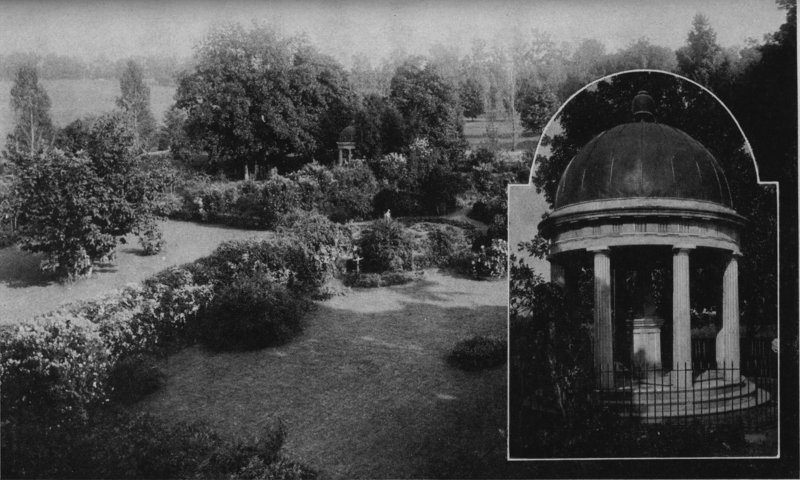
The Garden and the Tomb
Upon the tomb is carved General Jackson’s immortal tribute to his wife: “Her face was fair, her person pleasing, her temper amiable, her heart kind; she delighted in relieving the wants of her fellow creatures, and cultivated that divine pleasure by the most liberal and unpretending methods; to the poor she was a benefactor; to the rich an example; to the wretched a comforter; to the prosperous an ornament; her piety went hand in hand with her benevolence, and she thanked her creator for being permitted to do good. A being so gentle and so virtuous slander might wound, but could not dishonor. Even Death, when he bore her from the arms of her husband, could but transport her to the bosom of her God.”
99
The rest, sunlight, and pleasant atmosphere of the Hermitage were destined, however, to work a great improvement. His wiry, long-suffering body was to recover sufficiently for him to spend eight years in his new home before he was laid to rest in the garden beside the beloved Rachel. During these years his young men, under his wise guidance, had a tremendous influence in the nation—and in 1845, James K. Polk, who had openly conducted his campaign as “Young Hickory,” the legitimate political heir of the “sage of the Hermitage,” was inaugurated.
Andrew Jackson and his family, after Van Buren’s inauguration, made a triumphant progress southward and, on March 25, 1837, reached the Hermitage. To Martin Van Buren he wrote on March 30: “I reached home ... with a very bad cough, increased by a cold taken on board the Steam Boat.... I hope rest in due time may restore my health so as be enabled to amuse myself in riding over my farm and visiting my neighbors....”
But however interested he was in his farm and his neighbors he took time to write his successor and protégé several pages of very sound advice on state affairs:
“Fearlessly pursue your principles avowed, and the people will sustain you against all apostates, ambitious, 100 and designing men ...” and take care of “the safety of the deposit Banks of the West, and south....”
From that time onward the Hermitage was prominent in the eyes of the nation. The younger statesmen paid visits to “the sage of the Hermitage” as the ancients consulted oracles—and the masses continued to worship the “Hero of New Orleans.”
His domestic life flowed easily and pleasantly under the skilled and tactful direction of his daughter, Sarah. The adored little Rachel dogged his footsteps, rode with him, and, with her bright prattle, enlivened his days. Mrs. Marion Adams, Sarah’s older sister, now widowed, made her home at the Hermitage, and Rachel’s relatives came from their neighboring estates to pay respects to their beloved kinsman. Never was a lonely old man surrounded with greater affection or more kindly care.
But what of the outward appearance of the Hermitage of this period? There is every indication that the cedars along the driveway were set out at this time. A drawing of the Hermitage dated 1856 indicates that the cedars were still quite young at that time, and a statement of Parton, based on his visit to Nashville prior to the publication of his Life of Andrew Jackson in 1859, further corroborates it and gives, as well, an interesting picture of the appearance which the Hermitage finally assumed after its series of changes. He wrote:
101
“Now we leave the turnpike and turn into a private road, straight, narrow, a quarter of a mile long, the land on both sides dead level. We come to a low iron gate in a white wooden frame, which admits us to an avenue of young cedars, ending in a grove, through which a guitar-shaped lawn is visible.... We alight, at length, on the stone steps of the piazza, and the Hermitage is before us.... A two-story brick house, with a double piazza both in front and in the rear; the piazza wooden and painted white supported by thick grooved pillars of the same material and color. The floors of the lower piazza are of stone, and each terminates in a wing of the house....”
A familiar and cherished picture to Tennesseans, and to many thousands of Americans who have journeyed the same road to pay tribute to the memory of Andrew Jackson. Parton, like the Frenchmen with Lafayette, was struck by the simplicity of the Hermitage, but he was much impressed with the fertility of the land and the natural beauty of the estate. Like the Frenchmen, he, too, was much concerned with the “sad spectacle” of slavery, but he was convinced that the Jackson slaves had an unusually happy lot.
The best-known authority on the laying out of the cedar drive is the narrative of Mrs. Rachel Jackson Lawrence (“little Rachel”) which appears in the second volume of the late S. G. Heiskell’s Andrew Jackson and Early Tennessee History. Mr. Heiskell was not only 102 an eminent lawyer, but he was a careful and painstaking historian. He quotes Mrs. Lawrence as saying:
“Colonel Earle assisted in laying off the grounds, the front yard, at the Hermitage. My mother drew the plan, and Colonel Earle superintended the laying off, and the planting of all those cedars you can see there. He also laid off the center of the Hermitage garden. I think it was exposure to the sun, after being so closely confined in his studio, that resulted in his death. He came in, I remember, and sat down at the dinner table, and said he did not feel very well, thought he had something like a chill.... When supper time came, he was still feeling very badly.... About daylight he died with a congestive chill.”
Earl’s death was mentioned in General Jackson’s letters of September, 1838. “His death,” he wrote, “is a great bereavement to me ... he was my friend and constant companion....”
Mrs. Lawrence’s statement does not definitely place the laying out of the flower beds in the center of the garden. It is possible that, in those lonely days after his young wife’s death in 1819, he worked with Rachel Jackson in the garden of her new home. Frost, the English gardener may have worked with them. At any rate, the garden grew as the estate developed and, through the twenty years of his residence at the Hermitage, it must have delighted the beauty-loving soul of the artist.
103
But what suggested the guitar as a model for the drive? There is a tradition that General Jackson selected it because Rachel played the guitar—certainly, even at Hunter’s Hill, she played a harpsichord, and often accompanied the General when he played upon his flute. There is definite proof that Sarah York had a guitar, for General Jackson, in a letter written in Washington, April 12, 1832, said: “Your cousin Saml. J. Hays has agreed to take the Dog—will rest at Rockville with you tonight. He takes on Sarah’s Gator (guitar)—you must direct him where to leave it....”
Somewhere the connection between music and the cedars was seen by a mind poetic enough to look forward to a day when they would grow into a massive instrument upon which the pleasant winds might play. Perhaps “Old Hickory” himself conceived the idea—at any rate he approved it, or the drive would not have been planted. It is enough to know that in planting the trees he connected them with the music of at least one—perhaps two—mistresses of the Hermitage.
General Jackson was interested, too, in the willows which he had planted by Mrs. Jackson’s tomb and in the flowers she had loved. In a letter written to Andrew Jackson, Jr., on August 20, 1829, he expresses deep concern for the care of her grave in the garden:
“In your letter although you have informed me of your visit to your dear mother’s tomb, still you have not informed me of its situation, and whether the weeping that we planted around it are growing, or whether the 104 flowers reared by her industrious and beloved hands, have been set around the grave as I requested. My D’r son, inform me on this subject, you know it is the one dearest to my heart, and her memory will remain fresh there as long as life lasts....”
“As long as life lasts....” Each evening at sunset a failing old man turned his footsteps toward the garden. The chattering little girl who held his hand paused at the gate and watched in silence while he made his way slowly down the garden paths to the white stone temple in the lower end of the garden.
“No one ever went to the tomb with him,” Mrs. Lawrence told Mr. Heiskell. “I always went to the gate, and saw him in, but I realized he was going to the tomb. He would stay there a half hour, I suppose, then return. He did this as long as he was able to walk.”
It was not long to wait. Louis Philippe sent the artist Healy to paint his portrait, and Sam Houston was hastening from Texas that his fast-failing friend might lay his hands on his young son’s head in blessing. The portrait was finished three days before the old General’s death, but Sam Houston reached the Hermitage just a few hours too late.
The end came quietly and peacefully on June 8, 1845, and two days later Andrew Jackson was laid to rest 105 beside his beloved Rachel. Their mortal remains have rested peacefully in the earth they loved these many years, while the changing seasons have brought their fleeting beauty to the garden—but who shall say that their story has not become immortal?
106