CHAPTER EIGHTH First Contribution to Anatomy
Reading edition
Like all great teachers, Vesalius was ever mindful of the interests of his students. Soon after accepting the chair of Anatomy in Padua, he articulated a human skeleton for use in his class room. His next work was the preparation of a set of anatomical plates, Tabulae Anatomicae, which were intended to pave the way to anatomy for beginners. For the further benefit of his class, he edited an edition of Guinterius’s Institutionuin Anatomicarum, which was issued in April, 1538.
Tabulae Anatomicae
The Tabulae Anatomicae were in the form of Fliegende Blätter, or loose leaves, and consisted of six plates which are now among the rarest of medical works. They bore the following title:
Tabulae Anatomicae. Imprimebat Venetiis B(ernardinus). Vitalis Venetus sumptibus Joannis Stephani Calcarensis Prostrant verò in officina D. Bernardini. a. 1538.
In the preface Vesalius says that no one can learn either botany or anatomy from figures alone, but illustrations are a valuable means toward the imparting of 82 knowledge. In publishing these plates he hopes to benefit those persons who had attended his public dissections. Not a line in these pictures is unnatural; all has been reproduced just as he had shown in his demonstrations. He gives due credit to van Calcar, the artist who made the drawings of the three skeletons. The other pictures were made by the author himself.
The Tabulae Anatomicae were arranged in the following order:—
I.—The Portal System and the Organs of Generation; II.—The Venae Cavae and Chief Veins; III.—The Great Artery—Arteria Magna—and the Heart; IV.—The Skeleton in its Anterior View; V.—The Skeleton in its Side View; VI.—The Skeleton in its Posterior View.
The plates are of large dimensions, measuring over sixteen inches in length, and were cut in wood. Like those in the Fabrica, they were made in Italy. Owing to their transient use by medical students, the Tabulae were soon destroyed, although unauthorized editions were printed in several cities. The book was dedicated to Narcissus of Parthenope (Narciso Verdunno, or Vertuneo) who, in 1520, was first physician to the crown of Naples, and later, in 1524, was physician and councilor to Charles the Fifth. It is noteworthy that three of these plates deal with the skeleton, a subject to which Vesalius had given much attention. The absence of a plate showing the nervous system is also to be noted. Vesalius had such a 83 plate prepared, and it appeared in a pirated edition of the Tabulae which was published at Cologne in 1539. The large size of these plates, their fidelity to nature, and the skill with which they were cut in wood, were features which showed to the world that a real master of anatomy had been born. The original drawings were made by Jan Stephan van Calcar, who probably also was the engraver.
Only two copies of the Tabulae Anatomicae are known. A fine edition of these plates, reproduced by photography, was privately issued in 1874 by Sir William Stirling-Maxwell, the talented author of the Annals of the Artists of Spain.
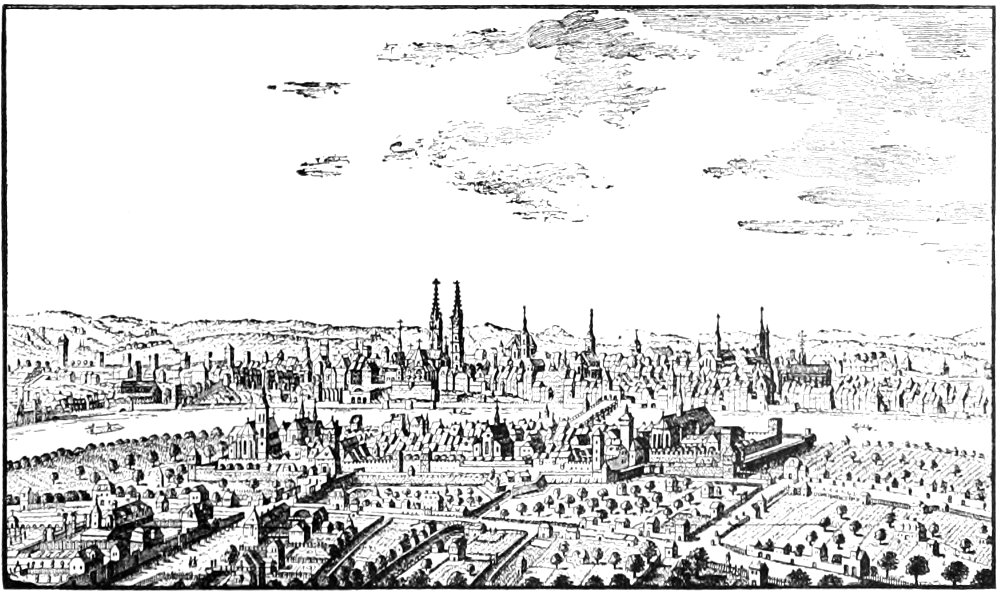
VIEW OF THE CITY OF BASEL IN THE SIXTEENTH CENTURY
84