CHAPTER TENTH Publication of the Epitome
Reading edition
Upon the thirteenth day of August, 1542, Vesalius finished the Epitome of his great book. The text and illustrations for it were forwarded to Basel by the same merchant who conveyed the manuscript and drawings of the Fabrica. The title of the lesser work is as follows:—
Andreae Vesalii Bruxellensis, Scholae medicorum Patavinae professoris, suorum de Humani corporis fabrica librorum Epitome. Basil., et officina Joannis Oporini, Anno, 1543, mense Junio.
This work is extremely rare. It belonged to the class of Fliegende Blätter and was issued unbound. Perfect copies of it are rarely found. The first twelve sheets are printed on both sides; the two last leaves are printed on one side only, in order that they might be cut out and pasted together to show two complete figures. Hence these sheets are often lacking. The Epitome appeared in the same year and in the same month as the Fabrica, but the latter work was printed first.
The Epitome is dedicated to Philip, the son of Charles the Fifth, who, after his father’s abdication, was known as Philip the Second of Spain. The title-page is printed from the same plate as the larger work; and Vesalius’s portrait also is present. From the fact that the dedication bears the inscription: Patavii, idibus Augusti 1542, the erroneous opinion arose that this work preceded the Fabrica.
96
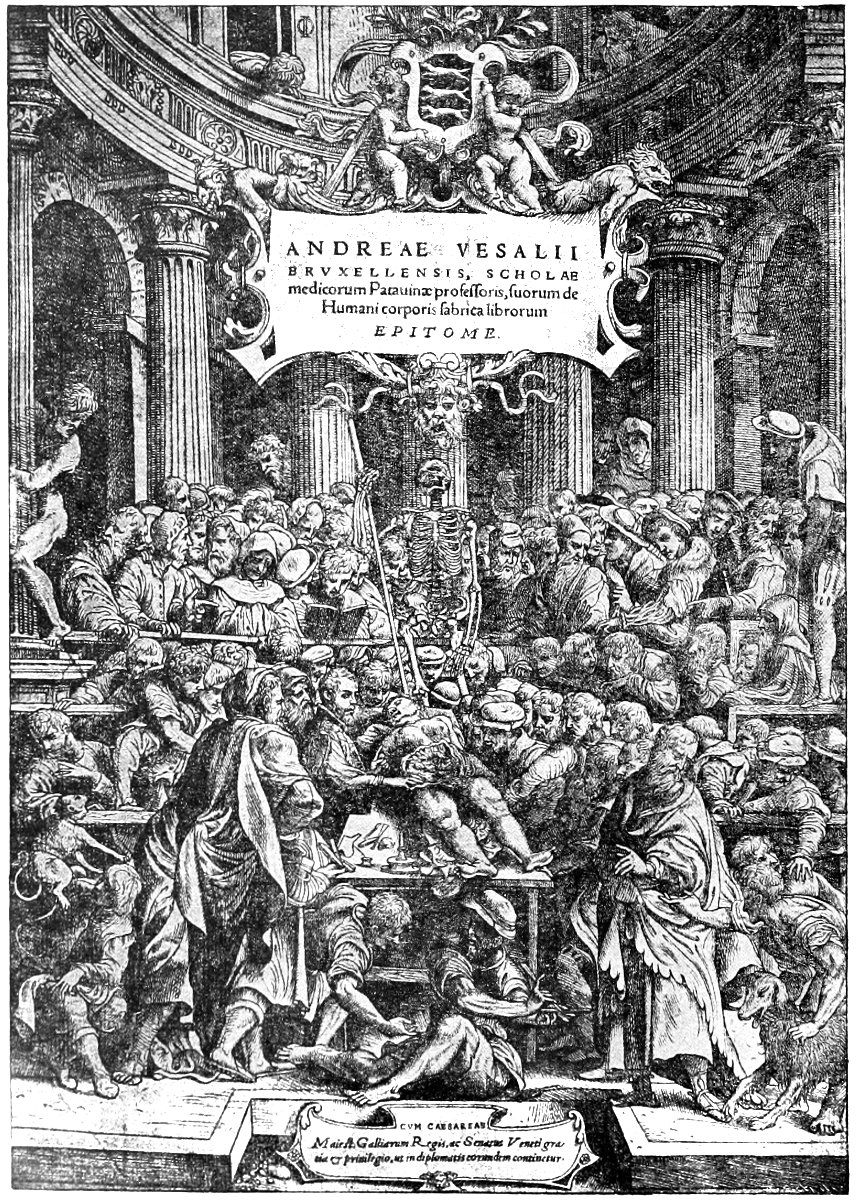
TITLE-PAGE OF VESALIUS’S “EPITOME”, 1543
97
Among the illustrations found in the Epitome are seven that are not in the large book; namely, five myologic plates, and the figure of a naked man and one of a woman. The myologic figures in the Epitome differ from those in the Fabrica in this respect: the muscles are drawn in their natural position, group, and order, so that the surgeon, in treating wounds and in performing operations, may have the correct relations of the parts in mind. Also, the one side of the figure differs from the other: the one showing the superficial muscles, while the other exhibits the deeper musculature. The muscles in the Fabrica, with the exception of four complete myologic figures, are represented as they appear in anatomical demonstrations, particular attention being given to their origins and insertions. For the purpose of the artist, the best figures are the three skeletons and the four complete myologic figures which are found in the Fabrica.
Two beautiful copies of the Epitome, printed on vellum, are in existence. One is in the British Museum and is thought to be the copy which was owned by the celebrated Dr. Richard Mead; the other one is in the possession of the University of Louvain.
Vesalius speaks modestly of the Epitome, which he regards as an index or appendix of the Fabrica, and is for the use of beginners in anatomy.
98
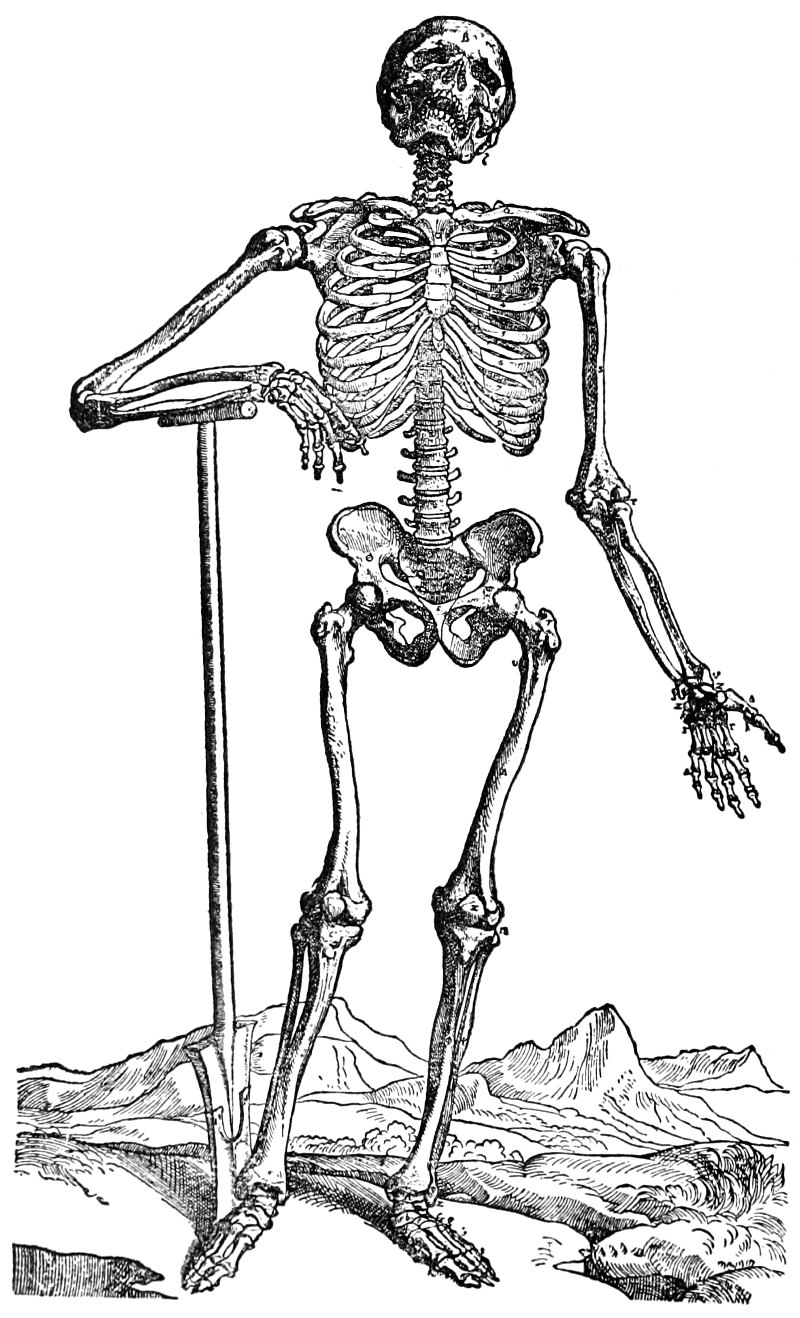
SKELETON BY VESALIUS (From the “Fabrica”, 1543. Reduced one-half)
99