Chapter III · The Great Enemies of Rome (continued 3)
Reading edition
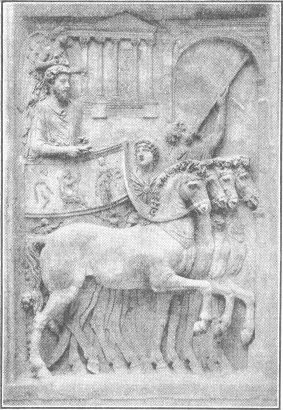
A TRIUMPH from a relief of the Empire
When he returned from his great campaigns in the East in the year 62 Pompeius landed at Brundisium and dismissed his soldiers to their homes. The senators heaved a vast sigh of relief. He was not going to be dangerous. When Pompeius arrived in Rome without his army he found that nobody much wanted him. People were more interested in the struggles that had been going on at home—Catiline’s conspiracy, Cicero’s strong line in putting the conspirators to death, the question whether Caesar had been implicated, the friendship between Caesar and Crassus—than in what Pompeius had been doing in the East. Without his army nobody was afraid of Pompeius. He found Lucullus, in the Senate and political circles generally, doing everything he could to thwart him, supported by Cato the Younger, who thought that imperialism, Eastern conquests, and new wealth were bad things, likely to ruin Rome. Pompeius celebrated a stupendous triumph which made him the idol of the mob; but the Senate would not hear of his being made consul or make grants of lands to his soldiers. The Conservative party had thwarted Pompeius at every turn; he was deeply hurt, and in his most sensitive part, his vanity. This hurt finally drove him into an alliance with Caesar and Crassus, the leaders of the Popular party, and his own most dangerous rivals. He disliked Crassus and feared Caesar. At the moment his support was invaluable to the Popular party; therefore Caesar set himself to overcome Pompeius’s distrust of himself and Crassus’s deep detestation of Pompeius. He had good arguments for each of them; and behind them a charm of manner that few people could resist.
Three years after Pompeius returned from the East the three strongest men in Rome were bound together. This first Triumvirate (60), as it was afterwards called, was a private arrangement. People only learned of its existence when they saw it at work. Pompeius married Caesar’s daughter, Julia, who, so long as she lived, kept him friendly with her father. Caesar was made consul and at once confirmed all that Pompeius had done in the East and made grants of lands to his soldiers. A big programme of land reform was passed through. The corn distribution was reorganized. People who criticized the Triumvirate too openly, like Cato, were banished. Cicero also was exiled, since Clodius had sworn vengeance on him. Caesar would have saved him by taking him with him to Gaul, as well as his brother Quintus, who was one of his adjutants; but Cicero refused. Caesar went off to Gaul the year after his consulship (58); Pompeius and Crassus were left masters in Rome.
There were at the time incessant disorders in the city. The strife of parties waxed bitter and furious. Fights between different political clubs were of nightly occurrence. The ingenious Clodius had reorganized the old associations of the workers into guilds of a more or less political kind, and thus built up a machinery in every quarter of the city which he handled with great adroitness at election times. Moreover, he organized something like a voters’ army of slaves and freedmen, which turned out on his instructions, and lived on the free corn given out by the State. Pompeius did nothing to cope with this state of things. He fell, in fact, into a strange condition of indolence, and took hardly any part in public affairs. The news of Caesar’s victories in Gaul did not rouse him, though Caesar’s popularity increased daily and his own declined.
Pompeius’s sloth at this period is sometimes put down to his extreme domestic happiness. Julia, his new wife, was but half his age, three and twenty. She possessed a full measure of the irresistible charm of her father; so long as she lived the bond between the Triumvirs was unshakeable. But her husband’s apparent indifference to public affairs was due, in the main, to another reason; the one which explains so much in Pompeius’s action and inaction both at this time and later. He stood aloof because he did not know what to do. The political tangle had become a knot that must be cut. Pompeius was not the man to cut knots. He let things slide.
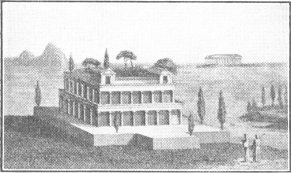
A ROMAN VILLA ON THE COAST Notice the roof garden
Disorder grew and nothing was done to stop it. The Senate, alarmed by Caesar’s growing popularity—a fifteen days’ festival was held in honour of his victories in Gaul—began to attack his new land and other laws. Pompeius did not trouble to defend them. Cicero had come back from banishment and made alarmist speeches declaring that Caesar was aiming at bringing the Republic to an end. Pompeius and Crassus quarrelled again. Yet when Caesar called his friends to meet him at Lucca, where he had gone into winter quarters (56), hardly any one in Rome refused to go. Pompeius, despite his growing jealousy and uneasiness, was reconciled to Crassus and the Triumvirate renewed. But as soon as he got back to Rome again, away from Caesar’s charm, he fell back into his old moody indolence. In the course of the next few years he became openly hostile to Caesar. Little heed was paid in Rome to what he was doing in Gaul. The death and defeat of Crassus at Carrhae (53), produced no deep stir. The disturbances in the city, which had been occasional, grew constant. More interest was felt by the ordinary citizen and even the ordinary senator in the brawls between Clodius and Milo than in anything happening outside Rome.
The Government was quite helpless. Things were plainly going from bad to worse. There was one strong man in the Roman world who might save the State; but the price of his doing it was one that made the Conservatives determined to have civil war rather. The clearer Caesar’s outstanding position became the more resentful were Pompeius’s feelings against him. Since his early youth he had been regarded by other people, and had come to regard himself, as the great man. Now, however, when there was a real opportunity for showing greatness he did not know how to do it; and saw, too, another likely to carry off the prize.
Julia’s death, two years after the meeting at Lucca, removed the one human being who might have prevented an open breach between Pompeius and Caesar, and left Pompeius’s jealousy to rule unchecked in his mind. Caesar, far from Rome, saw with clear eyes the meaning of what was happening there; Pompeius, though on the spot, did not or would not understand. He would never take action. For this very reason the senators looked upon him as a safe man and gave him powers far greater than any Caesar had or had ever asked for. He was made sole consul (52) and head of a special court which was to try all cases of disorder. Disorder had indeed been getting more and more serious; Clodius and Milo were rival candidates for the consulship. There were open fights, day and night, between their followers. At last Clodius was actually murdered by Milo’s ruffians on the Appian Way.
Pompeius did nothing, though in Rome he was all-powerful. Crassus was dead; Caesar far away in Gaul and hard pressed there. When Pompeius fell ill about this time prayers for his recovery were put up all over Italy; and when the news came that he was better great public services of thanksgiving took place. But as Plutarch says, this demonstration proved to be one of the causes of the civil war which followed. ‘For the joy Pompeius conceived on this occasion, added to the high opinion he had of his achievements, intoxicated him so far that, bidding adieu to the caution and prudence which had put his good fortune and the glory of his actions upon a sure footing, he gave in to the most extravagant presumption and even contempt of Caesar; insomuch that he declared, “He had not need of arms nor any extraordinary preparations against him, since he could pull him down with much more ease than he had set him up”.’ When people like Cicero expressed their fear that Caesar might march upon Rome with his army he said, ‘In Italy, if I do but stamp upon the ground an army will appear.’ Filled with such notions, he proceeded recklessly to drive Caesar to desperation. He refused to disband his own troops (two legions which he had lent to Caesar, and Caesar, on his demand, had returned to him loaded with presents); instead of backing Caesar’s candidature for the consulship for the year in which he was due to return from Gaul he opposed him in every way. Finally, he made it quite clear that if Caesar came to Rome without his army he would be in serious danger; and at the same time insisted that he should do so.
What this must lead to was plain enough to people in Rome. When they heard that Caesar had crossed the Rubicon (49) at the head of his troops (regardless of Sulla’s law) they fell into a panic. The Senate was terrified of Caesar and not much less afraid of Pompeius. But disunited as the Conservatives were among themselves, he was the only man who could hold them together at all, and their only general. If Pompeius had acted firmly at the crisis, whether with Caesar or against him, he might have prevented the civil war. But at a time when every day was vital he did nothing at all for several days, remained in his own house without giving any lead or staying in any way the gathering tumult and excitement. Refugees began to pour into Rome. For some reason or other every one took it for granted that Caesar was going to march on the city, though as a matter of fact he had made no move. At last Pompeius declared that the country was in danger and that every one should leave Rome. He himself left the city to muster the great bodies of soldiers in Italy into an army. Very soon afterwards the consuls fled, in such a hurry that they left the State treasures behind them, and with most of the senators joined Pompeius at Brundisium, whence they intended to sail for Greece.
Perhaps only a poet could interpret what was happening, in this time, in the mind of Pompeius. Lucan thus describes it:
The Last Phase: the ‘Shadow of a Mighty Name’
You fear, Magnus, lest new exploits throw past triumphs into the shade, and victory over the Pirates be eclipsed by the conquest of Gaul; your rival is spurred on by the habit of continuous enterprise and a success too proud to take the second place; for Caesar will no longer endure a greater nor Pompeius an equal. Which of them appealed more righteously to civil war, we are not permitted to know. Each has the support of a mighty judge; the gods approved the cause of the conqueror, Cato of the conquered. They were not, indeed, equally matched. Pompeius was of an age already failing in decay, and during the long repose of peace and civil life had forgotten the practice of command; eager to be on the lips of all, lavish in his gifts to the mob, swayed by the breath of the people’s will, and flattered by applause in the theatre that he built. Careless, too, of gaining fresh stores of strength, and relying over much on earlier success, he stands the shadow of a mighty name; like an oak that, towering in some fertile field, bears spoils offered by the people of old and votive gifts of their leaders; no longer cleaving to the earth by stout roots, it is kept upright by its own mere weight, and thrusting leafless branches through the air, gives no shade save from the naked trunk. Yet, though it rocks and soon will fall before the first blast from the east, though around it so many forest trees raise their stems unshaken, it is worshipped alone.
Lucan, Pharsalia, i. 121-43.
First in leaving Rome and then in leaving Italy Pompeius made fatal mistakes. Caesar was soon master of Italy, almost without bloodshed. Within the year he had reduced Spain and Sicily, the Roman granaries, after severe fighting; built a fleet and sailed for Greece. There he tried to induce Pompeius to meet him and so come to a settlement. Pompeius refused.
He believed that his army was stronger than Caesar’s. He and all his friends were full of bitterness, and quite sure of victory. They had, indeed, every advantage on their side, in numbers and supplies, and could afford to wear Caesar down by a waiting policy. This was Pompeius’s own plan, and it was sound. But he allowed himself to be overruled largely because of the gibes of his followers. He moved from Dyrrachium, where he had held a very strong position, to the plains of the Enipeus river. At Pharsalia a great battle took place (48). Pompeius was defeated. His defeat was largely his own fault. He had 43,000 men to Caesar’s 21,000 and was especially strong in cavalry. By a skilful stratagem Caesar defeated the cavalry; when Pompeius saw this he believed the day was lost; left the field and hid himself in despair in his tent. Deserted by their general his lines broke; the defeat became a rout. His army was wiped out. Pompeius himself fled to Egypt with a handful of attendants. There he was murdered by the Egyptians, under the eyes of his wife and son.
Caesar, it is said, wept when Pompeius’s seal-ring was handed to him, and he knew that his great rival had perished. He set the statue of Pompeius up again in Rome; and might, thereby, have seemed to rebuke, almost in the words Shakespeare puts into the mouth of Marullus, the fickle people of Rome who so soon forgot him who was once their idol.
A Broken Idol
Marullus. Wherefore rejoice? What conquest brings he home? What tributaries follow him to Rome To grace in captive bonds his chariot wheels? You blocks, you stones, you worse than senseless things! O you hard hearts, you cruel men of Rome, Knew you not Pompey? Many a time and oft Have you climb’d up to walls and battlements, To towers and windows, yea, to chimney-tops, Your infants in your arms, and there have sat The livelong day, with patient expectation, To see great Pompey pass the streets of Rome: And when you saw his chariot but appear, Have you not made a universal shout, That Tiber trembled underneath her banks, To hear the replication of your sounds Made in her concave shores? And do you now put on your best attire? And do you now cull out a holiday? And do you now strew flowers in his way, That comes in triumph over Pompey’s blood? Be gone! Run to your houses, fall upon your knees, Pray to the gods to intermit the plague That needs must light on this ingratitude.
Shakespeare, Julius Caesar, I. i.
XI Marcus Licinius Crassus
Of all the wealthy men in Rome, whether like Lucullus or Sulla they had brought their riches back from foreign conquests, or extracted it from the people of the overseas provinces as governors, or made it in business, the wealthiest was Marcus Licinius Crassus. His riches became a standard by which other men’s were measured. Crassus belonged to an old but comparatively poor family which suffered much in the wars of Marius and Sulla. He himself as a very young man was, like Pompeius, one of Sulla’s lieutenants. Like Pompeius again he had founded his fortune at the time of Sulla’s proscriptions. But the extraordinary and constant increase in his wealth was due to his own unresting energy and extreme ingenuity, helped by the fact that he was not in the least scrupulous.
The houses in which the ordinary Roman lived were chiefly built of wood: only very rich men had stone or marble houses at this time. The streets were extremely narrow, and many of them very steep and crooked, and the dwellings, whether single houses or great tenements, were crowded closely together. As the buildings grew old they were apt to fall down, especially the high flats, which became top-heavy. Serious fires were also very common. Crassus observed this. He therefore collected a great body of slaves, skilled as carpenters and masons. He also equipped others as a fire brigade. When a fire broke out anywhere he would make an offer to the owner to buy the house very cheaply. Were his offer accepted he would put out the conflagration and rebuild. Were it refused he would let it burn. At the same time he bought up at cheap rates houses in bad repair and likely to collapse, which he therefore got at low prices. In this way he became owner of a great part of Rome, and, as more and more people were constantly crowding into the city to live, and the supply of houses was less than the demand for them, he could and did charge high rents. People who refused to live in his houses could find nowhere else to go.
This was one of the means by which Crassus acquired his riches. But he was incessantly alert and active to spy out opportunities in this direction or in that for making money. His energy never relaxed: he was always busy. He never fell into idle ways or the kind of stupid amusement in which so many Romans, young and old, frittered away most of their time. At a time when he owned half the houses in Rome, and so many members of the Senate were in debt to him that they dared not vote against his wishes, he built for himself only one house, and that of moderate size. He enjoyed money-making as men enjoy any pursuit of which they are master. After a time, however, he grew so rich that a new ambition seized him. He began to thirst after direct political power—not merely the indirect power which his money gave him. Crassus was no fool. In financial affairs of all kinds he had courage, resource, ingenuity, determination, and persistence, with that touch of imagination which belongs to any kind of genius. It was not only by accident that everything he touched turned to gold. But his imagination was of a narrowly limited kind. He understood all the lower motives that move men but none of the higher ones, for he understood only what he found within himself, and within himself there was no room for the power of any kind of idea.
With most Romans of his time religion had become a dead thing. They kept the sacred images in their houses and performed all the official and recognized ceremonies. But this was matter of custom and manners, like the rules of dress. There was no reality or feeling in it. The reality of Roman religion had been men’s devotion to their country and the belief in the city as a great thing whose life went on after their own ended. In its service they had been prepared to spend themselves, for it to die. This kind of devotion had been profoundly shaken. The average Roman of Crassus’s time believed in nothing but his own pleasure, and in power and glory for himself.
In this Crassus was exactly like them. He was the richest man in Rome, but riches after a time ceased to satisfy him. They did not give him popularity. This it is true was partly his own fault, for Crassus, like many very wealthy men, combined reckless occasional expenditure with steady meanness. He gave the most gorgeous shows; but he hardly ever let off a debtor. His hardness in collecting small sums was a byword. He would spend thousands one day and haggle about a shilling the next. Of course it was this careful looking after the pence that had made and kept Crassus so rich; but it did not make him beloved. Nor, though he was a very capable soldier, could he compete in this respect with Pompeius, who always seemed to manage to get the showy things to do while other people only got the hard work. When Crassus boasted of his exploits in the campaign against Spartacus, people shrugged their shoulders. Yet the Slave War had been a most serious danger, the more so that it broke out at a moment when difficulties were dark on every side.
More than once in the last few years Rome had suffered severely from a shortage in the supply of wheat that meant actual famine for the poorer people. In Italy the fields which used to grow corn had been increasingly planted with vine and olive—more profitable crops. The corn grown in the countryside was not much more than sufficient for the needs of the people living there. Rome depended in the main on supplies from across the seas. Although the Sicilian towns were legally bound to send a certain proportion of their crop to Rome they did not always do so, and the Government was extremely slack in keeping them up to the mark. A serious famine occurred in the year of Mithridates’ invasion of Bithynia, which looked dangerous enough. At the same time came the news that the commander who had been sent out against the pirates who were devastating the Cilician coast had been seriously defeated by them and, worst of all, that a great rising of the slaves had broken out throughout Italy (73).
This Slave War proved more serious even than at first appeared. The slaves had not merely risen in great bodies: they had found a leader who proved a real military genius in Spartacus. Spartacus was a Thracian, and like most of his fellow slaves had been a prisoner of war.
These slaves were not the ordinary household slaves, many of whom were treated kindly enough, or those employed in crafts and industries. They were for the most part men kept in compounds under training for the games. All over Italy there were training schools, belonging to rich men, where picked slaves, chosen among prisoners of war because they were tall, strong, and handsome, were kept and taught to fight as gladiators. The conditions of these schools were very bad and the unfortunate men in them had nothing better before them than the chance of death in the arena. The taste of the Roman people was growing brutal; the part of the shows given them by successful generals or politicians who wanted popularity that they liked the best were the gladiatorial fights: fights between men armed in different ways that went on till one or other of the combatants was killed. A favourite combat was that between a man armed with a trident and another provided with a net. Sometimes these fights took place between bodies of men. Like the Spanish bull fights, these shows excited the people of Rome beyond anything. Good swordsmen fetched high prices and won fame for their owners.
These unhappy men were for the most part prisoners of war; many of them had been chiefs and leaders in their own country, and were men not only of strength and courage but of intelligence. In the big training school at Capua there was such a man among the slaves: Spartacus, a Thracian chief. His mind rebelled against the hopelessness of his lot and he stirred up his fellows. Eighty of them broke out from captivity and made their escape to the slopes of Vesuvius. There they built a strong camp, and, as the news spread of what they had done, slaves from all over Italy joined them: some breaking out of the schools and prisons as they had done, others running away from their masters and places of employment. A small force was sent against them. They drove it back in disorder and captured its weapons. This success encouraged further risings. Spartacus was soon at the head of a considerable force. In the next year (72) he defeated a consular army. His own numbers rose to over 40,000. The war was fought with horrible cruelty and bitterness on both sides. Neither gave nor expected any mercy. All captured slaves were put to death. Spartacus compelled three hundred Roman prisoners to fight as gladiators at the funeral games held for a fallen slave captain. Farms and country houses were plundered and burned.
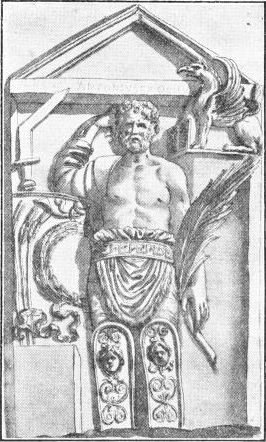
A THRACIAN GLADIATOR
The growing success of the slaves filled people with terror: they dreaded a general massacre of the rich. Yet it seemed impossible to crush them. Spartacus showed rare qualities as a general and organizer; and after he had defeated both consuls, in the following year, and began to move northwards, there was something like a panic in Rome. No one was willing to undertake command against him. At last Crassus came forward. Here, he thought, was his chance to win glory equal to that which Pompeius was gaining in Spain. His quick eye saw that the Roman armies were falling to pieces through bad discipline: his first task was to restore the strictness of military law.
In the beginning Spartacus seemed too strong and skilful for him, but Crassus knew that in the end jealousies were sure to break out in his ranks, since the slaves were men of different nationalities, only held together by the will and skill of their commander. At last, after long months in which success seemed hopeless, so hopeless that the Senate recalled Pompeius from Spain to Crassus’s infinite rage, he compelled Spartacus to fight a battle. He was killed and with him 12,000 of his followers. They fought heroically, their wounds were all in front. Pompeius as he crossed the Alps met only the bands of desperate fugitives fleeing from the conqueror. He put them to the sword and afterwards, to the disgust of Crassus, claimed a share in the victory. ‘Though Crassus’s men defeated the gladiators in battle, I plucked the war up by the roots’, he told the Senate.
Next year (70) Crassus and Pompeius were elected consuls together. This did not make them friends. Crassus disliked Pompeius and was exceedingly jealous of his great position and influence. He did not see why he should not be recognized as as big a man as Pompeius. Pompeius was cold, lazy, self-satisfied; good fortune rained its golden shower upon him and he stood and gathered it up in his hands. Crassus, tingling with energy, alert in every nerve, was exasperated when he thought of Pompeius.
But he was intelligent enough soon to realize that he would not rise to the position and power in the State he wanted by his own unaided efforts. Nor had he to look far to find the person who could give him what he had not himself got. Pompeius’s success filled him with anger and bitter envy because he disliked Pompeius. His self-satisfied and slow temper annoyed him. For the powers of Julius Caesar, on the other hand, Crassus felt nothing but lively admiration, wonder, and even devotion. He realized his extraordinary qualities at a time when Caesar was unpopular and unsuccessful. Moreover, he was conquered immediately by Caesar’s personal charm, and never ceased to feel it. Caesar was loaded with debt: his want of money was his main personal difficulty. His main political difficulty was the fact that the Democratic or Popular party had become stamped, at the time of Marius and Cinna, as the party of revolution and disorder. To Caesar, therefore, Crassus was invaluable: a firm bond was sealed between them.
Some years later Caesar actually succeeded in reconciling Crassus to Pompeius by persuading them that as long as they levelled their artillery against one another they raised people like Cicero and Cato the Younger to importance. These men would be nothing and could do nothing if Crassus, Pompeius, and himself were friends and acted together. He soon proved to be right. The Triumvirate were irresistible. First Caesar was consul (59): then, four years later (55), Crassus and Pompeius.
Crassus’s thirst for glory made him eager to have, in the year after his consulship, a great and important provincial command. To his delight, while Pompeius took Spain and Caesar remained in Gaul, he was given Syria. Although he was by now sixty the most fantastic visions of triumph and conquest immediately floated before his eyes: he saw himself performing feats in the East which should altogether outshine those of Lucullus and Pompeius. There was no war going on in that part of the world, but Crassus at once made up his mind that there should be war since it was the straight path to honour and renown. He would attack Parthia and conquer a new and rich country for Rome. This he planned regardless of the fact that the Parthians were actually allies of Rome. The ideas sown by Lucullus were bearing fruit.
Crassus was elderly. It was long since he had directed a campaign, and campaigning in the East was new to him. Neither he nor his son Publius, who after serving with Caesar in Gaul came with him as his aide-de-camp, or any other member of his staff, knew anything of the geography of Parthia. After gaining quick successes in Mesopotamia he returned to Syria for the winter instead of going forward and making, as he could have done, allies in the cities of Babylon and Seleucia, cities always at enmity with the Parthians. As it was, while he was busy inquiring into the revenues of the cities of Syria and weighing the treasures in the temples, the Parthians, warned of his intentions, were making preparations against him. Accounts of the scale of these preparations were brought in which alarmed the Roman soldiers. They had imagined that the Parthians, a most warlike people, were tame folk such as Lucullus had found the Armenians and Cappadocians. A series of terrific thunderstorms seemed to them to herald disaster.
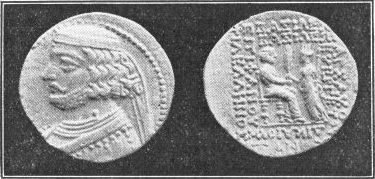
ORODES THE PARTHIAN
Crassus, however, paid no heed to the murmurs of his officers and men. He had no lack of courage or energy, and did not at all realize his danger. Moreover, he was deceived by spies into a false security. Thus he marched too far into a country about which he knew nothing. Suddenly his scouts brought in news that a great army was advancing. Very soon the Romans were upon this army. They found that its advance guard was composed of a kind of warrior never met by the Romans—bowmen on horseback, and bowmen of most deadly skill, whose arrows could pierce a steel cuirass, whose aim was sure and whose rapid movements made it almost impossible to stay them. Indeed, within a very short space of time the Roman army was hemmed in and surrounded. Crassus showed great intrepidity, but his men could not withstand the superior numbers and dreadful skill of the Parthians. With great difficulty he succeeded in extricating a portion of his men; but the day closed in defeat and the survivors were in the darkest spirits.
Next morning the enemy advanced again with loud shouts and songs of victory and a fearsome noise of drums. And in the front of their line was a man carrying on a high spear the head of young Publius Crassus, the son of the Roman commander. This sight sent a thrill of horror through the army. Crassus alone showed greatness of mind. Plutarch gives the following account of his behaviour:
Carrhae
Crassus was in this condition. He had ordered his son to charge the Parthians, and as a messenger had come with the news that there was a great rout, and that the enemy were being hotly pursued, and as, besides this, he saw that the force opposed to him was not pressing so hard (for in truth the larger part had moved off to meet Publius), he regained courage somewhat, and, concentrating his force, posted it in a strong position on some slopes, in the expectation that his son would soon come back from the pursuit. It proved, however, that the first messengers sent to him by Publius when he realized his danger had been intercepted by the barbarians and slain, while others, getting through with difficulty, reported that Publius was lost if he was not supported strongly and at once. Then Crassus became the prey of contrary impulses and no longer able to take a reasoned view of anything, being distracted between the desire to help his son and the fear of risking the safety of his force as a whole. At length he determined to advance.
Meantime the enemy were hurrying to the attack, more terrible than ever, with yells and shouts of triumph, and the kettledrums thundered again round the Roman ranks, as they stood expecting another battle to begin. Some of the Parthians, who were carrying the head of Publius stuck on the end of a spear, rode close up and displayed it, insolently asking about his parents and family, for it was monstrous, they said, that a noble youth of such brilliant courage should be the son of a coward like Crassus. This sight, more than all else, crushed and broke the spirit of the Romans, for they were not strengthened, as they should have been, by a resolution to defend themselves, but were seized, one and all, with fright and panic.
Yet it is said that Crassus never showed himself so great as in this disaster. Passing along the ranks, he shouted, ‘This grief touches me, and none besides, but by your success alone can the honour and glory of Rome be preserved inviolate and unconquered. If you pity me for the loss of a gallant son, prove it by your fury against the enemy. Take from them their triumph, punish their ferocity, do not be cast down by our loss. Great aims are never realized without some suffering. Lucullus did not overthrow Tigranes without bloodshed, nor Scipio Antiochus; our ancestors lost a thousand ships off the coast of Sicily, and in Italy many dictators and generals; but never did these defeats prevent them from crushing the conquerors. It is not by good luck, but by endurance and courage in the face of peril, that Rome has risen to its height of power.’
Plutarch, xxxix. 26.
Faulty generalship had brought the Roman army into a position whence no courage could save it. In the second day’s battle a terrible defeat was sustained: no less than thirty thousand Romans perished in the disaster of Carrhae (53). Crassus himself was killed in a parley afterwards.
It is said that a few days after the battle, before the news of it had reached him, the Parthian king was witnessing a performance of the Bacchae of Euripides in which there is a scene where one of the dancers comes in bearing a bleeding head. The actor who took this part carried the head of Crassus, which he cast, amid shouts of joy, at the king’s feet.
Such was the tragic end of the millionaire Crassus. The news of his death and defeat came to Rome but caused no excitement there. The city was more interested in the street brawls of Clodius and Milo. The politicians were watching the growing conflict between Caesar and Pompeius. Crassus had dropped out of the Triumvirate. The stage was cleared for the great duel.
XII Marcus Tullius Cicero
Of none of the men of his own time do we know so much as of Marcus Tullius Cicero. His contemporaries we know from the accounts given and judgements passed by others: Cicero we know from his own. He was the first speaker of his age, and his speeches deal largely with the politics and people of his time, as he defended or attacked the men and their acts. Cicero was anything but impartial; yet it is from what he says that much of our picture of Caesar and Crassus, Pompeius, Antonius, Catiline, Clodius, Cato, Brutus and a host of others are drawn. In all the long gallery of portraits he has painted none is so sharp and vivid as his own. It comes to us not only through his speeches but through all his writings—and he wrote admirably on many philosophical and semi-philosophical subjects—and above all through his letters. These letters are addressed for the most part to his intimate friend the banker Pomponius Atticus, but also to others including most of the prominent men of his time, and to his daughter Tullia, to whom he was devotedly attached. They give a day-to-day picture of the life of Rome and also of the man who wrote them. Cicero was immersed, like most men of his time, in politics. He rose, to his own ineffable delight (a delight which he expresses again and again with childlike complacency), to be consul. But the explanation of a character that at times amused and at times exasperated his contemporaries, and has caused the same mixture of feelings to much later admirers, is that he was, in his essence, an artist. He wanted, as do many artists, to be and do other things. He was more vain of his dubious success in politics than of the splendour of his oratory or the beauty of his writing. In action he was timid, uncertain, and quite unable to cope with the great currents of his time, snobbish and constantly mistaken in his judgements of people, and alternately elated and despairing in his view of public events. When he takes up his pen he is a master.
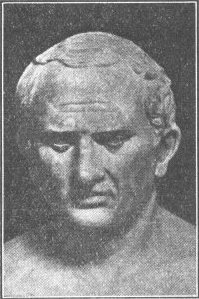
CICERO
Cicero was in some ways typical of the new men in Rome. He was born at Arpinum, where his family belonged to the Italian middle class. His parents were sufficiently well-to-do for the young man to receive an excellent education, completed, like that of other well-bred young men of the time, by attending lectures in Athens on literature and philosophy. His father’s death brought him a fortune that though not large was sufficient, together with a small estate at Arpinum and a house in Rome.
But Cicero had no mind for a life of fashionable idleness. For a middle-class provincial there was little chance in politics, so long as Sulla’s laws stood. He therefore turned to the law courts. There he soon made himself a great name, the more distinguished since he kept up the old custom of refusing fees. A wealthy marriage increased his consequence. His honesty and ability made him respected by all sorts of people. Cicero used his gifts in the most honourable way by defending the people of the provinces, who before his time had hardly ever got a hearing, against the rapacity of some of the Roman tax collectors. A case which made his name known throughout the Roman world was the prosecution of Caius Verres which he undertook on behalf of the people of Sicily. Verres, once an officer in Marius’s army, was a man of notoriously bad character. Like other praetors he looked on his governorship simply as an opportunity to make money for himself and his friends; it was freely said, even in Rome, that his misrule was ruining Sicily. And Sicily was one of the chief granaries of Rome. The greatest excitement was aroused over the case because the Democratic party took it up as a means of discrediting the Government; and at the same time brought in a Bill for the reform of the law courts by making the jurors not senators only, but, as before Sulla’s time, men belonging to the Equestrian Order. This frightened the Conservatives: they saw that much hung on the case of Verres. Quintus Hortensius, the most famous advocate of his time, agreed to defend him.
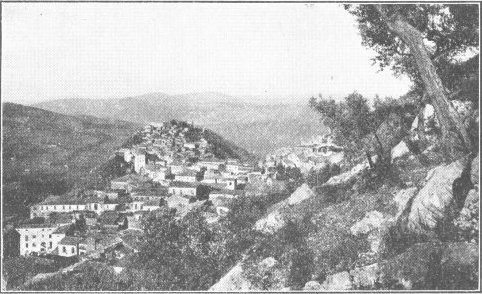
ARPINUM. Cicero’s birthplace
Cicero went to Sicily to collect evidence. He was quick to feel, in all his sensitive nerves, the tense atmosphere of excitement gathering round the case. It was to make or mar him. His genius rose delighted to the great occasion. He understood, as the Conservatives did not, the feelings that were dumbly stirring the mind of the ordinary decent Roman, and could give them voice. As the evidence he had collected was unrolled the story of the greed of Verres and the suffering of the people of Sicily was laid bare step by step. Excitement and anger against the class in power who did and defended such things grew and grew. Each day an enormous crowd thronged the Forum and at times its feelings made it positively dangerous. One witness told how a Roman citizen had been crucified: his appeal, ‘Civis Romanus sum—I am a Roman citizen’, had fallen on deaf ears. At this the hearers were stirred to such rage that Verres was only saved from being torn to pieces by the adjournment of the hearing. After fourteen days the defendants realized that their case was lost; no judge dared acquit Verres. He fled the city and was never heard of again. Cicero was the hero of the hour.
The man who appears and feels himself a hero when addressing a great crowd, who can work their feelings and his own into tempestuous enthusiasm, is often a weak reed, swayed by every impulse and incapable of the long slow effort required to carry a purpose into action. This was the case with Cicero. When speaking he was carried away by his own passion. Then he appeared to know exactly what he thought. Alone, however, he was moody, a prey to fearful doubt and depression, one day full of enthusiasm, the next despairing. He was at once vain and timid; uncertain of himself and turned this way and that by the praise or blame of others. His great desire was to be admired by every one. His comparatively humble origin made him feel any attention from the nobles far more flattering than it was.
In a good sense as well as in a bad he was a Conservative. His study of history made him feel full of respect for any institution that had lasted a long time, and for men belonging to ancient families. He felt this even at a time when his writings and speeches were making him known throughout Italy and admired by men whose praise was worth having. The rich men and many of the aristocrats were far inferior to Cicero in brains and character; yet he longed and strove to get into ‘society’. Society at the time was extravagant, frivolous, vicious, and hard-hearted. Cicero was modest and frugal in his personal habits, serious in the bent of his mind, a man of high moral principle and tender domestic affections. Yet nothing pleased him more than an invitation to one of the houses of the smart set; nothing vexed him more than to be thought old-fashioned or middle-class in his ideas.
All these feelings made him regard his own election to the consulship, and the support he received as candidate from the noble Conservatives, as the most wonderful affair. Yet the real reason why the Conservatives supported him was not that they loved Cicero but that they loathed Catiline, the third strong candidate, and were prepared to go to great lengths to keep him out. Antonius, who was elected as Cicero’s colleague, though a friend of Crassus, was considered to be harmless.
This consulship was the turning point in Cicero’s life. He had always wanted to stand well with all parties. Now he was compelled to take his place definitely on the Conservative side. More than that, it finally caused him to lose his sense of balance altogether and to think of himself as a statesman: a part for which he was ill fitted. He was so much impressed with his own importance that he bought a vast house on the Palatine. To do so he had to borrow money and thus got into debt. Before he had been free, after his consulship he became entangled and embarrassed.
This was the case with many of the leading politicians and men of all parties, and hampered their actions in countless ways. In order to win popular favour they spent huge sums on shows and gave feasts and presents to the populace. They lived altogether in a way expensive and showy beyond their means. To do this they had to borrow money at exorbitant terms, and were thus helplessly in the power of the rich men who lent to them. Caesar at this time was fearfully in debt and constantly in difficulties on this account. So were innumerable fashionable young aristocrats. The Roman laws of debt were still extremely harsh and all acted against the unfortunate debtor. Prices were steadily rising: the vast wealth of the few made the lot of the many increasingly hard. While Lucullus was in the East there had been a serious financial crisis in Rome, and the effects of this lasted for a long time.
As a consequence of this state of things a vast number of people of all classes were stirred to wild excitement and enthusiasm when Catiline, who was determined to be consul and by no means inclined to sit down under one rebuff, set out a programme of which the chief item was a wiping off of a large part of all outstanding debts. The poorer people were on his side in this almost to a man. So were a great many needy aristocrats, especially among the younger men. The rich, on the other hand, especially the class of Knights, to which most of the big financiers and trading houses belonged, were furious. They were ready to throw all their influence and the great power of the purse on to the side of the Conservatives, who cried that Catiline’s programme meant revolution. On both sides the wildest excitement and the most extreme bitterness of feeling was stirred up.
Catiline was a man of low character, and of very bad record, quite reckless. But he was by no means without ability. There was something to be said for his programme if nothing for the man who proposed it. Certainly the law of debt needed to be reformed. The rich did not argue against it: they fell into a panic. They saw that popular feeling and popular votes would be on Catiline’s side. But they had money and could bribe. They did bribe so effectively that when it came to the election he was beaten again.
The alarm of the propertied classes did not, however, die down, or the excitement of the disappointed. People had talked of revolution and civil war so loud and long during the elections that they began to believe in it. Cicero had been going about for days with a cuirass under his toga. He really believed that grave plots were on foot. He spent his time listening to spies and informers. One day he came down to the Senate with a very long face declaring that he ‘knew all’. He produced no proofs, but most people were too much excited to ask for proofs. The word plot was enough. A state of siege was proclaimed in the city.
Soon afterwards news came that a follower of Catiline had actually got some soldiers together in Etruria. Catiline, however, was still in Rome. He attended a meeting of the Senate. On his bench he sat alone, shunned by all the other senators, who applauded loudly while Cicero thundered against him. At last Catiline, unable to bear it any longer, got up, marched out of the Senate House, and left Rome. Cicero did not dare to have him arrested. There were as yet no solid proofs against him. A few days later proofs came. Catiline’s supporters in Rome lost their heads without him. They were foolish enough to ask some ambassadors of the Allobroges—a tribe of Gauls, then in the city with a petition to the Senate—whether their people would send soldiers to assist a rising.
Cicero now seemed to have the Catilinarians in his hand. They were ready, some of them, to bring the Gauls into Italy! That was enough. There was a wild outburst of feeling. All sorts of prominent people, including Caesar, were said to be implicated. Catiline had escaped, but all his close associates were arrested and brought up for trial by the Senate. Cicero hurried on the proceedings. He was terrified by the wild passion that swept all classes, the senators no less than the howling mobs outside. After two days’ debate the question of what should be done to the conspirators was put to the vote. The first senator voted for death. All the others who followed voted for death until it came to Caesar. Caesar knew of the rumours going about and the risk of his own position as leader of the party to which Catiline had belonged. Nevertheless with great courage he voted against the death penalty. Every Roman citizen, he urged, had the right to appeal to his fellows. To put men to death without trial was illegal. Cato, however, made a powerful plea on the other side. Death was decreed. As Caesar left the Senate House a group of knights threatened him with swords.
Next day Cicero, accompanied by a solemn procession of senators, saw the executions carried out. Caesar was not in the procession. A huge crowd escorted Cicero back to his home. They declared, and he proudly believed, that he had saved the country. Plutarch thus describes
Cicero’s Day of Triumph
Cicero passed through the Forum and, reaching the prison, handed over Lentulus to the officer with orders to put him to death; then he brought down Cethegus and the rest separately for execution. And when he saw many of the conspirators still standing together in the Forum, ignorant of what had happened and waiting for darkness in the belief that the men were alive and could be rescued, he cried to them with a loud voice, ‘They lived,’ Thus Romans signify death if they wish to avoid words of ill omen.
Evening had already come when he returned through the Forum to his house on the Palatine, no longer attended by the citizens with silence or even with restraint, but received everywhere with shouts and clapping of hands, and saluted as saviour and founder of his country. The streets were bright with the gleam of all the torches and links that were placed at the doors, and the women displayed lights from the roofs that they might see the hero and do him honour, as he made his stately progress escorted by the noblest in Rome; most of whom had conducted great wars and entered the city in triumphal processions and added whole tracts of sea and land to the empire, and who now agreed as they marched along that the Roman people was indebted to many leaders and generals of their day for wealth and spoil and power, but to Cicero alone for safety and life, because he had freed it from so vast and terrible a danger. For it was not thought so wonderful that he had crushed the conspiracy and punished the conspirators, but that he had quenched the most serious insurrection ever known with very little suffering, and without domestic strife and disturbance.
Plutarch, lvii. 22. §§ 2-5.
The circumstances of Cicero’s exile and return are described by Plutarch in passages that give a lively picture of the life of the time:
Cicero, convinced that he must go into exile or leave the question to be decided by armed conflict with Clodius, determined to ask Pompeius for help; but he had purposely gone away and was now staying at his villa in the Alban hills. Accordingly, Cicero first sent Piso, his son-in-law, to make an appeal, and afterwards went himself. When Pompeius knew that he had come, he did not wait to see him (for he was terribly ashamed to face the man who had engaged in hard struggles on his behalf and often shaped his policy to please him), but at the request of Caesar, whose daughter he had married, he was false to those obsolete services, and, slipping out by a back door, managed to evade the interview.
Thus betrayed by Pompeius and left without support, Cicero put himself in the hands of the consuls. Gabinius was harsh and unrelenting, but Piso spoke more gently to him, bidding him withdraw and let Clodius have his day, endure the changed times, and become once more the saviour of his country, which his enemy had filled with strife and suffering. After this answer Cicero consulted his friends, and Lucullus urged him to remain in the assurance that he would prevail, but others advised him to go into exile; for the people would feel his loss when it had enough of the mad recklessness of Clodius. He accepted this council, and taking to the Capitol the image of Minerva, a prized possession which had long stood in his house, he dedicated it with the inscription, ‘To Minerva, guardian of Rome,’ Then, having got an escort from his friends, he left the city secretly at night, and journeyed by land through Lucania, wishing to reach Sicily.
31. §§ 2-5.
As a matter of fact the immediate danger from Catiline had been exaggerated. People came to see this in a very few months. Catiline raised a few hundred men and was killed fighting. The real danger lay not in him but in the economic and political condition of Rome and Italy. Its causes were the mismanagement, corruption, and feebleness of the Government; the flaunting vulgarity and profiteering of the rich; the misery of the poor. Cicero had done nothing to meet these evils: he had no plan for doing so; he hardly realized that they were there. Men had called him ‘Father of his country’. That great day was ever in his mind. As he thought of it his vanity swelled and swelled until the year of his consulship seemed to him the greatest in the annals of Rome. He bored every one by talking incessantly of it on all occasions. He dreamed of this and saw nothing of the dark tides rising round. He watched helplessly the growing power of Pompeius, Crassus, and Caesar, and did not understand what Rome was coming to. Caesar was always friendly and gracious to him, for he had a mind which could appreciate Cicero’s genius as a writer: but Cicero distrusted Caesar.
He had meantime made a deadly enemy of Clodius who, by playing on disorder, was making himself more and more dangerous in Rome. Clodius was charged with sacrilege. He defended himself by saying that on the day on which he was said to have been present, in female clothes, at the Women’s Festival being celebrated in the house of Caesar’s wife, he was in fact not in the city. Cicero swore that he had seen him. Thanks to bribery Clodius was acquitted. He never forgave Cicero. Soon after this, in the first year of the Triumvirate (59), he secured his banishment from the city for a year.
Cicero, after a visit to Greece, retired to his villa at Tusculum. He would have been wiser had he settled down there and devoted himself to the writing of which he was a consummate master. But after sixteen months in the country he returned to Rome.
The Return
It is said that the people never passed a measure with such unanimity, and the Senate rivalled it by proposing a vote of thanks to those cities that had given help to Cicero in exile, and by restoring at the public expense his house, with the villa and buildings, which Clodius had destroyed. Thus Cicero returned in the sixteenth month after his banishment, and so great was the rejoicing in cities and the general enthusiasm in greeting him that he fell short of the truth when he declared afterwards that he was brought to Rome on the shoulders of Italy. Crassus, too, who had been his enemy before his exile, was glad to meet him and make proposals for reconciliation, saying that he did it to please his son Publius, who was an admirer of Cicero.
33. §§ 4-5.
When Clodius was murdered in the streets by Milo, Cicero undertook the latter’s defence in a very famous speech, which we still possess. Milo, however, was condemned. In the province of Cilicia to which he was soon afterwards appointed governor, Cicero showed himself an honest and upright administrator. When he returned to Rome, however, his conduct showed a helpless weakness. Between Pompeius and Caesar he for long did not know how to choose. Both seemed to him in a measure wrong. In his own letters he said to one of his friends at this time, ‘Whither shall I turn? Pompeius has the more honourable cause, but Caesar manages his affairs with the greatest address and is most able to save himself and his friends. In short, I know whom to avoid but not whom to seek.’ In the end, since he thought that Caesar failed, when he entered Rome, to treat him with proper distinction and courtesy, he joined Pompeius at Dyrrachium.
There, however, he made himself very unpopular by criticism of everything done or left undone. He took no part in the battle of Pharsalia, being in poor health: after it, instead of joining Cato, who was carrying on the war in Africa, he sailed to Brundisium. When Caesar returned from Egypt he set out to join him. Caesar hailed him with the greatest kindness and respect. Cicero, however, soon withdrew to Tusculum, where he busied himself with writing. His private affairs vexed him, however. He divorced his wife Terentia and married a rich young woman whose fortune paid off some of his debts. But his days were clouded by a heavy grief: his beloved daughter Tullia died.
After Caesar’s murder Octavius treated him graciously. Marcus Antonius, however, who divided the power of the State with Octavius, was detested by Cicero, who did all in his power to increase the growing dissensions between the two. Against Antonius he wrote a series of most envenomed speeches which he called Philippics in imitation of those of Demosthenes against Philip of Macedon. In this, however, he paved the way to his own doom. Antonius and Octavius patched up their quarrels, formed the Second Triumvirate with Lepidus, and carried through a terrible proscription. Cicero’s was one of the names on Antonius’s list, placed there mainly by the wish of his wife Fulvia, who hated the man who had spoken evil of her husband. Cicero was killed in his own villa at the age of sixty-four, and his head set up in Rome above the rostrum from which he had so often delivered passionate speeches.
XIII Caius Julius Caesar
So long as the world lasts men will discuss, without settling, the question, What constitutes greatness? Some people will give one answer, some another. There are those who hold that no man ought properly to be called great who is not also good. Thus a French historian said that Napoleon was as great as a man could be without virtue. Even here, however, there is room for difference and discussion. What is meant by virtue? Is the good man he who does good, who makes people better and happier, or the man who is good in himself, who tries always to put the welfare of others before his own, whether he succeeds or not? If the first be true, poets, painters, and sculptors must rank highest in the order of goodness as of greatness. If the second, most of the really good are forgotten, since they tried and failed. Is success the test? It is the only test that history accepts. The men who appear to us as great in the story of the past are those who made some mark, whether for good or evil, on their time. The others are forgotten. What we know of most of the men, great or small, of the past, is not what they were, but what they did. We know what they did. We can only guess why they did it. Often, too, it happens that good men—men kindly, affectionate, and unselfish—do harm to others without knowing it: bad men do good.
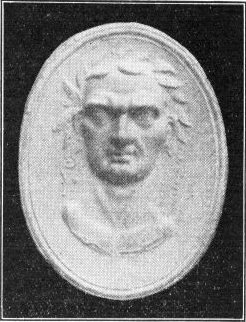
JULIUS CAESAR The Brit. Mus. gem
All these puzzling questions, and many more, are set to us by the character of Caius Julius Caesar. He puzzled the men who lived in his own time, and has gone on puzzling historians ever since. Brutus, who loved him, finally killed him because he thought he was doing more harm than good. Marcus Antonius, who also loved him, thought him, to the end, the noblest man that ever lived. One great historian regards him as one of the few really wise and far-seeing statesmen in the world’s story; a man who with extraordinary genius saw what the world needed and with extraordinary will carried it out. Another sees him as no more than a clever, selfish, and ambitious time-server: a man without fixed ideas or principles, whose sole object was power. Both admit his genius: but where one sees it directed steadily to great ends, the other sees nothing fixed in his character but the determination to succeed.
Caesar’s speeches (and he was a great speaker) are lost. We have two volumes of his writings: his account of the conquest and settlement of Gaul, and his account of the Civil War. These two volumes of Commentaries are so admirably written, in so pure and firm and lucid a style, with such mastery of narrative and of order, that their author would stand high among Roman writers had he been distinguished in no other way. Only a remarkable man could have written an account of his own doings in just this style. For there is no word of comment: the whole thing is, as Caesar himself says, bare, simple, and plain, with every kind of ornament cast aside. The language is simple, exact, concise. Every word tells. There is never a word too much. The dryness with which amazing feats of generalship, of endurance, of courage, are set down only makes them, in the end, more impressive. No mere talker, no one shifted this way and that by chance and by the opinion of others, could have written these books. They are the record of one who could both see and act.
In so far as we can judge a man from his face, the busts tell the same story. They show us Caesar in middle age, when firmly set to serious purposes, the idle impulses of youth left behind. The power to think, the power to act—these are the characteristics of the familiar bust. Yet Caesar, if we can believe the stories of him, retained to beyond middle life a rare personal charm, and always had much of the quick, passionate responsiveness of the artist. There was room in his mind for all sorts of things beside the business of making men do what he wanted. Whether the almost tragic nobility of the sculptured face, which is in this respect like that of Napoleon, means that Caesar was led on by something higher than personal ambition, the desire to engrave his own will upon the stuff of life, it is impossible to say. He made history; he was, in that sense, a man of destiny, but did he know what he was doing? did he care for a good beyond his own?
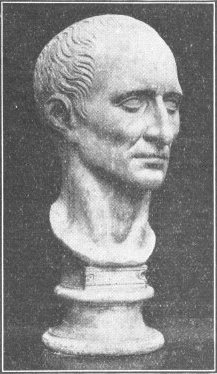
JULIUS CAESAR The Brit. Mus. bust
The first incident we know of Caesar is highly characteristic. Pompeius at the time of the proscriptions had put away his wife at Sulla’s behest. Caesar, a little younger, like him a rising young soldier, was descended from one of the most illustrious of patrician families. But his uncle had married Marius’s sister. Not only was he the nephew of Marius; he was allied to the beaten party in the Revolution by his marriage to Cornelia the daughter of Cinna. Sulla commanded him to divorce her. Caesar refused. He loved his wife dearly. Neither then (he was hardly out of his teens) nor at any other time was he ready to take orders from other men. Therefore his property and the dowry of his young wife were confiscated. His own life was in danger and he had to leave Rome. But his will did not bend. Sulla realized something of the stuff of which, youthful and unknown as he was, Caesar was made. ‘In that young man’, he said, ‘there are many Mariuses.’
At the time, and for long after, however, no sign of this was perceived by most people. At an age when Pompeius, the darling of fortune, had celebrated a triumph and was, despite his youth, a leading man in Rome, looked up to by every one, rather feared by the Senate, wealthy, prosperous, and important, Caesar was poor and quite unknown, attached by his relationship to Marius and Cinna to a defeated faction and a broken and discredited party. Yet Sulla was right. Caesar had a genius, a patience, and a power of will such as Marius never possessed. Of his military talents no one, not even Caesar himself, had any suspicion till long after. His rise was slow and difficult. Until his alliance with Crassus he was perpetually hampered by poverty and debts, both in fact and in the opinion of Rome.
When he escaped from Rome (81) Caesar went abroad first to the Greek islands, where he served his first campaign, and afterward to Bithynia; he also raised an expeditionary force against the Rhodian pirates. After Sulla’s death he returned to Rome. His eloquence soon won him a position in the Popular party. No one, however, regarded him as a serious rival to Pompeius, who was at this time regarded as inclining more or less to the Popular side. The enormous debts which were to be such a burden to Caesar were mainly contracted while Pompeius was in the East. He carried through magnificent building schemes, and gave superb games to the people—such being the road to popularity. Wider plans were forming in his mind, however: plans on the lines of Gracchus.
The great difficulty in Caesar’s way, over and above his own debts, was the character of the Popular party. It stood, to the majority of Conservatives and men of wealth and standing, for nothing but disorder and insecurity, with revolution in the background. These Conservatives did not see that they were helping to bring about all the things they dreaded by their opposition to change and their effort to keep all power in the hands of their own order, and their fear, distrust, and jealousy of any man of real ability. They drove young able men into the Popular party; and the Popular party to them was always the party of Marius and Cinna. There were in fact too many men in it of low character and reckless ways of life; men like Catiline and his friend Cethegus, like Clodius and Milo. The more clearly Caesar was marked out as the leader of this party the more did the Conservatives dread and hate him. Not without reason did he often think his very life was in danger. It was always possible that riots might break out. If they did the Popular party would be held responsible, and he would suffer for them all. His debts increased this danger. They made him at once reckless and powerless.
Yet Caesar’s popularity in Rome was real. At the time when his difficulties were thickest upon him he stood for election, against some of the most honoured and important senators, as Pontifex Maximus, the chief of the State religion. He was under forty; it was a post generally held by an old man; his religious views were known to be extremely ‘advanced’. Moreover, many people whispered that he had been privy to Catiline’s conspiracy, since Catiline was a member of his party. One of the other candidates offered to pay his debts if he would retire. To retire was not Caesar’s way; he regarded the proposal as an insult. As he left home on the day of election he told his mother, to whom he was devoted, that he would return Pontifex or an exile. He was elected.
The same immovable courage was shown by Caesar at the time of the Catilinarian conspiracy. The whole machinery of the trial of the conspirators was contrary to the law; the Senate was not a proper Court which could condemn men to death. Caesar knew that he was suspected by many of being involved in the conspiracy and that many would be only too delighted if they could see him in the dock for any reason. Yet he was the one man who dared to point out the illegality and injustice of what was being done and to vote against the death sentence. Caesar’s life was threatened at the time; but afterwards when the excitement died down and people could consider the affair more calmly they saw that he had been right; that he had kept his sense of justice when panic had made the other senators lose theirs altogether.
Caesar was soon after this made governor of Spain (61-60). But his creditors were so pressing that he would have actually been unable to start had he not come to an understanding with Crassus. Crassus settled the most urgent of his debts and he set out. Two stories are told of him at this time which show a good deal of his mind. In crossing the Alps he came upon a town so small that one of his friends remarked to him that in a place so tiny there could be none of the struggle for place and power such as there were in Rome, nothing worth having or being. Caesar, however, said, ‘I assure you I had rather be the first man here than the second man in Rome.’ When in Spain he spent his leisure in reading. Among other books he studied the Life of Alexander the Great. The followers of Pompeius who had just come back from the East were freely comparing him to Alexander. Caesar was so much moved by what he read that he sat thoughtful for a long time and at last, to the surprise of his companions, burst into tears. They could not understand the reason till he said, ‘Do you not think I have sufficient cause for concern, when Alexander at my age ruled over so many conquered countries and I have not one glorious achievement to boast?’
In his government of Spain Caesar showed firmness, energy, and wisdom. He carried out successful expeditions to distant parts of the peninsula and brought the whole country into such good order that he enriched it as well as the Roman State, himself, and his own soldiers. And all the time that he was in Spain his mind was at work. From a distance he saw the meaning of events in Rome with clearness and formed his own plans.
As soon as he returned he set to work to bring about that understanding between himself, Crassus, and Pompeius that was known afterwards (at the time it was a private bond) as the First Triumvirate (60). To bring this about was by no means easy. Pompeius was jealous and apt to ride the high horse. Crassus, though attached to Caesar, hated Pompeius. But Caesar persuaded them both. The world might see how things stood when he walked between them to the place of election for the consulship.
During his consulship (59) Caesar, despite the feeble opposition of his colleague, carried through a big programme of reforms. In addition he got a decree passed making him governor and military commander of Gaul for five years. In Transalpine Gaul very dangerous movements were said to be going on among the tribes. The Senate was not sorry to think of getting Caesar out of the way and into a dangerous place: he himself desired to win a glory equal to that of Pompeius and the command of an army devoted to himself. In Gaul he meant to find both. And he did.
Plutarch, who wrote the lives of many distinguished Romans, was no lover of Caesar. Pompeius is his hero. Yet Plutarch says that Caesar’s campaigns in Gaul (58-51) show him ‘not in the least inferior to the greatest and most admired commanders the world ever produced’. ‘In Gaul’, he says, ‘we begin a new life, as it were, and have to follow him in quite another track.’ In the nine years he spent there Caesar showed astonishing genius as a soldier and won the utter devotion of his men. But what he did in the field is surpassed by the statesmanship shown in his settlement of the country and plan for its government.
In Gaul Caesar’s great ideas found scope; but they were not born in Gaul. If Caesar at work in Gaul appears to be a different man from Caesar playing at politics in Rome, the reason is not that he suddenly changed but that the picture of him in Rome is based on the accounts given by his enemies, by men who feared and disliked without understanding him. They have drawn a picture of a wild, extravagant, and dissipated young man. Caesar was that, but behind it there was a mind more powerful, a personality more strong, than in any of his contemporaries: that mind and personality which old Sulla had perceived. When in Rome Caesar worked incessantly even while he pretended to idle. He was one of the busiest men in the city, though some of his busy-ness was of a foolish kind. In Gaul his immense energies were turned to constructive work. His health, which had been fragile—he suffered from epilepsy or what was called ‘the falling sickness’ and from violent headaches—and never became extraordinarily robust, was strengthened by the hardships of a military life, by long marches, exposure, and spartan food. And his energy, always extraordinary, seemed to grow by what it fed on. He never rested. When on horseback on the march he kept secretaries by him to write, at his dictation, letters, orders, memoranda, draft laws, and his own history. He reduced his hours of sleep to the fewest and at all times shared, like Hannibal, every hardship of his men. They adored him, not only because of this and because he never forgot that they were men like himself, but because of something magnetic in his personality, that charm which is the hardest thing in the world to describe or define. Caesar made his men believe in him: trust him when he asked them to do things that appeared impossible: face the most terrific odds and the severest trials in perfect belief in him. They believed, as he did, in his star. But their devotion was not only due to his genius. It was given to him, as a man, because of his charm.
For nine years Caesar was in Gaul. For nine years Rome saw nothing of him, though he spent winters at Ravenna and Lucca, and all the time never lost touch with what was going on in the capital, or hold over men there. He had left one or two faithful friends, among them Marcus Antonius and Curio, to look after his interests. But his whole mind and energy were devoted to his work in Gaul. It was a great work. Caesar not only fought battles and conquered territories, as Pompeius and Lucullus had done in the East. He did what they had never even tried to do: he romanized the country. Understanding, with rare quickness and sympathy, the nature of the people with whom he had to deal, he did not try to alter their deep-rooted habits. But he started the work, completed under the Empire, of spreading Roman law and order, coins and ways of trading, in a word Roman civilization, over Central Europe. Caesar’s mark remained upon it all. There were disturbances in various parts of the country after he left it. What the Romans called Gaul was a vast region inhabited by numerous tribes who hated and warred against one another, and had not learnt how to live in peace side by side. When Caesar took up his command, the wild hordes of the north were ready to swoop down upon Rome as they had done in the time of Brennus and again later when Marius defeated them at Vercellae and the Raudine Fields. As the result of Caesar’s work they were held back for more than four hundred years. And since Caesar was a statesman as well as a soldier his work was never wholly undone: the stamp of his genius and of Rome was set once and for all on North-western Europe.
As a soldier Caesar ranks among the greatest in the world. When he first went to Gaul his army was small—but four legions in all. The rest of his army he created, enlisting and training it on the spot. With his small forces he had to meet not Orientals, driven into battle by fear, but sturdy and fiercely warlike men with whom fighting was a natural passion. Among the Gaulish chieftains too there were leaders of great military gifts—Ariovistus, the chief of the Teutons, and Vercingetorix of the Arverni.
Some idea of the means by which Caesar stirred and inspired his men, and checked the danger of insubordination in his own ranks, which rose at times when they were called upon to fight forces far greater in numbers, is given by a passage in his own story. It begins with a speech he made to his men.
How Caesar dealt with threats of insubordination provoked by fear of meeting the Germans
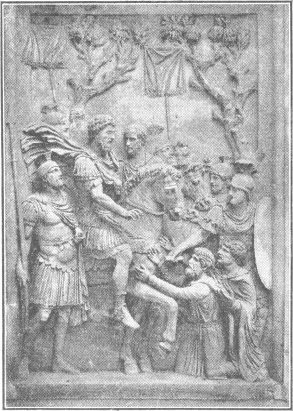
SUBMISSION OF TRIBES from a relief of the Empire
‘If any of you are alarmed by the defeat and flight of the Gauls, you will find on inquiry that they were tired out by the length of the war, and that Ariovistus, who for many months had been encamped behind the shelter of the swamps and made it impossible to engage him, suddenly fell on them when they were scattered without any thought of fighting, and conquered them rather by stratagem than by valour. Such a policy might well succeed against untrained barbarians, but even Ariovistus does not expect that Roman armies can be ensnared by it. Again, if any disguise their fears by a pretended anxiety about supplies or by imaginary difficulties in the route, they are acting presumptuously; for, as it seems, either they are hopeless about the commander’s performance of his duty or they are dictating to him what that duty is. These matters are for my decision; corn is being supplied by the Sequani, Leuci and Lingones, and the crops are already ripe. As for the difficulties of the route, you will soon have an opportunity of judging them. When I am told that the soldiers will disobey me and refuse to march, I am not at all troubled, for I know that, if an army has been disobedient, either its commander has been defeated through incompetence or some overt act has convicted him of extortion; but the whole course of my life bears witness to my integrity, and my success is proved by my campaign against the Helvetii. Accordingly I shall do at once what I had intended to do later and shall march to-night at the fourth watch, so that I may know without delay whether your fears are stronger than the claims of honour and duty. If no one else follows me, I shall start with the tenth legion, whose devotion is beyond question, and I intend to make it my bodyguard.’ Caesar had shown special favour to this legion and had an absolute trust in its valour.
This speech made an extraordinary impression upon all and inspired very great enthusiasm and eagerness to advance. The tenth legion set the example, thanking Caesar through its tribunes for his generous confidence, and declaring that it was ready in every way to fight. Then the rest of the legions commissioned their tribunes and chief centurions to apologize to Caesar; they had never hesitated or feared, and had never thought that they should meddle with their commander in the control of operations. Caesar accepted their apology and started at the fourth watch, as he had warned them.
Caesar, De Bello Gallico, i. 40. 8-41. 4.
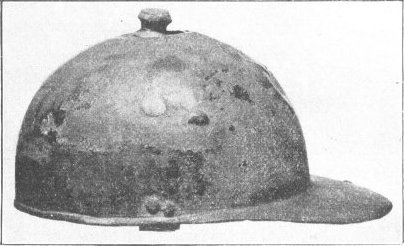
A ROMAN LEGIONARY HELMET found in Britain
There was a moment when it looked as though all Caesar’s work was to be swept away. He spent part of the year 54 in Britain. While he was away plans for a great rising were conceived. Soon after he returned all Gaul rose in a blaze. The first rising was put down. In 52 another and more serious movement took place with Vercingetorix at its head. The danger was greater than ever. It was the more serious that Caesar knew that in Rome his enemies were working against him. So great was it indeed that Caesar’s officers were in despair and begged him to retreat to some safe spot until reinforcements could be sent. But to wait for reinforcements would make things worse instead of better. The rebellion would gather force. It was by no means certain that Pompeius, now hand in glove with the Conservatives, would send him more troops. Pompeius would be glad to see his rival fail. Caesar was not going to give him that pleasure. And retreat in face of danger was never Caesar’s way. Always he went to meet it. So now. He delivered a blow at the very heart of the enemy’s position. Caesar’s capture of Alesia, the stronghold of Vercingetorix, and his defeat of the second great Gallic army that closed him in while he was blockading the town are among the great feats in the history of war. The odds were heavy against him. His army was in a position from which no luck, only the most brilliant generalship, could save it. Caesar not only saved it: he absolutely crushed the foe. Vercingetorix surrendered. The rebellion collapsed. By the end of the next year Gaul was under Caesar’s feet again. It was possible for him to turn his eyes and mind to Rome (50).
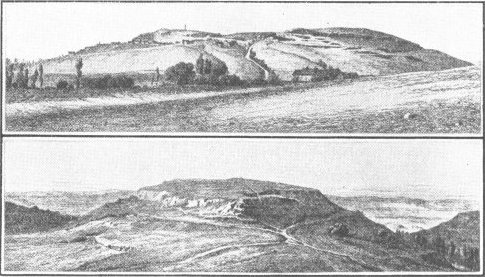
THE HEIGHTS OF ALESIA The stronghold of Vercingetorix
He did not want to quarrel with Pompeius. He had indeed from the first done everything in his power to prevent such a quarrel. But he saw that the old order of things in Rome was crumbling into ruin. If Pompeius and he could not rule together, one of them must rule alone. In the years of his absence Pompeius had moved more and more to the Conservative point of view. His jealousy of Caesar had grown. The long struggle came to a head when Caesar’s time in Gaul drew to an end.
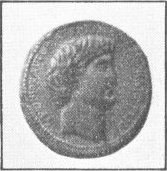
MARCUS ANTONIUS from a coin
Caesar from his winter quarters at Ravenna declared that he was ready to disband his army and return to Rome as a private citizen as soon as Pompeius demobilized his troops. Pompeius actually had a larger force of men under arms than Caesar, including two legions which Caesar had borrowed and sent back to him. In the Senate Curio proposed that both generals should lay down their commands. This was agreed to. Pompeius refused. A few months later the question came up again. Curio, who had been to Ravenna, where Caesar was, read a letter from him. In this he said he would disarm, if Pompeius did the same. The Senate declared the letter was dangerous, and the man who wrote it dangerous. A friend of Pompeius then proposed that by a certain day Caesar, if not disarmed, should be regarded as a traitor. When Marcus Antonius and Cassius, another tribune, vetoed this, they were expelled from the Senate and threatened with swords by Pompeius’s adherents. Caesar could no longer have any doubt as to what awaited him in Rome. He explained how things stood to his soldiers: they cried to him to march on (49).
By Sulla’s law the Rubicon was the military boundary of Italy. No one might cross it under arms. Caesar paused for a moment on the bank; then suddenly crying, ‘The die is cast’, he crossed the river at the head of his men and marching with great speed entered Ariminum.
The poet Lucan, writing long afterwards, tried to penetrate the secrets of his mind, and guess what passed in it at this moment.
The Approach to the Rubicon: a Poet’s Phantasy
Caesar had already hurried across the frozen Alps, pondering in his heart vast schemes of war to come; but when he reached the narrow waters of the Rubicon, the vision of his distracted country rose awful to his gaze, with saddened features clear seen through the gloom and white locks flowing from beneath her crown of towers. All dishevelled and bare-armed she stood before him, uttering words broken by sighs: ‘Whither do ye press on? Whither do ye bear these my standards? If ye come as loyal citizens, thus far and no further.’ Then Caesar shuddered in every limb, his hair stiffened, and faintness of heart, checking his steps, stayed him at the very brink. Soon he cried: ‘Oh Lord of thunder, that from the Tarpeian rock dost survey all our city, and gods that followed the race of Iulus from Troy, and mysteries of Quirinus lost to our sight, and Jupiter enthroned over Latium on Alba’s mount, and hearth of Vesta’s fire, and thou, Rome, worshipped as divine, be gracious to my cause. I bear against thee no frenzied arms. Lo! here am I, Caesar, conqueror by sea and land, still everywhere thy soldier if none forbid. On him, on him shall rest the guilt who makes me thy enemy!’ Then without delay be gave the signal for advance and quickly led his men through the swollen stream.
Lucan, Pharsalia, i. 183-203.
There was no resistance. It was not Caesar’s intention to use any violence. In Rome, however, when the news came that he was moving south, people fell into a panic. Pompeius lost his head. Although the forces at his command were greater than Caesar’s, he left the city, leaving everything, including the State Treasury, behind him. Most of the senators and people of consequence did the same.
Within sixty days from his crossing the Rubicon Caesar entered Rome and made himself master of it and of all Northern Italy without bloodshed. People who had trembled and believed that a reign of terror and proscriptions of the kind carried out by Marius and Sulla would follow, breathed again. Caesar showed no bitterness. There were no executions. The property of those who had fled with Pompeius was untouched. Even to Labienus, the one officer of his own who deserted him and joined the other side, Caesar was generous. He sent his goods after him.
Caesar summoned those members of the Senate who had remained in Rome and addressed them in a mild and gracious speech. He had no desire for war: he urged them to send deputies to Pompeius. But no one would do this. Pompeius meantime was embarking for Greece. Caesar did not follow him. He was master in Rome: but Rome was utterly dependent for all its supplies, the means by which it lived, on the world outside. Of that world Pompeius seemed master. Caesar’s first task was, therefore, not to defeat Pompeius but to secure the food supply of the capital. For this purpose he himself set out for Spain, where there was a strong Pompeian army, leaving Marcus Antonius in charge in Italy and sending Curio to Sicily. The Spanish campaign was severe, but after the Battle of Ilerda the Pompeian armies were shattered. A considerable force surrendered. Caesar pardoned the men and many of them joined his legions. When he returned home, capturing Massilia on the way, he heard that Curio had done excellently in Sicily: Cato had been defeated and fled to Pompeius.
The West was safe. From Spain, Sicily, and Sardinia corn flowed into Rome. Caesar could sail for Dyrrachium to meet Pompeius. Pompeius rejected all his proposals for peace. He was in a strong position: his army far outnumbered Caesar’s, and his companions were blindly certain of victory. They indeed spent their time quarrelling among themselves as to who should hold the great offices in Rome when they got back there: who should be Pontifex Maximus for instance, when Caesar had been killed. They were so sure of victory that when Caesar was compelled to shift his camp, since his men were dying of starvation, they insisted on following him and giving battle, though Pompeius saw that this was playing Caesar’s game: whereas to delay would have worn him down. At the battle of Pharsalia (48) Caesar’s much smaller army won a complete victory, thanks to his superior generalship. The princes of the East sent in their submission to the conqueror. The senators and men of rank who survived Pharsalia hastened to make their peace with Caesar, all except Cato, who had not shaved or cut his hair since Caesar crossed the Rubicon, and now sailed to Africa to resist to the last.
Pompeius fled to Egypt. Thither Caesar followed him only to learn the news of his death. When the bloody head of his chief enemy and sometime friend was handed to him Caesar turned away, tears in his eyes.
Years before Caesar had planned to bring Egypt under the Roman rule: but this plan had been defeated. Now he found everything in confusion there. The old king, dying two years earlier, had left his kingdom to his children, Cleopatra, then sixteen, and a baby boy. By Cleopatra, who even as a young girl had those extraordinary powers of mind and charm that have made her famous through the ages, Caesar was fascinated. Her wit and gaiety, her beauty and changefulness, held him entranced: and week after week he stayed on in Alexandria, while a dangerous insurrection was being planned by the ex-vizier of the old king. Suddenly it broke out. Caesar had but a handful of troops: to save his fleet from being used against him he had to set fire to it with his own hands. From the dock the flames spread to the palace and destroyed the great Alexandrine library, the most wonderful in the world. Caesar himself only just escaped: he had to swim across the harbour, holding his papers in one hand.
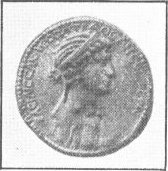
CLEOPATRA from a coin
The danger was serious but brief. Reinforcements arrived from Cilicia: the Egyptian rebels were defeated: the ex-vizier put to death: Cleopatra and her brother made rulers over Egypt under the protection of Rome. Caesar in the spring crossed to Asia Minor, where he came, saw, and conquered, as he himself said. In September he was in Athens: in October in Rome: in December in Africa. There, at the battle of Thapsus, he crushed out the last spark of opposition. Cato, who had fled to Utica, killed himself, much to Caesar’s distress. He admired the sturdy independence of the old man and would have spared him. His daughter Portia was married to Marcus Junius Brutus, a Pompeian whom Caesar had pardoned and loved as a son.
The secret of Caesar’s clemency, which astonished his contemporaries, lay partly in his own nature, partly in his clear purpose to re-establish life in Rome on a firm and lasting foundation. His mind had no bitterness. Bitterness arises out of some inner uncertainty; Caesar had a rare certainty as to what he wanted to do and as to his being able to do it. He was not afraid of other people or of their judgements. He had no need to compare himself uneasily with them. He could stand on what he did, irrespective of what they thought about it. He had come to build, not to destroy. He had seen the failure of Marius and of Sulla. Sulla had tried to restart Rome on a false basis—the rule of one party in the State, standing on the bleeding bodies and broken fortunes of the other. He had failed. His system had crumbled, and in its ruin it had brought the whole State to the ground. Moreover, Sulla’s system had left no room for growth. Rome’s task in the world had grown enormously and the old machine was quite incapable of fulfilling it. Caesar wanted to create a new machine that could govern not a city but a world.
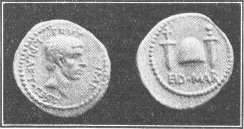
A ROMAN COIN celebrating the murder of Caesar
Caesar worked with the energy and power of a giant at his colossal task. Every part of the State was in disorder—the army, the navy, the treasury, the laws, trade, the whole business of government. He had to reconstruct the whole, and in the space of little more than a year he did much towards this. And besides these great tasks there were lesser ones—the reform of the calendar, of the system of weights and measures, of the language. Reforms are never popular. The change from bad to good is slow and gradual. Caesar’s followers were not made as rich as they had hoped. His measures were directed to filling, not private pockets, but the coffers of the State.
The people loved him. Their lot was vastly improved. But a growing body began to say that he was behaving as a tyrant and that things were no better than they had been under the old government. Some of these people were sincere republicans who were afraid that Caesar was trying to make himself king. Among them was Marcus Junius Brutus.
Brutus had married Cato’s daughter and shared many of Cato’s ideas. Round him there gathered a knot of men, among whom the ablest was Caius Cassius, who determined to free the city of the tyrant. To the minds of Brutus and Cassius it seemed that Caesar was destroying the seeds of greatness in all other men, to make himself supreme. Shakespeare makes Cassius argue thus:
The Penalty of Greatness
Cassius. Why, man, he doth bestride the narrow world Like a Colossus; and we petty men Walk under his huge legs, and peep about To find ourselves dishonourable graves. Men at some time are masters of their fates: The fault, dear Brutus, is not in our stars, But in ourselves, that we are underlings. Brutus and Caesar: what should be in that ‘Caesar’? Why should that name be sounded more than yours? Write them together, yours is as fair a name; Sound them, it doth become the mouth as well; Weigh them, it is as heavy; conjure with ’em, ‘Brutus’ will start a spirit as soon as ‘Caesar’. Now, in the names of all the gods at once, Upon what meat doth this our Caesar feed, That he is grown so great? Age, thou art sham’d! Rome, thou hast lost the breed of noble bloods! When went there by an age, since the great flood, But it was fam’d with more than with one man? When could they say, till now, that talk’d of Rome, That her wide walls encompassed but one man? Now is it Rome indeed, and room enough, When there is in it but one only man. O! you and I have heard our fathers say, There was a Brutus once that would have brook’d The eternal devil to keep his state in Rome As easily as a king.