Chapter III · The Great Enemies of Rome (continued 2)
Reading edition
The senators doubtless hoped that, Tiberius dead, his work would soon be forgotten. But the evils he had tried to remedy remained. And abroad serving in the army was his brother Caius, who did not forget. ‘Whither can I go?’ said Caius. ‘What place is there for me in Rome? The Capitol reeks with my brother’s blood. In my home my mother sits weeping and lamenting for her murdered son.’ His was a nature very different from his brother’s. Tiberius was quiet, gentle, kindly, naturally rather dreamy; a man who in happier times would have been content with the uneventful life of a gentleman. Caius was fiery and passionate, filled with an energy that must have found some outlet for itself in whatever circumstances he had lived. He loved his brother and his death filled his heart with glowing anger and a fixed determination that his work and life should not be wasted. He would carry out Tiberius’s ideals; and carry them farther than Tiberius had ever dreamed.
Caius Gracchus was nine years younger than Tiberius and a man of more remarkable character and more brilliant gifts than his brother. The sense of a great wrong made Tiberius burn with indignation, and in his indignation he took to politics; Caius had a natural genius for politics. His mind ranged forward into the future; whereas Tiberius worked blindly, in the dark, Caius knew where he wanted to go. And he understood men as his brother had never done. Without any of the shy aloofness that at times gave Tiberius the appearance of more strength than he really possessed, Caius made people like him without moving away by so much as an inch from the purpose he had in mind. That purpose was a change far more revolutionary than Tiberius had dreamed of.
Only twenty years of age at the time of his brother’s murder, Caius spent the next ten years in public service. Like Aemilianus he held it every man’s duty to work for the Republic. But while Aemilianus thought that for such work obedience, faithfulness, courage, temperance were all that were required of a man, Caius, who had these virtues in a high degree, had also an active questioning mind. It did not seem to him that the men who ruled the State were wise or just or generous enough to lay down, once for all, the lines on which it was to move for ever. The citizen had a duty to the Republic beyond that of loyal and obedient devotion. He must use not only his arm in its service but his mind also. He must help it to grow; make Rome worthy of the greatness about which people talked so lightly and easily. The greatness had been won at a fearful price. Hundreds of thousands of Roman soldiers had laid down their lives to make it; hundreds of thousands more had given their best years to its service, asking no reward but that the Republic should stand safe. It could, Caius thought, only be safe, only be great in so far as it became more and more the city of free men in fact as well as name.
With such thoughts as these moving in his mind he turned in loathing from the life of the young Roman noble of his own age and class. He had no use for personal luxury; wine and fine clothes and a gorgeous house in which to live a life of ease and idleness—these things were nothing to him. While serving abroad in Spain, Sardinia, and elsewhere, he shared the hardships of his soldiers, and spent his own money in the effort to make their hard lot less severe. Such leisure as he had was occupied in reading. In this way he disciplined and fortified his mind. Moreover, Caius had before him a fixed purpose, a clearly determined work in life. For that he was preparing. One of his weapons was to be the art of speech. He studied, therefore, particularly the works of the great Greek orators. He wanted to learn, and he did learn, how to use words to persuade men and impel them to action. He made himself one of the greatest orators Rome knew. His speeches are lost, but accounts of them remain, and they tell how Caius could set his hearers on fire, stir them to tears or anger.
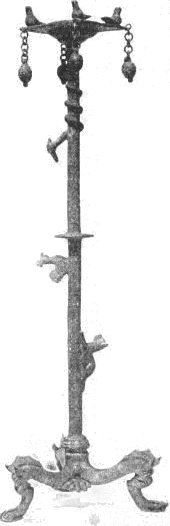
ELABORATE LAMP to show the luxury of later times
When, nine years after Tiberius’s death, Caius Gracchus came back to Rome (124), he found that men were waiting eagerly for him. Tiberius had not been forgotten. The poor hoped, the rich feared that Caius had come as his avenger. When he stood for the tribuneship the party in the Senate that had thwarted and finally murdered Tiberius strained every nerve to prevent Caius’s election. They did not wait to hear what his plans were. They knew that he belonged to the men of the new generation who wanted far-reaching changes, and they believed that any change must be at their expense. They at once began attacking Caius. They accused him of coming home before his time of service abroad was up. They even declared that he, the most scrupulously honest and disinterested of men, had made more money than he ought to have done from the various posts he had held. Caius turned on them. He had already served twelve years in the army. As for making money: ‘I am the only man who went out with a full purse and returned with an empty one. Others took out casks of wine for themselves, and when they had emptied them brought the casks back filled with gold and silver.’ He lived not in the rich quarter of Rome among the high-born and wealthy, but among the poor near the Forum. He was elected tribune by an overwhelming majority and at once set to work.
His main idea was a really great and original one; nothing less than the extension of Roman citizenship, in so far as voting rights went, to the people of Italy. The Italians were called to serve in Rome’s armies. The best soldiers, indeed, had always come from outside the capital. The Italians paid heavier taxes; they ought to share in the benefits of Rome and have a voice in its government. Caius Gracchus indeed dreamed of making the Government of Rome a real democracy. It was a magnificent dream; but the people were not ready for it. In fact it was only after a bitter war that the Italians won from the Romans the right to vote. Gracchus knew that his plan could not be carried through at once; but he had worked out a series of Bills which would, he believed, pave the way for it. Until they were through he said nothing of his great scheme.
Caius Gracchus. The varied Activities of a popular Leader
When the people had not only passed this law, but actually commissioned Gracchus to appoint the judges from the Order of the Knights, he became invested with a kind of royal authority, and even the senators were ready to listen to his counsel. When he gave it, he always proposed something to their credit, as, for example, a most just and honourable decree about the corn which the proconsul Fabius had sent from Spain. He persuaded the Senate to sell the corn and return the money to the cities from which it came, and furthermore to censure Fabius for making his rule burdensome and unendurable to the inhabitants; and this brought him great reputation and popularity in the provinces. He proposed, too, to send out colonies and to make roads and to build granaries, personally managing and controlling all these undertakings, never failing in attention to a mass of details, but with extraordinary quickness and application working out each task as if it alone engaged his efforts, with the result that even those who hated and feared him were astounded at his universal thoroughness and efficiency. Most people on meeting him were surprised to see him surrounded by contractors, craftsmen, ambassadors, commanders, soldiers, and scholars. Treating them all with an easy good nature, being at once kind and dignified, and suiting himself to the character of the individual, he proved that it was gross slander to call him dictatorial, or presumptuous, or violent. Thus his gift for popular leadership was shown rather in personal association and conduct than in public speeches.
Plutarch, liv. 6.
He was a tremendous worker and all his plans were thought out to the smallest detail. They were not vague ideas on paper. He began on his land policy. If it were to have any chance of being carried he must, he saw, break the solid majority of the landowning classes and their friends. The most important of these friends were the class known as the Knights, or Equestrian Order. The Senate was composed of men selected from among those who had held one of the high offices of State. Senators might not take part in business, but they alone served as jurors to try the cases which concerned people who carried it on, and particularly those who carried on one important kind of business, that of tax-collecting in the provinces. This was largely in the hands of the knights. Their name went back to the days of the old constitution when men of a certain wealth served in the cavalry, and were given votes as so serving. The so-called Equestrian Order had greatly grown in number. They were the money-makers, financiers, capitalists of Rome. As against changes in the land system they might stand with the Senate, but when Caius Gracchus proposed that the juries which tried people for political offences should be drawn not from the Senate, but from the knights, he won their support against it. He then turned to win that of the people by a new Corn Law which arranged that the Government should buy corn wholesale and supply it to the Roman people at a fixed low price. From this he turned to other constructive measures. He revived his brother’s Land Laws; started a great road-building scheme; and worked out a plan for the reorganization of the army. Over the detailed working out of all these big plans he watched himself with the eye of a practical man whom nothing escaped. For Caius, though his ideas were large and far-reaching, and his mind grasped problems that the ordinary Roman politician did not begin to see, was no dreamer. He was an organizer of consummate ability and possessed a remarkable knowledge of facts and of men. His house became a sort of great Government office, buzzing with hard work from morning until night.
In the following year he was re-elected and at once moved on to the next stage in his policy, a big scheme of land settlement and colonization, very much on the lines now worked by Canada and our other Colonies who assist intending settlers by giving them cheap passages out and plots of land in new territories. This done, he launched his plan of granting Roman citizenship to the Italians.
Here, however, he came into collision with rich and poor at once. The ordinary Roman citizen was jealous of his rights and did not want to share them. Caius’s popularity began to fall off at once. The idea of Italy a nation was one for which the Romans were not ready. They had been angry when Tiberius wanted to give farms to the Italians; Caius’s plan of giving them votes and thereby a share in the games, cheap corn, and other joys of Roman life, made them far more angry. They despised the Italians and cared nothing for their grievances. Caius could not stir them to any sympathy.
The leaders of the Senatorial party realized at once what had happened, and determined to strike. An outbreak of disorder at a meeting at which Caius was speaking gave them their chance. The consul declared that the State was in danger and proclaimed a state of siege in the city. Then he went out with armed bands and in the streets Caius himself and a number of his supporters were cut down and slain (121).
Thus both Caius and Tiberius Gracchus perished. Cornelia their mother left Rome and went to live at Misenum. Of her sons she spoke as of two heroes who had given their lives for their country. Her pride in them remained untarnished, for they had died true to the things in which they believed. Indeed, many years had not passed before statues to the brothers were set up in the public places in Rome and offerings brought there by the people who realized, too late, how greatly both Tiberius and Caius had served them. Had their work been carried through, Rome might have been spared the terrible disasters that came upon the city in the next half-century. As it was, the senators breathed with relief that Caius had followed his brother to a bloody grave; they did not see that those who opposed reform were preparing the way for revolution and civil war.
VI Cato the Censor
At any time there are always some people who look back and say, ‘Ah, things are not what they were. There are no such men nowadays as there used to be. The good old days are over. When I was young....’ and so on. Such men see in change nothing but evil. There is, to some minds, a danger in every change: but there may be greater danger in standing still.
The evils that men like the Gracchi saw in their own time made them desire to see the life of Rome move forward to other and better ways. A new world had opened round them: new ideas, new forces were making themselves felt. Rome was no longer a small city, whose existence was closed in by its own walls; it was the centre of a great dominion, and touched the life of other peoples and nations at innumerable points. The ways of the old could not be those of the new Rome. They saw the difficulties and risks, but they saw too the promise of better things to be won.
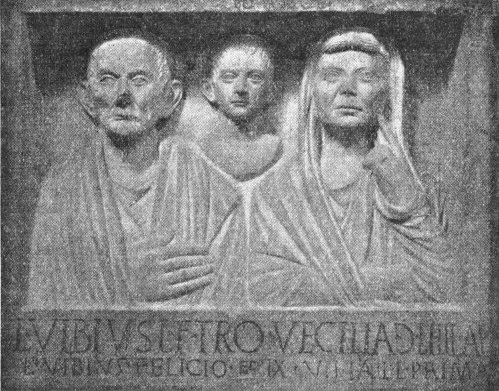
THE TOMB OF A ROMAN FAMILY: to show simplicity of dress
Very different was the outlook of a man like Marcus Porcius Cato. To him the ancient ways alone seemed right. He modelled his own life and actions so far as he could upon the heroes of the past, especially on those like Cincinnatus, who were noted for their simplicity and frugality. Cincinnatus, though he had held the highest offices in Rome, was found driving his own plough by those who came from Rome in an hour of peril to ask him to take over the highest power in the State. So Cato kept his dress, the furnishings of his house and table, and everything about him as plain as those he might have had in the days when every one was poor. In his own record of his life he reports that he never wore a garment that cost him more than a hundred drachmae; that even when praetor or consul he drank the same wine as his slaves; that a dinner never cost him from the market above thirty pence; and that he was thus frugal for the sake of his country, that he might be able to endure the harder service in war. He adds that having got, among some goods he was heir to, a piece of Babylonian tapestry, he sold it immediately; that the walls of his country houses were neither plastered nor white-washed; that he never gave more for a slave than fifteen hundred drachmae, as not requiring in his servants delicate shapes and fine faces but strength and ability to labour, that they might be fit to be employed in his stables, about his cattle or on such-like business; and that he thought proper to sell them again when they grew old, that he might have no useless persons to maintain. In a word he thought nothing cheap that was superfluous, that what a man has no need of is dear even at a penny; and that it is much better to have fields where the plough goes and cattle feed, than gardens and walks that require much watering and sweeping. This stern simplicity he carried throughout his life and in words of eloquence (he was one of the most powerful speakers in Rome) he tried to get others to imitate him.
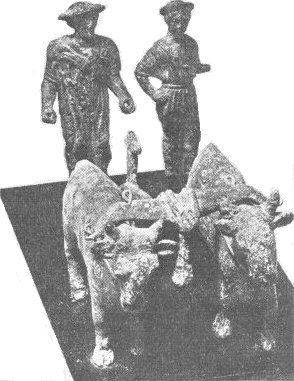
PLOUGHING: a terra-cotta group
Cato’s own character was of remarkable firmness. He did not ask other people to do what he would not do himself. He served in war again and again, and distinguished himself as a soldier, though his harshness made him detested by the peoples he conquered, for instance in Spain. But he wanted every one to think and live in his way, and judged with cruel severity those who thought or acted otherwise. The key to his character, both its strength and its weakness, is given by Plutarch when he remarks that ‘Goodness moves in a larger sphere than justice.’ Cato was just: but his justice was often harsh, cruel, and ungenerous. Thus he left his war-horse behind him when he left Spain, to save the public purse the charge of his freight, just as he sold his slaves when they became too old to work. In this we see carefulness and indifference to comfort and luxury turning to parsimony and meanness. As Cato grew older he became more and more fond of having money though not of spending it. He himself had prospered in life and, as he grew older, became extremely rich both from his farms and from lending money, at high interest, to shipping and other companies. For those who did not succeed he had a very severe judgement and small pity, as for those who gave way to any of the faults from which he was free. He judged instead of understanding them. His judgement was just but not sympathetic. His own account of the duties of a bailiff and his wife gives an excellent idea of the man.
The Duties of a Bailiff and his Wife
These will be your duties as bailiff. Maintain strict discipline; observe rest-days; do not lay hands on the property of another, but keep a careful watch over your own. It is your business to settle disputes in the household and to punish offences without excessive severity. The household ought to be well cared for, never suffering from cold or hunger, and should be sufficiently employed; in which case it will be easier to stop unruliness and dishonesty. If your conduct is good, your example will be followed; if you are wronged, your master will inflict the punishment. Reward merit, and thus encourage others to exert themselves. Do not waste time in taking walks; always be sober, and never go out to dinner. See that your master’s orders are carried out, and do not suppose that you are wiser than he is. His friends should be your friends, and you should obey those whom you are bidden to obey. Do not sacrifice at the cross-ways and on the hearth of the homestead except at the great festival of the Lares. Do not make an advance without your master’s knowledge, but exact all that is due to him. Never lend seed-corn, provisions, meal, grain, wine, or oil to any one. There should be two or three households to which you apply in times of need, and which you similarly help; but no more. Be punctual in settling accounts with your master. Special labour on the land, paid by the day, should not be employed beyond the term agreed. Buy nothing without your master’s knowledge, nor, indeed, keep any transaction from him. Let no one sponge upon you; consult no soothsayer, augur, prophet, or Chaldaean. Do not stint the sowing; for the result will be a poor crop. Acquaint yourself thoroughly with all the work on the farm, and often do some yourself, as long as it does not overtire you. Thus you will understand the feelings of the workers and they, knowing this, will be more contented, while you will enjoy better health, have less taste for idle walks, and be more ready for sleep. Be first to get up in the morning, and last to go to bed at night, taking care that the house is locked up, that everyone is at rest in his proper place, and that the animals have got their fodder.
You should take care, too, that your wife does not neglect her duties. Make her fear you. Do not let her indulge in luxury. She should see as little as possible of her neighbours and other female friends; she should not entertain at home or go out to dinner, or waste time in walks. Do not let her sacrifice, or depute any one else to sacrifice, without the orders of her master or mistress; for it must be understood that the master sacrifices for all the household. She should be neat, and keep the house neat and swept, and every day, before she goes to bed, she should see that the hearth is clean and the ashes gathered on to the embers. On days of festival, Kalends, Nones, or Ides, she should lay a garland on the hearth and during the same days offer up prayer to the Lar of the house for plenty. It is her business to see that food is cooked for you and everybody else, and to keep a good supply of poultry and eggs.
Cato, De Re Rustica, v. 1-5; cxliii. 1-2.
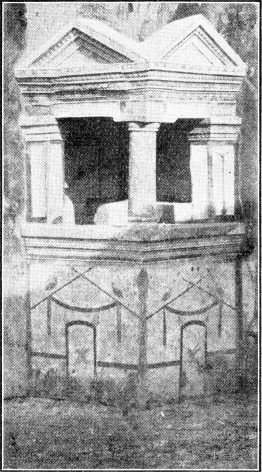
THE SHRINE OF THE LAR from a house in Pompeii
This same just but hard and ungenerous spirit is seen in Cato’s public life. As Censor he had the right to strike off the roll of senators men who were in any respect unworthy. In doing this Cato was fearless. He attacked the most popular men in Rome and did not yield an inch when there was a howl against him. Public money was to him as sacred as private, and ought, he held, to be husbanded in the same careful way. Thus he attacked the brother of Scipio Africanus, because, as he said, he had spent more than he ought on his campaigns. He admired Scipio greatly. Cato was far too intelligent not to appreciate his high qualities of mind and character: but he thought him a new and therefore dangerous kind of man.
Fifty years after the battle of Zama the Carthaginians, who were not allowed by the treaty to make war without the permission of Rome, sent an appeal for protection against Masannasa, the King of Numidia, who had gradually been encroaching on their territory. A Commission was sent out from Rome to inquire, with Cato at its head. Cato came back possessed by one idea, which never afterwards left him. ‘Carthage must be destroyed. Rome would not be safe until it was blotted out.’ When it was pointed out to him that the city was in no sense dangerous to Rome, that it had practically no arms, absolutely no fleet, and had shown in fifty years no sort of desire to attack Rome, was indeed too weak even to defend itself against attack, Cato paid no heed. It did not stir him when Scipio urged that to attack a defeated and helpless city was mean and unworthy of Rome, that its greatness would not be increased by destroying a beaten foe. Cato paid no heed. Carthage was rich and flourishing: it might one day be a danger again. It was taking trade that Rome might get, it possessed riches Rome might have. He was a powerful and effective speaker and his name stood high in Rome. What he said had a great influence because his character was deeply respected. Though old, his red hair quite white, he had lost none of his vigour. His dry humour could still make the Senate laugh, and his passionate earnestness rouse them to anger. His grey eyes sparkled, his long white teeth flashed when, day in, day out, whatever the main subject of his speech, the inflexible old man always ended with the words, ‘Carthage must be destroyed’.
Cato had his way in the end. The Romans carried out the destruction of Carthage (146). It was a mean and disgraceful act. The Carthaginians had already submitted, without terms, to the mercy of the Roman people. When the consuls arrived they first demanded that all arms should be collected and given up: then that all the inhabitants should depart and the city itself be removed. This was too much. The desperate people resolved to resist, and resist they did with terrible and extraordinary heroism.
Cato himself did not live through the siege: but he died knowing that his fierce will had its way. Carthage was to be destroyed. As a city it was to exist no longer.
VII Caius Marius and Lucius Cornelius Sulla
To understand the strange and in many ways sinister characters of Caius Marius and of Lucius Cornelius Sulla, we must have in our minds a picture of the dark times in which they lived. At a crisis in the life of the State Sulla showed courage, decision and will, and a stern devotion to his country which enabled him, in his own way, to save it. In these things he showed that he was a Roman of the old breed. Until this crisis came Sulla appeared no better than the other aristocrats of his time: like them he was careless of everything save his own selfish pleasure; always he remained hard, cruel, indifferent to the lives, feelings, and happiness of others. Whereas both Tiberius and Caius Gracchus lived and died for an idea greater than themselves, Sulla’s was a mind incapable of idealism. He and Caius Marius, his great rival, are alike in nothing except the harsh cruelty that belongs to times of revolutionary upheaval. In all other respects they are as unlike as any two men that ever lived. Marius was a son of the soil, a soldier with a soldier’s merits—courage, rude good humour, careless generosity—and his faults—cruelty, coarseness, indifference to everything but the rudest of pleasures. His one big work was the reconstruction of the army. Sulla was an aristocrat to the finger-tips: proud, cold-blooded, indifferent, highly educated, with a deep disbelief in everything and everybody. He had a remarkable intellect, and a physical beauty which attracted women without number. But it is doubtful whether he ever cared for a human creature. His extraordinary courage and his equally extraordinary indifference rested on a chilling belief in Fate. He was lucky: he called himself Sulla Felix; but nothing in the end was going to make any difference.
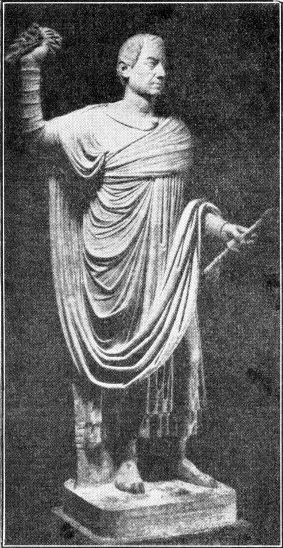
THE ARISTOCRAT distributing largesse
To see Marius and Sulla against the background of their time the events must be traced that followed on the death of Caius Gracchus.
Tiberius Gracchus, and far more clearly his brother Caius, had seen the growing dangers that threatened Rome, if no wise steps were taken in time to meet them. Both brothers gave their lives in the effort to save their country. Their sacrifice was vain. The men who had power in their hands were blind to the great change that was taking place. They tried to compel the stream to go on flowing in its old channels, although the weight of waters had grown too great for them to carry. The result was that suddenly the waters broke loose and flooded everything. Rome, all Italy, was torn by a bloody and terrible civil war.
At the time many people put these things down to the Gracchi. They had stirred up the lower orders and the Italians to discontent and bitterness. They had set strife between classes in Rome: roused the middle class against the senators and the mob against both. This was not a just statement. Caius Gracchus had thought out a great plan of reform that, if carried through, might have saved Rome and Italy from revolution and civil war. He had to win people to his side. In order to do so he passed measures that were not good in themselves but only as means to his great end. Thus he made the knights, the new class of wealthy men, judges instead of the senators; and gave doles of bread to the Roman populace in the hope that he would then be able to persuade them to give votes to the Italians and so make Italy really one.
The evil that men do lives after them: The good is oft interréd with their bones.
It was so with Caius Gracchus.
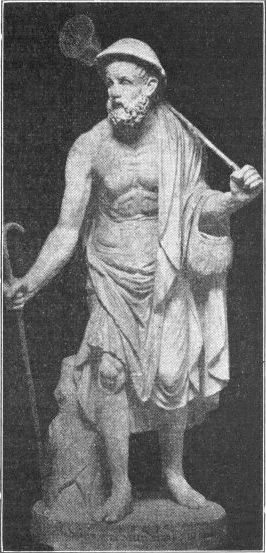
THE FISHERMAN
But the real cause of the civil war lay much deeper than the work of any single man or group of men. It was, in the main, the fact that while Rome had grown, and grown into a new world, the old system of government remained, and did not fit this new world. Rome was beginning to be a great trading empire. Yet wealth and power was jealously held by a small class in Rome in their own hands. The men of this class grew rich. They went out to the provinces, to Sicily, Greece, and Spain, as governors and made great fortunes. They came home with their riches and bought up the land that had once belonged to peasants and farmers, and worked this land with slaves. The condition of these slaves in the country was miserable, especially that of those who lived herded in camps. The greed of the agents of the tax-collecting companies made the Roman name hated in the provinces. In Italy, too, there was deep discontent. To keep the Roman poor quiet the ruling classes gave them games and bread-doles; they altered the laws so that no Roman citizen could be condemned to death for any offence. This kept the Romans quiet, but it made the Italians, who had no share in it, increasingly restive.
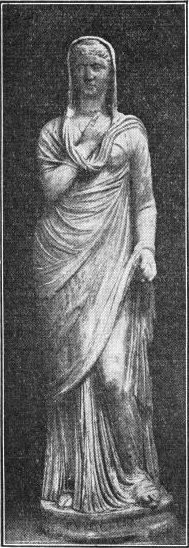
THE RICH MATRON
It had been clear to the far-seeing mind of Caius Gracchus that unless Rome could draw fresh blood and life and energy from Italy it must perish. The material wealth that was pouring into the city from all parts of the world, from Carthage and Corinth and the conquered kingdoms of the East, was doing more harm than good. Too many men, rich as well as poor, were beginning to care only for pleasure and for money as a means to pleasure. The luxury and extravagance of the rich made the poverty of the poor bitter, and these poor, uneducated, idle, accustomed to be kept in a good temper by splendid shows and presents of corn and wine, were ready at any moment to rise in disorder and destroy those who tried to help them. Most of them were not liable to military service—that was still confined to the old classes of men who held land; but they had votes, while the Italians had none. The town mob was swollen by freedmen—slaves who had saved enough money to buy themselves off—they too had votes.
The Roman voters cared nothing for the wrongs of the Italians, or of the people of the provinces. Like the rich, who lived on the revenues of the tax-collecting companies, they thought the rest of the world was there merely to supply them with comfort and luxuries. But while in Rome itself people were more and more sharply divided between the ‘have nots’ and the ‘haves’, all round them there was a growing dissatisfaction and discontent. The strife at home meant that enterprises abroad were badly managed. Many army commanders and provincial governors were incompetent and corrupt. There was no longer the old high Roman sense of duty and honesty. In its stead were pride, greed, and cruelty. The spirit that had shown itself in the savage destruction of Carthage and Corinth was shown again in the treatment of Jugurtha.
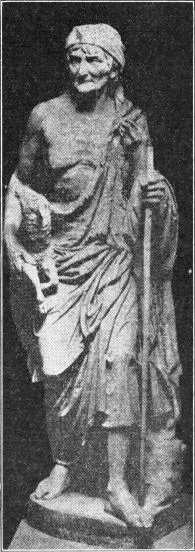
THE SHEPHERDESS
Jugurtha, the King of Numidia, threw off the Roman yoke and defied every Roman general sent against him until Caius Marius was sent out (107). Marius, the son of humble parents, had been marked by Scipio Aemilianus, under whom he served in Africa, as a coming man: but though he had already shown great gifts as a leader the Senate did not want to give him the command against Jugurtha because of his low birth, rude manners, and the love in which he was held by the Roman mob. He was at last elected by a huge majority, and, thanks in part to the brilliant exploits of a cavalry officer, Lucius Cornelius Sulla, ended the campaign in triumph. Jugurtha was captured, marched in chains through the Roman streets and cast naked into an ice-cold dungeon to die of hunger and exposure.
In Marius’s triumph there was a drop of bitterness. His glory was shared with Sulla. For it was Sulla who had actually captured Jugurtha. With a small body of men he had daringly entered the camp of Bocchus, King of Mauretania, with whom Jugurtha had taken refuge, and persuaded Bocchus to make friends with Rome by giving him up. He had a ring made with a picture of the scene, which annoyed Marius every time he saw it.
But no one at the moment thought that Sulla could be a real rival to Marius. There was no question of naming any one else as general when the strife of parties in Rome was suddenly interrupted by terrible news—the Northern barbarians were on the march. This danger, from the Cimbri and the Teutones, had actually been threatening for a long time. In 113 a consular army had been routed by the Cimbri. For the next eight years, joined by other tribes, they remained on the North Italian frontier, a perpetual menace, defeating, one after another, the armies sent against them. In 105, when Marius was still in Africa, two Roman armies were annihilated at Arausio on the Rhone (105). More than 80,000 men perished in a single battle. Only a handful escaped to bring the terrible news home. Such a disaster had not happened since Cannae. The way to Rome stood open: there was no army to stop the victors had they marched on to Italy. They did not. They turned to Spain. Marius, who was called home, given chief command, and made consul in three successive years, had time to create a new army.
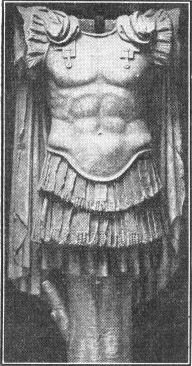
TROPHY OF VICTORY Capitoline Museum
In doing this he tackled one of the most pressing problems of the time. Gracchus had seen how great a danger the falling-off of the supply of men from the land might be: but no one had really grasped and dealt with the question from the army point of view until Marius took it in hand. This was indeed his greatest and most lasting work. First he changed the whole basis of service. Every one was liable to be called on, not only the shrinking class of holders of land. He took soldiers from the towns as well as from the country, from among freedmen and paupers as well as from among citizens. Second, he paid to every soldier a small daily wage. This was an immense change. It at once created a new class: the professional soldier. Formerly men had done their time in the army and then returned to ordinary civil life. Now the soldier was a soldier for life. Next Marius reorganized the army from within, sweeping away the differences between the Roman legions and those made up of Italians and allies. He improved the equipment of all ranks. This done he set himself to training his new men, encamped in Transalpine Gaul, in readiness to meet the foe.
A soothsayer, in whose prophecy he placed great faith, had told Marius he should be consul seven times. As consul for the fourth time he finally attacked the Teutones with his new armies. At Aquae Sextiae (to the north of Marseilles) 100,000 barbarians were slain (102). It was a terrible slaughter. For centuries after the fields were covered with blackening bones, and the people of Massilia used them to make fences for their vineyards. Next year Marius, consul for the fifth time, met the Cimbri, who had crossed the Alps and descended into the plains of Lombardy, at Vercellae (101). Before the battle messengers came from the Cimbri, demanding land for themselves and the Teutones. They had not heard of the rout of Aquae Sextiae. Marius smiled grimly. ‘Do not trouble yourselves about your brothers,’ he replied. ‘They have land enough which we have given them to keep for ever.’ When battle was joined next day it was the height of summer; the blazing heat exhausted the Northerners. Boiorix, the Cimbrian king, the tallest and strongest man in the army, perished; round him there lay, at the day’s end, 100,000 of his countrymen.
Marius returned home to be hailed as the saviour of his country, the peer of Camillus and Fabius. He was made consul for the sixth time.
Marius had won great victories; but the rejoicings in Rome over the terrible dangers that had been averted by his generalship were brief. Men’s minds were profoundly disturbed: many felt dimly that great and terrible events were coming without seeing what they were or how to deal with or prevent them. Marius certainly was not the man who had either the insight or the power to do this; he was a man of camps with no knowledge or understanding of politics. His victories and the great shows that followed them made him the idol of the mob: but the idol of the mob was the last man to deal wisely with the difficulties of Rome. The men of wealth and birth detested him as a dangerous, rude, unlettered boor, who knew nothing of government or public business. Marius could not even keep order. There were constant riots. People were set upon and murdered in the open streets. Alarming reports came from the provinces, especially from the East. But any one who had the courage to demand justice for the provincials was certain to be detested in Rome. Thus the honest Rutilius Rufus, who tried to defend the people of Asia against the greed of the Roman tax-collectors, was driven into exile. Nor did the Roman mob care a fig for the grievances of the Italians—or the senators either.
Drusus
There were, however, men in Rome who felt that dishonour was coming upon the Republic from these things as well as danger. These men—aristocrats of the old stamp—were, however, mostly rather inclined to turn aside from politics, which filled them with disgust. Their feelings were not keen enough to make them take action. But they saw that things were going from bad to worse; and when at last one of their order came forward who cared enough to take risks, they rallied round him. This was M. Livius Drusus, a young man of lofty family, who thought the men of his own order were partly to blame for what was happening. They held aloof and let vulgar and ignorant men like Marius and his associates, Glaucia and Saturninus (men of very low character who led the crowd by promises and bribes), drag the good name of Rome down. Two things stirred Drusus to action: one the shocking unfairness of the law courts, the other the fact that the people of Italy were shut out of all share in their own government. Everything was settled in Rome: the Italians had no voice. The consuls and other magistrates who made and administered the laws were chosen by Roman votes only. Yet the Italians had to send men to the army and pay taxes.
Drusus got his Bill for the reform of the law courts through (91) in spite of the moneyed men, since he proposed that the judges should be partly chosen from the Senate, and a strong body of senators backed this up. But when his Bill giving votes to the Italians came up things were different. There he could count on very little support. It did not help him in Rome that, when he fell ill, prayers for his recovery were put up in every town in Italy. This was indeed used against him by his enemies in Rome, who said there was a conspiracy going on. The rich Italians, too, made common cause with the rich men in Rome. Some of the aristocrats stood by Drusus, but the majority in Rome was against him.
Throughout Italy the struggle round his Bill raised an intense and deep excitement. Then one night Drusus was murdered in the street as he was going home. The murderer vanished. No inquiry was made. Drusus’s Bill was dropped; his party was crushed. His enemies at once rushed through a measure setting up a court before which every one suspected of sympathizing with votes for Italians was to be charged.
But the hopes of the Italians could not be crushed thus. The news of Drusus’s murder ran like an earthquake shock through Italy. Feeling was at fever pitch. Rome refused to recognize Italian rights: the Italians would compel it to do so by the sword. All over the peninsula feverish preparations went on. A few months after Drusus’s death fighting broke out at Asculum in the south and spread like lightning all over the north and centre.
This Social War, as it was called, was waged with dreadful bitterness on both sides, and the misery and ruin it brought on the country was terrible. In the first year (90) things went against Rome, though all their best generals, including Marius and his hated rival Sulla, took the field. In the second year (89) Marius did little or nothing, but in the south Sulla carried everything before him. But while the Romans were winning they were also beginning to see that the war need never have taken place: it was time to let the Italians take their share and make them Romans. A Bill giving them voting rights was drafted and passed into law. This did more than anything in the actual campaign to bring the fighting to an end.
The war was still raging when news came that the East was ablaze. Mithridates, King of Pontus, the richest king in Asia Minor, and far the ablest, had taken the field and was preparing to overrun the Roman provinces. Hard on the heels of this came worse. Mithridates had defeated a Roman general, destroyed his army, captured his fleet and was invading Asia. He came, he said, to free the people from the Roman tax-collectors who sucked their blood away. Slaves and prisoners were set free, those who killed Italians pardoned. On a certain day of the year 88 there was a massacre of no less than 80,000 Italians in Asia. The rebellion against Rome, thus begun, spread to Greece. Athens threw off the Roman yoke; Mithridates, who dreamed of ruling over the whole East, sent his general to help overthrow the Roman garrisons in Greece.
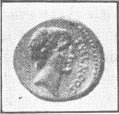
SULLA from a coin
Thus while Romans were fighting one another the lands beyond the seas of which they were so proud, and which were the source of most of their wealth, were in rebellion. Men of their own race had been massacred by Asiatics. Each day the news grew worse. In Rome there were riots in the streets. Sulla had been named commander against Mithridates. Marius could not bear this. He got his friends to bring in a Bill transferring the command to him. It was carried, but amid such disorder that senators and consuls fled from the city. Sulla had left the riots and disorders of Rome to go to his army at Nola. There he received the order to hand over the command to Marius. If Marius expected him to obey he had misread the character of the man he hated. Sulla’s answer was to march upon Rome at the head of his legions. There he was welcomed by the remnant of the Senate as the restorer of law and order. Marius fled.
Of the sudden rise of Sulla, Plutarch gives the following account:
Sulla Felix
In the long Social War, with all its vicissitudes and disasters, and dangers that threatened the safety of Rome, Marius could achieve nothing great, and merely proved that military excellence demands physical strength and vigour, while Sulla by many notable victories gained the reputation of a great general with the people, of the greatest of generals with his friends, and of the most fortunate with his enemies. Yet he was not sensitive about this last judgement as Timotheus the son of Conon was; for when his enemies attributed all his successes to fortune, and painted pictures in which he was represented asleep with Fortune casting a net over the cities, Timotheus was rude to them and angry, feeling that they deprived him of the credit due to his deeds. Sulla, on the other hand, not only accepted without annoyance the ‘felicity’ thus assigned to him, but even magnifying it and recognizing it as divine, he made fortune responsible for his exploits, either in a spirit of ostentation or from a genuine belief in providential guidance. For example, he has written in his memoirs that of all his decisions which were justified by results the happiest were not reached by deliberation, but adopted in the hurry of the moment. Moreover, when he says that he was born for fortune rather than for war, he seems to have more respect for fortune than for merit and to accept the control of an unseen power; insomuch that he makes a divine good luck the cause of his harmony with Metellus, his kinsman and colleague in the consulship; for he expected to have much trouble with him, but found him a most agreeable partner in office. Again, in the memoirs, which he has dedicated to Lucullus, he bids him place most reliance on any warning given him by a vision in the night. He tells us, too, that when he was leaving the city with an army to fight in the Social War, the earth opened near Laverna and a great fire gushed out, shooting up a bright flame to the sky. The prophets interpreted this to mean that a man of genius, who was of unusual and remarkable appearance, would take the command and free the country from its present disorders. Sulla declares that he was the man; for his golden hair was the peculiarity in his appearance, and he felt no diffidence in ascribing genius to himself after his great achievements.
Plutarch, xxxiii. 6. 2-7.
In many respects Lucius Cornelius Sulla is the most extraordinary figure in Roman history. Belonging to a very old family, the same as that of the Scipios, he grew up in genteel poverty, living in one of the large blocks of flats that had been built near the centre of the town. He was extremely handsome, with every grace of form and feature, tall, well built, with a face of classic outline, marred in later life by a hot and somewhat mottled complexion, but distinguished by eyes of a brilliant blue: eyes that could upon occasion flash fire. They did not often do so, for Sulla was a person of ice-cold reserve, seldom carried away by his feelings. Highly educated and gifted with unusual powers of mind, he looked out upon the world and despised most people in it. His was a mind incapable of feeling any sort of religious appeal. Most of the things people strove after seemed to him stupid, because there was no pleasure in them. He was what is called a cynic.
Until he was nearly fifty Sulla took no important part in public affairs. He served with great distinction in Africa. His unshakable courage and complete self-control, combined as they were with rare powers of making men do what he wanted and an absolute belief in himself, made him a successful commander. But for military glory in itself he did not care, or for any other kind of glory. To him these things were illusions. Nor was he stirred by patriotism in the ordinary sense. He saw the Rome of his time very much as it was and did not consider it worth the sacrifice of a pleasure. The aristocrats seemed to him selfish and stupid: the popular party vulgar and stupid. He saw what was going to happen but had none of the belief that inspires idealists that he could change the course of events. ‘Things are what they are; the consequences will be what they will be. Why then should we seek to be deceived?’ This, said two thousand years later, was a true description of Sulla’s point of view. He looked on, coldly scornful; and amused himself, like other well-to-do men of his class, with the arts in their lower as well as their higher forms. But, when occasion called, he could act. When the Social War broke out, and all hands in Rome were, as it were, called to the pumps, Sulla was ready. He proved more successful, if also more ruthless, than any other commander in the field; he understood, better than any one else, the supreme danger in which Rome stood. It was this, and not personal ambition in the ordinary sense, that made him take the command against Mithridates, and march on Rome when the Marius faction showed that they were incapable of keeping order there.
Sulla could spend no time in Rome. The danger in the East was too pressing. He sailed for Greece. Marius might return: if he did Sulla knew that his own life might be in danger, but he could not trouble about that. Roman rule in the East was threatened: it was his business to save it. He saw, as Marius did not or could not see, that at this terrible moment the fate of Rome trembled in the balance. Italy lay torn and exhausted by civil war. Agriculture had been ruined, thousands slain, and business of all kinds was at a standstill. The war in the East shook the very life of the Republic to its foundations. Rome lived, as London lives, on trade and supplies from overseas. They were stopped. There was a money panic. The danger was the greater that the revolt against Rome, both in Italy and in Asia, Greece, and elsewhere, had right on its side. The Roman Government, in the years that had passed since the defeat of Hannibal, had been bad: cruel, extortionate, and unjust. In Rome itself there was bitter disunion.
When Sulla set sail he knew all this, knew how tremendous a task was before him, and, believing as he did in his star, knew that he would accomplish it. But only he of Romans then living could have done it. Marius, hot-headed always and now old and weakened in will and mind by drink, could not have succeeded. It needed all Sulla’s extraordinary coolness, all his iron will.
Though he saw that trouble would break out again in Rome as soon as his back was turned, he also saw that the danger from the revolt of Greece and from Mithridates was even more immediate and pressing. The whole basis on which the Roman world rested would drop from under it if Mithridates succeeded. The danger was, in its way, as great as that which had threatened Rome when Hannibal crossed the Alps.
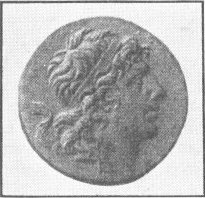
MITHRIDATES from a coin
For Mithridates was an exceedingly able prince. His strength did not lie in the huge hordes of soldiers he had behind him. Eastern soldiers were a poor match for Roman legionaries, even when they far outnumbered them. Nor did it lie in the vast wealth of the kingdoms over which he ruled: though in both men and resources he outclassed the small army Rome could send against him. His real strength was first his own ability, second, the general and widespread revolt against Rome. The Roman State, as he knew, was torn with revolution at home. There was a general sense of panic and uncertainty. The Government had neither men, money, nor supplies for the war against Mithridates.
Now, instead of closing ranks, as after Cannae, rich Romans fled, some even joining Mithridates. Marius and his party saw in the dangers Sulla went out to face nothing but their chance to come back to power in Rome. Marius himself was old now and had taken to drink. Almost as soon as Sulla sailed revolution broke out again in Rome. The streets ran with blood; the town was heaped with the bodies of the slain. Cinna, one of the consuls, proposed to recall Marius (who had fled to the ruins of Carthage) and brought up first slaves and then armed Italians against the Senate. He was defeated and declared a public enemy. With Sertorius, a most able officer but a personal enemy of Sulla, Cinna then organized the Samnites. Marius returned from Africa, and he, Cinna, Sertorius, and Carbo marched on Rome (87). When they at last entered the city at the head of their troops a terrible massacre took place. Marius, who was almost mad with fury, struck down any one who had ever thwarted or criticized him, among them some of the noblest men in Rome. Antonius, first of living orators, Publius Crassus, a fine soldier, Catulus who had shared with Marius the toils and honours of the wars against Teutones and Cimbri, Merula the consul, shared the fate of hundreds of less note. No one was safe. Marius walked about like a raging lion, thirsting for blood. The heads of the dead stood in rows round the Forum and above Marius’s own house. For five days the massacre went on until at last Sertorius, who had looked on with horror, stopped it by cutting Marius’s bodyguard of murderers to pieces. The old man was elected consul for the seventh time (86): a few days later he died. Sulla meantime was declared a public enemy, banished, and removed from his command. His house was demolished, all his goods were sold, his wife and family were driven into exile.
Such was the news that came to Sulla as he was besieging Athens and in the greatest danger. The city appeared impregnable. His small army was reduced by wounds, disease, and the shortage of supplies: the danger that Mithridates would land and cut them off was immediate. They would then be between the devil and the deep sea. But Sulla’s iron will did not quail. The man whom Rome regarded as a creature of pleasure shared every hardship of the soldiers and encouraged them day and night by his personal courage and calm. He showed marvellous ingenuity and resource in collecting supplies and a complete disregard of everything but the purpose in hand. He was a Greek scholar with a real admiration of Greek literature and art: yet he ransacked the temples and melted down the ornaments and treasures of centuries to make money; cut down the trees of the Sacred Grove of the Academy where Plato had walked with Socrates to make trench props. His ablest officer, Lucius Lucullus, was sent off to collect a fleet, somehow or other.
All through the winter and the whole of the next year Athens held out. The next winter came before Mithridates’ fleet sailed: it could do nothing till the spring. But with this news came that of a new danger. The Roman Government of Cinna was sending out an army against Sulla. He was between two fires. But his nerve did not fail. Athens fell to a supreme assault on the 1st March (86) before the new Roman army left Italy. Moving south Sulla then met Mithridates’ army on the Boeotian plain and at Chaeronea gained a victory that rang through the world. The spell of Mithridates’ name was broken: Rome was still invincible. The revolted cities of the East began to come back. In the same year Sulla gained another great victory. At first the Roman line broke, panic-struck. Sulla, leaping from his horse, snatched a standard and rushing into the hottest of the fight shouted to his men, ‘Soldiers! If you are asked where you abandoned your general, say it was at Orchomenus.’ Stung by this reproach and the supreme courage of their general, the men recovered. The day was won. Flaccus, the Roman general, made an agreement with Sulla: to him, whatever the orders of the Home Government, it seemed impossible that Roman armies should fight against one another when there was a common enemy to face. But a captain in the ranks, Fimbria by name, stirred up a mutiny, Flaccus was murdered, and Fimbria prepared to march on Sulla.
Sulla was now in a dilemma. His life was in danger unless he made peace with Mithridates. To do so was not magnificent: it was not even highly honourable. But Sulla was not a man to be stayed by such ideas. His own life was at the moment more important than anything else. If he were killed there would not be much left of the honour of Rome. He therefore made a treaty with Mithridates. He made the treaty on his own terms, however. Earlier, at a time when he was in extreme danger, Mithridates had offered him an alliance. This he had utterly rejected. Now he insisted that Mithridates should altogether abandon his plans and claims against Rome. By the treaty of Dardanus (84) the king had to give up all his conquests in Greece and Asia and hand over ships of war and a great sum of money to Sulla. In return the man who had arranged the cold-blooded murder of 80,000 Italians was made ‘friend and ally’ of Rome. Sulla knew that Mithridates would sooner or later give trouble again: but for the time being the danger was over. Rome’s power and name in the East had been saved, at a price. The treaty could not stand, but for the moment it was necessary. Sulla could turn to saving Rome at home. Fimbria’s army began to desert to him. Fimbria in despair killed himself. Sulla spent the next year in preparations for his own return in Rome. Carbo, who had succeeded Cinna, was as bitter against him as Cinna had been.
After a year in Asia collecting the taxes, not paid for the last four years, Sulla landed at Brundisium (83) with a well-filled treasury and a devoted army. On every soldier he imposed an oath: they were to treat the Italians as friends and fellow citizens, not as enemies. But to the Marian party in Rome he determined to show no mercy. The State must be cleared of these people: there must be no more riot and revolution. As Sulla marched north he defeated the forces sent against him: many of the soldiers deserted to him: many cities opened their gates. The Government of Marius, Cinna, and Carbo was thoroughly unpopular: and Sulla kept his word, doing no harm to the country through which he passed. Only the Samnites resisted strongly: them Sulla, who had been joined by young Crassus and by Cnaeus Pompeius, defeated in a great battle lasting from noon to the following mid-day outside the Colline Gate (82).
Rome and all Italy were now in Sulla’s power. He entered the city and assembled the Senate in the Temple of Bellona. As he explained his plans for restoring order—he was to have the powers of a dictator till that was done—a frightful sound was heard. Sulla gave his grim smile. ‘Some criminals being punished’, he said. Six thousand Samnite prisoners were being cut to pieces. In this spirit he proceeded to stamp out what had been the party of Marius. Marius had been mad with rage: Sulla was quite calm, but not a whit more merciful. The tomb of Marius was broken open, his ashes scattered in the road. Samnium, which had resisted the conqueror, was laid desert. The land was broken into allotments for Sulla’s soldiers.
The proscriptions followed. Lists of public enemies were posted and a reward paid to any one who killed the men whose names appeared. Their property was confiscated. Men put the names of private enemies on the list before or sometimes after they had killed them. Catiline, for instance, did this to his own brother. Sulla did not care. The State must be cleared of dangerous men and it must get revenues from somewhere. On the 1st June 81 the lists were closed: the executions and confiscations ended. Nearly five thousand persons had perished. Their property and that of those who had fled or been banished fell to the State, which got four million pounds in this way.
By murder and robbery the State treasury was filled. Sulla’s hard mind did not shrink from these ugly words. He did the things and made no pretences. In the same way he never pretended to believe in the rights of the people. He despised them, thought them stupid, ignorant, and lazy. What they needed was police. The Government he built up was of this kind. He made the Senate much larger and stronger, for men of birth and wealth, though no better than the others, could at least, he thought, be trusted to keep things orderly and as they were. No one was to be consul till he had passed through the lower offices, and then consul only once. As consul he was to stay in Italy without an army; at the end of his year he might be sent abroad, with an army, as a pro-consul. In Italy there were to be no troops: no soldiers were to cross the Rubicon. The law courts were reformed, the juries again drawn from the Senate.
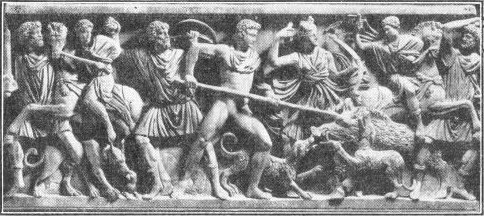
A BOAR HUNT from a sculpture in the Capitoline Museum
When he had finished his work of reorganization and built up the power of the Senate—i.e. of the older men of birth and property—as strongly as he could, Sulla laid down all his extraordinary powers and retired to private life. He had built himself a lovely villa, full of the art treasures he had brought from Greece and from the East, in the midst of exquisite gardens. There he lived, writing his memoirs, and enjoying the pleasures of hunting and fishing, banqueting and revelling, surrounded by the most amusing people he could find. Many of these were writers, artists, and actors. Actors were looked down upon in Rome, but Roscius the tragedian was a great friend of Sulla’s, for he scorned all such notions as unreal. Always Sulla had provoked the Romans by his power of casting off serious cares when he sat down at table and by what they thought his ill-timed jests. They did not understand his view of life. To him it was all a play, not a very good play: out of which, if one were lucky, one might get some entertainment. He had been lucky: chance was his goddess and he believed in nothing higher. Before he died, at the age of sixty, he wrote his own epitaph, which was inscribed on the great monument set up to him in the Campus Martius: ‘No friend ever did me so much good or enemy so much harm but I repaid him with interest.’
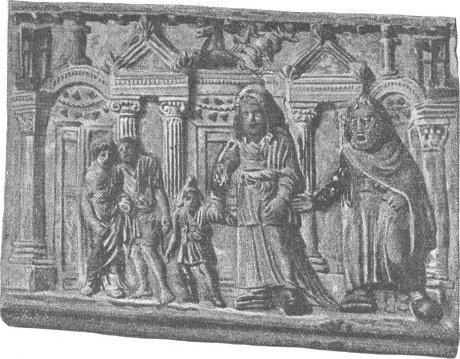
SCENE FROM A TRAGEDY Terra-cotta relief
VIII The New Rome
With the death of Sulla a new period of Roman history begins, a brief and in many ways brilliant half-century, about which we know far more than we do of any earlier time, since we possess the works, in writing, architecture, sculpture, of the men, or of some of them, who helped to make it. Roman life in these fifty years is, in many respects, startlingly like that of our own day. True, the great discoveries of science had not been achieved; there were no motors, telephones or lifts, no railways, no electric light or power, no illustrated papers—indeed the first newspaper of any kind was a small sheet issued by Caesar. But in the things they did and said and thought about, and in the way they acted and spoke and thought about them, the Romans who lived in the sixty odd years before the birth of Christ were very much like the Englishmen of our own day. The comfort of the lives of the well-to-do, with their elegant town houses and charming country villas, furnished with beautiful things brought from all parts of the world, depended on the labour of innumerable slaves. In many ways, however, these slaves were not worse off than the poor factory workers of our great towns; in some they were more fortunate. The lot of those who were being trained to fight in the games was certainly dreadful; but those owned by private persons were for the most part kindly treated and could and often did buy their freedom. The class of freedmen was a large and growing one in Rome.
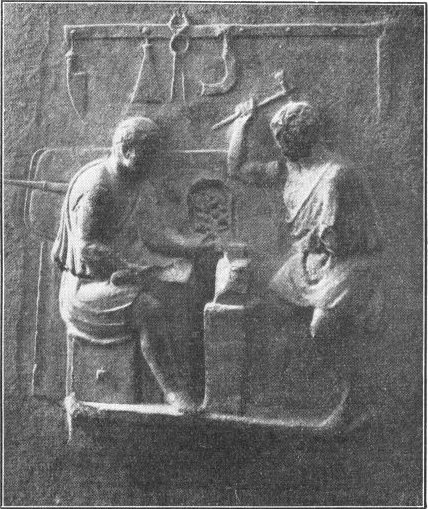
CUTLER’S FORGE
The revolutionary wars had brought ruin to many. Large tracts of Italy had been laid waste. But though the wounds that had been dealt at the life of the country bled for long, prosperity returned surprisingly quickly. If some families had lost everything, others had profited by their losses. And from abroad wealth poured into Italy in ever-increasing streams. A new class of rich men grew up, whose wealth came from business of all sorts—tax-farming in the provinces, house building, ship construction, agriculture on a large scale. Side by side with them were the lawyers, an increasingly important body. As to-day, a great many young men, when they had completed their education by spending some time abroad, in Greece by preference, became barristers. Success in the courts, the power of public speaking, opened the way to success in politics, though it was long before any one could go far along that road who had not won distinction as a soldier.
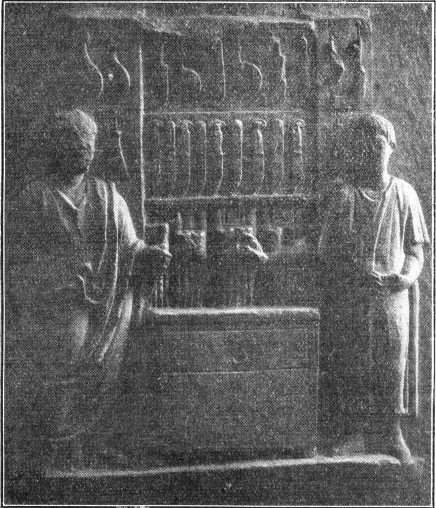
CUTLER’S SHOP
Very slowly and gradually, the sharp line between the new men and the old patrician families began to soften. There were few so proud that they would not go and eat a sumptuous dinner at the house of a man because his parent had not worn the purple stripe on his toga that marked the senator. Education spread. Sulla brought back with him from Greece innumerable treasures, among them the works of Aristotle, which became the educated young Roman’s bible.
All over Italy wealth spread, as the fields blossomed with vine and olive. Great roads made travel easier and swifter; aqueducts brought water where it was needed; the marshes were drained; everywhere lovely villas were built, their exquisite gardens adorned with beautiful statues. Thither the tired Roman went for a few days’ refreshment, accompanied by his friends and escorted by trains of slaves. Slaves wrote his letters for him, and carried them swiftly to his friends in other parts of Italy or across the seas. They copied the verses and prose sketches which the young Roman of fashion liked to have written, so that the vellum roll circulated almost as quickly and freely, among the well-to-do, as does the volume to-day. Life became more elegant and refined. Music, dancing, games of all sorts provided distraction; gambling became a passion with many; eating and drinking were as luxurious as now. When we think of the Romans of the period after the civil wars we must think of men intelligent, cultivated, educated, polished by contact with a wide and various world of affairs, their minds opened by foreign travel and the study of Greek language and literature.
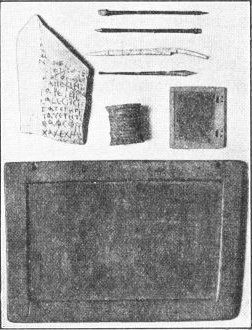
WRITING MATERIALS Pens, Ink, Tablet, and Potsherd Brit. Mus.
War, however, remained the high road to popularity and fame. Since all the provinces were held by military governors (pro-consuls or quaestors) any one who aspired to high place in the State must have gone through some sort of military training. The successful general was still the favourite candidate. But military prowess alone was no longer enough. The day was gone by when a boor like Marius could ride rough-shod over the Republic. The hero of the new Rome was to be something more than a soldier, though he must be a soldier too.
Within Italy the struggle between Romans and Italians was over. Italy was one, as it had never been before. Having acquired the vote, though not on terms of full equality with the Roman citizen, the Italian middle class settled down to money-making and did not, as a rule, trouble much about the stormy course of politics in the capital. More and more, it was from Italy that the army came; the Roman populace liked the shows given at the close of campaigns, but did not care much for the dangers and hardship of service.
But although this struggle was over, another remained, sharper and more bitter than before. The return of Sulla had meant the triumph of the Senatorial Party, of the Conservatives, the men of old family and fixed ideas. Sulla’s proscriptions, the murder and banishment of innumerable families and the seizure of their goods and estates, to be divided among their enemies, left behind them a deep hatred between those who had triumphed and those who had been defeated. After Sulla’s death the sons and grandsons of the proscribed began to come back, and what had once been the Popular Party, led by Marius and Cinna, built itself up again. At first it had no leaders. The men who were to be its leaders were still too young. Gradually, however, in spite of the unpopularity that had become attached to its very name, it gathered strength. The new rich and the struggling lawyers joined its ranks, since there was more chance there than in those of the Conservatives for fresh talent and new ideas. A new kind of political organization was built up through the clubs and workmen’s associations.
The main source of the growing strength of this new Popular Party was the weakness and inefficiency of the Government. Sulla had erected a remarkable machine, intended to prevent all change and keep the power of the State in the hands of a small ruling class, the patricians. But the machine would not work when his strong directing hand was removed. It was too stiff and rigid to cope with the growing tasks of administering the great empire over which Rome had to rule. Bit by bit Sulla’s system broke down; his rules were swept aside. In the years between his death and that of Caesar the rule of Rome extended enormously; each extension made the need of a strong and efficient Government more pressing. The actual government of Rome through the Senate was neither strong nor efficient. Nothing was well managed. This growing mismanagement compelled men of active minds to look around and ask themselves what was wrong. They found different answers. But the need of change was clear.
IX Lucius Licinius Lucullus
If great men are those whose action brings about great changes, Lucius Licinius Lucullus was one of the greatest men of his time. His campaign in Asia Minor started an altogether new policy. Hitherto Rome had acquired provinces in an accidental way; there had been no purpose of conquest. In Spain and Africa the influence of Carthage had to be wiped out; in Greece Rome was nominally a protector only, called in to help against outside dangers. In Asia Minor it was more or less the same. As regards Asia Minor no one in Rome was satisfied with the treaty Sulla had made with Mithridates. It was felt to be a disgrace to Rome that the man who had caused the murder of hundreds of thousands of Italians in cold blood was recognized as the ‘friend and ally’ of Rome and left in undisturbed possession. Mithridates had got to be punished. When Lucullus went to the East it was for this purpose. But he did far more. He discovered that these great Asiatic monarchies, with their myriad armies, looked strong but were really weak; they could not maintain themselves, if attacked. He did not merely make Rome safe against their attack; he marched through kingdom after kingdom, conquering and subduing them to Rome. Thus, in fact, if not yet in name, he made Rome an empire.
The work he thus began Lucullus did not complete. The idea was his; it was his hard fighting, the courage with which he overrode instructions and disregarded the Senate’s order to return, which paved the way for conquest. Pompeius, whose slow mind and cautious temper could never have started such a policy, saw from Rome what Lucullus’s fighting was leading up to. He saw the golden prize at the end of his efforts and determined to snatch it from him. In this he succeeded. But the credit or blame of making Rome an imperial power, a power that rules by force over alien races, belongs not to him but to Lucullus. This was not understood at the time. Lucullus, disappointed and embittered, came back to Rome and was known to his contemporaries not as the man who laid the foundations of the empire, but as the giver of the most luxurious and extraordinary banquets ever eaten. The proverb associated with his name—‘Dining with Lucullus’—shows this. His feasts were famous; the rarest foods from every part of the known world were on his table. His gardens too were wonderful, and his house glowed with all the treasures of the distant East. Among the treasures he brought back was one little noticed in his day—the cherry-tree. This soon grew all over Italy, but that Lucullus had brought it was forgotten. Like everything else that he did, it failed to bring him fame.
The family of L. Licinius Lucullus was one of the oldest in Rome and one of those not too numerous ones which maintained not only the pride of ancient race but the idea that good birth carried duties with it. He was poor but excessively proud, and belonged to that small Conservative group from which Rutilius Rufus and Livius Drusus came. His mind was clear and highly educated, cultivated in the full sense. As a soldier he was extremely able. The way in which the ordinary politician made money and bought votes disgusted him. In the main he stood sternly aloof from the scramble for office and wealth.
After Sulla’s death—he had been one of Sulla’s most capable officers—he retired to private life and watched with cold scorn the way in which the affairs of the State were mismanaged both at home and abroad; the long struggle with Sertorius, the rise of Pompeius, by good luck rather than, he thought, by merit. He had strong feelings and a good deal of the ambition that moves in almost every mind that is aware of its own powers, but he detested intrigue and had no aptitude for it. He was unpopular, because of his habit of saying what he thought, both in public and in private, about the corrupt politicians and vulgar scrambling money-makers whom other politicians abused in private but dared not offend in public. He had no party. Until he was fifty he had held no command or office of the first rank.
But when the question of the campaign against Mithridates came up Lucullus felt that he had a claim to it and was prepared, despite his ordinary aloofness, to push that claim through. Nicomedes, the old King of Bithynia, had just died (74) and left his rich territory—a buffer state between the Roman provinces in Asia Minor and Mithridates’ kingdom of Pontus—to the Roman people. This the able and wily King of Pontus was not going to allow. He declared war, made an alliance with Sertorius, and marched into Bithynia. This was a serious menace. When Mithridates invaded Cilicia (73) people remembered the massacre of fifteen years ago and trembled. Pompeius wanted the command, but he was still busy in Spain; in the end Lucullus was appointed.
The difficulties of the campaign were at first overwhelming. Lucullus was not in sole control and his colleagues were refractory. But the defeat of Cotta, the other consul, at last left him a free hand. Many of his captains were dismayed by the reduction of the Roman army. Lucullus remained calm. Mithridates had attacked the port of Cyzicus, far from his own base, with an army so large that to provision it was extremely difficult. Lucullus took up a position from which he could cut off his supplies and so close him in a trap between the town and his own army. With his smaller army Lucullus refused battle, and when Mithridates endeavoured to make his way out by dividing his forces Lucullus attacked the two parts in turn, though it was the dead of winter, and defeated them disastrously. A vast army perished in the snow. Lucullus was able to overrun Bithynia and force Mithridates to retreat into Pontus.
It was now that Lucullus took the step which makes his career profoundly important in the history of Rome. Instead of waiting for instructions from the Home Government—instructions which he knew would probably have ordered his recall and certainly a halt in his operations—he resolved to act boldly on a plan of his own. That plan was no less than the invasion of Mithridates’ kingdom. Nearly all his generals opposed him, but Lucullus’s mind was clear. He burned to wipe out the treaty of Dardanus and had come to the conclusion that Eastern monarchies were not so strong as they looked: that their loose organization could not stand against the disciplined force of Rome. Mithridates himself had something of genius; but Mithridates was old.
The progress of the campaign showed that Lucullus was right. Entering Pontus in the late autumn, he overran the rich country without meeting with any serious opposition; Mithridates’ armies had been scattered at Cyzicus; he had not yet collected fresh ones. Immense plunder—slaves and cattle, gold and silver, ivory and precious stones, rare stuffs and wondrous embroideries—were sent home to Rome. In the following spring when Mithridates did advance with his new army Lucullus defeated it decisively. Cabira was taken and Lucullus spent the winter with the royal palace as his head-quarters, training his army for the work before it. Here the defects of his character came into play. Proud and passionate, Lucullus had an inordinate sense of his own dignity and of the greatness of his own purpose; he forgot that the greatest general is only the leader of other men, on whom his triumphs depend. To Lucullus his soldiers were mere instruments, not human beings; the army a machine. Great generals like Hannibal, Caesar, Napoleon, Alexander and, in his degree, Sertorius, owe their lasting success to the power they have to make each man in the army feel that he is a man, whose devotion matters, on whom in the last resort everything depends. When soldiers feel this, when they feel that they and their general are part of one living thing, they can perform miracles. Lucullus had no such power. He was harsh, tyrannical, and inhuman in his attitude and, overwhelmed by a mass of work, never found time to relax. The sternness of discipline never unbent. He seemed to grudge the soldiers any share in the vast booty sent to Rome. He had no kindly word or look for individuals. It was this growing feeling of bitterness that the discontented officers in his army, and especially his brother-in-law Clodius, who was secretly working for Pompeius against him, used to sow the seeds of mutiny.
Lucullus, absorbed in the mighty design he had conceived, did not realize what was happening, even when after the capture of Amisus his men paid no heed to his orders that the city should be spared, but sacked and looted it. By the autumn all Pontus was in Roman hands. Lucullus, again refusing to await orders from Rome, pushed on into Armenia and attacked Tigranes, with whom Mithridates had taken refuge. This campaign was brilliantly carried out. With his small army, hardly 20,000 in all, Lucullus inflicted a series of crushing defeats on the Armenian forces. Armenia was under his feet. He had shown all the qualities of a great commander: clearness and steadiness of purpose, complete confidence, the boldness and unresting energy of genius. As he rested in winter quarters in South Armenia planning the conquest of Persia and Parthia, he might well compare himself with Alexander.
Next year Tigranes had gathered a fresh army and Lucullus determined to smash him by taking Artaxata, the capital of Armenia. But here he failed. The campaign was dreadful: the ground was covered with snow; the rivers icy. At last mutiny broke out, his men refused to go on. News came from Rome that Lucullus had been superseded. The plotters at Rome had got their way.
The fruits of victory had been snatched from Lucullus and left for Pompeius to garner. His soul might well be filled with bitterness as he came back to Rome. No one there realized what he had done; he had no party. The political struggle disgusted him more than ever. His solitariness had been increased by years of absolute power in the East. He withdrew into silent isolation, and the banquets which were the talk of Rome. Men gaped, but did not understand either the man or his work.
After Strenuous Years
In the life of Lucullus, as in Old Comedy, we find at the beginning the acts of a soldier and a statesman, but towards the end eating and drinking, and little else but revels and illuminations, and mere frivolity. For I count as frivolous his costly houses, with their porticoes and baths, and still more the pictures and statues and his pains in collecting such works of art at great expense, lavishing the magnificent fortune amassed during his campaigns on the site where even now, though luxury has increased so much, the gardens of Lucullus are counted among the noblest belonging to the Emperor. At Naples, too, and on the neighbouring coast he pierced hills with great tunnels, surrounded his house with ponds and channels of salt water for breeding fish, and even built out into the sea, so that Tubero, the Stoic philosopher, at the sight of this magnificence called him ‘Xerxes in a toga’. Besides all this, he had country seats near Tusculum, with gazebos and rooms and porticoes open to the air, where Pompeius came on a visit, and blamed him for lodging himself excellently in summer, but making a house that was uninhabitable in winter. Lucullus merely smiled and said, ‘Do you think that I have less sense than the cranes and storks, and do not change my home according to the season?’ At another time, when a Praetor was anxious to make his spectacle magnificent, and begged for a loan of some purple cloaks to dress the performers, Lucullus replied that he would give him some if he found that he had any. Next day he asked how many were wanted, and hearing that a hundred would be enough, he offered two hundred. Horace is thinking of this when he remarks that he considers a house poor when the valuables hidden and overlooked are not more than those known to the master.
Plutarch, xxxvi. 39.
X Cnaeus Pompeius
At the time of Sulla’s death the unanimous opinion of Rome would have fixed upon Cnaeus Pompeius as the one young man then alive who was likely to follow in his footsteps and rule the Roman world by his own will. And if there had been in Pompeius’s character the qualities which his rapid success seemed to promise, they would have been right. But the life of Pompeius shows how much circumstances—chance, opportunity, the good opinion of others, birth and wealth—can do for a man; and what they cannot do, unless he has within himself the qualities of mind and will which mark off the first-rate from the best second-rate. Greatness was, as it were, thrust upon him; but since he was not great in himself he could not achieve it. It is this that makes him so interesting a failure. His failure was due to the fact that at a supreme crisis he was called upon to do just the things he could not do. It was no accident that enabled Julius Caesar to succeed where he failed. For Caesar possessed in supreme degree the power to act with decision, which, when combined with clear judgement, makes the great man of action. At the crucial moment the judgement of Pompeius wavered: his will was uncertain. In ordinary peaceful times his weaknesses might never have been seen; but his life fell within an era of storm and stress when the stuff of which men are made is tested and shown.
Tall, strongly built, with curly hair and large eyes that though prominently set and wide open had a rather sleepy expression, Pompeius when young was often likened to Alexander the Great. He had his regular features and brilliant colouring, but in his eyes there was none of the fire or mystery that made Alexander seem to his contemporaries as beautiful as a god. His manners were grave and dignified. He gave all who saw him an impression of his importance. Pompeius had a very strong sense of his own importance. The thing he was most afraid of was of being laughed at. When he suspected that any one was doing this, he lost his temper.
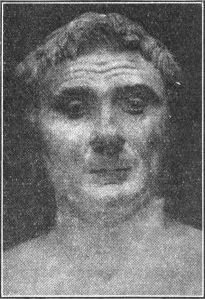
POMPEIUS
Pompeius belonged to a family old and honourable enough, though plebeian, to make the senators at last accept him as one of themselves, the more readily that he had acquired immense wealth in the proscriptions. At the time of the civil war he was on the side of Marius, and closely associated with him, while Marius and Cinna were in power in Rome. His first wife Antistia was the daughter of a friend of Cinna’s. When Sulla landed, however, Pompeius soon saw which way things were going. He collected an army and marched to join Sulla. Although he was only twenty-three at the time, Sulla hailed him as one of the most important of his supporters. He suggested to him that he should put away his young wife Antistia and marry his own daughter-in-law. To this Pompeius agreed, although Antistia loved him and was in the deepest distress, since her father had been killed in the proscriptions; moreover, her mother, when she heard how Pompeius intended to treat her daughter, laid violent hands upon herself. In the proscriptions Pompeius acquired so much wealth that within a few years he was one of the richest men in Rome. His popularity was great and he could afford to keep it up by giving splendid shows and presents to the people.
His wealth, his quick success, his great popularity filled the senators with awe. They had a constant fear that he was to be the next Sulla. They listened with respect to all that Pompeius said, though he was a dull speaker; and regarded him as the first general of the day, though he had really done nothing to deserve that title. But he was always lucky in his campaigns, and again and again had the good fortune to be made commander just at the stage when the fruits of a long struggle, carried on by others, were ready to be gathered. In the means by which he achieved success Pompeius was not over scrupulous. His want of feeling in the matter of Antistia was only one sign of this. The same kind of callousness was shown in the way he secured the final defeat of Sertorius, not by action in the field but by a plot. After three years of unsuccessful fighting Sertorius, much the ablest of Marius’s followers, who had raised the standard of revolt in Spain, was still as far from being conquered as ever. Pompeius was tired of the war; so were his troops. At last by the treachery of Perpenna and some other Romans in his army, on whose minds secret emissaries from Rome had worked, Sertorius was murdered. Pompeius then suppressed the revolt in Spain with horrible cruelty and returned to Rome crowned with success.
He was made consul (70) although he had never held any of the junior offices of State; but his consulship was marked by nothing more important than his constant disagreements with his colleague Crassus, who, though of patrician birth, inclined to the so-called Popular, anti-Senatorial party. For the next two years he was little to the fore until called upon, as the first general of the day, to deal with a difficulty which represented a most serious danger to Rome. Rome depended to a large extent on foreign corn. Yet this overseas corn supply was almost suspended by the pirates of the Mediterranean. Commander after commander failed to suppress them. Food prices in Rome rose to famine heights. At last the tribune Gabinius proposed that a special commander should be appointed, with unexampled power, both as regards men and money; and that Pompeius should be the man. Caesar and Cicero supported the plan. It was hotly opposed by those who thought such powers dangerous; but in the end Pompeius was appointed. He showed conspicuous energy and within forty days the seas were cleared.
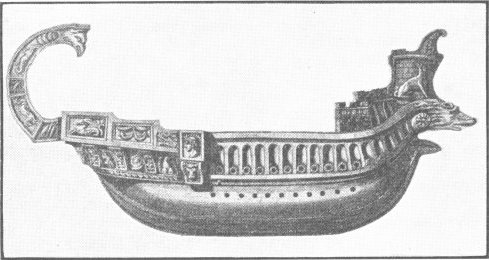
A VASE in the shape of a galley
A vivid account of Pompeius’s operations against the pirates was given by Cicero in the great speech he made in support of the proposal of Manilius to give him the command in the East, in the place of Lucullus.
Pompeius in his Prime
You know well enough how quickly these operations against the Pirates were conducted, but I must not on that account omit all mention of them. What man ever existed that, either in the course of business or in the pursuit of gain, was able to visit so many places and to travel such long distances in so short a time as this great blast of war, directed by Cn. Pompeius, swept over the seas? Even when it was yet too early for a distant voyage, he visited Sicily, explored the coast of Africa, thence crossed to Sardinia, and protected these three great granaries of the Republic with strong garrisons and fleets. Next, after returning to Italy, he provided in the same way for the safety of the two Spains and Transalpine Gaul, and sending ships to the Illyrian coast, to Achaia, and all Greece besides, he established large forces, military and naval, in the two seas of Italy. On the forty-ninth day after he left Brundisium he brought the whole of Cilicia under the dominion of the Roman people, and all the Pirates, wherever they might be, either were captured and put to death, or surrendered to his sole authority and command. Finally, when the Cretans had followed him even into Pamphylia with envoys begging for clemency, he did not disdain their offer of submission and was content to demand hostages. The result was that this great war, that lasted so long and reached so far, a war that harassed every country and every people, was taken in hand by Pompeius at the end of the winter, was begun in the early days of the spring, and was finished by the middle of the summer.
Cicero, De Lege Manilia, §§ 34-5.
Pompeius used the renown won by this success to secure for himself the fruits of the Asiatic victories won by Lucullus. On the one hand, he worked in Rome against Lucullus so that he got the command transferred to himself; on the other, by bribery and the arts of Clodius, Lucullus’s brother-in-law and aide-de-camp, he worked up a mutiny among his troops. Then he went out to Asia and in a series of spectacular campaigns laid the East at his feet. His progress through Asia was a parade; it was no wonder that the Romans were dazzled by the news of the way in which he overran kingdoms and conquered vast territories of enormous wealth. Pompeius seemed to them a general of the rank of Hannibal or Alexander.
The Senate grew alarmed. They had not forgotten how Sulla had returned from the East in 83 and set himself up as Dictator, master of Rome. If Pompeius in 62 wanted to do the same there was nothing to prevent him. He had a great army, devoted to him and ready to follow him in any adventure. He was extremely popular with the people of Rome. He had never shown any particular respect for the laws and customs of the State when he wanted anything for himself. He had broken the rules Sulla had laid down, by which no one could hold high command until he had passed through all the lower offices. Now, while still in Asia, he demanded to be allowed to stand as consul, in his absence, although he had never been tribune or praetor. The Senate put difficulties in his way. Indeed they did everything they could to irritate Pompeius and give him the excuse for taking the strong line they dreaded. Only Julius Caesar, the young and rapidly rising leader of the Popular party, backed him. The Senate refused to allow Pompeius to stand for the consulship. Nepos, his emissary, would actually have been killed in the streets if Caesar had not saved him. Caesar pleased him by proposing that he should finish rebuilding the Capitol.
The Senate’s fears were groundless, as Caesar knew. Pompeius was not like Sulla. Sulla always knew what he wanted. Pompeius had no clear aim. Opportunities lay open before him which he did not desire or know how to use. He wanted to be important, a big man of whom people spoke well, to whom they looked up; but his timid mind shrank from responsibility. He had never been fired by any great idea; he had no purpose that he wanted to impress upon the world. He had not even got that harsh and cold contempt for the mass of mankind that caused Sulla to feel a sort of bitter pleasure in imposing his will upon them. Of Caesar’s fire he had nothing. Politically he had never taken a firm line. If no one in Rome quite knew where he stood, Pompeius was in the same doubt himself. His was a respectable nature with a natural inclination towards safety. But in the Rome of his day things were in a state of uneasy movement; there was no safety or quiet for any one who wanted at the same time to be a big figure. Pompeius was later forced to take action. This action was weak and irresolute because his mind had never been clear. Most people are like Pompeius: they do not know what they want; or they want something vague, like happiness or the good opinion of others; or they want a number of things which cannot be had together. The mark of those men who stand out in history is that they conceived clearly something they wanted to have or do; and by force of will drove through to it. Even when they failed, as Hannibal, for instance, failed, their failure has in it something more magnificent than ordinary success. But this power to will implies a readiness to make sacrifices. If you want one thing you must be prepared to do without others. If you want to please yourself you must be ready to displease other people. You cannot have your own way and at the same time have the good opinion of everybody. This Pompeius never saw.