Chapter II · THE MAYAN CIVILIZATION (continued 2)
Reading edition
Transition Period
629 A. D. to 964 A. D. 10.3.0.0.0 to 11.0.0.0.0
Most of the Mayas surviving the collapse of the First Empire seem to have found a second home in western Yucatan, especially in the region called Chakunputun in the Chronicles. Here the rainfall is much less and the forest environment not nearly so luxuriant. Certain cities, which probably date from this transitional period, such as Hochob, Dzibilnocac, Rio Bec, etc., have very beautiful architecture showing advances over that of the First Empire in some features. Dated documents are so rare as practically to be non-existent. It seems probable that Mayan learning had been reduced to books for there is ample evidence from the succeeding period that astronomical and calendarial knowledge 149 had been conserved from ancient times. At the end of these lean centuries, the Mayas made their way still farther north. Chichen Itza which had been a provincial city of the First Empire was reoccupied and the Mayan renaissance known as the Second Empire began.
Period of the League of Mayapan
964 A. D. to 1191 A. D. 11.0.0.0.0 to 11.11.10.0.0
The first phase of the Mayan renaissance was pretty clearly centered in Chichen Itza although the earliest date which may be contemporary is probably that of the Temple of the Initial Series at Holactun. The inscription shows a survival of the ancient method of counting time and is now believed to treat of the interval between March 9, 1012 A. D. and November 14, 1016 A. D. Other cities rising to splendor during the Second Empire are Kabah, Labna, Sayil, and Izamal. The time of foundation for Uxmal is rather difficult to determine. According to tradition it was the capital of Toltec immigrants into Yucatan, but when or how they arrived cannot be answered definitely. The League of Mayapan was organized as an alliance between Chichen Itza and Uxmal in the second half of the twelfth century, and Mayapan was built as a neutralized capital of church and state under the inspiration of a Toltec noble named Quetzalcoatl. Finally, Izamal and Chichen Itza rebelled and Inetzalcoatl conquered the latter city in 1191 and made it the capital of a Maya-Toltec state.
Period of Mexican Influence
1191 A. D. to 1437 A. D. 11.11.10.0.0 to 12.4.0.0.0
The helpers of Hunac Ceel bore Mexican names and belonged to the Toltec nation. Hunac Ceel is 150 identified in one place with Kukulcan, the name meaning “plumed serpent” in the Mayan language, and in another place with Quetzalcoatl which has the same significance in the Mexican language. In Chichen Itza sculptural art and architecture have many clear analogies to works in the Valley of Mexico. The building called the Castillo seems to have been built by Quetzalcoatl, being the first structure in which serpent columns and other structural ideas of this ruler were given expression. The Temple of the High Priest’s Grave is a developed example of the new style bearing the date December 31, 1339 A. D. The elaborate Group of the Columns with the famous Temple of the Warriors, may be still later.
In the first half of the fifteenth century civil war and epidemic disease brought about a second depopulation of the stone-built cities including Chichen Itza, Mayapan, Uxmal, and probably also numerous other sites in the region of Uxmal. The last monument at Mayapan may declare the date September 28, 1437.
Modern Period
1437 A. D. to the present day.
After the second general abandonment of urban life the Mayas seem to have been divided into many warring factions. Temples were still regarded as sacred and some constructions in stone and mortar were still made, as we know from the first Spanish descriptions of towns on the east coast of Yucatan. Tulum probably represented this last phase and this site on a cliff overlooking the Caribbean is probably the city compared to Seville by the coasting expedition of Grijalva in 1518. A monument at 151 Tulum is believed to record the last setting up of a katun stone by the Mayas on 12.8.0.0.0, 2 Ahau 3 Pop, August 5, 1516, almost exactly 2129 years after the Mayas began to count every day in order.
At the present time certain ancient ideas still persist among the Lacandone Indians of the lowlands and among the Quiché, Cakchiquels, and several other tribes of the highlands. But the old glory of the Mayan civilizations has passed away never to return. A prophetic vision of this end is found in one of the Mayan Books of Chilam Balam which relates to events immediately after the founding of Merida.
“It was then that the teaching of Christianity began, that shall be universal over our land. Then began the construction of the church here in the center of the town of Tihoo: great labor was the destiny of the katun. Then began the execution by hanging, and the fire at the ends of our hands. Then also came ropes and cords into the world. Then the children of the younger brothers (the Indians) passed under the hardship of legal summons and tribute. Tribute was introduced on a large scale and Christianity was introduced on a large scale. Then the seven sacraments of the word of God were established. Let us receive our guests heartily: our elder brothers (the white men) come!”
152
Plate XXVI.
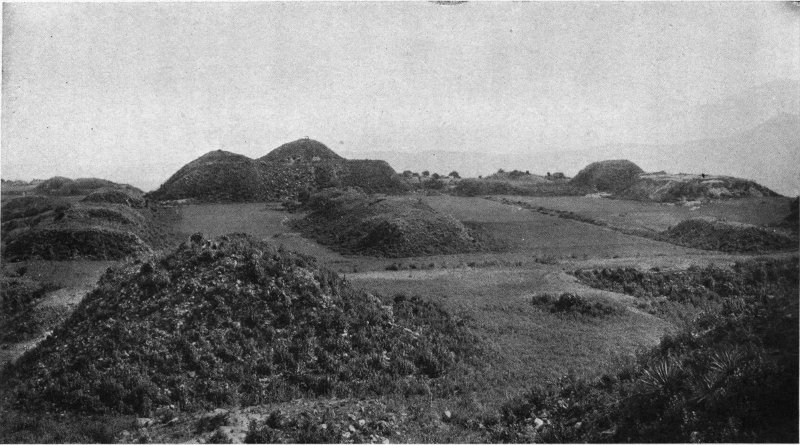
General View of Monte Alban from the North. The mounds are arranged around courts in an orderly manner.
153