THE LIST OF PICTURES FOR AN ISLAND GARDEN (continued 3)
Reading edition
The fragrant fringes of the Mignonette, how surprising and curiously beautiful they are under the little pocket microscope! What elaboration of detail, what tempered harmonies of color, what marvels of construction! I reach my hand for a blossom of Coreopsis Coronata some one has let fall on the step,—what a refulgent flower! There is something Spanish about its aspect always to me. There are eight yellow velvet petals deeply toothed at the edges, and rich embroideries in red about the warmer yellow of the centre. Gorgeous it is, and so is its relative, Coreopsis Drummondii, and both have a double row of sepals, the row nearest the corolla brown and thin and light, the outer one much coarser and bright green. The centre of the Drummondii is more like the wild Rudbeckia, with markings not so ornate as the Coronata, but in a mass, and of a brighter, clearer red. All this family of flowers, Lanceolata, Golden Banner, the deep scarlet and maroon varieties, are superb and most decorative.
It is a great temptation to linger over the loveliness of every flower that unfolds, but I spare my patient readers, and leave them to pursue these fascinating researches for themselves.
I have had reward enough for all my care of the Water Lilies (even though they had put forth only leaves, but they have blossomed well) in the delight of the birds over the tubs of clear water on which the mottled leaves are floating. So many charming creatures pause at them to drink, and the song-sparrows bathe there daily. Enchanting it is to watch their pretty ways as they hop from the tub’s edge upon a Lily-pad which yields beneath their weight and lets them gently down, but out of this they always flit and take their own way about it, dipping and splashing bravely till they are thoroughly drenched, then preening and drying themselves as they sit upon the brim, and singing their song of sweet content when all is done.
September 23d. Now are the crickets loud in the grass and the Hawkweed waves in pale yellow all over the island, the autumn Dandelion, starry on its long and slender stem. But still the garden glows, and still autumn
“Sets budding more And still more later flowers for the bees, Until they think warm days will never cease, For summer has o’er brimmed their clammy cells.”
Where the Hollyhocks earliest to blossom stand bereft of all save their thick-growing, full, round seed vessels, the late Morning-glories have wreathed and twined themselves and hung the stems with white and rose and heaven-blue bells, and the later blooming stalks are rich with fresh flowers. Still the Sweet Peas blossom as if their thick ranks were ready to fly away with myriad wings of delicious pink, blue, purple, red, and white. Poppies yet bloom, Rose Campions at their brightest, hemmed in with the Scarlet Flax, and the stars and suns of Marigolds blaze with a matchless glory. Single Dahlias are sumptuous in every color, and in their prime. One Coreopsis Golden Banner is a sight to see, like a great gold mountain heaped in the middle of the garden. Many kinds of Helianthus make splendid the little inclosure; Love-in-a-mist puts out flower after flower of mystic charm; the Asters bloom in profusion of exquisite colors,—the Comet variety, which I think is most lovely of all. The white Stocks are dazzling in their purity, and so fragrant! Nasturtiums run riot, of course, and light up every corner; the Phloxes glow; the Mourning Brides are fine in their sumptuous black-red velvet; Verbenas are brilliant; Tea Roses blossoming yet; the Giant Spider flower, Cloeme pungens, rises all over the garden in rosy purple clouds. Mignonette is lavish of rich spikes of bloom, and the Pansies never so splendid; immense smooth, perfect flowers of every color, they never put forth such in the summer heats. Picotee pinks are bright and sweet, but the poor little Margarets suffered too much with the venomous carnation worm, spite of my daily care, and are only just now sending up their buds. I shall take them up and keep them safe in the house over the winter. In a corner the deep blue Plumbago Lady Larpent blooms finely, the Foxgloves are strong and tall, though they will not blossom till another year; but the whole garden is a mass of bloom and fragrance, still haunted by birds, bees, butterflies, and dragonflies; the humming-birds are gone, I know not whither, not to return this year. The withering vines are alive with many little creepers and warblers and flycatchers; indeed, the island is full of distinguished bird-strangers on their way south. Scores of golden woodpeckers, or flickers, or yellow-hammers (they have dozens of striking names) are here, and just now two great ospreys perch on the vane above the highest ridge-pole, and soar and perch again, uttering strange, harsh cries. This morning a large flock of wild geese flew over toward the south, so low we could see the colors and the markings of their plumage. The familiar curlews call sweetly as in spring. Outside the garden this tranquil morning the soft green turf that slopes smoothly to the sea in front is shaggy with the thick dew from which the yet low sun strikes a thousand broken rainbows. The clumps of wild Roses glow with their red haws in the full light; the Elder bushes are laden with clusters of purple berries; Goldenrod and wild Asters bloom, and a touch of fire begins to light up the Huckleberry bushes, “Autumn laying here and there a fiery finger on the leaves.” The gray rocks show so fair in the changing lights, and all the dear island with its sights and sounds is set in the pale light summer-blue of a smiling sea as if it were June, with hardly a wave to break its happy calm. Round the horizon a band of haze, the same ashes-of-roses color as that which makes lovely the skies of May, holds the fair world in a light embrace for this one day; a few white clouds are losing themselves in the pure blue above; a few sails gleam afar. Though the tide is full, it makes no murmur; I hear only the drowsy bees in the Hollyhocks, the young fledgling song-sparrows trying their voices, learning the sweet song their parents are pouring at intervals on the quiet air, and the chirp and twitter of other birds, birds of passage, with finch and thrush, nuthatch and late robin, the whistle of a whitethroat, the clanking jar of the kingfisher that perches on the mast of the faithful little tug Pinafore (so many years our only link with the mainland in winter), as she lies at her wharf in the upper cove, and shows his handsome blue and gray plumage and white collar glittering in the sun. A fisherman draws his nets in a shining white skiff, but he makes no sound that I can hear. The season is so divinely tranquil and sweet, all things are so beautiful in and about the little isle, from the glittering seal that emerges from the waves to sun himself sometimes on the seaweed-covered rocks, to the smallest flower that blossoms in my garden; from the wonderful jelly-fish that spreads its large diaphanous cup, expanding and contracting as it swims, and colored like a great melting opal in the pale-green, translucent water, to the bright-eyed bats that flitter at dusk when the evening star is sparkling above the rich red of the sunset sky. And that reminds me that all summer a white bat has skittered ghostly with its dark companions, as soon as twilight fell, about the place. Of a white bat never before have I heard, but all kinds of strange and remarkable creatures find their way here, and I am surprised at nothing.
Once more the weird laughter of the loons comes to my ear, the distance lends it a musical, melancholy sound. From a dangerous ledge off the lighthouse island floats in on the still air the gentle tolling of a warning bell as it swings on its rocking buoy; it might be tolling for the passing of summer and sweet weather with that persistent, pensive chime.
And so the ripe year wanes. From turfy slopes afar the breeze brings delicious, pungent, spicy odors from the wild Everlasting flowers, and the mushrooms are pearly in the grass. I gather the seed-pods in the garden beds, sharing their bounty with the birds I love so well, for there are enough and to spare for us all. Soon will set in the fitful weather, with fierce gales and sullen skies and frosty air, and it will be time to tuck up safely my Roses and Lilies and the rest for their long winter sleep beneath the snow, where I never forget them, but ever dream of their wakening in happy summers yet to be.
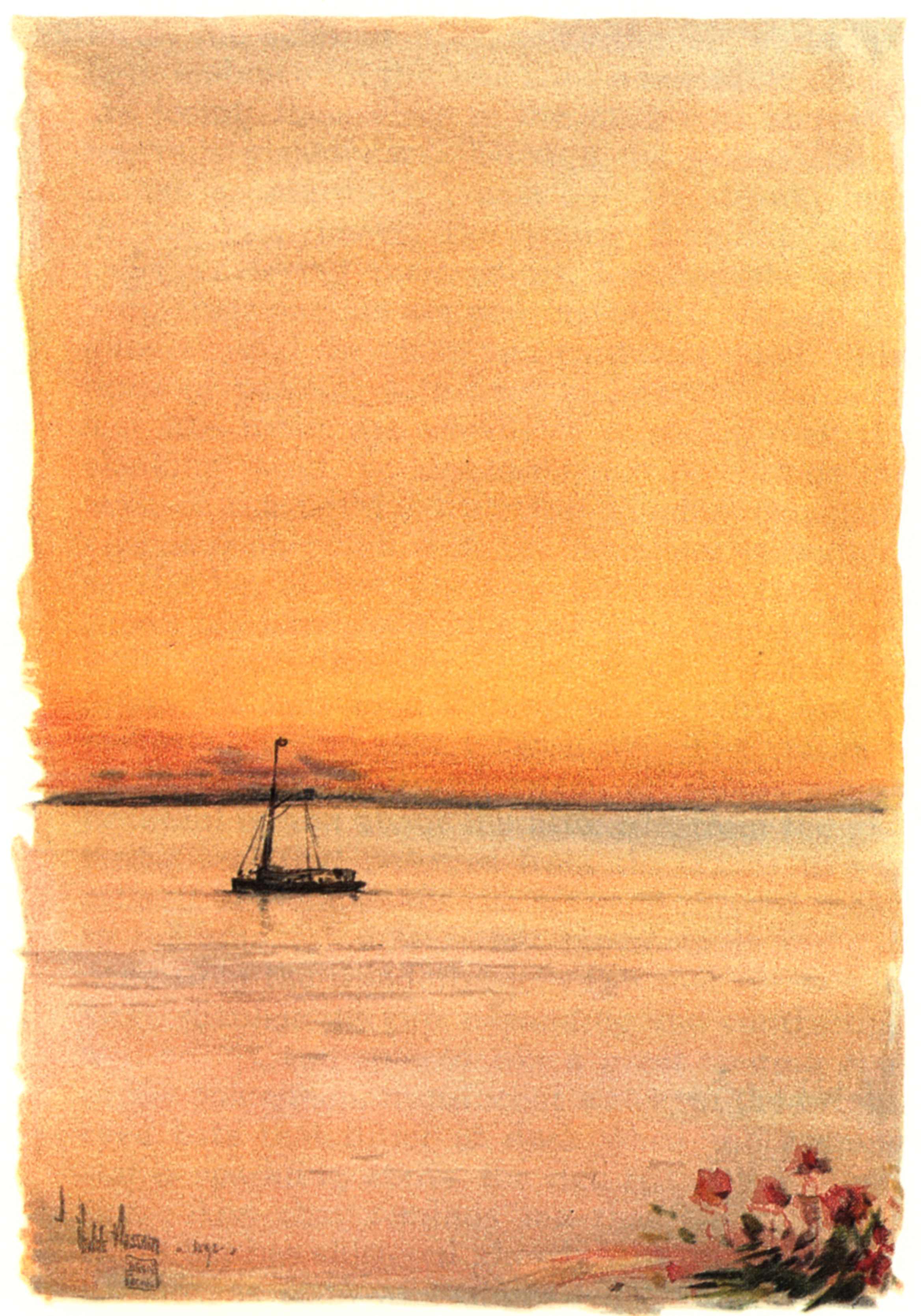
Sunset and the Pinafore