THE LIST OF PICTURES FOR AN ISLAND GARDEN (continued 2)
Reading edition
All the afternoon weeding and thinning out the plants. The large bank sloping to the southwest outside the garden is a perfect mass of flowers to be,—no weeds, for I have conquered them; but it is next to impossible to pull up plants enough to give all room. Again and again I have thinned them; now I think I must leave them to their fate and let it be a case of survival of the fittest.
24th. Last night, after having given myself the pleasure of watering the garden, I could not sleep for anxiety about the slugs. I seldom water the flowers at night because the moisture calls them out, and they have an orgy feasting on my most precious children all night long. Before going to bed I went all over the inclosure and, alas, I found them swarming on the Sweet Peas; baby slugs, tiny creatures covering the tender leaves and the dry pea-sticks even, thick as grains of sand. I was in despair, and though I knew they did not mind ashes, I took the fine sifter and covered Peas, sticks, slugs, and all with a thick, smothering cloud of wood ashes. Then I left them with many misgivings and went to bed, but not to sleep, for thinking of them. At twelve o’clock I said to myself, You know the slugs don’t care a rap for all the ashes in the world, but the friendly toads may be kept away by them, and who knows if such a smother of them may not kill the precious Peas themselves? I could not bear it any longer, rose up and donned my dressing gown, and out into the dark and dew I bore the hose, over my shoulders coiled, to the very farthest corners of the garden, and washed off every atom of ashes in the black midnight, and came back and slept in peace.
These are most anxious times on account of the slugs. Now, every morning when I rise I go at once into the garden at four o’clock and make a business of slaughtering them till half past five, when I stop for breakfast. If the day is pleasant they are all hidden by that time, for they dread so the touch of the sun. But in the hoary morning dew they delight. This is the hardest part of my gardening, and I rejoice that not one person in a thousand has this plague of slugs to fight. It is so difficult to destroy them; to see their countless legions and feel so helpless before their numbers, to find one’s most precious favorites nibbled and ragged, and everything threatened with destruction is a trial indeed. I carry a large pepper-box filled with air-slaked lime and shake it over them everywhere. They are so small this year that it destroys them; they turn milky and miserably perish, but the next morning there are just as many more to take their places. Still I patiently persevere, carefully washing off the lime, so anxious lest it should harm the plants, and killing by hand all the larger monsters.
In that most charming old book, Gilbert White’s “Natural History of Selborne,” I find he speaks of these arch enemies of mine as “unnoticed myriads of small shell-less snails called slugs, which silently and imperceptibly make amazing havoc in field and garden;” adding in a note, “Farmer Young of Norton Farm says that this spring (1777) about four acres of his wheat in one field were entirely destroyed by the slugs, which swarmed on the blades of corn and devoured it as fast as it sprung.”
Poor Farmer Young! I deeply sympathize with him and his long buried trouble!
Again White says: “The shell-less snails called slugs are in motion all winter in mild weather and commit great depredations on garden plants, and much injure the green wheat.”
There was a happy time when such a thing as a slug was unknown on my island, and I well remember the first that were brought here among some Moonflowers that were imported from a distant green-house. I saw them adhering to the outside of the flower-pots and did not kill them, never dreaming what powers of evil they would become!
25th. Every day the garden grows more interesting, more fascinating. Buds full of promise show themselves on the single Dahlias whose seeds were only planted in February; on the Rose Campions, the perennial kind, on the tall white Lilies. The Hollyhocks are thick with buds, and rich spikes head all the boughs of the Larkspurs, and as for the Roses, they are simply wonderful. The Tea Roses are loaded with buds; on one of the Polyanthas that lived all winter in the ground I counted fifty-two, and it is a tiny bush not more than a foot high. The dear old Sweet Rocket is blossoming in every corner, sending up its grateful perfume. Now come days of great anxiety about the Margaret Carnations that I have so loved and watched and tended since the first of March. They were splendid plants, full of health and strength and all ready to bloom. Alas, I saw, a day or two ago, the leaves turning yellow. I knew too well what that meant. There was but one thing to do. Down on my knees I went this morning, and bringing my face close to the ground, began pulling apart the central shoot in each plant, where the sickly color hung its flag of distress for a signal. Down, down a cruel length, into the very heart and core of each precious stem I tore my reluctant way to find that abomination of which I was in search, namely, a short fat lively white worm; for him I probed and brought him up on the point of a pin, and having a small quantity of alcohol at hand for the purpose, dropped him into it forthwith, for instant and complete destruction. Over forty of these beasts did I destroy, and left the tattered Pinks to rest and recover, if they could, poor things, after such a terrible experience! These worms seem made for all fragrant Pinks; as far as my experience goes they never attack anything else. How in the world, I wonder, do they know where the Carnations are planted and when to come for them? Such a scene of devastation as is my pretty bed of Pinks of which I was so proud, dwarfed and yellow, with their gnawed-off leaves strewn about all over the ground! But they will put out side shoots and patiently strive to fulfill heaven’s intent for them, of which they are conscious from the least root-tip to the end of every battered leaf. There is something pathetic as well as wonderful in the way in which these growing things of almost all kinds meet disaster and discouragement. Should they suffer misfortune like this,—the lopping of a limb, or the losing of buds, or any sapping of their vitality,—if the cause is removed, they will try so hard to repair damages, send out new shoots, make strenuous efforts to recover the lost ground, and still perfect blossom and fruit as nature meant they should. There is a lesson to be learned of them on which I have often pondered.
June 3d. This has been an exciting day, for the Water Lilies I sent for a week ago came in a mysterious damp box across the ocean foam! I had made their tubs all ready for them, putting in the bottom of each the “well-rotted manure,” and over this rich earth and sand mixed in proper proportions. These tubs, or rather large, tall butter firkins, stood ready in their places along the sunniest and most sheltered bed in the garden. Oh, the pleasure of opening that box and finding each unfamiliar treasure packed so carefully in wet moss, each folded in oiled paper to keep it moist, and each labeled with its fascinating name! The great pink Lotus of Egypt, the purple Lily of Zanzibar, and the red one of the same sort, the golden Chromatella, the pure white African variety and the smaller native white one, the yellow Water Poppy and the little exquisite plant called Parrot’s Feather, that creeps all about over the water and has the wonderful living, metallic green of the plumage of the handsome green parrots. These, with the flourishing Water Hyacinth I already had growing in its tub on the steps, and the bright pink Cape Cod Lily, make ten tubs of water plants,—a most breathlessly interesting family! And I must not forget another tub of seedling Water-Lilies that I am watching with the most intense interest also. It took most of the long, happy day to plant all these in the rich wet mud and settle them in their comfortable quarters. I laid some horseshoes I had picked up at different times, and saved, round the roots to hold them down temporarily, while I gently flooded the tubs with water and rejoiced to see the lovely leaves float out on the surface fresh as if they were at home. Then I sifted clean beach sand over the earth about them, to the depth of an inch or more, to hold the soil down and keep the water clear, and all was done. What delight to look forward to the watching and tending of these new friends! I find myself wondering what enemy will attack these, for surely something has been made for their destruction, which I must fight! There is not a growing thing in the garden that has not its enemies and destroyers, fortunate if it has only one. Just at this time there is a rampant little snuff-colored spider which comes in from the grass and fastens upon tender growths in the borders about the house, covering the succulent leaves and stems of Wild Cucumbers and Morning-glories, and even Nasturtiums and Cornflowers, so thickly that the plant is not to be seen at all for them; they are like a brown glove over every leaf, and they suck every drop of sap out of the plant, leaving it perfectly white. They are fatal on the Sweet Peas, of which they are especially fond. No poison known to me has the slightest effect on them; nothing but water turned on with the hose in floods disturbs them. This washes them away for the time being. It has to be repeated, however, many times a day, for they recover from their drenching and return to their work of devastation with renewed vigor. Fortunately these do not, like the slugs, last forever; they are gone in less than six weeks; but they keep me busy indeed while they stay.
I am obliged to spend a good deal of time just now hunting and destroying different bugs and worms and so forth. The blue-green aphis appears on certain precious Honeysuckle buds, and must be vigorously syringed with fir-tree oil before he gets a foothold and spreads his hideous legions everywhere. Also the lively worm that ties the Rose leaves together and gobbles them up and hides in a web within them, that I may find and crush him; and the white thrip which calls for hellebore, on the under side of them, and many more, must be attended to before they wax strong and bold in their villainy and defy me. A curious plague, if I may call it so, has come upon the little garden, in the shape of the delicious edible mushrooms, Coprinus Comatus, which come up all over the place and with slow strength heave the ground and my flowers into heaps, thrusting handsome long ivory-white, umbrella-shaped heads on stems a foot long, up high above and over most things in the beds. But these are eaten as soon as they appear, and are not such a very great trial, though I would rather they left my dear flowers undisturbed.
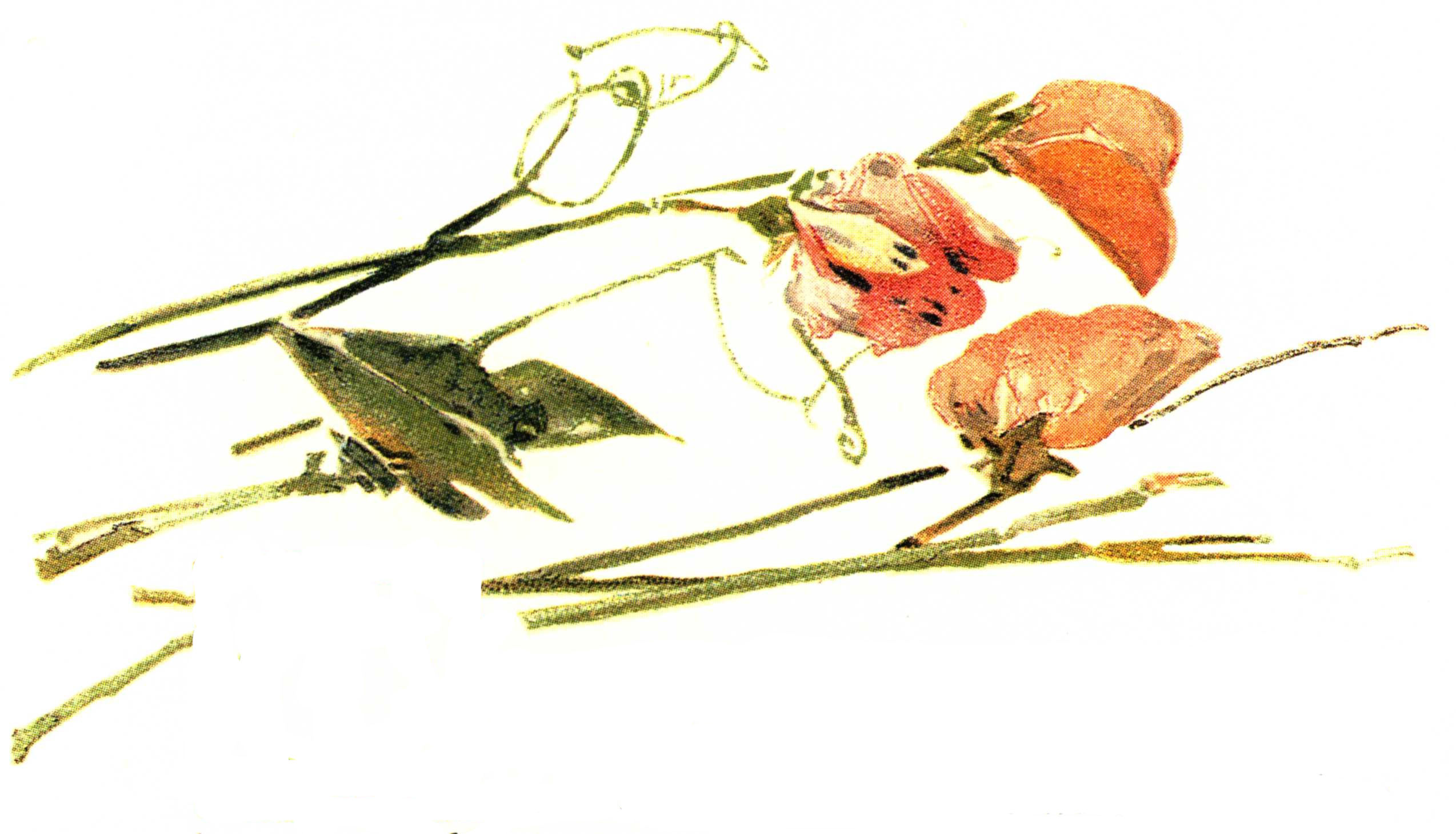

Much thought should be given to the garden’s arrangement with regard to economy of room, where one has but a small space to devote to it. And where one is unfamiliar with the habits of growth of the various plants that are to people it, a difficulty arises in making them effective and so disposing them that they shall not interfere with each other. For instance, in most cases tall plants should be put back against walls and fences and so forth, with the lower-growing varieties in the foreground. If one were to plant Verbenas and Venidium among Sunflowers and Hollyhocks, or even among Carnation Poppies and Cornflowers, Verbenas and Venidium would not be visible, for their habit is to creep close to the ground, and the tall growths would completely hide and most likely exterminate them, by shutting from them the sun and air without which they cannot live. These low, creeping plants are, however, very useful when one is planning for a succession of flowers. I plant Pansies, Verbenas, Drummond’s Phlox, and so forth, among my Pinks and Wallflowers and others of like compact habit, so that, when the higher slender plants have done blossoming, the others, which seldom cease flowering till frost, may still clothe the ground with color and beauty. Of course it goes without saying that climbing Vines should not be set where there is nothing upon which they may climb. Indeed that would be simple cruelty—nothing more nor less. Everything that needs it should be given a support without fail—all the myriad lovely Vines that one may have with so little trouble, and which seem to have been made to wreathe the dwellings of men with freshness and beauty and grace. The long list of varieties of flowering Clematis, so many shapes and colors, the numerous Honeysuckles, the Wistaria, Passion-flowers, Morning-glories, Hops, the Dutchman’s Pipe, the Cobœas, Woodbine, and many others, not counting Sweet Peas and Nasturtiums,—these last among the most beautiful and decorative of all,—every one is twice as valuable if given the support it demands. In the case of Nasturtiums, however, which seem with endless good-nature ready to adapt themselves to any conditions of existence, except, perhaps, being expected to live in a swamp, it is not so important that they should have something upon which to climb. A very good way is to put them near a rock one wishes to have covered, or to let them run down a bank upon which nothing else cares to grow. They will clothe such places with wild and beautiful luxuriance of green leaves and glowing flowers.
It seems strange to write a book about a little garden only fifty feet long by fifteen wide! But then, as a friend pleasantly remarked to me, “it extends upward,” and what it lacks in area is more than compensated by the large joy that grows out of it and its uplifting and refreshment of “the Spirit of Man.”
I have made a plan of this minute domain to show how it may be possible to accomplish much within such narrow compass, and also to give an idea of an advantageous method of grouping in a space so confined. I have not room to experiment with rockworks and ribbon-borders and the like, nor should I do it even if I had all the room in the world. For mine is just a little old-fashioned garden where the flowers come together to praise the Lord and teach all who look upon them to do likewise.
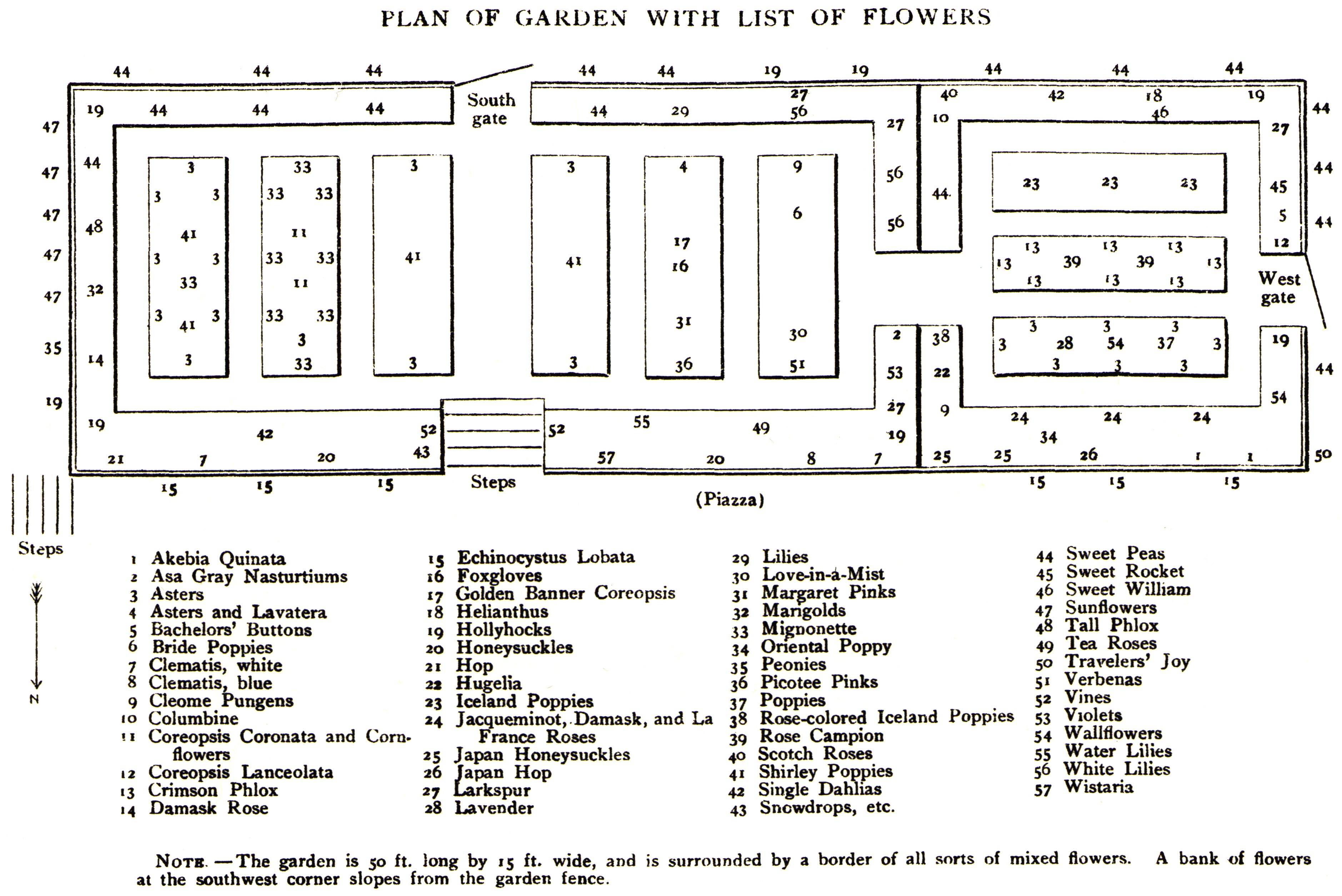
PLAN OF GARDEN WITH LIST OF FLOWERS
(Piazza)
1 Akebia Quinata 2 Asa Gray Nasturtiums 3 Asters 4 Asters and Lavatera 5 Bachelors’ Buttons 6 Bride Poppies 7 Clematis, white 8 Clematis, blue 9 Cleome Pungens 10 Columbine 11 Coreopsis Coronata and Cornflowers 12 Coreopsis Lanceolata 13 Crimson Phlox 14 Damask Rose 15 Echinocystus Lobata 16 Foxgloves 17 Golden Banner Coreopsis 18 Helianthus 19 Hollyhocks 20 Honeysuckles 21 Hop 22 Hugelia 23 Iceland Poppies 24 Jacqueminot, Damask, and La France Roses 25 Japan Honeysuckles 36 Japan Hop 27 Larkspur 28 Lavender 29 Lilies 30 Love-in-a-Mist 31 Margaret Pinks 32 Marigolds 33 Mignonette 34 Oriental Poppy 35 Peonies 36 Picotee Pinks 37 Poppies 38 Rose-colored Iceland Poppies 39 Rose Campion 40 Scotch Roses 41 Shirley Poppies 42 Single Dahlias 43 Snowdrops, etc. 44 Sweet Peas 45 Sweet Rocket 46 Sweet William 47 Sunflowers 48 Tall Phlox 49 Tea Roses 50 Travelers’ Joy 51 Verbenas 52 Vines 53 Violets 54 Wallflowers 55 Water Lilies 56 White Lilies 57 Wistaria
Note.—The garden is 50 ft. long by 15 ft. wide, and is surrounded by a border of all sorts of mixed flowers. A bank of flowers at the southwest corner slopes from the garden fence.
All through the months of April and May, when the weather is not simply impossible, I am at work in it, and also through most of June. It is wonderful how much work one can find to do in so tiny a plot of ground. But in the latter weeks of June there comes a time when I can begin to take breath and rest a little from these difficult yet pleasant labors; an interval when I may take time to consider, a morning when I may seek the hammock in the shady piazza, and, looking across my happy flower beds, let the sweet day sink deep into my heart. From the flower beds I look over the island slopes to the sea, and realize it all,—the rapture of growth, the delicious shades of green that clothe the ground, Wild Rose, Bayberry, Spirea, Shadbush, Elder, and many more. How beautiful they are, these grassy, rocky slopes shelving gradually to the sea, with here and there a mass of tall, blossoming grass softly swaying in the warm wind against the peaceful, pale blue water! Among the grass a few ghostly dandelion tops yet linger, with now and then a belated golden flower. How lovely is the delicacy of the white bleached rocks, the little spaces of shallow soil exquisite with vivid crimson Sorrel, or pearly with the brave Eyebright, all against the soft color of the sea. What harmony of movement in all these radiant growths just stirred by the gentle air! Here and there a stout little bough of Chokecherry, with clustered white blossoms tipped with pink, springing from a cleft in the rock, lights up in sunshine, its pink more glowing for the turquoise background of the ocean. How hot the sun blazes! The Blue-eyed Grass is quite faint and drooping in the rich turf, but the yellow Crowfoot shines strong and steady; no sunshine is too bright for it. In the garden the tall Jacqueminot Rosebushes gather power from the great warmth and light, and hold out their thick buds to absorb it and fold its splendor in their inmost hearts. One or two of the heaviest buds begin to loosen their crimson velvet petals and shed their delicious perfume on the air. The Oriental Poppy glories in the heat. Among its buds, thrust upward like solid green apples, one has burst into burning flame, each of its broad fiery petals as large as the whole inside of my hand. In the Iceland Poppy bed the ardent light has wooed a graceful company of drooping buds to blow, and their cups of delicate fire, orange and yellow, sway lightly on stems as slender as grass. In sheltered corners the Forget-me-not spreads its cool, heaven-blue clusters; by the fence “the Larkspurs listen” while they wait; the large purple Pansies shrink and turn from the too brilliant gaze of the sun. Rose Campions, Tea Roses, Mignonette, Marigolds, Coreopsis, the rows of Sweet Peas, the broad-leaved Hollyhocks and the rest, rejoice and grow visibly with every moment of the glorious day. Clematis and Honeysuckle almost seem to hurry, Nasturtiums reach their shield-like leaves and wind the stems thereof round any and every stick and string they can touch by which to lift themselves, here and there showing their first glowing flowers, and climbing eagerly. The long large buds of the white Clematis, the earliest of all, are swelling visibly before my eyes, and the buds of the early June Honeysuckle are reddening at the end of every spray. In one corner a tall purple Columbine hangs its myriad clustered bells; each flower has six shell-like whorls set in a circle, colored like rich amethysts and lined with lustrous silver, white as frost. Cornflowers like living sparks of exquisite color, rose and azure, white and purple, twinkle all over the place, and the heavenly procession begins in good earnest. The Grapevine smooths out its young leaves,—they are woolly and crimson; the wind blows and shows me their grayish-white under surfaces. I think of Browning’s tender song, the verse,—
“The leaf buds on the vine are woolly, I noticed that to-day, One day more bursts them open fully, You know the red turns gray.”
The Echinocystus plants that have sprung in thick ranks along the edge of the beds against the piazza are fairly storming up the trellis, having sown themselves in the autumn; they have just really begun to take firm hold, and are climbing hand over hand, as sailors do, with their strong green tendrils stretching out like arms and hands to right and left, laying hold of every available thing by which to cling and spring upward to the very eaves. There in August they form a closely woven curtain of lush, light green, overhung with large, loose clusters of starry white flowers having a pure, delicious fragrance like honey and the wax of the comb.
Now come the most perfect days of the year, blue days, hot on the continent, but heavenly here, where the cool breeze breathes round the islands from the great expanse of whispering water. Delightful it is to lie here and rest and realize all this beauty and rejoice in all its joy! The distant coast-line is dim in soft mirage.
“Half lost in the liquid azure bloom of a crescent of sea, The silent, sapphire-spangled, marriage-ring of the land.”
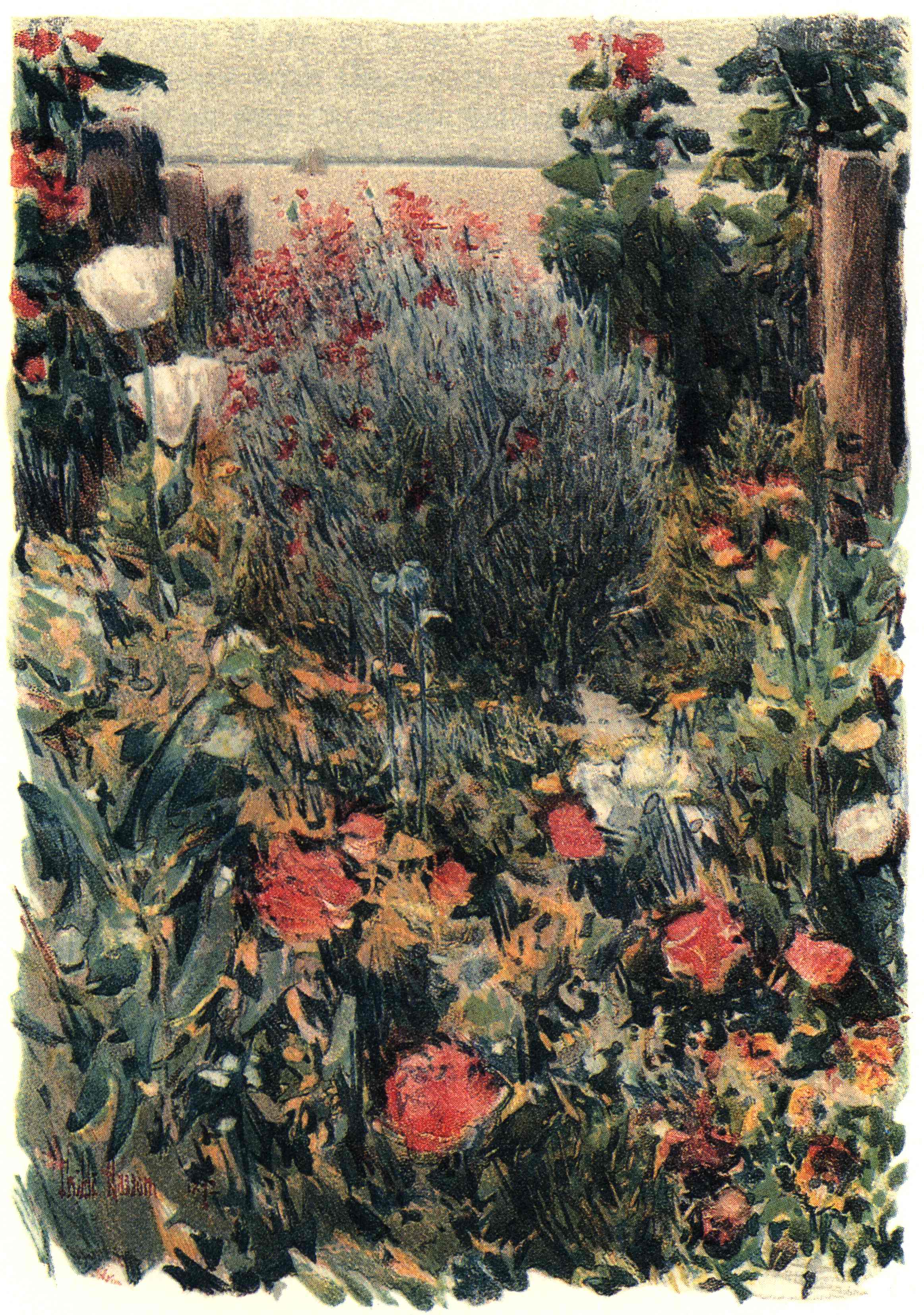
The Bride
It lies so lovely, far away! At its edge the water is glassy calm, the houses and large, glimmering piles of buildings along its whole length show white in the hot haze; in the offing the far-off sails are half lost in this shimmering veil; farther out there is a soft wind blowing; little fishing-boats with their sails furled lie at anchor between us and the land, faintly outlined against the delicate tone of the water. All is so still! I hear a bee go blundering into the Bachelor’s Buttons that hold up their flowers to the sun like small, compact yellow Roses. Suddenly comes a gush of the song-sparrow’s music, but father martin sits at his door very quiet; it is too hot on the red roof of his little house, so he sits at its portal and meditates while his small wife broods within, only now and then from his pretty throat pours a low ripple of sound, melodiously content. I am conscious of the sandpiper calling and the full tide murmuring, and I, too, am content.
Outside the garden fence it is as if the flowers had broken their bounds and were rushing down the sloping bank in a torrent of yellow, where the early Artemisias and Eschscholtzias are hastening into bloom, overflowing in a flood of gold that, lightly stirred by every breeze, sends a satin shimmer to the sun. Eschscholtzia—it is an ugly name for a most lovely flower. California Poppy is much better. Down into the sweet plot I go and gather a few of these, bringing them to my little table and sitting down before them the better to admire and adore their beauty. In the slender green glass in which I put them they stand clothed in their delicate splendor. One blossom I take in a loving hand the more closely to examine it, and it breathes a glory of color into sense and spirit which is enough to kindle the dullest imagination. The stems and fine thread-like leaves are smooth and cool gray-green, as if to temper the fire of the blossoms, which are smooth also, unlike almost all other Poppies, that are crumpled past endurance in their close green buds, and make one feel as if they could not wait to break out of the calyx and loosen their petals to the sun, to be soothed into even tranquillity of beauty by the touches of the air. Every cool gray-green leaf is tipped with a tiny line of red, every flower-bud wears a little pale-green pointed cap like an elf, and in the early morning, when the bud is ready to blow, it pushes off the pretty cap and unfolds all its loveliness to the sun. Nothing could be more picturesque than this fairy cap, and nothing more charming than to watch the blossom push it off and spread its yellow petals, slowly rounding to the perfect cup. As I hold the flower in my hand and think of trying to describe it, I realize how poor a creature I am, how impotent are words in the presence of such perfection. It is held upright upon a straight and polished stem, its petals curving upward and outward into the cup of light, pure gold with a lustrous satin sheen; a rich orange is painted on the gold, drawn in infinitely fine lines to a point in the centre of the edge of each petal, so that the effect is that of a diamond of flame in a cup of gold. It is not enough that the powdery anthers are orange bordered with gold; they are whirled about the very heart of the flower like a revolving Catherine-wheel of fire. In the centre of the anthers is a shining point of warm sea-green, a last, consummate touch which makes the beauty of the blossom supreme. Another has the orange suffused through the gold evenly, almost to the outer edges of the petals, which are left in bright, light yellow with a dazzling effect. Turning the flower and looking at it from the outside, it has no calyx, but the petals spring from a simple pale-green disk, which must needs be edged with sea-shell pink for the glory of God! The fresh splendor of this flower no tongue nor pen nor brush of mortal man can fitly represent.
Who indeed shall adequately describe any one, the simplest even, of these radiant beings? Day after day, as I watch them appear, one variety after another, in such endless changes of delicate beauty, I can but marvel ever more and more at the exhaustless power of the great Inventor. Must He not enjoy the work of His hands, the manifold perfection of these His matchless creations? Who can behold the unfolding of each new spring and all its blossoms without feeling the renewal of “God’s ancient rapture,” of which Browning speaks in “Paracelsus”? In that immortal rapture, I, another of his creatures, less obedient in fulfilling His laws of beauty than are these lovely beings, do humbly share, reflecting it with all the powers of my spirit and rejoicing in His work with an exceeding joy.
As the days go on toward July, the earth becomes dry and all the flowers begin to thirst for moisture. Then from the hillside, some warm, still evening, the sweet rain-song of the robin echoes clear, and next day we wake to a dim morning; soft flecks of cloud bar the sun’s way, fleecy vapors steal across the sky, the southwest wind blows lightly, rippling the water into little waves that murmur melodiously as they kiss the shore. In this warm gray, brooding light I am reminded of Tennyson’s subtle description of such a daybreak:—
“When the first low matin chirp hath grown Full quire, and morning driven her plough of pearl Far furrowing into light the mounded rack, Beyond the fair green field and eastern sea.”
Through the early hours of the day the mottled, pearly clouds keep their shape, with delicious open spaces of tempered blue between; by and by the sky’s tender fleece is half shadowed, toward noon it melts into loose mists. Color everywhere tells against these pellucid grays,—the gold of Lemon Lilies, the flame of Iceland Poppies, all the sweet tints of every blossom. Presently the happy rain begins to fall, so soft, so warm, so peaceful, the very sound of it is a pleasure; every leaf in the patient garden, which has waited for the shower so long, spreads itself wide to catch each crystal drop and treasure its deep refreshment. All day it rains; at night the melody lulls us to sleep as it patters on the roof. In the night the wind changes, and next day brings a northeast storm again with a wild wind, but from this the little flower plot is well protected, and I rejoice in the thorough watering deep down among their roots which is doing all the plants unmeasured good. Two, perhaps three days, it lasts, the gale blowing till there is such contention of winds and waves about the little isle as to make a ceaseless roaring of wild breakers round its shores. When at last the tempest wears itself out, what delight there is in the great tranquillity that follows it, what music in the soft, far murmurs of ceasing strife in air and ocean, spent wrath that seems to breathe yet in an undertone, half sullen, half relenting, while the broad yellow light that lies over sea and rocks in stillness, like a quiet smile, promises a heavenly day on the morrow.
Then, with what fresh wealth of color and perfume the garden will meet the resplendent sunrise! Every moment it grows more and more beautiful. I think for wondrous variety, for certain picturesque qualities, for color and form and a subtle mystery of character, Poppies seem, on the whole, the most satisfactory flowers among the annuals. There is absolutely no limit to their variety of color. They are the tenderest lilac, the deepest crimson, richest scarlet, white with softest suffusion of rose; all shades of rose, clear light pink with sea-green centre, the anthers in a golden halo about it; black and fire-color; red that is deepened to black, with gray reflections; cherry-color, with a cross of creamy white at the bottom of the cup, and round its central altar of ineffable golden green again the halo of yellow anthers; purple, with rich splashes of a deeper shade of the same color, with grayish white rays about the centre; all shades of lavender and lilac; exquisite smoke-color, in some cases delicately touched and freaked with red; some pure light gray, some of these gray ones edged with crimson or scarlet; there are all tints of mauve. To tell all the combinations of their wonderful hues, or even half, would be quite impossible, from the simple transparent scarlet bell of the wild Poppy to the marvelous pure white, the wonder of which no tongue can tell. Oh, these white Poppies, some with petals more delicate than the finest tissue paper, with centres of bright gold, some of thicker quality, large, shell-like petals, almost ribbed in their effect, their green knob in the middle like a boss upon a shield, rayed about with beautiful grayish yellow stamens, as in the kind called the Bride. Others—they call this kind the Snowdrift—have thick double flowers, deeply cut and fringed at the edges, the most opaque white, and full of exquisite shadows. Then there are the Icelanders, which Lieutenant Peary found making gay the frosty fields of Greenland, in buttercup-yellow and orange and white; the great Orientals, gorgeous beyond expression; the immense single white California variety. I could not begin to name them all in the longest summer’s day! The Thorn Poppy, Argemone, is a fascinating variety, most quaint in method of growth and most decorative. As for the Shirleys, they are children of the dawn, and inherit all its delicate, vivid, delicious suffusions of rose-color in every conceivable shade. Of the Poppy one of the great masters of English prose discourses in this wise. Speaking of the common wild Poppy of the English fields, which grows broadcast also over most of Europe, he says: “The splendor of it is proud, almost insolently so,” which immediately brings to mind Browning’s lines in “Sordello,”—
“The Poppy’s red effrontery, Till autumn spoils its fleering quite with rain, And portionless, a dry, brown, rattling crane Protrudes.”
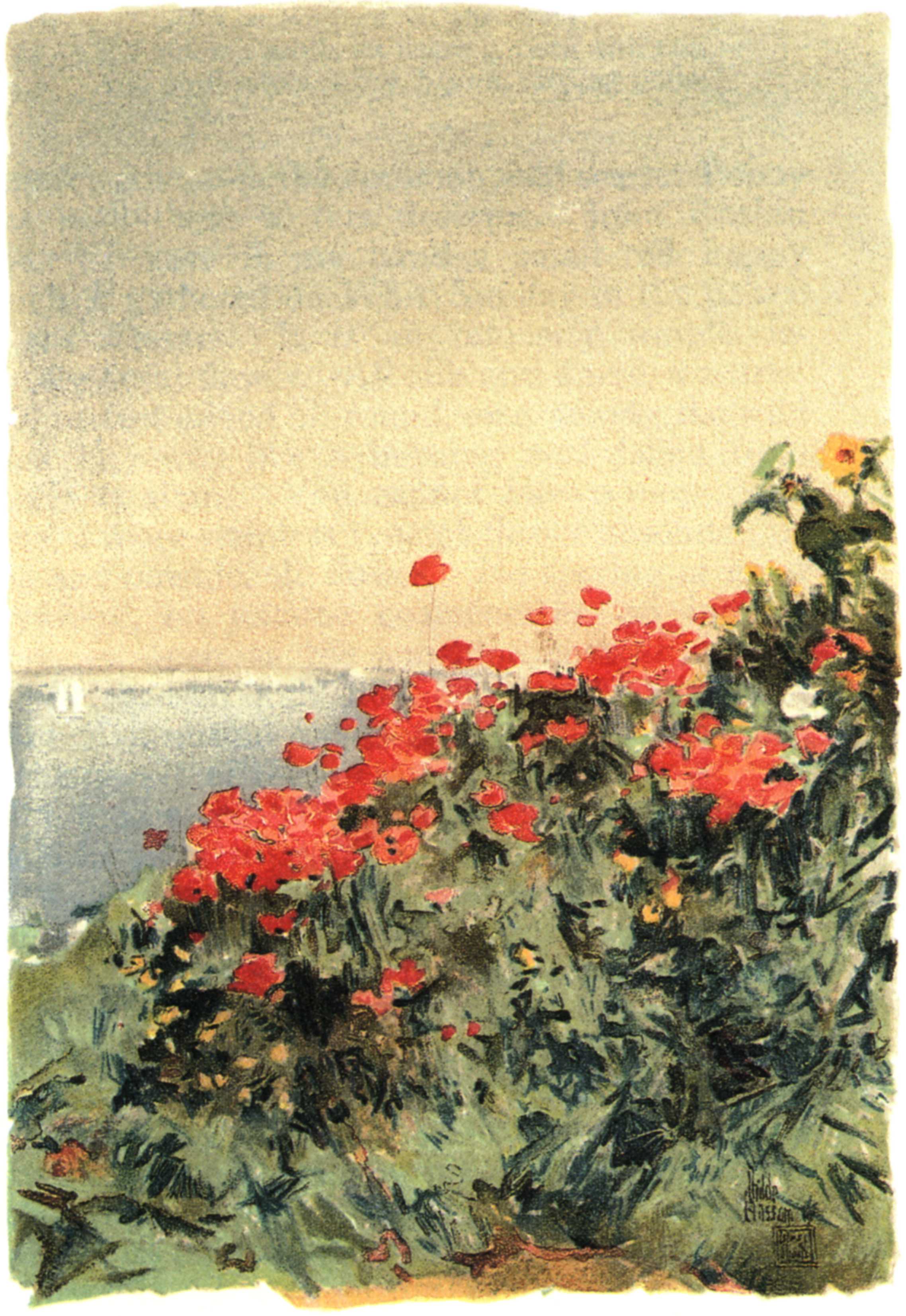
Poppy Bank in the Early Morning
Papaver Rhœas is the common wild scarlet Poppy that both these writers describe. John Ruskin says: “I have in my hand a small red Poppy which I gathered on Whit Sunday in the palace of the Cæsars. It is an intensely simple, intensely floral flower. All silk and flame, a scarlet cup, perfect edged all round, seen among the wild grass far away like a burning coal fallen from Heaven’s altars. You cannot have a more complete, a more stainless type of flower absolute; inside and outside, all flower. No sparing of color anywhere, no outside coarsenesses, no interior secrecies, open as the sunshine that creates it; fine finished on both sides, down to the extremest point of insertion on its narrow stalk, and robed in the purple of the Cæsars....
“Literally so. That Poppy scarlet, so far as could be painted by mortal hand, for mortal king, stays yet, against the sun and wind and rain, on the walls of the house of Augustus, a hundred yards from the spot where I gathered the weed of its desolation.... The flower in my hand is a poverty stricken Poppy, I was going to write, poverty strengthened Poppy, I mean. On richer ground it would have gushed into flaunting breadth of untenable purple; flapped its inconsistent scarlet vaguely to the wind; dropped the pride of its petals over my hand in an hour after I gathered it. But this little rough-bred thing ... is as bright and strong to-day as yesterday.... What outline its petals really have is little shown in their crumpled fluttering, but that very crumpling arises from a fine floral character which we do not enough value in them. We usually think of a Poppy as a coarse flower; but it is the most transparent and delicate of all the blossoms of the field. The rest, nearly all of them, depend on the texture of their surfaces for color. But the Poppy is painted glass; it never glows so brightly as when the sun shines through it. Wherever it is seen, against the light or with the light, always it is a flame, and warms the wind like a blown ruby.... Gather a green Poppy bud, just when it shows the scarlet line at its side, break it open and unpack the Poppy. The whole flower is there complete in size and color, its stamens full grown, but all packed so closely that the fine silk of the petals is crushed into a million of wrinkles. When the flower opens, it seems a relief from torture; the two imprisoning green leaves are shaken to the ground, the aggrieved corolla smooths itself in the sun and comforts itself as best it can, but remains crushed and hurt to the end of its days.”
I know of no flower that has so many charming tricks and manners, none with a method of growth more picturesque and fascinating. The stalks often take a curve, a twist from some current of air or some impediment, and the fine stems will turn and bend in all sorts of graceful ways, but the bud is always held erect when the time comes for it to blossom. Ruskin quotes Lindley’s definition of what constitutes a Poppy, which he thinks “might stand.” This is it: “A Poppy is a flower which has either four or six petals, and two or more treasuries united in one, containing a milky, stupefying fluid in its stalks and leaves, and always throwing away its calyx when it blossoms.”
I muse over their seed-pods, those supremely graceful urns that are wrought with such matchless elegance of shape, and think what strange power they hold within. Sleep is there, and Death his brother, imprisoned in those mystic sealed cups. There is a hint of their mystery in their shape of sombre beauty, but never a suggestion in the fluttering blossom; it is the gayest flower that blows. In the more delicate varieties the stalks are so slender, yet so strong, like fine grass stems, when you examine them you wonder how they hold even the light weight of the flower so firmly and proudly erect. They are clothed with the finest of fine hairs up and down the stalks, and over the green calyx, especially in the Iceland varieties, where these hairs are of a lovely red-brown color and add much to their beauty.
It is plain to see, as one gazes over the Poppy beds on some sweet evening at sunset, what buds will bloom in the joy of next morning’s first sunbeams, for these will be lifting themselves heavenward, slowly and silently, but surely. To stand by the beds at sunrise and see the flowers awake is a heavenly delight. As the first long, low rays of the sun strike the buds, you know they feel the signal! A light air stirs among them; you lift your eyes, perhaps to look at a rosy cloud or follow the flight of a caroling bird, and when you look back again, lo! the calyx has fallen from the largest bud and lies on the ground, two half transparent, light green shells, leaving the flower petals wrinkled in a thousand folds, just released from their close pressure. A moment more and they are unclosing before your eyes. They flutter out on the gentle breeze like silken banners to the sun, and such a color! The orange of the Iceland Poppy is the most ineffable color; it “warms the wind” indeed! I know no tint like it; it is orange dashed with carmine, most like the reddest coals of an intensely burning fire. Look at this exquisite cup: the wind has blown nearly smooth the crinkled petals; these, where they meet in the centre, melt into a delicate greenish yellow. In the heart of the blossom rises a round green altar, its sides penciled with nine black lines, and a nine-rayed star of yellow velvet clasps the flat, pure green top. From the base of this altar springs the wreath of stamens and anthers; the inner circle of these is generally white, the outer yellow, and all held high and clear within the cup. The radiant effect of this arrangement against the living red cannot be told.
The Californias put out their clean, polished, pointed buds straight up to the sun from the first, but all the others have this fashion of drooping theirs till the evening before they blow. There is a kind of triumph in the way they do this, lifting their treasured splendor yet safe within its clasping calyx to be ready to meet the first beams of the day.
The Orientals are glorious, even in the victorious family of Poppies. Ruskin has a chapter on “The Rending of Leaves.” I always think of it when I see the large, hairy, rich green leaves of this variety, which are deeply “rent,” almost the whole width of the leaf to the midrib. These leaves grow somewhat after the fashion of a Dandelion, spreading several feet in all directions from the centre, which sends up in June immense flower-stalks crowned with heavy apple-like buds, that elongate as they increase in size, till some morning the thick calyx breaks and falls, and the great scarlet flags of the flower unfold. There is a kind of angry brilliance about it, a sombre and startling magnificence. Its large petals are splashed near the base with broad, irregular spots of black-purple, as if they had been struck with a brush full of color. The seed-pod, rising fully an inch high in the centre, is of a luminous, indescribable shade of green, and folded over its top, a third of its height, is a cap of rich lavender, laid down in points evenly about the crown. On the centre of this is a little knob of deep purple velvet, from which eleven rays of the same color curve over the top and into each point of the lavender cap. And round this wonderful seed-pod, with its wealth of elaborate ornament, is a thick girdle of stamens half an inch deep, with row upon row and circle within circle of anthers covered with dust of splendid dusky purple, and held each upon a slender thread of deeper purple still. It is simply superb, and when the great bush is ablaze with these flowers it is indeed a conflagration of color. “The fire-engines always turn out when my Orientals blaze up on the hillside,” writes a flower-loving friend to me. No garden should be without these, for they flourish with the least care, are perfectly hardy, and never fail to blossom generously.
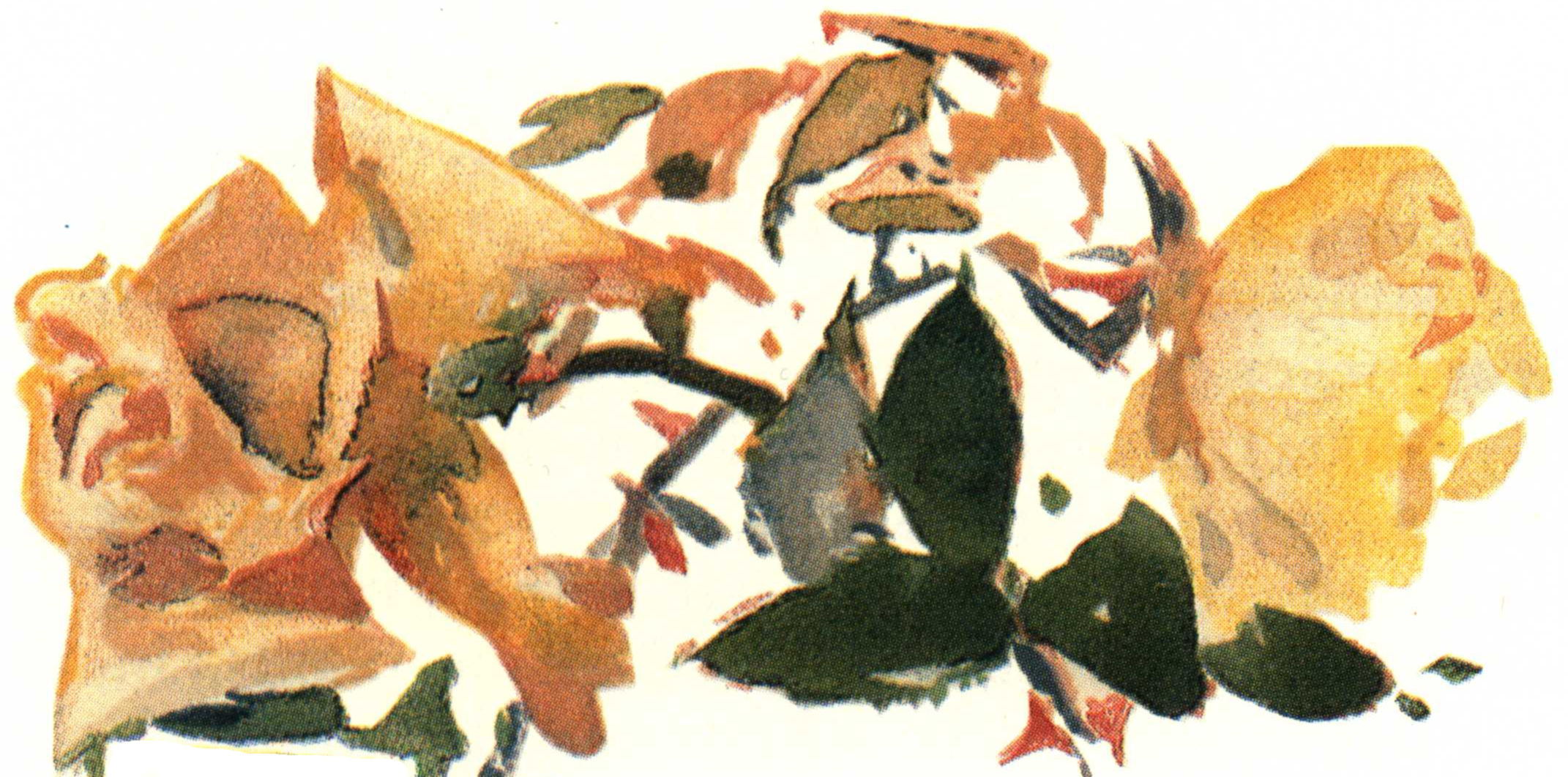

That every plant should select only its own colors and forms from the great laboratory of Nature has always seemed to me a very wonderful thing. Each plant takes from its surroundings just those qualities which will produce its own especial characteristics and no others, never hesitating and never making a mistake. For instance, the California Poppies, if left to themselves, will take yellow of many resplendent shades for their color, and never vary their cool, gray-green, red-tipped, foliage; the Peacock Poppy will be always scarlet-crimson, with a black spot rimmed with white in every petal; the Corn Poppy will be always clear scarlet; the Bride a miracle of lustrous white, and so on. Runge, a noted chemist, says: “A plant is a great chemist: it distinguishes and separates substances more definitely and accurately than man can, with all his skill, his intelligence, and his appliances.... The little Daisy, which has painted its ‘wee crimson-tipped flowers,’ puts the chemist and scientific man to shame, for it has produced its leaf and stem and flowers, and has dyed these with their bright colors from materials which he can never change with all his arts.”
By what power do they know how to select each its own hue and shape, when earth and air hold all the tints and forms that the Creator has invented? The subtle knowledge of plants, instinct perhaps would be a better word, is astonishing. If you dig a hole in the ground and put into it a Rosebush, filling one side of the hole with rich earth and the other with poor soil, every root of that Rosebush will leave the poor half to inhabit the rich and nourishing portion. That is a matter of course, but the instinct of the Rose is something to think about, nevertheless.
Some one has said, speaking of a tree, “What an immense amount of vitally organized material has been here gathered together! It is God’s own architecture! This mass of vegetable matter is only earth and air that have undergone transmutation. The material alike of wandering zephyrs and rushing storms, of gently descending night-dews and angry thunder-showers has been here, on this spot, metamorphosed.”
And I should add that into this piece of architecture God has breathed a vital spark, almost a mind, so remarkable is the intelligent action often manifested in many plants and trees.
A famous Frenchman, Camille Flammarion, says: “I know a maple-tree which was dying on the ruins of an old wall, a few feet from good rich earth (the soil in a ditch), and which in despair threw out a venturesome root, reached the coveted earth, buried itself there, and gained a solid footing, so that by degrees, although a motionless thing, it changed its place, let its original roots die, and lived resuscitated upon the organ that had set it free. I have known elms which were going to eat up the soil of a fertile field, whose food had been cut off from them by a wide ditch, and who, therefore, determined to make their uncut roots pass under the ditch. They succeeded, and returned to their regular food, much to the cultivator’s astonishment. I know an heroic Jasmine which went eight times through a board which kept the light away from it, and which a teasing observer would put back in the shade, hoping so to wear out the flower’s energy, but he did not succeed.”
This happened in France, but here in New England I myself know of a great Wistaria which grew over one side of a fine old house in an enchanting garden, and which did something quite as wonderful. It was a triumph of a vine! The butt or stump, where it emerged from the ground, was a foot in diameter, and its branches covered one side of the house, a space of thirty feet by thirty feet. So large a vine required a great deal of water, so it sent its roots down eight feet under the foundation of the house, passed along under the brick floor of the dairy, a distance of fifteen feet, making a solid mat of roots under the whole floor, reached the well and went straight through the cracks and crevices of its stone wall to the desired moisture. An elm root in the same garden went sixty feet or more under the foundation of the house to that same well.
To quote another writer who has carefully observed these things: “Plants have to the full extent of their necessities a power of observation, of discrimination in the selection of their food, a knowledge of where it is to be found, and the power to a considerable extent to obtain it. For instance, if some animal’s remains are buried in the garden, say twenty feet from the grapevine, the vine will know it, and the underground part of the vine will at once change its course and make a direct march for this new storehouse of food, and upon reaching it will throw out an incredible number of roots for its consumption.... A weeping willow was planted in a dry, gravelly soil on the south side of a house, a situation in every respect unsuited to this tree, which delights in a heavy moist soil; the result was a slow, stunted growth. After a few years in which it barely lived, it surprised its owner by a vigorous growth which was as astonishing as pleasing, and the cause was looked for. It was found the roots in search of food had traveled under the house a distance of some thirty feet to the well, where they took a downward course till they reached the water that furnished the moisture which is essential to the growth of this tree.
“The movements of the squash vine when pressed by hunger or thirst are truly wonderful. During a severe drought if you place a basin of water at night, say two feet to the left or the right of a strong vine, in the morning it will be found bathing in the basin! Is not this an indication of thought in the vine? Does it not indicate a knowledge in the vine analogous to human understanding?... There must be some agent employed to bring the vine to the fountain....
“The more we study plant life the more we become convinced that life is a unit, varying in form only, not in principle. Everything capable of reproduction, growth, and development is governed by the same law, and each is but a part of the unit we term life.”
Again to quote the famous Frenchman: “When I breathe the perfume of a Rose,” he says, “when I admire the beauty of form, the grace of this flower in its freshly opening bloom, what strikes me most is the work of that hidden, unknown, mysterious force which rules over the plant’s life and can direct it in the maintenance of its existence, which chooses the proper molecules of air, water, and earth for its nourishment, and which knows, above all, how to assimilate these molecules and group them so delicately as to form this graceful stem, these dainty green leaves, these soft pink petals, these exquisite tints and delicious fragrance....
“This mysterious force is the animating principle of the plant. Put a Lily seed, an acorn, a grain of wheat, and a peach-stone side by side in the ground, each germ will build up its own organism and no other....
“A plant breathes, drinks, eats, selects, refuses, seeks, works, lives, acts, according to its instincts. One does like a charm, another pines, a third is nervous and agitated. The Sensitive Plant shivers and droops its leaves at the slightest touch.”
Climbing plants show often a surprising degree of intelligence, reaching out for support as if they had eyes to see. I have known a vine whose head was aimlessly waving in the wind, with nothing near it to which it might cling, turn deliberately round in an opposite direction to that in which it had been growing and seize a line I had stretched for it to grasp, without any help outside itself, and within the space of an hour’s time. By manifold ways they cling and climb, many by winding their stems round and round strings or sticks or wires, or whatever is given them, as do the Morning-glories, Hop, Honeysuckle, Wistarias, and many others; but Sweet Peas, Cobcœa, and so forth, put out a delicate tendril at the end of each leaf, or rather group of leaves. Nasturtiums, Clematis, and others take a turn with their leaf-stems round anything that comes in their way, and so lift and hold themselves securely, and the Echinocystus or Wild Cucumber has a system of tendrils strong as iron and elastic as India-rubber. It is most interesting to observe them all and ponder on their different charming ways and habits, to help them if they need it, and to sympathize with all their experiences. As I work among my flowers, I find myself talking to them, reasoning and remonstrating with them, and adoring them as if they were human beings. Much laughter I provoke among my friends by so doing, but that is of no consequence. We are on such good terms, my flowers and I!
Altogether lovely they are out of doors, but I plant and tend them always with the thought of the joy they will be within the house also. I know well what Emerson means when he asks,
“Hast thou named all the birds without a gun? Loved the wood Rose and left it on its stalk?”
and if I gather this or any other wild-flower I do it with such reverent love that even he would be satisfied. No one knows better and deplores more deeply than I the wholesale destruction, wanton and cruel, which goes on among our wild-flowers every year; but to bring a few indoors for purposes of study and fuller appreciation is another and a desirable thing. For the wild Rose is but partially learned when one pauses a moment in passing to admire the sweet surprise of its beauty as it suddenly smiles up from the roadside. It cannot be learned in a single glance, nor, indeed, in many glances: it must be carefully considered and lovingly meditated upon before it yields all the marvel of its delicate glory to your intelligence. “Consider the Lilies,” said the Master. Truly, there is no more prayerful business than this “consideration” of all the flowers that grow.
And in the garden they are planted especially to feast the souls that hunger for beauty, and within doors as well as without they “delight the spirit of man.” Opening out on the long piazza over the flower beds, and extending almost its whole length, runs the large, light, airy room where a group of happy people gather to pass the swiftly flying summers here at the Isles of Shoals. This room is made first for music; on the polished floor is no carpet to muffle sound, only a few rugs here and there, like patches of warm green moss on the pine-needle color given by the polish to the natural hue of the wood. There are no heavy draperies to muffle the windows, nothing to absorb the sound. The piano stands midway at one side; there are couches, sofas with pillows of many shades of dull, rich color, but mostly of warm shades of green. There are low bookcases round the walls, the books screened by short curtains of pleasant olive-green; the high walls to the ceiling are covered with pictures, and flowers are everywhere. The shelves of the tall mantel are splendid with massed Nasturtiums like a blazing torch, beginning with the palest yellow, almost white, and piled through every deepening shade of gold, orange, scarlet, crimson, to the blackest red; all along the tops of the low bookcases burn the fires of Marigolds, Coreopsis, large flowers of the velvet single Dahlias in yellow, flame, and scarlet of many shades, masses of pure gold summer Chrysanthemums, and many more,—all here and there interspersed with blossoming grasses for a touch of ethereal green. On one low bookcase are Shirley Poppies in a roseate cloud. And here let me say that the secret of keeping Poppies in the house two whole days without fading is this: they must be gathered early, before the dew has dried, in the morning. I go forth between five and six o’clock to cut them while yet their gray-green leaves are hoary with dew, taking a tall slender pitcher or bottle of water with me into the garden, and as I cut each stem dropping the flower at once into it, so that the stem is covered nearly its whole length with water; and so on till the pitcher is full. Gathered in this way, they have no opportunity to lose their freshness, indeed, the exquisite creatures hardly know they have been gathered at all. When I have all I need, I begin on the left end of this bookcase, which most felicitously fronts the light, and into the glasses put the radiant blossoms with an infinite enjoyment of the work. The glasses (thirty-two in all) themselves are beautiful: nearly all are white, clear and pure, with a few pale green and paler rose and delicate blue, one or two of richer pink, all brilliantly clear and filled with absolutely colorless water, through which the stems show their slender green lengths. Into the glasses at this end on the left I put first the dazzling white single Poppy, the Bride, to lead the sweet procession,—a marvelous blossom, whose pure white is half transparent, with its central altar of ineffable green and gold. A few of these first, then a dozen or more of delicate tissue-paperlike blossoms of snow in still another variety (with petals so thin that a bright color behind them shows through their filmy texture); then the double kind called Snowdrift, which being double makes a deeper body of whiteness flecked with softest shadow. Then I begin with the palest rose tints, placing them next, and slightly mingling a few with the last white ones,—a rose tint delicate as the palm of a baby’s hand; then the next, with a faint suffusion of a blush, and go on to the next shade, still very delicate, not deeper than the soft hue on the lips of the great whelk shells in southern seas; then the damask rose color and all tints of tender pink, then the deeper tones to clear, rich cherry, and on to glowing crimson, through a mass of this to burning maroon.
The flowers are of all heights (the stems of different lengths), and, though massed, are in broken and irregular ranks, the tallest standing a little over two feet high. But there is no crushing or crowding. Each individual has room to display its full perfection. The color gathers, softly flushing from the snow white at one end, through all rose, pink, cherry, and crimson shades, to the note of darkest red; the long stems of tender green showing through the clear glass, the radiant tempered gold of each flower illuminating the whole. Here and there a few leaves, stalks, and buds (if I can bring my mind to the cutting of these last) are sparingly interspersed at the back. The effect of this arrangement is perfectly beautiful. It is simply indescribable, and I have seen people stand before it mute with delight. It is like the rose of dawn.
To the left of this altar of flowers is a little table, upon which a picture stands and leans against the wall at the back. In the picture two Tea Roses long since faded live yet in their exquisite hues, never indeed to die. Before this I keep always a few of the fairest flowers, and call this table the shrine. Sometimes it is a spray of Madonna Lilies in a long white vase of ground glass, or beneath the picture in a jar of yellow glass floats a saffron-tinted Water Lily, the Chromatella, or a tall sapphire glass holds deep blue Larkspurs of the same shade, or in a red Bohemian glass vase are a few carmine Sweet Peas, another harmony of color, or a charming dull red Japanese jar holds a few Nasturtiums that exactly repeat its hues. The lovely combinations and contrasts of flowers and vases are simply endless.
On another small table below the “altar” are pink Water Lilies in pink glasses and white ones in white glasses; a low basket of amber glass is filled with the pale turquoise of Forget-me-nots, the glass is iridescent and gleams with changing reflections, taking tints from every color near it. Sweet Peas are everywhere about and fill the air with fragrance; orange and yellow Iceland Poppies are in tall vases of English glass of light green. There is a large, low bowl, celadon-tinted, and decorated with the boughs and fruit of the Olive on the gray-green background. This is filled with magnificent Jacqueminot Roses, so large, so deep in color as to fully merit the word. Sometimes they are mixed with pink Gabrielle de Luizets and old-fashioned Damask Roses, and the bowl is set where the light falls just as it should to give the splendor of the flowers its full effect. In the centre of a round table under one of the chandeliers is a flaring Venice glass as pure as a drop of dew and of a quaintly lovely shape; on the crystal water therein lies a single white Water Lily, fragrant snow and gold. By itself is a low vase shaped like a Magnolia flower, with petals of light yellow deepening in color at the bottom, where its calyx of olive-green leaves clasps the flower. This has looking over its edge a few pale yellow Nasturtiums of the Asa Gray variety, the lightest of all. With these, one or two of a richer yellow (Dunnett’s Orange), the flowers repeating the tones of the vase, and with them harmoniously blending. A large pearly shell of the whelk tribe was given me years ago. I did not know what to do with it. I do not like flowers in shells as a rule, and I think the shells are best on the beach where they belong, but I was fond of the giver, so I sought some way of utilizing the gift. In itself it was beautiful, a mass of glimmering rainbows. I bored three holes in its edge and suspended it from one of the severely simple chandeliers with almost invisible wires. I keep it filled with water and in it arrange sometimes clusters of monthly Honeysuckle sparingly; the hues of the flowers and the shell mingle and blend divinely. I get the same effect with Hydrangea flowers, tints and tones all melt together; so also with the most delicate Sweet Peas, white, rose, and lilac; with these I take some lengths of the blossoming Wild Cucumber vine with its light clusters of white flowers, or the white Clematis, the kind called “Traveler’s Joy,” and weave it lightly about the shell, letting it creep over one side and, running up the wires, entirely conceal them; then it is like a heavenly apparition afloat in mid air. Sometimes the tender mauve and soft rose and delicate blues of the exquisite little Rose Campion, or Rose of Heaven, with its grassy foliage, swing in this rainbow shell, making another harmony of hues.
Sometimes it is draped with wild Morning-glory vines which are gathered with their buds at evening; their long wiry stems I coil in the water, and arrange the graceful lengths of leaves and buds carefully, letting a few droop over the edge and twine together beneath the shell, and some run up to the chandelier and conceal the wires. The long smooth buds, yellow-white like ivory, deepen to a touch of bright rose at the tips close folded. In the morning all the buds open into fair trumpets of sea-shell pink, turning to every point of the compass, an exquisite sight to see. By changing the water daily these vines last a week, fresh buds maturing and blossoming every morning.
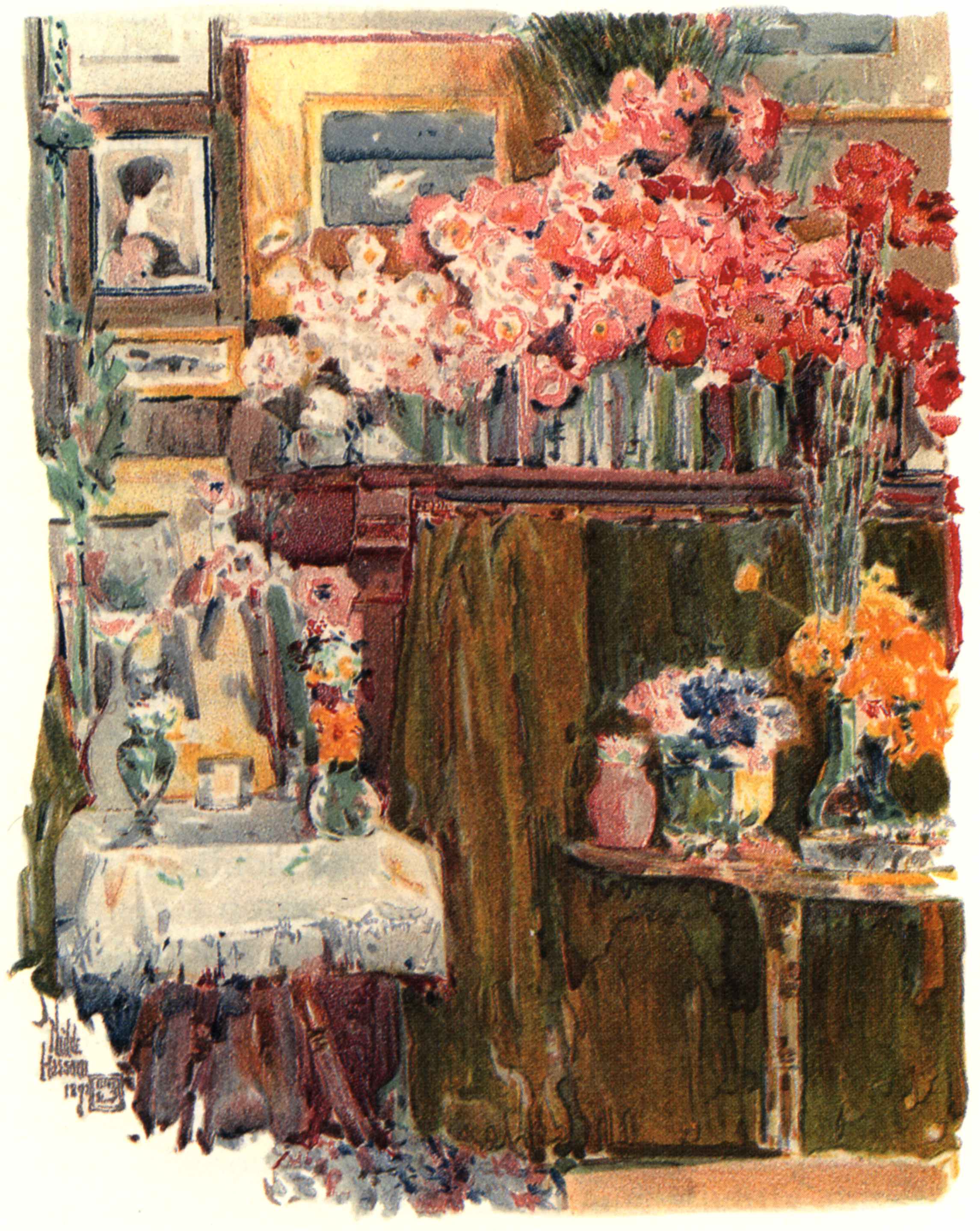
The Altar and Shrine
Near my own seat in a sofa corner at one of the south windows stands yet another small table, covered with a snow-white linen cloth embroidered in silk as white and lustrous as silver. On this are gathered every day all the rarest and loveliest flowers as they blossom, that I may touch them, dwell on them, breathe their delightful fragrance and adore them. Here are kept the daintiest and most delicate of the vases which may best set off the flowers’ loveliness,—the smallest of the collection, for the table is only large enough to hold a few. There is one slender small tumbler of colorless glass, from the upper edge of which a crimson stain is diffused half way down its crystal length. In this I keep one glowing crimson Burgundy Rose, or an opening Jacqueminot bud; the effect is as if the color of the rose ran down and dyed the glass crimson. It is so beautiful an effect one never wearies of it. There is a little jar of Venice glass, the kind which Browning describes in “The Flight of the Duchess,”—
“With long white threads distinct inside, Like the lake-flower’s fibrous roots that dangle Loose such a length and never tangle.”
This is charming with a few rich Pinks of different shades. Another Venice glass is irregularly bottle-shaped, bluish white with cool sea-green reflections at the bottom, very delicate, like an aqua-marine. It is lightly sprinkled with gold dust throughout its whole length; toward the top the slender neck takes on a soft touch of pink which meets and mingles with the Bon Silene or La France Rose I always keep in it. Another Venice glass still is a wonder of iridescent blues, lavenders, gray, and gold, all through, with a faint hint of elusive green. A spray of heaven-blue Larkspur dashed with rose is delicious in this slender shape, with its marvelous tints melting into the blue and pink of the fairy flowers.
A little glass of crystal girdled with gold holds pale blue Forget-me-nots; sometimes it is rich with orange and yellow Erysimum flowers. In a tall Venetian vase of amber a Lilium auratum is superb. A low jar of opaque rose-pink, lost at the bottom in milky whiteness, is refreshing with an old-fashioned Damask Rose matching its color exactly. This is also exquisite with one pink Water Lily. The pink variety of the Rose Campion is enchanting in this low jar. A tall shaft of ruby glass is radiant with Poppies of every shade of rose and lightest scarlet, with the silvery green of a few oats among them. A slender purple glass is fine with different shades of purple and lilac Sweet Peas, or one or two purple Poppies, or an Aster or two of just its color, but there is one long gold-speckled Bohemian glass of rich green which is simply perfect for any flower that blows, and perfect under any circumstances. A half dozen Iceland Poppies, white, yellow, orange, in a little Japanese porcelain bottle, always stand on this beautiful table, the few flecks of color on the bottle repeating their tints. I never could tell half the lovely combinations that glow on this table all summer long.
By the wide western window a large vase of clear white glass, nearly three feet high, stands full of spears of timothy grass taller than the vase, the tallest I can find, springing stately and high, their heavy green tops bending the fine strong stems just enough for consummate grace. These are mixed with lighter branching grasses, and down among the grass stalks are thrust the slender stalks of tall Poppies of every conceivable shade of red; the whole is a great sheaf of splendor reaching higher than the top of the window. This is really imposing; it takes the eye with delight.
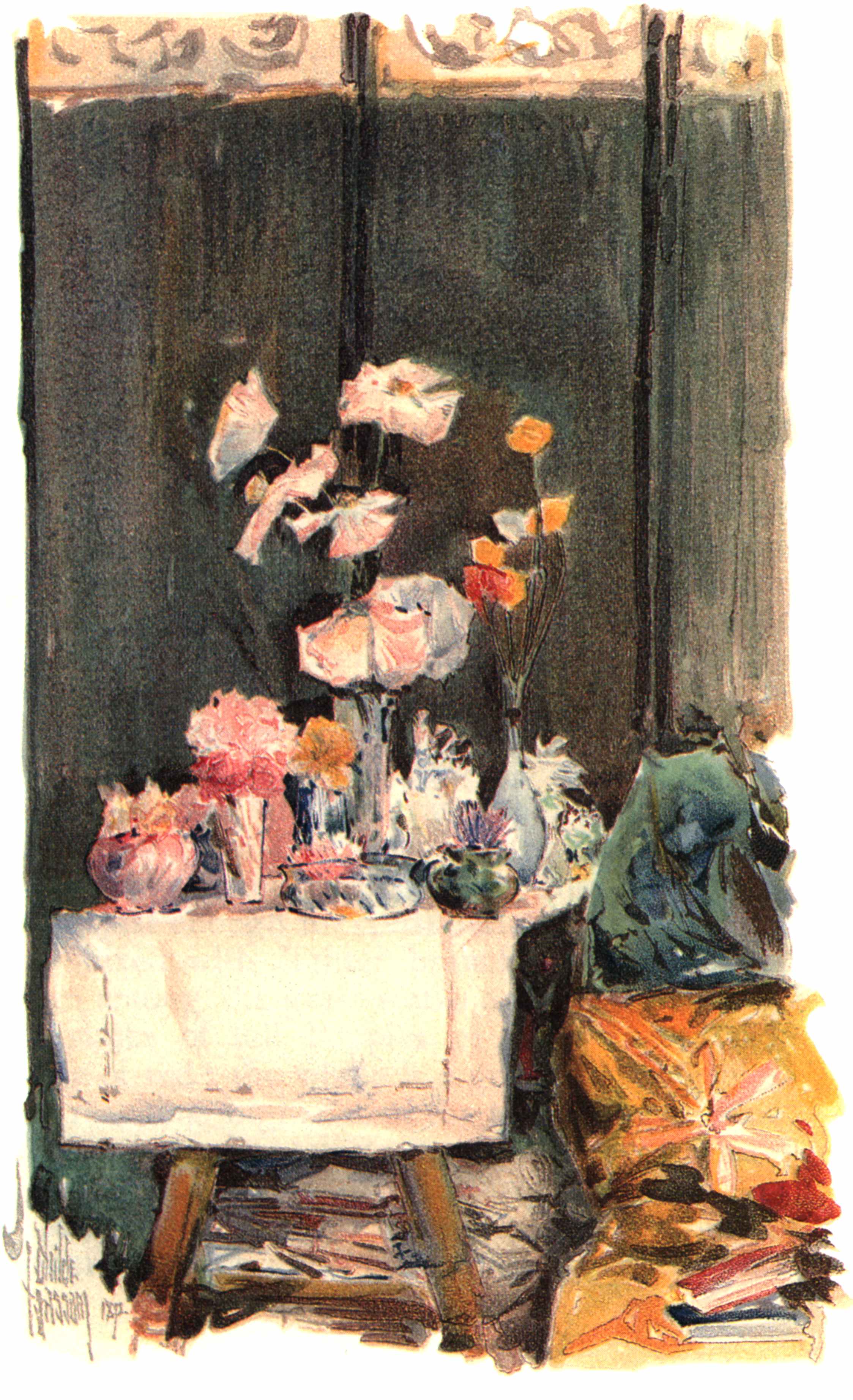
A Favorite Corner
All summer long within this pleasant room the flowers hold carnival in every possible combination of beauty. All summer long it is kept fresh and radiant with their loveliness,—a wonder of bloom, color, and fragrance. Year after year a long procession of charming people come and go within its doors, and the flowers that glow for their delight seem to listen with them to the music that stirs each blossom upon its stem. Often have I watched the great red Poppies drop their fiery petals wavering solemnly to the floor, stricken with arrows of melodious sound from the matchless violin answering to the touch of a master, or to the storm of rich vibrations from the piano. What heavenly music has resounded from those walls, what mornings and evenings of pleasantness have flown by in that room! How many people who have been happy there have gone out of it and of the world forever! Yet still the summers come, the flowers bloom, are gathered and adored, not without wistful thought of the eyes that will see them no more. Still in the sweet tranquil mornings at the piano one sits playing, also with a master’s touch, and strains of Schubert, Mozart, Schumann, Chopin, Rubinstein, Beethoven, and many others, soothe and enchant the air. The wild bird’s song that breaks from without into the sonata makes no discord. Open doors and windows lead out on the vine-wreathed veranda, with the garden beyond steeped in sunshine, a sea of exquisite color swaying in the light air. Poppies blowing scarlet in the wind, or delicately flushing in softest rose or clearest red, or shining white where the Bride stands tall and fair, like a queen among them all. A thousand varied hues amid the play of fluttering leaves: Marigolds ablaze in vivid flame; purple Pansies,—a myriad flowers, white, pink, blue, carmine, lavender, in waves of sweet color and perfume to the garden fence, where stand the sentinel Sunflowers and Hollyhocks, gorgeously arrayed and bending gently to the breeze; Sunflowers with broad faces that seem to reflect the glory of the day; the Hollyhocks, tall spikes of pale and deep pink, white, scarlet, yellow, maroon, and many hues. Over the sweet sea of flowers the butterflies go wavering on airy wings of white and gold, the bees hum in the Hollyhocks, and the humming-birds glitter like jewels in the sun; but whether these their winged lovers go or come, the flowers do not care, they live their happy lives and rejoice, intent only on fulfilling Heaven’s will, to grow and to blossom in the utmost perfection possible to them. Climbing the trellis, the monthly Honeysuckle holds its clusters high against the pure sunlit sky, glowing in beauty beyond any words of mine to tell. Charming people sit within the pleasant room among its flowers, listening to the delicious music; others are grouped without in the sun-flecked shadow of the green vines, where the cool air ripples lightly in the leaves; lovely women in colors that seem to have copied the flowers in the garden, and all steeped in sweet dreams and fugitive fancies as delicate as the perfumes that drift in soft waves from the blossoms below. Beyond the garden the green grassy spaces sloping to the sea are rich with blossoming thickets of wild Roses, among the bleached white ledges, blushing fair to see, and the ocean beyond shimmers and sparkles beneath the touch of the warm south wind.
Enchanting days, and evenings still more so, if that were possible! With the music still thrilling within the lighted room where the flowers glow under the lamplight, while floods of moonlight make more mystic the charmed night without. The thick curtain of the green vine that drapes the piazza is hung over its whole surface with the long drooping clusters of its starry flowers that lose all their sweetness upon the air, and show from the garden beneath like an immense airy veil of delicate white lace in the moonlight,—a wonderful white glory. Through the windows cut in this living curtain of leaves and flowers we look out over the sea beneath the moon—is anything more mysteriously beautiful?—on glimmering waves and shadowy sails and rocks dim in broken light and shade; on the garden with all its flowers so full of color that even in the moonlight their hues are visibly glowing. The fair creatures stand still, unstirred by any wandering airs, the Lilies gleam, and the white stars of the Nicotiana, the white Poppies, the white Asters that just begin to bloom, and the tall milky clusters of the Phlox: nothing disturbs their slumber save perhaps the wheeling of the rosy-winged Sphinx moth that flutters like the spirit of the night above them as they dream.
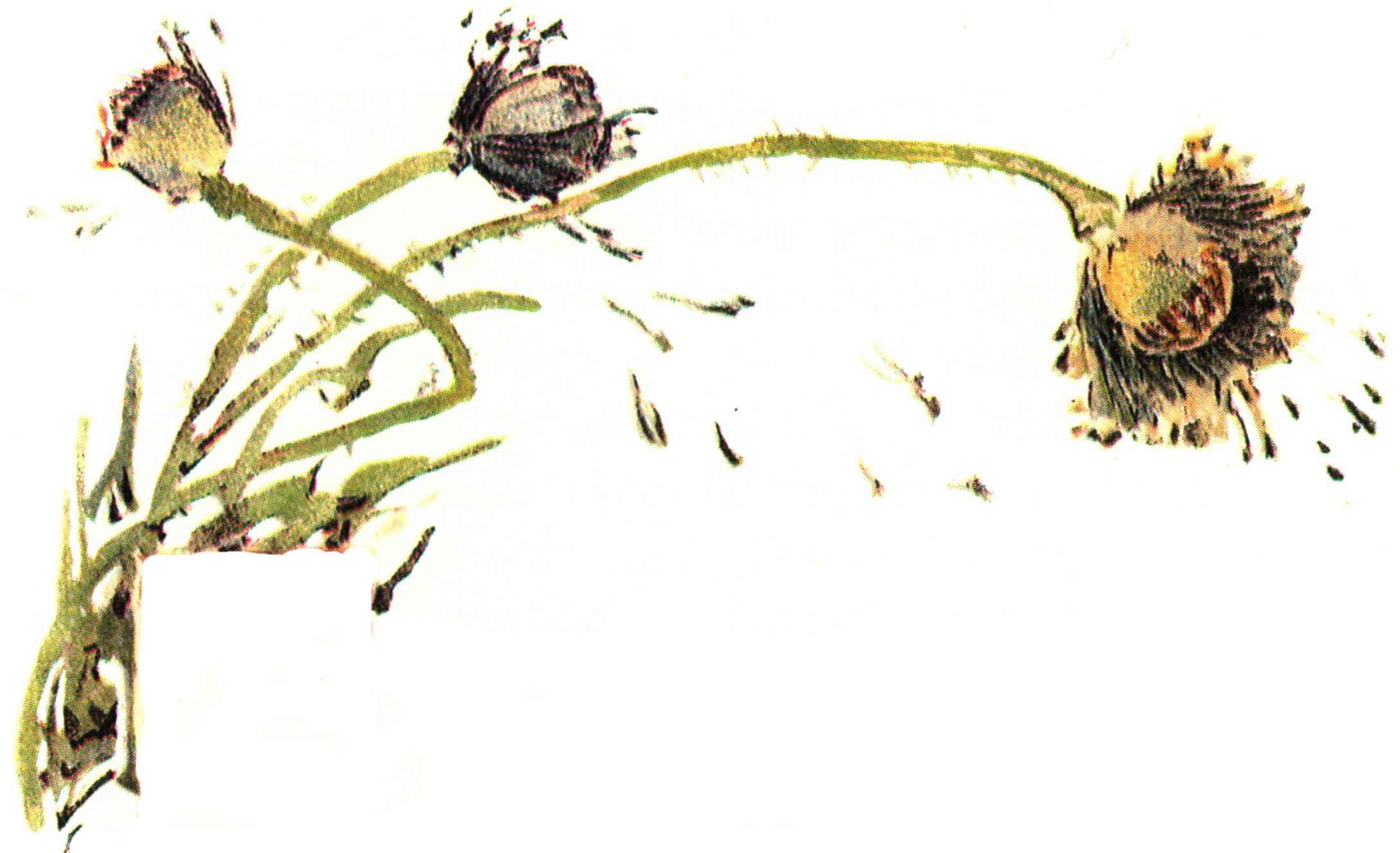

The garden suffers from the long drought in this last week of July, though I water it faithfully. The sun burns so hot that the earth dries again in an hour, after the most thorough drenching I can give it. The patient flowers seem to be standing in hot ashes, with the air full of fire above them. The cool breeze from the sea flutters their drooping petals, but does not refresh them in the blazing noon. Outside the garden on the island slopes the baked turf cracks away from the heated ledges of rock, and all the pretty growths of Sorrel and Eyebright, Grasses and Crowfoot, Potentilla and Lion’s-tongue, are crisp and dead. All things begin again to pine and suffer for the healing touch of the rain.
Toward noon on this last day of the month the air darkens, and around the circle of the horizon the latent thunder mutters low. Light puffs of wind eddy round the garden, and whirl aloft the weary Poppy petals high in air, till they wheel like birds about the chimney-tops. Then all is quiet once more. In the rich, hot sky the clouds pile themselves slowly, superb white heights of thunder-heads warmed with a brassy glow that deepens to rose in their clefts toward the sun. These clouds grow and grow, showing like Alpine summits amid the shadowy heaps of looser vapor; all the great vault of heaven gathers darkness; soon the cloudy heights, melting, are suffused in each other, losing shape and form and color. Then over the coast-line the sky turns a hard gray-green, against which rises with solemn movement and awful deliberation an arch of leaden vapor spanning the heavens from southwest to northeast, livid, threatening, its outer edges shaped like the curved rim of a mushroom, gathering swiftness as it rises, while the water beneath is black as hate, and the thunder rolls peal upon peal, as faster and faster the wild arch moves upward into tremendous heights above our heads. The whole sky is dark with threatening purple. Death and destruction seem ready to emerge from beneath that flying arch of which the livid fringes stream like gray flame as the wind rends its fierce and awful edge. Under it afar on the black level water a single sail gleams chalk-white in the gloom, a sail that even as we look is furled away from our sight, that the frail craft which bears it may ride out the gale under bare poles, or drive before it to some haven of safety. Earth seems to hold her breath before the expected fury. Lightning scores the sky from zenith to horizon, and across from north to south “a fierce, vindictive scribble of fire” writes its blinding way, and the awesome silence is broken by the cracking thunder that follows every flash. A moment more, and a few drops like bullets strike us; then the torn arch flies over in tattered rags, a monstrous apparition lost in darkness; then the wind tears the black sea into white rage and roars and screams and shouts with triumph,—the floods and the hurricane have it all their own way. Continually the tempest is shot through with the leaping lightning and crashing thunder, like steady cannonading, echoing and reëchoing, roaring through the vast empty spaces of the heavens. In pauses of the tumult a strange light is fitful over sea and rocks, then the tempest begins afresh as if it had taken breath and gained new strength. One’s whole heart rises responding to the glory and the beauty of the storm, and is grateful for the delicious refreshment of the rain. Every leaf rejoices in the life-giving drops. Through the dense sparkling rain-curtain the lightning blazes now in crimson and in purple sheets of flame. Oh, but the wind is wild! Spare my treasures, oh, do not slay utterly my beautiful, beloved flowers! The tall stalks bend and strain, the Larkspurs bow. I hold my breath while the danger lasts, thinking only of the wind’s power to harm the garden; for the leaping lightning and the crashing thunder I love, but the gale fills me with dread for my flowers defenseless. Still down pour the refreshing floods; everything is drenched: where are the humming-birds? The boats toss madly on the moorings, the sea breaks wildly on the shore, the world is drowned and gone, there is nothing but tempest and tumult and rush and roar of wind and rain.
The long trailing sprays of the Echinocystus vine stretch and strain like pennons flying out in the blast, the Wistaria tosses its feathery plumes over the arch above the door. Alas, for my bank of tall Poppies and blue Cornflowers and yellow Chrysanthemums outside! The Poppies are laid low, never to rise again, but the others will gather themselves together by and by, and the many-colored fires of Nasturtiums will clothe the slope with new beauty presently. The storm is sweeping past, already the rain diminishes, the lightning pales, the thunder retreats till leagues and leagues away we hear it “moaning and calling out of other lands.” The clouds break away and show in the west glimpses of pure, melting blue, the sun bursts forth, paints a rainbow in the east upon the flying fragments of the storm, and pours a flood of glory over the drowned earth; the pelted flowers take heart and breathe again, every leaf shines, dripping with moisture; the grassy slopes laugh in sweet color; the sea calms itself to vast tranquillity and answers back the touch of the sun with a million glittering smiles.
Though the outside bank of flowers is wrecked and the tall Poppies prone upon the ground, those inside the garden are safe because I took the precaution to run two rows of wire netting up and down through the beds for their support. So, when the winds are cruelly violent, the tall, brittle stalks lean against this light but strong bulwark and are unhurt.
After the storm, in the clear, beautiful morning, before sunrise I went as usual into the garden to gather my flowers. To and fro, up and down over the ruined bank I passed; the wind blew cool and keen from the west, though the sky was smiling. The storm had beaten the flowers flat all over the slope; in scarlet and white and blue and pink and purple and orange bloom they were prostrate everywhere, leaves, stalks, blossoms, and all tangled and matted in an inextricable confusion. Swiftly I made my way through it, finding a foothold here and there, and stooping for every freshly unfolded cup or star or bell whose bud the tempest had spared. As I neared the little western gate with my hands full of blossoms to enter the garden on my way to the house, I was stopped still as a statue before a most pathetic sight. There, straight across the way, a tall Poppy plant lay prone upon the ground, and clinging to the stem of one of its green seed-pods sat my precious pet humming-bird, the dearest of the flock that haunt the garden, the tamest of them all. His eyes were tightly closed, his tiny claws clasped the stem automatically, he had no feeling, he was rigid with cold. The chill dew loaded the gray-green Poppy leaves, the keen wind blew sharply over him,—he is dead, I thought with a pang, as I shifted my flowers in a glowing heap to my left arm, and clasped the frozen little body in the palm of my right hand. It was difficult to disengage his slender wiry claws from their close grip on the chilly stalk, but he never moved or showed a sign of life as I took him off. I held him most tenderly in my closed hand, very careful not to crush or even press his tiny perishing body, and breathed into the shut hollow of my palm upon him with a warm and loving breath. I was so very busy, there were so many things to be done that morning, I could not stop to sit down and nurse him back to life. But I held him safe, and as I went up and down the garden paths gathering the rest of my flowers, I breathed every moment into my hand upon him. Ten, fifteen, twenty minutes passed; he made no sign of life. Alas, I thought, he is truly dead; when all at once I felt the least little thrill pass through the still, cold form, an answering thrill of joy ran through me in response, and more softly, closely, tenderly yet I sent my warm breath to the tiny creature as I still went on with my work. In a few minutes more I began to feel the smallest fluttering pulse of life throbbing faintly within him; in yet a few moments more he stirred and stretched his wings, comforting himself in the genial heat. When at last I felt him all alive, I took a small shallow basket of yellow straw, very small and light, and in it put a tuft of soft cotton wool, filled a tiny glass cup with sugar and water, honey-thick, placed it in the basket by the cotton, then gently laid the wee bird on the warm fluff. His eyes were still closed, but he moved his head slowly from side to side. The sun had risen and was pouring floods of light and heat into the garden. I carried the basket out into the corner where the heavenly blue Larkspurs stood behind the snow-whiteness of the full blossoming Lilies, and among the azure spikes I hung the pretty cradle where the sunbeams lay hottest and brightest on the flowers. The wind, grown balmy and mild, rocked the tall flower-spikes gently, the basket swayed with them, and the heat was so reviving that the dear little creature presently opened his eyes and quietly looked about him. At that my heart rejoiced. It was delightful to watch his slow return to his old self as I still went on with my work, looking continually toward him to see how he was getting on. The ardent sunbeams sent fresh life through him; suddenly he rose, an emerald spark, into the air, and quivered among the blue flowers, diving deep into each winged blossom for his breakfast of honey.
All day and every day he haunts the garden, and when tired rests contentedly on the small twig of a dry pea-stick near the Larkspurs. The rosy Peas blossom about him, the Hollyhock flowers unfold in glowing pink with lace-like edges of white; the bees hum there all day in and out of the many flowers; the butterflies hover and waver and wheel. When one comes too near him, up starts my beauty and chases him away on burnished wings, away beyond the garden’s bounds, and returns to occupy his perch in triumph,—the dry twig he has taken for his home the whole sweet summer long. Other humming-birds haunt the place, but he belongs there; they go and come, but he keeps to his perch and his Larkspurs faithfully. He is so tame he never stirs from his twig for anybody, no matter how near a person may come; he alights on my arms and hands and hair unafraid; he rifles the flowers I hold, when I am gathering them, and I sometimes think he is the very most charming thing in the garden. The jealous bees and the butterflies follow the flowers I carry also, sometimes all the way into the house. The other day, as I sat in the piazza which the vines shade with their broad green leaves and sweet white flowers climbing up to the eaves and over the roof, I saw the humming-birds hovering over the whole expanse of green, to and fro, and discovered that they were picking off and devouring the large transparent aphides scattered, I am happy to say but sparingly, over its surface, every little gnat and midge they snapped up with avidity. I had fancied they lived on honey, but they appeared to like the insects quite as well.
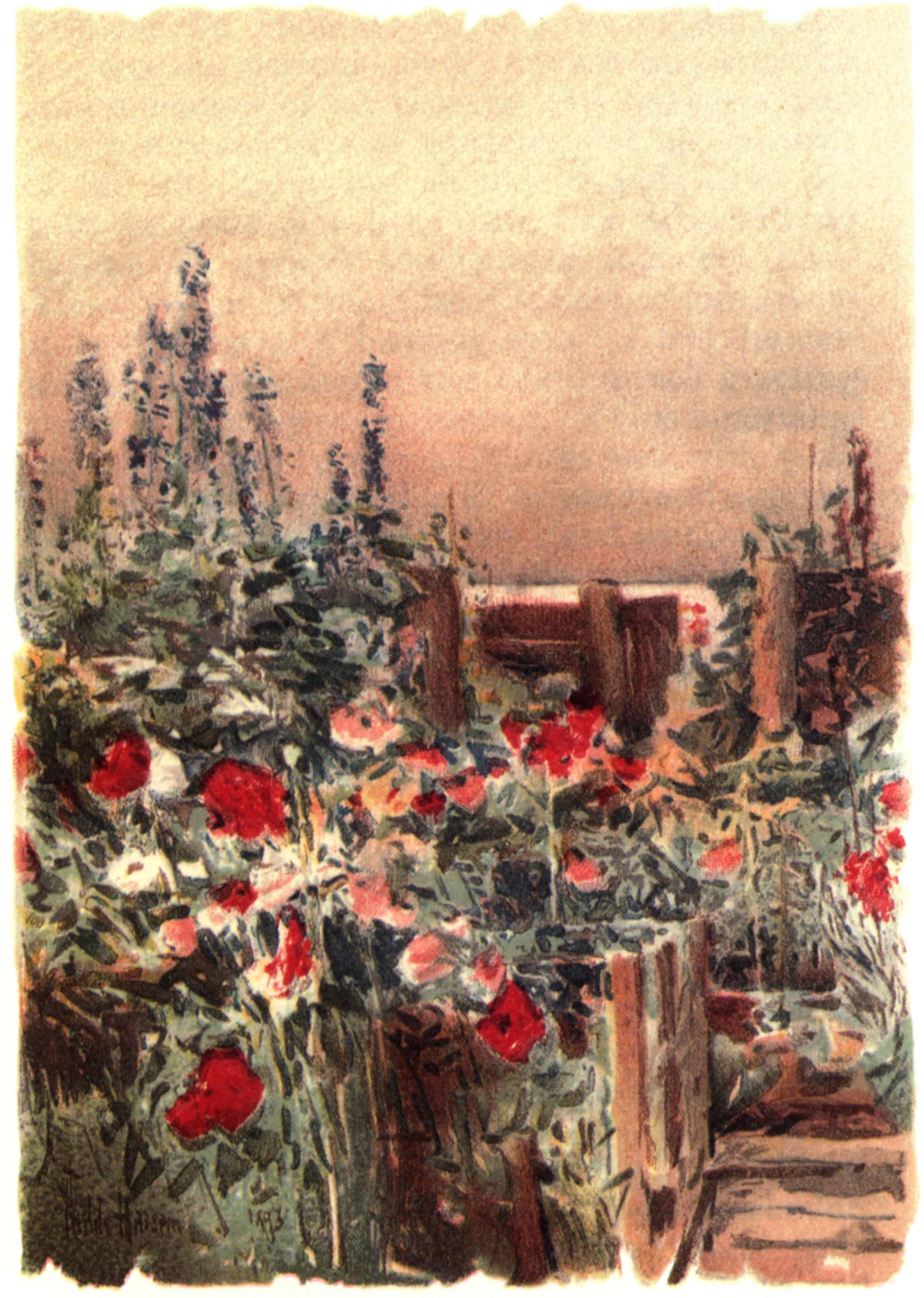
Home of the Humming-bird
In the sweet silence before sunrise, standing in the garden I watch the large round shield of the full moon slowly fading in the west from copper to brass and then to whitest silver, throwing across a sea of glass its long, still reflection, while the deep, pure sky takes on a rosy warmth of color from the approaching sun. Soon an insufferable glory burns on the edge of the eastern horizon; up rolls the great round red orb and sets the dew twinkling and sparkling in a thousand rainbows, sending its first rejoicing rays over the wide face of the world. When in these fresh mornings I go into my garden before any one is awake, I go for the time being into perfect happiness. In this hour divinely fresh and still, the fair face of every flower salutes me with a silent joy that fills me with infinite content; each gives me its color, its grace, its perfume, and enriches me with the consummation of its beauty. All the cares, perplexities, and griefs of existence, all the burdens of life slip from my shoulders and leave me with the heart of a little child that asks nothing beyond its present moment of innocent bliss. These myriad beaming faces turned to mine seem to look at me with blessing eyes. I feel the personality of each flower, and I find myself greeting them as if they were human. “Good-morning, beloved friends! Are all things well with you? And are you tranquil and bright? and are you happy and beautiful?” They stand in their peace and purity and lift themselves to my adoring gaze as if they knew my worship,—so calm, so sweet, so delicately radiant, I lose myself in the tranquillity of their happiness. They seem like sentient beings, as if they knew me and loved me, not indeed as I love them, but with almost a reliance on my sympathy and care, and a pleasure in my delight in them. I please myself with the thought that if anything goes wrong with them, if a vine or tender stalk droops for lack of support, or if some insect is working them woe, or threat of harm comes to them from any quarter, they say to each other, “Patience! She will be coming soon, she will see our trouble, she will succor us, and all will again be well.”
The summer life in the garden of the winged things of the air is most charming,—the wonderful creatures that have escaped, as it were, from the earth. The life that crawls and creeps and devours and destroys, in the forms of slug and cutworm and all hideous shapes, is utterly forgotten as we watch these ethereal beings, fluttering, quivering, darting, dancing, wavering, wheeling, rejoicing aloft in merry flight. The Larkspur spikes bend with the weight of the booming bees, the whole blossoming space is alive with many-colored butterflies like floating flowers, and the humming-birds are a perpetual pleasure. They are astir even before sunrise, when the air is yet chill with the breath of the retreating night,—there they are, vibrating with their soft humming over the Larkspur blossoms which are themselves like exquisite azure birds all poised for flight, or diving deep into the fragrant trumpets of the Honeysuckle, everywhere flashing in emerald and ruby as the sun’s first beams strike them, like the living jewels they are. Their fearlessness is something amazing. I never shall forget the surprise of joy that filled me when for the first time one alighted on my sleeve and rested, as much at home as if I were a stick or a harmless twig! Sparrows and nuthatches had often alighted on my head as I stood musing over my flowers, perfectly still, but to have this tiny spark of brilliant life come to anchor, as it were, on anything so earthly as my arm was indeed a nine days’ wonder! Now it has grown to be an old story, but it is never any less delightful.
August 18th. This morning the garden was so dry again when I sought it at sunrise, in spite of the heavy dew, that I took the hose and turned on the water, showering the whole place most thoroughly. When I had done the drops clung thickly to everything, to the sprays of Sweet Peas especially, the rough surface of their leaves and stalks catching and holding the water more tenaciously than the smoother foliage; they were begemmed, as it were, with so many sparkling spheres of light. The tamest, dearest humming-bird, whose home is in the Larkspurs, was greatly excited by this unexpected and refreshing shower, and whirred about me, uttering continually his one fine, sweet, keen note. When my rain-storm ceased he flew to the Sweet Peas close to his azure bower, and sitting on a green spray already bent with the weight of the clear drops, proceeded to take his morning bath with the most cheerful enjoyment. He fluttered his tiny wings and ducked his head and wagged his tail and drenched himself completely; his feathers were so soaking wet that his little body looked no bigger than a bumble-bee; then he flew up and lighted on the tallest pea-stick that reached over the fence among the Larkspurs: there sitting on his favorite twig he rapidly preened his feathers, shook himself, spread his wings and tail and combed them with his slender beak and dried them in the broad, bright beams that poured across the garden from the low sun. With claws and beak he smoothed and arranged his dainty raiment, perfectly regardless of me, his ardent admirer, standing near enough to touch him with my finger. Then he fluttered in and out among the flowers, dipping into every dewy chalice and feasting on his fragrant honey.
I wonder, as I muse over the charms of these most minute of feathered creatures, how it is possible for their tiny wings to bear them over the miles of restless and perilous brine, to find this rock with its nest of flowers! Do they surmise the hospitality that awaits them at the end of their long journey as they steer their dangerous way across the wastes of the salt sea on those small, weak, quivering pinions? Have they some subtle inkling of the tender welcome that awaits them here? Do they guess how they will be admired and adored? I have filled a small glass mug with sugar and water thick as honey, and fastened it in a crotch of the pea-sticks for them to feed upon; the bees throng to it, the ants have found it, and I hope the humming-birds will feast there too. One morning lately, as I was busy in the garden, a little creature brushed by me so close I thought it was a bee; turning to look at it, I was sure it was a humming-bird, but such an atom! Its like I had never imagined. I watched it, fascinated, as it flew here, there, and everywhere, whirring just like a humming-bird, crazy over the annual Larkspurs. A greenish golden sheen was reflected from the head and back, the very color of the little bird, and it had a small, short tail, with a band of white round its body, which seemed feathered, as also its mottled breast. Its bright black eyes were like the bird’s, and it hummed with its wings in precisely the same way. Its beak was short, and as it went from flower to flower, probing for honey, I was perfectly sure it was a new variety of humming-bird, the most minute that was ever created. I watched it with breathless interest, completely puzzled by it. Perfectly tame, it flew all about me and investigated the flowers in my hand. Suddenly I discovered that it had three pairs of legs! No bird, I said, ever had more than one, and then I was satisfied that it must be the most marvelous moth in the world. It was so happy and beautiful, flying about so confidingly in the bright sunshine within reach of my hand! But I knew of some one to whom it would be a treasure, so I threw a light veil over, caught it, and sent it softly to sleep forever with some chloroform. It was Ællopos Titan, very rare, and found in the tropics.
The dazzling white Lilies blossoming now, bright as silvery snow below the Larkspurs, are taller than they by several feet. I wish I could in any words paint the hues of these splendid Delphiniums; such shades of melting blue, some light, others dark, some like the summer heaven, and dashed across their pale azure wings with delicious rose. Now is the garden at high tide of beauty. Sweet Peas are brilliant in all their vivid tints; they are doing bravely, spite of the drought, because their roots are so well shaded. They bloom so plenteously that they can hardly be gathered, though they are cut daily. The Rose Campion bed is a lake of delicate colors with its border of scarlet Flax. Poppies of every tint are blazing; the Hollyhocks are splendid, with their comrades the Sunflowers; every day the single Dahlias surprise me with new and unexpected flowers; the Tea Rose bed is a perpetual delight and astonishment; the purple Zanzibar Lily is blossoming in its tub and never is without its wonderful cup afloat; the Lotus sends up strong, long-stemmed leaves aloft, and keeps me eagerly looking for its promised flower of radiant pink,—its leaves are a marvel with their mystic markings held so high above the water. The Honeysuckles are breathing out all their sweetness on the air; the Pinks are out in spicy bloom; the Mountain Fringe drapes the doorway with cloudy green and pale rose-color. Constellations of Marigolds and Artemisias and Coreopsis, whole solar systems of fiery suns and stars, blossom all over the place, and in partly shaded corners large fragrant stars of Nicotiana shine also when twilight falls. The Japanese Sunflowers make every spot gay where they unfold; they are hardy; when once they fairly get a foothold in the garden, they will not be dislodged, and I for one would never wish to dislodge them, though they spread and grow and multiply rapidly, and take much space if left to go on undisturbed. They have an indescribable golden atmosphere about them, because, I suppose, of their cup-like shape; they never stretch their petals out flat like other Sunflowers. They have a small brown central disk, and their “ray-like florets” are of deep yellow, curved more inward than outward. The Artemisias are in one shade of full, rich gold, in shape like a common field Daisy; the Marigolds are in every shade of yellow, orange, and flame, effulgent,—some with centres of velvet brown, some with peacock green, some all gold, with exquisite gradations of color through all their rays. “Ardent Marigolds!” sang John Keats. Ardent indeed they are, with fervors of color that glow like the beams of day.
The dark crimson Jacqueminot Roses are almost gone, but almost every other flower is at its best, the whole garden in blossom at once. Dearly I love to sit in the sun upon the doorstep with a blossom in my hand and meditate upon its details, the lavish elaboration of its loveliness, to study every peculiar characteristic of each, and wonder and rejoice in its miraculous existence, a feast more delicate and satisfying than the honey the birds and bees and butterflies gather from its heart. Over my head the Cobœa vine droops its large green and purple bells, with many another flower beside. The Tropæolum Lucifer thronging up the trellis on either hand truly merits the name of Light-bearer; its scarlet velvet blooms have almost an illuminating quality. I hold a flower of the pretty Love-in-a-mist, the quaint Nigella, and scan its charming face. It blossoms late and long, and is a flower of most distinguished beauty. It is star-shaped, in tints of white, blue, and purple, with full rich stamens and anthers of warmer red-purple, the petals on the back delicately veined in each variety with fine lines of faint green. The rich cluster of stamens is surrounded at the base by eight smaller inner petals in different tints, so wonderful in detail, so ornate in decoration as to be simply indescribable. Each large outer petal is curved and cup-shaped, yet each has its finishing point which makes the blossom starry, and these eight inner petals radiate from the centre within, above the larger ones. The foliage whence it gets its old-time name, Love-in-a-mist, is like a soft green vapor, and in the double varieties, the white especially, runs up and mixes itself with the petals. The single varieties are much the finest. They have a faint perfume of anise, and they are among the quaintest and most interesting flowers I know.
I love to pore over every blossom that unfolds in the garden, no matter what it may be, to study it and learn it by heart as far as a poor mortal may. If one but gazes closely into a tiny flower of the pale blue Forget-me-not, what a chapter of loveliness is there! One sees at a glance the sweet color of the starry, compact cluster, and perhaps will notice that the delicate buds in their cherishing calyx are several shades of rose and lilac before they unclose, but unless one studies it closely, how shall one know that in most cases the himmel-blau petals are distinctly heart-shaped, that round its golden centre it wears a necklace of pearls, or so they seem, till on looking closer one discovers that the effect is made by the fluting of the whitened folds of each petal at the base; it looks precisely as if it wore a string of polished beads. The tiny spot of darkness within its inmost yellow ring holds five stamens, with dusty anthers of paler yellow (also heart-shaped when the flower first unfolds) in a close circle round the pistil of pale green. Unless the eyes are young and keen a microscope only will tell this; but it is one of the wisest things in the world to carry in one’s pocket a little magnifying glass, for this opens so many unknown gates into the wonders and splendors of Creation. There is such wealth of ornament, such marvelous subtile thought spent on the smallest blossom! The “sweet and cunning hand of Nature” is so lavish of its work, and it is all so happy, the joy is so inexhaustible, the refreshment to the human soul so heavenly!