A WORD TO THE BEGINNER
Reading edition
As you glance over the pages of this book you may say to yourself, “I can never learn all of these birds.” This is a natural attitude of mind upon the part of one to whom many bird-names are new and who feels that he doesn’t know much about birds.
It may be reassuring to you to learn that most people know more about birds than they realize. Already your mind is full of common bird-names. You wouldn’t be reading this book had you not already learned a good deal about some birds.
Here is a bit of good advice. Instead of taking this book to the field with you in the hope that you may accurately identify every bird you see, suppose you choose eight or ten birds which you do not know, but about which you wish to learn, and concentrate upon these. You already know the Bluebird, the Robin, the Crow. Suppose you try now the Wood Thrush, the Towhee, the Meadowlark. Look these up in the book, find out whether you may expect to see them at the time you are to make your trip of discovery, learn where to look for them, what to look for when they appear, something about what they will say as they call or sing—and fasten these facts in your mind. If you adopt this procedure, you will not be misled into identifying some bird of the deep woods as a Meadowlark, or a bird of the open field as a Wood Thrush. Some birds will puzzle you, of course, but as you continue your study these problems will be solved.
As a serious bird student you will, first of all, want to be able to describe a bird accurately, using some acceptable scientific terms. Some of these will be new to you, but they will all become understandable in a short time. On the next page is a chart showing the names of the bird’s parts. You should become so familiar with these words that they will not confuse you.
2
Many books give complete color keys which are to help the beginner. I do not believe much in these, because I have always found them tedious and difficult. I believe that good sketches obviate much of the need of such keys.
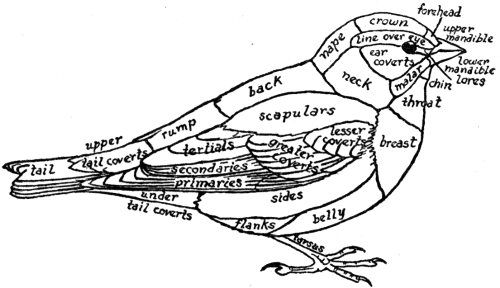
Topography of a Bird
In making your studies be careful not to expect to find birds during seasons when they do not normally occur. On the other hand, if you identify a bird at a time which is not indicated in this manual, special note should be made, for pioneer records such as these are valuable to the author who wants to gather together all data, and the last word has not yet been said upon all the movements of even our commonest species.
BIRD-SONGS
It is my belief that but few people altogether lack a sense of tune. Some of my students at the University of Pittsburgh had difficulty, I remember, in diagramming bird-songs; but with a little practice you will be able to jot down syllables which will help you to recall bird-songs. The well-known names Chickadee, Phœbe, and Killdeer are all permanent records of this very sort of syllabization of bird-songs—an attempt to write down what the bird is saying. Sometimes a bird will be heard again and again before it is seen. If my notes concerning songs are at all accurate, some of these will help you to find birds which you might have difficulty in identifying from appearance alone.
3
NOTE-BOOKS
Write down all sorts of notes, be they ever so incomplete. Make sketches of birds as you see them; diagram the songs and call-notes. Keep all that you write as accurate and free from imagination as possible. Do not accredit a bird with certain colors until you see them.
A note-book may take the form of a diary wherein is stated the temperature of the day, the weather conditions, the length and route of your field-trip, and the birds which you saw, together with notes upon them. Or, your system may be more elaborate, with a separate sheet for each species whereon you put all the data which you accumulate, more or less, perforce, in chronological order. The principal point to remember is that notes should be written while they are fresh in the mind, on the spot, if possible, to avoid inaccuracies.
SPECIMENS
Only a few ornithologists can have a complete collection of birds for reference. Everyone can save feathers of birds, or old nests, however, and when birds are found dead, they may be saved as specimens, if a permit for holding them is requested from the State Game Commission. When I was a lad I saved feathers which I found in the woods and had a large collection of these. Some of them, I later found, were all that were needed in authenticating a good record.
You will find it helpful to visit a good museum occasionally, so as to have a close view of the birds you have been reading about, or studying under difficulty, in the field. Here you will see clearly the color patterns, the anatomical characteristics, and the actual size of the birds that have puzzled you.
FIELD-GLASSES
A good binocular, preferably one which magnifies about six times, is a great aid to the amateur. The field of the glass, its illumination, ease of adjustment, and such points should be investigated before the purchase is made. A well-made glass with good lenses is probably the best in the long run, even though it be more expensive. Glasses should be handled carefully. They should have a good carrying-case, and should not be left lying in the sun nor exposed to the rain.
4
BOOKS
Many excellent standard works upon birds are available. When I was a youngster I wore out three volumes of Dr. Frank M. Chapman’s Bird-Life; I devoured the reading matter, cut up the pictures, and studied the technique of the artist who had painted them. By the time I had destroyed the third copy of this helpful volume, I knew the birds treated there pretty well. Chapman’s Handbook of Birds of Eastern North America is a desk-side companion today. The little pocket volumes called Bird Guides, by C. A. Reed, are helpful; but the color-plates in them have been used so many times that they are worn out, with the result that the colors are often very misleading. Dr. B. H. Warren’s volumes on the Birds of Pennsylvania, published in 1888 and 1890, contain much of value and interest, including a series of colored pictures which always elicit praise. These volumes, while interesting historically, do not meet the needs of the Pennsylvania bird student today, in the light of present knowledge. The excellent state publications Birds of New York (Eaton) and Birds of Massachusetts (Forbush), are magnificently illustrated and are well worth possessing; they treat of many of the species found in Pennsylvania. Books on general aspects of ornithology which you will find useful are: Wetmore’s The Migrations of Birds, Ball’s Bird Biographies, Blanchan’s Bird Neighbors and Birds That Hunt and Are Hunted, Chapman’s What Bird is That?, Coues’ Key to North American Birds, the National Geographic Society’s Book of Birds, and Forbush’s Useful Birds and Their Protection.
MAGAZINES
The proceedings of the Delaware Valley Ornithological Society, published under the title Cassinia, contain a wealth of material interesting to the Pennsylvania student. The Cardinal, journal of the Audubon Society of the Sewickley Valley, and a well-edited periodical, contains articles of interest chiefly to workers in western Pennsylvania; The Auk, The Wilson Bulletin, Bird-Lore, The Oologist, The Condor (western), and Nature Magazine, all are likely to contain articles of interest to Pennsylvania bird students.
5
BIRD HIKES
Early-morning hikes are good, but activity among birds is high, as a rule, until 10 o’clock A.M., or later, so you need not be in haste to get out at 4 o’clock, unless you have to go far. The trained bird student so comes to depend upon songs that he stays out as long as the birds are singing. Windy days are poor, because the birds are shy. In gentle rains, birds will often be very active and tame. Toward evening, birds often become active and vociferous again. Only a few of our birds sing during the heat of the midsummer noon.
IN THE FIELD
Winter is an ideal time to begin bird-study, because there are no leaves and because the birds are few and not difficult to identify. If you learn the winter birds thoroughly, you will be ready for the rush of the spring as old favorites return and new friends appear.
Midsummer is often a disappointing season because birds are silent and in poor feather. At this time you will be able to study the plumages of the young birds, however, and you will find much of interest in watching the affairs of family life. Migrant shore-birds should be watched during late summer.
Fall is the season of trials. Now come the restless, sombre-colored hordes, most of them silent save for a few brief call-notes. When you can easily identify all the fall birds, you are a pretty good ornithologist.
In approaching a bird, common sense will warn you that you should be as quiet as possible. You should be obscurely dressed, and if you can go under, around, or between bushes, rather than through them, you will cause less disturbance. Often the best way to study birds is to find a pleasant, somewhat hidden spot and remain there for an hour, watching all that comes by. A good bird student, in the course of his walk, will try to visit as many different kinds of country as he can; he will visit the ponds and marshes, the grape-vine thickets, the open fields, and the hemlock woods of his neighborhood. He knows that in these different regions he is likely to find different birds. In fact, unless he does carefully study all 6 of these regions, he is not thoroughly studying the bird-life of his locality.
You may have trouble in seeing some birds, though you pursue them ever so tirelessly. Try kissing the back of your hand in such a manner as to imitate the cries of a young or wounded bird. This sound will often arouse the curiosity of the wariest bird and he will come close. I thus made a squeaking sound once and a Robin hit me with full force on the neck; she was so convinced that I had one of her young in my dreaded clutches that she gave stern battle! These squeaking cries sometimes draw even the birds of prey.
VALUE OF PENNSYLVANIA BIRDS
Birds are of great value from the economic standpoint. The insects, destructive mammals and reptiles, and weed-seeds which they destroy are all enemies of man. It is amazing that in the scheme of nature certain birds should patrol the air, others the fields, others the trees, others the forest-floor, and so on, so that all outdoors is, in a sense, cared for by our feathered friends. It has been said that our very existence depends upon these birds who make it possible for the trees, the flowers, and the grain-fields to grow. And all the while these same creatures are delighting us with their beautiful colors and their cheerful songs.
Game-birds are important in Pennsylvania, with 700,000 hunters faring forth each fall. In addition to our popular game-birds, the Bob-White, Wild Turkey, and Ruffed Grouse, the Game Commission has introduced the Ring-necked Pheasant and Hungarian Partridge. These foreigners relieve the burden of shooting from our native game.
From the economic standpoint only a few birds in Pennsylvania may be said to be thoroughly undesirable. The Goshawk is a savage destroyer of small game and poultry. His smaller cousins, the Sharp-shinned Hawk and Cooper’s Hawk, are killers. The Great Horned Owl is destructive at times. Other hawks and owls, the Crow, Kingfisher, Starling, and other species have some destructive or undesirable traits, but they are not altogether bad.
Our valuable song and insectivorous birds have been 7 protected since 1858. Certain migratory birds, such as the loons, grebes, herons, and gulls, have been protected since 1900 by the International Bird Treaty with Canada. Today we protect one admittedly destructive bird—the Raven, because it is so rare and because of its fame in literary circles.
HELPING OUR BIRD FRIENDS
We may encourage birds to live about us, if we bear in mind their needs. In winter we may feed the Chickadees, Cardinals, Downy Woodpeckers, and other birds which live in our neighborhood. We may tack pieces of suet on a sheltered branch and scatter grain and grit on “feeding counters.” When snow is on the ground the birds have considerable difficulty in getting enough food, and our assistance will sometimes keep them from starvation. Feeding-shelters may be very simple, or they may be elaborate, but they should be placed and built so as to serve the needs of the birds best. A feeding-shelf built at a window furnishes a very attractive and useful device.
Before spring is upon us we should erect nesting-boxes for the Purple Martins, Bluebirds, and House Wrens we wish to attract. Those who are interested in securing specifications for these boxes should write to the Game Commission at Harrisburg for their bulletin, “A Year’s Program for Bird Protection.”
In spring we should think of the trees or shrubs which will attract birds. A fruit-laden mulberry tree always attracts birds in midsummer. Thick bushes placed in clumps will almost surely lure nesting Catbirds or Chipping Sparrows; a trumpet vine will mean Hummingbirds!
In midsummer the birds’ bath must be arranged. Such a bath may be very simple. But it must not be deep, and the edges should slope into the deeper water gradually. Remember that the water should be changed frequently unless a running stream is provided.
House cats and birds do not thrive together as a rule. If you wish to make conditions as nearly ideal as possible for your bird friends, you had better not keep a cat, for these animals are, by nature, crafty and bloodthirsty, and they 8 will catch birds for “sport,” even though they are well fed.
If you carefully watch the birds, you will become aware of their needs. You may find it necessary to shoot Starlings occasionally if they persist in ousting Flickers from their nests. You may have to plant sunflowers to attract Goldfinches; you may find it desirable to allow part of your property to grow up into weeds and bushes so that it may furnish a home for some unusual bird neighbor. At my home at Bethany, West Virginia, we have permitted raspberry vines to grow on a hillside back of the house, and here Indigo Buntings nest, within a few rods of the open windows!
LIFE-ZONES IN PENNSYLVANIA
The term Life-Zone is used by scientists in referring to a region where environmental conditions so react upon each other as to form a suitable home for certain plant and animal forms. A Life-Zone naturally has no hard and fast boundaries as does a geographical zone; its boundaries are determined by temperature, rainfall, soil, altitude, drainage, and innumerable other factors, which so create a certain average whole as to attract certain species of plants, birds, mammals, and so forth, which in turn themselves become part of the environment, and are responsible for the presence of certain forms. These Life-Zones are, then, associations which naturally develop in sections where similar conditions exist. In Pennsylvania there are three or four of these associations. One, noticeable in the southern and southwestern counties, has been called the Carolinian Life-Zone. Here such birds as the Carolina Wren, Cardinal, Tufted Tit, and Red-bellied Woodpecker live. In much of Pennsylvania the Alleghenian Life-Zone occurs, where the Least Flycatcher, Wilson’s Thrush, Swamp Sparrow, and Rose-breasted Grosbeak are to be found in summer. Higher in the mountains is the Canadian Life-Zone; here the Junco, Hermit Thrush, Red-breasted Nuthatch, Wilson’s Snipe, and Northern Water Thrush nest. As you read this book, you will notice that many birds are to be found in northern or mountainous counties; others in southern or less mountainous counties, and so forth. This is an indication of Life-Zone distribution.
9
BIRD-MIGRATION IN PENNSYLVANIA
Some of our winter birds spend the year round in one region. Certain of them, like the Song Sparrow and Crow, migrate to an extent, the nesting individuals moving southward during winter, their place being taken by other individuals of the same species from farther north. Some winter birds, such as the Junco, Golden-crowned Kinglet, Brown Creeper, and Tree Sparrow, visit us from the north and return to their Canadian nesting-ground with the arrival of spring. Most of our familiar summer birds spend the winter to the southward, many of them in South America. They come to us for a few months each year for the sole purpose of bringing forth their young. Many species of birds pass through Pennsylvania en route from their home in the south to their nesting-grounds in the north, and back again in the fall.
By far the greater number of species migrate to an extent. The phenomenon of bird-migration has caused many a student to wonder. How did such a tremendous annual movement originate? How do the birds endure their great flights across bodies of water?
The probability is that the migration of birds developed in past centuries as the food-supply in the tropics became insufficient for all the nesting birds which tried to bring forth their young there. Urged by the need for solitude and a good food-supply, certain birds pushed out from the ancestral range and established a new summer home. After the young were reared, instinct drew them back to the region which was familiar to them, and so great migration routes have developed. Today the tiny Ruby-throated Hummingbird rears his young in our woodlands, then returns to South America with the young birds. Our Yellow Warbler, Red-eyed Vireo, Purple Martin, Rose-breasted Grosbeak, Scarlet Tanager, and many others, all go to South America.
Food-conditions, no doubt, have something to do with migration movements. Birds are well clothed with feathers, to be sure, but many of them depend on an insect diet, such as would be difficult to secure during cold winters. Some of our birds actually do not migrate if a food-supply is available.
Most of the smaller birds migrate at night, following 10 streams or mountain ranges. Swallows and hawks usually migrate by day, ducks and geese by both day and night. The Ohio, Delaware, and Susquehanna river valleys are important routes of migration. The shore of Lake Erie is a resting-ground for birds which have flown over this large body of water. In fall, at Presque Isle, the trees may be alive with birds which have just made the flight. The Atlantic Coast is an important route of migration for many waterbirds. Since Pennsylvania has no salt-water shore-line, we do not find some species which are to be found along the coast of New Jersey and Delaware.
Many birds which occur in abundance at Erie, in fall, rest there until they are able to take another flight; then they start southward for a feeding or resting-ground south of Pennsylvania, and therefore skip over most of the Commonwealth.
The distribution of birds and the constancy of their migration routes is a source of much wonder to all of us. Why should the two Palm Warblers, for instance, so invariably be found each year, one to the eastward, one to the westward of the mountains? Why should some birds be here in fall and not in spring? Why should others be so variable in numbers? If you keep careful notes upon the migratory birds, you may eventually help to solve some of these problems.
11
HORNED GREBE Colymbus auritus Linnæus
Other Names.—Dipper; Hell-Diver.
Description.—Neck long; no tail-feathers; toes flat and broad, feet at rear of body; sexes similar. Adult in spring: Large, puffy head, black, with stripe and silken plumes behind eye buffy; plumage of back blackish edged with gray; secondaries white; neck, breast, and sides chestnut; belly silvery white; eyes bright pink, the pupil encircled with a white ring. Immature birds and adults in winter: Grayish black above, silvery white beneath, grayish on the throat, with white cheek-patches which nearly meet on nape. Length: 13½ inches.
Range in Pennsylvania.—A migrant throughout the Commonwealth from March 20 to May 10 and from October 1 to November 30; occasional in winter when water is free of ice.
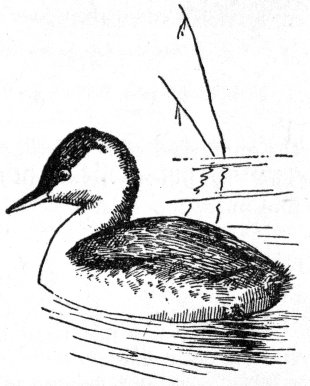
Horned Grebe, Winter Plumage
The white on the sides of the head and the white wing-patches distinguish this species in winter plumage from the Pied-billed Grebe; the gay spring plumage of the Horned Grebe is unmistakable. Look for this bright-eyed diver along the larger waterways. Its ability in swimming under water causes it to evade its enemies by disappearing beneath the surface rather than by flying. Grebes have the interesting habit of swallowing their own feathers as they moult, or as they pluck them out.
Holbœll’s Grebe (Colymbus holbœllii), a much larger bird, is very rare in Pennsylvania. In spring plumage it has a red-brown neck. It is about twice as large as either the Horned or Pied-billed Grebe and has a proportionately heavier and larger bill.
PIED-BILLED GREBE Podilymbus podiceps podiceps (Linnæus)
Other Names.—Dabchick; Hell-Diver; Dipper; Dipper-Duck (erroneous).
Description.—Sexes similar. Adults in summer: Glossy, dark brown above; throat black; neck, breast, and sides grayish, washed with brownish and indistinctly mottled with blackish; lower breast and belly glossy white; black band across bill. Immature birds and adults in winter: Similar, but without black on throat and bill. Length: 13½ inches.
Range in Pennsylvania.—Rare as a summer resident, chiefly because 12 there are so few lakes and marshes suited to its nesting; fairly common as a migrant from April 1 to May 15 and from August 25 to October 30.
Nest.—Flat, composed of decaying vegetation, floating among water-weeds or anchored by plants which are attached to the bottom. Eggs: 4 to 7, dull white, usually so heavily stained as to be brownish in appearance.
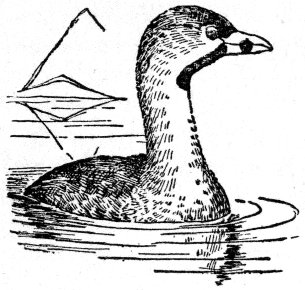
Pied-billed Grebe, Breeding Plumage
The Pied-billed Grebe is such an excellent diver and can so artfully escape detection by swimming beneath the surface of the water, with only its bill exposed, that it is often a difficult bird to observe. On land it is virtually helpless. The shortness of the body of the swimming grebe makes it comparatively easy to identify, and the unmarked wings distinguish this species from the Horned Grebe. The Pied-billed Grebe will frequently be seen along smaller streams and in little ponds.
LOON Gavia immer immer (Brünnich)
Other Names.—Great Northern Diver; Loom.
Description.—Size large; bill long and sharp; tail very short, with legs sticking out behind. Adults in spring: Upperparts black, with bluish and greenish reflections; patches on throat and sides of neck streaked with white; back and wings marked regularly with rows of white squares; underparts silvery white; sides black, spotted finely with white; eyes red. Immature birds and adults in winter: Upperparts blackish, margined with gray and without white spots; throat and neck grayish; underparts white. Length: about 30 inches.
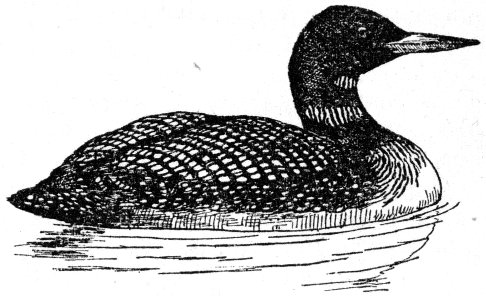
Loon, Breeding Plumage
Range in Pennsylvania.—A fairly common migrant along the larger lakes and waterways from March 15 to May 10 and from October 1 to December 15; occasional in winter when the water is free of ice.
The Loon is at perfect ease in the water; on land it shuffles along, using its wings as feet, and it cannot rise in flight from the ground. It lives almost altogether on fish which it captures under water and swallows entire. As a rule, it is to be seen far out from shore, floating quietly. Easily it slips under the water, perhaps to reappear a 13 hundred yards or more from the point at which it went down. The weird, laughing cry, which is famous in literature, is not often heard in Pennsylvania, since the birds do not nest here.
In the hand, the Loon is easily recognized by its striking coloration in spring; or in winter by its long, sharp bill and its large, webbed feet; at a distance, in the water, it may be confused with a cormorant, which has a hooked bill and a rather long tail, or with some of the larger ducks which have shorter, more stubby bills.
The smaller Red-throated Loon (Gavia stellata), usually a rare bird in Pennsylvania, is found during winter or early spring. In winter the back is gray, flecked with white; in spring there is a triangular patch of red-brown on the lower throat; it is always white below.
HERRING GULL Larus argentatus argentatus Pontoppidan
Other Names.—Sea Gull; Gray Gull.
Description.—Sexes similar. Adults in summer: White, with pearl-gray back and wings; tips of wings black with white spots; bill yellow with orange spot near tip of lower mandible; feet pale pink; eyes pale yellow. Adults in winter: Similar, with gray spots on head and neck. Immature birds: Dark gray-brown at a distance, with blackish bill and dark brown eyes; in the hand the upper-parts are found to be dark gray, considerably marked with buffy. The acquiring of fully adult plumage requires several moults. Birds which are not fully adult may have black-tipped, white tails. Young in their first flight plumage are darker than older individuals. Length: 24 inches.
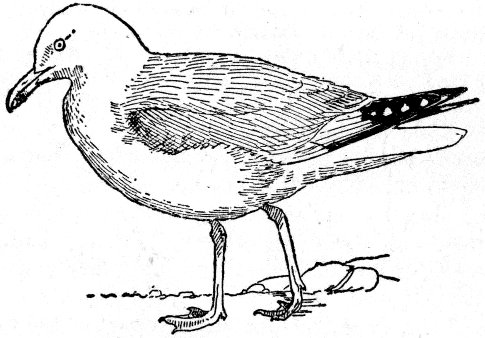
Herring Gull, Breeding Plumage
Range in Pennsylvania.—A somewhat irregular migrant and winter resident throughout, save at Erie, where it is common during summer, though it does not, apparently, nest there. In the interior it appears in spring as soon as the ice breaks up and is usually noted along the larger waterways.
Large gulls seen in Pennsylvania are usually of this species. Their long wings and graceful flight mark them at great distance. The smaller Ring-billed Gull, which is not easy to distinguish from this species in the field, has greenish yellow feet and a black band across the bill. Herring Gulls are often abundant about the harbor at Erie.
14
RING-BILLED GULL Larus delawarensis Ord
Description.—Sexes similar. Adults in summer: Like the Herring Gull, but much smaller, with greenish yellow bill crossed near tip by black band, and with greenish yellow feet. In winter the head and neck are spotted with gray. Immature: Gray-brown; tail white, with black band near tip; end of bill black. Length: 18 inches.
Range in Pennsylvania.—An irregular migrant in February, March, and April, and in October and November, sometimes appearing in flocks; occasional in winter.
The Ring-billed Gull should be identified in the field with a glass. It is much like the Herring Gull in general appearance, and, unless it be compared directly with the larger bird, may pass undetected. Remember the yellowish feet and the black band across the bill.
BONAPARTE’S GULL Chroicocephalus philadelphia (Ord)
Description.—Size small; sexes similar. Adults in summer: White, with rosy flush on belly, head black with white spot at eye, pearl-gray mantle, and black-tipped wings. Adults in winter lack the rosy flush of the underparts and have white heads upon the back of which are two dusky spots. Immature birds are similar to adults in winter but have a black band near the tip of the tail. Length: 14 inches.
Range in Pennsylvania.—A fairly regular migrant along the waterways from about April 1 to May 10 (sometimes considerably later) and from September 1 to October 10. Not often seen in winter.
This, the smallest of our gulls, is often seen in flocks. At Conneaut Lake, Crawford County, where they are regular visitors, they circle about rapidly, like terns, resting on the water at intervals or standing on a floating timber. Their black heads distinguish them easily from all other species save the Laughing Gull (Chroicocephalus atricilla megalopterus) a larger species which nests along the Atlantic Coast, and which may occur occasionally along the waterways of the southeastern part of the Commonwealth.
COMMON TERN Sterna hirundo Linnæus
Other Names.—Sea Swallow; Striker; Wilson’s Tern.
Description.—Smaller than a gull, with long, deeply forked tail. Adults in summer: Top of head glossy black; rest of body pearl-gray, save throat, sides of head, and tail, which are white, the outer tail-feathers with outer webs pearl-gray; bill red, with black tip; feet orange-red. Adults in winter: Similar, but with forepart of head and underparts white, and bill blackish. Immature: Similar to adults in winter, but plumage considerably washed with brownish, lesser wing-coverts slaty, and tail short, though forked. Length: 15 inches.
Range in Pennsylvania.—A rather irregular migrant.
15
The more rapid flight, long forked tail, and habit of pointing the bill downward, rather than forward, while flying, distinguish the terns from the gulls. Common Terns are sometimes seen flying gracefully about a small pond, seeking small fish or aquatic insects, which they capture with great dexterity. During migration they are usually silent, and they do not often remain long in one locality.
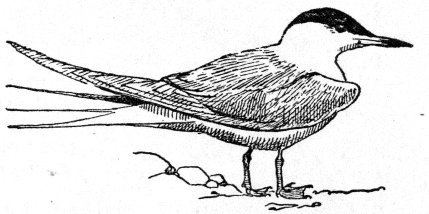
Common Tern, Adult
The much larger Caspian Tern (Hydroprogne caspia imperator) is similar in color-pattern to the Common Tern but has a much heavier, red bill, and a short, though forked tail. This species, which is decidedly rare as a migrant in the interior, has established a small nesting colony near Erie. The Caspian Tern is 21 inches long.
BLACK TERN Chlidonias nigra surinamensis (Gmelin)
Other Name.—Marsh Tern.
Description.—Size small; tail short, forked. Adults in summer: Head and underparts black, save under tail-coverts, which are white; upperparts gray; bill and feet red. Adults in winter and immature: White, with pearl-gray back and wings and dusky spots on head; bill and feet dusky. Length: 10 inches.
Range in Pennsylvania.—Irregular as a migrant throughout the Commonwealth; more frequently seen than other Terns about marshes and on small bodies of water; usually seen between April 25 and September 30. Though it is thus to be seen in midsummer irregularly, it is not known to nest in Pennsylvania at the present time.
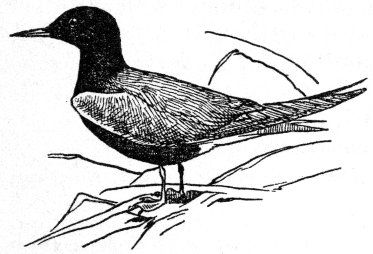
Black Tern, Adult
The adult Black Tern, as it courses about a marsh or pond, is a beautiful, buoyant creature. Its flight is swallow-like. It is probable that this species nests occasionally along the Lake Erie shore, or at some of the larger lakes wherever there are marshy shores.
DOUBLE-CRESTED CORMORANT Phalacrocorax auritus auritus (Lesson)
Other Name.—Shag.
Description.—Four toes all webbed together; bill long and strongly hooked at tip; tail stiff and moderately long; plumage thick and firm. 16 Adults in breeding plumage: Glossy greenish black, save on back which is dark gray, each feather being margined with lighter gray; two filamentous tufts of black feathers on back of head; neck with thin sprinkling of silken white feathers during period of courtship; bill blackish, marked at base with dull yellow; sack under bill yellow; eyes bright green. Immature and adult in winter (the plumage usually seen in Pennsylvania): Without crests, and whole plumage brownish black, somewhat mottled beneath, and with light area on throat; eyes grayish green, not bright green. Length: About 30 inches.
Range in Pennsylvania.—A migrant found principally along the larger water-ways from about March 20 to May 10 and from September 15 to November 15. It is occasionally seen in winter when the water is free of ice.
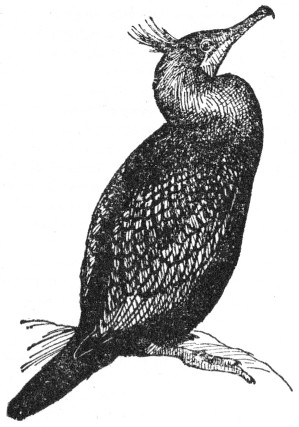
Double-crested Cormorant, Breeding Plumage
Cormorants sit low in the water so that, while swimming, their tails do not show as field-marks, but their long necks, large heads, and the strongly hooked bills distinguish them at a considerable distance. In flight their wings beat regularly.
The bulky, wide-winged White Pelican (Pelecanus erythrorhynchos) is occasionally noted as a straggler in Pennsylvania. It is white, with black wing-tips, and is so noticeably equipped with long bill and throat-pouch that it can hardly be confused with any other species. Its four toes are all webbed together, as in the Double-crested Cormorant. Additional records of this species are desirable.
MERGANSER Mergus merganser americanus Cassin
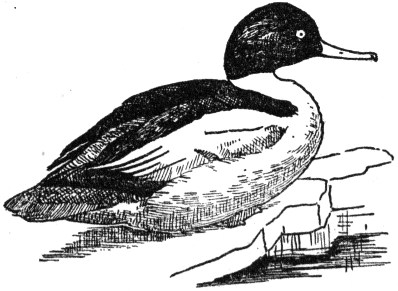
American Merganser, Male
Other Names.—Shelldrake; Goosander; Fish Duck; Sawbill; American Merganser.
Description.—One of the largest of the ducks; bill long and narrow, with teeth on both mandibles. Adult male: Head and upper neck greenish black; lower neck, patches in wings, and underparts white; belly suffused with salmon-pink, noticeable in some individuals; back, shoulders, and wings black; rump and tail gray; bill and feet red; eyes bright red. Adult female: Head, with two large crests, and neck rich brown, marked with white areas in front of eye and on chin and upper throat; upperparts ashy gray; patch in wings, and breast and belly white. Length: 25 inches.
17
Range in Pennsylvania.—A fairly common and regular migrant along the larger waterways and sometimes on the smaller streams from about March 15 to April 20 and from October 1 to December 1. It frequently occurs in winter when the water is free of ice.
The mergansers are all expert fishermen and like to fish in swift water. They dive easily and their serrate bills help them to hold their slippery prey.
The female Merganser is difficult to distinguish from the female Red-breasted Merganser; in the present species, however, the white area on the chin and upper throat is sharply defined, whereas in the Red-breasted species the chin and throat are not white, but of a brownish color, paler than the rest of the head.
RED-BREASTED MERGANSER Mergus serrator Linnæus
Other Names.—Shelldrake; Fish Duck; Sawbill.
Description.—Male, with long, graceful crest of fine feathers; female with double crest, as in the female Merganser. Male: Head and upper neck glossy greenish black; lower neck, patch on upper chest, patches on wing, and underparts white; back black; rump and tail grayish; breast reddish brown, mottled with black, and on sides marked with a striking double row of black and white feathers; sides finely barred with blackish; legs, feet, and eyes red. Female: Head and neck rufous brown, grayish on crown and crest; throat not white, but of paler brown than rest of head; back grayish, washed with brown; underparts white, sides marked with brown; bill and feet brownish; base of lower mandible reddish; eyes, brown. Length: 22 inches.
Range in Pennsylvania.—A fairly common and regular migrant, principally along the larger waterways, appearing somewhat later in spring than the preceding species and disappearing earlier in the fall.
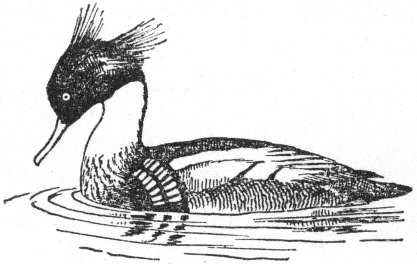
Red-breasted Merganser, Male
It is said that the Red-breasted Merganser is less frequently seen along the smaller streams than is the larger Merganser. Both species eat fish and therefore are not considered as of much value for food.
HOODED MERGANSER Lophodytes cucullatus (Linnæus)
Other Names.—Shelldrake; Fish Duck.
Description.—Bill long and narrow, with teeth on both mandibles. Male: Head, neck, back, and tail black; a high, fan-shaped crest on head strikingly marked with white; speculum white; sides rufous, finely barred 18 with black; breast and belly white; eyes bright yellow. Female: Dull brown, somewhat brighter on the thin crest, and grayer on head and neck; upper throat, belly, and speculum white; eyes brown. Length: 18 inches.
Range in Pennsylvania.—Fairly common and regular as a migrant from March 25 to April 15 and from October 25 to December 10. It has been noted in summer locally, so there is a possibility that it nests, though there are no definite records at present.
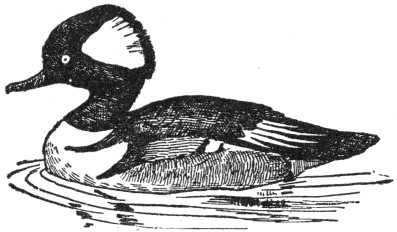
Hooded Merganser, Male
The male Hooded Merganser is one of our most striking birds and cannot easily be confused with any other species. The Hooded Merganser may be found along a quiet stretch of a small stream where the handsome males, at rest, do not display their high crests. In such mood the head has much the appearance of that of the other species of Fish Duck—thin, long, and snake-like. When rising, the birds beat their wings with amazing rapidity, the white speculum in the wings flickering brilliantly. This species is not so often found in swift water as are the Merganser and Red-breasted Merganser.
MALLARD Anas platyrhynchos platyrhynchos Linnæus
Other Names.—Gray Mallard; Wild Duck.
Description.—Male: Head and neck rich glossy green, with violet reflections; neck with striking white collar; back and wings gray; speculum violet, bordered with black and white; rump, and upper and under tail-coverts black; tail feathers whitish; breast rich glossy chestnut; sides gray, finely barred; belly white; bill yellow; feet bright pink. Female: Mottled and streaked all over with grayish brown; speculum as in male; bill dull greenish yellow; feet dull pink. Length: 23 inches.
Range in Pennsylvania.—Common and regular as a migrant from March 1 to May 20 and from October 1 to December 15; nests locally and uncommonly, chiefly in swampy regions or along small upgrown streams.
Nest.—Built in a depression under a bush or in high grass, usually near the water, and lined with down. Eggs: 6 to 15, pale greenish buff. Duck eggs are usually glossy in appearance.
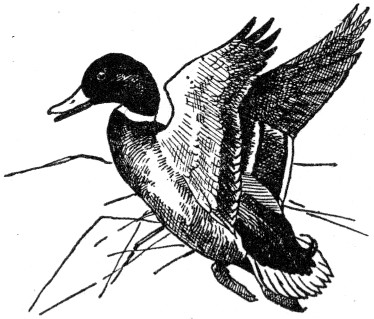
Mallard, Male
The Mallard, best known of our ducks, is the ancestor of several domestic strains of water-fowl. It is usually found in flocks along 19 the shallow margins of streams, where it procures its food by nibbling along the bottom while its tail protrudes from the water.
The white tail and red feet of the male, which contrast with the gray of the back and wings, are good field-marks as the flock hurriedly rises and makes away.
BLACK DUCK Anas rubripes tristis Brewster
Other Names.—Black Mallard; Dusky Mallard.
Description.—Sexes similar; general appearance dark brown, darkest on top of head and on back, all feathers margined with brownish buff; cheeks buffy, streaked with black; speculum rich violet, bordered with black, and, at tips of feathers, with white; under-wing plumage white; bill greenish; feet dusky in Black Duck; bright red in the Red-legged Black Duck. Length: 22 inches.
Range in Pennsylvania.—A fairly common migrant from March 1 to May 10 and from October 1 to December 25; uncommon and local as a summer resident, chiefly near lakes or quiet stretches in streams. Nest and eggs like those of the Mallard.
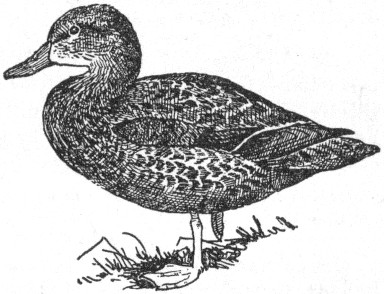
Black Duck, Male
Two forms of the Black Duck occur in Pennsylvania: The smaller, duller Black Duck as a migrant occurs at about the same time as the Mallard and nests locally. The Red-legged Black Duck (Anas rubripes rubripes), a summer bird of Labrador, comes south later in the fall, and has been known even to occur in the northern part of the State in late December, so there is a probability that this form occasionally winters when the water is free of ice.
Both the Mallard and Black Duck quack loudly, like domestic ducks, particularly when they are surprised. Large, dark-colored ducks which show white under the wings as they fly off are likely to be Black Ducks.
GADWALL Chaulelasmus streperus (Linnæus)
Other Name.—Gray Duck.
Description.—Smaller than Mallard. Male: Top of head with low, fluffy crest, mottled with rufous and black; sides of head and neck buffy, streaked and spotted with black; breast and lower neck black, each feather with a central spot and border of white which gives a remarkably beautiful scaled appearance; back gray-brown; rump and upper and under tail-coverts black; breast and belly whitish; sides finely barred with blackish, 20 lesser wing-coverts chestnut; speculum white; feet yellow. Female: Similar but duller, and with chest and sides buffy, thickly spotted with blackish; underparts white, more or less spotted with black, and with little or no chestnut on the lesser wing-coverts. Length: 20 inches.
Range in Pennsylvania.—A rare and irregular migrant from about March 10 to April 30 and from September 25 to October 30. This is one of our rarer ducks.
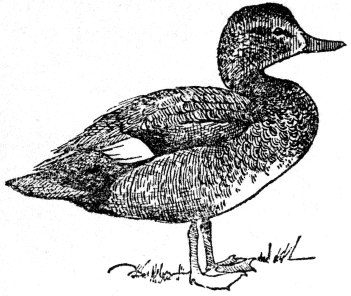
Gadwall, Male
I have found the yellow feet of this species to be a fairly good field-mark, but in the swimming birds the white speculum, though it be nearly covered by the flank-feathers, is a reliable feature. Gadwalls feed in shallow water, as do their close relatives, the Black Duck and Mallard, and they often feed at night. Definite records of this species in Pennsylvania are desirable.
BALDPATE Mareca americana (Gmelin)
Other Names.—Widgeon; American Widgeon.
Description.—Male: Top of head white or buffy; sides of crown back of eye glossy green, spotted with black; rest of head buffy, finely streaked and spotted with black; breast and sides pinkish brown, the sides finely and thickly barred with black; belly white; back gray-brown, finely barred black; bill blue-gray. Female: Head and neck pale buffy, finely streaked with black; breast and sides dull pinkish brown, washed with grayish; belly white; back grayish brown, barred irregularly with buffy; greater wing-coverts brownish gray, their outer webs mostly or entirely white, their tips black, sometimes edged with white; greater under wing-coverts white. Length: 19 inches.
Range in Pennsylvania.—Rather common as a migrant from March 1 to August 15 and from October 1 to November 1, sometimes abundant, particularly along the larger streams.
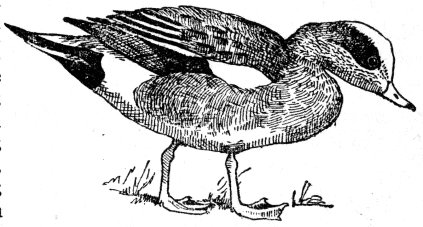
Baldpate, Male
The white crown-patch of the male Baldpate not only has given this bird its name but also furnishes an excellent field-mark. The pinkish brown breast and sides are somewhat diagnostic also, though this color is not usually seen to good advantage in the field. The call-note is said to be “a sort of whew, whew, whew.” Baldpates are, as a rule, shallow-water feeders.
21
The European Widgeon (Mareca penelope) should be looked for in Pennsylvania. The male has a buffy crown. The under wing-coverts of the female are barred, whereas in the female Baldpate the greater under wing-coverts are white.
GREEN-WINGED TEAL Nettion carolinense (Gmelin)
Other Name.—Mud Teal.
Description.—Small for a Duck, being about half as large as a domestic Duck. Male: Head, with flowing crest, chestnut, an area around and back of eye to nape glossy green, bordered below with a thin whitish line; chin black; upperparts gray, finely barred with black; speculum green, bordered with black and buffy; middle under tail-coverts black, lateral ones creamy; breast and sides pinkish brown, finely barred with black, a white bar on side of breast; belly white or buffy, spotted, sometimes irregularly, with blackish. Female: Top of head blackish, feathers edged with rufous; sides of head and neck white, heavily streaked with black; upperparts blackish, all feathers margined with buffy; green speculum on wing, as in male; underparts considerably mottled—not barred as in male. Length: 14½ inches.
Range in Pennsylvania.—A migrant from March 20 to April 20 and from September 25 to November 10, often found along smaller streams. Locally, as at Conneaut Lake and at Erie, it is common during the height of migration.
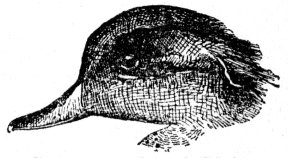
Green-winged Teal, Male
The Teals are our smallest ducks. Their size and remarkably swift flight make them comparatively easy to identify, save in foggy weather when the apparent size of birds in the field is apt to be misleading. The Green-wing feeds like the Mallard and Black Duck, by “tipping” in shallow water and plucking food from the bottom.
BLUE-WINGED TEAL Querquedula discors (Linnæus)
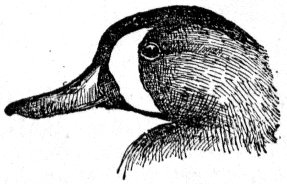
Blue-winged Teal, Male
Description.—Size small, as in Green-wing. Male: Head dark blue-gray with violet reflections; crown dark brown; chin and sides of base of bill blackish; a crescent-shaped patch of white in front of eye; back brown, barred and mottled with black; breast white, buffy, or rusty, heavily spotted with black; lesser and middle wing-coverts gray-blue, forming a conspicuous color-area, particularly in flight; speculum glossy green. Female and immature: Crown dark brown, irregularly streaked with grayish; sides of head and neck grayish, streaked with black; throat whitish; breast and belly usually whitish spotted and margined with blackish; speculum glossy green. Length: 16 inches.
22
Range in Pennsylvania.—A migrant from April 15 to May 15 and from September 1 to October 15, sometimes quite common. It may nest occasionally in marshy situations.
The blue lesser wing-coverts of this species are fairly easy to recognize, even at a considerable distance. It is relatively silent while it is passing through Pennsylvania; the Green-wing is more voluble. At Wildwood Lake, near Harrisburg, Blue-winged Teals occur with some regularity along a marshy neck of land which protrudes into the lake at the mouth of an inflowing stream. Here the birds rest quietly, feeding in early morning and toward evening, and flying about only when they are disturbed. They are usually mated by the time they reach this latitude in the spring.
SHOVELER Spatula clypeata (Linnæus)
Other Name.—Spoonbill Duck.
Description.—Comparatively small, but larger than the Teals. Bill very large and broad, noticeably so even at considerable distance in the field. Male: Head and neck rich black, glossed with green and violet; line down back of neck and back dark brown; belly and sides rich chestnut; lesser wing-coverts gray-blue, as in the Blue-winged Teal, the greater coverts brownish, tipped with white; speculum green; upper and under tail-coverts black; eyes yellow; feet pink. Female: Head and neck streaked with black and buffy bars; throat buffy; underparts buffy, feathers margined and spotted with dark brown and buffy; feet orange-pink, paler than in male; eyes brown; bill greenish yellow, blotched with brownish. Immature birds are intermediate in appearance between the adult male and adult female. The immature female’s speculum is noticeably grayish, with little green. Length: 20 inches.
Range in Pennsylvania.—Rather rare migrant from March 1 to April 15 and from September 15 to November 1. Not usually seen in large flocks.
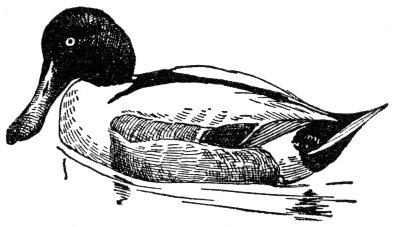
Shoveler, Male
The huge bill of this species will distinguish it in any plumage. Its blue wing-coverts have much the appearance of those of the Blue-winged Teal.
PINTAIL Dafila acuta tzitzihoa (Vieillot)
Other Names.—Sprig; Sprig-tail; Spike-tail.
Description.—Neck long and slender in both sexes. Male in mating plumage, which is characteristic of the winter months: Head warm brown, glossed faintly on cheeks with violet; back of neck blackish, bordered by 23 white stripes which run down sides of neck to breast; back brownish gray; shoulders black, margined with white or buffy; wing brownish gray, the greater coverts tipped with cinnamon; speculum green, bordered narrowly with white; central tail-feathers very long and narrow, black; underparts white; sides heavily marked with fine lines of black. Female: Crown blackish, irregularly marked with rich brown; throat white; sides of head and neck considerably streaked; breast buffy, spotted with blackish; feathers of sides margined and barred with dark brown and white; under wing-coverts dark brown, bordered with whitish. The male in summer breeding dress resembles the female. Length: Male, 28 inches, in full, long-tailed plumage; female, 22 inches.
Range in Pennsylvania.—A fairly common and regular migrant from March 1 to April 15 and from September 20 to December 15. It has even been known to winter in the northern part of the Commonwealth.
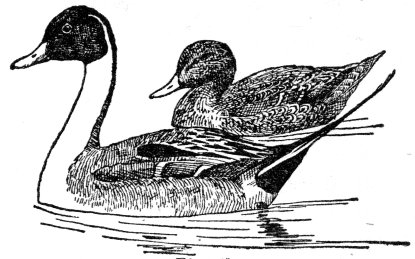
Pintail Male Female
The female, while not strikingly marked, may be recognized by the long neck, the sharply pointed middle tail-feathers, and by the dark under wing-coverts. Pintails are swift fliers, and have the ability of rising straight into the air from a pond or from the ground.
WOOD DUCK Aix sponsa (Linnæus)
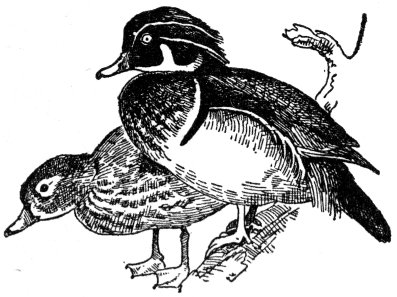
Wood Duck Female Male
Description.—Smaller than Mallard; both sexes with crest, smaller in female than in male. Male: Head and crest rich glossy green, with violet and blue reflections; a line from bill over eye, a line along side of crest, and other lines in flowing feathers of crest, white; throat, a band from it up cheeks, and a wide band at nape, white; breast and an area at either side of base of tail, chestnut, the breast spotted with white; band on breast in front of wing, white; sides buffy, finely barred with black, the long flank-feathers tipped with striking bands of black and white; back greenish brown; scapulars blackish, glossed with steel-blue and greenish; speculum steel-blue tipped with white; primaries tipped with greenish blue; tail blue-black; eyes red; bill dusky, white, and red; feet yellowish. Female: Area below and back of eye, and throat, white; crown brown, glossed with purplish; sides of head ashy brown; breast and sides grayish, streaked and mottled with brownish; belly white; back olive-brown, glossed with greenish; the inner primaries tipped with greenish blue. The immature 24 resembles the adult female. The male in eclipse plumage, which he assumes during late summer, is similar to the female. Length: 18½ inches.
Range in Pennsylvania.—Fairly common as a migrant and summer resident throughout, arriving in early April and remaining until November 1. Commoner than most species of this family along the smaller streams.
Nest.—In a cavity in a tree. Eggs: 7 to 15, buffy white.
The male Wood Duck, thought by many to be the most beautiful American bird, is a gorgeous creature. It is little wonder that an Indian legend tells us that a little gray duck, while on a search for happiness, swam into the end of the rainbow and came forth the brilliant creature we now call the Wood Duck.
Agile almost as a perching bird, these ducks run about on the ground, snapping up insects, or swim buoyantly in quiet pools near the woodland they have selected as their summer home. In a cavity in a tree, sometimes at considerable distance from the water and at quite a height from the ground, the down-lined nest is built.
The young birds, it is said, clamber out of the nest and fall to the ground as best they can, without being helped by either parent. Surely, young birds which survive such an ordeal are prepared for the later battles of life!
Wood Ducks are fond of acorns and of the seeds of many aquatic plants. The young birds, like the adults, are amazingly agile and run about like young chickens, bright-eyed, attractive, and so small as to be fairly ludicrous as they race into the water for a swim!
REDHEAD Nyroca americana (Eyton)
Description.—Head high, rising abruptly from bill; both sexes with tendency toward fluffy, round crest. Male: Entire head bright rufous, glossed with purplish; lower neck, all around, breast, and upper back, blackish; rest of back and scapulars finely barred with wavy black and white lines of equal width; wing-coverts brownish gray; wings gray, without a noticeable speculum; upper and under tail-coverts black; belly white, lower belly more or less barred like back; sides barred as in back; eyes yellow; bill blue-gray. Female: Upperparts dark grayish brown, darker on wings, all feathers more or less margined with buffy or ashy; neck buffy, somewhat mottled; breast and sides gray-brown, washed or margined with buffy; belly and under tail-coverts somewhat suffused with buffy; eyes brown; bill blackish, with blue-gray band at end. Length: 19 inches.
Range in Pennsylvania.—Fairly common as a migrant, noticeably along the larger waterways, from March 1 to April 25 and from October 10 to November 15. Sometimes occurs in great flocks.
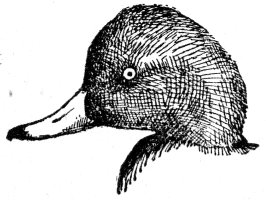
Redhead, Male
The high head and yellow eyes distinguish the male Redhead from the male Canvasback, which is otherwise similar in appearance.
25
CANVASBACK Aristonetta valisineria (Wilson)
Description.—Bill long and gradually sloping up to the head which is long and low, different markedly in this respect from that of the Redhead. Male: Head and neck rufous; chin and crown blackish; lower neck, breast, and upper back, black; back and wing-coverts barred with black and white, the white lines so much wider as to appear, even at some distance, whiter than in the Redhead; belly white, sides finely barred; upper and under tail-coverts and tail, black; eyes reddish brown; bill blackish. Female: Head, neck, breast, and upper back, light rufous; throat pale, the frontparts of head somewhat brighter; back, grayish brown, feathers washed with wavy white lines which the female Redhead does not have; belly white; sides grayish brown, sometimes marked like back. Length: 21 inches. The female is a little smaller than the male.
Range in Pennsylvania.—A fairly common and regular migrant, principally along the larger waterways, usually from March 10 to April 20 and from October 1 to December 15, sometimes abundant; irregular in winter.
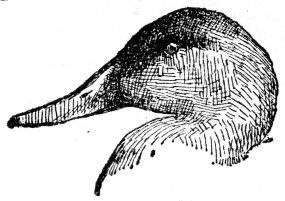
Canvasback, Male
The white back of the male Canvasback is noticeable at a distance. The female, which is rather similar to the female Redhead, may always be recognized by the long, rather thin bill and low head.
SCAUP Fulix marila nearctica (Stejneger)
Other Names.—Blue-bill; Black-head; Raft Duck; Greater Scaup; American Scaup.
Description.—Adult male: Head, neck, breast, and upper back, black, head with greenish reflections; back and scapulars barred with black and white; speculum white; upper and under tail-coverts black; belly white, lower belly and sides finely barred with black; bill blue-gray; eyes yellow. Female: Area about base of bill white; head, neck, upper back, and breast, dark brown, margined with buffy on breast; rest of upperparts somewhat lighter brown; sides brown, marked with wavy white lines; belly and speculum white. Length: 18½ inches.
Range in Pennsylvania.—Fairly common as a migrant from March 10 to April 25 and from October 1 to December 10. The Scaups are among the species of this family most commonly recorded at reservoirs and along large waterways.
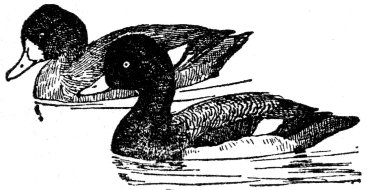
Scaup Female Male
The two Scaups are not easy to distinguish in the field, and certain identification depends upon the males, for the females are very much alike. The male Scaup’s head shows greenish reflections; the Lesser Scaup’s head is glossed with purplish.
26
LESSER SCAUP Fulix affinis (Eyton)
Other Names.—Blue-bill; Black-head; Raft Duck.
Description.—Decidedly similar, in both sexes, to the preceding species, but smaller, and the male’s head with purplish, rather than greenish reflections. The barring of the sides of the Lesser Scaup is stronger than in the Scaup. The females of the two species are practically indistinguishable in the field. Length: 16½ inches.
Range in Pennsylvania.—Commoner throughout than the preceding species, although some of our field records may be open to question in view of the similarity of the two. The white speculum, dark head, and blue-gray bill are good field characters to remember.
RINGED-NECKED DUCK Perissonetta collaris (Donovan)
Other Names.—Blue-bill; Black-head; Raft Duck.
Description.—Both sexes similar to the Scaup and Lesser Scaup in general appearance, differing in the following respects: in the male Ring-neck the chin is white; the head, which has a somewhat higher crest than in either Scaup, is richly glossed with purplish blue; there is a rich brown collar about the neck (not easily noted in the field); the back is blackish, and the speculum is gray, not white; the female Ring-neck may be distinguished from the female Scaups by the gray speculum; the head and neck of the female Ring-neck often has a mottled or spotted appearance. In both sexes the blackish bill, which is crossed near the tip with a whitish band, is an excellent field-mark. If the sun is bright, this band may give the impression that the bird is holding some small shining object in its bill. Length: 16½ inches.
Range in Pennsylvania.—While our records tend to indicate that this species is less common than the Scaup or Lesser Scaup, it is probably fairly regular and common as a migrant, occurring at about the same time as the Lesser Scaup.
GOLDENEYE Glaucionetta clangula americana (Bonaparte)
Other Names.—Cuphead; Whistler.
Description.—Both sexes with short, stubby bills and high heads. Male: Head black, glossed with green; a white spot below and in front of eye; neck, exposed part of wing-coverts, speculum and part of scapulars, and underparts, white; rest of plumage black; eyes yellow. Female: Head brown, neck paler; breast, back, and sides gray; speculum and underparts white; eyes yellow. Length: 20 inches.
Range in Pennsylvania.—A migrant which sometimes occurs in winter when there is open water, but is not often common. It is to be found from March 1 to April 15 and from October 10 to November 30.
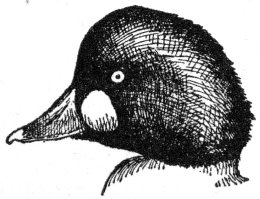
Goldeneye, Male
Goldeneyes will sometimes be seen resting on a floating piece of ice. The musical, whistling sound of their beating wings has been responsible for their common name, “Whistler.”
27
The large head and ludicrously short bill are fairly good field-marks for this species, even at a considerable distance. The strongly contrasting black and white plumage of the male is not easily to be confused with that of any other species.
The Barrow’s Goldeneye (Glaucionetta islandica) is much rarer in Pennsylvania than the Goldeneye. The male has a purplish head and a somewhat crescent-shaped patch in front of and below the eye. His scapulars are marked with white areas along the shafts. Records of this species are very desirable.
BUFFLEHEAD Charitonetta albeola (Linnæus)
Other Names.—Butterball; Dipper Duck.
Description.—About half as large as a Mallard; both sexes with short bills and high, rounded crests, more or less as in the Goldeneye. Male: Head black, glossed handsomely with greenish, purplish, bluish, and fiery orange; a large white band across back of head from eye to eye; lower neck, wing-coverts, speculum, outer scapulars, and underparts, white; back and wings black; lower back and tail grayish; eyes dark brown. Female: Head and upper breast dull brown, patch on either side of head, speculum, and breast and belly, white. Length: 15 inches.
Range in Pennsylvania.—Common, sometimes abundant, as a migrant, from March 15 to April 15 and from October 1 to November 10. It is often seen along the smaller, swifter streams and at small lakes. Mated pairs are usually noted in spring.
The male, like the Wood Duck, is a creature of great beauty. The Bufflehead is a good diver, and can disappear at the wink of an eye with the agility of a grebe. It eats much animal matter, including small fish which it captures while diving. These ducks are often exceedingly fat, and this tendency, as well as the plump roundness of their body, has given them the common name, “Butterball.”
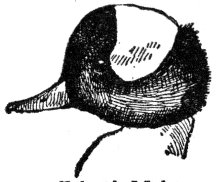
Bufflehead, Male
OLD SQUAW Clangula hiemalis (Linnæus)
Other Names.—Old Wife; Sou’ Southerly; Long-tailed Duck.
Description.—Male with very long, narrow, middle tail-feathers, longer than in the Pintail; female without long tail-feathers. Male in winter: Sides of head washed with grayish brown; sides of back of head and upper neck black, more or less margined with buffy; rest of head, neck, upper back, scapulars, and lower belly, white; back and wings, breast, and upper belly, black; bill black with yellowish orange band across end; eyes pale brown. Female: Upper parts dark brown; scapulars and back more or less margined with grayish; sides of head and neck white or whitish; breast gray; belly white. The male in summer has the sides and front of head white; the rest 28 of the plumage is chiefly black, save the belly, which is white. Length: male, 21 inches; female, 16 inches.
Range in Pennsylvania.—A migrant from February 20 to April 10 and from November 1 to December 20, sometimes occurring in winter, and irregularly very abundant. Tremendous flocks have been noted at Conneaut Lake and at Lake Erie.
The Old Squaw is a handsome and noisy species and demands attention wherever it is found. It usually feeds in deep water, and therefore is found but rarely in smaller ponds or along streams. The under wing-coverts are dark, and there is no speculum in the wing. Its rapid flight carries it along, a few feet above the water, at from 35 to 60 miles an hour, perhaps faster, and it alights with a swish. It is an expert diver.
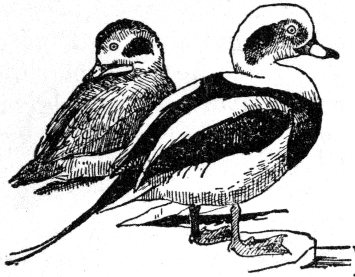
Old Squaw, Winter Plumage
THE SCOTERS
Three species of scoter occur in Pennsylvania. They are diving ducks and are usually to be found only on the larger bodies of water. As a rule, they are not common; they are fond of salt water, and are commonly found in the bays along the Atlantic coast. The adult males all have grotesque and highly colored bills. All scoters are commonly called “Black Ducks” in the interior; along the coast they are called also “Sea Coots.” Scoters will, as a rule, be found in large, raft-like flocks.
AMERICAN SCOTER Oidemia americana Swainson
Description.—Male: Black, with rich purplish reflections; ridges among feathers of neck, bill black, with knob at base of upper mandible peach-yellow; feet brownish red; eyes dark brown. Female and young: Gray-brown in general appearance, with cheek region whitish, sharply defined from crown; underparts whitish, irregularly barred and mottled with dusky. Length: 19 inches.
Range in Pennsylvania.—Rare migrant and winter visitant from November until early April, commonest, perhaps, at Lake Erie and Conneaut Lake.
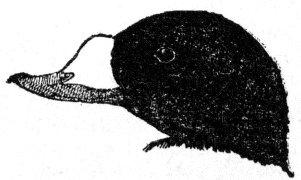
American Scoter, Male
This is probably the rarest of the scoters in Pennsylvania; further data are desirable.
29
WHITE-WINGED SCOTER Oidemia deglandi Bonaparte
Description.—Size large, noticeably larger than a Mallard. Male: Black, with white spot below and at rear of eye, and white speculum; belly and sides rich deep brown; bill orange, with long knob, black at base, feathers reaching forward on it far beyond corners of mouth; feet red; eyes white. Female and immature: Deep brown, lighter below; speculum white; spot at base of bill and ear-coverts whitish, not always clearly defined. Length: 22 inches.
Range in Pennsylvania.—As a rule, rare, save at Lake Erie and Conneaut Lake where it is sometimes fairly common during late fall; it is rarer in spring than in fall.
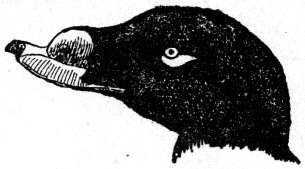
White-winged Scoter, Male
The white speculum of this large, heavy species will serve to identify it at some distance.
SURF SCOTER Melanitta perspicillata (Linnæus)
Description.—Larger than Mallard. Male: Black, with square crown-patch and triangular nape-patch of white; feet red; bill marked with red, white, and yellow, a black spot near base; eyes white. Female and immature: A whitish spot at base of bill and on ear-coverts, much as in the White-winged Scoter; upperparts dark brown; throat, breast, and sides grayer; belly white. Length: 20 inches.
Range in Pennsylvania.—Like the White-winged Scoter, rare, save at Conneaut Lake and Lake Erie where it is a fairly common fall and rare spring migrant, which sometimes occurs during the winter. Scoters are occasionally seen along the Susquehanna and the Delaware rivers, but they are not, as a rule, either common or regular.
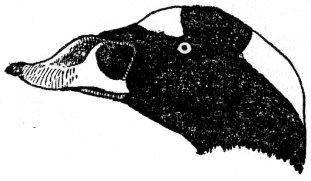
Surf Scoter, Male
The strange shape and color-pattern of the bills of male scoters will distinguish them at once in hand. They are given to flocking and, as they feed, most of the flock may disappear for seconds at a time, to bob up buoyantly as others of the flock slip under.
RUDDY DUCK Erismatura jamaicensis (Gmelin)
Other Names.—Butterball; Bullhead; Bullneck; Dipper Duck.
Description.—Both sexes with thick necks, short upper tail-coverts, and stiff tails; about half as large as a Mallard. Male: Crown black; cheeks and chin white; throat, neck, and back rich rufous; lower back and tail blackish; breast and belly silvery white, somewhat mottled along sides; bill pale gray-blue; eyes black. Female and immature: Upperparts dark grayish brown, feathers marked with narrow, wavy, buffy bars; sides of head 30 and upper throat whitish; lower throat and neck grayish; underparts silvery white. Length: 15 inches.
Range in Pennsylvania.—Fairly common and regular as a migrant, sometimes abundant, from April 1 to May 15 and from October 1 to November 15. It is seen along smaller as well as larger waterways where it may dive readily upon being approached.
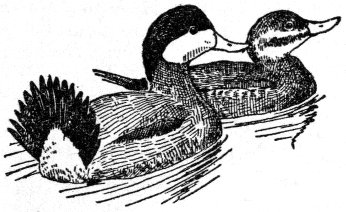
Ruddy Duck Male Female
The Ruddy Duck, with its stiff, upturned tail, is comical in appearance. The male, while in bright breeding plumage, is given to holding himself with a jaunty air. They are expert divers but sometimes have difficulty in rising from the water, for their wings are comparatively small. As they get under way they patter with their great feet while their wings beat the water noisily. The neck of the Ruddy Duck is unusually large for a duck. The head may even be pushed back into the skin of the neck; in most ducks the circumference of the neck is noticeably less than that of the head at its greatest diameter.
CANADA GOOSE Branta canadensis canadensis (Linnæus)
Other Names.—Wild Goose; Honker.
Description.—Size large, about that of a domestic Goose, with about the same proportions; sexes similar. Head and neck black, a broad band under eye, and across throat, white; upperparts brownish gray, the feathers margined with a lighter shade, giving a somewhat scaled appearance; breast and sides gray-brown, more or less as in back; belly white; rump and tail black; upper tail-coverts white. Feet and bill black; eyes dark brown. Length: About 3 feet.
Range in Pennsylvania.—A regular and sometimes common migrant from mid-February to early April and from October 15 to November 30, sometimes occurring in winter, even when ice covers the lakes, at which times the great birds stand about on the frozen surface. As a rule, Canada Geese do not stop long in Pennsylvania; most flocks do not linger here at all, merely passing over.
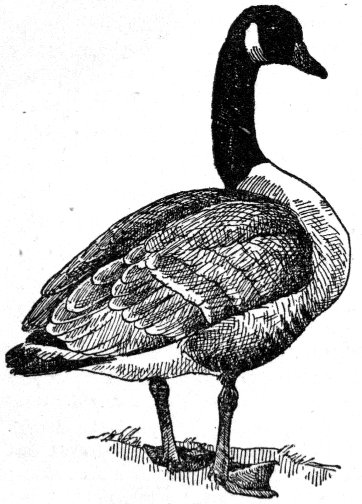
Canada Goose
For us, since the days of our forefathers, and for the Red Man who originally inhabited 31 Penn’s Woods, the V-shaped spring flocks of Canada Geese have heralded the breaking up of the winter, and, in the fall, the coming of the cold season. Canada Geese migrate both by day and night, but they are noticed at night more often than by day because in the comparative stillness of the dark hours their loud, musical bugling drifts down to us as we lie awake, thrilled at the sound. Could we see the great birds, could we know the distant clime toward which they are heading, some of the mystery might be dispelled; but their long journey, their great bodies speeding along at 60 miles an hour or more, and their wide, swishing wings are only suggested by the clamor and challenge that comes to us, holds us spellbound, then gradually dies away as the flock passes on.
Canada Geese are not so aquatic in habit as are ducks. Large flocks often descend to the fields where they feed upon grass or sprouting grain and where they walk about in a dignified fashion.
It is supposed that an old gander always leads the migration flocks. While this may not be the case, it is reasonable to assume that adult birds, with their experience and intelligence, should determine the movements of the flock. Canada Geese sometimes fly in a line, sometimes abreast, but the V-formation is characteristic.
The Greater Snow Goose (Chen hyperboreus nivalis), a white bird with black wing-tips, sometimes flies across Pennsylvania. It has been recorded once or twice in huge flocks. The White-fronted Goose (Aner albifrons gambelli), a gray goose with a white area at the base of the bill, black spots on the belly, and yellow feet, occurs rarely. The Brant (Branta bernicla glaucogastra), smallest of our geese and similar to the Canada Goose but with only a suggestion of a white band on the neck, occurs rarely. It is a maritime species, not often noted inland.
WHISTLING SWAN Cygnus columbianus (Ord)
Description.—Size very large; neck extremely long, and wing-spread sometimes as much as 6 to 7 feet; sexes similar. Adults: Pure white; bill and feet black, a small yellow spot at base of upper mandible just in front of eye; eyes brown. Young birds are pale brownish gray in color, usually darkest on the head and neck. As the immature plumage is replaced by the adult plumage, a vague mottling appears. Length: About 4½ feet.
Range in Pennsylvania.—A fairly regular migrant along the larger waterways; rare and irregular elsewhere; occasional in winter. It is usually seen in early spring from March 20 to April 15 and from October 15 to December 1.
A flock of swans flying in the sunlight is an inspiring spectacle. The birds are so large and their plumage so immaculate that they attract attention everywhere.
32
They sometimes migrate in immense flocks. In storms or on foggy nights they may become bewildered and descend to smaller streams, but, as a rule, they are found only along large open stretches of water.
At Harrisburg, swans sometimes spend the winter along the Susquehanna when the water is open.
The Trumpeter Swan (Olor buccinator), always a very rare bird in the eastern United States, and of late thought to be on the verge of extermination, is even larger than the Whistling Swan. The bill of this species is entirely black, lacking the yellow spot which is characteristic of the adult Whistling Swan and being of a different shape.
AMERICAN BITTERN Botaurus lentiginosus (Montagu)
Other Names.—Thunder-pump; Bum Cluck; Stake-Driver; Plum Pudd’n.
Description.—Sexes similar; larger than Crow. Upperparts brown, considerably mottled, streaked, and barred with black; a glossy black streak from corners of mouth down sides of neck; throat white; neck and breast marked with broad buffy brown streaks, which are mottled with brownish gray, in imitation of dead cat-tail leaves; belly buffy; feet greenish; bill greenish yellow at base, blackish at tip; eyes bright yellow. Length: 28 inches, with neck stretched out.
Range in Pennsylvania.—Fairly common migrant and summer resident, nesting only in marshy situations. It arrives in early April and leaves in late September or early October.
Nest.—A platform of cat-tail leaves and stalks, or other dead vegetation, usually placed in a remote section of some marsh, among rather high weeds. Eggs: 3 to 5, pale buffy brown.
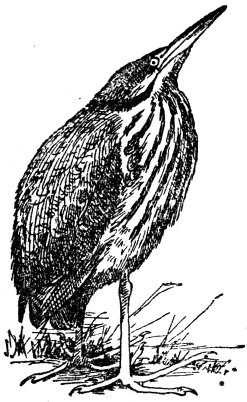
American Bittern
The Bittern is a terrestrial heron and rarely alights in trees. It may be confused with the immature Black-crowned Night Heron, which, unlike the Bittern, often perches on a prominent branch or on a tree top.
To know the Bittern one must penetrate the swamp. From the cat-tails, a great brown bird arises, green feet awkwardly dangling. Rapidly the creature makes away, once it has started; perhaps it utters a startled squawk as it jumps from the grass.
In the spring, male Bitterns have a remarkable courtship ceremony which is accompanied by the queer sounds which have given the bird most of its common names. These names, most of which are very good renditions of the queer sounds the birds give, are: “Bum Cluck” or “Plum Pudd’n.” The familiar nicknames, “Stake-Driver” 33 and “Thunder-Pump” also suggest the sounds. While they give these sounds, the male birds inflate their necks and fluff out their feathers, as they strut and bow, and snap their bills.
The sitting mother bird depends greatly upon her remarkably protective coloration. Taken unawares, the hunting Bittern will stand erect with bill pointing skyward, realizing that its dull colors, its streaked breast, and its sharp bill all resemble cat-tail leaves. The eyes of a Bittern are so arranged that the bird can point its bill straight up yet at the same time look directly at us as we approach. Its golden-yellow eyes have a serpentine appearance.
Young Bitterns, in their ragged natal down, are odd creatures. They clamber about their crude cradle, soon developing remarkable strength in toes and feet.
The Bittern and young Black-crowned Night Heron are our only large, brown herons; the Bittern has yellow eyes; the young Black-crown has dark brown eyes.
LEAST BITTERN Ixobrychus exilis exilis (Gmelin)
Description.—Size very small, body hardly as heavy as that of a Robin; proportions those of a heron, however, with long bill and feet and short tail. Male: Crown, which has a crest, back, and tail, glossy black; back of neck chestnut; lesser wing-coverts buffy; greater wing-coverts and secondaries chestnut, darker than neck; underparts buffy, somewhat streaked on neck with white and fine lines of brownish; a black patch at each side of breast; throat, line along sides of back and of breast, and under tail-coverts, whitish; feet yellowish green; bill yellowish, tipped with dusky; eyes yellow. Female and immature: Similar, but black of crown and back less glossy, coloration throughout less striking. Length: 13 inches.
Range in Pennsylvania.—Rather rare migrant and summer resident, save locally, when it nests in cat-tail swamps and similar situations. Its date of arrival is open to question since the birds are so silent and retiring as to pass for the most part unobserved. They probably come in mid-April and leave in late September.
Nest.—A platform of cat-tail stalks and similar materials built on the ground, or a few inches above the ground, or in weeds above the water, and surrounded by high weeds and grasses. Eggs: 3 to 6, pale blue.
The Least Bittern is one of our quietest, most retiring birds, and is therefore but little known. It may occur regularly in cat-tail swamps where it has never been seen, simply because no one ventures into its damp, shadowy home among the high, green blades.
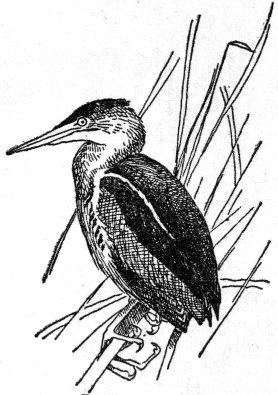
Least Bittern
It moves slowly, as a rule, and with marvelous control. As it 34 has very strong feet, it can climb up the cat-tail leaves where it sometimes perches so as to survey its surroundings the better.
If startled, it flies up rapidly; but, like a Rail, it does not like to fly far because its long, rather awkward wings appear to tire quickly, and it drops back into its retreat, where it is usually difficult to find it again.
The parent bird has the strange habit of destroying, and perhaps eating, her eggs if they are disturbed. We found a nest containing two fresh eggs at Sandy Lake, Mercer County. Upon returning, a few hours later, I found but a few shells in the nest. I feel certain the parent bird, either the male or female, had destroyed the eggs.
GREAT BLUE HERON Ardea herodias herodias Linnæus
Other Names.—Crane; Fish Crane; Sandhill Crane (all erroneous).
Description.—Size very large, the largest of our herons; sexes similar. Adults in breeding plumage: Blue-gray, generally speaking; center of crown and throat white; sides of crown and nape black, where long, black feathers form a considerable crest; neck grayish brown, tinged with pinkish; a narrow black, white, and buffy line down middle of foreneck; feathers of lower neck much lengthened and narrowed, with whitish and blackish streaks; bend of wing chestnut-brown; a ruff of black on shoulders; breast and belly streaked with black and white; feathers on legs reddish brown; legs and feet black; lower mandible yellow; eyes bright yellow. Immature: Similar but entire crown black and plumage considerably marked, margined, and washed with rusty. Adults have plume-like feathers on the lower back which the immature birds lack. Length: About 4 feet.
Range in Pennsylvania.—A common summer resident along all water-ways; irregular and local as a nesting species, however; usually found in colonies. The birds arrive in mid-March and remain until late October. They have been noted irregularly during winter.
Nest.—In Pennsylvania, the Great Blue Heron usually, if not always, nests in trees; in some sections of the United States it nests on the ground. The nest is a huge, sprawling affair, made of long sticks, and placed high in a tree, which, if alive, becomes dead as a result of the droppings from the birds. Eggs: 3 to 6, pale blue.
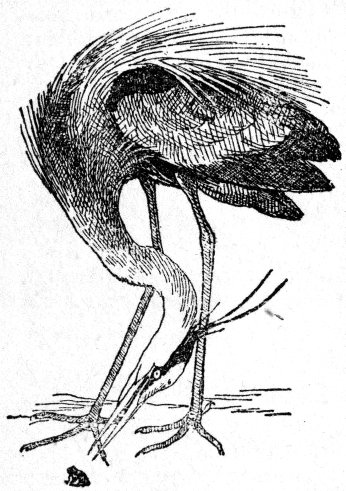
Great Blue Heron
Reports concerning Sandhill Cranes in Pennsylvania usually refer to this species, as cranes do not occur here. Cranes have an elevated, short hind toe; the hind toe of a heron is on the same level 35 as the other toes, and therefore shows in the track. Herons fly with their necks doubled back, except when they are springing into the air or alighting; cranes always hold their necks straight out.
The Great Blue Heron is an expert fisherman. Statuesque, he stands in the water, intently watching for fish, which he captures with his great, powerful bill, and he can swallow a 14-inch fish without great difficulty. He has favorite fishing-points, and here, in the mud along the bank, his great tracks may be seen. If the bird student wishes to see one of these herons he usually has but to wait at such a point for the evening hour of fishing, and the wide-winged bird, with neck drawn back into the body, and feet sticking straight out behind, will fly deliberately down to the angling-grounds, and there promptly devote himself to capturing a meal.
AMERICAN EGRET Casmerodius albus egretta (Gmelin)
Other Names.—Egret; White Crane (erroneous).
Description.—Size large, standing about 3 feet high. Pure white, with black-tipped yellow bill, yellow eyes, and black feet. In its breeding plumage it has exquisite plumes on the back. Birds seen in Pennsylvania usually have no trace of these plumes. Length: About 3 feet, with neck fully stretched.
Range in Pennsylvania.—A midsummer wanderer, found chiefly in the southeastern counties where it may occur in some numbers during July and August.
The Egret, as it stands along a verdant bank, is a creature of great beauty. Its white plumage makes it conspicuous in any setting. It is larger than the Little Blue Heron which, in its white phase of plumage, also occurs in Pennsylvania during midsummer. The delicate nuptial plumes, stripped from the backs of nesting birds, were once very popular as decorations for women’s hats.
LITTLE BLUE HERON Florida cærulea cærulea (Linnæus)
Other Names.—White Heron; White Crane (erroneous).
Description.—Smaller than Egret. White, with dusky wing-tips; bill dark, dull gray-green; feet greenish. In its breeding-range some birds are dark blue, others white. It is supposed that there are two phases of plumage. In Pennsylvania the white phase is customarily seen. Length: 22 inches.
Range in Pennsylvania.—A midsummer wanderer, usually seen in the southeastern counties during July and August.
This bird should not be confused with the Snowy Heron, a southern species which does not wander much during summer, and which never has dusky spots on the wing-tips. The smaller Green Heron has a somewhat bluish back, but must not be confused with this species.
36
GREEN HERON Butorides virescens virescens (Linnæus)
Other Names.—Fly-up-the-Creek; Shite-poke; Green Bittern.
Description.—Size small; sexes similar. Crown, crest, and line below the eye black, glossed with green; throat whitish, extending down neck as a frontal line which widens at breast; neck reddish brown, glossed with purplish; back with plume-like feathers, blue-green, appearing blue in most lights; wing-coverts glossy green, margined with buffy; tail green; belly gray, some feathers edged with buffy; bill yellowish with dusky tip; feet and eyes bright yellow. Immature: Mottled in appearance, considerably streaked with black on neck and underparts; crest small; no plume-like feathers or blue-gray color on the back. Nestlings are covered with long, irregular down. Length: 17 inches.
Range in Pennsylvania.—A common summer resident from April 10 to September 30. It is to be found along all small streams and ponds.
Nest.—Of sticks, placed together as a shallow platform, from 6 to 30 feet from the ground in a bush or tree. Eggs: 3 to 6, pale blue. Green Herons sometimes nest in small colonies, but in Pennsylvania are more frequently found in solitary pairs.
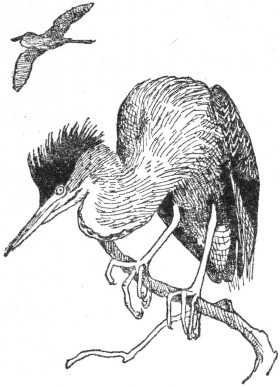
Green Heron
The Green Heron has the interesting habit of twitching its tail nervously when it is excited. These small but adept fishermen are usually frightened from some favorite haunt along a stream. They fly up rapidly, uttering loud, harsh squawks which may be written keeow, or skeeowp. Their yellow feet and blue backs show plainly as the birds fly away. The fact that the Green Heron’s back is so noticeably blue should not lead the bird-student to think he is seeing the Little Blue Heron; a species which is rare in Pennsylvania and which, when it does occur, is usually found in its white plumage.
BLACK-CROWNED NIGHT HERON Nycticorax nycticorax nævius (Boddært)
Other Names.—Quawk; Bull Bittern.
Description.—Larger than Crow; bill heavy and blunt for a heron; neck usually drawn in, though it is of considerable length, as in other members of the family; sexes similar. Adults: Forehead, lores, neck, and underparts white, somewhat grayish on neck; crown, upper back, and scapulars black, glossed with green; two or three long white plumes on back of crest; wings, tail, and lower back clear gray; legs and feet yellow; bill dusky with yellowish green base and bare area in front of eyes; eyes red. Immature: Grayish brown above, the feathers streaked or tipped with buffy or whitish; outer webs of primaries rusty; underparts whitish, streaked with dark gray-brown; feet and legs yellow; bill dusky; eyes dark red-brown or red. Length: 2 feet.
37
Range in Pennsylvania.—A summer resident, locally abundant in eastern and southeastern Pennsylvania, where colonies occur along the Susquehanna and Delaware rivers; in western Pennsylvania the species is rare and irregular; at Erie it has been noted a few times. It arrives at its nesting-grounds in late March or early April and remains until October.
Nest.—A platform of sticks, usually placed high in a tree. Many nests, sometimes hundreds of them, are placed together in a favorite grove which is usually near a lake or on an island in a river. At Harrisburg the Night Herons nest on McCormick’s Island. Eggs: 3 to 6, pale blue.
The loud, barking qua of the Night Heron as it rises from its fishing-ground and flies over after nightfall is a startling sound. The species may be identified easily from this sound alone.
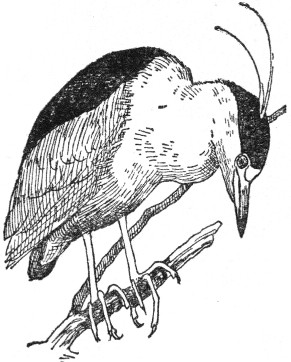
Black-crowned Night Heron
Immature birds look somewhat like a Bittern, but the Bittern is a bird of the ground, rarely alighting in trees, whereas the Night Heron, after being frightened from a retreat along the shore, usually alights on a high branch.
Night Herons sometimes circle over the water, snatching their food from the surface, like gulls. As a rule, such activities are noted only during the nesting season, however, when the young have to be fed. When there are no family duties, they prefer to hunt at night.
The heavy bill and habit of perching with neck drawn in gives the bird a characteristic appearance at a distance.
The nesting colony, while interesting to the bird-student, is offensively filthy and has a disagreeable odor. The young, when newly hatched, give forth a peculiar, chuckling peep which has a somewhat ventriloquistic quality. As they develop they clamber about the branches, using their necks, wings, and bills in crawling from perch to perch.
KING RAIL Rallus elegans elegans Audubon
Description.—The largest of our rails, about the size of a crow, but with slenderer body; sexes similar. Upperparts dark brown, feathers of the back and scapulars widely margined with olive-gray; wings and tail olive-brown; throat and areas in front of and above eye, white; neck and breast rich reddish brown, much like the breast of a robin; sides and flanks dark brown, or blackish, sharply and widely barred with white; bill dull reddish yellow, tipped with black; feet dull reddish; eyes bright red. Immature birds are darker and less handsomely marked. Length: 15 inches.
Range in Pennsylvania.—A rare, local migrant, probably occasional as a summer resident. It nests only in marshy sections. Nesting records are very desirable. It is to be found from April 15 to mid-September.
38
The King Rail, though a rather large bird, is so rare and retiring that it is rarely seen, and Pennsylvania records are few. It has been noted chiefly in the less mountainous counties and is apparently commoner in the fall, when the gunners sometimes take the bird. King Rails are weak fliers; sometimes they drop exhausted in the middle of a city and residents are startled at seeing a queer bird on the streets.
VIRGINIA RAIL Rallus virginianus Linnæus
Description.—Size of robin; sexes similar. Upperparts dark brown or black, the feathers edged with olive-brown or gray; wings and tail dark brown, reddish brown on coverts; forepart of superciliary line and throat, white; cheeks grayish; underparts reddish brown, save on flanks and under tail-coverts which are black or dark gray, sharply barred with white; bill and feet reddish; eyes red. Immature birds are darker throughout and the red-brown of the underparts is replaced by blackish, mixed with white. Length: 9½ inches.
Range in Pennsylvania.—A fairly regular but local summer resident, sometimes common, from April 15 to September 30. It nests only in marshy situations, where it lives among cat-tails or other aquatic vegetation.
Nest.—Of cat-tail leaves or grasses, made in a cup, placed at the base of water-plants on the ground, or a short distance above the water, usually well sheltered from above, sometimes by a canopy of cat-tail leaves which has been arranged by the parents. Eggs: 6 to 11, buffy white, spotted with dark or reddish brown.
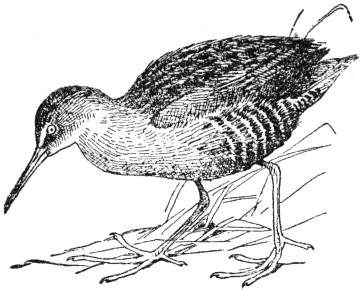
Virginia Rail
The pig-like grunts and squawks of a pair of Virginia Rails may bewilder the casual wayfarer near a cat-tail marsh. Rails are rarely seen but may appear along one of the open waterways if the observer remains motionless and silent.
SORA RAIL Porzana carolina (Linnæus)
Other Names.—Ortolan; Reed Bird; Carolina Rail.
Description.—Smaller than a robin; bill rather short; sexes similar. Adults: Center of crown, region at base of bill back to eye, and broad line down chin and throat, black; front of crown, sides of head, and rest of throat and breast, ashy gray, a tiny white spot back of eye; upper-parts olive-brown, the feathers with blackish centers, those of the back and scapulars narrowly but sharply edged with white; wings dark brown, the coverts somewhat lighter; belly and sides of under tail-coverts white; bill yellow; feet green; eyes brown. Immature birds are similar but lack all black on face and throat; the breast and neck are washed with cinnamon-brown, rather than gray, and the upperparts are darker. Length: 8 inches.
39
Range in Pennsylvania.—Fairly common and regular as a migrant; locally abundant from April 25 to May 15 and from August 25 to October 15; occurs as a summer resident wherever marshes furnish it a nesting-site. It is not common as a breeding species.
Nest.—A crude cup made of dead cat-tail leaves or grass, arched over and well concealed by surrounding marsh vegetation. Eggs: 8 to 16, buffy, spotted with brown.
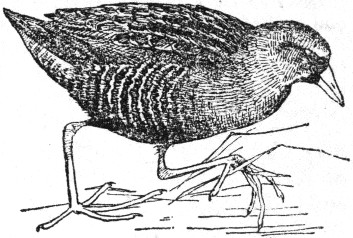
Sora Rail
The Sora is a weak-winged bird and during migration often flies so low that it strikes itself against wires. These injured birds are often the only individuals of this retiring species which are seen by Pennsylvania bird students, unless the cat-tail marshes, where the birds nest, are visited and penetrated.
In the home of the Sora many strange call-notes are to be heard when the birds are curious or disturbed. Some of these notes are sweet and musical; others are strange and hardly bird-like. One call, which is a series of rapidly descending notes, is characteristic.
The Yellow Rail (Coturnicops noveboracensis) is smaller than the Sora and is rich buffy yellow with dark, streaked upperparts. It is exceedingly rare, in fact, virtually unknown, save at Erie and in the marshes about Philadelphia, where it occurs chiefly as a migrant. Additional records are very desirable.
The tiny Black Rail (Creciscus jamaicensis jamaicensis) is about as large as an English Sparrow, and is dark brown, sprinkled with white above, with a red-brown mantle from nape down neck, and dark ashy gray below, with barred flanks and red eyes. The Black Rail has been noted but a few times in Pennsylvania. Additional records are very desirable.
FLORIDA GALLINULE Gallinula chloropus cachinnans Bangs
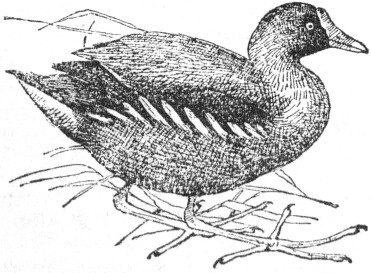
Florida Gallinule
Other Name.—Mud Hen.
Description.—Smaller than crow; bill of medium length; general appearance rail-like; sexes similar. Adults: Head, neck, upper back and underparts slaty gray, darker on crown and face; a row of white streaks along sides and indistinct bars of white on the belly; lower back and wings olive-brown, richest on scapulars and tail; under tail-coverts white laterally, black in middle; bill, with frontal shield, red, and yellow tip; feet greenish 40 yellow, with red area on tibiæ just above heel; eyes red-brown. Immature: Similar but with underparts whitish, no red on legs, and bill brown, with small frontal shield. Length: 13½ inches.
Range in Pennsylvania.—A rather rare migrant during mid-spring and early fall; rare and local as a summer resident.
Nest.—A crude cup of dead cat-tail leaves, placed on the ground or above the water, among water-plants. Eggs: 3 to 10, buffy, finely spotted with brown.
The Florida Gallinule, while not often recorded in Pennsylvania, may be commoner than we suppose. Look for it in cat-tail marshes, along channels or little pools of open water. Its call-notes are rather chicken-like.
COOT Fulica americana Gmelin
Other Name.—Mud Hen.
Description.—Size of a small duck; feet with wide, flat lobes, unique among American birds; sexes similar. Adults: Head and neck black, rest of plumage dark slaty gray, somewhat paler below, and sometimes irregularly barred with whitish on breast and belly; edge of wing, tips of secondaries, and lateral undertail coverts, white; bill whitish, with frontal shield and two small spots near tip mahogany-red; legs and feet greenish, somewhat paler on tibiæ and on lobes on toes. Young: Similar but with a brownish wash on back and lighter below; frontal shield noticeably smaller. Length: 15 inches.
Range in Pennsylvania.—A fairly regular and common migrant, especially on the lakes and larger waterways, from April 15 to May 15 and from September 15 to November 15; often found in company with ducks. Rare as a summer resident. It should be looked for along the shore of Lake Erie in summer.
Nest.—A crude cup made of cat-tail leaves, sometimes placed in a rather open situation, but arched over with grasses. Eggs: 7 to 15, pale buffy white, heavily and evenly sprinkled with small dark brown spots.
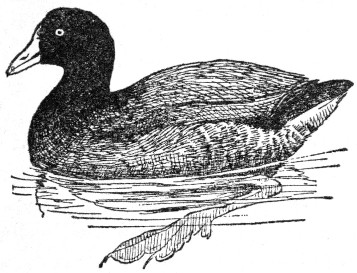
Coot
The Coot’s queer feet are distinctive. As the bird rises from the water, it patters along with these until it has sufficient momentum to rise. Nesting records for the Coot in Pennsylvania are desirable.
WOODCOCK Rubicolor minor (Gmelin)
Other Names.—Wall-eyed Snipe; Bog Snipe.
Description.—Appearance snipe-like, with very long bill and large eyes in back of the head, but feet very short, more as in gallinaceous birds; sexes similar, the female larger; three outer primaries narrow and stiff. Adults: Back of crown black, crossed with buffy bars; upperparts dark brown and 41 black, the feathers barred, margined, and speckled with buffy brown and gray; wing coverts buffy brown, barred with darker brown; underparts buffy, tending toward rufous; tips of tail-feathers gray above, silvery white underneath; eyes dark brown; bill and feet pinkish flesh color. Downy young buffy brown considerably marked with blackish. Length: 11 inches.
Range in Pennsylvania.—A rather uncommon and somewhat irregular migrant and summer resident, coming sometimes as early as the first week of March and remaining until the middle of October. It is sometimes common during migration, particularly in the fall.
Nest.—A mere depression in the leaves, usually in more or less open woodland, sometimes concealed from above by brush or a bush or tree. Eggs: 3 or 4, buffy brown, spotted with darker brown.
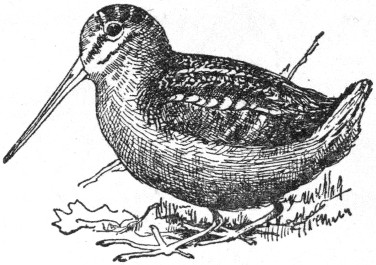
Woodcock
In spring the Woodcock must be sought in some bushy swale, along the borders of a marsh, or near a small stream where the low banks are constantly moist and where brush and old logs give this retiring species a retreat. Here the nocturnal birds bore in the mud with their long bills, searching for food which they may grasp with the mobile tips of their mandibles. When disturbed they fly up rapidly, their wings whistling musically as they make off, somewhat erratically, through the undergrowth.
The spring courtship flight of the Woodcock is remarkable. On warm evenings the males bleat in their favorite haunts, then, as darkness descends, mount on whistling wings higher and higher, until they are far above the earth. They then hurl themselves back and forth as they start pitching toward the earth, the while producing a twittering sound with their throats as they drop at considerable speed, to alight not far from the point at which they started. Courting Woodcocks will sometimes alight within a few feet of a quiet observer.
Because the incubating bird is quiet and her back so perfectly resembles the leaves and twigs near her, she is very difficult to see. She so implicitly believes that she cannot be seen that she is not often flushed from her nest; sometimes she will permit her back to be stroked or her whole body to be lifted from her eggs.
WILSON’S SNIPE Capella gallinago delicata (Ord)
Other Names.—Jack Snipe; English Snipe (erroneous).
Description.—A little heavier than a Robin, but with short tail, very long bill, and moderately long feet; sexes similar. Upperparts black, plumage 42 edged, barred, and variously marked with white, buffy, and grayish; a light line through middle of crown, another over eye; wings dark brown, outer edge of outer primary and tips of greater coverts, white; tail black, tipped with orange-buff and white, the outer feathers white, barred with black; throat and belly white; neck and breast buffy, indistinctly barred with dark brown; sides barred with black; under tail-coverts buffy, barred with black; bill greenish dusky; feet dull green; eyes, which are placed rather far back in the head, dark brown. The female is somewhat browner than the male; immature birds are sometimes quite brownish, especially in the region of the head and neck. Length: 11 inches.
Range in Pennsylvania.—As a migrant, rather regular and common, particularly in suitable marshes or along the margins of streams, from March 15 to May 20 and from September 15 to November 10; as a summer resident, local, known to nest at Pymatuning Swamp, Crawford County, and presumably in other northern counties where there are suitable marshes.
Nest.—A shallow cup made of dead stalks of various plants, placed on a small island or a water-soaked log, or in a low, moist, field, among the grass. Eggs: 4, olive-brown, spotted with rich dark brown, chiefly at the larger end.
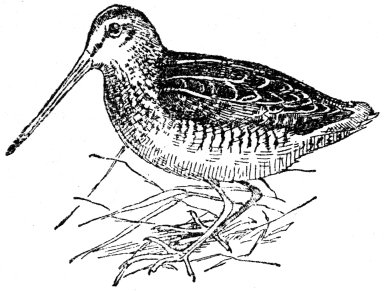
Wilson’s Snipe
The average bird student knows the Snipe as a bird which springs from a marshy spot with startled scaip, scaip as it zigzags its way to a safe retreat, or mounts in the air to circle and return. At such a time the reddish brown band at the tip of the tail and the white belly, which flashes as the bird erratically turns, are good field-marks.
On its nesting-grounds the Snipe is a different creature. High overhead, in wide circles, the birds fly, giving forth strange windy hoots which they are said to produce by spreading widely the outermost feathers of the tail. When the performers come to earth they may perch on a wayside post, on a fence, or on a tree—an unheard-of feat for a Snipe at any other season. The male Snipe, and perhaps the female also, performs many queer antics during the nesting season.
The downy young, which leave their nests shortly after hatching, are beautiful creatures—dark brown and black with cream-colored and buffy spots and flecks which are arranged in a pattern which gives them a protective coloration. They are strong-legged creatures and can run rapidly and swim with ease as soon as they leave the nest.
The Dowitcher (Limnodromus griseus griseus), a shore-bird which resembles the Wilson’s Snipe, is a rare migrant. It is pale rufous, 43 speckled with black below, and variously mottled above in summer; in winter it is brownish gray above, white below, with a few dark barrings; in all plumages the rump and upper tail-coverts and tail are noticeably barred with black and white. Length: 10½ inches.
The rare Stilt Sandpiper (Micropalama himantopus) has long green legs, but otherwise looks rather like a Yellow-legs. In spring it has a red-brown patch on the face and heavily barred underparts; in the fall it is gray above, white below, with a few dusky spots on the breast. The upper tail-coverts in any plumage are white.
The Knot or Robin Snipe (Calidris canutus rufus), is a rare migrant also. It is dull rufous below in spring, and the upperparts are streaked and barred with black, white, and rufous. In winter it is gray above, with black and white barring on the upper tail-coverts; below it is white, with faint dark barring. The upperparts in winter have a scaly appearance as the result of light margins of the feathers. Length: 10½ inches.
PECTORAL SANDPIPER Pisobia maculata (Vieillot)
Other Name.—Oxeye.
Description.—Smaller than Robin. Adults in summer: Upperparts black, the feathers margined with creamy buff, a distinct superciliary line of buffy white; rump and upper tail-coverts black, narrowly tipped with buffy; middle tail-feathers brownish gray, narrowly margined with white; underparts white, the neck and breast rather heavily but finely streaked with blackish and buffy brown. Adults in winter and immature: Similar, but the general appearance much more reddish brown. Length: 9 inches.
Range in Pennsylvania.—Recorded chiefly at Erie; a rather rare and irregular migrant in spring from March 20 to May 15; somewhat more common and regular in midsummer and fall, occurring from late July to late October, though it is highly probable that individuals do not remain in one place during this period. As nesting duties in the north are completed, the immature birds and adults in fresh plumage come south in flocks.