A WORD TO THE BEGINNER (continued 2)
Reading edition
The shore-birds are not, as a rule, common in Pennsylvania. There are not many extensive mud-flats where they may feed, and many of the streams have been polluted, destroying the animal food. Erie is such an admirable resting and feeding-ground for such birds that many of them stop there after their flight across Lake Erie, then strike out to the southward, flying over most of Pennsylvania.
The White-rumped Sandpiper (Pisobia fuscicollis), which resembles the Pectoral Sandpiper but has a distinctly white rump, is a rare migrant, noted chiefly at Erie and in the Pymatuning Swamp region. The Baird’s Sandpiper (Pisobia bairdi) is rare, save at Erie, where it is a fairly regular and common fall migrant from late August to the end of September.
44
LEAST SANDPIPER Pisobia minutilla (Vieillot)
Other Names.—Meadow Peep; Oxeye.
Description.—About as large as an English Sparrow. Adults in spring: Upperparts black, margined and tipped with buffy and reddish brown; rump and upper tail-coverts black; middle tail-feathers black, outer ones ashy gray; throat, superciliary, and narrow ring about eye, white; neck and breast buffy, streaked with dark brown; rest of underparts white, the sides with narrow streaks of dusky; bill blackish; feet dull green. Adults and young in winter: Upperparts brownish gray; breast pale brownish gray or grayish, indistinctly streaked. Length: 6 inches.
Range in Pennsylvania.—The Least Sandpiper occurs with some regularity both in spring and fall throughout the Commonwealth. It may be found at almost any wayside puddle or along the margins of streams from early May until about the end of the month and from mid-August to early October, and is particularly common at Erie.
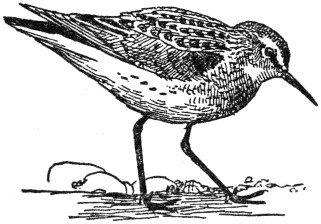
Least Sandpiper
The Least Sandpiper is noticeably smaller than the common Spotted Sandpiper and does not have that species’ habit of “tipping up” its tail. It is, however, very similar in general appearance to the Semipalmated Sandpiper, which may occur at the same time, but differs in having green feet, and (if the bird be in the hand) in having no partial webs between the toes.
RED-BACKED SANDPIPER Pelidna alpina pacifica Coues
Description.—About the size of a Spotted Sandpiper; bill slightly curved at tip. Adults in spring: Back and scapulars bright reddish brown, the feathers with dark centers; breast white, finely streaked with dark brown; large black patch on middle of belly; lower belly white. Adults and young in winter: Upperparts gray, wing-coverts gray, edged with buffy; underparts white, the breast grayish, the sides sometimes somewhat streaked. Length: 8 inches.
Range in Pennsylvania.—A migrant, rare in spring, fairly common in fall, especially at Erie, where it has been noted from mid-August to late October.
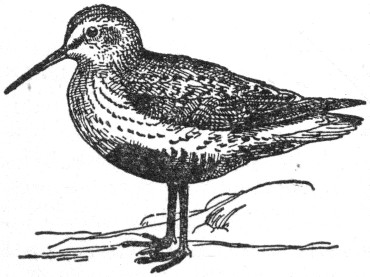
Red-backed Sandpiper
The gay spring plumage of this species is easily remembered. In the gray winter plumage it is not so easy to recognize, but its somewhat curved bill is diagnostic.
45
SEMIPALMATED SANDPIPER Ereunetes pusillus (Linnæus)
Description.—About as large as an English Sparrow; half-webs between the front toes, which are responsible for the bird’s name. Adults in spring: Upperparts dark brown, plumage margined with brownish gray and traces of reddish brown; rump grayish brown; upper tail-coverts blackish; tail gray, central feathers darkest; underparts white, with faint streaking on breast. Young birds in their first fall plumage have a somewhat scaly appearance above as a result of the buffy tips and borders of the feathers; their breasts are buffy, unstreaked; bill black; feet blackish. Length: A little over 6 inches.
Range in Pennsylvania.—A migrant, commoner in the fall than in the spring, and noted chiefly at Erie. It occurs during May and from late July or early August to late September.
The legs and feet of this species are black; in the Least Sandpiper they are greenish. The bill of this species is about straight; that of the Least Sandpiper is slightly decurved at the tip; in any age or plumage the Semipalmated Sandpiper may be recognized when in the hand by its partially webbed front toes.
SANDERLING Crocethia alba (Pallas)
Description.—Three toes; a little smaller than Robin. Adults in summer: Head, back, lower throat, and sides of breast, rusty brown, the feathers edged with whitish and centered with black; wings with white area on basal half of inner flight-feathers; belly and narrow margins of tail-feathers white. Adults in winter: Gray above, white below, with white face and eye-ring. Young in first winter plumage: Whitish, streaked with black above; breast buffy; rest of underparts white. Length: 8 inches.
Range in Pennsylvania.—An abundant fall migrant at Erie from late July on; rare elsewhere.
GREATER YELLOW-LEGS Totanus melanoleucus (Gmelin)
Other Name.—Yellow-legs Snipe.
Description.—Larger than Robin; legs very long and yellow; bill long, slender, and straight. Adults: Upperparts black; head and neck streaked with white; feathers of back spotted and barred with whitish; upper tail-coverts and tail white, barred with black; underparts white, breast spotted and sides barred with black. Adults and young in winter: Similar but with less striking markings both above and below; sides only slightly barred; bill and eyes black. Length: 14 inches.
Range in Pennsylvania.—A fairly common migrant throughout, to be observed at small pools and larger bodies of water from mid-April until May and from early August to latter October; not often seen in flocks.
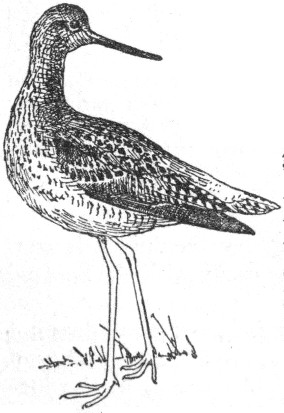
Greater Yellow-legs
46
The Greater and Lesser Yellow-legs are much alike in appearance, this species being much the larger. Their loud, clear whistles and their habit of lifting their wings high above their backs as they alight are characteristic.
LESSER YELLOW-LEGS Totanus flavipes (Gmelin)
Other Names.—Summer Yellow-legs; Yellow-legs.
Description.—Remarkably similar to the Greater Yellow-legs in all respects, even in habits, but noticeably smaller, even in the field. Length: Almost 11 inches.
Range in Pennsylvania.—A fairly common and regular migrant, often commoner than the Greater Yellow-legs and more apt to be noted in small flocks. It is to be found from late April to mid-May and from early August to mid-October.
Look for the Yellow-legs along some mud-flat, preferably on an inland pool. The clear whistle may be imitated easily, and will sometimes lure the birds back after they have taken flight. Both the Greater and Lesser Yellow-legs jerk their bodies stiffly as they become uneasy.
SOLITARY SANDPIPER Tringa solitaria solitaria Wilson
Description.—Smaller than Robin; flight swift and graceful; wings in flight look black. Adults: Upperparts dark olive-brown; head and neck streaked, and back finely spotted with white; middle tail-feathers dark, the others white, barred with black; underparts white, the breast streaked, the sides sometimes barred with black. In winter the birds are similar but are less streaked and spotted. Length: 8½ inches.
Range in Pennsylvania.—Common and regular migrant from early May until about the first of June and from mid-July to early October. It sometimes occurs in midsummer and may nest, though we have no actual records at present.
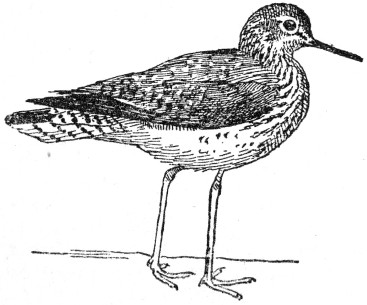
Solitary Sandpiper
The Solitary Sandpiper is confused more easily with the Spotted Sandpiper than with any other species. It jerks stiffly and does not bob constantly as does the Spotted when approached; the wings of the Solitary are dark, unmarked, while the Spotted Sandpiper’s wings have a band of white which shows plainly in flight; and the Solitary’s 47 tail appears white in flight, while that of the Spotted is dark. Look for the Solitary Sandpiper at small pools in woodlands, or along the grassy margins of slow-moving streams or of ponds.
The Willet and Western Willet (Catoptrophorus semipalmatus semipalmatus and s. inornatus) rarely occur. They are large gray shore-birds, much barred with blackish above and below in spring, plain gray above in winter, the wings always with large, noticeable white patches which show plainly in flight. Length: 15 inches.
BARTRAMIAN SANDPIPER; UPLAND PLOVER Bartramia longicauda (Bechstein)
Other Names.—Field Plover; Prairie Whistler.
Description.—Larger than Robin; tail rather long and much pointed; upperparts rich buffy; the head and neck streaked and the back barred with black; primaries dark brown, the outermost barred with white; inner tail-feathers dark brown, the outer ones buffy, all tipped and edged with white, showing plainly in the field, and all more or less barred with black and marked with noticeable subterminal band of black; underparts whitish, the breast and sides washed with buffy and marked with black in the form of delicate bars, arrow-heads, and spots; legs and feet brownish yellow. Young birds are similar but the buffy coloration is richer. Length: 11½ inches.
Range in Pennsylvania.—A rather local summer resident, found only in wide, open fields, apparently rare in western Pennsylvania, save in Mercer and Crawford counties where it nests irregularly, but fairly common in southeastern Pennsylvania, where it inhabits the wide fields in the less mountainous districts from early April to mid-September.
Nest.—A depression in the ground, usually in the middle of a large, flat, upland field, not near water. Eggs: 4, buffy brown, spotted with dark or reddish brown. The eggs are surprisingly large for so small a bird, as is the case in all shore-birds.
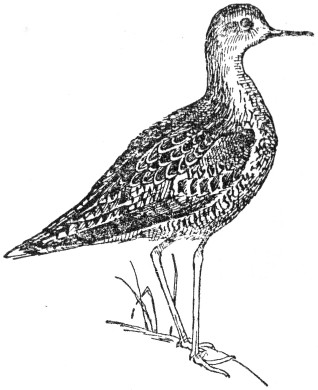
Bartramian Sandpiper
The Upland Plover is a bird of wide pastures and grassy fields. It is difficult to approach, save at the nesting season, when it may come near so as to lead us away from its young; but its presence is announced by the high and musical whistle which has given the bird one of its popular names, “Prairie Whistler,” and which it utters from the ground, while in flight, or while perched on a fencepost, telegraph-pole, or tree.
The flight of this bird is singularly beautiful as, with wide wings beating through a comparatively short arc, it fairly quivers through 48 the air. All its movements seem tremulous and graceful, and as it alights it lifts its wings gracefully, high above its back, and folds them carefully.
Its call-note, which is heard as the bird is disturbed, is a mellow, bubbling whistle, very musical, and with a quality of liquidity which few bird-notes possess.
The young birds run about shortly after hatching and are difficult to find. They never go to the margins of streams to hunt their food, as do other members of the family, and when autumn comes they mount to the sky and make their way to the prairies of Texas where they stop for a time while en route to their winter home in Argentina.
If this magnificent bird is given careful protection, it may survive; but unless it is guarded in South America, as well as in its nesting-grounds, there is little hope for it.
SPOTTED SANDPIPER Actitis macularia (Linnæus)
Other Names.—Tilt-up; Tip-up; Peep.
Description.—Larger than an English Sparrow, with long, narrow, pointed wings; upperparts brownish gray, with a faint greenish gloss, more or less barred with black; an indistinct superciliary line of white; face and underparts white, spotted throughout with black, the largest spots on the sides and flanks; wings like back, the bases of the primaries and secondaries whitish, showing in flight; inner tail-feathers dark like back, outer ones lighter, about white, but never appearing, even in flight, as white as in the Solitary Sandpiper. Immature birds are not spotted below, and the barring of the upperparts is restricted to the scapulars and wing-coverts; there is a slight buffy gray wash on the breast. Length: 7½ inches.
Range in Pennsylvania.—Common summer resident throughout from mid-April to late September. It is found along all small streams, sometimes even in the mountains and heavily wooded districts.
Nest.—On the ground, often near a stream, sometimes in a field, and made of dead weed-stalks, lined with finer materials. Eggs: 4, whitish to brownish buffy, irregularly and sometimes heavily spotted and blotched with reddish brown, usually about the larger end.
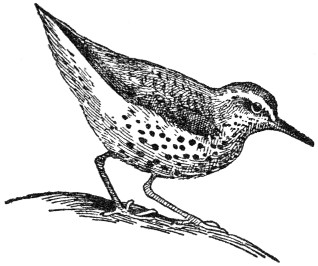
Spotted Sandpiper
The Spotted Sandpiper is our best-known shore-bird. It is not particularly wary, and frequents all the small streams which have not been polluted. As it runs along the muddy margin, it bobs and teeters constantly, perhaps calling softly. Fluttering out over the water, its wing-tips almost touching the surface, it whistles tweet, 49 tweet, tweet, tweet, clearly, and circles back to the shore or alights on a stone or fallen tree. The white areas in the wings show rather plainly in flight.
The young are so small and flimsy that they are comical, with their wisps of tails and long, slender feet. They can swim readily, however, and run with amazing rapidity. Even the adult can swim and dive if necessary.
The Spotted Sandpiper is a much more energetic, nervous bird than its relative, the Solitary Sandpiper, and it is not so often found wading about in deep water as is that somewhat larger, darker bird. When the two species fly up, the Solitary usually utters two or three loud, sharp whistles as it flies directly away, or up into the air. The Spotted, on the other hand, usually flutters away, just a little above the water, and customarily circles back to the shore not far away.
KILLDEER Oxyechus vociferus vociferus (Linnæus)
Other Names.—Killdee; Killdeer Plover.
Description.—Three toes; size of Robin; forehead, patch over eye, throat, ring around neck, and underparts white, the breast crossed by two prominent black bands; forepart of crown and line from bill under eye, blackish; rest of head and upperparts gray-brown, with greenish reflections; wings with bases of flight-feathers white, showing plainly in flight; rump and upper tail-coverts bright orange-brown; middle tail-feathers dark brown, outer feathers white, all with white tip and irregular subterminal bar of black; bill black; feet pale flesh-color; eyelids red. Length: 10½ inches.
Range in Pennsylvania.—A widely distributed migrant and summer resident from mid-March to mid-November; occasional in winter.
Nest.—A depression in the sod or among gravel, sometimes rather carefully lined with pebbles or bits of debris. Eggs: 4, whitish to buffy brown, heavily spotted with dark or reddish brown.
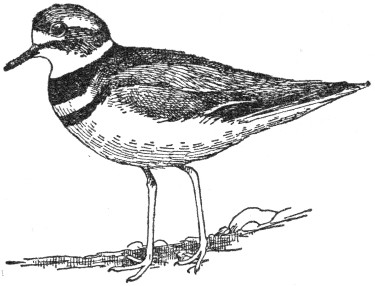
Killdeer
Our Killdeer is a bird of the open pastures. Although it searches for food along the water’s edge, it often builds its nest some distance away. The striking coloration and clear whistled cry kill-deer, kill-deer make this one of our most easily identified birds, even at a considerable distance.
The large Black-bellied Plover (Squatarola squatarola cynosuræ) is common during the fall migration at Erie from mid-August to mid-September and later, but is rare elsewhere in Pennsylvania. 50 The black underparts of the adult in spring and the black underwing feathers of the young and adult in winter are diagnostic marks. The call-note may be written too-ree.
Somewhat smaller is the Golden Plover (Pluvialis dominica dominica), whose black underparts and golden flecked upperparts make the spring plumage easily recognizable; it is dull brownish in fall, with golden flecks on the crown and back. At Erie it is common in fall from early September throughout the month; elsewhere in Pennsylvania it is rare, and it is not noted during the spring, for its northward migration route passes along the Mississippi Valley.
SEMIPALMATED PLOVER Charadrius semipalmatus Bonaparte
Other Name.—Ring Plover.
Description.—Like the Killdeer in general appearance, but much smaller, and with only one black band around the neck; rump and upper tail-coverts the same gray-brown as the back; eyelids yellow; bill short, orange, tipped with black. Length: A little under 7 inches.
Range in Pennsylvania.—A rather rare migrant during May and from August 10 to October 1, save at Erie, where it is regular and common.
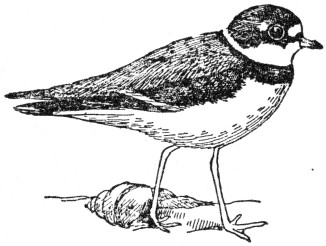
Semipalmated Plover
The clear call-note of this species, ker-ee, ker-ee, suggests that of the Killdeer. Young Semipalmated Plovers coming south for the first time are often very easy to approach.
The Piping Plover (Charadrius melodus), which is about the size of the Semipalmated Plover and like it in pattern, is pale sandy above, with a blackish ring about neck, black primaries and central tail-feathers, and bright yellow eyelids and feet. This species nests at Erie, arriving in mid-April and remaining until early September; elsewhere in Pennsylvania it is very rare.
RUDDY TURNSTONE Arenaria interpres morinella (Linnæus)
Description.—Size of Robin; bill sharply pointed. Adults in spring: Upperparts strikingly marked with black, white, and rusty red; tail white, with black band near tip; underparts white, marked with black on throat and breast. In winter: Upperparts blackish, the feathers margined with grayish; lower back white; tail as in summer; legs orange-red. Length: 9½ inches.
Range in Pennsylvania.—A rare but rather regular migrant in May and September, noted chiefly at Erie.
51
RING-NECKED PHEASANT Phasianus colchichus torquatus Gmelin
Other Names.—Ring-neck; Pheasant; English Pheasant.
Description.—Size of a chicken; male with a long, pointed tail; female with shorter, more rounded tail. Adult male: Head and neck, with tufts on sides of head, glossy green; collar about neck white; back and scapulars golden yellow, the centers of the feathers glossy green; rump grayish, glossed with green, and marked with black spots; wings light gray, the primaries barred with black; tail brown, barred with black and glossed with pinkish; breast rich copper-red, glossed with violet, the feathers tipped with black; sides golden yellow, spotted with glossy purple; belly black; face bare, the skin deep red; bill and feet light gray; eyes bright yellow. Female and immature male: Pale sandy brown, the head and neck with a pinkish cast, and entire upperparts streaked and barred with dark brown and black, giving the bird an entirely different appearance and color pattern from that of the adult male; eyes dark brown. Length: Male, about 30 inches; female, about 24 inches.
Range in Pennsylvania.—A permanent resident, very common in some districts, notably in the less mountainous counties. It is becoming common throughout much of the Commonwealth through the restocking efforts of the Game Commission.
Nest.—A depression in the ground, lined with grasses or other vegetation, usually placed in a field not far from a brush-lined stream, or under a fallen bough at the edge of a woodland. Eggs: 8 to 20, olive-brown in color, glossy in appearance.
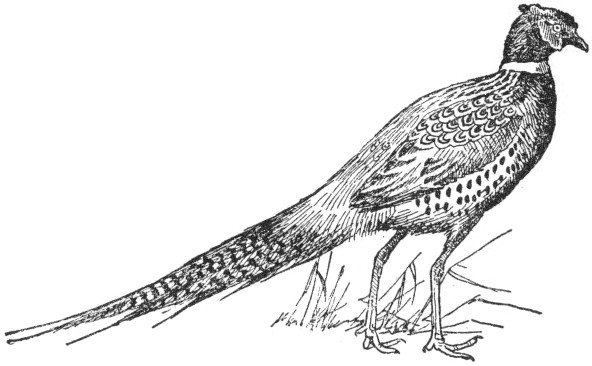
Ring-necked Pheasant, Male
The Ring-neck is a native of Asia. It was brought to Great Britain at the time of the Roman invasion and has become thoroughly acclimated there. In many parts of the New World, Ring-necks have been introduced and they seem to make their way very well. They have been present in Pennsylvania for only a few years, yet during the 1927 hunting season 177,500 of the birds were taken as legal game.
In spite of its magnificent coloration, the Ring-neck is protectively colored, though birds which wander about through the open field, where they search for food, can be seen easily. As they fly up, it sometimes takes a second or two for them to get well under way, but they fly strongly and make a difficult mark for the sportsman once they learn the meaning of a gun.
52
BOB-WHITE Colinus virginianus virginianus (Linnæus)
Other Names.—Quail; Partridge; Virginia Partridge.
Description.—Size of small bantam chicken. Male: Head blackish, mottled with gray and red-brown; throat, spots on neck, and a prominent line above eye, white; back and breast mottled with gray, pinkish brown, buffy, black, and white; scapulars bordered with buffy; rump and tail gray; belly whitish, barred with black; flanks rusty red, feathers margined with white. Female: Similar, but with buffy yellow superciliary and throat. Length: 10 inches.
Range in Pennsylvania.—Common permanent resident, chiefly in the less mountainous counties, and usually to be found in cultivated districts.
Nest.—On the ground, in high grass or among brush, made of dry grasses, arched over with grasses or other vegetation; usually placed along a road, or at the edge of a field. Eggs: 12 to 24, pure white.
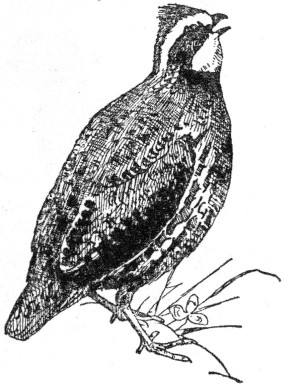
Bob-White, Male
In winter Bob-Whites frequent old weed-patches, briar-thickets, or cornfields where the stalks have been left standing. They are very sociable, and wander about in flocks, searching for food, roosting together on the ground in a compact ring, their heads out and tails together. Being protectively colored, they usually do not fly until they are virtually tramped upon. When a flock is disturbed, they rush into the air on noisy wings and scatter in all directions. After a short time the birds begin to call to each other, pur-lee, pur-lee, and the flock reassembles.
With the coming of spring the flocks break up. Male birds mount favorite fence-posts, stones, or low boughs and give the clear whistle which every farmer boy can imitate. This whistle is one of the clearest and most powerful of bird-notes.
Male and female birds share the duties of incubating the eggs, which are turned over carefully so that they get the proper amount of heat. Sometimes the eggs are so numerous that they are piled upon each other in the nest, and at such times the lower layer of eggs must receive special attention. As a rule, all the eggs hatch.
Among the enemies of Bob-Whites are the blacksnake, which eats the eggs and young; the Cooper’s Hawk and the Goshawk, which capture the adults; and the skunk and other ground-prowlers which eat the eggs and sometimes the adults. Half-starved house cats are frequently serious enemies of this popular game-bird.
The Hungarian or European Gray Partridge (Perdix perdix 53 perdix), a bird a little larger than the Bob-White, gray in color with a dark brown horse-shoe shaped mark on the breast, a red-brown tail, and reddish eyelids, has been released in several parts of Pennsylvania as a game-bird, and it is now on the increase. The bright red-brown tail of this species is very noticeable in flight.
RUFFED GROUSE Bonasa umbellus umbellus (Linnæus)
Other Names.—Partridge; Gray Partridge; Birch Partridge; Silver-tail (gray phase); Pheasant (erroneous).
Description.—Size of chicken, with broad, fan-shaped tail; sexes similar. Upperparts principally reddish brown, irregularly marked with black, buffy, gray, and whitish; sides of neck with ruffs of broad, black feathers glossed with greenish; tail reddish brown or gray, or of intermediate shade, irregularly barred and mottled with black, with a broad blackish band near end, and a gray tip; throat and breast buffy; rest of underparts white, tinged with buffy and barred with black or dark brown, the bars indistinct on the breast and belly, stronger on the sides. The female, which is a little smaller, has smaller ruffs on the neck, and, as a rule, a shorter tall. Length: 17 inches.
Range in Pennsylvania.—A permanent resident throughout in the wilder, wooded sections; variable in abundance as a result of unfavorable nesting seasons, change of forest conditions, destruction by natural enemies, disease, and heavy hunting.
Nest.—A hollow lined with leaves at the base of a stump, under a low hemlock, or under the fallen branch of a tree. Eggs: 7 to 14, pale buffy.
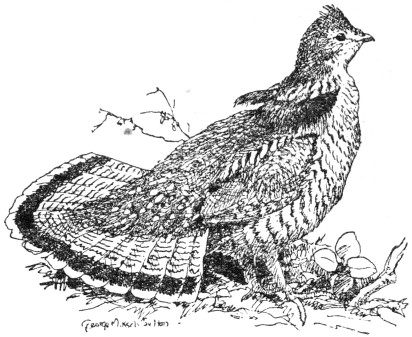
Ruffed Grouse
The Ruffed Grouse, our best-known game-bird, is a creature of personality. Protectively colored, he waits until he is almost trodden upon, then rises with a startling whir of wings, leaving the wayfarer thunderstruck. The female, as she incubates, is rarely seen, for she does not stir, and her back perfectly imitates her surroundings.
In the spring, the male Grouse struts and drums at chosen spots in the woodland. On a log he paces up and down, ruffs lifted, wide tail fully spread and elevated; or he stands erect, and, beating his chest rapidly with his wings, produces the drumming sound for which he is so famous. Grouse may drum at any time of the year, and sometimes at night, but they do so chiefly during the morning on spring days.
The young run nimbly soon after hatching and leave their nest 54 at once. They develop rapidly. After a week they can fly readily though they are very small. The mother Grouse, in luring an enemy from her young, employs broken-wing tactics, dragging herself over the ground as though she were badly wounded.
In the winter, Grouse develop long lateral scales on their toes which function as snow-shoes. Their neat tracks in the snow lead from a roost under a branch to which dead leaves cling, and wander about the bushes and trees where the birds have been feeding on buds, twigs, and dried berries. Grouse are especially fond of aspen, birch, beech, and maple buds. They like wild-grape vines both for the food and the shelter which they afford. During summer, Grouse eat much insect food, as well as berries and leaves. They sometimes eat hemlock needles and leaves of mountain laurel.
WILD TURKEY Meleagris gallopavo silvestris Vieillot
Description.—Size and appearance very similar to that of the domestic bird, but tips of tail-feathers and upper tail-coverts rich deep chestnut; primaries barred with black and white; feet mahogany-red. A large Wild Turkey gobbler in spring is a magnificent creature with its rich, iridescent plumage, highly colored and wattled head, and proud carriage. Length: About 4 feet.
Range in Pennsylvania.—Once fairly common throughout the State, especially in the southern mountainous counties, but brought to the verge of extermination through forest fires, excessive hunting, and encroaches of civilization. The Game Commission has brought in some birds from other States to replenish our stock; some mingling has occurred between wild birds and domestic individuals which have wandered from the farms. Wild Turkeys are now to be found chiefly along the ridges of the South Mountain District, and seem to be holding their own fairly well. While these are not strictly the original strain, they are nevertheless wild, and are therefore fairly representative of the race which once occurred. The Wild Turkey is a permanent resident.
Nest.—A depression in the leaves, under brush, or in a thicket, usually well concealed from above. Eggs: 6 to 15, cream-buff, thickly but finely spotted with reddish brown.
The sight of a flock of Wild Turkeys coasting on their strong wings from the crest of a ridge to the lower levels is one long to be remembered. The spectacle before us, of weighty, muscular creatures hurling themselves through the air is difficult to believe, accustomed as we are to the flightless clumsiness of their cousins of the barnyard.
Having very keen senses, the Wild Turkeys are difficult to approach, for they are very wary and at the slightest warning make off on a run up the ridge, or leap into the air.
In summer, they eat many small fruits and insects, including grasshoppers, but in winter, when it is often necessary for them to scratch in the snow, they eat chestnuts and acorns, the berries of 55 Jack-in-the-pulpit, corn if they live near the farms, and other such food as they can find. In some districts these splendid birds have difficulty in finding adequate food to carry them through the winter and in such regions the Game Protector sees that the birds are fed, and Boy Scouts, sportsmen’s organizations, and others coöperate in saving the birds.
The Wild Turkey gobbler, notably in the spring, has the same tendencies toward fighting and vainglorious display as has his domestic relative.
MOURNING DOVE Zenaidura macroura carolinensis (Linnæus)
Other Names.—Carolina Dove; Rain Crow (erroneous); Turtle Dove.
Description.—A little larger than a Robin; head small, tail long and pointed. Adults: Crown clear gray; front of head, face, throat, and lower neck, soft reddish brown, two small black spots back of and below the eye; sides and back of neck gray, with patches of iridescent feathers which reflect greenish, golden, and purplish lights; back and wings grayish brown, some of the coverts and tertials with black spots; rump and tail gray, the outer tail-feathers noticeably tipped with white; underparts pinkish brown, lightest on belly and under tail-coverts; bill black; feet reddish. Female: Less brightly colored than male. Young birds in their first flight plumage are much scaled in appearance and lack the bright colors of the adult. Length: About 12 inches.
Range in Pennsylvania.—A common summer resident throughout, arriving in late March and remaining until November. It is occasionally found in winter when the ground is free of snow or when food in the form of seed or grain is plentiful. In many sections it is becoming commoner.
Nest.—A flimsy, flat structure made of small twigs, weed-stalks, or other bits of vegetation, placed, usually, on a horizontal branch or in an ample crotch in an orchard tree or willow, often near a stream, and usually not at great height from the ground. The nest is sometimes placed on the ground. Eggs: 2, white.
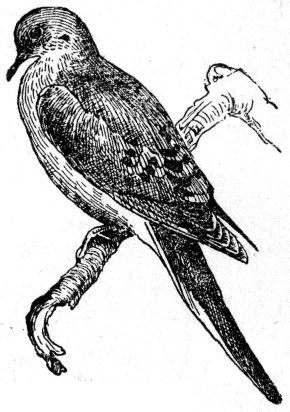
Mourning Dove
Doves are often to be seen perched on a prominent dead branch, and at such times their small heads, erect posture, and pointed tails are noticeable. As they fly up from a field, or alight, the white in their outer tail-feathers shows plainly, but wherever they occur they may be recognized by the characteristic whistling sound of their wings in flight and their gentle cooing. This song may be written coo-oo-oo, ooh, ooh, ooh, the opening syllable using three notes, the middle note being the highest in the song. At close range this 56 cry is rough and throaty; at a distance it is mellow and soft, its tender, mournful quality making adequate description difficult.
Young Doves are fed with partly digested food which the parents pump up from their stomachs. They are helpless, dowdy creatures while in the nest, and they sometimes come to an untimely end when a gale blows the structure from its scant moorings or when, from lack of proper balance, it topples to one side.
The white eggs, when fresh, are translucent as moonstones, and the sunlight, in penetrating the thin shells, discloses faintly the color of the golden yolk.
Doves eat a great deal of weed seed. They have no destructive habits whatever, and are worthy of all possible protection. They appear to be on the increase as a result of shortening the shooting season in the South, where they are popular as game-birds.
TURKEY VULTURE Cathartes aura septentrionalis Wied
Other Names.—Buzzard; Turkey Buzzard.
Description.—Smaller than a Turkey; head and upper neck virtually bare; ruff of feathers about lower neck; wings long as in most birds of prey, but feet without the sharp, curved claws of the hawk tribe; plumage blackish brown, glossed with purplish when fresh, rusty and soiled in appearance when old; under surface of flight-feathers lighter, showing in flight; skin of neck and head reddish, with whitish tubercles and ridges, and some hairs and small feathers; bill whitish; feet dull flesh-color; eyes brown. Downy young, white in color with pale blue-gray feet and head. Length: About 30 inches.
Range in Pennsylvania.—A regular and fairly common summer resident in the southern half of the Commonwealth and locally in western Pennsylvania, at least as far north as Crawford County, where it nests in limited numbers at Pymatuning Swamp. It arrives in mid-March and stays until November, or later. In the southernmost counties, and occasionally elsewhere in its range, it remains throughout the winter.
Nest.—No nest is built. Eggs: 2, whitish, blotched irregularly with black, brown, and gray, placed on the ground in a cavity among rocks or in a hollow log.
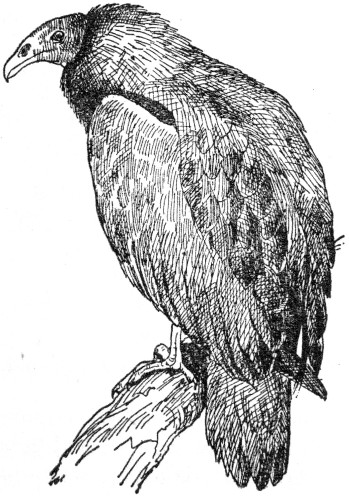
Turkey Vulture
At close range the Turkey Vulture is not a beautiful creature—its carriage is slovenly, its facial expression unpleasant, and its 57 plumage harsh; but circling in the sky, its wide wings hardly moving for hours at a time, it becomes a glorified being, among the most graceful and well-balanced of our soaring birds.
It is equipped by Nature as a carrion-eater, the bare head and neck permitting it to eat the flesh of dead animals without soiling its feathers. Its feet are not used in capturing or carrying prey, but a considerable burden may be carried in the bill. When Vultures find a dead cow or horse, word seems to travel immediately to all nearby districts and the great birds swing silently in to the feast. They are frequently seen along roadsides where they devour rabbits and other small mammals which have been killed by motor cars.
It is said that the Turkey Vulture carries the germs of hog cholera and the dreaded foot-and-mouth disease. This is only occasionally, if ever, true, however, and, as a rule, it is a harmless and highly beneficial bird. Nevertheless, it is not protected in Pennsylvania at the present time.
Young Vultures cannot stand when newly hatched.
MARSH HAWK Circus cyaneus hudsonius (Linnæus)
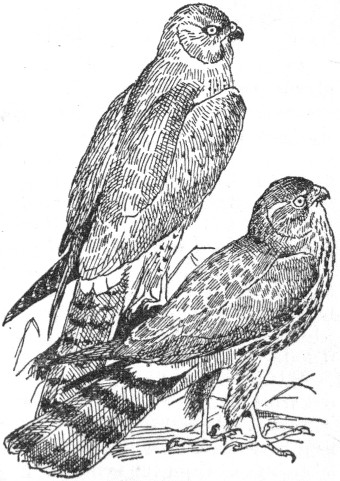
Marsh Hawk Male Female
Other Names.—Swamp Hawk; Marsh Harrier; Pigeon Hawk (erroneous); Chicken Hawk; Hen Harrier.
Description.—Face with an owl-like ruff of feathers; wings and tail long; feet long and slender. Adult male: Upperparts light ashy gray, somewhat darker on top of head, and slightly streaked on neck; tips of wings black; tail barred with black; upper tail-coverts white; lower parts white, grayer on throat and upper breast, and flecked with pale reddish brown on sides and flanks; eyes bright yellow. Adult female: Plumage rich brown, considerably mottled throughout, sometimes heavily streaked with blackish below, and feathers sometimes considerably margined with buffy; upper tail-coverts always white; eyes yellow. Immature birds are usually plain brown, unstreaked below, and have brown eyes. The feet are always yellow. Length: About 20 inches.
Range in Pennsylvania.—A common though somewhat local migrant and summer resident from March 15 to November 1. Less often seen in the mountainous counties and occasionally noted in winter. Its summer range 58 depends more or less upon swampy country in which the nest is characteristically built.
Nest.—On the ground in a swamp, composed of dead weed-stalks, cat-tail leaves, and similar materials, sometimes with neat cup and lining, at other times loosely constructed with little attempt at neatness. Eggs: 4 to 7, pale blue or chalky white, occasionally faintly spotted with brown.
The Marsh Hawk is usually to be seen flying near the ground over a field or low meadow. Beating its way along rapidly, it pauses at times to watch the grass where prey may hide, sometimes wheeling suddenly toward the ground as it captures a mouse or shrew. It may always be recognized by the white upper tail-coverts which show plainly in flight, a mark which our other hawks do not have.
Occasionally the Marsh Hawk circles high in air where the white patch on the back is not visible. At such times the long and somewhat pointed wings, black wing-tips, long tail, and white appearance of the male and the dull brown appearance of the female will distinguish the species.
The male has the interesting custom of looping the loop during its season of courtship. At the nest the birds are very fierce in defending their young and swoop about the intruder, uttering loud, piercing, Flicker-like cries.
Its food consists of mice, frogs, snakes, and other creatures which are captured among the cat-tails or on the ground. Occasionally it takes a bird or visits the poultry-yard, but, as a rule, it is a beneficial species. It is not protected in Pennsylvania.
SHARP-SHINNED HAWK Accipiter velox (Wilson)
Other Names.—Bird Hawk; Blue Darter; Chicken Hawk; Pigeon Hawk (erroneous).
Description.—Small for a Hawk, being but little larger than a Robin; wings comparatively short and rounded; tail long and square at tip: female considerably larger than male. Adults: Top of head and neck blackish, base of feathers of nape white; cheeks and malar region whitish streaked with reddish brown; throat white, finely streaked with black; upperparts blue-gray, the tail marked with three or four blackish bands; underparts white, heavily barred with reddish brown save on middle of belly and under tail-coverts. Immature birds: Brown, not gray, plumage of the upperparts edged with rusty brown and underparts streaked, not barred, with dark brown. The eyes of adults are usually red; of immatures, yellow. The feet, which are long and slender, are always yellow. Length: Male, 12 inches; female, 13½ inches.
Range in Pennsylvania.—A migrant and summer resident throughout from March 1 to November 25; occasionally to be seen in winter.
Nest.—A rather large, flat platform made of slender twigs, built near the trunk on a hemlock bough, or in other sheltered situation, usually 30 to 40 feet from the ground. Eggs: 4 to 6, pale greenish white, handsomely and irregularly blotched with rich brown.
59
The Sharp-shin is the enemy of all small birds. It is swift in flight and skulks along among the bushes, pouncing upon its victims suddenly. Near the nest of a pair of these birds located at McDonald Water Works, Washington County, there were no small birds—they had probably all been killed or driven out by the Sharp-shins.
Another very small member of this family, the Sparrow Hawk, is a bird of the open fields, with long, pointed wings and red-brown back. The Sharp-shin sometimes circles rapidly in the open but does not hover over its prey as does the Sparrow Hawk.
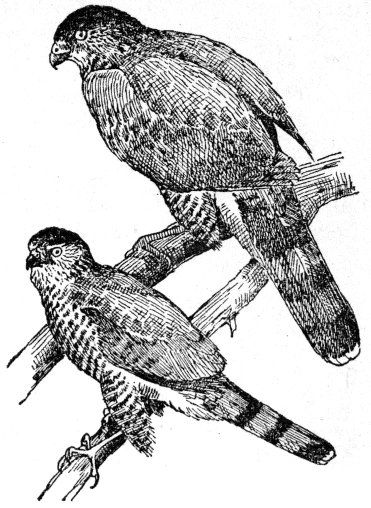
Cooper’s Hawk, Female Sharp-shinned Hawk, Male
Young Sharp-shins, which are downy white, are fed upon small birds which are neatly plucked by the parent.
COOPER’S HAWK Accipiter cooperi (Bonaparte)
Other Names.—Chicken Hawk; Blue Darter; Pigeon Hawk (erroneous); Hen Hawk.
Description.—Almost precisely like the Sharp-shin in proportions and coloration, but larger, the smaller male bird usually being a few ounces heavier than the largest female Sharp-shin, but not always to be distinguished easily from that species in the field. In the hand the Cooper’s Hawk may always be recognized by the shape of the tip of the tail which is rounded, not square, as it is in the Sharp-shin. Length: Male, 16 inches; female, 19 inches.
Range in Pennsylvania.—A fairly common summer resident in wooded sections from March 1 to December 10; occasional in winter.
Nest.—A bulky mass of twigs, lined with flakes of bark, usually placed from 40 to 60 feet from the ground in a beech tree. Eggs: 3 to 6, chalky blue-white.
The Sharp-shinned and Cooper’s Hawks, both bird-killers, are fairly common and are to be rated as our most objectionable birds of prey. They are not protected in Pennsylvania.
GOSHAWK Astur atricapillus atricapillus (Wilson)
Other Names.—Hen Hawk; Gray Hawk; Partridge Hawk; Squirrel Hawk; Chicken Hawk.
Description.—A large, heavy-bodied Hawk, with comparatively short wings and long tail; female considerably larger than male. Adults: Crown 60 black; area above and back of eye white, marked irregularly with black; rest of head whitish, streaked with black; upperparts blue-gray, the tail marked with three or four broad blackish bands; underparts heavily and finely barred with clear gray throughout, also somewhat streaked, particularly on the breast; eyes red or red-brown; cere and feet yellowish green. Immature birds: Brown, not gray; plumage of upperparts dark brown, margined and edged with buffy and whitish, and on wing-coverts with rusty brown; underparts buffy white, heavily streaked with blackish. Length: Male, 21 inches; female, 24 inches.
Range in Pennsylvania.—Rare as a permanent resident in the northern, more mountainous counties; known to have nested at seven localities. As a winter visitant, irregular, though in some sections, notably among the eastern counties, to be found with some regularity from about October 20 to March 1.
Nest.—A large mass of sticks, with a shallow cup, lined with bark and occasional sprigs of green hemlock, placed from 40 to 60 feet up in a beech or hemlock tree. Eggs: 3 to 5, chalky white, with a faint bluish cast.
The Goshawk is our most savage destroyer of small game. In occasional winter invasions it is abundant, and at such times takes a terrific toll of Ruffed Grouse, Ring-necked Pheasants, poultry, and cotton-tail rabbits.
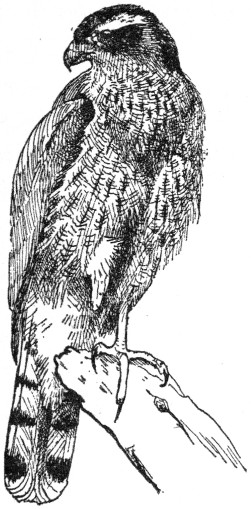
Goshawk
In the field, it has a very gray appearance, more so than any other species; even its heavily marked underparts, at a distance, are gray. It does not often circle in the sky, preferring to fly at about the level of tree tops, or, indeed, a few feet from the ground, so as to drop upon unsuspecting prey.
The parent birds are formidable warriors when their nest is disturbed. While I was making notes at a nest in Potter County, the heavy female bird struck me on the head, shoulders, and back a dozen times with her large feet. The male was wary, though he joined in the battle occasionally.
Rarely does the Goshawk capture mice or other destructive small mammals, eating virtually nothing but Grouse so long as these birds can be found. It is not protected in Pennsylvania.
RED-TAILED HAWK Buteo borealis borealis (Gmelin)
Other Names.—Chicken Hawk; Hen Hawk.
Description.—Large, with broad wings and comparatively short tail; often seen circling in the sky or perched on a prominent dead stub; female 61 larger than male. Adults: Upperparts dark brown, glossed with violet on back; scapulars and wing-coverts somewhat barred with buffy brown; throat white; breast usually crossed by a brownish band or by a row of streaks; rest of underparts whitish, barred and streaked with blackish, particularly on flanks and sides; tibial feathers buffy; tail bright red-brown with white tip and subterminal band of black; eyes dark brown; feet and cere greenish yellow. Immature birds are similar but the plumage of their upperparts is considerably mottled and edged with buffy, and the tail is gray, crossed with many narrow black bands. The underparts are often more heavily marked than in the adults, and the eyes are grayish yellow, not dark brown. Length: Male, 20 inches; female, 23 inches.
Range in Pennsylvania.—Fairly common permanent resident, save at high altitudes, where it is to be found only irregularly during winter. Some Red-tails migrate into or through Pennsylvania during fall and early winter, but it is now believed that most nesting birds actually remain in one region during the entire year. In many sections of the State it is becoming rarer each year.
Nest.—A bulky affair of twigs and branches, lined with leaves and finer materials, placed usually in a large, high, deciduous tree, at from 50 to 80 feet from the ground. Eggs: 2 or 3, whitish, irregularly blotched and spotted with reddish brown.
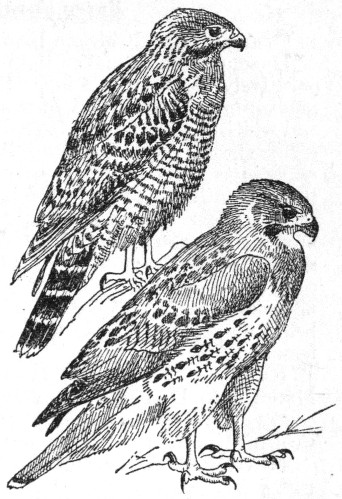
Red-shouldered Hawk Red-tailed Hawk
The Red-tail may easily be confused with the Red-shoulder, which, while smaller, has the same proportions. The Red-shoulder is more often found in swampy country or in the lowlands; the Red-tail is a bird of the fields and open wood-lots. The Red-shoulder’s scream is clear and loud; that of the Red-tail is wheezy and often whistle-like in quality. The Red-shoulder’s flight is more rapid, at times more owl-like than that of the Red-tail, and, of course, the Red-shoulder’s tail is never red-brown, but is black, crossed with narrow white bands. Immature Red-shoulders are to be distinguished from immature Red-tails with difficulty, partly because the birds do not call much and partly because there is variation in the size of the sexes—a small male Red-tail being not much larger than a female Red-shoulder; in the hand, however, the young Red-shoulder is more conspicuously streaked below than is the young Red-tail, and the feet are always slenderer and more delicate than in the larger species.
The Red-tail’s food habits are, for the most part, innocent; nevertheless, it is not protected in Pennsylvania at the present time.
62
RED-SHOULDERED HAWK Buteo lineatus lineatus (Gmelin)
Other Name.—Chicken Hawk.
Description.—Smaller than the Red-tail, with broad wings and comparatively short tail. Adults: Head and neck dark brown, streaked with reddish brown; back dark brown, with irregular barring and edging of gray and whitish; wings black, barred and spotted with white, lesser coverts rich reddish brown; tail black, crossed with three distinct but narrow white bands; underparts reddish brown, barred on belly, sides, and flanks with white; throat whitish, streaked, not barred, with dusky; a black spot on malar region; under tail-coverts white; feet and cere greenish yellow; eyes dark brown. Immature birds: Dark brown above, neck and back streaked and spotted with whitish and buffy; lesser wing-coverts reddish brown; primaries edged with buffy brown; tail gray-brown crossed with several light bars; underparts buffy white, streaked with black, principally on breast, sides, and belly; eyes pale grayish, with a yellow cast. Length: Male, 18½ inches; female, 21 inches.
Range in Pennsylvania.—A somewhat local summer resident from March 1 to December 1, often found along river valleys or in swampy country; winters occasionally, chiefly in the southern half of the Commonwealth. Usually not so common as the Red-tail.
Nest.—Of twigs, lined with leaves and other fine materials, and usually with a sprig or two of fresh hemlock, built in a hemlock, beech, or other forest tree, usually from 30 to 60 feet from the ground. Sometimes the Red-shoulder adds materials to the last year’s nest of a Crow and uses this structure as a nest. Eggs: 3 to 6, pale greenish white, irregularly blotched with dark reddish brown.
Even at a distance the bright reddish coloration of the underparts of the adult Red-shoulder should serve to distinguish it. The bird student will do well to remember that the Red-shoulder and Red-tail customarily choose prominent perches from which to watch for prey, whereas the Cooper’s Hawk, Sharp-shin, and Goshawk almost never choose such lookout posts. A large Hawk seen on a dead stub in the open is almost certainly either a Red-shoulder or a Red-tail. The flying Red-shoulder circles more rapidly than does the Red-tail, and with a glass the dark, white-barred tail should be seen easily.
It is fond of snakes, frogs, and mice, which it captures usually in the lowlands. Occasionally it catches a bird or young poultry, but it visits the farms only when food is scarce in its wilder habitat. Young Red-shoulders whose stomachs I examined at Pymatuning Swamp had eaten only grasshoppers, field-mice, snakes, frogs, and beetles.
The Red-shoulder’s loud, clear scream, when familiar to the bird student, is diagnostic. The Blue Jay can imitate this scream almost perfectly, however, so the bird student must use care in recording the species from call-note alone. This species, while for the most part innocent in food habits, is not protected in Pennsylvania.
63
BROAD-WINGED HAWK Buteo platypterus platypterus (Vieillot)
Other Names.—Chicken Hawk; Pigeon Hawk (erroneous).
Description.—The Broad-wing, because of its name, is often thought to be one of our largest hawks, but in reality it is one of the smaller species, being about the size of a Crow. Adults: Gray-brown above; throat white; malar region blackish; tail crossed with three distinct and rather broad white bands; underparts warm brown, the belly and sides heavily barred with white, the under tail-coverts largely whitish; cere and feet yellowish green; eyes dark brown. Immature: Dark brown, with head and neck considerably streaked; wing-coverts edged with buffy white; underparts buffy white, heavily streaked with black; tail grayish, marked with five or six black bands. Length: Male, 16 inches; female, 17 inches.
Range in Pennsylvania.—An uncommon and local summer resident from about April 20 to October 1. This hawk is not found in winter in Pennsylvania, for it migrates to Central America during the cold months.
Nest.—A platform of sticks, usually placed in a large crotch of a deciduous tree, and not often at great height from the ground. An old Crow nest is sometimes used. Eggs: 2 to 4, whitish, spotted and blotched, sometimes very handsomely, with rich brown.
A small hawk with wide wings, short tail, and the general appearance of a Red-tail is likely to be a Broad-wing. Look for it about deciduous woodlands. Its scream is feeble. It nests in woodlands not far from Pittsburgh.
ROUGH-LEGGED HAWK Archibuteo lagopus sancti-johannis (Gmelin)
Other Name.—Chicken Hawk.
Description.—Larger than a Red-tail; two distinct types of plumage, one light, one dark; feet, down to the very toes, fully feathered. Light phase of plumage: Head and neck black, boldly streaked with white; back dark brown; tail white at base, black on terminal third; breast and throat buffy, broadly streaked with black; feathers of leg buffy, spotted with blackish; belly and under tail-coverts black; wing-linings white, with black spots at wrist and black tips on all primaries and secondaries; cere and feet yellowish; eyes dark brown. Dark phase: Brownish black, spotted irregularly with white on belly, the tail marked with three or four narrow whitish bands. Length: About 22 inches.
Range in Pennsylvania.—A rare and irregular winter visitor from the far North, usually seen in the more northerly counties and in fairly open country.
The great Rough-leg will perch on a hay-stack or a low stump in an open field in preference to a high stub. In searching for prey, it beats over the ground in the manner of the Marsh Hawk. It is distinctly beneficial in food habits. In any plumage the bird in the hand may be recognized by the feathered feet; in the field the distinctly black underparts are diagnostic. Unfortunately, this species is not protected at the present time in Pennsylvania.
64
GOLDEN EAGLE Aquila chrysaëtos chrysaëtos (Linnæus)
Description.—Size very large; wing-spread from 6 to 8 feet; female noticeably the larger. Adults: Plumage rich deep brown, save on crown, nape, and hind neck where the pointed feathers are golden brown, and on the basal half of the tail, which is barred with whitish or gray; cere and toes yellow; bill blue-black; eyes dark brown; tarsus, which is fully feathered down to the toes, white or pale buffy. Immature: Similar, but the basal half or two-thirds of the tail is white and the under tail-coverts are margined with buffy. Length: About 3 feet.
Range in Pennsylvania.—A winter visitant, usually rare, though sometimes recorded several times during a single season. It is most often to be seen in the mountainous counties.
The Golden Eagle is occasionally caught in steel traps which have been set for foxes or other fur-bearers. Each winter one or two of these great birds are thus made captive or shot by farmers who are protecting their poultry.
It is a magnificent creature, with its regal bearing, its deep set, brilliant eyes, and its sleek, lustrous plumage. In captivity it is not given to beating itself about, but bears itself with simple dignity, as though it understood the futility of trying to make an escape.
In the field, it is to be distinguished with difficulty from the immature Bald Eagle, the latter bird having white areas on the under wing which the Golden Eagle lacks. Close at hand, it will be noted that both birds have long feathers on the tibial region, the tips of these feathers sometimes reaching well toward the toes, but in the Golden Eagle the whole foot, down to the toes, is covered with short, thick plumage.
The Golden Eagle has been known to kill foxes and lambs. There is an authentic record of the killing of a sturdy, though small, fawn by one of these great birds. Pursuing the fawn through the woods, it frightened it over a sharp declivity, and its leg was broken in the fall. The Eagle’s long, vise-like talons and great bill finished the unfortunate creature.
BALD EAGLE Haliæëtus leucocephalus leucocephalus (Linnæus)
Other Names.—American Eagle; White-headed Eagle.
Description.—Size very large, a wing-spread of over 6 feet. Fully adult birds: Brownish black with head and neck, tail, and upper and under tail-coverts, white; bill clear bright yellow; feet dull yellow; eyes bright pale yellow. Young birds in their first plumage: Almost black, with irregular mottling of white on underparts; bill and cere dusky; eyes dark brown. In somewhat older young the plumage is much mottled with white, buffy, and grayish on the upperparts as well as below, and the under wings are blotched with white. As the bird grows older the light areas become more extensive. 65 In the fourth year the head and tail become pure white and the mottling of the rest of the plumage does not reappear. Immature Bald Eagles sometimes have the general appearance of a Golden Eagle, but the feathers of the feet never extend down to the toes, as they do in the Golden Eagle. Length: A little under 3 feet.
Range in Pennsylvania.—Rare and irregular migrant and summer resident (occasionally noted in winter), save at Erie, where it is fairly common. Here it searches for fish and refuse along the shore and nests in the vicinity. In October and November, Bald Eagles from the North Country migrate through Pennsylvania, following some of the ridges of the eastern counties. They are sometimes noted along the Susquehanna and Delaware rivers, where formerly, and perhaps in limited numbers today, they nest on the larger wooded islands.
Nest.—A huge mass of sticks and débris, sometimes a wagon-load or more, built into the principal crotch or top of a sycamore or other large tree, often at great height from the ground. Eggs: 2 or 3, chalky white.
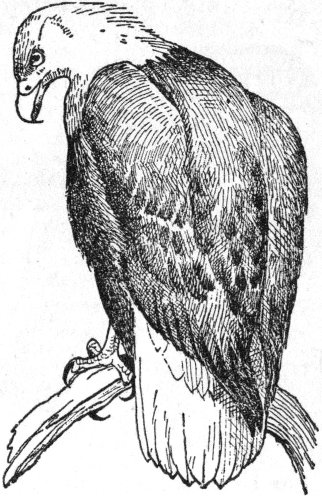
Bald Eagle, Adult
The Bald Eagle is usually seen along waterways or in the mountains. It ranges widely and flies with great majesty, its wide, heavy wings giving it, even at great distance, the appearance of weight and strength.
It is fond of carrion and pursues the smaller Osprey or Fish Hawk until that bird is forced to give up the prey which it has captured. Bald Eagles rarely take poultry. They sometimes pursue water-fowl, but in Pennsylvania do not destroy much game or valuable wild-life and are therefore protected.
The cry of the Bald Eagle is a barking squeal, sometimes very high and thin, often scarcely to be heard.
A dark-colored Eagle with white patches showing on the under-wing is likely to be an immature Bald Eagle. The Golden Eagle almost always appears dark from below, save for the basal half of the tail, which is grayish or white.
DUCK HAWK Rhynchodon peregrinus anatum (Bonaparte)
Other Names.—Peregrine Falcon; Rock Hawk; Bullet Hawk; Blue Hawk; American Peregrine; Ledge Hawk.
Description.—Size medium; female much larger than male; wings long and pointed; plumage very firm and stiff. Adults: Top of head and patch below eyes and on rear part of cheeks, black; back, wings, and tail bluish slate, heavily barred with darker gray; tail tipped with white; underparts 66 buffy, barred and spotted with black, chiefly on sides and flanks. Immature: Upperparts dark brown, the plumage considerably margined with buffy or pale brownish; area below eye black; cheeks brownish; underparts dark brown, all the feathers widely margined with buffy, giving a mottled and streaked appearance; cere and feet yellow; eyes very dark brown. Length: Male, 16 inches; female, 19 inches.
Range in Pennsylvania.—A rare summer resident from March to November along cliff-lined rivers. It occasionally occurs in migration and has been known to winter in the Philadelphia region, where the solitary birds live upon pigeons, and roost on the ledges of tall buildings.
Nest.—None is made. Eggs: 3 to 6, whitish, heavily spotted with rusty or chocolate-brown, or solid brown, laid either on the bare rock in a sheltered niche on a high cliff, or in a slight depression in the earth on such a ledge, if there be any soil.
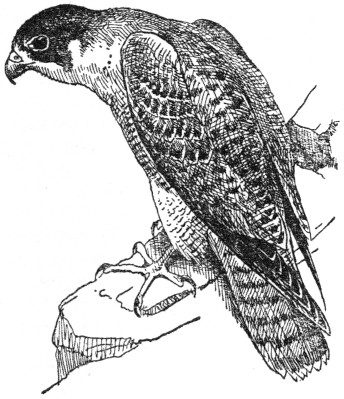
Duck Hawk, Adult
This is one of Pennsylvania’s rarest hawks. Along the Juniata River, and where there are cliffs along the Delaware and Susquehanna rivers, they are sometimes seen beating their way buoyantly, high in the air, or plunging down from the heights either in pursuit of prey or in play. Their call-note, a sharp and rapidly repeated kee, kee, kee, kee echoes among the rocks. Near their nest the birds are vicious toward intruders.
For speed and daring, the Duck Hawk is famous. It pursues and captures the most rapid ducks, even Teal. I have seen it kill Pileated Woodpeckers and Crows, but, as a rule, it captures Meadowlarks, Blue Jays, Robins, and shorebirds which happen to pass by its eyrie, or for which it watches from its high vantage-point. It is particularly fond of domestic pigeons if there be any in the vicinity, and will live almost exclusively upon them as long as the supply lasts. Striking its prey with closed fists, it slashes the skin open with the long claws of the hind toe.
Sometimes a Duck Hawk may be seen from the train window in the vicinity of Huntingdon, Spruce Creek, Palmerton, or Dauphin. The Duck Hawk is not protected in Pennsylvania.
PIGEON HAWK Tinnuculus columbarius columbarius (Linnæus)
Description.—Size small, a little larger than a Sparrow Hawk, but heavily built, and with plumage firm like that of the Duck Hawk. Adults: Blue-gray, narrowly streaked with black above, an inconspicuous band of buffy or pale reddish brown at neck, primaries barred with white; tail blackish 67 with three or four distinct, though narrow, white or grayish bars, and a white tip; underparts buffy or rich ochraceous, streaked with black, save on throat. Immature: Dark brown above, the primaries and tail barred with buffy; underparts much as in adult birds; cere and feet yellow; eyes black. Length: About 10 inches.
Range in Pennsylvania.—A rare migrant, additional records for which are very desirable. It usually occurs in late April and early May and in late September and early October. It is said to have nested in Pike County.
So many hawks are called Pigeon Hawk that it is difficult to make Pennsylvania farmers and gunners realize that this little hawk is really a comparatively rare bird. It flies rapidly, directly, and is, in general appearance, much like a Sparrow Hawk with a blue-gray back.
I have noted Pigeon Hawks in Pennsylvania only a few times. Each time the hawk was surrounded and besieged by a flock of swallows, one of which it may have been holding in its talons.
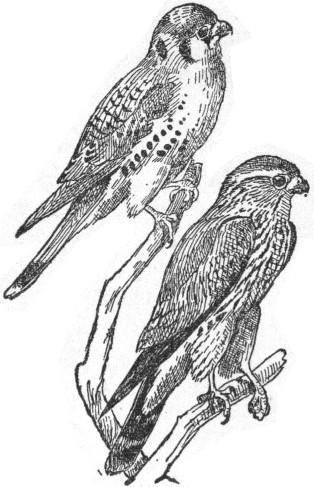
Sparrow Hawk, Male Pigeon Hawk
SPARROW HAWK Cerchneis sparveria sparveria (Linnæus)
Other Names.—Mouse Hawk; Killy Hawk; Pigeon Hawk (erroneous).
Description.—Size small, not much larger than a Robin; adults and young alike; wings pointed. Male: Top of head blue-gray, with rusty brown crown-patch; sides of head buffy or whitish, with black marks below eye, on ear-coverts, and on side of nape; back rich reddish brown, barred on scapulars, and sometimes on back, with black; wing-coverts blue-gray, spotted with black; primaries black, barred with white; tail rich rufous, tipped with white, and with a broad subterminal bar of black; underparts whitish or buffy, sometimes quite reddish, with spots or bars of black on sides and flanks; cere and feet yellow; eyes dark brown. Female quite different, having the back and tail heavily barred with black, the wing-coverts reddish brown barred with black, and the underparts streaked with pale reddish brown. Length: About 10 inches.
Range in Pennsylvania.—A common and widely distributed summer resident from March 10 to November 15. Occasional in winter.
Nest.—In a cavity in a tree or in a bird-box from 20 to 40 feet from the ground. Eggs: 4 to 8, buffy or whitish, heavily spotted with reddish brown.
The trim form of this elegant creature is a familiar roadside acquaintance, and the piercing killee, killee, killee of the bird, as it hovers looking for prey, is characteristic. The Sparrow Hawk is distinctly beneficial, feeding upon grasshoppers, field mice, and other small mammals. It is protected by law at all times in Pennsylvania.
68
OSPREY; FISH HAWK Pandion haliaëtus carolinensis (Gmelin)
Description.—Size large, wings long, giving the bird in flight somewhat the appearance of a gull; feet large, the outer toe reversible, the under side of the toes with spiny scales for holding slippery prey; upperparts blackish brown, the feathers margined with brownish; nape and superciliary white or whitish spotted with black; tail with from six to nine grayish bands, noticeable particularly on the inner web; underparts shining white, with spots of brown on breast, particularly in the female. The under wings are white save the greater coverts and flight feathers which are prominently barred; a black area at the bend of the wing; bill black; feet pale blue-gray; eyes orange-yellow. Length: 23 inches.
Range in Pennsylvania.—Common and regular, principally along the waterways, as a migrant in April and May and in September and October. Rare and local as a summer resident. Additional nesting records are desirable.
Nest.—A bulky mass of sticks and débris, usually placed in a dead tree, sometimes at the very top, from 20 to 50 feet from the ground. Eggs: 2 to 4, whitish, spotted with reddish brown, or solid rich brown. There is much variation in the color of the eggs.
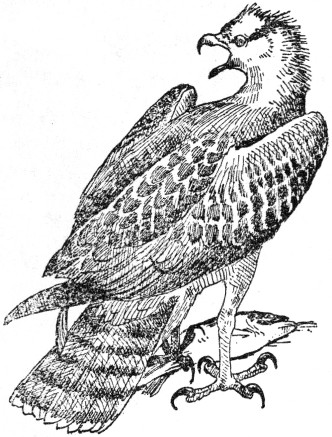
Osprey
The Osprey is usually seen near a lake or waterway. Its easy flight gives it somewhat the bearing of a gull, but its broad, barred tail and dark upperparts distinguish it even at a great distance.
The Osprey’s food is almost altogether fish. Its firm, glossy plumage, its great claws, its slender, long wings, are all adapted to the capture of fish, upon which it pounces from the air, plunging into the water, sometimes to be lost to view for a second or more. Occasionally it grips a fish so large that it cannot extricate its talons, and is dragged to an unfortunate death. When the Osprey rises from a plunge in the water it often halts in mid-air to shake itself free of water, a somewhat amusing performance.
Although the Osprey eats fish almost exclusively, it is protected in Pennsylvania. It sometimes captures the destructive carp which is such a pest in some localities. It does not often take trout or other valuable food or game-fish and never captures birds or game. Smaller birds, such as grackles, fear the Osprey so little that they have been known to build their own cradles among the foundation material of the Osprey’s bulky eyrie. Along the Atlantic Coast Ospreys sometimes nest on the ground.
69
BARN OWL Tyto alba pratincola (Bonaparte)
Other Names.—Monkey-faced Owl; Golden Owl.
Description.—Larger than a Crow; face with round ruff of feathers about eyes; legs very long and lanky, with sparse feathering down to tips of toes. Face white, with reddish brown area about eye and narrow ring of reddish brown at outer edge of facial disc; upperparts golden brown, much variegated with fine gray barring and black and white speckling; underparts white, buffy, or ochraceous, finely spotted with black. The under surface of the wings is principally white, but the flight-feathers, as well as the tail, are narrowly barred with dark gray; bill pale flesh-color; eyes black. Length: 18 inches.
Range in Pennsylvania.—A fairly common though somewhat local summer resident, chiefly in the southern and southeastern counties, and only rarely in the northern and mountainous counties and at high altitudes, from late March to November; occasional in winter. In the western counties it has been known to nest as far north as Crawford County.
Nest.—In a large cavity in a tree, often a sycamore, or in a barn or loft wherever the eggs may be laid with safety. Eggs: 5 to 9, white.
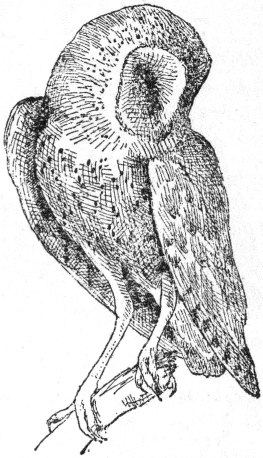
Barn Owl
When a country newspaper announces the capture of a creature, half monkey and half bird, the bird student may be fairly certain that someone has found a Barn Owl. The strange, melancholy expression of the bird’s face, its peculiarly awkward, long legs, and its odd habit of bowing, hissing, and swaying back and forth, all make it an object of great curiosity.
The Barn Owl can see perfectly by day, though it is chiefly nocturnal. It preys upon rats, mice, and shrews principally, and is almost altogether beneficial in its food-habits. All Owls have the habit of throwing up wads of indigestible matter, such as the bones and fur of the mice they have eaten. An examination of the pellets of the Barn Owl has shown that these creatures eat but very few birds and virtually no game.
Half-grown young in their nest, clamoring for food, make a considerable outcry. They have insatiable appetites and during early summer the parents are kept busy bringing in rats and mice for their hungry offspring.
The Barn Owl’s golden brown and gray back, its white appearance beneath, and its lack of any ear-tufts are good field-marks. This species is protected in Pennsylvania.
70
LONG-EARED OWL Asio otus wilsonianus (Lesson)
Other Names.—Cat Owl; Cedar Owl; Hoot Owl.
Description.—Size medium, about that of a Crow; head with two prominent tufts of feathers which are nearly always held erect in life; feet fully feathered. Upperparts gray, mottled with buffy brown and speckled with black and white; tail with six or eight dark gray bars; face whitish to rich buff, bordered by black; ear-tufts black margined with whitish or buffy; underparts whitish, washed irregularly with buffy—the breast broadly and irregularly streaked and the sides and belly barred with dark brown and gray; feet buffy; eyes bright yellow. Length: 15 inches.
Range in Pennsylvania.—A fairly common, though somewhat local resident, which may migrate to an extent when food is scarce during winter. It is usually to be found near hemlocks.
Nest.—A flat platform of twigs, sometimes built upon the old nest of a squirrel or Crow, lined with finer materials and a few belly feathers from the owls. Sometimes an old Crow nest is used without any renovation or addition. Eggs: 4 to 6, white.
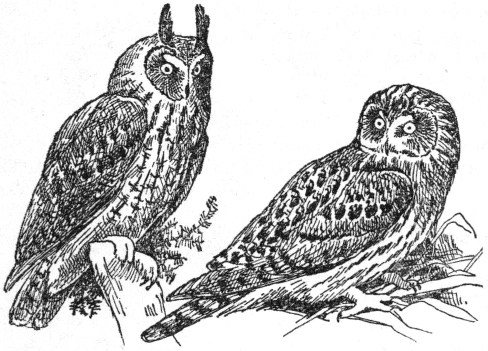
Long-eared and Short-eared Owls
Long-eared Owls are neither noisy nor bold, and may therefore live in a region without being known unless the bird student assiduously searches for them in dense hemlock clumps, in cedars, or thick grape-vine tangles, where they are usually to be found. They are principally nocturnal, and it is sometimes difficult to make the birds fly from their perches during the day. Any medium-sized owl which flies from a dense hemlock is likely to be of this species. Its general appearance, at such a time, is grayish.
It is a highly beneficial bird, living almost altogether on mice which it captures both in the woodlands and at the edges of fields. These it swallows wherever it may be, but the pellets are usually cast up during the daytime at the favorite resting-place, so after a few months’ sojourn at one point the pellets become numerous. Pellets of this nature, strewn over the ground, are always a fairly sure sign of the presence of owls.
The young, which resemble their parents in color, are remarkably adept at clambering about their nesting-tree before they can fly. They are odd in appearance when newly hatched, with their queer 71 eyes and large mouths. Since the eggs are laid and hatch at intervals of two or three days each, the young are of different sizes.
The call-note of this Owl, which I have not frequently heard, resembles a Screech Owl’s quavering whistle somewhat, but is shorter, more whining, and less musical, and is varied with angry, coughing sounds. This species is protected in Pennsylvania.
SHORT-EARED OWL Asio flammeus (Pontoppidan)
Other Names.—Meadow Owl; Marsh Owl; Swamp Owl; Bog Owl.
Description.—Size medium, like the Long-eared Owl; head with very small tufts, not apparent in field. Dark brown above, the feathers margined with buffy brown, the wings spotted and barred with buffy, the tail with rich buffy and brown bands of about equal width; underparts buffy or whitish, streaked, broadly on breast, narrowly on belly, with dark brown; feet buffy; eyes yellow. Length: 15 inches.
Range in Pennsylvania.—A fairly common and regular migrant from March 1 to April 15 and sometimes later and from October 1 to November 15. It has been known to nest once or twice within the Commonwealth; it is sometimes found in winter, particularly in the lowlands of the less mountainous counties.
The Short-eared Owl sometimes hunts during the day. It courses over the meadows and marshes, its wide, soft wings carrying it easily but rather unsteadily, a few feet from the ground. As a rule, it prefers to hunt at eventide.
It nearly always perches on the ground. Its coloration is protective as it sits among the dead grasses or cat-tail leaves, motionless until it springs awkwardly into the air and makes off. It does not often alight in trees, though it may occasionally roost in low, dense bushes or conifers.
As the Short-ear flies away, the light spots on the upper surfaces of the wing and the dark spots at the bend of the wing on the under surface are usually noticeable. Any medium-sized owl which flies up from the ground in the open is almost certain to be of this species.
Its food habits are strictly beneficial. It captures mice, preferring to hunt in the open, almost never capturing its prey in the woodlands. It is often found in large flocks during the period of migration. In fact, where one occurs others are likely to be found. Flocks sometimes number a hundred or more individuals. When these owls visit a farm in such numbers for a week or two, they may effectively destroy the mice and other destructive small mammals.
The Short-eared Owl is curious; squeaking cries, given in imitation of a mouse or small bird, will sometimes cause it to come very close, where it may hover for several seconds, if the observer remains perfectly motionless. The Short-eared Owl is protected in Pennsylvania.
72
BARRED OWL Strix varia varia Barton
Other Names.—Hoot Owl; Black-eyed Owl (rare).
Description.—Much larger than a Crow; no tufts on the head; feet feathered almost to claws. Upperparts dull chocolate-brown, each feather with two or three grayish white or buffy bars, especially noticeable on scapulars; tail and wings distinctly barred; face grayish, finely barred with dark gray; underparts whitish or grayish white, tinged with buff, the breast distinctly barred, the belly and sides streaked with dark brown; bill greenish yellow; eyes very large, dark brown with blue-black pupils. Length: 20 inches.
Range in Pennsylvania.—A fairly common but rather local permanent resident, found chiefly in deep woodlands and usually along streams or in lowlands, not on the ridges as is the Great Horned Owl.
Nest.—Almost always a cavity in a tree, though sometimes the deserted nest of a Crow or hawk. Eggs: 2 to 4, white, and quite round.
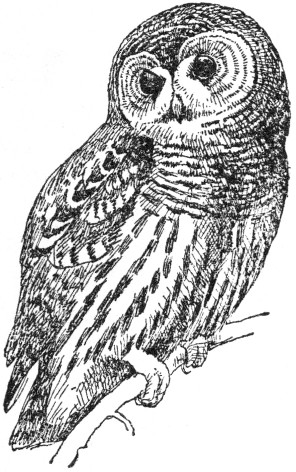
Barred Owl
I shall never forget my first glimpse of a Barred Owl. In a deep woodland, where all was quiet and where shadows lent an air of mystery, I suddenly realized that a shapeless ball of brown on a nearby branch was three young Barred Owls, sitting very close together, eyes nearly shut. As I approached they refused to budge, preferring, it appeared, to keep their eyes closed so as not to be bothered with any unpleasant consideration of an encounter with an enemy. When I rapped the branch upon which they sat, they opened their eyes, popped their beaks, and flew off grunting. Their mother swooped down upon me with an angry cry.
The Barred Owl’s song is weird. It is a series of eight or nine hoots which are given with much vigor, and which, at a distance, sound like the barking of a dog. When two or three Barred Owls join in a chorus, the effect is unbelievably comical. The usual cry is often varied with single hoots, barks, or grunts.
It is not blameless in food habits. The usual fare of mice and chipmunks is occasionally varied with squirrels, rabbits, and birds, usually of smaller varieties.
A good imitation of the cries of a Barred Owl may draw the creatures close, sometimes many of them at once. This cry will sometimes attract Crows also, who sense the possibility of a good hour’s attack upon an ancient foe.
The Barred Owl is not protected in Pennsylvania.
73
SAW-WHET OWL Cryptoglaux acadica acadica (Gmelin)
Description.—Considerably smaller than a Screech Owl; no tufts on head. Adults: Facial disc white, with radial streaks of brown; upperparts dull chocolate-brown, finely streaked on head and spotted on back and wings with white; tail with three or four whitish bars; underparts white, broadly streaked with dark reddish brown; legs and feet white, feathered down to claws; eyes yellow. Immature: Like adult, but head and back unspotted, and breast brown, unstreaked; belly deep buffy; eyes brownish. Length: 8 inches.
Range in Pennsylvania.—Nests rarely in the northern and mountainous counties. Chiefly to be found as an irregular visitor in winter, in northern and central Pennsylvania.
Nest.—In a cavity, frequently a woodpecker’s deserted nest. Eggs: 3 to 5, white.
This tiny owl is rarely seen, even though it lives in the vicinity. It hunts its food at night and sleeps so soundly by day that it may be captured in the hand. Its food habits are strictly beneficial and it is protected by law.
Look for the Saw-whet Owl in dense growths of alder, hemlock, or in vines. A very small owl of erratic, rapid flight is likely to be of this species. All records of it are very desirable.
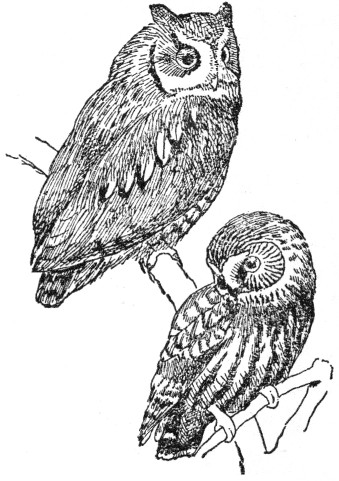
Screech Owl, Red Phase Saw-whet Owl
SCREECH OWL Otus asio nævius (Gmelin)
Other Names.—Squinch Owl; Little Owl; Red Owl; Gray Owl; Hoot Owl; Squeak Owl; Mottled Owl.
Description.—Size small, but little longer than a Robin, though heavier; head with prominent ear-tufts, almost always visible in the field; feet feathered down to claws. Red phase of plumage: Upperparts bright reddish brown, finely streaked with black, the scapulars streaked with buffy white; underparts white, streaked finely with black, and barred with reddish brown, chiefly on sides. Gray phase of plumage: Upperparts gray, mixed with brownish, streaked with blackish and mottled with white and buffy, especially on scapulars; underparts white, streaked and barred with black, grayish, and white, some of the patterns of the feathers being beautiful and unusual; eyes yellow. Length: 9½ inches.
Range in Pennsylvania.—A common permanent resident throughout the Commonwealth.
Nest.—In a cavity in a tree, often in an orchard. Eggs: 4 to 6, white.
The Screech Owl is usually a familiar village bird whose quavering song is thought by some to be sad and ominous, by others to be 74 among the most beautiful songs given by our birds. It lives principally upon mice but it also captures small birds, particularly in the spring when it feeds upon nestlings which it finds in the vicinity. The coloration of the Screech Owl is interesting. That there should be two distinct types of color pattern, wholly independent of age, sex, or season, seems rather useless. Some purpose at present unknown may be served by this phenomenon. The Screech Owl is protected in Pennsylvania.
GREAT HORNED OWL Bubo virginianus virginianus (Gmelin)
Other Names.—Hoot Owl; Big Owl; Cat Owl.
Description.—Size large; head with prominent tufts of feathers; feet fully feathered down to claws; female noticeably larger than male. Facial disc rich orange-brown; ear-tufts black, edged with rich buffy; upperparts mottled and speckled with gray, black, white, and buffy; throat pure white; underparts buffy and white, finely and thickly barred with black; feet buffy; tail and wings inconspicuously barred; eyes large, bright yellow. Length: About 2 feet.
Range in Pennsylvania.—A fairly common permanent resident throughout, particularly in higher woodlands along the ridges.
Nest.—An old Crow’s or hawk’s nest, somewhat relined, or a large cavity in a tree or cliff. Eggs: 2 or 3, white, and nearly round.
The eggs of this great bird of prey are laid early. More than once I have seen the mother incubating eggs, her back covered with snow. In Pennsylvania, nesting usually begins in mid-February, though a set of eggs has been taken in late January.
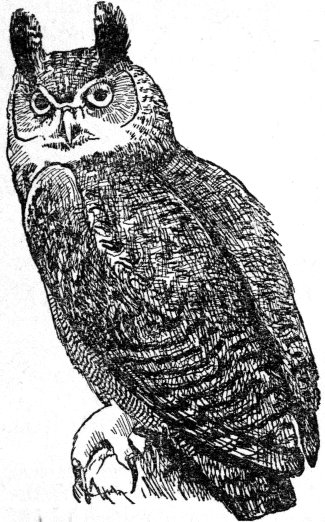
Great Horned Owl
The Great Horned Owl is so muscular and so well armed with heavy beak and iron talons that it does not hesitate to capture large prey, such as large chickens, geese, and even turkeys. It is very fond of cotton-tail rabbits, whose skulls it crushes with a nip of its beak, and often kills skunks, though it may carry a reminder of the encounter for months. It is one of our most destructive birds of prey, though it varies its diet with mice and other harmful creatures.
The deep-voiced hoot of this owl is usually heard on early spring nights. A mellow, bass who, who-who-who, who, who, with remarkable carrying power, is the love-song. It is sometimes given all night 75 long during late January, when the moonlight gives the woodlands a chilly and mysterious brilliance. A loud and startling scream is sometimes given, which is often wrongly attributed to a wild cat. The probability is that a wild cat in its wildest fit of anger or alarm could not produce a sound half so loud and terrifying.
In captivity the Great Horned Owl rarely becomes tame, though it may stand on its perch quietly enough during the day. One which I had at one time was somewhat tractable, yet not to be trusted. It caught the fingers of my left hand one day with its great claws. Being unable to extricate myself, and being threatened at any minute with a nip from the vicious beak, I summoned aid. I learned a little that day about the terrific grip that closes upon the unfortunate rabbit or skunk this creature captures.
SNOWY OWL Nyctea nyctea (Linnæus)
Other Names.—White Owl; Arctic Owl; Snow Owl.
Description.—Size large, head without ear-tufts; feet so heavily feathered that the claws are sometimes hidden. Plumage white, barred with dark grayish brown, particularly on the back and wings and sides of breast. Individuals vary greatly in appearance, some being pure white, others being heavily barred. Younger birds are usually darker. Eyes bright yellow. Length: About 2 feet.
Range in Pennsylvania.—A rare and irregular winter visitor, particularly in the northern counties, and occasionally common as during the hiemal invasion which occurred in 1926-27.
The Snowy Owl is a bird of the open fields, not of the woodlands, and, like the Rough-legged Hawk, is likely to be seen perched on a fence-post, a hay-stack, or on the ground, rather than in a tree. Its white plumage makes it a prominent feature of the landscape save when there is snow on the ground.
In Pennsylvania, its food includes small game animals and birds, mice, and other small mammals, and, occasionally, poultry. It is not particularly harmful, since it usually confines its hunting to the open fields. In the North Country it preys upon water-fowl. Its flight is very strong and rapid. It is not protected in Pennsylvania, though it should be because of its great rarity.
YELLOW-BILLED CUCKOO Coccyzus americanus americanus (Linnæus)
Other Name.—Rain-Crow.
Description.—A long, slender bird about the size of a Robin, with very long tail and curved bill; feet with two toes pointing forward, two backward. Upperparts olive-gray, glossed with green, the primaries rich reddish brown, apparent in flight; tail with outer feathers black, broadly tipped with white, 76 the outer vane of outer feathers also white; underparts white; bill blackish, the lower mandible rich yellow; eyes dark brown; eyelids yellowish. Length: 12 inches.
Range in Pennsylvania.—A summer resident from early May to late September, found chiefly about orchards and shade trees, principally in the southern and less mountainous counties. Additional nesting records of this species are desirable.
Nest.—A loose platform of twigs placed on a horizontal branch, usually not more than 15 feet from the ground. Eggs: 3 to 6, pale greenish blue.
The cuckoos are slim, retiring birds, which often are not seen unless they fly from the thick leaves where they have been searching for caterpillars—their favorite food. The Yellow-billed Cuckoo’s very reddish wings serve to identify it at considerable distance. Its song is an unmusical series of kuks. No song is given which resembles the word “cuckoo,” our birds receiving their name merely from their relationship to the famed English bird.
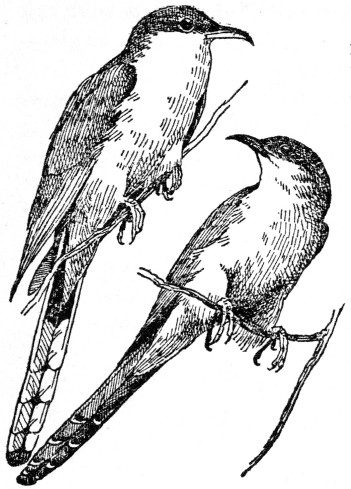
Yellow-bulled Cuckoo Black-billed Cuckoo
BLACK-BILLED CUCKOO Coccyzus erythophthalmus (Wilson)
Other Name.—Rain-Crow.
Description.—Upperparts grayish brown, faintly glossed with greenish and bronze; outer tail-feathers narrowly and inconspicuously tipped with white; underparts white, somewhat grayish on throat and breast; bill black; eyes dark brown; eyelids red. Length: A little under 12 inches.
Range in Pennsylvania.—A summer resident from early May to latter September. I have found this species common in some of the northern counties where the Yellow-billed species was rare.
Nest.—A rather well-built platform of twigs, lined with leaves and a few grasses, usually but a few feet from the ground on a horizontal branch in a rather thick clump of saplings or in alders. Eggs: 2 to 5, glaucous green, somewhat like those of the Yellow-bill, but darker and smaller.
The Black-billed Cuckoo is fond of lowlands which are upgrown with young saplings, or of alders along streams. It is sometimes seen in orchards. The song of the Black-bill differs from that of the Yellow-bill in that the syllables are grouped, usually in threes. The song might be written kuk-kuk-kuk-kuk, cl-uck, cl-uck, cl-uck, kuk-kuk-kuk, kuk-kuk-kuk, kuk-kuk-kuk, kuk-kuk-kuk, the last syllables dying off gently. The Yellow-bill’s song is louder.
77
Like its slightly larger relative, the Black-bill is fond of caterpillars, and both are very valuable birds. They eat so many “woolly” caterpillars that their stomachs become lined with the spines from the bodies of their prey.
BELTED KINGFISHER Streptoceryle alcyon alcyon (Linnæus)
Description.—Head large, with long bill and prominent crest; feet small and short; plumage firm and compact. Male: Head and crest blue-gray, the feathers with dark centers; two spots, one in front of, and one under eye, and collar about neck, white; back and band across breast blue-gray, the wings and tail considerably spotted with white; bill blackish; eyes dark brown. Female and young: Similar, but with sides and a broken band across lower breast bright reddish brown, noticeable in the field. Length: 13 inches.
Range in Pennsylvania.—A common and widely distributed summer resident from late March until the end of October; occasional in winter, when the streams are open. It does not occur along streams which have been polluted by mining refuse and other poisonous waste products.
Nest.—At the end of a 6-foot burrow in a bank, made of a few fish-bones and scales crudely scraped together. Eggs: Usually 7, glossy white. The burrow, while usually dug rather high on a bank, directly along the stream, is sometimes located at some distance from water. It is dug with the bill and feet.
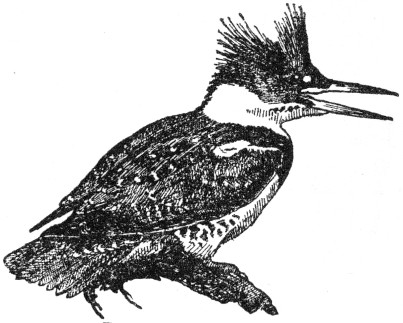
Belted Kingfisher, Male
The flashing white collar and underparts of the Kingfisher gleam as he flies rapidly along his chosen stream, giving his loud, rattling call. As he perches on a favorite overhanging stub, he elevates his crest, rattles once or twice, then becomes quiet as he watches the pool below him. Suddenly he dives from his perch, there is a splash, and he disappears beneath the surface. In a few seconds he arises, a slim, glistening fish in his mandibles. He makes off up stream, rattling again and again as the fish ceases its struggles, then swallows his prey, head first, entire. In addition to fish, he eats crayfish and other small aquatic creatures, and sometimes mice.
When the young hatch they are naked and ugly. They soon are covered with pin-feathers, however, and when the tips of these break, the young begin to look like their parents at once. Several days before they leave the burrow to learn angling for themselves, they scuttle about on their short feet, sometimes coming to the entrance for a moment to glimpse the world that is soon to be such 78 an unfolding of adventure for them. They rattle like their parents, and if a hand is thrust in among them, they pick savagely at the fingers—either in anger or with the belief that a larger, finer fish than parents ever caught has come to be swallowed.
Kingfishers capture some trout and other valuable food or game-fish and are therefore not protected in Pennsylvania.
HAIRY WOODPECKER Dryobates villosus villosus (Linnæus)
Other Name.—Sapsucker (erroneous).
Description.—Smaller than Robin; like other Woodpeckers, usually seen perched on the trunk of a tree or flying, in a strongly undulating fashion, through the air. Adult male: Top of head, line through eye and line from lower mandible to rear part of head, black, nape bright red, rest of head, white; back, black with white median stripe; wings black, spotted profusely with white; tail black, the outer feathers white, unspotted; underparts white. The adult female is precisely the same but lacks the red nape. Young birds have the crown red, the tips of the feathers lightly speckled with white. Length: 9½ inches.
Range in Pennsylvania.—A common permanent resident, usually to be found in the higher woodlands but often also in the towns.
Nest.—A cavity in a tree trunk, usually from 25 to 60 feet from the ground, the entrance about 2 inches in diameter. Eggs: 3 to 5, glossy white.
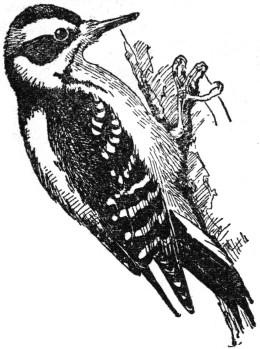
Hairy Woodpecker
The Hairy Woodpecker’s loud, sharp peek, peek is a welcome sound in winter woods of northern Pennsylvania where so few birds are found during the cold season. This species is the enemy of all wood-boring larvæ, its sharp, chisel-like bill, long, barb-tipped tongue, strong feet, and stiff tail all being peculiarly adapted to existence on the tree-trunks. It is sometimes found in orchards, but about towns and human dwellings is not nearly so often seen as its smaller, more confiding relative, the Downy Woodpecker.
DOWNY WOODPECKER Dryobates pubescens medianus (Swainson)
Other Name.—Sapsucker (erroneous).
Description.—About the size of an English Sparrow. Precisely like the Hairy Woodpecker, but noticeably smaller, with shorter, weaker bill, and the outer tail-feathers distinctly barred with black. The Downy is quieter, less energetic bird than its larger cousin; its call-note is softer in quality and its song, which is composed of a series of call-notes rapidly repeated, is more musical than that of the Hairy Woodpecker. Length: A little under 7 inches.
79
Range in Pennsylvania.—An abundant permanent resident, often seen in the towns.
Nest.—A cavity in a dead stub, usually from 15 to 30 feet from the ground, the entrance about 1½ inches in diameter. Eggs: 4 to 6, laid on a heap of small chips at the bottom of the cavity, glossy white.
The careful bird student can distinguish the Hairy and Downy Woodpeckers from call-notes, general appearance, flight, or even from the sound of their pounding on wood, which in the Hairy is so loud and positive in nature as to suggest, at times, a much larger bird. The amateur, however, may have some difficulty in distinguishing the two species.
The Downy and Hairy both like to be fed suet during the winter. They will come regularly to the feeding-counter and often become quite tame.
YELLOW-BELLIED SAPSUCKER Sphyrapicus varius varius (Linnæus)
Other Names.—Yellow-bellied Woodpecker; Sapsucker.
Description.—Smaller than a Robin, with all the characteristics of the woodpecker tribe to which it belongs. Adult male: Top of head and throat rich, deep red; lines below crown-patch, back of eye, and enclosing throat to form prominent breast-patch, black; lines above and below eye white; back black, spotted with white; wings black, with prominent white patch on greater coverts, and primaries spotted; tail black, the central and outer feathers marked with white; underparts whitish and pale yellow, barred on sides and flanks with blackish gray. Adult female: Similar, but throat white. Immature birds are similar to the adult female, save on the head and back, which are brownish throughout, spotted irregularly with black and on top of head with flecks of red, yellow, and glossy black. Length: 8½ inches.
Range in Pennsylvania.—A common migrant, sometimes abundant, from March 30 to May 15 and from September 1 to November 15; rare and local as a summer resident in the northern and mountainous counties; casual in winter.
Nest.—A cavity in dead or living wood, often in a yellow birch, from 30 to 60 feet from the ground. Eggs: 3 to 6, glossy white.
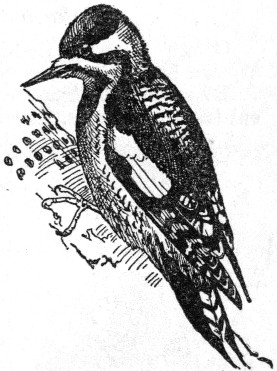
Yellow-bellied Sapsucker
The Sapsucker is, for the most part, a quiet and rather dignified woodpecker. Rarely does it pound noisily at a dead stub, searching for grubs. As a rule, it is to be seen drilling its sap-wells on the lower trunk of a maple, apple, or hemlock, where it clings sometimes for hours at a time if unmolested. These wells, which penetrate only to the sap-bearing layer of bark, are made in regular rows. Here gathers the sap which the bird regularly swallows, together 80 with all the small insects which have come to drink. This sap-drilling is a destructive trait, for many valuable trees are girdled annually through the attacks, chiefly, of the migrant birds. During the summer the parents capture only insect food for their young.
The mewing note of the Sapsucker will startle the beginner in bird-study. It is almost as convincing an imitation of the cry of a cat as is the scolding, querulous call of a Catbird, and is a familiar sound of the spring woods.
When courtship starts, Sapsuckers quite forget their dignity and go flashing through the tree-tops, sometimes three or four in a flock, bowing and dancing, displaying their spotted wings and tails and giving forth loud and incessant Flicker-like cries of plee-kah, plee-kah.
A Sapsucker sometimes actually becomes intoxicated with the juice it has drunk and wanders through the woods bumping into trees and branches, grasping the bark as best it can with toes which are marvelously adapted to holding to rough surfaces, even while the bird sleeps.
PILEATED WOODPECKER Phlœotomus pileatus abieticola (Bangs)
Other Names.—Red-headed Woodpecker (erroneous); Cock o’ the Woods; Log-cock; Woodcock (erroneous); Indian Hen; Black Woodpecker.
Description.—Size large, about that of a Crow; both sexes with prominent triangular crests. Adult male: High crest and line from lower mandible to middle of head, bright glossy red; narrow line back of eye and prominent line from bill under eye to neck and down to edge of breast, white; throat whitish; patch at base of folded primaries and irregular barring, on sides and flanks, white; the under-wing lining and most of the inner web of primaries white, showing plainly in flight. Rest of plumage brownish black; eyes bright orange-yellow. Female: Similar, but front of head brownish, only the rear part of the crest red. Immature birds are similar to the female. Length: 17 inches.
Range in Pennsylvania.—A rare permanent resident, found chiefly in the northern mountainous counties, but a few still persist in the southwestern counties and locally elsewhere. It is becoming somewhat commoner as a result of rigid protection.
Nest.—A large cavity in a tree, drilled by the birds, usually in a dead stub, though sometimes in a living yellow birch, at from 20 to 60 feet from the ground. Eggs: 3 to 5, glossy white.
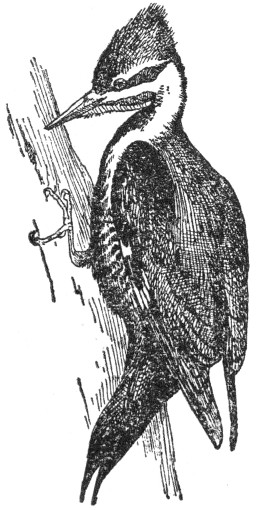
Pileated Woodpecker
The magnificent Log-cock is all too rare in Pennsylvania, but wherever the striking 81 creature swings noisily across a valley or pounds with its great bill into soft wood, the bird student receives a thrill few of our birds can afford. Its flight is rather slow and laborious, and noticeably less undulating than in other woodpeckers.
It is given to searching for food in deep, shadowy woods, where it is sometimes the only bird to be found, and where the sound of its hammering gives the only hint of life in the vast stillness.
The call of the Pileated is a high, irregular cackle, something like the spring song of the Flicker, but more noisy and irregular. An imitation of this cry, a clapping of the hands, or the beating of a dead stub with a stick, will sometimes bring the curious, bright-eyed creatures very close—too close, if the gunner be of the law-breaking kind. The fact that this bird is sometimes called Woodcock, and therefore regarded as a game-bird, has led to the destruction of many of them. They are naturally creatures of the wilderness, and have never been really common. Careful protection will be necessary if we are to keep them from extinction in this Commonwealth.
The food of the Pileated Woodpecker is chiefly grubs, bored sometimes from the very center of great trees. Its long, barb-tipped tongue aids it in securing its food.
In looking for the bird, seek the wild, wooded mountains. Listen for the cackling cry; watch for a big, black bird with flashing wing-linings; and attempt an imitation of its hammering by beating two sticks together.
RED-HEADED WOODPECKER Melanerpes erythrocephalus erythrocephalus (Linnæus)
Other Name.—Red-head.
Description.—A little smaller than a Robin. Adults: Head, neck, and upper breast, rich, deep red; upperparts glossy blue-black; the terminal half of the secondaries, rump, and upper tail-coverts, white; tail black, the outer feathers tipped and somewhat edged with white; lower breast and belly white, a reddish or buffy cast in the middle. Immature birds: Head and neck grayish brown, somewhat mottled; upper back glossy black, barred with gray; wings black, the terminal half of secondaries barred with black and white; tail usually as in adults; underparts white; the sides more or less streaked and spotted with dark brown or gray. Length: 9½ inches.
Range in Pennsylvania.—A local but usually common summer resident from April 15 to October 1; casual in winter.
Nest.—A cavity drilled in a dead tree or telegraph-pole, usually from 15 to 30 feet from the ground, often in an oak. Eggs: 3 to 5, glossy white.
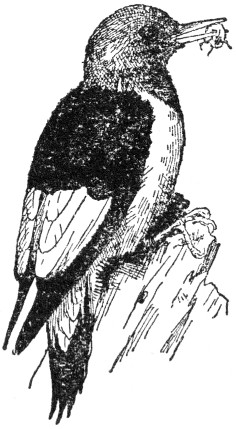
Red-headed Woodpecker
82
The white wing-patches of this bird are conspicuous, particularly in flight, and its loud cry, kree-er, kree-er, is a familiar roadside sound. It is given to capturing insects flycatcher-fashion and is an accomplished acrobat in the air. The food of the Red-head is varied, and while it often eats grubs, it also takes other insects and much small fruit. Occasionally an individual develops the habit of eating the eggs of other birds.
RED-BELLIED WOODPECKER Centurus carolinus (Linnæus)
Other Names.—Ladder-back; Zebra Woodpecker; Chiv; Sapsucker (erroneous).
Description.—A little smaller than a Robin. Adult male: Top of head and back of neck bright, glossy scarlet; rest of head, neck, and underparts, ashy gray, the region about the bill and the belly usually tinged with red; upperparts, including wings, strikingly barred with glossy black and white; upper tail-coverts white, with median streaks or sagittate markings of black; tail black, the feathers considerably marked with white. Adult female: Similar, the forepart of the head gray. Immature birds are similar to the female, but the belly is often tinged with brownish rather than red. Length: 9½ inches.
Range in Pennsylvania.—Fairly common in the extreme southwestern counties; local, sometimes common, in other western counties as far north as Crawford County, and through the southern tier of counties; a permanent resident wherever found.
Nest.—A cavity drilled from 20 to 60 feet from the ground, usually in a forest tree. Eggs: 3 to 6, glossy white.
The squirrel-like cry of this woodpecker, which may be written chiv, chiv, is a familiar sound in some of the woodlands of Greene County. Its call-notes resemble those of the Red-head and Flicker, and are considerably varied. The principal range of this species is the southern United States. It is gradually moving northward, however, like the Cardinal, and should be looked for in all central counties. The bright red top of the head and prominently barred back are good field-marks.
NORTHERN FLICKER Colaptes auratus luteus Bangs
Other Names.—Golden-winged Woodpecker; Yellow Hammer; Wake Robin; Ground Woodpecker; Wickup; Clape; Yarrup; High-hole; Plickah; Ant-bird, and many other names, most of them colloquial.
Description.—A little larger than a Robin. Male: Top of head gray, scarlet patch on nape, black patch extending backward from each lower mandible, rest of head cinnamon-brown; back and wings olive-brown, barred with black, the wing-linings and shafts of feathers bright yellow, noticeable in flight; rump and upper tail-coverts white; tail-feathers black above, edged with whitish, bright yellow below; breast with prominent black patch; underparts light cinnamon-brown, each feather with round black spot at 83 tip; under tail-coverts barred with black. Female: Similar but lacking the black marks which extend backward from the lower mandibles. Immature birds: Similar to the female, but with red sprinkled over top of head. Length: 12 inches.
Range in Pennsylvania.—An abundant and widely distributed summer resident and migrant from March 15 to November 15; casual in winter.
Nest.—A cavity drilled in a living or dead tree, often an apple or maple, from 4 to 40 feet from the ground. Eggs: 5 to 11, usually 7 or 8, glossy white.
The Flicker is one of our best-known birds. Living in the towns, and conspicuous as it is with its golden wing and tail-linings, its white rump-patch, and easily imitated cries, it is familiar to all, and has won for itself many a nickname.
It is often seen hopping about on the lawn. Its ability in perching or in standing on the ground marks it as a creature of wide adaptation, yet on the tree-trunk it is a normal woodpecker, using its still tail-feathers as a prop.
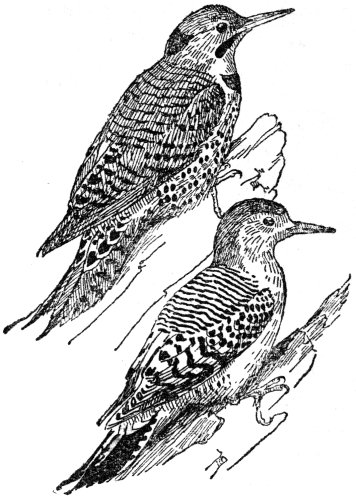
Northern Flicker Red-bellied Woodpecker
The Flicker is very fond of ants. Patiently it will sit on an ant-hill, probing its long, saliva-covered tongue down into the burrow, drawing the insects out and eating them by the dozen. It may remain thus at an ant-hill half an hour at a time, filling its gizzard and crop with the insects, whose bites and acid flavor seem not to be objectionable.