Volume 1 — LETTER XXVIII.
Reading edition
DEFINITION OF THE TERM INSECT.
What is an insect? This may seem a strange question after such copious details as have been given in my former Letters of their history and economy, in which it appears to have been taken for granted that you can answer this question. Yet in the scientific road which you are now about to enter, to be able to define these creatures technically is an important first step which calls for attention. You know already that a butterfly is an insect—that a fly, a beetle, a grasshopper, a bug, a bee, a louse, and flea, are insects—that a spider also and centipede go under that name; and this knowledge, which every child likewise possesses, was sufficient for comprehending the subjects upon which I have hitherto written. But now that we are about to take a nearer view of them—to investigate their anatomical and physiological characters more closely—these vague and popular ideas are insufficient. In common language, not only the tribes above mentioned, but most small animals—as worms, slugs, leeches, and many similar creatures, are known by the name of insects. Such latitude, however, cannot be admitted in a scientific view of the subject, in which the class of insects is distinguished from these animals just as strictly as beasts from birds, and birds from reptiles and amphibia, and these again from fishes. Not, indeed, that the just limits of the class have always been clearly understood and marked out. Even when our correspondence first commenced, animals were regarded as belonging to it, which since their internal organization has been more fully explained, are properly separated from it. But it is now agreed on all hands, that an earthworm, a leech, or a slug, is not an insect; and a Naturalist seems almost as much inclined to smile at those who confound them, as Captain Cook at the islanders who confessed their entire ignorance of the nature of cows and horses, but gave him to understand that they knew his sheep and goats to be birds.
You will better comprehend the subsequent definition of the term Insect, after attending to a slight sketch of the chief classifications of the animal kingdom, more especially of the creatures in question, that have been proposed. That of Aristotle stands first. He divides animals into two grand sections, corresponding with the Vertebrata and Invertebrata of modern Zoologists: those, namely, that have blood, and those that have it not[1]:—by this it appears that he only regarded red blood as real blood; and probably did not suspect that there was a true circulation in his Mollusca and other white-blooded animals. His Enaima, or animals that have blood, he divides into Quadrupeds, Birds, Fishes, Cetacea, and Apods or reptiles; though he includes the latter, where they have four legs, amongst the quadrupeds[2]; and his Anaima, or animals without blood, into Malachia, Malacostraca, Ostracoderma, and Entoma. The first of these, the Malachia, he defines as animals that are externally fleshy and internally solid, like the Enaima; and he gives the Sepia as the type of this class, which answers to the Cephalopoda of the moderns. The next, the Malacostraca, synonymous with the Crustacea of Cuvier and Lamarck, are those, he says, which have their solid part without and the fleshy within, and whose shell will not break, but splits, upon collision[3]. The Ostracoderma, corresponding with the Testacea of Linné, he also defines as having their fleshy substance within, and the solid without; but whose shell, as to its fracture, reverses the character of the Malacostraca. He defines his last class Entoma, in Latin Insecta, with which we are principally concerned, as animals whose body is distinguished by incisures, either on its upper or under side, or on both, and has no solid or fleshy substance separate, but something intermediate, their body being equally hard both within and without[4]. This definition would include the Annelida and most other Vermes of Linné, except the Testacea, which accordingly were considered as insects by those Zoologists that intervened between Aristotle and the latter author. The Stagyrite, however, in another place, has expressly excluded all apods[5]. From other passages in his works, it appears that he regarded the Vermes, &c. either as larvæ, or as produced spontaneously and not ex ovo[6].
This definition of an insect, though partly founded on misconception, as well as his primary division of animals in general, is by no means contemptible. If you look at a bee or a fly, you will observe at first sight that its body is insected, being divided as it were into three principal pieces—head, trunk, and abdomen[7]; and if you examine it more narrowly, you will find that the two last of these parts, especially the abdomen, are further subdivided. And this character of insection, or division into segments, more or less present in almost every insect[8], is not to be found (with the exception of the Crustacea, which Aristotle distinguishes by the nature of their integument and its contents) in any of the other classes into which he divided animals without blood. It was on account of this most obvious of their characters, that these little creatures were in Greek named Entoma, and in Latin Insecta; and from the former word, as you know, our favourite science takes the name of Entomology.
Pliny adhering to the definition of Aristotle, as far as it relates to the insection of the animals we are speaking of, expressly includes Apods, as well as Aptera, amongst them[9]; and in this was followed, without any attempt at improvement, by all the entomological writers that intervened between him and the great Aristotle of the moderns, Linné.
This illustrious naturalist, aware of the incorrectness of the primary divisions of the animal kingdom founded upon the presence or absence of blood, establishes his system upon the structure of the heart, and upon the temperature and colour of the circulating fluid. He divided animals into two great sections or sub-kingdoms, each comprising two classes. His first section included those having a heart with two ventricles, two auricles, and warm and red blood, viz. the Mammalia or beasts, and the Aves or birds. His second, those having a heart with one ventricle, one auricle, and cold and red blood, namely, the classes Amphibia, which included reptiles, serpents, &c. and Pisces or fish. His third, those having a heart with one ventricle and no auricle, and cold white sanies in the place of blood, namely, his classes Insecta et Vermes, including the Invertebrate animals of Lamarck. Thus the first of Aristotle's great divisions he increased by the addition of a new and very distinct class, the Amphibia, by which some ground was gained in the science; but as much was lost by his compressing the four classes of which the last consisted into two, by which the natural classes of Cephalopoda and Crustacea merged under Insecta and Vermes. Linné was not aware of the extraordinary fact, that the Cephalopoda have three hearts; and that though the Crustacea and Arachnida have a circulation, Insects have none, or he would never have taken this retrograde step.
Indeed Linné's definition of an Insect is, in many most material points, inapplicable, not only to the Crustacea, but to many other animals included under that denomination. This will appear evident from a very slight examination. Thus it runs: "Polypod animalcula, breathing by lateral spiracles, armed every where with an osseous skin, whose head is furnished with movable sensitive antennæ[10]." Now of this definition only the first member can be applied to the whole class which it is meant to designate; for the entire genus Cancer L., which, with some others, forms the class Crustacea of the moderns, does not respire by spiracles at all, but by gills; and the same in some degree may be said of spiders, scorpions, &c. With the last member of the definition Linné himself must have been aware that a large number of what he conceived to be insects were at variance, as mites, spiders, and many other of his apterous tribes: though from some very recent observations of M. Latreille[11], there seems some ground for thinking, that in these the antennæ are represented by the mandibles, palpi, &c.[12], and to the soft flexible, coriaceous or membranous skin of a vast number of insects, the term cutis ossea is by no means applicable.
Evident as these incongruities are, when the Herculean task which Linné imposed upon himself, and the vastness and variety of his labours, are considered, they become very venial. Indeed, unless he had divided his class Insecta into two or more, it was impossible to define it intelligibly to ordinary readers, otherwise than nearly in the terms which he actually employed; and these characters, restricted and amended by qualifying clauses, are still those to which recurrence must be had in a popular definition of the class, when separated as it ought to be from the Crustacea and Arachnida.
Pennant, Brisson, and other zoologists, who, attending to nature rather than system, saw the impropriety of uniting a crab or a lobster in the same class with a bee or a beetle, long since assigned the Crustacea their ancient distinct rank. "But these changes," as Latreille observes[13], "being only founded upon external characters, might be deemed arbitrary; and to fix our opinion, it was necessary to have recourse to a decisive authority—the internal and comparative organization of these animals." It results from the observations of the most profound comparative anatomist of our age, M. Cuvier, that the Crustacea and Arachnida differ from insects properly so called, and particularly from those that are furnished with wings, in having a complete system of circulation, a different mode of respiration, and that they have a more perfect organization. Influenced by these motives, both Cuvier and Lamarck have considered them as forming two classes separate from insects. Treviranus, led by considerations founded on the organs of circulation, of respiration, and of generation, is of opinion that spiders and scorpions ought to form one class with the Crustacea: he observes, however, that the nervous system of all three is very dissimilar; and that in an arrangement founded on this circumstance, the organs of motion, and the external shape, even spiders and scorpions must be placed in different classes[14].
It is to be observed with regard to the Arachnida of the French school, that the class as laid down by them includes several animals that have no circulation, and breathe by tracheæ, of which description are the mites (Acarus L.), and the harvest-men (Phalangium L.) &c.; and therefore it has been divided into two orders, Pulmonaria and Tracheana; but if the definition from the internal organization be adhered to, the latter should either remain with the class Insecta, or form a new one by themselves. Yet the animals that compose the Trachean order of Arachnida, their external form considered, are certainly much more nearly related to the spiders and scorpions than to any members of the class Insecta at present known. This circumstance, perhaps, may seem to throw some doubt upon the modern system of classification.
I must further observe, that the assertion of Treviranus, which appears to intimate that the respiration of the pulmonary Arachnida is the same with that of the Crustacea, is not quite correct, since in the latter the branchiæ or gills are external, and in the former internal, the air entering by spiracles before it acts upon them[15].
It may not be amiss in this place to lay before you the principal points in which the Crustacea and Arachnida agree with Insecta, and also those in which they differ.
The Crustacea agree with Insecta in having a body divided into segments, furnished with jointed legs, compound eyes, and antennæ. Their nervous system also is not materially different, and they are both oviparous. They differ from them in having the greater insections of the body less strongly marked; in the greater number of legs on the trunk, the anterior ones performing the office of maxillæ: in their eyes usually on a moveable footstalk: their palpigerous mandibles; and their four antennæ at least in the great majority. But the principal difference consists in the internal organization and the fountains of vitality; for the Crustacea have a double circulation, the fountain of which is a heart in the middle of their thorax[16]. They have too a kind of gizzard and liver, at least the Decapods[17], and their respiration is by gills. Genuine insects terminate their existence after they have laid their eggs[18]; but the Crustacea live longer, and lay more than once.
The Arachnida will be found to differ from insects more widely than even the Crustacea. They agree in their jointed legs and palpi; immoveable eyes; and in being covered with a coriaceous or corneous integument: but they differ in having a system of circulation; gills instead of tracheæ; their organs of generation double; and the females lay more than once in their lives. Their head also is not distinct from the trunk as in insects; they have no compound eyes; and their antennæ, if we admit the opinion on this head of MM. Latreille and Treviranus, that they have representatives of these organs, differ totally in structure, situation, and use, from those of the great body of insects. In the Araneidæ or Spiders, their body seems to have no segments or incisure but that which separates the abdomen from the trunk; and in the Scorpionidæ they are observable only in the abdomen. Other particulars might be enumerated in which these two classes differ from insects; but these will be sufficient to convince you that Aristotle and MM. Cuvier and Lamarck were justified in separating them.
The two last-mentioned authors made further improvements in Zoology. The latter, from the consideration of the general structure of animals, perceiving that Aristotle's Enaima were distinguished from his Anaima, by being built as it were upon a vertebral column, very judiciously changed the denomination, which was indeed improper, of "The Philosopher's" two sub-kingdoms, into that of Vertebrata or animals that have a vertebral column, and Invertebrata or those that have no vertebral column. These he distributes into three primary divisions according to their supposed degrees of intelligence—Thus:
* Apathetic Animals. 1. Infusoria.
2. Polypi.
3. Radiata.
4. Vermes.
** Sensitive Animals. (Epizoaria.)
5. Insecta.
6. Arachnida.
7. Crustacea.
8. Annelida.
9. Cirrhipeda.
10. Mollusca.
*** Intelligent Animals. 11. Pisces.
12. Reptilia.
13. Aves.
14. Mammalia.[19]
Profiting by the light afforded by the Aristotelian system, this eminent zoologist improved, we see, upon that of Linné, by resolving his Insecta into three classes, and his Vermes into seven, interposing the Linnean Insecta between the four first and three last, in which he was not so happy, since as to sense insects should certainly occupy the place he has here assigned to the Mollusca.
In the work from which I have taken this statement of Lamarck's system, that acute writer has given a sketch of another method of arrangement, in which he has made the first deviation from the beaten track of an unbroken and unbranching series. In the Supplement to the first volume, he has distributed the Invertebrata in a double subramose series—one consisting of articulate, and the other of inarticulate animals[20].
Upon Lamarck's system, most of the modern ones, with some variation, are founded. There is one, however, by a learned countryman of ours, that is more unique, sui generis, and I may add profound, than any that has yet appeared. I am speaking of that, you will perceive, of which our friend Mr. Wm. MacLeay has given a detailed statement in his Horæ Entomologicæ. In this he goes even far beyond what Lamarck has attempted in the above sketch, and substantiates his claim to be considered as one of those original thinkers, rari nantes in gurgite vasto, that do not appear every day. The following are the principal bases of his system.
1. That all natural groups, whether kingdoms or any subdivision of them, return into themselves; a distribution which he expresses by circles.
2. That each of these circles is formed precisely of five groups, each of which is resolvable into five other smaller groups, and so on till you reach the extreme term of such division.
3. That proximate circles or larger groups are connected by the intervention of lesser groups, which he denominates osculant.
4. That there are relations of analogy between the corresponding points of contiguous circles.
This system he has represented by tables of circles inscribed with the five primary divisions of each group. His first table exhibits a general view of organized matter as distributed in the animal and vegetable kingdoms—Thus:
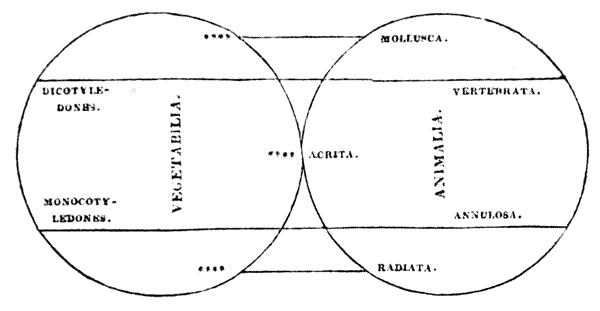
Our learned author here divides the animal kingdom into what may be denominated five sub-kingdoms or provinces, in three of which (with the exception of the Crustacea and Arachnida belonging to his Annulosa) no circulation of blood is visible, but which obtains in the rest. These he names—
1. Acrita, consisting of the Infusory Animals, the Polypi, the Corallines, the Tæniæ, and the least organized of the Intestinal Worms.
2. Radiata, including the Jelly-fish, Star-fish, Echini, and some others.
3. Annulosa, consisting of Insecta, Arachnida, and Crustacea.
4. Vertebrata, consisting of Beasts, Birds, Reptiles, Amphibia, and Fishes.
5. Mollusca, including the numerous tribes of shell-fish, land-shells, slugs, &c., which, from their mucous or gelatinous substance, from their nervous system and the imperfection of their senses, return again to the Acrita, though connected with the Vertebrata by having a heart and circulation.
His next set of circles shows the sub-division of these five sub-kingdoms into classes—Thus:
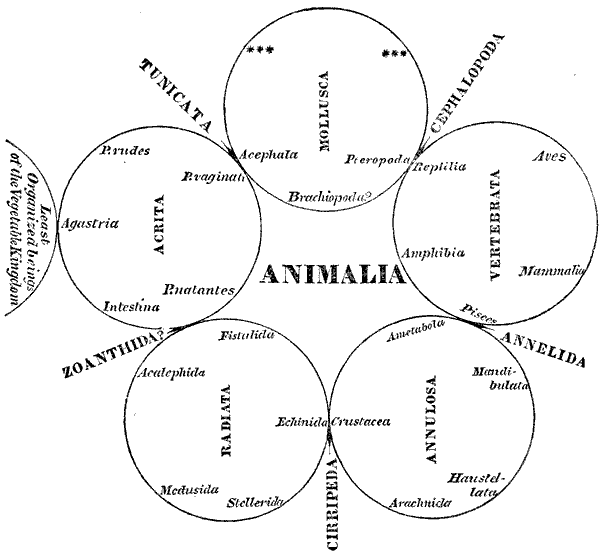
In this scheme the osculant classes are those placed between the circles. In the Mollusca circle two classes are still wanting to complete the quinary arrangement of that sub-kingdom. I am not sufficiently conversant with the details of the animal kingdom at large to hazard any decided opinion upon Mr. MacLeay's whole system, or to ascertain whether all these classes are sufficiently distinct[21]. My sentiments with regard to those of the Annulosa I shall state to you hereafter.
Upon a future occasion I shall consider more at large the station to which insects seem entitled in a system of invertebrate animals, which will not accord exactly with that assigned by MM. Cuvier and Lamarck. But I am now in a field in which I have no intention to expatiate further, than as it is connected with the subject of the present letter. I shall therefore confine myself in what I have more to say to the definitions of Insecta that have been given by modern authors, beginning with that of the zoologist last mentioned. Insects form a part of his second group, which he terms sensitive animals (animaux sensibles), which group he thus defines: "They are sentient, but obtain from their sensations only perceptions of objects—a kind of simple ideas which they cannot combine to obtain complex ones. Charact. No vertebral column; a brain, and most commonly an elongated medullary mass; some distinct senses; the organs of movement attached under the skin: form symmetrical, by parts, in pairs[22]." This division of animals, from the kind and degree of sense and intelligence that they possess, seems rather fanciful than founded in nature, since many insects show a greater portion of them than many vertebrate animals. Compare in this respect a bee with a tortoise[23]. Lamarck divides his group of animaux sensibles into two sections, namely, Articulated animals, exhibiting segments or articulations in all or some of their parts; and Inarticulatcd animals, exhibiting neither segments nor articulations in any of their parts. Insecta, Arachnida, and Crustacea, belong to the first of these sections, which he defines as "those whose body is divided into segments, and which are furnished with jointed legs bent at the articulations[24]." Insecta he defines—"Articulate animals, undergoing various metamorphoses, or acquiring new kinds of parts—having, in their perfect state, six feet, two antennæ, two compound eyes, and a corneous skin. The majority acquiring wings. Respiration by spiracles (stigmates), and two vascular opposite chords, divided by plexus, and constituting aeriferous tracheæ, which extend every where. A small brain at the anterior extremity of a longitudinal knotty marrow, with nerves. No system of circulation, no conglomerate glands. Generation oviparous: two distinct sexes. A single sexual union in the whole course of life[25]." Arachnida he defines—"Oviparous animals, having at all times jointed legs, undergoing no metamorphosis, and never acquiring new kinds of parts. Respiration tracheal or branchial: the openings for the entrance of the air spiraculiform (stigmatiformes). A heart and circulation beginning in many. The majority couple often in the course of life[26]." I shall next add his definition of Crustacea: "Oviparous, articulated, apterous animals, with a crustaceous integument more or less solid, having jointed legs; eyes either pedunculate or sessile, and most commonly four antennæ, with a maxilliferous mouth seldom rostriform; maxillæ in many pairs placed one over the other; scarcely any under-lip; no spiraculiform openings for respiration; five or seven pair of legs; a longitudinal knotty marrow terminated anteriorly by a small brain. A heart and vessels for circulation. Respiration branchial with external branchiæ, sometimes hid under the sides of the shell of the thorax, or shut in prominent parts; sometimes uncovered, and in general adhering to particular legs or to the tail. Each sex usually double[27]."
I have given Lamarck's definitions of these three classes, all considered as Insecta by Linné, that by comparing them together you may be better enabled to appreciate the system of this author. On looking over the characters of the Arachnida as here given, you will see at once that it consists of heterogeneous animals—for in fact he includes in this class not only the Trachean Arachnida of Latreille, but the Ametabolia of Dr. Leach, or the Hexapod Aptera, and the Myriapoda.
I shall next copy for you Latreille's latest definition of Insecta and Arachnida.
"Insecta: A single dorsal vessel representing the heart: two trunks of tracheæ running the whole length of the body, and opening externally by numerous spiracles; two antennæ; very often upper appendages for flight, indicating the metamorphosis to which the animal is subject when young; legs most commonly reduced to six. Arachnida: Distinguished from Crustacea by having their respiratory organs always internal, opening on the sides of the abdomen or thorax to receive the respirable fluid. Sometimes these organs perform the office of lungs, and then the circulation takes place by means of a dorsal vessel, which sends forth arterial, and receives venose branches. Sometimes they are tracheæ or air-vessels, which, as in the class Insecta, replace those of circulation. These have only the vestige of a heart, or a dorsal vessel alternately contracting and sending forth no branch. The absence of antennæ, the reunion of the head with the thorax, a simple trachea but ramified and almost radiating, serve to distinguish these last Arachnida, or the most imperfect of insects, which respire only by tracheæ[28]." Under this head he observes—"Of all these characters, the most easy to seize and the most certain would doubtless be, if there were no mistake in it, that of the absence of antennæ; but later and comparative researches, confirmed by analogy, have convinced me, that these organs, under particular modifications it is true, and which have misled the attention of naturalists, do exist[29]:" and he supposes, from the situation and direction of the mandibles of the Arachnida, corresponding with that of the intermediate pair of antennæ in Crustacea, that they really represent the latter organs. If this supposition be admitted, their use is wholly changed; the palpi, in fact, executing the functions of antennæ, which probably induced Treviranus to call them Fühlhörner (Feelinghorns). Perhaps these last may be regarded as in some sort representing the external antennæ of the Crustacea? With regard to Insecta, their antennæ seem to disappear in the Pupiparæ Latr., or the genus Hippobosca L.
The above definitions of the Arachnida by these two celebrated authors, appear to me the reverse of satisfactory. When we are told of animals included in it, that some breathe by gills and others by tracheæ, that some have a heart and circulation and others not, we are immediately struck by the incongruity, and are led to suspect that animals differing so widely in the fountains of life ought not to be associated in the same class. A learned zoologist of our own country, Dr. Leach, seems to have made a nearer approach to a classification in accordance with the internal organization, by excluding from Arachnida the Acari and Myriapoda.
Sub-kingdom Annulata Cuv.
* Gills for respiration. Classes.
Legs sixteen: Antennæ two or four 1 Crustacea.
** Sacs for respiration.
Legs twelve: Antennæ none 3 Arachnöidea.
*** Tracheæ for respiration.
a. No Antennæ.
4 Acari.
b. Two Antennæ.
Six thoracic legs: Abdomen also bearing legs 2 Myriapoda.
Six thoracic legs: No abdominal legs 5 Insecta[30].
Mr. MacLeay, on whose system I shall now say a few words, divides his sub-kingdom Annulosa into five classes, namely, Crustacea, Ametabola, Mandibulata, Haustellata, Arachnida. From the Crustacea he goes by the genus Porcellio Latr. to Iulus[31], which begins his Ametabola: these he connects with the Mandibulata, by Nirmus, which he thinks approaches some of the corticarious Coleoptera[32]. This class he appears to leave by the Trichoptera Kirby, and so enters his Haustellata by the Lepidoptera[33], and leaves it again by the Diptera by means of the Pupiparæ Latr., especially Nycteribia, connecting this class with the Arachnida, which he enters by the Hexapod Acari L.[34], and these last he appears to leave by the Araneidæ, and to enter the Crustacea by the Decapods[35]: thus making good his circle of classes, or a series of Annulose animals returning into itself. Mr. MacLeay's whole system upon paper appears very harmonious and consistent, and bears a most seducing aspect of verisimilitude; but it has not yet been so thoroughly weighed, discussed, and sifted, as to justify our adopting it in toto at present: should it, however, upon an impartial and thorough investigation, come forth from the furnace as gold, and be found to correspond with the actual state of things in nature, my objections, which rest only upon some parts of his arrangement of Annulosa, would soon vanish. Some of those objections I will state here, and some will come in better when I treat of the Systems of Entomology. My first objection is, that his Ametabola, Mandibulata, and Haustellata, approach much nearer to each other than they do to the other two classes of his circle, or than even these last to each other; so that under this view it should primarily consist of three greater groups, resolvable, it may be, into five smaller ones. My next objection is, that he has also considered the Trachean and Pulmonary Arachnida as forming one class. Whether an animal breathes by gills or tracheæ, or has a circulation or not, is surely as strong a reason for considering those so distinguished as belonging to different classes, as the taking of their food by suction or by manducation is, for separating others to the full as much or more nearly related as to their external structure. But of this more hereafter. I cannot help, as a last objection, lamenting that our learned author has rejected from his system a term consecrated from the most remote antiquity, and which, even admitting his arrangement, might have been substituted for Annulosa, a name borrowed by Scaliger from Albertus Magnus, neither of whom, in Entomology, is an authority to weigh against Aristotle, from whom we derive the term Insecta, in Greek Εντομα.
As Fabricius did not alter Linné's class Insecta, but merely broke up his orders into new ones, which he named classes, I shall give you a detail of the alterations he introduced into the science in a future letter.
Having stated what my predecessors have done in classification, I shall next proceed to lay before you my own sentiments as to—What is an insect. Since our correspondence commenced, the Arachnida, principally on account of their internal organization, have been excluded from bearing that name, carrying with them, as we have seen, several tribes, which as yet have not been discovered to differ materially in that respect from the present Insecta: for the sake, therefore, of convenience and consistency, that I may, as far as the case will admit, adhere to the Horatian maxim
—— Servetur ad imum Qualis ab incepto processerit et sibi constet,
I shall regard as Insects all those Annulosa that respire by tracheæ[36] and have no circulation, considering the Trachean Arachnida and the Myriapoda for the present as sub-classes, the one bordering upon the Arachnida, and the other upon the Crustacea. Some of these I am ready to own seem separated by an interval sufficiently wide from the Hexapods, which may be regarded as more peculiarly entitled to the denomination of Insects. The most striking differences will be found in the coalition of the head with the trunk in some (Phalangidæ), and the disappearance of the annulose form of the body in others (Acarus L.), so that the legs only are jointed[37]. Yet an approach to such structure may be traced in some Hexapods; for instance, the coalition of the head and trunk in Melophagus, Latr., and that of the trunk and abdomen in Sminthurus, Latr.[38] The Myriapoda exhibit other remarkable differences; though their head and trunk are distinct, the former antenniferous, and their body annulose, the abdomen as well as the trunk is furnished with legs, sometimes amounting to hundreds; but even to this a tendency has been observed in some Hexapods[39]. If you examine a specimen of Machilis polypoda, an insect related to the common sugar-louse (Lepisma saccharina), you will find that the abdomen is furnished with a double series of elastic appendages, which, being instruments of motion, may be regarded as representing legs. It is worthy of notice, that the Myriapoda when first disclosed from the egg have never more than six legs[40], and keep acquiring additional pairs of them and additional segments to their abdomen as they change their skins: and it is equally remarkable, that many Hexapods are subject to a law in some degree the very reverse of this, having many abdominal legs in their first state, and losing them all in their last. The union of the head with the trunk in the Trachean Arachnida has been regarded as almost an unanswerable argument, in spite of their different internal organization, for including them in the same class with the Pulmonary Arachnida; but the case of Galeodes, which, though furnished with gills, (as an eminent Russian Entomologist Dr. G. Fischer is reported to have discovered,) implying also a circulation, and evidently belonging to the last-mentioned class, has nevertheless a distinct thorax consisting of more than one piece, to which are affixed only six legs[41], proves that even this circumstance possesses no weight when set against the organization. If it was a difference in this respect, that proved the Crustacea classically distinct from Insecta—that likewise was the principal reason for the separation also of the Arachnida—it seems to follow that it ought also to furnish an argument equally cogent for considering the Trachean Arachnida, as well as the Myriapoda, distinct from the Pulmonary.
Another difference between the tribes in question is that of their metamorphosis; and this appears to have had great weight with Lamarck, inducing him to include in his Arachnida, not only the Tracheans and Myriapods, but even the apterous Hexapods, except Pulex, or the Anoplura and Thysanura of modern authors. But the metamorphosis alone, unless supported by the internal organization, will I think scarcely be deemed a sufficient reason for separating from each other tribes agreeing in that respect, and placing them with others with which they disagree. The metamorphosis in some of the Hexapods (Lepidoptera) consists in the loss of legs, the acquisition of wings, a great change in the oral organs and in the general form; in others (some Coleoptera), in the acquisition only of wings and a change of shape, the oral organs remaining much the same; in others again (Curculio L.), in the acquisition of six legs and wings and a change of form; in the flea, in the acquisition of six legs and a change of form only; in the Orthoptera, Hemiptera, &c. in the mere acquisition of wings; in the Libellulidæ, in the loss of the mask that covers the mouth and the acquisition of wings; in the Diptera, in the acquisition of six legs, wings, a change of the oral organs and of the form; in some of the Octopods (Acarus L.), in the acquisition of a pair of legs; and in others (Phalangium and Aranea L.), solely in a modification of them as to their proportions; in the Myriapods, the alteration that takes place in this respect is considerable; a large number of pairs of legs is acquired and many additional abdominal segments, and the proportion which the abdomen bears to the whole insect is quite altered. In all these cases there is a change more or less, either partial or general, of the original shape or organs of the animal; and with regard to their metamorphosis, there is a greater difference between a young and adult Iulus than between a young and adult grasshopper or bug: so that if the metamorphosis, per se, be assumed as a principal regulator of the class, the grasshopper or bug have as little claim to belong to it as the Iulus.
M. Lamarck lays considerable stress upon another character—That Insecta engender only once in the course of their lives, and Arachnida more than once. But this, if examined, will be found to be confined chiefly to the Pulmonary Arachnida, the Tracheans following the law of Insecta in this respect[42].
You may perhaps object that the bringing of the Trachean Arachnida and the Myriapoda into the class Insecta will render the approximation of them to a natural arrangement more difficult, since it will be impossible at the same time to connect the Myriapods with the Crustacea, and the Trachean with the genuine Arachnida. I admit the validity of your objection, but by no arrangement of insects in a simple series can we attain this object: the difficulty, however, may perhaps be obviated in this way. The distribution of organized matter, to adopt Mr. Wm. MacLeay's metaphor[43], begins in a dichotomy, constituting the animal and vegetable branches of the great tree of nature, and from these two great branches, by means of infinite ramifications, the whole system is formed, and, what is remarkable, these branches unite again so as to represent a series returning into itself, a discovery due to the patient investigation and acumen of our learned friend just mentioned. Now, in considering the Aptera order, we find at first setting out from the Hexapods, a dichotomy, where the Anoplura Leach branch off on the one side, and the Thysanura Latr. on the other—the former, by means of the Pediculidæ, taking their food by suction, particularly Phthirus Leach, or the Morpion (in which the segments of the trunk and abdomen become indistinct[44]) approach the Octopods by the hexapod Acari L.—the latter by Machilis polypoda tending towards the Myriapods. In the Octopod branch a further dichotomy takes place, from which you proceed on one side to the Araneidæ in the Arachnida, by Phalangium, &c.; and in the other by Chelifer, &c. to Scorpio. Again, the Myriapod branch also divides, going by the Iulidæ to one branch of the Isopod Crustacea, and by the Scolopendridæ to another.
But there is another view of this subject before alluded to, which may be repeated here, and which seems to prove that the types of form in one natural group or class are reproduced in another; this appears to result from the following parallel series:
Neuropterous Larvæ. Aptera. Arachnida. Crustacea.
Psocus Hexapoda Galeodes Larunda.
Myrmeleon Phalangium Aranea Decapoda brachyura.
Octopoda
Panorpa? Chelifer Scorpio Decapoda macroura. Thalassina Scorpio especially.
Ephemera Myriapoda ***** Isopoda.
No type representing the Myriapoda has yet been discovered in the Arachnida class; but I have little doubt of its existence. You will observe that the analogies between the larvæ of the winged orders and the Aptera were first noticed by Mr. W. MacLeay[45]. It is probable that these parallel series of representatives of each other might be increased, as well as the numbers in the respective columns.
What I have said will, I trust, sufficiently justify me for making at present no more material alterations in the classification I long since proposed to you[46]; I shall, therefore, now proceed to define the objects I consider as Insecta; but I shall first observe—that as Latreille considers the branchiopod Crustacea or Entomostraca of Müller as entitled to the denomination of Crustaceo-Arachnida[47]; so his Trachean Arachnida might be called Arachnida-Insecta, and his Myriapoda, Crustaceo-Insecta.
Sub-kingdom—Annulosa[48].
Class—Insecta.
First Definition—From their external Organization.
Body—divided into Head—Trunk—Abdomen. Head.—Principal seat of the organs of sensation. Organs of sight. Immoveable eyes, simple or compound, varying in number. Organs of hearing uncertain, probably connected with the antennæ. Organ of taste. Ligula or palate within the mouth, accompanied by the organs of manducation—a pair of mandibles and maxillæ and an upper and lower lip, or their representatives. Organs of touch. Principally two jointed antennæ or their representatives, and four jointed feelers—two maxillary and two labial. Trunk. Principal seat of the organs of motion. Organs of walking, running, or jumping. Six or eight jointed thoracic legs, in pairs. Organs of flight. Four wings or their representatives, mostly with branching nervures containing air-vessels; found in the majority of the class. Organs (external) of respiration. A double set of lateral spiracles, some for expiration. Abdomen. Principal seat of the organs of generation. Organs of motion. In the Myriapods many pairs of acquired legs; in the Thysanura elastic ventral or caudal appendages. Organs of respiration. A double series of lateral spiracles for inspiration in the majority; in some only a single series, and in others only a single pair. Organs of generation those common to the Vertebrata, but retractile within the body, attended usually by various anal appendages, particularly a forceps in the males, and an ovipositor in the females.
Second Definition—From their internal Organization.
Sensation. Nervous System. A small brain usually subbilobed, crowning a knotty double medullary chord; nerves proceeding from the brain and other ganglions to all parts of the body.
Circulation. Heart replaced by a simple alternately contracting dorsal vessel or pseudocardia, without arteries or veins, but filled with a white cold sanies.
Respiration. Lungs replaced by tracheæ, which receive the air from the spiracles, and distribute it by bronchiæ infinitely ramified.
Digestion. Liver and biliary vessels in most replaced by from 2 to + 150 floating hepatic filaments opening into the space between the two skins of the intestinal canal below the pylorus.
Generation. Internal organs. Males—Vasa deferentia, and vesiculæ seminales, and the other ordinary organs. Females—Ovary usually bipartite, with palmate lobes; genital organs single and mostly anal; one sexual union impregnates the female for her life. Development. In their passage to their adult state, after they have left the egg, insects undergo several simultaneous changes of their integument or successive moults, and the majority assume three distinct forms, with distinct organs, which appear as rudiments in their second state, and are completely developed in their last.
In defining the Arachnida I shall only mention those particulars in which they differ from Insectæ in their external anatomy.
Class—Arachnida.
Body. Head and Trunk usually not separated by a suture. Eyes. Two to eight, not lateral. Mandibles cheliform or unguiculate, representing the interior pair of the antennæ of the Crustacea. Palpi pediform or cheliform. Trunk. Legs eight or their representatives: tibiæ mostly consisting of two joints. Abdomen with from two to eight spiracles.
Sensation. Nervous System. A small bilobed brain crowning a double, knotty, medullary chord; nerves proceeding from the brain and other ganglions to all parts of the body.
Circulation. Heart unilocular, inaurite, with a system of circulation by arteries and veins; blood a cold white sanies.
Respiration. Lungs replaced by internal gills receiving the air by spiracles.
Digestion. Liver, consisting of conglomerate glands, and enveloping the intestines[49]; hepatic ducts.
Generation. Genital organs double, ventral; more than one sexual union in the course of life.
The external characters in this class are the same almost in every respect as those which distinguish the Phalangidæ, the whole difference consisting almost in the systems of circulation, respiration, and digestion. Perhaps some future anatomist may discover in the tribe just mentioned, that there is a nearer agreement between them and the Arachnida in these systems than is at present suspected, which would prove them true Arachnida. I am inclined to think that Phrynus and Gonyleptes, &c. breathe by branchial spiracles; but having no opportunity of examining living specimens, I dare not speak with any confidence on the subject.
Having thus given you a view of the most important diagnostics by which what we have all along called Insects may scientifically be distinguished from other invertebrate animals, it may not be without use, if, under this head, I take a more popular and familiar view of the subject, and say something upon those distinctions which may attract the attention of the more common observer.
The notion of diminutive size, particularly as compared with vertebrate animals, seems more frequently attached to the idea of an insect than any other; and this notion is generally correct, for one insect that is bigger than the least of the above animals, thousands and thousands are vastly smaller: but there exist some that are considerably larger, whether we take length or bulk into consideration, and this in almost every order. To prove this most effectually, and that you may have a synoptical view of the comparative size of the larger insects of the different orders and tribes, I now lay before you a table of the dimensions of such of the largest as I have had an opportunity of measuring, including particularly those giants that are natives of the British isles.
Order and Family. Species. Length. Breadth. Expansion of Wings.
Inches. Inches. Longitudinal. Transverse.
Inches. Inches.
COLEOPTERA.
Cicindelidæ Manticora grandis 15⁄8 7⁄10
Anthiadæ Anthia sexguttata 17⁄8 7⁄10
Carabidæ Carabus scabrosus 1¾ 8⁄10
Dytiscidæ Dytiscus latissimus 1½ 1
Staphylinidæ Staphylinus olens Br. 1½ 5⁄10
Hydrophilidæ Hydrophilus piceus Br. 1¾ 7⁄8
Buprestidæ Buprestis grandis 2½ 1
———–– bicolor 25⁄12 ¾
Dynastidæ Dynastes Hercules 4½ Horns included 2½
Megasoma Actæon K. 4¼ Horns included 2¼
Cetoniadæ Goliathus giganteus 37⁄10 19⁄10
Lucanidæ Lucanus Cervus Br. 2 Mandibles included 7⁄10
Tenebrionidæ Tenebrio grandis? 15⁄8 7⁄10
Brentidæ Brentus N. S. Mus. MacLeay 21⁄10 2⁄12
Calandridæ Calandra N. S. Mus. MacLeay 35⁄8 1
Brachyceridæ Brachycerus apterus 15⁄8 7⁄8
—————– Toxicophagus Burch. 2 9⁄10
Prionidæ Prionus grandis 6½ 23⁄8
———– cervicornis 5½ Mandibles included 15⁄8
Do. 4¼ ———–– excluded
Lamiadæ Lamia grandis 2¾ 1 nearly
Chrysomelidæ Chrysomela N. S. MacLeay 1¼ ¾
Hispidæ Alurnus grossus 13⁄10 6⁄10
Erotylidæ Erotylus grandis 16⁄10 nearly 6⁄10
DERMAPTERA.
Labidura gigantea Br.? 1¼ nearly, Forceps included
Forficula N. S. N. Holl. 14⁄5 2⁄5 Do.
ORTHOPTERA.
Blattidæ Blatta gigantea 25⁄8 1½
——– N. S. MacLeay 33⁄10 1½
Phasmidæ Phasma grandis 2 about 17⁄8
——– australensis K. 8½ ¾ 7½ 2¾
Achetidæ Gryllotalpa vulgaris Br. 1¾
Locustidæ Locusta Dux 43⁄8 8¼ 2
Conocephalidæ Acrida viridissima Br. 21⁄10
HEMIPTERA.
*
Fulgoridæ Fulgora laternaria 3 nearly 56⁄10 2
Cicadiadæ Cicada N. S. N. Holland 21⁄10 Wings excluded 5½
** Do. 28⁄10 Wings included
Nepidæ Belostoma grandis 3 56⁄10 13⁄10
Lygeidæ Lygæus Pharaonis 2 1
LEPIDOPTERA.
*
Papilionidæ Papilio Remus 8¾ 35⁄8
——— Priamus 2½ 76⁄10 3
——— Machaon Br. 1 3½ nearly 1½ Tail excluded
Nymphalidæ Morpho Teucer 17⁄10 7½ 4½
Sphingidæ Sphinx N. S. Brazil 2½ 7⁄10 6½
——— Atropos Br. 2 5⁄8 4¾ 1½
***
Bombycidæ Attacus Atlas 1¾ 8¾ 5½
Gastropacha quercifolia Br. 1¼ nearly 3½ 1¼
Noctuidæ Erebus Strix 2¼ 10¾ 3¼
NEUROPTERA.
Agrionidæ Agrion lineare 5½ 5
Æshnidæ Anax Imperator Leach—Br. 3½
Myrmeleonidæ Myrmeleon libelluloides 2 5
Semblidæ Corydalis cornuta 2¾ Mandibles included 5¼
Do. 2 Mandibles excluded
HYMENOPTERA.
Scoliadæ Scolia cyanipennis 2
Pompilidæ Pompilus ocellatus 21⁄8 3½
Vespidæ Cyclostoma grandis N. S. K. China 2
Xylocopidæ Xylocopa Nigrita 15⁄8
DIPTERA.
Tipulidæ Tipula sinuata Br. 13⁄8 2½
Asilidæ New Gen. Brazil. 1¾
Muscidæ Echinomyia grossa Br. ¾
Tabanidæ Tabanus N. S. Mus. Drury 11⁄8
———– bovinus Br. 1 nearly
APTERA. Expansion of Legs.
* Inches.
Scolopendridæ Scolopendra N. S. Mus. MacLeay 13 7⁄8
Scolopendridæ Scolopendra N. S. Mus. MacLeay 13 7⁄8
**
Iulidæ Iulus N. S. Do. 5½ 8⁄10
Phalangidæ Gonyleptes N. S. Brazil 3⁄8 6
Class.
ARACHNIDA.
Scorpionidæ Scorpio N. S. MacLeay 7 nearly, Chelæ excluded
Araneidæ Mygale N. S. Do. 3 1½ 11
From this table you see that several insects included in it exceed some of the smallest Vertebrata in bulk. In the Mammalia, the Sorex Araneus, called by the common people here the Ranny, is not more than two inches long excluding the tail; and the Mus messorius, or harvest-mouse, peculiar to the southern counties of England, is still more diminutive: so that to these little animals, the larger Dynastidæ, Goliathi, and Prioni, &c., appear giants, and may compete with the mole in size. Even some of the beetles of our own country, as the great Hydrophilus, the stag-beetle, &c., are more bulky than the two first-named quadrupeds. Amongst the birds, many Picæ, Passeres, &c., yield to several insects in dimensions, and their wings when expanded do not extend so far as those of not a few Lepidoptera. The great owl-moth of Brazil (Erebus Strix) in this respect is a larger fowl than the quail. Those beautiful little creatures, the humming-birds (Trochilus L.), the peculiar ornament and life of tropical gardens, which emulate the most splendid butterflies in the brilliancy of their plumage, are smaller than a considerable number of insects in almost every order, and even than some of those that are natives of Britain. Various reptiles also are much inferior in size to many of the insects of the above table. The smallest lizard of this country would be outweighed by the great British beetles lately mentioned, and the mole-cricket (Gryllotalpa vulgaris); and some of the serpent tribe are smaller than the larger Scolopendræ and Iuli. Amongst the fishes also, though some are so enormous in bulk, others in this respect yield the palm to several insects. The minnow and the stickleback that frequent our own pools and streams are considerably inferior in size to some of our water beetles.
In looking over the table, and comparing the different species that compose it with each other, you will perceive that the largest insects of the two sections of Hemiptera, of the Lepidoptera as to their body merely, of the Hymenoptera and Diptera, in general size fall considerably short of those of the other orders; and that certain individuals of the Orthoptera and Aptera bear away the palm in this respect from all the rest. In the Coleoptera the giants, with the exception of the Goliathi, are chiefly to be found amongst the timber devourers in the Lamellicorn and Capricorn tribes. Of orthopterous insects the Phasmidæ present the most striking examples of magnitude; and in the Neuroptera, the Agrionidæ of great length.
It is worthy of remark here, that although the tropical species of a genus usually exceed those of colder climates in size, the Gryllotalpa of Brazil is very considerably smaller than that of Europe: whether this is the case with the rest of the cricket tribe I have not had an opportunity of ascertaining. The Lepidoptera, though often remarkable for the vast expansion of their "sail-broad vans," if you consider only their bodies, never attain to gigantic bulk. Even the hawk-moths (Sphinx L.), though usually very robust, make no approach to the size of the great beetles, or the length of some of the spectres (Phasma) and dragon-flies (Agrionidæ). With regard to the superficial contents of their wings, a considerable difference obtains in different species where they expand to the same length—for the secondary wings are sometimes smaller than the primary, and sometimes they equal them in size. In some instances, also, the latter although long are narrow, and in others they are nearly as wide as long: regard, therefore, should be had to their expansion both ways. In the Hymenoptera and Diptera, the principal giants are to be found in the predaceous or blood-sucking tribes, as Scolia, the Sphecidæ, Pompilidæ, Vespidæ, &c., belonging to the former order; and the Asilidæ and Tabanidæ to the latter. The true and false humble bees (Bombus and Xylocopa) and the fly tribe (Muscidæ), though they sometimes attain to considerable size, scarcely afford an exception to this observation. Amongst the Aptera none of the Hexapods strike us by their magnitude, and few of the Octopods, though the legs of some of the Phalangidæ inclose a vast area. That in the table would with them describe a circle of six inches diameter, though its body is little more than a quarter of an inch in length. The Myriapods exceed most insects in the vast elongation of their body, which with their motion gives them no slight resemblance to the serpents. In the class Arachnida, the bird-spiders (Mygale) are amongst the principal giants, nor do the Scorpions fall far short of them—both of them when alive often alarming the beholder as much by their size as by their aspect.
But as I have before observed, generally speaking, one of the most remarkable characters of the insect world, is the little space they occupy; for though they touch the vertebrate animals and even quadrupeds by their giants, yet more commonly in this feature they go the contrary way, and by their smallest species reach the confines of those microscopic tribes that are at the bottom of the scale of animal life. I possess an undescribed beetle, allied to Silpha minutissima E. B.[50] which, though furnished with elytra, wings, antennæ, legs, and every other organ usually found in the order it belongs to, is absolutely not bigger than the full stop that closes this period. In several other coleopterous genera there are also very minute species, as in Cryptophagus, Anisotoma, Agathidium, &c. I know no orthopterous insect that can be called extremely minute, except that remarkable one found on the Continent in the nests of ants, the Blatta Acervorum of Panzer[51], but now called, I believe, Myrmecophilus: nor indeed any in the Hemiptera, Neuroptera, and Diptera, that approach the extreme limits of visibility: but in the Lepidoptera, the pygmy Tinea occultella is almost invisible except in flight, being scarcely thicker than a horse's hair, and proportionably short; indeed, many others of those lovely Lilliputians, the subcutaneous Tineæ, decorated with bands of gold and silver, and studded with gems and pearls, that in larger species would dazzle the beholder's eye, are in size not much more conspicuous. In the Hymenoptera order, Ichneumon Punctum of Dr. Shaw, which forms so striking a contrast to his giant Phasma dilatatum, being placed together in the same plate; and another that I possess, under the trivial name of Atomos, would elude the searching eye of the entomologist unless when moving upon glass. Linné named the tribe of parasites to which these belong, Minuti, on account of their generally diminutive size. But these little minims, under the superintendence of Providence, are amongst the greatest benefactors of the human race, since they keep within due bounds the various destroyers of our produce.
The number of minute species of insects seems greatly to exceed that of large ones, at least in Europe, of which it may be asserted probably with truth, that two-thirds are under a quarter of an inch in length, and one-third not exceeding much a duodecimal of it. It might hold good perhaps in Coleoptera, Hymenoptera, Diptera, and Aptera: but in Orthoptera, Hemiptera, Neuroptera, and especially Lepidoptera, a large proportion would be found to exceed three lines in length. Neither can it be affirmed of extra-European species, of those at least preserved in cabinets, amongst which it is rare to find an insect less than the fourth of an inch long. This, however, must probably be attributed to the inattention of collectors, who neglect the more minute species.
Though size forms a pretty accurate distinction between insects and the great bulk of vertebrate animals, it affords less assistance in separating them from the invertebrate classes, which are of every size, from the monstrous bulk of some Cephalopoda (cuttle-fish) and Mollusca (shell-fish, &c.) to the invisible infusory animalcule: but external characters, abundantly sufficient for this purpose, may be drawn from the general covering, substance, form, parts, and organs of the body. As I shall enter into pretty full details upon this subject when I come to treat of the external anatomy of insects, I shall here, therefore, only give such a slight and general sketch of the distinctions just mentioned, as will answer the end I have in view. I must here repeat what I have before observed, and what it is necessary that you should always bear in mind, namely, that at the limits of classes and of every other natural group, the characters begin to change, those peculiar to the one group beginning gradually to disappear, and those of the other to show themselves; so that it is impossible almost to draw up a set of characters so precise as exactly in every respect to suit all the members of any natural group.
Whichever way we turn our eyes on the objects of creation, above—below—athwart, analogies meet us in every direction, and it appears clear, that the Book of Nature is a Book of Symbols, in which one thing represents another in endless alternation. And not only does one animal, &c. symbolize another, but even between the parts and organs of one set of animals there is often an analogy as to their situation and use, when there is little or no affinity as to their structure—or again, the analogy is in their situation, without affinity in either structure or use. Thus certain parts in one tribe represent other certain parts of another tribe, though as to their structure there is often a striking disagreement. This is particularly observable between the vertebrate and invertebrate animals. I shall therefore, in my remarks on the general and particular structure of insects, contrast it in its most important points with that of the first-mentioned tribe.
The first thing that strikes us when we look at an insect is its outside covering, or the case that incloses its muscles and internal organs. If we examine it attentively, we find that it is not like the skin of quadrupeds and other Vertebrata, covering the whole external surface of the body; but that in the large majority it consists of several pieces or joints, in this respect resembling the skeleton of the animals just named; and that even in those in which the body appears to have no such segments, as in many of the Mites (Acarus L.), they are to be found in the limbs. This last circumstance, to have externally jointed legs, is the peculiar and most general distinction by which the Insecta of Linné, including the Crustacea, may always be known from the other invertebrate animals[52].
If we proceed further to examine the substance of this crust or covering, though varying in hardness, we shall find it in most cases, if we exclude from our consideration the shells of the Mollusca, &c., better calculated to resist pressure than that of the majority of animals that have no spine. In all the invertebrate tribes, indeed, the muscles, there being no internal skeleton, are attached to this skin or its processes, which of course is firmer than the internal substance; but in insects it is very often rigid and horny, and partially difficult to perforate, seldom exhibiting that softness and flexibility which is found in the cuticle of birds and most quadrupeds. From this conformation it has been sometimes said, that insects carry their bones on the outside of their body, or have an external skeleton. This idea, though not correct in all respects, is strictly so in this—that it affords a general point of support to the muscles, and the whole structure is erected upon it, or rather I should say within it. The difference here between Insects and the Vertebrata seems very wide; but some of the latter make an approach towards it. I allude to the Chelonian Reptiles (Testudo L.), in which the vertebral column becomes external or merges in the upper shell. The cyclostomous fishes also are not very wide of insects as to their integument. But on this subject I shall be more full hereafter.
The forms of insects are so infinitely diversified that they almost distance our powers of conception: in this respect they seem to exceed the fishes and other inhabitants of the ocean, so that endless diversity may be regarded as one of their distinctions. But on all their variations of form the Creator has set his seal of symmetry; so that, if we meet with an animal in the lower orders in which the parts are not symmetrical, we may conclude in general that it is no insect.
But it is by their parts and organs that insects may be most readily distinguished. In the vertebrate animals, the body is usually considered as divided into head, trunk, and limbs, the abdomen forming no part of the skeleton; but in the insect tribes, besides the organs of sense and motion, the body consists of three principal parts—Head, Trunk, and Abdomen—the first, as was before observed, bearing the principal organs of sense and manducation; the second most commonly those of motion; and the third those of generation—the organs of respiration being usually common to both trunk and abdomen. These three primary parts,—though in some insects the head is not separated from the trunk by any suture, as for instance in the Arachnida; and in others, head, trunk, and abdomen form only one piece, as in some mites,—still exist in all, and in the great majority they are separated by incisures more or less deeply marked: this is particularly visible in the Hymenoptera and Diptera, which, in this respect, are formed upon a common model; and in the rest, with the above exceptions, it may be distinctly traced.
The head of insects is clearly analogous to that of vertebrate animals, except in one respect, that they do not breathe by it. It is the seat probably of the same senses as seeing, hearing, smelling, tasting—and more peculiarly perhaps of that of touch. The eyes of insects, though allowed on all hands to be organs of sight, are differently circumstanced in many particulars from those of the animals last mentioned; they are fixed, have neither iris nor pupil, are often compound, and are without eyelids to cover them during sleep or repose; there are usually two compound ones composed of hexagonal facets, but in some instances there are four; and from one to three simple in particular orders. The antennæ of insects in some respects correspond with the ears of the animals we are comparing with them; but whether they convey the vibrations of sound has not been ascertained: that they receive pulses of some kind from the atmosphere I shall prove to you hereafter—so that if insects do not hear with them in one sense, they may, by communicating information, and by aëroscopy, to use Lehman's term, not directly in his sense[53], supply the place of ears, which would render them properly analogous to those organs. That in numbers these remarkable organs are tactors is generally agreed, but this is not their universal use. That insects smell has been often proved; but the organ of this sense has not been ascertained. What has improperly been called the clypeus, or the part terminating the face above the upper lip (labrum), is in the situation of the nose of the Vertebrata, and therefore so far analogous to it, and in some cases even in form: I therefore call it the nose. Whether this part represents the nose by being furnished with what answer the purpose of nostrils, residing somewhere at or above the suture that joins it to the upper lip, I cannot positively affirm; but from the observations of M. P. Huber, with regard to the hive-bee, it appears that at least these insects have the organ of the sense in question somewhere in the vicinity of the mouth, and above the tongue[54]: analogy, therefore, would lead us to look for its site somewhere between the apex of the nose and the upper lip; and in some other cases, which I shall hereafter advert to, there is further reason for thinking that it actually resides at the apex of the nose. The organ of taste in insects, though some have advanced their palpi to that honour, is doubtless in some part within the mouth analogous in a degree to the tongue and palate of the higher animals. The organs of manducation, in what may be deemed the most perfect description of mouth, consist of an upper lip closing the mouth above, a pair of mandibles moving horizontally that close its upper sides, and a lower lip with a pair of maxillæ attached to it, which close the mouth below and on the under sides, both labium and maxillæ being furnished with jointed moveable organs peculiar to annulose pedate animals, called palpi. In some tribes these organs assume a different form, that they may serve for suction; but though in many cases some receive an increment at the expense of others, and a variation in form takes place, none, as M. Savigny has elaborately proved, are totally obliterated or without some representative[55]. The organs now described, except the upper lip, are formed after a quite different type from those of Vertebrata, with which they agree only in their oral situation and use.
The second portion of the body is the Trunk, which is interposed between the head and abdomen, and in most insects consists of three principal segments, subdivided into several pieces, which I shall afterwards explain to you. I shall only observe, that some slight analogy may perhaps be traced between these pieces and the vertebræ and ribs of vertebrate animals, particularly the Chelonian reptiles. This is most observable in Gryllus L. and Libellula L., in which the lateral pieces of the trunk are parallel to each other[56]. In the Diptera and many of the Aptera most of these pieces are not separated by sutures. Each of the segments into which the trunk is resolvable bears a pair of jointed legs, the first pair pointing to the head, and the two last to the anus. These legs in their composition bear a considerable analogy to those of quadrupeds, &c., consisting of hip, thigh, leg, and foot; but the last of these, the foot or Tarsus, is almost universally monodactyle, unless we regard the Calcaria that arm the end of the tibia, as representing fingers or toes, an idea which their use seems to justify. Acheta monstrosa and Tridactylus paradoxus, however[57], exhibit some appearance of a phalanx of these organs. They differ from them first in number, the thoracic legs being invariably six in all insects, with the exception of the Octopods or most of the Trachean Arachnida, which have usually eight. In the Myriapods, though there are hundreds of abdominal legs, only six are affixed to the trunk. Next they differ with regard to the situation of their legs; for though the anterior pair or arms are analogous in that respect, the posterior pair are not, since in quadrupeds these legs are placed behind the abdomen, but in insects before it—in fact, in the former the legs may be considered as placed at each end of the body, excluding only the head and tail, but in the latter in the middle. Though they correspond with those of quadrupeds in being in pairs or opposite to each other, yet their direction with respect to the body is different, the legs of quadrupeds, &c. being nearly straight, whereas in insects they are bent or form an angle, often very obtuse at the principal articulations, which occasions them to extend far beyond the body, and when long to inclose a proportionally greater space. The wings are the organs of motion with which the upper side of the trunk is furnished; and these, though they are the instruments of flight, are in no other respect analogous to those of birds, which replace the anterior legs of quadrupeds, but approach nearer, both in substance and situation, to the fins of some fishes, and perhaps in some respects even to the leaves of plants. M. Latreille is of opinion, That the four wings or their representatives replace the four thoracic legs of the decapod Crustacea[58]. Upon this opinion, which shows great depth of research and practical acumen, I shall have occasion to express my sentiments when I come to treat more at large on the anatomy of the trunk and its members; at any rate they do not replace the two anterior pair of legs of the hexapod Aptera. When merely used as wings, they commonly consist of a fine transparent double membrane, strengthened by various longitudinal and transverse nervures, or bones as some regard them, accompanied by air-vessels, of which more hereafter, as well as of their kind and characters. I shall only observe, that insects are known from all other winged animals, by having four wings, or what represent them, and this even generally in those that are supposed to have only a pair. Another peculiarity distinguishes the trunk of insects that you will in vain look for in the vertebrate animals—these are one or two pair of lateral spiracles or breathing pores. Though the respiratory sacs, &c. of birds are almost as widely dispersed as the tracheæ and bronchiæ of insects[59], yet their respiration is perfectly pulmonary, and nothing like these pores is to be discovered in them.
The principal peculiarity of the third part of the body, the abdomen, is its situation behind the posterior pair of thoracic legs, and its rank as forming a distinct portion of what represents the skeleton. In most insects it is so closely affixed to the posterior part of the trunk as to appear like a continuation of it, but in the majority of the Hymenoptera and Diptera, and in the Araneidan Arachnida, or spiders, it is separated by a deep incisure; and in the first-mentioned tribe is mostly suspended to the trunk by a footstalk, sometimes of wonderful length and tenuity. In the Mammalia the male genital organs are partly external; but in insects as well as in many of the vertebrate animals, except when employed, they are retracted within the body. This part is the principal seat of the respiratory pores or spiracles, many having eight in each side, while others have only one.
Such are the principal external characters which distinguish Insecta and Arachnida, or what we have heretofore regarded as insects, to which here may be added another connected with their internal organization. The union of the sexes takes place in the same manner as amongst larger animals; and the females with very few exceptions, more apparent than real, are oviparous. They are, however, distinguished by this remarkable peculiarity already alluded to, that, except in the case of the Arachnida, one impregnation fertilizes all the eggs they are destined to produce. In most cases, after these are laid, the females die immediately, and the males after they have performed their office, though they will sometimes unite themselves to more than one female. One other circumstance may be named here—that no genuine insect or Arachnidan has yet been found to inhabit the ocean.
Before I conclude this letter, it is necessary to apprize you, that every thing which it contains relative to the characters of insects, has reference to them only in their last or perfect state, not in those preparatory ones through which you are aware that the majority of them must pass. The peculiar characteristics of them in these states—in the egg, the larva, and the pupa, will be the subjects of my next letters, which will be devoted to a more detailed view of the metamorphosis of insects than I gave you before when adverting to this subject[60].