Front matter (continued 5)
Reading edition
What could he do? His life lay in the hollow of my hand, and he knew me well enough to be certain that at the first glimpse of a trick I should act.
But he was such a slippery devil I could not be sure; and a dozen suggestions flashed into my thoughts. Had that parade of his about the police surrounding the house been no more than a bluff? There were men there, because I had taken care to see them for myself. But were they really the police?
If it had been no more than a lie, it had at any rate resulted disastrously for him. That was a consolation, anyway. But if they were only his creatures and not police, why had he given me the letter to order them to withdraw?
He might be afraid of the papers falling into their hands, of course, and so constituting a source of practically inexhaustible blackmail for them. But, on the other hand, he might be just laying a trap for me to fall into their hands.
Whatever view I took of it, I should have to be on the alert; and when I reached the house I kept my hand on the revolver which had already done me such service that night.
The men were still there, and as I approached one of them stopped me. He was dressed in the uniform of the police, but he lacked the military bearing of that remarkably fine set of men.
"I am from Herr von Felsen, and have this note for one of you," I said as I drew it out.
We went to a lamp close at hand, where another man not in uniform joined us. They read it, put their heads together in a whispered conference, and then favoured me with a searching stare.
"It's right enough," said one of them. "Good-night, sir"; and with that they turned away, spoke to some others who appeared mysteriously from I didn't know where, and all walked away in a body.
I waited until they were out of sight before I let myself into the house; and as I closed the door, my sister and Althea came running downstairs.
"Is that you, Paul?" asked Bessie.
"Yes. Everything is as well as we could wish."
Althea laid both her hands in mine. "It has been like a nightmare," she said.
"Von Felsen thought so too, I can assure you. But with a little luck now a few hours will see all righted. Get ready to start, Bess. You must go right through to Brussels. Sew these papers into your dress; or hide them in any way you like, so long as you get them through safely."
"I shall be ready in a few minutes"; and she ran off with the packet.
"Tell me how you have managed it, Paul. It seems like a miracle," said Althea.
I put my arm about her. "I found out things that beat him, and you will have no more trouble through him."
"What things?"
"Ah, there you must have patience. I am pledged not to speak for twenty-tour hours, in order to give him time to leave the country."
"He will not go," she answered instantly, shaking her head vigorously.
"He dare not stay. If you love me, nothing now can come between us."
"If? Paul!" and she put her arms round my neck; and what followed concerned nobody but ourselves. But when she drew away it was to shake her head doubtingly. "I do not trust him."
"Him? No; but his fear, yes. I tell you he dare not play me false."
"Pray Heaven it will all be right; but I still fear for you, Paul."
"It will be as surely as I kiss you now," I whispered. "And now can you get your father to leave? There is no absolute need now, thank Heaven; but while I am doing what I have to do, it would be best for him to be out of the city."
"And you?" she asked with quick solicitude.
"I shall be all right. I hold all the winning cards, whatever happens."
Her dear face clouded and her brows puckered with a frown as she shook her head. "I could not go if you were to remain. I will not, at least until I know that all is right with you. Nor indeed could I if I would. My father has been in a terrible state for some hours. I told him what you suggested--that the scheme had failed, you know--and he wanted to rush out of the house on the instant. I only stopped him by pointing out the police to him."
"They are gone, I am glad to say. Von Felsen himself gave me a note calling them away. What's that?" I broke off, as a sound upstairs reached us, followed a moment afterwards by the shutting of a door.
"Bessie probably," suggested Althea.
"Of course. I forgot; but I have been a bit strung up by the night's business. I was going to say that you had better not tell your father the police have been removed. If he will not leave the city, he is safest here." I hurried away then to put von Felsen's confessions and the keys I had taken from him in safe hiding, and soon after that Bessie came down and we started for the station.
After what Dormund had told me that day at the station about the passports, I had some doubt whether some demur might be raised about Bessie's departure; but no questions were asked, and she was soon seated in the ladies' compartment with two other Englishwomen who, I was glad to hear, were going through to Brussels. In the bustle of the preparations and in giving her full instructions about the packet she was carrying, I had thought no more of the little incident while I was with Althea; but at the last moment I remembered it.
"By the way, Bess, did you come out of your room and go back again while I was talking to Althea?"
"No. Why?"
"I thought I heard some one run upstairs and shut a door."
"It must have been Baron von Ringheim. He passed my room while I was secreting the papers, and went into his own room. I wondered at the time what had taken him downstairs."
"By Jove, I hope he didn't hear any thing about the police having left the house. I must get back. Wire me the instant you arrive, Bess. Good-bye."
The train was signalled out then, and with a last wave of the hand to her I left the station. I was eager to be home again. If the Baron had been anxious to leave the house and had really heard me tell Althea the road was clear, it was quite likely he might take advantage of my absence to carry out his purpose.
Anxious as this thought made me, I was not too preoccupied to keep my eyes about me; and it was not without a start of concern that I observed one of the men whom I had seen a short while before at my house. It was the man in plain clothes who joined his uniformed companion to read the letter.
He was apparently absorbed in reading a timetable, but I saw that he followed me as I went out.
I got into a cab therefore and promised a liberal fare for a quick journey. But the night horses of Berlin are not more brilliant than those of London, and we had gone a very short distance before the horse fell.
I jumped out, and found myself in a by thoroughfare which the man had taken for a short cut.
I knew my way well enough, however, and set off homewards at a brisk pace; but as I turned into a narrow street I tripped and fell, just as a man rushed round the corner after me and fired a pistol at very short range, and then bolted like a rabbit.
My fall probably saved my life; and I jumped up and rushed after him, like a fool, instead of resting content with my narrow escape. But he disappeared round a corner and, as I darted after him, I ran into a couple of policemen who had heard the shot fired. As no one else was to be seen, they thought I had fired the shot and was running away; and despite all I could say, they insisted upon arresting me.
Fortune could not have served me a more scurvy trick at such a moment.
CHAPTER XXII
IN SEARCH OF THE BARON
Anyone who has ever lived in the capital of the German Empire, or indeed in any German town of size, knows the absolute futility of arguing with the police. Definite regulations are laid down for them, as the sand of the sea in number and an auctioneer's catalogue in precision of detail; and unless you are a person of infinite leisure and unruffled temper, you will do what they tell you and do it without remonstrance.
When they insisted upon detaining me upon suspicion of having fired the shot which had attracted their notice, I could not restrain a heated protest or two; but I soon ceased to remonstrate.
I chafed and fretted at the detention; and all the more so, because while one of them took charge of me, his companion made a long search for my assailant. He must have been an extremely conscientious fellow, for he showed more than German thoroughness in the search. They are very rarely quick in their methods, but they claim to be sure; and when he returned after nearly an hour, he had quite convinced himself that the man was not hidden anywhere near us.
"You must have fired the shot," he said, with an air of satisfied conviction, "or I should have found the man. There was no one else about." He then ran his hands down outside my coat, felt my revolver and drew it out. "Ah, I knew it," he exclaimed triumphantly.
"Do let us go to the station," I said impatiently.
"You'll have enough of that before this is settled. Who are you, and where do you live?"
I said I would explain everything at the police quarters, and to my relief we set off for them then.
As a matter of fact, I was not a little bothered how to reply to the questions. If I gave my address, I knew that it was quite in accordance with the regulation methods for some one to be sent to search my house; and apart altogether from the alarm which such a proceeding would cause Althea following upon the news of my arrest, there was the awkward fact of the Baron's presence there.
Again, the ordinary process of interrogation would be directed to extracting from me a detailed account of my movements during the hours prior to the act with which I was to be charged. Police inquiries under such circumstances are inspired with as much minuteness as the average Teutonic biblical criticism.
The inquisitor at such times always presses his questions under the belief that at the bottom of the charge there is some heinous crime which he will be able to unearth if only he is clever enough.
The moment I was inside the building, therefore, I made haste to get out my version of the affair, and ended with a request for a communication to be made at once to Dormund or Feldermann.
The officer in charge listened with a frown of impatience, and then turned to the men who had taken me in charge. He was a surly individual; and when my revolver was produced, he gathered it in with a sort of cluck, such as a broody hen might give on discovering a titbit for her chicks.
"You will see that it is loaded in every barrel," I said.
He did not even take the trouble to look. The fact that a shot had been fired, and that I had been found running away and in the possession of a weapon, was obviously proof enough for him. "Well, your name and address?" he grunted as he took up his pen very deliberately.
"Paul Bastable."
"Where do you live. Answer."
I replied that I had been a newspaper correspondent and gave him the name of the paper, adding that both Dormund and Feldermann were my friends.
"Where do you live?" he repeated.
"They know me perfectly well, and I desire to communicate with them."
"Address refused," he murmured as if to himself, and wrote that down. It was the preface to just such a list of questions as I had anticipated. What I was doing in the streets at that time of night; where I had been; where I was going; why I carried a revolver; why I had fired the shot; what I had done all the evening, and so on.
I returned much the same answer to all the questions--that I wished to be allowed to communicate with either Dormund or Feldermann; and we reached a deadlock, and he was ordering me to the cells, when it occurred to me to play the "British subject" card.
"Wait a moment, please. You have ignored my statement and are going to charge me with a serious, offence. I am a British subject and demand to be allowed to communicate with the British consul."
I knew he dared not refuse, and was pleased to see his shaggy brows knit more closely than ever as he thought it over.
"How do I know that?" he asked after a pause.
"Both Herr Dormund and Herr Feldermann know it." I was resolved to rub their names into him at every available chance. "Let me assure you that I have told you the absolute truth in regard to that shot. The mistake which your men made was quite intelligible under the circumstances, but it was a mistake. The shot was fired by a man whom I think I could identify; it was fired at me; and I was pursuing him when I was arrested."
His face might have been a barber's dummy for all the effect this appeared to produce. A long pause followed while he thought over the position, and then he told the others to take me off to the cells.
"You will enter the fact that I have demanded to see my consul, please," I said as I was led away; but like the rest, this elicited no notice.
I was left to cool my heels there for about an hour. I did not care two straws about the charge which had been preferred against me; but the delay fretted me almost into a fever, and had I been left much longer I believe I should have even ventured to make some attempt to escape.
But to my intense relief when the cell door was opened, Dormund was there. He favoured me with one of his driest smiles as he held out his hand. "You have a rare capacity for getting into trouble, Herr Bastable. Surely you know that revolver practice in the streets of Berlin is illegal."
"You have some really sharp fellows under you," I retorted with a grin. "Last time they accused me of having murdered myself, and now they think I tried to do it again."
He led me off to a room where we were alone. "Now tell me all about it."
I told him succinctly what had occurred. He accepted my story at once and together we smiled at the mistake of the others. "But you had no right to have this thing with you at all," he said, referring to the pistol. "You know the law. We shall have to keep it, and I'm afraid you must be prepared to answer for its possession."
"Anyhow, you can see that it hasn't been fired since it was cleaned. Get that quite clear, and I don't mind admitting that I often carry such a thing for my own protection."
"Do you still wish to communicate with your consul, or to make any fuss about the mistake these men made?"
"I want to get home and get to bed. All the rest can go hang."
"We can manage that, but you'll hear about the revolver from us in a day or so. Here are the rest of your things"; and soon afterwards we left the place together.
"Have you taken the advice I gave you yet?" he asked as we walked toward my house.
"What was that?"
"You were at the station to-night, you said. Have your friends gone?"
"No," I replied after a pause. "But I can assure you that all that bother is over and done with. I've been very anxious, but I've won all along the line."
"I am very glad to hear it. How?"
"You'll hear all about it to-morrow or the next day at latest."
"Well, we're schooled to patience, you know. I hope you are right. And I'm heartily glad you were not detained to-night; it might not have been so easy to get you out to-morrow, if a singular rumour running round our place has any foundation--about that old Jew's murder. Fortunately, I don't know anything officially, or I couldn't tell you. But I should advise you to be careful. Good-night"; and without waiting for any reply he turned away and left me.
I attached no importance to his words at the time. It was not probable that anything could have leaked out yet about von Felsen or the fact that I had got a confession from him; and having that, I cared not a jot for anything else.
My one anxiety was to get home and assure myself that Althea's father was still in the house.
Althea met me as I entered, and her looks showed me in a second that something was wrong.
"Thank Heaven, you have come, Paul. I have been tortured with the fear that something must have happened to you."
"Your father?" I asked.
She threw up her hands. "You have guessed it then?"
"Tell me. I have been haunted by the fear that he heard us speaking about the house being clear of the police."
"He has gone, Paul. What do you think can have happened?"
At the sight of her agitation I blamed myself for having let her see by my eager question how grave a view I took of the matter.
"I was half afraid of something of the sort," I replied in a much lighter tone, as we went into the drawing-room; "but no doubt I can put it all right. Bessie told me at the station that he had been downstairs; and that noise you and I heard when we were talking about the police was probably when he heard what we said. It is unfortunate, of course; but it will be all right."
"You are only saying that to ease my mind, Paul."
"No, on my word. I am quite sure of being able to secure his pardon, and no trouble can come of this unless he meets with it from any other source. No police trouble, I mean. As for the rest I believe I know where to look for him, and of course I must be off at once. But tell me first all what led up to his going."
She described his conduct during the day. He had been possessed by the thought that there had been some treachery to the cause; our story of the failure of the scheme had intensely excited him, and in this respect he suspected me of treachery; he had been fretting to get away to consult with others, and had only been kept in the house through fear of the police surrounding it.
"I went straight up to my room the moment you left with Bessie," she concluded, "and not finding him there went to his room. He was not there either. I called to him, but he did not reply; and thinking he might have been taken ill again, I made a thorough search of the house. He must have hidden somewhere and slipped out without my knowledge."
While she was telling me this the thought of the bomb I had given to him flashed across my thoughts, and only with the greatest difficulty could I repress the consternation it caused. Had he taken it with him? Was he mad enough to make the attempt to wreck the cruiser alone? If so, and he were found with that in his possession, or if he made any such mad attempt, the discovery of my part in the affair was all but certain.
"I'll go and have a look at his room, Althea," I said quietly when she had told me all she knew, and we went upstairs together. "Thank the Lord he has left his bag here," I cried with a sigh of satisfaction as I saw it. I had never felt such a flush of infinite relief in my life before.
But it was only for a moment, until I had forced the bag open.
The bomb was gone!
Althea saw then how the discovery affected me. The sudden rush from fear to relief, and back to fear.
"Paul!" Her face was white and strained.
I shook myself together and forced a smile. "Thank goodness he can do no harm with it at any rate. And he might have taken this too." He had left the revolver behind, and I slipped it into my pocket. "He cannot get into any very serious trouble before I find him. I'll go at once."
I went first to my own room to get some cartridges for the revolver in place of the blank ones with which I had before loaded it, and as we were going downstairs Althea asked me what had kept me so long away.
"I was arrested, but had no difficulty in explaining matters." I did not say anything about the attempt on my life, not wishing to alarm her.
"I was sure there was trouble," she cried in distress. "I have brought so much to you already."
"To-morrow we shall just smile at it all. I am absolutely confident, Althea."
"I cannot smile yet, Paul, nor be confident either. I could almost wish----"
I gathered her in my arms. "You must never harbour that thought again, dearest. Never if you love me."
"You would at least be safe; and the thought of your danger chills me with dread every minute you are away."
"But the mere fact that I have been in the hands of the police within the last hour and am here now at your side may tell you there is no such danger as you fear. You do but frighten yourself with shadows. If there had been any real trouble such as you fear, they would have detained me."
"I cannot help it, Paul. If it were only myself I should not care," she said with a heavy sigh.
"Keep this in your thoughts then. Bessie has taken with her something which would cut the knot of our difficulties were it twenty times worse than it is. But now what of yourself? Will you stay here alone, or go to Chalice?"
"Stay here. My father may return. I shall wait up all night for him."
"I shall bring him back in an hour or so. You will see," I said cheerfully.
"I pray with all my heart you will. But where are you going?"
"I think I know where to find him; but I must not stay to tell you any more. Keep a stout heart for that hour or so, and all will be well."
I put all the cheering confidence I could into my tone and manner, but it was of little avail. "I wish I could go with you," she cried wistfully. "If you do not return soon I shall be fit to do something desperate. I cannot tell you how this suspense tortures me. It was all I could do to prevent myself from coming after you just now."
"You cannot do anything but wait, dearest. Wait and trust. It will all come right."
But although I had spoken so confidently to Althea, I was very far from feeling so; and as I hurried through the deserted streets I wished the Baron had been at Jerusalem and all his mad-brained schemes and cause and associates with him before he had come to plunge us all into this unsavoury mess.
There was, of course, only one place in the whole city where I could go in search of him--the wharf of W. Mischen; and it was no more than a bare possibility that he or any one else would be there at that time of night.
Moreover, if I did succeed in finding him there it was anything but clear how I could get him away. Already he entertained the gravest suspicions of me; and the moment he spoke to any of his infernal associates, all the fairy tales I had told him would be exposed.
He would show the bomb which I had given to him; and it needed no gift of prophecy to understand the feeling which would be aroused against me. Every man in the crowd would be itching to slit my throat or put a bullet into me.
There was just one chance in a million in my favour--that he had set out to blow up the "warship" by himself. But even that would not help me; as I should most certainly be unable to trace his movements.
If it had not been for the sham bomb which I had given him with its compromising history connecting me closely and certainly with it, I should have given up the quest altogether and left him to find his way back to the house. But I dared not leave that broad trail without at least a desperate effort to efface it. If it were discovered and my purchase of it proved, it would taint the whole story I had to tell of my possession of the paper I had secured from von Felsen. It would all be set down to my connexion with these infernal Poles.
In a word I was just at the end of my wits; and when I turned into the lane leading down to the wharf, I did not know whether to hope that I should find it empty or not.
I went very warily as I neared the place, pausing many a time to look about me. If any one was in the building, it was almost a certainty that spies would be somewhere in hiding to give warning to those within of the approach of any unwelcome strangers.
I scanned every possible hiding spot, therefore; and satisfied myself that no one was about; and so far as I could judge, the building itself was empty. It was shut up and in total darkness.
I pressed my ear against the door, and listened intently for any sound within. It was as still as the grave. I think I was relieved to find it so.
I was turning away to think what I could do next, when I heard a faint sound of cautious footsteps in the lane above.
Whoever might be coming, I had no mind to be caught in that equivocal position, so I crept away stealthily, keeping close in the shadows, and hid myself behind a heap of rubbish which stood against the adjoining warehouse, as two men came cautiously down the narrow street.
I was soon satisfied that the newcomers were not the regular police patrol; but they might be detectives. I should be in a pretty mess if they were; and I held my breath as they came near, watching them the while with straining eyes and quickened pulse. And then I saw that they themselves were being shadowed.
CHAPTER XXIII
IN THE GRIP OF AN ENEMY
The appearance of the third man was as disconcerting as it was mystifying. That he was sleuthing the other two was clear from the stealthy manner of his approach and the care he displayed in taking advantage of every scrap of shelter. He was an adept at the work. More than once the men looked round to make sure they were not followed; and each time, as if by instinct, the other had gone to cover.
As they reached the warehouse the couple became even more cautious, and the spy did not venture to show so much as the tip of his nose. With a last look round, they opened the door quickly and disappeared into the building.
I dared not show myself, of course, until I knew what the spy would do; and I felt extremely uncomfortable as I waited.
It was some minutes before he ventured any nearer; and then he came down the lane with cat-like stealth and absolutely noiseless tread, and at first did what I had done, listened intently for any sounds within the warehouse.
Presently he stepped back a pace and scrutinized the front, and then turned his attention to the adjoining building. While doing this, he came right up to the rubbish heap behind which I lay; and a few seconds later began to glance about him as if for a place in which to hide.
The heap appeared to suggest itself to him in the same light as it had to me; and I saw that discovery was inevitable.
I scrambled to my feet, therefore, not willing to be taken at a disadvantage; and without a sound he turned on the instant and bolted up the lane.
I was completely mystified by this sudden flight. He was a spy, of course; but whether he had been set on by the police, or was shadowing some suspected members of the band, I had no means of even guessing.
Nor had I the time. If he was from the police he would soon be back with help; while if he was one of the men, he would carry the news to his friends that some one else was dangerously interested in the proceedings.
It was clear that something was going on inside the place, and I had to find the means of ascertaining whether Althea's father was there.
My previous visit had shown me that access to "W. Mischen's" premises could be obtained without much trouble from the water front; and although I was by no means a professional housebreaker, I had no difficulty in finding a way into the unoccupied warehouse.
One of the windows was unfastened, and raising this cautiously I squeezed through. It was a large empty room, and as dark as a chimney; but I felt all round the walls until I came to a door and shutting that behind me I struck a match and found the way out on to the wharf.
Then I had a stroke of luck. Tied to the wharf on the opposite side from "W. Mischen's" was a small boat with the oars in it; and, perceiving the possible value of having a means of retreat by the river in case of trouble, I decided to borrow this and fasten it in readiness for use in emergency. I hauled it along to "W. Mischen's" landing stage and made it fast.
The night was very still. The silence on the river was unbroken except for the lapping of the water as it eddied past, and the occasional creak of the small boat as it gritted against the wharf.
On my former visit I had noted the position of the two doors opening from the building to the wharf. One was from the warehouse portion; the other from the offices; and the latter was unfastened. I would have given a good deal to have known whether this was due to the carelessness of the obliging young clerk, or whether it had been used that night by those who were in the building. If they were expecting any fresh arrivals by water the discovery of my boat might be very awkward.
Still I could not stay to count the risks, so I pushed the door open and entered. I remembered that there was a flight of stone steps leading to the upper part; but before going up, I crept into the offices and made sure that the men I sought were not there.
I found them empty, and retraced my steps and crept up the stairs, carefully feeling each step with my hands as I went. At the top the way was blocked by a door.
No light showed from the other side of it, however; and after listening intently, I turned the handle very slowly, pausing at each creak it gave, until it yielded. It was another big barn of a room with windows looking out over the river.
My eyes were now getting accustomed to the darkness, and, by the aid of the very faint light from the windows, I made out a heap of empty sacks in one corner. I was crossing towards these on tiptoe, when I heard the murmur of voices.
Glancing in what I judged to be the direction of the sound I saw a light through the crack of a door; and after a pause I stole over the sacks and concealed myself among them.
It proved a lucky step. I had just lain down under them when the door opened and a man came out.
I recognized him as the more reckless of the couple who had been at Ziegler's with the Baron on the night of the murder.
The light from the door enabled me to see more of the place. The room from which he came was at the end farthest from the stairs by which I had come up; and between that and the stairs there was another door. I judged that there were two offices each communicating with the big warehouse and probably with one another.
This discovery was to prove of much value a little later on.
"Hush!" called some one from the room at the noise he made.
"To the devil with your hushing," he muttered with an oath. "Who's to hear?" and he opened the door leading to the stairway and went down.
I had had ample proof of his recklessness before; and I knew that if there were any others like him in the company, my life would not be worth a pinch of snuff should they discover me. I lay as still as the sacks which covered me, therefore.
Those in the room were of a much more cautious nature, however, than the fellow who had just left them; and, although they spoke together, their tones were so low that I could not make out what they said. Occasionally a single word would reach me; but I listened in vain for any indication that the Baron was among them.
In my eagerness to ascertain what was being said I was about to risk crawling to the door when I heard the man returning, and soon learnt then why the door leading to the wharf had been left open.
"Not a sign of them," he said, as he entered, to the others. "I expect the plan has missed fire. If I thought he was still fooling us, I'd shoot the old fool off hand." He left the door wide open, and I could hear distinctly.
"Not so loud, Gassen," said some one hurriedly. "Your voice carries so."
"I wish it would carry to that cursed Englishman and bring him here to the old lunatic's rescue."
"We have no proof. It's only your guess work."
"I want no more proof than we have. Who else was likely to betray us? Tell me that. Who else would have been able to get that cursed news into the papers and have the plans about the ship changed? Wasn't he a newspaper man of some sort? Tell me that. And how else could he get the news except from that blabbering old fool in the corner there when he was at his house."
"The news came from Paris."
"Paris be hanged," he cried fiercely with an oath. "How could they know in Paris if some one here hadn't told them from Berlin. Tell me that."
There was a long pause during which one of the men struck a match and began to smoke.
So Althea's father was there all the time, and this meeting had apparently been held for my punishment rather than in connexion with the meditated outrage. He was suspected of having betrayed everything to me; and my trick of getting the news published had been guessed.
"We shall have to give it up for to-night, Gassen," said the man who had spoken before. "They have failed to get him to come."
"Why don't they come back and say so then?"
"They may have been stopped in some way. Or perhaps they came while we were away."
"Schmidt has been here all the time taking care of the old fool there. Or are you another of the white-livered ones?"
"I've been here all through, of course. You needn't talk like that to me," said a man who had not spoken before.
Gassen laughed. "I shall say what I please and you can do what you like."
I wished with all my heart that the man would have started a quarrel; but he appeared to be afraid, and held his tongue.
"I don't mean to stay here all night," said the former speaker, whom I judged by his voice to be an older man than the others. "It isn't safe."
"What will you do with our precious 'leader' then?" was the reply with a very scornful reference to the unfortunate Baron.
"He can be kept here. There's plenty of room in the cellars."
"If you do go, we shan't want more than enough room to bury him. You can take my word for that," was the retort with a brutal laugh.
"I won't have any violence here, Gassen."
"Then you'd better stop and prevent it. I shall keep my word. But you know that pretty well by this time, I fancy."
The man addressed shifted uneasily and his chair scraped on the floor.
"You'll do what I say, Gassen," he replied with an effort to put authority into his voice.
"Then you'll have to say what I say. That's all. I haven't come here to-night for fun. Do you suppose there will be no violence, as you call it, if they succeed in persuading the Englishman to come to the rescue of the old dotard? Tell me that."
"Nothing must be done here any way."
Gassen swore contemptuously. "Well, it doesn't matter. You haven't seen him and I have; and you can take it from me that he isn't the man to take what's in store for him here without putting up a fight for his life."
This unexpected tribute to my fighting instincts was flattering perhaps; but I knew what lay behind it; and it came out the next instant.
"I may as well tell you what I mean to do. If they do get him here, I shall shoot him straight away without wasting any time in talk."
"You're too reckless. You'll get us all into trouble."
"Reckless?" he repeated with a curt laugh. "I'm not reckless enough to give him a chance at me."
It was a novel experience to listen to the plans for one's own murder; and I found it sufficiently depressing. I knew that the fellow was quite capable of making his words good; and that when we two did meet, it would be a question of which of us was the handier with his weapon.
That the others were against the violence he threatened with such sinister bluntness, would not help me in the least. He would not let their reluctance stand in the way of his purpose. He had persuaded himself that I was the traitor who had baulked their plans; and was fully set upon taking my life in revenge.
My plight was indeed about as desperate as it could be; and what to do constituted the toughest problem I had ever had to face.
There were three courses. One was to sneak out of the place and fetch the police, taking the risk of what might happen to Althea's father when they came or in the interval before I could get them there. Another was to wait where I was, trusting to my luck to prevent my being discovered. In this event I should have to run the risk of allowing the other men who had gone for me to return and to the hope that the milder counsels of the elder man would prevail in regard to the Baron. The third was the bolder course of facing the three men there and then before the party was enlarged.
I decided at once against the first. The delay might prove fatal to Althea's father; for the man, Gassen, was quite capable of knocking him on the head or shooting him when he found that he was to be baulked of his revenge on me.
The same objection applied to the second alternative. And even more strongly. He might insist upon being left in charge of the old man; and in that event I could not entertain a doubt that Althea would never see her father again alive.
The third course appeared at first sight the most dangerous; but was not so in reality. There were only three men in the room beyond; and two of these were opposed to Gassen's policy of violence. And with him I need have no scruples; and should have the advantage of surprise.
I was very unwilling to take life; and the reluctance was so strong that, although I felt perfectly justified in creeping up to the room and shooting him before he saw me, I could not persuade myself to do it. But I would shoot him with no more compunction than I would have shot a dog, the instant he made any sign of an attempt to harm me.
I decided therefore that the bolder course was also the safer; and I began to edge myself free from the sacks under which I lay concealed. In doing this I made enough noise to attract the attention of the men.
"What's that?" It was Gassen's voice and he sprang to his feet.
"I heard nothing," said the other man.
Gassen came out and stood listening. I could have shot him then and ended the affair; but my reluctance to kill a man in cold blood stayed my hand.
"It must be the boat," he murmured, turning back for a moment into the room. "I'll go down and see. They may want my help; and we may be able to use your river scheme after all."
"Don't do anything rash, Gassen. A shot out there in the night would rouse the whole city. For God's sake, man, be cautious."
"Oh, to hell with your caution," he muttered as he came out again and went to the stairs. "If I don't come back, you'll know I've taken him down the river."
In a second I had another scheme and one that pleased me better. The only really dangerous man there was Gassen; and I resolved to follow him and tackle him alone.
He all but closed the door of the room after him, and I slipped from my shelter and crept as noiselessly as I could after him.
One of the others heard me, however, and just as I reached the head of the stairs he came out to listen.
"I'm sure I heard something. They must have come. Should we go down? I am afraid of Gassen's rashness."
"Oh, leave him to himself." This was from the man whom Gassen had called Schmidt and who had spoken so little; and at that his companion returned to the room.
I crept on down the stairs, pausing now and then in the half hope that Gassen would return, when I should have a double advantage in my attack--surprise and a greater height from which to strike.
But I reached the door leading to the water front before I saw him.
He was standing on the edge of the wharf, his figure silhouetted sharply against the sheen of the gliding river, shading his eyes as he looked anxiously up stream for some sign of those he was awaiting so impatiently.
I was on the point of making my rush for him, when he turned and looked straight in my direction. I thought he saw me and held my breath in expectation of his attack. But I had presence of mind enough to remain as still as a stone figure.
Then he turned away; and I concluded that I had been too deep in the shadow of the doorway for his eyes to pierce the darkness.
He moved off toward the end of the wharf, and then I saw him start and stare down intently at the river below.
He had discovered the boat which I had fastened there, and he stooped down to examine it closely. Intent upon this he did not hear my steps as I crossed toward him, and when he rose I was close to him and had him covered with my revolver.
His surprise was so complete that he all but staggered backwards into the river. "The Englishman!" he exclaimed with a foul oath, as his hand went to his pocket.
"You won't move," I said in a low tense tone.
He recovered his coolness on the instant. "You daren't fire here," said he.
"You'll see that, if you move."
"How did you get here?"
"Turn round with your back to me."
"What for? What do you want to do?"
"Do as I tell you. Quick."
For a moment he hesitated whether to try the risk of a fight for it; but with a shrug of the shoulders he obeyed.
"Now get down into that boat."
He paused again; and again obeyed.
"Throw those oars out here," I rapped out sternly.
I knew he had a revolver on him and watched him like a lynx. "Well, it's a fine night for the river," he said carelessly as he picked up one of the oars and tossed it on the wharf. I went a little nearer to the edge to watch him more closely as he picked up the other; not for a second suspecting his intention.
"Same place as the other?" he asked in the same indifferent tone.
"Don't fool with me," I cried.
But he did. Just as he seemed about to toss the oar to the side of the other, he swung it round and thrust it violently into the pit of my stomach.
A fool in my unpreparedness I staggered, my pistol dropped from my hand, and the next instant he was back on the wharf with his hand at my throat.
CHAPTER XXIV
FROM PERIL TO PERIL
Gassen was a very heavily built man as well as much more muscular than I; and I should not have had one chance in ten against him in a struggle, even had the conditions been equal.
But they were anything but equal. I had allowed myself to be caught at such a disadvantage that the fight was as good as finished even before it had begun. At the mere force of his rush upon me I went down like a throttled puppy, choking vainly for breath as his fingers played a lively tune on my windpipe.
I knew that he meant to have my life; and I have never been so near death as when I lay staring helplessly up into his eyes, ablaze with the joy of victory and drunk with the lust for vengeance.
My first effort was a desperate attempt to drag his hands from my throat; but although I put out all my strength and squirmed and wriggled and twisted to elude his grip, I could do nothing. His arms were twice as thick as mine and quite as hard; and to stop the twistings of my body he knelt on me, pressing his knees into my ribs and stomach until I thought the bones would crack.
I made frantic struggles for breath under the grim iron ruthless grip of his steely hands; and as I felt the blood congesting in my brain and the deadening sense of suffocation growing, I abandoned all hope and had no longer power to offer resistance.
But even at that instant the luck turned. I was throwing out my hands wildly in vague convulsive movements when my left hand struck against my revolver.
On the instant hope and the love of life revived.
To distract his attention I recommenced to struggle, using my right hand only; and just as he was lifting me up to dash my head against the ground and finish the thing, I fired and shot him in the head.
Death was instantaneous, I think. His grip relaxed and he was falling forward on top of me when I had just sufficient strength left to push him to one side.
I lay still for some moments, incapable of movement, while the effects of the struggle and my terrible fight for breath continued. And at length I sat up, dazed, dizzy and bewildered, until the instinct of self-preservation roused me to effort.
I scrambled to my feet and stood, staggering and shaking like a drunken man, as I looked down at the still body and wondered in a vague dreamy way what I had better do with it. I was in very truth drunk with the peril through which I had passed and with the relief of my unexpected escape from death.
Then I remembered the men in the room above and wondered if they had heard the shot fired, and what they would do in consequence. I had still the work to do which had brought me to the place. For Althea's sake I must go through with it; and the thought of her put fresh strength into me.
My antagonist was lying close to the edge of the water; and this started an idea. I staggered along to the end of the landing stage, unfastened the boat, and dragged it close to where he lay. Then, having taken the precaution to exchange revolvers, that he might appear to have killed himself, I bundled him into the boat, and thrust it out for the stream to carry him where it would.
All the time I had been wondering dimly why the men above had not come out to learn the reason of the shot; and now I began to wish they would come. I was recovering mastery of both wits and muscles; and perceived that if they would but help me by coming down, I could easily drive them into the river at the point of the revolver, to swim for their lives.
In this hope I waited for what seemed a long time. But either they had not heard the shot or were afraid to venture down.
When they did not come, there was nothing for it but for me to go up again to them. Now that the one desperate man, Gassen, was dead, I feared them no longer. The one man's persistent urging of caution and the other's fear of Gassen led me to believe that they were of the order of men who can plan trouble for others to do but don't care to take a hand in carrying it out.
As they would probably conclude that any noise I made was caused by Gassen returning there was no need for any particular caution; so I ran up the stairs and crossed to the room with a firm tread.
"Was that a shot just now, Gassen?" asked the elder man. "You weren't fool enough to fire at this time of night outside?"
He had barely finished the question when I entered the room, bringing them both to their feet with a cry of surprise.
"Who's Gassen?" I asked. "And where's the Baron von Ringheim?"
"It's the Englishman!" This was from the man of few words; and he clapped his hand to his pocket, so I covered him.
"You can take it out and lay it on the table there," I said sternly.
He fumbled at his pocket in hesitation; but a slight movement of my weapon decided him, and he laid a revolver on the table, which I pocketed.
"Put your hands up, you," I said to the other. He was a man of some fifty years of age and stood staring aghast at me. But he put his hands up and I ran through his pockets to make sure he was not also armed. He was not.
"Now we can talk with less strain. You sent for me to come here to help the Baron. I'm here to do it."
Both were still all but speechless with amazement. "What do you mean?" faltered at length the elder man.
"Wasn't it you who sent for me?"
He fell back into his chair and stared at me in silence, passing his hand across his brow distractedly.
"You'd better begin to think a bit. If you didn't send for me I shall come to the conclusion that you meant to harm him; and in that case we shall quarrel."
"Yes--yes. I did send for you," he answered hesitatingly. "We have managed to save him from the anger of some of those who meant to harm him."
"Then hand him over to me and I'll relieve you of your guard. Where is he?"
He half-turned toward the corner, in where I saw the poor old man lying bound.
"He was very violent and--and we had to--to restrain him, or he would have run into danger."
"You make a poor show as a liar. But never mind; release him."
"We can do it safely now," he said to his companion, adding to me, very nervously: "I am not--not lying. We have saved his life."
"Quick," I said sternly. "As for your not lying, I have been concealed in the warehouse there long enough to hear what has passed."
"Then you know what has become of our friend?" he asked as the other began to set the Baron free.
"He has gone off in a boat."
"But that noise--that pistol shot--was it a shot? It may bring the police here to us."
"I should think it's very likely. You'll be able to tell them how you saved this old man's life," I replied drily. "Not that there seems to be much life left in him," I added as the Baron was brought up to the table and the light of the lamp fell on his bloodless features. It was like the face of the dead.
He was unconscious and I laid him full length on the table and set to work rubbing his hands and chafing his limbs to restore the circulation. While doing this I found the bomb in his pocket and transferred it to mine.
"If he is dead you will answer for it," I said, hot with rage against them. I could detect no pulse and my efforts to restore him appeared to have no effect.
"We have not harmed him, I swear that," declared the elder man.
"Well then, you'd better do your best to restore him."
"He is in your hands now. I cannot remain here any longer."
"Can't you?" The look with which I accompanied the words was enough, and the two of them fell to work with me on the instant.
We succeeded in bringing him round at length; but he was as helpless as a newborn babe; and to get him away from the place by any means short of carrying him was impracticable.
What to do perplexed me infinitely. The time was running away fast; and this threatened a double trouble. The men who had gone in search of me might return; or the police might arrive, either roused by the shot which had killed Gassen or brought by that spy whom I had seen on my arrival.
Either event would be fatal to me.
To add to my exasperation I saw how, fool-like, I had myself destroyed what would have been a feasible means of escape. If I had not sent that boat off with its ghastly burden, I could have used it now; and I cursed myself for my stupidity.
To get another was impossible. I could not leave the place to go and hunt for one, neither could I send the others. I might whistle for a sight of either of them again if once he got his nose outside.
And so far as I could tell, the old man would not be fit to walk for hours. That we should remain there all that time was out of the question of course. But I had to do something; and at length decided to carry him down to the waterside, let the two men go where they would, and hunt up some means of getting the Baron away by water.
"You must carry him down to the air," I said. I was compelled to make them do it lest they should attempt some treachery.
Both were only too glad of the chance of escape thus offered them; and they were in the act of picking him up, when sounds from below reached us.
They dropped him again and stood looking at one another and shaking with fear.
It flashed on me instantly that the police had come; and in order that I might have a plausible tale to tell and appear to have been threatened by my two companions, I ordered them back into a corner of the room and drew out my revolver again.
"Don't you move so much as a finger," I cried. My intention was, of course, to act as if I had rescued the Baron.
But I blundered. It was not the police. Three men came hurrying up the stairs and into the room, and in one of them I recognized the fellow who had been with Gassen at Ziegler's house on the night of the murder.
He recognized me at the same instant. One of the three, not understanding the position and addressing the elder of the two, exclaimed as he entered:
"We haven't got him, general."
"But we have. There he is," cried his companion.
The pause of surprise was broken by a laugh from one of the newcomers. "What the devil does all this mean?" he asked.
At this point the cowardice of the man they had called the "general," promised to stand me in good stead. Watching me carefully, lest I should carry out my threat to shoot him, he stepped forward a pace and said: "There has been a great mistake. Gassen was wrong, and there has not been any treachery. We were just about to leave here."
But the statement was received with a jeering scoff.
"Where are your wits, general?" cried the man who had spoken first, and who appeared to exercise some amount of authority. "We all know that some one betrayed us; and Fritz Gassen was right--it could only be this man." He jerked his hand in my direction. "And we know where he got it from"; and he emphasized this with a nod toward the old Baron lying so still and white on the table. "Didn't he tell us so himself?"
"He does not know what he says; he's out of his mind," was the reply; and for a while they wrangled.
"Well, where's Gassen? He can settle this between us," said the newcomer after a while.
"He has gone"; and the speaker added the story about the supposed shot and subsequent disappearance of Gassen.
The men listened very intently, and kept shooting black angry glances of suspicion at me. They guessed what had occurred.
"Where is he?" they demanded, turning to me, when the "general" finished.
I was on the horns of a dilemma. If I made any show of force I should be giving the lie to the "general's" statement.
"He went off down the river to look for you," I answered.
"'Down' the river?" cried another quickly. "You hear that?"
"Well, up the river then," I said sullenly.
"You shot him. That's the truth," came the retort, sharp as a pistol report.
This appeared to give me the opportunity I sought of being able to take out my revolver without any apparent hostile intention. "Here's my revolver. You can see for yourself it hasn't been fired."
But it was as bad a blunder as I could have made. One of them craned his neck forward as if to satisfy himself of the truth of what I had said; and then gave a cry of rage. "It's Gassen's pistol. There's his mark on it. I know it."
The rest followed his pointing finger.
"Well, anyway it's loaded in all six chambers; and it's the only one that's going to be drawn now." I spoke very coolly and watched the three newcomers closely.
"What about no treachery now?" cried one, turning to the elder man.
"You've brought this on yourselves by suspecting me. You'd better go before there's any trouble," I said to the three. If I could get rid of them, the others would give little trouble enough.
"You'd better go," said the "general" nervously.
They were perplexed what to do, and stood hesitating near the door. The sight of my weapon had a very wholesome restraining effect. One of them began to back out, and it looked as if I was going to get my way and frighten them off.
But just as this appeared most probable and I was beginning to breathe more freely again, trouble came from the man, Schmidt, whom I had treated with contemptuous indifference as of no account.
He had been standing in the corner to which I had thrust him on the arrival of the others, and had not spoken a word. I had almost forgotten him, indeed; but I was to pay for that forgetfulness now.
As I stood facing the others he was on my left hand, and he hurled something at me with great force. It struck my revolver hand and the weapon dropped. When I recovered my surprise I was looking down the barrels of three pistols pointed straight at my head.
"No shooting here, Marx," cried the elder man earnestly. "It isn't safe."
"Why didn't you say that when he was covering us?" was the angrily spoken reply. "He shall pay for Gassen's death."
But terror of the consequences made the man earnest, and for a second he stood right in the way of the pointed weapons. They pushed him hurriedly aside; but I had been able to use the moment. I clapped my hand to my pocket feeling for the weapon I had annexed, but instead I felt the bomb I had taken from the old Baron, and raised it high so that all should see it just as the man was thrust to one side.
"I'll send him to hell for that," declared the more daring man.
"Then we'll all go there together," I cried in a ringing voice. "I can do it with this."
One of them fired at once, and that I was not killed was due only to the "general's" terror. He threw up the fellow's arm as he fired.
"For God's sake," he exclaimed. "Are you all mad?"
"You fool," was the reply. "The thing's only a sham."
Again he was being pushed aside when another man came rushing in.
"The police!" he cried. And at the same instant we heard a loud peremptory knocking at one of the street doors below.
In a moment panic held every man in the room in its thrall. Dead silence fell on us.
But I doubt if any one of them was more utterly confounded than I or more desperately embarrassed. To fall into the hands of the police was better than to be shot down like a dog; but it meant a hundred hazards for me to be caught under such circumstances.
We all stood staring at one another like a set of wax figures, the common peril knitting us together in a bond of panic.
Then the knocking was repeated with even louder clamour than before.
CHAPTER XXV
AN AWKWARD PLIGHT INDEED
The second clamour of the police at the doors below brought me to my senses; and luckily I was the first man to throw off the apathy of alarm which their coming had caused.
If any of us were to escape, it could only be by the river; and I set about making a desperate attempt to get away by that means and to take the Baron with me.
As I had had to carry my life in my hands when coming into the building, and had been fully alive to the fact that my safety might depend upon my knowing how to get out of it again without even a second's hesitation, I had observed with scrupulous care the means of exit.
The room in which we all were was the larger of the pair of offices, the two doors of which I had seen when hiding in the outer warehouse. The partitions were of rough matchboarding, and I noticed now that the door fastened with a spring lock.
The only light we had was from a lantern standing on the table, and my first step was to knock this off the table. I used the instant of consternation which followed to spring at the fellow who had entered last and was holding the door, thrust him away, and slam the door.
The hubbub and confusion which followed were indescribable, and the air reeked with the curses and execrations of the men, who appeared to have only a very slight acquaintance with the plan of the place.
They were all jammed together in a body, close to the door, and struggling, swearing, and fighting one another in their frantic efforts to get out.
Not one of them had a thought to spare for the helpless old man on the table, and I picked him up and ran through to the smaller room beyond. One of the five had known of this other exit, and he was at the door as I reached it. He got out before me and turned to call to the rest.
Which of them it was I don't know, but I struck at him and hit him hard enough to send him sprawling along the floor of the warehouse; and before he could regain his feet I was well on my way down the stairs to the wharf.
The police meantime were thundering at the doors which let out upon the lane and beginning to break them in, and as I reached the bottom I heard the men above rushing after me down the stairs. It was a question of seconds now.
I slammed behind me the door which let out on to the wharf, and a glance showed me where the boat lay in which the men had arrived. I darted to it, slid the Baron into the bows, and with my heart in my mouth cast the painter loose and jumped in, just as the rest of the men came streaming out on to the wharf.
They gave a yell of rage as they caught sight of me, and one of them--the brute who had been so in tent on taking my life--ran along the stage and jumped after me.
I had not been able to push the boat off any distance but had seized hold of one of the oars. He landed in the boat, nearly capsizing her; but before he could recover his balance, I thrust the end of the oar into his stomach and sent him overboard.
The next instant I was pulling down stream for my life. The wharf and all upon it were soon lost in the gloom, and the sounds of a struggle, presumably between my late companions and the police, grew gradually fainter and fainter as I increased the distance between us.
I had succeeded in escaping for the moment, but my troubles were by no means over. The men whom my flight had so enraged would tell the police all about me and the direction in which I had gone, and in a short time the river would be alive with parties searching for me.
To remain in the boat for long was therefore out of the question, and yet I could not leave it safely. The trouble was of course what to do with my companion.
But for him, I would have landed at once and have made my way home. But he could not walk a step, and indeed, when I stopped rowing for a moment to examine him, I found that he was once more unconscious.
I considered very carefully whether the really best course in both our interests would not be to abandon him and get my story of all that had occurred to Feldermann or even to Herr Borsen. It was all important that I should get my version of the affair to the authorities first; and I was confident that the knowledge I possessed in regard to von Felsen would enable me to secure the Baron's pardon as well as clear myself.
But I could not face Althea and tell her that I had found her father, that he was desperately ill, but that I had left him drifting in an open boat on the river while I made sure of my own skin.
I must find some other plan than that. By hook or crook I must manage to get him to some sort of shelter. Where to look for one, or even how to set about the search, puzzled me consumedly.
My vague idea was that I might be able to discover some cottage where a few marks would secure what was wanted; and as it was certain that nothing of the sort would be found down the stream and in the middle of the city, I pulled across the river and, hugging the banks as closely as practicable, I doubled on my tracks, and rowed as hard as I could upstream.
I did not get through without a couple of disquieting scares. I had been rowing for a long time and was resting to take breath when I heard the sound of oars in the distance. I could not be certain whether the sound was coming up or down the stream, so I paddled quietly into the side, shoved the nose of the boat into some reeds on the bank, and lay down.
It proved to be a false alarm, however. The boat was coming down stream, and I judged it to be either some early fishermen or some peasants taking produce down to the market.
But this decided me to abandon the river at once. It was now close to the dawn; and if we were seen, the news would be told to any one in pursuit; and my thought was to destroy all traces of our course by sinking the boat.
I rowed across the river again, therefore, and picked up my companion and carried him ashore. This roused him, and as I laid him down he began to babble and chatter with all the inconsequence of an imbecile.
I then undressed and pushed off into the river again, drew out the bung, and wedged the oars under the thwarts. When the boat was nearly full I plunged into the water, hung on to the stern until she sank, and then swam ashore.
While dressing I felt the bomb in my pocket and the revolver which I had taken from the men in the warehouse. The Baron had been watching me with the intent stare of lunacy; but the moment his eyes fell on the bomb, some chain of thought appeared to be linked up in his bewildered wits, and he came at me and tried to get possession of it.
But I flung it far out into the river and sent the revolver after it. This appeared to enrage him; for he began to fight with me with more strength than I could have believed possible after his experiences of the long night of hardship, and kept up an incessant stream of angry invective.
In the midst of it, I heard the throbbing of an approaching launch, and knew at once that this time it must be the police. There was sufficient light now for any one on the river to be able to see us where we were, especially if any sound of his voice attracted their attention.
It was an awkward predicament and a dangerous one too. I had no alternative but to use force. Some bushes were close by, so I caught him up in my arms, thrust one hand over his mouth, and dragged him to shelter, where I had to lie at full length upon him to keep him quiet until the launch had passed.
I told him that the police were close upon us, but he would not or could not understand; and he writhed and wriggled to free himself the whole of the time the launch was passing, and indeed until the snort of its engines was no longer to be heard.
When I released him, he got up and tried to rush away; and again I had to drag him back and use force to hold him. But his efforts had weakened him considerably, or perhaps the paroxysm of rage had passed; for he lay comparatively quiet, while I tried to think what to do next.
I was some miles from the city, in a district of which I knew nothing; the light was strengthening every minute; I had a madman to take charge of; and must either get him back safely and secretly to my house, or at least find some sort of shelter where he could remain under supervision.
The first step was of course to get far enough away from the river bank not to be seen by any one on the look out for us.
But nothing would induce him to leave the waterside. He retained in his poor crazed brain some remnants of recollection of the scheme to destroy the cruiser and the fact that it had to be done on the river, and for this purpose the impulse to stay near the water was irresistible.
I tried to reason with him and to make him understand the danger of his being arrested; every argument and persuasion I could think of: but it was absolutely useless; and when at length I essayed to force him to come away, he set up struggling and yelling.
I had to employ force again. I fastened my handkerchief over his mouth as a gag; for his cries were loud enough to be heard at some distance; and then carried him away across some fields for some few hundred yards.
I began to consider again very carefully whether in both our interests it would not be best for me to abandon him and hurry back to the city alone; but I could not bring myself to desert the helpless old man. I must find some other plan than that. I must get him to some sort of shelter, and that one consideration must determine everything else.
Another spell of weakness followed my last exercise of force; and when I took off the gag and released my hold of him, he remained quiet. I sat and watched him, hoping that he would sleep, and that the sleep would to some extent soothe his excitement and reduce his delirium.
He did fall asleep, and for an hour or so I watched him. He started every now and then and talked a little, murmuring some fragments of sentences. I heard Althea's name, and mine, and stray references to his country; but I paid little attention. The truth was I myself was so overcome with fatigue, that it was with the utmost difficulty I could keep my eyes open.
When he woke, he was much calmer and spoke almost rationally. I explained the position and he seemed to understand it; and when I said our safety depended upon our getting to some place of shelter, he agreed. But I noticed that he would not look me in the face, and kept eyeing me furtively with quick, stealthy glances, lowering his head each time I looked at him.
This was a small matter, however; and as he rose readily to go with me, I was more hopeful than I had been at any time before.
But I found that I was used up. I could scarcely drag one leg after the other; and when after some time I saw a cattle shed with the door invitingly ajar, the desire for rest, the imperative need for it, indeed, took too strong a hold of me to be resisted.
I found some fodder lying in one corner of the place and on this he lay down immediately, declaring that he was worn out, In the hope that the rest, even without sleep, would serve to refresh me, I sat up and watched while he slept as quietly and peacefully as a child.
But nature would not be denied; and when I caught myself nodding drowsily, I fastened his wrist to mine with my handkerchief, and lay back with an intense sigh of relief. I was a light sleeper at all times, and was confident that the least movement of my companion would rouse me.
My confidence was misplaced, however. I must have slept very soundly, for when I woke the sun was high in the heavens streaming in through the wide open door, and a man, presumably the owner of the barn, was standing over me with a pitchfork in his hand, demanding very angrily what I meant by sleeping there.
And the Baron was gone!
One end of the handkerchief was still fastened to my wrist, but the other was dangling loose.
"You'll come to the police, you rascal," cried the farmer. "Who are you and what the devil do you mean by being here? Where do you come from?"
He flung the questions at me as I sat up rubbing my eyes and blinking stupidly at him.
I made an effort to rise, but he threatened me with the fork. "Lie still, or you'll have something else than bread in your belly for breakfast," he threatened.
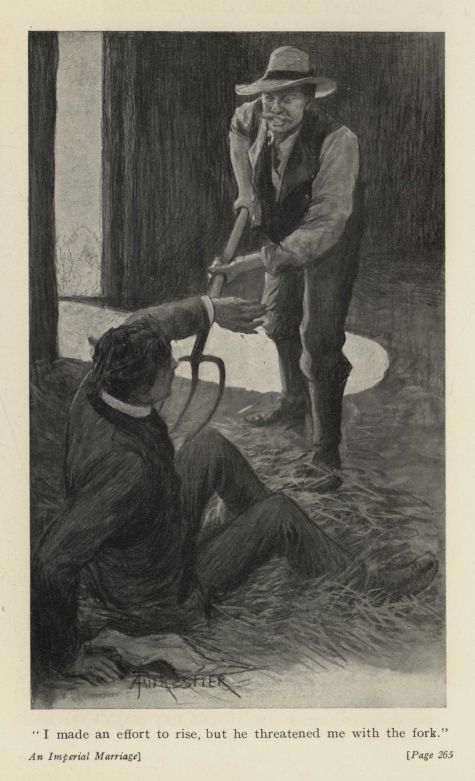
"I made an effort to rise, but he threatened me with the fork." Page 265
I saw the force of the argument and obeyed. "I am sorry you take it so ill. I have done no harm and----"
I began, but he cut me short.
"No harm, you dirty rascal. It's scoundrels like you that are the pest of the country--lazy, loafing tramps sneaking about and stealing whatever you can lay your hands on"; and he let himself go on what was evidently a sore subject with him. His fury was out of all proportion to the cause of it, even supposing I had been the tramp he deemed me.
To argue with any one in such a rage as possessed him at that moment was obviously useless, however, so I let him storm and abuse me as he pleased. While he held that fork, I knew that any retort from me might make him use it.
He mistook my calmness for fear, and as he warmed to the congenial work of abusing me, he grew more threatening with his weapon, and flourished it about in such a way that I expected any moment to find it plunged into my body. I simulated dire alarm, and cringed and winced at his gestures in a way that gave him huge delight.
But it also led him to give me the chance for which I was waiting; and when at last an opportunity came, I dragged the fork out of his grasp, jumped to my feet, and placed myself between him and the door.
For once at any rate I traded on somebody else's evil reputation. The farmer ran rapidly down the scale through surprise to almost abject fright. He stood shaking in every limb with his eyes darting from the fork to my face, as if he expected me to treat him to the same sort of breakfast as that with which he had so glibly threatened me.
"I didn't mean it," he stammered. "I know you have done no harm. It'll be all right, my man. You can go."
"I'm glad you've changed your tone, but you've made a mistake about me. I hope you can see that."
"I do. I do," he cried readily, his eyes still fixed warily on the pitchfork. I turned and tossed it away behind me, and he heaved a sigh of relief.
"If I have done any harm I'll pay you," I said, taking out some money. "How much? Five marks, ten marks? By the way, what time is it? My watch has stopped," and I pulled it out with a view to impress him still further.
It had the due effect, and his manner changed again; but he was not quite free from suspicion. "I do not charge for such a trifle," he said, with an air of nervous apology mingled with doubt.
"I am quite willing to pay you and quite able to. And if you can give me some breakfast, not of that sort"--I laughed as I pointed round to the fork--"I shall be happy to pay for that also. I lost my way in the night, and overcome with fatigue I lay down to sleep. I had a friend with me, but he must have got up and gone out while I slept. Here, you'll want this, I suppose;" and I picked up the fork and handed it to him. "Shall we walk up to your house? If I had seen it in the night we should have knocked you up."
As I handed him the fork, he looked at me and then a smile spread slowly over his broad face, as my easy manner drove home the conviction that I really was not the desperate character for whom he had mistaken me.
"You can have some breakfast, and welcome; but it's nearer dinner-time. It's close to midday."
I wound up my watch and set it to the correct time, which he gave me. "I suppose you haven't seen anything of my friend?" I asked carelessly.
"No--at least no one who has said anything about having a friend anywhere about here; but we had a stranger at the house this morning asking for some food. But he's a very old man and ill."
It was the Baron, right enough, and the good news excited me greatly.
"That's the man," I cried eagerly. "He is ill. Let's push on to the house at once"; and I hurried on at a rapid pace.
CHAPTER XXVI
A CHARGE OF MURDER
The farmer lumbered along at my side for a while, puffing and blowing hard, and as we climbed a hilly field we had to call a halt.
"I'm not so young as you," he said, gasping and wiping his forehead.
"I'm very anxious to get to my friend," I replied.
"He didn't seem very anxious to see you; at least he didn't say anything about any friend; but it was a hint from him which sent me down to that barn of mine to look for you."
"What did he say?" I asked, seeing that there was something behind his words.
"We've had a very rough character about these parts for some time past--a rascal that has been robbing right and left and has knocked one or two of the neighbours on the head--and I was speaking of him to my wife before the old stranger, and he turned and said he had seen a man of the sort in the barn there."
I laughed but held my tongue.
"You must excuse me, but is there anything funny about the old gentleman? He is a gentleman, of course; I could see that in a twinkle?"
The question gave a hint of the line to take. "Did you notice anything odd about him, then?"
"It's not for me to talk, of course; but my wife thought he was a bit strange in his head."
"Poor old fellow," I replied in a tone of commiseration.
"Ah, I thought as much," was the answer with a note of self-satisfaction. "My wife isn't often wrong. Are you in charge of him so to speak?"
"He is in my charge just at present; but I'm not his keeper, if that's what you mean? He's as harmless as a child; but he fancies himself a desperate conspirator. He's a noble."
"He told us that, but we didn't believe him."
"It's true; and of course his people are well able to pay handsomely for anything that is done for him."
The bait was taken readily. "I shall be glad to help of course if I can."
"If he's still at the house, you can. I want to get on to the city and send his friends out for him. If you could look after him meanwhile, you can name your own price, and I'll pay you something on account of it."
"I suppose he really is harmless. I mean he wouldn't be likely to give any trouble if we kept him in the house?"
"Oh, no chance of it. And certainly not, if you or I were in the room with him. Although of course I must get on to the city. I suppose two or three twenty mark pieces would pay you for a lost day?"
"I should think it would be worth five," he replied with Teutonic aptitude for driving a bargain.
"It's a lot of money; but we'll make it the five with an extra one for the wife, if she looks well after him. I always like the wife to have something."
We came in sight of the house soon after that, and with intense satisfaction I saw the Baron sitting by the door basking in the sunlight. Fearing that possibly he might take fright when he saw me and run away, or do something to scare the farmer from the bargain, I gave the latter a couple of gold pieces as an earnest, and sent him on ahead to get the Baron up into a room.
There was no difficulty. He went up to the Baron, who greeted him with a condescending smile. They spoke together, and I breathed a sigh of fervent thanksgiving when the two went indoors.
That load was lifted from my shoulders, and I followed to the house after an interval. Over a hearty meal I heard that the Baron had been put to bed, where he had fallen fast asleep. I did my utmost to ingratiate myself with both the farmer and his wife, and laughed as heartily as he himself did when he told her how he had treated me in the barn; and with a promise that they should be relieved of their charge as soon as possible, I set off in the farmer's cart for the nearest station on my way back to the city, to relieve Althea's anxiety and send her out to her father's assistance.
The stroke of good luck in finding a shelter for him had raised my spirits, and as I paced up and down the platform of the little by-station, where I had to wait over an hour for the train, I was able to view with comparative ease of mind the complications which still beset me.
My first step was obvious. As soon as I had seen Althea, I would get an interview with Herr Borsen and make a clean breast of everything, both in regard to myself and von Felsen. I was convinced in my own mind that the man who had fired that shot at me after leaving the station had been instigated by him. I had seen him at my house, had recognized him at the station, and again after he had fired at me.
In the face of that, it would be quixotic to wait for further proofs before letting von Felsen feel the weight of my hand. That day should see the end of things so far as he was concerned; I would hand over to Herr Borsen, not only the confession of the theft of the papers, but also that of the murder.
As I recalled my interview with him I saw how he had fooled me, and that his prompt recovery from terror--which I had attributed to his relief at hearing that his life might still be saved--was in reality due to his belief that he could compass my death in time to save himself from all trouble through the revelation of what I had forced from him.
Such a snake as that deserved no mercy, and he should have none.
I anticipated very little trouble in getting out of my own troubles. I had committed no crime. My association with old Ziegler and the men who had been plotting against the Government was in reality innocent enough; and although it was probable that those whom I had outwitted on the previous night would tell of my presence at the wharf and would do all they could against me, the fact that I had gone in search of the Baron would put that right.
The one step which I did regret was that I had had to take the life of the man, Gassen. But it had been done in self-defence. I had not intended to do more than send him adrift in the boat, while his attack on me had meant murder and nothing short of it. But whether it would be prudent to open my lips about it was questionable, and I would await developments before deciding.
Altogether, I was in a very confident mood as I drove from the station to my house, and jubilant in my anticipation of Althea's delight at the good news I could give her about her father.
But instead of having to deliver good news I had to receive bad--the worst indeed. The servants were alone in the house and on the point of leaving it; and I found Ellen sitting disconsolately in the hall, her eyes red with weeping, dressed in her hat and jacket ready to go.
"What is the matter? Where is Fräulein von Ringheim?"
"She has gone, sir. There has been such trouble here. We had the police looking for you, and they searched the house from top to bottom," she wailed, her words interspersed with sobs. "Cook has packed, sir; and I can't stay, if you please."
"Very well, but before you go, try and tell me something more definite."
She fumbled in her pocket and brought out a telegram. "The Fräulein opened it, sir: I didn't; and she told me I must get it to you as it was very important."
It was from Bessie and announced her safe arrival in Brussels with "everything." This was one piece of good news at any rate.
"Now, Ellen," I said, turning to question her, "of course you must go away if you wish, and I shouldn't think of stopping you. But I assure you the whole businesss is a mistake somewhere, and you do not run the faintest risk in staying here. Martha has not gone yet?" This was the cook.
"No, sir; but she's just ready."
"Well, while I change and look round, go and tell her to see me before she leaves."
"But the police told us both to go, sir."
"I'm not at all sure that you've had the police here at all. Did the Fräulein go away with them, whoever they were?"
"No, sir. Herr von Felsen was here and was with her when the men were turning the place upside down. You never saw such a mess as they've made of things."
"Never mind the mess. Did he come with them?"
"Just before them, He was very excited and said they were coming."
"What time was that?"
"About midday, sir."
"And when did he leave? Did the Fräulein go with him?"
"Yes, sir. That was about an hour ago."
It was just four o'clock. If I had not had to wait for that train, I should have been in time to take a hand in the business.
"I am quite convinced from your answers that these men were not police, Ellen; but tell me were any of them the men who were watching the house yesterday?"
"Yes, sir. One of them spoke to me yesterday, and it was he who told us to-day that if we didn't go we should be in trouble. He behaved shameful, and wanted to put us out there and then without our boxes; but cook she up and told him she wasn't going without hers, and then he gave us an hour to clear out in."
"Well done, Martha," I exclaimed, as the cook came downstairs. I explained to her that the men had not been the police, and endeavoured to allay the fears of them both.
I succeeded after some difficulty, and they agreed to remain.
"That fellow said he'd come back in an hour to see that we had gone," said Martha, a woman with a great deal of spirit. "I hope he will come"; and she nodded her head with an emphasis which promised him a warm reception.
"I don't expect you'll see him here again. Now, a last question. Did they say anything to you about the supposed crime for which I was to be arrested?"
"They went on awful about you, sir," replied Martha. "You was a conspirator, and a murderer, and you'd either run away to get out of their hands or had killed yourself; and I don't know what else. But you were never coming back. That was certain."
"Well, here I am, you see; so you can tell how much to believe of the rest."
"They said they had warrants for you, sir," put in Ellen. "They showed me some papers; and the Fräulein told me afterwards they had, and that she was going away in order to prevent any harm coming to you."
"Well, we'll soon have things all right again," I replied, and went off to change my clothes and view the results of the men's work.
I thought I could understand it all, I guessed that the man who had fired at me on the previous night had mistaken my fall for the result of his shot, and had accordingly reported that the attempt had been successful. With me out of his way, von Felsen had only to recover possession of the stolen paper, the keys and the confessions he had written, to find his hand once more on the controlling lever of everything so far as Althea was concerned.
That was what the search meant, and that it had been complete, the evidence of my own eyes showed. But it had not been successful, any the more for that. The stolen paper was safe in Brussels, and I had been in such a cyclone hurry to get after the Baron on the previous night, that I had not stayed to look the other things up, but had thrust them into the first place which had caught my eye. This had been the large upright iron stove in the hall among the kindling wood and paper. And there I found them.