Front matter (continued 3)
Reading edition
"I know that man they call the "doctor," and you may shake hands with yourself on your escape. And as for Dragen, every one of us knows about him. Who's behind it?"
"Don't ask me, even privately. Get Dragen first, and he'll tell you. Dragen hasn't a suspicion that I even know he was concerned in it."
He gave me a very shrewd sharp glance. "Nor Herr von Felsen either?"
"I mention no names. But tell me how did you hear about me?"
"Some one who took a considerable risk and came to me. We have had a hint to hold our hands for a while, or she would have remained as His Majesty's guest. I won't ask how she came to know so promptly that you were missing; but Herr Dormund is very sore about you."
It was Althea herself then. She had run this risk of imprisonment for me. The knowledge was worth all it had cost me.
"I don't want any fuss made about the affair at present if it can be avoided, but I should like to know if you get hold of the men," I said as I rose.
"Of course. You had better let me have that jacket and the papers. They may help us. Well, congratulations again. And by the way, don't run any more risks about the lady I referred to. She said she was at your house, and gave her word that if we had to do anything, she would either be found there or else would tell us where."
"Just one question, "When was I carried off?"
He smiled. "Why last night, of course."
I drove home and found my sister in the deepest distress on my account. She was overjoyed to see me, and declared that she and Althea had passed a night of terrible agitation and suspense.
I did not tell her what had occurred, but merely that I had been detained and unable to send word.
"We thought you had been arrested, Paul; and Althea insisted upon rushing off to the police this morning. Herr von Felsen came early, and again this evening, and is with her now in the drawing-room. I must run and tell her the good news;" and she was rushing out of the room when I stopped her.
"Don't tell her yet. I'll change and go into them. Von Felsen may be glad to know I'm back."
"Oh, how I loathe that man, Paul! Had he anything to do with this?"
"My dear child, how could he?" I replied as I hurried off to get into some decent clothes.
I was not more than a few minutes making the change, and I went down to the room where the two were together. I paused a moment on the threshold in doubt whether I should not after all let Bessie announce my arrival.
"Yes, my solemn word on it. Bring him back and I will do all you wish."
It was Althea's voice and I could not help hearing. It decided me, and I opened the door and entered.
She sprang to her feet and cried out with astonishment and I hoped delight, while von Felsen turned as pale as death.
"Good evening, Fräulein Althea," I said quietly, holding out my hand. "I am afraid I have given you and Bessie a great fright. I am very sorry."
She could not speak for the moment and her hand shook as she laid it in mine. Then after a pause: "Oh, Mr. Bastable, I--I am so relieved."
Affecting not to notice her agitation I turned to von Felsen. "Good-evening; I suppose you know the fuss I have stupidly caused."
I did not wish him to think that I knew of his hand in the affair, and spoke much more courteously than I had ever addressed him before.
"Yes, I did hear of it," he replied uneasily. "The fact is I was just offering my services in the matter."
"Well, I'm afraid it's more than I should have done had you been the cause of the trouble. But then we don't hit it off very well, do we? But you could not have done anything. It was just a police blunder at the last. I had a little trip into the country, and they took me for a tramp, or something of the sort. Of course it was all put right easily enough."
"A trip into the country!" cried Althea.
"Well, not exactly a voluntary outing. The fact is I was robbed in the street here in Berlin, and the scoundrels took me off in a motor-car. I found myself early this morning miles and miles away--I suppose there must have been a smash up or something; I had been unconscious evidently--and when I reached a station the man sent for the police, who shoved me into a cell and kept me there all day." I laughed as if the thing were the merest joke.
"You are not hurt?" asked Althea.
"Not a scratch, thank goodness."
"I hope you would know the scoundrels, Herr Bastable?" said von Felsen.
"What a question!" I answered with another laugh. "Do you think you would, if you had been chloroformed to wake up on a lonely road in the dark miles away from anywhere. They knew their business too well for that."
"Well, I'm sure I congratulate you, Herr Bastable," said von Felsen, with well affected sincerity. "As you say, we don't exactly hit it in many ways, but a thing of this sort might happen to any of us. It's monstrous that it could occur. Of course you'll set the police to work."
I threw up my hands as if it were useless. "I've just been with Feldermann and his manner told me what to expect. Without a clue of any sort, what can they do?"
Althea had been watching him very closely, and now turned to him. "You said just now, that you had no doubt of your being able to get to the bottom of it all."
"I shall do everything in my power as it is," he replied uneasily.
"But you spoke of having knowledge that would lead to certain success."
"I made sure it was merely a case of arrest; in which event, of course, my influence would soon have enabled me to ascertain everything."
"I did not take it to be merely that," was the drily spoken reply.
"Well, it's very good of you, von Felsen," I interposed. "And if you can find the fellows, I'll prosecute them readily enough."
"You do not know all that has passed, Herr Bastable," said Althea with great deliberation. "And I think you should know."
Von Felsen took alarm at this and said: "As you have returned without my help, I suppose I can do no more. I'll go." I sauntered over as if to look at a letter lying on a table and got between him and the door.
"You should explain to Mr. Bastable, certainly. Herr von Felsen exacted a pledge from me to do a certain thing on the condition that he secured your return in safety," she added to me, speaking with some little hesitation.
"How could he possibly have done it?" I cried with a smile. "Anyhow, as I have returned in safety and without his help, the pledge may be considered as withdrawn, whatever its nature. That's quite clear."
He understood that I guessed what the pledge was, and turned at bay. "You may as well know what it was," he said with a scowl. "Fräulein Althea agreed to do what my father wishes--become my wife. You know well enough the many solid reasons there are for that marriage. Herr Borsen told you."
I laughed. "I thought you were going to marry old Ziegler's daughter. Is that off then?"
He shot at me a look of bitter hatred. "It's no concern of yours. You have interfered a great deal too much as it is, Herr Bastable; and Fräulein Althea should know that your interference can only have serious consequences for her; unless, indeed"--and he turned to her--"she can see her way to comply with my father's wishes at once."
"Can't you bring some more relatives into it besides your papa?" I asked with a grin. "A baby brother or something equally influential?"
He let the jibe pass. "Now that your whereabouts are known," he continued to Althea, "the decision must be made immediately."
"If I may be allowed a suggestion," I said to Althea very gravely, "it might help matters if you were to meet Hagar Ziegler and arrange which marriage should take place first."
He all but swore at me for this. "You may think it a good subject for a jest, Herr Bastable; but Fräulein Althea and her father will find very little subject for laughter in it. If your decision is not made within three days, Fräulein, I will not answer for the consequences."
"Let me see, you named a week to Herr Ziegler, didn't you?" I said in the same tone of banter.
But Althea was alarmed by the threat. "Mr. Bastable!" she cried with a gesture of protest. It was a mistake. Von Felsen was quick to see the impression he had created, and the wisdom of not saying any more. If he was to win, it would be by playing on her fears.
"That is my last word," he said, as he turned to leave.
"But not Ziegler's," I retorted, as I shut the door behind him.
"I think I am frightened, Mr. Bastable," said Althea nervously. "Why did you provoke him so?"
"To make him take the buttons off the foils. But I am sorry you let him see that he had scared you. And there is less cause than ever now."
"Tell me."
"I have first to scold you. You did very wrong to go to the police about me and then give them that promise not to attempt to avoid arrest."
"Was I to sit still while I believed you were in danger?" she cried vehemently. "And after what you had done for me?"
"I am very angry," I replied with a smile.
"I should do the same thing again." And then her face lighted. "Oh, I think I was never so delighted in my life as when I saw you come into the room safe and unhurt!"
"If you had only had a little more patience you----"
"Patience? And you in peril!" She stopped with sudden embarrassment as the colour rushed in a crimson flood to her cheeks, and she lowered her head.
I was scarcely less embarrassed, and hot passionate words of love rushed to my lips only to be forced back with a resolute effort.
"Althea."
She looked up and our eyes met. I made a movement to take her hand when the door was opened and my sister came in hurriedly.
CHAPTER XII
MURDER
It was no doubt quite for the best that my sister interrupted us at such a moment. Althea's solicitude on my account; the sacrifice she had shown herself ready to make to secure my safety, and the emotion caused by my return, had filled me with stronger hopes than I had ever ventured to encourage before.
Yet to have spoken the words which Bessie's entrance had prevented, would only have complicated matters and have placed Althea in a position of supreme embarrassment. Whatever her feeling might be for me, she still held paramount what she believed to be her duty in regard to her father, and continued to look upon the marriage with von Felsen as a possible alternative.
There was another consideration, moreover. If I had blurted out the declaration of my love, it would make it very difficult, if not actually impossible, for her to remain longer in the same house with us.
Bessie was quick to understand that she had entered at an awkward moment, and paused for an instant by the door. "I could not wait any longer when I knew Herr von Felsen had gone," she said doubtfully.
"There is no reason why you should, Bess," I replied.
"Come and sit by me," said Althea, making room for her. "And now, Mr. Bastable, was I not right in thinking that Herr von Felsen was at the bottom of all your trouble? I read an absolute confirmation of it in his face when you came in; although I was sure of it before, of course, when I told Herr Feldermann."
"It is one thing to guess and another to have proof," I said, and went on to give them a general account of my adventure of the preceding night. They both plied me with a host of questions until at length I had to avoid the fusillade on the plea that I was both famished and worn out.
Bessie ran off at once to have something got ready for me, and again Althea and I were alone. But I had myself well in hand now. Besides, the conditions were changed; the moment of emotion had passed, and we were both cooler.
"It was on my account then that you got into this danger?" she said.
"If von Felsen was in it, probably; but then there has never been any love lost between us. He has always owed me a grudge." I had not admitted that I knew he had planned the thing.
"If you can prove it, you will have him punished?"
"I hope to deal with him in another way yet."
"Is it not all a terrible complication?"
"I think we shall unravel it," I said hopefully.
Bessie came back then to say that all was ready for me and I rose.
"How shall I ever be able to repay my obligation, Mr. Bastable?"
"I shall manage to get even with you some day, I expect. Bessie will tell you that whenever I do a little thing for her, she has to pay the price, eh Bess?"
"Bessie has already told me lots of things," was the reply.
"Ah, you mustn't believe half she says. She's a born gossip," I answered, and then went off.
The next morning I went early to the Jew's house and found him full of the news of my disappearance. I did not tell him what had occurred, merely that I had had to leave the city and had been detained.
"I came to see you that night because I wanted to know if your daughter's marriage could not be postponed for a time."
"It is fixed for to-morrow, Herr Bastable, and everything is arranged."
"I'm afraid you'll have to put it off, Ziegler." But he would not listen to this. He was deaf alike to arguments, persuasions and threats. And while we were in the midst of a heated discussion about it, Hagar herself came in.
He told her what I wished; but she added her protests to his and spoke with great passion. She was intensely agitated at the suggestion, and wound up a fierce tirade with the vehement declaration: "If it is put off, father, I will kill myself." And that ended the matter.
She was a strange girl; and the instant I said that I should urge it no more, she seized my hand and pressed her lips to it, not a little to my embarrassment. "It is you I have to thank for its taking place so soon, Herr Bastable. I know that. Father has told me all: and I shall never cease to feel that you have been my best friend throughout."
"You see," said the Jew, lifting up his hands, when she had left the room.
"All right. Let us talk about something else. How goes the matter of the papers?"
"Just as we should wish; but I was sorry you did not come to me yesterday. I had arranged for you to see some of my friends."
"I can see them to-day. I am in earnest, and mean to go through with the thing. I am as eager as you yourself, I assure you."
He sat thinking a moment. "I ought to tell you, I think. There has been some rumour again of betrayal of our plans. Only vague, I give you my honour; but hints which I do not understand. You have not spoken to any one?"
"Not to a soul."
"I do not understand it. I do not understand it," he repeated. "Questions were even put to me about myself--to me, who have given so much to the cause and done so much, too. But if any questions are put to you to-day, you will understand the reason. Will you come here this afternoon?"
After some further conversation I agreed to return in the afternoon and left him. I attached little or no importance to his statements at the time, but they had a more than sinister look when I came to recall them in the light of after events.
I knew I was playing with double-edged tools in the affair. Suspicion of my good faith would bring on me the anger of men to whom treachery was the one unforgivable crime; while, on the other hand, the mere fact of my having any dealings at all with them might place me in jeopardy with the authorities.
It was for this reason that I had resolved to prevent von Felsen having any knowledge of the part I was playing until the very last moment. I should not be a free man for an hour after he got wind of the thing, unless I was in a position to call a halt by means of my knowledge of his own acts.
From Ziegler I went to Chalice, and found matters in a pretty muddle. Ever since I had seen her two days before she had been in a condition of excited indecision; and as I had not gone to her, she had sent for Prince von Graven. He was there when I arrived, and she had just told him all I had said to her.
His reception of me may be imagined. He looked as if it would have given him the pleasure of his life to run me through there and then, and his furiously indignant denunciation of my interference in the affair matched his looks.
A very warm altercation followed, in the course of which it came out that the Kaiser had heard the rumours in regard to the Prince and Althea. Chalice watched us both and appeared to side with each in turn. She evidently wished to be able both to marry a man of his high rank, and yet to secure the triumph of the promised Court patronage.
At length I began to find myself losing command of my temper under the fire of his invective, so I held my tongue and let him rage at will.
"If ill temper would solve the difficulty we should very soon settle it," I declared, when a pause gave me a chance to speak. "But we are not doing an atom of good by all this talk. The thing is perfectly simple: Fräulein Chalice can either give up this chance or give up you. One of the two sacrifices she must make, and if we stay here and talk till to-morrow morning we can't alter the position."
"You have no right to interfere, sir," he rapped back.
"My interference has consisted in telling her the plain truth."
"To attempt to come between us in this way is unjustifiable, monstrous. I will not allow it either. You shall answer to me, sir."
"I don't care a snap of my finger for your anger, Prince von Graven; and I certainly do not intend to have a personal quarrel over the thing. Can you deny that I have put the matter in its true light?"
"That is not the point. The point is your conduct."
I shrugged my shoulders and turned to Chalice. "It is for you to decide. I shall of course take your answer as final."
"But how can I decide? Is there no way out?"
"There is only one of the two ways. You can't have both. I will come for your decision in an hour," I replied and rose. I thought that it would be best for me to leave them together to discuss it alone.
But Chalice stopped me. "Don't go, Herr Bastable; but excuse us a moment"; and she took him into another room.
She was soon back again, smiling and carolling an air from one of her songs. "The Prince has gone," she announced. "He is in a tearing rage and vows he will never see me again if I do what you ask. But I shall do it. I wrote the letter yesterday, and it took me such a time. Here it is"; and she handed it to me.
"I may place this in hands which will give it to the Emperor?"
"Why, of course," she cried. "But you must make sure that it does get to him."
"I can promise that, I think."
"You don't know how I thank you, Herr Bastable," she said gaily, as we shook hands. "And if I tell the truth, I would really rather please the Kaiser than the Prince. I would indeed, although I didn't dare to say so while he was here. He is such a dear fellow. I hate to make him angry; but he is awfully handsome when he is in a rage, isn't he? And if he doesn't come round this time, I can't help it, can I? And now I must get to my practice. Good-bye."
In this way she settled it; and whether she did or did not care for the man who was willing to sacrifice all his prospects in life for her sake, I could not even then determine. Nor did I, in truth, very much care.
I went straight with the letter to Herr Borsen, who showed some surprise at seeing me. "I heard strange news about you, Herr Bastable. I am glad to see there was no truth in it. You were reported to have disappeared."
"I have reappeared, that's all; and I have news for you, which I think you will agree is of importance."
"You newspaper men have certainly the habit of rushing matters," he smiled. "What is it?"
"We must have a deal over it. It is something that the Emperor will be very glad to know; and if I tell you, will you give me an undertaking to get it direct to him?"
"Would you wish His Majesty to be also a party to the matter?" he asked with a very dry smile. "Or perhaps you would prefer an audience with him?"
I affected to take his jibe as earnest and replied very seriously: "Yes, that would be by far the simplest course."
"You could then force your own terms on him."
"Exactly. Do you think I had better just drop in on him in a friendly way?" I paused and then added: "Or shall we quit fooling and settle something?"
"What is the nature of your news?"
"I understand that at length the news about Prince von Graven and Fräulein Korper has reached His Majesty. Is that so?"
"Undoubtedly; and with results."
"Well, if I can hand you a statement as to the truth of the whole affair, together with a written renunciation on the lady's part, will you pledge me your word of honour that it shall go straight to the Kaiser?"
"You're a cool hand, Bastable," he said laughing.
"Well, my dear fellow, there are other ways of doing it; but I know enough of Court affairs to be aware that any one who could claim the credit of having obtained such a document would do himself a good turn. I would rather you had the credit than any one else; but you see you are Count von Felsen's secretary, and I have to reckon with him."
He sat thinking. He knew the advantage to be gained as well as I did. "Yes, I'll give you my word," he said after the pause.
I handed him the letter which Chalice had given me without a word, and watched his mounting surprise as he read it. "But this is not from Fräulein Korper at all."
"No. That's the mistake. The Prince cares no more for her than you do"; and I made the matter plain, taking good care to emphasize the sacrifice which Althea had made and her real motive.
"She is a singer, then?" he asked, referring to Chalice.
"She has one of the most beautiful voices you ever heard, Borsen. She is Grumpel's favourite pupil, and he is putting her into the programme for the State concert next week in the place of his Prima, who has disappointed him."
He looked at me, his eyes full of meaning and his lips drawn into a dry smile. "I think I see. And you don't wish to appear in it?"
"You can shut me clean out of the picture if you like"; and I rose.
"I hope she will make the sensation old Grumpel expects. She ought to, after this," he said as we shook hands.
"Oh, by the way," I said, turning at the door as if with an afterthought, "I expect to have some almost equally important news for you about the von Felsen marriage in a day or two. Matters are in train."
"Are you going to bring that off too?" he exclaimed. "Upon my word, I shall begin to have some real belief in you newspaper men."
"I only want a few days," I replied casually.
"After this, you can have a month, of course, or as long as you wish."
I returned home, speculating rather uneasily what Althea would say when I told her what had occurred; but she was not in the house, and my sister told me she had gone to see Chalice. I was not sorry that Chalice should tell her the news.
In the afternoon I spent an hour or two with Herr Ziegler, and was introduced to some of the men associated with him in the political schemes of the Polish party.
I could not see any real reason for me to meet them, and I said as little as possible, beyond expressing sympathy with their cause and a willingness to help in the manner arranged with the Jew.
They appeared to be equally on their guard with me; and the chief impression left on my mind was that the men were not going straight; that some of them distrusted Ziegler, and were disposed therefore to regard me with no little suspicion. There was an air of insincerity, a disposition to fence, and such a reluctance to do more than hint and insinuate and imply, that I felt anything but easy in mind.
I told the Jew my opinion when the rest had left us; but he explained it away as no more than the caution natural under the circumstances.
However, the main thing I cared about was the arrangement that I was to be the go-between with von Felsen in getting the papers; and as any hour might bring the news that he had obtained them, Ziegler and I were to keep in constant touch.
But the more I thought over the afternoon's interviews the less I liked the look of things, and the stronger grew the impression that there was something crooked. I began to worry myself with the fear that the plan on which so much depended would go wrong.
For the first time, also, there was something like a cloud between Althea and myself as the result of the news Chalice had told her. She said little more than that she knew what had been done; but added that, as there was no longer any reason for her to remain with us, she had decided to return home on the following morning.
I took this as a sign of her dissatisfaction at my action; and as I was in a fretful and rather irritable mood, I just held my tongue. The evening was thus passed with a feeling of restraint which all Bessie's efforts could not remove.
I sat worrying over matters for a few minutes after they had left me, and at length grew so uneasy that I resolved to go at once to Ziegler to thresh out with him my doubts about his friends. I could not rest quiet or shake off the sense of impending trouble; and I soon had a tragic and terrible confirmation of my fears.
I was close to his house when I met Hagar rushing along the street distraught with terror. She was bareheaded, her eyes wide and fright-stricken, and she was so absorbed by her agitation, that she did not see me and did not even hear me when I first called to her.
I turned and caught her up.
"What has happened?" I asked, seizing her arm.
She tried at first to break away from me with a cry of fear, as if not recognizing me.
"I am Mr. Bastable, your father's friend. Tell me what is the matter."
She looked at me with a dazed expression, trembling violently the while, and then, with a great effort as if her emotion were choking her, she told me.
"I was coming to you. Oh, Herr Bastable, my father is dead. He has been murdered. Oh God! Oh God!"
I caught my breath with the shock of the tidings, and in an instant all my suspicions of the afternoon recurred to me with startling force.
CHAPTER XIII
IN THE HOUSE OF DEATH
As soon as I had shaken off the first stunning effect of the news of the murder, I did what I could to calm Hagar, and then asked her to return with me to the house. But this induced a fresh paroxysm of alarm.
"No, no. They will take my life," she cried. "I dare not. I dare not."
"I will see that no one harms you," I assured her. "I am armed, and by this time they will have fled. There is no danger."
I prevailed in the end, and together we went back to the house. She shuddered violently as we entered, and clung to my arm, shrinking and shaking and glancing about her in terror at every step.
I knew where her father had kept his liquors, so I got her some brandy and made her drink a fairly stiff dose.
"Where are your servants?" I asked.
"One is ill, and the other has been away all the afternoon." Her lips trembled and her voice quivered as she replied.
"You must make an effort," I said sharply. "Tell me everything."
"I cannot think. I cannot think," she moaned distractedly, and laid her head on the table in an agony of wild grief.
I gave her some more of the spirit, and as soon as she had drunk it I said as impressively as I could: "If you would revenge your father's death, you must let me know everything at once. Revenge is still in your power, remember. Your father would have had you think of that."
The appeal had an immediate effect. She raised her head and her eyes flashed with a new light. "You are right," she cried in a strong vibrating tone. "I will never rest until he is revenged and his murderers are punished. That I swear to my God!"
She rose then and led me into the room where the body lay, just as it had fallen, huddled up on the floor close to the table at which most of the old man's life had been spent.
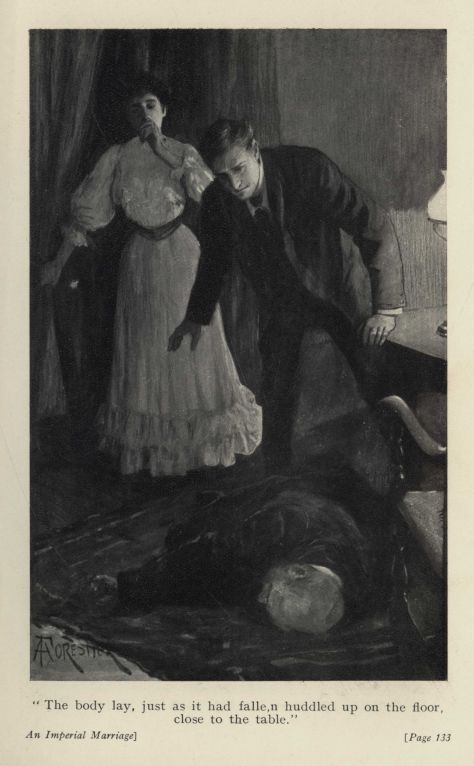
"The body lay, just as it had fallen huddled up on the floor, close to the table." Page 133
"You have had no doctor yet," I exclaimed, turning to the telephone.
"I ran for my life the instant I discovered what had occurred."
"What is your doctor's name?" I asked as I tried the telephone. She told me; but I could get no reply to my call. And then I discovered that the communication had been cut. A sinister and suggestive circumstance.
I knelt down by the body and made a rapid examination. He had been stabbed from behind, and was long past all human help. The eyes were fast glazing and the body beginning to stiffen.
As I was feeling the pulse a ring dropped from the hand, and intent on the work of examination, I put it without thinking into my pocket.
"When did it occur?"
"I do not know. I was in my room upstairs and came down to speak to him about--about my marriage to-morrow----" She paused and closed her eyes and clenched her hands for a moment, and then forced herself to continue. "I found him as you see. That was just before I ran out of the house in my panic and you met me. I remembered his warning to me and fled. I was mad for the time, I think."
"What was his warning?"
"It was after you left him this afternoon. Something you said made him speak to me. He had had a letter threatening his life, and charging him with treachery; and I was threatened also."
I had been kneeling all this time by the body and now rose. "You have no idea who can have done this?"
"None. He told me he had an important interview to-night, and must not be disturbed. That was why I did not come down earlier."
"We must find out with whom," I replied. "And now we must have the police. Have you nerve enough to fetch them or shall we go together?"
"Don't leave me."
At that instant as we turned to leave, I heard a sound somewhere in the house. Hagar heard it also, and clutched my arm shaking like a leaf.
"You say we are alone in the house?" I asked in a low tone.
She nodded, her eyes strained in the direction of the sound.
We stood listening intently.
"They have come back in search of me," she whispered.
"Then we shall find out who they are. Courage."
I glanced round the room and motioned to her to hide behind the curtains which covered the deep window recess, and stood there with her.
Two or three minutes of tense silence followed. Then we heard footsteps stealthily approaching the room. A pause, and then three men entered. One a grey-haired, distinguished-looking man well on in years; the other two younger and of a commoner type, swarthy, determined-looking men.
From where they stood they could not see the body of the Jew, and judging by their start at finding the room empty, I judged that they had expected to see Ziegler at his desk.
Their words confirmed this.
"Not here, the old fox," growled one.
"Come away. Come away," said the elder man, laying his hand nervously on the arm of one of the others.
"Not till this thing is settled," he replied, shaking off the other's hand impatiently. "I mean to have the truth out of the old rat, or his life."
"And the girl's too," added the other. "You know what we were told about them both. I shall wait for him."
"No, no. No bloodshed, no bloodshed, for Heaven's sake," cried the old man with a gesture of protest and dismay.
"My God! Look here!" This was from one of the two who had moved forward and was pointing at the dead body.
The old man gave a cry of horror and sank into a chair covering his face in his clasped hands.
"What can this mean?"
His companions were standing by the body gazing at one another in blank wonderment and surprise. Then one of them stooped down and examined the corpse.
"Dead, sure enough; and murdered, too," he announced.
He rose and they both looked round at the elder man. "Do you know anything of this?" asked one.
Without a word the man they addressed sprang up and rushed out of the room.
The two stared at one another again in silence.
Then one of them laughed sneeringly.
His companion winced. His nerves were not so tough.
"What shall we do?" he asked rather huskily. He was beginning to shake.
"Do? Why, what we came to do, of course. Find the old rat's daughter and finish the thing," he said brutally, and with an oath.
Hagar was trembling like an aspen and her breath was so laboured and heavy that I made sure they would hear it.
I pressed her arm to try and reassure her.
"I think we'd better go," said the weaker fellow.
A muttered oath at his cowardice was the response. "I'm going to search the house," declared his companion, and he began to glance round the room.
But the other went toward the door. "I'm going."
At this moment Hagar could restrain her terror no longer, and a heavy half-sigh half-groan burst from her.
Both men turned at once toward the curtains, and the bolder one put his hand to draw a weapon, knife or pistol; but before he could get it out, I stepped forward and covered him with my revolver.
"The Englishman!" they both cried in a breath, and the man by the door darted out of the room.
His companion stood his ground and met my look steadily.
"So it's your work, eh?"
"Take your hand from that weapon of yours," I cried sternly.
"What quarrel have you with me?"
"Do as I say," I thundered.
He took his hand from his pocket, shrugged his shoulders, and deliberately turned his back on me and walked toward the door.
His consummate coolness placed me in a dilemma. Shoot him down in cold blood I could not.
Hagar's courage returned the instant she perceived that the advantage was on my side. "Don't let him go," she said, and stepped forward.
The fellow started at the sound of her voice and looked at her with an expression of the bitterest malignity.
"Stop, you," I cried.
He faced me, laughed again with his former deliberate coolness and paused as if about to return. "Very well," he said slowly, with a shrug of indifference; and then, before I could guess his purpose, he sprang backwards to the door and rushed out.
As a matter of fact I was much relieved by his departure; but Hagar flew into a passion and reproached me bitterly for having allowed him to escape. "He murdered my father and will kill me," she cried. "You should have shot him."
It was clear from this that her agitation had been too great to admit of her understanding the purport of what had passed while the three men were together in the room.
I did not stay to explain matters and let her reproaches pass without reply. "We must have the police here at once," I said. "You had better come with me."
We went out to the front door, and seeing a police officer at a little distance, I called him and told him what had occurred.
He came in with us and made a rapid examination of the dead man. "He has been dead some time. When did it occur?"
I told him all I knew of the affair: that Hagar had found her father dead; had fled from the house in fear; had taken me back; and the cause of our delay in telling the police, adding such a description as I could of the men.
Of course I quite expected him to suspect us of the deed, and was not therefore in the least surprised when he replied that we should be detained.
"You had better go for one of your superior officers," I told him. "We will remain in the next room."
"I'm not so sure of that," he replied knowingly.
"Then send for some one. You can easily get a messenger in the street."
I led Hagar into the next room, and he went out and did as I suggested. Then he came to us, and we waited for the arrival of the others. Hagar spoke to the officer, but I took no part in the conversation.
I was completely mystified by the affair. I recalled all the events of the afternoon. Ziegler's singular hints of treachery; the others' suspicion of me; the fact of the threatening letter of which Hagar had told me: and all these things pointed clearly to the conclusion that the murder had been done by some one who suspected the Jew, and that it was in revenge we should look for the motive.
But the arrival of the three men, obviously bent upon doing that which had already been down, negatived any such conclusion absolutely, or appeared to do so.
That they had expected to find the Jew still alive, there was not the shadow of a doubt. Their actions had shown this as plainly as their words had expressed it. They had come to obtain an explanation of the facts which they held to justify their suspicions; and in default of that explanation being satisfactory, they were resolved to take his life.
The words and acts of the eldest of the men had proved that.
The next question was whether their own thought was right--that some one of their number had anticipated them. It was a plausible supposition.
But there was another possible theory. The Jew was a man with many enemies. He had been a hard man, and had been threatened more than once by those who laid their ruin at his door. He carried many secrets, too; and it was easy to conceive that there were hundreds in Berlin who would welcome his death.
Had some such enemy dealt this secret stroke? It was a question which could only be answered after a strict search into the hidden undercurrents of his life and business.
To me his death was little short of a calamity. It threatened to overthrow my whole plans. The suspicions of his good faith entertained by his companions were almost sure to fall upon me; and in that case I should assuredly find myself shut out from the scheme on which I had built so much.
It was this aspect of the affair which concerned me chiefly as we sat waiting for the arrival of the police, and I racked my wits in vain for a solution to the problems which it raised.
When they arrived, Hagar and I were subjected to a searching cross-examination at their hands: she in one room, I in another. I was questioned very closely as to my relations with Ziegler; and except that I did not say a word as to the Polish intrigue, I gave as full and complete an account as possible. I had indeed nothing to conceal.
I perceived that the questions were directed to elicit any possible motive on my part which could in any way connect me with the crime. My replies appeared to satisfy them, and I noticed that they were compared with the statements which had been obtained from Hagar.
After the comparison had been made, the manner of the men questioning me underwent a considerable change. Not a little to my relief.
"We accept your statement, Herr Bastable; but of course you will understand that we were compelled to interrogate you closely as you were found upon the scene of the murder. Now, I invite you to tell me frankly of any circumstance which you think will tend to throw light on the matter."
"I am utterly baffled," I replied. "The only guess I can make is that it may have been the work of some one whose hatred he has incurred as a money-lender. He must have had many enemies."
"His daughter believes it was the work of the men who came here afterwards when you were here."
"That is incredible"; and I gave my reasons, adding that Hagar had been much too agitated to understand what had passed.
"You know that he was associated with the Polish party of independence. She says so. Will you tell me all you know about that? Have you any reason to believe that he contemplated betraying them in any way?"
"None whatever. I knew that he was associated with them. I learnt that some time ago when I was on newspaper work here in Berlin."
"I will be frank with you. It has been suggested to us, before this I mean, that you were associated with him in some such way, and that that was the cause of your recent visits to him. What do you say to that?"
This was getting near home with a vengeance. "The only foundation for such a statement lies in the fact that he had asked me as a newspaper man, if I could make use of political information of importance if he obtained it for me. That is of course my business--provided of course that the information is authentic."
"How was he to obtain it?"
"That I can't say." I used the equivocation intentionally. "I know I was to pay for it, and to judge of its worth when I knew it."
"How were you to receive it?"
"He was to tell me the time and place and means and everything. I should of course have used my own discretion in handling it."
"That lends itself to the fact that he did meditate some sort of betrayal. I presume the information related to his political associations."
"I scarcely think so in the sense you imply. More probably something that would have helped his party. I do not know, as I have told you, the exact nature of the news, but I gathered of course that it must affect my own country, seeing that it was as an English newspaper man he approached me."
"You have taken no other part in these Polish intrigues?"
I smiled. "I am an Englishman, not a Pole; and have no other feeling in their affairs beyond the natural English attitude toward any movement which has the liberty of the subject as its motive. But this was business, you understand."
"One other question. You owed him no money?"
"Not a mark. I never have. I am now a man of considerable means indeed."
He bowed and lifted his hands to signify that he had finished with me. "I can go?" I asked.
"Certainly."
"And Fräulein Ziegler? She is in need of a friend and I should like to help her if she wishes? It is the more terrible for her as she was to have been married to-morrow."
"Indeed? To whom?" he asked quickly.
I regretted my indiscretion, but it was too late. "To Herr Hugo von Felsen."
"Ah. That explains. She asked to see him."
"Can I see her?" I asked, and received a ready assent.
I went to her with the mere intention of offering assistance, the last thing in my thoughts being that a momentous discovery was to be the result of the interview.
CHAPTER XIV
THE MURDERER
It will be readily understood that at the moment of my leaving the police official to go to Hagar Ziegler I was in a very unusual mood. Within the past twenty-four hours I had been within an ace of losing my life; I had seriously wounded if not actually killed a fellow-creature in order to escape; I had endured the bitter mortification of police detention; and had returned to Berlin to take up the thread of an exciting struggle. And now on the top of all had come the murder of the Jew, with its consequences of personal hazard to myself and its disastrous menace to my plans. The examination by the police had, moreover, been a great strain, and when I rose from it I felt both nervous and unstrung.
I say this in order to account in some measure for an act which was altogether foreign to my customary habit, and a paltering and cowardly hesitation which I have never been quite able to understand.
I had been treading on very ticklish ground in that part of the questioning which had related to my connexion with Ziegler's political associates, and I had been most unpleasantly conscious that a very little thing would have induced the official to order my detention. At a time when in Althea's interests my freedom was so essential, such a result would have been fatal, and the relief with which I had heard that I could leave the house was indescribable.
This was the predominant feeling as I went to the room to see Hagar. It was my part to assume indifference, however, and I plunged my hands into my pockets with every appearance of casual assurance.
As I did so my heart seemed to stop suddenly; a shiver of dread chilled me to the marrow; every muscle grew instantly tense and set; and then with a bound the blood began to rush through my veins at a rate which set every pulse throbbing violently.
My fingers had touched the ring which I had taken from the dead man's grasp, the existence of which until that moment I had forgotten.
In an instant the conviction rushed on me, that if I returned to the official and gave it him he would refuse to accept my explanation, would connect me in some way with the crime, and have me detained if not actually arrested.
The ring was certainly the most important clue; for it was virtually certain that the owner of it was the man who had done the deed, and it was my clear duty to hand it over to the police. To evade that duty would be a piece of paltry cowardice. I realized all that clearly, but at that moment I was a coward. I was afraid of being prevented from making any further efforts on Althea's behalf. And that fear prevailed.
Instead of returning with it to the official, I slipped it on to my finger and continued my way to see Hagar. It may appear like the language of exaggeration to say that the ring seemed to burn the flesh like a band of fire; but my nerves were so high-strung at the moment, that that was precisely the sensation, and my hand was trembling like that of a detected thief.
I was a little surprised to find that Hagar had almost entirely shaken off her former agitation. This had apparently been caused as much by her fears for her own life as by the horror at her father's fate; and now that she was safe, she had set herself to the task of helping the police to the utmost in the work of tracing the murderer.
The police were going to remain in the house, and she had readily expressed her willingness to stay there also. For this purpose she had sent for a relative to come and be with her. I concluded that the police were resolved to keep her under close observation; but she did not appreciate this fact.
My offers of help were therefore superfluous.
"You have been kindness itself, Herr Bastable. I shall never forget that I owe you my life. Those men would have killed me, as they had killed my poor father, had you not been here with me."
"Is there nothing more I can do for you?"
"No; unless you can help me to find those villains. I should know them again and so would you, I am sure."
"Yes. But I do not think they were guilty of this."
"I know they were. Why else were they here?" she cried. She was manifestly still holding to what I believed to be a quite mistaken belief; but I had already given my opinion to the police, and to argue with her was needless.
"I am going now, Fräulein. There is no message I can take for you anywhere? Nothing I can do?"
She hesitated, and after a pause said with some sign of anxiety: "I sent to Herr von Felsen, but he has not come?" and she looked at me half doubtfully, half questioningly.
"Would you like me to see him?"
"You are not friendly."
"I am your friend, remember that. I will certainly go to him if you wish."
"Oh, if you would!" she cried, her face lighting with a smile of gratitude.
"Of course I will," I agreed, and held out my hand.
She was an emotional girl, and instead of merely shaking my hand she seized it, and was in the act of pressing her lips to it, when she paused and glanced up in my face with a smile.
"It is a coincidence," she said, still holding my hand.
"What is?"
"Your ring. It is a facsimile of one I gave Hugo."
For an instant the room seemed to reel about me. I knew that she put her lips to my hand and that it fell listlessly to my side as she released it. I knew that next she was looking fixedly and with alarm at some change in my face, and I heard her voice, faint and as if at a distance.
"You are ill, Herr Bastable. You are white as death. What is the matter?"
I must have staggered, too, for she put out her hands and held me.
But at that I made a strenuous effort. "I am all right. This--this has all tried my nerves. I shall be all right in the air"; and with that I walked none too steadily out of the house, dazed and thunderstruck by the sinister truth which her words had revealed with this stunning suddenness.
As soon as I reached the street I stood for a few moments breathing deep draughts of the cool air while I sought to steady my bewildered wits, and then plunged along at a rapid pace.
So it was von Felsen himself who was the murderer. It was all clear enough to me soon. I could see his wily hand throughout. It was he who had started the suspicion against Ziegler with hints and insinuations of treachery dropped stealthily in likely quarters. He had planned it all as a safe background for the deed he contemplated, and had probably written the threatening letter with his own hand.
Driven to bay by the old Jew's determination to force the marriage with Hagar and thus wreck his prospects in every other direction, he had seen that his only escape lay in Ziegler's death; and he had been callous enough to select the very eve of the marriage for the deed.
I recalled what Hagar had said about her father having told her that he had a very private and important interview that night, and must not be disturbed. Von Felsen had arranged that easily enough no doubt from his knowledge of his victim's affairs. He would have little difficulty, moreover, in getting into the Jew's house and to the Jew's room secretly; and the rest was easy to guess.
There had probably been a struggle of some sort in which the ring had been pulled off von Felsen's finger; but he had found his chance to deliver the death-thrust in the back, and in his unnerved confusion afterwards he had not missed the ring.
I believed him to be as great a coward as he was a scoundrel, and at such a moment of crisis his thoughts would be too intent upon escaping from the scene of his crime to think of anything else.
And now what ought I to do?
As I began to consider this, the thought flashed upon me that indirectly I had been the cause of the Jew's death. It was my action in forcing on the marriage which had led von Felsen to this desperate means of preventing it. I had thrust him into a comer from which he could see no other means of escape.
How often I had regretted that act of mine! Even Althea herself had deemed it a mistake.
Regrets were useless now, however. I had to decide what line to take in view of the fateful proof which had come into my possession. I had his life in my hands. Was I to use the power to further my own purposes or to help justice?
I had to a certain extent compromised myself by not disclosing the possession of the ring to the police before I left the Jew's house, and the fears which had operated to prevent my doing so had no doubt been well grounded. But this did not prevent me from seeing plainly that my duty was to return and state all I knew and give up the evidence I had.
It was a difficult problem. On the one side there was Althea's happiness and all I cared for in life; on the other, the satisfaction of the demands of abstract justice and the punishment of a murderer.
I do not know how another man placed as I was would have acted, but I could not bring myself to make the necessary sacrifice. Let those blame me who will, but let them first try to put themselves in my position.
I resolved to try and use the knowledge I had for my own ends.
There were many difficulties in the way. The deed was not one which I could use to force the hands of von Felsen's friends. It was too heinous. They would not dare to attempt to condone it. What I had sought to obtain was the proof of some act of his which, falling far short of such a crime as this, would drive them to agree to my terms in order to save him from exposure and disgrace.
But I could use the power with von Felsen himself to force him to the commission of such an act; and with this intention I resolved to go straight to him now, using the message from Hagar as the reason for my visit.
I should have to act very warily and use the utmost caution in choosing the moment for showing my power.
I did not find him at his house, and at first this rather surprised me; but I knew the clubs he belonged to, and set off to make a round of them. Then I guessed his object. On such a night he would not dare to be alone; cunning would lead him to do all he could to be able to account for his time, should suspicion ever point in his direction.
I found him at the second effort, and sent in my name, saying that my business was of the greatest importance.
"I must speak to you in private," I told him when he came out with an assumption of irritation at my interruption of his pleasure. But it was easy to see that under the surface he was intensely wrought and uneasy.
"I don't know what you can want with me," he said, as he led me to a room where we could be alone.
"I have very grave news for you and a message. Herr Ziegler has been murdered to-night, and his daughter wishes you to go to her at once."
He had schooled himself carefully to hear the news when it came. "Murdered? Old Ziegler? Do you mean that, Heir Bastable?" he exclaimed.
"Certainly. I have just come from there." I kept my eyes on him closely, watching every gesture and expression.
"Good God!" he cried next, throwing up his hands, as if the significance of the news were just breaking in upon him. He acted well, but could not meet my eyes. "Tell me all about it."
"The police will tell you. They are at the house."
"Of course they would be," he said, keeping his head bent. Then, after a slight pause: "Have they any clue to the thing?"
"Yes. They know who did it."
I spoke very sharply, and the unexpectedness of the reply startled him out of the part he was playing. He glanced up quickly, his face pale and his eyes full of fear. "Whom do they suspect?"
"They do not suspect. They know," I replied, emphasizing the last word.
Alarm robbed him of the power of speech for the instant, "I'm glad to hear that," he said quite huskily. "Who was it?"
"Some of Ziegler's shady political associates. They were seen at the house."
His sigh of relief was too deep to escape me; it came straight from his heart. Before he answered he took out his case and lighted a cigarette. "By Jove, the news has shaken me up; see how my hand trembles." Cool, to draw pointed attention to his own agitation.
"It couldn't shake much more if you had done the thing yourself."
The cigarette dropped from his fingers. "I don't know what the devil you mean. If it's a joke it's a devilish poor one."
"I was only wondering if you could have been more upset if you had done it," I replied, fixing him again with a steady stare.
Whether he had any suspicion of what lay behind the words I do not know, or whether some sense of danger nerved him to make an effort; but his manner underwent a sudden change, and he became callous and cynical. "I suppose you writing fellows affect that sort of experiment. If you can bring yourself down to plain facts perhaps you will give me some account of the affair."
"I should have thought you would be anxious to get to Fräulein Ziegler at once in such a case."
He laughed very unpleasantly. "Not if you knew how that girl bores me."
"You don't mean that you won't go to her?"
"What has it got to do with you?" He was fast recovering his self-composure. Voice and manner were steadier, as the belief strengthened that no suspicion would attach to him.
For a moment I hesitated whether to strike the blow which would bring him to my feet, and my fingers went to the ring in my pocket. But I resolved to wait. "It has nothing to do with me," I answered; "but as you are going to marry her to-morrow, and this blow has come at such a moment, you can understand how she needs the strength of your support."
"You don't suppose there can be any marriage to-morrow, surely! Of course the old man's death has altered everything--made that impossible, I mean."
"It would be like you to desert her at such a time; but she has all her father's papers, you know, and is not exactly the sort of girl to stand any fooling."
"She can do what she pleases, and so shall I," he answered with a shrug and a sneer. "Anyway, she can't be married on the day after such a thing."
I knew what he meant. He was not afraid of Hagar as he had been of her father. There would be no marriage if he could avoid it.
"Well, I have given you her message, and if you don't intend to go to her, it's your affair not mine"; and I turned on my heel.
"You haven't told me how it happened," he said quickly.
I turned for an instant. "You'll hear it all from the police and will get their theory; and perhaps when you do hear it, you'll take my view that they are all wrong. I told them so to-night."
I just caught his quick glance of consternation at this as I swung round and went off. As I was crossing the hall I looked back and saw him standing leaning against the table in moody thought.
I walked home thinking that the cool air would refresh me after the strain of the night's events. I was worn out and sorely in need of sleep.
My sister was waiting for me with a very worried expression in her eyes.
"I began to fear something had happened again, Paul," she said.
"Something has happened, Bess; but I can't talk to-night. I'm as tired out as a hound after a hard day across country. I must get straight to bed."
"You look awfully worried, dear. Eat something; I'm sure you need it."
"You girls always seem to think that if a man can only be got to eat, nothing else matters," I exclaimed fretfully.
"Well, try the prescription now at any rate," she replied with a bright smile. "And while you eat I have something to tell you."
"If it's anything in the shape of another worry keep it till the morning; if it will keep, that is."
"I'm afraid it won't, Paul," she said, with such a rueful air that I could not refrain from smiling.
"Well, I'll take your medicine, if only to please you"; and I sat down to the dainty little meal she had had prepared. "What is it?"
"Eat something first," she insisted; and began to talk about a number of insignificant matters.
"Now tell me," I said at length.
"We have another visitor, Paul."
"Another what?" I cried, looking up quickly.
"Althea's father, Paul. The Baron von Ringheim."
"The deuce!"
"I didn't know what to do. I couldn't send him away, and I did so wish you would come home. He said he was in great trouble, and begged to be allowed to stay here for to-night at any rate. And he is in trouble, evidently."
"Where is he?"
"With Althea. They both asked me to send you up to them the moment you came in."
A pretty complication in truth. A leader of the Polish Irreconcilables in the house at such a time.
"I'll go to them," I said.
I went upstairs slowly, thinking how on earth to deal with so unwelcome a crisis. For Althea's sake the thing must be faced and her father sheltered somehow. But how?
Althea's voice called to me to enter when I knocked.
I opened the door, and then started back in dismay as I recognized in her companion the eldest of the three men whom I had seen an hour or two before in the murdered man's house.
For a moment I was literally struck dumb with amazement.
CHAPTER XV
BARON VON RINGHEIM
Baron von Ringheim had been sitting by Althea, and rose at my entrance and bowed to me with old world courtesy.
"My father, Mr. Bastable," said Althea; and at this he advanced toward me with hand extended.
I was still under the thrall of astonishment caused by my recognition, and only the expression of mingled pain, alarm and surprise on Althea's face enabled me to take his hand and mumble some formal reply.
He did not appear to notice anything strange in my conduct, however.
"I have to return you many thanks, sir, for the assistance which you have rendered to my daughter. She has told me how you have helped her, and I beg you to believe that I am sincerely grateful."
He said this with an air of great dignity, of patronage, indeed; almost as if in his opinion the opportunity of helping a daughter of his was something upon which I might well congratulate myself.
I murmured some sort of reply about having done very little.
"I would not have you belittle your services, Herr Bastable," he continued in the same indulgent tone. "I and Althea--for she is entirely with me in expressing this sentiment--are your debtors, distinctly your debtors. Our family is one of the oldest and highest in the Empire, and although at the present time we are the subjects of cruel persecution and have suffered egregious wrongs and abominable robbery, it shall never be said that we are deficient in gratitude."
This long and curious speech gave me time to recover myself, while the look of growing embarrassment and concern with which Althea regarded him while he was making it recalled to my memory what she had said of him on a former occasion.
"I beg you to say no more," I replied.
"That is the modesty of an English gentleman, and I appreciate it," he answered with another elaborate flourish and bow. "I have heard of you, Herr Bastable, and was assured that I should find a welcome here. For that also we thank you."
"My father can remain to-night?" asked Althea, as a sort of aside.
He heard this, however. "To be frank with you, Herr Bastable, I am in a slight difficulty for the moment. It is some time since I was in Berlin; as a matter of fact, I am not supposed to be allowed to come here at all, and if my presence were discovered it might lead to very serious embarrassment. I shall therefore appreciate it very highly if you will permit me to ask your hospitality for a while."
"I shall esteem it an honour, Baron."
"Again I beg to assure you that I am extremely grateful."
I had still great difficulty in suppressing the signs of infinite amazement that this could possibly be the same man whom I had seen in the company of the two ruffians in the old Jew's house.
"You look very tired and worried, Mr. Bastable," said Althea. "Bessie has very kindly seen to a room being prepared for my father."
"I am worn out, and shall ask the Baron to excuse me"; and we bowed gravely to one another. "But there is a question I should wish to put before retiring--who spoke so highly of me to you as to induce you to put this confidence in me to-night?"
"I knew that my daughter was here, Herr Bastable. The information came from a highly confidential source. But I was absolutely sure of you."
A glance of appeal from Althea accompanied this courteously worded roundabout refusal to tell me anything more, so I bade them good-night and went away. I was indeed so fatigued that even this strange development, with all the awkward and indeed perilous complications it threatened, could not keep me awake. I slept soundly for many hours, and did not awake until late in the morning.
Over my breakfast Bessie gave me her views of the Baron.
"He is a very strange old gentleman, Paul. His room is next to mine, you know; and I heard him moving about very early, hours before I got up. And when I saw him afterwards he had forgotten who I was, and spoke to me as if I were a servant. What do you make of him?"
"I am probably more puzzled than you are, Bess."
"How did he come here? Did Althea tell him of us?"
"I don't think so. Has she ever said anything to you about him?"
"Has she said anything to you? She did to me, but I don't know whether she meant me to tell you."
"About the effect of his troubles upon him, you mean?"
"Yes," she nodded rather eagerly. "I suppose he is harmless."
"Oh yes," I said with a smile. "He'll be all right in that respect. You needn't be scared."
"He has a loaded revolver. He left it under his pillow. Ellen was nearly frightened out of her life when she fetched me to see it."
"Where is it?"
"He came in for it just as we were both there. He was really very odd. He had that little bag of his with him and----"
"What little bag? Did he bring any luggage with him, then?"
"Nothing except the little leather bag. Well, he apologized to us, taking me for one of the servants, as I told you, and declared that the thing was not loaded--although I am sure it was--and made up a story that he was accustomed to have it with him just for practice, and said that we were not to say anything to any one about it; and then he offered us some money."
"What did you do?" I asked with a grin.
"It's no laughing matter, Paul. Ellen declares she can't stay in the house if he stops here."
"I'll see to it. But what did you do?"
"You don't suppose we took his money. I told him pretty sharply he had made a mistake; but he was so polite and seemed so sorry, that I couldn't be angry. But you'll have to do something, or we shall lose Ellen."
"Oh, I'll do something. You need not be frightened, nor Ellen either. So far as I can see, his brain has been affected by his troubles and persecution, and he is just a mixture of dignified gentleman and something else; and I'll see that when he is something else, he will not be able to do any harm."
"Poor Althea is in an awful state about it all. She almost broke down this morning when speaking to me about it, and you know what wonderful strength she has. She believes that he will be arrested here, that some one has betrayed us, and that he has been sent here merely to get us all into trouble. She intends to take him away somewhere to-day, I think."
"Well, it is a bit of a mix up, Bess, and that's the truth; but I'll find a way to straighten things out. You talk to Ellen and put her right, and if you can't, I'll see her. In the meantime, I'll go and talk things over with Althea and her father. I was too tired last night."
"Althea wants to see you. She told me so."
"All right. I'll go up to her room as soon as I have thought matters over."
It was of course quite on the cards that Althea's guess at the reason for her father's coming to my house was the right one; and it was certainly a disquieting suggestion. I remembered Feldermann's hints about my connexion with the Polish party and the questions put to me on the previous night by the police. If we were found harbouring a man who was held to be so dangerous as the Baron, the consequences to Althea and to us all might be really serious.
As to his object in Berlin at such a time, I myself could make a pretty fair guess. Ziegler had more than once suggested that a stroke of some sort was to be attempted soon, and the mysterious hints dropped to me that day in the club by the Polish journalist prompted the exceedingly disquieting thought that the attempt might take the form of some kind of violence.
That Baron von Ringheim was in league with the more desperate section of the party was shown plainly by his having been with two of them on the previous night at the Jew's house on a mission of violence. Yet he had obviously gone to the house to attempt to prevent violence. His protests had proved as much.
So far as I could judge, he had gone there to investigate some charges of treachery which had been made against the murdered man; and that von Felsen had intentionally started those suspicions, and had in some way been instrumental in sending the men to the house, I was convinced. But why send such a man as the Baron? Did von Felsen know that he was actually in Berlin--and then a light seemed to break in upon everything.
It must have been through von Felsen that the news of Althea's whereabouts had been conveyed to her father, and he had deliberately contrived that he should arrive at a moment when the murder had just been committed--apparently by Ziegler's associates. The moment of all others when the Baron would be in the greatest need of shelter.
But one of the most perplexing parts of the puzzle still remained to be solved. What was the precise character of the relationship between the Baron and the rest of this Polish party? Althea had suggested that although formerly he had been a real power amongst them, in later years his authority and influence had ceased.
There had been ample ground in the conduct of the two men toward him on the preceding night to confirm this, but I must satisfy myself completely on the point. I was ready, for Althea's sake, to run the risk of harbouring him; but I was certainly not going to allow him to use the house for the furtherance of any schemes of his party, whether violent or not.
I went upstairs, resolved to find this out from himself. I was fortunate to find him alone in his room. I could talk more plainly to him alone than when Althea was present.
He had the little bag of which my sister had spoken, and he gave a little start of surprise and hurriedly shut and locked it. I think he was rather offended at the abrupt manner in which I entered the room, and with much the same outward show of old-fashioned courtesy which he had displayed on the previous night there was a nervous restlessness which was fresh.
He greeted me with a bow and words of thanks, and for a moment we played at just being guest and host. But I kept my eyes fixed steadily on him all the time, and he began to grow exceedingly uncomfortable under the scrutiny, and at length found himself quite unable to meet my eyes.
"You must excuse me now, Herr Bastable," he said at length; and hugging his bag as if it contained all he had in the world, he made as if to leave the room.
For a second or two I did not reply, but just stared hard first at him and then very pointedly at the bag.
"I must first ask you one or two questions, Baron von Ringheim." I dropped the courteous tone and put a spice of sharpness into my tone.
He noticed it at once and drew himself up, but could not meet my eyes. "I don't understand by what right you adopt that tone, sir."
"And you will please to answer me quite frankly. Nothing else will satisfy me or meet the needs of the case."
"This is quite extraordinary."
I pointed at the bag. "You have a revolver there. Why?"
"I decline to be questioned in this tone by you or any one, sir. I am under an obligation to you for what you have done for my daughter and now for myself, but this gives you no right----"
"I take the right, Baron. In the first place, believe that I am wishful to be your friend in every sense of the term, and you may safely give me your fullest confidence. Your daughter will have told you that, I am sure."
"My private affairs----"
"Are precisely those which I am determined to know, Baron," I broke in pretty sternly. I felt that I must dominate him. "This is as much for your own sake as for your daughter's. Now, please, an answer."
But he would not answer, and made an attempt to avoid doing so by a show of anger.
"Tell me then the object of your presence in Berlin?" I said next.
"This is insufferable conduct, sir. Insufferable," he cried.
I should have to hit him harder if I was to do anything with him. "Tell me then what you were doing at the house of Herr Ziegler just after he had been assassinated last night?"
The effect was instantaneous. He turned very white, stared at me for a second and began to tremble violently.
"What do you mean?" he faltered after a pause.
"I was there and saw you, Baron."
He clasped his hands to his face and fell back into a chair.
"Remember, please, that I speak only as a friend. I declare to you on my honour that I have no motive but to help you. But I must be told everything. Put yourself unreservedly into my hands, and I can and will save you; but there must be no half measures. I repeat, you must tell me everything."
For a long time he was unable to speak a word, and I made no attempt to force matters. I wished him to recover some measure of self-control.
"I had nothing to do with that--that deed," he said presently, speaking in a slow broken tone.
"I know that. I know that the man was dead before you arrived; but your companions came prepared to do it, and but for my presence, there would have been a second murder."
"No, no, no," he protested.
"I know what I say to be true, Baron; just as I am convinced that you went there to protest against any violence at all."
"Ah, you know that. Yes, that is true. I swear that," he cried eagerly. "I should have prevented it. My authority as leader would have prevented it. Would to Heaven I had been in time!"
"You have great influence with your associates, then?"
"I am the leader of the whole movement. My word is absolute."
The declaration was made with a singular mixture of pride and simpleness. It was obvious that he believed it. "You think those men last night would have obeyed you?"
"They would not have dared to disobey," he replied in the same tone. "I went there to inquire into a charge of treachery against Ziegler--that he had betrayed some of our plans to an Englishman---- Why it was to you, of course." He said this with a little start as if he had just recalled it. "I was called to Berlin on that very matter."
I began to see light now. Althea was right in one respect--his mind was so affected and his memory so clouded that consecutive reasoning was impossible. He was not responsible for either words or deeds. But there was more behind. Some one was using him as a stalking horse for very sinister purposes.
"You arrived in the capital yesterday and were told to come to the house of a man believed to be about to betray your schemes?"
"Yes," he said simply, almost pathetically.
"Can you think of any reason for that?"
"No. I didn't understand it. I forgot until this moment, indeed, that you were the suspected Englishman."
It was obviously useless to question him any more about that. "Now, as to this other purpose--the bigger plan of your associates?"
"You know that too?"
"Have I not proved to you that I know things? But I am not a traitor, Baron."
He smiled childishly. He had become almost like a child, indeed, now. "It will be a grand stroke against the Government. We shall destroy the vessel, of course; but there will be no loss of life. I will not sanction the taking of lives, Herr Bastable."
So this was the scheme. To blow up one of the Kaiser's warships. I repressed all signs of astonishment and tried to look as if I had expected the reply. "But you cannot avoid loss of life, Baron."
It proved a very fortunate remark. With a very cunning smile he looked up and nodded his head knowingly. "I shall not allow it to be done until I am sure of that. I keep the bomb in my own possession till then"; and he hugged the little bag closer than ever to his side.
Here was a complication indeed. A lunatic in the house with a bomb in his possession capable of blowing a warship to fragments.
And this was the man I had described to Bessie as harmless!
CHAPTER XVI
MY RÔLE AS A CONSPIRATOR
Baron von Ringheim did not observe my profound consternation at hearing that he had a bomb in his possession, and he appeared to regard it only as a useful thing to carry about in a dressing-bag. He was indeed engrossed by his own shrewdness in keeping it by him so as to prevent its use at the wrong moment.
I believe that he interpreted my dismay rather as a tribute to his admirable caution. That I should object to have such a thing in my house did not occur to him.
For some moments I was at a loss what line to take. Of course I had to get possession of the bomb at any cost. If he were arrested and it were to be found there, we should all find ourselves in prison and called on to face a charge involving heavy punishment.
"I have done you an injustice, Baron," I said, changing my tone for one of profound admiration. "You are a wonderful leader."
He accepted this with something of a return to his former dignified bearing. "You have greatly wronged me, Herr Bastable," he said with dignity.
I played up to this at once. "For the future you will have no more devoted follower than myself. I crave your pardon for my bluntness; but you shall know the truth. I was told that you had ceased to lead the movement, and it was essential that I should satisfy myself. My life is at stake in this cause. But I shall doubt no more."
"Then you are with us?"
"With you, Baron, heart and soul. I raised my voice against it all at the time; I protested against the shame of doubting you; I used every means in my power to convince the others. But all was in vain. They insisted; and I was but one against all the rest."
He was as much bewildered at this as I had intended. "I don't understand," he said.
I replied with a passionate harangue against the wickedness of any attempt to undermine his authority, and talked until his poor half-crazed wits were in a whirl of perplexity. Then with dramatic earnestness I cried: "You have been shamefully betrayed and deceived."
"What do you mean?" he stammered.
"That," I exclaimed indignantly, pointing at the bag. "But I will see that all is made right. The bomb you have there is a sham, a fraud, a trick. The real one is in the hands of those who mean to use it when and how they please. Your counsels of humanity have been set at naught, and the lives of hundreds are in peril."
"It is impossible," he protested weakly.
"Show it to me and I will prove my words; aye, and do more than that. I will see that the real one is placed in your possession."
The look he cast at me was almost piteous in its appealing trustfulness; and after a second's pause, he unfastened the bag, and with fingers which trembled so violently that I feared he would drop it, he handed me the bomb.
That I took it with intense relief may well be imagined, and I handled it with the utmost caution and no little dread. Whether it was really the terrible engine of destruction that he believed, I did not know; but with an assumption of confidence I was very far from feeling, I pointed to some mark on it. "I knew it," I cried. "See that. The proof of the betrayal; shame! shame!" and with that I slipped it into a large inner pocket of my jacket.
"What are you going to do?" he asked as I turned to the door.
"I am on fire until this has been righted. When I return I shall have something to tell you. From this moment you, and you only, are my leader."
He was going to protest, but I gave him no time. My one thought was to get rid of the thing at once. But how to do so perplexed me sorely.
I was consumedly uncomfortable and intensely scared. I felt that my life was in danger every second the confounded thing was in my possession. Every time it moved ever so slightly as I walked I feared that it would explode, and I drew my first deep breath of relief the instant I was out of the house.
But the streets had even more potential terrors. When any one approached me on the side where I was carrying it, I was afraid they would knock against it and blow me and half Berlin with me into eternity.
Every policeman I met was an object of dread; and when one turned to gaze after me, I jumped to the conclusion that he knew what I was carrying and was about to arrest me.
I left the house with no definite purpose or plan for getting rid of it, and I walked on at first aimlessly, wondering vaguely whether I should hide it or bury it somewhere without being observed.
With this thought I made for the Thiergarten, and I had reached the west end of Unter den Linden when it occurred to me that the best and simplest course would be to drop it over the Marschall Bridge into the river.
I walked down North Wilhelmsstrasse with much the sort of feeling a thief might have who had the proceeds of his theft upon him and knew that the police were close on his track. Every harmless citizen I met became a detective, told off especially to watch me; and when I reached the bridge and loitered along, gazing enviously at the water below and waiting for a chance to drop the thing over unseen, I was convinced that everybody there could tell from my manner that I was intent upon the commission of some ill deed and had slackened their pace to watch me.
My fingers trembled so violently as I held it in readiness that I wonder I did not drop it on the pavement; and when a chance did come at last, and I was alone close to the middle of the bridge and took it out of my pocket, glancing furtively all round me the while, the perspiration stood in great beads on my forehead.
At the last moment even I had a horrible and almost paralysing fear that when dropped from such a height it might be exploded by contact with the water; and when at last I did succeed in letting it go, I watched its fall with bated breath and a sort of dread that the end of all things for me was at hand.
But it disappeared from sight and nothing happened, and I drew one deep, deep breath of fierce exultant joy, and then leaned against the parapet with the helpless inertness of a drunken man.
It was some time before I could rally myself sufficiently to set about finding something which I could take back with me to the Baron as the real bomb. How to manage this puzzled me not a little.
I searched the shop windows for some kind of hollow metal ball; my intention being to fill it with shot and other things so as to be of about the same weight as the thing I had thrown into the river. I hunted in vain for this until a man in an ironmonger's shop suggested a ball-cock.
I had invented a little story about wanting it for some private theatricals. He was an ingenious fellow and became quite interested in helping me. He hunted up one of the size I wished, filed off the long handle, drilled a hole and stuffed in some cotton waste and enough shot to give it the required weight, and succeeded in making up a very passable counterfeit of an actual bomb.
At a gunsmith's I bought some blank revolver cartridges for the Baron's revolver, in case he should object to hand that over to me; and thus prepared I turned homewards very much easier in mind.
Close to the house I met Herr Feldermann, and he stopped me. "I have just come from your house, Herr Bastable--about the Ziegler murder, you know."
"Have you found the men, then?" I asked as unconcernedly as I could.
"Not yet; but of course we shall find them. We have such a close description."
"I shall certainly know them again."
"There is a somewhat curious thing about it," he said slowly, and then with a sudden penetrating glance: "Have you ever seen the Baron von Ringheim?"
There was nothing for it but a lie, so I lied. "No. You don't mean that he has anything to do with this?"
"Dormund swears that your description fits him like a glove."
I managed to smile. "Isn't the Baron something of a red rag to Dormund? He gave me that impression that day at the station."
"There's something in that, perhaps. But he's a very shrewd fellow. You don't think there's anything in the idea, then?"
"My dear Feldermann, how on earth should I know? If I had seen him I could tell in a second."
"His daughter is with your sister; do you happen to know if the father is really in Berlin?"
"I can ask her if you like."
"Of course if you find out anything about his movements you'll tell us?"
"Of course. It would make a rattling good newspaper story, wouldn't it? By the way, I suppose you'll want my evidence. Don't bother me unless it's necessary."
"I came to tell you that we shall not have to trouble you yet, and perhaps not at all if you can help us in the way I've suggested. And I think you'll be able to, if you wish."
With this uncomfortably suggestive hint he left me.
Did he know already that the Baron was with me? One never could get to the bottom of his thoughts. If he did know anything, why had he not arrested the man whom the description appeared to fit so exactly?
Ah well, it was no use to seek trouble. Plenty of complications were coming my way unsought. I was fast getting into the mood of a fatalist. If everything was destined to go smash, smash it would go; and nothing I could do could prevent it.
As soon as I reached home I had a long interview with the Baron. It was very much of a burlesque. I made up a story about the manner in which I had secured the deadly bomb which I placed in his hands; succeeded in substituting blank cartridges for those in his weapon; and, what was of even more importance, got from him the particulars of the contemplated destruction of the war-ship.
This was after I had thoroughly convinced him that I was heart and hand in the cause of which he believed himself to be the leader, and had told him that Althea should be taken fully into our confidence.
I saw her alone first, however, and gave her an account of all that had passed. She was deeply moved by the story.
"They are merely making a tool of him, Mr. Bastable; and they must have given him that awful thing because they were afraid of the results to themselves should it be discovered in their possession. My poor father!"
"If you will take the line I have already taken with him, I think it may be possible to stop any further mischief at least," I said. "But he must be made to feel that unless he trusts to me he can do nothing. Then we can see about getting him away from the city."
"But the danger to you. We have no right to place you in such a position. I intended to take him away somewhere to-day."
"Bessie told me something about that. But it is impracticable. You had better remain here. You forget that you promised Herr Feldermann to let him know wherever you were," I reminded her.