Chapter XXI
Reading edition
Ch. 21:1-25. APPENDIX TO JOHN’S GOSPEL.—Waiting for Christ while we work (3).—The power of the Lord over nature (6).—Love sees most quickly; zeal acts most quickly (7).—Christ provides for our simplest wants; fire for the cold, food for the hungry (9).—A true proof of love for Christ: shepherding his sheep (15-17).—Service and suffering are both following Christ (18).—The impertinence of curiosity rebuked (21-23).—The last word and the first word of Christ the same, Follow Me.
After these things Jesus shewed himself again to the disciples at the sea of Tiberias; and on this wise shewed he himself.
2 There were together Simon Peter, and Thomas called Didymus, and[760] Nathanael of Cana in Galilee, and the sons[761] of Zebedee, and two other of his disciples.
3 Simon Peter saith unto them, I go a fishing. They say unto him, We also go with thee. They went forth, and entered into a ship immediately; and that night they caught nothing.
1-3. The departure of the disciples into Galilee is not to be regarded as an abandonment on their part of hope; for Christ’s direction to his disciples after his resurrection was to go into Galilee and meet him there (Matt. 28:7; Mark 16:7). We are rather to regard it, therefore, as an evidence that they were convinced by his repeated appearances of the resurrection of their Lord, and went into Galilee in anticipation of meeting him there. For the same reason we are not to regard Peter’s declaration, I go a fishing, as an indication that he had abandoned his sacred for a secular calling. His restless temperament did not allow him to wait in inactivity, and he sought relief in work. The response of the other disciples, We also go with thee, has been rightly used by the homiletical commentators as an illustration of the influence of example. John was one of the sons of Zebedee. Assuming that the 21st chapter is from his pen, we have in it the description of an eye-witness. There is nothing to indicate who were the two unnamed disciples, but the fact that they are unnamed has been regarded as an indication that they were not two of the twelve. The ship was, of course, simply a fisherman’s boat, probably not very different in shape and size from those to be seen in the Sea of Galilee at the present day, as represented in the accompanying illustration.
4 But when the morning was now come, Jesus stood on the shore: but the disciples knew[762] not that it was Jesus.
5 Then[763] Jesus saith unto them, Children, have ye any meat? They answered him, No.
4, 5. The night of labor spent in vain might naturally have recalled to the disciples that other night of toil after which Christ first called some of these disciples to be his followers (Luke 5:1-11). In the gray twilight they saw a stranger on the shore; that they did not recognize him may have been due in part to the dimness of the early light, but more probably to the fact, illustrated by other post-resurrection appearances, that he was recognized only as he chose to reveal himself (ch. 20:14; Luke 24:16). Certainly it indicates that the disciples had no such expectation of his appearance as would lead them, according to the theory of M. Renan, to conjure up a spectre. There is nothing in the words, and we may presume there was nothing in the tones of Jesus, to quicken their perception. His language is that of a fisherman: Boys (παιδία), have ye no fish? The word rendered meat (προσφάγιον) is literally what is eaten therewith, i. e., with bread, and here is equivalent to fish, which in Galilee was a common accompaniment of bread in the peasant’s meal.
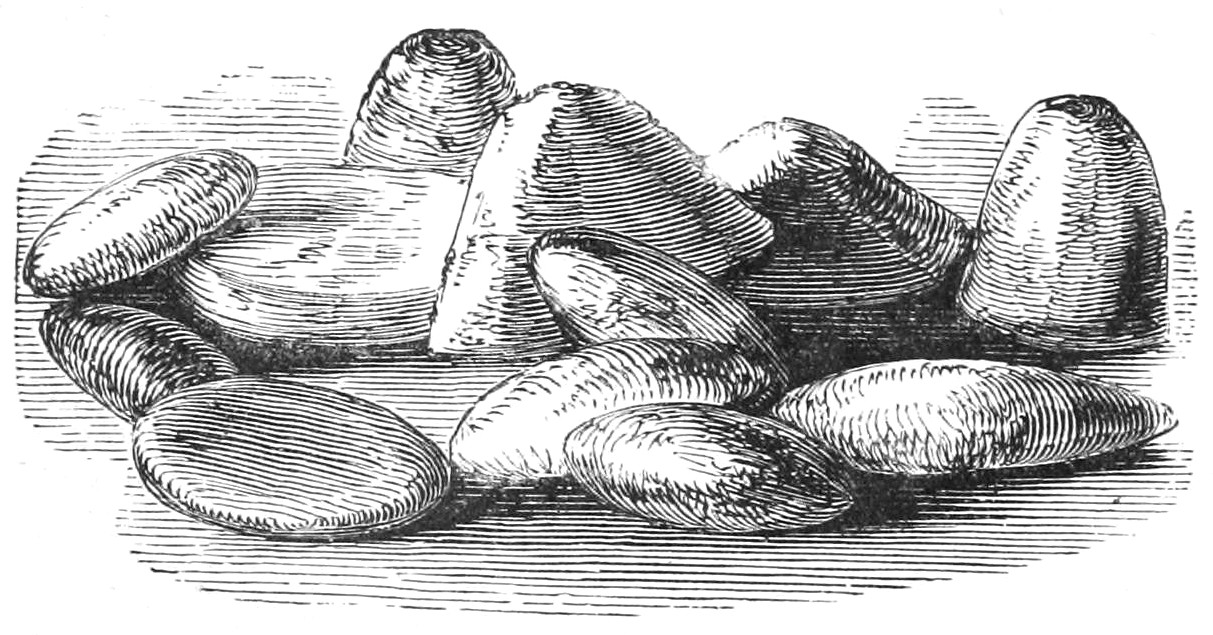
ANCIENT BREAD.
6 And he said unto them, Cast[764] the net on the right side of the ship, and ye shall find. They cast therefore, and now they were not able to draw it for the multitude of fishes.
7 Therefore that disciple whom Jesus loved saith unto Peter, It is the Lord. Now when Simon Peter heard that it was the Lord, he girt his fisher’s coat unto him, (for he was naked,) and did cast himself into the sea.
8 And the other disciples came in a little ship; (for they were not far from land, but as it were two hundred cubits,) dragging the net with fishes.
6-8. There was nothing to the disciples especially suggestive in the direction to cast the net on the right side of the ship. They might naturally suppose that he had perceived indications of a school of fishes there.—In the effect produced on the two disciples, Peter and John, by the miraculous draught of fishes which followed, the character of each is strikingly illustrated. John, with his quicker intuitions, recalling that other fishing scene, recognized the Lord first; Peter, with his greater boldness to act, leaped into the water, and partly swam and partly waded ashore. Comp. ch. 20:6, 8, notes. The distance was about two hundred cubits, that is, about three hundred feet. The fisher’s coat, which Peter girt unto him, appears to have been a sort of loose garment, like the workmen’s blouse of to-day, which Peter had laid off during his night’s work. This he put on, counting it unseemly to appear without it in the presence of his Lord, at the same time drawing it up and tucking it in about the waist, that it might not impede his swimming to the shore.—The accompanying illustration shows the probable style of the fisher’s coat, in contrast with the long robe worn by one not engaged in manual labor. The net itself was so full of fishes, and they so great, that the disciples abandoned the attempt to bring them into the boat, but dragged them in the net to the land.
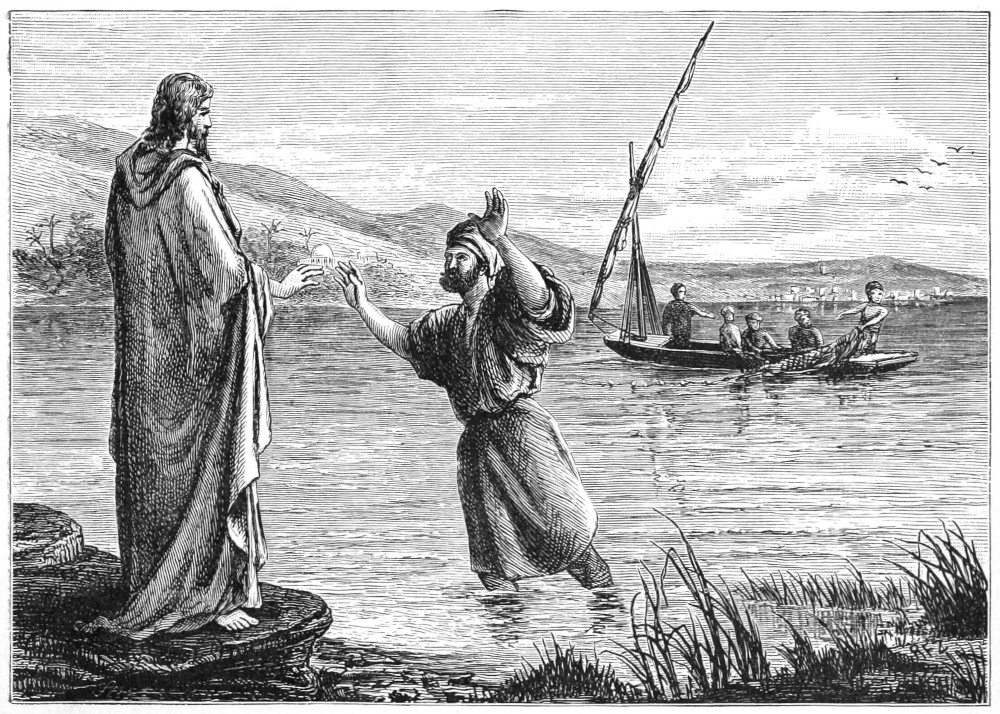
HE GIRT HIS FISHER’S COAT UNTO HIM.
9 As soon then as they were come to land, they saw a fire of coals there, and fish laid thereon, and bread.
10 Jesus saith unto them, Bring of the fish which ye have now caught.
11 Simon Peter went up, and drew the net to land full of great fishes, an hundred and fifty and three: and for all there were so many, yet was not the net broken.
9-11. On coming to the shore the disciples found a fire of coals already kindled, and some fish laid thereon, and some loaves of bread—in short, preparation for a simple meal. There has been some unprofitable discussion among the commentators respecting the manner in which this provision had been made. It is attributed by different commentators to the ministry of angels, to the activity of Peter, to the forethought of Jesus. Alford, following Stier and the older commentators, insists that it was miraculously provided. Trench rightly and briefly disposes of this question: “By what ministry, natural or miraculous, has been often inquired, but we must leave this undetermined, as we find it.” The provision apparently was not sufficient for the company, for Christ bade Peter add to the stock from the fish just caught. Peter went, therefore, to aid the others in bringing the net to shore. The fish were counted, and the exact number is recorded by the Evangelist. The attempt to draw some spiritual lessons from this number affords a curious illustration of the absurdities into which the allegorizing method is liable to carry the student. The exact enumeration is important only because it is an indication of accuracy in the historian; in such an enumeration there is no opportunity for the exaggeration of imagination. To me Augustine’s allegorical interpretation of the contrast between this and the analogous yet widely different miracle recorded in Luke 5:1-11 is scarcely more profitable than the spiritualizing interpretation of the meaning of the one hundred and fifty-three; the curious in such matters will find it fully reported in Trench on the Parables. It might be possible to account for each single feature in this narrative without assuming a miracle; but in a candid consideration of all the features combined—the fruitless fishing all night, the sudden and extraordinary success in the morning, the number of fish, their size, the unbroken net, though dragged full of fish to the shore—it is impossible to doubt that we have here, what evangelical critics have always seen in the narrative, the account of a miraculous manifestation of the Lord’s power.
12 Jesus saith unto them, Come and dine. And none of the disciples durst ask him, Who art thou? knowing that it was the Lord.
13 Jesus[765] then cometh, and taketh bread, and giveth them, and fish likewise.
14 This[766] is now the third time that Jesus shewed himself to his disciples, after that he was risen from the dead.
12-14. There is a verbal, but no real inconsistency in the statement that none of the disciples durst ask him, Who art thou? knowing that it was the Lord. “But seeing that His form was altered, and full of much awfulness, they were greatly amazed, and desired to ask somewhat concerning It; but fear, and their knowledge that He was not some other, but the same, checked their inquiry.”—(Chrysostom.) The careful student will observe that the Evangelist does not characterize this as the third appearance of Jesus, but as the third appearance to his disciples, i. e., the apostles. This excludes the appearance to Mary (ch. 20:16), and to the two disciples on the walk to Emmaus (Luke 24:13-35); the two preceding appearances referred to were that to the ten on the evening of the day of the resurrection (ch. 20:19) and that to the eleven in the week following (ch. 20:26). Without following the allegorizing commentators into any of their extravagances, we may reasonably see, with Alford, Trench, and others, a spiritual significance in the fact that Christ provided a meal for the apostles at the same time when, by this new miraculous draught, he reminded them of their first call to become fishers of men, thus suggesting to them the spiritual truth involved in the Lord’s Supper, and symbolically represented in the feeding of the five thousand, that they who minister in the things of Christ are themselves dependent on Christ for their spiritual support; perhaps also suggesting that when the labor of life is over there will be for them that have wrought for Christ a feast with him in the kingdom of heaven. But certainly Trench goes too far in saying that “the character of the meal was sacramental, and it had nothing to do with the stilling of their present hunger.” It is much more reasonable to see in this provision for the disciples’ commonest needs—food and a fire at the end of a night of sleepless toil—a new illustration of the tenderness of Christ’s consideration for his own.
15 So when they had dined, Jesus saith to Simon Peter, Simon, son of Jonas, lovest thou me more[767] than these? He saith unto him, Yea, Lord; thou knowest that I love thee. He saith unto him, Feed[768] my lambs.
16 He saith to him again the second time, Simon, son of Jonas, lovest thou me? He saith unto him, Yea, Lord; thou knowest that I love thee. He saith unto him, Feed my sheep.[769]
17 He saith unto him the third time, Simon, son of Jonas, lovest thou me? Peter was grieved[770] because he said unto him the third time, Lovest thou me? And he said unto him, Lord, thou[771] knowest all things; thou knowest that I love thee. Jesus saith unto him, Feed my sheep.
15-17. So when they had dined, Jesus saith to Simon Peter, Simon, son of Jonas, lovest thou me more than these? He saith unto him, Yea, Lord, thou knowest that I have affection for thee. He saith unto him, Feed my lambs. He saith to him again the second time, Simon, son of Jonas, lovest thou me? He saith unto him, Yea, Lord, thou knowest that I have affection for thee. He saith unto him, Shepherd my sheep. He saith unto him the third time, Simon, son of Jonas, hast thou affection for me? Peter was grieved because he said unto him the third time, Hast thou affection for me? and he said unto him, Lord, thou knowest all things; thou knowest that I have affection for thee. Jesus saith unto him, Feed my little sheep. This translation will suggest to the English reader, though inadequately, points of difference in the original which our English translation wholly fails to preserve, possibly through the inattention of the translators, but more probably through the inadequacy of the English language to represent delicate shades of meaning which are represented by the Greek. (1) Two different Greek words are rendered indiscriminately love (φιλέω and ἀγαπάω). I have attempted to indicate the difference by rendering the one to love and the other to have affection, though this rather suggests that there is a difference than indicates in what it consists. The word which Christ uses in his question, Lovest thou me? (ἀγαπάω), signifies, if not the higher, at least the more thoughtful and reverential affection, founded on an intelligent estimate of character, and accompanied by a deliberate and well-considered choice. Peter’s I love thee represents rather the personal instinctive love, the activity of feeling rather than of will, the affection which, being spontaneous and instinctive, gives no account of itself, and no reason for its existence. We are bid in the N. T. to exercise the first form of love (ἀγαπάω) towards God, but never the second; while the Father is said to exercise both forms towards his own Son. Two different Greek words are also rendered indiscriminately feed. To indicate the difference I have rendered one by the rare but indispensable verb shepherd. Finally, three words are used to represent the flock which Christ commends to Peter’s care—lambs (ἀρνία), sheep (πρόβατά), and little sheep (προβάτιά). There is some uncertainty as to the reading, but the one I have followed is accepted by the best critics—Alford, Meyer, etc. To feed the sheep is simply to nourish them; to shepherd them is not in contrast the ruling activity (so Meyer), but the whole shepherd care of the flock—watching, tending, leading—as illustrated in Psalm 23 and in John 10:1-18. The term lamb is never used in the N. T. except of Christ himself (John 1:29; 1 Pet. 1:19; Rev. 5:6, 8, 12, etc.), or of the followers of Christ (Luke 10:3). By the lambs here, then, I understand Christ to mean his professed followers; Peter was to show his love for the Master by teaching them. The term sheep is more general, and includes in the figurative language of the Bible those who have wandered away from the fold of God (Matt. 9:36; 12:11, 12; 15:24; Luke 15:4-6). Peter is to show his love for the Master, not only by teaching the Lord’s disciples, but by shepherding the sheep, whether in the fold or wandering from it, as a good shepherd going before them, going after them, giving his life, if need be, for them (John 10:1-13). The little sheep are the young, who have not yet wandered away, and whom he is to keep in the Master’s fold by feeding them there with the herbage of life. Christ calls them my lambs, my sheep, because the Father has given all to him, and he is, as Redeemer and Saviour, Lord of all. The most superficial student will not fail to see in this thrice-repeated question an indirect and implied reference to and recall of the thrice-repeated denial of his Lord by Peter. In his request for permission to walk on the water, in his protest against the feet-washing, in his assertion “Though all men shall be offended because of thee, yet will I never be offended” (Matt. 14:28; 26:33; John 13:8), there are indications of an overweening self-confidence in his love for the Lord as greater than that of the other disciples. It was this self-confidence in the strength of his love which had proved his danger. Christ addresses him, not by his new name of Peter, but by the old name which he bore before he knew the Lord, and asks him, Hast thou for me a greater love than these? Peter, saying nothing of the love of the others, not even venturing to claim for himself the intelligent and deliberate love which rules the life and molds the character, answers in humility: Thou knowest my affection for thee. Show it then, says Jesus, not by assuming pre-eminence over my flock, but by becoming their shepherd (= servant, ch. 13:12-17). He then repeats the question, Lovest thou me? Peter answers as before: Thou knowest my affection for thee. Show it then, says Christ, by shepherding my sheep; by seeking the lost, restoring the wanderer. A third time he asks the question, now changing it and adopting Peter’s own language: Art thou sure of thine affection for me? Peter is grieved, at the change in the question as well as at its repetition, “because he said unto him the third time, Hast thou affection for me?” and appeals to him as the Searcher of hearts to witness for himself the depth and reality of his affection. And Christ finally bids him show his love by feeding the little sheep—the young, the feeble, those most needing care. Meyer well notes the fact that Christ does not question Peter’s faith, but the love which proceeds from faith and shows itself by its work; and Godet notes the curious resemblance between the present situation and that of two scenes in the previous life of Peter with which it is related. He had been called to the ministry by Jesus after a miraculous draught of fishes; it is after a similar draught that the ministry is restored to him. He had lost his office by his denial beside a fire of coals; it is beside a fire of coals that he recovers it.—(Godet.) The ecclesiastical commentators see in this scene a reinstatement of Peter in his apostolic office, to which Alford well replies that “there is no record of his ever having lost it.” The R. C. divines find in it a proof-text for their belief in the primacy of Peter; to which Peter himself furnishes a quite adequate reply in 1 Pet. 5:1-3. The shepherd is not a lord over God’s heritage, but one who follows the Chief Shepherd, goes before the flock, is their example and their leader, by his own life showing them the way to live, and, if need be, by his own death for their sakes showing them how to die. It must strike one, too, as curious that Peter should be grieved at words which constitute him the head of the church and the vicar of God upon earth. The true lesson of this scene is for all the disciples of Christ. We are all, through Peter’s experience, admonished to show our love for our Master, not by asking permission to do great things (as to walk on the waves), not by refusing to accept his humiliation for us (as by refusing to allow the feet-washing), nor yet by professing what we will do in the hour of difficulty and danger (as by the assurance, “I will not deny thee”), nor even by entering into fierce battle against his foes (as by drawing the sword on Malchus), but by laying down the life in quiet, humble, self-denying service for the Master’s sheep—the followers of Christ, the wanderers from the fold, and the weakest and feeblest in the fold.
18 Verily, verily, I say unto thee,[772] When thou wast young, thou girdedst thyself, and walkedst whither thou wouldest: but when thou shalt be old, thou shalt stretch forth thy hands, and another shall gird[773] thee, and carry thee whither thou wouldest not.
19 This spake he, signifying by what death[774] he should glorify God. And when he had spoken this, he saith unto him, Follow[775] me.
18, 19. In this language, when thou wast young thou girdedst thyself, there is perhaps a reference to Peter’s act in girding himself and casting himself into the sea (ver. 7). The prophecy foretells the manner of his death, which, according to an early and apparently trustworthy tradition, was by crucifixion at about the same time with Paul, in the persecutions under Nero. According to Origen, Peter was crucified with his head downwards, either by his own request, because in his humility he was unwilling to suffer the same death as his Lord, or by order of Nero, as matter of wanton and ingenious cruelty. The contrast between Peter’s experience in his youth and in his old age is one common in Christian experience, a contrast between doing and suffering, between active, energetic service of the Lord and the patient endurance of his cross. Both are involved in following Christ. To interpret this command, Follow me, literally, as Godet: “Jesus began to move off, and commanded Peter to follow him in the literal sense, and John followed them without any express invitation,” seems to me a shallow interpretation, which is not helped by supposing it to be a symbolical act, a sort of childish object-teaching. Peter had gone back to his fishing; in saying Follow me, Christ calls him again to become a fisher of men, by the same phrase which he had employed three years before on the shore of the same sea and after a similar miracle.
20 Then Peter, turning about, seeth the disciple whom Jesus loved, following; which also leaned on his breast at supper, and said, Lord, which is he that betrayeth thee?
21 Peter, seeing him, saith to Jesus, Lord, and what shall this man do?
20, 21. It is not necessary, and it is hardly reasonable, to impute Peter’s question to a feeling of jealousy; it is rather to be attributed to the natural and almost universal tendency to inquire into the duty and destiny of others. The Lord’s reply indicates what is the answer which he would make to us whenever we, following Peter’s doubtful example, pry curiously into his purposes respecting others.
22 Jesus saith unto him, If I will that he tarry till I come,[776] what is that to thee? Follow[777] thou me.
23 Then went this saying abroad among the brethren, that that disciple should not die: yet Jesus said not unto him, He shall not die; but, If I will that he tarry till I come, what is that to thee?
22, 23. It is curious to see how Christ’s language here, notwithstanding John’s interpretation, has been misconstrued, even down to the latest time, as a promise, or a quasi-promise, that John should tarry until the second coming of Christ. Ancient legends report that after his interment there were strange movements in the earth that covered him, that when the tomb was subsequently opened it was found empty, that he was reserved to reappear again in conflict with Anti-Christ; so late as the sixteenth century an enthusiast was burned at Toulouse who gave himself out as St. John; and even so sober a commentator as Godet submits, though hesitatingly, the hypothesis that, as the primitive epoch of humanity had its Enoch, and the theocratic epoch its Elijah, neither of whom knew death, so also the Christian epoch may have had its deathless representative. Two other interpretations are: (1) That Christ refers here to his coming to his own in their death, and that by the phrase If I will that he tarry till I come he means, If I will that he meet a natural death instead of martyrdom. This interpretation Alford justly characterizes as frigid and inapplicable here, since martyrdom is as truly a coming of the Lord as natural death. (2) That by his Second Coming, Christ refers to the destruction of Jerusalem, an interpretation strangely adopted by Alford. That destruction was an historical prophecy, but in no wise an historical fulfillment of the promise of the Lord’s Second Coming. There is no reason for regarding this language of Christ as anything else than purely hypothetical, equivalent to, Suppose that I were to will that he should remain upon the earth unto the end; what would that be to thee?
24 This is the disciple which testifieth of these things, and wrote these things: and[778] we know that his testimony is true.
25 And[779] there are also many other things which Jesus did, the which, if they should be written every one, I suppose that even the world itself could not contain the[780] books that should be written. Amen.
24, 25. There is uncertainty respecting the authorship and authenticity of these verses. For discussion of this question, see Smith’s Bib. Dict., p. 1430, note b; Godet’s Commentary, Vol. III, pp. 362, 363. The verses are found in all the manuscripts, except that Tischendorf believes that ver. 25 was originally wanting in the Sinaitic MS.; he thinks that the color of the ink and a slight difference in the handwriting show that it did not proceed from the original scribe, but was added by a contemporary reviser. But though there is no external evidence for setting either verse aside, the internal evidence seems to me decisive against verse 25. “This inharmonious and unspiritual exaggeration” (Meyer) is entirely inconsistent with John’s scrupulously simple and truthful narrative. The authorship of ver. 24 is more uncertain. Whether written by John, or added almost immediately after by some companion, it affords a very strong attestation of the apostolic authorship of the Fourth Gospel. On a careful examination of the different authorities, it seems to me that Godet’s conclusion, though hypothetical, is in accordance with probabilities, and his deduction respecting the authenticity of the Gospel as a whole is irresistible: “1st. That the narrative (verses 1-23) is from the hand of the Evangelist. 2d. That ver. 24 is a declaration emanating from the friends of John, who had called forth the composition of his Gospel, and to whom he had committed it after its completion. 3d. That ver. 25 is written by one of them, with whom the work was deposited, and who thought himself bound to close it thus, to the glory, not of the author, but of the subject of history. By these last words the entire work becomes a whole. Accordingly we are shut up to hold either that John is the author of our Gospel, or that the author is a forger, who, 1st, palmed himself off on the world with all the characteristics of the apostle; who, 2d, carried his shamefulness so far that he got made out for him, by an accomplice of his fraud, a certificate of identity with the person of John; or who, more simply still, to save himself the trouble of finding a companion in falsehood, made out this certificate for himself in the name of another, or of several others. And he who had recourse to such ways was the author of a writing in which lying is blasted as the work of the devil (ch. 8:44), and truth glorified as one of the two essential features of the divine character! If any one will believe such a story, * * * let him believe it” (1 Cor. 14:38).
Two years have elapsed since the publication of the preceding volume in this series of Commentaries on the books of the New Testament. A considerable part of the Commentary on John was then already written; all that part of it which was common to the Four Gospels was substantially ready for the printer; little else remained to be written except that portion which dealt with the larger discourses of our Lord, and not all of that; and a life-long study of the Four Gospels, part of the results of which had been given to the public in a Life of Christ, and others of which were in manuscript notes, had made me measurably familiar with the ground that lay before me. But the discourses of Jesus, as recorded by John, can be studied only meditatively. A certain quiet restfulness of mind is essential to any spiritual apprehension of their meaning. And I have believed that those to whom this volume had been earlier promised, and whose impatience at the delay has reached me in letters that have always been kindly and courteous and full of encouragement, would easier pardon delay than despoiling haste in preparation. I can ask no leniency of any critic on the ground that time was wanting to do adequately the needful work.
I have stated in the introduction the reasons which have led me, after a careful, and I believe a measurably impartial, study of the question, to believe that the Fourth Gospel is the work of the apostle John, and that he is the one designated in that Gospel as “the disciple whom Jesus loved.” I wish to add here, emphatically, that the meditative study of the discourses which John has reported has strengthened that conviction. Either we have here the truths which Christ taught, reported by one who lived after the spiritual and catholic character of Christianity had begun to show itself by its actual development, and who therefore comprehended his profounder instructions as they were not comprehended during his lifetime; or else we must believe that the centuries immediately succeeding the first of the Christian era produced a spiritual genius whose insight into the profoundest truths of human experience, when inflamed into more than merely human life by the inbreathing of God, makes him the equal if not the superior of the Jesus portrayed in the three synoptic Gospels, and yet one who has been utterly unknown to fame, and who has left no other monument to his memory than a document that is a fraud if not a forgery. The skepticism that asserts this lays too heavy a tax on human credulity. It asks us to believe not only in a Socrates who had no Plato to reveal his teachings and his influence, but in one who did not hesitate to employ a petty and useless fraud as a setting for the most transcendent spiritual truth.
This truth may be expressed in two words as that of the Divine Immanence. Around this the whole Gospel of John centres; to illustrate this the whole Gospel was written. That there is in man the possibility of a more than merely earthly life; that in him has been planted the germ of a divine life; that this life, when divinely developed, brings with it a new light and power; that God is in the soul and the soul may live in perpetual consciousness of its God; that Christ is not merely a Memory and a Hope, but a Presence; that the Supernatural is not a past phenomenon, but a present and a perpetual experience; that miracles—that is, signs of the divine, All-mighty love—are forever going on in human experience, on a transcendently grander scale in the nineteenth century than they did in the first; that the evidence of Christianity is not to be sought in dingy and doubtful records of past events, but in the personal observation and witness of present occurrences; that revelation was not completed with the Apocalypse, but every devout soul has the promise of an inner light, and the invisible and Catholic brotherhood and household of faith, which is the true church of Christ, has in it an everlasting Shechinah, which reveals with perpetually increasing clearness the truth of God both to it and through it; and that fidelity to the sacred and sweet duties of love is at once the condition and the result of this living experience of an ever-living God, in the spiritual realm as in nature, every fruit being the seed vessel of new growths for the future:—this I believe to be the Gospel of our Lord Jesus Christ according to John. And I believe there is no better protection against that skepticism of the present age, whose vice is not that it demands a reason for every faith, but that it denies the witness of the spiritual sight to spiritual things, than the patient, meditative study of this Gospel, except the patient, persistent pursuit of the life to which it invites. To those that have no faith in such a life and such a light, to whom Christ is only a mist-covered mountain seen across the intervening eighteen centuries, and God only an hypothesis made probable by the Paleyrian argument from design, this Commentary will probably give no aid, and this Gospel will even appear to be uninterpretable in its mysticism. To those that have this faith in a perpetually present Immanuel, a Christ who is ever a God with us, however dim the faith may be, these pages are commended in the prayer and hope that they may help to make the Gospel clearer, the faith stronger, and the Christ nearer and dearer.