TRIAL OF ARTHUR THISTLEWOOD, (continued 2)
Reading edition
Re-examined in chief.—He said, the British army were at Cambray when he became acquainted with Brunt there.
Another witness was then called, but the Court and Jury were of opinion, as it was half-past seven, that it was the best time for adjourning. The Court was accordingly adjourned till nine o’clock on Tuesday morning.
SECOND DAY.—Tuesday, April 18.
The Court met this morning at nine o’clock, and the names of the Jury having been called over, and Thistlewood and the other prisoners being put to the bar, the evidence for the prosecution was continued.
Eleanor Walker examined by Mr. Gurney.—I am servant to Henry Rogers: he lives at No. 4, Fox-court, Gray’s-Inn-lane. We had a lodger named Brunt. He occupied two rooms on the second floor. They were front rooms. In January a lodger came, introduced by Brunt. This was a month or five weeks before Brunt was taken up. He (Brunt) said the lodger lately came from the country, and he wanted a room; and as we had one to let, he wished him to have it. The room was unfurnished. He paid three shillings a week for it. He (the lodger) said he might not bring his goods in for a week or better. He never brought any in to my knowledge. I do not think I should know him again. I do not remember having heard him called by his name. The room he took was a two-pair back room.
This witness was not cross-examined.
Re-called.—While this person occupied the room, I heard persons frequently go up stairs.
Mary Rogers, the aunt and mistress of the last witness, examined by Mr. Gurney.—The room was let by my maid while I was out. After the lodger had been in the house for a week, I said to Mr. Brunt, “You have brought a lodger.” He said, “Yes, I have, and I hope he will pay you. I know nothing of the man, but seeing him at a public-house, and seeing him want a room.” He said he was a butcher out of work. He paid me for four or five weeks. I cannot say whether he ever slept there; he did not to my knowledge. I and my maid in the evening saw three men coming up stairs. The one in the middle was a black man. The light from my room was on their faces. At other times I heard persons going up stairs, but took no particular notice.
This witness was not cross-examined.
Joseph Hale, a young lad, the apprentice of Brunt, examined by Mr. Gurney.—I am apprentice to Brunt. I have served two years and better of my apprenticeship. I lived with him in Fox-court. I remember a person coming to lodge there in January. His name was Ings, a butcher. Brunt and he looked at the room. Brunt said, “It will do; go down and give them a shilling.” After that Ings used to come to the room. The key was mostly left in the front room, and Ings used to come there for it. Persons used sometimes to come to the room before my master was taken up. This was every evening. I saw different persons. They were Ings, Tidd, Thistlewood, Bradburn, Edwards, Hall, Potter, and Strange. I remember a man named Adams: he came. Davidson, the black man, came also. Others used to come, but I do not recollect them. They used to stay nearly about two hours. There was no furniture in the room that ever I saw. They used to take chairs in, out of the front room. I did not hear any of their conversation. They used to call Thistlewood sometimes T., his initial, and sometimes Arthur. I once saw the door of Ings’s room open, and saw some long poles, like branches of trees cut rough; I suppose about twenty of them. I sometimes heard hammering and sawing in the room. My master was taken on Thursday, the 24th of February. On the Sunday before that there was a meeting in the room. There were more that morning than ever I had seen come up before. All the persons whom I have named were there that morning. After the meeting broke up I saw Strange in my master’s room. There was no meeting on the Monday evening. There was no meeting on Tuesday. On the Wednesday there were several persons going in and out. Some of them came into the front room, where I worked. They got some pistols, and were putting new flints in them. There were five or six pistols. One of the men said there were people overlooking them from the next house, and Brunt told them to go to the back room. Strange and a man whom I did not know were the men who had the pistols. I cannot say how many I saw go in and out. I saw Thistlewood that day. In the afternoon he asked me for a sheet of writing-paper. I gave him one. He took it, I believe, into the back room.
My master after this came out of the back room, and desired me to get six sheets of cartridge paper. He gave me sixpence. I bought the paper and gave it to him, and he took it into the back room. This was about four or five in the afternoon. I heard people going down stairs between five and six. My master was in and out several times. He went away finally about six. There was a man went with him. It was not one of the men I used to see there. A table had been taken that day from my mistress’s room to the back room. I wanted the table, and went for it. I knocked at the door, and Potter opened it. There were four or five in the room besides Potter. After my master was gone, I saw Tidd between seven and eight. Mrs. Brunt called him, and he came into her room. She showed him a pike-head and a sword. She asked him what she should do with them. She then gave them to him, and he took them out of the room into the back room. After this I heard some persons go down stairs. Tidd left a message, that if any persons called they should be sent to the White Hart. Some persons did call on my master, and I went to show them to the White Hart. Potter came, and he went. He knew the way himself. There were three came to whom I shewed the way.
My master came home that night at about nine o’clock. I observed his dress was dirty. He appeared confused. I heard him say to his wife, it was all up, or words to that effect. He said that where he had been, a great many officers had come in. He said he had saved his life, and that was all. Just as he said this, another man came in. I do not know that man. Brunt shook hands with him, and asked him if he knew who had informed. The man said, no. The man then said, he had had a dreadful blow on the side, which knocked him down. Brunt then said, “There is something to be done yet.” After this Brunt and the other man went away together. Mrs. Brunt and I after this went to Ings’s room. I saw several rolls of brown paper with tar in them. I saw only one pole remaining. I saw something rolled up, and tied round with strings. I understood them to be hand-grenades. I saw an iron pot belonging to Brunt. My master came in about eleven o’clock. He told me to get up in the morning as soon as I could and clean his boots. They were very dirty. He called me in the morning at half past six, and when I got up he asked me if I knew the Borough. I told him yes. He then asked if I knew Snow’s-fields. I said no. He then went into the back room and put the things out of the cupboard into two baskets; one of which was afterwards put into a blue apron belonging to Mrs. Brunt. This apron had before this been as a curtain in Ings’s room.
My master told me that Potter lived in Snow’s fields. When we had the baskets ready, two officers came in and took my master into custody. I knew where Tidd lived. He lived in the Hole-in-the-Wall-passage, Brooks’-market. Adams lived next door.
Cross-examined by Mr. Adolphus.—My master is a journeyman shoemaker: not a very poor man. Adams is also a shoemaker. Ings had the lodgings five weeks. I believe they had meetings there every night. I thought there were about twenty persons there on the Sunday. I know some of the prisoners. Strange is a boot-seller—selling boots in a shop. Edwards was an artist. Edwards was there very often: oftener than Adams—almost every day. Hall was a journeyman tailor, I believe. I don’t know where he lives. I cannot say how many persons were there at one time on Wednesday. The baskets used by my master were rush baskets. As near as I can guess there were about twenty poles. They were branches of trees in a green raw state. I believe they kept a fire in Ings’s room. I do not know whether the poles were cut up to light the fire or not.
Thomas Smart examined by Mr. Littledale.—I am a watchman of the parish of St. George, Hanover-square. I was on watch on the south side of Grosvenor-square, on Tuesday the 22d of February. I went there about eight o’clock. About half-past eight I saw four suspicious men walking the square. I thought they were after no good; one of them was a dark man, and the other a tall man. I watched them. They were looking down the areas. Charles Bissix’s box is at the west side of the square.
Cross-examined by Mr. Curwood.—It was not a very uncommon thing to see suspicious men walking about.
Henry Gillan examined by Mr. Bolland.—I am a servant to Mr. Whittle, apothecary, at 15, Mount-street, Grosvenor-square. I sometimes use the Rising-sun public-house. It is in Charles-street, which runs into Grosvenor-square and Mount-street. I was there on Tuesday the 22d of February. I saw that short man (pointing to the prisoner Brunt) there. There was a tall man with him. They had some bread and cheese and porter. There were dominos on the table, and the short man challenged me to play with him. I played two games with him, and left the house before ten, leaving them there.
John Hector Morris examined by the Attorney-General.—I am a journeyman cutler to Mr. Underwood, in Drury-lane. I remember on Christmas-eve a man brought a sword to my master’s shop. The man was habited like a butcher. He drew the sword from under his smock-frock, without a scabbard. He wished to have it ground sharp, particularly at the point. He said to put the name of Inns on it; but I am hard of hearing, and it might be Ings. He called for it in a few days. In about a fortnight he brought another sword to have it sharpened in the same way. It was much longer than the other. [Here the witness identified the prisoner Ings as the man who brought the swords.] I should know the swords again.
Edward Simpson examined by the Attorney-General.—I am a corporal major of the 2nd Regiment of Life-Guards. I know a person named Harrison. He was in the Guards. (Here he identified Harrison.) He was discharged in 1814. When I knew him, he was in King-street barracks, Portman-square. He had an opportunity of knowing them. Part of the barracks looked into Gloucester Mews. There was a loft with five windows looking into it. There was hay and straw in that loft; the windows had been stopped up since the Cato-street business.
Cross-examined by Mr. Curwood.—I don’t know how many men are in Knightsbridge barracks; they would hold about 300.
James Adams examined by the Attorney-General.—I am a pawnbroker in Berwick-street. I know the prisoner Davidson from his having pledged things at my shop. He came on the 23d of February, in the morning, and took a brass-barrelled blunderbuss out of pledge.
This witness was not cross-examined.
Thomas Hyden examined by Mr. Gurney.—I am a cow-keeper. I was formerly a member of a shoemakers’ club. I knew Wilson there. I saw him a few days before the 23d of February; he met me in the street, and made a proposition to me. He asked me if I would be one of a party to destroy his Majesty’s Ministers; he said they were waiting for a cabinet dinner, and that all things were ready. He told me they had a sort of things which I never saw; they were called by the name of hand-grenades,—and, he said, he depended on me to be one. He said that Mr. Thistlewood would be glad to see me, if I would be one. He said, the use to be made of the hand-grenades was to be put under the table, at the cabinet dinner, with the fuse alight, and those who escaped were to be destroyed by the sword or some other weapon. He also said that fires were to be lighted, and the town to be kept in confusion for several days, till the thing became general. He named some houses. Lord Harrowby’s, Lord Castlereagh’s, Lord Wellington’s, Lord Sidmouth’s, the Bishop of London’s, and several others which I do not remember. I told him I would make one. This was, I believe, four or five days before the Cato-street business. Before that I went to Lord Harrowby’s. I do not remember the day. I followed his Lordship in the park. I gave him a note. On Wednesday, the 23d, I saw Wilson again. I believe it was between four and five o’clock in the afternoon. I met him in Manchester-street, Manchester-square. He said, “Hyden, you are the very man I wanted to see.” I asked him what there was going to be; and he said, there was to be a cabinet dinner at Lord Harrowby’s, Grosvenor-square. He told me I was to go to the Horse and Groom public-house, the corner of Cato-street. I was to go in there, or otherwise I was to wait at the corner until I was shoved into a stable close by. I asked him the hour, and he said about half past five or a quarter before six. I then asked him how many there were to be, and he said twenty or thirty. I asked him, was that all there was going to be? and he said, there was to be another party in the Borough, another in Gray’s Inn-lane, and another in Gee’s-court, or in the city. He said, all Gee’s-court were in it; but they would not act till after the English began, as they had so often deceived them before. Gee’s-court is inhabited by Irish. It is at the St. Giles’s end of Oxford-street. He also said there was a gentleman’s servant supporting them with money; and, if they would act on the subject, he would give them a great deal more. He asked me if I had a gun; and I said yes, but it was only a rubbishing one. He then said they would provide me with a gun, and something to work with. There were, he also said, two pieces of cannon in Gray’s Inn-lane, which they could get by breaking in a small door. He said there were four pieces of cannon in the Artillery Ground, and they could be very easily taken, by killing the sentinel. After they left Grosvenor-square, they were to meet near the Mansion-house. I was told to come to my time, or the thing would be done before I came.
I went to John-street that evening; it was nearly seven o’clock. The entrance to Cato-street is a little gateway from John-street. When I got there I saw Wilson and Davidson; I had seen him (Davidson) before. Davidson said I was come, and he asked me if I would go in. I said no, as I was going somewhere else to look for some cream. He said if I would go in, Mr. Thistlewood was there. I asked him what time I should be there, and he said eight o’clock. If I were not there in time, he said, I was to follow them down to Grosvenor-square, and, at the fourth house from the corner, at the bottom of the square, I should find them.
Cross-examined by Mr. Adolphus.—I am not certain whether the first conversation I had with Wilson was before the Sunday, before the Cato-street business. I am not quite certain. It was four or five days before. I am not able to say what day I gave the information to Lord Harrowby. It might be a day or two before I saw Wilson in Manchester-street. The conversation with Wilson was in Manchester-street; we were walking up and down the street.
A note was here put into witness’s hand, which he said was the one given by him to Lord Harrowby. It was in his own hand-writing.
Cross-examined.—The reason why I gave the note to Lord Harrowby was, because I could not see Lord Castlereagh.—I did not call at Lord Castlereagh’s house, but I went three or four times near the house, in order to see him. I did not see him, and then I gave the note to Lord Harrowby. I am certain that in Wilson’s conversation with me, the words, “His Majesty’s Ministers,” were used.
The Earl of Harrowby examined from the bench by the Attorney-General.—I reside in Grosvenor-square, on the south side, near Charles-street, next door to the Archbishop of York’s. I am a Privy-Councillor, and one of his Majesty s Ministers. I am President of the Council, and one of the Cabinet. On the 23d of February last, I intended giving a cabinet dinner; I think it was on Wednesday, the 23d. Only those who compose the Cabinet are invited to Cabinet dinners. I believe the invitations went out the latter part of the week before, but my head servant can speak to that more correctly. Invitations were sent to the Lord Chancellor; to the Earl of Liverpool, the First Lord of the Treasury; to Mr. Vansittart, the chancellor of the Exchequer; to Earl Bathurst, the Secretary of State for the Colonial department; to Lord Sidmouth, the Secretary of State for the Home Department; to Lord Castlereagh, the Secretary of State for Foreign Affairs; the Duke of Wellington, Master General of the Ordnance; Mr. Canning, the First Commissioner of the India Board; Mr. Robinson, President of the Board of Trade; Mr. B. Bathurst, Chancellor of the Duchy of Lancaster; Mr. Wellesley Pole, the Master of the Mint; and the Earl of Mulgrave; all these are Privy-Councillors. They are employed in the different offices I have mentioned, and also form what is called the Cabinet. In common parlance they are called his Majesty’s Ministers. On the Tuesday before the intended dinner, I was riding in the Park without a servant. It was about two o’clock. I went to a Council at Carlton-House. I am not positive as to the hour. As I came near Grosvenor-gate a person met me, and asked me if I was Lord Harrowby. I said, yes. He said he wished to give a note to Lord Castlereagh, which was of considerable importance to him and to myself. He then gave me a letter. After some further conversation, he gave me a card, with his address. I saw the man again by appointment on Wednesday morning in the ring, among the young plantations in Hyde-Park. The dinner did not take place at my house on Wednesday. The preparations went on as if the parties were to dine together, until I wrote a note from the Earl of Liverpool’s to my head servant, to say the Cabinet would not dine there. It would be seven, or half past, at which the party would dine.
Cross-examined by Mr. Curwood.—I had some general knowledge of some conspiracy, or something of the kind, going on before this. I do not know a person named Edwards. We had some general information a considerable time before this, that some plan was in agitation, but we did not know the time at which it was to take place, or the particulars. I will not say to two months. It was some considerable time before this.
John Baker examined by the Attorney-General.—I am butler to Lord Harrowby. The cards of invitation were issued for the cabinet dinner on the 18th, or 19th. It was about eight in the evening of the 23d when I first knew that the Cabinet were not to dine at my Lord Harrowby’s. The preparations for it went on till then. The Archbishop of York lives next door to my Lord Harrowby’s. I can’t say whether his grace had company on the 23d of February. I noticed several carriages draw up at his door.
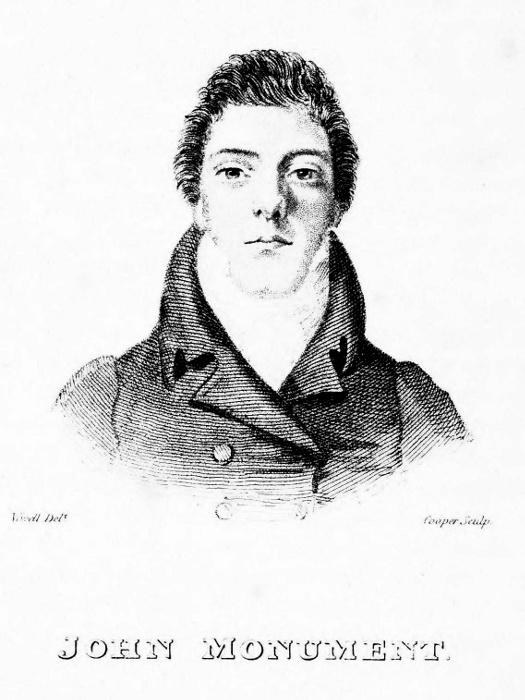
John Monument examined by the Solicitor-General.—I am by trade a shoemaker. I generally live near Brooks’-market, but I am now a prisoner in the Tower. I know the prisoner Thistlewood. I met him at the house of one Ford some weeks before the transactions of the 23d of February. He afterwards called upon me at my lodgings. He was not alone. Brunt was with him. He told me that he wanted to speak with me in private. In consequence I went out of the room with him, my mother and brother being at that time in the room with me. Brunt staid behind when I went out. Thistlewood then said to me, “Great events are now close at hand—the people are every where anxious for a change. He had been promised support by a great many men, who had deceived him, but he had now got men who would stand by him.”
He then asked me if I had any arms. I said, “No, I had not.” He said, that every man of them, that is, of those who were attached to him, had arms, pikes, pistols, or sabres; and added, that I might buy a pistol for four or five shillings. I said that I was too poor to buy one. He replied, that if such were the case, he would see what could be done for me. Brunt called upon me again in four or five days. He said, that he could not stay long with me; there were several more men of his trade waiting to see him on this business, and he must call on them. I did not see him afterwards for some time. He called, however, again upon me on the Tuesday previous to the 23d. I then told him that I thought I had lost him, as he had staid away so very long. He replied, that owing to the King’s death, an alteration had taken place in their plans. I asked what those plans were. He said that I should know them better at a meeting to be held the night afterwards, than he could tell me. I asked him where the meeting was to be. He said at Tyburn-turnpike. He did not tell me what was to be done there.
I asked him if I was to see any persons there how I was to know them as friends, and requested him to give me the word. Brunt then told me, that if I saw any persons about, I was to say B-U-T; and if they were friends, they would say T-O-N. He would, however, call on me the following morning, and tell me more particulars.
On the Wednesday afternoon, between four and five, he did call again: he came by himself. He called me down stairs, and asked me if I was ready to go. I said, “No, I have got some work to do, and it must be done before I go.” He asked me how long it would be before it was finished. I said, that it would be done about six o’clock. He then said, that he could not wait for me so long—that I must therefore come to the place appointed along with the man to whom he had introduced me; that man’s name was Tidd. He charged me not to be later than six o’clock, as Tidd had others as well as myself, to take with him to the place of meeting.
I went to Tidd’s at half-past six, who complained that many men had disappointed him. We waited till seven, but no person came. Tidd then went into a corner of the room, took out a large pistol, and stuck it in a belt, which he wore round his waist. He also took out four or five pike-heads, which he wrapped up in brown paper. He took also several shafts, four or five feet long. We then went out, along Holborn, and up Oxford-street. I asked him, in his room, where we were going. He said to a room in a mews in John-street, Edgware-road. When we got into Holborn, he gave me the pike-shafts, and told me to take care of them. I asked him again, as we were going along, where we were going; and wanted to know whether it was to the House of Commons. He said, “No, there were too many soldiers near there.” I again pressed him on the subject, and he said that they were going to Grosvenor-square, as there was a cabinet dinner there that evening. I did not ask him any more questions; for on his saying that, I was satisfied for what purpose they were going.
We then went to Cato-street. Under the archway I saw two men, whom Tidd appeared to know. He spoke to them; and, after a few moments we all went into the stable together. There were in the loft and stable about twenty-four or twenty-five persons. I had not been there long when some one proposed to count the numbers assembled. Thistlewood replied, that there was no occasion to do so, as he knew that there were about four or five and twenty persons in the room. There was a person in a brown great coat sitting on a carpenter’s bench, who spoke of the impropriety of going with so small a number to Lord Harrowby’s. Thistlewood replied, there were quite enough of them. He only wanted thirteen to go into the room, and supposing Lord Harrowby to have sixteen servants, that number would be quite enough to master them.
The man in the brown coat said, “After we have done, there will be a crowd about the door, how are we to make our escape?” Thistlewood said, “You know the larger body is already gone to arrange matters; we, the smaller, are left to do the business.” Davidson then blamed the tall man in the brown great coat for throwing cold water on the plan, and added, that if he was afraid, he might as well go away. Brunt said, “Rather than give up the business, I will go to the house and blow it up, though I perish myself in the ruins, for you know we have got that which can easily do it.” The man in the great coat then said, as they were all for it, he would not oppose it. He then proposed that all in the room should put themselves under the orders of Thistlewood. Upon which Thistlewood said, that all engaged in the business were equal, and should have the same honour as himself, and proposed that fourteen should volunteer to go into the room at Lord Harrowby’s. Those that volunteered were to range themselves on the side in which the fire-place stood. They did so in the course of a few minutes. Whether they were exactly fourteen I don’t know.
I heard nothing said of what the rest were to do. On somebody asking that question, Thistlewood replied, that they all knew their places. Thistlewood then went out for a few moments. On his return, he said that he had received intelligence that the Duke of Wellington and Lord Sidmouth had arrived at Lord Harrowby’s. I was myself taken into custody in the room.
Cross-examined by Mr. Adolphus.—I never saw Thistlewood till I saw him at Ford’s. I attended at the meeting in Finsbury-market. I was so far off that I could not tell whether Thistlewood was there, nor even the purpose of the meeting. There was no particular acquaintance at that time between me and Thistlewood. I did not then know Brunt or Edwards. There was a long interval between my first and second conversation with Brunt. I thought that they had done with me, finding me so reluctant to join in their measures. The man in the brown coat was not Adams. I have seen Adams since, at Hicks’s Hall. The room was much crowded—the parties in it were eating bread and cheese. I do not know that I ever saw Adams before I saw him at Hicks’s Hall. I recollect the prisoner Davidson from his colour. If any person had addressed them besides the man in the brown coat, I must have heard him. I was taken in the room when the soldiers came. I had no arms. I made no resistance.
Re-examined by the Solicitor-General.—I was nearly the last person who entered the room. I was there nearly a quarter of an hour before the officers came. I was unacquainted with every person in the room except Thistlewood, Brunt, and Tidd. It was candlelight. On the bench were swords, pistols, and blunderbusses. When I was brought up to Whitehall, I was handcuffed to Thistlewood; who advised me, when I came before the Privy-Council, to say that I had been brought to Cato-street by Edwards. I asked him how I could tell such a falsehood, when I had never seen such a man as Edwards in my life. He said that was of no consequence. If asked what sort of a man he was, I was to say, he was a little taller than myself, and dressed in a brown coat.
By a Juryman.—I have had no communication with Adams since my apprehension.
By the Solicitor-General.—I never saw him except when I was brought up as a witness to Hicks’s Hall.
Thomas Monument.—I am brother to the last witness. I remember Thistlewood calling upon my brother. He brought Brunt with him. They did not stay in the room more than five or ten minutes. Thistlewood then asked my brother if he might speak with him. On my brother’s replying yes, they went out together for ten minutes. They then returned; and Brunt and Thistlewood went away.
On the Tuesday before the Cato-street business, Brunt called again on my brother, with a man named Tidd. My brother said, “Brunt, I have not seen you for so long a time, that I thought I had lost you.” Brunt said, “The King’s death had made some alteration in our plans.” My brother asked what those plans were. Brunt said, they had different objects in view. Brunt asked my brother to meet him at Tyburn-turnpike that evening, when an outline of their plan should be given to him. Brunt said that he ought to be there at six o’clock: if he saw any persons about, he should say, B-u-t, and if they were of their party they would say, t-o-n. They did not press me to go, but spoke only to my brother. I did not go. Brunt called at five the next evening for my brother to go. He said, he could not go then, as we had work to do. Brunt then bade my brother call on Tidd, at the Hole-in-the-wall passage, at seven. He did so, as I was informed.
Cross-examined by Mr. Curwood.—Not suspecting that any mischief was going on, I was not anxious to know to what the conversation of my brother and Brunt referred. I thought that it might perhaps relate to some club-dinner.
Thomas Dwyer examined by Mr. Gurney.—I live in Cheese-court, Oxford-street. Some time in February I became acquainted with Davidson. He introduced me to Thistlewood. We went together to a public-house at the end of Molyneux-street, not far from Cato-street. This might be about the 9th, 10th, or 11th of February. Thistlewood said nothing particular to me at that time. He observed, that he had been in four or five revolutions, and that Ireland was in a disturbed state. I am an Irishman. Thistlewood said, that he had a good many of my countrymen with him. He pressed me to go with him also.
I saw Davidson on the night before the 23d. He told me that he was going to stand sentry. The next morning I was called upon by a person, who took me to Fox-court, Gray’s Inn-lane. He was a tall man, and his name is Harrison. We went into a two-pair back room; the room door was locked. He knocked at another door, and a woman gave him the key. He opened the door, and we entered.
There was a cupboard in the room, out of which was taken a ball, wrapped up in yarn. Harrison told me the purpose for which it was intended, and called it a grenade. Shortly afterwards Thistlewood, Davidson, and a few more, came in. Davidson had a blunderbuss, a pair of pistols, and a bayonet, in his side pocket. Others also came in, but I did not know their names. [The witness was here told to look into the dock, and see if he could identify any of the prisoners as being then present. He instantly identified Brunt.] On Davidson’s saying that he had only given twelve shillings for his pistols, Brunt said he would go out and buy a pair.
I had some conversation with Thistlewood about the hand-grenades. Thistlewood said, that some of them were to be thrown into the horse-barracks, and others into Lord Harrowby’s house, to set fire to it, and blow it up. Thistlewood asked me how many of my countrymen I could muster, as he should want some of them at half-past eight that evening. I told him that I could muster about twenty-six or twenty-seven. He told me that they, meaning himself and friends, were to assemble at the Horse and Groom; and ordered me to be at the Pontefract Castle, at the end of Barret’s-court, a house much frequented by Irishmen. He told me that I was to pick out the best of my countrymen, and go to the Foundling Hospital, knock at the porter’s lodge, put a pistol to his breast, and turn on to the right hand, as there were twenty-five or twenty-six stand of arms in the other lodge: these I was to seize. At the same time another party would secure two pieces of cannon which were in the Light Horse Riding-School, Gray’s Inn-lane. Another party was in the meantime to go to the Artillery-ground, Finsbury, and seize what was there. He also mentioned that there was to be a cabinet dinner at Lord Harrowby’s, and that the party there were to be attacked.
After this, I saw a bundle, containing gunpowder, taken out and laid upon the floor; a tin measure was produced, and several smaller woollen bags were filled with it. This was done by Harrison. I afterwards heard Thistlewood give directions generally to them all. He said that a dozen pike-handles were to be taken to Mary-le-bone, some others to Finsbury, and some elsewhere. I was asked, but refused, to take some of them. I saw a bag; and the powder which had been measured out, and also the grenades, were put into it.
I heard directions given to a man by Harrison, to take something to the Horse and Groom, at the end of Cato-street. In the mean time another person went out to get the pike-handles. I got back to my own place at twelve o’clock. I told Major James of what I had seen and heard: in consequence of what he said, I went to the Secretary of State about one, or half-past one o’clock that day.
Cross-examined by Mr. Curwood.—I am a bricklayer by trade. I never, before the month of February, saw Davidson. Davidson introduced me to Thistlewood on the ninth of that month. They did not know me, and I did not know them, yet I was let into their secrets on the morning of the 23d of February. I have lived fifteen years in the parish of Mary-le-bone, with a good character, and yet all of a sudden a band of traitors intrusted me with their traitorous designs. I told them that it was a hard thing to inveigle men into a scheme like theirs, and doubted whether I should be able to accomplish it. Though I expressed this doubt, I was sent to the Foundling Hospital to take the arms. I acceded to their proposal at the time, but had no intention of executing it. I do not know a man of the name of Hugglestone. I never was in a court before, except on the trial of a woman for stealing. I was in Ireland at the time of the rebellion. I cannot tell how old I was then.
George Kaylock examined by Mr. Littledale. I live at 22, Cato-street. I saw Harrison and another against the stable-door in Cato-street, at five o’clock on the 23d February. I asked Harrison how he did. He replied, pretty well; he had taken two rooms there, and was going to do them up. Between five and seven o’clock I saw more than twenty people go in at the stable-door.
Richard Monday examined by Mr. Littledale.—I live at 23, Cato-street. About twenty minutes after four, on the 23d, as I was coming from my work, I saw Davidson standing under the archway. I knew Davidson, from seeing him with Firth, the cow-keeper. I went home and got my tea. I came out again at twenty minutes past five, and went to a public-house. On leaving it, I saw Davidson going into No. 1 for a light. In going into the stable, into which Harrison admitted him, he stooped for a bundle, and I then observed that he had two belts on, one across his shoulder, and the other round his waist; in that round his waist, on the left side, two pistols were inserted; on the other a sword was suspended, which jutted out considerably. The place where they met is a stable, belonging to General Watson; it has lately been used as a cow-house by Firth. There is a chaise-house, and a stable below, and a loft, with two rooms above. One of these rooms has a window, the other is dark. I observed, in the course of the afternoon, that something like a coarse matting was hung over the windows, and the partition in the stable-yard.
Elizabeth Westall.—I live at No. 1, Cato-street. About three o’clock I saw a man go into the stable with a sack on his shoulder. About six o’clock I went out, and saw a man of colour standing by the stable. I was much alarmed by that circumstance, thinking that the stable was unoccupied. I was out ten minutes. Shortly after I returned, the man of colour came into my house, and asked me for a light. I gave him a light. He then went back to the stable where I had seen him at first.
George Ruthven, the police-officer, was then examined by Mr. Bolland.
I went, on the 23d of February, to Cato-street. Three others were to meet me there. When we were all assembled we were about twelve of us. I went into the stable, and saw a man with a sword by his side, and a blunderbuss on his shoulder. I saw one man below, and I have some faint recollection that I saw another. The whole of my party followed me into the stable. On seeing the man with the blunderbuss on his shoulder, I told some of the party to secure him. I went up a ladder, which led to a loft.
When I got there I saw several men; heard the clattering of arms, and saw swords and pistols. Three or four of my party went up with me. I am sure that Ellis and Smithers were with me. From the view which I had of the place, I think there were 24 or 25 persons present. The size of that room is 15 feet, five one way, and ten feet ten the other. There are two rooms adjoining this, separated by doors. When I got into the room, I said, “we are officers; seize their arms.” I saw in the room Thistlewood, whom I have known for four or five years.
Thistlewood was standing, at the time we entered, at the right hand side of the table, near the door of the little room. On my saying, “We are officers,” he seized a sword, which was drawn, and retreated to the little room. The sword was a very long one, and rather bright. He stood in the entry of the door fencing, to prevent any one’s approach. Smithers approached him. Thistlewood stabbed him, and Smithers fell, saying, “Oh, my God! I’m done,” or something to that effect. Somebody from the corner of the room where Thistlewood stood said, “Put out the lights—kill the b——rs, and throw them down stairs.” The lights were then put out; I joined in their cry of “kill them,” and rushed down stairs.
I did not observe any thing till I got into John-street, where I met the soldiers, whom I brought. Several shots were fired from the corner of the room where Thistlewood was standing; I think down the stairs. On arriving a second time at the stable, I met Tidd grappling with one of the military. I secured him. I was afterwards in the public-house, (Horse and Groom) and saw Bradburn brought in. On him were found six ball-cartridges and three balls. Davidson and Wilson were brought in. Davidson sang a song. I then went back to the loft, and found there, Shaw Strange, Cooper, Monument, and Bradburn. I saw arms in the hands of several persons. I found two swords and a bag. The bag contained ten hand-grenades. I also found balls and fusees. They were brought to Bow-street, and remained since in possession of an officer. Afterwards I went to the Horse and Groom. I had seen Cooper there, with a stick, and Gilchrist came back for it, but did not get it. I observed it cut.
Cross-examined by Mr. Adolphus.—Thistlewood had not been much out of sight since Watson’s trial. Witness had seen him five or six times. He had a motive for it. It was not for this purpose, that he was aware of. There were four or five Edwardses, officers with him, but he was not aware that Edwards, who had been concerned in this business, was connected with any of them. He knew nothing further, than that he was directed to watch Thistlewood.
James Ellis, by the Attorney-General.—Went with the other officers to Cato-street on the 23d of February; he went in immediately after Ruthven. He saw two men, one having on two cross-belts; either in his right or left holding a carbine, in the other a sword. Witness observed, that he was a man of colour. The other person was between the foot of the ladder and the stall next to it, for there were three. He followed Ruthven up as close as he could. The man of colour said something ending with “men.” He heard the men above rushing back behind the carpenter’s table, and a noise like fencing with swords. There might be twenty or twenty-five men. Ruthven said, “We are officers, seize their arms, or surrender your arms.”
Witness had not known Thistlewood before, but he was satisfied it was he who menaced with the sword. Witness had before held forward his staff of office; he now presented a pistol, and desired him to desist, or he would fire. Smithers then gained the top of the ladder, and advanced towards the little room. Thistlewood struck him with the sword near the breast. Smithers fell back, held up his hands, and exclaimed, “O, God!” Witness fired on Thistlewood, and Smithers staggered towards him. The candles were put out, and the witness was forced down. He stood at the door to the street. Several shots were fired: some balls passed him. On going out he heard a cry. Saw a man running towards Queen-street, with belts on. He secured him. It was Davidson, the man of colour. He had a carbine in the one hand, and a sword in the other. He afterwards assisted in securing four, to whom he could not speak positively.
Cross-examined by Mr. Curwood.—He was a constable, and had the warrant. He had a part in conducting the officers; but Mr. Ruthven was there.
William Westcott had part in conducting the patrol at Bow-street, and was a constable. He was down in the stable the whole time, and heard firing on the loft. He saw Ings in the stable, who wanted to rush out, while the other officers were up. Witness and Ings had a contest. There was terrible confusion in the loft; some came tumbling down, and some singly. He knew Thistlewood. There was a light. Thistlewood fired at witness. Three holes were in his hat by balls. Witness rushed towards Thistlewood, when he was struck down. Thistlewood then made a cut at him with a sword, and ran out. Witness was wounded in the back of his hand with one of the balls, as he had held up his hand to protect his head.
Hugh Nixon, one of the Bow-street officers, saw Ruthven, Ellis, and the deceased go up the ladder. He went up, and saw Ellis fire. There was a rush down, and he saw a man fire a pistol; he rather believed it was Thistlewood. Ings was pursued and brought back. Witness found a sword in the stable, and a bayonet up stairs.
John Wright, a patrol of Bow-street, was one of the officers who went to Cato-street. They mustered at the Horse and Groom. He saw Cooper having a broom-stick, and another coming to drink beer. Cooper left the stick. Witness took a sword and a knife from a man who was in the stable, near a stall. That moment he was knocked down, and received a stab in his side. Wilson and Bradburn were afterwards taken. Witness found about two dozen ball-cartridges in Wilson’s pocket, and a pair of scissors; and found two haversacks on his sides.
William Charles Brookes, a patrol, being directed by Mr. Birnie towards persons passing, saw Ings, and a person in front of him with a cutlass, and spoke to them. Ings fired, and slightly wounded him on the shoulder. Witness staggered into the road. Ings went off towards the Edgware-road. Witness pursued. Ings threw away the pistol. Moy took him. Witness asked him why he had fired at him, a man whom he had never seen. He said, “I wish I had killed you.”
Ings.—“Pray, my Lord, am I not allowed to ask any question?”
Court.—“You are not on your trial at present.”
Witness stated, that two haversacks, a knife-case, and a tin box, three parts full of powder, were found on Ings.
Giles Moy confirmed this evidence, so far as he was concerned.
Robert Chapman, one of the Bow-street officers, went to Cato-street; saw Ings in the stable, and heard him say, “Look out, above.” Witness, in the watch-house, took from Ings a knife-case, two balls, and a pistol-key. He saw one running through the stable with a sword in his hand.
Captain Fitzclarence appeared on the right of the bench, and said, he was a lieutenant in the Coldstream Guards; he went with a piquet to John-street on the 23d of February, about eight in the evening. On hearing reports of pistols, they went to Cato-street. He was directed by a police-officer to the stable. He met two men at the door: the man on his right cut at him with a sword, the other man presented a pistol. He got in and seized a man, who called out, “Don’t kill me, and I will tell you all.” He gave him in charge, and then secured another man in one of the stalls. On going up stairs, he secured three, four, or five persons. He fell against the body of poor Smithers, who was lying dead. He saw several arms.
Samuel Taunton, a Bow-street officer, went to Brunt’s lodgings, searched the front and back rooms, and found two baskets. Brunt, who was in the front room, and had been previously taken into custody, said, he knew nothing of the baskets. The room did not belong to him in which they were; it was the back room. In the same room there was a pike-staff and an iron pot. Witness sent for the landlady, Mrs. Rogers. She said, her niece had let the back-room to a man she did not know. Brunt, said, it was a man at the public-house, and he did not know his name.
Witness then went to Tidd’s, in the Hole-in-the-Wall passage, near Gray’s Inn-lane. There he found a box full of ball-cartridges, 965 in number; he found ten grenades, and a great quantity of gunpowder. He found, in haversacks, 434 balls. He found also sixty-nine ball-cartridges, and about eleven bags of gunpowder, one pound each. The grenades were in a wrapper. In one of the baskets at Brunt’s were nine papers of rope-yarn and tar; in the other, three of the same, two flannel bags of powder, one pound each, and five empty bags, a paper of powder, one leathern bag, with three balls in it. They were all here.
Cross-examined by Mr. Adolphus.—This was on the 24th. Brunt had been in custody before. Tidd was absent.
Daniel Bishop, a Bow-street officer, went on the morning of the 24th, with other officers, to apprehend Thistlewood, about ten in the morning, to Whitecross-street, Moorfields. The house was kept by Harris. He received a key from Mrs. Harris, which opened a ground-floor. There he saw Thistlewood, who thrust his head from under the clothes in bed; the shutters were shut. Witness told his name and business, and, having a sword in one hand, and a staff in the other, threw himself on the bed. Thistlewood said, he would make no resistance. He had his breeches on, in the pockets of which they found two balls, two cartridges, and some flints. They also found a small silk sash.
Cross-examined.—A man of the name of Edwards did not go, nor any who knew where Thistlewood was.
Lavender produced and identified the belt found in Thistlewood’s coat-pocket.
Ruthven produced the pike-staff, grenades, &c.
All the soldiers and officers who had any of the articles seized were now arranged behind the witness-box, and handed to Ruthven their several charges, and Ruthven laid them on the table. A pike was screwed on a staff, and handed to the Jury. The whole of the frightful apparatus was now exposed to view. Guns, blunderbusses, carbines, swords, pistols, pikes, sticks, cartridges, bullets; even the pot in which the tar was boiled,—all were produced and identified.
The fire-arms remained loaded till produced on this occasion, when the charges were drawn; they were loaded with ball. One of the grenades had been given to a person by an order of Colonel Congreve to be examined. The production of Ings’s knife excited an involuntary shudder; it was a broad desperate-looking weapon.
The Jury inspected the arms separately, and particularly the pikes, the construction and formation of which have already been minutely described. The whole had a most formidable appearance.
John Hector Morrison, servant to Mr. Underwood, cutler, in Drury-lane, was re-called, and looked at two swords, which, he said, were the same he had ground for Ings.
Serjeant Edward Hanson, of the Royal Artillery, examined by Mr. Gurney.—I examined one of the grenades produced to me at Bow-street; it is composed of a tin case, in the form of a barrel, in which a tube is soldered. The case contains three ounces and a half of gunpowder. The priming in the tube is a composition of saltpetre, powder, and brimstone. The tin was pitched, and wrapped round with rope-yarn, which was cemented with rosin and tar. Round the tin, and in the rope-yarn, twelve pieces of iron were planted. From the lighting of the fusee to the explosion might take about half a minute. If one of them were to be exploded in a room where there were a number of persons, it would produce great destruction. The pieces of iron would fly about like bullets.
[The witness here opened another of the grenades for the satisfaction of the Jury; it was composed in the manner already described. The pieces of iron principally consisted of old cart-nails, such as the tires of wheels are nailed on with. The carcase, or tin-case, was wrapped in an old stocking, and the powder which it contained was pronounced very good.]
Witness, in continuation.—I examined one of the fire-balls; it consisted of oakum, tar, rosin, and stone-brimstone, pounded. If one of these was thrown into a house, and alighted on wood, it would be sure to set it on fire. The effect would be still more certain on straw or hay.
The Attorney-General.—“That is the case, my Lord, on the part of the Crown.”
THE DEFENCE.
Mr. Curwood now rose to address the Jury on the part of the prisoner. He commenced by stating, “That if it were consistent with a sense of moral and professional duty, he would not have stood there to address them. It was one of the characteristics of the profession to which he had the honour to belong, however, and one which perhaps reflected upon it the greatest credit, that they were not at liberty to refuse their assistance to persons in the situation of the unfortunate man at the bar. No man could feel more impressed than himself with the sense of the great and weighty duty he had to perform. He felt that the unhappy prisoner had a right to call upon him to do his duty boldly and fearlessly, and without any consideration for the Government who were the prosecutors on this occasion; he felt also that he had a duty to perform to his country, by assisting in the administration of the law, and not by any power which he possessed, if he did possess such power, to endeavour to pervert that law. He owed something too, to his own fair fame, which was all, his only inheritance.
“With these feelings pressing upon him, he might truly say, he was placed in a trying and critical situation. It was fit on an occasion of this sort, that they should know something of the man by whom they were addressed. It could not be denied that the unfortunate transactions, to which their attention had been so painfully directed, had arisen out of that state of the country which they must all alike lament and deplore. It was clear also, that while they had attachments to certain parties, prejudices would arise which it was out of their power to control in favour of the sentiments of those parties. With respect to himself, although like every other Englishman, he had his feelings upon certain points, yet he never belonged to any particular party, nor was he in the habit of attending political meetings. With respect to Government, he never had received any place or appointment from them, nor was it likely that he should. In the present instance, therefore, he had no motive to influence him in doing his duty, or at least in endeavouring to do it fairly and honestly.
“It was due to his Learned Friends and to himself to state, that in consequence of the lateness of the moment in which they were called upon to undertake this arduous task, not having received their instructions till a late hour on Thursday, that the difficulties with which they had to cope were of no ordinary kind; and these difficulties became the more formidable, when it was recollected that they had arrayed against them the most distinguished talents which it was in the power of the Crown to procure—talents not a little aided by the advantage of study, and of a mature consideration of all the facts of the case which they were called upon to discuss. No doubt, in the notice which they (the Jury) had given to the Attorney-General, when he opened this case, they had not failed to observe, and he had observed it with unfeigned surprise, that he had not stated to them precisely what were the points which they were called upon to try. He had indeed stated that it was a prosecution for high treason, but he had only defined what was the quality of the treason which he meant to impute.
“Unfortunately, there was mixed up with this transaction a great deal for which the prisoner might hereafter be answerable, and which was calculated to make a deep impression on the minds of the Jury; but whatever was their opinion upon the moral guilt of the prisoner, if, upon a review of the evidence, they should not be of opinion that he had committed the precise offence charged in the indictment, it was their duty to pronounce a verdict of Not Guilty. It therefore devolved upon him to state precisely what they had to try; it was not merely a question of high treason, but a question of a particular species of high treason.
“The indictment was very long, and contained many things which, in the language of the law, were called overt acts. They were not, however, because a great body of evidence had been given to them, to jump at the conclusion, that the substantive treason alleged had been committed. The sorts of treason charged were four in number: the first was founded upon the late statute of the 36th of the King, for conspiring to depose his majesty from his imperial style and dignity. It was now nearly 400 years since that statute, to which Englishmen had been wont to look with veneration as a protection for the dearest rights of man—he meant the statute of Edw. III.—had been passed. There, among other treasons set forth, was the conspiring to take away, or the compassing and imagining, or intending to compass or imagine the King’s death—but there had subsequent treasons started up. There was now another Act of Parliament in existence, which embraced not merely the compassing and imagining the King’s death; but the conspiring to depose him from his imperial style and dignity. It was also treason to conspire to levy war against his majesty. This was the question then which they had to try.
“First, had the prisoners at the bar conspired or imagined the death of the King; secondly, had they conspired to depose his Majesty from his imperial style and dignity; thirdly, had they conspired to levy war against the King; and lastly, had they actually levied war against the King? He apprehended that they must be satisfied that one or other of these charges was proved, before they could find a verdict of guilty.
“Before he came to these topics, they would look to the probability of the evidence which had been laid before them. The great mass which had been adduced certainly led them to conclude that a conspiracy of some kind had existed; but it did not follow that the substantive treason charged in the indictment had therefore been committed. It did not follow, as a matter of course, that the removal of the administration of the King must be succeeded by the deposition of the Monarch himself. Let them go by steps. There was continually in Parliament one party endeavouring to remove another; that was to say, endeavouring to remove the existing administration. He would admit, probably with the best intentions.
“Would it be contended, that this removal of an administration was necessarily connected with the deposition of the Monarch, and that every man who attempted to effect such a purpose would be involved in the crime of high treason?
“Again, other men might think it necessary that an administration should be removed by violence; and this too with the most virtuous intentions. He desired not to be misunderstood, as meaning under that plea to justify assassination. Nothing was further from his feelings; but all he meant to argue was, that they must not take it as a necessary consequence that the death or destruction of a whole administration involved the death or deposition of the King. If they (the Jury) were of opinion that it did not involve such a consequence, the evidence on this occasion did not support the substantive treason laid in the two first divisions of the indictment.
“There were two other treasons, however; one was the conspiracy to levy war against his Majesty; and the other, the actual levying of war. Now he called upon them to look to the evidence, and see whether they could draw from that a fair inference, that there was a conspiracy to levy war, and that what had been done amounted to an actual levying of war. In the detail given by the first witness, Adams, who in fact proved the whole case—he thought there was much more for ridicule, than for serious consideration. In his opinion, the testimony of this man was utterly incredible, independent of the fact of his being an accomplice.
“The Attorney-General had told them that an accomplice was a necessary witness; but though necessary, he was not of necessity to be believed. The more atrocious the guilt in which he had steeped himself, the less worthy he was of credit; and where a most atrocious and wicked witness came to tell them a tale, not only improbable, but most ridiculous in itself, would they not at once dismiss him from their notice?
“It often happened, that those who were the most ingenious in devising and promoting mischief, were the first to become informers; and that this was the case in the present instance, he should be enabled to prove. They would, however, consider the evidence which had been given by Adams to support the fact of there having been a conspiracy to levy war against the King. They would lay out of their consideration for a moment all that had been said of the assassination of his Majesty’s Ministers; and they would consider the evidence as it had been given by him to support that conspiracy. They had here everything to raise their passions.
“They had all the materials and preparations for war before them (the arms on the table); but what was the result of all the discussions which took place at all the meetings of the conspirators from the 4th of February, in which the assassination of his Majesty’s Ministers had been repeatedly debated?
“In the cross-examination of Adams, it appeared that one of the conspirators, Palin, had, with some degree of sense, when all those things were talked of, asked where the men were to come from to effect this mighty revolution? In one moment his Majesty’s Ministers were to be assassinated!—a detachment was to go and take possession of two pieces of cannon in Gray’s Inn-lane!—another detachment was to make a descent upon the Artillery-Ground!—a third party were to seize the Mansion-house, as a seat for the Provisional Government! and yet to effect all this, what was the actual strength of the conspirators in its most exaggerated state? Why, forsooth, forty men, two old sabres, six shillings, and a reputed pound-note!! Where an infamous witness told them such a story could they believe it?—was it credible? Would they take away the life of a man under such circumstances? If it were possible for them to do so, he could only say that they would be more insensible than the deluded men themselves.
“Then as to the other point, the actual levying of war; what a levying of war was, he hardly knew how to define. Lord Hale had said, that this was a question of fact, which a Jury alone was capable of deciding.—That learned Judge had also talked of “marching with unfurled banners, and being furnished with military officers”—but where were the unfurled banners here, or where the military officers?—The only military man they had heard of was one disbanded soldier, and the purpose to which he was to be applied was the destruction of his Majesty’s Ministers—an act which, he contended, even if effected, did not amount to a levying of war.—If they were told the contrary, he was sure they would treat such an intimation as absurd and ridiculous. Where was this great conspiracy concocted? In a two-pair back room! Where was the battle fought? In a stable! Where were the traitors incorporated? In a hay-loft! How were they armed? With a few rusty swords, halberts, and old pistols!
“He would put it to the plain common sense and understanding of the Jury, whether they would pronounce persons so assembled and so armed, guilty of levying war against the King? It was rather a levying war against the constables, at the very name of whom they trembled. Then, if there was no levying of war, was there a conspiracy to levy war? The only evidence they had of such a conspiracy came out of the mouth of those three witnesses who were so far contaminated, that it was beyond all doubt they had themselves been deeply implicated in the projected assassination of his Majesty’s Ministers.”
“The question, then, for their consideration resolved itself into this point: they would consider, even supposing that the assassination of the Ministers was intended, whether this of necessity implied that his Majesty was also to be deposed. If they did not think that the one must of course follow the other, then their verdict must be “Not Guilty.” He implored them to do their duty strictly according to law, to consider what the law of the country was, to step neither to the right nor to the left, but to come to a fair and impartial and unprejudiced conclusion. He implored them to do so, not only for their own sakes, but for the sake of the country; for if once jurymen suffered their feelings of indignation towards one offence to lead them to admit the existence of another of a different character, not proved, there would be an end of the due distinctions of justice. If this man had been guilty of another offence, there was another indictment against him, on which he must take his trial if he were acquitted of this: and if he were convicted under that, he would suffer the penalty of the law. But, upon this occasion, he called upon them not to find him guilty of High Treason, because they thought him worthy of death for having incurred the guilt of assassination.
“In conclusion, the learned gentleman said, he would proceed to call a witness to prove that Adams, who had been called for the Crown, together with an accomplice of the name of Edwards, who had not been called, were the persons who had conveyed the arms and ammunition to the house of Tidd on the very morning they had been found there by the Bow-street officers.”
Mr. Adolphus then proceeded to call the
EVIDENCE FOR THE DEFENCE.
Mary Parker examined.—I am the daughter of Richard Tidd; I live with my father; I remember the police officers coming and finding some boxes and things in our lodgings; they came about half-past eight; those things had been in the house when they came, about a quarter of an hour; they were brought that morning; among them were the pike staves; it was no person in my father’s employment who brought them; he had been taken into custody the night before; I know a person of the name of Adams; I have seen him at my father’s; I know a person of the name of Edwards; I have also seen him there; he has been there often; I have seen similar things before the officers came; I believe these to be the same things; Edwards took part away; I do not know who took the rest; he took them away on Wednesday; my father did not take them away; Edwards did not take away the box; he only took away some things that I have since heard were used; the box was brought a day or two before my father was taken; it never was uncorded; Adams brought a large grenade; I do not know what Edwards was.
The Attorney-general declined asking this witness any question.
Edward Hucklestone examined by Mr. Curwood.—I know a man of the name of Dwyer. I have known him for some years. Latterly I have known him intimately. I used the same public-house. I do not think he is to be believed on his oath.
Cross-examined by the Attorney-General.—I saw him with plenty of money, and knowing that he had little or no work, I was surprised. I was in distress. He told me he would put me in the way to make plenty of money, if I would go with him. I agreed; and he proposed that we should charge gentlemen with an unnatural offence. That he was to go up first, and then I was to join him. I left him quite shocked. This was about three months ago. He said he had got ten pounds at a time from a gentleman in St. James’s-street, by only catching him by the collar, and accusing him. I met him the next night at the Rodney’s-head, and he called me a coward. I told him of the danger, and reminded him that his brother had been transported for the same thing. He said he knew better how to general it than his brother. I ought to have communicated it to a magistrate; but I was afraid of falling a “wictim” to the Irishmen who lived in the neighbourhood. I have spoken to him since. I was a shoemaker, but am now articled to a cow-doctor in Newman-mews. I first communicated this to my brother, about a week ago. I did not mention it before, lest I might be ill-treated, as I had to go so much about among the cows. Some of the Irishmen have gone away from the neighbourhood now, and that induced me to summon up courage to mention it to my brother. I did go with Dwyer to the Park, but I was always struck with the horror of the thing. When I saw the names of the witnesses in this case in the paper, I made the communication to my brother.
(The witness was desired not to go out of Court.)
Mr. Joseph Doane examined by Mr. Adolphus.—I am called the Court Reporter; I prepare for the newspapers an account of the movements of the Court, the cabinet dinners, &c. I send the same accounts to six papers, among others to The New Times, [Looked at the announcement in the New Times, of the cabinet dinner, on Tuesday the 22d of February.] The intelligence respecting the Court in this paper I sent. The paragraph respecting the cabinet dinner, from the wording, I think I did not send. I think so from the use of the word “grand;” cabinet dinners are always alike, and I do not think I used the word “grand.”
Andrew Mitchell: I am printer of The New Times; I produce the original of the paragraph respecting the cabinet dinner, announced in The New Times on the 22d of February.
Mr. Doane recalled: That is not my manuscript; I always write from a manifold.
Andrew Mitchell: I did not receive that from Mr. Doane, but from a person of the name of Lavenue, who furnishes things in the same way.
John Whittaker: I searched in eleven newspapers of the 22d of February for the annunciation of a cabinet dinner at Lord Harrowby’s, and in none of those papers was there such an announcement as that in The New Times.
The Attorney-General: These papers ought to be here.
The Chief Justice Abbot: Strictly speaking, they ought to be here.
The witness: The New Times alone had the annunciation of the dinner at Lord Harrowby’s on the 22d of February.
Mr. Adolphus: This is all the evidence I intend to offer on the part of the prisoner.
Mr. Gurney: I wish, my Lord, that Dwyer should be again called.—The witness, Dwyer, was then again put in the box, and examined by Mr. Gurney: I do not know a man of the name of Hucklestone.—[The witness Hucklestone was desired to stand up.]—Dwyer: I know that man, but did not know his name was Hucklestone. I have met him in Oxford-road. Not in a public-house. I never proposed to him to charge any person with an unnatural offence. In February last I was at work at the parish mill, and got three shillings. I have a wife and family.
Cross-examined: I did not know Hucklestone by name. I saw him with other chaps at the corner of James-street, near where I live; but I never associated with him. I have seen him in Hyde-park. I never went into a public-house with him. I resorted to the Rodney’s-Head, but never knew him to resort there. I have not repeatedly met him in a public-house. I don’t know that I can swear I never saw him in a public-house. I will swear I have not been with him at the Rodney’s-Head within this three months. I am a bricklayer by trade, and worked fourteen years for one master.
Mr. Adolphus now entreated permission to be allowed till the ensuing day to prepare himself to address the Jury on the part of the prisoner. The state of exhaustion to which he had been reduced, as well as the shortness of the time which had elapsed since he had received his instructions, and the great importance of the duty which he had to perform, where the life of a fellow-creature was at stake, the more imperiously impelled him to entreat this indulgence, if consistent with the views of the Court.
The Lord Chief Justice felt the propriety of the appeal, and after some conversation relative to the convenience of the Jury, the Court was adjourned till the following morning.
THIRD DAY, Wednesday, April 19, 1820.
The Court opened again at nine o’clock this morning, and a few minutes after Mr. Adolphus rose to address the Jury on behalf of the prisoner, and commenced by observing, that “he could not request their attention to the feeble and humble efforts which he was going to make in defence of the prisoner at the bar, without returning them his sincere thanks for the kind and gracious manner in which they had conceded to him further time for the preparation of his defence. Under all the circumstances of the case, the situation in which he (Mr. Adolphus) stood was sufficiently distressing; but it would have been still more so if he had been compelled to address them yesterday evening with a mass of evidence totally undigested, with a memory wandering over all, but steadily directed to none of the points which had come out during the trial; and without any of that simplification of the case which he had been able to effect, though imperfectly, in the few hours which, by their kindness, he had been able to steal from sleep.
“The inquiry in which they were then engaged was a most anxious and important inquiry: indeed, so anxious and so important was it that it was only natural to expect that the minds of counsel engaged in conducting it would sink under the heavy task imposed upon them. During the course of his professional career many trials similar to the present had taken place: but in none of them did the parties accused labour under such dreadful charges as were now brought against the prisoner at the bar; in none of them had they been so totally deprived of all assistance and support as the unfortunate individual had been on whose fate they now stood impanelled to decide.
“To say that he (Thistlewood) had all the weight of office arrayed against him—to say that the prosecution was conducted with all the talent and all the power of Government, was to say nothing more than that Thistlewood was indicted for high treason. He (Mr. Adolphus) meant not to blame the Government for exerting all its energies in a case like the present; by no means—the Crown had, on all occasions, and particularly on an occasion like this, a right to demand of its best servants their best services: he only meant to contrast the difficulties against which Thistlewood had to contend with those which had surrounded other unfortunate men in his situation.
“Against the great legal talent which had been employed against them by the Crown, there had come forward advocates of high character, and not inferior ability—advocates who voluntarily embarked themselves in the cause of their clients—gave up their whole time and attention to their interests, methodized and simplified the evidence necessary to maintain them, and entered the Court prepared to meet the case brought forward by the Crown on every one of its points and bearings.
“Far different was the case of the unhappy man then standing at their bar.
“On the evening previous to his trial he was scarcely acquainted with the name of the counsel who was to defend him: and that counsel had scarcely more early information of the grounds on which his defence was to be rested. He (Mr. Adolphus) could assure them that he was only chosen counsel for Thistlewood on Thursday last; that unavoidable business had kept him out of town during the whole of Friday; and that he had appeared before them on the Monday with such information as he could collect in the interim. He deplored this circumstance, but he could not complain of it. His want of ability and preparation was not, however, the only circumstance which rendered Thistlewood’s case more desperate than that of the individuals who had formerly been placed in his situation. Many of them had been allied with, or supported by, men of power, and rank, and influence in the country. Thistlewood, on the contrary, was aided by no party, was supported by no subscription, but was deserted by men of every class and party in the community. He (Mr. Adolphus) had received no assistance, no information, no instructions, from him; all that he knew of the case was derived from the materials which the solicitor, the gratuitous solicitor for the defence (Mr. Harmer), had been able to collect within the last few days.
“Besides these circumstances was another still more extraordinary and unfortunate. At the state trials of 1794, whoever was discharged by a verdict of his countrymen was discharged at once from all further prosecution; and with the inquiry of that Court ended all inquiry into his conduct.
“This man, Thistlewood, however, was so beset, that, even though he obtained at their hands a verdict of acquittal upon this charge, he had to undergo a similar trial upon other indictments: indeed he (Mr. Adolphus) did not hesitate to say that he (Thistlewood) was surrounded by every danger which could possibly environ the life of a single individual. It appeared as if this melancholy choice alone were left him, whether he would have the execution of his sentence end with the severing of his head from his body, or whether he would have his body given up after his execution to the dissecting knife of the surgeon. If his guilt were of such a nature as to demand that penalty to be added to the others inflicted by the law, he had only himself to blame for it: far was it from his (Mr. Adolphus’s) intention to palliate his conduct upon that point: the only reason which he had for even alluding to it was to implore them to place out of their consideration every circumstance which was not connected with the subject of their present investigation, and which had not been brought regularly before them in the course of the trial.
“The Attorney-General had made the same request to them, and it had well become his character and legal knowledge to do so. It was not less his duty as a man and as a Christian, than as a high officer of the Crown, to give them that advice: for, bound as he was to protect the interests of the Crown, he was not less bound not to exercise his power in wantonly running down those subjects, who were living under its fostering care and protection. Made, then, as this request had been made to them by the Attorney-General, he (Mr. Adolphus) could not help repeating it; for he was well aware how difficult it was to dismiss from the mind the impressions of ill-will and dislike which were naturally conceived against any one who was, or ever had been, the subject of general reprobation.
“On occasions like the present a man’s usual convictions stole into his mind, in spite of himself: it therefore became them to be doubly on their guard, and to view the case then under their consideration as if they had never heard the name of Thistlewood before, and as if they had never received any other information than that which had come under their notice in the course of the trial, upon which, and upon which alone, they were sworn to give their verdict. He agreed with the Attorney-General that the present was a case of infinite importance; not, however, to the prisoner at the bar merely, whose life was at a stake, (indeed in that point of view it was of less importance than in any other) but also to the state and to all posterity.
“It was of importance to the state that verdicts should be given upon strict evidence alone, and not upon favourable or unfavourable impressions conceived by the Jury regarding the party on his trial. It was of importance also to posterity; because if, as against a bad man, a certain kind of evidence should now be allowed to procure conviction, it would, in time, be also allowed to procure conviction against a good one; and, in that case nobody could tell whose fame might not be impeached, whose property might not be injured, whose life might not be destroyed, by the same kind of evidence as had been produced on this trial; evidence which ought never to have the credence of any jury, or the sanction of any court.
“It was not, therefore, so much for the value of Thistlewood’s life (though God forbid that he should undervalue the life of any man) as for the value of a precedent in a case of treason, that he was then contending; for if a charge of high treason could be substantiated against any British subject on such evidence as had just been adduced there would be an end to all our well-founded boasts of the excellence of our law regarding high treason. Such an event, however, he, for one, did not anticipate, when he recollected with what care the law of treason had been guarded by the legislature, and with what caution executed by our juries, ever since the period of its first institution. Nor was such caution, vigilance, and correctness, as had been always exhibited by our juries, with some few exceptions, and those in bad times, unnecessary or uncalled-for.
“An accusation of high treason was a fearful accusation. In all other criminal cases, from a simple assault up to a murder, the King though not the real, was the ostensible prosecutor: in a case of high treason, however, the King was not merely the ostensible but also the real prosecutor; he was directly arrayed against the prisoner, and therefore it was the imperative duty of the Jury to see that the subject was not oppressed. The present case of high treason was as important as any of those which had ever preceded it; and the Jury ought, therefore, to be peculiarly careful not to allow one tittle of evidence to weigh with them which had not been admitted on former occasions, and, if they had any doubts with regard to its admissibility, ought to lean to the prisoner, and not to the Crown, however interested they might be in its preservation, and the preservation of its authority.
“He had before had occasion to state to them, that the defence of the prisoner at the bar had come to him, in the course of his professional business, as an enforced duty. He had not sought it; he had not refused it; indeed, as an advocate, he could do neither one nor the other. Standing, however, as he did, in that Court, as the advocate, the unfee’d, and therefore, in some respect, the voluntary advocate of the prisoner Thistlewood, he deemed it right (unnecessary and improper as it might be on any other occasion for an advocate to press his own political opinions on the Jury) to state that, during the whole of his life he had never given his assent to any proposition tending to change the constitution, as established at the Revolution, either in church or state. He had been born a subject of his late most gracious Majesty; to him, whilst alive, he had paid a subject’s loyal obedience. He was now a subject of his present most gracious Majesty, and the allegiance which he had paid to the father he willingly transferred, as his due to the son.
“To the questions which had lately agitated the country, he had never lent himself for a single moment; on the contrary, he had always opposed, to the utmost of his power, every design of faction and innovation. Thus much he thought it necessary to state in the peculiar situation in which he stood; but making as he had that declaration of his political principles, he also felt, both as a man and as an Englishman, that he had a strong principle to advance and establish in this defence; and he therefore trusted that, if any persons were present who felt an interest in the fate of the prisoner, they would not think that he would relax, in his efforts on his (Thistlewood’s) behalf, on account of the difference of their political opinions. If any thought that he would relax, he was sorry that they should entertain such an opinion of him: he would, however, use every exertion to make a fair defence for the prisoner: if it were not conducted with ability, it would be not from want of intention, but from want of ability, which would be the prisoner’s misfortune as well as his own.
“The learned Counsel then proceeded to observe, that the line of defence which he found it necessary to pursue was the most difficult which it had ever fallen to the lot of an advocate to make good; and he should here be deficient in respect to the good sense and talent of the jury, if he pretended to assert that the prisoner at the bar was perfectly guiltless. He was afraid that it was but too evident that he (Thistlewood) and those with whom he was connected had meditated assassination, a crime which was little less horrible than the commission of it. He did not intend to palliate Thistlewood’s conduct in doing so—far from it: it was a crime not to be palliated: the very blood recoiled from it—the best feelings of human nature revolted against it, and the indignation and execration of society always followed it. Still he thought it possible that Thistlewood, though he might be guilty of murder and the other crimes imputed to him in the various indictments, might not be guilty of high treason. Unless, therefore, he was fully and clearly proved to be so, it was their duty to acquit him; and in so acquitting him, in spite of all the odium and prejudice which surrounded him, they would be doing honour to themselves, and benefit to their posterity.
“He was not weak enough to say this in any hope that, by flattering them, he should obtain their verdict; he should be sorry to obtain it on such terms; for if they gave a verdict for him against the evidence, they would be doing no honour to themselves, and a great injury to their posterity. He had once thought of stating to them, at some length, the nature of the law of treason, but he had afterwards found reason to change his opinion, it having been suggested to him that the law on that subject would come better to them from the Court. He should therefore proceed, before he entered into a minute examination of the evidence (on the general nature of it he had already made some comments) to state to them the nature of the indictment.
“They had heard the indictment read over to them, and would have perceived, unacquainted as they were with the technicalities of the law, that the same offence was charged against the prisoner, though somewhat varied in terms. There were four charges, or counts, to which he particularly wished to call their attention; there were to each of these ten or eleven overt acts, all of which, it had been said, must be considered as shewing the intention with which the prisoner had acted.
“The prisoner was charged, in the first count, with “compassing, imagining, inventing, devising, and intending to deprive and depose our Lord the King, from the style, honour, and kingly name of the imperial crown of this realm.” The overt acts stated in the indictment were, conspiring to assassinate several of the Privy-Council; procuring large quantities of arms with intent to assassinate them; as also to subvert and destroy the constitution as by law established; issuing proclamations to the King’s subjects containing solicitations to aid and assist them in making and levying insurrection; and various other acts specified therein. Before, however, they found the prisoner guilty upon this count; they ought to be convinced that the intention to depose the King existed previously, and not subsequently, to the commission of these overt acts. For though they should be perfectly convinced that the prisoner had gone to Lord Harrowby’s house with the intention of killing the King’s ministers, that fact alone did not render him guilty of high treason: it was necessary that a treasonable intention should be first proved to exist.
“To meditate the assassination of a privy-councillor was certainly a crime of great magnitude, and by 3 Hen. VII. cap. 14., had been made a felony; and by a later statute, that of 9th Anne, cap. 16, to assault or attempt to kill one in the execution of his office was made a felony, without benefit of clergy. Thus it was clear that to kill a privy-councillor was not in itself an act of high treason, unless it were coupled with other acts tending to prove a treasonable intention previously existing in the mind of the prisoner. They must, therefore, before they brought in a verdict of guilty against him, be convinced of one of these four points: either that he did intend to deprive and depose our Lord the King from the style, honour, and kingly name of the imperial crown of this realm; or that he did intend to excite rebellion and insurrection within this realm, in order to subvert the government; or that he did intend to levy war against the King, in order, by force and restraint, to compel him to change his measures and councils; or that he did intend, with force and arms, to effect those purposes.
“These were the points which must be established before they could find the prisoner at the bar guilty of high treason; and what was the evidence produced to establish them? He did not hesitate to affirm, that never was evidence so weak tendered to prove charges so heinous. It was contradictory, it was inadmissible, it was incredible, coming from any quarter, but still more incredible, coming, as it did, from men destitute of all character, avowedly engaged in a conspiracy to effect a hideous murder, and therefore men of such a description as ought never to be allowed by their oaths to bring the life of man into danger at all. Before he proceeded any further, it would be requisite to call their attention to the degree of credit which ought to belong to an accomplice. The Attorney-General, in calling an accomplice as witness, had stated that he was to be believed, whenever he was supported by other collateral evidence. On this doctrine he would not comment just at present, but would content himself with observing, that it must be clear to all of them that the whole charge of high treason rested in this case solely on the evidence of an accomplice. For if the testimony of Adams were to be dismissed from their notice, there was not a single syllable said by all the other witnesses who had been produced, (so loosely indeed had they supported the testimony of Adams) tending to convict Thistlewood of high treason.
“The question then came to this point, whether a charge of high treason ought to be considered as made out, which rested solely on the testimony of an accomplice, and an accomplice, too, like Adams. He maintained that it ought not, for if Adams were believed, no witness could hereafter be rejected as unworthy of credit, and consequently no man’s life or honour could be considered secure.” An accomplice, however, continued the Attorney-General, not indeed in those very words, but in words to that effect, “ought not to be expected to receive support on every point which he mentions in evidence, because if he were to receive such support, there would be no reason to call him at all.”
“It was true that the evidence of an accomplice might be believed under certain circumstances, that is, when he was supported by other more respectable witnesses; but then he must not be supported by only a few witnesses, but by all the witnesses which could be called to confront him. He would even go so far as to say that those who availed themselves of the evidence of an accomplice were bound to produce every witness acquainted with the facts to which he swore, not merely those who could support, but even those who were likely to contradict them. These persons were the solemn gages of his truth, and like witnesses to the signature of deeds, ought to be called forward for the common good of all parties. This was not merely his opinion, but the opinion of many eminent lawyers who had gone before him. Indeed he had read an opinion of one of them in a book, which he could not with propriety mention there; an opinion which was so much in unison with his own, though much more forcibly expressed, that he could not omit the opportunity of reading it to them. The argument in it was clear and satisfactory, and the law was not more accurately laid down than it was forcibly expressed. The passage to which he alluded was as follows: