HISTORY
Reading edition
OF THE
Cato-Street Conspiracy,
&c. &c.
On the morning of Thursday the 24th of February 1820, the metropolis was thrown into the greatest consternation and alarm, by the intelligence, that, in the course of the preceding evening, a most atrocious plot to overturn the government of the country, had been discovered, but which, by the prompt measures directed by the privy council, who remained sitting the greatest part of night, had been happily destroyed by the arrest and dispersion of the conspirators. Before day-light the following proclamation was placarded in all the leading places in and about London:—
LONDON GAZETTE EXTRAORDINARY,
Thursday, February 24, 1820.
Whereas Arthur Thistlewood stands charged with high treason, and also with the wilful murder of Richard Smithers, a reward of One Thousand Pounds is hereby offered to any person or persons who shall discover and apprehend, or cause to be discovered or apprehended, the said Arthur Thistlewood, to be paid by the lords commissioners of his majesty’s treasury; upon his being apprehended and lodged in any of his Majesty’s gaols. And all persons are hereby cautioned upon their allegiance not to receive or harbour the said Arthur Thistlewood, as any person offending herein will be thereby guilty of high treason.
Sidmouth.
The above-named Arthur Thistlewood is about forty-eight years of age, five feet ten inches high, has a sallow complexion, long visage, dark hair, (a little grey), dark hazel eyes and arched eye-brows, a wide mouth and a good set of teeth, has a scar under his right jaw, is slender made, and has the appearance of a military man; was born in Lincolnshire, and apprenticed to an apothecary at Newark; usually wears a blue long coat and blue pantaloons, and has been a lieutenant in the militia.
The particular part of the plan of the traitorous conspirators, which had been frustrated by their arrest the previous evening, was the following; and its atrocity fully justified the alarming impression which the first rumours had created.
It had been ascertained by the gang, that the greater part of his majesty’s ministers were to dine together at the Earl of Harrowby’s, and this was considered as a favourable opportunity for effecting their entire extermination: Thistlewood was to have knocked at Lord Harrowby’s door, with a letter, purporting to be a despatch, or with a red box, such as is used in all the public offices, desiring it to be delivered immediately to the cabinet ministers at dinner, without delay. The servant, it was supposed, would immediately proceed with the despatch, while Thistlewood, with another of the conspirators, entered the hall as if to wait. They were immediately to open the street-door, others were to come in with hand-grenades, which were to be thrown into the house; and, in the confusion produced by them, all the rest of the conspirators were to rush into the dining-room, where the ministers were at dinner, and the work of assassination was to have been instantly begun.
The sensations thus excited in the public mind, were by no means allayed, when, in the course of the day, the details of the horrible transaction began to develope themselves; every one felt a breathless anxiety to probe to the bottom the secret workings of so detestable a conspiracy, confidence between man and man became weakened, and that social intercourse which constitutes the peculiar charm of society in this happy country, seemed to be placed at the mercy of the midnight assassin; the only hope left to the upright and the loyal portion of the community was, that the discovery would finally terminate in the beneficial result of purging society of some of the foulest members that apparently ever moved in it.
For some time previous to the day on which the arrests took place, it had been known to his Majesty’s government, that an attempt at the assassination of his Majesty’s ministers was meditating, and that Arthur Thistlewood was at the bottom of it. On Tuesday, the 22d of February, certain advice was received, that the attempt was to be made on Wednesday night, at the Earl of Harrowby’s, in Grosvenor-square. It is supposed that the Earl of Harrowby’s was fixed upon, because, being nearer the outlet from London than the residence of any other of the cabinet ministers (Lord Westmoreland’s excepted, who lives in the same square,) escape out of town, after the attempt had been made, would have been more easy. Be this as it may, the conspirators, as soon as they had ascertained that the cabinet dinner was to be held there, lost no time in arranging their dreadful and diabolical project.
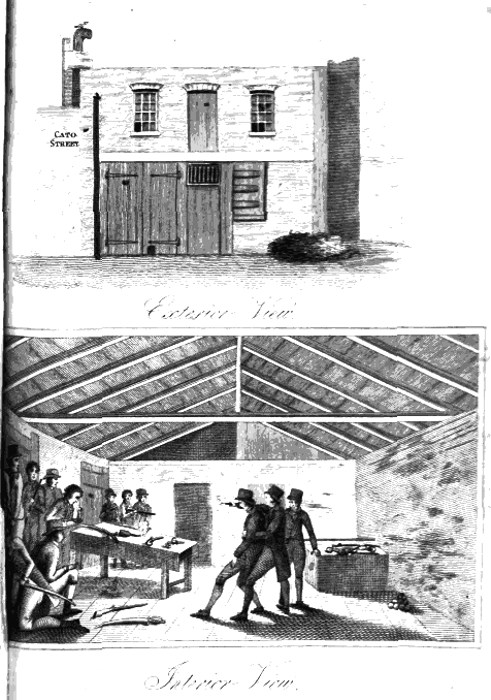
The place chosen to arrange finally their proceedings, to collect their force, and to arm themselves, was near the Edgeware-road. John-street is a short distance on the road, and intersected by another street, called Cato-street.
Cato-street is rather an obscure street, and inhabited by persons in an humble class of life; it runs from John-street into Queen-street, and is parallel with Newnham-street. It is open at one end for the admission of carriages, but is closed by posts at the other. The premises occupied by the conspirators consisted of a three-stall stable, with a loft above, in a very dilapidated condition. They are the property of General Watson, and have been recently in the possession of an old servant of his, who had turned cow-keeper. From this man they had been engaged by some of the diabolical crew whose machinations have been so happily discovered. The people in Cato-street were utterly ignorant that the stable was let until Wednesday, when several persons were seen to go in and out, and carefully to lock the door after them. Some of these individuals carried sacks, and parcels of various descriptions.
For two or three hours previous to the entrance of the stable, the police-officers were on the spot, making their observations, but still no suspicion was excited of the real object of their attack; and so well was the plan of surprise laid, that, until the discharge of fire-arms was heard, every thing remained perfectly quiet.
Thus accurately informed of the intentions of the conspirators, warrants were issued to apprehend them while they were assembled. These warrants were put into the hands of the police-officers, under the able direction of Richard Birnie, Esq., the chief magistrate of Bow-street. A detachment of the Coldstream Guards from Portman-street barracks, were also ordered to accompany the police-officers. They proceeded to the place of meeting in Cato-street, the police-officers proceeding first. The conspirators had taken the precaution to place a sentinel below.
The military consisted of the picket-guard of the 2d Coldstream Regiment, which was stationed in Portman-street barracks. It consisted of thirty men, including a sergeant and corporal, and commanded by Captain Frederick Fitzclarence, who happened to be on duty at the time. They were called out about a quarter to eight o’clock; each man provided with twenty rounds of ball cartridge. The detachment immediately proceeded in the direction of the Edgware-road. The men were not acquainted with the business on which they were called out. They supposed a fire had taken place, and that they had been sent for to protect the property. On their arrival within about sixty yards of the house in Cato-street, John-street, the place of the meeting, they were halted for a few minutes, during which they were ordered by Captain Fitzclarence to fix bayonets and shoulder arms. They were also enjoined to observe the strictest silence. The detachment then marched on, but had not proceeded more than a few yards when they heard the noise of fire-arms. They were then ordered to advance in double quick time, and instantly came in junction with the civil officers, who had arrived previously on the ground, and were engaged with the party in the house.
The only approach to this pandemonium was by a narrow ladder. Ruthven, one of the principal Bow-street officers, led the way, and he was followed by Ellis, Smithers, Surman, and others of the patrol. On the door being opened, about twenty-seven or thirty men were seen within, all armed in some way or other; and some of them engaged either in charging fire-arms, or in girding themselves in belts similar to those worn by the military, while others were in close and earnest deliberation. There were tables about the room, on which lay a number of cutlasses, bayonets, pistols, sword-belts, pistol-balls in great quantities, ball-cartridges, &c.
As the officers entered the room, the conspirators all started up, when Ruthven, who had been furnished with a warrant from the magistrates, exclaimed—“We are peace-officers! Lay down your arms!” In a moment all was confusion. The notorious Arthur Thistlewood, opposed himself to the officers, armed with a cut-and-thrust sword of unusual length. Ruthven attempted to secure the door, and Ellis, who had followed him into the room, advanced towards the man, and, presenting his pistol, exclaimed—“Drop your sword, or I’ll fire instantly!” Thistlewood brandished his sword with increased violence, when Smithers, the other patrol, rushed forward to seize him; and on the instant the ruffian stabbed him to the heart. Poor Smithers fell into the arms of his brother-officer, Ellis, exclaiming—“Oh, God! I am——” and in the next instant was a corpse.
Whilst this deed was doing, the lights were extinguished, and a desperate struggle ensued, in which many of the officers were severely wounded. Surman, one of the patrol, received a musket-ball on the temple, but fortunately it only glanced along the side of his head, tearing up the scalp in its way. The conspirators kept up an incessant fire; whilst it was evident to the officers that many of them were escaping by some back way. Mr. Birnie exposed himself every where, and encouraged the officers to do their duty, whilst the balls were whizzing round his head. At this moment Captain Fitzclarence (a young officer well known for his gallantry and gentlemanly conduct) arrived at the head of the detachment of the Coldstream Guards. They surrounded the building, and Captain Fitzclarence, with Sergeant Legge and three files of grenadiers entered the stable, where the first object that presented itself to their sight, was one of the party running out of the stable, apparently with intention to make his escape. He was seized by one of the soldiers, when the ruffian instantly approached the gallant captain, and presented a pistol at his breast; but, as he was in the act of pulling the trigger, Sergeant Legge rushed forward, and, whilst attempting to put aside the destructive weapon, received the fire upon his arm. Fortunately for this brave man, the ball glanced along his arm, tearing the sleeve of his jacket, from the wrist to the elbow, and only slightly wounding him.
A black man was the next that was started from his place of concealment; he was armed with a cutlass. He also aimed a blow at Captain Fitzclarence, but was seized and secured by one of the soldiers, James Basey, without any injury to the latter but a slight cut on the finger. Then addressing himself to his friends in the house, he exclaimed, “Fight on while you have a drop of blood in you—you may as well die now as at another time.”
The detachment was then ordered to rush forward which they did, headed by their captain, who darted into a stall, and seized by the collar a fellow who was standing in it, and who grappled with him with one hand, while he attempted to fire a pistol at him with the other, which did not go off, the powder flashing in the pan. The miscreant still holding firmly by the coat, the captain called out to his men to disengage him. Two of them, James Revel and James Basey, immediately seized him, and he surrendered himself, saying, “Do not kill me, and I’ll tell you all.” This scene took place in the stable on the ground-floor. It was a three-stalled stable, with a hay-loft over it, with which it communicated by a ladder placed at one end. The detachment led by Captain Fitzclarence then mounted the ladder and into the loft, now filled with smoke, and only illuminated by the occasional flashes of the fire-arms of the conspirators.
In the confusion naturally occasioned by the contest, Thistlewood contrived to make his escape, almost unobserved, and the constables had by this time retired for the purpose of surrounding the house, and intercepting the flight of any others of the gang. On entering the loft, the military came in contact with the dead body of the murdered Smithers, (the constable), and a ruffian lying at his side all covered with the blood of the dead man. The fellow rose, and did not appear to have sustained any hurt or injury. Addressing himself to the soldiers, he said, “I hope they will make a difference between the innocent and the guilty.” Three others were next taken together; they were huddled in a corner among some shavings. One of them jumping out said, “I resign myself; there is no harm; I was brought in here innocent this afternoon.”
These four were all of them found by the soldiers in the room, making, with the man taken below in the stall, and the two outside, seven prisoners. The constables had previously taken two, one of whom made his escape down the street, but was pursued and re-taken. The moment he was caught he fired a pistol, which he had concealed on his person: it went off, but did no injury.
Muddock, one of the soldiers, when he entered the loft, in the midst of darkness, ran against something which he at the moment conceived to be a part of the building. He was, however, soon undeceived, by a wretch snapping a pistol at him, which happily missed fire. Failing in this detestable purpose, the miscreant threw himself on the ground, exclaiming, “Use me honourably,” and the gallant soldier contented himself with making him prisoner. When this was mentioned to Captain Fitzclarence, he asked Muddock why he had not stuck his opponent; the reply of the brave fellow was, “Why, your honour, I had him by the heels, and I took his pistol from him, and I wanted no more.” The pistol was loaded nearly to the muzzle.
It is impossible to give a minute detail of the desperate conflict which took place, or the numerous instances of personal daring manifested by the peace-officers and the military, thus brought into sudden contact with a band of assassins in their obscure den, and in utter darkness. Unfortunately, this darkness favoured the escape of many of the wretches, and the dreadful skirmish ended in the capture of only nine of them. The military, on searching the loft, found a great quantity of pistols, blunderbusses, swords, and pikes, about sixteen inches long, made to screw into a handle. They also found a great many common files, sharpened to a point at the ends, and made to be used as pikes: they also found a large quantity of ammunition, consisting of ball-cartridges, powder-flasks, slugs wrapt up in paper, and a sack full of hand-grenades. The military, accompanied by the constables, then withdrew, and proceeded to Bow-street-office with their prisoners.
The soldiers were laden with the arms and ammunition which they found in the stable; and having delivered their prisoners and booty, four of them were examined briefly by the Magistrates, viz., James Revel, James Basey, William Curtis, and John Muddock. They identified the prisoners who were then standing at the bar, as the persons whom they had taken in the stable. The fire-arms and ammunition were then shown to them, which they also identified. Captain Fitzclarence, with his detachment, then marched back to Portman-barracks, to which also they conveyed the arms and ammunition taken, and deposited them in the Captain’s room.
Shortly after the arrival of the cavalcade at the police-office, in Bow-street, Mr. Birnie, the Magistrate, arrived, and having taken his seat at the bench, the prisoners were placed at the bar in the following order:—
James Ings, a butcher, James Wilson, a tailor, Richard Bradburn, a carpenter, James Gilchrist, a shoemaker, Charles Cooper, a bootmaker, Richard Tidd, a bootmaker, John Monument, a shoemaker, John Shaw, a carpenter, and William Davidson, a cabinet-maker.
Davidson is a man of colour, and a worthy coadjutor of Messrs. Watson, Thistlewood, and Co., upon many occasions. At the meeting in Finsbury market-place, a few months ago, this fellow was one of the principal speakers, and advised the persons assembled to go armed to all public meetings; and was also the bearer of the black flag, with a death’s head, in the mob which attempted to excite a tumult in Covent-garden, during the election. When Ellis, the officer, was putting the handcuffs on him, he amused himself by vociferating passages from the popular air of “Scots wha ha’e wi’ Wallace bled,” and frequently exclaiming, “B—st and d—n the eyes of all those who would not die for liberty.”
Ings is a fierce ruffian, a short stout man, apparently between 30 and 40, but of most determined aspect. His hands were covered with blood; and as he stood at the bar, manacled to one of his wretched confederates, his large fiery eyes glared round upon the spectators with an expression truly horrible. The rest had nothing extraordinary in their appearance. They were for the most part men of short stature, mean exterior, and unmarked physiognomy.
The office was crowded with soldiers and officers, bringing in arms and ammunition of various kinds, which had been taken on the premises; muskets, carabines, broad-swords, pistols, blunderbusses, belts, and cartouch-boxes, ball cartridges, gunpowder, (found loose in the pockets of the prisoners), haversacks, and a large bundle of singularly-constructed stilettoes. These latter were about 18 inches long, and triangular in form: two of the sides being concave, and the other flat; the lower extremity having been flattened, and then wrung round spirally, so as to make a firm grip, and ending in a screw, as if to fit into the top of a staff. Several staves indeed were produced, fitted at one end with a screwed socket; and no doubt they were intended to receive this formidable weapon.
The depositions of a number of officers, most of them wounded, and several of the soldiers, having been taken, their evidence substantiating the foregoing narrative, the prisoners were asked whether they wished to say any thing? Cooper, and Davidson the black, were the only ones who replied, and they merely appealed to the officers and soldiers to say, whether they had not instantly surrendered themselves. Ellis, the patrol, who received the murdered body of his comrade Smithers in his arms, replied, that Davidson had made the most resistance. At the moment when the lights were extinguished, he had rushed out of the place, armed with a carbine, and wearing white cross-belts. Ellis pursued him a considerable distance along John-street; and, having caught him, they fell together, and in the deadly struggle which ensued, Davidson discharged his carbine, but without effect, and Ellis succeeded in securing him.
Captain Fitzclarence had seized and secured one or two of the prisoners with his own hands, and he was not only much bruised, but his uniform was almost torn to pieces.
We will here shortly digress, for the purpose of stating the immediate circumstances which led to the frustration of the sanguinary plot, and the arrest of its fiend-like authors.
It had been for some time well known to government, that Thistlewood, forgetful of his narrow escape on the former occasion of an indictment for High Treason[1], and, as it were, unconscious of the blessings of that constitution, which in the equal and upright administration of justice to all, gives to the accused party the advantage of the conscientious doubts of the jury, and which beneficent feature in the trial by a British Jury had alone saved him from condign punishment, had never ceased to pursue his disloyal and traitorous designs, but had still continued in darkness and obscurity, to hatch new plots, as preposterous as diabolical, and to entrap new agents, as weak as they were wicked, and as certain of being ultimately involved in the same sacrifice to public justice, as he himself seemed devoted to by a besotted perseverance in his horrid principles.
Conscious, however, as were the ministers that some dreadful scheme was perfecting, and that a tremendous blow was about to be struck, they were ignorant of the time or nature of the intended movement, until the very day destined for its consummation, when a communication was made to the Secretary of State for the Home Department, by Lord Harrowby, who stated that he had that morning been stopped by a man, when riding in St James’s-park, who delivered to him a letter, the contents of which were, that a gang of assassins were to assassinate his Lordship and the rest of the cabinet ministers, when assembled at his house on the evening of that day at a cabinet dinner. His Lordship, although he did not know the man, listened to his representation, in addition to the contents of the letter, and afterwards consulted his brother ministers upon the subject; and they immediately determined to postpone the cabinet dinner.
The discovery, indeed, of the infamous wretches and their intended diabolical act is next to a miracle, and is only to be attributed to the determination and perseverance of the man who made the communication to the earl of Harrowby: he called at his lordship’s house, in Grosvenor-square, on Wednesday morning, (the 23d), between eleven and twelve o’clock, and inquired of the porter if the noble earl was at home? The porter replied in the negative. The man appeared very anxious to see his lordship, but the porter did not give him any hopes, as he refused to tell his business; the man, however, urged the necessity of seeing his lordship, without loss of time; and at length he observed, that if he did not see him, the porter would not be sitting in his chair in the hall to-morrow. This observation astonished the porter, and induced him to believe that the man really had something of a serious and alarming nature to communicate to the noble earl: he then told him that his lordship was riding on horseback in the park, directed him to that part in which he was most likely to find him, and described his groom and the livery he wore, &c. The man hastened to the Park, and discovered the groom, as described by the porter, hailed him, and asked him if the gentleman before was the earl of Harrowby? The groom replied in the affirmative. The man then told him, that he wanted and must speak with his lordship. The groom informed his noble master, who immediately stopped his horse. The man then presented a letter to him, which the earl opened and read. The man having informed him that he had a deal more to communicate, his lordship dismounted, and walked and talked with the man for some time; and the result of their interview was the communication to the secretary of state, of which we have just spoken.
Precautions were immediately taken at the secretary of state’s office, for the discovery and apprehension of the villains. The first intimation that was given of the affair at the office in Bow-street was at past seven o’clock, when it was made known that a number of officers, constables, and patrol, would be wanted. Ellis, who is a conductor of a party of patrol, was ordered to leave his division, and repair to the office with the men under his direction. The expedition upon which they were to be sent was kept a secret till they started, which was between half-past eight o’clock and nine. The place of rendezvous of the assassins was in Cato-street, John-street, in the Edgware-road, where the neighbours had become alarmed by a number of strange men assembling in a stable, and a loft over it, after dark; sacks being hung up on the inside of the windows to prevent detection.
In the course of the day inquiries had been made, and the result was, that some desperate act was expected to take place. The ministers’ servants were armed with pistols, and two officers or constables appointed to each residence. The Earl of Harrowby and Viscount Castlereagh dined with the Earl of Liverpool; and at nine o’clock they went to the secretary of state’s office for the home department, at which time all the cabinet ministers assembled. Mr. Birnie, the magistrate, was directed by Viscount Sidmouth to be in Cato-street, and in readiness to act in case of emergency. A party of the guards, under the command of Captain Fitzclarence, was ordered to march to Cato-street, to assist the police, if necessary. Unfortunately, however, they were not clearly directed, or they did not understand where the place was, as they were at the contrary end of the street when the assassins commenced their murderous attack upon the officers, and it was only by the discharge of pistols that they found out where the building was. When the police-officers arrived, they found two sentinels at the door, armed with guns and swords. These opposed their admittance without the pass-word. The officers, however, soon overpowered and secured them. They then gave an alarm, and the officers heard by the noise in the loft that several persons were up stairs. They ascended to the loft by a ladder which the conspirators themselves had used; when the contest, which we have already described, ending in the arrest of most of the conspirators, took place.
The same sources of information which led to the detection of the conspiracy enabled the magistrates to trace the hiding-place of Thistlewood. Instead of returning to his own lodgings in Stanhope-street, Clare-market, it was discovered that he had proceeded to an obscure house, No. 8, White-street, Little Moorfields. Thither, at nine o’clock on Thursday morning, the 24th of February, Lavender, Bishop, Ruthven, Salmon, and six of the patrol, were despatched. On arriving at the house, three of the latter were placed at the front, and three at the back door, to prevent escape. Bishop observed a room on the ground-floor, the door of which he tried to open, but found it locked. He called to a woman in the opposite apartment, whose name is Harris, to fetch him the key. She hesitated, but at last brought it. He then opened the door softly. The light was partially excluded, from the shutters being shut; but he perceived a bed in the corner, and advanced. At that instant a head was gently raised from under the blankets, and the countenance of Thistlewood was presented to his view. Bishop drew a pistol, and presenting it at him, exclaimed, “Mr. Thistlewood, I am a Bow-street officer; you are my prisoner:” and then, “to make assurance doubly sure,” he threw himself upon him. Thistlewood said, he would make no resistance. Lavender, Ruthven, and Salmon, were then called, and the prisoner was permitted to rise. He had his breeches and stockings on, and seemed much agitated. On being dressed, he was handcuffed; in his pockets were found some ball-cartridges and flints, the black girdle, or belt, which he was seen to wear in Cato-street, and a sort of military silk sash.
A hackney-coach was then sent for, and he was conveyed to Bow-street. In his way thither he was asked by Bishop, what he meant to do with the ball-cartridges; he declined answering any questions. He was followed by a crowd of persons, who repeatedly cried out, “Hang the villain! hang the assassin!” and used other exclamations of a similar nature.
When he arrived at Bow-street, he was first taken into the public office, but subsequently into a private room, where he was heard, unguardedly, to say, that “he knew he had killed one man, and he only hoped it was Stafford;” meaning Mr. Stafford, the chief clerk of the office, to whose unremitting exertions in the detection of public delinquents too much praise cannot be given.
Mr. Birnie, having taken a short examination of the prisoner, sent him to Whitehall to be examined by the Privy-Council. Here the crowd was as great as that which had been collected in Bow-street. Persons of the highest rank came pouring into the Home Office, to learn the particulars of what had transpired.
The arrest of Thistlewood was heard with infinite satisfaction; he was placed in a room on the ground-floor, and a vast number of persons were admitted in their turn to see him. His appearance was most forbidding. His countenance, at all times unfavourable, seemed now to have acquired an additional degree of malignity. His dark eye turned upon the spectators as they came in, as if he expected to see some of his companions in guilt, who he had heard were to be brought thither. He drank some porter that was handed to him, and occasionally asked questions, principally as to the names of the persons who came to look at him. Then he asked “to what gaol he should be sent?—he hoped not to Horsham.” (This was the place in which he was confined, in consequence of his conviction for sending a challenge to Lord Sidmouth.)
At two o’clock he was conducted before the Privy-Council. He was still handcuffed, but mounted the stairs with alacrity. On entering the council-chamber he was placed at the foot of the table. He was then addressed by the Lord Chancellor, who informed him that he stood charged with the twofold crime of treason and murder; and asked him whether he had anything to say for himself? He answered, that “he should decline saying any thing on that occasion.”
No persons were suffered to have access except those on business to the public offices at Whitehall, nor was any individual allowed to hold communication with the prisoner. About a dozen soldiers were in the hall and adjoining lodge; they formed a part of the military escort that accompanied the police-officers to the spot where Thistlewood and his companions were first discovered. The soldiers had with them the different articles and weapons found upon the party when taken, among which were two small pistols, one of them loaded, and a bundle of files, similar to those used in small brasswork. The points of such files are always sharp, and the part of the file which goes into the handle is necessarily pointed, to penetrate the hole made in the wood for its reception; some of the files appeared, however, to have had the handle-points brightened, and the ends made more fine, as if by being whetted upon a stone. There were also in the hall two or three bags, containing three bayonets and some ammunition, made up in both small and large cartridges. The soldiers who had seized those articles were examined before the Privy-Council. After his examination, Thistlewood was taken back to the room in which he had been previously placed; his commitment to Coldbath-fields was made out, and he was conveyed to that prison under the care of six officers. There was a partial shouting and groaning, as the carriage in which he was placed drove off.
The appearance of Thistlewood at this time was wretched in the extreme. When in custody with Watson, Preston, and Hooper, on the charge for high treason, he was a stout, active, cheerful-looking man, with something of a fearless and determined cast of features. His deportment at that time was free and unembarassed, with much of the air of a sea-faring man. Within the six months previous to the present arrest, his appearance had, in every respect, undergone a total change; he had been seen constantly in the streets, dressed in a shabby manner; his countenance squalid and emaciated, and his whole dress and the expression of his features, denoting a man who was reduced to a state of extreme indigence. He was generally observed walking or running through the streets with eager impetuosity, and his shoes and an old surtout coat, which he generally wore, bearing all the marks of the poverty and distressed circumstances of the wearer.
When before the Privy-Council, his dress was an old black coat and waistcoat, which were thread-bare, corduroy breeches very much worn, and old worsted stockings. His general appearance indicated great distress; his limbs were slender, and his countenance squalid and somewhat dejected. There was nothing of agitation in his manner. He sat with his eyes chiefly fixed on the ground, except when he occasionally raised them to survey Members of the Privy-Council, as they passed through the hall on their way to the Council-room.
The following Privy-Councillors were present at his examination:—The Duke of Wellington, the Earls of Harrowby, Liverpool, and Westmoreland, Lords Sidmouth, Castlereagh, and Melville, the Chancellor of the Exchequer, Mr. Canning, Mr. Wellesley Pole, Sir William Scott, the Chief Baron of Scotland, the ex-Attorney-general, (Sir S. Shepherd), Mr. Bragge Bathurst, and other members of the cabinet.
It is impossible to describe the anxiety and horror which pervaded the countenances of thousands of persons who went to view the scene of action the day after the arrest. Through the whole of the day, and till very late in the evening, several persons of the highest consideration in the country visited the place. A man no way authorized, took possession of the place, and imposed on the public by demanding a shilling from each person for admission.
The alarm in the neighbourhood, on hearing the report of fire-arms, and the noise of contest on premises which they considered untenanted, may be more easily conceived than described. It was heightened by every circumstance of terror that the imagination could form to itself. The house was surrounded with soldiers and police-officers—fighting was heard within—officers were obscurely seen scaling a ladder and entering the scene of battle, while their fate and the cause of the combat were entirely unknown. Some of the persons belonging to the public-house adjoining, after running to the spot, fled in dismay when they heard the balls whistling about their ears.
Several of the inhabitants of Cato-street had observed, since the preceding Monday, strange-looking men coming about the empty premises. On the morning of Wednesday, (the day of the arrest) they saw Davidson, the man of colour, and three others, watching at different ends of the street, while some of their associates were heard nailing up the windows within the loft. Before dusk Davidson again made his appearance, with a sack on his back, which the neighbours at the time supposed to contain carpenters’ tools for repairing or new-modelling the interior of the building, but which had in fact conveyed the arms with which they were to equip themselves for their daring enterprise. After the arsenal was formed, the band arrived; and the people in the public-house were surprised, if not alarmed, to see upwards of twenty persons, entire strangers to the place, hovering about their premises, and at last entering the den. Still they had no suspicion of what was going forward, and no presentiment of what was in a short time to occur. The police soon arrived, and the murderous struggle took place which we have already described.
The body of Smithers, who was murdered, was removed to the Horse and Groom public-house, opposite. He must have died instantly, and without convulsion. He received only one wound, about an inch below his right breast, and about an inch in width. His body was exposed in a room on the first floor of the public-house, above-mentioned, in the dress in which he was killed. His breast and neck were covered with blood, but his countenance was as placid, and his features as composed, as if their expression had been arrested, and life extinguished, during a tranquil sleep. On his death being mentioned to Lord Sidmouth, his Lordship expressed great regret at the event, and sympathy for his surviving widow; saying, with great humanity, that, as he could not, restore to her her husband, he would take care that she should not want his assistance in a pecuniary point of view. The unfortunate man’s sister, from Putney, was one of the first to view the dead body of her brother, and deeply affected the spectators with the poignancy of her sorrow.
The sword with which the murder of Smithers was perpetrated is of foreign manufacture, and nearly a foot longer than those which we are ordinarily in the habit of seeing.
A lady, of the name of Northmore, who lives in a street immediately adjoining that in which the conspirators assembled, found a sabre in her yard, which had been thrown away by one of the gang, in his flight. This also is a weapon of foreign manufacture, and, from its appearance, had evidently been ground within a day or two. It was perfectly sharp on both sides, and, in addition to its brass hilt, there was attached to it a handkerchief, so disposed as to afford a sort of guard for the arm. Mrs. Northmore, on finding the weapon, sent for a friend, who advised her to transmit it to Bow-street. This was accordingly done; and, extraordinary to relate, it was recognised by an active member of that establishment as exactly representing one of two sabres, of which a description had been given at the office, and which were known to have been lately taken to a cutler, for the purpose of grinding.
The hand-grenades found in the loft, and produced in the examination, are about the size of a large orange, made of cast-iron, filled with combustibles; they have a round hole, in which is placed a fuse, which, on being set fire to, is thrown by the hand, and when it falls it explodes: the splinters caused by the explosion spread in all directions, and one of them has been known to kill ten or twelve persons. It was intended to explode these horrible instruments at the Earl of Harrowby’s house.
After the committal of Thistlewood by the Privy-Council, the whole of the prisoners underwent an examination, likewise by the Privy-Council; and on their being re-committed, one of them proposed to become king’s evidence, which offer was accepted.
During the attendance of Mr. Birnie upon the Privy-Council on Thistlewood’s examination, the officers arrived at Bow-street, with all the persons found in the house where Thistlewood had been apprehended, and Mr. J. E. Conant, the magistrate, proceeded with their examination; they consisted of the landlady of the house, Mrs. Hill, a lodger, and Lewis Casper, a man who did not lodge in it.
Elizabeth Harris, the landlady, stated, that her husband worked at the letter-foundry of Messrs. Caslon and Catherwood, in Chiswell-street, Moorfields. On Wednesday, the 23d of February, she had a bill in her window to let her lodgings, when in the morning, between ten and eleven o’clock, Thistlewood came into her house, and inquired about the lodging: she told him it was only half a bed with her nephew. Thistlewood agreed for the half bed, for which he was to pay two shillings and sixpence a week, and was to take possession of it that night. She at first said, that she had a slight knowledge of Thistlewood, but denied it afterwards. It was supposed she was concealing him, as he was locked up in the room. This she explained, by saying the door flew open, and she could not keep it shut without locking it. She said Thistlewood arrived at her house between ten and eleven o’clock on Wednesday night: he observed that he was late; she replied he was late, and she had almost given him up. He then went to bed. Her street-door standing open only by a latch, the officers had entered and searched the upper part before she knew they were there, when they asked her to unlock the door where Thistlewood was in bed, which she instantly did. She did not know Lewis Casper had been in her house till she found him in the coach with her when they were brought away.
Lewis Casper stated himself to be a watch-finisher, residing in Union-street, Bishopsgate, and accounted for his being in the house by saying he was with Mrs. Hill, the lodger, who washed for him, and he appointed his little boy to call for a key there.
This man was detained till it was ascertained if he was the man he represented himself to be. Mrs. Harris and Mrs. Hill were discharged for the present.
In the course of Thursday, the 24th of February, the following persons were arrested as concerned in the conspiracy:—
Brunt, who was to have been second in command to Thistlewood. He was a shoemaker; an excellent workman, and earned between forty and fifty shillings a week. He was taken in bed. He had previously provided himself with a sword and a brace of pistols, in case of need, but he did not make use of them on this occasion. He was apprehended at his lodgings in Fox-court, Gray’s-inn-lane; in his room a vast quantity of hand-grenades, and other combustibles, were found. These were charged with powder, pieces of old iron, and other materials, calculated upon explosion to produce the most horrible consequences. A great number of pike-blades, or stilettoes, such as were discovered in Cato-street, and a number of fire-arms, were likewise found. The whole of these were taken to Bow-street. He was afterwards sent to Whitehall, and then committed to Coldbath-fields.
Firth, the person by whom the stable was let to Harris. He admitted that he has attended some of the Radical meetings, but denied any knowledge of the conspiracy.
Cooper, a shoemaker, living in Garden-court, Baldwin’s-gardens: he was apprehended in the middle of the day.
Simmons, a footman, living with a respectable family in Seymour-street. He underwent an examination before the secretary of state for the home department, and another before the magistrates at Bow-street, was ultimately committed to Tothill-fields’ prison.
Tadd, a shoemaker, of whom the following account was given at the period of his arrest. He is a man of the age of 49, and lived with his wife and family in a small and miserable dwelling situated in the Hole-in-the-Wall-passage, leading from Baldwin’s-gardens to Torrington-street. His family consists of one daughter, and two orphan children, whom he had taken under his care. Tadd has been esteemed among his neighbours, and by those who have employed him in his trade, as an industrious sober man, and an excellent workman. He has earned by his own hands forty shillings a week, and very often even a greater sum. During the whole course of his life, he was never known to neglect his work, or become inebriated; but within the last week he had been in a drunken state, and his family had been at a loss to account for the extraordinary change in his conduct. On Wednesday night, three men came to Tadd while in such a state of drunkenness as scarcely to be able to keep his legs, and forced him away, notwithstanding the earnest entreaties and remonstrances of his wife and family. Nothing was said by the men who took him away, as to their object, either to the wife or any one in the house; and during the whole night, and the greater part of the next day, they were in total ignorance of the circumstances since disclosed, and were at a loss to account for the absence of Tadd. In the morning (Thursday), between seven and eight o’clock, two men came to the house, laden with a box of a considerable size, and, putting it down on the floor, said, “they would call in a few minutes for it.” The men refused to answer the interrogatories put to them as to their object in leaving the box, and only repeated, that, they would call in a short time, and take it away. Very soon afterwards, two more men came with a large bundle of sticks, some of them of the thickness of a man’s wrist. These were left in a similar manner, and the men also refused to answer any questions, saying only, that they would call again for them in a few minutes. Ten minutes had not elapsed before two police-officers entered the house, and seized the box and sticks. When opened, the box was discovered to contain a great number of pike-heads, sharpened ready for use. The sticks were also seized, and carried away by the officers. It would appear, from this statement, that Tadd was taken by the three men whom we have described to the stable in Cato-street, where he was subsequently apprehended, and carried to Bow-street, together with several others.
Robert Adams, living in a miserable hovel in Brooks’-market, Holborn, and working as a shoemaker. He some time since was a private in the Royal Horse-guards, in which regiment he served for five years. He very much resembles Thistlewood in his person, but has a cast in his left eye.
In addition to these arrests, several warrants were issued, among which was one against a native of France.
The lodgings of Thistlewood, and of all the others who were taken into custody, were searched, and several important papers, and quantities of arms, were discovered and seized. Among those found in Thistlewood’s apartment was a copy of the bill furnished to Dr. Watson by Mr. Ottley, owner of the Crown and Anchor Tavern, in the Strand, for the expenses of the dinner given to Hunt, on his return from Manchester. Judging from his former connexions, it may be considered as fortunate for the Doctor that he was not able to liquidate this debt, being at the time of the arrests an inmate of Whitecross-street prison on account of this bill, and thus saved from the temptation of joining his former associates.
It is a singular fact, that when Thistlewood was arrested, he had not a farthing of money in his possession. The same observation may be made with respect to his comrades, all of whom were in the most wretched state of poverty.
We will here suspend for a time the particulars of the proceedings against the Conspirators, for the purpose of recording the proceedings of the Coroner’s Inquest on the body of Richard Smithers, the unfortunate Bow-street officer, who was murdered, as before stated, when in the execution of his duty, in Cato-street. The inquest was held on Friday the 25th February, at the Horse and Groom public-house, John-street, Edgeware-road, which is situated but a few yards from the spot where the atrocious deed was perpetrated. In the course of the day great numbers of persons visited the miserable building which the Conspirators had selected as the scene of their deliberations, and one universal feeling of horror and detestation against Thistlewood and his infamous associates appeared to actuate the multitude.
The Coroner for the county of Middlesex, Thomas Stirling, Esq., having arrived, and proclamation having been made by the beadle of the parish of St. Mary-le-bone, that the Jury summoned should proceed to inquire “when, how, and by what means, Richard Smithers came by his death,” the Jury were sworn.
The foreman of the jury observed to the coroner, that he and his fellow-jurors wished to inspect the body in the presence of the surgeon, in order that he might be ready to answer any question that might arise on the moment. This suggestion was complied with; and on the return of the jury from viewing the body,
Mr. Fisher, the surgeon, was sworn, and deposed as follows:—I am surgeon to the Police establishment in Bow-street. I was called upon for the first time, this day, to examine the body of the deceased. I found an external wound under the right breast. It was two inches in length, and half an inch broad. I opened the body to ascertain the depth and direction of the wound, and I discovered that some sharp instrument had penetrated between the fifth and sixth ribs, wounded the outward surface of the right lobe of the liver, passed through the diaphragm into the chest, lacerated the pericardium, penetrated the right ventricle of the heart, wounded the left lobe of the lungs, and struck against the ribs on the left side. The wound I supposed to be about twelve inches in length. The blood flowed from the heart, and occasioned immediate death. The opening in the pericardium was larger than that presented by the external wound, which was always the case with wounds of this description. The weapon was prevented from passing entirely through the body by the ribs on the left side. It must have been a very sharp instrument, both pointed and cutting, to make such a wound. The membranes, which were cut asunder, could only have been severed by an exceedingly sharp instrument. That death was inevitable after such a wound, the heart having been cut open, and the blood effused into the cavity of the chest.
George Thomas Ruthven being sworn, said, I am an officer belonging to the public-office in Bow-street. On Wednesday evening last, at half-past eight o’clock, I was in this house. I received an order from Mr. Birnie, who is a Justice of the Peace for the county of Middlesex, to go to a shed or stable in Cato-street, in consequence of a number of men being assembled there for treasonable purposes. There was a warrant issued by Mr. Baker, a magistrate of Marlborough-street. On entering the house, I observed in the lower place a man with a cutlass at his side, and a musket on his shoulder. The door by which I entered from the street was not fast; there were persons going in and out; the man with the musket seemed as if he was guarding the staircase; there was only one man on guard. Ellis, Smithers, the deceased, and several others, went in with me. I don’t know how they came in. They were of course ordered. They were all constables, in number about a dozen. I was the first person that entered. Mr. Birnie, the magistrate, was not there at that time; he was at hand in the street, giving orders. The man who stood at the door as sentinel was walking about. I did not stop to see what he did particularly, but immediately called out to some of the party who followed to secure him. I am not aware that they did secure him, for I immediately went up the stairs. I believe that man was taken; but I am not aware that he was apprehended then; I believe he was caught afterwards. I ascended by a sort of step-ladder staircase. The stairs were so narrow, that the officers were obliged to go one by one. When I got up to the top of the ladder, I observed a sort of table or carpenter’s bench, and a number of arms on it. Thistlewood was on the right-hand side of the table. I know Thistlewood very well. I have followed him for days and nights together. I think about twenty-four or twenty-five persons were assembled. There were different sorts of arms on the table: a variety of pistols and swords. They looked as if they were sorted out. They were handing about as if they were giving or distributing them to each other. Arthur Thistlewood was one. I am quite certain that he was present: I have followed him for days together. He stood by the side of the table handing arms about. He had on a sort of a long brown coat, I think. I knew him as well as I knew my father; quite as well. I could not be mistaken. I have no doubt whatever as to the identity of Thistlewood. As soon as I thought that three or four of the party were up, I said aloud, “We are officers, seize their arms.” I did this to warn the people who we were. As soon as I said this, they each took up what they could from the table, and retired to the farther part of the room. Thistlewood, being near a door that leads into a little closet over the coach-house, retired into that room. He was not further from the door of the little room than I am from that gentleman who is writing there (pointing to a gentleman who sat writing within about four feet of witness). There were others in that little room; how they got in there I cannot tell. I suppose there were five or six, or four or five persons in it. The whole party appeared at that time to be armed. Thistlewood, as he retired, had a sword in his hand, which he moved in a menacing way to keep the officers off. He was not striking with it, but moving his arm round as if to make a stab. The sword appeared bright. As we approached, he retired; and Smithers, who was within a pace of me to the right, stepped forward with his staff. Thistlewood immediately stabbed him, and he fell on me. A pistol was then fired; I know not by whom. I saw the swords of the party directed against the candles, which were immediately put out. Thistlewood stabbed the deceased in the right side as he approached. He did not come out of the little room to do it. He was within the little room, and thrust forward his arm to strike the blow. I saw the sword he carried; it was bright, and glittered. I did not see the hilt. It was a long blade, three feet and a half or four feet long. It appeared straight; but he waved it in such a way, that my eyes might have deceived me as to its shape.
When Smithers fell, he fell upon me, being stabbed on the right side, and I standing a little to his left. I could not at the moment tell whether he appeared to be much injured. In falling, he said, “Oh, Lord! Oh, my God! I am done!” I believe these were his words, or something of that sort.
I don’t know whether Thistlewood drew the weapon out of his body; for instantaneously a pistol was fired, and the lights were put out. I have been enabled to recognise three of the persons who were in the room, besides Thistlewood, I think, since. They are Shaw Strange; he has another name; a man named Blackburn, and James Wilson. There was another man who stood at the door, and fired at a sergeant; his name is Tidd: I don’t know his christian name. The sergeant at whom he fired is present. Tidd first attempted to fire a pistol at Captain Fitzclarence. I seized his arm, and he pulled me down on him. I called on the sergeant to take the pistol from him, and he fired at the sergeant and tore his clothes. I am sure that Blackburn, Wilson, Shaw Strange, and Tidd, were present. There were also two other persons taken, who had been in this house (the Horse and Groom) in the course of the evening. I did not recognise them in the room; but I know they were apprehended, and, I believe, admitted that they had been there. They left a stick behind them in the Horse and Groom; the end of it was evidently cut for the purpose of holding a weapon.
It was like a broom-stick, with a hole cut in the top. The persons that I allude to have admitted that they were in the room at the time the officers entered; but I do not know it. One of them was taken by Captain Fitzclarence; I have seen him here before. These two persons came in to drink a pint of porter, and left the stick behind them in a mistake. One of them came back, and asked for a little walking-stick. The boy, who thought it a queer sort of a stick, had taken it up-stairs, but returned it to the person who called for it. That stick was at the public-office. These persons called at the Horse and Groom an hour before the officers proceeded to the loft. Nothing took place before the party fired, except my exclaiming, “We are officers—take their arms.” When Smithers fell, a pistol was fired, and the lights were put out. I cannot say by whom the pistol was fired. The moment Smithers fell, somebody in the room where Thistlewood was, cried out—“Kill the b——rs; throw them down stairs!” I also cried, “Aye, kill them,” that they might mistake me for a friend. There were nine persons taken that night. I was not present at the apprehension of all of them. While I was securing two of them the rest were brought in. After I had secured Tidd, Wilson, and Blackburn, I proceeded to secure the others; they were then conveyed to Bow-street, and afterwards to the House of Correction.
Several of the party escaped; nine only being taken, and the number in the room appearing to me to be about twenty-five.
When the prisoners were secured by the soldiers, I went up into the loft, and saw Smithers lying on his face; this was twenty minutes or half an hour after the entrance had been made. There were hand-grenades and arms lying about the room. I had no time before to pay attention to Smithers. A man below stairs endeavoured to escape from the door; he had a pistol in his hand. I called out, “Secure that man!” When I did so, he lifted his arm, and attempted to fire the pistol at Captain Fitzclarence; I caught hold of him, and the sergeant coming up, I desired him to take the pistol. The man fired, and struck the sergeant’s coat with a bullet.
I believe only four of us got up. The party in the room fired directly at the staircase, thinking we were coming up in numbers. If they had not done so, they would have killed me, for I stood at one side of it.
There was somebody below who I expected would take care of the sentinel; but, in the confusion, he was handed from one to another, and thus escaped for a few minutes. It was quite dark, and I could not see the party escaping. There were, I think, twenty shots fired at us. It appeared to me as if some shots were fired from the window into the street to create alarm. The whole civil power present on the occasion was not more than twelve or fourteen men. I do not know the man who was acting as sentinel; I believe his name is Davidson. He is a man of colour. I had not time to notice him particularly. I believe he was the man who was walking at the foot of the stairs, with a cutlass by his side, and a musket on his shoulder. I believe there was one light in the lower part of the building where he was. Some one, however, cried out, “They are up-stairs,” and we heard the clashing of arms. I cannot identify the man who was below stairs, I cannot swear to him. There was another officer shot on the left side of the head; he was dangerously wounded; his name is Surman. Another officer, of the name of Westcott, had two or three shots through his hat. One of the bullets struck him on the finger, but did not hurt him materially. I was not wounded at all. At the time I did not know friend from foe. Immediately when the party cried out, “Kill the b——s,” I also said, “Kill them,” in order to deceive them. I had a brace of pistols; one of them flashed in the pan. The lights being out, I was afterwards afraid to fire, lest I might kill one of my comrades. There was a latch to the door which led into the street, and I found no difficulty in getting in. I secured a considerable quantity of arms; amongst the rest there was a large grenade, and several hand-grenades. The large one consisted of a tin canister, with a plate at top, strengthened by several pieces of iron, and bound round with a quantity of tarred rope. I got eight of the hand-grenades; they were about the size of my doubled fist. I also found in the room two swords, and some ball-cartridges, which are in my possession.
The large grenade weighs fourteen or fifteen pounds. It is a canister strongly bound with tarred rope. It is not circular. A number of pistols, swords, cartridges, and bullets, were also found in the room.
No person but Thistlewood offered violence before the candles were put out. There were likewise found in the room about three dozen of weapons, which resembled a sort of bayonet. The bottom part had not a socket like a bayonet, but a screw to fasten into a stick. I found also a dozen of sticks, formed for the purpose of being fitted to those bayonets.
The bayonets appeared to be newly made. They are very rough, and not at all brightened or polished. The balls I picked up in the room were not fired from pistols. If they had, they would have been flattened; I desired the men to pick the arms up, and each man to keep safely what he found: in consequence, some were in the possession of one man, and some in that of another; two or three muskets were either found in the room, or else taken from some of the persons who had been apprehended.
The party had no notice but what I gave that we were officers.
The deposition of this witness having been read over to, and signed by, him,
James Ellis was next called.—Having been sworn, he stated, I live at No. 22, Paradise-row, Palmer’s-village, St. Margaret’s, Westminster, and am an officer belonging to the Bow-street patrol. I am also a constable. On Wednesday night last, about half-past seven o’clock, Mr. Stafford, the chief clerk at Bow-street, directed me to take Richard Smithers, John Surman, and William Gibbs, and to proceed in a coach with them to John-street, Edgeware-road, as fast as possible, there to meet Mr. Birnie, who would give us further orders. We did so; and when we arrived at the spot, we found Mr. Birnie waiting. He inquired whether we had seen any thing of the military. We told him we had not. He said he expected them every minute. In about twenty minutes Mr. Birnie called us together. Some inquiries were made, but I don’t know of whom, as to what number were likely to be in the room to which we were going, and whether Arthur Thistlewood was to be there. Mr. Birnie gave me a warrant, signed by Mr. Baker, of Marlborough-street, to apprehend Arthur Thistlewood and thirteen other persons named in it. I have not the warrant; I have given it to Mr. Baker. On our being called together, and Mr. Birnie being given to understand that Thistlewood and others were in the room, he asked how many there might be present, and was informed that there was about a dozen. He then inquired how many there were of us. We told him about a dozen also. He said he had been disappointed in the soldiers, who had perhaps missed their way, and were half an hour too late, and that we must proceed to apprehend the parties. We said we would do the best we could. Smithers observed, if there were forty of them we would secure them. Mr. Birnie then directed me to call Ruthven, another officer, out of the Horse and Groom, and we were sent forward to the house, the military not having come in time. Ruthven opened the door and went in; it was a kind of stable where the meeting was held. Ruthven went in first, I followed him. When I entered the stable I observed a man with belts on, a musket or fusil on his arm, and a sword at his side. I believe he held the musket in the position which soldiers do, when on duty. He was walking backward and forward. Ruthven desired some person to take charge of him. I took him by the collar, turned him half round, and gave him to some other person, observing at the same time that he was a man of colour. At that moment Ruthven was at the foot of the ladder, up which he went. I followed as closely as I possibly could, and was immediately followed by Smithers. Before I got up the ladder, I heard a clattering of swords. I heard Ruthven say at that moment, “We are officers, seize their arms,” or “lay down your arms,” I cannot tell which. Upon gaining the top of the ladder, Ruthven turned a little to the left, to go round a table or carpenter’s bench. I observed a number of men falling back to the other end of the room. They were apparently all armed. I also saw three or four men backing into the little room on the right. They were all armed with swords or cutlasses. A tall man immediately brandished a sword at me: his foot was advanced in a fencing attitude, as if he meant to stab. I held up my staff in my left hand, and presented a pistol at him with my right; I held up my staff that he might see it, to shew him what I was. The light was then as good as it is here: it was very lightsome: I desired the man to desist, or I certainly would fire. I did not fire then, I did afterwards. I did not know who the tall man was that threatened me at the time, but I have seen him since, and I know it was Thistlewood. There were some persons in the further room to the right. There was another closet near to the ladder, which was not discovered nor opened for half an hour afterwards. No one was found there. Smithers rushed past, and endeavoured to get into the little room. I saw the tall man draw his hand back, and make a thrust of a sword at him, which I saw strike him on the breast.
It was the same tall man, Thistlewood, who had flourished his sword at me. The manner in which he did it made me fix my eyes on him, so as to mark the kind of countenance he had. Smithers, on being struck, immediately threw up his hands, fell towards me, and exclaimed, “Oh! my God!” I instantly fired at the man who killed Smithers, but I missed him. Smithers fell against me at the time, so as to drive me to the head of the stairs. A rush was then made by the party, and I was knocked down from the top to the bottom of the ladder. The moment I fired, the candles were all put out with the swords.
I think there were four or five and twenty persons present. There were four or five in the small room. The time was so short that very little observation could be made. I ran to the door, when two or three shots were fired in the stable below, where I was. I don’t know by whom they were fired. It was in the dark, and I could not discover friend from foe. I do not know that any officer fired except myself. I have not heard of such a thing. When I arrived at the door, I heard a cry of “Stop him,” and instantly saw a man running at the other side of the street; I pursued, and took him in the street, about twenty yards from the door. When laying hold of him, he made a cut at me with a long sword. This was the man of colour. I received a cut, a very slight one, in the leg. I think it was when his arm, in striking at me, swung round my neck, that the sword, which was a very long one, hit my leg. The man’s name is Davidson. I believe him to be the same man who kept the door, but I will not positively swear to that. I took him to a shop at the corner, and seized his fusil, which was that of a light-horseman, but perhaps rather heavier.
I have seen Thistlewood, and I believe him to be the man that struck Smithers. I did not know him at the time. I saw him for six or seven seconds, or more, when he brandished his sword at me, until he went towards the little room. On seeing that, Smithers rushed forward, and the moment he got near the door, I saw him struck. I was sure that he was killed. It was a stab—a thrust—he received. The sword was long, very bright, and triflingly turned at the end. It seemed sharp on both sides. He brandished it at me. The whole space of this time was not more than ten or twelve seconds. I saw the man with his sword, before I got to the top of the ladder. As soon as Davidson was secured, I returned to the place, and I then found the military had come. I left Davidson in a shop, with two of our people to take care of him. The prisoners were all disarmed, and I proceeded to tie them together. I was only a few minutes gone when I took Davidson. I stayed as little time as I possibly could.
As soon as I had tied the prisoners I went to Smithers; he was lying on his face. I turned him up, and I believe he breathed faintly. I afterwards found a pistol, a bayonet, a quantity of ball cartridges, and several bullets. Many other weapons were found by the officers.
I am most positive of the identity of Thistlewood. I feel no hesitation on the subject.
[Here the witness handed some of the bullets which he had taken to the Jury.]
Witness continued.—I was entering the centre of the room when Smithers passed me. I had my eyes fixed on Thistlewood, when he was brandishing his sword. I am able to recognize him, though I could not recognise any of the others. I saw him for eight or ten seconds, but I cannot speak to his dress: it was a dark dress, but I cannot speak to it distinctly. I heard yesterday, that Thistlewood was the person who struck the blow, but that did not affect my opinion. I would have sworn to him, if it had not been mentioned. There were several persons wounded. An officer named Biggs was wounded. The place where the business occurred is not ten yards from this. It is the first stable down the yard, and is, I think, on the north side of the street. When I fell down the ladder, I fell on some of the officers who were coming up. I should have been shot if I had not so fallen. There were several shots fired in the stable. I had a cutlass by my side, but could not use it. The flashes were numerous below, but I could not see who or what they were who fired. In the confusion Davidson escaped, but I afterwards took him. When I came back there were several persons in custody. There were many shots fired from the window.
We officers carry cutlasses, but they could be of no use against the length of the swords which the party made use of.
I cannot state the specific words of the warrant. It was given to me in the street by Mr. Birnie, and has been placed in the hands of Mr. Baker, the magistrate.
The Coroner inquired of Pyall, the beadle, whether he had the warrant in his possession, and was answered in the negative.
The Witness.—The warrant was in my possession; it authorized us to apprehend Arthur Thistlewood and thirteen other persons named in it, for unlawfully assembling together, but for what specific purpose I cannot say, and to bring them before the sitting magistrate, to be dealt with according to law.
Pyall, the beadle, was despatched to Mr. Baker for the warrant, and the deposition of Ellis having been read over to him, he signed it.
William Westcott next underwent an examination to the following effect:—I live at No. 10, Simmons-street, Sloane-square, Westminster, and am one of the assistant patrol of Bow-street.—On Wednesday night last, I was sent to the stable in Cato-street, by order of Mr. Birnie. I accompanied Ruthven, Ellis, Smithers, and others to the spot. Ruthven went first, and I followed Smithers. I was behind him in the stable. The moment Ruthven, Ellis, and Smithers had gone up the ladder leading to the loft, I seized a man in the stable below dressed like a butcher. His name I believe was Ings.—When I entered, he rushed out against me: and finding resistance, put his hand to his belt, as if to pull something out of it. I immediately knocked him down by hitting him on the right eye. He was dressed in a long coat beneath his jacket, and had an apron over the whole. This happened before the first pistol was fired, and I was in the act of handcuffing him when I heard a fresh pistol fired in the loft. I had not quite succeeded before Thistlewood came down the ladder, and as he was upon the steps fired a pistol; whether levelled at me or not I cannot say. Seeing me so busily engaged in securing the butcher, he levelled another shot at my head, and at the same time made several cuts at me with a sabre. The pistol went off, and the shot penetrated my hat. I knocked him down with the stick I had in my hand, but he rose and succeeded in making his escape. While I was engaged with Thistlewood, Ings contrived to make his escape also; when Thistlewood was gone, I found that I was wounded in the hand, and that some shot had gone through the flap of my coat. In the mean time both Thistlewood and Ings succeeded in getting away. I pursued Thistlewood, but in vain, and after having followed him through several streets, I returned to the stable. I then went into the loft, and saw the deceased lying dead on the floor. There were several persons present, and the prisoners had been subdued.
The Jury asked the witness whether Thistlewood was the first who came down the steps?—There was a complete rush, and I did not particularly observe whether he did or not. Did he come down before the officer Smithers fell?—I did not see the officer fall. You went with the whole body of the officers?—Yes, I did. There were only three officers, I understand, in the loft?—I believe no more. Where were the others?—They were upon the scout. Then I understand that after the three officers mentioned had gone up, Thistlewood came down, and prevented others from ascending the steps? Yes; and he fired down the steps to prevent the ascent of others.
Charles Moy.—I live at No. 11, London court, Mary-le-bone, and am a watchman. On Wednesday night, about half-past eight, I apprehended Ings, while Brooks was in pursuit of him. He fired at Brooks; but I cannot say what fire-arms he used, as he threw it down before I reached him. Brooks cried out, Stop thief! and I immediately apprehended him. The ball went through the coat and waistcoat of Brooks, and grazed the top of his shoulder. I took Ings down to Mary-le-bone watch-house, assisted by Brooks and another officer. I searched him, and found seven or eight bullets in his pockets, some gunpowder in a tin flasket, and a haversack. He had a kind of belt on each side for pistols.
Sergeant Legge, of the 2d battalion of Coldstream Guards, was next examined.—On Wednesday evening last I was called up about eight o’clock, and received orders to march to John-street, Edgware-road. I was then quartered in Portman-street barracks. A picket, usually employed on occasions when the military is required in aid of the civil power, was ordered out. It was commanded by Captain Fitzclarence. Upon arriving at John-street, we were unable to ascertain the spot whither we ought to proceed, and the captain advanced to ascertain what we were to do. When he returned, he ordered the picket to advance at double quick time. Upon reaching the stable in Cato-street, I observed a man standing with a pistol in his hand. He presented it at Captain Fitzclarence, and I knocked it aside with my pike. I then seized the muzzle-end of the pistol with my hand, and a scuffle ensued between the man and myself about the pistol. I kept firm hold of it till it went off, and the ball passing by my arm, tore the cloth off my sleeve. (Witness here exhibited the sleeve of his coat, which appeared to be very much torn.) In wrestling with the prisoner, I held my face down to the lock of the pistol, and as it went off the ball grazed my right eyebrow. As soon as the pistol was discharged, the prisoner let go his hold. I secured him, and delivered him over to the police. I believe the prisoner’s name is Tidd. After this skirmish I followed my officer and part of the picket up the steps into the loft. The greater part of the picket had reached the loft before I was disengaged from the prisoner. When I had reached the loft I discovered a table in the centre of it, nearly covered with pistols, blunderbusses, ammunition, and other arms of various descriptions. Three men had then surrendered; I think their names were Monument, Cooper, and Gilchrist. I do not recollect what police-officers were present at the time. Upon looking on the floor, I saw the deceased lying dead at my feet. His body was examined by the picket, and I perceived the wound on his right breast. I was ordered back to the barracks for a reinforcement, and when I returned, the whole of the prisoners taken that moment were collected into the loft. Upon the arrival of the reinforcement, the prisoners were conveyed to Bow-street.
Here one of the jury observed, that the inquest had proceeded far enough to ascertain the acts of Thistlewood. The Coroner replied, that those who were aiding and abetting in the murder were equally guilty as the principal; and it would be necessary to ascertain who they were, and what they did.
Here the examination was interrupted by the arrival of a messenger, with a letter from Mr. Baker, the magistrate, to the Coroner. It was read aloud, and was to the following effect:—
“I beg to inform you, that I granted a warrant on Wednesday the 23d instant, for the apprehension of Arthur Thistlewood, and several others, on a charge of felony, and that I afterwards received from Mr. Ellis an order to lay it before the Privy-Council on the examination of the prisoners when in custody. It has not yet been returned to me, nor do I think that I shall be able to obtain it at the present moment. Perhaps it would be better to adjourn the inquest for the present, and I will endeavour to get it for you to-morrow, or send you the information, on which it was issued.”
William Sarmon.—I live in Edgeware-road, and am a tailor by trade. On Wednesday night, about eight o’clock, I was passing through Cato-street, and when opposite to the stable I heard Westcott say that Smithers had been stabbed. In two or three minutes afterwards two men rushed out of the stable. One of the two cut me with a sabre on the hat. He was a tall man dressed in a dark coat. He struck at me twice, and hit my thigh, but fortunately did not wound me. I was so frightened at the moment, that I could not tell which way he ran, and I did not stop to look. There were many people in the street at the time. I do not know the appearance of Thistlewood. I only observed that the man who struck me was of a pale complexion, and wore a dark long coat. The other man who accompanied him out of the stable did not attempt to strike me. They both passed behind me on the right hand, I think, through the gateway towards John-street. I heard several shots within the building, while I was standing opposite the stable. That night I wore a loose coat, and by that means I was not wounded. I saw Westcott go into the stable, and I knew him well. I had seen him many times before.
Here the examination of the witnesses terminated, and the Coroner expressed a wish to receive some information respecting the christian names of those who had been described as having been apprehended in the stable. He thought there was no distinction between the case of Thistlewood and the other prisoners; they all entertained the same mischievous design, and shewed their purpose but too plainly, in being so well furnished with fire-arms, hand-grenades, &c. He wished to know whether the gentlemen of the Jury were satisfied with the evidence already received.
A juryman said, he wished to put a question to Ruthven, the officer, before the verdict was pronounced; but Mr. Pyall, the summoning officer, stated, that Ruthven had gone away, notwithstanding his particular request that he should remain.
The Coroner wished to know whether any of the Jury required an adjournment of the inquest; if they did, he would willingly attend to their request. The Jury unanimously declared that they were satisfied; and the Coroner, in a formal manner, asked, “Is Arthur Thistlewood guilty or not guilty of murder?”
Foreman.—Guilty.
Coroner.—Is William Davidson guilty of murder or manslaughter?
Foreman.—Guilty of murder.
One of the Jury wished to ask a question, which he thought of some importance, before the verdict was pronounced upon all the prisoners. He wished to know whether those who might have met for a different purpose were equally guilty of the murder with Thistlewood?
The Coroner replied, that there could be no doubt that they were implicated in the murder as much as Thistlewood himself, for whatever illegal purpose they might have met. They had impeded the officer in the execution of his duty, and one of them had killed him.
A Juryman.—If any of the prisoners had been put in the same situation as Thistlewood, they would probably have acted in the same manner.
Another Juryman.—But are those who surrendered themselves equally guilty?
Coroner.—There can be no doubt of it. They were all assembled for one common purpose, and the act of one is the act of the whole. It is clearly murder in them all. If a man intends to do a mischief to another, and, instead of killing him, happens to kill a second, it is equally murder, as if he had killed the man he intended.
A Juryman.—Another doubt arises in my mind. Had not these men a right to defend themselves, after the pistol had been fired by the officer Ellis?
Coroner.—Certainly not; there cannot be a doubt upon it.
The jury, by their foreman, then pronounced a verdict of “Guilty of Murder” against the following prisoners: James Ings; Charles Cooper; Richard Tidd; John Monument; John Charles Strange; Richard Blackburn; James Wilson; James Gilchrist; and others unknown.
In the course of the day, the afflicted parents of the deceased visited the body, and showed much feeling upon the occasion. The old couple were so decrepit as scarcely to be able to get up stairs. Smithers was a stout, good-looking man, about thirty-three years of age.
In addition to the wound that was the immediate cause of the death of Smithers, it was found that a pistol bullet had penetrated his shoulder nearly six inches. It was extracted by Bennett, and was found to have been cast from pewter. A second sabre wound was also found under his blade-bone. In what manner these wounds were inflicted, there are no means of knowing, but it is supposed they occurred after his fall.
On Thursday afternoon, the 2d of March, at four o’clock, his remains were removed from his lodgings in Carteret-street, in the Broadway, Westminster, and buried in the church-yard of St. Margaret’s, Westminster, amidst a great concourse of sympathizing spectators. It was too trying a task for his widow to undertake to follow him to the grave, and she was prevailed on not to attempt it. The deceased’s father and brothers followed as principal mourners. They were succeeded by some private friends, and a numerous assemblage of officers and others belonging to Bow-street office; Mr. John Lavender, belonging to Queen-square police-office, to which the deceased formerly belonged; Mr. Armstrong and his son, both officers belonging to the police-office in Worship-street; making in the whole 67 persons; thus showing the last mark of respect to a departed officer, who had fallen a sacrifice by the hands of a ferocious assassin.
The procession passed through the following streets; the windows of each house were filled with spectators of both sexes;—Tothill-street, Dartmouth-street, Great and Little Queen-streets, Great George-street, and through the grand opening leading to St. Margaret’s church. The rush from the crowd to gain admittance into the latter place was astonishing; but no accident occurred. The service was performed by the Rev. Mr. Rodber. The church-yard was filled with an immense crowd of persons of all descriptions, among which were numerous soldiers belonging to the Guards. A general regret and pity seemed to pervade the whole of this vast assemblage at the melancholy fate of this unfortunate man. The procession then returned through Tothill-street to Carteret-street, when the officers returned to the undertaker’s. The whole of this funeral was conducted in the most decorous manner; and several magistrates were amongst the spectators.
On Sunday, the 27th of February, at one o’clock, the Cabinet Council assembled at the secretary of state’s office for the home department, to proceed with the investigation of the charges against the assassins. Their lordships were assisted by the law officers.
Robert Adams, late a private of the Royal Horse-Guards, and who had become king’s evidence, was examined before their lordships, which occupied their time till half-past two o’clock, which was then too late an hour to proceed with the examination of Abel Hall, a tailor, who had been apprehended on Saturday morning by Lavender, Bishop, and Salmon, the officers, in Seward-street, Chiswell-street.
A quantity of ball-cartridges, a musket, and a cavalry sword, which they found concealed in a ruinous shed at the back of a small house near the Regent’s park, were this day produced. The woman occupying the house was also brought up, but after a short examination she was discharged. It did not appear that she had any knowledge of these things being on her premises. These articles appear to have been deposited in the place where they were found by some of the conspirators in their retreat.
On Monday, the 28th of February, the Privy-Council again met, and on this day a proclamation was placarded in different parts of London, offering a reward of 200l. for the apprehension of John Palin, alias Peeling, who had been charged with high treason. He was described as being a child’s chair-maker, and as having been formerly a corporal in the East London Militia, and about forty years of age.
Private information was the same evening given to Lavender and Bishop, that Palin, for whose apprehension the reward of 200l. had been offered, was concealed in a house in the neighbourhood of Battle-bridge. They proceeded immediately with their informer to the spot described, but found that there was no ground for the suspicion which had arisen. Though the officers did not find Palin, they found three men and a woman of somewhat suspicious appearance. One man was in bed, and said he was unwell. The patrol suspecting him to be one of the Cato-street gang of assassins, and that he was in bed in consequence of the bruises he had received, made him get up, when he was found to have all his clothes on except his shoes. They stripped him, but he had no bruises. The other two men were melting lead in a frying-pan. One of the men lived at that place, the others in Monmouth-street and Brownlow-street. They were all three brought to the office, and underwent an examination before Mr. Birnie, when there being no charge against them, and they not being known, they were discharged. It is supposed that Palin might have taken the alarm, and escaped at the back of the house while the officers were knocking at the door.
The notorious Preston, the cobbling politician, of Spa-fields’ memory, was also this day arrested on suspicion of being concerned in the plot, under a warrant issued by R. Birnie, Esq. It appears that the lodgings of this man were searched a few days before, but nothing of a suspicious nature was found. On those occasions he facetiously said—“his armory could not boast of a swan-shot, nor his port-folio of a scrap of paper of the slightest political interest.” Circumstances afterwards transpired which led to his arrest upon a charge of high treason. He was found industriously engaged in mending a shoe, with his family about him. He was surprised at this new visit, but submitted to his fate with cheerfulness, not unaccompanied by an apparent sense of his own importance. His daughters were highly indignant at this intrusion on their domestic privacy. The officers conducted their prisoner to Bow-street office, from whence he was sent to the Marquis of Anglesea public-house opposite. He was placed under the care of Lack, one of the patrol. He called for “a pipe and pot,” and, seating himself before the fire, seemed perfectly happy. He laughingly said to a gentleman who went to see him, that he thought “the farce would not be complete till he was taken.” He had previously denied all knowledge of the late conspiracy. After being shortly examined before Mr. Birnie, he was sent to Covent-garden watch-house, where he remained in confinement during that night. On the following morning he was removed from that place of confinement to the secretary of state’s office for the home department, where, at twelve o’clock, the Lords of the Council assembled, consisting of the Cabinet Ministers, the Marquis of Camden, Mr. Peel, Sir William Scott, Sir John Nicholls, Mr. Sturges Bourne, together with the Attorney and Solicitor-Generals, and other law officers.
Mr. Buller, one of the principal clerks of the council, attended to take the minutes of the proceedings. When Preston was taken in before the Lords of the Council he behaved with his usual boldness and low insolence to most of their lordships personally. He called upon them with the most ludicrously impudent arrogance, and asked what they meant by sending for him to disturb his peace of mind, and to disturb the economy of his family, alluding to his three daughters binding shoes, and himself making them.
The examination of this impudent fellow lasted about half an hour, after which he was committed to Tothillfields-bridewell in the custody of two of the Bow-street officers. When he returned from the Council Chamber he was almost breathless, and gasped out to those about him—“Bless me, how I perspire! but I always do when I have any thing like a subject to speak upon.” Whilst his commitment was making out, he requested to be assisted with a little porter. Some porter was given to him, and whilst he was drinking it Lord Castlereagh passed through the hall, when Preston observed, “Aye, there he goes! His lordship will remember what I have said to him as long as he lives. I have talked more treason, as they call it, to-day, than ever I did in my whole life before.” The porter seemed to inspire him, and he was proceeding with more remarks, when the officers received his commitment, and he was led to the coach which was to convey him to prison. A number of gentlemen were assembled in the hall; and, as he passed through the midst of them, he bowed and smiled on all sides, repeatedly saying, “God bless you all.”
In the course of the day an application was made at the police-office, Bow-street, by one of Preston’s daughters, to be allowed to see her father, and to deliver him some clean linen; she was referred by the magistrate to Lord Sidmouth, and accordingly wrote the following letter to his Lordship, which she carried to the office of the Home Department, and delivered it to one of the messengers, while she waited in the hall for an answer:—
“My Lord,—I entreat your Lordship to allow an agonized daughter to have an interview with her father, who was dragged from home, and his family, consisting of three daughters besides myself, totally unprotected, on a charge of which he is completely innocent, and of which he has no knowledge whatever. My father’s house was searched four times successively on four different days, and nothing was found that could at all criminate him in the late dreadful proceedings.
“I have called at Bow-street for the purpose of giving my father some linen, and also to know if he could be held to bail, and have been referred to your Lordship. I am now waiting in the lobby of the Home Department Office with the linen to give to my father; and I hope your Lordship will grant me an interview with him.
“I am, my Lord,
Your Lordship’s obedient humble servant, Ann Preston.”
“17, Princes-street, Drury-lane, Feb. 29. To Lord Viscount Sidmouth, &c. &c.”
After being absent some time, the messenger who carried the letter to his Lordship returned, and told her she must call again on the following day for an answer. She then inquired where her father was, and was informed that he had been examined that day before the Privy-Council, and had been committed. She then left the office in tears.
The next morning she waited at the office of the Home Department, as she had been directed, for an answer to her application. She saw Mr. Hobhouse, and was told by him, that she could not see her father till after the following Friday; and, if she would call again on the Saturday, she would probably have an order to see him. She waited in the lobby until her father was brought out, after his examination before the Privy-Council, and he looked very anxiously at her; but they were not allowed to speak to each other. She had a bundle of linen; and, when her father was conveyed to Tothill-fields prison, she followed him, and gave the linen to the governor.
About this time Waddington, the fellow who had been brought into some notoriety, by his arrest for being the bearer of a placard, the object of which was to create an unlawful assembly on Kennington Common, appeared before Mr. Hicks, the sitting magistrate at Bow-street, and with ridiculous effrontery, stated that the reason of his calling was to say that the officers had seized his books and papers, which they were very welcome to do, as he had nothing in his possession that he was ashamed of, or that could lead to any charge. His landlady, who was present when his place was searched for books and papers, told him that the officers had left a message, desiring him to attend at the office, as he was wanted there; and he consequently attended.