Chapter IV · GOVERNMENT.
Reading edition
Egypt has, of late years, experienced great political changes, and nearly ceased to be a province of the Turkish Empire. Its present Básha (Mohammad ’Alee), having exterminated the Ghuzz, or Memlooks, who shared the government with his predecessors, has rendered himself almost an independent prince. He, however, professes allegiance to the Sultán, and remits the tribute, according to former custom, to Constantinople; he is, moreover, under an obligation to respect the fundamental laws of the Kur-án and the Traditions; but he exercises a dominion otherwise unlimited.[208] He may cause any one of his subjects to be put to 99death without the formality of a trial, or without assigning any cause: a simple horizontal motion of his hand is sufficient to imply the sentence of decapitation. But I must not be understood to insinuate that he is prone to shed blood without any reason: severity is a characteristic of this prince rather than wanton cruelty; and boundless ambition has prompted him to almost every action by which he has attracted either praise or censure.[209]
In the Citadel of the Metropolis is a court of judicature, called “ed-Deewán el-Khideewee,”[210] where, in the Básha’s absence, presides his “Kikhya,”[211] or deputy, Habeeb Efendee. In cases which do not fall within the province of the Kádee, or which are sufficiently clear to be decided without referring them to the court of that officer, or to another council, the president of the Deewán el-Khideewee passes judgment. Numerous guard-houses have been established throughout the metropolis, at each of which is stationed a body of Nizám, or regular troops. The guard is called “Kulluk,” or, more commonly at present, “Karakól.” Persons accused of thefts, assaults, etc., in Cairo, are given in charge to a soldier of the guard, who takes them to the chief guard-house, in the Mooskee, a street in that part of the town in which most of the Franks reside. The charges being here stated, and committed to writing, he conducts them to the “Zábit,” or chief magistrate of the police of the metropolis. The Zábit, having heard the case, sends the accused for trial to the Deewán el-Khideewee.[212] When a person denies the offence with which he is charged, and there is not sufficient evidence to convict him, but some ground of suspicion, he is generally bastinaded, in order to 100induce him to confess; and then, if not before, when the crime is not of a nature that renders him obnoxious to a very heavy punishment, he, if guilty, admits it. A thief, after this discipline, generally confesses, “The devil seduced me, and I took it.” The punishment of the convicts is regulated by a system of arbitrary, but lenient and wise, policy: it usually consists in their being compelled to labour, for a scanty sustenance, in some of the public works, such as the removal of rubbish, digging canals, etc.; and sometimes the army is recruited with able-bodied young men convicted of petty offences. In employing malefactors in labours for the improvement of the country, Mohammad ’Alee merits the praises bestowed upon Sabacon, the Ethiopian conqueror and king of Egypt, who is said to have introduced this policy. The Básha is, however, very severe in punishing thefts, etc., committed against himself:—death is the usual penalty in such cases.
There are several inferior councils for conducting the affairs of different departments of the administration. The principal of these are the following:—1. The “Meglis el-Meshwar′ah”el-Meshwar′ah” (the Council of Deliberation), also called “Meglis el-Meshwar′ah el-Melekeeyeh” (the Council of Deliberation on the Affairs of the State), to distinguish it from other councils. The members of this and of the other similar councils are chosen by the Básha, for their talents or other qualifications; and consequently his will and interest sway them in all their decisions. They are his instruments, and compose a committee for presiding over the general government of the country, and the commercial and agricultural affairs of the Básha. Petitions, etc., addressed to the Básha, or to his Deewán, relating to private interests or the affairs of the government, are generally submitted to their consideration and judgment, unless they more properly come under the cognizance of other councils hereafter to be mentioned. 2. The “Meglis el-Gihádeeyeh” (the Council of the Army); also called “Meglis el-Meshwar′ah el-’Askereeyeh” (the Council of Deliberation on Military Affairs). The province of this court is sufficiently shown by its name. 3. The Council of the “Tarskháneh,” or Navy. 4. The “Deewán et-Tuggár” (or Court of the Merchants). This court, the members of which are merchants of various countries and religions, presided over by the “Sháhbandar” (or chief of the merchants of Cairo), was instituted in consequence of the laws of the Kur-án and the Sunneh being found not sufficiently explicit in some cases arising out of modern commercial transactions.
101The “Kádee” (or chief judge) of Cairo presides in Egypt only a year, at the expiration of which term, a new Kádee having arrived from Constantinople, the former returns. It was customary for this officer to proceed from Cairo, with the great caravan of pilgrims, to Mekkeh, perform the ceremonies of the pilgrimage, and remain one year as Kádee of the holy city, and one year at El-Medeeneh.[213] He purchases his place privately of the government, which pays no particular regard to his qualifications, though he must be a man of some knowledge, an ’Osmánlee (that is, a Turk), and of the sect of the Hanafees. His tribunal is called the “Mahkem′eh,” or Place of Judgment. Few Kádees are very well acquainted with the Arabic language; nor is it necessary for them to have such knowledge. In Cairo, the Kádee has little or nothing to do but to confirm the sentence of his “Náïb” (or deputy), who hears and decides the more ordinary cases, and whom he chooses from among the ’Ulama of Istambool, or the decision of the “Muftee” (or chief doctor of the law) of his own sect, who constantly resides in Cairo, and gives judgment in all cases of difficulty. But in general, the Náïb is, at the best, but little conversant with the popular dialect of Egypt; therefore, in Cairo, where the chief proportion of the litigants at the Mahkem′eh are Arabs, the judge must place the utmost confidence in the “Básh Turgumán” (or Chief Interpreter), whose place is permanent, and who is consequently well acquainted with all the customs of the court, particularly with the system of bribery; and this knowledge he is generally very ready to communicate to every new Kádee or Náïb. A man may be grossly ignorant of the law, and yet hold the office of Kádee of Cairo: several instances of this kind have occurred; but the Náïb must be a lawyer of learning and experience.
When a person has a suit to prefer at the Mahkem′eh against another individual or party, he goes thither, and applies to the “Básh Rusul” (or chief of the bailiffs or sergeants who execute arrests) for a “Rasool” to arrest the accused. The Rasool receives a piaster or two,[214] and generally gives half of this fee privately to his chief. The plaintiff and defendant then present themselves in the great hall of the Mahkem′eh, which is a large saloon, facing a spacious court, and having an open front formed 102by a row of columns and arches. Here are seated several officers called “Sháhids,” whose business is to hear and write the statements of the cases to be submitted to judgment, and who are under the authority of the “Básh Kátib” (or Chief Secretary). The plaintiff, addressing any one of the Sháhids whom he finds unoccupied, states his case, and the Sháhid commits it to writing, and receives a fee of a piaster or more; after which, if the case be of a trifling nature, and the defendant acknowledge the justice of the suit, he (the Sháhid) passes sentence; but otherwise he conducts the two parties before the Náïb, who holds his court in an inner apartment. The Náïb, having heard the case, desires the plaintiff to procure a “fetwa” (or judicial decision) from the Muftee of the sect of the Hanafees, who receives a fee, seldom less than ten piasters, and often more than a hundred or two hundred. This is the course pursued in all cases but those of a very trifling nature, which are settled with less trouble, and those of great importance or intricacy. A case of the latter kind is tried in the private apartment of the Kádee, before the Kádee himself, the Náïb, and the Muftee of the Hanafees, who is summoned to hear it, and to give his decision; and sometimes, in cases of very great difficulty or moment, several of the ’Ulama of Cairo are, in like manner, summoned. The Muftee hears the case and writes his sentence, and the Kádee confirms his judgment, and stamps the paper with his seal, which is all that he has to do in any case. The accused may clear himself by his oath when the plaintiff has not witnesses to produce: placing his right hand on a copy of the Kur-án, which is held out to him, he says, “By God, the Great!” three times, adding, “By what is contained in this of the word of God!” The witnesses must be men of good repute, or asserted to be such, and not interested in the cause: in every case at least two witnesses are requisite[215] (or one man and two women); and each of these must be attested to be a person of probity by two others. An infidel cannot bear witness against a Muslim in a case involving capital or other heavy punishment; and evidence in favour of a son or grandson, or of a father or grandfather, is not received; nor is the testimony of slaves; neither can a master testify in favour of his slave.
The fees, until lately, used to be paid by the successful party; but now they are paid by the other party. The Kádee’s fees for decisions in cases respecting the sale of property are two per 103cent. on the amount of the property: in cases of legacies, four per cent., excepting when the heir is an orphan not of age, who pays only two per cent.: for decisions respecting property in houses or land, when the cost of the property in question is known, his fees are two per cent.; but when the cost is not known, one year’s rent. These are the legitimate fees; but more than the due amount is often exacted. In cases which do not concern property, the Kádee’s Náïb fixes the amount of the fees. There are also other fees than those of the Kádee to be paid after the decision of the case: for instance, if the Kádee’s fees be two or three hundred piasters, a fee of about two piasters must be paid to the Básh Turgumán; about the same to the Básh Rusul; and one piaster to the Rasool, or to each Rasool employed.
The rank of a plaintiff or defendant, or a bribe from either, often influences the decision of the judge. In general the Náïb and Muftee take bribes, and the Kádee receives from his Náïb. On some occasions, particularly in long litigations, bribes are given by each party, and the decision is awarded in favour of him who pays highest. This frequently happens in difficult law-suits; and even in cases respecting which the law is perfectly clear, strict justice is not always administered; bribes and false testimony being employed by one of the parties. The shocking extent to which the practices of bribery and suborning false witnesses are carried in Muslim courts of law, and among them in the tribunal of the Kádee of Cairo, may be scarcely credited on the bare assertion of the fact: some strong proof, resting on indubitable authority, may be demanded; and here I shall give such proof, in a summary of a case which was tried not long since, and which was related to me by the Secretary and Imám of the Sheykh El-Mahdee, who was then supreme Muftee of Cairo (being the chief Muftee of the Hanafees), and to whom this case was referred after judgment in the Kádee’s court.
A Turkish merchant, residing at Cairo, died, leaving property to the amount of six thousand purses,[216] and no relation to inherit but one daughter. The seyyid Mohammad El-Mahrookee, the Sháh-bandar (chief of the merchants of Cairo), hearing of this event, suborned a common felláh, who was the bowwáb (or door-keeper) of a respected sheykh, and whose parents (both of them Arabs) were known to many persons, to assert himself a son of a brother of the deceased. The case was brought before the Kádee, 104and, as it was one of considerable importance, several of the principal ’Ulama of the city were summoned to decide it. They were all bribed or influenced by El-Mahrookee, as will presently be shown; false witnesses were brought forward to swear to the truth of the bowwáb’s pretensions, and others to give testimony to the good character of these witnesses. Three thousand purses were adjudged to the daughter of the deceased, and the other half of the property to the bowwáb. El-Mahrookee received the share of the latter, deducting only three hundred piasters, which he presented to the bowwáb. The chief Muftee, El-Mahdee, was absent from Cairo when the case was tried. On his return to the metropolis, a few days after, the daughter of the deceased merchant repaired to his house, stated her case to him, and earnestly solicited redress. The Muftee, though convinced of the injustice which she had suffered, and not doubting the truth of what she related respecting the part which El-Mahrookee had taken in this affair, told her that he feared it was impossible for him to annul the judgment, unless there were some informality in the proceedings of the court, but that he would look at the record of the case in the register of the Mahkem′eh. Having done this, he betook himself to the Básha, with whom he was in great favour for his knowledge and inflexible integrity, and complained to him that the tribunal of the Kádee was disgraced by the administration of the most flagrant injustice; that false witness was admitted by the ’Ulama, however evident and glaring it might be; and that a judgment which they had given in a late case, during his absence, was the general talk and wonder of the town. The Básha summoned the Kádee and all the ’Ulama who had tried this case, to meet the Muftee in the Citadel; and when they had assembled there, addressed them, as from himself, with the Muftee’s complaint. The Kádee, appearing, like the ’Ulama, highly indignant at this charge, demanded to know upon what it was grounded. The Básha replied that it was a general charge, but particularly grounded on the case in which the court had admitted the claim of a bowwáb to a relationship and inheritance which they could not believe to be his right. The Kádee here urged that he had passed sentence in accordance with the unanimous decision of the ’Ulama then present. “Let the record of the case be read,” said the Básha. The journal being sent for, this was done; and when the secretary had finished reading the minutes, the Kádee, in a loud tone of proud authority, said, “And I judged so.” The Muftee, in a louder and more authoritative tone, exclaimed, “And thy 105judgment is false!” All eyes were fixed in astonishment, now at the Muftee, now at the Básha, now at the other ’Ulama. The Kádee and the ’Ulama rolled their heads and stroked their beards. The former exclaimed, tapping his breast, “I, the Kádee of Misr, pass a false sentence!” “And we,” said the ’Ulama, “we, Sheykh Mahdee! we, ’Ulama el-Islám, give a false decision!” “O Sheykh Mahdee,” said El-Mahrookee (who, from his commercial transactions with the Básha, could generally obtain a place in his councils), “respect the ’Ulama as they respect thee!” “O Mahrookee!” exclaimed the Muftee, “art thou concerned in this affair? Declare what part thou hast in it, or else hold thy peace: go, speak in the assemblies of the merchants, but presume not again to open thy mouth in the council of the ’Ulama!” El-Mahrookee immediately left the palace, for he saw how the affair would terminate, and had to make his arrangements accordingly. The Muftee was now desired, by the other ’Ulama, to adduce a proof of the invalidity of their decision. Drawing from his bosom a small book on the laws of inheritance, he read from it, “To establish a claim to relationship and inheritance, the names of the father and the mother of the claimant, and those of his father’s father and mother, and of his mother’s father and mother, must be ascertained.” The names of the father and mother of the pretended father of the bowwáb the false witnesses had not been prepared to give; and this deficiency in the testimony (which the ’Ulama, in trying the case, purposely overlooked) now caused the sentence to be annulled. The bowwáb was brought before the council, and, denying the imposition of which he had been made the principal instrument, was, by order of the Básha, very severely bastinaded; but the only confession that could be drawn from him by the torture which he endured was, that he had received nothing more of the three thousand purses than three hundred piasters. Meanwhile, El-Mahrookee had repaired to the bowwáb’s master: he told the latter what had happened at the Citadel, and what he had foreseen would be the result, put into his hand three thousand purses, and begged him immediately to go to the council, give this sum of money, and say that it had been placed in his hands in trust by his servant. This was done, and the money was paid to the daughter of the deceased.
In another case, when the Kádee and the council of the ’Ulama were influenced in their decision by a Básha (not Mohammad ’Alee), and passed a sentence contrary to law, they were thwarted 106in the same manner by El-Mahdee. This Muftee was a rare example of integrity. It is said that he never took a fee for a fetwa. He died shortly after my first visit to this country.—I could mention several other glaring cases of bribery in the court of the Kádee of Cairo; but the above is sufficient.
There are five minor Mahkem′ehs in Cairo; and likewise one at its principal port, Boolák; and one at its southern port, Masr El-’Ateekah. A Sháhid from the great Mahkem′eh presides at each of them, as deputy of the chief Kádee, who confirms their acts. The matters submitted to these minor tribunals are chiefly respecting the sales of property, and legacies, marriages, and divorces; for the Kádee marries female orphans under age who have no relations of age to act as their guardians; and wives often have recourse to law to compel their husbands to divorce them. In every country-town there is also a Kádee, generally a native of the place, and never a Turk, who decides all cases, sometimes from his own knowledge of the law, but commonly on the authority of a Muftee. One Kádee generally serves for two or three or more villages.
Each of the four orthodox sects of the Muslims (the Hanafees, Sháfe’ees, Málikees, and Hambel′ees) has its “Sheykh,” or religious chief, who is chosen from among the most learned of the body, and resides in the metropolis. The Sheykh of the great mosque El-Azhar (who is always of the sect of the Sháfe’ees, and sometimes Sheykh of that sect), together with the other Sheykhs above mentioned, and the Kadee, the Nakeeb el-Ashraf (the chief of the Shereefs, or descendants of the Prophet), and several other persons, constitute the council of the ’Ulama[217] (or learned men), by whom the Turkish Báshas and Memlook chiefs have often been kept in awe, and by whom their tyranny has frequently been restricted: but now this learned body has lost almost all its influence over the government. Petty disputes are often, by mutual consent of the parties at variance, submitted to the judgment of one of the four Sheykhs first mentioned, as they are the chief Muftees of their respective sects; and the utmost deference is always paid to them. Difficult and delicate causes, which concern the laws of the Kur-án or the Traditions, are also frequently referred by the Básha to these Sheykhs; but their opinion is not always followed by him: for instance, after consulting 107them respecting the legality of dissecting human bodies, for the sake of acquiring anatomical knowledge, and receiving their declaration that it was repugnant to the laws of the religion, he, nevertheless, has caused it to be practised by Muslim students of anatomy.
The police of the metropolis is more under the direction of the military than of the civil power. A few years ago it was under the authority of the “Wálee” and the “Zábit;” but since my first visit to this country the office of the former has been abolished. He was charged with the apprehension of thieves and other criminals; and under his jurisdiction were the public women, of whom he kept a list, and from each of whom he exacted a tax. He also took cognizance of the conduct of the women in general; and when he found a female to have been guilty of a single act of incontinence, he added her name to the list of the public women, and demanded from her the tax, unless she preferred, or could afford, to escape that ignominy, by giving to him, or to his officers, a considerable bribe. This course was always pursued, and is still, by a person who farms the tax of the public women,[218] in the case of unmarried females, and generally in the case of the married also; but the latter are sometimes privately put to death, if they cannot, by bribery or some other artifice, save themselves. Such proceedings are, however, in two points, contrary to the law, which ordains that a person who accuses a woman of adultery or fornication, without producing four witnesses of the crime, shall be scourged with eighty stripes, and decrees other punishments than those of degradation and tribute against women convicted of such offences.
The office of the Zábit has before been mentioned. He is now the chief of the police. His officers, who have no distinguishing mark to render them known as such, are interspersed through the metropolis: they often visit the coffee-shops, and observe the conduct, and listen to the conversation, of the citizens. Many of them are pardoned thieves. They accompany the military guards in their nightly rounds through the streets of the metropolis. Here, none but the blind are allowed to go out at night later than about an hour and a half after sunset, without a lantern or a light of some kind. Few persons are seen in the streets later than two or three hours after sunset. At the fifth or sixth hour, one might pass through the whole length of the metropolis 108and scarcely meet more than a dozen or twenty persons, excepting the watchmen and guards, and the porters at the gates of the bye-streets and quarters. The sentinel, or guard, calls out to the approaching passenger, in Turkish, “Who is that?” and is answered in Arabic, “A citizen.”[219] The private watchman, in the same case exclaims, “Attest the unity of God!” or merely, “Attest the unity!”[220] The reply given to this is, “There is no deity but God!” which Christians, as well as Muslims, object not to say; the former understanding these words in a different sense from the latter. It is supposed that a thief, or a person bound on any unlawful undertaking, would not dare to utter these words. Some persons loudly exclaim, in reply to the summons of the watchman, “There is no deity but God: Mohammad is God’s Apostle.” The private watchmen are employed to guard, by night, the sooks (or market-streets) and other districts of the town. They carry a nebboot (or long staff), but no lantern.
The Zábit, or A′gha of the police, used frequently to go about the metropolis by night, often accompanied only by the executioner and the “shealeg′ee,” or bearer of a kind of torch called “shealeh,” which is still in use.[221] This torch burns, soon after it is lighted, without a flame, excepting when it is waved through the air, when it suddenly blazes forth: it therefore answers the same purpose as our dark lantern. The burning end is sometimes concealed in a small pot or jar, or covered with something else, when not required to give light; but it is said that thieves often smell it in time to escape meeting the bearer. When a person without a light is met by the police at night, he seldom attempts resistance or flight; the punishment to which he is liable is beating. The chief of the police had an arbitrary power to put any criminal or offender to death without trial, and when not obnoxious, by law, to capital punishment; and so also had many inferior officers, as will be seen in subsequent pages of this work: but within the last two or three years, instances of the exercise of such power have been very rare, and I believe they would not now be permitted. The officers of the Zábit perform their nightly rounds with the military guards merely as being better acquainted than 109the latter with the haunts and practices of thieves and other bad characters; and the Zábit himself scarcely ever exercises any penal authority beyond that of beating or flogging.
Very curious measures, such as we read of in some of the tales of “the Thousand and One Nights,” were often adopted by the police magistrates of Cairo, to discover an offender, before the late innovations. I may mention an instance. The authenticity of the following case, and of several others of a similar nature, is well known. I shall relate it in the manner in which I have heard it told.—A poor man applied one day to the A′gha of the police, and said, “Sir, there came to me, to-day, a woman, and she said to me, ‘’Take this “kurs,”[222] and let it remain in your possession for a time, and lend me five hundred piasters:’ and I took it from her, Sir, and gave her the five hundred piasters, and she went away: and when she was gone away, I said to myself, ‘’Let me look at this kurs;’ and I looked at it, and behold, it was yellow brass: and I slapped my face, and said, ‘’I will go to the A′gha, and relate my story to him; perhaps he will investigate the affair, and clear it up;’ for there is none that can help me in this matter but thou.” The A′gha said to him, “Hear what I tell thee, man. Take whatever is in thy shop; leave nothing; and lock it up; and to-morrow morning go early; and when thou hast opened the shop, cry out, ‘’Alas for my property!’ then take in thy hands two clods, and beat thyself with them, and cry, ‘’Alas for the property of others!’ and whoever says to thee, ‘’What is the matter with thee?’ do thou answer, ‘’The property of others is lost: a pledge that I had, belonging to a woman, is lost; if it were my own, I should not thus lament it;’ and this will clear up the affair.” The man promised to do as he was desired. He removed everything from his shop, and early the next morning he went and opened it, and began to cry out, “Alas for the property of others!” and he took two clods, and beat himself with them, and went about every district of the city, crying, “Alas for the property of others! a pledge that I had, belonging to a woman, is lost; if it were my own, I should not thus lament it.” The woman who had given him the kurs in pledge heard of this, and discovered that it was the man whom she had cheated; so she said to herself, “Go and bring an action against him.” She went to his shop, riding on an ass, to give herself consequence, and said to him, “Man, give me my property 110that is in thy possession.” He answered, “It is lost.” “Thy tongue be cut out!” she cried: “dost thou lose my property? By Allah! I will go to the A′gha, and inform him of it.” “Go,” said he; and she went, and told her case. The A′gha sent for the man; and, when he had come, said to his accuser, “What is thy property in his possession?” She answered, “A kurs of red Venetian gold.” “Woman,” said the A′gha, “I have a gold kurs here: I should like to show it thee.” She said, “Show it me, Sir, for I shall know my kurs.” The A′gha then untied a handkerchief, and, taking out of it the kurs which she had given in pledge, said, “Look.” She looked at it and knew it, and hung down her head. The A′gha said, “Raise thy head, and say where are the five hundred piasters of this man.” She answered, “Sir, they are in my house.” The executioner was sent with her to her house, but without his sword; and the woman, having gone into the house, brought out a purse containing the money, and went back with him. The money was given to the man from whom it had been obtained, and the executioner was then ordered to take the woman to the Rumeyleh (a large open place below the Citadel), and there to behead her; which he did.
The markets of Cairo, and the weights and measures, are under the inspection of an officer called the “Mohtes′ib.” He occasionally rides about the town, preceded by an officer who carries a large pair of scales, and followed by the executioners and numerous other servants. Passing by shops, or through the markets, he orders each shopkeeper, one after another, or sometimes only one here and there, to produce his scales, weights, and measures, and tries whether they be correct. He also inquires the prices of provisions at the shops where such articles are sold. Often, too, he stops a servant, or other passenger in the street, whom he may chance to meet carrying any article of food that he has just bought, and asks him for what sum, or at what weight, he purchased it. When he finds that a shopkeeper has incorrect scales, weights, or measures, or that he has sold a thing deficient in weight, or above the regular market price, he punishes him on the spot. The general punishment is beating or flogging. Once I saw a man tormented in a different way, for selling bread deficient in weight. A hole was bored through his nose, and a cake of bread, about a span wide, and a finger’s breadth in thickness, was suspended to it by a piece of string. He was stripped naked, with the exception of having a piece of linen about his 111loins, and tied, with his arms bound behind him, to the bars of a window of a mosque called the Ashrafeeyeh, in the main street of the metropolis, his feet resting upon the sill. He remained thus about three hours, exposed to the gaze of the multitude which thronged the street, and to the scorching rays of the sun.
A person who was appointed Mohtes′ib shortly after my former visit to this country (Mustaf′a Káshif, a Kurd) exercised his power in a most brutal manner, clipping men’s ears (that is, cutting off the lobe, or ear-lap), not only for the most trifling transgression, but often for no offence whatever. He once met an old man, driving along several asses laden with water-melons, and pointing to one of the largest of these fruits, asked its price. The old man put his finger and thumb to his ear-lap, and said, “Cut it, Sir.” He was asked again and again, and gave the same answer. The Mohtes′ib, angry, but unable to refrain from laughing, said, “Fellow, are you mad or deaf?” “No,” replied the old man, “I am neither mad nor deaf; but I know that, if I were to say the price of the melon is ten faddahs, you would say, ‘Clip his ear’; and if I said five faddahs, or one faddah, you would say, ‘Clip his ear’; therefore clip it at once, and let me pass on.” His humour saved him.—Clipping ears was the usual punishment inflicted by this Mohtes′ib; but sometimes he tortured in a different manner. A butcher, who had sold some meat wanting two ounces of its due weight, he punished by cutting off two ounces of flesh from his back. A seller of “kunáfeh” (a kind of paste resembling vermicelli) having made his customers pay a trifle more than was just, he caused him to be stripped, and seated upon the round copper tray on which the kunáfeh was baked, and kept so until he was dreadfully burnt. He generally punished dishonest butchers by putting a hook through their nose, and hanging a piece of meat to it. Meeting, one day, a man carrying a large crate full of earthen water-bottles from Semennood, which he offered for sale as made at Kinë, he caused his attendants to break each bottle separately against the vendor’s head. Mustaf’aMustaf’a Káshif also exercised his tyranny in other cases than those which properly fell under his jurisdiction. He once took a fancy to send one of his horses to a bath, and desired the keeper of a bath in his neighbourhood to prepare for receiving it, and to wash it well, and make its coat very smooth. The bath-keeper, annoyed at so extraordinary a command, ventured to suggest that, as the pavements of the bath were of marble, the horse might slip, and fall; and also, that it might 112take cold on going out; and that it would, therefore, be better for him to convey to the stable the contents of the cistern of the bath in buckets, and there to perform the operation. Mustaf′a Káshif said, “I see how it is; you do not like that my horse should go into your bath.” He desired some of his servants to throw him down, and beat him with staves until he should tell them to stop. They did so; and beat the poor man till he died.
A few years ago there used to be carried before the Mohtes′ib, when going his rounds to examine the weights and measures, etc., a pair of scales larger than that used at present. Its beam, it is said, was a hollow tube, containing some quicksilver; by means of which, the bearer, knowing those persons who had bribed his master, and those who had not, easily made either scale preponderate.
As the Mohtes′ib is the overseer of the public markets, so there are officers who have a similar charge in superintending each branch of the Básha’s trade and manufactures; and some of these persons have been known to perpetrate most abominable acts of tyranny and cruelty. One of this class, who was named ’Alee Bey, “Názir el-Kumásh” (or Overseer of the Linen), when he found a person in possession of a private loom, or selling the produce of such a loom, generally bound him up in a piece of his linen, soaked in oil and tar; then suspended him, thus enveloped, to a branch of a tree, and set light to the wrapper. After having destroyed a number of men in this horrible manner, he was himself, among many others, burnt to death, by the explosion of a powder-magazine on the northern slope of the Citadel of Cairo, in 1824, the year before my first arrival in Egypt. A friend of mine, who spoke to me of the atrocities of this monster, added, “When his corpse was taken to be buried, the Sheykh El-’Aroosee (who was Sheykh of the great mosque El-Azhar) recited the funeral prayers over it, in the mosque of the Hasaneyn; and I acted as ‘muballigh’ (to repeat the words of the Imám): when the Sheykh uttered the words, ‘Give your testimony respecting him,’ and when I had repeated them, no one of all the persons present, and they were many, presumed to give the answer, ‘He was of the virtuous’: all were silent. To make the circumstance more glaring, I said again, ‘Give your testimony respecting him:’ but not an answer was heard; and the Sheykh, in confusion, said, but in a very low voice, ‘May God have mercy upon him.’ Now we may certainly say of this cursed man,” continued my friend, “that he is gone to hell: yet 113his wife is constantly having ‘khatmehs’ (recitations of the Kur-án) performed in her house for him; and lights two wax candles, for his sake, every evening, at the niche of the mosque of the Hasaneyn.”
Every quarter in the metropolis has its sheykh, called “Sheykh el-Hárah,” whose influence is exerted to maintain order, to settle any trifling disputes among the inhabitants, and to expel those who disturb the peace of their neighbours. The whole of the metropolis is also divided into eight districts, over each of which is a sheykh, called “Sheykh et-Tumn.”
The members of various trades and manufactures in the metropolis and other large towns have also their respective sheykhs, to whom all disputes respecting matters connected with those trades or crafts are submitted for arbitration; and whose sanction is required for the admission of new members.
The servants in the metropolis are likewise under the authority of particular sheykhs. Any person in want of a servant may procure one by applying to one of these officers, who, for a small fee (two or three piasters), becomes responsible for the conduct of the man whom he recommends. Should a servant so engaged rob his master, the latter gives information to the sheykh, who, whether he can recover the stolen property or not, must indemnify the master.
Even the common thieves used, not many years since, to respect a superior, who was called their sheykh. He was often required to search for stolen goods, and to bring offenders to justice; which he generally accomplished. It is very remarkable that the same strange system prevailed among the ancient Egyptians.[223]
The Coptic Patriarch, who is the head of his church, judges petty causes among his people in the metropolis; and the inferior clergy do the same in other places; but an appeal may be made to the Kádee. A Muslim aggrieved by a Copt may demand justice from the Patriarch or the Kádee: a Copt who seeks redress from a Muslim must apply to the Kádee. The Jews are similarly circumstanced. The Franks, or Europeans in general, are not answerable to any other authority than that of their respective consuls, excepting when they are aggressors against a Muslim: they are then surrendered to the Turkish authorities, who, on the other hand, will render justice to the Frank who is aggrieved by a Muslim.
114The inhabitants of the country-towns and villages are under the government of Turkish officers and of their own countrymen. The whole of Egypt is divided into several large provinces, each of which is governed by an ’Osmánlee (or a Turk); and these provinces are subdivided into districts, which are governed by native officers, with the titles of “Mamoor and Názir.” Every village, as well as town, has also its Sheykh, called “Sheykh el-Beled;” who is one of the native Muslim inhabitants. All the officers above mentioned, excepting the last, were formerly Turks; and there were other Turkish governors of small districts, who were called “Ká-shifs,” and “ Káïm-makáms:” the change was made very shortly before my present visit to this country; and the Felláheen complain that their condition is worse than it was before; but it is generally from the tyranny of their great Turkish governors that they suffer most severely.
The following case will convey some idea of the condition of Egyptian peasants in some provinces. A Turk,[224] infamous for many barbarous acts, presiding at the town of Tanta, in the Delta, went one night to the government-granary of that town, and, finding two peasants sleeping there, asked them who they were, and what was their business in that place. One of them said that he had brought 130 ardebbs of corn from a village of the district; and the other, that he had brought 60 ardebbs from the land belonging to the town. “You rascal!” said the governor to the latter; “this man brings 130 ardebbs from the lands of a small village; and you, but 60 from the lands of the town.” “This man,” answered the peasant of Tanta, “brings corn but once a week; and I am now bringing it every day.” “Be silent!” said the governor; and, pointing to a neighbouring tree, he ordered one of the servants of the granary to hang the peasant to one of its branches. The order was obeyed, and the governor returned to his house. The next morning he went again to the granary, and saw a man bringing in a large quantity of corn. He asked who he was, and what quantity he had brought; and was answered, by the hangman of the preceding night, “This is the man, Sir, whom I hanged by your orders, last night; and he has brought 160 ardebbs.” “What!” exclaimed the governor: “has he risen from the dead?” He was answered, “No, Sir; I hanged him so that his toes touched the ground; and when you were gone, I untied the rope: you did not order me to kill him.” The Turk muttered, “Aha! hanging and killing are different things: 115Arabic is copious: next time I will say kill. Take care of Aboo-Dá-ood.”[225] This is his nick-name.
Another occurrence may here be aptly related, as a further illustration of the nature of the government to which the people of Egypt are subjected. A felláh, who was appointed Názir (or governor) of the district of El-Manoofeeyeh (the southernmost district of the Delta), a short time before my present visit to Egypt, in collecting the taxes at a village, demanded, of a poor peasant, the sum of sixty riyáls (ninety faddahs each, making a sum total of a hundred and thirty-five piasters, which was then equivalent to about thirty shillings). The poor man urged that he possessed nothing but a cow, which barely afforded sustenance to himself and his family. Instead of pursuing the method usually followed when a felláh declares himself unable to pay the tax demanded of him, which is to give him a severe bastinading, the Názir, in this case, sent the Sheykh el-Beled to bring the poor peasant’s cow, and desired some of the felláheen to buy it. They saying that they had not sufficient money, he sent for a butcher, and desired him to kill the cow; which was done: he then told him to divide it into sixty pieces. The butcher asked for his pay; and was given the head of the cow. Sixty felláheen were then called together; and each of them was compelled to purchase, for a riyál, a piece of the cow. The owner of the cow went, weeping and complaining, to the Názir’s superior, the late Mohammad Bey, Deftardár. “O my master,” said he, “I am oppressed and in misery: I had no property but one cow, a milch cow: I and my family lived upon her milk; and she ploughed for me, and threshed my corn; and my whole subsistence was derived from her: the Názir has taken her, and killed her, and cut her up into sixty pieces, and sold the pieces to my neighbours—to each a piece, for one riyál; so that he obtained but sixty riyáls for the whole, while the value of the cow was a hundred and twenty riyáls, or more. I am oppressed and in misery, and a stranger in the place, for I came from another village; but the Názir had no pity on me. I and my family are become beggars, and have nothing left. Have mercy upon me, and give me justice: I implore it by thy hareem.” The Deftardár, having caused the Názir to be brought before him, asked him, “Where is the cow of this felláh?” “I have 116sold it,” said the Názir. “For how much?” “For sixty riyáls.” “Why did you kill it and sell it?” “He owed sixty riyáls for land: so I took his cow, and killed it, and sold it for the amount.” “Where is the butcher that killed it?” “In Manoof.” The butcher was sent for, and brought. The Deftardár said to him, “Why did you kill this man’s cow?” “The Názir desired me,” he answered, “and I could not oppose him: if I had attempted to do so, he would have beaten me, and destroyed my house: I killed it; and the Názir gave me the head as my reward.” “Man,” said the Deftardár, “do you know the persons who bought the meat?” The butcher replied that he did. The Deftardár then desired his secretary to write the names of the sixty men, and an order to the sheykh of their village to bring them to Manoof, where this complaint was made. The Názir and butcher were placed in confinement till the next morning; when the sheykh of the village came, with the sixty felláheen. The two prisoners were then brought again before the Deftardár, who said to the sheykh and the sixty peasants, “Was the value of this man’s cow sixty riyáls?” “O our master,” they answered, “her value was greater.” The Deftardár sent for the Kádee of Manoof, and said to him, “O Kádee, here is a man oppressed by this Názir, who has taken his cow, and killed it; and sold its flesh for sixty riyáls. What is thy judgment?” The Kádee replied, “He is a cruel tyrant, who oppresses every one under his authority. Is not a cow worth a hundred and twenty riyáls, or more? and he has sold this one for sixty riyáls: this is tyranny towards the owner.” The Deftardár then said to some of his soldiers, “Take the Názir, and strip him, and bind him.” This done, he said to the butcher, “Butcher, dost thou not fear God? Thou hast killed the cow unjustly.” The butcher again urged that he was obliged to obey the Názir. “Then,” said the Deftardár, “if I order thee to do a thing, wilt thou do it?” “I will do it,” answered the butcher. “Slaughter the Názir,” said the Deftardár. Immediately, several of the soldiers present seized the Názir, and threw him down; and the butcher cut his throat, in the regular orthodox manner of killing animals for food. “Now, cut him up,” said the Deftardár, “into sixty pieces.” This was done: the people concerned in the affair, and many others, looking on; but none daring to speak. The sixty peasants who had bought the meat of the cow were then called forward, one after another, and each was made to take a piece of the flesh of the Názir, and to pay for it 117two riyáls; so that a hundred and twenty riyáls were obtained from them. They were then dismissed; but the butcher remained. The Kádee was asked what should be the reward of the butcher; and answered that he should be paid as he had been paid by the Názir. The Deftardár therefore ordered that the head of the Názir should be given to him; and the butcher went away with his worse than valueless burden, thanking God that he had not been more unfortunate, and scarcely believing himself to have so easily escaped until he arrived at his village. The money paid for the flesh of the Názir was given to the owner of the cow.
Most of the governors of provinces and districts carry their oppression far beyond the limits to which they are authorized to proceed by the Básha; and even the sheykh of a village, in executing the commands of his superiors, abuses his lawful power: bribes, and the ties of relationship and marriage, influence him and them, and by lessening the oppression of some, who are more able to bear it, greatly increase that of others. But the office of a sheykh of a village is far from being a sinecure: at the period when the taxes are demanded of him, he frequently receives a more severe bastinading than any of his inferiors; for when the population of a village does not yield the sum required, their sheykh is often beaten for their default: and not always does he produce his own proportion until he has been well thrashed. All the felláheen are proud of the stripes they receive for withholding their contributions; and are often heard to boast of the number of blows which were inflicted upon them before they would give up their money. Ammianus Marcellinus gives precisely the same character to the Egyptians of his time.[226]
The revenue of the Básha of Egypt is generally said to amount to about three millions of pounds sterling.[227] Nearly half arises from the direct taxes on land, and from indirect exactions from the felláheen: the remainder, principally from the custom-taxes, the tax on palm-trees, a kind of income-tax, and the sale of various productions of the land; by which sale, the government, in most instances, obtains a profit of more than fifty per cent.
The present Básha has increased his revenue to this amount by most oppressive measures. He has dispossessed of their lands almost all the private proprietors throughout Egypt, allotting 118to each, as a partial compensation, a pension for life, proportioned to the extent and quality of the land which belonged to him. The farmer has, therefore, nothing to leave to his children but his hut, and perhaps a few cattle and some small savings.
The direct taxes on land are proportioned to the natural advantages of the soil. Their average amount is about 8s. per feddán, which is nearly equal to an English acre.[228] But the cultivator can never calculate exactly the full amount of what the government will require of him: he suffers from indirect exactions of quantities (differing in different years, but always levied per feddán) of butter, honey, wax, wool, baskets of palm-leaves, ropes of the fibres of the palm-tree, and other commodities: he is also obliged to pay the hire of the camels which convey his grain to the government shooneh (or granary), and to defray various other expenses. A portion of the produce of his land is taken by the government,[229] and sometimes the whole produce, at a fixed and fair price, which, however, in many parts of Egypt, is retained to make up for the debts of the insolvent peasants.[230] The felláh, to supply the bare necessaries of life, is often obliged to steal, and convey secretly to his hut, as much as he can of the produce of his land. He may either himself supply the seed for his land, or obtain it as a loan from the government: but in the latter case he seldom obtains a sufficient quantity, a considerable portion being generally stolen by the persons through whose hands it passes before he receives it. To relate all the oppressions which the peasantry of Egypt endure from the dishonesty of the Mamoors and inferior officers would require too much space in the present work. It would be scarcely possible for them to suffer more, and live. It may be hardly necessary, therefore, to add, that few of them engage, with assiduity, in the labours of agriculture, unless compelled to do so by their superiors.
The Básha has not only taken possession of the lands of the private proprietors, but he has also thrown into his treasury a considerable proportion of the incomes of religious and charitable institutions, deeming their accumulated wealth superfluous. He first 119imposed a tax (of nearly half the amount of the regular land-tax) upon all land which had become a “wakf” (or legacy unalienable by law) to any mosque, fountain, public school, etc.; and afterwards took absolute possession of such lands, granting certain annuities in lieu of them, for keeping in repair the respective buildings, and for the maintenance of those persons attached to them, as Názirs (or wardens), religious ministers, inferior servants, students, and other pensioners. He has thus rendered himself extremely odious to most persons of the religious and learned professions, and especially to the Názirs of the mosques, who too generally enriched themselves from the funds intrusted to their care, which were, in most cases, superabundant. The household property of the mosques and other public institutions (the wakfs of numerous individuals of various ranks) the Básha has hitherto left inviolate.
The tax upon the palm-trees has been calculated to amount to about a hundred thousand pounds sterling. The trees are rated according to their qualities; generally at a piaster and a half each.
The income-tax, which is called “firdeh,” is generally a twelfth or more of a man’s annual income or salary, when that can be ascertained. The maximum, however, is fixed at five hundred piasters. In the large towns it is levied upon individuals; in the villages upon houses. The income-tax of all the inhabitants of the metropolis amounts to eight thousand purses, or about forty thousand pounds sterling.
The inhabitants of the metropolis and of other large towns pay a heavy tax on grain, etc. The tax on each kind of grain is eighteen piasters per ardebb (or about five bushels); which sum is equal to the price of wheat in the country after a good harvest.[231]
120CHAPTER V.| | DOMESTIC LIFE.
Having sufficiently considered the foundations of the moral and social state of the Muslims of Egypt, we may now take a view of their domestic life and ordinary habits; and, first, let us confine our attention to the higher and middle orders.
A master of a family, or any person who has arrived at manhood, and is not in a menial situation, or of very low condition, is commonly honoured with the appellation of “the sheykh,” prefixed to his name. The word “sheykh” literally signifies “an elder,” or “an aged person”; but it is often used as synonymous with our appellation of “Mister”; though more particularly applied to a learned man, or a reputed saint. A “shereef,” or descendant of the Prophet, is called “the seyd,” or “the seyyid” (master, or lord), whatever be his station. Many shereefs are employed in the lowest offices: there are servants, dustmen, and beggars, of the honoured race of Mohammad; but all of them are entitled to the distinctive appellation above mentioned, and privileged to wear the green turban;[232] many of them, however, not only among those of humble station, but also among the wealthy, and particularly the learned, assume neither of these prerogatives; preferring the title of “sheykh,” and the white turban. A man who has performed the pilgrimage is generally called “the hágg;”[233] and a woman who has alike distinguished herself, “the hággeh:” yet there are many pilgrims who, like those shereefs just before alluded to, prefer the title of “sheykh.” The general appellation of a lady is “the sitt,” which signifies “the mistress,” or “the lady.”
Before I describe the ordinary habits of the master of a family, I must mention the various classes of persons of whom the family may consist. The hareem, or the females of the house, have distinct apartments allotted to them; and into these apartments 121(which, as well as the persons to whom they are appropriated, are called “the hareem”) no males are allowed to enter, excepting the master of the family, and certain other near relations, and children. The hareem may consist, first, of a wife, or wives (to the number of four); secondly, of female slaves, some of whom, namely, white and Abyssinian slaves, are generally concubines, and others (the black slaves) kept merely for servile offices, as cooking, waiting upon the ladies, etc.; thirdly, of female free servants, who are, in no case, concubines, or not legitimately so. The male dependants may consist of white and of black slaves, and free servants; but are mostly of the last-mentioned class. Very few of the Egyptians avail themselves of the licence, which their religion allows them, of having four wives; and still smaller is the number of those who have two or more wives, and concubines besides. Even most of those men who have but one wife are content, for the sake of domestic peace, if for no other reason, to remain without a concubine slave: but some prefer the possession of an Abyssinian slave to the more expensive maintenance of a wife; and keep a black slave-girl, or an Egyptian female servant, to wait upon her, to clean and keep in order the apartments of the hareem, and to cook. It is seldom that two or more wives are kept in the same house: if they be, they generally have distinct apartments. Of male servants, the master of a family keeps, if he can afford to do so, one or more to wait upon him and his male guests: another, who is called a “sakka,” or water-carrier, but who is particularly a servant of the hareem, and attends the ladies when they go out;[234] a “bowwáb,” or door-keeper, who constantly sits at the door of the house; and a “sáïs,” or groom, for the horse, mule, or ass. Few of the Egyptians have “memlooks,” or male white slaves; most of these being in the possession of rich ’Osmánlees (or Turks); and scarcely any but Turks of high rank keep eunuchs: but a wealthy Egyptian merchant is proud of having a black slave to ride or walk behind him, and to carry his pipe.
The Egyptian is a very early riser; as he retires to sleep at an early hour: it is his duty to be up and dressed before daybreak, when he should say the morning-prayers. In general, while the master of a family is performing the religious ablution, and saying his prayers, his wife or slave is preparing for him a cup of coffee, and filling his pipe, which she presents to him as soon as he has acquitted himself of his religious duties.
122Many of the Egyptians take nothing before noon but the cup of coffee and the pipe: others take a light meal at an early hour. The meal of breakfast (“el-fatoor”) generally consists of bread, with eggs, butter, cheese, clouted cream, or curdled milk, etc.; or of a “fateereh,” which is a kind of pastry, saturated with butter, made very thin, and folded over and over like a napkin: it is eaten alone, or with a little honey poured over it, or sugar. A very common dish for breakfast is “fool mudemmes,” or beans, similar to our horse-beans, slowly boiled, during a whole night, in an earthen vessel, buried, all but the neck, in the hot ashes of an oven or a bath, and having the mouth closely stopped: they are eaten with linseed-oil, or butter, and generally with a little lime-juice: thus prepared, they are sold in the morning in the sooks (or markets) of Cairo and other towns. A meal is often made (by those who cannot afford luxuries) of bread and a mixture called “dukkah,” which is commonly composed of salt and pepper, with “zaatar” (or wild marjoram) or mint or cumin-seed, and with one, or more, or all, of the following ingredients: namely, coriander-seed, cinnamon, sesame, and “hommus” (or chick-peas): each mouthful of bread is dipped in this mixture. The bread is always made in the form of a round flat cake, generally about a span in width, and a finger’s breadth in thickness.
The pipe and the cup of coffee are enjoyed by almost all persons who can afford such luxuries, very early in the morning, and oftentimes during the day. There are many men who are scarcely ever seen without a pipe either in their hand or carried behind them by a servant. The smoker keeps his tobacco for daily use in a purse or bag made of shawl-stuff, or silk, or velvet, which is often accompanied with a small pouch containing a flint and steel, and some agaric tinder, and is usually crammed into his bosom.
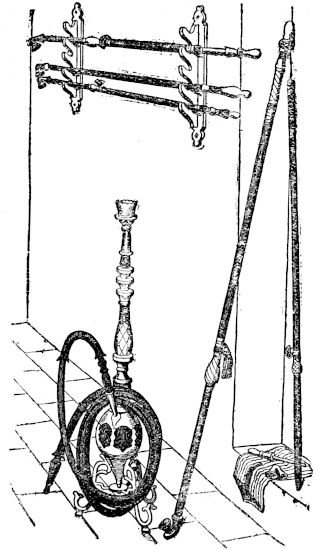
PIPES.
The pipe (which is called by many names, as “shibuk,” “’ood,” etc.) is generally between four and five feet long; some pipes are shorter, and some are of greater length. The most common kind used in Egypt is made of a kind of wood called “garmash′ak.”[235] The greater part of the stick (from the mouth-piece to about three-quarters of its length) is covered with silk, which is confined at each extremity by gold thread, often intertwined with coloured silks, or by a tube of gilt silver; and at the lower extremity of the covering is a tassel of silk. The covering was originally designed to be moistened with water, in order to cool the pipe, and, consequently, 123the smoke, by evaporation; but this is only done when the pipe is old, or not handsome. Cherry-stick pipes, which are never covered, are also used by many persons, particularly in the winter. In summer the smoke is not so cool from the cherry-stick pipe as from the kind before mentioned. The bowl is of baked 124earth, coloured red or brown.[236] The mouth-piece is composed of two or more pieces of opaque, light-coloured amber, interjoined by ornaments of enamelled gold, agate, jasper, carnelion, or some other precious substance. It is the most costly part of the pipe; the price of one of the kind most generally used by persons of the middle order is from about one to three pounds sterling. A wooden tube passes through it. This is often changed, as it soon becomes foul from the oil of the tobacco. The pipe also requires to be cleaned very often, which is done with tow, by means of a long wire. Many poor men in Cairo gain their livelihood by going about to clean pipes.
The tobacco smoked by persons of the higher orders, and some others, in Egypt, is of a very mild and delicious flavour. It is mostly from the neighbourhood of El-Ládikeeyeh, in Syria. The best kind is the “mountain tobacco,” grown on the hills about that town. A stronger kind, which takes its name from the town of Soor, sometimes mixed with the former, is used by most persons of the middle orders. In smoking, the people of Egypt and of other countries of the East draw in their breath freely, so that much of the smoke descends into the lungs; and the terms which they use to express “smoking tobacco” signify “drinking smoke,” or “drinking tobacco,” for the same word signifies both “smoke” and “tobacco.” Few of them spit while smoking; I have very seldom seen any do so.
Some of the Egyptians use the Persian pipe, in which the smoke passes through water. The pipe of this kind most commonly used by persons of the higher classes is called “nárgeeleh,” because the vessel that contains the water is a cocoa-nut, of which “nárgeeleh” is an Arabic name. Another kind, which has a glass vase, is called “sheesheh.”[237] Each has a very long flexible tube. A particular kind of tobacco, called “tumbák,” from Persia, is used in the water-pipe; it is first washed several times, and put into the pipe-bowl while damp, and two or three pieces of live charcoal are placed on the top. Its flavour is mild, and very agreeable; but the strong inhalation necessary in this mode of smoking is injurious to persons of delicate lungs.[238] In using the 125Persian pipe, the person as freely draws the smoke into his lungs as he would inhale pure air. The great prevalence of liver-complaints in Arabia is attributed to the general use of the nárgeeleh; and many persons in Egypt suffer severely from the same cause. A kind of pipe commonly called “gózeh,” which is similar to the nárgeeleh, excepting that it has a short cane tube, instead of the snake (or flexible one), and no stand, is used by men of the lowest class, for smoking both the tumbák and the intoxicating “hasheesh,” or hemp.
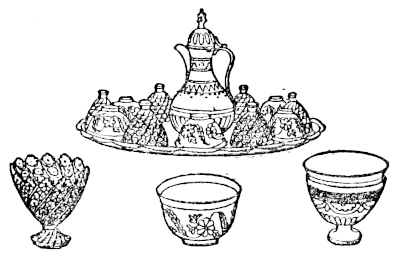
COFFEE SERVICE.
The coffee (“kahweh”[239]) is made very strong, and without sugar or milk. The coffee-cup (which is called “fingán”) is small, generally holding not quite an ounce and a half of liquid. It is of porcelain, or Dutch ware, and, being without a handle, is placed within another cup (called “zarf”), of silver or brass, according to the circumstances of the owner, and, both in shape and size, nearly resembling our egg-cup.[240] In preparing the coffee, the water is first made to boil, the coffee (freshly roasted and pounded) 126is then put in, and stirred, after which the pot is again placed on the fire, once or twice, until the coffee begins to simmer, when it is taken off, and its contents are poured out into the cups while the surface is yet creamy. The Egyptians are excessively fond of pure and strong coffee thus prepared, and very seldom add sugar to it (though some do so when they are unwell), and never milk or cream; but a little cardamom-seed is often added to it. It is a common custom, also, to fumigate the cup with the smoke of mastic; and the wealthy sometimes impregnate the coffee with the delicious fragrance of ambergris. The most general mode of doing this is to put about a carat-weight of ambergris in a coffee-pot, and melt it over a fire; then make the coffee in another pot, in the manner before described, and, when it has settled a little, pour it into the pot which contains the ambergris. Some persons make use of the ambergris, for the same purpose, in a different way, sticking a piece of it, of the weight of about two carats, in the bottom of the cup, and then pouring in the coffee; a piece of the weight above mentioned will serve for two or three weeks. This mode is often adopted by persons who like always to have the coffee which they themselves drink flavoured with this perfume, and do not give all their visitors the same luxury. The coffee-pot is sometimes brought in a vessel of silver or brass (called “’áz’kee”[241]), containing burning charcoal. This vessel is suspended by three chains. In presenting the coffee, the servant holds the foot of the zarf with his thumb and first finger. In receiving the fingán and zarf, he makes use of both hands, placing the left beneath and the right above at the same instant.
In cold weather, a brasier, or chafing-dish (called “mankal,” and vulgarly “mankad”), of tinned copper, full of burning charcoal, is placed on the floor, and sometimes perfume is burnt in it. The Egyptians take great delight in perfumes,[242] and often fumigate their apartments. The substance most commonly used for this purpose is frankincense of an inferior quality, called “bakhoor el-barr.” Benzoin and aloes-wood are also used for the same purpose.
If he can conveniently afford to keep a horse, mule, or ass, or to hire an ass, the Egyptian is seldom seen walking far beyond the threshold of his own house; but very few of the people of Cairo, or of the other towns, venture to expose themselves to the 127suspicion of possessing superfluous wealth, and, consequently, to greater exactions of the government than they would otherwise suffer, by keeping horses.[243] The modern saddle of the horse is generally padded, and covered with cloth or velvet, embroidered, or otherwise ornamented; and the head-stall and breast-leather are adorned with silk tassels, and coins, or other ornaments, of silver. Wealthy merchants, and the great ’ulama, usually ride mules. The saddle of the mule is, generally, nearly the same as that of the ass, of which a sketch is inserted; when the rider is one of the ’ulama, it is covered with a “seggádeh” (or prayer-carpet)prayer-carpet); so, also, sometimes, is the ladies’ saddle, from which, however, the former differs considerably, as will be shown hereafter. Asses are most generally used for riding through the narrow and crowded streets of Cairo, and there are many for hire; their usual pace is an easy amble. Egypt has long been famed for its excellent asses, which are, in general, larger than those of our country, and very superior to the latter in every respect. The usual price of one of a good breed and well trained is about three or four pounds sterling. The ass is furnished with a stuffed saddle, the forepart of which is covered with red leather, and the seat, most commonly, with a kind of soft woollen lace, similar to our coach-lace, of red, yellow, and other colours. The stirrup-leathers 128are, in every case, very short. The horseman is preceded by a servant, or by two servants, to clear the way; and, for the same purpose, a servant generally runs beside or behind the ass, or sometimes before, calling out to the passengers to move out of the way to the right or left, or to take care of their backs, faces, sides, feet, or heels.[245] The rider, however, must be vigilant, and not trust merely to his servant, or he may be thrown down by the wide load of a camel, which accident, indeed, is sometimes unavoidable in the more narrow and crowded streets. His pipe is generally carried by the servant, and filled and lighted if he dismount at a house or shop.
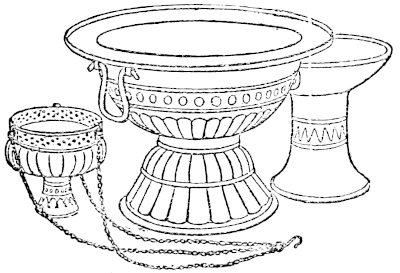
ÁZ’KEE AND MANKALS.[244]
If he have no regular business to employ him, the Egyptian spends the greater part of the day in riding, paying visits, or making purchases; or in smoking and sipping coffee and chatting with a friend at home; or he passes an hour or more in the morning enjoying the luxuries of a public bath. At noon he has again to say prayers, if he fulfil the duties imposed on him by his religion; but, as I have remarked on a former occasion, there are comparatively few persons among the Egyptians who do not sometimes neglect these duties, and there are many who scarcely ever pray. Directly after midday (if he has not taken a late breakfast) he dines, then takes a pipe and a cup of coffee, and, in hot weather, usually indulges himself with a nap. Often he retires to recline in the hareem, where a wife or female slave watches over his repose, or rubs the soles of his feet with her hands. On such occasions, and at other times when he wishes to enjoy privacy, every person who comes to pay him a visit is told, by the servant, that he is in the hareem; and no friend expects him to be called thence, unless on very urgent business. From the time of the afternoon-prayers until sunset (the next time of prayer) he generally 129enjoys again his pipe and a cup of coffee in the society of some one or more of his friends at home or abroad. Shortly after sunset he sups.
I must now describe the meals of dinner (“el-ghada”) and supper (“el-’asha”), and the manner and etiquette of eating. The same remarks will apply to both these repasts; excepting that supper is always the principal meal. It is the general custom to cook in the afternoon, and what remains of the supper is eaten the next day for dinner, when there are no guests in the house. The master of a family generally dines and sups with his wife or wives and children; but there are many men, particularly of the higher classes, who are too proud to do this, or too much engaged in society to be able to do so, unless on some few occasions; and there are men even of the lowest class who scarcely ever eat with their wives or children. When a person is paying a visit to a friend, and the hour of dinner or supper arrives, it is incumbent on the master of the house to order the meal to be brought; and the same is generally considered necessary if the visitor be a stranger.
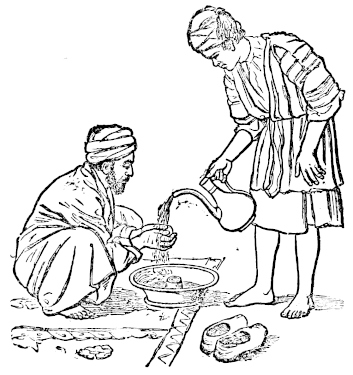
WASHING BEFORE OR AFTER A MEAL.
Every person, before he sits down to the table, or rather to the 130tray, washes his hands,[246] and sometimes his mouth also, with soap and water; or, at least, has some water poured upon his right hand. A servant brings to him a basin and ewer (called “tisht” and “ibreek”), of tinned copper, or brass.[247] The former of these has a cover pierced with holes, with a raised receptacle for the soap in the middle; and the water, being poured upon the hands, passes through this cover into the space below; so that when the basin is brought to a second person, the water with which the former one has washed is not seen. A napkin (“footah”) is given to each person.
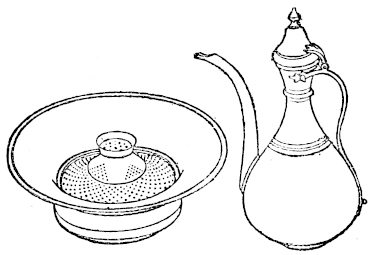
TISHT AND IBREEK.[248]
A round tray (called “seeneeyeh,” and “sáneeyeh”) of tinned copper, or sometimes of brass, generally between two and three feet in diameter, serves as a table; being placed upon a stool (“kursee”) about fifteen inches high, made of wood, and often covered with mother-of-pearl, tortoise-shell, bone, etc. These two pieces of furniture compose the “sufrah.” Round cakes of bread, such as have been before described, sometimes cut in halves across the middle, are placed round the tray, with several limes, cut in two, to be squeezed over any of the dishes that may require the acid; and a spoon of box-wood, or of ebony, or tortoise-shell, is put for each person. The bread often serves 131as a plate. Several dishes of tinned copper, or of china, containing different kinds of viands, vegetables, etc., are then placed upon the tray, according to the common fashion of the country; or only one dish is put on at a time, after the Turkish mode.
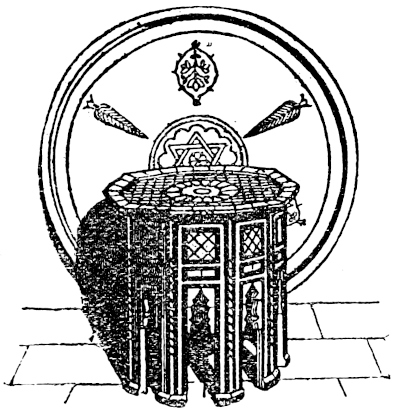
KURSEE AND SEENEEYEH.
The persons who are to partake of the repast sit upon the floor around the tray, each with his napkin upon his knees; or, if the tray be placed near the edge of a low deewán, which is often done, some of the persons may sit on the deewán, and the others on the floor: but if the party be numerous, the tray is placed in the middle of the room, and they sit round it with one knee on the ground, and the other (the right) raised; and, in this manner, as many as twelve persons may sit round a tray three feet wide. Each person bares his right arm to the elbow, or tucks up the hanging end of his sleeve. Before he begins to eat, he says, “Bi-smi-llah” (In the name of God).[249] This is generally said in a low, but audible voice; and by the master of the house first. It is considered both as a grace and as an invitation to any person to partake of the meal; and when any one is addressed with “Bi-smi-llah,” or “Tafaddal” (which latter signifies, in this case, “Do me the favour to partake of the 132repast”), he must reply, if he do not accept the invitation, “Heneeän” (or “May it be productive of enjoyment,” or “benefit”), or use some similar expression: else it will be feared that an evil eye has been cast upon the food; and they say that, “in the food that is coveted” (or upon which an envious eye has fallen), “there is no blessing.” But the manner in which the Egyptian often presses a stranger to eat with him, shows that feelings of hospitality most forcibly dictate the “Bi-smi-llah.” The master of the house first begins to eat; the guests or others immediately follow his example. Neither knives nor forks are used: the thumb and two fingers of the right hand serve instead of those instruments; but the spoons are used for soup or rice, or other things that cannot be easily taken without; and both hands may be used in particular cases, as will be presently 133explained. When there are several dishes upon the tray, each person takes of any that he likes, or of every one in succession: when only one dish is placed upon the tray at a time, each takes from it a few mouthfuls, and it is quickly removed, to give place to another.[251] To pick out a delicate morsel, and hand it to a friend, is esteemed polite. The manner of eating with the fingers, as practised in Egypt and other Eastern countries, is more delicate than may be imagined by Europeans who have not witnessed it, nor heard it correctly described. Each person breaks off a small piece of bread, dips it in the dish, and then conveys it to his mouth, together with a small portion of the meat or other contents of the dish.[252] The piece of bread is generally doubled together, so as to enclose the morsel of meat, etc.; and only the thumb and first and second fingers are commonly used. When a person takes a piece of meat too large for a single mouthful, he usually places it upon his bread.
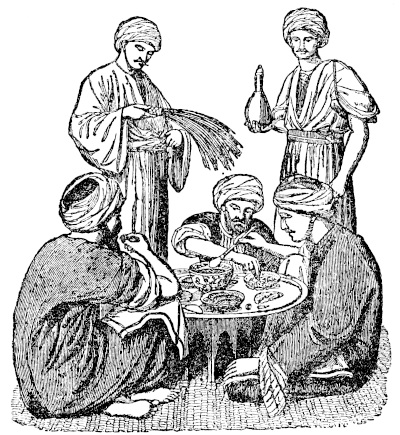
A PARTY AT DINNER OR SUPPER.[250]
The food is dressed in such a manner that it may be easily eaten in the mode above-described. It generally consists, for the most part, of “yakhnee,” or stewed meat, with chopped onions, or with a quantity of “bámiyehs,”[253] or other vegetables; “káwurmeh,” or a richer stew, with onions; “warak mahshee,” or vine-leaves, or bits of lettuce-leaf or cabbage-leaf, with a mixture of rice and minced meat (delicately seasoned with salt, pepper, and onions, and often with garlic, parsley, etc.) wrapped up in them, and boiled; cucumbers (“khiyár”), or black, white, or red “bádingáns,”[254] or a kind of gourd (called “kara kooseh”) of the size and shape of a small cucumber, which are all “mahshee,” or stuffed, with the same composition as the leaves above-mentioned; and “kebáb,” or small morsels of mutton or lamb, roasted on skewers. Many dishes consist wholly, or for the most part, of vegetables; such as cabbage, purslain, spinach, beans, lupins, chick peas, gourd cut into small pieces, colocasia, lentils, 134etc. Fish, dressed with oil, is also a common dish. Most of the meats are cooked with clarified butter, on account of the deficiency of fat; and are made very rich: the butter, in the hot season, is perfectly liquid. When a fowl is placed whole on the tray, both hands are generally required to separate the joints; or two persons, each using the right hand alone, perform this operation together: but some will do it very cleverly without assistance, and with a single hand. Many of the Arabs will not allow the left hand to touch food in any case,[255] excepting when the right is maimed. A boned fowl, stuffed with raisins, pistachio-nuts, crumbled bread, and parsley, is not an uncommon dish; and even a whole lamb, stuffed with pistachio-nuts, etc., is sometimes served up; but the meat is easily separated with one hand. Sweets are often mixed with stewed meat, etc.; as, for instance, “’annáb” (or jujubes), peaches, apricots, etc., and sugar, with yakhnee. Various kinds of sweets are also served up, and often in no particular order with respect to other meats. A favourite sweet dish is “kunáfeh,” which is made of wheat-flour, and resembles vermicelli, but is finer; it is fried with a little clarified butter, and sweetened with sugar or honey. A dish of water-melon (“batteekh”), if in season, generally forms part of the meal. This is cut up about a quarter of an hour before, and left to cool in the external air, or in a current of air, by the evaporation of the juice on the surfaces of the slices; but it is always watched during this time, lest a serpent should come to it, and poison it by its breath or bite; for this reptile is said to be extremely fond of the water-melon, and to smell it at a great distance. Water-melons are very abundant in Egypt, and mostly very delicious and wholesome. A dish of boiled rice (called “ruzz mufelfel,” the “piláv” of the Turks), mixed with a little butter, and seasoned with salt and pepper, is generally that from which the last morsels are taken; but, in the houses of the wealthy, this is often followed by a bowl of “khusháf,”[256] a sweet drink, commonly consisting of water with raisins boiled in it, and then sugar: when cool, a little rose-water is dropped into it.[257] The water-melon frequently supplies the place of this.[258]
135The Egyptians eat very moderately, though quickly. Each person, as soon as he has finished, says, “El-hamdu li-lláh” (Praise be to God),[259] and gets up, without waiting till the others have done:[260] he then washes his hands and mouth with soap and water; the basin and ewer being held by a servant, as before.
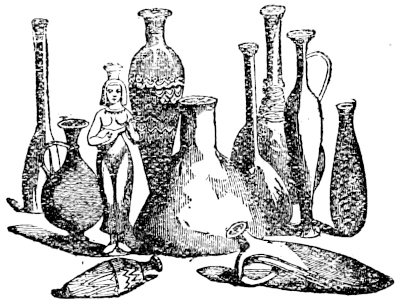
WATER-BOTTLES.
The only beverage at meals is water of the Nile, or, sometimes, at the tables of the rich, sherbet, which will presently be described. The Arabs drink little or no water during a meal, but generally take a large draught immediately after. The water of the Nile is remarkably good; but that of all the wells in Cairo and in other parts of Egypt is slightly brackish. In general, water is drunk either from an earthen bottle or from a brass cup.[261] The water-bottles are of two kinds; one called “dórak,” and the other “kulleh:” the former has a narrow, and the latter a wide, mouth. They are made of a greyish, porous earth, which cools the water deliciously, by evaporation; and they are, therefore, generally placed in a current of air. The interior is often blackened with the smoke of some resinous wood, and then perfumed with the smoke of “kafal”[262] wood and mastic; the latter used last. A small earthen vessel (called “mibkhar′ah”) is employed in performing 136these operations, to contain the burning charcoal, which is required to ignite the wood, and the mastic; and the water-bottle is held inverted over it. A strip of rag is tied round the neck of the dórak, at the distance of about an inch from the mouth, to prevent the smoke-black from extending too far upon the exterior of the bottle. Many persons also put a little orange-flower-water into the bottles. This gives a very agreeable flavour to their contents. The bottles have stoppers of silver, brass, tin, wood, or palm-leaves; and are generally placed in a tray of tinned copper, which receives the water that exudes from them. In cold weather, china bottles are used in many houses instead of those above-described, which then render the water too cold.[263] The two most common forms of drinking-cups are here represented. Some of them have texts of the Kur-án, etc., engraved in the interior, or the names of “the Seven Sleepers”: but inscriptions of the former kind I have seldom seen. Every person, before and after drinking, repeats the same ejaculations as before and after eating; and this he does each time that he drinks during a meal: each friend present then says to him, “May it be productive of enjoyment,” or “benefit”; to which the reply is, “God cause thee to have enjoyment.”[264]
Though we read, in some of the delightful tales of “The Thousand and One Nights,” of removing “the table of viands” and bringing “the table of wine,” this prohibited beverage is not often introduced in general society, either during or after the meal, or at other times, by the Muslims of Egypt in the present day. Many of them, however, habitually indulge in drinking wine with select parties of their acquaintance. The servants of a man who is addicted to this habit know such of his friends as may be admitted, if they happen to call when he is engaged in this unlawful pleasure; and to all others they say that he is not at home, or that he is in the hareem. Drinking wine is indulged in by such persons before and after supper, and during that meal; but it is most approved before supper, as they say that it quickens the appetite. The “table of wine” is usually thus prepared, according to a penitent Muslim wine-bibber, who is one of my friends (I cannot speak on this subject from my own experience; 137for, as I never drink wine, I have never been invited to join a Muslim wine-party):—a round japanned tray, or a glass dish, is placed on the stool before-mentioned: on this are generally arranged two cut-glass jugs, one containing wine,[265] and the other, rosoglio; and sometimes two or more bottles besides: several small glasses are placed with these; and glass saucers of dried and fresh fruits, and, perhaps, pickles: lastly, two candles, and often a bunch of flowers stuck in a candlestick, are put upon the tray.
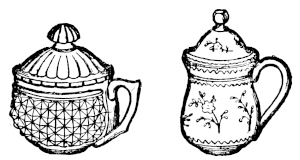
SHERBET-CUPS.
The Egyptians have various kinds of sherbets, or sweet drinks. The most common kind[266] is merely sugar and water, but very sweet: lemonade[267] is another: a third kind, the most esteemed, is prepared from a hard conserve of violets, made by pounding violet-flowers, and then boiling them with sugar: this violet-sherbet is of a green colour: a fourth kind is prepared from mulberries: a fifth, from sorrel. There is also a kind of sherbet sold in the streets,[268] which is made with raisins, as its name implies;implies; another kind, which is a strong infusion of liquorice-root, and called by the name of that root; and a third kind, which is prepared from the fruit of the locust tree, and called, in like manner, by the name of the fruit. The sherbet is served in coloured glass cups, generally called “kullehs,” containing about three-quarters of a pint; some of which (the more common kind) are ornamented with gilt flowers, etc. The sherbet-cups are placed on a round tray, and covered with a round piece of embroidered silk, or cloth of gold. On the right arm of the person who presents the sherbet is hung a large oblong napkin with a wide embroidered border of gold and coloured silks at each end. This is ostensibly offered 138for the purpose of wiping the lips after drinking the sherbet; but it is really not so much for use as for display: the lips are seldom or scarcely touched with it.
The interval between supper and the “’eshë,” or time of the night-prayers, is generally passed in smoking a pipe, and sipping a cup of coffee. The enjoyment of the pipe may be interrupted by prayer, but is continued afterwards; and sometimes draughts or chess, or some other game, or at least conversation, contributes to make the time glide away more agreeably. The members of an Egyptian family in easy circumstances may pass their time very pleasantly; but they do so in a quiet way. The men often pay evening visits to their friends, at, or after, supper-time. They commonly use, on these and similar occasions, a folding lantern (“fánoos”), composed of waxed cloth strained over rings of wire, and a top and bottom of tinned copper. This kind of lantern is here represented, together with the common lamp (“kandeel”), and its usual receptacle of wood, which serves to protect the flame from the wind. The lamp is a small vessel of glass, having a little tube in the bottom, in which is stuck a wick formed of cotton twisted round a piece of straw. Some water is poured in first, and then the oil. A lamp of this kind is often hung over the entrance of a house. By night, the interiors of the houses present a more dull appearance than in the day: the light of one or two candles (placed on the floor or on a stool, and sometimes surrounded by a large glass shade, or enclosed in a glass lantern, on account of the windows being merely of lattice-work) is generally thought sufficient for a large and lofty saloon. Few of the Egyptians sit up later, in summer, than three or four o’clock, which is three or four hours after sunset; for their reckoning of time is from sunset at every season of the year: in winter they often sit up five or six hours.
Thus the day is usually spent by men of moderate wealth who have no regular business to attend to, or none that requires their own active superintendence. But it is the habit of the tradesman to repair, soon after breakfast, to his shop or warehouse, and to remain there until near sunset.[269] He has leisure to smoke as much as he likes; and his customers often smoke with him. To some of these he offers his own pipe (unless they have theirs with them), and a cup of coffee, which is obtained from the nearest coffee-shop. A great portion of the day he sometimes passes in 139agreeable chat with customers, or with the tradesmen of the next or opposite shops. He generally says his prayers without moving from the shop. Shortly after the noon-prayers, or sometimes earlier or later, he eats a light meal, such as a plate of kebáb and a cake of bread (which a boy or maid daily brings from his house, or procures in the market), or some bread and cheese or pickles, etc., which are carried about the streets for sale; and if a customer be present, he is always invited, and often pressed, to partake of this meal. A large earthen bottle of water is kept in the shop, and replenished, whenever necessary, by a passing “sakka,” or water-carrier. In the evening, the tradesman returns to his house, eats his supper, and, soon after, retires to bed.
It is the general custom in Egypt for the husband and wife to sleep in the same bed, excepting among the wealthy classes, who mostly prefer separate beds. The bed is usually thus prepared in the houses of persons of moderate wealth: a mattress, stuffed with cotton, about six feet long, and three or four feet in width, is placed upon a low frame: a pillow is placed for the head, and a sheet spread over this and the mattress: the only covering in summer is generally a thin blanket: and in winter a thick quilt, stuffed with cotton. If there be no frame, the mattress is placed upon the floor; or two mattresses are laid one upon the other, with the sheet, pillow, etc.; and often, a cushion of the deewán is placed on each side. A musquito-curtain[270] is suspended over the bed by means of four strings, which are attached to nails in the wall. The dress is seldom changed on going to bed; and in winter, many people sleep with all their ordinary clothes on, excepting the gibbeh, or cloth coat; but in summer, they sleep almost, or entirely, unclad. In winter, the bed is prepared in a small closet (called “khazneh”): in summer, in a large room. All the bed-clothes are rolled up, in the day-time, and placed on one side, or in the closet above-mentioned. During the hottest weather, many people sleep upon the house-top, or in a “fes-hah,” (or “fesahah”), which is an uncovered apartment; but ophthalmia and other diseases often result from their thus exposing themselves to the external air at night. The most common kind of frame for the bed is made of palm-sticks; but this harbours bugs, which are very abundant in Egypt in the summer, as fleas are in the winter. These and other plagues to which the people of Egypt are exposed by night and day have been before mentioned.[271] 140With regard to the most disgusting of them, the lice, it may here be added, that, though they are not always to be avoided even by the most scrupulous cleanliness, a person who changes his linen after two or three days’ wear is very seldom annoyed by these vermin; and when he is, they are easily removed, not attaching themselves to the skin; they are generally found in the linen. A house may be kept almost clear of fleas by frequent washing and sweeping; and the flies may be kept out by placing nets at the doors and windows: but it is impossible to purify an Egyptian house from bugs, if it contain much wood-work, which is generally the case.
The male servants lead a very easy life, with the exception of the “sáïs,” or groom, who whenever his master takes a ride, runs before or beside him; and this he will do in the hottest weather for hours together, without appearing fatigued. Almost every wealthy person in Cairo has a “bowwáb,” or door-keeper, always at the door of his house, and several other male servants. Most of these are natives of Egypt; but many Nubians are also employed as servants in Cairo and other Egyptian towns. The latter are mostly bowwábs, and are generally esteemed more honest than the Egyptian servants; but I am inclined to think, from the opinion of several of my friends, and from my own experience, that they have acquired this reputation only by superior cunning. The wages of the male servants are very small, usually from one to two dollars (or from four to eight shillings) per month: but they receive many presents.[272] On the “’eed” (or festival) after Ramadán, the master generally gives, to each of his servants, part or the whole of a new suit of clothes, consisting of an “’eree” (a blue shirt, which is their outer dress), a “tarboosh,” and a turban. Other articles of dress which they require during the year (excepting, sometimes, shoes) the servants are obliged to provide for themselves. Besides what their master gives them, they also receive small presents of money from his visitors, and from the tradespeople with whom he deals; particularly whenever he has 141made any considerable purchase. They sleep in the clothes which they wear during the day, each upon a small mat; and in winter they cover themselves with a cloak[273] or blanket. In some respects, they are often familiar in their manners to their master, even laughing and joking with him: in others, they are very submissive: paying him the utmost honour, and bearing corporal chastisement from his hand with child-like patience.
The male black slave is treated with more consideration than the free servant; and leads a life well suited to his lazy disposition. If discontented with his situation, he can legally compel his master to sell him. Many of the slaves in Egypt wear the Turkish military dress. They are generally the greatest fanatics in the East; and more accustomed than any other class to insult the Christians and every people who are not of the faith which they have themselves adopted, without knowing more of its doctrines than Arab children who have been but a week at school. Of the female slaves, some account will be given in the next chapter.
An acquaintance with the modern inhabitants of Egypt leads us often to compare their domestic habits with those of Europeans in the middle ages; and, perhaps, in this comparison, the points of resemblance which we observe, with regard to the men, are more striking than the contrasts; but the reverse will be found to be the case when we consider the state of the females.