Chapter III · RELIGION AND LAWS.
Reading edition
As the most important branch of their education, and the main foundation of their manners and customs, the religion and laws of the people who are the subject of these pages must be well understood—not only in their general principles, but in many minor points—before we can proceed to consider their social condition and habits in the state of manhood.
A difference of opinion among Muslims, respecting some points of religion and law, has given rise to four sects, which consider each other orthodox as to fundamental matters, and call themselves “Sunnees,” or followers of the traditions; while they designate all other Muslims by the term “Shiya’ees,” signifying, according to their acceptation, “heretics.” The Sunnees alone are the class which we have to consider. The four sects into which they are divided are the “Hanafees,” “Sháfe’ees,” “Málikees,” and “Hambel′ees,”—so called from the names of the respective doctors whose tenets they have adopted. The Turks are of the first sect, which is the most reasonable. The inhabitants of Cairo, a small proportion excepted (who are Hanafees), are either Sháfe’ees or Málikees; and it is generally said that they are mostly of the former of these sects, as are also the people of Arabia; those of the Sharkeeyeh, on the east of the Delta, Sháfe’ees; those of the Gharbeeyeh, or Delta, Sháfe’ees, with a few Málikees; those of the Boheyreh, on the west of the Delta, Málikees. The inhabitants of the Sa’eed, or the valley of Upper Egypt, are likewise, with few exceptions, Málikees; so also are the Nubians, and the Western Arabs. To the fourth sect very few persons in the present day belong. All these sects agree in deriving their code of religion and law from four sources; namely, the Kur-án, the traditions of the Prophet, the concordance of his early disciples, and analogy.
The religion which Mohammad taught is generally called by the Arabs “El-Islám.”“El-Islám.” “Eemán” and “Deen” are the particular terms applied, respectively, to faith and practical religion.
The grand principles of the faith are expressed in two articles, the first of which is this—
“There is no deity but God.”
God, who created all things in heaven and in earth, who 53preserveth all things, and decreeth all things, who is without beginning, and without end, omnipotent, omniscient, and omnipresent, is one. His unity is thus declared in a short chapter of the Kur-án[96]: “Say, He is God; one [God]. God is the Eternal. He begetteth not, nor is He begotten; and there is none equal unto Him.” He hath no partner, nor any offspring, in the creed of the Muslim. Though Jesus Christ (whose name should not be mentioned without adding, “on whom be peace”) is believed to have been born of a pure virgin, by the miraculous operation of God,[97] without any natural father, to be the Messiah, and “the Word of God, which He transmitted unto Mary, and a Spirit [proceeding] from Him,”[98] yet he is not called the Son of God; and no higher titles are given to him than those of a Prophet and Apostle; he is even considered as of inferior dignity to Mohammad, inasmuch as the Gospel is held to be superseded by the Kurán. The Muslim believes that Seyyidna ’Eesa[99] (or “our Lord Jesus”), after He had fulfilled the object of His mission, was taken up unto God from the Jews, who sought to slay Him; and that another person, on whom God had stamped the likeness of Christ, was crucified in His stead.[100] He also believes that Christ is to come again upon the earth, to establish the Muslim religion, and perfect peace and security, after having killed Antichrist, and to be a sign of the approach of the last day.
The other grand article of the faith, which cannot be believed without the former, is this—
“Mohammad is God’s Apostle.”
Mohammad is believed by his followers to have been the last and greatest of Prophets and Apostles.[101] Six of these—namely, Adam, Noah, Abraham, Moses, Jesus, and Mohammad—are believed each to have received a revealed law, or system of religion 54and morality. That, however, which was revealed to Adam was abrogated by the next; and each succeeding law, or code of laws, abrogated the preceding, though all are believed to have been the same in every essential point; therefore, those who professed the Jewish religion from the time of Moses to that of Jesus were true believers, and those who professed the Christian religion (uncorrupted, as the Muslims say, by the tenet that Christ was the son of God) until the time of Mohammad are held, in like manner, to have been true believers. But the copies of the Pentateuch, the Psalms of David (which the Muslims also hold to be of divine origin), and the Gospels now existing, are believed to have been so much altered as to contain very little of the true word of God. The Kur-án is believed to have suffered no alteration whatever.
It is further necessary that the Muslim should believe in the existence of angels, and of good and evil genii; the evil genii being devils, whose chief is Iblees:[102] also, in the immortality of the soul, the general resurrection and judgment, in future rewards and punishments in Paradise and Hell, in the balance in which good and evil works shall be weighed, and in the bridge “Es-Sirát”“Es-Sirát” (which extends over the midst of Hell, finer than a hair, and sharper than the edge of a sword), over which all must pass, and from which the wicked shall fall into Hell. He believes, also, that they who have acknowledged the faith of El-Islám and yet acted wickedly will not remain in Hell for ever; but that all of other religions must: that there are, however, degrees of punishments, as well as of rewards,—the former consisting in severe torture by excessive heat and cold, and the latter, partly in the indulgence of the appetites by most delicious meats and drinks, and in the pleasures afforded by the company of the girls of Paradise, whose eyes will be very large and entirely black,[103] and whose stature will be proportioned to that of the men, which will be the height of a tall palm-tree, or about sixty feet. Such, the Muslims generally believe, was the height of our first parents. It is said that the souls of martyrs reside, until the judgment, in the crops of green 55birds, which eat of the fruits of Paradise and drink of its rivers.[104] Women are not to be excluded from Paradise, according to the faith of El-Islám; though it has been asserted, by many Christians, that the Muslims believe women to have no souls. In several places in the Kur-án, Paradise is promised to all true believers, whether males or females. It is the doctrine of the Kur-án that no person will be admitted into Paradise by his own merits; but that admission will be granted to the believers merely by the mercy of God, on account of their faith; yet that the felicity of each person will be proportioned to his good works. The very meanest in Paradise is promised “eighty thousand servants” (beautiful youths, called “weleeds”), “seventy-two wives of the girls of Paradise” (“hooreeyehs”), “besides the wives he had in this world,” if he desire to have the latter (and the good will doubtless desire the good), “and a tent erected for him of pearls, jacinths, and emeralds, of a very large extent;” “and will be waited on by three hundred attendants while he eats, and served in dishes of gold, whereof three hundred shall be set before him at once, each containing a different kind of food, the last morsel of which will be as grateful as the first.” Wine also, “though forbidden in this life, will yet be freely allowed to be drunk in the next, and without danger, since the wine of Paradise will not inebriate.”[105] We are further told, that all superfluities from the bodies of the inhabitants of Paradise will be carried off by perspiration, which will diffuse an odour like that of musk; and that they will be clothed in the richest silks, chiefly of green. They are also promised perpetual youth, and children as many as they may desire. These pleasures, together with the songs of the angel Isráfeel, and many other gratifications of the senses, will charm even the meanest inhabitant of Paradise. But all these enjoyments will be lightly esteemed by those more blessed persons who are to be admitted to the highest of all honours—that spiritual pleasure of beholding, morning and evening, the face of God.[106]—The 56Muslim must also believe in the examination of the dead in the sepulchre, by two angels, called Munkar and Nekeer, of terrible aspect, who will cause the body (to which the soul shall, for the time, be re-united) to sit upright in the grave,[107] and will question the deceased respecting his faith. The wicked they will severely torture; but the good they will not hurt. Lastly, he should believe in God’s absolute decree of every event, both good and evil. This doctrine has given rise to as much controversy among the Muslims as among Christians; but the former, generally, believe in predestination as, in some respects, conditional.
The most important duties enjoined in the ritual and moral laws are prayer, alms-giving, fasting, and pilgrimage.
The religious purifications, which are of two kinds,—first, the ordinary ablution preparatory to prayer, and secondly, the washing of the whole body, together with the performance of the former ablution,—are of primary importance: for prayer, which is a duty so important that it is called “the Key of Paradise,” will not be accepted from a person in a state of uncleanness. It is therefore also necessary to avoid impurity by clipping the nails, and other similar practices.[108]
There are partial washings, or purifications, which all Muslims perform on certain occasions, even if they neglect their prayers, and which are considered as religious acts.[109] The ablution called “el-wudoó,” which is preparatory to prayer, I shall now describe. The purifications just before alluded to are a part of the wudoó: the other washings are not, of necessity, to be performed immediately after, but only when the person is about to say his prayers; and these are performed in the mosque or in the house, in public or in private. There is in every mosque a tank (called “meydaäh”) or a “hanafeeyeh,” which is a raised reservoir, with spouts round it, from which the water falls. In some mosques there are both these. The Muslims of the Hanafee sect (of which are the Turks) perform the ablution at the latter (which has received its name from that cause); for they must do it with running water, or from a tank or pool at least ten cubits in breadth, 57and the same in depth; and I believe that there is only one meydaäh in Cairo of that depth, which is in the great mosque El-Azhar. A small hanafeeyeh of tinned copper, placed on a low shelf, and a large basin, or a small ewer and basin of the same metal, are generally used in the house for the performance of the wudoó.
The person, having tucked up his sleeves a little higher than his elbows, says, in a low voice, or inaudibly, “I purpose performing the wudoó, for prayer.”[110] He then washes his hands three times; saying, in the same manner as before, “In the name of God, the Compassionate, the Merciful! Praise be to God, who hath sent down water for purification, and made El-Islám to be a light and a conductor, and a guide to Thy gardens, the gardens of delight, and to Thy mansion, the mansion of peace.” Then he rinses his mouth three times, throwing the water into it with his right hand;[111] and in doing this he says, “O God, assist me in the reading of Thy book, and in commemorating Thee, and in thanking Thee, and in worshipping Thee well!” Next, with his right hand, he throws water up his nostrils (snuffing it up at the same time), and then blows it out, compressing his nostrils with the thumb and finger of the left hand; and this also is done three times. While doing it, he says, “O God, make me to smell the odours of Paradise, and bless me with its delights; and make me not to smell the smell of the fires [of Hell].” He then washes his face three times, throwing up the water with both hands, and saying, “O God, whiten my face with Thy light, on the day when Thou shalt whiten the faces of Thy favourites; and do not blacken my face, on the day when Thou shalt blacken the faces of Thine enemies.”[112] His right hand and arm, as high as the elbow, he next washes three times, and as many times causes some water to run along his arm, from the palm of the hand to the elbow, saying, as he does this, “O God, give me my book in my right hand;[113] and 58reckon with me with an easy reckoning.” In the same manner he washes the left hand and arm, saying, “O God, do not give me my book in my left hand, nor behind my back; and do not reckon with me with a difficult reckoning; nor make me to be one of the people of the fire.” He next draws his wetted right hand over the upper part of his head, raising his turban or cap with his left: this he does but once; and he accompanies the action with this supplication, “O God, cover me with Thy mercy, and pour down Thy blessing upon me; and shade me under the shadow of Thy canopy, on the day when there shall be no shade but its shade.” If he have a beard, he then combs it with the wetted fingers of his right hand; holding his hand with the palm forwards, and passing the fingers through his beard from the throat upwards. He then puts the tips of his fore-fingers into his ears, and twists them round, passing his thumbs at the same time round the back of the ears, from the bottom upwards; and saying, “O God, make me to be of those who hear what is said, and obey what is best;” or, “O God, make me to hear good.” Next he wipes his neck with the back of the fingers of both hands, making the ends of his fingers meet behind his neck, and then drawing them forward; and in doing so, he says, “O God, free my neck from the fire; and keep me from the chains, and the collars, and the fetters.” Lastly, he washes his feet, as high as the ankles, and passes his fingers between the toes: he washes the right foot first, saying, at the same time, “O God, make firm my feet upon the Sirát, on the day when feet shall slip upon it:” on washing the left foot, he says, “O God, make my labour to be approved, and my sin forgiven, and my works accepted, merchandise that shall not perish, by Thy pardon, O Mighty! O very Forgiving! by Thy mercy, O most Merciful of those who show mercy!” After having thus completed the ablution, he says, looking towards heaven, “Thy perfection, O God! [I extol] with Thy praise: I testify that there is no deity but Thou alone: Thou hast no companion: I implore Thy forgiveness, and turn to Thee with repentance.” Then looking towards the earth, he adds, “I testify that there is no deity but God: and I testify that Mohammad is His servant and His apostle.” Having uttered these words, he should recite, once, twice, or three times, the “Soorat el-Kadr,” or 97th chapter of the Kur-án.
59The wudoó is generally performed in less than two minutes; most persons hurrying through the act, as well as omitting almost all the prayers, etc., which should accompany and follow the actions. It is not required before each of the five daily prayers, when the person is conscious of having avoided every kind of impurity since the last performance of this ablution. When water cannot be easily procured, or would be injurious to the health of the individual, he may perform the ablution with dust or sand. This ceremony is called “tayemmum.” The person, in this case, strikes the palms of his hands upon any dry dust or sand (it will suffice to do so upon his cloth robe, as it must contain some dust), and, with both hands, wipes his face: then, having struck his hands again upon the dust, he wipes his right hand and arm as high as the elbow; and then, the left hand and arm, in the same manner. This completes the ceremony. The washing of the whole body is often performed merely for the sake of cleanliness; but not as a religious act, excepting on particular occasions—as on the morning of Friday, and on the two grand festivals, etc.,[114] when it is called “ghusl.”
Cleanliness is required not only in the worshipper, but also in the ground, mat, carpet, robe, or whatever else it be, upon which he prays. Persons of the lower orders often pray upon the bare ground, which is considered clean if it be dry; and they seldom wipe off immediately the dust which adheres to the nose and forehead in prostration; for it is regarded as ornamental to the believer’s face: but when a person has a cloak or any other garment that he can take off without exposing his person in an unbecoming manner, he spreads it upon the ground to serve as a prayer-carpet. The rich use a prayer-carpet (called “seggádeh”) about the size of a wide hearth-rug, having a niche represented upon it, the point of which is turned towards Mekkeh.[115] It is reckoned sinful to pass near before a person engaged in prayer.
Prayer is called “salah.” Five times in the course of every day is its performance required of the Muslim: but there are comparatively few persons in Egypt who do not sometimes, or often, neglect this duty; and many who scarcely ever pray. Certain portions of the ordinary prayers are called “fard,” which 60are appointed by the Kur-án; and others, “sunneh,” which are appointed by the Prophet, without allegation of a divine order.
The first time of prayer commences at the “maghrib,” or sunset,[116] or rather, about four minutes later; the second, at the “’eshë,” or nightfall, when the evening has closed, and it is quite dark;[117] the third, at the “subh” or “fegr;” i.e., daybreak;[118] the fourth, at the “duhr,” or noon, or, rather, a little later, when the sun has begun to decline; the fifth, at the “’asr,” or afternoon; i.e., about mid-time between noon and nightfall.[119] Each period of prayer ends when the next commences, excepting that of daybreak, which ends at sunrise. The Prophet would not have his followers commence their prayers at sunrise, nor exactly at noon or sunset, because, he said, infidels worshipped the sun at such times.
Should the time of prayer arrive when they are eating, or about to eat, they are not to rise to prayer till they have finished their meal. The prayers should be said as nearly as possible at the commencement of the periods above mentioned: they may be said after, but not before. The several times of prayer are announced by the “muëddin” of each mosque. Having ascended to the gallery of the “mád’neh,” or menaret, he chants the “adán,” or call to prayer, which is as follows: “God is most Great!” (this is said four times.) “I testify that there is no deity but God!” (twice.) “I testify that Mohammad is God’s Apostle!” (twice.) “Come to prayer!” (twice.) “Come to security!” (twice.)[120] “God is most Great!” (twice.) “There is no deity but God!”—Most of the muëddins of Cairo have 61harmonious and sonorous voices, which they strain to the utmost pitch: yet there is a simple and solemn melody in their chants which is very striking, particularly in the stillness of night.[121] Blind men are generally preferred for the office of muëddins, that the hareems and terraces of surrounding houses may not be overlooked from the mád’nehs.
Two other calls to prayer are made during the night, to rouse those persons who desire to perform supererogatory acts of devotion.[122] A little after midnight, the muëddins of the great royal mosques in Cairo (i.e., of each of the great mosques founded by a Sultán, which is called “Gámë, Sultánee”), and of some other large mosques, ascend the mád’nehs, and chant the following call, which, being one of the two night-calls not at the regular periods of obligatory prayers, is called the “Oola,” a term signifying merely the “First.” Having commenced by chanting the common adán, with those words which are introduced in the call to morning-prayer (“Prayer is better than sleep”), he adds, “There is no deity but God” (three times) “alone: He hath no companion: to Him belongeth the dominion; and to Him belongeth praise. He giveth life, and causeth death; and He is living, and shall never die. In His hand is blessing [or good]; and He is Almighty.—There is no deity but God!” (three times) “and we will not worship any beside Him, ‘serving Him with sincerity of religion,’[123] ‘though the infidels be averse’[124] [thereto]. There is no deity but God! Mohammad is the most noble of the creation in the sight of God. Mohammad is the best prophet that hath been sent, and a lord by whom his companions became lords; comely; liberal of gifts; perfect; pleasant to the taste; sweet; soft to the throat [or to be drunk]. Pardon, O Lord, Thy servant and Thy poor dependent, the endower of this place, and him who watcheth it with goodness and beneficence, and its neighbours, and those who frequent it at the times of prayers and good acts, O Thou Bountiful!—O Lord!”[125] (three times.) “Thou art He who ceaseth not to be distinguished by mercy: Thou art liberal of Thy clemency towards the rebellious; and protectest him; and concealest what is foul; and makest manifest every virtuous action; and Thou bestowest Thy beneficence upon the servant, and comfortest him, O Thou Bountiful!—O Lord!” 62(three times.) “My sins, when I think upon them, [I see to be] many; but the mercy of my Lord is more abundant than are my sins: I am not solicitous on account of good that I have done; but for the mercy of God I am most solicitous. Extolled be the Everlasting! He hath no companion in His great dominion. His perfection [I extol]: exalted be His name: [I extol] the perfection of God.”
About an hour before daybreak, the muëddins of most mosques chant the second call, named the “Ebed,” and so called from the occurrence of that word near the commencement.[126] This call is as follows: “[I extol] the perfection of God, the Existing for ever and ever” (three times): “the perfection of God, the Desired, the Existing, the Single, the Supreme: the perfection of God, the One, the Sole: the perfection of Him who taketh to Himself, in His great dominion, neither female companion, nor male partner, nor any like unto Him, nor any that is disobedient, nor any deputy, nor any equal, nor any offspring. His perfection [I extol]: and exalted be His name! He is a Deity who knew what hath been before it was, and called into existence what hath been; and He is now existing as He was [at the first]. His perfection [I extol]: and exalted be His name! He is a Deity unto whom there is none like existing. There is none like unto God, the Bountiful, existing. There is none like unto God, the Clement, existing. There is none like unto God, the Great, existing. And there is no deity but Thou, O our Lord, to be worshipped and to be praised and to be desired and to be glorified. [I extol] the perfection of Him who created all creatures, and numbered them, and distributed their sustenance, and decreed the terms of the lives of His servants: and our Lord, the Bountiful, the Clement, the Great, forgetteth not one of them. [I extol] the perfection of Him who, of His power and greatness, caused the pure water to flow from the solid stone, the mass of rock: the perfection of Him who spake with our lord Moosa [or Moses] upon the mountain;[127] whereupon the mountain was reduced to dust,[128] through dread of God, whose name be exalted, the One, the Sole. There is no deity but God. He is a just Judge. [I extol] the perfection of the First. Blessing and peace be on thee, O comely of countenance! O Apostle of God! 63Blessing and peace be on thee, O first of the creatures of God! and seal of the apostles of God! Blessing and peace be on thee, O thou Prophet! on thee and on thy Family, and all thy Companions. God is most Great! God is most Great!” etc., to the end of the call to morning-prayer. “O God, favour and preserve and bless the blessed Prophet, our lord Mohammad! And may God, whose name be blessed and exalted, be well pleased with thee, O our lord El-Hasan, and with thee, O our lord El-Hoseyn, and with thee, O Aboo-Farrág,[129] O Sheykh of the Arabs, and with all the favourites [the “welees”] of God. Amen.”
The prayers which are performed daily at the five periods before mentioned are said to be of so many “rek’ahs,” or inclinations of the head.[130]
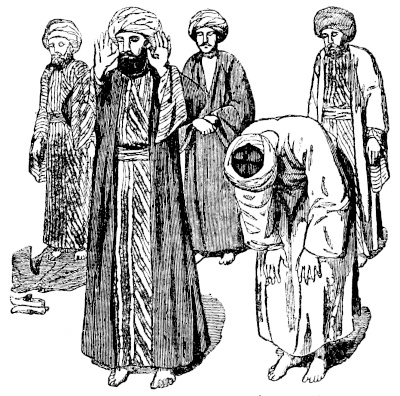
POSTURES OF PRAYER. (PART I.)
The worshipper, standing with his face towards the Kibleh (that is, towards Mekkeh), and his feet not quite close together, says, inaudibly, that he has purposed to recite the prayers of so many rek’ahs (sunneh or fard) the morning-prayers (or the noon, etc.) of the present day (or night); and then, raising his open hands on each side of his face, and touching the lobes of his ears with the ends of his thumbs, he says, “God is most Great!” (“Alláhu Akbar.”) This ejaculation is called the “tekbeer.” He then proceeds to recite the prayers of the prescribed number of rek’ahs,[131] thus:—
Still standing, and placing his hands before him, a little below his girdle, the left within the right, he recites (with his eyes directed towards the spot where his head will touch the ground in prostration) the Fát’hah, or opening chapter of the Kur-án,[132] and 64after it three or more other verses, or one of the short chapters, of the Kur-án—very commonly the 112th chapter—but without repeating the bismillah (in the name of God, etc.) before the second recitation. He then says, “God is most Great!” and makes, at the same time, an inclination of his head and body, placing his hands upon his knees, and separating his fingers a little. In this posture he says, “[I extol] the perfection of my Lord, the Great!” (three times), adding, “May God hear him who praiseth Him. Our Lord, praise be unto Thee!” Then, raising his head and body, he repeats, “God is most Great!” He next drops gently upon his knees, and, saying again, “God is most Great!” places his hands upon the ground, a little before his knees, and puts his nose and forehead also to the ground (the former first), between his two hands. During this prostration he says, “[I extol] the perfection of my Lord, the Most High!” 65(three times.) He raises his head and body (but his knees remain upon the ground), sinks backwards upon his heels, and places his hands upon his thighs, saying, at the same time, “God is most Great!” and this he repeats as he bends his head a second time to the ground. During this second prostration he repeats the same words as in the first, and in raising his head again, he utters the tekbeer as before. Thus are completed the prayers of one rek’ah. In all the changes of posture, the toes of the right foot must not be moved from the spot where they were first placed, and the left foot should be moved as little as possible.
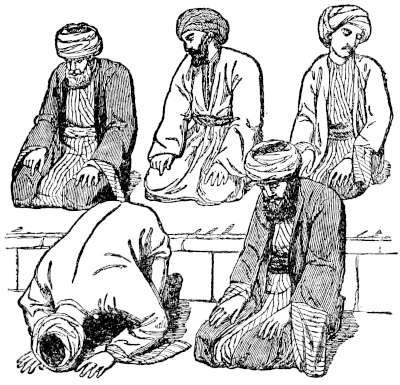
POSTURES OF PRAYER. (PART II.)
Having finished the prayers of one rek’ah, the worshipper rises upon his feet (but without moving his toes from the spot where they were, particularly those of the right foot), and repeats the same; only he should recite some other chapter, or portion, after the Fát’hah, than that which he repeated before, as, for instance, the 108th chapter.[133]
66After every second rek’ah (and after the last, though there be an odd number, as in the evening fard), he does not immediately raise his knees from the ground, but bends his left foot under him, and sits upon it, and places his hands upon his thighs, with the fingers a little apart. In this posture he says, “Praises are to God, and prayers, and good works. Peace be on thee, O Prophet, and the mercy of God, and His blessings! Peace be on us, and on [all] the righteous worshippers of God!” Then raising the first finger of the right hand[134] (but not the hand itself), he adds, “I testify that there is no deity but God; and I testify that Mohammad is His servant and His apostle.”
After the last rek’ah of each of the prayers (that is, after the sunneh prayers and the fard alike), after saying, “Praises are to God,” etc., the worshipper, looking upon his right shoulder, says, “Peace be on you, and the mercy of God!” Then looking upon the left, he repeats the same. These salutations are considered by some as addressed only to the guardian angels who watch over the believer, and note all his actions;[135] but others say that they are addressed both to angels and men (i.e., believers only), who may be present; no person, however, returns them. Before the salutations in the last prayer, the worshipper may offer up any short petition (in Scriptural language rather than his own); while he does so, looking at the palms of his two hands, which he holds like an open book before him, and then draws over his face, from the forehead downwards.
Having finished both the sunneh and fard prayers, the worshipper, if he would acquit himself completely, or rather, perform supererogatory acts, remains sitting (but may then sit more at his ease), and recites the “A′yet el-Kursee,” or Throne-Verse, which is the 256th of the 2nd chapter of the Kur-án;[136] and adds, “O High! O Great! Thy perfection [I extol].” He then repeats, “The perfection of God!” (thirty-three times.) “The perfection 67of God, the Great, with His praise for ever!” (once.) “Praise be to God!” (thirty-three times.) “Extolled be His dignity! There is no deity but He!” (once.) “God is most Great!” (thirty-three times.) “God is most Great in greatness, and praise be to God in abundance!” (once.) He counts these repetitions with a string of beads called “sebhah” (more properly “subhah”). The beads are ninety-nine, and have a mark between each thirty-three. They are of aloes, or other odoriferous or precious wood, or of coral, or of certain fruit-stones, or seeds, etc.
Any wandering of the eyes, or of the mind, a coughing, or the like, answering a question, or any action not prescribed to be performed, must be strictly avoided (unless it be between the sunneh prayers and the fard, or be difficult to avoid; for it is held allowable to make three slight irregular motions, or deviations from correct deportment); otherwise the worshipper must begin again, and repeat his prayers with due reverence. It is considered extremely sinful to interrupt a man when engaged in his devotions. The time usually occupied in repeating the prayers of four rek’ahs, without the supererogatory additions, is less than four, or even three, minutes. The Muslim says the five daily prayers in his house or shop or in the mosque, according as may be most convenient to him: it is seldom that a person goes from his house to the mosque to pray, excepting to join the congregation on Friday. Men of the lower orders oftener pray in the mosques than those who have a comfortable home, and a mat or carpet upon which to pray.
The same prayers are said by the congregation in the mosque on the noon of Friday; but there are additional rites performed by the Imám and other ministers on this occasion. The chief reasons for fixing upon Friday as the Sabbath of the Muslims were, it is said, because Adam was created on that day, and died on the same day of the week, and because the general resurrection was prophesied to happen on that day; whence, particularly, Friday was named the day of “El-Gum’ah” (or the assembly). The Muslim does not abstain from worldly business on Friday, excepting during the time of prayer, according to the precept of the Kur-án, ch. lxii., vv. 9 and 10.
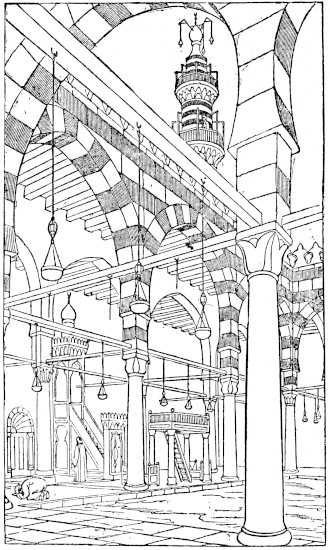
INTERIOR OF A MOSQUE.
To form a proper conception of the ceremonials of the Friday-prayers, it is necessary to have some idea of the interior of a mosque. A mosque in which a congregation assembles to perform the Friday-prayers is called “gámë’.” The mosques of 68Cairo are so numerous, that none of them is inconveniently crowded on the Friday; and some of them are so large as to occupy spaces three or four hundred feet square. They are 69mostly built of stone, the alternate courses of which are generally coloured externally red and white. Most commonly a large mosque consists of porticoes surrounding a square open court, in the centre of which is a tank or a fountain for ablution. One side of the building faces the direction of Mekkeh, and the portico on this side, being the principal place of prayer, is more spacious than those on the three other sides of the court: it generally has two or more rows of columns, forming so many aisles, parallel with the exterior wall. In some cases, this portico, like the other three, is open to the court; in other cases, it is separated from the court by partitions of wood, connecting the front row of columns. In the centre of its exterior wall is the mehráb (or niche) which marks the direction of Mekkeh; and to the right of this is the “mimbar” (or pulpit). Opposite the mehráb, in the fore part of the portico, or in its central part, there is generally a platform (called “dikkeh”), surrounded by a parapet, and supported by small columns; and by it, or before it, are one or two seats, having a kind of desk to bear a volume of the Kur-án, from which a chapter is read to the congregation. The walls are generally quite plain, being simply white-washed; but in some mosques the lower part of the wall of the place of prayer is lined with coloured marbles, and the other part ornamented with various devices executed in stucco, but mostly with texts of the Kur-án (which form long friezes, having a pleasing effect), and never with the representation of anything that has life. The pavement is covered with matting, and the rich and poor pray side by side; the man of rank or wealth enjoying no peculiar distinction or comfort, unless (which is sometimes the case) he have a prayer-carpet brought by his servant, and spread for him.[137]
The Prophet did not forbid women to attend public prayers in a mosque, but pronounced it better for them to pray in private: in Cairo, however, neither females nor young boys are allowed to pray with the congregation in the mosque, or even to be present in the mosque at any time of prayer: formerly women were permitted (and perhaps are still in some countries), but were obliged to place themselves apart from the men, and behind the latter; because, as Sale has remarked, the Muslims are of opinion that the presence of females inspires a different kind of devotion from that which is requisite in a place dedicated to the worship of God. Very few women in Egypt even pray at home.
70Over each of the mosques of Cairo presides a “Názir” (or warden), who is the trustee of the funds which arise from lands, houses, etc., bequeathed to the mosque by the founder and others, and who appoints the religious ministers and the inferior servants. Two “Imáms” are employed to officiate in each of the larger mosques: one of them, called the “Khateeb,” preaches and prays before the congregation on the Friday: the other is an “Imám Rátib,” or ordinary Imám, who recites the five prayers of every day in the mosque, at the head of those persons who may be there at the exact times of those prayers: but in most of the smaller mosques both these offices are performed by one Imám. There are also to each mosque one or more “muëddins” (to chant the call to prayer), and “bowwábs” (or door-keepers), according as there are one or more mád’nehs (or menarets) and entrances; and several other servants are employed to sweep the mosque, spread the mats, light the lamps, and attend to the sákiyeh (or water-wheel), by which the tank or fountain, and other receptacles for water, necessary to the performance of ablutions, are supplied. The Imáms, and those persons who perform the lower offices, are all paid from the funds of the mosque, and not by any contributions exacted from the people.
The condition of the Imáms is very different, in most respects, from that of Christian priests. They have no authority above other persons, and do not enjoy any respect but what their reputed piety or learning may obtain them: nor are they a distinct order of men set apart for religious offices, like our clergy, and composing an indissoluble fraternity; for a man who has acted as the Imám of a mosque may be displaced by the warden of that mosque, and, with his employment and salary, loses the title of Imám, and has no better chance of being again chosen for a religious minister than any other person competent to perform the office. The Imáms obtain their livelihood chiefly by other means than the service of the mosque, as their salaries are very small: that of a Khateeb being generally about a piaster (2⅖d. of our money) per month; and that of an ordinary Imám, about five piasters. Some of them engage in trade; several of them are “’attárs” (or druggists and perfumers), and many of them are schoolmasters: those who have no regular occupations of these kinds often recite the Kur-án for hire in private houses. They are mostly chosen from among the poor students of the great mosque El-Azhar.
The large mosques are open from day-break till a little after 71the ’eshë, or till nearly two hours after sunset. The others are closed between the hours of morning and noon prayers; and most mosques are also closed in rainy weather (excepting at the times of prayer), lest persons who have no shoes should enter, and dirt the pavement and matting. Such persons always enter by the door nearest the tank or fountain (if there be more than one door), that they may wash before they pass into the place of prayer; and generally this door alone is left open in dirty weather. The great mosque El-Azhar remains open all night, with the exception of the principal place of prayer, which is called the “maksoorah,” being partitioned off from the rest of the building. In many of the larger mosques, particularly in the afternoon, persons are seen lounging, chatting together, eating, sleeping, and sometimes spinning or sewing, or engaged in some other simple craft; but, notwithstanding such practices, which are contrary to precepts of their prophet, the Muslims very highly respect their mosques. There are several mosques in Cairo (as the Azhar, Hasaneyn, etc.), before which no Frank, or any other Christian, nor a Jew, were allowed to pass, till of late years, since the French invasion.
On the Friday, half an hour before the “duhr” (or noon), the muëddins of the mosques ascend to the galleries of the mád’nehs, and chant the “Selám,” which is a salutation to the Prophet, not always expressed in the same words, but generally in words to the following effect:—“Blessing and peace be on thee, O thou of great dignity! O Apostle of God! Blessing and peace be on thee, to whom the Truth said, I am God! Blessing and peace be on thee, thou first of the creatures of God, and seal of the Apostles of God! From me be peace on thee, on thee and on thy Family and all thy companions!”—Persons then begin to assemble in the mosques.
The utmost solemnity and decorum are observed in the public worship of the Muslims. Their looks and behaviour in the mosque are not those of enthusiastic devotion, but of calm and modest piety. Never are they guilty of a designedly irregular word or action during their prayers. The pride and fanaticism which they exhibit in common life, in intercourse with persons of their own, or of a different faith, seem to be dropped on their entering the mosque, and they appear wholly absorbed in the adoration of their Creator; humble and downcast, yet without affected humility, or a forced expression of countenance.
The Muslim takes off his shoes at the door of the mosque, carries them in his left hand, sole to sole, and puts his right foot 72first over the threshold. If he have not previously performed the preparatory ablution, he repairs at once to the tank or fountain to acquit himself of that duty. Before he commences his prayers, he places his shoes (and his sword and pistols, if he have such arms) upon the matting, a little before the spot where his head will touch the ground in prostration: his shoes are put one upon the other, sole to sole.
The people who assemble to perform the noon prayers of Friday arrange themselves in rows parallel to that side of the mosque in which is the niche, and facing that side. Many do not go until the adán of noon, or just before. When a person goes at, or a little after, the Selám, as soon as he has taken his place in one of the ranks, he performs two rek’ahs, and then remains sitting, on his knees or cross-legged, while a reader, having seated himself on the reading-chair immediately after the Selám, is occupied in reciting (usually without book) the Soorat el-Kahf (the 18th chapter of the Kur-án), or a part of it; for, generally, he has not finished it before the adán of noon, when he stops. All the congregation, as soon as they hear the adán (which is the same as on other days), sit on their knees and feet. When the adán is finished, they stand up, and perform, each separately, two[138] rek’ahs, “sunnet el-gum’ah” (or the sunneh ordinance for Friday), which they conclude, like the ordinary prayers, with the two salutations. A servant of the mosque, called a “Murakkee,” then opens the folding-doors at the foot of the pulpit-stairs, takes from behind them a straight wooden sword, and, standing a little to the right of the doorway, with his right side towards the kibleh, holds this sword in his right hand, resting the point on the ground. In this position he says, “Verily God favoureth, and His angels bless, the Prophet. O ye who believe, bless him, and greet him with a salutation!”[139] Then one or more persons, called “Muballighs,” stationed on the dikkeh, chant the following, or similar words.[140] “O God! favour and preserve and bless the most noble of the Arabs and ’Agam [or foreigners], the Imám of Mekkeh and El-Medeeneh and the Temple, to whom the spider showed favour, and wove its web in the cave; and whom the dabb[141] saluted, and 73before whom the moon was cloven in twain, our lord Mohammad, and his Family and Companions!” The Murakkee then recites the adán (which the Muëddins have already chanted): after every few words he pauses, and the Muballighs on the dikkeh repeat the same words in a sonorous chant.[142] Before the adán is finished, the Khateeb, or Imám, comes to the foot of the pulpit, takes the wooden sword from the Murakkee’s hand, ascends the pulpit, and sits on the top step or platform. The pulpit of a large mosque on this day is decorated with two flags, with the profession of the faith, or the names of God and Mohammad, worked upon them: these are fixed at the top of the stairs, slanting forward. The Murakkee and Muballighs having finished the adán, the former repeats a tradition of the Prophet, saying, “The Prophet (upon whom be blessing and peace!) hath said, ‘If thou say unto thy companion while the Imám is preaching on Friday, Be thou silent, thou speakest rashly.’ Be ye silent: ye shall be rewarded: God shall recompense you.” He then sits down. The Khateeb now rises, and, holding the wooden sword[143] in the same manner as the Murakkee did, delivers an exhortation, called “khutbet el-waaz.” As the reader may be curious to see a translation of a Muslim sermon, I insert one. The following is a sermon preached on the first Friday of the Arab year.[144] The original, as usual, is in rhyming prose.
“Praise be to God, the renewer of years, and the multiplier of favours, and the creator of months and days, according to the most perfect wisdom and most admirable regulation; who hath dignified the months of the Arabs above all other months, and pronounced that among the more excellent of them is El-Moharram the Sacred, and commenced with it the year, as He hath closed it with Zu-l-Heggeh. How propitious is the beginning, and how good is the end![145] [I extol] His perfection, exempting Him from 74the association of any other deity with Him. He hath well considered what He hath formed, and established what He hath contrived, and He alone hath the power to create and to annihilate. I praise Him, extolling His perfection, and exalting His name, for the knowledge and inspiration which He hath graciously vouchsafed; and I testify that there is no deity but God alone; He hath no companion; He is the most holy King; the [God of] peace: and I testify that our Lord and our Prophet and our friend Mohammad is His servant, and His apostle, and His elect, and His friend, the guide of the way, and the lamp of the dark. O God! favour and preserve and bless this noble Prophet, and chief and excellent apostle, the merciful-hearted, our lord Mohammad, and his family, and his companions, and his wives, and his posterity, and the people of his house, the noble persons, and preserve them amply! O servants of God! your lives have been gradually curtailed, and year after year hath passed away, and ye are sleeping on the bed of indolence and on the pillow of iniquity. Ye pass by the tombs of your predecessors, and fear not the assault of destiny and destruction, as if others departed from the world and ye must of necessity remain in it. Ye rejoice at the arrival of new years, as if they brought an increase to the term of life, and swim in the seas of desires, and enlarge your hopes, and in every way exceed other people [in presumption], and ye are sluggish in doing good. O how great a calamity is this! God teacheth by an allegory. Know ye not that in the curtailment of time by indolence and sleep there is very great trouble? Know ye not that in the cutting short of lives by the termination of years is a very great warning? Know ye not that the night and day divide the lives of numerous souls? Know ye not that health and capacity are two blessings coveted by many men? But the truth hath become manifest to him who hath eyes. Ye are now between two years: one year hath passed away, and come to an end, with its evils; and ye have entered upon another year, in which, if it please God, mankind shall be relieved. Is any of you determining upon diligence [in doing good] in the year to come? or repenting of his failings in the times that are passed? The happy is he who maketh amends for the time passed in the time to come; and the miserable is he whose days pass away, and he 75is careless of his time. This new year hath arrived, and the sacred month of God hath come with blessings to you—the first of the months of the year, and of the four sacred months, as hath been said, and the most worthy of preference and honour and reverence. Its fast is the most excellent of fasts after that which is incumbent,[146] and the doing of good in it is among the most excellent of the objects of desire. Whosoever desireth to reap advantage from it, let him fast the ninth and tenth days, looking for aid.[147] Abstain not from this fast through indolence, and esteeming it a hardship; but comply with it in the best manner, and honour it with the best of honours, and improve your time by the worship of God morning and evening. Turn unto God with repentance, before the assault of death: He is the God who accepteth repentance of His servants, and pardoneth sins.—The Tradition.[148]—The Apostle of God (God favour and preserve him!) hath said, ‘The most excellent prayer, after the prescribed,[149] is the prayer that is said in the last third of the night; and the most excellent fast, after Ramadán, is that of the month of God, El-Moharram.’”
The Khateeb, having concluded his exhortation, says to the congregation, “Supplicate God.” He then sits down, and prays privately; and each member of the congregation at the same time offers up some private petition, as after the ordinary prayers, holding his hands before him (looking at the palms), and then drawing them down his face. This done, the Muballighs say, “A′meen! A′meen! (Amen! Amen!) O Lord of all creatures!”—The Khateeb now rises again, and recites another Khutbeh, called “khutbet en-naat,” of which the following is a translation:—[150]
“Praise be to God, abundant praise, as He hath commanded! I testify that there is no deity but God alone: He hath no companion: affirming His supremacy, and condemning him who denieth and disbelieveth: and I testify that our lord and our prophet Mohammad is His servant and His apostle, the lord of mankind, the intercessor, the accepted intercessor, on the day of assembling: God favour him and his family as long as the eye seeth and the ear heareth! O people! reverence God by doing 76what He hath commanded, and abstain from that which He hath forbidden and prohibited. The happy is he who obeyeth, and the miserable is he who opposeth and sinneth. Know that the present world is a transitory abode, and that the world to come is a lasting abode. Make provision, therefore, in your transitory state for your lasting state, and prepare for your reckoning and standing before your Lord: for know that ye shall to-morrow be placed before God, and reckoned with according to your deeds; and before the Lord of Might ye shall be present, ‘and those who have acted unjustly shall know with what an overthrowal they shall be overthrown.’[151] Know that God, whose perfection I extol, and whose name be exalted, hath said (and ceaseth not to say wisely, and to command judiciously, warning you, and teaching, and honouring the dignity of your Prophet, extolling and magnifying him), ‘Verily, God favoureth, and His angels bless, the Prophet: O ye who believe, bless him, and greet him with a salutation!’salutation!’[152] O God! favour Mohammad and the family of Mohammad, as Thou favouredst Ibráheem[153] and the family of Ibráheem; and bless Mohammad and the family of Mohammad, as Thou blessedst Ibráheem and the family of Ibráheem among all creatures—for Thou art praiseworthy and glorious! O God! do Thou also be well pleased with the four Khaleefehs, the orthodox lords, of high dignity and illustrious honour, Aboo-Bekr Es-Siddeek, and ’Omar, and ’Osmán, and ’Alee; and be Thou well pleased, O God! with the six who remained of the ten noble and just persons who swore allegiance to thy Prophet Mohammad (God favour and preserve him!) under the tree; (for Thou art the Lord of piety, and the Lord of pardon,) those persons of excellence and clemency, and rectitude and prosperity, Talhah, and Ez-Zubeyr, and Saad, and Sa’eed, and ’Abd-Er-Rahmán Ibn-’Owf, and Aboo-’Obeydeh ’Amir Ibn-El-Garráh; and with all the Companions of the Apostle of God! (God favour and preserve him!); and be Thou well pleased, O God! with the two martyred descendants, the two bright moons, ‘the two lords of the youths of the people of Paradise in Paradise,’ the two sweet-smelling flowers of the Prophet of this nation, Aboo-Mohammad El-Hasan, and Aboo-’bd-Allah El-Hoseyn: and be Thou well pleased, O God! with their mother, the daughter of the Apostle of God (God favour and preserve him!), Fátimeh Ez-Zahra, and with their grandmother Khadeegeh 77El-Kubra, and with ’A’ïsheh’A’ïsheh, the mother of the faithful, and with the rest of the pure wives, and with the generation which succeeded the Companions, and the generation which succeeded that, with beneficence to the day of judgment! O God! pardon the believing men and the believing women, and the Muslim men and the Muslim women, those who are living, and the dead; for Thou art a hearer near, an answerer of prayers, O Lord of all creatures! O God! aid El-Islám, and strengthen its pillars, and make infidelity to tremble, and destroy its might, by the preservation of Thy servant, and the son of Thy servant, the submissive to the might of Thy majesty and glory, whom God hath aided, by the care of the Adored King, our master the Sultán, son of the Sultán, the Sultán Mahmood[154] Khán: may God assist him, and prolong [his reign]! O God! assist him, and assist his armies! O Thou Lord of the religion, and of the world present, and the world to come! O Lord of all creatures! O God! assist the forces of the Muslims, and the armies of the Unitarians! O God! frustrate the infidels and polytheists, thine enemies, the enemies of the religion! O God! invert their banners, and ruin their habitations, and give them and their wealth as booty to the Muslims![155] O God! unloose the captivity of the captives, and annul the debts of the debtors; and make this town to be safe and secure, and blessed with wealth and plenty, and all the towns of the Muslims, O Lord of all creatures! And decree safety and health to us and to all travellers, and pilgrims, and warriors, and wanderers, upon Thy earth, and upon Thy sea, such as are Muslims, O Lord of all creatures! ‘O Lord! we have acted unjustly towards our own souls, and if Thou do not forgive us and be merciful unto us, we shall surely be of those who perish.[156] I beg of God, the Great, that He may forgive me and you, and all the people of Mohammad, the servants of God. ‘Verily God commandeth justice, and the doing of good, and giving [what is due] to kindred; and forbiddeth wickedness, and iniquity, and oppression: He admonisheth you that ye may reflect.’[157] Remember God; He will remember you: and thank Him; He will increase to you [your blessings]. Praise be to God, the Lord of all creatures!”
78During the rise of the Nile, a good inundation is also prayed for in this Khutbeh. The Khateeb, or Imám, having ended it, descends from the pulpit, and the Muballighs chant the “ikámeh” (described in page 66): the Imám, stationed before the niche, then recites the “fard” prayers of Friday, which consist of two rek’ahs, and are similar to the ordinary prayers. The people do the same, but silently, and keeping time exactly with the Imám in the various postures. Those who are of the Málikee sect then leave the mosque; and so also do many persons of the other sects: but some of the Sháfe’ees and Hanafees (there are scarcely any Hambel′ees in Cairo) remain, and recite the ordinary fard prayers of noon; forming a number of separate groups, in each of which one acts as Imám. The rich, on going out of the mosque, often give alms to the poor outside the door.
There are other prayers to be performed on particular occasions—on the two grand annual festivals, on the nights of Ramadán (the month of abstinence), on the occasion of an eclipse of the sun or moon, for rain, previously to the commencement of battle, in pilgrimage, and at funerals.
I have spoken thus fully of Muslim worship because my countrymen in general have very imperfect and erroneous notions on this subject; many of them even imagining that the Muslims ordinarily pray to their Prophet as well as to God. Invocations to the Prophet, for his intercession, are, indeed, frequently made, particularly at his tomb, where pious visitors generally say, “We ask thy intercession, O Apostle of God!” The Muslims also even implore the intercession of their numerous saints.
The duty next in importance to prayer is that of giving alms. Certain alms are prescribed by law, and are called “zekah”: others, called “sadakah,” are voluntary. The former, or obligatory alms, were, in the earlier ages of El-Islám, collected by officers appointed by the sovereign, for pious uses, such as building mosques, etc.; but now it is left to the Muslim’s conscience to give them, and to apply them in what manner he thinks fit; that is, to bestow them upon whatever needy persons he may choose. They are to be given once in every year, of cattle and sheep, generally in the proportion of one in forty, two in a hundred and twenty; of camels, for every five, a ewe; or for twenty-five, a pregnant camel; and likewise of money, and, among the Hanafees, of merchandize, etc. He who has money to the amount of two hundred dirhems (or drams) of silver, or twenty mitkáls (i.e., thirty drams) of gold (or, among the Hanafees, the value of the 79above in gold or silver ornaments, utensils, etc.), must annually give the fortieth part (“ruba el-’oshr”), or the value of that part.
Fasting is the next duty. The Muslim is commanded to fast during the whole month of Ramadán[158] every day, from the first appearance of daybreak, or rather from the hour when there is sufficient light for a person to distinguish plainly a white thread from a black thread[159] (about two hours before sunrise in Egypt), until sunset. He must abstain from eating, drinking, smoking, smelling perfumes, and every unnecessary indulgence or pleasure of a worldly nature; even from intentionally swallowing his spittle. When Ramadán falls in summer,[160] the fast is very severe; the abstinence from drinking being most painfully felt. Persons who are sick, or on a journey, and soldiers in time of war, are not obliged to observe the fast during Ramadán; but if they do not keep it in this month they should fast an equal number of days at a future time. Fasting is also to be dispensed with in the cases of a nurse and a pregnant woman. The Prophet even disapproved of any person’s keeping the fast of Ramadán if not perfectly able; and desired no man to fast so much as to injure his health, or disqualify himself for necessary labour. The modern Muslims seem to regard the fast of Ramadán as of more importance than any other religious act, for many of them keep this fast who neglect their daily prayers; and even those who break the fast, with very few exceptions, pretend to keep it. Many Muslims of the wealthy classes eat and drink in secret during Ramadán; but the greater number strictly keep the fast, which is fatal to numerous persons in a weak state of health. There are some other days on which it is considered meritorious to fast, but not absolutely necessary. On the two grand festivals, namely, that following Ramadán, and that which succeeds the pilgrimage, it is unlawful to do so, being expressly forbidden by the Prophet.
The last of the four most important duties, that of pilgrimage, remains to be noticed. It is incumbent on every Muslim to perform, once in his life, the pilgrimage to Mekkeh and Mount ’Arafát, unless poverty or ill health prevent him; or, if a Hanafee, he may send a deputy, whose expenses he must pay.[161] Many, 80however, neglect the duty of pilgrimage who cannot plead a lawful excuse; and they are not reproached for so doing. It is not merely by the visit to Mekkeh, and the performance of the ceremonies of compassing the Kaabeh seven times and kissing the “black stone” in each round, and other rites in the Holy City, that the Muslim acquires the title of “el-hágg”[162] (or the pilgrim): the final object of the pilgrimage is Mount ’Arafát, six hours’ journey distant from Mekkeh. During his performance of the required ceremonies in Mekkeh, and also during his journey to ’Arafát, and until his completion of the pilgrimage, the Muslim wears a peculiar dress, called “ehrám” (vulgarly herám), generally consisting of two simple pieces of cotton, or linen, or woollen cloth, without seam or ornament, one of which is wrapped round the loins, and the other thrown over the shoulders: the instep and heel of each foot, and the head, must be bare; but umbrellas are now used by many of the pilgrims. It is necessary that the pilgrim be present on the occasion of a Khutbeh which is recited on Mount ’Arafát in the afternoon of the 9th of the month of Zu-l-Heggeh. In the ensuing evening, after sunset, the pilgrims commence their return to Mekkeh. Halting the following day in the valley of Mina (or, as it is more commonly called, Muna), they complete the ceremonies of the pilgrimage by a sacrifice (of one or more male sheep, he-goats, cows, or she-camels, part of the flesh of which they eat, and part give to the poor), and by shaving the head and clipping the nails. Every one, after this, resumes his usual dress, or puts on a new one, if provided with such. The sacrifice is called “el-fida” (or the ransom), as it is performed in commemoration of the ransom of Isma’eel (or Ishmael) by the sacrifice of the ram, when he was himself about to have been offered up by his father; for it is the general opinion of the Muslims that it was this son, not Isaac, who was to have been sacrificed by his father.
There are other ordinances, more or less connected with those which have been already explained.
The two festivals called “el-’Eed es-Sugheiyir,”[163] or the Minor Festival, and el-Kebeer,”el-Kebeer,” or the Great Festival, the occasions of which have been mentioned above, are observed with public prayer and general rejoicing. The first of these lasts 81three days; and the second, three or four days. The festivities with which they are celebrated will be described in a subsequent chapter. On the first day of the latter festival (it being the day on which the pilgrims perform their sacrifice) every Muslim should slay a victim, if he can afford to purchase one. The wealthy person slays several sheep, or a sheep or two, and a buffalo, and distributes the greater portion of the meat to the poor. The slaughter may be performed by a deputy.
War against enemies of El-Islám, who have been the first aggressors, is enjoined as a sacred duty; and he who loses his life in fulfilling this duty, if unpaid, is promised the rewards of a martyr. It has been said, even by some of their leading doctors, that the Muslims are commanded to put to death all idolaters who refuse to embrace El-Islám, excepting women and children, whom they are to make slaves:[164] but the precepts on which this assertion is founded relate to the Pagan Arabs, who had violated their oaths and long persevered in their hostility to Mohammad and his followers. According to the decisions of the most reasonable doctors, the laws respecting other idolaters, as well as Christians and Jews, who have drawn upon themselves the hostility of the Muslims, are different: of such enemies, if reduced by force of arms, refusing to capitulate or to surrender themselves, the men may be put to death or be made slaves, and the women and children also, under the same circumstances, may be made slaves: but life and liberty are to be granted to those enemies who surrender themselves by capitulation or otherwise, on the condition of their embracing El-Islám or paying a poll-tax, unless they have acted perfidiously towards the Muslims, as did the Jewish tribe of Kureydhah, who, being in league with Mohammad, went over to his enemies and aided them against him: for which conduct, when they surrendered, the men were slain, and the women and children were made slaves.—The Muslims, it may here be added, are forbidden to contract intimate friendship with unbelievers.
82There are certain prohibitory laws in the Kur-án which must be mentioned here, as remarkably affecting the moral and social condition of its disciples.
Wine, and all inebriating liquors, are forbidden, as being the cause of “more evil than profit.”[165] Many of the Muslims, however, in the present day, drink wine, brandy, etc., in secret; and some, thinking it no sin to indulge thus in moderation, scruple not to do so openly; but among the Egyptians there are few who transgress in this flagrant manner. “Boozeh,” or “boozah,” which is an intoxicating liquor made with barley-bread, crumbled, mixed with water, strained, and left to ferment, is commonly drunk by the boatmen of the Nile, and by other persons of the lower orders.[166] Opium, and other drugs which produce a similar effect, are considered unlawful, though not mentioned in the Kur-án; and persons who are addicted to the use of these drugs are regarded as immoral characters; but in Egypt, such persons are not very numerous. Some Muslims have pronounced tobacco, and even coffee, unlawful.
The eating of swine’s flesh is strictly forbidden. The unwholesome effects of that meat in a hot climate would be a sufficient reason for the prohibition; but the pig is held in abhorrence by the Muslim chiefly onon account of its extremely filthy habits.[167] Most animals prohibited for food by the Mosaic law are alike forbidden to the Muslim. The camel is an exception. The Muslim is “forbidden [to eat] that which dieth of itself, and blood, and swine’s flesh, and that on which the name of any beside God hath been invoked; and that which hath been strangled or killed by a blow, or by a fall, or by the horns [of another beast]; and that which hath been [partly] eaten by a wild beast, except what he shall [himself] kill; and that which hath been sacrificed unto idols.”[168] An animal that is killed for 83the food of man must be slaughtered in a particular manner: the person who is about to perform the operation must say, “In the name of God! God is most great!” and then cut its throat, at the part next the head, taking care to divide the windpipe, gullet, and carotid arteries; unless it be a camel, in which case he should stab the throat at the part next the breast. It is forbidden to utter, in slaughtering an animal, the phrase which is so often made use of on other occasions, “In the name of God, the Compassionate, the Merciful!” because the mention of the most benevolent epithets of the Deity on such an occasion would seem like a mockery of the sufferings which it is about to endure. Some persons in Egypt, but mostly women, when about to kill an animal for food, say, “In the name of God! God is most great! God give thee patience to endure the affliction which He hath allotted thee!”[169] If the sentiment which first dictated this prayer were always felt, it would present a beautiful trait in the character of the people who use it. In cases of necessity, when in danger of starving, the Muslim is allowed to eat any food which is unlawful under other circumstances. The mode of slaughter above described is, of course, only required to be practised in the cases of domestic animals. Most kinds of fish are lawful food:[170] so also are many birds; the tame kinds of which must be killed in the same manner as cattle; but the wild may be shot. The hare, rabbit, gazelle, etc., are lawful food, and may either be shot, or killed by a dog, provided the name of God was uttered at the time of discharging the arrow, etc., or slipping the dog, and he (the dog) has not eaten any part of the prey. This animal, however, is considered very unclean: the Sháfe’ees hold themselves to be polluted by the touch of its nose, if it be wet; and if any part of their clothes be so touched, they must wash that part with seven waters, and once with clean earth: some others are only careful not to let the animal lick, or defile in a worse manner, their persons or their dress, etc. When game has been struck down by any weapon, but not killed, its throat must be immediately cut: otherwise it is unlawful food.
84Gambling and usury are prohibited,[171] and all games of chance; and likewise the making of images or pictures of anything that has life.[172] The Prophet declared that every representation of this kind would be placed before its author on the day of judgment, and that he would be commanded to put life into it; which not being able to do, he would be cast, for a time, into hell.
The principal civil and criminal laws remain to be stated. Their origin we discover partly in customs of the Pagan Arabs, but mostly in the Jewish Scriptures and traditions.
The civil and criminal laws are chiefly and immediately derived from the Kur-án[173]; but, in many important cases, this highest authority affords no precept. In most of these cases the Traditions of the Prophet direct the decisions of the judge.[174] There are, however, some important cases, and many of an inferior kind, respecting which both the Kur-án and the Traditions are silent or undecisive. These are determined by the explanations and amplifications derived either from the concordance of the principal early disciples, or from analogy, by the four great Imáms, or founders of the four orthodox sects of El-Islám; generally on the authority of the Imám of that sect to which the ruling power belongs, which sect, in Egypt, and throughout the Turkish Empire, is that of the Hanafees: or, if none of the decisions of the Imám relate to a case in dispute (which not unfrequently happens), judgment is given in accordance with a sentence of some other eminent doctor, founded upon analogy.—In general, only the principal laws, as laid down in the Kur-án and the Traditions, will be here stated.
The laws relating to marriage and the licence of polygamy, the facility of divorce allowed by the Kur-án, and the permission of concubinage, are essentially the natural and necessary consequences of the main principle of the constitution of Muslim society—the restriction of the intercourse between the sexes before marriage. Few men would marry if he who was disappointed in a wife whom he had never seen before were not allowed to take another; and 85in the case of a man’s doing this, his own happiness, or that of the former wife, or the happiness of both these parties, may require his either retaining this wife or divorcing her. But I hope that my reader will admit a much stronger reason for these laws, regarding them as designed for the Muslims. As the Mosaic code allowed God’s chosen people, for the hardness of their hearts, to put away their wives, and forbade neither polygamy nor concubinage, he who believes that Moses was divinely inspired, to enact the best laws for his people, must hold the permission of these practices to be less injurious to morality than their prohibition, among a people similar to the ancient Jews. Their permission, though certainly productive of injurious effects upon morality and domestic happiness, prevents a profligacy that would be worse than that which prevails to so great a degree in European countries, where parties are united in marriage after an intimate mutual acquaintance. As to the licence of polygamy, which seems to be unfavourable to the accomplishment of the main object for which marriage was instituted, as well as to the exercise and improvement of the nobler powers of the mind, we should remark that it was not introduced, but limited, by the legislator of the Muslims. It is true that he assumed to himself the privilege of having a greater number of wives than he allowed to others; but, in doing so, he may have been actuated by the want of male offspring, rather than impelled by voluptuousness.
The law respecting marriage and concubinage is perfectly explicit as to the number of wives whom a Muslim may have at the same time; but it is not so with regard to the number of concubine-slaves whom he may have. It is written, “Take in marriage, of the women who please you, two, three, or four; but if ye fear that ye cannot act equitably [to so many, take] one; or [take] those whom your right hands have acquired,”[175] that is, your slaves. Therefore many of the wealthy Muslims marry two, three, or four wives, and keep besides several concubine-slaves; and many of the most revered characters, even Companions of the Prophet, are recorded to have done the same. The conduct of the latter clearly shows that the number of concubine-slaves whom a man may have is not limited by the law in the opinion of the orthodox.[176]
86It is held lawful for a Muslim to marry a Christian or a Jewish woman, if induced to do so by excessive love of her, or if he cannot obtain a wife of his own faith; but in this case the offspring must follow the father’s faith,[177] and the wife does not inherit when the father dies. A Muslim′eh, however, is not allowed under any circumstances, but when force is employed, to marry a man who is not of her own faith. A man is forbidden, by the Kur-án[178] and the Sunneh, to marry his mother, or other ascendant; his daughter, or other descendant; his sister, or half-sister; the sister of his father or mother, or other ascendant; his niece, or any of her descendants; his foster-mother,[179] or a woman related to him by milk in any of the degrees which would preclude his marriage with her if she were similarly related to him by consanguinity; the mother of his wife, even if he have not consummated his marriage with this wife; the daughter of his wife if he have consummated his marriage with the latter, and she be still his wife; his father’s wife, and his son’s wife; and to have at the same time two wives who are sisters, or aunt and niece: he is forbidden also to marry his unemancipated slave, or another man’s slave, if he have already a free wife. It is lawful for the Muslim to see the faces of these women whom he is forbidden to marry, but of no others, excepting his own wives and female slaves. The marriage of a man and woman, or of a man and a girl who has arrived at puberty, is lawfully effected by their declaring (which the latter generally does by a “wekeel,” or deputy) their consent to marry each other, in the presence of two witnesses (if witnesses can be procured), and by the payment, or part-payment, of a dowry. But the consent of a girl under the age of puberty is not required; her father, or, if he be dead, her nearest adult male relation, or any person appointed as her guardian by will or by the Kádee, acting for her as he pleases.[180] The giving of a dowry is indispensable, and the least sum that is allowed by law is ten “dirhems” (or drachms of silver), which is 87equal to about five shillings of our money. A man may legally marry a woman without mentioning a dowry; but after the consummation of the marriage she can, in this case, compel him to pay the sum of ten dirhems.[181]
A man may divorce his wife twice, and each time take her back without any ceremony, excepting in a case to be mentioned below; but if he divorce her the third time, or put her away by a triple divorce conveyed in one sentence, he cannot receive her again until she has been married and divorced by another husband, who must have consummated his marriage with her.[182] When a man divorces his wife (which he does by merely saying, “Thou art divorced,” or “I divorce thee”), he pays her a portion of her dowry (generally one-third), which he had kept back from the first, to be paid on this occasion, or at his death; and she takes away with her the furniture, etc., which she brought at her marriage. He may thus put her away from mere dislike,[183] and without assigning any reason; but a woman cannot separate herself from her husband against his will, unless it be for some considerable fault on his part, as cruel treatment, or neglect; and even then, application to the Kádee’s court is generally necessary to compel the man to divorce her; and she forfeits the above-mentioned remnant of the dowry.
The first and second divorce, if made without any mutual agreement for a compensation from the woman, or a pecuniary sacrifice on her part, is termed “talák reg’ee” (a divorce which admits of return); because the husband may take back his wife, without her consent, during the period of her “’eddeh” (which will be presently explained), but not after, unless with her consent, and by a new contract. If he divorce her the first or second time for a compensation, she perhaps requesting, “Divorce me for what thou owest me,” or “—hast of mine” (that is, of the dowry, furniture, etc.), or for an additional sum, he cannot take her again but by her own consent, and by a new contract. This is a “talák báïn” (or separating divorce), and is termed “the lesser separation,” to distinguish it from the third divorce, which is called “the greater separation.” The “’eddeh” is the period during which a divorced woman or a widow must wait before marrying again,—in either case, if pregnant, until delivery; otherwise 88the former must wait three lunar periods, or three months, and the latter, four months and ten days. A woman who is divorced when in a state of pregnancy, though she may make a new contract of marriage immediately after her delivery, must wait forty days longer before she can complete her marriage by receiving her husband. The man who divorces his wife must maintain her in his own house, or in that of her parents, or elsewhere, during the period of her ’eddeh, but must cease to live with her as her husband from the commencement of that period. A divorced woman who has a son under two years of age may retain him until he has attained that age, and may be compelled to do so by the law of the Sháfe’ees, and by the law of the Málikees, until he has arrived at puberty, but the Hanafee law limits the period during which the boy should remain under her care to seven years: her daughter she should retain until nine years of age, or the period of puberty. If a man divorce his wife before the consummation of marriage, he must pay her half the sum which he has promised to give her as a dowry, or, if he have promised no dowry, he must pay her the half of the smallest dowry allowed by law, which has been above mentioned, and she may marry again immediately.
When a wife refuses to obey the lawful commands of her husband, he may, and generally does, take her, or two witnesses[184] against her, to the Kádee’s court, to prefer a complaint against her; and, if the case be proved, a certificate is written declaring the woman “náshizeh,” or rebellious against her husband. This process is termed “writing a woman náshizeh.” It exempts her husband from obligation to lodge, clothe, and maintain her. He is not obliged to divorce her; and, by refusing to do this, he may prevent her marrying another man as long as he lives; but, if she promise to be obedient afterwards, he must take her back, and maintain her, or divorce her. It is more common, however, for a wife whose husband refuses to divorce her, if she have parents or other relations able and willing to support her comfortably, to make a complaint at the Kádee’s court, stating her husband’s conduct to be of such a nature towards her that she will not live with him, and thus cause herself to be registered “náshizeh,” and separated from him. In this case, the husband generally persists, from mere spite, in refusing to divorce her.
As concubines are slaves, some account of slaves in general 89may here be appropriately inserted, with a statement of the principal laws respecting concubines and their offspring, etc.—The slave is either a person taken captive in war, or carried off by force from a foreign hostile country, and being at the time of capture an infidel; or the offspring of a female slave by another slave, or by any man who is not her owner, or by her owner if he do not acknowledge himself to be the father; but a person cannot be the slave of a relation who is within the prohibited degrees of marriage. The power of the owner is such that he may even kill his slave with impunity for any offence; and he incurs but a slight punishment (as imprisonment for a period at the discretion of the judge) if he do so wantonly. He may give or sell his slaves, excepting in some cases which will be mentioned, and may marry them to whom he will, but not separate them when married. A slave, however, according to most of the doctors, cannot have more than two wives at the same time. As a slave enjoys less advantages than a free person, the law, in some cases, ordains that his punishment for an offence shall be half of that to which the free is liable for the same offence, or even less than half: if it be a fine, or pecuniary compensation, it must be paid by the owner, to the amount, if necessary, of the value of the slave, or the slave must be given in compensation. An unemancipated slave, at the death of the owner, becomes the property of the heirs of the latter; and when an emancipated slave dies, leaving no male descendant or collateral relation, the former owner is the heir; or, if he be dead, his heirs inherit the slave’s property. But an unemancipated slave can acquire no property without the permission of the owner. Complete and immediate emancipation is sometimes granted to a slave gratuitously, or for a future pecuniary compensation. It is conferred by means of a written document, or by a verbal declaration in the presence of two witnesses, or by presenting the slave with the certificate of sale obtained from the former owner. Future emancipation is sometimes covenanted to be granted on the fulfilment of certain conditions; and more frequently, to be conferred on the occasion of the owner’s death. In the latter case, the owner cannot sell the slave to whom he has made this promise; and as he cannot alienate by will more than one-third of the whole property that he leaves, the law ordains that, if the value of the said slave exceed that portion, the slave must obtain, and pay to the owner’s heirs, the additional sum.—A Muslim may take as his concubine any of his female slaves who is a Muslim’eh,Muslim’eh, or a Christian, or a Jewess, 90if he have not married her to another man; but he may not have as his concubines, at the same time, two or more who are sisters, or who are related to each other in any of the degrees which would prevent their both being his wives at the same time if they were free. A Christian is not by the law allowed, nor is a Jew, to have a Muslim′eh slave as his concubine.[185] The master must wait a certain period (generally from a month to three months) after his acquisition of a female slave, before he can take her as his concubine. When a female slave becomes a mother by her master, the child which she bears to him is free, if he acknowledge it to be his own; but if not, it is his slave. In the former case the mother cannot afterwards be sold or given away by her master (though she must continue to serve him and be his concubine as long as he desires); and she is entitled to emancipation at his death. Her bearing a child to him is called the cause of her emancipation or liberty; but it does not oblige him to emancipate her as long as he lives, though it is commendable if he do so, and make her his wife, provided he have not already four wives, or if he marry her to another man, should it be her wish. A free person cannot become the husband or wife of his, or her, own slave, without first emancipating that slave; and the marriage of a free person with the slave of another is dissolved if the former become the owner of the latter, and cannot be renewed but by emancipation and a regular legal contract.
The most remarkable general principles of the laws of inheritance are the denial of any privileges to primogeniture,[186] and in most cases awarding to a female a share equal to half that of a male of the same degree of relationship to the deceased.[187] A person may bequeath one-third of his or her property; but not 91a larger portion, unless he or she has no legal heir; nor any portion to a legal heir, excepting wife or husband, without the consent of all the other heirs. The children of a person deceased inherit the whole of that person’s property, or what remains after payment of the legacies and debts, etc., and the share of a male is double the share of a female. If the children of the deceased be only females, two or more in number, they inherit together, by the law of the Kur-án, two-thirds; and if there be but one child, and that a female, she inherits by the same law half. [But the remaining third, or half, is also assigned to the said daughters or daughter, by a law of the Sunneh (which applies also to other cases), if there be no other legal heir.] If the deceased have left no immediate descendant, the sons and daughters of his son or sons inherit as immediate descendants [and so on]. If the deceased have left a child or a son’s child [and so on], each of the parents of the deceased inherits one-sixth. If the father be dead, his share falls to his father. [If the mother be dead, her share falls to her mother.] If the deceased have left no child or son’s child [and so on], the mother has one-third of the property, or of what remains after deducting the share of the wife or wives or husband, and the residue is for the father; unless the deceased has left two or more brothers or sisters, in which case the mother inherits one-sixth, and the father the residue; the said brothers or sisters receiving nothing[188] [if the deceased have left a father or any ascendant in the male line]. A man inherits half of what remains of his wife’s property after the payment of her legacies, etc., if she have left no child or son’s child [and so on]; and one-fourth if she have left a child or son’s child [and so on]. One-fourth is the share of the wife, or of the wives conjointly, if the deceased husband have left no child or son’s child [and so on]; and one-eighth 92if he have left any such descendant.[189] If the deceased have not left a father [nor any ascendant in the male line], nor a child [nor a son’s child, and so on], the law ordains as follows:—1. A sole brother, or sister, only by the mother’s side, inherits one-sixth; and if there be two or more brothers or sisters, only by the mother’s side, or one or more of such relations of each sex, they inherit collectively one-third, which is equally divided, without distinction of male and female.—2. If the deceased have left a sole sister by his father and mother [and no such brother], she inherits half; and a man inherits the whole property of such a sister [or what remains after the payment of her legacies, etc.], if she have left no child; but if she have left a male child [or son’s child, and so on], he (the brother) inherits nothing; and if she have left a female child, the said brother inherits what remains after deducting that child’s share [and after the payment of the legacies, etc.]. If the deceased have left two or more sisters, by his father and mother [and no such brother], they inherit together two-thirds. If the deceased have left one or more brothers, and one or more sisters, by his father and mother, they inherit the whole [or what remains after the payment of the legacies, etc.], and the share of a male is double the share of a female.—3. Brothers and sisters by the father’s side only [when there is no brother or sister by the father and mother] inherit as brothers and sisters by the father and mother.[190] No distinction is made between the child of a wife and that borne by a slave to her master (if the master acknowledge the child to be his own): both inherit equally. So also do the child of a wife and the adopted child. A bastard inherits only from his mother, and vice versâ. When there is no legal heir, or legatee, the property falls to the government-treasury, which is called “beyt el-mál.” The laws respecting certain remote degrees of kindred, etc., I have not thought it necessary to state.[191] The property of the deceased is nominally divided into keeráts (or twenty-fourth parts); and the share of each son, or other heir, is said to be so many keeráts.
The law is remarkably lenient towards debtors. “If there be any [debtor],” says the Kur-án,[192] “under a difficulty [of paying 93his debt], let [his creditor] wait till it be easy [for him to do it]; but if ye remit it as alms, it will be better for you.” The Muslim is commanded (in the chapter from which the above extract is taken), when he contracts a debt, to cause a statement of it to be written, and attested by two men, or a man and two women, of his own faith. The debtor is imprisoned for non-payment of his debt; but if he establish his insolvency, he is liberated. He may be compelled to work for the discharge of his debt, if able.
The Kur-án ordains that murder shall be punished with death; or rather, that the free shall die for the free, the slave for the slave, and a woman for a woman; or that the perpetrator of the crime shall pay to the heirs of the person whom he has killed, if they allow it, a fine, which is to be divided according to the laws of inheritance.[193] It also ordains that unintentional homicide shall be expiated by freeing a believer from slavery, and paying, to the family of the person killed, a fine, unless they remit it.[194] But these laws are amplified and explained by the same book and by the Imáms.—A fine is not to be accepted for murder unless the crime has been attended by some palliating circumstance. This fine, which is the price of blood, is a hundred camels; or a thousand deenárs (about £500) from him who possesses gold; or from him who possesses silver, twelve thousand dirhems[195] (about £300). This is for killing a free-man: for a woman, half the sum: for a slave, his or her value; but that must fall short of the price of blood for the free. A person unable to free a believer must fast two months, as in Ramadán. The accomplices of a murderer are liable to the punishment of death. By the Sunneh also, a man is obnoxious to capital punishment for the murder of a woman; and by the Hanafee law, for the murder of another man’s slave. But he is exempted from this punishment who kills his own child or other descendant, or his own slave, or his son’s slave, or a slave of whom he is part-owner: so also are his accomplices; and according to Esh-Sháfe’ee, a Muslim, though a slave, is not to be put to death for killing an infidel, though the latter be free. In the present day, however, murder is generally punished with death; the government seldom allowing a composition in money to be made. A man who kills another in self-defence, or to defend his property from a robber, is exempt from all punishment. The price of blood is a debt incumbent on the family, tribe, or association of which the homicide is a member.member. 94It is also incumbent on the inhabitants of an enclosed quarter, or the proprietor or proprietors of a field, in which the body of a person killed by an unknown hand is found; unless the person has been found killed in his own house. A woman, convicted of a capital crime, is generally put to death by drowning in the Nile.
The Bedawees have made the law of the avenging of blood terribly severe and unjust, transgressing the limits assigned by the Kur-án: for, with them, any single person descended from the homicide, or from the homicide’s father, grandfather, great-grandfather, or great-grandfather’s father, may be killed by any of such relations of the person murdered or killed in fight; but, among most tribes, the fine is generally accepted instead of the blood. Cases of blood-revenge are very common among the peasantry of Egypt, who, as I have before remarked, retain many customs of their Bedawee ancestors. The relations of a person who has been killed, in an Egyptian village, generally retaliate with their own hands rather than apply to the government, and often do so with disgusting cruelty, and even mangle and insult the corpse of their victim. The relations of a homicide usually fly from their own to another village, for protection. Even when retaliation has been made, animosity frequently continues between the two parties for many years; and often a case of blood-revenge involves the inhabitants of two or more villages in hostilities, which are renewed, at intervals, during the period of several generations.