GALVANISM, (continued 3)
Reading edition
By J. ALDINI.
I. The philosophers of the present period are so sanguine in their expectations, that when a new theory is proposed, unless it be presented to them perfect and fully proved, they either attack it in part, or entirely reject it. Such has been the case with animal electricity, discovered by Galvani. It is urged against it by its opponents, that it is subject to variations; and because they do not find it obedient to all those laws established by the laborious researches of a Franklin, a Beccaria and an Æpinus, they assert either that it has no foundation, or that it is contrary to nature. It has therefore Pg 156 been conceived that an accurate comparison of animal and common electricity, in order to ascertain whether there be any difference between them, might be the best means of obviating such objections. For this purpose I made various experiments in animal electricity under the air pump, employing proper conductors, and I compared its phænomena with those exhibited by the Leyden flask. In a word, while I endeavoured to pursue my researches agreeably to the general theory of common electricity, my principal object was to prove the constancy of animal electricity, by discovering, if possible, an agreement in the physical laws of both.
II. As it had been proved by a great many experiments, that common electricity could be obtained from non-conducting bodies in the most perfect vacuum possible to be formed by means of an air pump, experiments were undertaken in order to ascertain whether the same phænomenon was common also to animal electricity, and with this view attempts were made to excite the latter in vacuo[7]. Muscati indeed had deprived animals of life in vacuo, and afterwards found them susceptible of Galvanism in the open air; but he made no attempt to determine whether the animal electricity could be manifested in vacuo. I employed for my experiments a glass vessel; Plate IV. fig. 6., furnished with a metallic rod, which could be, raised up or pushed down at pleasure. To the extremity Pg 157 of the rod, within the receiver, was affixed at right angles a metallic wire, from one end of which an armed frog was suspended by the muscles, and from the other a small metallic chain a little longer than the frog, a plate of silver being placed below both the frog and the chain. When as perfect a vacuum as possible had been obtained, the metallic rod was pushed down, so that the small chain and the spinal marrow of the suspended frog were made to touch the silver plate, and by these means the latter formed an arc in the exhausted receiver. In this experiment, the power of Galvanism was found to be the same as in the open air, so that as often as the rod was pushed down contractions were excited in the frog. By this method it was easy to ascertain what repeated contact could produce by forming new arcs: for though the small chain and the extremity of the spinal marrow touched the silver plate; yet, when removed from that position ever so little, by moving the rod new contractions took place, which could not have been expected unless new contact on moving the rod had produced as it were new arcs. This kind of apparatus seemed the most convenient for performing in vacuo all those experiments which Galvani had performed in the open air.
III. But it was as yet difficult to determine, whether the contractions which took place were stronger in rarefied than in common air; for the difference between the electricity was so small, that it was impossible to say which was the more powerful. I therefore resolved to clear up this point by other Pg 158 experiments. For this purpose, having cut in two a prepared frog, I placed in vacuo one part of it, by means of the above apparatus, and after a short period drew it out, and compared it with the half which had not been subjected to the action of a vacuum. On applying an arc, the one exhibited strong and the other faint contractions; from which it appeared that the vacuum had occasioned some loss of the animal electricity; as the muscular and nervous parts subjected to experiment belonged to the same frog, this evidently showed that the whole difference arose from the action of the vacuum.
IV. It is well known that a vacuum absorbs common electricity; and therefore it need not excite any wonder that in the present experiment it should have dispersed some of the animal electricity. As this loss took place by insensible degrees, strong contractions were not to be expected; and the case is nearly the same in a Leyden flask loaded with aqueous vapours, which produces no remarkable explosion. But though convinced of the truth of this circumstance, I resolved to confirm it by a new experiment. I therefore charged two Leyden flasks armed in the same manner, applying them at the same time to the same conductor, and by the same number of turns of the machine. One of these flasks was introduced into the glass receiver of the air-pump, and the other was exposed to the atmosphere. At the end of five minutes after the air had been exhausted as much as possible, the flask in the receiver was taken out, and, being discharged by a metallic arc, emitted a weak spark, while the other flask exhibited Pg 159 strong signs of electricity. I again charged two flasks by the same turns of the machine till the electrometer indicated in both the same degree of electricity, and kept one of them for half an hour beneath the receiver. When the latter was taken out, it afforded a weak and almost exhausted spark; while the other, which had remained in the open air, emitted a strong one. Had the first flask remained longer under the receiver, it would no doubt have entirely lost its electricity; while the other without the machine retained that with which it was charged.
V. In this experiment every possible care was taken to observe the variations produced by the vacuum. The receiver which covered the Leyden flask was of a large size, and the flask, being placed in the middle of it, was at a considerable distance from its sides: the receiver was well fitted to the plate of the machine, and not by means of moist leather, as is usual, so that all communication with the external air was prevented; and therefore there is no reason to suppose that any aqueous vapour introduced into the machine, when the pressure of the air was withdrawn, could perform the office of an arc. That the electricity might not immediately bring itself to a state of equilibrium, the conductor of each flask terminated in a ball: had not this been the case, the whole electricity would soon have been dispersed; for, when the conductors terminate in a point, if the chamber be darkened, coruscations of light will every where be seen on the glass receiver, and afford a most agreeable spectacle. A conductor terminating in a Pg 160 ball seemed therefore to be most convenient for my purpose, that, by rendering it more difficult for the electricity to bring itself to an equilibrium, I might be able to produce a greater imitation of the intimate manner in which animal electricity adheres to the animals. But though in the above experiments I ascribe some part of the phænomena to the animal electricity being weakened in vacuo, I am of opinion that more is to be ascribed to the violent perturbation of the principles which the vacuum must have excited in the muscular and nervous parts.
VI. As it was now established, that animal electricity could be excited in vacuo, I endeavoured to ascertain whether that excited without the vacuum, and conveyed to the receiver, could be made to pass through a very small space in vacuo. For this purpose I placed the metallic rod at a small distance from a silver plate resting on the bottom of the air pump: the limbs of a chicken or lamb, prepared in the usual manner, were then deposited near it; and the muscles, by means of a metallic chain, were made to communicate with the plate of the machine, while an armed nerve was made to communicate by means of an insulated arc with the metallic rod. The air being exhausted, the rod was pushed down, and gradually brought as near as possible to the plate without coming into actual contact with it. In this state no contractions were produced; but they immediately took place when the rod was brought into contact with the plate. It appears therefore that animal electricity is considerably impeded Pg 161 in its progress by a vacuum; and that, like artificial electricity, it does not readily suffer itself to be dissipated, unless transmitted through good conducting bodies. For, when a small quantity of the electric fluid is accumulated in the Leyden flask, either none of it proceeds from the metallic wire to a less perfect conductor, or, if any is transmitted, it must be with difficulty, and with great violence. Common electricity, indeed, is seen to pass quietly through metals or water separately; but a strong electric spark, in proceeding from one metallic conductor to another, if it pass through water interposed between them, does so with such violence, that the glass vessel which contains the water is in danger of being broken to pieces. That electricity, therefore, may be conveyed from a conducting body, to one less endowed with that property, it must be in such abundance as to be able to overcome the resistance of the body through which it has to pass: hence, it need excite no surprise, that the small quantity of electricity which produces contractions should not be able to pass over a very small space in vacuo. Here then we have a proof that animal electricity is not only subject to the laws of non-conducting bodies, but that it is affected different ways by the smallest obstacles of conducting bodies, and by different kinds of them. It is indeed so evident that a vacuum from its nature is unfit for conveying electricity, that, even if one be produced, not by the usual method, which is always attended with some defects, but in the most accurate manner possible, it is totally improper for being a conductor Pg 162 of the electric fluid. This is sufficiently proved by the following experiment of Walsh: If two barometers be joined, and the upper part or bend be carefully deprived of air, when one of these barometers is electrified, the electric fluid will not be communicated to the other, in consequence of the resistance opposed by the intervening vacuum. Adams, however, exhibited by means of a single barometer the same phænomenon as Walsh did with a double one[8]; for, having extracted the air entirely from the upper part of the barometer, no electric light was observed; but on introducing a very small quantity of air the whole barometer became luminous. These observations are sufficient to show that animal electricity, in regard to the property of not being able to pass through a small space in vacuo, is subservient to the general laws of common electricity. But let us proceed to other phænomena respecting animal electricity excited in vacuo.
VII. If a prepared frog, furnished with two armatures, Pg 163 be placed in a horizontal position on a non-conducting body, under a glass receiver, (Plate IV. fig. 11.) and if an arc be formed by pushing down a rod, so as to join both the armatures without touching the frog, contractions will immediately take place; but if the smallest non-conducting body intervene, none will be produced. I found it no very difficult matter to exhibit in vacuo, by an apparatus somewhat similar, what may be called an animal alarum. A horizontal arm fixed to a vertical moveable rod (Plate IV. fig. 5.) was adapted to the inside of a glass receiver, in such a manner that, when the receiver was exhausted, any body resting on the horizontal arm could be made to fall down. The leg of a prepared frog was then fixed to the vertical rod; while the other rested on the horizontal arm, and the spinal marrow, with an armature of tin foil, touched a silver plate in the bottom of the receiver. The horizontal arm being turned round a little, by means of the vertical rod, the leg of the frog resting on the arm fell down on the plate below: an arc being thus formed, contractions immediately took place, and were incessantly repeated, until all the animal electricity was restored to an equilibrium.
VIII. These experiments were made on dead frogs; but I shall here show that living ones also may be made to exhibit signs of electricity under the same circumstances. A piece of tin foil was applied to the back of a frog tied to a silver plate by means of silk strings, (Plate IV. fig. 4.) and two metallic chains were suspended in such a manner, that by pushing Pg 164 down the rod the extremity of the one chain could be made to touch the silver plate, and the extremity of the other the tin armature: when an arc was by these means formed, contractions instantly took place. The frog began to breathe with difficulty, to be agitated with convulsive movements, and to be seized with an universal tremor, so that its last moment seemed to be approaching; but on air being admitted into the receiver, it recovered and appeared as lively and active as before. On examining more closely the changes which had taken place in the animal while in this state, which was certainly contrary to nature, I found the muscles red with a superabundance of blood: but when dissected in the usual manner, they exhibited strong signs of animal electricity; for, on applying an arc to the nerves or muscles, without any armature, violent contractions were produced, and continued for a long time, provided care was taken that there should be no deficiency of animal moisture. That such a quantity of electricity should be excited, will not seem astonishing to those who have seen more violent electric commotions excited in the animal machine by the action of a needle. This indeed has been placed beyond all doubt by an observation of Gardini, who says “that having made some experiments with a large torpedo, he remarked that stronger convulsions were produced when the animal was subjected to great pain by any means, such as pricking it with a needle[9].” The phænomena Pg 165 exhibited by a vacuum or rarefied air, were exhibited also by condensed air, so that very powerful contractions were produced by one homogeneous arc. For, if the same apparatus described in Plate IV. fig. 4. be adapted to a condensing machine, a dead frog introduced into it will readily be contracted. Live frogs also, after being kept for half an hour or a whole hour in air twice as dense as that of the atmosphere, exhibited strong signs of electricity without any armature, and merely by the application of a silver arc to the nerves and muscles.
IX. Having made these experiments in vacuo and condensed air, it was of some importance to try also what effect would be produced on animal electricity by the action of the aëriform fluids. The apparatus employed for this purpose was as follows: I provided a glass vessel (Plate IV. fig. 3.), terminating at the upper extremity in a neck, to which could be closely fitted, when necessary, a metallic cover, having a perforation in the centre to receive a moveable rod, which was connected with a transverse metal conductor supporting a frog prepared in the usual manner. Having filled the vessel with water, or mercury, which was still better, I placed it on the shelf of a pneumatic tub, and introduced into it, according to Priestley’s method, any particular gas. Some water or mercury was put into the dish to which it was afterwards removed; and the metal cover, having a frog suspended from it, being then fitted to the neck of the vessel, the frog by means of this apparatus could be immersed Pg 166 at pleasure in carbonic acid gas, hydrogen, or any other kind of gas; so that the constancy of animal electricity might be tried in either. It is evident that, by letting down the spinal marrow of the frog, and the end of the conductor to the surface of the water or mercury, by means of the rod, an arc will be formed, and that muscular contractions must then be produced. The same experiment may be performed by means of a bottle (Plate IV. fig. 6.) furnished with a cover like the former. After being filled with water or mercury, it is inverted on the shelf of the pneumatic tub, and the gas is then introduced in the usual manner; but care must be taken not to displace the whole of the water or mercury, as a portion must be left to cover the bottom when the jar is turned up. This experiment I tried only with oxygen gas, reserving the other kinds of air till a more convenient opportunity.
X. To give more weight to these experiments in vacuo, I endeavoured to prevent all those errors which arose, or might be suspected to arise, from the introduction of air; for I supposed that some opponent of the theory of animal electricity, while endeavouring to find out objections against it, since there was no foundation for asserting that the vacuum afforded any electricity to the animals, might pretend that, the plate of the pneumatic machine being metal, according to custom, some electricity from the atmosphere might be attracted by it, and be thus conveyed even through a vacuum to the animals. On this account it was necessary that a Pg 167 vacuum should be formed, without placing the receiver on a metallic plate; without the contact of any conducting bodies, and in such a manner as to show that the electricity excited was that really existing in the animals. I therefore employed a glass receiver (Plate IV. fig. 9.) cut into two parts above its middle, between which was placed a horizontal partition, in order that the upper part might be filled with oil, or some non-conducting body. The partition was perforated with a large aperture, the superior edges of which projected a little upwards; and the lower, projecting downwards, were furnished with small circular grooves, so that the hole could be shut by a piece of bladder tied over it with thread. A sharp-pointed rod was placed over the hole, so that, being let down by a non-conducting handle, it could be made to pierce the bladder. This, however, was to be done only when the lower part of the receiver was exhausted of air; for the oil, when the air is withdrawn, speedily falls down: by these means a vacuum is formed in the upper part, and, in consequence of the interposed stratum of the oil, remains insulated, as it can receive no electricity from the metallic plate of the machine, nor from other conducting bodies. But it will be in vain to attempt to form a vacuum in this manner, unless the parts of the cut glass be so fitted as to prevent entirely the admission of external air. A very simple and ingenious apparatus, for the same purpose, was invented by F. Borelli: in order to stop the efflux of the oil at pleasure, he adapted to the hole a glass cone, by which means he was enabled to produce an insulated vacuum of greater or less Pg 168 capacity in the upper part of the receiver. Here then I had a vacuum every where surrounded with non-conducting bodies, so that, if animal electricity were excited in it, there could be no reason for ascribing it to electricity borrowed from the atmosphere.
XI. I adapted to a glass rod, in a longitudinal direction, a metallic plate, (Plate IV. fig. 7.) which at the upper extremity was bent into a right angle, and supported the spinal marrow of a frog, so that it might be considered as a lengthened conductor of the nerves. This plate was inserted into a glass receiver, so as to move in it with ease; and by means of a screw could be fixed at any altitude whatever. An accurate representation of this apparatus, with the glass rod annexed, is seen in Plate IV. fig. 8. Iron hooks fixed to the feet of the suspended frog acted the part of a conductor to the muscles; and the upper part of the receiver being exhausted of air, as above described, a stratum of oil was still left to separate the frog from the partition. To guard against all danger from the action of any internal metallic body, a strong magnet was applied to the iron conductor of the muscles, which, immediately obeying the power of attraction, fell upon the conductor of the nerves; and thus a circuit of animal electricity from the muscles to the nerves being speedily effected[10], contractions were immediately produced. When I communicated Pg 169 this experiment to the Institute, I was extremely desirous that the apparatus I had here invented for the purposes of animal electricity might be of some advantage to the science of philosophy in general, of which I was always fond, and which formed the chief object of my study. But it is necessary that I should mention to what I more particularly allude.
XII. Such bodies as had hitherto been put into the air pump were gradually subjected to the action of a vacuum. Hence it appeared that the apparatus above described might be attended with a considerable degree of utility; as in future, any body whatever, whether solid or fluid, might be subjected to this action at once. For, the lower part of the receiver being deprived of its internal air, if the bladder be burst by means of the glass rod, the fluid will run down and occupy the space emptied of air, leaving a vacuum in the upper part. When the fluid has thus fallen to the lower part of the receiver, solid bodies even, if any were immersed in it while in the upper part of the receiver, will also experience the action of the vacuum. But liquid bodies are of such a nature, that they have united with them certain aëriform fluids, which, when the pressure of the air is removed, readily expand. A fluid, therefore, when it has fallen to the lower part of the receiver, being agitated and thrown into a state of perturbation by the motion, its most subtle principles will be extricated, and fill the capacity of the bell. The vacuum will then be disturbed by the evaporation, Pg 170 which, acting on the mercury in the barometer connected with the air pump, will cause it to fall. But every one acquainted with the principles of philosophy must know, that the depression of the mercury in the barometer will be greater, according as a greater quantity of aëriform fluids has been disengaged in the receiver; and if the degree of pressure in the barometer varies according to the variety of aëriform principles, it may be readily seen, that this method may be employed to determine the quantity of them, or their elasticity, since they are cut off from all communication with the surrounding atmosphere, though it still exercises its pressure upon them.
XIII. The vacuum here obtained in the upper part of the bell, seems to be far superior to that produced in the lower part, according to the usual method. For it has long been a complaint among philosophers, that by working the air pump the air is only rarefied, till it no longer possesses elasticity capable of raising the valve, so that it is impossible to produce a complete vacuum by this method. If we can credit the followers of Euler, that subtle fluid, which they call ether, and which permeates every thing, still remains; for, adopting the opinion of the antient Peripatetics, they consider a vacuum as beneath the dignity of nature. But, setting aside this question, I shall only observe, that if a vacuum be formed in the upper part of the receiver, by the method above described, it does not appear that it can be disturbed by any thing from without, and the gravity of the falling Pg 171 fluid will not suffer itself to be overcome by the subtle ether, if any really exists. Should it be apprehended that the air contained in the oil may be disengaged, and disturb the vacuum, you may substitute in its stead mercury or water, which can be deprived of air either by boiling or by long exposure to the action of a vacuum. But before any thing certain on this subject can be said, new and repeated experiments will be necessary. As every objection that could be made in regard to a vacuum seems now to be obviated, since a space perfectly free from common air can be produced, and cut off from all communication with the atmosphere, or with conducting bodies, I shall return to animal electricity, from which I was led by a desire of contributing towards the improvement of natural philosophy in general.
XIV. Those who attempt to determine the velocity of the nervous fluid in a given time, undertake a matter of great difficulty, respecting which nothing certain can be known. Haller rejected the suppositions of those who, comparing the tenuity of the nervous tubes of the heart with the large branch of the aorta, were of opinion, that the velocity of the nervous fluid must be two thousand eight hundred and eighty times greater than that of the blood. This celebrated physician, distrusting hypothesis, had recourse to experiment, and found that the velocity of the nervous fluid would be no less than nine thousand feet in the first minute. But in this determination of the velocity of the nervous fluid Pg 172 there seems to be some difficulty, which perhaps ought to be ascribed rather to the period when that celebrated man lived, than to his want of sagacity or accuracy. Had Haller possessed the means of conveying the nervous fluid with his own hands to different parts at pleasure, he would no doubt have given us some more certain ideas respecting its rapid motion. I resolved, therefore, not to neglect those advantages with which the modern philosophy has been enriched, and to employ very long metallic arcs, by which I could direct the animal electricity as I pleased. A staircase which reached from the top to the bottom of the house, with many windings, presented me with an iron plate, exceedingly convenient for the transmission of animal electricity. A metal wire, brought down from the top of the staircase, was connected with the iron plate, and by these means I obtained an arc, the length of which was above one hundred and fifty feet. When this arrangement was made, the two extremities of this very long arc were applied to the armed nerves and muscles of a frog; and the animal electricity being thus excited, instantly proceeded with so much velocity from the one extremity of the arc to the other, that no difference could be perceived between the time when the frog touched the arc, and that when it began to be agitated. But to show that this result was not owing entirely to the metallic conductor, I employed long ropes dipped in salt water, and always with the same effect. This circumstance seems to prove, in a striking manner, a great similarity between the nervous fluid and common electricity, and to overturn the Pg 173 opinion of Haller, who, according to his calculations, makes the nervous fluid require a second for passing over the space of 150 feet.
XV. According to Beccaria, a celebrated observer of the propagation of the electric fluid, there are two ways of its being transmitted; one when it flows through conducting bodies only, and the other when, being collected in non-conducting bodies, it proceeds from the coating electric by excess to that which is in the contrary state. In the one case, Beccaria establishes a certain time for its passage; in the other he allows none. This celebrated man observed, that the electric matter was conveyed from the conductor of a machine, along a metallic wire 500 feet in length, in the course of a second; in its passage along a hempen rope of the same length, it employed seven seconds; but when the rope was moistened with water, it required only two or nearly three vibrations of a pendulum. When he discharged a Leyden flask by the longest conductor, he was never able to observe the least interval of time. The same thing was remarked by Jallabert, Sigaud de la Fond, and other philosophers, who performed their experiments, not in an apartment but in the open air; and conveyed the electric fluid in this manner for a considerable distance along the banks of large rivers. Monnier extended two iron wires[11] in an open field, parallel to each other, for the distance of 5107 feet; and a man placed between them held in Pg 174 his hands the extremity of the conductors, keeping them at a little distance from his body. “But the man, who was in the middle of the arc,” says the author, “while he saw the spark issue from the jar, received the shock: he could have distinguished the smallest interval of time between the explosion and the shock; and if it had amounted to the fourth part of a second, it could have easily been remarked.”
XVI. While reflecting on these facts, I formed a conjecture from the great celerity with which animal electricity is conveyed, respecting the manner in which it is evolved. If the animal electricity were conveyed from a muscle to a nerve, or vice versa, in the same manner as the common electric fluid is conveyed from the machine by the chain, it would have been observed to employ some time, however small, in its passage. As I at first ascribed this to the shortness of the conductor I had used, I extended it to more than 250 Parisian feet, and applied the nerves and muscles of a frog to this new conductor in the manner above described, without observing the least obstacle to the passage of the electric fluid. As this arc formed a half of that employed by Beccaria, the space of half a second would have been required, if we consider in this passage only one kind of electricity. But the half second required according to the observations of Beccaria was not observed: it therefore appears, that this propagation of animal electricity ought not to be referred to the first-mentioned case, but to that where equilibrium is restored between the negative and positive state.
Pg 175
XVII. This rapid conveyance of animal electricity, however, is entirely stopped, if the metallic arc be intercepted, not only by non-conducting but by certain conducting bodies. Here then we have again occasion for the action of two contrary kinds of electricity. For the electric matter, whether positive or negative, when conveyed from the machine to the chain, pervades all bodies in the same manner, provided they be conductors. Thus the metallic conductor of the machine, the insulated person, and all other bodies that may be connected with it, become electric in the same manner. But the same electric matter collected in non-conducting bodies requires, before it can be discharged, certain conditions in the conducting bodies by which it is discharged. When the metallic arc is interrupted by a little water, the Leyden flask, if it contain a moderate quantity of electricity, cannot be discharged; for the two contrary kinds of electricity to be discharged require that every part of the arc should be equally endowed with the property necessary for conducting the electric fluid. But in the case of only one kind of electricity, it would pass with great readiness either through water or metal. Let us now apply these phænomena of general electricity to the theory of animal electricity. In the experiment mentioned in the sixth section, if only one kind of electricity proceeded from the nerves or the muscles, it would be immediately conveyed from the nerve to the metal, then to the vacuum back to the metal, and thence to the muscle, as being the place from which it issued. Besides, the electricity propagated in this manner would have produced contractions, Pg 176 which however were not observed. The progress of the animal electricity, therefore, experienced considerable obstacles, not only from non-conducting but also from conducting bodies; which affords a strong proof that electricity exists and is collected in the muscular fibre, in the same manner as in non-conducting bodies. But the remarkable quickness of the progress of animal electricity leads me to the Leyden flask; and therefore I shall here say a few words respecting the analogy between the phænomena it exhibits, and those of animal electricity; and give an account of the reasons which first induced me to enter on this comparison.
XVIII. When public meetings were held at the house of Galvani, for the purpose of discussing the theory of animal electricity, great doubts were entertained respecting two contrary kinds of electricity acting in animals. The reasoning on this subject, which displays acuteness and ingenuity, was as follows: If two kinds of electricity, one positive and the other negative, prevailed in the nerves and muscles of animals, on applying the muscles of one frog to the armed nerve of another, we should observe contractions; which however is not found to be the case. The proposed doubt, however, gave me considerable uneasiness, as the dispute on that subject seemed to lay a foundation for many objections against the theory of animal electricity. But the novelty of this event will excite no astonishment in those who consider the subject with attention: nay, it would rather seem astonishing if the matter were otherwise. The phænomena in the above experiment Pg 177 are perfectly agreeable to the laws of general electricity, and to the theory of the new animal Leyden flask. For, if we suppose the muscles of the frog furnished with nerves to represent so many Leyden flasks, no contractions ought to be expected from them, in circumstances under which Leyden flasks themselves would produce no explosion. This we always observe in two electric jars, neither of which is discharged when the arc is established between the exterior coating of the one and the interior coating of the other. If the muscles, therefore, in the above experiment, represent Leyden flasks, in cases in which no explosion could take place in the latter no contractions can be observed in the former.
XIX. For the sake of illustrating the proposed analogy, it will be proper that I should here explain the conditions under which contractions are produced by the application of two frogs to each other, and compare them with the phænomena of the Leyden flasks. I shall therefore show, in a few words, the different methods in which several frogs are made to contract at the same time, and in which Leyden jars are discharged. Place on a glass plate two frogs, one of which has its spinal marrow armed, and let a communication be established between its muscles and the spinal marrow of another frog, by means of a small metallic chain. If the arc be formed from the armed spinal marrow of the one frog to the muscles of the other, contractions will be produced in both. Let us now apply to Leyden flasks the arrangement followed with the frogs. If two electric Leyden jars stand on a glass plate, Pg 178 when an arc is applied, some electricity will be elicited; but an absolute explosion will never be produced. If one extremity of a metallic wire, however, be brought in contact with the inside of one of the Leyden jars, and the other with the exterior coating of the other, on applying an arc to the other two coatings, which have no communication with the metallic wire that has been added, an explosion will take place, and both the jars will be discharged. But the above contractions may be produced in a manner still simpler. If the spinal marrow of one frog be united to the muscles of another, as soon as an arc is formed from the spinal marrow of the armed frog to the remote muscles of the other, strong contractions will be produced in both. The analogy between animal and artificial electricity, which is the object of our research, will always be apparent in this experiment. Two charged Leyden flasks, suspended in such a manner from the conductor of the machine that the exterior coating of the one is connected with the interior coating of the other, form a very happy representation of the frogs; for, the same arc being applied, and in the same manner, both to the frogs and the Leyden flasks, when an explosion is produced by the latter contractions will take place in the former.
XX. Hitherto the contractions have been produced by establishing the arc from the nerve of one frog to the muscles of another: but contractions will take place in both, if the arc be conveyed from the armed spinal marrow of the one to the armed spinal marrow of the other, provided care be taken that Pg 179 corresponding muscles communicate alternately with the conducting body. But it is much more difficult to reconcile this phænomenon than the former to the general laws of electricity. This difficulty, however, may be obviated, if we suppose that the one frog, in consequence of its natural moisture, forms an arc to the other. This indeed was first confirmed by the experiments of Galvani; for, having divided a frog lengthwise, both parts were connected merely by their moisture[12]. Yet, when the arc touched one of the separated parts, the other was immediately contracted. As this explanation is so obvious, nothing further needs be said on the subject. But I was unwilling to leave in a state of uncertainty the analogy between the phænomena of animal electricity and those of the Leyden flask, the wonderful agreement of which had so much excited my astonishment: and indeed I had no cause to repent of my perseverance; for, though it did not enable me to attain to what I proposed, it conducted me to some general phænomena of electricity, which no one perhaps had before made an object of research. I discovered that one Leyden flask may be applied as an arc to another. I provided two insulated Leyden jars of the same capacity, one of them charged and the other uncharged, and established a communication between the exterior coating of both, by means of a conducting body; and having then formed an arc from the interior coating of the one to that of the other, there Pg 180 was an immediate transmission of the electricity with an explosion; and at the same time the flask which at first was uncharged became charged. If I formed an arc with my arms and hands, I experienced a considerable shock during the passage of the electric fluid. When I observed this effect, I conceived it was not contrary to the principles of philosophy to suppose that the one frog, in respect to the other, represented a Leyden flask, and at the same time acted the part of an arc.
XXI. Some, perhaps, will object to this analogy, that in the above experiments the flask destitute of electricity forms the arc; while, on the contrary, both flasks ought to be charged to represent properly the muscles and nerves of frogs, which both possess electricity. But the very same phænomenon is observed in two charged flasks, provided one of them is charged with more electricity than the other. Hence, in support of our analogy, we need only assume, that the quantity of electricity in the one frog is a little different from that of the other; a supposition which, in forming an hypothesis, the severest philosopher may allow. I shall say nothing of the great variety and connection of the elements of which animal bodies are composed, and which on this account require a difference in the quantity of the animal electricity. It appears by some late experiments of Valli[13], that Pg 181 animal electricity is discharged in the same manner as that which is collected in non-conducting bodies. It is likewise proved, that the same arc and the same armatures, according to the various consensus and connection of the nerves, and according to the different positions in which they are applied, elicit a larger or smaller quantity of electricity, and sometimes none at all. Those indeed who consider these observations will hardly think it possible, when animal Leyden flasks consist of so many different parts, that there should not be some difference in the electricity collected. But there is no need of employing conjecture in regard to a point, which is confirmed not only in regard to animals, but in all conducting bodies, by the ingenious observations of Coulomb[14]; for it is fully established that the electric matter is communicated and accumulated different ways on the surface of conducting bodies. But if this phænomenon takes place in conducting bodies the parts of which are homogeneous, there is no reason to deny that it may appear in animals in which provident nature has so intermixed conducting with non-conducting parts, in order that the action of animal electricity might not be short and transient, but constant and durable.
XXII. But if the diversity in the structure of animal Pg 182 bodies require that the force and power of the animal electricity, collected in the corresponding muscles, should be different, a singular agreement will appear between the phænomena of the Leyden flask and those of animal electricity. If an insulated person touch two flasks containing equal quantities of electricity, however great, he will experience no shock; but if one of the flasks contain a greater charge than the other, he will receive a shock according to the ratio of the difference of the electricity of the flasks. Though the frogs therefore represent two Leyden flasks, one of them may act the part of an arc, and produce an equilibrium, provided it be allowed that there is a difference between the quantities of the electricities collected. I have here endeavoured to establish the proposed analogy, not because I suppose the muscles to be so many Leyden flasks, such as they are exhibited to us by the ingenuity of philosophers, but in order to show that many phænomena are common to both; nor have I applied animal electricity to explain all the phænomena of muscular motion, with a view of obtaining applause from those who are zealous advocates for this theory. I must also observe, that if in the prosecution of this object I have met with any anomalies, I do not on that account despise the agreement of the laws of philosophy which have been established by so much labour. Several of the phænomena observed by Galvani and others have served me as a foundation for the proposed analogy, and induced me to extend, if possible, its boundaries. But going back to the Pg 183 origin of animal electricity, since it belongs to the subject, I shall here take a general view of the whole, and express the substance of it in a few corollaries.
XXIII. The corollaries I propose will follow the order of time in which they arose, and therefore will express the gradual improvement of animal electricity.
1. Animal electricity passes freely through bodies which possess nearly the same degree of conducting power, but it does not pass through non-conducting bodies.
2. It is affected by the obstacles which occur, not only in non-conducting but in conducting bodies, as well as by their varieties; and if these obstacles be numerous, its passage is stopped: but if it be possible to overcome them, the impediment causes it to make a more powerful effort to attain to a state of equilibrium. Hence, unlike armatures and arcs are of great effect in exciting a moderate degree of electricity, when the same electricity resists the power of a homogeneous metal.
3. Animal electricity obeys the law of equilibrium; for, when the muscles have been brought to a state of equilibrium with the corresponding nerves, no contractions are produced by the application of an arc; but if that which produces the equilibrium be removed, the contractions immediately take place.
Pg 184
4. Poisons, mephitic air, aëriform fluids, and condensed air, do not prevent animal electricity from being excited.
5. The influence of a vacuum on animal electricity is various. In dead animals, if kept a long time in vacuo, the animal electricity is weakened: in living animals it is considerably increased.
6. Though a vacuum does not prevent the electricity from being excited, it will not serve as a conductor of it when it has been excited: if an arc from the nerves to the muscles be intercepted by the smallest vacuum, no contractions take place.
7. As metallic armatures are of great effect in attracting and collecting artificial electricity, the case is the same with animal electricity; but care must be taken not to ascribe to them that electricity which the muscles naturally possess.
8. Though unlike armatures have a great effect in calling forth animal electricity, we have reason to conclude from several experiments, that they do not contain two kinds of electricity capable of producing muscular motion.
9. As natural electricity issues with great force from sharp-pointed bodies, and proceeds to them more readily than to others, the case is the same in regard to animal electricity, as it issues more readily from the pointed parts of the metallic arming applied to the nerves and muscles.
Pg 185
10. The nervo-electric fluid is propagated with that rapidity which is required in restoring to an equilibrium two opposite kinds of electricity.
11. The same conditions which cause two flasks to be discharged when an arc is established from the exterior coating of the one to the interior coating of the other, excite contractions in two frogs, when an arc is formed from the nerve of one to the muscles of the other.
12. The arc applied as above mentioned to the interior coating of two phials, and to the nerves of two frogs, seems to give more force to the proposed analogy; for the electric explosions have a great similarity to the muscular motions excited in the frogs.
I might have enlarged the number of these corollaries, had not the well-known fate of various opinions, now consigned to oblivion, rendered me more timid in hazarding conjectures. I, however, did not allow myself to think that I ought so far to give way to my timidity as to check the spirit of inquiry, or to abandon the hope of one day attaining to the truth. But it would be unreasonable to expect in animal electricity, which is yet in its infancy, that precision and those satisfactory results which can be the work only of time, and of the continued labour of philosophers.
Pg 186
CONCLUSION.
I publish my experiments respecting muscular contractions produced by one metal with the greater confidence, as they were repeated different ways by the celebrated Humboldt, who has adopted my opinion. In his work on Galvanism, under the head which he entitles “Answer to the Objections made by Volta to the Experiments of Aldini,” he says, “J. Aldini of Bologna invented a very ingenious apparatus, by means of which he was enabled to refute the supposition of Professor Volta. For this purpose he had recourse to mercury: every thing relating to his experiments is very well represented in the plate which accompanies his memoir. Volta, in reply to these experiments, observes, that they can impose only on those who have not thoroughly examined them. He denies the facts related by Aldini, and persists in his opinion that the phænomena of Galvanism may all be referred to the laws of heterogeneity. In regard to the experiments made with mercury, he says that there is a great difference between the surface of this metal and the interior of its mass; because the surface becomes oxidated by the contact of the atmospheric air; that consequently, in the experiment of Aldini, the conducting arc is not really but apparently homogeneous, the organs being immersed to different depths in the metal: besides, that the mercury in these experiments produces a Pg 187 shock; and that, as this shock is not the same at both extremities of the arc, the result is an unequal development of electricity. Volta, therefore, opposes to the phænomena described by Aldini nothing but hypothesis. We might reply in the same manner; but as it is much better in philosophical disputes to have recourse to experiments, I undertook some researches for the purpose of removing all doubt in regard to this subject.
“I purified mercury by all the known means employed for that purpose. I strained it several times through a piece of chamois leather; I washed it with water and soap, with vinegar and with alcohol. It appeared to me that it contained neither lead nor tin; and that it was free from oily particles and dust: it was perfectly fluid, and divided itself into small, very round globules, which did not adhere to each other, and which left behind them no traces. Its surface was as brilliant as that of glass, without any pellicle or spot; and a small quantity of it being stirred in a mortar with water, did not communicate to it any sensible colour. It dissolved in nitric acid without sensible effervescence, and without giving any precipitate. A large quantity of mercury thus purified was poured into three porcelain vessels; and as I was aware that, if I performed several experiments with the same quantity of mercury, it might be objected, that the metal had contracted some impurity by the mere contact of the animal substances, I made only one experiment with the mercury in each of the vessels.
Pg 188
“I prepared several legs of frogs in such a manner that a portion of the crural nerve and a part of the muscle of the same length were left dependent. I placed a glass tube in a horizontal direction above a vessel containing mercury; made fast to it two silk threads, and suspended from it the thigh of the leg in such a manner that the nerve and muscle could be made to descend at pleasure. I brought the leg of the frog within two lines of the vessel, and then lengthened the thread till the nerve touched the surface of the metal. No contractions took place; but as soon as the nerve also was brought into contact with the metal, by lengthening the silk thread, the whole limb experienced a convulsive shock. I repeated this experiment with the same precaution, employing the two other vessels, and the same results were obtained.
“The muscle and nerve touched the mercury only at the surface; they were in no manner immersed in the metal; and care had been taken to lower them so gently, that it was impossible to suspect there could be any impulse, as in the experiment where Aldini had caused the mercury to flow down by employing a vessel shaped somewhat like a syphon.”
Pg 189
APPENDIX.
No. I.
An Account of the Experiments performed by J. Aldini on the Body of a Malefactor executed at Newgate Jan. 17th 1803.
INTRODUCTION.
The unenlightened part of mankind are apt to entertain a prejudice against those, however laudable their motives, who attempt to perform experiments on dead subjects; and the vulgar in general even attach a sort of odium to the common practice of anatomical dissection. It is, however, an incontrovertible fact, that such researches in modern times have proved a source of the most valuable information, in regard to points highly interesting to the knowledge of the human frame, and have contributed in an eminent degree to the improvement of physiology and anatomy. Enlightened legislators have been sensible of this truth; and therefore it has been wisely ordained by the British laws, which are founded on the basis of humanity and public benefit, that the bodies of those who during life violated one of the most sacred rights of mankind, should after execution be devoted to a purpose which might make some atonement for their crime, by Pg 190 rendering their remains beneficial to that society which they offended.
In consequence of this regulation, I lately had an opportunity of performing some new experiments, the principal object of which was to ascertain what opinion ought to be formed of Galvanism as a mean of excitement in cases of asphyxia and suspended animation. The power which exists in the muscular fibre of animal bodies some time after all other signs of vitality have disappeared, had before been examined according to the illustrious Haller’s doctrine of irritability; but it appeared to me that muscular action might be excited in a much more efficacious manner by the power of the Galvanic apparatus.
In performing these experiments, I had another object in view. Being favoured with the assistance and support of gentlemen eminently well skilled in the art of dissection, I proposed, when the body should be opened, to perform some new experiments which I never before attempted, and to confirm others which I had made above a year ago on the bodies of two robbers decapitated at Bologna.
To enlarge on the utility of such researches, or to point out the advantages which may result from them, is not my object at present. I shall here only observe, that as the bodies of valuable members of society are often found under similar circumstances, and with the same symptoms as those Pg 191 observed on executed criminals; by subjecting the latter to proper experiments, some speedier and more efficacious means than any hitherto known, of giving relief in such cases, may, perhaps, be discovered. In a commercial and maritime country like Britain, where so many persons, in consequence of their occupations at sea, on canals, rivers, and in mines, are exposed to drowning, suffocation, and other accidents, this object is of the utmost importance in a public view, and is entitled to every encouragement.
Forster, on whose body these experiments were performed, was twenty-six years of age, seemed to have been of a strong, vigorous constitution, and was executed at Newgate on the 17th of January 1803. The body was exposed for a whole hour in a temperature two degrees below the freezing point of Fahrenheit’s thermometer; at the end of which long interval it was conveyed to a house not far distant, and, in pursuance of the sentence, was delivered to the College of Surgeons. Mr. Keate, master of that respectable society, having been so kind as to place it under my direction, I readily embraced that opportunity of subjecting it to the Galvanic stimulus, which had never before been tried on persons put to death in a similar manner: and the result of my experiments I now take the liberty of submitting to the public.
Before I conclude this short introduction, I consider it as my duty to acknowledge my obligations to Mr. Carpue, lecturer on anatomy, and Mr. Hutchins, a medical pupil, for Pg 192 the assistance they afforded me in the dissection. I was also much indebted to Mr. Cuthbertson, an eminent mathematical instrument maker, who directed and arranged the Galvanic apparatus. Encouraged by the aid of these gentlemen, and the polite attention of Mr. Keate, I attempted a series of experiments, of which the following is a brief account.
Pg 193
EXPERIMENT I.
One arc being applied to the mouth, and another to the ear, wetted with a solution of muriate of soda (common salt), Galvanism was communicated by means of three troughs combined together, each of which contained forty plates of zinc, and as many of copper. On the first application of the arcs the jaw began to quiver, the adjoining muscles were horribly contorted, and the left eye actually opened.
EXPERIMENT II.
On applying the arc to both ears, a motion of the head was manifested, and a convulsive action of all the muscles of the face: the lips and eyelids were also evidently affected; but the action seemed much increased by making one extremity of the arc to communicate with the nostrils, the other continuing in one ear.
EXPERIMENT III.
The conductors being applied to the ear, and to the rectum, excited in the muscles contractions much stronger than in the preceding experiments. The action even of those muscles Pg 194 furthest distant from the points of contact with the arc was so much increased as almost to give an appearance of re-animation.
EXPERIMENT IV.
In this state, wishing to try the power of ordinary stimulants, I applied volatile alkali to the nostrils and to the mouth, but without the least sensible action: on applying Galvanism great action was constantly produced. I then administered the Galvanic stimulus and volatile alkali together; the convulsions appeared to be much increased by this combination, and extended from the muscles of the head, face, and neck, as far as the deltoid. The effect in this case surpassed our most sanguine expectations, and vitality might, perhaps, have been restored, if many circumstances had not rendered it impossible.
EXPERIMENT V.
I next extended the arc from one ear to the biceps flexor cubiti, the fibres of which had been laid bare by dissection. This produced violent convulsions in all the muscles of the arm, and especially in the biceps and the coraco brachialis even without the intervention of salt water.
Pg 195
EXPERIMENT VI.
An incision having been made in the wrist, among the small filaments of the nerves and cellular membrane, on bringing the arc into contact with this part, a very strong action of the muscles of the fore-arm and hand was immediately perceived. In this, as in the last experiment, the animal moisture was sufficient to conduct the Galvanic stimulus without the intervention of salt water.
EXPERIMENT VII.
The short muscles of the thumb were dissected, and submitted to the action of the Galvanic apparatus, which induced a forcible effort to clench the hand.
EXPERIMENT VIII.
The effects of Galvanism in this experiment were compared with those of other stimulants. For this purpose, the point of the scalpel was applied to the fibres, and even introduced into the substance of the biceps flexor cubiti without producing the slightest motion. The same result was obtained from the use of caustic volatile alkali and concentrated Pg 196 sulphuric acid. The latter even corroded the muscle, without bringing it into action.
EXPERIMENT IX.
Having opened the thorax and the pericardium, exposing the heart in situ, I endeavoured to excite action in the ventricles, but without success. The arc was first applied upon the surface, then in the substance of the fibres, to the carneæ columnæ, to the septum ventriculorum, and lastly, in the course of the nerves by the coronary arteries, even with salt water interposed, but without the slightest visible action being induced.
EXPERIMENT X.
In this experiment the arc was conveyed to the right auricle, and produced a considerable contraction, without the intervention of salt water, but especially in that part called the appendix auricularis: in the left auricle scarcely any action was exhibited.
EXPERIMENT XI.
Conductors being applied from the spinal marrow to the fibres of the biceps flexor cubiti, the gluteus maximus, and the gastrocnemius, separately, no considerable action in the muscles of the arm and leg was produced.
Pg 197
EXPERIMENT XII.
The sciatic nerve being exposed between the great trochanter of the femur and the tuberosity of the ischium, and the arc being established from the spinal marrow to the nerve divested of its theca, we observed, to our astonishment, that no contraction whatever ensued in the muscles, although salt water was used at both extremities of the arc. But the conductor being made to communicate with the fibres of the muscles and the cellular membrane, as strong an action as before was manifested.
EXPERIMENT XIII.
By making the arc to communicate with the sciatic nerve and the gastrocnemius muscle, a very feeble action was produced in the latter.
EXPERIMENT XIV.
Conductors being applied from the sciatic to the peronæal nerve, scarcely any motion was excited in the muscles.
EXPERIMENT XV.
The sciatic nerve being divided about the middle of the thigh, on applying the conductors from the biceps flexor cruris Pg 198 to the gastrocnemius, there ensued a powerful contraction of both. I must here observe that the muscles continued excitable for seven hours and a half after the execution. The troughs were frequently renewed, yet towards the close they were very much exhausted. No doubt, with a stronger apparatus we might have observed muscular action much longer; for, after the experiments had been continued for three or four hours, the power of a single trough was not sufficient to excite the action of the muscles: the assistance of a more powerful apparatus was required. This shows that such a long series of experiments could not have been performed by the simple application of metallic coatings. I am of opinion that, in general, these coatings, invented in the first instance by Galvani, are passive. They serve merely to conduct the fluid pre-existent in the animal system; whereas, with the Galvanic batteries of Volta, the muscles are excited to action by the influence of the apparatus itself.
From the above experiments there is reason to conclude:
I.
That Galvanism exerts a considerable power over the nervous and muscular systems, and operates universally on the whole of the animal œconomy.
Pg 199
II.
That the power of Galvanism, as a stimulant, is stronger than any mechanical action whatever.
III.
That the effects of Galvanism on the human frame differ from those produced by electricity communicated with common electrical machines.
IV.
That Galvanism, whether administered by means of troughs, or piles, differs in its effects from those produced by the simple metallic coatings employed by Galvani.
V.
That when the surfaces of the nerves and muscles are armed with metallic coatings, the influence of the Galvanic batteries is conveyed to a greater number of points, and acts with considerably more force in producing contractions of the muscular fibre.
Pg 200
VI.
That the action of Galvanism on the heart is different from that on other muscles. For, when the heart is no longer susceptible of Galvanic influence, the other muscles remain still excitable for a certain time. It is also remarkable that the action produced by Galvanism on the auricles is different from that produced on the ventricles of the heart, as is demonstrated in Experiment the tenth.
VII.
That Galvanism affords very powerful means of resuscitation in cases of suspended animation under common circumstances. The remedies already adopted in asphyxia, drowning, &c. when combined with the influence of Galvanism, will produce much greater effect than either of them separately.
To conclude this subject, it may be acceptable to the reader to have a short but accurate account of the appearances exhibited on the dissection of the body, which was performed with the greatest care and precision by Mr. Carpue.
Pg 201
“The blood in the head was not extravasated, but several vessels were prodigiously swelled, and the lungs entirely deprived of air; there was a great inflammation in the intestines, and the bladder was fully distended with urine. In general, upon viewing the body, it appeared that death had been immediately produced by a real suffocation.”
It may be observed, if credit can be given to some loose reports, which hitherto it has not been in our power to substantiate, that after this man had been for some time suspended, means were employed with a view to put an end to his sufferings.
From the preceding narrative it will be easily perceived, that our object in applying the treatment here described was not to produce re-animation, but merely to obtain a practical knowledge how far Galvanism might be employed as an auxiliary to other means in attempts to revive persons under similar circumstances.
In cases when suspended animation has been produced by natural causes, it is found that the pulsations of the heart and arteries become totally imperceptible; therefore, when it is to be restored, it is necessary to re-establish the circulation throughout the whole system. But this cannot be done without re-establishing also the muscular powers which have Pg 202 been suspended, and to these the application of Galvanism gives new energy.
I am far from wishing to raise any objections against the administration of the other remedies which are already known, and which have long been used. I would only recommend Galvanism as the most powerful mean hitherto discovered of assisting and increasing the efficacy of every other stimulant.
Volatile alkali, as already observed, produced no effect whatever on the body when applied alone; but, being used conjointly with Galvanism, the power of the latter over the nervous and muscular system was greatly increased: nay, it is possible that volatile alkali, owing to its active powers alone, might convey the Galvanic fluid to the brain with greater facility, by which means its action would become much more powerful in cases of suspended animation. The well known method of injecting atmospheric air ought not to be neglected; but here, likewise, in order that the lungs may be prepared for its reception, it would be proper previously to use Galvanism, to excite the muscular action, and to assist the whole animal system to resume its vital functions. Under this view, the experiments of which I have just given an account, may be of great public utility.
It is with heartfelt gratitude that I recall to mind the politeness and lively interest shown by the members of the Pg 203 College of Surgeons in the prosecution of these experiments. Mr. Keate, the master, in particular proposed to make comparative experiments on animals, in order to give support to the deductions resulting from those on the human body. Mr. Blicke observed that on similar occasions it would be proper to immerse the body in a warm salt bath, in order to ascertain how far it might promote the action of Galvanism on the whole surface of the body. Dr. Pearson recommended oxygen gas to be substituted instead of the atmospheric air blown into the lungs. It gives me great pleasure to have an opportunity of communicating these observations to the public, in justice to the eminent characters who suggested them, and as an inducement to physiologists not to overlook the minutest circumstance which may tend to improve experiments that promise so greatly to relieve the sufferings of mankind.
Pg 204
No. II.
Report presented to the Class of the Exact Sciences of the Academy of Turin, 15th August 1802, in regard to the Galvanic Experiments made by C. Vassali-Eandi, Giulio, and Rossi, on the 10th and 14th of the same Month, on the Bodies of three Men a short Time after their Decapitation. By C. Giulio.
The First Consul, in a letter to Chaptal, in which he announced to that minister the two prizes he had founded to encourage philosophers to make new researches in regard to Galvanism, says, “Galvanism, in my opinion, will lead to great discoveries.” This observation was just and profound: great discoveries have already been made; Galvani and Volta have immortalized their names, and several celebrated philosophers and physiologists have rendered themselves illustrious in this branch of science, so abundant in astonishing phænomena: yet it is only in its infancy, and there can be no doubt that many important discoveries still remain to be made.
Vassali, Rossi, and myself, have for several years been employed in researches on this subject. While the first examined the Galvanic fluid in every point of view, for the purpose of illustrating its nature by means of a great number of ingenious experiments, performed with that care and exactness for which he is distinguished, Rossi and I attempted Pg 205 to explain the action of the Galvanic fluid on the different organs of the animal œconomy.
Sometimes I was obliged to interrupt my researches by unfortunate circumstances, and at others by my administrative functions: but I have now resumed them; and though success has not yet crowned our efforts by any brilliant discovery, we trust, and with confidence, that we shall be able to add some valuable facts to the history of the animal œconomy; to rectify others; to confirm facts already received; and to extend the domain of an inexhaustible agent fertile in wonders.
Volta had announced that the involuntary organs, such as the heart, the stomach, the intestines, the bladder and vessels, are insensible to the Galvanic action[15]: but we have fully refuted this great physiological error. Unfortunately, however, the Latin memoir containing the decisive experiments which we made on cold-blooded and warm-blooded animals in 1792, presented to the Academy soon after, and which, according to Sue, in his History of Galvanism[16], “are curious, and contain very interesting observations,” did not appear till 1801, Pg 206 when it was printed in the last volume of the Transactions of the Academy.
In that interval Grapengiesser found, as we had done, that Galvanism, by means of zinc and silver[17], has an influence on the peristaltic motion. Humboldt ascertained the Galvanic action on the hearts of frogs, lizards, toads, and fishes. Smuch observed the excitability of the heart by the Galvanic fluid; and Fowler changed the pulsations of the heart without the immediate application to it of armatures, and only by adapting them in warm-blooded animals to the recurrent nerve by means of the sympathetic[18].
It is chiefly in regard to the experiments of these learned Germans that the historian of Galvanism states[19], that the involuntary vermicular motion of the intestines, according to the acknowledgment of all physiologists, obeys metallic irritation; whence it follows, says he, that the Italian philosophers have advanced an error when they said that Galvanism exercises no action but on the muscles, which depend on the will. As an accurate and impartial historian, how can Sue accuse the Italian philosophers indiscriminately of such an error, since he had our memoir before him when employed on the second volume of his History of Galvanism, and since he gave a short account of my experiments in his first volume? Nay, Pg 207 I gave an account of my experiments in a small work published in Italian in 1792. But as Italian works are not much read in France, and were less so at that period, I should not have reproached C. Sue with this act of injustice, and his incorrectness in regard to the Italian philosophers, had not my Latin memoir been known to him, as it had appeared in the Transactions of the Academy.
Though we made a great many experiments before we attempted to combat a philosopher so justly celebrated as Volta, and to establish the influence of Galvanism on the involuntary organs; and though Grapengiesser, Humboldt, Smuch, Fowler, &c. ascertained this influence in certain cold-blooded and even warm-blooded animals; an object of so much importance to physiology required to be extended and confirmed, especially in man, by new experiments. We have been the more sensible of the necessity of establishing this fact in an incontestable manner, either in regard to the involuntary organs in general, or more particularly the heart, as the celebrated Aldini, professor at Bologna, in an Italian work replete with new facts and valuable experiments made on the bodies of decapitated criminals, has been obliged to acknowledge that he was not able to obtain any contraction in that organ by means of the electro-motor of Volta, which is so powerful.
We shall give an account, in particular memoirs, of the experiments we have already made, and of those which we Pg 208 propose to perform. In regard to the stomach, the large and the small intestines, and the bladder, we shall say only, in a general manner, that by armature of the different nervous branches we obtained contractions analogous to those described in regard to animals. The Galvanic action on the heart and arteries is the object of the present paper, as it is of the utmost importance to physiology, and deserves, under every point of view, to excite our attention and occupy our reflections.
Our experiments on the different parts of the head and trunk of the decapitated criminals were begun, on the 10th of August, in a hall of the large hospital of St. John, and resumed and continued yesterday in the anatomical theatre of the university, before a great number of spectators.
We tried the influence of Galvanism on the heart in three different ways:
1st, In arming the spinal marrow by means of a cylinder of lead introduced into the canal of the cervical vertebræ, and then conveying one extremity of a silver arc over the surface of the heart, and the other to the arming of the spinal marrow. The heart of the first individual subjected to our experiments immediately exhibited very visible and very strong contractions. These experiments were made without the intervention of any kind of pile, and without any armature applied to the heart. It is very remarkable, that when the Pg 209 former is touched first, and then the arming and spinal marrow, the contractions of the heart which follow are more instantaneous, and stronger, than when the arming of the spinal marrow is first touched, and then the heart. In a memoir on Galvanism, read in the last public sitting of the academy, I gave an account of a great number of experiments, made especially on frogs, which exhibited a similar phænomenon. In these animals I observed, a great number of times, that when the arming of the crural nerves was touched first, and then the muscles of the thigh, there were no contractions, or the contractions were exceedingly weak; and, on the other hand, that when the muscles of the thighs were first touched, and then the arming of the crural nerves, as long as the least vitality remained in the organs, the contractions of the muscles were constant and violent. In the memoir already mentioned I have endeavoured to account for this phænomenon, to which I shall recur, when it has been ascertained by a sufficient number of trials, that it is as general in men as I found it in frogs and other cold-blooded animals.
The second manner in which we tried the influence of Galvanism on the heart was by arming the par vagum and the great sympathetic nerve. The object of these experiments will be readily comprehended by anatomists acquainted with the details of neurology. In these, as well as in the first and other experiments where we armed the cardiac nerves themselves, we obtained contractions in the heart. In this, as in the Pg 210 former case, the contractions took place when the heart was first touched, and then the arming of the nerves, were much stronger than when the arming of the nerves was touched first, and then the heart. In this method we even observed that the Galvanic experiments sometimes failed.
The third kind of experiments on the heart were performed by means of the pile. The pile employed on the 10th of August, for the experiments on the first decapitated criminal, was composed of fifty plates of silver and as many of zinc, with pasteboard moistened by a strong solution of muriate of soda. The silver was mixed with a tenth part of copper. This is the proportion which we found most favourable to the intensity of the signs of Galvanism:
Metre.
The diameter of the silver plates was 0·036
Their thickness 0·0015
The dimensions of the pieces of pasteboard were the same.
Metre.
The diameter of the zinc plates was 0·042
Their thickness 0·0035
The pile employed for the experiments on the 15th of August was composed of fifty plates of pure silver, and twice Pg 211 that number of plates of zinc and pieces of pasteboard; the latter moistened in a solution of muriate of soda.
Metre.
The diameter of the silver plates was 0·038
Their thickness 0·001
The dimensions of the pieces of pasteboard were the same.
Metre.
The diameter of the zinc plates was 0·04
Their thickness 0·001
By making the negative extremity of the pile to communicate, by means of respective conductors, with the spinal marrow, or merely with the muscles of the back or breast, laid bare, and the positive extremity immediately with the heart, instantaneous and violent contractions were obtained; and the contractions were produced also when the heart was made to communicate with the negative extremity of the pile, and the spinal marrow with the positive extremity.
We shall observe, in regard to contractions of the heart, that of all its parts the apex is the most susceptible of motion, and the most sensible to the Galvanic influence: we must observe also, that the contractions produced by communication with the pile were not only strong, but that they continued a long time even after the communication was destroyed.
Pg 212
A very remarkable circumstance is, that the heart, which of all the muscles retains longest, in general, its contractility in regard to mechanical stimulants, is the first to become insensible to the Galvanic influence. The muscles of the arms, and those of the back and breast, continue to be excitable by Galvanism for whole hours; and the heart had lost its excitability about forty minutes after death.
The experiments made yesterday in the anatomical theatre exhibited nearly the same results in regard to the heart as those already mentioned. The great arteries, such as the aorta and some of its branches, being injected with water raised nearly to the same temperament as that of the blood in the living individual, and subjected to the Galvanic action, exhibited contractions. But it is probable that they will appear stronger when trials of this kind shall be made on bodies endowed with a higher degree of vitality than those of yesterday, and when the interval between the period of decapitation and that of the experiments shall be less. With this view, indeed, we have provided a hall much nearer to the place of execution; for the results which we obtained in the man decapitated on the 10th of August, in which case the experiments were begun five minutes after the decapitation, were all comparatively more striking, and stronger, than those obtained in the experiments of yesterday, which were begun more than twenty minutes after decapitation, and which were performed, as appears, on bodies endowed with a much less degree of vitality.
Pg 213
In the experiments made on the arteries, we armed the nervous plexuses, which envelop the trunks of the cœliac and mesenteric arteries, several branches of which are even interwoven around the aorta: a communication was established between the positive or negative extremity of the pile and the aortic artery itself. It was by these means that we obtained visible contractions.
If the effects of Galvanism on arterial contractions be constant, as I suppose them to be, all those discussions which have been agitated so long, and with so much violence, in regard to the irritability of the arteries, which does not manifest itself by the action of different mechanical and chemical stimulants, will at length be terminated in a positive and irrefragable manner; all doubts will at length be removed; and we shall be indebted to the Galvanic fluid, which is the most energetic of all agents applied to the animal fibre, for having fixed the opinions of physiologists on a point of so much importance to the animal œconomy.
Whence comes it that Aldini, even with the help of the most powerful electro-motors, was not able to obtain contractions in the heart of man, which we so evidently obtained by the same means which always withstood his efforts? How happens it that we obtained contractions by means much weaker?
The first experiments of Aldini on the human heart were Pg 214 begun an hour and a half after death[20]. The trunk had been exposed a long time to the open air, the temperature of which was no more than + 2. It is probable that the cold, and the long interval between the period of death and that of the experiment, had already annihilated the irritability of the heart[21]. In the fifty-third experiment, the heart of another executed criminal constantly remained motionless and insensible to the Galvanic current. But in this experiment, before trying the heart, a considerable time was employed in making trials on the voluntary organs, the sensibility of which to Galvanism had already been acknowledged. But the very reverse of this method ought to be followed; for I will here repeat, that excitability, by means of the Galvanic fluid, is extinguished in the heart a long time before it becomes extinct in the voluntary muscles. This is so certain, that while no part of the heart, tried externally and internally, presented any sign of contractions, the diaphragm, and the muscles of the upper and lower extremities, gave very strong ones.
Pg 215
In our experiments which were begun five minutes after death, the heart ceased to be sensible to the Galvanic agent about the fortieth minute; and this was the case in the temperature of + 25; while the voluntary muscles retained their Galvanic excitability for hours. In other experiments made by Aldini, the contractility of the voluntary muscles existed three hours, and even five hours, after death.
In the oxen subjected to Galvanic experiments by Aldini, the excitability of the heart must have been extinguished sooner, since the action of the Galvanic fluid of the pile produced no contractions, though applied immediately after death.
If contractions were observed in the voluntary muscles under the same circumstances, it was because these muscles, which lose much sooner than the heart their excitability in regard to mechanical stimulants, retain it much longer than that organ in regard to the Galvanic agent. What then is the cause of this diversity, which seems contrary to every analogy, and which, however, is proved by facts? It is still involved in much obscurity: but it is not yet time to tear the dark veil which conceals it; we are not yet enlightened by a sufficient number of facts; and the few scattered data which we have been able to collect, cannot yet be connected in a manner capable of encouraging us to attempt to rend the veil at present.
Pg 216
We shall not here speak of the astonishment with which the spectators were struck when they saw the contractions of the frontal muscles, those of the eye-lids, the face, the lower jaw, and the tongue; when they beheld the convulsions of the muscles of the arms, the breast, and of the back, which raised the trunk some inches from the table; the contractions of the pectoral muscles, and the exterior and interior intercostal muscles, which diminished the intervals between all the ribs, and made them approach each other with violence, raising the inferior ones towards the superior, and the latter towards the first rib and the clavicle; the contractions of the arms, which, when the uncovered biceps muscle was touched, as well as its tendon, were so speedy and violent, that complete flexion of the fore-arm on the arm took place, and that the hand raised weights of some pounds fifty minutes after decapitation. Similar experiments may be seen in the work of Aldini: our object in this report was merely to speak of the Galvanic influence on the heart and arteries of man, which had not yet been observed.
These new and important results, which we obtained in regard to the heart and arteries of man, will be confirmed by other trials. We shall repeat our experiments as soon as an opportunity occurs, and we shall take care to give you an early account of the most remarkable observations we shall make.
Pg 217
No. III.
Account of an experiment made at Calais, on the transmission of Galvanism through an arm of the sea. By J. Aldini.
The experiments made at the Lake of Geneva by Mr. de Luc and his brother, and those made in England on the banks of the Thames, by which it has been proved that common electricity is susceptible of transmission through a considerable space of water, induced me to try some analogous experiments in regard to Galvanism by endeavouring to make it traverse a certain extent of sea.
Some philosophers, to whom I communicated this project, seemed to entertain doubts on the subject, as they conceived that a considerable extent of sea water might perhaps destroy or impede the action of the Galvanic fluid. My late passage at Calais afforded me an opportunity of removing all these doubts by an experiment which was attended with complete success.
Pg 218
M. Sept-Fontaines, distinguished by his philosophical knowledge, was desirous of assisting me in my proposed researches; M. Cheely, chemist of the military hospital, prepared the necessary instruments; and M. Debaudre, the port engineer, conducted the arrangement of the Galvanic arcs.
On the 27th of February, the sky being serene, and the sea calm, every thing seemed to be favourable for the experiment. A gentle south-west wind prevailed at the time; the temperature of the water of the sea was 47·4° of Fahrenheit, that of the atmosphere 49·4°, and the barometer stood at 30·37 inches.
Fort Rouge and the West Mole afforded me two fixed points proper for my purpose. A Galvanic pile consisting of eighty plates of silver and zinc was constructed on the West Mole on an insulated stool, and the animals destined to be exposed to the Galvanic action were placed at Fort Rouge. The Galvanic chain was composed of the arm of the sea which separates Fort Rouge from the Western Mole, and of three wires disposed in the following manner.
The first wire proceeded from the base of the pile, and, being supported by an insulator, fell vertically into the sea to the depth of about three fathoms.
The second wire, insulated in the same manner, proceeded from the summit of the pile, and was conveyed in a horizontal Pg 219 direction at the height of from six to nine feet above the surface of the sea, as far as the platform of Fort Rouge.
A third wire, also insulated, and placed at one corner of the platform, descended perpendicularly into the sea in the same manner as the first.
When this arrangement was made, if a person on the platform touched the extremities of the second and third wires, and thus completed the Galvanic circle, he always experienced a shock; and when animals recently killed were substituted in the room of the person, they were thrown into strong convulsions. We therefore concluded that the portion of sea water between the pile and the animal subjected to its action formed a part of the Galvanic circle: such was the consequence we thought ourselves authorised to deduce from this experiment. The breadth of the water was about 200 feet.
I must freely confess, that in repeating these experiments, we found, that to receive the shock, it was not absolutely necessary that the person should hold in his hands the two conductors, and that it was sufficient to touch the wire alone which proceeded from the summit of the pile. This apparent anomaly deranged at first the result of my researches; and we suspected that the shocks before received had been transmitted without the intervention of the water of the sea. It was therefore necessary that this doubt should be cleared up by new observations.
Pg 220
I tried separately, on the platform, the action of the two conducting wires, and found that by touching the wire which fell into the sea no shock was produced. I then took in my hand the other wire, which proceeded from the summit of the pile; and having thus brought its action into equilibrium, I experienced a shock: which shows that the Galvanic fluid took its course from the bottom of the pile traversing the sea. M. Sept-Fontaines proposed that we should lower to the level of the sea the wire which proceeded from the summit of the pile, and which was extended to Fort Rouge. The action of the Galvanism was then checked, but was immediately restored by placing the conductor in its former position. Thus, notwithstanding the large extent of water by which the metallic conductors were separated; and notwithstanding the agitation produced by the sea, the Galvanism found no obstacle to its propagation, and pursued its usual direction.
Hence it may be readily perceived, that though the experiments here described are analogous to those formerly made with the Leyden flask on lakes and rivers, they are new of their kind, and may contribute to establish the similarity between the properties of common electricity and of Galvanism. I will even venture to assert, that these experiments, if pursued and varied, may lead to some interesting discoveries in natural philosophy.
After making these observations at Fort Rouge, I repaired Pg 221 in company with M. Sept-Fontaines to the West Mole, to try the power of the pile unconnected with the sea. Having formed an arc, we found that the action of the pile, in this case, was stronger; which induced us to conclude, that the Galvanic power in traversing the sea had been in some measure weakened. There is reason to suppose, that by transmitting the Galvanic influence gradually to greater distances through the sea, the point of the minimum of its action, that is, a distance at which it will no longer be sensible, may be discovered. This distance remains to be determined, and also the difference between the propagation of common electricity in fresh water, and that of Galvanism in salt water.
I observed that the sea shore, still moist after the water retires in consequence of the reflux, is endowed with the power of conveying Galvanism to very great distances. I made several experiments on this subject with M. Bastide, physician of Calais, who acknowledged that he had received very strong shocks, the effects of which were sensible the day following.
THE END.
Wilks and Taylor, Printers, Chancery-lane.
[Transcriber Note: Double-click plate image to view detailed image.]
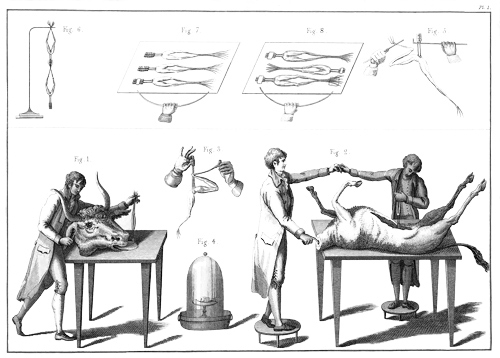
Pl. 1
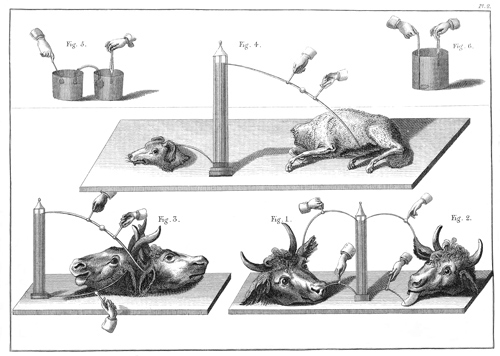
Pl. 2.
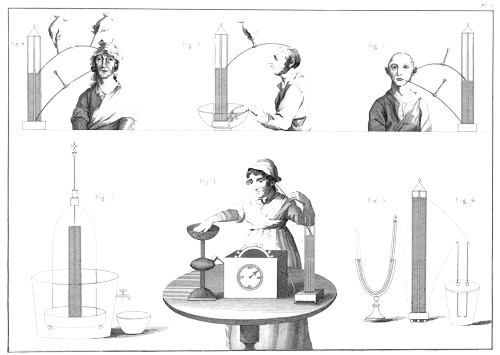
Pl. 3.
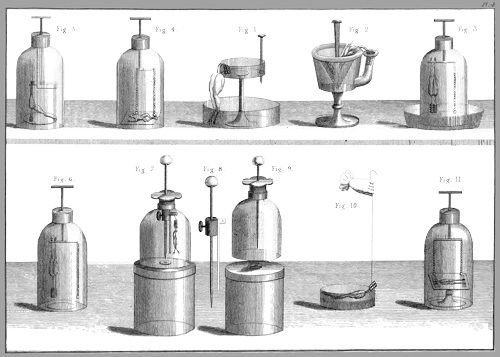
Pl. 4.
BOOKS
PRINTED FOR AND SOLD BY
CUTHELL AND MARTIN,
HOLBORN.
LA GRANGE’S (Professor in the Central Schools of Paris, &c.) Manual of a Course of Chemistry, or a Series of Experiments and Illustrations, necessary to form a complete Course of that Science, 2 vols. 8vo. illustrated with 17 Plates by Lowry, 18s. in boards.
Brisson’s (Professor of Chemistry in the Central Schools of Paris) Physical Principles of Chemistry, to which is added a short Appendix by the Translator, illustrated with Seven large Engravings by Lowry, 1 vol. 8vo. 10s. 6d. boards.
Morgagni on Diseases, translated by Alexander, 3 vols. 4to. boards, 1l. 16s.
Monro’s (Dr. Alex. senior) Works, with his Life, and Portrait by Basire, 4to. boards, 1l. 1s.
Gellert’s Metallurgic Chymistry, being a System of Mineralogy in general, and of all the Arts arising from this Science, to the great Improvement of Manufactures, and the most capital Branches of Trade and Commerce, Theoretical and Practical. Translated from the German, 8vo. with 4 Plates, boards, 6s.
Gillespie’s Observations on the Diseases which prevailed on board a Part of his Majesty’s Squadron on the Leeward Island Station, between November 1794 and April 1796, 8vo. boards, 5s.
Fontana’s Treatise on the Venom of the Viper, on the American Poisons, and on the Cherry Laurel, and some other Vegetable Poisons, to which are annexed Observations on the primitive Structure of the Animal Body, different Experiments on the Reproduction of the Nerves, and a Description of a new Canal of the Eye, with Ten descriptive Plates. Translated by Skinner, 2 vols. 12s. boards.
Fourcroy’s System of Chemical Knowledge, with the Synoptic Tables of Chemistry, translating by Nicholson, 11 vols. 8vo.—The Synoptic Tables are already printed, Price 1l. 1s. boards.
Haller’s First Lines of Physiology, a new Edition, to which is added, a Translation of the Index composed for the Edinburgh Edition printed under the Inspection of Dr. William Cullen, neatly printed in 8vo. boards, 10s. 6d.
Swediaur’s Practical Observations on Venereal Complaints, to which are added, An Account of a new Venereal Disease which has lately appeared in Canada; and A Pharmacopœia Syphilitica, 8vo. boards, 4s.
The same Book on fine paper, boards, 5s.
Shaw’s Essays for the Improvement of Arts, Manufactures, and Commerce, by Means of Chemistry, 8vo. boards, 5s.
Buchan’s Domestic Medicine. A new Edition is in the Press, and will shortly appear.
Clark’s Treatise on the Prevention of Diseases incident to Horses, to which are subjoined Observations on some of the Surgical and Medical Branches of Farriery, a new Edition, in 1 vol. 8vo. boards, 8s.
Cooper’s Complete Distiller, containing the Method of performing the various Processes of Distillation, with Descriptions of the several Instruments, &c. with a Plate, boards, 3s. 6d.
Chemical Vocabulary and Tables of the Old and New Nomenclature, by De Morveau, Lavoisier, Berthollet, and Fourcroy, boards, 4s.
Bergman’s Physical and Chemical Essays, translated from the original Latin, with Notes and Illustrations by Dr. Cullen, of Dublin, 3 vols. 8vo. with Plates, 18s. boards.
Bell’s (Benjamin) System of Surgery, a new Edition, 7 vols. 8vo. with many Plates, 3l. 3s. boards.
Bell’s (Benjamin) Treatise on the Hydrocele, on Sarcocele, on Cancer, and other Diseases of the Testes, 8vo. with four Plates, 4s. boards.
Withering’s Systematic Arrangement of British Plants, with an easy Introduction to the Study of Botany, illustrated by Copper-plates, 4 vols. 8vo. boards, 2l. 2s.
Transcriber’s Note:
Dialect, obsolete and alternative spellings were left unchanged. ‘Economy’ is spelled without an œ twice in the Contents; elsewhere it appears as ‘œconomy.’ Footnotes were renumbered sequentially and moved to the end of the section in which related anchors occur.
Obvious printing errors, such as backwards, upside down, unprinted, or partially printed letters, were corrected. Final stops missing at the end of abbreviations and sentences were added.
The following items were changed:
Added missing page number (3) to first entry of Table of Contents Added missing close quote to footnote [21]. Changed comma to stop ‘…printed in 8vo. boards,.…’