Front matter (continued 3)
Reading edition
A species clearly distinct in form and habit.
Genus: PSEUDOCOCCUS, Westwood.
Adult females covered with cottony secretion; stationary; antennæ of nine joints; anogenital ring conspicuous, with six hairs; upper digitules of the foot absent.
64. Pseudococcus asteliæ, Maskell.
N.Z. Trans., Vol. XVI., 1883, p. 139.
(Plate XVIII., Fig. 2.)
Adult female about 1/10in. long, yellowish-brown, covered with a not very abundant white cotton; segmented; anal tubercles inconspicuous; anal ring with six hairs. Antennæ with nine joints, of which the third, fourth, and fifth are the longest; the second, sixth, and ninth a little shorter; the first, seventh, and eighth the shortest. The fourth, fifth, and sixth are the narrowest, the two ends of the antennæ being thicker than the middle. The eighth joint is a little expanded at the tip; and the ninth is fusiform, with a shallow depression at the extremity. All the joints have a few long hairs, and on the eighth is one a good deal stronger than the others. The legs have the tibiæ twice as long as the tarsus; the claw is slender, and has no tooth on the inner edge. There are only two digitules (the lower pair), which are long and fine. The trochanter bears one short bristle. The whole leg is slender and long. The eyes are tubercular and smooth, showing after maceration in potash a small dark terminal spot. The body is covered with a number of spinnerets of two kinds: those with simple concentric circles are the largest, and are found all over the integument; the others are multilocular, and are placed in groups at the edges of the segments and also in great numbers at the cephalic and abdominal extremities. Interspersed with these spinnerets are several hairs, mostly very short, but on the head are some pretty long. From the anal tubercles spring two strong setæ with tubercular bases, not very long. The mentum is dimerous, and bears a few hairs on the tip. In the groups of spinnerets at the edges of the segments are found a few small conical spines. The four spiracles are small and simple.
Adult male unknown.
Habitat—On Astelia sp., in forests, Hawke's Bay.
Allied to P. Mespili, Geoffroy; but differs in the antennæ, feet, and spinnerets.
Subdivision III.—COCCIDÆ.
Adult females active, covered with mealy secretion; antennæ of seven joints; no hairs on anogenital ring. Eyes of male not facetted.
This subdivision, which includes the single genus Coccus, of which there would seem to be not more than one distinct species—Coccus cacti (the cochineal insect)—and two or three varieties, has not yet any representatives in New Zealand.
Subdivision IV.—MONOPHLEBIDÆ.
Adult females active or stationary; naked, or covered with mealy, cottony, or waxy secretion; segmented; antennæ of ten or eleven joints; anterior pair of feet similar to the rest; anogenital ring without hairs; anal tubercles inconspicuous.
Males with facetted eyes and no ocelli.
Strictly speaking, the wings of the males of this group should, according to its name, present only a single nervure. This, however, is not the case, or, rather, it should be said that the nervure is precisely similar to that of all other Coccids, branching once, so that it cannot form a distinctive character. Possibly the name of Monophlebus was originally given by Leach to an abnormal or imperfect specimen.
Genus: ICERYA, Signoret.
Adult females having antennæ of eleven joints; covered with thin mealy secretion or with cotton; stationary; with or without ovisac. Rostrum and mentum present. Segmentation inconspicuous.
Adult males without tassels on the abdomen; antennæ with two dilations on each joint.
Two species only of this genus are at present known, the one described below and another, I. sacchari, infesting sugar-canes in Mauritius. The male of the latter is unknown. Possibly researches in Australia might result in the discovery of others.
65. Icerya Purchasi, Maskell.
N. Z. Trans., Vol. XI., 1878, p. 221; Vol. XVI., 1883, p. 140; p. 140; Vol. XVII., 1884, p. 30; Vol. XIX., 1886, p. 45.
The "Cottony-cushion Scale."
(Plate XIX.)
Adult female dark reddish-brown, covered with a thin powdery secretion of yellowish meal, and with slender glassy filaments; stationary at gestation, and gradually raising itself on its head, lifting the posterior extremity until nearly perpendicular, filling the space beneath it with thick white cotton, which gradually extends for some distance behind it in an elongated, white ovisac, longitudinally corrugated; ovisac often much longer than the insect, and becoming filled with oval red eggs. Length of female, about 1/5in., reaching sometimes nearly 1/3in. Body previous to gestation lying flat on the plant, the edge slightly turned up; on the dorsum a longitudinal raised ridge, forming one or more prominences. Insect covered all over with numerous minute fine hairs, most thickly on the thoracic region; round the edge these hairs are longer, and are arranged in tufts somewhat closely set; the tufts are black, and contain from twenty to thirty hairs in each. Amongst the hairs in the tufts are several protruding tubular spinnerets, having on the outer end a kind of multiglobular ring or crown; from these proceed cylindrical, glassy, straight tubes as long as the tufts of hair. Long, fine, glassy, delicate filaments, as long as the body of the insect, radiate from the edge all round; but these, being very fragile, are often irregular, or absent. During gestation thick, short, cottony processes form at the edge of the thorax, seemingly attached to the feet. Antennæ of eleven joints, very slightly tapering; each joint bearing hairs. Feet normal, somewhat thick. Rostrum not long; mentum triarticulate. Procreation commencing soon after the first formation of the ovisac, the eggs being ejected into the sac as it grows; ovisac at completion containing sometimes as many as 350 eggs; ovisac convex above, sometimes irregularly split, more often nearly conical, divided by several regular longitudinal grooves or ribs.
Female of second stage dark-red, elongated, slightly convex, active, covered with thin meal, or short curly cotton. Body hairy with marginal tufts and spinnerets, as in adult. Anal tubercles inconspicuous, but the abdomen exhibits three small lobes on each side, from which spring six short setæ. Antennæ of nine nearly equal joints, hairy. Feet normal, thick. Several radiating, fine cottony filaments. Length of insect variable, from 1/10in. to 1/6in. The dorsum exhibits the longitudinal raised ridge, but less conspicuously than in the adult.
Young larva, about 1/24in. long, dark-red, elongated, flattish, active; covered with yellow cottony down. Antennæ of six joints, hairy; the last joint is much the largest, clavate, apparently four-ringed, bearing four long hairs. Feet slender; digitules short, fine hairs. Eyes prominent, tubercular. Mentum biarticulate. Anal tubercles represented by three small processes at each side of the abdominal extremity, each process bearing a very long seta. Six longitudinal rows of circular multilocular spinnerets, four on the dorsum and one on each edge. Alternating with these are rows of hairs with tubercular bases.
Adult male large, the length slightly varying; some specimens reach 1/8in.; expanse of wings, 1/4in.; length of antennæ, about 1/8in. Body red, with a shining, diamond-shaped, black patch on the dorsal surface of the thorax; legs and antennæ black. Wings dark-brown with (in some lights) a bluish tinge, marked with oblique, narrow, wavy stripes; main nervure red, branching once; there are also two longitudinal, whitish, narrow bands.[U] Antennæ very long and slender, with ten joints, which may easily be taken for nineteen, for, after the first which is short, round, and simple, all the other nine have two dilated portions with a constriction in the middle, and on each dilation is a ring of very long hairs, giving the antenna a feathery appearance.[V] Eyes very large and prominent, almost pedunculated, brown, divided into numerous semi-globular facets. Feet long and very hairy; coxæ short and thick, tibiæ long and slender, claw thin; upper digitules absent, lower pair only short bristles. Abdomen slender, segments somewhat distinct; on each segment some hairs; the last segment ends in two thick, conspicuous, cylindrical processes, which, in side view, are seen to incline upwards, and beneath them is the short, conical spike sheathing the penis. Penis red, longish, tubular, and thick, with many recurved short hairs, and at the end a ring of short spines. Each of the two processes on the last segment bears three or four long setæ, but there do not appear to be any of the long cottony appendages seen in the males of most Coccids.
Habitat—On wattle, pine, orange, lemon, cypress, rose, gorse, grass, and, in fact, on almost every kind of native and introduced plants, Nelson, Hawke's Bay, Auckland. It will probably appear also elsewhere, but the climate of Canterbury and Otago may prove too cold in winter for it.
Allied to I. sacchari, Guérin, which damages sugar-canes in Mauritius; but differing in the formation of the ovisac, the presence of the marginal tufts and spinneret tubes in the female, and in other particulars. The male of I. sacchari has not been described. The male of I. Purchasi is probably quite distinct.
This species is supposed to have come originally from Australia. It has been very injurious to orange and lemon trees at the Cape of Good Hope and in California. In Auckland it has destroyed whole orchards of the same trees, and in Nelson and Hawke's Bay it is a dreadful pest on all kinds of plants.
Tree-growers should especially beware of this insect, and the best plan to adopt would be to burn at once any tree found infested with it.
Genus: CŒLOSTOMA, Maskell.
N.Z. Trans., Vol. XII., 1889, p. 294.
Adult females with antennæ of eleven joints; segmented; naked, active; at gestation becoming stationary and enclosed in a thick mass of white cottony secretion. Anal tubercles absent or inconspicuous. Rostrum and mentum absent in the adult female.
Males with prominent, facetted eyes; ocelli absent. Abdomen without tassels.
In one New Zealand species the female in the second stage is stationary, enclosed in a thick, hard mass of waxy secretion, of which some account is given in Chap. III. The other species included in this work inhabits a remote and scarcely visited district, and the female has not hitherto been found; it is not possible therefore to include the excretion of wax and the stationary position amongst the generic characters at present.
This genus is allied to Porphyrophora, Brandt, and to Monophlebus, Leach; differing from the former by the presence of an œsophagal orifice, and from the latter by the absence of tassels on the abdomen of the male. In the genus Ortonia, Signoret, the female possesses a rostrum and mentum.
66. Cœlostoma zealandicum, Maskell.
N.Z. Trans., Vol. XII., 1879, p. 294; Vol. XIV., 1881, p. 226; Vol. XVI., 1883, p. 141.
(Plate XX.; Plate XXI., Fig. 1.)
Adult female brick-red, elongated, distinctly segmented, convex; length about 1/2in.; before gestation active, naked or covered with thin meal; during gestation stationary, enclosed in a thick mass of white cotton. Antennæ of eleven joints, tapering to the tip; the joints all nearly equal, and bearing several hairs. Feet black, short, strong; all the pairs placed somewhat forward; digitules absent, a short seta at the base of the claw; on the inner edge of the tibia and tarsus a fringe of strong hairs; on the trochanter a long hair. Rostrum and mentum absent; mouth represented by a minute orifice between the second pair of feet. Eyes very minute, tubercular, projecting, placed behind the antennæ. Anal tubercles absent; anogenital opening small, elliptical, simple, hairless. Body flattish beneath, more convex above; segments distinct, generally smooth, sometimes bearing hard projecting callosities. Skin covered with minute hairs interspersed with circular spinnerets.
Female of second stage deep-red in colour, nearly globular, very indistinctly segmented; stationary, enclosed in a thick, hard solid test of yellow wax; tests attaining sometimes the size of a large pea; enclosed insect averaging 1/5in. in length. Insect filling the test; skin smooth, very thin; general appearance like a hard, round, smooth ball. Anal tubercles absent; anogenital ring small, simple, hairless: from this ring springs often a tuft of short white cotton, and a long white cottony seta protruding through an orifice in the test. Rostrum and mentum present, very small; mentum triarticulate, with a few hairs at the tip. Antennæ very short, of eight joints, conical, tapering to the tip, hairy. Feet atrophied, bloated-looking, apparently only consisting of a very short femur, tibia, and tarsus; digitules two, very small. Skin covered with a great number of circular spinnerets of two sizes, the larger ones simple, the smaller multilocular. Tracheæ very large; spiracular orifices containing brown tubes with beaded extremities on the inner end. Anal extremity dark-brown, the anal ring in the centre; spinnerets here very numerous, converging towards the anus. Insect in this stage emitting a strong, persistent, and fetid odour.
Young larva brick-red, elongated, active, naked; length, about 1/24in. Antennæ of six joints, hairy; last joint the largest, clavate. Eyes and feet as in adult, but there is no fringe on the tibia and tarsus. Rostrum and mentum large, conspicuous. Skin covered with circular spinnerets and minute hairs; the spinnerets are most numerous on the abdomen. Anogenital ring apparently folded. At the extremity of the abdomen two long hairs springing from quadrate tubercular bases which represent the anal tubercles.
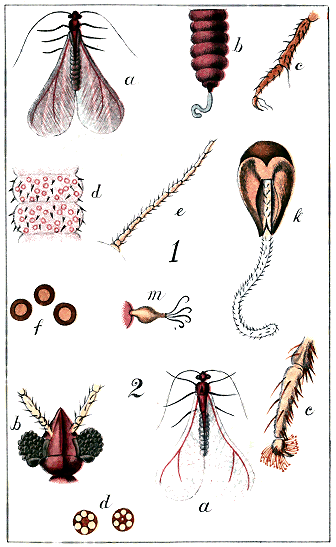
Adult male red or purplish in colour, wings bluish-purple with red nervures; length, about 1/5in.; width across expanded wings, about 1/2in. Eyes large, prominent, facetted. Antennæ of ten joints, each joint bearing many hairs. Feet long, slender, with somewhat large trochanter; on the tibia and tarsus a fringe of hairs as in the female. Upper digitules two long fine hairs; lower digitules absent. The nervure of the wings branches twice at least. Haltere large, inflated, sac-like; bearing four curling setæ. Abdomen distinctly segmented, each segment bearing many fine short hairs and several small circular marks. Abdominal spike short, broad, bivalvular; penis protruding as a long soft white tube covered with minute recurved hairs.
Habitat—For the adult female and larva the trunks of trees and shrubs in forests, or rocks and bushes in open country, Otago, Nelson, Canterbury, Wellington. For the second stage the stems and roots of Muhlenbeckia adspersa (complexa?); Sumner Road, Lyttelton; Evans Bay, Wellington: Rhipogonum scandens (supplejack); Riccarton Bush, Canterbury; Nelson; Wellington. On Muhlenbeckia the waxy tests are often largest and most numerous underground. Male insects sometimes found clustering, attached to females.
This is a very large and peculiar species, its transformations and changes of secretion being abnormal. It cannot be said to be greatly harmful; but the odour of the second stage is unpleasant.
67. Cœlostoma wairoense, Maskell.
N.Z. Trans., Vol. XVI., 1883, p. 141.
(Plate XXI., Fig. 2.)
Adult female, female of second stage, and larva unknown.
Adult male very nearly resembling that of C. zealandicum; body red or purplish, wings blue with red nervures. Length of body, about 1/6in. Eyes prominent, facetted. Antennæ of ten joints, slender, with fine hairs. Feet as in C. zealandicum, but with fewer hairs. Digitules twenty-four, all springing from the claw, none from the tarsus. Haltere, abdominal spike, penis, and abdomen as in C. zealandicum; but the circular marks on the segments in this species are multilocular.
Male pupa bright-red, enclosed in a cylindrical sac of white cotton. Pupæ occurring in numerous colonies.
Habitat—On Phormium tenax, Leptospermum scoparium (manuka), Northern Wairoa, Auckland.
The female of this species will, when found, probably nearly resemble that of C. zealandicum: at present the great number of digitules on the foot of the male sufficiently distinguish it.
INDEX OF PLANTS AND THE COCCIDIDÆ ATTACKING THEM.
This list is of course only approximate, as insects may at any time be found on other trees than those given.
Icerya Purchasi is omnivorous, and it has not been thought necessary to repeat it here against every plant in the list; but it has been set against some.
The adult female of Cœlostoma zælandicum may also be found wandering over numbers of native trees in forests.
In hothouses and greenhouses all sorts of plants are liable to attack.
Key to Symbols Following Insect Listings
* Unsightly: spoiling appearance of plant. † Usually accompanied by much black fungus. ‡ Likely to do much injury to plant.
Plants. Insects.
Alsophila Colensoi (fern) Lecanium mori. *
Apple Mytilaspis pomorum. ‡
" Dactylopius glaucus. * ‡
Apricot Mytilaspis pomorum. ‡
Ash " pomorum. ‡
Asplenium bulbiferum (fern) Chionaspis dubia. * †
" lucidum " dubia. * †
Astelia Cunninghamii Mytilaspis cordylinidis. *
" " " epiphytidis.
" " Fiorinia asteliæ. * †
" " " stricta.
" " Pseudococcus asteliæ.
Atherosperma Novæ-Zælandiæ Aspidiotus atherospermæ.
" " Mytilaspis pyriformis. *
" " Fiorinia asteliæ. *
" " Ctenochiton viridis. * †
" " Inglisia patella.
" " Eriochiton spinosus.
Bavardia Lecanium maculatum. * † ‡
Box " hesperidum. * † ‡
Brachyglottis repanda Fiorinia minima.
" " Ctenochiton flavus.
" " " fuscus. * †
Budlæia salicina Aspidiotus budlæiæ.
Calceolaria Dactylopius calceolariæ. * † ‡
Camellia Aspidiotus camelliæ.
" Lecanium hemisphæricum. * † ‡
" " hesperidum. * † ‡
" " oleæ. * † ‡
" Pulvinaria camellicola. * † ‡
Carpodetus serratus Aspidiotus carpodeti.
Cassinia leptophylla (tauhine) Lecanium oleæ. * † ‡
Celmisia Rhizococcus celmisiæ. *
Coprosma Aspidiotus nerii.
" Mytilaspis pyriformis. *
" Chionaspis dubia.
" Fiorinia asteliæ. *
" Ctenochiton perforatus. * †
Coprosma Ctenochiton viridis. * †
" Inglisia patella.
" Dactylopius glaucus. *
Cordyline australis (cabbage-tree) Mytilaspis cordylinidis. * ‡
" " Fiorinia stricta. * ‡
" indivisa (large-leaved cabbage-tree) Mytilaspis cordylinidis. * ‡
" " Fiorinia stricta. * ‡
Corynocarpus lævigata (karaka) Aspidiotus nerii.
Cotoneaster microphylla Mytilaspis pomorum. ‡
Cyathea Smithii (tree-fern) Ctenochiton depressus. *
Cyathodes acerosa Poliaspis media. *
" " Eriococcus multispinus. *
Cypress Icerya Purchasi. * ‡
Danthonia (grass) Dactylopius calceolariæ. *
Dendrobium Fiorinia stricta. *
" Ctenochiton elongatus. * †
Drimys colorata Mytilaspis drimydis.
" " Inglisia patella.
Dysoxylon spectabile Aspidiotus dysoxyli.
" " Mytilaspis pyriformis. *
" " Chionaspis dysoxyli. * ‡
Earina Ctenochiton elongatus.
" Fiorinia stricta. *
Elæocarpus dentatus (hinau) Ctenochiton elæocarpi.
" " " flavus.
" " Inglisia ornata. *
" " Eriococcus pallidus.
Eucalyptus Mytilaspis cordylinidis. *
Euonymus Aspidiotus camelliæ. * ‡
Ferns, various Chionaspis dubia.
" " Poliaspis media.
" " Ctenochiton depressus. *
" " Lecanium mori.
" " Dactylopius glaucus. * ‡
Gahnia Mytilaspis cordylinidis. *
Geniostoma ligustrifolia Ctenochiton elongatus. *
Gooseberry Fiorinia grossulariæ.
Gorse Icerya Purchasi. * ‡
Grasses, various Dactylopius poæ.
" " Icerya Purchasi. * ‡
Hawthorn Mytilaspis pomorum. ‡
Hedycarya Fiorinia stricta.
Hoheria angustifolia Eriococcus hoheriæ.
Holly Lecanium hesperidum. * † ‡
Hymenanthera crassifolia Ctenochiton hymenantheræ. * †
Ivy Lecanium hesperidum. * † ‡
Knightia excelsa Eriococcus multispinus. *
Laurel Lecanium hesperidum. * † ‡
Lemon Aspidiotus coccineus. * ‡
" Icerya Purchasi. * ‡
Leptospermum scoparium (manuka) Mytilaspis leptospermi.
" " Ctenochiton flavus.
" " Inglisia leptospermi.
" " " ornata.
" " Planchonia epacridis.
" " Cœlostoma wairoense. *
Leucopogon Fraseri Poliaspis media. *
" " Planchonia epacridis.
Lilac Mytilaspis pomorum. ‡
Melicope ternata Eriochiton spinosus.
Metrosideros tomentosa (pohutukawa) Lecanochiton metrosideri. * †
" robusta (rata) Mytilaspis metrosideri.
" " " Lecanochiton metrosideri. * †
Muhlenbeckia adspersa Fiorinia stricta.
" " Eriochiton spinosus.
" " Cœlostoma zælandicum.
Myoporum lætum (ngaio) Eriococcus pallidus.
Myrtle Lecanium hesperidum. * † ‡
Norfolk Island pine (Araucaria) Eriococcus araucariæ. * † ‡
Olearia Haastii Eriochiton hispidus. * †
Orange Aspidiotus coccineus. * ‡
" Chionaspis citri.
" Lecanium hesperidum. * † ‡
" " oleæ. * † ‡
" Icerya Purchasi. * ‡
Orchids (hothouse) Aspidiotus epidendri. * ‡
" " " nerii. * ‡
" " Dactylopius glaucus. * ‡
Palms (hothouse) Aspidiotus epidendri. * ‡
" " " nerii. * ‡
" " Dactylopius glaucus. * ‡
Panax arboreum Fiorinia minima.
" " Ctenochiton flavus. * †
" " " fuscus. * †
" " " perforatus. * †
" " " viridis. * †
" " Dactylopius glaucus. *
Parsonsia Chionaspis minor.
Peach Mytilaspis pomorum. ‡
Pear Diaspis santali.
" Mytilaspis pomorum. ‡
Pellæa rotundifolia (fern) Chionaspis dubia.
Phormium tenax (New Zealand flax) Mytilaspis cordylinidis. *
" " Fiorinia stricta. *
" " Dactylopius calceolariæ. *
" " Cœlostoma wairoense. *
Phymatodes Billardieri (fern) Mytilaspis phymatodidis. *
Pines and firs Icerya Purchasi. * ‡
Piper excelsum Ctenochiton piperis.
" " Dactylopius glaucus. *
Pittosporum (various) Fiorinia asteliæ.
" " Ctenochiton perforatus. * †
" " " viridis. * †
" " Dactylopius glaucus. * †
Plagianthus Ctenochiton depressus. *
Plum Diaspis santali. ‡
" Mytilaspis pomorum. ‡
Poa anceps (tussock-grass) Dactylopius poæ.
Rhipogonum scandens (supplejack) Chionaspis minor. *
" " " Cœlostoma zælandicum.
Rose Diaspis rosæ. * ‡
" Icerya Purchasi. * ‡
Rubus australis (bush-lawyer) Chionaspis dubia. *
" " " Ctenochiton perforatus. * †
" " " " viridis. * †
" " " Eriococcus multispinus.
Rubus australis (bush-lawyer) Dactylopius glaucus. *
Santalum Cunninghamii (maire) Diaspis santali. *
" " " Rhizococcus fossor.
Sophora tetraptera (kowhai) Aspidiotus sophoræ.
Sweetbriar Icerya Purchasi. * ‡
Sycamore Mytilaspis pomorum.
Thorn " pomorum. ‡
Various greenhouse or hothouse plants Aspidiotus epidendri. * ‡
" " " " " nerii. * ‡
" " " " Diaspis Boisduvalii. * † ‡
" " " " Lecanium hemisphæricum. * † ‡
" " " " " hesperidum. * † ‡
" " " " " hibernaculorum. * † ‡
" " " " " mori.
" " " " " oleæ. * † ‡
" " " " Dactylopius glaucus. * ‡
" " " " Icerya Purchasi. * ‡
Veronica (various) Poliaspis media.
" " Lecanium hesperidum. * †
" " Dactylopius alpinus. *
Vitex littoralis (puriri) Aspidiotus carpodeti.
Wattle (various) " epidendri. *
" " Diaspis Boisduvalii. *
" " Icerya Purchasi. * †
Weeping-willow Aspidiotus camelliæ.
INDEX OF GROUPS, SUBDIVISIONS, GENERA, AND SPECIES INCLUDED IN THIS WORK.
Names in italics are synonyms. * Signifies that the insect has not yet been found in New Zealand.
Page Acanthococcidæ, 88, 91 Acanthococcus, 95 multispinus, 94 Aclerda*, 63 Antonina*, 88 Aonidia*, 39 Aspidiotus, 39, 40 atherospermæ, 40 aurantii, 42 Bouchei, 44 budlæiæ, 40 camelliæ, 41 carpodeti, 42 citri, 42 coccineus (the orange-scale), 42 conchiformis, 51 dysoxyli, 43 epidendri, 44 falciformis, 51 juglandis, 51 nerii, 44 pomorum, 51 pyrus-malus, 51 rosæ, 47 sophoræ, 45 Asterolecanium*, 64, 87, 91 quercicola*, 92 Boisduvalia*, 89 Callipappus*, 90 Calymnatus hesperidum, 80 Calypticus hesperidum, 80 Capulinia*, 89 Carteria*, 62 Ceroplastes*, 62 Chermes epidendri, 44 filicum, 80 hibernaculorum, 81 oleæ, 82 Chionaspis, 39, 54 citri, 54 dubia, 54 dysoxyli, 55 euonymi, 54 minor, 56 Coccidæ, 89, 103 Coccidinæ, 38, 88 Coccus* (the cochineal-insect), 89 hesperidum, 80 Cœlostoma, 90, 107 wairoense, 109 zælandicum, 107 Cryptokermitidæ, 87 Ctenochiton, 62, 65 depressus, 66 elæocarpi, 67 elongatus, 68 flavus, 68 fuscus, 70 hymenantheræ, 71 perforatus, 72 piperis, 73 spinosus, 86 viridis, 74 Dactylopidæ (the "mealy-bugs"), 89 Dactylopius, 89 alpinus, 99 calceolariæ, 100 glaucus, 100 poæ, 101 Diaspidinæ, 37, 39 Diaspis, 39, 45 Boisduvalii, 46 Bouchei, 44 gigas, 58 rosæ, 47 santali, 47 Drosicha*, 90 Ericerus*, 62 Eriochiton, 63, 84 hispidus, 84 spinosus, 86 Eriococcus, 88, 92 araucariæ, 93 hoheriæ, 93 multispinus, 94 pallidus, 95 Eriopeltis*, 63 Fairmairia*, 62 Fiorinia, 39, 57 asteliæ, 58 grossulariæ, 59 minima, 59 stricta, 60 Gossyparia*, 88 Guerinia*, 90 Hemicoccidinæ, 38, 87 Icerya, 90, 104 Purchasi (the cottony-cushion scale), 104 sacchari*, 106 Inglisia, 62, 75 leptospermi, 75 ornata, 76 patella, 78 Kermes*, 87 camelliæ, 41 Kermitidæ*, 87 Leachia*, 90 Lecanidæ, 63, 79 Lecanidinæ, 38, 62 Lecanium, 63, 79 depressum, 79 hemisphæricum, 80 hesperidum (the holly and ivy scale), 80 hibernaculorum, 81 maculatum, 81 mori, 82 oleæ (the "black scale"), 82 Lecanochiton, 62, 64 metrosideri, 64 Lecanococcidæ, 63, 84 Lecanodiaspidæ, 62, 63 Lecanodiaspis*, 63, 64 Lecanopsis*, 63 Leucaspis*, 39 Lichtensia*, 63 Llaveia*, 90 Margarodes*, 91 Monophlebidæ, 90, 104 Monophlebus*, 90 Mytilaspis, 39, 48 cordylinidis, 48 drimydis, 49 epiphytidis, 49 leptospermi, 50 metrosideri, 50 phymatodidis, 51 pomicorticis, 52 pomorum (the apple-scale), 51, 52 pyriformis, 53 Nidularia*, 88 Orthezia*, 89 Ortonia*, 90 Parlatoria*, 39 Philippia*, 63 Physokermes*, 63 Planchonia, 64, 88, 91 epacridis, 91 Poliaspis, 39, 56 media, 57 Pollinia*, 64, 87 Porphyrophora*, 91 Porphyrophoridæ*, 91 Pseudococcus, 89, 101 asteliæ, 102 Pulvinaria, 63, 83 camellicola, 83 Puto*, 89 Rhizococcus, 88, 96 araucariæ, 93 celmisiæ, 96 fossor, 97 Ripersia*, 89 Signoretia*, 63 Targionia*, 39 Uhleria, 57 gigas, 58 Vinsonia*, 62 Walkeriana*, 90 Westwoodia*, 89
DESCRIPTIONS OF PLATES.
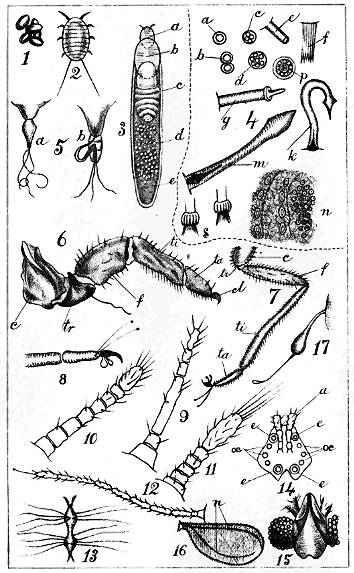
Plate I.
Fig.
1. Eggs of Coccididæ.
2. Larva of Diaspidinæ.
3. Diagram of life-history of female Diaspidinæ. a, pellicle of larva; b, second pellicle; c, adult female somewhat shrivelled after egg-laying; d, eggs; e, secreted matter forming the "scale." In this diagram the scale is shown as overturned.
4. Types of various spinnerets. a, simple orifices (Mytilaspis); b, double orifice (Planchonia); c, multilocular orifice (Ctenochiton); d, multilocular orifice (Cœlostoma); e, simple protruding spinneret (Aspidiotus); f, serrated protruding spinneret (Mytilaspis drimydis); g, protruding spinneret (Acanthococcus); k, conical spiny spinneret and cottony secretion (Rhizococcus); m, lanceolate spinneret and glassy secretion (Inglisia); n, group of abdominal spinnerets, with detached orifices (Mytilaspis); p, double multilocular orifice (Cœlostoma); s, coronetted spinnerets and part of glassy secretion (Icerya).
5. Rostra. a, simple rostrum of Diaspidinæ; b, rostrum and trimerous mentum of Coccidinæ.
6. Foot of a female insect. c, coxa; tr, trochanter; f, femur; ti, tibia; ta, tarsus; cl, claw.
7. Foot of a male insect. The letters as in Fig. 6.
8. Foot with digitules, upper and lower.
9. Type of female antenna (Ctenochiton).
10. Type of female antenna (Dactylopius).
11. Type of antenna of larva (Icerya).
12. Type of male antenna (Fiorinia).
13. One joint of antenna of Monophlebidæ (Icerya).
14. Diagram of head of male of Lecanidinæ (after Signoret), both dorsal and ventral aspects being shown together. a, antennæ; e, e, true eyes, the lower pair being on the ventral surface in the place of the mouth; oc, oc, ocelli.
15. Head of male Icerya, with facetted eyes.
16. Wing of male insect. n, nervure.
A. D. WILLIS, WANGANUI, N. Z.
W.M.M., delt. ad. nat
PLATE I.
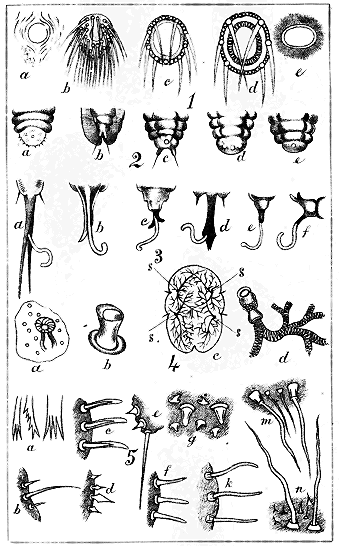
Plate II.
Fig.
1. Types of anogenital rings. a, Diaspidinæ; b, Lecanidinæ; c, Acanthococcidæ; d, Dactylopidæ; e, Monophlebidæ.
2. Types of last abdominal segments of female. a, Diaspidinæ; b, Lecanidinæ; c, Acanthococcidæ; d, Dactylopidæ; e, Monophlebidæ.
3. Types of last abdominal segments of male, and sheath of the penis. a, Diaspidinæ; b, Lecanidinæ (Ctenochiton); c, Acanthococcidæ; d, Lecanidinæ (Inglisia); e, Dactylopidæ; f, Monophlebidæ (Icerya).
4. Respiratory system. a, spiracle of Lecanium (after Targioni); b, spiracle of Coccus (after Targioni); c, diagram of arrangement of the four spiracles and the tracheal tubes (Lecanidinæ) (s. spiracles); d, spiracle and trachea of Cœlostoma.
5. Types of spines and hairs. a, anal serrated hairs (Aspidiotus nerii); b, spiracular spines (Ctenochiton); c, marginal spines (Ctenochiton); d, lanceolate marginal spines (Inglisia); e, spines on anal tubercles (Rhizococcus); f, marginal spines (Eriococcus); g, conical spines (Eriococcus); k, marginal hairs (Dactylopius); m, hairs (Icerya); n, anal hairs (Cœlostoma).
A. D. WILLIS, WANGANUI, N. Z.
W.M.M., delt. ad. nat
PLATE II.
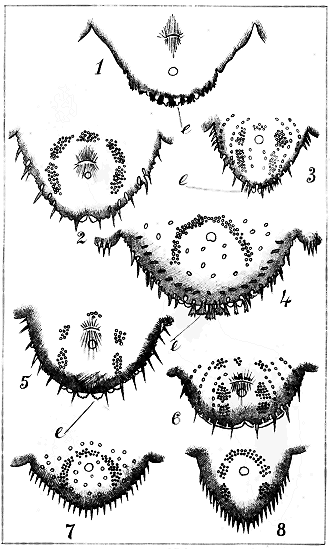
Plate III.
Types of Last Abdominal Segments of the Diaspidinæ.
Fig.
1. Aspidiotus coccineus (after Comstock); no groups of spinnerets.
2. Diaspis rosæ; five groups of spinnerets.
3. Mytilaspis cordylinidis; five groups of spinnerets and single orifices.
4. Mytilaspis pyriformis; five groups of spinnerets, almost forming an arch.
5. Chionaspis dysoxyli; five groups of spinnerets.
6. Poliaspis media; eight groups of spinnerets.
7. Fiorinia asteliæ; arch of spinnerets.
8. Fiorinia stricta; five groups of spinnerets, the three upper groups almost forming an arch.
A. D. WILLIS, WANGANUI, N. Z.
W.M.M., delt. ad. nat
PLATE III.
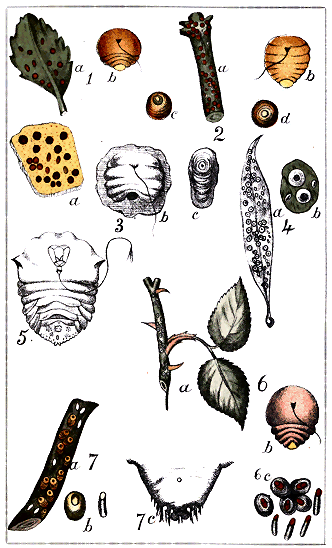
Plate IV.
Fig.
1. Aspidiotus atherospermæ. a, insects on leaf of Atherosperma; b, adult female.
2. Aspidiotus camelliæ. a, insects on twig of Euonymus; b, adult female; c, d, puparia of female.
3. Aspidiotus coccineus. a, insects on rind of orange; b, adult female in puparium (overturned); c, puparium of male.
4. Aspidiotus nerii. a, insects on leaf of wattle; b, puparia, male and female.
5. Diaspis Boisduvalii, adult female (after Signoret).
6. Diaspis rosæ. a, insects on twig of rose; b, adult female; c, puparia, male and female.
7. Diaspis santali. a, insects on twig of pear; b, male and female puparia; c, last abdominal segment of female.
A. D. WILLIS, WANGANUI, N. Z.
W.M.M., delt. ad. nat
PLATE IV.
Plate V.
Fig.
1. Mytilaspis cordylinidis. a, insects on leaf of Cordyline australis (cabbage-tree); b, male and female puparia; c, adult female.
2. Mytilaspis epiphytidis. a, female puparium; b, male puparium; c, adult female.
3. Mytilaspis drimydis. a, insects on leaf of Drimys colorata; b, male and female puparia; c, adult female; d, marginal spinnerets.
4. Mytilaspis leptospermi. a, insects on bark of Leptospermum (manuka); b, male and female puparia; c, adult female.
5. Mytilaspis pomorum. a, insects on twig of hawthorn; b, female puparia; c, adult female; d, puparium overturned, showing enclosed female, f, and eggs, e.
6. Mytilaspis pyriformis. a, insects on leaf of Dysoxylon spectabile; b, male and female puparia; e, adult female; d, male; e, last three joints of male antenna; f, foot of male.
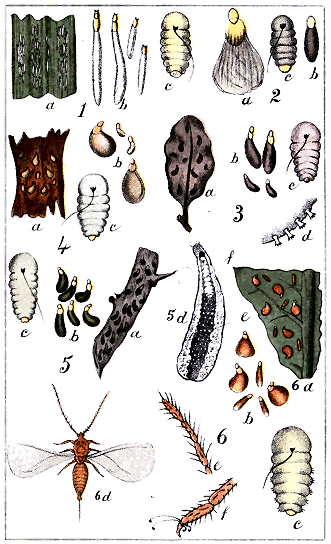
A. D. WILLIS, WANGANUI, N. Z.
W.M.M., delt. ad. nat
PLATE V.
PLATE VI.
Fig.
1. Chionaspis citri. a, insects on rind of orange; b, male and female puparia; c, adult female.
2. Chionaspis dubia. a, insects on fern-leaf (Pellæa); b, male and female puparia; c, adult female.
3. Chionaspis dysoxyli. a, insects on leaf of Dysoxylon; b, male and female puparia; c, adult female.
4. Chionaspis minor. a, insects on twig of Parsonsia; b, male and female puparia; c, adult female.
5. Poliaspis media. a, insects on leaves of Cyathodes; b, male and female puparia; c, adult female.
6. Fiorinia asteliæ. a, insects on leaves of Coprosma; b, male and female puparia; c, adult female; d, pellicles of second stage.
7. Fiorinia stricta. a, insects on leaves of Earina; b, male and female puparia; c, adult female.
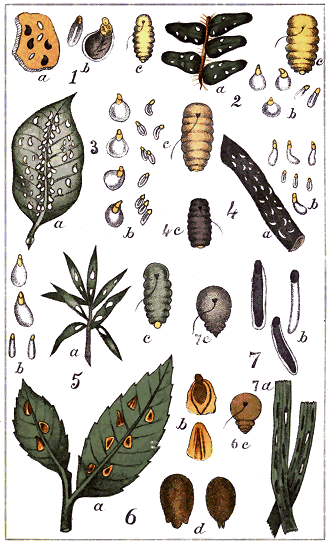
A. D. WILLIS, WANGANUI, N. Z.
W.M.M., delt. ad. nat
PLATE VI.
Plate VII.
Fig.
1. Lecanochiton metrosideri. a, insects on branch and leaves of Metrosideros (rata); b, test of female, upper side; c, test of female, under-side; d, female of second stage, ventral aspect; e, antenna of adult female; f, test of male.
2. Ctenochiton depressus. a, insects on leaf of Plagianthus; b, adult female, dorsal aspect; c, test of male; d, part of fringe of female test.
3. Ctenochiton elæocarpi. a, insect on bark of Elæocarpus (hinau); b, female of second stage in test, on leaf.
4. Ctenochiton elongatus. a, female tests on leaves of Earina; b, part of fringe.
5. Ctenochiton flavus. a, insects on half leaf of Panax; b, female tests; c, male test; d, adult female, ventral aspect; e, spiracular and marginal spines and spinnerets of female.
6. Ctenochiton fuscus. a, insects on half leaf of Panax; b, female test, upper side.
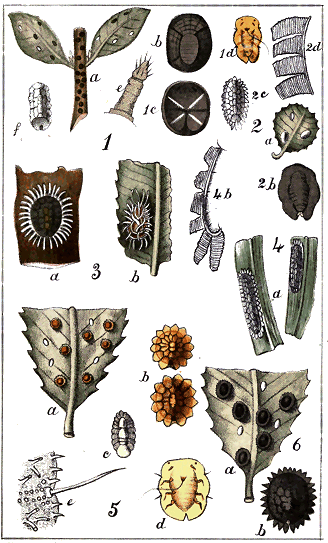
A. D. WILLIS, WANGANUI, N. Z.
W.M.M., delt. ad. nat
PLATE VII.
PLATE VIII.
Fig.
1. Ctenochiton hymenantheræ. a, insects on leaves of Hymenanthera; b, female test; c, male test.
2. Ctenochiton perforatus. a, insects on leaf of Coprosma; b, adult female in test, ventral aspect; c, male test; d, female test and fringe; e, portion of edge of female test with three segments of fringe, showing the rows of perforations; f, antenna of adult female; g, male; k, head of male, upper side; m, head of male, under-side.
3. Ctenochiton piperis. a, insects on leaf of Piper excelsum; b, females in tests, dorsal aspect; c, male pupa in test, dorsal aspect; d, female of second stage, dorsal aspect; e, two of the tubercles on the dorsum of the adult female, after pressure.
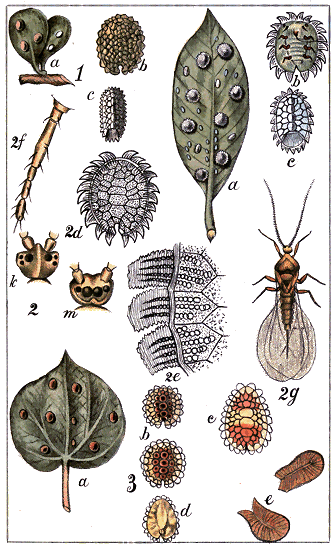
A. D. WILLIS, WANGANUI, N. Z.
W.M.M., delt. ad. nat
PLATE VIII.
PLATE IX.
Fig.
1. Ctenochiton viridis. a, insects on leaf of Coprosma; b, female of second stage; c, adult female (the test removed); d, male test; e, a segment of the female test; f, diagram of head of male, upper and under sides shown together, eight eyes and two ocelli; k, antenna of male.
2. Inglisia leptospermi. a, insects on twig of Leptospermum (manuka); b, female test, side view; c, female test, upper side; d, male test; e, a segment of the female test; f, adult female, dorsal aspect; g, antenna of female; k, foot of female.
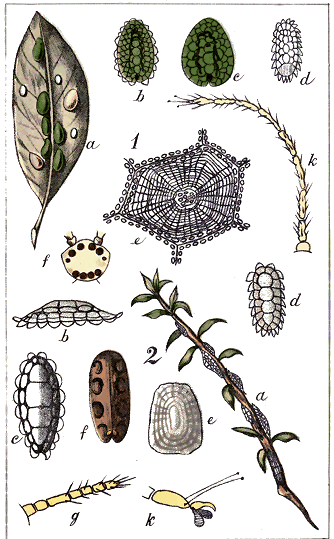
A. D. WILLIS, WANGANUI, N. Z.
W.M.M., delt. ad. nat
PLATE IX.
Plate X.
Fig.
1. Inglisia ornata. a, insects on twig of Elæocarpus (hinau); b, female test, side view; c, female test, dorsal view; d, a segment of the female test and three segments of fringe; e, male test; f, adult female, side view; g, marginal spines of female.
2. Inglisia patella. a, insects on leaf of Coprosma; b, c, female tests, upper side; d, adult female, ventral aspect; e, marginal spines of female.
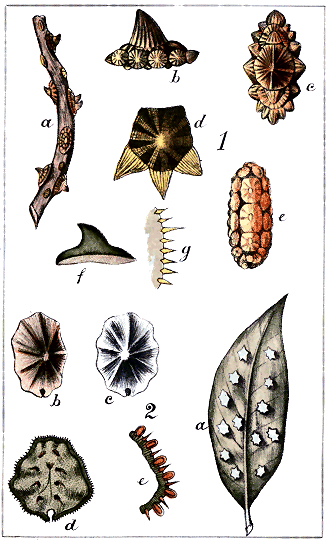
A. D. WILLIS, WANGANUI, N. Z.
W.M.M., delt. ad. nat
PLATE X.
PLATE XI.
Fig.
1. Lecanium depressum. a, adult female, dorsal aspect; b, markings of the skin.
2. Lecanium hemisphæricum. a, insects on Camellia; b, adult female, dorsal aspect; c, adult female, side view; d, female of second stage.
3. Lecanium hesperidum. a, insects on leaf of ivy; b, adult female, dorsal aspect; c, female of second stage; d, markings of skin.
4. Lecanium mori. a, insects on fern-leaf (Asplenium); b, adult female, dorsal aspect.
5. Lecanium oleæ. a, insects on twig of Camellia; b, adult female, dorsal aspect; c, adult female, side view; d, female of second stage, dorsal aspect; e, markings of skin.
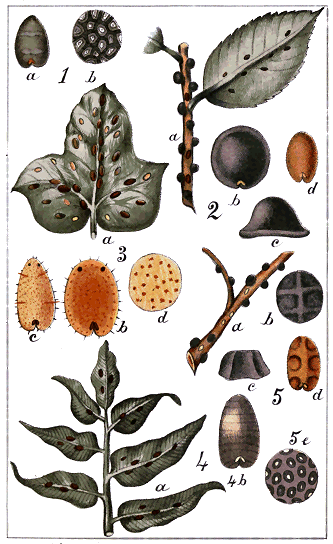
A. D. WILLIS, WANGANUI, N. Z.
W.M.M., delt. ad. nat
PLATE XI.
Plate XII.
Fig.
1. Pulvinaria camellicola. a, insects on branch and leaf of Camellia; b, adult female and ovisac, dorsal aspect; c, adult female and ovisac, side view; d, adult female, dorsal aspect; e, female of second stage; f, markings of skin, with hairs; g, antenna of adult female; k, diagram of head of male, upper and under sides shown together, four eyes and two ocelli.
2. Planchonia epacridis. a, insect in test on leaf of Leucopogon; b, female in test, dorsal aspect; c, portion of the double fringes; d, extremity of abdomen of female; e, anogenital ring and anal tubercles of female; f, antenna of larva; g, rings with hairs replacing antennæ of adult female.
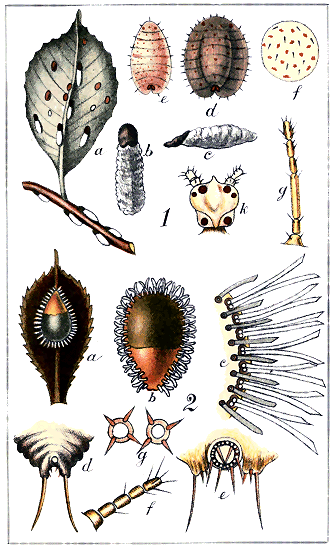
A. D. WILLIS, WANGANUI, N. Z.
W.M.M., delt. ad. nat
PLATE XII.
Plate XIII.
Fig.
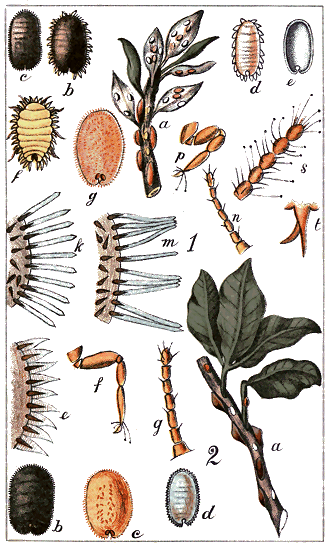
1. Eriochiton hispidus. a, Insects on twig and leaves of Olearia Haastii; b, adult female, dorsal aspect, with fragments of test and fringe; c, adult female without test, dorsal aspect; d, male test, upper side; e, male test, under-side; f, larva, with fringe; g, female of second stage, without test, dorsal aspect; k, m, spines and tubular fringe; n, antenna of adult female; p, foot of adult female; s, last five joints of male antenna; t, abdominal spike of male.
2. Eriochiton spinosus. a, insects on twig of Melicope; b, adult female, without test; c, female of second stage; d, male test; c, marginal spines and feathery fringe of female; f, foot of adult female; g, antenna of adult female.
A. D. WILLIS, WANGANUI, N. Z.
W.M.M., delt. ad. nat
PLATE XIII.
PLATE XIV.
Fig.
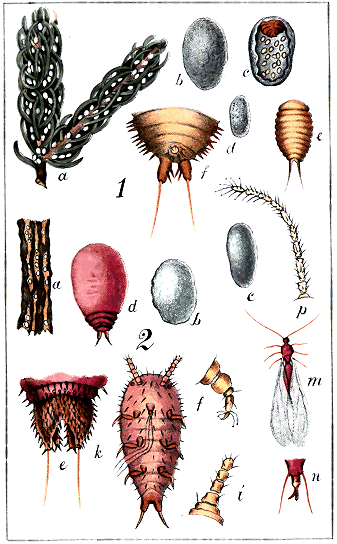
1. Eriococcus araucariæ. a, insects on twig of Araucaria excelsa (Norfolk Island pine); b, sac of female, upper side; c, sac of female, under-side, with enclosed shrivelled female and eggs; d, sac of male; e, adult female before gestation; f, extremity of abdomen, anogenital ring, and anal tubercles of female.
2. Eriococcus hoheriæ. a, insects on bark of Hoheria; b, sac of female, upper side; c, sac of male; d, adult female; e, extremity of abdomen and anal tubercles of adult female; f, foot of adult female; g, antenna of adult female; k, larva, ventral aspect; m, male; n, abdominal spike of male; p, antenna of male.
A. D. WILLIS, WANGANUI, N. Z.
W.M.M., delt. ad. nat
PLATE XIV.
Plate XV.
Fig.
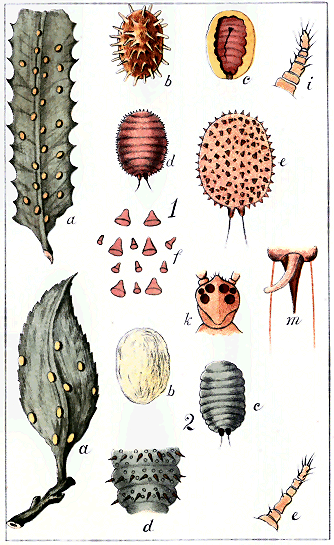
1. Eriococcus multispinus. a, insects on leaf of Knightia; b, sac of female, upper side; c, sac of female, under-side, with enclosed insect; d, adult female, dorsal aspect; e, diagram of arrangement of spines on female; f, spines of female; i, antenna of female; k, head of male, upper side; m, abdominal spike of male.
2. Eriococcus pallidus. a, insects on leaf of Myoporum (ngaio); b, sac of female; c, adult female, dorsal aspect; d, part of abdomen of female; e, antenna of female.
A. D. WILLIS, WANGANUI, N. Z.
W.M.M., delt. ad. nat
PLATE XV.
Plate XVI.
Fig.
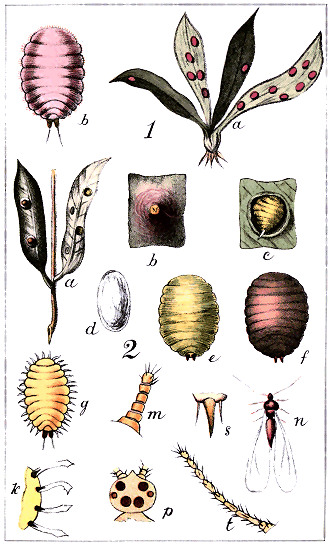
1. Rhizococcus celmisiæ. a, Insects on leaves of Celmisia; b, adult female dorsal aspect.
2. Rhizococcus fossor. a, Insects on leaves of Santalum (maire); b, elevation produced by insect on upper side of leaf; c, female in pit on under-side of leaf; d, sac of male; e, adult female before gestation, from a pit; f, adult female from surface of leaf; g, female of second stage; k, marginal spines and tubular cotton of second stage; m, antenna of adult female; n, male; p, diagram of head of male, upper and lower sides shown together, four eyes and two ocelli; s, abdominal spike of male; t, antenna of male.
A. D. WILLIS, WANGANUI, N. Z.
W.M.M., delt. ad. nat
PLATE XVI.
Plate XVII.
Fig.
1. Dactylopius alpinus. a, Insects on twig of Veronica; b, adult female, dorsal aspect; c, female of second stage; d, anogenital ring; e, antenna of adult female.
2. Dactylopius calceolariæ. a, Insects on leaf of Phormium tenax; b, adult female, dorsal aspect; c, antenna of adult female.
3. Dactylopius glaucus. a, Insects on leaf of Coprosma; b, adult female, green variety; c, adult female, brown variety; d, sac of male; e, antenna of male.
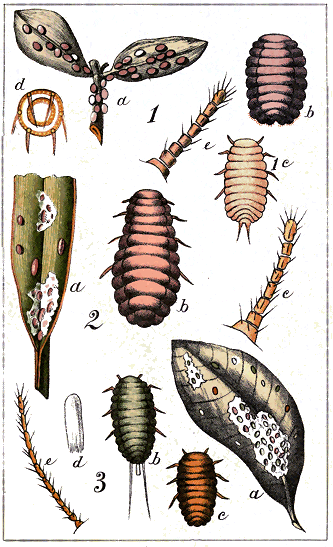
A. D. WILLIS, WANGANUI, N. Z.
W.M.M., delt. ad. nat
PLATE XVII.
Plate XVIII.
Fig.
1. Dactylopius poæ. a, Insects on roots of Poa (tussock-grass); b, adult female; c, antenna of adult female; d, foot of adult female; e, anogenital ring and anal tubercles of adult female.
2. Pseudococcus asteliæ. a, Insects on leaf of Astelia; b, adult female, dorsal aspect; c, antenna of adult female; d, foot of adult female; e, various spinnerets.
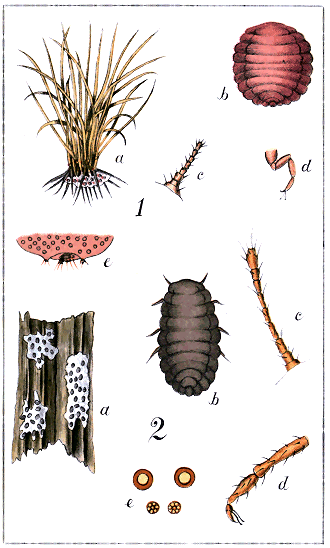
A. D. WILLIS, WANGANUI, N. Z.
W.M.M., delt. ad. nat
PLATE XVIII.
Plate XIX.
Icerya Purchasi. a, Insects on twig of Acacia (wattle); b, adult female and ovisac, upper view; c, adult female and ovisac, side view; d, female of second stage; e, larva, with yellow cotton; f, male; g, haltere of male; k, two joints of male antenna; m, hairs, spinnerets, and glassy tubes; n, antenna of adult female.
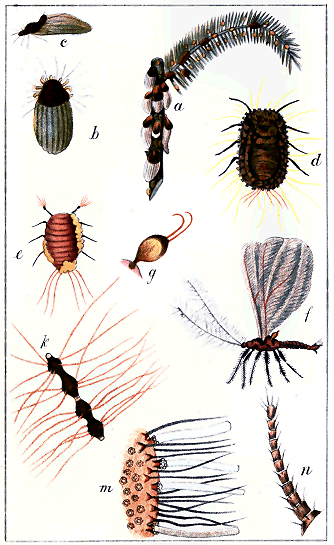
A. D. WILLIS, WANGANUI, N. Z.
W.M.M., delt. ad. nat
PLATE XIX.
Plate XX.
Cœlostoma zælandicum. a, adult female, dorsal aspect; b, adult female, ventral aspect; c, waxy tests of females of second stage on twig of Muhlenbeckia; d, female of second stage, dorsal aspect; e, female of second stage, ventral aspect, with anal tuft of cotton and seta; f, larva, with yellow mealy secretion; g, eggs, in cottony mass; k, antenna of female, second stage; l, foot of female, second stage; m, antenna of adult female; n, spiracle and trachea of female; p, anal extremity and "honeydew" organ of larva and female of second stage.
N.B.—The foot of the adult female is shown in Plate I., Fig. 6.
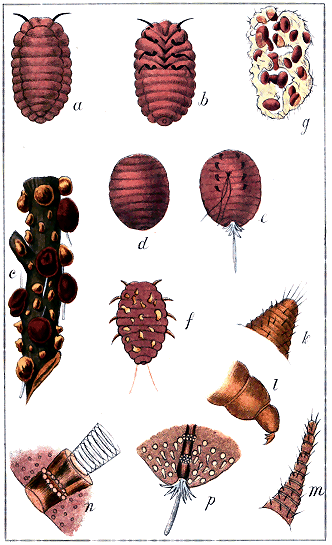
A. D. WILLIS, WANGANUI, N. Z.
W.M.M., delt. ad. nat
PLATE XX.
Plate XXI.
Fig.
1. Cœlostoma zælandicum. a, male insect; b, abdomen of male; c, foot of male; d, hairs and marks, abdomen of male; e, antenna of male; f, circular marks, abdomen of male; k, abdominal spike and penis of male; m, haltere of male.
2. Cœlostoma wairoense. a, male insect; b, head of male, upper side, with facetted eyes; c, foot of male; d, circular marks, abdomen of male.
A. D. WILLIS, WANGANUI, N. Z.
W.M.M., delt. ad. nat
PLATE XXI.
Plate XXII.
The Honeydew, and resulting Fungi.
Fig.
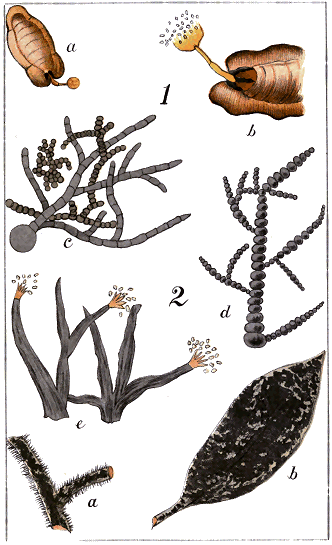
1. a, Lecanid female (Ctenochiton) with protruded honeydew organ; b, abdominal extremity of the same, enlarged, the drop of honeydew bursting in spray.
2. a, fungoid growth on upper side of leaf; b, fungoid growth on twig; c, d, e, various forms of black fungi from honeydew.
A. D. WILLIS, WANGANUI, N. Z.
W.M.M., delt. ad. nat
PLATE XXII.
Plate XXIII.
Parasites of Coccididæ.
Fig.
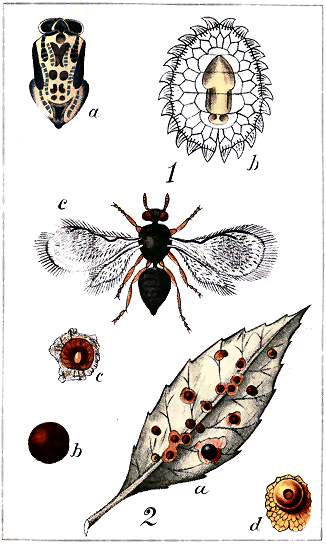
1. a, pupa of hymenopterous parasite; b, the same pupa under the waxy test of Ctenochiton perforatus; c, imago, or full-grown parasite.
2. a, brown and yellow fungi on Ctenochiton viridis (leaf of Hedycarya dentata); b, upper side of brown fungus; c, under-side of the same, with attached fungoid sheet; d., Ctenochiton viridis (test removed) filled with yellow fungus, and with globular mass of the same above it.
A. D. WILLIS, WANGANUI, N. Z.
W.M.M., delt. ad. nat
PLATE XXIII.
Since this work has been in type, the author has received a letter from the State Inspector of Fruit Pests for California, in which the writer states that the insect Icerya Purchasi has there, especially in the southern part of the State, gained such hold on the orange-groves, in spite of the most strenuous efforts, that the people find it impossible to keep it down. Orange- and lemon-growers (and indeed other tree-growers) in New Zealand, especially in the North Island, should take note of this fact, and beware of ever letting this omnivorous and most destructive insect obtain any footing on their trees. A speedy burning of every infected tree is the best remedy in this case.
Transcriber Notes
Illustrations were moved so as not to split paragraphs. Cover image compiled from materials made available at The Internet Archive (https://archive.org).
The notes explaining the damage done by the insects in the "INDEX OF PLANTS AND THE COCCIDIDÆ ATTACKING THEM." were moved before the table.