Introductory material
Reading edition


It is with reluctance that I suffer these fragmentary and inadequate sketches of the Isles of Shoals to appear in book form. Except that some account of the place, however slight, is so incessantly called for by people who throng these islands in summer, I should hardly venture to offer to the public so imperfect a chronicle, of which the most that can be said is, that it is, perhaps, better than nothing.

AMONG THE ISLES OF SHOALS.

In a series of papers published not many years ago, Herman Melville made the world acquainted with the “Encantadas,” or Enchanted Islands, which he describes as lying directly under the equator, off the coast of South America, and of which he says: “It is to be doubted whether any spot of earth can, in desolateness, furnish a parallel to this group.” But their dark volcanic crags and melancholy beaches can hardly seem more desolate than do the low bleached rocks of the Isles of Shoals to eyes that behold them for the first time. Very sad they look, stern, bleak, and unpromising, yet are they enchanted islands in a better sense of the word than are the great Galapagos of which Mr. Melville discourses so delightfully.
There is a strange charm about them, an indescribable influence in their atmosphere, hardly to be explained, but universally acknowledged. People forget the hurry and worry and fret of life after living there awhile, and, to an imaginative mind, all things become dreamy as they were to the lotus-eaters, to whom
“The gushing of the wave Far, far away did seem to mourn and rave On alien shores.”
The eternal sound of the sea on every side has a tendency to wear away the edge of human thought and perception; sharp outlines become blurred and softened like a sketch in charcoal; nothing appeals to the mind with the same distinctness as on the mainland, amid the rush and stir of people and things, and the excitements of social life. This was strikingly illustrated during the late war, which, while it wrung the heart of the whole country, and stirred the blood of every man, woman, and child on the continent, left the handful of human beings upon these lonely rocks almost untouched. The echoes of woe and terror were so faint and far they seemed to lose their significance among the many-voiced waters they crossed, and reached at last the indifferent ears they sought with no more force than a spent wave.
Nine miles of the Atlantic Ocean intervene between these islands and the nearest point of the coast of New Hampshire; but from this nearest point the coast-line recedes gradually, in dim and dimmer distance, to Cape Ann, in Massachusetts, twenty-one miles away at the southwest, and to Cape Neddock, in Maine, sixteen miles distant in the northeast (in clear weather another cape is faintly distinguishable beyond this), and about one third of the great horizon is filled by this beautiful, undulating line of land, which, under the touch of atmospheric change, is almost as plastic as the clouds, and wears a new aspect with every turn of wind and weather.
Sailing out from Portsmouth Harbor with a fair wind from the northwest, the Isles of Shoals lie straight before you, nine miles away,—ill-defined and cloudy shapes, faintly discernible in the distance. A word about the origin of this name, “Isles of Shoals.” They are supposed to have been so called, not because the ragged reefs run out beneath the water in all directions, ready to wreck and destroy, but because of the “shoaling,” or “schooling,” of fish about them, which, in the mackerel and herring seasons, is remarkable. As you approach they separate, and show each its own peculiar characteristics, and you perceive that there are six islands if the tide is low; but if it is high, there are eight, and would be nine, but that a breakwater connects two of them. Appledore, called for many years Hog Island, from its rude resemblance to a hog’s back rising from the water, when seen from out at sea, is the largest and most regular in shape. From afar, it looks smoothly rounded, like a gradually sloping elevation, the greatest height of which is only seventy-five feet above high-water mark. A little valley in which are situated the buildings belonging to the house of entertainment, which is the only habitation, divides its four hundred acres into two unequal portions. Next, almost within a stone’s throw, is Haley’s Island, or “Smutty-nose,” so christened by passing sailors, with a grim sense of humor, from a long black point of rock stretching out to the southeast, upon which many a ship has laid her bones. This island is low and flat, and contains a greater depth of soil than the others. At low tide, Cedar and Malaga are both connected with it,—the latter permanently by a breakwater,—the whole comprising about one hundred acres. Star Island contains one hundred and fifty acres, and lies a quarter of a mile southwest of Smutty-nose. Toward its northern end are clustered the houses of the little village of Gosport, with a tiny church crowning the highest rock. Not quite a mile southwest from Star, White Island lifts a lighthouse for a warning. This is the most picturesque of the group, and forms, with Seavey’s Island, at low water, a double island, with an area of some twenty acres. Most westerly lies Londoner’s, an irregular rock with a bit of beach, upon which all the shells about the cluster seem to be thrown. Two miles northeast from Appledore, Duck Island thrusts out its lurking ledges on all sides beneath the water, one of them running half a mile to the northwest. This is the most dangerous of the islands, and, being the most remote, is the only one visited to any great degree by the shy sea-fowl that are nearly banished by civilization. Yet even now, at low tide, those long black ledges are often whitened by the dazzling plumage of gulls whose exquisite and stainless purity rivals the new-fallen snow. The ledges run toward the west and north; but at the east and south the shore is bolder, and Shag and Mingo Rocks, where, during or after storms, the sea breaks with magnificent effect, lie isolated by a narrow channel from the main granite fragment. A very round rock west of Londoner’s, perversely called “Square,” and Anderson’s Rock, off the southeast end of Smutty-nose, complete the catalogue.
Smutty-nose and Appledore are almost united by a reef, bare at low tide, though a large vessel can pass between them even then. Off the landing at White Island the Devil’s Rock rolls an incessant breaker, and makes an attempt to reach the shore perilous in any but the serenest weather. Between Londoner’s and Star is another, hardly bare at low tide; a perpetual danger, for it lies directly in the path of most of the sailing vessels, and many a schooner has been “brought up all standing” by this unexpected obstacle. Another rock, about four miles east of Appledore, rejoices in the significant title of the “Old Harry.” Old Harry is deeply sunk beneath the surface, and never betrays himself except in great storms, when an awful white spray rises afar off, and the Shoalers know how tremendous are the breakers that send it skyward.
The names of the towns, Appledore, Gosport, and, along the coast, Portsmouth, Newcastle, Rye, Ipswich, Portland, Bangor, Newbury, Amesbury, Salisbury, and many more, are all borrowed from towns on, or not far from, the coasts of England and Wales, as may be seen from the maps of those countries. Salisbury Beach fronts our islands. Amesbury lies farther inland, but the gentle outline of Po Hill, in that town, is the last eminence of any importance on the southern end of the coast line.
The dividing line between Maine and New Hampshire passes through the group, giving Appledore, Smutty-nose, and Duck Islands to Maine, and the rest to New Hampshire; but their allegiance to either is a matter of small importance, the few inhabitants troubling themselves but little about what State they belong to. Till within a few years no taxes were required of them, and they enjoyed immunity from this and various other earthly ills as completely as the gulls and loons that shared their dwelling-place.
Swept by every wind that blows, and beaten by the bitter brine for unknown ages, well may the Isles of Shoals be barren, bleak, and bare. At first sight nothing can be more rough and inhospitable than they appear. The incessant influences of wind and sun, rain, snow, frost, and spray, have so bleached the tops of the rocks, that they look hoary as if with age, though in the summer-time a gracious greenness of vegetation breaks here and there the stern outlines, and softens somewhat their rugged aspect. Yet so forbidding are their shores, it seems scarcely worth while to land upon them,—mere heaps of tumbling granite in the wide and lonely sea,—when all the smiling, “sapphire-spangled marriage-ring of the land” lies ready to woo the voyager back again, and welcome his returning prow with pleasant sights and sounds and scents that the wild wastes of water never know. But to the human creature who has eyes that will see and ears that will hear, nature appeals with such a novel charm, that the luxurious beauty of the land is half forgotten before one is aware. Its sweet gardens, full of color and perfume, its rich woods and softly swelling hills, its placid waters, and fields and flowery meadows, are no longer dear and desirable; for the wonderful sound of the sea dulls the memory of all past impressions, and seems to fulfil and satisfy all present needs. Landing for the first time, the stranger is struck only by the sadness of the place,—the vast loneliness; for there are not even trees to whisper with familiar voices,—nothing but sky and sea and rocks. But the very wildness and desolation reveal a strange beauty to him. Let him wait till evening comes,
“With sunset purple soothing all the waste,”
and he will find himself slowly succumbing to the subtile charm of that sea atmosphere. He sleeps with all the waves of the Atlantic murmuring in his ears, and wakes to the freshness of a summer morning; and it seems as if morning were made for the first time. For the world is like a new-blown rose, and in the heart of it he stands, with only the caressing music of the water to break the utter silence, unless, perhaps, a song-sparrow pours out its blissful warble like an embodied joy. The sea is rosy, and the sky; the line of land is radiant; the scattered sails glow with the delicious color that touches so tenderly the bare, bleak rocks. These are lovelier than sky or sea or distant sails, or graceful gulls’ wings reddened with the dawn; nothing takes color so beautifully as the bleached granite; the shadows are delicate, and the fine, hard outlines are glorified and softened beneath the fresh first blush of sunrise. All things are speckless and spotless; there is no dust, no noise, nothing but peace in the sweet air and on the quiet sea. The day goes on; the rose changes to mellow gold, the gold to clear, white daylight, and the sea is sparkling again. A breeze ripples the surface, and wherever it touches the color deepens. A seine-boat passes, with the tawny net heaped in the stern, and the scarlet shirts of the rowers brilliant against the blue. Pleasantly their voices come across the water, breaking the stillness. The fishing-boats steal to and fro, silent, with glittering sails; the gulls wheel lazily; the far-off coasters glide rapidly along the horizon; the mirage steals down the coast-line, and seems to remove it leagues away. And what if it were to slip down the slope of the world and disappear entirely? You think, in a half-dream, you would not care. Many troubles, cares, perplexities, vexations, lurk behind that far, faint line for you. Why should you be bothered any more?
“Let us alone. Time driveth onward fast, And in a little while our lips are dumb.”
And so the waves, with their lulling murmur, do their work, and you are soothed into repose and transient forgetfulness.
The natives, or persons who have been brought up here, find it almost as difficult to tear themselves away from the islands as do the Swiss to leave their mountains. From a civilized race’s point of view, this is a curious instance of human perversity, since it is not good for men to live their whole lives through in such remote and solitary places. Nobody hears of people dying of homesickness for New York, or Albany, or Maine, or California, or any place on the broad continent; but to wild and lonely spots like these isles humanity clings with an intense and abiding affection. No other place is able to furnish the inhabitants of the Shoals with sufficient air for their capacious lungs; there is never scope enough elsewhere; there is no horizon; they must have sea-room. On shore it is to them as if all the trees and houses crowded against the windows to suffocation; and I know a youth who, when at the age of thirteen he made his first visit to the mainland, descended to the cellar of the house in which he found himself, in the not over-populous city of Portsmouth, and spent the few hours of his stay sitting dejectedly upon a wood-pile, in mute protest against the condition of things in general, and the pressure of human society in particular.
Each island has its peculiar characteristics, as I said before, and no two are alike, though all are of the same coarse granite, mixed with masses and seams of quartz and feldspar and gneiss and mica-slate, and interspersed with dikes of trap running in all directions. Upon Appledore, for the most part, the trap runs from north to south, while the veins of quartz and feldspar run from east to west. Sometimes the narrow white quartz veins intersect the dark trap, in parallel lines, now wavering, and now perfectly straight, and showing a surface like that of some vast piece of inlaid work. Each island presents its boldest shore to the east, to breast the whole force of the great Atlantic, which every year assails the iron cliffs and headlands with the same ponderous fury, yet leaves upon them so little trace of its immense power,—though at White Island, on the top of a precipitous rock called “The Head,” which is nearly fifty feet high, lies a bowlder weighing fifteen tons, tossed there from below by the breakers. The shores are seldom very bold, but on the east they are often very striking with their rifts and chasms, and roughly piled gorges, and square quarries of stone, and stairways cut as if by human hands. The trap rock, softer than the granite, is worn away in many places, leaving bare perpendicular walls fifteen or twenty feet high. The largest trap dike upon Appledore runs across the island from northeast to southwest, disappears in the sea, and reappears upon Smutty-nose, a quarter of a mile distant in a straight line. In some places, the geologist will tell you, certain deep scratches in the solid rock mean that here the glacier ground its way across in the world’s earlier ages. Frequently the trap rock is honeycombed in a curious fashion,—filled with small holes on the surface, as if drops of water falling for years in the same spots had worn these smooth round hollows. This always happens close to the water, and only in the trap rock, and looks as if it might be the result of the flying spray which, in winter and toward spring, when the northwest gales blow sometimes for three weeks steadily day and night, beats continually upon the shore.
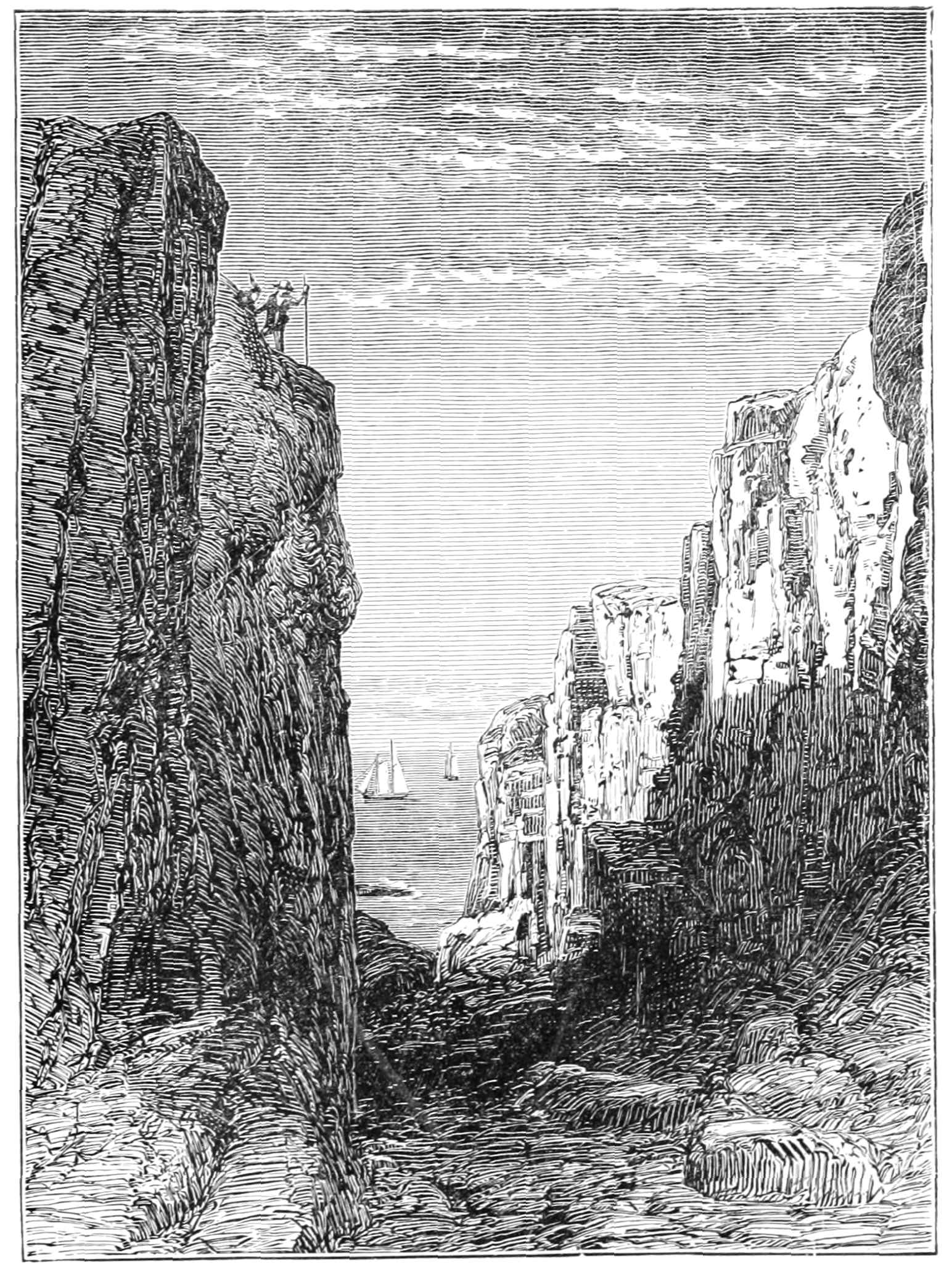
Trap Dike, Appledore.
The coast-line varies, of course, with high or low tide. At low water the shores are much more forbidding than at high tide, for a broad band of dark sea-weed girdles each island, and gives a sullen aspect to the whole group. But in calm days, when the moon is full and the tides are so low that it sometimes seems as if the sea were being drained away on purpose to show to eager eyes what lies beneath the lowest ebb, banks of golden green and brown moss thickly clustered on the moist ledges are exposed, and the water is cut by the ruffled edges of the kelps that grow in brown and shining forests on every side. At sunrise or sunset the effect of the long rays slanting across these masses of rich color is very beautiful. But at high tide the shores are most charming; every little cove and inlet is filled with the music of the waves, and their life, light, color, and sparkle. Who shall describe that wonderful noise of the sea among the rocks, to me the most suggestive of all the sounds in nature? Each island, every isolated rock, has its own peculiar rote, and ears made delicate by listening, in great and frequent peril, can distinguish the bearings of each in a dense fog. The threatening speech of Duck Island’s ledges, the swing of the wave over Halfway Rock, the touch of the ripples on the beach at Londoner’s, the long and lazy breaker that is forever rolling below the lighthouse at White Island,—all are familiar and distinct, and indicate to the islander his whereabouts almost as clearly as if the sun shone brightly and no shrouding mist were striving to mock and to mislead him.
There are no beaches of any considerable size along the circle of these shores, and except in two narrow fissures, one on Malaga and one on Star, only a few feet wide at their widest, there is no fine, clean sand, such as lies sparkling on the coast at Rye, opposite, and shows, faintly glimmering, white in the far distance. The dock at Smutty-nose is filled with coarse sand and mud, like the little basin of the “Upper Cove” on Appledore; and the largest beach on Star, of the same character, is covered with a stratum of fish-bones several feet deep,—by no means a pleasantly fragrant pavement. Roughly rounded pebbles, not beautiful with warmth of color like those on the Cohasset beaches, but a cold, hard combination of gray granite and dark trap, are heaped in the coves. Indian arrowheads of jasper and flint have been found among them. Now and then a smoother bit consists of a coarse gravel, which, if you examine, you will find to be principally composed of shells ground fine by the waves, a fascinating mixture of blue and purple mussels, lined with the rainbow tints of mother-of-pearl, and fragments of golden and ruddy snail-shells, and striped and colored cockles; with here and there a piece of transparent quartz, white or rosy, or of opaque feldspar, faintly straw-colored, or of dull-purple porphyry stone, all clean and moist with the odorous brine. Upon Appledore and the little islets undevastated by civilization these tiny coves are the most delightful places in the world, lovely with their fringe of weeds, thistles, and mullein-stalks drawn clearly against the sky at the upper edge of the slope, and below, their mosaic of stone and shell and sea-wrack, tangles of kelp and driftwood,—a mass of warm neutral tints,—with brown, green, and crimson mosses, and a few golden snail-shells lying on the many-tinted gravel, where the indolent ripples lapse in delicious murmurs. There are few shells more delicate than the variegated snails and cockles and stout whelks that sparsely strew the beaches, but these few are exceedingly beautiful, and more precious from their rarity. Two kinds of pure white spiral shells, not quite an inch long, are occasionally found, and cause one to wonder how they can be rolled together with the heavy pebbles by the breakers and not be annihilated.
After the dark blue mussel-shells have lain long on shore in sun and rain, they take a curious satin sheen, lovely to behold, and the larger kind, shedding their coat of brown varnish, are colored like the eastern sky in clear winter sunsets, a rosy purple, with pearly linings streaked with iridescent hues. The driftwood is always full of suggestions:—a broken oar; a bit of spar with a ragged end of rope-yarn attached; a section of a mast hurriedly chopped, telling of a tragedy too well known on the awful sea; a water-worn buoy, or flakes of rich brown bark, which have been peacefully floated down the rivers of Maine and out on the wide sea, to land at last here and gladden firesides so remote from the deep green wood where they grew; pine-cones, with their spicy fragrance yet lingering about them; apples, green spruce twigs, a shingle, with some carpenter’s half-obliterated calculations pencilled upon it; a child’s roughly carved boat; drowned butterflies, beetles, birds; dead boughs of ragged fir-trees completely draped with the long, shining ribbon-grass that grows in brackish water near river mouths. The last, after lying awhile in the wind and sun, present a weird appearance, for the narrow ribbons are dried and bleached as white as chalk, and shiver and shudder with every wind that blows. It used to be a great delight to hold such a bough aloft, and watch all the long, delicate pennons and streamers fly trembling out on the breeze. Beyond high-water mark all things in the course of time take a uniform gray color from the weather; wood, shells, stones, deposited by some great tide or storm, and left undisturbed for months, chocolate-colored bark and yellow shingle and gray stone are not to be distinguished one from another, except by their shape. Of course all white things grow whiter, and shells already colorless become as pure as snow. Sometimes the slabs and blocks of wood that float ashore have drifted so long that they are water-logged, and covered with a rich growth of mosses, barnacles, and wondrous sea-creatures. Sometimes they are completely riddled by the pholas, and the hardest shells are pierced smoothly through and through by these soft worms.
But as a child I was never without apprehension when examining the drift, for I feared to find some too dreadful token of disaster. After the steamer Bohemian was wrecked (off Halifax, I think) a few years ago, bales of her costly cargo of silks and rich stuffs and pieces of the wreck were strewn along the coast even to Cape Ann; and upon Rye Beach, among other things, two boots came on shore. They were not mates, and each contained a human foot. That must have been a grewsome discovery to him who picked them up.
There are not many of these quiet coves. In general a confusion reigns as if an earthquake had rent and split the coasts, and tumbled the masses in chaotic heaps. On Appledore and the larger islands the interior is rather smoother, though nowhere will you find many rods of plain walking. Slopes of greenness alternate with the long white ledges, and here and there are bits of swampy ground and little valleys where the turf is short, and the sheep love to browse, and the mushrooms grow in August and September. There are no trees except, perhaps, a few balm-of-gilead trees on Star and a small elm on Appledore, which has been struggling with the bleakness of the situation some twenty years. It is very probable that the islands were wooded many years ago with spruce and pine perhaps,—a rugged growth. I am certain that cedars grew there, for I found on the highest part of Smutty-nose Point, deep down in a crevice in the rocks, a piece of a root of cedar-wood, which, though perfectly preserved, bore marks of great age, being worn as smooth as glass with the raindrops that had penetrated to its hiding-place. There are a few bushes, browsed down by the sheep, with maple, poplar, and birch leaves; and I have seen the crumbling remains of the stump of some large tree in the principal gorge or valley at Appledore. The oldest inhabitants remember quite an orchard on Smutty-nose. In the following note (for which I am indebted to Mr. T. B. Fox) from “Christopher Leavitt’s Voyage into New England” in the year 1623, it appears that there were trees, though not of the kind the voyagers wished to see. He says: “The first place I set my foot upon in New England was the Isles of Shoulds. We could see not one good timber tree, or so much good ground as to make a garden. Good fishing-place for six ships,” he goes on to say, “not more for want of good storage rooms. Harbor indifferent good. No savages at all.” That was two hundred and forty-six years ago. In the Rev. Jedediah Morse’s journal of a mission to the Shoals in August, 1800, he says, referring to the wretched state of the inhabitants of Star Island at that time, “All the trees, and the bushes even, have been consumed, and they have cut up, dried, and burned many acres of the sward, leaving only naked rocks where formerly there was the finest pasturage for cows.” The bushes have never grown again on Star; but Appledore, wherever there is soil enough to hold a root, is overgrown with huckleberry and bayberry bushes, the glossy green leaves of the latter yielding a wholesome, aromatic fragrance, which accords well with the fresh and healthy sea-odors. Blackberry, raspberry, wild currant, and gooseberry bushes also flourish; there are clumps of elder and sumach, woodbine and the poison ivy, shrubs of wild-cherry and shadbush, and even one little wild apple-tree that yearly bears a few large, bright blossoms.
It is curious to note the varieties of plants, wild-flowers, and grasses on this island alone. There are six different ferns, and many delicate flowers bloom in the spring, whose faces it is a continual surprise to find looking up at you from the rough ground, among the rocks. Every flower seems twice as beautiful under these circumstances; and it is a fact that the salt air and a peculiar richness in the soil give a luxuriance of growth and a depth of color not found elsewhere. “Is that willow-weed” (or whatever it may be)? “I never saw any so bright!” is a remark often heard from strangers visiting the islands for the first time. The pale-pink herb-robert, for instance, blushes with a tint almost as deep as a damask rose, and as for the wild-roses, I heard some one say they were as “bright as red carnations.” In the spring the anemones are stained with purple and pink and yellow in a way that makes their sisters of the mainland seem pallid beside them; and the violets are wonderful,—the blue ones so large and dark, and the delicately-veined white ones rich with creamy fragrance.
The calyx of the shadbush-flower is dyed with purple, almost crimson, and the color runs into the milky whiteness of the petals. The little pimpernel (when it has anything but salt gravel to grow in, for it runs fairly into the sea) is clear vermilion, and the pearly eyebright is violet on the edges; the shy celandine glows golden in its shady clefts, and the spotted jewel-weed is as rich and splendid as a flower in Doctor Rappacini’s famous garden. Sometimes it is as if the order of nature were set aside in this spot; for you find the eyebright and pimpernel and white violets growing side by side until the frost comes in November; often October passes with no sign of frost, and the autumn lingers later than elsewhere. I have even seen the iris and wild-rose and golden-rod and aster in blossom together, as if, not having the example of the world before their eyes, they followed their own sweet will, and bloomed when they took the fancy. As for garden flowers, when you plant them in this soil they fairly run mad with color. People say, “Do give me some seeds of these wonderful flowers”; and they sow them in their gardens on the mainland, and they come up decorous, commonplace, and pale, like their sisters in the same soil. The little spot of earth on which they grow at the island is like a mass of jewels. Who shall describe the pansies, richly streaked with burning gold; the dark velvet coreopsis and the nasturtium; the larkspurs, blue and brilliant as lapis-lazuli; the “ardent marigolds,” that flame like mimic suns? The sweet-peas are of a deep, bright rose-color, and their odor is like rich wine, too sweet almost to be borne, except when the pure fragrance of mignonette is added,—such mignonette as never grows on shore. Why should the poppies blaze in such imperial scarlet? What quality is hidden in this thin soil, which so transfigures all the familiar flowers with fresh beauty? I have heard it said that it is the crumbled rock which so enriches the earth, but I do not know.
If a flock of sheep and various cows did not browse over Appledore incessantly, it would be a little wilderness of wild-flowers in the summer; they love the soil and climate, and put forth all their strength and loveliness. And every year or two a new kind appears, of which the seed has been brought by some bird, or, perhaps, shaken out of a bundle of hay. Last summer, for the first time, I found the purple polygala growing in a meadowy piece of turf on the south side of the island. Columbines and the fragrant ground-nut, helianthus, and various other plants, grow only on Duck Island; and it is singular that the little potentilla, which I am told grows elsewhere only on mountain-sides, is found here on all the islands. At Smutty-nose alone certain plants of the wicked-looking henbane (Hyoscyamus niger) flourish, and, on Londoner’s only, there spreads at the top of the beach a large sea-lungwort (Mertensia maritima). At Star the crooked little ways between the houses are lined with tall plants of the poisonous hemlock (the Conium that made the death-draught of Socrates), which flourishes amain, and is the only green thing out of the small walled enclosures, except the grass and the burdocks; for the cows and the children devastate the ground.
Appledore is altogether the most agreeable in its aspect of all the islands, being the largest, and having a greater variety of surface than the rest. Its southern portion is full of interest, from the traces of vanished humanity which one beholds at every step; for the ground in some places is undermined with ancient graves, and the ruined cellars of houses wherein men and women lived more than a century ago are scattered here and there to the number of seventy and more. The men and women are dust and ashes; but here are the stones they squared and laid; here are the thresholds over which so many feet have passed. The pale green and lilac and golden lichens have overgrown and effaced all traces of their footsteps on the door-stones; but here they passed in and out,—old and young, little feet of children, heavy tramp of stalwart fishermen, lighter tread of women, painful and uncertain steps of age. Pleasant it is to think of the brown and swarthy fisherman, the father, standing on such a threshold, and with the keen glance all seafaring men possess sweeping the wide horizon for signs of fair or foul weather; or the mother, sitting in the sun on the step, nursing her baby, perhaps, or mending a net, or spinning,—for the women here were famous spinners, and on Star Island yet are women who have not forgotten the art. Pleasanter still to think of some slender girl at twilight lingering with reluctant feet, and wistful eyes that search the dusky sea for a returning sail whose glimmer is sweeter than moonlight or starlight to her sight,—lingering still, though her mother calls within and the dew falls with the falling night. I love to people these solitudes again, and think that those who lived here centuries ago were decent, God-fearing folk, most of them,—for so tradition says;[A] though in later years they fell into evil ways, and drank “fire-water,” and came to grief. And all the pictures over which I dream are set in this framework of the sea, that sparkled and sang, or frowned and threatened, in the ages that are gone as it does to-day, and will continue to smile and threaten when we who listen to it and love it and fear it now are dust and ashes in our turn.
Some of the cellars are double, as if two families had built together; some are distinctly marked; in others the stones have partly fallen in; all are more or less overgrown with lichens, and thick, short turf creeps everywhere in and about them. Sometimes garlands of woodbine drape the walls, and poison-ivy clasps and knots itself about the rocks; clumps of sweet flowering-elder cluster in the corners, or graceful, stag-horned sumachs, or raspberry bushes with ruddy fruit. Wild spiked thistles spread, and tall mullein-stalks stand like sentinels on guard over the desolation. Beautiful it is to see the delicate herb-robert’s rosy flowers among the rough heaps of rocks, like a tender afterthought where all is hard and stern.
It is a part of the religious belief of the Shoalers, that the ruinous cairn on the summit of Appledore was built by the famous John Smith and his men when they discovered the islands in the year 1614; and I will not be so heretical as to doubt the fact, though it seems just as likely that it was set up by fishermen and sailors as a landmark. At any rate, nobody knows when it was not there, and it is perfectly safe to imagine any origin for it. I never could be precisely certain of the site of the first meeting-house on this island, “built (of brick) at a very early period, possibly the first in the province,” says Williamson in his “History of Maine.” Probably there was no cellar beneath it, and the slight underpinning has been scattered and obliterated by time,—a fate which many of the houses must have shared in like manner. When man has vanished, Nature strives to restore her original order of things, and she smooths away gradually all traces of his work with the broad hands of her changing seasons. The men who built the Pyramids felt this; but will not the world spin long enough to level their masonry with the desolate sands? Neither is there any sign of the foundation of that “Academy” to which “even gentlemen from some of the principal towns on the sea-coast sent their sons for literary instruction,”—I quote again from Williamson. How like a dream it seems, looking now at these deserted rocks, that so much happened here in the years that are gone! The connection of Spain with these islands always had a great fascination for me; it is curious that the brightest and gayest of lands, all aglow with sunshine and so rich with southern beauty, should be in any way linked with this place, so remote and desolate. “In 1730, and afterwards, three or four ships used to load at the Shoals with winter and spring merchantable fish for Bilboa in Spain.” What wondrous craft must have navigated these waters,—lazy, lumbering old ships, with quaintly carved figure-heads, and high-peaked sterns and prows, and heavy draperies of weather-beaten sails, picturesque and charming to behold, and well enough for the sparkling Mediterranean, but not the sort of build to battle with the Atlantic breakers, as several wrecks of vessels caught in the terrible gales and driven upon the pitiless ledges might testify! The ship Sagunto, it is said, met her destruction here as late as the year 1813; and there are faint echoes of other disasters of the kind, but the names of other ships have not come down to us. One wrecked on Appledore left only a quantity of broad silver pieces sprinkled about the rocks to tell of the calamity. A fisherman from Star, paddling over in his dory to explore the coves and chasms for driftwood (for the island was uninhabited at the time), came suddenly upon the glittering coins. His amazement was boundless. After filling his pockets, a sudden terror possessed him; he began to have a suspicion that something uncanny lurked at the bottom of such good fortune (for the superstition of the natives is very great), and fled home to tell his neighbors, who came in a body and made short work of the process of gathering the rest of the treasure. Occasionally, since that time, coins have been found about the southeast point, whereon the unknown vessel struck and was completely destroyed. Of course Captain Kidd, “as he sailed,” is supposed to have made the locality one of his many hiding-places. I remember being awed when a child at the story of how a certain old black Dinah, an inhabitant of Portsmouth, came out to Appledore, then entirely divested of human abodes, and alone, with only a divining-rod for company, passed several days and nights wandering over the island, muttering to herself, with her divining-rod carefully balanced in her skinny hands. Robert Kidd’s buried treasure, if it existed, never signalled from below to that mystic rod, and the old negress returned empty-handed; but what a picture she must have made wandering there in the loneliness, by sunlight, or moonlight, or starlight, with her weird figure, her dark face, her garments fluttering in the wind, and the awful rod in her hand!
On Star Island, I have been told, a little three-legged black pot full of gold and silver pieces was dug up not very many years ago; and it is certainly true that Mr. Samuel Haley, who lived upon and owned Smutty-nose, in building a wall, turned over a large, flat stone beneath which lay four bars of solid silver. He must have been a fine, energetic old fellow, that Samuel Haley. With this treasure, says tradition again, he built, at great trouble and expense, the sea-wall which connects Smutty-nose with Malaga, and makes a safe harbor for distressed mariners in stormy weather. (This name Malaga, by the way, is a very distinct token of the Spaniards.) Not only did Haley build the sea-wall, but he erected salt-works which “manufactured excellent salt for the curing of fish,” and stretched a ropewalk over the uneven ground to the extent of two hundred and seventy feet, and set up windmills to catch with their wide wings all the winds that blew, that he might grind his own corn and wheat, and live as independently as possible of his fellow-men; for that is one of the first things a settler on the Isles of Shoals finds it necessary to learn. He planted a little orchard where the soil was deepest, and with much cherishing care contrived to coax his cherry-trees into abundant fruitfulness, and in every way made the most of the few advantages of the place. The old square house which he built upon his island, and which still stands, had, long ago, a broad balcony running the whole length of the house beneath the second-story windows. This being in a ruinous condition, I never dared venture out upon it; but a large, square lookout, with a stout railing, which he built on the top of the house, remained till within a few years; and I found it a charming place to linger in on still days, and watch the sky and the sea and the vessels, and the play of color over the bright face of the world. Looking from that airy station years ago, I used to think how many times he had sat there with his spy-glass, scanning the horizon and all within it, while the wind ruffled his gray hair and the sun shone pleasantly across his calm old face. Many years of his useful, happy life he lived there, and left behind him a beloved and honorable name. His descendants, still living upon Star, are among the best people in the village. A young girl bearing his name was lately married to one of the youthful fishermen. Star Island might well be proud of such a girl, so modest and sweet, and pretty too, slender and straight, dark-haired, brown-eyed,—as picturesque a creature as one would wish to see, with a delicate rose in her cheek and a clear light of intelligence in her eyes. Considering her, and remembering this ancient ancestor of hers, I thought she came honestly by her gentle, self-reliant expression, and her fine bearing, full of unconscious dignity and grace. The old man’s quaint epitaph speaks of his humanity in “receiving into his enclosure many a poor, distressed seaman and fisherman in distress of weather.” “In distress of weather!” One must live in such a place fully to comprehend the meaning of the words. It was his custom every night to put in his bedroom window, over the broad balcony facing the southeast, a light which burned all night,—a little act of thoughtfulness which speaks volumes. I think the lighthouse could not have been kindled at that time, but I am not sure. There is much uncertainty with regard to dates and records of those old times. Mr. Haley is said to have died in 1811, but I have always heard that he was living when the Sagunto was wrecked upon his island, which happened, according to the Gosport records, in 1813. This is the entry: “Ship Sagunto stranded on Smotinose Isle Jany 14th 1813 Jany 15th one man found, Jany 16th 6 men found 21—7 the Number of men yet found Belonging to said ship twelve.” I am inclined to think the writer made a mistake in his date as well as his spelling and arithmetic, for it is an accepted tradition that Mr. Haley found and buried the dead crew of that ship, and I have always heard it spoken of as a simple fact. On that stormy January night, runs the story, he placed the light as usual in his chamber window, and I dare say prayed in his good heart that no vessel might be wandering near this dangerous place, tossed helpless on the raging sea in the thick darkness and bitter cold and blinding snow. But that night the great ship Sagunto drove, crashing, full upon the fatal southeast point, in sight of the tiny spark that burned peacefully, unwavering, in that quiet chamber. Her costly timbers of mahogany and cedar-wood were splintered on the sharp teeth of those inexorable rocks; her cargo of dried fruits and nuts and bales of broadcloth and gold and silver, was tossed about the shore, and part of her crew were thrown alive upon it. Some of them saw the light, and crawled toward it benumbed with cold and spent with fatigue and terror. The roaring of the storm bore away their faint cries of distress; the old man slept on quietly, with his family about him, sheltered, safe; while a stone’s-throw from his door these sailors strove and agonized to reach that friendly light. Two of them gained the stone-wall in front of the house, but their ebbing strength would not allow them to climb over; they threw themselves upon it, and perished miserably, with safety, warmth, and comfort so close at hand! In the morning, when the tumult was somewhat hushed, and underneath the sullen sky rolled the more sullen sea in long, deliberate waves, the old man looked out in the early light across the waste of snow, and on the wall lay—something that broke the familiar outline, though all was smooth with the pure, soft snow. He must put on coat and cap, and go and find out what this strange thing might be. Ah, that was a sight for his pitying eyes under the cold and leaden light of that unrelenting morning! He summoned his sons and his men. Quickly the alarm was given, and there was confusion and excitement as the islanders, hurriedly gathering, tried if it were possible yet to save some life amid the wreck. But it was too late; every soul was lost. Fourteen bodies were found at that time, strewn all the way between the wall and that southeast point where the vessel had gone to pieces. The following summer the skeleton of another was discovered among some bushes near the shore. The imagination lingers over those poor drowned sailors; strives to figure what each man was like, what might have been the musical name of each (for all names in Spanish should be musical, with a reminiscence of flute and guitar in them); dwells on the dark-olive faces and jet-black hair, the graceful foreign dress,—curious short jackets, perhaps, with bits of bright embroidery that loving hands had worked for them, all stained and tarnished by the brine. No doubt some of them wore about their necks a cross or amulet, with an image of the “Blessed Virgin” or the “Son of God,” that so they might be saved from just such a fate as this; and maybe some one among these sailor-men carried against his heart a lock of hair, dark and lustrous before the washing of the cold waves dulled the brightness of its beauty. Fourteen shallow graves were quarried for the unknown dead in the iron earth, and there they lie, with him who buried them a little above in the same grassy slope. Here is his epitaph:—
“In memory of Mr. Samuel Haley Who died in the year 1811 Aged 84 He was a man of great Ingenuity Industry Honor and Honesty, true to his Country & A man who did A great Publik good in Building A Dock & Receiving into his Enclosure many a poor Distressed Seaman & Fisherman In distress of Weather.”
A few steps from their resting-place the low wall on which the two unfortunates were found frozen is falling into ruin. The glossy green leaves of the bayberry-bushes crowd here and there about it, in odorous ranks on either side, and sweetly the warm blush of the wild-rose glows against its cool gray stones. Leaning upon it in summer afternoons, when the wind is quiet and there steals up a fragrance and fresh murmur from the incoming tide, when the slowly mellowing light lies tranquil over the placid sea, enriching everything it touches with infinite beauty,—waves and rocks that kill and destroy, blossoming roses and lonely graves,—a wistful sadness colors all one’s thoughts. Afar off the lazy waters sing and smile about that white point, shimmering in the brilliant atmosphere. How peaceful it is! How innocent and unconscious is the whole face of this awful and beautiful nature! But, listening to the blissful murmur of the tide, one can but think with what another voice that tide spoke when it ground the ship to atoms and roared with sullen thunder about those dying men.
There is no inscription on the rough boulders at the head and foot of these graves. A few more years, and all trace of them will be obliterated. Already the stones lean this way and that, and are half buried in the rank grass. Soon will they be entirely forgotten; the old, old world forgets so much! And it is sown thick with graves from pole to pole.
“These islands bore some of the first footprints of New-England Christianity and civilization. They were for a long time the abode of intelligence, refinement, and virtue, but were afterwards abandoned to a state of semi-barbarism.” The first intelligence of the place comes to us from the year 1614, when John Smith is supposed to have discovered them. The next date is of the landing of Christopher Leavitt, in 1623. In 1645, three brothers, Robert, John, and Richard Cutts, emigrated from Wales, and on their way to the continent paused at the Isles of Shoals, and, finding them so pleasant, made their settlement here. Williamson mentions particularly Richard Gibson, from Topsham, England, and various other men from England and Wales. Many people speedily joined the little colony, which grew yearly more prosperous. In 1650, the Rev. John Brock came to live among the islanders, and remained with them twelve years. All that we hear of this man is so fine, he is represented as having been so faithful, zealous, intelligent, and humane, that it is no wonder the community flourished while he sat at the helm. It was said of him, “He dwells as near Heaven as any man upon earth.” Cotton Mather thus quaintly praises him: “He was a good grammarian, chiefly in this, that he still spoke the truth from his heart. He was a good logician, chiefly in this, that he presented himself unto God with a reasonable service. He was a good arithmetician, chiefly in this, that he so numbered his days as to apply his heart unto wisdom. He was a good astronomer, chiefly in this, that his conversation was in Heaven.... So much belonged to this good man, that so learned a life may well be judged worthy of being a written one.” After him came a long procession of the clergy, good, bad, and indifferent, up to the present time, when “divine service,” so-called, has seemed a mere burlesque as it has been often carried on in the little church at Star.
Last summer I was shown a quaint little book entitled “The Fisherman’s Calling. A brief essay to Serve the Great Interests of Religion among our Fishermen. By Cotton Mather, D. D. Boston in New England. Printed: Sold by T. Green. 1712,” and I found the following incident connected with Mr. Brock’s ministry at the Shoals: “To Illustrate and Demonstrate the Providence of God our Saviour over the Business of fishermen, I will entertain you with Two short Modern Histories.” Then follows an account of some Romish priests upon some isles belonging to Scotland, who endeavored to draw the poor fishermen over to popery. The other is this: “When our Mr. Brock lived on the Isles of Shoals, he brought the Fishermen into an agreement that besides the Lord’s Day they would spend one day of every month together in the worship of the Glorious Lord. A certain day which by their Agreement belonged unto the Exercises of Religion being arrived, they came to Mr. Brock, and asked him, that they might put by their meeting and go a Fishing, because they had Lost many Days by the Foulness of the weather. He, seeing that without and against his consent they resolved upon doing what they asked of him, replied, ‘If you will go away I say unto you, ‘Catch Fish if you can!’ But as for you that will tarry, and worship our Lord Jesus Christ this day, I will pray unto Him for you that you may afterwards take fish till you are weary.’ Thirty men went away from the meeting and Five tarried. The thirty that went away from the meeting with all their Craft could catch but four Fishes. The Five which tarried went forth afterwards and they took five Hundred. The Fishermen were after this Readier to hearken unto the Voice of their Teacher.”
If virtue were often its own reward after a fashion like this, in what a well-conducted world we should live! Doubtless the reckless islanders needed the force of all the moral suasion good Mr. Brock could bring to bear upon them; too much law and order they could not have; but I like better this story of the stout old fisherman who in church so unexpectedly answered his pastor’s thrilling exhortation, “Supposing, my brethren, that any of you should be overtaken in the bay by a northeast storm, your hearts trembling with fear, and nothing but death before, whither would your thoughts turn? what would you do?”—with the instant inspiration of common-sense, “I’d hoist the foresail and scud away for Squam!”
The first church on Star was built principally of timbers from the wrecks of Spanish ships, but it has been partially burned and rebuilt twice. Various rough characters, given over to hard drinking, and consequently lawless living, have joined the colony within the last ten years, and made the place the scene of continually recurring fires. On going down to Appledore one spring I was surprised at the daily and nightly jangling of the dull bell at Star,—a dissonant sound borne wildly on the stormy wind to our dwelling. “What is Star Island ringing for?” I kept asking, and was as often answered, “O, it’s only Sam Blake setting his house on fire!”—the object being to obtain the insurance thereupon.
On the Massachusetts records there is a paragraph to the effect that, in the year 1653, Philip Babb, of Hog Island, was appointed constable for all the islands of Shoals, Star Island excepted. To Philip Babb we shall have occasion to refer again. “In May, 1661,” says Williamson, “being places of note and great resort, the General Court incorporated the islands into a town called Appledore, and invested it with the powers and privileges of other towns.” There were then about forty families on Hog Island, but between that time and the year 1670 these removed to Star Island and joined the settlement there. This they were induced to do partly through fear of the Indians, who frequented Duck Island, and thence made plundering excursions upon them, carrying off their women while they were absent fishing, and doing a variety of harm; but, as it is expressly stated that people living on the mainland sent their children to school at Appledore that they might be safe from the Indians, the statement of their depredations at the Shoals is perplexing. Probably the savages camped on Duck to carry on their craft of porpoise-fishing, which to this day they still pursue among the islands on the eastern coast of Maine. Star Island seemed a place of greater safety; and probably the greater advantages of landing and the convenience of a wide cove at the entrance of the village, with a little harbor wherein the fishing-craft might anchor with some security, were also inducements. William Pepperell, a native of Cornwall, England, emigrated to the place in the year 1676, and lived there upwards of twenty years, and carried on a large fishery. “He was the father of Sir William Pepperell, the most famous man Maine ever produced.” For more than a century previous to the Revolutionary War there were at the Shoals from three to six hundred inhabitants, and the little settlement flourished steadily. They had their church and school-house, and a court-house; and the usual municipal officers were annually chosen, and the town records regularly kept. From three to four thousand quintals of fish were yearly caught and cured by the islanders; and, beside their trade with Spain, large quantities of fish were also carried to Portsmouth, for the West India market. In 1671 the islands belonged to John Mason and Sir Ferdinando Gorges. This man always greatly interested me. He must have been a person of great force of character, strong, clear-headed, full of fire and energy. He was appointed governor-general of New England in 1637. Williamson has much to say of him: “He and Sir Walter Raleigh, whose acquaintance was familiar, possessing minds equally elastic and adventurous, turned their thoughts at an early period of life towards the American hemisphere.” And the historian thus goes on lamenting over him: “Fame and wealth, so often the idols of superior intellects, were the prominent objects of this aspiring man. Constant and sincere in his friendships, he might have had extensively the estimation of others, had not selfishness been the centre of all his efforts. His life and name, though by no means free from blemishes, have just claims to the grateful recollections of the Eastern Americans and their posterity.”
From 1640 to 1775, says a report to the “Society for Propagating the Gospel among the Indians and Others in North America,” the church at the Shoals was in a flourishing condition, and had a succession of ministers,—Messrs. Hull, Brock, Belcher, Moody, Tucke, and Shaw, all of whom were good and faithful men; two, Brock and Tucke, being men of learning and ability, with peculiarities of talent and character admirably fitting them for their work on these islands. Tucke was the only one who closed his life and ministry at the Shoals. He was a graduate of Harvard College of the class of 1723, was ordained at the Shoals July 20, 1732, and died there August 12, 1773,—his ministry thus covering more than forty years. His salary in 1771 was paid in merchantable fish, a quintal to a man, when there were on the Shoals from ninety to one hundred men, and a quintal of fish was worth a guinea. His grave was accidentally discovered in 1800, and the Hon. Dudley Atkins Tyng, who interested himself most charitably and indefatigably for the good of these islands, placed over it a slab of stone, with an inscription which still remains to tell of the fine qualities of the man whose dust it covers; but year by year the raindrops with delicate touches wear away the deeply cut letters, for the stone lies horizontal; even now they are scarcely legible, and soon the words of praise and appreciation will exist only in the memory of a few of the older inhabitants.
At the time of Mr. Tucke’s death the prosperity of the Shoals was at its height. But in less than thirty years after his death a most woful condition of things was inaugurated.
The settlement flourished till the breaking out of the war, when it was found to be entirely at the mercy of the English, and obliged to furnish them with recruits and supplies. The inhabitants were therefore ordered by the government to quit the islands; and as their trade was probably broken up and their property exposed, most of them complied with the order, and settled in the neighboring seaport towns, where their descendants may be found to this day. Some of the people settled in Salem, and the Mr. White so mysteriously murdered there many years ago was born at Appledore. Those who remained, with a few exceptions, were among the most ignorant and degraded of the people, and they went rapidly down into untold depths of misery. “They burned the meeting-house, and gave themselves up to quarrelling, profanity, and drunkenness, till they became almost barbarians”; or, as Mr. Morse expresses it, “were given up to work all manner of wickedness with greediness.” In no place of the size has there been a greater absorption of “rum” since the world was made. Mr. Reuben Moody, a theological student, lived at the Shoals for a few months in the year 1822, and his description of the condition of things at that time is frightful. He had no place to open a school; one of the islanders provided him with a room, fire, etc., giving as a reason for his enthusiastic furtherance of Mr. Moody’s plans, that his children made such a disturbance at home that he couldn’t sleep in the daytime. An extract from Mr. Moody’s journal affords an idea of the morals of the inhabitants at this period:—
“May 1st. I yet continue to witness the Heaven-daring impieties of this people. Yesterday my heart was shocked at seeing a man about seventy years of age, as devoid of reason as a maniac, giving way to his passions; striving to express himself in more blasphemous language than he had the ability to utter; and, being unable to express the malice of his heart in words, he would run at every one he saw. All was tumult and confusion,—men and women with tar-brushes, clenched fists, and stones; one female who had an infant but eight days old, with a stone in her hand and an oath on her tongue, threatened to dash out the brains of her antagonists.... After I arrived among them some of them dispersed, some led their wives into the house, others drove them off, and a calm succeeded.”
In another part of the journal is an account of an old man who lived alone and drank forty gallons of rum in twelve months,—some horrible old Caliban, no doubt. This hideous madness of drunkenness was the great trouble at the Shoals; and though time has modified, it has not eliminated the apparently hereditary bane whose antidote is not yet discovered. The misuse of strong drink still proves a whirlpool more awful than the worst terrors of the pitiless ocean that hems the islanders in.
As may be seen from Mr. Moody’s journal, the clergy had a hard time of it among the heathen at the Isles of Shoals; but they persevered, and many brave women at different times have gone among the people to teach the school and reclaim the little children from wretchedness and ignorance. Miss Peabody, of Newburyport, who came to live with them in 1823, did wonders for them during the three years of her stay. She taught the school, visited the families, and on Sundays read to such audiences as she could collect, took seven of the poorer female children to live with her at the parsonage, instructed all who would learn in the arts of carding, spinning, weaving, knitting, sewing, braiding mats, etc. Truly she remembered what “Satan finds for idle hands to do,” and kept all her charges busy and consequently happy. All honor to her memory! she was a wise and faithful servant. There is still an affectionate remembrance of her among the present inhabitants, whose mothers she helped out of their degradation into a better life. I saw in one of the houses, not long ago, a sampler blackened by age, but carefully preserved in a frame; and was told that the dead grandmother of the family had made it when a little girl, under Miss Peabody’s supervision. In 1835 the Rev. Origen Smith went to live at Star, and remained perhaps ten years, doing much good among the people. He nearly succeeded in banishing the great demoralizer, liquor, and restored law and order. He is reverently remembered by the islanders. In 1855 an excellent man by the name of Mason occupied the post of minister for the islanders, and from his report to the “Society for Propagating the Gospel among the Indians and Others in North America” I make a few extracts. He says: “The kind of business which the people pursue, and by which they subsist, affects unfavorably their habits, physical, social, and religious. Family discipline is neglected, domestic arrangements very imperfect, much time, apparently wasted, is spent in watching for favorable indications to pursue their calling.... A bad moral influence is excited by a portion of the transient visitors to the Shoals during the summer months.” This is very true. He speaks of the people’s appreciation of the efforts made in their behalf; and says that they raised subscriptions among themselves for lighting the parsonage, and for fuel for the singing-school (which, by the way, was a most excellent institution), and mentions their surprising him by putting into the back kitchen of the parsonage a barrel of fine flour, a bucket of sugar, a leg of bacon, etc. “Their deep poverty abounded unto the riches of their liberality,” he says; and this little act shows that they were far from being indifferent or ungrateful. They were really attached to Mr. Mason, and it is a pity he could not have remained with them.
Within the last few years they have been trying bravely to help themselves, and they persevere with their annual fair to obtain money to pay the teacher who saves their little children from utter ignorance; and many of them show a growing ambition in fitting up their houses and making their families more comfortable. Of late, the fires before referred to, kindled in drunken madness by the islanders themselves, or by the reckless few who have joined the settlement, have swept away nearly all the old houses, which have been replaced by smart new buildings, painted white, with green blinds, and with modern improvements, so that yearly the village grows less picturesque,—which is a charm one can afford to lose, when the external smartness is indicative of better living among the people. Twenty years ago Star Island Cove was charming, with its tumble-down fish-houses, and ancient cottages with low, shelving roofs, and porches covered with the golden lichen that so loves to embroider old weather-worn wood. Now there is not a vestige of those dilapidated buildings to be seen; almost everything is white and square and new; and they have even cleaned out the cove, and removed the great accumulation of fish-bones which made the beach so curious.
The old town records are quaint and interesting, and the spelling and modes of expression so peculiar that I have copied a few. Mr. John Muchamore was the moderator of a meeting called “March ye 7th day, 1748. By a Legall town meeting of ye Free holders and Inhabitence of gosport, dewly quallefide to vote for Tiding men Collers of fish, Corders of wood. Addition to ye minister’s sallery Mr John Tucke, 100 lbs old tenor.”
In 1755, it was “Agred in town meating that if any person shall spelth [split] any fish above hie water marck and leave their heads and son bones [sound-bones] their, shall pay ten lbs new tenor to the town, and any that is above now their, they that have them their, shall have them below hie warter in fortinets time or pay the same.” In another place “it is agreed at ton meating evry person that is are kow [has a cow] shall carry them of at 15 day of may, keep them their til the 15 day of October or pay 20 shillings lawful money.” And “if any person that have any hogs, If they do any damg, hom [whom] they do the damg to shall keep the hog for sattisfaxeon.”
The cows seem to have given a great deal of trouble. Here is one more extract on the subject:—
“This is a Leagel vot by the ton meeting, that if any presson or pressons shall leave their Cowks out after the fifteenth day of May and they do any Dameg, they shall be taken up and the owner of the kow shall pay teen shillings old tenor to the kow constabel and one half he shall have and the other shall give to the pour of the place.
“Mr Dainel Randel “Kow Constabel.”
“On March 11th 1762. A genarel free Voot past amongst the inhabents that every fall of the year when Mr Revd. John Tucke has his wood to Carry home evary men will not com that is abel to com shall pay forty shillings ould tenor.”
But the most delightfully preposterous entry is this:—
“March 12th 1769. A genarel free voot past amongst the inhabents to cus [cause] tow men to go to the Revd Mr John Tucke to hear wether he was willing to take one Quental of fish each man, or to take the price of Quental in ould tenor which he answered this that he thought it was easer to pay the fish than the money which he consented to taik the fish for the year insuing.”
“On March ye 25 1771. ”then their was a meating called and it was gurned until the 23rd day of apirel.
“Mr Deeken Willam Muchmore “Moderator.”
Among the “offorsers” of “Gospored” were, besides “Moderator” and “Town Clarke,” “Seelekt meen,” “Counstauble,” “Tidon meen” (Tithing-men), “Coulears of fish,”—“Coulear” meaning, I suppose, culler, or person appointed to select fish,—and “Sealers of Whood,” oftener expressed corders of wood.
In 1845 we read that Asa Caswell was chosen highway “sovair.”
Very ancient tradition says that the method of courtship at the Isles of Shoals was after this fashion: If a youth fell in love with a maid, he lay in wait till she passed by, and then pelted her with stones, after the manner of our friends of Marblehead; so that if a fair Shoaler found herself the centre of a volley of missiles, she might be sure that an ardent admirer was expressing himself with decision certainly, if not with tact! If she turned, and exhibited any curiosity as to the point of the compass whence the bombardment proceeded, her doubts were dispelled by another shower; but if she went on her way in maiden meditation, then was her swain in despair, and life, as is usual in such cases, became a burden to him.
Within my remembrance an occasional cabbage-party made an agreeable variety in the life of the villagers. I never saw one, but have heard them described. Instead of regaling the guests with wine and ices, pork and cabbage were the principal refreshments offered them; and if the cabbage came out of the garden of a neighbor, the spice of wickedness lent zest to the entertainment,—stolen fruit being always the sweetest.
It would seem strange that, while they live in so healthy a place, where the atmosphere is absolutely perfect in its purity, they should have suffered so much from ill health, and that so many should have died of consumption,—the very disease for the cure of which physicians send invalids hither. The reasons are soon told. The first and most important is this: that, as nearly as they could, they have in past years hermetically sealed their houses, so that the air of heaven should not penetrate within. An open window, especially at night, they would have looked upon as madness,—a temptation of Providence; and during the winter they have deliberately poisoned themselves with every breath, like two thirds of the rest of the world. I have seen a little room containing a whole family, fishing-boots and all, bed, furniture, cooking-stove in full blast, and an oil lamp with a wick so high that the deadly smoke rose steadily, filling the air with what Browning might call “filthiest gloom,” and mingling with the incense of ancient tobacco-pipes smoked by both sexes (for nearly all the old women used to smoke); every crack and cranny was stopped; and if, by any chance, the door opened for an instant, out rushed a fume in comparison with which the gusts from the lake of Tartarus might be imagined sweet. Shut in that deadly air, a part of the family slept, sometimes all. What wonder that their chests were hollow, their faces haggard, and that apathy settled upon them! Then their food was hardly selected with reference to health, saleratus and pork forming two of the principal ingredients in their daily fare. Within a few years past they have probably improved in these respects. Fifteen years ago I was passing a window one morning, at which a little child two years old was sitting, tied into a high chair before a table drawn close to the window, eating his breakfast alone in his glory. In his stout little fist he grasped a large iron spoon, and fed himself from a plate of beans swimming in fat, and with the pork cut up in squares for his better convenience. By the side of the plate stood a tin mug of bitter-strong black coffee sweetened with molasses. I spoke to his mother within; “Ar’n’t you afraid such strong coffee will kill your baby?” “O no,” she answered, and held it to his lips. “There, drink that,” she said, “that’ll make you hold your head up!” The poor child died before he grew to be a man, and all the family have fallen victims to consumption.
Very few of the old people are left at the present time, and the village is very like other fishing-villages along the coast. Most of the peculiar characteristics of the race are lost in the present generation of young women, who are addicted to the use of hoops and water-falls, and young men, who condescend to spoil their good looks by dyeing their handsome blond beards with the fashionable mixture which inevitably produces a lustre like stove-blacking. But there are sensible fellows among them, fine specimens of the hardy New England fisherman, Saxon-bearded, broad-shouldered, deep-chested, and bronzed with shade on shade of ruddy brown. The neutral blues and grays of the salt-water make perfect backgrounds for the pictures these men are continually showing one in their life about the boats. Nothing can be more satisfactory than the blendings and contrasts of color and the picturesque effect of the general aspect of the natives in their element. The eye is often struck with the richness of the color of some rough hand, glowing with mingled red, brown, and orange, against the gray-blue water, as it grasps an oar, perhaps, or pulls in a rope. It is strange that the sun and wind, which give such fine tints to the complexions of the lords of creation, should leave such hideous traces on the faces of women. When they are exposed to the same salt wind and clear sunshine they take the hue of dried fish, and become objects for men and angels to weep over. To see a bona fide Shoaler “sail a boat” (when the craft is a real boat and no tub) is an experience. The vessel obeys his hand at the rudder as a trained horse a touch on the rein, and seems to bow at the flash of his eye, turning on her heel and running up into the wind, “luffing” to lean again on the other tack,—obedient, graceful, perfectly beautiful, yielding to breeze and to billow, yet swayed throughout by a stronger and more imperative law. The men become strongly attached to their boats, which seem to have a sort of human interest for them,—and no wonder. They lead a life of the greatest hardship and exposure, during the winter especially, setting their trawls fifteen or twenty miles to the eastward of the islands, drawing them next day if the stormy winds and waves will permit, and taking the fish to Portsmouth to sell. It is desperately hard work, trawling at this season, with the bitter wind blowing in their teeth, and the flying spray freezing upon everything it touches,—boats, masts, sails, decks, clothes completely cased in ice, and fish frozen solid as soon as taken from the water. The inborn politeness of these fishermen to stranger-women is something delightful to witness. I remember once landing in Portsmouth, and being obliged to cross three or four schooners just in (with their freight of frozen fish lying open-mouthed in a solid mass on deck) to reach the wharf. No courtly gentlemen could have displayed more beautiful behavior than did these rough fellows, all pressing forward, with real grace,—because the feeling which prompted them was a true and lofty feeling,—to help me over the tangle of ropes and sails and anchors to a safe footing on shore. There is a ledge forty-five miles east of the islands, called Jeffrey’s Ledge, where the Shoalers go for spring fishing. During a northeast storm in May, part of the little fleet came reeling in before the gale; and, not daring to trust themselves to beat up into the harbor (a poor shelter at best), round the rocky reefs and ledges, the fishermen anchored under the lee of Appledore, and there rode out the storm. They were in continual peril; for, had their cables chafed apart with the shock and strain of the billows among which they plunged, or had their anchors dragged (which might have been expected, the bottom of the sea between the islands and the mainland being composed of mud, while all outside is rough and rocky), they would have inevitably been driven to their destruction on the opposite coast. It was not pleasant to watch them as the early twilight shut down over the vast, weltering desolation of the sea, to see the slender masts waving helplessly from one side to another,—sometimes almost horizontal, as the hulls turned heavily this way and that, and the long breakers rolled in endless succession against them. They saw the lights in our windows a half-mile away; and we, in the warm, bright, quiet room, sitting by a fire that danced and shone, fed with bits of wreck such as they might scatter on Rye Beach before morning, could hardly think of anything else than the misery of those poor fellows, wet, cold, hungry, sleepless, full of anxiety till the morning should break and the wind should lull. No boat could reach them through the terrible commotion of waves. But they rode through the night in safety, and the morning brought relief. One brave little schooner “toughed it out” on the distant ledge, and her captain told me that no one could stand on board of her; the pressure of the wind down on her decks was so great that she shuddered from stem to stern, and he feared she would shake to pieces, for she was old and not very seaworthy. Some of the men had wives and children watching them from lighted windows at Star. What a fearful night for them! They could not tell from hour to hour, through the thick darkness, if yet the cables held; they could not see till daybreak whether the sea had swallowed up their treasures. I wonder the wives were not white-haired when the sun rose, and showed them those little specks yet rolling in the breakers! The women are excessively timid about the water, more so than landswomen. Having the terror and might of the ocean continually encircling them, they become more impressed with it and distrust it, knowing it so well. Very few accidents happen, however: the islanders are a cautious people. Years ago, when the white sails of their little fleet of whale-boats used to flutter out of the sheltered bight and stand out to the fishing-grounds in the bay, how many eyes followed them in the early light, and watched them in the distance through the day, till, toward sunset, they spread their wings to fly back with the evening wind! How pathetic the gathering of women on the headlands, when out of the sky swept the squall that sent the small boats staggering before it, and blinded the eyes, already drowned in tears, with sudden rain that hid sky and sea and boats from their eager gaze! What wringing of hands, what despairing cries, which the wild wind bore away while it caught and fluttered the homely draperies and unfastened the locks of maid and mother, to blow them about their pale faces and anxious eyes! Now no longer the little fleet goes forth; for the greater part of the islanders have stout schooners, and go trawling with profit, if not with pleasure. A few solitaries fish in small dories and earn a slender livelihood thereby.
The sea helps these poor people by bringing fuel to their very doors; the waves continually deposit driftwood in every fissure of the rocks. But sad, anxious lives they have led, especially the women, many of whom have grown old before their time with hard work and bitter cares, with hewing of wood and drawing of water, turning of fish on the flakes to dry in the sun, endless household work, and the cares of maternity, while their lords lounged about the rocks in their scarlet shirts in the sun, or “held up the walls of the meeting-house,” as one expressed it, with their brawny shoulders. I never saw such wrecks of humanity as some of the old women of Star Island, who have long since gone to their rest. In my childhood I caught glimpses of them occasionally, their lean brown shapes crouching over the fire, with black pipes in their sunken mouths, and hollow eyes, “of no use now but to gather brine,” and rough, gray, straggling locks: despoiled and hopeless visions, it seemed as if youth and joy would never have been theirs.
A WOMAN OF STAR ISLAND.
Isles of Shoals, 1844.
Over the embers she sits, Close at the edge of the grave, With her hollow eyes like pits, And her mouth like a sunken cave. Her short black pipe held tight Her withered lips between, She rocks in the flickering light Her figure bent and lean. She turns the fish no more That dry on the flakes in the sun; No wood she drags to the door, Nor water,—her labor is done. She cares not for oath or blow, She is past all hope or fear; There is nothing she cares to know, There is nothing hateful or dear. Deep wrong have the bitter years Wrought her, both body and soul. Life has been seasoned with tears; But saw not God the whole? O wreck in woman’s shape! Were you ever gracious and sweet? Did youth’s enchantment drape This horror, from head to feet? Have dewy eyes looked out From these hollow pits forlorn? Played smiles the mouth about Of shy, still rapture born? Yea, once. But long ago Has evil ground away All beauty. The salt winds blow On no sorrier sight to-day. Trodden utterly out Is every spark of hope. There is only left her, a doubt, A gesture, half-conscious, a grope In the awful dark for a Touch That never yet failed a soul. Is not God tender to such? Hath he not seen the whole?
The local pronunciation of the Shoalers is very peculiar, and a shrewd sense of humor is one of their leading characteristics. Could De Quincey have lived among them, I think he might have been tempted to write an essay on swearing as a fine art, for it has reached a pitch hardly short of sublimity in this favored spot. They seemed to have a genius for it, and some of them really devoted their best powers to its cultivation. The language was taxed to furnish them with prodigious forms of speech wherewith to express the slightest emotion of pain, anger, or amusement; and though the blood of the listener was sometimes chilled in his veins, overhearing their unhesitating profanity, the prevailing sentiment was likely to be one of amazement mingled with intense amusement,—the whole thing was so grotesque and monstrous, and their choice of words so comical, and generally so very much to the point.
The real Shoals phraseology existing in past years was something not to be described; it is impossible by any process known to science to convey an idea of the intonations of their speech, quite different from Yankee drawl or sailor-talk, and perfectly unique in itself. Why they should have called a swallow a “swallick” and a sparrow a “sparrick” I never could understand; or what they mean by calling a great gale or tempest a “Tan toaster.” Anything that ends in y or e they still pronounce ay with great breadth; for instance, “Benny” is Bennaye; “Billy” Billay, and so on. A man by the name of Beebe, the modern “missionary,” was always spoken of as Beebay, when he was not called by a less respectful title. Their sense of fun showed itself in the nicknames with which they designated any person possessing the slightest peculiarity. For instance, twenty years ago a minister of the Methodist persuasion came to live among them; his wife was unreasonably tall and thin. With the utmost promptitude and decision the irreverent christened her “Legs,” and never spoke of her by any other name. “Laigs has gone to Portsmouth,” or “Laigs has got a new gown,” etc. A spinster of very dark complexion was called “Scip,” an abbreviation of Scipio, a name supposed to appertain particularly to the colored race. Another was called “Squint,” because of a defect in the power of vision; and not only were they spoken of by these names, but called so to their faces habitually. One man earned for himself the title of “Brag,” so that no one ever thought of calling him by his real name; his wife was Mrs. Brag; and constant use so robbed these names of their offensiveness that the bearers not only heard them with equanimity, but would hardly have known themselves by their true ones. A most worthy Norwegian took up his abode for a brief space among them a few years ago. His name was Ingebertsen. Now, to expect any Shoaler would trouble himself to utter such a name as that was beyond all reason. At once they called him “Carpenter,” apropos of nothing at all, for he never had been a carpenter. But the name was the first that occurred to them, and sufficiently easy of utterance. It was “Carpenter,” and “Mis’ Carpenter,” and “them Carpenter children,” and the name still clings to fine old Ingebertsen and his family. Grandparents are addressed as Grans and Gwammaye, Grans being an abbreviation of grandsire. “Tell yer grans his dinner’s ready,” calls some woman from a cottage door. One old man, too lazy almost to live, was called “Hing”; one of two brothers “Bunker,” the other “Shothead”; an ancient scold was called “Zeke,” another “Sir Polly,” and so on indefinitely. In pleasant weather sometimes the younger women would paddle from one island to another “making calls.” If any old “Grans” perceived them, loafing at his door in the sun, “It’s going to storm! the women begin to flit!” he would cry, as if they were a flock of coots. A woman, describing how slightly her house was put together, said, “Lor’, ’twan’t never built, ’twas only hove together.” “I don’ know whe’r or no it’s best or no to go fishin’ whiles mornin’,” says some rough fellow, meditating upon the state of winds and waters. Of his boat another says with pride, “She’s a pretty piece of wood!” and another, “She strikes a sea and comes down like a pillow,” describing her smooth sailing. Some one, relating the way the civil authorities used to take political matters into their own hands, said that “if a man didn’t vote as they wanted him to, they took him and hove him up agin the meetin’ us,” by way of bringing him to his senses. Two boys in bitter contention have been heard calling each other “nasty-faced chowderheads,” as if the force of language could no further go. “I’m dryer than a graven image,” a man says when he is thirsty. But it is impossible to give an idea of their common speech leaving out the profanity which makes it so startling.
Some comical stories are told of the behavior of officers of the law in certain emergencies. On one occasion two men attacked each other in the cove which served as the Plaza, the grand square of the village, the general lounging-place. A comrade in a state of excitement ran to inform the one policeman, who straightway repaired to the scene of battle. There were the combatants raging like wild beasts, while the whole community looked on aghast. What was to be done? Evidently something, and at once. The policeman looked about him, considering. As for interfering with that fearful twain, it was out of the question. His eye fell upon a poor old man who leaned against a fish-house enjoying the scene. A happy thought struck him! He dashed down upon the ancient and unoffending spectator, and hurled him to the ground with such force that he broke his collar-bone. Then, I suppose, he retired, serene in the proud consciousness of having done his duty, and of having been fully equal to the occasion.
Two of the chief magistrates of the place had a deadly feud, entirely personal, which had smouldered between them for years. One day the stronger of the two quietly “arrested” the weaker, tied him hand and foot with ropes, “hove” him into his whale-boat, and sailed off with him in triumph to the land. Arrived at the city of Portsmouth, he conducted him to jail, delivered him over to the jailer with much satisfaction, crying, “There! There he is! Take him and lock him up! He’s a poor pris’ner. Don’t you give him nothin’ t’ eat!” and returned rejoicing to the bosom of his family. It being Thanksgiving Day, the jailer is said to have taken the prisoner at once into his house, and, instead of locking him up, gave him, according to his own account, “one of the best Thanksgiving dinners he ever ate.”
Nearly all the Shoalers have a singular gait, contracted from the effort to keep their equilibrium while standing in boats, and from the unavoidable gymnastics which any attempt at locomotion among the rocks renders necessary. Some stiff-jointed old men have been known to leap wildly from broad stone to stone on the smooth, flat pavements of Portsmouth town, finding it out of the question to walk evenly and decorously along the straight and easy way. This is no fable. Such is the force of habit. Most of the men are more or less round-shouldered, and seldom row upright, with head erect and shoulders thrown back. They stoop so much over the fish-tables—cleaning, splitting, salting, packing—that they acquire a permanent habit of stooping.
Twenty years ago, an old man by the name of Peter was alive on Star Island. He was said to be a hundred years old; and anything more grisly, in the shape of humanity, it has never been my lot to behold; so lean and brown and ancient, he might have been Methuselah, for no one knew how long he had lived on this rolling planet. Years before he died he used to paddle across to our lighthouse, in placid summer days, and, scanning him with a child’s curiosity, I wondered how he kept alive. A few white hairs clung to his yellow crown, and his pale eyes, “where the very blue had turned to white,” looked vacantly and wearily out, as if trying faintly to see the end of the things of this world. Somebody, probably old Nabbaye, in whose cottage he lived, always scoured him with soft soap before he started on his voyage, and in consequence a most preternatural shine overspread his blank forehead. His under jaw had a disagreeably suggestive habit of dropping, he was so feeble and so old, poor wretch! Yet would he brighten with a faint attempt at a smile when bread and meat were put into his hands, and say, over and over again, “Ye’re a Christian, ma’am; thank ye, ma’am, thank ye,” thrust all that was given him, no matter what, between his one upper garment—a checked shirt—and his bare skin, and then, by way of expressing his gratitude, would strike up a dolorous quaver of—
“Over the water and over the lea And over the water to Charlie,”
in a voice as querulous as a Scotch bagpipe.
Old Nabbaye, and Bennaye, her husband, with whom Peter lived, were a queer old couple. Nabbaye had a stubbly and unequal growth of sparse gray hair upon her chin, which gave her a most grim and terrible aspect, as I remember her, with the grizzled locks standing out about her head like one of the Furies. Yet she was a good enough old woman, kind to Peter and Bennaye, and kept her bit of a cottage tidy as might be. I well remember the grit of the shining sand on her scoured floor beneath my childish footsteps. The family climbed at night by a ladder up into a loft, which their little flock of fowls shared with them, to sleep. Going by the house one evening, some one heard Nabbaye call aloud to Bennaye up aloft, “Come, Bennaye, fetch me down them heens’ aigs!” To which Bennaye made answer, “I can’t find no aigs! I’ve looked een the bed and een under the bed, and I can’t find no aigs!”
Till Bennaye grew very feeble, every summer night he paddled abroad in his dory to fish for hake, and lonely he looked, tossing among the waves, when our boat bore down and passed him with a hail which he faintly returned, as we plunged lightly through the track of the moonlight, young and happy, rejoicing in the beauty of the night, while poor Bennaye only counted his gains in the grisly hake he caught, nor considered the rubies the lighthouse scattered on the waves, or how the moon sprinkled down silver before him. He did not mind the touch of the balmy wind that blew across his weather-beaten face with the same sweet greeting that so gladdened us, but fished and fished, watching his line through the short summer night, and, when a blush of dawn stole up in the east among the stars, wound up his tackle, took his oars, and paddled home to Nabbaye with his booty,—his “fare of fish” as the natives have it. Hake-fishing after this picturesque and tedious fashion is done away with now; the islands are girdled with trawls, which catch more fish in one night than could be obtained in a week’s hard labor by hand.
When the dust of Bennaye and Nabbaye was mingled in the thin earth that scarce can cover the multitude of the dead on Star Island, a youthful couple, in whom I took great interest, occupied their little house. The woman was remarkably handsome, with a beautiful head and masses of rich black hair, a face regular as the face of a Greek statue, with eyes that sparkled and cheeks that glowed,—a beauty she soon exchanged for haggard and hollow looks. As their children were born they asked my advice on the christening of each, and, being youthful and romantic, I suggested Frederick as a sounding title for the first-born boy. Taylor being the reigning President, his name was instantly added, and the child was always addressed by his whole name. Going by the house one day, my ears were assailed by a sharp outcry: “Frederick Taylor, if you don’t come into the house this minute, I’ll slat your head off!” The tender mother borrowed her expression from the fishermen, who disengage mackerel and other delicate-gilled fish by “slatting” them off the hook.
All this family have gone, and the house in which they lived has fallen to ruin; only the cellar remains, just such a rude hollow as those scattered over Appledore.
The people along the coast rather look down upon the Shoalers as being beyond the bounds of civilization. A young islander was expressing his opinion on some matter to a native of Rye, who answered him with great scorn: “You don’t know nothin’ about it! What do you know? You never see an apple-tree all blowed out.” A Shoaler, walking with some friends along a road in Rye, excited inextinguishable laughter by clutching his companion’s sleeve as a toad hopped innocently across the way, and crying: “Mr. Berraye, what kind of a bug do you call that? D—d if I ever see such a bug as that, Mr. Berraye!” in a comical terror. There are neither frogs nor toads at the Shoals. “Set right down and help yourselves,” said an old fellow at whose door some guests from the Shoals appeared at dinner-time. “Eat all you can. I ain’t got no manners; the girl’s got the manners, and she ain’t to hum.”
One old Shoaler, long since gone to another world, was a laughable and curious character. A man more wonderfully fulfilling the word “homely” in the Yankee sense, I never saw. He had the largest, most misshapen cheek-bones ever constructed, an illimitable upper lip, teeth that should not be mentioned, and small, watery eyes. Skin and hair and eyes and mouth were of the same pasty yellow, and that grotesque head was set on a little, thin, and shambling body. He used to be head singer at the church, and “pitched the tune” by whistling when the parson had read the hymn. Then all who could joined in the singing, which must have been remarkable, to say the least. So great a power of brag is seldom found in one human being as that which permeated him from top to toe, and found vent in stories of personal prowess and bravery unexampled in history. He used to tell a story of his encounter with thirteen “Spanish grandeers” in New Orleans, he having been a sailor a great part of his life. He was innocently peering into a theatre, when the “grandeers” fell upon him out of the exceeding pride of their hearts. “Wall, sir, I turned, and I laid six o’ them grandeers to the right and seven to the left, and then I put her for the old brig, and I heerd no more on ’em!”