Introductory material (continued 2)
Reading edition
He considered himself unequalled as a musician, and would sing you ballad after ballad, sitting bent forward with his arms on his knees, and his wrinkled eyelids screwed tight together, grinding out the tune with a quiet steadiness of purpose that seemed to betoken no end to his capacities. Ballads of love and of war he sang,—the exploits of “Brave Wolf,” or, as he pronounced it, “Brahn Wolf,” and one famous song of a naval battle, of which only two lines remain in my memory;—
“With sixteen brass nineteens the Lion did growl, With nineteen brass twenties the Tiger did howl.”
At the close of each verse he invariably dropped his voice, and said, instead of sung, the last word, which had a most abrupt and surprising effect, to which a listener never could become accustomed. The immortal ballad of Lord Bateman he had remodelled with beautiful variations of his own. The name of the coy maiden, the Turk’s only daughter, Sophia, was Susan Fryan, according to his version, and Lord Bateman was metamorphosed into Lord Bakum. When Susan Fryan crosses the sea to Lord Bakum’s castle and knocks so loud that the gates do ring, he makes the bold young porter, who was so ready for to let her in, go to his master, who sits feasting with a new bride, and say:—
“Seven long years have I tended your gate, sir, Seven long years out of twenty-three, But so fair a creetur as now stands waitin’ Never before with my eyes did see. “O, she has rings on every finger, And round her middle if she’s one she has three; O, I’m sure she’s got more good gold about her Than would buy your bride and her companie!”
The enjoyment with which he gave this song was delightful to witness. Of the many he used to sing, one was a doleful story of how a youth of high degree fell in love with his mother’s fair waiting-woman, Betsy, who was in consequence immediately transported to foreign lands. But alas for her lover!—
“Then he fell sick and like to have died; His mother round his sick-bed cried, But all her crying it was in vain, For Betsy was a-ploughing the raging main!”
The word “main” was brought out with startling effect. Another song about a miller and his sons I only half remember:—
“The miller he called his oldest son, Saying, ‘Now my glass it is almost run, If I to you the mill relate, What toll do you resign to take?’ “The son replied: ‘My name is Jack, And out of a bushel I’ll take a peck.’ ‘Go, go, you fool!’ the old man cried, And called the next to his bedside. “The second said: ‘My name is Ralph, And out of a bushel I’ll take a half.’ ‘Go, go, you fool!’ the old man cried, And called the next to his bedside. “The youngest said: ‘My name is Paul, And out of a bushel I’ll take it all!’ ‘You are my son!’ the old man cried, And shot up his eyes and died in peace.”
The manner in which this last verse was delivered was inimitable, the “died in peace” being spoken with great satisfaction. The singer had an ancient violin, which he used to hug under his wizened chin, and from which he drew such dismal tones as never before were heard on sea or land. He had no more idea of playing than one of the codfish he daily split and salted, yet he christened with pride all the shrieks and wails he drew out of the wretched instrument with various high-sounding titles. After he had entertained his audience for a while with these aimless sounds, he was wont to say, “Wall, now I’ll give yer Prince Esterhazy’s March,” and forthwith began again precisely the same intolerable squeak.
After he died, other stars in the musical world appeared in the horizon, but none equalled him. They all seemed to think it necessary to shut their eyes and squirm like nothing human during the process of singing a song, and they “pitched the tune” so high that no human voice ever could hope to reach it in safety. “Tew high, Bill, tew high,” one would say to the singer, with slow solemnity; so Bill tried again. “Tew high again, Bill, tew high.” “Wull, you strike it, Obed,” Bill would say in despair; and Obed would “strike,” and hit exactly the same impossible altitude, whereat Bill would slap his knee, and cry in glad surprise, “D—d if he ain’t got it!” and forth, with catch Obed and launch on his perilous flight, and grow red in the face with the mighty effort of getting up there, and remaining there through the intricacies and variations of the melody. One could but wonder whence these queer tunes came,—how they were created; some of them reminded one of the creaking and groaning of windlasses and masts, the rattling of rowlocks, the whistling of winds among cordage, yet with less of music in them than these natural sounds. The songs of the sailors heaving up the anchor are really beautiful often, the wild chant that rises sometimes into a grand chorus, all the strong voices borne out on the wind in the cry of
“Yo ho, the roaring river!”
But these Shoals performances are lacking in any charm, except that of the broadest fun.
The process of dunning, which made the Shoals fish so famous a century ago, is almost a lost art, though the chief fisherman at Star still “duns” a few yearly. A real dunfish is handsome, cut in transparent strips, the color of brown sherry wine. The process is a tedious one: the fish are piled in the storehouse and undergo a period of “sweating” after the first drying, then are carried out into sun and wind, dried again slightly, and again piled in the warehouse, and so on till the process is complete. Drying fish in the common fashion is more difficult than might be imagined: it is necessary to watch and tend them continually as they lie on the picturesque “flakes,” and if they are exposed at too early a stage to a sun too hot they burn as surely as a loaf of bread in an intemperate oven, only the burning does not crisp, but liquefies their substance.
For the last ten years fish have been caught about the Shoals by trawl and seine in such quantities that they are thinning fast, and the trade bids fair to be much less lucrative before many years have elapsed. The process of drawing the trawl is very picturesque and interesting, watched from the rocks or from the boat itself. The buoy being drawn in, then follow the baited hooks one after another. First, perhaps, a rockling shows his bright head above water; a pull, and in he comes flapping, with brilliant red fins distended, gaping mouth, indigo-colored eyes, and richly mottled skin: a few futile somersets, and he subsides into slimy dejection. Next, perhaps, a big whelk is tossed into the boat; then a leaden-gray haddock, with its dark stripe of color on each side; then, perhaps, follow a few bare hooks; then a hake, with horrid, cavernous mouth; then a large purple star-fish, or a clattering crab; then a ling,—a yellow-brown, wide-mouthed piece of ugliness never eaten here, but highly esteemed on the coast of Scotland; then more cod or haddock, or perhaps a lobster, bristling with indignation at the novel situation in which he finds himself; then a cusk, long, smooth, compact, and dark; then a catfish. Of all fiends commend me to the catfish as the most fiendish! Black as night, with thick and hideous skin, which looks a dull, mouldy green beneath the water, a head shaped as much like a cat’s as a fish’s head can be, in which the devil’s own eyes seem to glow with a dull, malicious gleam,—and such a mouth! What terrible expressions these cold creatures carry to and fro in the vast, dim spaces of the sea! All fish have a more or less imbecile and wobegone aspect; but this one looks absolutely evil, and Schiller might well say of him that he “grins through the grate of his spiky teeth,” and sharp and deadly are they; every man looks out for his boots when a catfish comes tumbling in, for they bite through leather, flesh, and bones. They seize a ballast-stone between their jaws, and their teeth snap and fly in all directions. I have seen them bite the long blade of a sharp knife so fiercely, that, when it was lifted and held aloft, they kept their furious gripe, and dangled, flapping all their clumsy weight, hanging by their teeth to the blade. Sculpins abound, and are a nuisance on the trawls. Ugly and grotesque as are the full-grown fish, there is nothing among the finny tribe more dainty, more quaint and delicate, than the baby sculpin. Sometimes in a pool of crystal water one comes upon him unawares,—a fairy creature, the color of a blush-rose, striped and freaked and pied with silver and gleaming green, hanging in the almost invisible water as a bird in air, with broad, transparent fins suffused with a faint pink color, stretched wide like wings to upbear the supple form. The curious head is only strange, not hideous as yet, and one gazes marvelling at all the beauty lavished on a thing of so little worth.
Wolf-fish, first cousins to the catfish, are found also on the trawls; and dog-fish, with pointed snouts and sand-paper skins, abound to such an extent as to drive away everything else sometimes. Sand-dabs, a kind of flounder, fasten their sluggish bodies to the hooks, and a few beautiful red fish, called bream, are occasionally found; also a few blue-fish and sharks; frequently halibut,—though these latter are generally caught on trawls which are made especially for them. Sometimes is caught on a trawl a monstrous creature of horrible aspect, called the nurse-fish,—an immense fish weighing twelve hundred pounds, with a skin like a nutmeg-grater, and no teeth,—a kind of sucker, hence its name. I asked a Shoaler what the nurse-fish looked like, and he answered promptly, “Like the Devil!” One weighing twelve hundred pounds has “two barrels of liver,” as the natives phrase it, which is very valuable for the oil it contains. One of the fishermen described a creature which they call mud-eel,—a foot and a half long, with a mouth like a rat, and two teeth. The bite of this water-snake is poisonous, the islanders aver, and tell a story of a man bitten by one at Mount Desert last year, “who did not live long enough to get to the doctor.” They bite at the hooks on the trawl, and are drawn up in a lump of mud, and the men cut the ropes and mangle their lines to get rid of them. Huge sunfish are sometimes harpooned, lying on the top of the water,—a lump of flesh like cocoanut meat encased in a skin like rubber cloth, with a most dim and abject hint of a face, absurdly disproportionate to the size of the body, roughly outlined on the edge. Sword-fish are also harpooned, weighing eight hundred pounds and upward; they are very delicate food. A sword-fish swimming leaves a wake a mile long on a calm day, and bewilders the imagination into a belief in sea-serpents. There’s a legend that a torpedo was caught here once upon a time; and the thrasher, fox-shark, or sea-fox occasionally alarms the fisherman with his tremendous flexible tail, that reaches “from the gunnel to the mainmast-top” when the creature comes to the surface. Also they tell of skip-jacks that sprang on board their boats at night when they were hake-fishing,—“little things about as large as mice, long and slender, with beaks like birds.” Sometimes a huge horse-mackerel flounders in and drives ashore on a ledge, for the gulls to scream over for weeks. Mackerel, herring, porgies, and shiners used to abound before the seines so thinned them. Bonito and blue-fish and dog-fish help drive away the more valuable varieties. It is a lovely sight to see a herring-net drawn in, especially by moonlight, when every fish hangs like a long silver drop from the close-set meshes. Perch are found in inexhaustible quantities about the rocks, and lump or butter fish are sometimes caught; pollock are very plentiful,—smooth, graceful, slender creatures! It is fascinating to watch them turning somersets in the water close to the shore in full tides, or following a boat at sunset, and breaking the molten gold of the sea’s surface with silver-sparkling fin and tail. The rudder-fish is sometimes found, and alewives and menhaden. Whales are more or less plentiful in summer, “spouting their foam-fountains in the sea.” Beautiful is the sparkling column of water rising suddenly afar off and falling noiselessly back again. Not long ago a whale twisted his tail in the cable of the schooner Vesper, lying to the eastward of the Shoals, and towed the vessel several miles, at the rate of twenty knots an hour, with the water boiling all over her from stem to stern!
Last winter some of the Shoalers were drawing a trawl between the Shoals and Boone Island, fifteen miles to the eastward. As they drew in the line and relieved each hook of its burden, lo! a horror was lifted half above the surface,—part of a human body, which dropped off the hooks and was gone, while they shuddered, and stared at each other, aghast at the hideous sight.
Porpoises are seen at all seasons. I never saw one near enough to gain a knowledge of its expression, but it always seemed to me that these fish led a more hilarious life than the greater part of their race, and I think they must carry less dejected countenances than most of the inhabitants of the sea. They frisk so delightfully on the surface, and ponderously plunge over and over with such apparent gayety and satisfaction! I remember being out one moonless summer night beyond the lighthouse island, in a little boat filled with gay young people. The sea was like oil, the air was thick and warm, no star broke the upper darkness, only now and then the lighthouse threw its jewelled track along the water, and through the dense air its long rays stretched above, turning solemnly, like the luminous spokes of a gigantic wheel, as the lamps slowly revolved. There had been much talk and song and laughter, much playing with the warm waves (or rather smooth undulations of the sea, for there wasn’t a breath of wind to make a ripple), which broke at a touch into pale-green, phosphorescent fire. Beautiful arms, made bare to the shoulder, thrust down into the liquid darkness, shone flaming silver and gold; from the fingers playing beneath, fire seemed to stream; emerald sparks clung to the damp draperies; and a splashing oar-blade half revealed sweet faces and bright young eyes. Suddenly a pause came in talk and song and laughter, and in the unaccustomed silence we seemed to be waiting for something. At once out of the darkness came a slow, tremendous sigh that made us shiver in the soft air, as if all the woe and terror of the sea were condensed in that immense and awful breath; and we took our oars and pulled homeward, with the weird fires flashing from our bows and oar-blades. “Only a porpoise blowing,” said the initiated, when we told our tale. It may have been “only a porpoise blowing”; but the leviathan himself could hardly have made a more prodigious sound.
Within the lovely limits of summer it is beautiful to live almost anywhere; most beautiful where the ocean meets the land; and here particularly, where all the varying splendor of the sea encompasses the place, and the ceaseless changing of the tides brings continual refreshment into the life of every day. But summer is late and slow to come; and long after the mainland has begun to bloom and smile beneath the influence of spring, the bitter northwest winds still sweep the cold, green water about these rocks, and tear its surface into long and glittering waves from morning till night, and from night till morning, through many weeks. No leaf breaks the frozen soil, and no bud swells on the shaggy bushes that clothe the slopes. But if summer is a laggard in her coming, she makes up for it by the loveliness of her lingering into autumn; for when the pride of trees and flowers is despoiled by frost on shore, the little gardens here are glowing at their brightest, and day after day of mellow splendor drops like a benediction from the hand of God. In the early mornings in September the mists draw away from the depths of inland valleys, and rise into the lucid western sky,—tall columns and towers of cloud, solid, compact, superb; their pure, white, shining heads uplifted into the ether, solemn, stately, and still, till some wandering breeze disturbs their perfect outline, and they melt about the heavens in scattered fragments as the day goes on. Then there are mornings when “all in the blue, unclouded weather” the coast-line comes out so distinctly that houses, trees, bits of white beach, are clearly visible, and with a glass, moving forms of carriages and cattle are distinguishable nine miles away. In the transparent air the peaks of Mounts Madison, Washington, and Jefferson are seen distinctly at a distance of one hundred miles. In the early light even the green color of the trees is perceptible on the Rye shore. All through these quiet days the air is full of wandering thistle-down, the inland golden-rod waves its plumes, and close by the water’s edge, in rocky clefts, its seaside sister blossoms in gorgeous color; the rose-haws redden, the iris unlocks its shining caskets, and casts its closely packed seeds about, gray berries cluster on the bayberry-bushes, the sweet life-everlasting sends out its wonderful, delicious fragrance, and the pale asters spread their flowers in many-tinted sprays. Through October and into November the fair, mild weather lasts. At the first breath of October, the hillside at Appledore fires up with the living crimson of the huckleberry-bushes, as if a blazing torch had been applied to it; the slanting light at sunrise and sunset makes a wonderful glory across it. The sky deepens its blue; beneath it the brilliant sea glows into violet, and flashes into splendid purple where the “tide-rip,” or eddying winds, make long streaks across its surface (poets are not wrong who talk of “purple seas,”) the air is clear and sparkling, the lovely summer haze withdraws, all things take a crisp and tender outline, and the cry of the curlew and the plover is doubly sweet through the pure, cool air. Then sunsets burn in clear and tranquil skies, or flame in piled magnificence of clouds. Some night a long bar lies, like a smouldering brand, along the horizon, deep carmine where the sun has touched it; and out of that bar breaks a sudden gale before morning, and a fine fury and tumult begins to rage. Then comes the fitful weather,—wild winds and hurrying waves, low, scudding clouds, tremendous rains that shut out everything; and the rocks lie weltering between the sea and sky, with the brief fire of the leaves quenched and swept away on the hillside,—only rushing wind and streaming water everywhere, as if a second deluge were flooding the world.
After such a rain comes a gale from the southeast to sweep the sky clear,—a gale so furious that it blows the sails straight out of the bolt-ropes, if any vessel is so unfortunate as to be caught in it with a rag of canvas aloft; and the coast is strewn with the wrecks of such craft as happen to be caught on the lee shore, for
“Anchors drag, and topmasts lap,”
and nothing can hold against this terrible, blind fury. It is appalling to listen to the shriek of such a wind, even though one is safe upon a rock that cannot move; and more dreadful is it to see the destruction one cannot lift a finger to avert.
As the air grows colder, curious atmospheric effects become visible. At the first biting cold the distant mainland has the appearance of being taken off its feet, as it were,—the line shrunken and distorted, detached from the water at both ends: it is as if one looked under it and saw the sky beyond. Then, on bright mornings with a brisk wind, little wafts of mist rise between the quick, short waves, and melt away before noon. At some periods of intense cold these mists, which are never in banks like fog, rise in irregular, whirling columns reaching to the clouds,—shadowy phantoms, torn and wild, that stalk past like Ossian’s ghosts, solemnly and noiselessly throughout the bitter day. When the sun drops down behind these weird processions, with a dark-red, lurid light, it is like a vast conflagration, wonderful and terrible to see. The columns, that strike and fall athwart the island, sweep against the windows with a sound like sand, and lie on the ground in ridges, like fine, sharp hail; yet the heavens are clear, the heavily rolling sea dark-green and white, and, between the breaking crests, the misty columns stream toward the sky.
Sometimes a totally different vapor, like cold, black smoke, rolls out from the land, and flows over the sea to an unknown distance, swallowing up the islands on its way. Its approach is hideous to witness. “It’s all thick o’ black vapor,” some islander announces, coming in from out of doors; just as they say, “It’s all thick o’ white foam,” when the sudden squall tears the sea into fringes of spray.
In December the colors seem to fade out of the world, and utter ungraciousness prevails. The great, cool, whispering, delicious sea, that encircled us with a thousand caresses the beautiful summer through, turns slowly our sullen and inveterate enemy; leaden it lies beneath a sky like tin, and rolls its “white, cold, heavy-plunging foam” against a shore of iron. Each island wears its chalk-white girdle of ice between the rising and falling tides (edged with black at low-water, where the lowest-growing seaweed is exposed), making the stern bare rocks above more forbidding by their contrast with its stark whiteness,—and the whiteness of salt-water ice is ghastly. Nothing stirs abroad, except perhaps
“A lonely sea-bird crosses, With one waft of wing,”
your view, as you gaze from some spray-incrusted window; or you behold the weather-beaten schooners creeping along the blurred coast-line from Cape Elizabeth and the northern ports of Maine towards Cape Ann, laden with lumber or lime, and sometimes, rarely, with hay or provisions.
After winter has fairly set in, the lonely dwellers at the Isles of Shoals find life quite as much as they can manage, being so entirely thrown upon their own resources that it requires all the philosophy at their disposal to answer the demand. In the village, where several families make a little community, there should be various human interests outside each separate fireside; but of their mode of life I know little. Upon three of the islands live isolated families, cut off by the “always wind-obeying deep” from each other and from the mainland, sometimes for weeks together, when the gales are fiercest, with no letters nor intercourse with any living thing. Some sullen day in December the snow begins to fall, and the last touch of desolation is laid upon the scene; there is nothing any more but white snow and dark water, hemmed in by a murky horizon; and nothing moves or sounds within its circle but the sea harshly assailing the shore, and the chill wind that sweeps across. Toward night the wind begins to rise, the snow whirls and drifts, and clings wherever it can find a resting-place; and though so much is blown away, yet there is enough left to smother up the rock and make it almost impossible to move about on it. The drifts sometimes are very deep in the hollows; one winter, sixteen sheep were buried in a drift, in which they remained a week, and, strange to say, only one was dead when they were discovered. One goes to sleep in the muffled roar of the storm, and wakes to find it still raging with senseless fury; all day it continues; towards night the curtain of falling flakes withdraws, a faint light shows westward; slowly the clouds roll together, the lift grows bright with pale, clear blue over the land, the wind has hauled to the northwest, and the storm is at an end. When the clouds are swept away by the besom of the pitiless northwest, how the stars glitter in the frosty sky! What wondrous streamers of northern lights flare through the winter darkness! I have seen the sky at midnight crimson and emerald and orange and blue in palpitating sheets along the whole northern half of the heavens, or rosy to the zenith, or belted with a bar of solid yellow light from east to west, as if the world were a basket, and it the golden handle thereto. The weather becomes of the first importance to the dwellers on the rock; the changes of the sky and sea, the flitting of the coasters to and fro, the visits of the sea-fowl, sunrise and sunset, the changing moon, the northern lights, the constellations that wheel in splendor through the winter night,—all are noted with a love and careful scrutiny that is seldom given by people living in populous places. One grows accustomed to the aspect of the constellations, and they seem like the faces of old friends looking down out of the awful blackness; and when in summer the great Orion disappears, how it is missed out of the sky! I remember the delight with which we caught a glimpse of the planet Mercury, in March, 1868, following close at the heels of the sinking sun, redly shining in the reddened horizon,—a stranger mysterious and utterly unknown before.
For these things make our world: there are no lectures, operas, concerts, theatres, no music of any kind, except what the waves may whisper in rarely gentle moods; no galleries of wonders like the Natural History rooms, in which it is so fascinating to wander; no streets, shops, carriages, no postman, no neighbors, not a door-bell within the compass of the place! Never was life so exempt from interruptions. The eight or ten small schooners that carry on winter fishing, flying to and fro through foam and squall to set and haul in their trawls, at rare intervals bring a mail,—an accumulation of letters, magazines, and newspapers that it requires a long time to plod through. This is the greatest excitement of the long winters; and no one can truly appreciate the delight of letters till he has lived where he can hear from his friends only once in a month.
But the best balanced human mind is prone to lose its elasticity, and stagnate, in this isolation. One learns immediately the value of work to keep one’s wits clear, cheerful, and steady; just as much real work of the body as it can bear without weariness being always beneficent, but here indispensable. And in this matter women have the advantage of men, who are condemned to fold their hands when their tasks are done. No woman need ever have a vacant minute,—there are so many pleasant, useful things which she may, and had better do. Blessed be the man who invented knitting! (I never heard that a woman invented this or any other art.) It is the most charming and picturesque of quiet occupations, leaving the knitter free to read aloud, or talk, or think, while steadily and surely beneath the flying fingers the comfortable stocking grows.
No one can dream what a charm there is in taking care of pets, singing-birds, plants, etc., with such advantages of solitude; how every leaf and bud and flower is pored over, and admired, and loved! A whole conservatory, flushed with azaleas, and brilliant with forests of camellias and every precious exotic that blooms, could not impart so much delight as I have known a single rose to give, unfolding in the bleak bitterness of a day in February, when this side of the planet seemed to have arrived at its culmination of hopelessness, with the Isles of Shoals the most hopeless speck upon its surface. One gets close to the heart of these things; they are almost as precious as Picciola to the prisoner, and yield a fresh and constant joy, such as the pleasure-seeking inhabitants of cities could not find in their whole round of shifting diversions. With a bright and cheerful interior, open fires, books, and pictures, windows full of thrifty blossoming plants and climbing vines, a family of singing-birds, plenty of work, and a clear head and quiet conscience, it would go hard if one could not be happy even in such loneliness. Books, of course, are inestimable. Nowhere does one follow a play of Shakespeare’s with greater zest, for it brings the whole world, which you need, about you; doubly precious the deep thoughts wise men have given to help us,—doubly sweet the songs of all the poets; for nothing comes between to distract you.
One realizes how hard it was for Robinson Crusoe to keep the record of his lonely days; for even in a family of eight or nine the succession is kept with difficulty. I recollect that, after an unusually busy Saturday, when household work was done, and lessons said, and the family were looking forward to Sunday and merited leisure, at sunset came a young Star-Islander on some errand to our door. One said to him, “Well, Jud, how many fish have they caught to-day at Star?” Jud looked askance and answered, like one who did not wish to be trifled with, “We don’t go a-fishing Sundays!” So we had lost our Sunday, thinking it was Saturday; and next day began the usual business, with no break of refreshing rest between.
Though the thermometer says that here it is twelve degrees warmer in winter than on the mainland, the difference is hardly perceptible,—the situation is so bleak, while the winds of the north and west bite like demons, with all the bitter breath of the snowy continent condensed in their deadly chill. Easterly and southerly gales are milder; we have no east winds such as sadden humanity on shore; they are tempered to gentleness by some mysterious means. Sometimes there are periods of cold which, though not intense (the mercury seldom falling lower than 11° above zero), are of such long duration that the fish are killed in the sea. This happens frequently with perch, the dead bodies of which strew the shores and float on the water in masses. Sometimes ice forms in the mouth of the Piscataqua River, which, continually broken into unequal blocks by the rushing tide and the immense pressure of the outer ocean, fills the space between the islands and the shore, so that it is very difficult to force a boat through. The few schooners moored about the islands become so loaded with ice that sometimes they sink; every plunge into the assailing waves adds a fresh crust, infinitely thin; but in twenty-four hours enough accumulates to sink the vessel; and it is part of the day’s work in the coldest weather to beat off the ice,—and hard work it is. Every time the bowsprit dips under, the man who sits astride it is immersed to his waist in the freezing water, as he beats at the bow to free the laboring craft. I cannot imagine a harder life than the sailors lead in winter in the coasting-vessels that stream in endless processions to and fro along the shore; and they seem to be the hardest set of people under the sun,—so rough and reckless that they are not pleasant even at a distance. Sometimes they land here. A crew of thirteen or fourteen came on shore last winter; they might have been the ghosts of the men who manned the picaroons that used to swarm in these seas. A more piratical-looking set could not well be imagined. They roamed about, and glared in at the windows with weather-beaten, brutal faces, and eyes that showed traces of whiskey, ugly and unmistakable.
No other visitors break the solitude of Appledore, except neighbors from Star once in a while; if any one is sick, they send, perhaps, for medicine or milk; or they bring some rare fish; or if any one dies, and they cannot reach the mainland, they come to get a coffin made. I never shall forget one long, dreary, drizzly northeast storm, when two men rowed across from Star to Appledore on this errand. A little child had died, and they could not sail to the mainland, and had no means to construct a coffin among themselves. All day I watched the making of that little chrysalis; and at night the last nail was driven in, and it lay across a bench in the midst of the litter of the workshop, and a curious stillness seemed to emanate from the senseless boards. I went back to the house and gathered a handful of scarlet geranium, and returned with it through the rain. The brilliant blossoms were sprinkled with glittering drops. I laid them in the little coffin, while the wind wailed so sorrowfully outside, and the rain poured against the windows. Two men came through the mist and storm, and one swung the light little shell to his shoulder, and they carried it away, and the gathering darkness shut down and hid them as they tossed among the waves. I never saw the little girl, but where they buried her I know: the lighthouse shines close by, and every night the quiet, constant ray steals to her grave and softly touches it, as if to say, with a caress, “Sleep well! Be thankful you are spared so much that I see humanity endure, fixed here forever where I stand!”
It is exhilarating, spite of the intense cold, to wake to the brightness the northwest gale always brings, after the hopeless smother of a prolonged snow-storm. The sea is deep indigo, whitened with flashing waves all over the surface; the sky is speckless; no cloud passes across it the whole day long; and the sun sets red and clear, without any abatement of the wind. The spray flying on the western shore for a moment is rosy as the sinking sun shines through, but for a moment only,—and again there is nothing but the ghastly whiteness of the salt-water ice, the cold, gray rock, the sullen, foaming brine, the unrelenting heavens, and the sharp wind cutting like a knife. All night long it roars beneath the hollow sky,—roars still at sunrise. Again the day passes precisely like the one gone before; the sun lies in a glare of quicksilver on the western water, sinks again in the red west to rise on just such another day; and thus goes on, for weeks sometimes, with an exasperating pertinacity that would try the most philosophical patience. There comes a time when just that glare of quicksilver on the water is not to be endured a minute longer. During this period no boat goes to or comes from the mainland, and the prisoners on the rock are cut off from all intercourse with their kind. Abroad, only the cattle move, crowding into the sunniest corners, and stupidly chewing the cud; and the hens and ducks, that chatter and cackle and cheerfully crow in spite of fate and the northwest gale. The dauntless and graceful gulls soar on their strong pinions over the drift cast up about the coves. Sometimes flocks of snow-buntings wheel about the house and pierce the loud breathing of the wind with sweet, wild cries. And often the spectral arctic owl may be seen on a height, sitting upright, like a column of snow, its large, round head slowly turning from left to right, ever on the alert, watching for the rats that plague the settlement almost as grievously as they did Hamelin town, in Brunswick, five hundred years ago.
How the rats came here first is not known; probably some old ship imported them. They live partly on mussels, the shells of which lie in heaps about their holes, as the violet-lined fresh-water shells lie about the nests of the muskrats on the mainland. They burrow among the rocks close to the shore, in favorable spots, and, somewhat like the moles, make subterranean galleries, whence they issue at low tide, and, stealing to the crevices of seaweed-curtained rocks, they fall upon and dislodge any unfortunate crabs they may find, and kill and devour them. Many a rat has caught a Tartar in this perilous kind of hunting, has been dragged into the sea and killed,—drowned in the clutches of the crab he sought to devour; for the strength of these shell-fish is something astonishing.
Several snowy owls haunt the islands the whole winter long. I have never heard them cry like other owls; when disturbed or angry, they make a sound like a watchman’s rattle, very loud and harsh, or they whistle with intense shrillness, like a human being. Their habitual silence adds to their ghostliness; and when at noonday they sit, high up, snow-white above the snow-drifts, blinking their pale yellow eyes in the sun, they are weird indeed. One night in March I saw one perched upon a rock between me and the “last remains of sunset dimly burning” in the west, his curious outline drawn black against the redness of the sky, his large head bent forward, and the whole aspect meditative and most human in its expression. I longed to go out and sit beside him and talk to him in the twilight, to ask of him the story of his life, or, if he would have permitted it, to watch him without a word. The plumage of this creature is wonderfully beautiful,—white, with scattered spots like little flecks of tawny cloud,—and his black beak and talons are powerful and sharp as iron; he might literally grapple his friend, or his enemy, with hooks of steel. As he is clothed in a mass of down, his outlines are so soft that he is like an enormous snowflake while flying; and he is a sight worth seeing when he stretches wide his broad wings, and sweeps down on his prey, silent and swift, with an unerring aim, and bears it off to the highest rock he can find, to devour it. In the summer one finds frequently upon the heights a little, solid ball of silvery fur and pure white bones, washed and bleached by the rain and sun; it is the rat’s skin and skeleton in a compact bundle, which the owl rejects after having swallowed it.
Some quieter day, on the edge of a southerly wind, perhaps, boats go out over the gray, sad water after sea-fowl,—the murres that swim in little companies, keeping just out of reach of shot, and are so spiteful that they beat the boat with their beaks, when wounded, in impotent rage, till they are despatched with an oar or another shot; or kittiwakes,—exquisite creatures like living forms of snow and cloud in color, with beaks and feet of dull gold,—that come when you wave a white handkerchief, and flutter almost within reach of your hand; or oldwives, called by the natives scoldenores, with clean white caps; or clumsy eider-ducks, or coots, or mergansers, or whatever they may find. Black ducks, of course, are often shot. Their jet-black, shining plumage is splendidly handsome, set off with the broad, flame-colored beak. Little auks, stormy-petrels, loons, grebes, lords-and-ladies, sea-pigeons, sea-parrots, various guillemots, and all sorts of gulls abound. Sometimes an eagle sweeps over; gannets pay occasional visits; the great blue heron is often seen in autumn and spring. One of the most striking birds is the cormorant, called here “shag”; from it the rock at Duck Island takes its name. It used to be an object of almost awful interest to me when I beheld it perched upon White Island Head,—a solemn figure, high and dark against the clouds. Once, while living on that island, in the thickest of a great storm in autumn, when we seemed to be set between two contending armies, deafened by the continuous cannonading of breakers, and lashed and beaten by winds and waters till it was almost impossible to hear ourselves speak, we became aware of another sound, which pierced to our ears, bringing a sudden terror lest it should be the voices of human beings. Opening the window a little, what a wild combination of sounds came shrieking in! A large flock of wild geese had settled for safety upon the rock, and completely surrounded us,—agitated, clamorous, weary. We might have secured any number of them, but it would have been a shameful thing. We were glad, indeed, that they should share our little foothold in that chaos, and they flew away unhurt when the tempest lulled. I was a very young child when this happened, but I never can forget that autumn night,—it seemed so wonderful and pitiful that those storm-beaten birds should have come crying to our rock; and the strange, wild chorus that swept in when the window was pried open a little took so strong a hold upon my imagination that I shall hear it as long as I live. The lighthouse, so beneficent to mankind, is the destroyer of birds,—of land birds particularly, though in thick weather sea-birds are occasionally bewildered into breaking their heads against the glass, plunging forward headlong towards the light, just as the frail moth of summer evenings madly seeks its death in the candle’s blaze. Sometimes in autumn, always in spring, when birds are migrating, they are destroyed in such quantities by this means that it is painful to reflect upon. The keeper living at the island three years ago told me that he picked up three hundred and seventy-five in one morning at the foot of the lighthouse, all dead. They fly with such force against the glass that their beaks are often splintered. The keeper said he found the destruction greatest in hazy weather, and he thought “they struck a ray at a great distance and followed it up.” Many a May morning have I wandered about the rock at the foot of the tower mourning over a little apron brimful of sparrows, swallows, thrushes, robins, fire-winged blackbirds, many-colored warblers and fly-catchers, beautifully clothed yellow-birds, nuthatches, catbirds, even the purple finch and scarlet tanager and golden oriole, and many more beside,—enough to break the heart of a small child to think of! Once a great eagle flew against the lantern and shivered the glass. That was before I lived there; but after we came, two gulls cracked one of the large, clear panes, one stormy night.
The sea-birds are comparatively few and shy at this time; but I remember when they were plentiful enough, when on Duck Island in summer the “medrakes,” or tern, made rude nests on the beach, and the little yellow gulls, just out of the eggs, ran tumbling about among the stones, hiding their foolish heads in every crack and cranny, and, like the ostrich, imagining themselves safe so long as they could not see the danger. And even now the sandpipers build in numbers on the islands, and the young birds, which look like tiny tufts of fog, run about among the bayberry-bushes, with sweet, scared piping. They are exquisitely beautiful and delicate, covered with a down just like gray mist, with brilliant black eyes, and slender, graceful legs that make one think of grass-stems. And here the loons congregate in spring and autumn. These birds seem to me the most human and at the same time the most demoniac of their kind. I learned to imitate their different cries; they are wonderful! At one time the loon language was so familiar that I could almost always summon a considerable flock by going down to the water and assuming the neighborly and conversational tone which they generally use: after calling a few minutes, first a far-off voice responded, then other voices answered him, and when this was kept up a while, half a dozen birds would come sailing in. It was the most delightful little party imaginable; so comical were they, so entertaining, that it was impossible not to laugh aloud,—and they could laugh too, in a way which chilled the marrow of one’s bones. They always laugh, when shot at, if they are missed; as the Shoalers say, “They laugh like a warrior.” But their long, wild, melancholy cry before a storm is the most awful note I ever heard from a bird. It is so sad, so hopeless,—a clear, high shriek, shaken, as it drops into silence, into broken notes that make you think of the fluttering of a pennon in the wind,—a shudder of sound. They invariably utter this cry before a storm.
Between the gales from all points of the compass, that
“’twixt the green sea and the azured vault Set roaring war,”
some day there falls a dead calm; the whole expanse of the ocean is like a mirror; there’s not a whisper of a wave, not a sigh from any wind about the world,—an awful, breathless pause prevails. Then if a loon swims into the motionless little bights about the island, and raises his weird cry, the silent rocks re-echo the unearthly tone, and it seems as if the creature were in league with the mysterious forces that are so soon to turn this deathly stillness into confusion and dismay. All through the day the ominous quiet lasts; in the afternoon, while yet the sea is glassy, a curious undertone of mournful sound can be perceived,—not fitful,—a steady moan such as the wind makes over the mouth of an empty jar. Then the islanders say, “Do you hear Hog Island crying? Now look out for a storm!” No one knows how that low moaning is produced, or why Appledore, of all the islands, should alone lament before the tempest. Through its gorges, perhaps, some current of wind sighs with that hollow cry. Yet the sea could hardly keep its unruffled surface were a wind abroad sufficient to draw out the boding sound. Such a calm preceded the storm which destroyed the Minot’s Ledge Lighthouse in 1849. I never knew such silence. Though the sun blazed without a cloud, the sky and sea were utterly wan and colorless, and before sunset the mysterious tone began to vibrate in the breezeless air. “Hog Island’s crying!” said the islanders. One could but think of the Ancient Mariner, as the angry sun went down in a brassy glare, and still no ripple broke the calm. But with the twilight gathered the waiting wind, slowly and steadily; and before morning the shock of the breakers was like the incessant thundering of heavy guns; the solid rock perceptibly trembled; windows shook, and glass and china rattled in the house. It is impossible to describe the confusion, the tumult, the rush and roar and thunder of waves and wind overwhelming those rocks,—the whole Atlantic rushing headlong to cast itself upon them. It was very exciting: the most timid among us lost all sense of fear. Before the next night the sea had made a breach through the valley on Appledore, in which the houses stand,—a thing that never had happened within the memory of the oldest inhabitant. The waves piled in from the eastward (where Old Harry was tossing the breakers sky-high),—a maddened troop of giants, sweeping everything before them,—and followed one another, white as milk, through the valley from east to west, strewing the space with boulders from a solid wall six feet high and as many thick, which ran across the top of the beach, and which one tremendous wave toppled over like a child’s fence of blocks. Kelp and sea-weed were piled in banks high up along the shore, and strewed the doorsteps; and thousands of the hideous creatures known among the Shoalers as sea-mice, a holothurian (a livid, shapeless mass of torpid life), were scattered in all directions. While the storm was at its height, it was impossible to do anything but watch it through windows beaten by the blinding spray which burst in flying clouds all over the island, drenching every inch of the soil in foaming brine. In the coves the “yeasty surges” were churned into yellow masses of foam, that blew across in trembling flakes, and clung wherever they lit, leaving a hoary scum of salt when dry, which remained till sweet, fair water dropped out of the clouds to wash it all away. It was long before the sea went down; and, days after the sun began to shine, the fringe of spray still leaped skyward from the eastern shore, and Shag and Mingo Rocks at Duck Island tossed their distant clouds of snow against the blue.
After the wind subsided, it was curious to examine the effects of the breakers on the eastern shore, where huge masses of rock were struck off from the cliffs, and flung among the wild heaps of scattered boulders, to add to the already hopeless confusion of the gorges. The eastern aspects of the islands change somewhat every year or two from this cause; and, indeed, over all their surfaces continual change goes on from the action of the weather. Under the hammer and chisel of frost and heat, masses of stone are detached and fall from the edges of cliffs, whole ledges become disintegrated, the rock cracks in smooth, thin sheets, and, once loosened, the whole mass can be pulled out, sheet by sheet. Twenty years ago those subtle, irresistible tools of the weather had cracked off a large mass of rock from a ledge on the slope of a gentle declivity. I could just lay my hand in the space then: now three men can walk abreast between the ledge and the detached mass; and nothing has touched it save heat and cold. The whole aspect of the rocks is infinitely aged. I never can see the beautiful salutation of sunrise upon their hoary fronts, without thinking how many millions of times they have answered to that delicate touch. On Boone Island,—a low, dangerous rock fifteen miles east of the Shoals,—the sea has even greater opportunities of destruction, the island is so low. Once, after a stormy night, the lighthouse-keeper told me the family found a great stone, weighing half a ton, in the back entry, which Father Neptune had deposited there,—his card, with his compliments!
Often tremendous breakers encompass the islands when the surface of the sea is perfectly calm and the weather serene and still,—the results of great storms far out at sea. A “long swell” swings indolently, and the ponderous waves roll in as if tired and half asleep, to burst into clouds of splendor against the cliffs. Very different is their hurried, eager breaking when the shoulder of a gale compels them. There is no sound more gentle, more slumberous, than the distant roll of these billows,—
“The rolling sea resounding soft,”
as Spenser has it. The rush of a fully alive and closely pursued breaker is, at a distance, precisely like that which a rocket makes, sweeping headlong upward through the air; but the other is a long and peaceful sigh, a dreamy, lulling, beautiful sound, which produces a Lethean forgetfulness of care and pain, makes all earthly ill seem unreal, and it is as if one wandered
“In dreamful wastes, where footless fancies dwell.”
It requires a strong effort to emerge from this lotus-eating state of mind. O, lovely it is, on sunny afternoons to sit high up in a crevice of the rock and look down on the living magnificence of breakers such as made music about us after the Minot’s Ledge storm,—to watch them gather, one after another,
“Cliffs of emerald topped with snow, That lift and lift, and then let go A great white avalanche of thunder,”
which makes the solid earth tremble, and you, clinging to the moist rock, feel like a little cockle-shell! If you are out of the reach of the heavy fall of spray, the fine salt mist will still stream about you, and salute your cheek with the healthful freshness of the brine, make your hair damp, and encrust your eyebrows with salt. While you sit watching the shifting splendor, uprises at once a higher cloud than usual; and across it springs a sudden rainbow, like a beautiful thought beyond the reach of human expression. High over your head the white gulls soar, gathering the sunshine in the snowy hollows of their wings. As you look up to them floating in the fathomless blue, there is something awful in the purity of that arch beneath their wings, in light or shade, as the broad pinions move with stately grace. There is no bird so white,—nor swan, nor dove, nor mystic ibis: about the ocean-marges there is no dust to soil their perfect snow, and no stormy wind can ruffle their delicate plumes,—the beautiful, happy creatures! One never tires of watching them. Again and again appears the rainbow with lovely colors melting into each other and vanishing, to appear again at the next upspringing of the spray. On the horizon the white sails shine; and far and wide spreads the blue of the sea, with nothing between you and the eastern continent across its vast, calm plain.
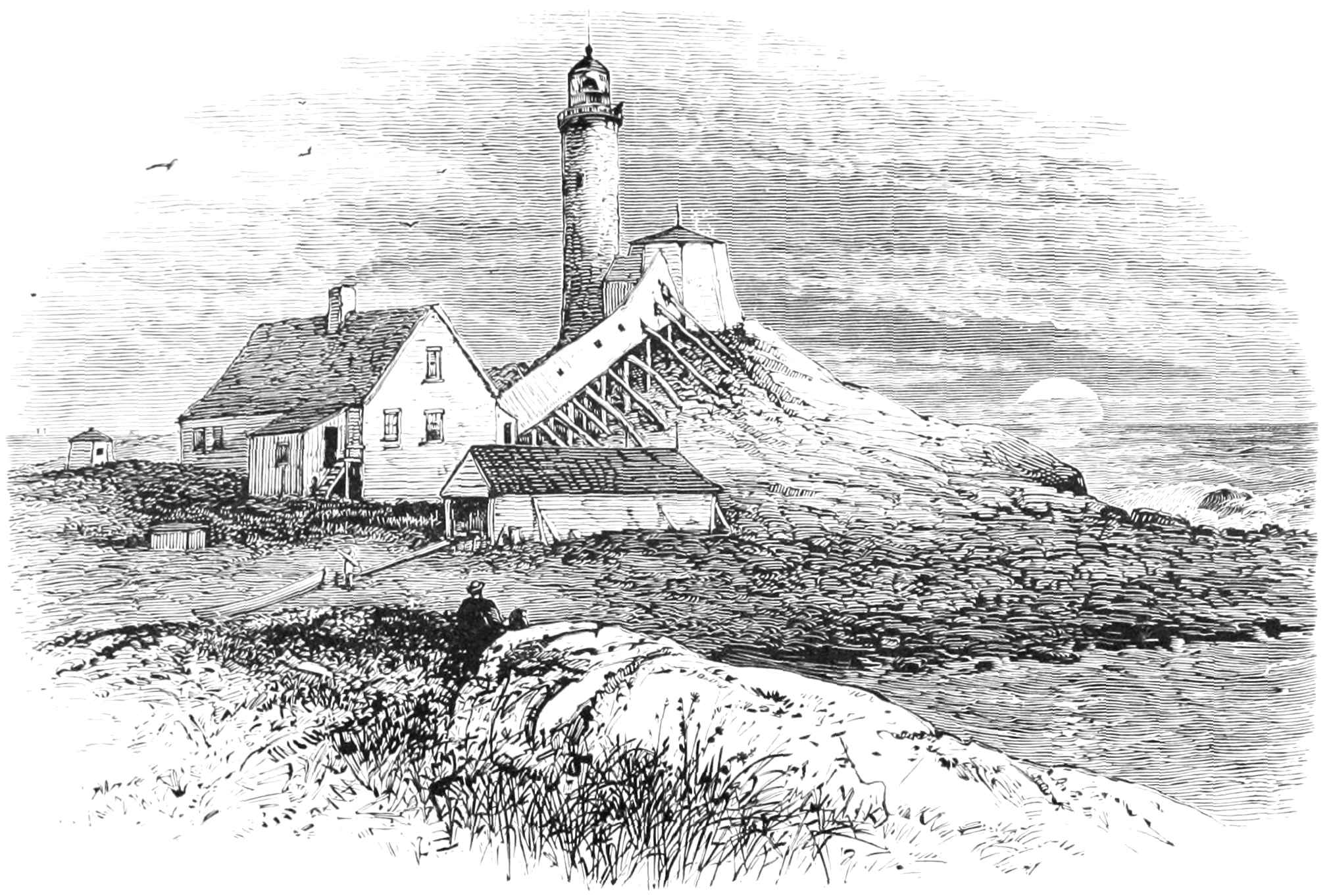
White Island.
I well remember my first sight of White Island, where we took up our abode on leaving the mainland. I was scarcely five years old; but from the upper windows of our dwelling in Portsmouth, I had been shown the clustered masts of ships lying at the wharves along the Piscataqua River, faintly outlined against the sky, and, baby as I was, even then I was drawn, with a vague longing, seaward. How delightful was that long, first sail to the Isles of Shoals! How pleasant the unaccustomed sound of the incessant ripple against the boat-side, the sight of the wide water and limitless sky, the warmth of the broad sunshine that made us blink like young sandpipers as we sat in triumph, perched among the household goods with which the little craft was laden! It was at sunset in autumn that we were set ashore on that loneliest, lovely rock, where the lighthouse looked down on us like some tall, black-capped giant, and filled me with awe and wonder. At its base a few goats were grouped on the rock, standing out dark against the red sky as I looked up at them. The stars were beginning to twinkle; the wind blew cold, charged with the sea’s sweetness; the sound of many waters half bewildered me. Some one began to light the lamps in the tower. Rich red and golden, they swung round in mid-air; everything was strange and fascinating and new. We entered the quaint little old stone cottage that was for six years our home. How curious it seemed, with its low, whitewashed ceiling and deep window-seats, showing the great thickness of the walls made to withstand the breakers, with whose force we soon grew acquainted! A blissful home the little house became to the children who entered it that quiet evening and slept for the first time lulled by the murmur of the encircling sea. I do not think a happier triad ever existed than we were, living in that profound isolation. It takes so little to make a healthy child happy; and we never wearied of our few resources. True, the winters seemed as long as a whole year to our little minds, but they were pleasant, nevertheless. Into the deep window-seats we climbed, and with pennies (for which we had no other use) made round holes in the thick frost, breathing on them till they were warm, and peeped out at the bright, fierce, windy weather, watching the vessels scudding over the intensely dark blue sea, all “feather-white” where the short waves broke hissing in the cold, and the sea-fowl soaring aloft or tossing on the water; or, in calmer days, we saw how the stealthy Star-Islander paddled among the ledges, or lay for hours stretched on the wet sea-weed, with his gun, watching for wild-fowl. Sometimes the round head of a seal moved about among the kelp-covered rocks. A few are seen every winter, and are occasionally shot; but they are shyer and more alert even than the birds.
We were forced to lay in stores of all sorts in the autumn, as if we were fitting out a ship for an Arctic expedition. The lower story of the lighthouse was hung with mutton and beef, and the store-room packed with provisions.
In the long, covered walk that bridged the gorge between the lighthouse and the house, we played in stormy days; and every evening it was a fresh excitement to watch the lighting of the lamps, and think how far the lighthouse sent its rays, and how many hearts it gladdened with assurance of safety. As I grew older I was allowed to kindle the lamps sometimes myself. That was indeed a pleasure. So little a creature as I might do that much for the great world! But by the fireside our best pleasure lay,—with plants and singing birds and books and playthings and loving care and kindness the cold and stormy season wore itself at last away, and died into the summer calm. We hardly saw a human face beside our own all winter; but with the spring came manifold life to our lonely dwelling,—human life among other forms. Our neighbors from Star rowed across; the pilot-boat from Portsmouth steered over, and brought us letters, newspapers, magazines, and told us the news of months. The faint echoes from the far-off world hardly touched us little ones. We listened to the talk of our elders. “Winfield Scott and Santa Anna!” “The war in Mexico!” “The famine in Ireland!” It all meant nothing to us. We heard the reading aloud of details of the famine, and saw tears in the eyes of the reader, and were vaguely sorry; but the fate of Red Riding-Hood was much more near and dreadful to us. We waited for the spring with an eager longing; the advent of the growing grass, the birds and flowers and insect life, the soft skies and softer winds, the everlasting beauty of the thousand tender tints that clothed the world,—these things brought us unspeakable bliss. To the heart of Nature one must needs be drawn in such a life; and very soon I learned how richly she repays in deep refreshment the reverent love of her worshipper. With the first warm days we built our little mountains of wet gravel on the beach, and danced after the sandpipers at the edge of the foam, shouted to the gossiping kittiwakes that fluttered above, or watched the pranks of the burgomaster gull, or cried to the crying loons. The gannet’s long, white wings stretched overhead, perhaps, or the dusky shag made a sudden shadow in mid-air, or we startled on some lonely ledge the great blue heron that flew off, trailing legs and wings, stork-like, against the clouds. Or, in the sunshine on the bare rocks, we cut from the broad, brown leaves of the slippery, varnished kelps, grotesque shapes of man and bird and beast that withered in the wind and blew away; or we fashioned rude boats from bits of driftwood, manned them with a weird crew of kelpies, and set them adrift on the great deep, to float we cared not whither.
We played with the empty limpet-shells; they were mottled gray and brown, like the song-sparrow’s breast. We launched fleets of purple mussel-shells on the still pools in the rocks, left by the tide,—pools that were like bits of fallen rainbow with the wealth of the sea, with tints of delicate sea-weeds, crimson and green and ruddy brown and violet; where wandered the pearly eolis with rosy spines and fairy horns; and the large, round sea-urchins, like a boss upon a shield, were fastened here and there on the rock at the bottom, putting out from their green, prickly spikes transparent tentacles to seek their invisible food. Rosy and lilac star-fish clung to the sides; in some dark nook, perhaps, a holothure unfolded its perfect ferns, a lovely, warm buff color, delicate as frost-work; little forests of coralline moss grew up in stillness, gold-colored shells crept about, and now and then flashed the silver-darting fins of slender minnows. The dimmest recesses were haunts of sea-anemones that opened wide their starry flowers to the flowing tide, or drew themselves together, and hung in large, half-transparent drops, like clusters of some strange, amber-colored fruit, along the crevices as the water ebbed away. Sometimes we were cruel enough to capture a female lobster hiding in a deep cleft, with her millions of mottled eggs; or we laughed to see the hermit-crabs challenge each other, and come out and fight a deadly battle till the stronger overcame, and, turning the weaker topsy-turvy, possessed himself of his ampler cockle-shell, and scuttled off with it triumphant. Or, pulling all together, we dragged up the long kelps, or devil’s-aprons; their roots were almost always fastened about large, living mussels; these we unclasped, carrying the mussels home to be cooked; fried in crumbs or batter, they were as good as oysters. We picked out from the kelp-roots a kind of star-fish which we called sea-spider; the moment we touched it an extraordinary process began. One by one it disjointed all its sections,—whether from fear or anger we knew not; but it threw itself away, bit by bit, until nothing was left of it save the little, round body whence the legs had sprung!
With crab and limpet, with grasshopper and cricket, we were friends and neighbors, and we were never tired of watching the land-spiders that possessed the place. Their webs covered every window-pane to the lighthouse top, and they rebuilt them as fast as they were swept down. One variety lived among the round gray stones on the beach, just above high-water mark, and spun no webs at all. Large and black, they speckled the light stones, swarming in the hot sun; at the first footfall they vanished beneath the pebbles.
All the cracks in the rocks were draped with swinging veils like the window-panes. How often have we marvelled at them, after a fog or a heavy fall of dew, in the early morning, when every slender thread was strung with glittering drops,—the whole symmetrical web a wonder of shining jewels trembling in the breeze! Tennyson’s lines,
“The cobweb woven across the cannon’s throat Shall shake its threaded tears in the wind no more,”
always bring back to my mind the memory of those delicate, spangled draperies, more beautiful than any mortal loom could weave, that curtained the rocks at White Island and “shook their threaded tears” in every wind.
Sometimes we saw the bats wheel through the summer dusk, and in profoundly silent evenings heard, from the lighthouse top, their shrill, small cries, their voices sharper and finer than needle-points. One day I found one clinging to the under side of a shutter,—a soft, dun-colored, downy lump. I took it in my hand, and in an instant it changed to a hideous little demon, and its fierce white teeth met in the palm of my hand. So much fury in so small a beast I never encountered, and I was glad enough to give him his liberty without more ado.
A kind of sandhopper about an inch long, that infested the beach, was a great source of amusement. Lifting the stranded sea-weed that marked the high-water line, we always startled a gray and brown cloud of them from beneath it, leaping away, like tiny kangaroos, out of sight. In storms these were driven into the house, forcing their way through every crack and cranny till they strewed the floors,—the sea so encircled us! Dying immediately upon leaving the water from which they fled, they turned from a clear brown, or what Mr. Kingsley would call a “pellucid gray,” to bright brick-color, like a boiled lobster, and many a time I have swept them up in ruddy heaps; they looked like bits of coral.
I remember in the spring kneeling on the ground to seek the first blades of grass that pricked through the soil, and bringing them into the house to study and wonder over. Better than a shop full of toys they were to me! Whence came their color? How did they draw their sweet, refreshing tint from the brown earth, or the limpid air, or the white light? Chemistry was not at hand to answer me, and all her wisdom would not have dispelled the wonder. Later the little scarlet pimpernel charmed me. It seemed more than a flower; it was like a human thing. I knew it by its homely name of poor-man’s weather-glass. It was so much wiser than I, for, when the sky was yet without a cloud, softly it clasped its small red petals together, folding its golden heart in safety from the shower that was sure to come! How could it know so much? Here is a question science cannot answer. The pimpernel grows everywhere about the islands, in every cleft and cranny where a suspicion of sustenance for its slender root can lodge; and it is one of the most exquisite of flowers, so rich in color, so quaint and dainty in its method of growth. I never knew its silent warning fail. I wondered much how every flower knew what to do and to be; why the morning-glory didn’t forget sometimes, and bear a cluster of elder-bloom, or the elder hang out pennons of gold and purple like the iris, or the golden-rod suddenly blaze out a scarlet plume, the color of the pimpernel, was a mystery to my childish thought. And why did the sweet wild primrose wait till after sunset to unclose its pale yellow buds; why did it unlock its treasure of rich perfume to the night alone? Few flowers bloomed for me upon the lonesome rock; but I made the most of all I had, and neither knew of nor desired more. Ah, how beautiful they were! Tiny stars of crimson sorrel threaded on their long brown stems; the blackberry blossoms in bridal white; the surprise of the blue-eyed grass; the crowfoot flowers, like drops of yellow gold spilt about among the short grass and over the moss; the rich, blue-purple beach-pea, the sweet, spiked germander, and the homely, delightful yarrow that grows thickly on all the islands. Sometimes its broad clusters of dull white bloom are stained a lovely reddish-purple, as if with the light of sunset. I never saw it colored so elsewhere. Quantities of slender, wide-spreading mustard-bushes grew about the house; their delicate flowers were like fragrant golden clouds. Dandelions, buttercups, and clover were not denied to us; though we had no daisies nor violets nor wild roses, no asters, but gorgeous spikes of golden-rod, and wonderful wild morning-glories, whose long, pale, ivory buds I used to find in the twilight, glimmering among the dark leaves, waiting for the touch of dawn to unfold and become each an exquisite incarnate blush,—the perfect color of a South Sea shell. They ran wild, knotting and twisting about the rocks, and smothering the loose boulders in the gorges with lush green leaves and pink blossoms.
Many a summer morning have I crept out of the still house before any one was awake, and, wrapping myself closely from the chill wind of dawn, climbed to the top of the high cliff called the Head to watch the sunrise. Pale grew the lighthouse flame before the broadening day as, nestled in a crevice at the cliff’s edge, I watched the shadows draw away and morning break. Facing the east and south, with all the Atlantic before me, what happiness was mine as the deepening rose-color flushed the delicate cloudflocks that dappled the sky, where the gulls soared, rosy too, while the calm sea blushed beneath. Or perhaps it was a cloudless sunrise with a sky of orange-red, and the sea-line silver-blue against it, peaceful as heaven. Infinite variety of beauty always awaited me, and filled me with an absorbing, unreasoning joy such as makes the song-sparrow sing,—a sense of perfect bliss. Coming back in the sunshine, the morning-glories would lift up their faces, all awake, to my adoring gaze. Like countless rosy trumpets sometimes I thought they were, tossed everywhere about the rocks, turned up to the sky, or drooping toward the ground, or looking east, west, north, south, in silent loveliness. It seemed as if they had gathered the peace of the golden morning in their still depths even as my heart had gathered it.
In some of those matchless summer mornings when I went out to milk the little dun cow, it was hardly possible to go farther than the doorstep, for pure wonder, as I looked abroad at the sea lying still, like a vast, round mirror, the tide drawn away from the rich brown rocks, a sail or two asleep in the calm, not a sound abroad except a few bird voices; dew lying like jewel-dust sifted over everything,—diamond and ruby, sapphire, topaz, and amethyst, flashing out of the emerald deeps of the tufted grass or from the bending tops. Looking over to the mainland, I could dimly discern in the level sunshine the depths of glowing green woods faintly revealed in the distance, fold beyond fold of hill and valley thickly clothed with the summer’s splendor. But my handful of grass was more precious to me than miles of green fields, and I was led to consider every blade where there were so few. Not long ago I had watched them piercing the ground toward the light; now, how strong in their slender grace were these stems, how perfect the poise of the heavy heads that waved with such harmony of movement in the faintest breeze! And I noticed at mid-day when the dew was dry, where the tall, blossoming spears stood in graceful companies that, before they grew purple, brown, and ripe, when they began to blossom, they put out first a downy ring of pollen in tiny, yellow rays, held by an almost invisible thread, which stood out like an aureole from each slow-waving head,—a fairy-like effect. On Seavey’s Island (united to ours by a narrow beach covered at high tide with contending waves) grew one single root of fern, the only one within the circle of my little world. It was safe in a deep cleft, but I was in perpetual anxiety lest my little cow, going there daily to pasture, should leave her cropping of the grass and eat it up some day. Poor little cow! One night she did not come home to be milked as usual, and on going to seek her we found she had caught one foot in a crevice and twisted her hoof entirely off! That was a calamity; for we were forced to summon our neighbors and have her killed on the spot.
I had a scrap of garden, literally not more than a yard square, wherein grew only African marigolds, rich in color as barbaric gold. I knew nothing of John Keats at that time,—poor Keats, “who told Severn that he thought his intensest pleasure in life had been to watch the growth of flowers,”—but I am sure he never felt their beauty more devoutly than the little, half-savage being who knelt, like a fire-worshipper, to watch the unfolding of those golden disks. When, later, the “brave new world” of poets was opened to me, with what power those glowing lines of his went straight to my heart,
“Open afresh your rounds of starry folds, Ye ardent marigolds!”
All flowers had for me such human interest, they were so dear and precious, I hardly liked to gather them, and when they were withered, I carried them all to one place and laid them tenderly together, and never liked to pass the spot where they were hidden.
Once or twice every year came the black, lumbering old “oil-schooner” that brought supplies for the lighthouse, and the inspector, who gravely examined everything, to see if all was in order. He left stacks of clear red and white glass chimneys for the lamps, and several doe-skins for polishing the great, silver-lined copper reflectors, large bundles of wicks, and various pairs of scissors for trimming them, heavy black casks of ill-perfumed whale-oil, and other things, which were all stowed in the round, dimly-lighted rooms of the tower. Very awe-struck, we children always crept into corners, and whispered and watched the intruders till they embarked in their ancient, clumsy vessel, and, hoisting their dark, weather-stained sails, bore slowly away again. About ten years ago that old white lighthouse was taken away, and a new, perpendicular brick tower built in its place. The lantern, with its fifteen lamps, ten golden and five red, gave place to Fresnel’s powerful single burner, or, rather, three burners in one, enclosed in its case of prisms. The old lighthouse was by far the most picturesque; but perhaps the new one is more effective, the light being, undoubtedly, more powerful.
Often, in pleasant days, the head of the family sailed away to visit the other islands, sometimes taking the children with him, oftener going alone, frequently not returning till after dark. The landing at White Island is so dangerous that the greatest care is requisite, if there is any sea running, to get ashore in safety. Two long and very solid timbers about three feet apart are laid from the boat-house to low-water mark, and between those timbers the boat’s bow must be accurately steered; if she goes to the right or the left, woe to her crew unless the sea is calm! Safely lodged in the slip, as it is called, she is drawn up into the boat-house by a capstan, and fastened securely. The lighthouse gave no ray to the dark rock below it; sending its beams far out to sea, it left us at its foot in greater darkness for its lofty light. So when the boat was out late, in soft, moonless summer nights, I used to light a lantern, and, going down to the water’s edge, take my station between the timbers of the slip, and, with the lantern at my feet, sit waiting in the darkness, quite content, knowing my little star was watched for, and that the safety of the boat depended in a great measure upon it. How sweet the summer wind blew, how softly plashed the water round me, how refreshing was the odor of the sparkling brine! High above, the lighthouse rays streamed out into the humid dark, and the cottage windows were ruddy from the glow within. I felt so much a part of the Lord’s universe, I was no more afraid of the dark than the waves or winds; but I was glad to hear at last the creaking of the mast and the rattling of the rowlocks as the boat approached; and, while yet she was far off, the lighthouse touched her one large sail into sight, so that I knew she was nearing me, and shouted, listening for the reply that came so blithely back to me over the water.
Unafraid, too, we watched the summer tempests, and listened to the deep, melodious thunder rolling away over the rain-calmed ocean. The lightning played over the iron rods that ran from the lighthouse-top down into the sea. Where it lay on the sharp ridgepole of the long, covered walk that spanned the gorge, the strange fire ran up the spikes that were set at equal distances, and burnt like pale flame from their tips. It was fine indeed from the lighthouse itself to watch the storm come rushing over the sea and ingulf us in our helplessness. How the rain weltered down over the great panes of plate glass,—floods of sweet, fresh water that poured off the rocks and mingled with the bitter brine. I wondered why the fresh floods never made the salt sea any sweeter. Those pale flames that we beheld burning from the spikes of the lightning-rod, I suppose were identical with the St. Elmo’s fire that I have since seen described as haunting the spars of ships in thunder-storms. And here I am reminded of a story told by some gentlemen visiting Appledore sixteen or eighteen years ago. They started from Portsmouth for the Shoals in a whaleboat, one evening in summer, with a native Star-Islander, Richard Randall by name, to manage the boat. They had sailed about half the distance, when they were surprised at seeing a large ball of fire, like a rising moon, rolling toward them over the sea from the south. They watched it eagerly as it bore down upon them, and, veering off, went east of them at some little distance, and then passed astern, and there, of course, they expected to lose sight of it; but while they were marvelling and speculating, it altered its course, and suddenly began to near them, coming back upon its track against the wind and steadily following in their wake. This was too much for the native Shoaler. He took off his jacket and turned it inside out to exorcise the fiend, and lo, the apparition most certainly disappeared! We heard the excited account of the strange gentlemen and witnessed the holy horror of the boatman on the occasion; but no one could imagine what had set the globe of fire rolling across the sea. Some one suggested that it might be an exhalation, a phosphorescent light, from the decaying body of some dead fish; but in that case it must have been taken in tow by some living finny creature, else how could it have sailed straight “into the teeth of the wind”? It was never satisfactorily accounted for, and must remain a mystery.
One autumn at White Island our little boat had been to Portsmouth for provisions, etc. With the spy-glass we watched her returning, beating against the head wind. The day was bright, but there had been a storm at sea, and the breakers rolled and roared about us. The process of “beating” is so tedious that, though the boat had started in the morning, the sun was sending long yellow light from the west before it reached the island. There was no cessation in those resistless billows that rolled from the Devil’s Rock upon the slip; but still the little craft sailed on, striving to reach the landing. The hand at the tiller was firm, but a huge wave swept suddenly in, swerving the boat to the left of the slip, and in a moment she was overturned and flung upon the rocks, and her only occupant tossed high upon the beach, safe except for a few bruises; but what a moment of terror it was for us all, who saw and could not save! All the freight was lost except a roll of iron wire and a barrel of walnuts. These were spread on the floor of an unoccupied eastern chamber in the cottage to dry. And they did dry; but before they were gathered up came a terrible storm from the southeast. It raved and tore at lighthouse and cottage; the sea broke into the windows of that eastern chamber where the walnuts lay, and washed them out till they came dancing down the stairs in briny foam! The sea broke the windows of the house several times during our stay at the lighthouse. Everything shook so violently from the concussion of the breakers, that dishes on the closet shelves fell to the floor, and one member of the family was at first always made sea-sick in storms, by the tremor and deafening confusion. One night when, from the southeast, the very soul of chaos seemed to have been let loose upon the world, the whole ponderous “walk” (the covered bridge that connected the house and lighthouse) was carried thundering down the gorge and dragged out into the raging sea.
It was a distressing situation for us,—cut off from the precious light that must be kept alive; for the breakers were tearing through the gorge so that no living thing could climb across. But the tide could not resist the mighty impulse that drew it down; it was forced to obey the still voice that bade it ebb; all swollen and raging and towering as it was, slowly and surely, at the appointed time, it sank away from our rock, so that, between the billows that still strove to clutch at the white, silent, golden-crowned tower, one could creep across, and scale the height, and wind up the machinery that kept the great clustered light revolving till the gray daylight broke to extinguish it.
I often wondered how it was possible for the sea-birds to live through such storms as these. But, when one could see at all, the gulls were always soaring, in the wildest tumult, and the stormy petrels half flying, half swimming in the hollows of the waves.
Would it were possible to describe the beauty of the calm that followed such tempests! The long lines of silver foam that streaked the tranquil blue, the “tender-curving lines of creamy spray” along the shore, the clear-washed sky, the peaceful yellow light, the mellow breakers murmuring slumberously!
Of all the storms our childish eyes watched with delighted awe, one thunder-storm remains fixed in my memory. Late in an August afternoon it rolled its awful clouds to the zenith, and, after the tumult had subsided, spread its lightened vapors in an under-roof of gray over all the sky. Presently this solemn gray lid was lifted at its western edge, and an insufferable splendor streamed across the world from the sinking sun. The whole heaven was in a blaze of scarlet, across which sprang a rainbow unbroken to the topmost clouds, “with its seven perfect colors chorded in a triumph” against the flaming background; the sea answered the sky’s rich blush, and the gray rocks lay drowned in melancholy purple. I hid my face from the glory,—it was too much to bear. Ever I longed to speak these things that made life so sweet, to speak the wind, the cloud, the bird’s flight, the sea’s murmur. A vain longing! I might as well have sighed for the mighty pencil of Michael Angelo to wield in my impotent child’s hand. Better to “hush and bless one’s self with silence”; but ever the wish grew. Facing the July sunsets, deep red and golden through and through, or watching the summer northern lights,—battalions of brilliant streamers advancing and retreating, shooting upward to the zenith, and glowing like fiery veils before the stars; or when the fog-bow spanned the silver mist of morning, or the earth and sea lay shimmering in a golden haze of noon; in storm or calm, by day or night, the manifold aspects of Nature held me and swayed all my thoughts until it was impossible to be silent any longer, and I was fain to mingle my voice with her myriad voices, only aspiring to be in accord with the Infinite harmony, however feeble and broken the notes might be.
It has been my good fortune to witness but few wrecks at the Shoals. The disasters of which we hear faintly from the past were many and dreadful; but since the building of the lighthouse on White Island, and also on Boone Island (which seems like a neighbor, though fifteen miles distant), the danger of the place is much lessened. A resident of Star Island told me of a wreck which took place forty-seven years ago, during a heavy storm from the eastward. It blew so that all the doors in the house opened as fast as they shut them, and in the night a vessel drove against “Hog Island Head,” which fronts the village on Star. She went to pieces utterly. In the morning the islanders perceived the beach at Londoners heaped with some kind of drift; they could not make out what it was, but, as soon as the sea subsided, went to examine and found a mass of oranges and picture-frames, with which the vessel had been freighted. Not a soul was saved. “She struck with such force that she drove a large spike out of her forefoot” into a crevice in the rock, which was plainly to be seen till a few years ago. My informant also told me that she remembered the wreck of the Sagunto, in 1813; that the beaches were strewn with “almond-nuts” long after; and that she picked up curiously embroidered vests and “work-bags” in all directions along the shores.
During a storm in 1839, while living at White Island, we were startled by the heavy booming of guns through the roar of the tempest,—a sound that drew nearer and nearer, till at last, through a sudden break in the mist and spray, we saw the heavily rolling hull of a large vessel driving by, to her sure destruction, toward the coast. It was as if the wind had torn the vapor apart on purpose to show us this piteous sight; and I well remember the hand on my shoulder which held me firmly, shuddering child that I was, and forced me to look in spite of myself. What a day of pain it was! how dreadful the sound of those signal-guns, and how much more dreadful the certainty, when they ceased, that all was over! We learned afterward that it was the brig Pocahontas, homeward bound from Spain, and that the vessel and all her crew were lost. In later years a few coasters and fishermen have gone ashore at the islands, generally upon the hidden ledges at Duck. Many of these have been loaded with lime,—a most perilous freight; for as soon as the water touches it there is a double danger; and between fire and water there is little chance of escape.
I wish I could recall the graphic language of a Star Islander who described to me a wreck of this kind. The islanders saw at sunrise, one bitter winter day, a schooner ashore among the dreadful ledges at Duck Island, and, though the wind blew half a gale, they took their boats and ran down toward her before the northwester. Smoke and steam and spray and flame were rising from her and about her when they reached the spot. Only one man was found alive. From the davits, hanging head downward, was the lifeless body of a fair-haired boy of sixteen or thereabouts. The breakers swept him to and fro, and, drawing away, left his long yellow hair dripping with the freezing brine. The mate’s story was that he had gone to unfasten the boat which hung at the stern, that a sea had struck him, and he had fallen headforemost with his feet entangled in the ropes of the davits. He was the only son of his mother, who was a widow. They carried his body home to that most unhappy mother. The vessel was a total loss, with all on board, except the mate.
One winter night at Appledore when it was blowing very hard northwest, with a clear sky, we were wakened by a violent knocking at the door. So unaccustomed a sound, at that time of night too, was enough to startle us all, and very much amazed we were. The door was opened to admit four or five shipwrecked men, whose hands, feet, and ears were all frozen stiff,—pitiable objects they were indeed. Their vessel had struck full on York Ledge, a rock lying off the coast of Maine far east of us, and they had taken to the boat and strove to make a landing on the coast; but the wind blew off shore so fiercely they failed in their attempt, their hands became useless from the cold, they dropped their oars, and, half steering with one of the seats of the boat, managed to reach Appledore, more dead than alive. They were obliged to remain there several days before finding an opportunity of going on shore, the gale was so furious. Next morning, in the glare of the winter sunshine, we saw their vessel, still with all sail set, standing upright upon the ledge,—a white column looming far away. One of the most hideous experiences I have heard befell a young Norwegian now living at the Shoals. He and a young companion came out from Portsmouth to set their trawl, in the winter fishing, two years ago. Before they reached the island, came a sudden squall of wind and snow, chilling and blinding. In a few moments they knew not where they were, and the wind continued to sweep them away. Presently they found themselves under the lee of White Island Head; they threw out the road-lines of their trawl, in desperate hope that they might hold the boat till the squall abated. The keepers at the lighthouse saw the poor fellows, but were powerless to help them. Alas! the road-lines soon broke, and the little boat was swept off again, they knew not whither. Night came down upon them, tossed on that terrible black sea; the snow ceased, the clouds flew before the deadly cold northwest wind, the thermometer sank below zero. One of the men died before morning; the other, alone with the dead man, was still driven on and on before the pitiless gale. He had no cap nor mittens; had lost both. He bailed the boat incessantly, for the sea broke over him the livelong time. He told me the story himself. He looked down at the awful face of his dead friend and thought “how soon he should be like him”; but still he never ceased bailing,—it was all he could do. Before night he passed Cape Cod and knew it as he rushed by. Another unspeakably awful night, and the gale abated no whit. Next morning he was almost gone from cold, fatigue, and hunger. His eyes were so swollen he could hardly see; but afar off, shining whiter than silver in the sun, the sails of a large schooner appeared at the edge of the fearful wilderness. He managed to hoist a bit of old canvas on an oar. He was then not far from Holmes’ Hole, nearly two hundred miles from the Shoals! The schooner saw it and bore down for him, but the sea was running so high that he expected to be swamped every instant. As she swept past, they threw from the deck a rope with a loop at the end, tied with a bow-line knot that would not slip. It caught him over the head, and clutching it at his throat with both hands, in an instant he found himself in the sea among the ice-cold, furious waves, drawn toward the vessel with all the strength of her crew. Just before he emerged, he heard the captain shout, “We’ve lost him!” Ah the bitter moment! For a horrible fear struck through him that they might lose their hold an instant on the rope, and then he knew it would be all over. But they saved him. The boat with the dead man in it, all alone, went tossing, heaven knows where.
The great equinoctial gale of September 8, 1869, was very severe at the islands. One schooner went ashore on Cannon Point at Appledore, and was a complete wreck, though no lives were lost. She was lying in “The Roads,” between Star and Appledore, safely moored, her crew supposed; but she dragged moorings, anchors, everything with which they strove to save her, and crashed on the rocks, breaking up like an eggshell. Various buildings were blown down; windows at Appledore were blown in, in some cases sash and all, in others the glass was smashed as if the wind had thrust an arm through.
At about seven o’clock in the evening a great copper-colored arch spanned the black sky from west to east. The gale was then at its height. After that lurid bow dissolved, flying northward in wild, scattered fragments, the wind abated, and we began to take breath again. A man at Star, on the edge of the storm, rowed out in his dory to make more secure a larger boat moored at a little distance. Down came the hurricane and caught him, and whirled him away like a dead leaf on the surface of the sea. He gave himself up for lost, of course; so did his friends. But he fastened himself with ropes to the inside of the boat, and, tossing from billow to billow, bailed for dear life the whole night long. Toward morning, the wind lulling very considerably, he was carried along the coast of Maine, and landed in York, a short distance from his father’s home, and quietly walked into the house and joined the family at breakfast; then took the cars for Portsmouth, and astounded the whole Shoals settlement by appearing in the steamer Appledore in time for dinner. Everybody supposed him, without a shadow of doubt, to be at the bottom of the sea.
Boone Island is the forlornest place that can be imagined. The Isles of Shoals, barren as they are, seem like Gardens of Eden in comparison. I chanced to hear last summer of a person who had been born and brought up there; he described the loneliness as something absolutely fearful, and declared it had pursued him all through his life. He lived there till fourteen or fifteen years old, when his family moved to York. While living on the island he discovered some human remains which had lain there thirty years. A carpenter and his assistants, having finished some building, were capsized in getting off, and all were drowned, except the master. One body floated to Plum Island at the mouth of the Merrimack; the others the master secured, made a box for them,—all alone the while,—and buried them in a cleft and covered them with stones. These stones the sea washed away, and, thirty years after they were buried, the boy found the bones, which were removed to York and there buried again. It was on board a steamer bound to Bangor, that the man told his story. Boone Island Light was shining in the distance. He spoke with bitterness of his life in that terrible solitude, and of “the loneliness which had pursued him ever since.” All his relatives were dead, he said, and he had no human tie in the wide world except his wife. He ended by anathematizing all islands, and, vanishing into the darkness, was not to be found again; nor did his name or any trace of him transpire, though he was sought for in the morning all about the vessel.
One of the most shocking stories of shipwreck I remember to have heard is that of the Nottingham Galley, wrecked on this island in the year 1710. There is a narrative of this shipwreck existing, written by “John Deane, then commander of said Galley, but for many years after his Majesty’s consul for the ports of Flanders, residing at Ostend,” printed in 1762. The ship, of one hundred and twenty tons, carrying ten guns, with a crew of fourteen men, loaded partly in England and partly in Ireland, and sailed for Boston on the 25th of September, 1710. She made land on the 11th of December, and was wrecked on that fatal rock. At first the unhappy crew “treated each other with kindness and condolence, and prayed to God for relief.” The only things saved from the wreck were a bit of canvas and half a cheese. The men made a triangular tent of the bit of canvas, and all lay close together beneath it, sideways; none could turn without the general concurrence: they turned once in two hours upon public notice. They had no fire, and lived upon kelp and rockweed, and mussels, three a day to a man. Starvation and suffering soon produced a curious loss of memory. The fourth day the cook died. When they had been there upwards of a week, they saw three sails in the southwest, but no boat came near them. They built a rude boat of such materials as they could gather from the wreck, but she was lost in launching. One of the men, a Swede, is particularly mentioned; he seems to have been full of energy; with help from the others he built a raft; in launching this they overset it. Again they saw a sail, this time coming out from the Piscataqua River; it was soon out of sight. The Swede was determined to make an effort to reach the shore, and persuaded another man to make the attempt with him. At sunset they were seen half-way to the land; the raft was found on shore with the body of one man; the Swede was never seen more. A hide was thrown on the rocks at Boone Island by the sea; this the poor sailors ate raw, minced. About the end of December the carpenter died, and, driven to madness by hunger, they devoured the flesh of their dead comrade. The captain, being the strongest of the party, dragged the body away and hid it, and dealt small portions of it daily to the men. Immediately their dispositions underwent a horrible change. They became fierce and reckless, and were the most pitiable objects of despair, when, on January 4th, 1711, they were discovered and taken off. It was evening when they entered the Piscataqua River, and eight o’clock when they landed. Discovering a house through the darkness, the master rushed into it, frightening the gentlewoman and children desperately, and, making his way to the kitchen, snatched the pot wherein some food was cooking off the fire, and began to eat voraciously. This old record mentions John Plaisted and John Wentworth as being most “forward in benevolence” to these poor fellows.