Front matter (continued 3)
Reading edition
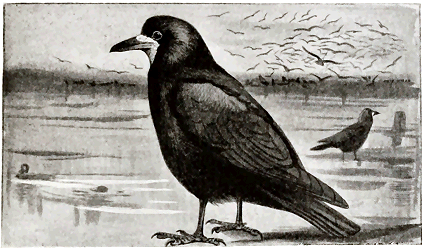
Perhaps the most familiar birds of the open fields, especially in spring, are the Rooks. They may be found on every kind of field in turn. They visit the grass-lands, especially when manure is being spread; they are constant companions of the ploughman’s team, and search furrow after furrow as the bright share turns over the brown earth; whilst all the newly-sown patches are sought for any seed that may chance to be within reach. In seed-time Rooks are certainly troublesome, and usually one or two of the marauders have to be shot and hung up from stakes on the scene of their misdeeds as a warning to the rest before the pilfering ceases. And yet happy is the farmer that has a rookery within easy distance of his land. The birds will increase its value and fertility by ridding pasture and arable land of countless insect pests, and for nine or ten months out of the twelve wage a never-ending war upon the real enemies of his crops. Many farmers we have known will admit that the Rook is of service; others have been converted into staunch friends of the bird after we have satisfied them by ocular demonstration of the number of wire-worms a healthy hearty Rook will devour in the course of a morning. Very beautiful these birds look in their purple-black plumage, almost as polished as bright steel, in the sunlight as they walk about the ploughed fields and pastures. And then their home in the cluster of elm-trees yonder is a place fraught with interest if full of noise. Towards the close of February, or, if the weather be still inclement, not until the beginning of March, and at least a fortnight or three weeks later than in Devonshire, the Rooks begin to tidy up their big nests in the slender branches at the tree-tops. Others, less fortunate, commence to build entirely new nests. But this building is by no means universal for a week or more; the mania for collecting sticks and turf has not yet spread through the entire colony, and numbers of birds may be seen looking on with indifference at the efforts of more industrious neighbours. What a noisy animated scene the old rookery is for the next month, until the eggs are laid in the big massive nests; then there is comparative quietness until the young are hatched, when the noisy clamour begins again with greater volume until nestlings and parents get on to the adjoining fields. They return in many cases to the nest-trees to roost, and then each evening the din is deafening as troop after troop of tired birds come straggling in from all directions and caw themselves hoarse before dropping off to sleep in the tall trees.
The Rook.
Another familiar bird of the farm is the Starling—a species that does not reveal its beauty unless examined minutely. There are few birds in this country more gorgeously arrayed with metallic sheen than a fine old cock Starling in the full flush and vigour of spring plumage. His lemon-yellow bill at this season also increases the effect. As harmless as it is useful, it keeps close company with the Rooks, although it shows little inclination to follow those birds on to the arable land; it loves the grass fields and manure heaps, being somewhat of an unclean feeder. Then it always selects a covered site of some kind for nesting purposes, being most adaptive in this respect. We used to place boxes for its accommodation in the trees; and we have known a disused pigeon-cot fastened to a high wall packed to its utmost capacity with nests. Few birds are more attached to their breeding-place. For many years a pair of Starlings bred in a hole in a tall elm-tree in one of the fields. From this nest we actually obtained forty eggs in a season, and sometimes for a couple of years in succession the birds did not succeed in raising a brood. Every summer the Starlings of the entire district gathered into one or two large flocks, and these came evening by evening to roost in a cluster of white-thorns until the late autumn, when they changed their quarters to the evergreens close by. Another thing that endears the Starling to us is its perennial song. Few other song-birds make so much fuss over their music as the Starling. Action of some kind seems always essential to vocal effort; and the way he erects almost every feather, or sways about or stands in some grotesque attitude, during his periods of song is most entertaining. The House Sparrow is another familiar bird of the farm and garden. Unfortunately he is far too common for most farmers, especially in the vicinity of large towns and villages; and the way these pilfering birds will thresh out a field of wheat or oats is literally surprising. Friends of the Sparrow, usually utterly ignorant of its habits and the serious mischief it can do, cannot understand the farmers' indignation, and are always protesting against its wanton slaughter. But then there is reason in all things, and in grain-growing districts the bird should be kept down. The boy with his clappers amongst the corn may, if he conscientiously sticks to his work (and this rarely happens), keep the vast flocks of Sparrows on the move, but the birds will gorge themselves with grain meantime; whilst shooting round the fields is little more effective, for the feathered thieves soon desert the hedge-sides and settle in the centre of the crops, where it is next to impossible to dislodge them, or to alarm them by repeated discharges of the gun. The Sparrow nuisance is philosophically endured by many farmers, and regarded, like the weather, as beyond their control. In some cases we have known farmers absolutely cease growing corn at all because the birds take such a large proportion of the crop! Here the usefulness of the Sparrow-hawk becomes only too apparent, but the keepers shoot that bird down—every one they can reach—and the Sparrows have things all their own way.
The Brambling.
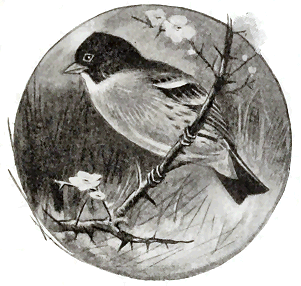
There are many other birds of the Finch tribe frequenting farm and garden. The Chaffinch, one of the handsomest of all, is also one of the commonest, and his sprightly song is one of the most cheering harbingers of spring the fields can boast. The resumption of song by the Chaffinch offers an interesting contrast between the habits of individuals of the same species in northern and southern shires respectively. In Yorkshire the music of this bird is seldom or never heard before the first week in March; in Devonshire it is familiar enough in the early days of February, and may sometimes be detected towards the close of January—a remarkable instance of the effect of climate upon avine song. Another thing we have remarked in this species, and that is its much handsomer nests in Yorkshire than in Devonshire. We never found much garniture of paper, lichen, and cocoons on nests in the latter county; in fact, the faculty of mimicry does not seem so pronounced in these southern individuals. During winter the northern shires are invaded by vast flocks of Chaffinches, presumably from continental areas. Upon their first appearance in November these flocks are almost entirely composed of males; the females arrive later, and before the winter is over the sexes are more or less intermixed. The Brambling, of course, we have as a winter visitor only. We have repeatedly remarked the regularity with which this bird returns to certain winter quarters. For years and years we have known flocks to arrive in November—practically about the same time as the migratory Chaffinches—and take up their quarters in certain woods and shrubberies, where they used nightly to roost throughout the winter, spending the day on the surrounding open fields. Redwings also frequented the same places in similar large companies, the natural inference being that all these birds were from the same continental localities, and followed the same route inland from the coast, although the latter birds were always the first to appear towards the end of October. The Bullfinch we have always with us, but in small and apparently decreasing numbers. For this the rascally bird-catcher is largely to blame. To the naturalist there are few more irritating persons than a bird-catcher. We would sooner tolerate a shooter, for he at least kills the bird and has done with it, and the discharge of his gun at intervals makes the birds alert and wary. But the bird-catcher by his sly insinuating methods will carry off a dozen birds where a gunner might not get more than one. He is at his nefarious business early and late in a certain spot so long as he knows a single bird worth catching remains in it. His nets close upon all birds alike—birds he prizes and birds he cares nothing about, cocks and hens and young indiscriminately; all are caged and carried off, to a worse fate by far, in most instances, than sudden dissolution from a shot-gun. It is true the bird-catcher must ply his wretched business with due regard to an all too brief close time; but this in not a few cases he ignores, and thus still further constitutes himself the scourge of the fields and hedgerows. We invariably remarked that Bullfinches retired to the cover of shrubberies and gardens to breed. During the remainder of the year they kept to the hedgerows, especially such as contained plenty of weeds beside them, almost invariably in pairs, one bird trooping in undulating flight after the other, and both made very conspicuous by the white rump. The Hawfinch was much rarer. This shy bird loves the small plantations, but in fruit time comes into the gardens near its usual haunts. We should class it as perhaps the most local of the Finches (with the possible exception of the Siskin) in the northern shires of England, whilst north of these it seems almost everywhere to be a winter visitor only. During winter flocks of Crossbills are occasionally met with, but they are no common feature of the bird-life of farm and garden in Yorkshire or Derbyshire. The Tree Sparrow is another very local and uncommon species, and especially during the breeding season. We have records of odd nests made in holes in trees on some of the farms, but we find it more frequent in wilder localities. In winter it sometimes visits the farmyards, and we have noticed it mingled with flocks of Lesser Redpoles on the stubbles and clover fields in late autumn. The Linnet, with its close allies the Twite and the Lesser Redpole, are familiar winter visitors to the fields, wandering about in flocks, each usually composed of a single species. As we have already seen, the Twite is a common bird in summer upon the moors; in autumn it leaves them in companies for the fields. In its habits the Linnet is very similar. All the winter through large flocks—sometimes numbering many hundreds of birds—resort to certain weed-grown pastures and stubbles, where they spend most of the day upon the ground in never-ending quest of tiny seeds. If alarmed, they rise somewhat in straggling order, but quickly bunch together and resort to some tree-top, from which they again descend in scattered numbers. Their twittering chorus whilst in the trees is very remarkable, and the observer will note that this becomes much more musical and prolonged as the spring approaches. The birds then quit the fields and retire to the higher ground gorse coverts and roughs near the moors where they breed. The Lesser Redpole, to our mind, is the most charming of the three. It is, of course, most numerous on our Yorkshire and Derbyshire farms during winter, when it congregates upon them in flocks that frequent much the same localities as the Linnets and Twites. But it is not exclusively confined to these spots, as we shall see in a later chapter (conf. p. 189). Many odd pairs of Redpoles linger behind on these northern farms to breed, making their exquisite little cup-shaped nest in the hedges towards the end of May. This pretty nest, combined with the short pleasing song of the male bird, and the utter trustfulness of both sexes, summer and winter alike, endear the Redpole to us in a way that few other species do. It is decidedly a bird of the northern shires, becoming rarer and more local through the midlands, and only breeding here and there farther south. Both Goldfinch and Greenfinch also require passing notice. The former bird is another that has been almost exterminated by the rascally bird-catcher; still, it is observed in sufficient numbers to render it familiar in many a garden and hedgerow. Perhaps they are most frequently remarked during winter, when, in pairs, they love to haunt the weed-grown wastes and the sides of the fields where thistles and docks are abundant. The Greenfinch is much more common, but here again we remark a change of habitat with the season, the birds quitting the open fields for shrubberies and gardens as the breeding season approaches. Notwithstanding this, however, a good many nests are made in the hedges in the fields, in the white-thorn by preference. We have also found many nests of this Finch placed at high elevations in elm-trees, especially about the farm lands. Occasionally a Siskin may be remarked in company with Redpoles on the stubbles and wild weed-grown pastures, but as a rule this engaging little species confines itself to the trees along the river-side during its winter sojourn in Yorkshire, and there we shall meet with it in the following chapter. Some of these Finches, those that breed within the limits of farm and garden, betake themselves to the fields of mowing grass in June, the House Sparrow especially; and then when the hay is cut or the wheat and oats are sufficiently forward they pass on to the corn-fields to renew their depredations.
From the Finches to the Buntings is not a very great stride in avine classification, and the latter birds are common enough upon the farm. That is to say, a single species only, during summer, namely, the Yellow Bunting. The Cirl Bunting is absent from the northern shires, and the Common Bunting is far more local than his name suggests, occurring most frequently in the maritime localities. In winter we have the Snow Buntings in localized flocks upon the fields, very capricious in their appearance, and sometimes not being seen for several years in succession. We can recall a very large flock of these Buntings that frequented some pasture fields at Endcliffe, quite close to grimy Sheffield, but unfortunately they were sadly reduced in numbers by local gunners during the winter of their stay. The Reed Bunting also visits the farm during this season, and we have from time to time detected them amongst the ricks with Sparrows and other hard-billed birds in severe weather. The Yellow Bunting, however, is the one familiar Bunting of the farm in most parts of Yorkshire and Derbyshire. It is one of our showiest native birds, and, as is usually the case, what it gains in colour it loses in melody. There are few bird-songs of the field and hedgerows more monotonous than that of the “Yoldring”, as the Yorkshire lads call him, and yet the oft-repeated refrain has a genuine ring of spring about it. This song usually commences about the beginning of March in the north of England, but in the southern counties it is not unfrequent in February, another instance of climatic influence. We all of us know the yellow-crowned musician, sitting on the top of the hedge or in some wayside tree, trilling his simple lay; we most of us know his rustic nest on the bank of the hedgerow, and his mate’s four or five curiously-scrawled eggs—a peculiarity which has gained for him the local name of “Writing Lark” in not a few country places. There are also many birds of the Thrush tribe to be met with in farm and garden—indeed every British species might be included, if we except the Ring-ouzel; but even that one is occasionally seen on the meadows and about the fruit-gardens on its way to and from the moors where it breeds. Song Thrush and Missel-thrush and Blackbird frequent almost every hedge and field at one time of the year or another, nesting commonly in these places, the Stormcock showing the only partiality for the trees. Then in autumn—in October—comes the Redwing from Scandinavian fell and forest, followed in November (sometimes as early as mid October) by the Fieldfare from the same far northern lands, both species frequenting farm and garden alike, the former delighting in the wet meadows and grass-lands, the latter showing a stronger preference for the hawthorns, holly-bushes, and other berry-bearing trees. By the end of September the Missel-thrush has gathered into flocks of considerable size. But this gregariousness is continued for scarcely three months, and for the remainder of the winter the birds live in pairs or small parties, or attach themselves to companies of Fieldfares. We find a marked difference in the duration of the melody of the Song Thrush between birds inhabiting the northern and southern shires. In Devonshire, for example, this Thrush warbles throughout the year, except during the moult; in Yorkshire it may be heard to sing in September (chiefly young birds), and occasionally in October, but during the three succeeding months it remains mute, resuming its song the following February. It is interesting to remark that the Blackbird in both northern and southern shires does not regain its song after the moult until the following February, and even then, in both latitudes, it is by no means a regular or a constant singer before March. Indeed the Song Thrush is to a very great extent migratory in the northern shires, its place being partially taken by the Redwing. In South Yorkshire, as I remarked twenty years ago, the birds are almost all gone early in November. They return, sometimes in companies, by the end of January or the beginning of February. There is also a very marked decrease in the number of Blackbirds in the late autumn, the birds reappearing early in February. Possibly some of the Song Thrushes migrate into the south-western counties, and to this fact is due the exceptional abundance of this species in Devonshire during winter.
The Whinchat.
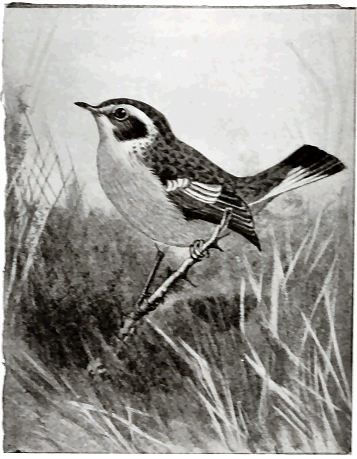
Leaving the hedgerows and the trees for a time we shall find the hay-meadows contain several interesting birds. One of the most easily recognized of these is the Whinchat, a bird that is somewhat rare and local in the south-western counties, but widely and commonly dispersed over the northern shires of England; in Scotland it again becomes somewhat local. We usually detect it clinging to some tall dock plant, meadow-sweet, or stem of cow-parsley, where it sits and utters a sharp double note, resembling the syllables u-tac, at intervals, jerking its tail meanwhile. Its mate may be seen sitting in a similar manner on another stem not far away, and when disturbed they flit from stalk to stalk about the field. These birds are only seen in England during summer: they arrive in the southern counties about the middle of April, but do not reach the south Yorkshire hay-meadows before the end of the month or even the first week in May. Their pretty nest is snugly hidden amongst the long meadow grass, a simple structure of dry grass, lined with a few horse-hairs, and the half-dozen eggs are turquoise-blue, with just the faintest indication of a zone of pale-brown spots round the end. Incidentally we may remark that the Whinchat is also a frequenter of the gorse coverts and the moorlands. In the late summer, when the brood and parents are about the fields, they resort to the corn, and even feed upon it; but the farmer need not be alarmed at their visits to the grain, for they destroy a countless number of injurious insects during their stay in the fields as an ample recompense. A Whinchat we once dissected, shot on the 29th of April, was crammed with small beetles, ants, larvæ of the drake-fly, and several centipedes. In July and August the Whinchat is moulting, and by the third week in September it has departed with its young to the south, although it prolongs its stay into October in Devonshire. These smiling meadows and grain-fields are also the summer home of the Tree Pipit, from April onwards to September. This species also rears its young in a slight nest amongst the grass, the cock bird spending most of his time before the eggs are hatched in a series of song flights from some favourite tree. We knew a Tree Pipit to return for many years in succession to a sapling oak growing in a hedgerow, and to use one special branch from which to soar and sing throughout the early summer. These birds also frequent the corn-fields, and eat the soft milky grain, but their usual food consists of insects, worms, and grubs.
Another well-known summer visitor to the meadows and corn-lands is the Landrail, known almost as generally as the Corncrake. Few persons there are that do not know the rasping, monotonous double cry of this bird, and yet few people ever see a Corncrake all their lives, and still fewer, perhaps, could describe or identify it. Its note is almost as familiar as that of the Cuckoo, and equally characteristic of spring and early summer. There is something romantic about this rasping cry, that sounds almost all night long from the meadow grass. The bird itself is rarely seen, it runs through the dense herbage with astonishing rapidity, and should it by chance disclose itself to our scrutiny, it is seldom imprudent enough to repeat the action. And yet the Corncrake is not quite such a skulking bird as some would make him. When all is quiet he not unfrequently wanders out of the hay-meadow through the hedge into the barer pasture beyond, sometimes running a score of yards into the open field; but at the least alarm he is off back again and soon concealed amongst the weeds and long grass in the bottom of the hedge. Rarely indeed is he flushed even by the aid of dogs; we have known him perch on the top of a thick low hedge when put up by a collie. He flies slowly and in a somewhat laboured way, with his long legs dangling down, and all his efforts seem directed into reaching cover of some kind. The hay harvest in July is a cause of much disturbance to the Corncrake. As the mowers or the more modern mowing-machine lay swathe after swathe of tall grass its haunts become more and more restricted; the brooding Crake at last slips quietly off her nest alarmed at the approaching scythes or rattle of the machine, until at last her home with its numerous eggs is left bare and desolate. We have known her to remove her eggs in the course of a night and place them amongst still standing grass, but the end eventually was just the same. Probably this destruction of nests during hay harvest is responsible for the diminishing numbers of this species in not a few districts. But if the cutting of the grass brings ruin to some birds it also brings an abundance of food to others. These are the Thrushes and Starlings that may then be seen on the shorn fields busily in quest of snails and worms. The Corncrake calls no longer; perhaps the old birds retire to the clover, the standing corn, or even to the turnip and potato fields, and about these places they skulk for the remainder of their stay, and then return broodless to the south. No wonder their return in spring seems to be in fewer and fewer numbers. The Sky-lark is more fortunate. It breeds in much the same localities as the Corncrake, but nests earlier, so that the young are generally able to fly before the mowers enter the fields. Speaking of Sky-larks we may mention that large flocks of this bird appear upon certain suitable fields in the late autumn, remaining throughout the winter. These birds are from the Continent, and come to our isles in that vast tide of migration that sets westwards across Europe from the far East in October and November. The birds always prefer high ground, and we have remarked this choice in the southern counties as well, and seldom wander far from a district during their stay, except under the pressure of continued snow-storms. They invariably return to the usual haunts when the ground is clear again.
The Yellow Wagtail.
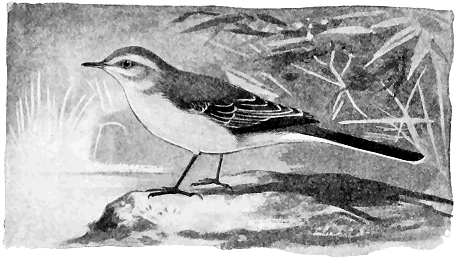
At least two species of Wagtails are common birds upon the fields and pastures of the northern shires. The Pied Wagtail is perhaps the most familiar, although both this bird and the Yellow Wagtail are more or less migratory. Perhaps these birds are most interesting when they congregate in large numbers upon the ploughed fields in March, and run to and fro with dainty steps about the heels of the ploughman and his team. We knew an old farmer who had a special liking for these pretty birds. He knew they lived entirely on insects, worms, and such-like creatures, without professing any knowledge of ornithology. Indeed, we well remember when the old boy heard that we had just published our first book on bird-life, Rural Bird-life: being Essays on Ornithology, how he paused one day at his work in the fields and solemnly put the question: “Charley, what is this ‘Ornithowlogy’; is it a new religion?” We confess to feeling fairly nonplussed at such a remark, and did our best to tell him, with as serious a look as we could command, the proper meaning of the awful word. Poor old White, at a ripe age, has been gathered to his fathers. He was one of the most tolerant and philosophic farmers that we ever met, and we dwell thus affectionately upon his memory; for we were always welcome, boy and man, to wander about his land at all times and seasons without let or hindrance, and study the birds upon it to our heart’s content. But to return to the Wagtails. The Yellow Wagtail is the most closely attached to the fields and pastures of the two; it may often be seen running amongst the cattle, and is a numerous visitor to the fallows in March. Both in spring and autumn Wagtails gather into flocks and migrate thus together. The Pied Wagtail is very fond of nesting in a hole in the wall of some outbuilding, and will tenant one spot with great regularity season after season. The Yellow Wagtail is perhaps the least aquatic in its habits, as the Gray Wagtail is the most. Both Magpies and Jays are also very frequently observed upon the fields searching for worms and grubs; whilst the fleet-winged Swallows and Martins during their summer sojourn fly over many times every acre of the farm, and, as most readers know, are extremely fond of rearing their broods in or on the buildings attached thereto. We never met a farmer who would allow these birds to be molested. Happy birds! They at least are secure in the farmers' friendship, and not even the gamekeeper can say a word against them. The Cuckoo is much less fortunate in this respect; the farmer, we honestly believe, has a genuine love for the bird, and delights to hear its loud and happy voice across his fields, for it tells him that winter is passed, and that better times are approaching both for man and beast. The gamekeeper knocks it over with an oath, and fills its tuneful yellow bill with blood, because it not only looks like a Hawk, but he is “sartin sure” that it turns into one for the winter!
The turnip fields in autumn are always a favourite resort of birds. They are not only the last of the cover left upon the farm, but they abound with food for various species especially. They are the one spot where the migrant Pipits, Thrushes, and even Warblers can always be certain of a meal, to say nothing of an odd Woodcock now and then and the last lingering coveys of Partridges. Even in winter the birds are fond of such a retreat. On many farms the turnips are left in the ground—especially the white variety—until they are wanted for the cattle; the ground is soft and moist, and abounds with food the small birds desire, whilst the broad leaves are a shelter.
Then in late autumn the Jack Snipe once more appears upon the few square yards of bog beside the pond where the cattle drink, or in the sunk fences which usually become rills during the wetter portions of the year. This little bird, we know, breeds upon the Scandinavian fells, and yet it will return winter after winter to the very centre of England to some square yard of bog on a South Yorkshire farm, coming and going so quietly that no man may say exactly when it arrives or departs, and living here for months in this warm corner in the fields, in solitary state, a recluse waxing fat in its solitude. Then winter comes round once more. All the summer birds of farm and garden are far beyond the seas; new birds are here from other and sterner lands. The snow-storms come, and the birds congregate in rich variety about the ricks and farmsteads; flocks of Lapwings cross over the fields bewildered and forlorn; the Moorhen leaves the frozen pond and fraternizes with the poultry; the Larks disappear from the snow-drifted high lands; the Fieldfares congregate in the hawthorns, the Redwings starve. At night the scene becomes even more interesting as half-frozen birds seek roosting-places in the ricks and amongst the ivy; yet amidst frost and snow the Robin and the Wren, and perhaps the Hedge Accentor, carol forth an evening song. The snow melts; the once green pastures are brown and withered; scarcely a fleck of green relieves field or hedgerow, the birds scatter on to the open ground again, and so the northern winter runs its course. How different in the warmer southern county, where all is green, and the visit of winter so light that it is scarcely felt by bird or beast!
Garden bird-life is too familiar to require much detailed notice here. The garden hedge we know is always sure to contain one of the first Hedge Accentors' nests of the year; whilst the Wren is as certain to select the ivy on the wall in which to construct her ball-like abode. The Robin as surely returns each spring to rear its young in some hole in the wall itself. Amongst the fruit trees the Titmice and Flycatchers have their favourite nooks and crannies, and the Redstart has returned as long as we can remember to the hole in the old pear-tree. One bird, however, that frequents the gardens of the northern shires is specially interesting to South Yorkshire naturalists. This is the Garden Warbler; and its exceptional interest centres in the fact that the bird was first described from an example obtained near Sheffield—possibly in the immediate neighbourhood of Broom Hall—and sent by Francis Jessop to Willughby, the co-worker with Ray nearly a century and a half ago, the latter naturalist describing it in his Ornithologia. It is the “Pettichaps” of Latham, a name, according to Professor Newton, that had not become obsolete in 1873 in the vicinity of Sheffield, although we never heard of it being applied to this species during a residence there of some twenty years. It is a late migrant, seldom reaching its Yorkshire haunts before the beginning of May, and, as its name implies, is very partial to large gardens. Its habits somewhat closely resemble those of the Blackcap; and of all the Warbler band its song is only inferior to that of this species. Its nest is frequently made in a currant or gooseberry bush, a flimsy little structure enough, made of dry grass stalks and roots and lined with horse-hair. The eggs are very similar to those of the Blackcap, and four or five in number. During fruit time this Warbler is often to be met with in the garden feeding upon currants and other berries. It is most secretive in its habits, usually betraying its whereabouts by its sharp call-note of tec or tac. Its food consists of insects, larvæ, and most kinds of soft fruit and berries. It leaves Yorkshire in September. There are many other birds that visit the gardens in the northern shires for fruit or vegetable food. In cherry time the Blackbird and the Starling are troublesome enough; the Ring-ouzel visits the gardens near the moors for a similar purpose. Then the Hawfinch and the Jay have a great weakness for green peas; whilst the small Finches play havoc amongst the newly-sown beds. Kestrel and Sparrow-hawk, however, often visit such localities too, the former for mice, the latter for birds.
Before finally leaving the farmstead we ought to give a passing word to the Barn Owl. This bird is not so abundant now in many places as was formerly the case, but it must still be regarded as common in most parts of the northern shires. There are not a few farmers, we are glad to say, who fully recognize the merits of this useful bird, worth more than half a dozen cats in any farmstead, and requiring no keep whatever. These birds are specially fond of the tall-roofed barns where nothing intervenes between the rafters and the slates or tiles, where little daylight ever enters, and where ready means of getting out and in are presented. There are farms where the Owl is quite an institution, where no one ever thinks of molesting it, and where its peculiar noises and nightly wanderings create not the least curiosity. In fact, the bird is regarded as part and parcel of the barns, a useful adjunct to the cats and village rat-catcher, and a good many times more effective in ridding buildings and land of some of their most annoying pests. We need scarcely state that the Swift is a well-known summer visitor to farm and farmstead. We shall have occasion to allude to this bird again in a future chapter (conf. p. 271).
CHAPTER VII.
BY RIVER AND POOL.
Broadly speaking, the northern shires are remarkably well-watered; not only by a net-work of rivers, but by an almost endless succession of pools and lakes, canals and dams, the latter to some extent being due to the necessities of the vast and busy centres of manufacture and commerce. Bird-life in great variety and of exceptional interest is to be found upon these rivers and pools and along their banks and margins, and again presenting us with not a little room for comparison with that frequenting similar localities in more southern counties. Here again we miss some birds that are familiar farther south; we find others that are rarer, or less known there. Unfortunately too many of these northern waters are polluted, especially in their lower reaches and in the immediate neighbourhood of towns, by drainage and factory refuse of various kinds. Rivers that run in their higher reaches over moss-grown stones and sandy beds, clear as crystal, and fringed on either bank with brushwood and timber, become little more than open sewers as they pass the big centres of manufacturing life. The waters are stained as with ochre from the filthy “wheel swarf”, and poisoned with refuse from dyes and sundry chemicals. Yet even in these forbidding places bird-life is not altogether absent, and from time to time Wagtails, Pipits, and such-like species may be remarked on passage even in the centre of so grimy a place as Sheffield. Above the towns where the water still runs clear, and some miles below them where the sediment has settled and the water again become more purified, these canals and rivers are favourite haunts of birds. Then far away amidst rural scenes there are many meres and clear pools where Nature is still undefiled by man; in some of the suburban areas there are clear still mill-dams, which drive the grinding wheels, and which are yet so pure that trout live in them in abundance.
The Kingfisher.
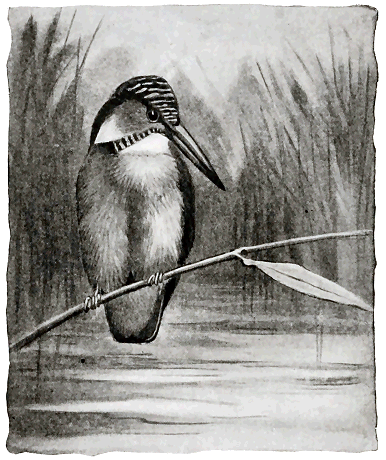
Now, even about such a prosaic spot as a mill-dam there is usually not a little to interest the lover of birds. That refulgent avine gem, the Kingfisher, is a frequent haunter of the shuttles, and the dyke just above and below the sluice. We have seen this bird perch on a branch sticking out of the shallow water at the far end of a mill-dam and plunge again and again into the pool in chase of minnows, and not fifty yards away a dozen sturdy Sheffield grinders were hard at work astride their stones in the hull which resounded with the fitful deafening roar and screech as the metal met the grindstones so familiar to such a spot. Where the horsetail reeds grow up in a dense forest of dark-green from out the shallow parts of the mill-dam, the Moorhen is often common enough, and rears its young from a floating nest some distance from the bank where only boats can reach it. This latter species is much more familiar than the Kingfisher, and it is astonishing how the Moorhen will continue to haunt such a spot long after the entire aspect of it has been changed. We know of dams, once surrounded by gardens and fields, now almost hidden by houses and workshops, where this bird still lingers and breeds every year, amidst a never-ceasing din from water-driven tilts and forges. The series of dams in the Endcliffe Valley, one following the other through a succession of picturesque woods, and united by a broad stream, all situated in the western suburbs of Sheffield, were a very favoured haunt of birds. There can be little doubt that a century and a half ago Francis Jessop used to search this valley for ornithological information; from that day to this not a few of the birds that are intimately associated with his name continue to frequent the place. Here may the Kingfisher be watched, gliding like a spot of blue across the water and up the wooded stream, which is a favourite resort of the Gray Wagtail. Then the fringe of alders by many of these Yorkshire pools and rivers is a favourite resort of Titmice, Redpoles, and Siskins. Nowhere in the northern shires does the alder flourish better than here; its wood is used to make the clogs—or wooden-soled shoes—so universally worn by the mill hands, colliers, and poorer classes of Lancashire and Yorkshire. During its growth, here by the river-side, its seeds are a great attraction to these little birds. The Siskin is one of the most interesting of them. We often met with it in company with Redpoles, especially in many parts of South Yorkshire, which locality it visits during winter. We never found a nest in the county, although we believe the Siskin has been known to breed therein, as well as in many other counties farther south. As previously remarked, the favourite summer home of the Siskin is the pine-woods of Scotland. Very engaging these birds are in the alder-trees, as they cling in almost every possible attitude and pick out the seeds. They also visit the birch-trees in the same localities, and here they are sometimes joined by a company of Bramblings. These larger and heavier-looking birds are equally at home amongst the long slender twigs, hanging head downwards like a Tit or a Goldcrest, and swaying to and fro like animated pendulums, all the time keeping up a chorus of twittering notes. Possibly the Brambling is a life-paired species, for we have often witnessed various little marks of affection between the sexes during winter. The Titmice are equally engaging. Five out of the half-dozen British species may be met with singly in parties or in mixed companies amongst the alders and birches along the river-side, each one with its characteristic note and all with the acrobat-like ways that ever make them so amusing. These remarks more specially relate to autumn and winter; in spring they scatter far and wide to less riparian haunts to rear their young in spots that fancy or necessity requires.
Titmice.
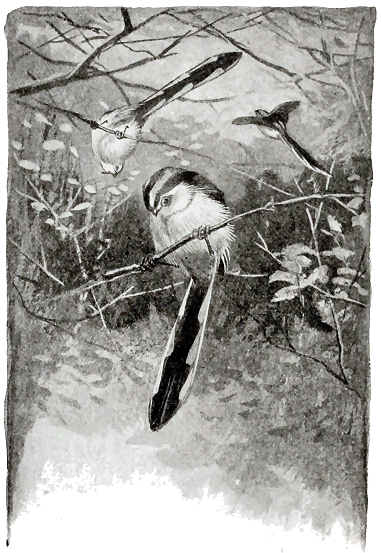
In autumn many of these mill-dams are recognized gathering-places of birds of the Swallow tribe. In August and September Swallows and Martins in countless hosts congregate over them, flitting to and fro in a mazy throng the livelong day, preying upon the swarms of gnats and midges hovering above the surface. These birds are thus forgathering where they have been wont to do for many previous autumns previous to starting off to a winter haunt in Africa. Then in winter not a few shyer and rarer birds are attracted to these open sheets of water, Ducks and Geese and even Wild Swans paying them visits as they roam about the country. There is a fine example of Bewick’s Swan in the Weston Park Museum at Sheffield, which was shot from a mill-dam close to the town, an exceptionally favoured spot, for Ducks and various other strange fowl are by no means rare visitors during the winter months. Our sombre little friend, the Sand Martin, loves these dams and reservoirs, and delights to tunnel into the steep banks to make its nest. Numbers of Sand Martins so do at the reservoirs at Hollow Meadows, for instance. The Pied Wagtail delights in such spots, tripping daintily round the water’s edge in quest of insects, and building its nest in some hole in a wall or about the hulls. We have seen the nest of this species in a crevice of the masonry supporting the heavy cumbersome water-wheel, and not many inches from it, with its continuous splash and roar. Now and then such an unusual bird as a Stormy Petrel or a Gull visits them; whilst during migration time in spring and autumn the Ringed Plover, the Dunlin, the Wigeon, the Teal, and the Pochard are all known to alight occasionally near or upon the dams and reservoirs of South Yorkshire. Coots, Water Rails, and Spotted Crakes either frequent some of them all the year round or visit them from time to time.
The bird-life along our canal banks if somewhat sparse is by no means uninteresting. In rural districts one of the most familiar species is the Reed-bunting—not inaptly named by some observers a "Riverside Bunting". We can recall how very common this bird was along the water-side and about the towing-paths of the canal just outside Walton Park, once the famous seat of Charles Waterton, the old-time Yorkshire naturalist. The bird is by no means a shy or a timid one. It will sit and await your approach, watching you with uneasy flicks of its tail as it clings to some willow twig or reed stem, then start off in dipping flight for a little way to wait again. Finally, as likely as not, it returns to its original haunt, flitting just above the surface. The cock bird is readily identified by the black head and throat, and white cheeks: in the hen these parts are reddish-brown streaked with darker brown. Its song is very similar to that of the better-known Yellow Bunting, consisting of a double note several times repeated and finishing up with a short spluttering trill. In Yorkshire this song commences early in April, sometimes at the end of March, and continues into the late summer, when the moult arrests it. During winter this Bunting often wanders from the water-side, and then we have seen it in the stackyards, but at no time of the year is it ever so gregarious as the Yellow or Cirl Buntings. Flocks of this bird have been recorded from Redcar towards the end of September, and there is other evidence to suggest that our resident individuals are increased in numbers by migrants from the Continent. The first nests of the year are usually made by the end of April, and are placed on or near the ground, amongst a tuft of rushes or amongst the dense vegetation on the banks of the canal or pool. Externally these are made of dry grass, moss, and scraps of aquatic vegetation; inside they are lined with finer grass and hair. The eggs are from four to six in number, olive or buff in ground colour, streaked and spotted with purplish brown and gray. It is worthy of remark, however, that the intricate pencilling so prominent a feature in the eggs of the Yellow Bunting are absent, the lines being shorter and broader and the spots larger and rounder. One might fancy that they had been put on with a quill rather than with a steel pen. Both Pied and Gray Wagtails are familiar objects on the towing-path; whilst among the vegetation near the water the Sedge Warbler has its summer home. This latter bird arrives here in April and leaves again in September. The Reed Warbler is much more local in Yorkshire, although it is known to breed at Hornsea Mere and one or two other places. In the back-waters of the canals, amongst the reeds and flags, both Coots and Moorhens have their residence, whilst the Little Grebe, if not quite so familiar, owing to its more skulking habits, is by no means rare. It is rather surprising what small pools of water will in some cases content a pair of these amusing little birds, whilst it is equally noteworthy how often this species is entirely overlooked. Possibly their alertness and partiality for cover to some extent explains it. Least showy, as they are the smallest, of all the British Grebes, they are often mistaken for a rat or even a fish; certainly they are as much at home in the water as the latter. Towards the end of March they build a bulky floating nest among the flags and rushes, composed of dead and rotten stalks matted and heaped together, the half-dozen white eggs (stained brown almost as soon as laid) resting in a shallow hollow at the top. The marvellous celerity with which the sitting bird covers her eggs with weed when the nest is approached must be familiar to every bird’s-nester. A great many of the chicks are destroyed by hungry pike, and to this, perhaps, must we attribute the fact of its seldom increasing in numbers, even in localities where it is never otherwise molested. As a rule the canals are too deep to admit of birds obtaining much food from their margins; but the insect life that flits over the surface is sought by Swallow, Martin, and Swift.
We must include a brief visit to the fish-ponds in the present chapter. There are many of these scattered about the parks of our northern shires, and not a few of them are frequented by birds in plenty. Most readers will remember what a paradise for aquatic birds the lake at Walton Hall became under the loving care of the famous old Yorkshire naturalist; how the birds used to flock there in winter and join the resident population that dwelt in that valley of peace. And this, mind, at no great distance from populous towns and villages, in a country filled with collieries and workshops, crossed by railways, and many miles from the coast. It only shows what can be done if we encourage and protect the birds that visit us. Many a picturesque old fish-pond we can recall in Yorkshire and Derbyshire—spots where the deep water teemed with fish, and the big elms and horse-chestnut trees almost swept the surface with their spreading branches, high up in which the Rooks and Herons reared their young. Amongst the clumps of iris and flag that grew so luxuriantly in the shallows Coot and Moorhen made their nests, and their broods of black downy chicks might be seen paddling about the broad flat leaves of the water-lily and the candock, or resting and sunning themselves on the floating vegetation. The steel-blue Swallows and Martins come from the adjoining meadows and park to dart to and fro with shrill twitter, and thread their way beneath the drooping branches of the chestnuts gaily ornamented with their noble spikes of fair yet evil-smelling bloom, like miniature candelabra. The Herons all day long fly up and down from their nests in the tree-tops to and from the shallows, where the roach are an easy prey. How stately the big gray birds look standing so solemn in the shallows! With what patience they wait and watch and finally strike, sending that formidable spear-like bill into the doomed fish, which is quickly disposed of with a grunt of satisfaction! Now and then the Kingfisher’s radiant beauty is reflected in the unruffled water as he glides across; at intervals a shy Water-rail or a Grebe sails timidly out from the rushes, dives at the least alarm, and the scarcely-ruffled surface indicates the quick return under water to the sheltering greenery. In winter these ponds are often visited by Wild Ducks, Wigeons, and Teals, with sometimes much rarer fowl. Indeed, the very uncertainty of what might be found was one of the greatest attractions of such a spot. Here also dwell the stately Swans, half-domesticated it is true, yet none the less ornamental for that. These birds mate for life, and are apparently much attached to each other. They always select the tiny islet in the pool for their domestic arrangements; and on this in April they construct a big nest of straw and sticks and other rubbish, in which the hen bird lays her massive pale-green eggs. At first the young birds are brown and dingy looking; nor do they acquire that pure white dress characteristic of their parents until the following autumn.
The Tufted Duck.
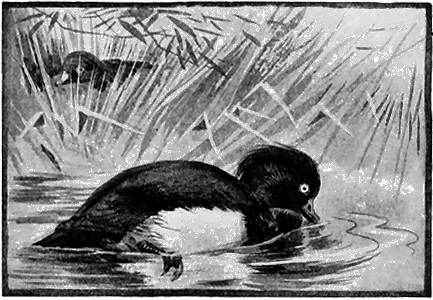
In a previous chapter we dealt at some length with the bird-life of Sherwood Forest. We will now return to that area in order to make a brief survey of the birds that frequent some of the pools in the vicinity of the Dukeries, round about Clumber and Newstead. It would be difficult to find a more suitable place for Ducks throughout the length and breadth of England than some of the charming rush-fringed ponds that are such a feature of this part of Nottinghamshire. They afford plenty of cover and food, not only the ponds themselves but the streams and marshes by which many of them are joined together, and above all they are well watched by vigilant keepers, so that the birds are practically safe from molestation during the nesting season. Here may the habits of the Tufted Duck be studied to perfection. This bird is an old friend of ours; we have seen much of it in more southern haunts, especially during the non-breeding season. Most if not all the Tufted Ducks leave Devonshire for more northern haunts in spring, but in the Dukeries they are to be seen throughout the year, apparently in undiminished numbers. There can be little doubt, we think, that this Duck pairs for life; certainly it may be seen in company with its mate summer and winter alike. During winter the birds are sociable and gregarious, and the fact is not so readily remarked, but as spring draws on they separate more, and from that time onwards to the laying season live almost exclusively in pairs. The nesting season of this Duck varies a good deal according to locality. In southern haunts the duck commences to lay at the end of April or early in May; in North Notts the birds are at least two or three weeks later. The nest is frequently made in a tuft or tussock of sedge, amongst long grass, or beneath a small bush. It is merely a hollow lined with a little dry vegetation, but as the eight or ten eggs accumulate, the duck surrounds them with a bed of down plucked from her own body. These eggs are greenish-buff in colour. Tufted Ducks are most expert divers, and feed much towards evening, during the night, and early in the morning. By day they may usually be seen swimming lazily about, preening their plumage, and now and then sleeping, as they float buoyantly upon the water far out from shore. The Mallard is also a common bird about these ponds and pools. We have already seen that it not unfrequently nests far from water amongst the more open parts of the grand old forest; but nevertheless a fair number of birds frequent these pools for domestic purposes. The Shoveler is also present, if in much smaller numbers, and hides its very similar nest in much the same sort of places. Its nine or ten eggs are, however, pale buffish-white, with a faint tinge of olive. The tame and confiding little Teal—smallest of all our British Ducks—is also a common resident in this district. We cannot say whether the Pochard breeds here or not. We have seen it during autumn and spring, perhaps on passage only; but it certainly breeds in Yorkshire at Hornsea Mere, in the East Riding. We have also remarked several of the above-named species on the beautiful ponds at Newstead Abbey, once the classic home of Byron, during the early summer months, so that some of them may breed in this immediate neighbourhood.
Returning now to the rivers of our northern shires, we will briefly glance at one or two birds that are specially associated with such water-ways. Here in Yorkshire, Dipper, Gray Wagtail, and Heron may perhaps be the most familiar birds, but to our mind the Kingfisher is the most distinguished, and from some points of view the most interesting. We always think a special charm attaches to birds that have a place in ancient history, or that are surrounded by more or less classic legends and superstitions. The Kingfisher is one of these. From the very earliest times of which we possess any record, the bird, for some reason that to the modern mind does not seem always very clear, has figured largely in myth and superstition. Some of these are by no means wanting in poetic imagination. Legend, for instance, accounts for the beautiful colour of its plumage in the following amusing way: When the Kingfisher was liberated from the Ark it was a plain gray-plumaged bird, but flying towards the sun it became of the same hue as the sky on its upper parts, whilst its lower parts were scorched by the solar rays to the chestnut tint they now are. Fable is also curiously associated with the domestic arrangements of the Kingfisher, mid-winter being given as the date of its reproduction. Ovid tells us that during this period Æolus, the god of wind, exerted his influence, so that the tempests were quieted and the sea remained calm, upon which the floating nest might remain in safety for the seven Halcyon Days. As old Shakespeare has it:
"This night the siege assuredly I’ll raise: Expect Saint Martin’s summer, halcyon days". —Henry V.
We also find under the term Halcyon (another name for the Kingfisher) in Minsben’s Dictionary the following quaint passage bearing on this fable: “A bird called also Kingfisher, because she fisheth in the sea, and casteth herself with such force at the fishes. She conceiveth in the sea, and in it she brings forth her young—and that in chill and cold weather; and meanwhile the heaven is serene, and the sea tranquil, nor agitated by troubles of winds. Hence those serene days are called Halcyon-days.” Superstition attributed to the Kingfisher not a few virtues. For instance, Lupton, three hundred odd years ago, in a book entitled A Thousand Notable Things, &c., writes: “A little bird called the King’s fisher, being hanged up in the air by the neck, his neb or bill will be always direct or straight against the wind. This was told me for a very truth by one that knew it by proof, as he said.” Possibly the superstition widely prevailed at that remote date, as four years later Storer, in his Life and Death of Thomas Wolsey, Cardinal, gives it thus:
"As a Halcyon with her turning breast Demonstrates wind from wind, and east from west".
Marlowe (Jew of Malta, i. 1) has another rendering of the superstition, thus:
"But now how stands the wind? Into what corner peers my Halcyon’s bill? Ha! To the East? Yes! See, how stand the vanes? East and by south."
It is interesting to remark that the quaint old superstition is not quite dead, even at the close of the nineteenth century! We have on more than one occasion come across country people in Yorkshire and Derbyshire who have assured us that the dead body of the Kingfisher, if hung up by a thread, will turn its beak in the direction of the wind then prevailing. Mummified Kingfishers were also believed to be a charm against thunderbolts, and also a preservative against clothes-moths. Professor Newton informs us in his Dictionary of Birds that in many islands of the Pacific Ocean the indigenous Kingfisher (of various species) is an object of much veneration.
Surely after these few extracts from some of the many legends in which the Kingfisher is involved the gem-like bird acquires a greater interest as we watch it passing like a gleam of blue light along the river. Even in our own day there is not a little fiction and absurdity gathered round the nesting habits of the Kingfisher. We are told that the bird is careful to make a nest of fish-bones for its eggs; this is a widely prevailing idea among persons who should know better, such as keepers, fishermen, and bird-nesting boys, for their experience is generally personal. Perhaps appearances have fostered, if they have not absolutely originated this belief. The Kingfisher pairs for life, and returns in most cases to the same place to nest season after season. This nest is usually in a hole, in many cases in a steep bank overhanging the river, and generally excavated by the birds themselves. Very often, however, a rat’s hole will be selected and various trifling alterations made to suit the new tenant. The hole almost invariably slopes upwards from the entrance, and is from three to four feet in length, enlarged at the end into a kind of chamber. The birds, it should be remarked, resort to this hole to roost, and frequent it generally long before the eggs are laid, so that a collection of bones, decaying fish, and droppings accumulates in the chamber. Upon these fish-bones the six or eight pearly-white eggs are deposited, surrounded in course of time by a heap of most offensive matter. When the young are hatched the place becomes even more filthy, owing to the increased amount of droppings and the number of fish brought for their food. We are not aware that more than one brood is reared in the season, although several clutches of eggs will be laid in the efforts to accomplish this, if the eggs chance to be destroyed. Not a few persons believe the Kingfisher to be mute; but this is not the case. Its note is shrill, but not very loud, and resembles the word peep, sometimes uttered several times in quick succession. It is not, however, by any means a garrulous bird, and usually flies along in silence. By the way, we might mention that the Kingfisher is by no means the only bird of gay plumage that as it were fouls its own nest, for the Hoopoe, a handsome bird with a wonderful crest, possesses a nest which, during the course of incubation, is rendered filthy and obnoxious from the droppings of the female, conditions which become worse when the young are hatched. How different this from the cleanly habits of the Starling, for instance, that conveys the droppings of its young away most carefully, usually after every visit with food.
As many of the rivers of the northern shires approach the sea they widen into estuaries, the shores of which are the resort of a great variety of bird-life. The Humber and the Tyne on the east coast, the Solway, the Lune, the Ribble, and the Mersey on the west coast of England are capital instances of such. The mud-flats up to tidal limits, often extending many miles inland, are favourite feeding-places of large numbers of wading birds, not only during the two seasons of migration, but throughout the winter months. In summer these places are more or less uninviting; the birds are scattered far and wide, not only over our own uplands and inland waters, but beyond the seas on arctic tundras; in early autumn the birds appear again in small numbers, and as that season advances become increasingly numerous. When these birds of mud-flat and sand-bank depart, little else is left but an occasional Gull, or possibly a laggard wading bird or two that from some reason or another have not migrated with their companions. We might, however, mention that in or near the beds of some of these northern rivers the Ringed Plover breeds. In spring and autumn companies of Terns hang about these estuaries; the Sandwich, Common, Arctic, and Lesser Terns appear from the middle of April onwards; their return is noticed during August and the first half of September. These dates are nearly coincident with those at which we notice these birds in the Devonshire estuaries, save that in autumn the migration continues into October, and during some years is even prolonged into November. Sanderlings, Curlew Sandpipers, and Knots, birds that migrate amongst the latest in spring and breed in the high north, are some of the first to reappear in autumn, even at the end of July or early in August. Common Sandpipers, as their name suggests, are abundant during their short stay at the mouths of these northern rivers previous to passing south. In the Humber district especially, vast flights of Dunlins often appear upon the mud-flats towards the end of August, and remain for the winter. When the rising tide drives them from the muds, they often resort to the fields to wait until the ebb. The movements of these birds are most interesting, as a vast flock wheels and spreads out or closes up with as much precision as drilled troops. Scattered amongst them are many odd Stints and Sanderlings and Ringed Plovers. Curlews, Whimbrels, and Bar-tailed Godwits also appear about these estuaries during migration time, and some of them remain upon them throughout the winter. At the latter season Ducks of various species are regular visitors. Some of these, however, keep well off the land out at sea, only entering the river mouths during rough weather, or at night for the purpose of feeding in the shallower water. One of the most familiar, perhaps, is the Scaup; the Pochard is another, with a much more marked preference for rivers; the Pintail is a third. Companies of Swans from time to time may be observed, usually consisting of Whoopers, and much more rarely of Bewick’s Swans.
During the migration season in spring, and more especially in autumn, these northern river-valleys are frequented by great numbers of land birds on their way to more northern and eastern breeding grounds in Continental areas, or returning south and west to winter in our islands or to cross over them to warmer latitudes. These northern rivers are exceptionally favourable for migration, so many of them trending in the same general direction as the birds are bent on following. Vast numbers of migrant small birds follow such river-valleys as the Tees and the Humber, on their way into Yorkshire, Notts, and Derbyshire, by way of the Don and its tributary streams. It is unnecessary here to dwell upon these species in detail, for we hope to go much deeper into the matter when we come to a study of the migration of birds in the northern shires. We have gathered much evidence in support of this migration during a residence of many years at no great distance from the Humber and certain valleys in direct communication with that important estuary—next, perhaps, in interest, so far as bird-life is concerned, to that still more wonderful locality the Wash, a little lower down the coast.
CHAPTER VIII.
ON SEA AND SHORE.
It is the bird-life of sea and shore especially that renders these northern shires so much more interesting than the littoral counties of the south and west. Compared with these the southern coasts seem tame and deserted, indeed. This is principally due not only to the fact that so many marine species breed in northern areas only, but also to the much greater strength of migration generally along the coasts. All along the coast from Lincolnshire northwards to the Firth of Forth, and onwards to the Hebrides, St. Kilda, the Orkneys and the Shetlands, we have vast and varied bird populations, not only scattered up and down the shore, but congested here and there where the sea-fowl in unnumbered hosts congregate to rear their broods. The southern counties present us with nothing approaching to this; the wealth and variety of the marine avifauna of the northern shires is one of the most pleasing of their many characteristics.
For the sake of comparison we may here state that along the entire coast-line of South Devon—embracing some of the finest cliff scenery in England and full of sandy reaches, rolling downs, rocky islets and stacks, and lengths of shingle and sand—there are but two typical marine species (at most three, if we include the doubtful Oyster-catcher) that breed, and one only of these, the Herring Gull, in any numbers; the other, the Ringed Plover, is local and nowhere numerous! But how very different is the case when we get round the English coast as far as the Wash and enter that area which for the purposes of the present work we describe as the northern shires. Let us follow this line of varied coast, with its alternating lengths of sand and shingle, buttress-like cliffs, rocky shores, and islets round to the Forth, and briefly glance at the several species that frequent it and breed upon it in succession. We will, however, leave for a future chapter the birds that are more strictly confined to the sea-cliffs, and deal with those only that nest either along the flat shores or low rocky islands.
1. The Lesser Tern. 2. The Ringed Plover.
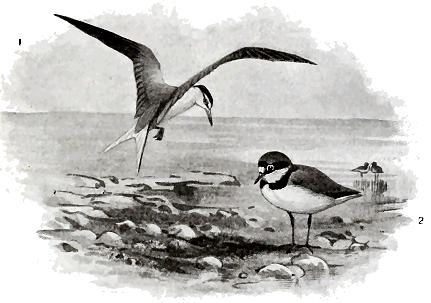
The first two species that we shall meet with during summer on the sandy reaches of the Lincolnshire coast are the Lesser Tern and the Ringed Plover. The first-named of these is a summer migrant and a late one. We remark it passing up the Devon coast early in May; it reaches its breeding-places by the middle or the third week in that month on the Lincolnshire and Yorkshire coasts, but is later still in Scotland. The return passage is made towards the end of August and through September. Incidentally we may remark that not only this but the other British species of Tern often continue their migrations at night. We have frequently heard the well-known note sounding from the darkened air as flocks of these birds passed north or south along the coast, a short distance from shore. The Lesser Tern breeds in May. It makes no nest, but deposits two or three eggs upon the bare shingle, in spots where the debris of the shore is large—pebbles, broken shells, and the like—not on the fine sand. We may remark that we have taken as many as four eggs in a clutch from this part of the coast. The eggs are very difficult to see on the rough shingle, and during our search for them the distressed little birds flutter and beat about the air uttering their shrill note incessantly, peering down most anxiously, yet displaying no increased alarm when they are actually found and taken. It is a most unfortunate circumstance that this Tern prefers the coast of the mainland to an island for breeding purposes. To this fact its absolute extermination is largely due in not a few localities. There can be no doubt that the three or four other British Terns would have shared the same fate, and become rare and local long ago, in England especially, had they not bred in much less accessible spots, as on the Farne Islands, for instance. Upon the same coast the Ringed Plover also breeds. This bird is a resident in the British Islands, but subject to a good deal of local movement during autumn and winter. We shall find, however, that it always prefers to deposit its four pear-shaped eggs upon the finest brown sand, where scarce a pebble or a shell can be seen. The reason for this curious choice is because the eggs are only spotted, not blotched, and therefore they best resemble such a resting-place as is chosen for them. They would be much more conspicuous upon the shingle where the Tern’s eggs rest. Both eggs have a buff ground-colour closely resembling the sand, but those of one bird are heavily marked to harmonize with shingle, those of the other finely spotted to imitate grains of sand. These birds, again, evince little or no anxiety during our search for their eggs; they seem fully aware that the best policy is to leave them to the safety ensured by their protective coloration. They are laid in Lincolnshire in June, and fresh eggs of both species may be got together during that month; and during the daytime the nearly vertical sun renders incubation scarcely necessary. Both these species may be found breeding here and there along the shore right up to the Humber, and from Spurn still farther northwards until the coast assumes a more rocky character as we approach the famous Flamborough headland. When we reach the rocks a little Passerine bird makes its appearance, and this is the Rock Pipit. As its name implies—and it is a most appropriate one—the bird is only found breeding on a rocky shore. Given this, its distribution round our entire coast-line is a very general one. It breeds as commonly on the rocky shores of Devon as on the Hebrides and the Farne Islands; but there are no Rock Pipits on the flat coast-line between the Thames and the Humber. We meet with it again, however, here on the Yorkshire coast, and cannot easily mistake it, for it is about the only small bird that dwells in such a haunt during summer.
Sheldrakes.
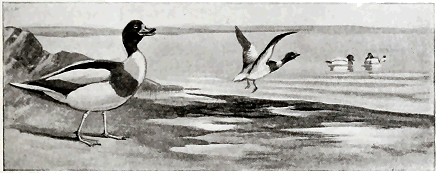
Travelling northwards again until we reach the coast of Northumberland, where between the towns of North Sunderland and Berwick we shall find another length of shore of great interest to the ornithologist. Indeed between these two points are situated the famous Farne Islands, the grandest and most imposing haunt of sea-birds round the entire English coast. On the mainland, nearly opposite to the Farne Islands, there is a long reach of sand dunes between the sea and the cultivated land, and these are frequented by at least one bird of exceptional interest. We may dismiss the Gulls that beat along in restless flight, and pay small attention to the Common Buntings that here justify their name, and for the time being confine our observations to the Sheldrakes that haunt this part of the coast. These sand dunes are an ideal locality for such a bird. Should the tide chance to be out, more likely than not this species will be detected upon them. It is a shy and wary fowl, though, and we need the aid of our powerful binocular to bring it within range of much detailed scrutiny. This Duck is to our mind quite the handsomest of its family in our islands, a combination of very pronounced black, white, and chestnut, with a dash of crimson and pink on bill and legs thrown in. You may watch it thus through your glass walking in a somewhat stately way, not waddling like a more typical Duck; but should you attempt a much nearer scrutiny the big bird unfolds its broad party-coloured wings and seeks a more secluded resting-place. Should the time be high-water, and the blue sparkling sea reaches almost up to the links, most probably a few Sheldrakes will be observed flying over the water up or down the coast. The flight is very characteristic, unlike that of the true Ducks, more like that of a Goose or a Swan, the wings moved up and down with slow measured strokes, so very different from the rapid beats of the bird’s Anatine relations. In this species the sexes are very similar in colour; indeed the chief external difference is the absence of the frontal shield from the female. Following the almost universal law, this conspicuous hen bird takes good care to conceal herself from enemies during the critical period of incubation, and lays her eggs at the end of a long and often winding burrow in the sand. In this particular district a rabbit hole is almost invariably selected, and some of the chosen burrows are so intricate that we may spend hours in the fruitless search for the exact position of the nest. This is usually made at the end of the burrow, and consists in the first place of a handful of dry grass—possibly a rabbit’s old abode; but as the creamy-white and fragile eggs accumulate (to the number of a dozen or sometimes more) the old birds surround them with down of exquisite softness and lavender-gray in colour. As is generally the case where both sexes are showy, and incubate in covered or concealed nests, the male bird takes his due share in the duty of hatching; but so careful are the birds in relieving each other—usually at morning and evening—that they seldom betray the whereabouts of the nest. The young birds, soon after being hatched, quit the burrow and betake themselves in their parents' company to the sea-shore. In this locality the bird is certainly becoming rarer owing to the way the young are captured and the eggs taken by fishermen and others. We once inspected an entire brood of a dozen ducklings that a fisher lad was rearing at Seahouses. He had them confined in a small pen and fed them chiefly upon sand-hoppers, which they were marvellously adept at capturing as he threw them down one by one amongst the downy little creatures. From Holy Island right round to the Forth, this Duck may be met with breeding, preferring in the latter locality the numerous sandy islets. Round the coasts of Scotland it becomes even more numerous and widely dispersed.
We will now retrace our steps to the Farne Islands and make a brief inspection of such birds that build their nests on the flat surface, reserving the cliff-haunting species for our next chapter. Repeated visits to these islands only increase their charm. A single visit is bewildering, renewed acquaintance impresses their wonders upon us and enables us fully to realize the grandeur of the scene and more completely to enjoy the avine wonders of the place. Apart from their bird-life, there is a strong human interest clinging to them, for Grace Darling casts a halo of romance around them by her daring deed long years ago, and which is still a stock subject for conversation up and down the coast. These rocky islands lying a few miles off the shore are nowadays almost a perfect sanctuary for sea-birds. This was not always so; for we can recall the time when the eggs especially were gathered in such a wholesale way that the wonder is there were any sea-birds left there. Strict protection is now the rule, and visitors are generally kept under such close supervision that the lifting of an egg without permission is almost an impossibility. There are, of course, a good many birds on and off these islands at all times of the year; now and then, especially in winter or during migration time, a rare straggler of some non-indigenous British species appears, and the light-keepers have repeatedly assured us that at intervals the sea around them during winter often swarms with Ducks and other northern birds. It is, however, in spring and summer that the islands become crowded with their normal inhabitants—Gulls, Terns, Eider Ducks, Cormorants, Ringed Plovers, Oyster-catchers, Guillemots, and Puffins—assembled there for the express purpose of rearing their young. One of the most characteristic birds of the islands is the Lesser Black-backed Gull—in fact the entire group may be regarded as one vast colony of this species, and perhaps the most densely populated one throughout the length and breadth of the British archipelago. These birds return to the islands—coming from the south from many parts of the German Ocean and the English Channel—early in spring, but the exact date varies a good deal in different years. In some seasons they return en masse as early as from the middle to the end of March; in other seasons not before the middle of April. A month later they are engaged in nesting duties. The date of breeding, however, varies little, and the eggs are invariably laid during May and June. On approaching some of the islands, the first impression is that this Gull monopolizes the whole of the ground, as it occurs in such vast abundance. The air seems full of them, the ground and bare rocks are crowded; and as our boat finally grates against the rough beach and we eagerly jump ashore all becomes noisy excitement—a perfect babel of protesting cries that is persistently kept up until we leave the place. We shall find that the nests vary a good deal in size, some being little more than hollows trampled out amongst the dense beds of campion and thrift, others more substantial and composed of pieces of turf, sea-weed, stalks of herbage and grass. The eggs are three or four in number, and subject to an incredible amount of variation in colour—greens, olives, browns, and grays of almost every possible shade representing the shell tints; browns and grays the markings, which take the form of round spots, blotches, streaks, either evenly distributed over most of the surface, scattered here and there, or forming zones round the end. Right through the summer these Gulls are employed in rearing their young, the period being unusually prolonged because so many of the first clutches of eggs are taken for culinary and other purposes. During the latter part of August and throughout September these Gulls and their young leave the islands and work their way southwards, scattering far and wide over the seas, following the shoals of herrings and sprats and other fish, some of them possibly wandering as far as the Spanish and north-west African coasts. A few Herring Gulls breed here and there among the other species, but this bird has very few large colonies in the northern shires. This is the one species of Gull that breeds on the south coast of Devon, and there its colonies are larger than any we have visited elsewhere in the British Islands. Scattered pairs, however, may be met with here and there along the coasts, and in some few inland spots throughout the northern shires. The Kittiwake also breeds in numbers at the Farnes, but we will reserve our notice of it for a later chapter.
The Lesser Black-backed Gull.
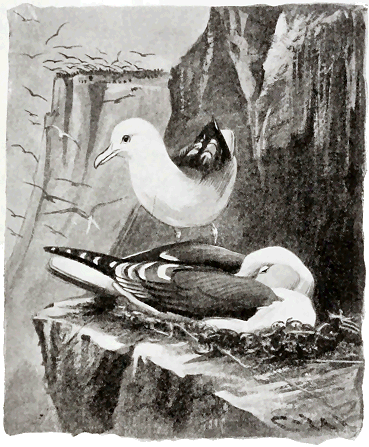
Next to the Lesser Black-backed Gull the Terns are certainly the most numerous and most interesting birds. Three out of the five British species return each spring to these famous islands to breed. The Roseate Tern, rarest of all the indigenous species, used formerly to breed here, but it eventually became extinct, although from time to time an odd pair or so are observed in their old-time haunts, so that the bird may re-establish itself in them, more especially as the sea-birds are now so strictly preserved there. The three regular breeding species are the Sandwich Tern, the Common Tern, and the Arctic Tern. All are summer migrants only to the British Islands. The Sandwich Tern, by far the largest of the three species, arrives at the islands during the last half of April, as a rule, but some seasons is not seen until the beginning of May. There is much in their early movements that reminds us of the actions of Rooks just previous to nesting. Every morning for perhaps a month after their arrival they assemble at the islands and stay for a short time, previous to dispersing over the surrounding sea to search for food, lingering longer and longer as the actual breeding time approaches, until they finally decide upon a spot to nest, and about a week after this the first eggs are laid. The laying season lasts a month, say from the middle of May until the middle of June. The earliest young may be remarked about the latter date, and from that time onwards rapidly increase in numbers from day to day. July is a busy month indeed for the parent birds. In exceptionally early seasons some of the young are able to fly by the beginning of August, and by the end of the month the birds quit the breeding-place, and finally desert the vicinity of the islands during the first week in September. Sometimes the autumn exodus is made, but the birds return in a day or so and linger about the islands before finally taking their departure south. The Sandwich Terns do not always breed in exactly the same spot every season. Sometimes an exceptionally high spring-tide will wash away most of the eggs, and then the poor birds move to another situation, perhaps to another island, and try again. This happened in the summer of 1883, and we saw the beach literally strewn with broken egg-shells, the sole remains of the wrecked colony. On our way from the beach towards the barer rising ground in the centre, where the main colony chances to be established, we pass many outlying nests, not only of this Tern, but of Gulls and Eiders. Birds are rising from all parts of the ground, and gradually congregating into a dense bewildering, drifting, noisy throng above our heads. At last we reach the colony of Sandwich Terns, and there we find for an area of many square yards the ground literally covered so closely with eggs that to walk amongst them without breaking them is almost an impossible feat, not only because the nests are but a few feet apart, but because the eggs themselves so closely resemble the ground in colour. The nests are slight enough, many of them nothing but hollows in the ground, some of them with a few bits of weed and grass loosely arranged, and chiefly round the margin. The two, or less frequently three, eggs are very beautiful objects, and vary enormously in the character of the markings. The ground colour may be any shade between rich buff and dull white; the markings are brown of many shades, and ink-gray. These latter vary considerably in shape and size, from large irregular blotches that conceal nearly a third of the shell to splashes, spots, and streaks, sometimes distributed over the entire surface, or in zones, or irregularly here and there. During the whole period of our stay the birds remain above us, fluttering and gliding to and fro uttering shrill notes of alarm.
The Arctic Tern, on an average, arrives later than the preceding species, generally about the first week in May, sometimes not before the third week in that month. A week or so elapses before the birds finally settle down to nesting duties, so that the eggs are seldom laid before June, exceptionally during the last few days of May. As a rule the breeding season is over by August, and the bulk of the birds quit the islands in the first week of September. In later seasons they may not leave until the end of that month, and a few in rare instances linger into October. The eggs are generally laid close to the water’s edge, and so far as our experience extends (and that is a rather wide one, for we have visited colonies in many parts of the British area) no nest is ever made for their reception. They are placed upon the bare sand and shingle, and upon the line of rubbish that marks the limit of the highest water-mark. Two or three eggs are laid for a clutch, varying from buff to olive and pale-green in ground colour, heavily spotted and blotched with brown of many shades, and gray. Lastly, we have the Common Tern, a bird that arrives and departs at about the same dates as the preceding species. We generally found the breeding-places of this Tern at a greater distance from the water than those of the Arctic Tern, amongst the grass and sea campion on the higher parts of the island. As our boat approaches the nursery of this Tern, numbers of birds may be seen squatting on the beach or swimming about in the rock pools. These are the first to take alarm, and as we finally land others rise from the island, and the air is soon filled with screaming birds. The colony is established on some rising bare ground, and the eggs are laid in scanty nests—hollows lined with bits of grass and stalks of marine plants. The eggs, two or three in number, very closely resemble those of the Arctic Tern, but are larger, rounder, and never appear to have any olive or green tint on the shell.
The Eider Duck.
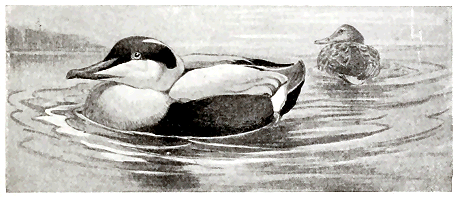
Many pairs of Eider Ducks also breed upon the Farne Islands, placing their nests amongst the campion and long grass, in crevices of the lichen-covered rocks, or in holes in the ruins that are to be found on some of the islets. These Eiders are remarkably tame, and allow the observer to watch them as they brood over their eggs. The male birds, however, are much shyer, and never come near the nests at all, spending most of their time upon the sea off the islands. Then the Ringed Plover breeds here in small numbers, also the Oyster-catcher (a noisy, shy bird enough), and not a few Rock Pipits. Upon an outlying reef the Cormorants have their colony—a dirty, evil-smelling spot, which apparently by common consent is shunned by all the other species. This islet is low, not more than a dozen feet above the sea in its highest part, sloping to the water’s edge on one side. Where the huge nests of the Cormorants are built there is scarcely a trace of any vegetation; everything is more or less covered with droppings, and decaying fish are strewn here and there—the whole place smelling most offensively on a calm hot day. These nests are made of sea-weed, stalks of marine plants and turf, and many are lined with green herbage. The three or four long oval eggs are pale-green, but so thickly coated with lime and dirt that all trace of this is hidden until they are washed and well scraped.
The Farnes are also a great breeding resort of the Puffin (called “Coulter-neb” by some people because its beak closely resembles the coulter of a plough), some of the islands being so undermined by their burrows that almost every few steps we sink deep into the soft loamy soil. During the non-breeding season these birds disperse far and wide over the sea, roaming immense distances from their birthplace, but as spring arrives they collect at the old familiar spots to rear their young. Puffins cannot be regarded as common about the Farne Islands until April, but from then until the end of the following August they are one of the most abundant species at them, although, owing to their subterranean habits, the fact is not very palpable to ordinary observation. These birds excavate a long burrow in the soft soil, often extending many yards underground, and at the end, upon a handful of dry grass perhaps mixed with a few feathers, the hen bird lays a solitary egg, dull-white in colour, very sparingly marked with pale-brown and gray. When the colony is approached such birds as may chance to be above ground soon betake themselves to the sea; those in the burrows remain to be dug out before they will usually budge from their egg, resenting this by bites and scratches dealt in the most savage manner. There is something immensely ludicrous about the look of a Puffin as you drag the struggling bird into the daylight; but we would warn those who might essay the experiment to encase their hands in strong gloves, or they may repent the business. Had space permitted, we should have liked to say something about the curious transformation the beak of this bird undergoes as the pairing season approaches, but we must wait for a future opportunity. Most, in fact all, of these species breed in many other parts of the coasts of the northern shires, but we have elected to describe them here, for the Farne Islands are probably the most accessible locality and admirably situated for studying all these birds within a very small area.
The bird-life at sea off our northern shires is replete with interest at all seasons of the year. In summer, in the neighbourhood of the great breeding colonies of sea-fowl, the surrounding seas for many miles are full of animation, the birds scattering from these home centres far and wide in quest of their finny prey. What a variety of birds we meet with thus, each searching in its own peculiar way for sustenance! How varied their actions; how diversified their habits and economy! In winter these self-same waters are the home of countless birds that migrate from arctic latitudes to spend that season where food is ever plentiful and the water always open. Hordes of Ducks and Geese swell the more sedentary avine populations, or replace such species as Terns, that migrate or wander south with the approach of winter. Vast numbers of Divers and birds of the Auk tribe move south to these seas off the northern shires; Gulls in uncounted hosts do the same. At varying distances from the land armies of these sea-fowl migrate south in autumn and north in spring; sometimes for days in succession Gulls or Skuas, Terns, Gannets, Guillemots, and so on pass to and fro according to season, these avine movements being on a much grander scale than ever we remark on our southern coast lines.
Gulls and Terns.
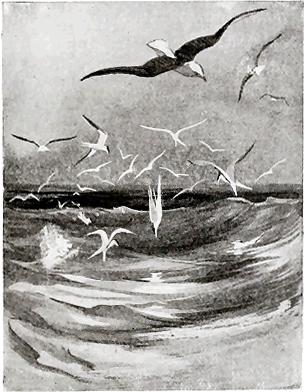
From shore, on this bright May morning, for instance, there is nothing to indicate that much of special interest is to be seen among the birds at sea. From where we stand, near the old-fashioned little quay of this northern fishing village, redolent of tar and stale fish, the sparkling water right away to the headland yonder, and still beyond to the line of the horizon where blue sky and blue sea seem to meet in an indistinct haze, is apparently deserted of bird-life. But we will get aboard this well-found taut little coble, hoist the brown sail and put her nose before the spanking breeze, and see what birds we may fall in with during a few hours' cruise. Behind the headland yonder, and at no great distance from land, a mixed company of Terns are fishing. There are few prettier sights than this amongst bird-life on the sea, especially should a shoal of fry chance to be swimming close to the surface. Above the moving mass of glittering fish the snow-white looking Terns flutter and poise and drift to and fro in a constantly-changing throng; many birds are swimming above the shoal, and every few moments one of the flying Terns drops down like a stone into the water with a splash that we can hear half a mile or more across the sea. The force with which they descend is scarcely sufficient to immerse their light bodies, and before the spray has cleared the bird is either up again into the air, or swallowing the captured fish whilst sitting on the surface. A few Gulls are flying about close by, but these birds prefer larger game; although occasionally they will chase a Tern that may chance to be passing with a tiny fish and endeavour to make the poor little bird drop its capture. Out in the offing the Gulls are much more numerous, for there the fishing fleet is at work, and the birds hover around ready to pick up any unconsidered trifles that may chance to come in their way. A mile or so off the headland the sea is literally alive with birds of the Auk tribe that are breeding on the long range of cliffs. Here we renew our acquaintance with the comical-looking Puffins—hundreds of them swimming about, diving at intervals, preening their plumage, and disporting themselves generally. Many of them allow the bows of the coble almost to reach them before they dive with startling speed and reappear some distance ahead or astern, the first thing they do upon reaching the surface again being to look about in all directions for any possible further danger. Mingled amongst them are the Guillemots and Razorbills, the one bird easily identified by its long pointed bill, the other by its deep flattened one crossed with a conspicuous white line on either side. The Razorbill may be further distinguished by the white streak of plumage which runs from the base of the upper mandible to the eye. In the Ringed Guillemot, a form of the Common Guillemot, the white streak extends backwards behind the eye. Both birds are very similar in their actions out here at sea, swimming and diving with great celerity. Here and there small parties of one species or the other may be seen flying swiftly along just above the waves on their way to or from the headland where they are now breeding. They feed on fish—here in these northern waters young herrings and coal-fish are favourite fare—crustaceans, and molluscs, chasing the former with great dexterity through the water, searching for the latter in soundings amongst the weed and rocks. We shall have more to say about these Auks in the following chapter. They are all resident in British seas, coming to the land in summer to breed, and during the remainder of the year wandering far and wide over the waste of waters, and then visiting coasts and estuaries and harbours where they are never seen during the season of reproduction. Here and there in our northern waters, but only off the western coast-line during summer, we may frequently fall in with Petrels and Shearwaters. These birds are the most pelagic of all, and only visit the land to breed. The Fulmar is the largest indigenous British species, and looks very like a Gull as it flies about over the water. The Manx Shearwater comes next in size, but it is a dark-plumaged bird on the upper parts, only white below. Its long wings are very noteworthy, as it skims and dashes about round our boat. The Fork-tailed Petrel comes next in point of size. This and the following species are more nocturnal in their habits, but equally as pelagic as the foregoing. Lastly we have the Stormy Petrel—the smallest of web-footed birds—perhaps the most widely and commonly distributed of all, and often met with not only in our northern seas during summer, but as far to the south as the English Channel, in which it has at least one known nesting station. None of these birds are known to breed anywhere along the east coast of England or Scotland. The typical Petrels may be readily identified by the sooty-black plumage, relieved by a patch of white across the rump and the upper tail-coverts. These small Petrels rarely alight upon the sea to swim notwithstanding their webbed feet. They flutter often close to the big waves, and may then be seen to drop their legs downwards and to pat the water with their feet, seeming sometimes literally to run down the glassy surface of some huge roller. We shall have occasion to enter into more details respecting all these Petrels in the following chapter.