Front matter (continued 2)
Reading edition
Another raptorial bird by no means unfrequently met with on the mountains is the Peregrine. In some parts of the Highlands this Falcon may be found breeding on the face of some towering storr rock amongst the frowning hills. We had an interesting experience of such a nest on the lofty storr at Talisker, in Skye. This charming little spot nestles in a hollow in the hills, is surrounded by trees of goodly growth and a wealth of other vegetation—literally an oasis among bare mountains and upland moors. We used to sit out in the garden and grounds there and watch the Peregrines about their nest, which was situated in a gaping fissure perhaps two-thirds of the distance up the face of the cliff. A pair of Ravens also had their nest in the same rock, together with numbers of Jackdaws and Starlings. Whether the Peregrines respected the lives of their more weakly neighbours we cannot say, but the Ravens oft resented the near approach of these Falcons, sallying out from the cliffs and buffeting them in mid-air. Time after time we watched these Falcons dart down from the higher air with both wings closed and enter the fissure which contained their nest. The late Mr. Cameron, then residing at Talisker, informed me that these Peregrines had frequented the rocks here for many years, notwithstanding the fact that their eggs or young were taken every season. At such a vast height the Peregrines looked no bigger than Jackdaws, whilst the latter birds resembled Starlings flying to and fro before the rugged cliff. The Raven, we are glad to say, is a familiar bird still among the mountains of the north. The time has gone for ever when we could number this fine species as a denizen of the mountains of the Peak and some other English uplands, although we have heard that it still nests amongst the hills of the Lake district. The hoarse croak of the Raven is one of the most familiar bird-notes heard among the Highlands. Notwithstanding gun, trap, and poison, the bird somehow or another still maintains its position; possibly its excessive cunning and wariness are the chief means of its salvation. This bird is one of the few species indigenous to both the north and south of England that is still commonest in some of the southern shires. In Devonshire, especially, it is by no means uncommon, both on the central plateau of Dartmoor as well as along the rock-bound coasts. Indeed, until within the past few years it used to breed within a mile or so of Torquay. We own to a special weakness for the Raven notwithstanding his questionable means of getting a livelihood. He has been our sole companion in many a rocky glen, and cheered us by his wicked croaking on many a lonely ramble over the wild hills of the north. We specially recall his lively ways at St. Kilda, when of an evening we used to wander up the heights of Connacher to watch the Fulmars and admire the glorious sunsets that canopied the lonely Atlantic. We can also remember how we were cheered by his croak when wandering, lost and hungry and tired out, across the mountain heaths enshrouded in a dense mist between Sligachan and Talisker, just as night was falling, and when, after making up our mind for a night on the hills, we had the good fortune to meet with a shepherd and obtain from him our bearings. For a northern bird the Raven is another early breeder; and it is interesting to remark that there is very little difference between the date of nesting in the extreme south of England and the Highlands, March being the month in both areas. In the Highlands, Ravens' nests are invariably destroyed whenever they are accessible; but fortunately the wily birds, in not a few localities, select fissures and rock ledges quite inaccessible save to a winged enemy. A dead sheep or other animal will almost without fail attract Ravens from a large area, and we have on one occasion counted no less than seven on such a carcass, sharing the prize with the Hooded Crow. A keeper friend of ours informed us of a much larger congregation at the body of a dead horse, the birds in time picking the bones of every scrap of flesh. Speaking of Ravens brings us of course to a passing notice of the Hooded Crow. In England we have plenty of Hooded Crows during autumn and winter, especially in the eastern counties, but they do not breed in the country (if we except possibly the Isle of Man). In the Highlands, however, the bird is a resident pest—like the poor, always with us, and, sad to relate, as little welcome. Amongst the mountains of the north, especially in the littoral districts, the Hooded Crow is certainly the commonest bird of the Crow tribe. He practically replaces the Carrion Crow, the familiar species of the southern shires. These Hooded Crows are wary birds; they need to be, or their race would soon be exterminated in Scotland. But for downright impudence and cunning commend us to the Hooded Crows of St. Kilda. These gray-coated rascals would allow us repeatedly to approach them within a few paces; indeed, they would sometimes allow us almost to kick them out of our way, as the saying goes; but this was only as long as we did not carry a gun. Had we such a weapon with us the crafty fellows would invariably keep at a safe distance. This was all the more remarkable, for at the time of our visit and stay on St. Kilda, in 1884, there was not a gun on the island except the one we carried, so that the birds could not have been taught to shun such an object by experience. We might attempt an explanation of the fact by suggesting that the birds became suspicious when they saw a person carrying an unfamiliar object; but against this we have the behaviour of birds in other localities where guns are common, being no more wary than these unsophisticated crows of St. Kilda. The St. Kildans detest them, and with good cause, for they commit sad havoc amongst their fields and gardens, and are as keen “collectors” of eggs as the men themselves. The Hooded Crow is a far more sociable bird than the Carrion Crow, and we have remarked them gregarious at all times of the year. In winter, of course, they become most so, and nowhere is this trait more apparent than in the low-lying English counties. We shall have occasion to meet with this interesting bird in a future chapter (conf. p. 276). This brief list practically exhausts the typical land birds and Passeres of the mountains, with the sole exception of the charming little Snow Bunting. In not a few northern English shires this species is a fairly well-known winter migrant, but it breeds sparingly on some of the Scottish mountains, a few pairs finding an arctic climate by vertical instead of latitudinal migration, but most of its kindred journey far beyond our limits to rear their young.
The Dotterel.
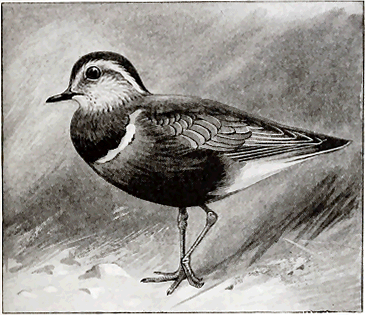
Our last mountain bird is the Dotterel. But this is a bird of passage from the south, resorting only to the northern heights during summer. Unfortunately, the species is not so common on our English mountains as was formerly the case; its eggs are eagerly sought by collectors; the bird itself is in great request for its feathers, which are used to make trout and salmon flies. Although becoming rarer, it still breeds on some of the mountains of Cumberland; whilst across the Border it is more numerous, and we believe regularly nests on the Grampians and in a few other places. It is late to arrive on these mountains in spring, as might naturally be inferred, when we bear in mind their bleak and barren character, reaching them in May, and quitting them in September. We have seen eggs of the Dotterel that had been taken on the Cumberland mountains in June. It would seem that the birds do not retire to the elevated nesting-grounds directly they arrive, but frequent the more lowland fields for a week or so ere ascending to them. The summer home of the Dotterel is shared, in some instances at least, with that still more mountain bird, the Ptarmigan. The Dotterel is one of the very few species in which the hen bird is larger and more brightly coloured than the cock, and the latter consequently incubates the eggs and takes the greater share in the task of rearing the young. The hen is even said to take the initiative in courtship, but we have yet to learn that the “new woman” has quoted the fact in support of her advanced opinions! But then the Dotterel is widely known by the accompanying and preceding epithet of “foolish”, and its English name is said to be the diminutive of “Dolt”; whilst its Latin name of morinellus is said by some to have been derived from morus, a fool—facts which those interested in so-called “sex problems” will also do well to bear in mind.
Now a few words respecting the bird-life of the lochs. These lochs, so far as the present chapter is concerned, may be divided into two distinct classes. First, we have the mountain pools—sheets of water of varying size, often at considerable elevations, situated in hollows among the hills, and an especial feature of many districts in the Highlands. Second, we have at sea-level the marine lochs or fiords, another almost exclusive Scottish feature, the nearest approach to them, so far as our experience extends, being some of the charming land-locked rivers or fiords in the south-west of England. Some few of the birds that we meet with on or about these lochs may be seen in many a southern shire at one season or another, but on the other hand there is a predominating number of species that stamps the avifauna of these northern localities with distinctness. Many of these lochs are grandly picturesque, surrounded as they are with lofty mountains and rolling uplands; their solitude in not a few cases is intense. No wonder that some of our shyest birds resort to them, especially as they present the additional attraction of abundance of food. Upon the shores of some of them we have come across the rare Greenshank; on others in the Hebrides the Red-necked Phalarope (gentlest and most trustful of all wading birds) lives in colonies during the summer. From time to time the various Plovers and Sandpipers resort to their shallow margin, coming there to feed from nesting-places on the moors. Now and then in certain favoured spots the shadow of the Osprey—rarest, perhaps, of all our indigenous birds of prey—is reflected in the calm unruffled water as the bird soars over, and perhaps drops down upon some surface-floating fish. Our first introduction to the Osprey took place nearly twenty years ago in Ross-shire, at the head of Loch Carron. We had been kept rain-bound for a couple of days in the hotel at Strome Ferry, and a most miserable and depressing time we had of it, the surrounding hills hidden by clouds and the surface of the loch churned into foam by the incessant downpour. The second evening the weather cleared, and we started off for a long ramble along the loch-side; the sun shone out brilliantly, and began to dispel the caps of clouds hanging on the hills. The most abundant bird on the loch was the Common Gull, respecting which we shall have more to say on a future page. We saw several pairs of Redshanks near the swollen streams, many Plovers in the distance, a few Dippers, Common Sandpipers, and Mergansers. But the bird that interested us most was an Osprey, flying slowly over the loch about thirty feet above the water. It was hovering with quivering wings, the head almost hidden as the bird peered down in quest of prey. Every few moments the bird flapped its long wings as if to steady itself and gain fresh momentum for its flight. For some time we watched it hovering above the shallow water close inshore, and then it poised for a moment and dropped like a stone into the loch, the noise of its plunge being distinctly audible more than a quarter of a mile away. It rose in a few seconds, and then, after hovering a short time, went off in a slow laboured flight to a clump of trees, and we saw it no more. As we previously stated, the Osprey is one of our rarest raptorial birds. A hundred years ago it is recorded as breeding in the English Lake district, whilst at a still more distant date it is known to have nested on the south coast of England. Although more than once thought by competent observers to have become absolutely extinct as a breeding species in the British Islands, the bird still lingers on and returns to nest in one or two places in Scotland, the exact location of which its best friends will desire to remain unpublished. Unfortunately, the Osprey is a summer migrant to our area, and the poor birds in travelling to and from their Highland haunts are exposed to much persecution. A favourite situation for the eyrie of this bird is an island in some secluded loch amongst the mountains, and in some cases a ruin of some ancient chieftain’s stronghold supports the nest. There is no more harmless bird of prey in Scotland, for its food is composed exclusively of fish.
1. The Red-breasted Merganser. 2. The Black-throated Diver.
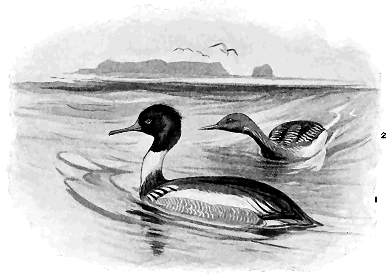
The birds of these mountain lochs are all migratory, visiting them chiefly in summer for the purpose of rearing their young; whilst a few, chiefly Ducks, may be met with in their vicinity during open weather in winter. Of course these remarks apply only to the fresh-water lochs amongst the hills; the sea-water lochs have a perennial supply of birds, because they are never completely ice-bound in our islands, and furnish an abundance of food all the year round. Among the most characteristic of the birds of these hill lochs we may mention the Divers. Of these there are two species that breed near them, one of them, however, the Red-throated Diver, being much commoner than the other, the Black-throated Diver. These birds are more or less migratory, and are only to be found upon fresh-water lochs during summer. In winter they retire to the coasts, where the open sea ensures a constant food supply, and then wander far south of their breeding area. Possibly there are few other districts in the world more depressing in continued wet weather than the Hebrides—a wild savage land of rock and loch and ling surrounded by stormy seas, and only too often shrouded in gray mist. During such weather the cries of the Divers from the upland lochs sound more uncanny and melancholy than ever—oft-repeated wails or screams, compared with which we should describe the nocturnal lament of a tom-cat musical; and even more impressive and unearthly do they become when uttered during the few hours of darkness that characterize the night in summer in these northern lands. These cries have irritated us too often for us to say that we love them; still, they are not without a certain charm, imbuing as they often do with life scenes where solitude otherwise reigns supreme. Both these Divers rarely visit the land except to breed; they are clumsy birds out of the water, but in that element are as much at home as the fish themselves. They fly well and rapidly, and are perhaps more frequently seen in the air than standing on the ground. Both species may be found nesting on the lochs of the Outer Hebrides. The nests are never made far from the water; in fact, we have seen the eggs so close to the margin of the loch that the least rise in the water—a frequent occurrence in such wet districts—must have washed them away. In these cases there can be little doubt that the birds removed them to a safer distance when they were threatened with such a danger. A favourite locality is on some small islet in the loch. In some cases little or no nest is made, but in others a substantial structure of grass, weeds, and stalks of plants is formed. Very often the nest may be discovered by the path the old birds make in going to and from the water. The two eggs are much like those of a Gull in colour, but are very elongated. There can be little doubt that both these Divers consume a vast number of trout in the course of a summer. But the supply of fish is almost inexhaustible; we know lochs that literally teem with trout. The fish, however, are very small and scarcely worthy of the angler’s attention.
The Mallard or Wild Duck is another very common bird on these mountain lochs during summer, especially on those that contain islands. Some of these latter are clothed with a dense growth of heath and gorse, and in such localities we have known several nests within a radius of a few yards. But the Wild Duck is one of the most cosmopolitan of our indigenous birds, breeding almost as commonly in the extreme south of England amidst pastoral surroundings, as in the Highlands where its solitude is seldom disturbed save by a wandering keeper or shepherd. Its nest, however, varies considerably; neither is water essential to its location. We have seen its nest amongst the bracken, far from water, in the open parts of Sherwood Forest, we have taken it from the rushes near a stagnant lowland pool, as well as from the knee-deep ling, the bare ground on the hillsides, and the bramble-covered banks of river and stream. Some nests are made of little else than down from the female’s body, others are much more elaborately constructed of almost any kind of vegetation growing near. We may also mention that this Duck breeds in some numbers near most of the tarns and pools of the moorlands from the Peak district northwards. Here and there in the more remote Highlands—Caithness, Sutherlandshire, and Ross-shire—a few pairs of Scoters frequent the mountain lochs. The Teal, on the other hand, is a much commoner species in these localities, whilst the Red-breasted Merganser is even of wider distribution still throughout the Highlands. We cannot well leave these fresh-water lochs without a passing glance at the Red-necked Phalarope. This again is a migratory species which arrives at the mountain pools in May. Its favourite haunts are the clear tarns surrounded with rushes and sphagnum on the moors, at no great distance from the sea. So far as we know, this Phalarope nests on no part of the British mainland now; its summer resorts are in the Outer Hebrides, in Orkney and Shetland. To these pools the birds return each summer with unfailing regularity. Their gregarious habits very largely increase their charm and interest. We know of few, if any, birds more trustful and tame. When their breeding-place is approached the pretty little birds either run or fly to the neighbouring pool and there swim about in the most unsuspicious and confiding manner, utterly regardless of danger. They make their slight nests on the banks of the water, and lay four very pretty eggs, olive or buff in ground colour, heavily marked with dark brown, paler brown, and gray. Here again we have another instance in which the hen Phalarope is more brilliant in colour than the cock bird, and not only takes the initiative in courtship, but leaves the care of the eggs and young chiefly to him. Possibly the females of these birds and Dotterels hold strongly advanced views on the question of sex and its rights and privileges; anyway, they must be ranked amongst the very few female creatures that have partially succeeded in emancipating themselves from the ordinary duties of their sex. Perhaps in the remote future the principle will universally apply to civilized man himself, for there are not wanting signs of this sexual evolution towards such emancipation.
We will bring the present chapter to a close with a brief notice of the bird-life to be met with on the sea-lochs. Many a charming essay on ornithology is reflected in their clear waters; many a page from the story of our native birds is graven along their rocky shores. We have had the good fortune to explore not a few of these charming Highland fiords, to dwell beside them for weeks at a time, and thus become familiar with the birds upon them and with their most engaging ways. One of the most familiar birds of these Highland lochs is the Red-breasted Merganser, known throughout these localities as the “Sawbill” (conf. p. 96). The drake is a very pretty bird, the duck more soberly arrayed, yet both easily identified by their long narrow bill. They are generally met with in pairs during summer, and their actions in the water furnish us with many an hour’s amusement. This Merganser is a most expert diver, and every few moments either one or the other of the pair disappears in quest of food. Rarely or never do both birds dive at the same time, one always keeping on the surface as if on the look-out. Sometimes, however, the birds will suddenly commence to chase each other through the water in sportive play, and then both may dive, churning the water into foam. When fishing, the birds frequently, after diving, stand erect in the water and flap their wings vigorously for a few moments. These birds are very regular in their movements, especially on tidal water, and we have frequently remarked how they would visit certain spots to feed at low-water, flying up at great speed from different parts of the loch, their wings making a peculiar whistling sound as they hurried along. Sometimes they may be seen standing on some low, sea-surrounded rock basking in the sun and digesting their meal. Each pair of birds seem attached to a certain locality, and may be found in it from day to day right through the breeding season. We have taken many nests of this Merganser, and invariably found them made on islands in the lochs. In not a few instances the first eggs are laid on the bare earth, usually under the shelter of a rock, or in a hollow amongst the gorse or ling close to the water’s edge. These eggs eventually become surrounded with down plucked from the female’s body, but before this is arranged, when there are but one or two laid, they are left bare and uncovered. The much rarer Goosander may occasionally be met with on these Highland sea-lochs, especially in the Outer Hebrides. Other birds of the Duck tribe that frequent these lochs and the islands in them are the Sheldrake and the Eider.
Needless to remark, these lochs are favourite haunts of Gulls and Terns. Of the former the most interesting, perhaps, is the Common Gull, a species that has no English breeding-place, yet in some of these northern fiords it nests in abundance. In this case again islands are invariably selected if any are to be had. This Gull we found nesting in large numbers in Loch Follart in Skye, but owing to the relentless way in which its eggs were taken we should presume that it has now become much scarcer. Then on the islands again we may meet with colonies of Arctic Terns. These graceful birds are quite a summer feature of the lochs, their airy movements as they fish just off the shore being highly interesting. The Common Tern is much more local, and yet there are not a few colonies scattered up and down these lochs amongst the Hebrides, at least as far north as Skye. Of the Terns we shall have more to say in a later chapter (conf. p. 221). Where the cliffs are steep by the loch-side, in not a few of these northern waters, we shall be sure to find the Black Guillemot, a bird, as its name indicates, almost uniform black in colour (during summer), with white wing-bars and coral-red legs and bill. This bird is never seen in such numbers together as the better-known and larger Common Guillemot; rather is it found in scattered pairs, fishing close inshore where the rocks fall sheer down into deep water. Its habits, however, are very similar; it dives with the same agility, feeds on fry, crustaceans, and small shell-fish, and is just as thoroughly marine in its tastes. We must note, however, one important difference, and that concerning its nesting economy. Like the Razorbill, it breeds in holes and fissures of the rocks, makes no nest, and its eggs are very similar to those of the latter species but much smaller, and two in number. As most readers may be aware, the Guillemot and the Razorbill are content to lay one only. Both these latter birds may be met with swimming about the marine lochs, and there are many colonies of them scattered about the Hebrides. These we hope to notice in greater detail in our chapter devoted to the bird-life of the ocean cliffs (conf. p. 240). Of the wading birds that haunt these lochs mention may be made of the Oyster-catcher and the Ringed Plover. The former bird is one of the noisiest to be found in such localities, especially when its nesting-places are invaded by man. It loves the stretches of shingly beach, laying its three eggs just above high-water mark on the line of drifted weed and rubbish that marks the limits of spring-tide. Its so-called “nest” is worthy of special examination, the shells and pebbles often being arranged very systematically round the eggs. Other nest there is none, but in most cases a number of sham or empty “nests” or hollows in the shingle will be found close to the one that contains the eggs. Many of these birds wander far southwards from these northern lochs during winter, and at that season are found in localities which they just as regularly leave as spring returns.
CHAPTER IV.
ON HEATHS AND MARSHES.
The title of the present chapter, to some readers, may seem rather a misnomer, especially the first portion of it. We have already made a brief survey of bird-life among the heather, but then a moor is not exactly a heath. For the purpose of the present volume the definition of the word “heath” must be taken to be a small area of uncultivated ground, covered with bracken, brambles, gorse, and briars, with patches of heather here and there, studded with stunted trees and bushes, and in not a few cases surrounded with woods, arable lands, and pastures. There are many such delightful bits of waste ground in the northern shires, not only inland, but at no great distance from the sea. Of the bogs and marshes we may claim a fair share, although drainage and reclamation have reduced their area considerably in not a few cases, or removed others entirely. The fens of the low-lying eastern counties—of Norfolk and Suffolk—scarcely come within our limits, whilst those of Lincolnshire exist almost only in name. The bird-life of these heaths and marshes is characteristic and interesting, although perhaps there is greater similarity between the species and those of more southern localities than we have hitherto found to be the case.
The Nightjar.
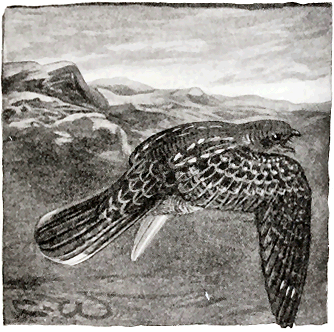
Heaths have always been favourite places of ours. They are never of such barren and forbidding aspect as the moorlands, even in mid-winter; vegetation is more generous; trees, in which we delight, are not altogether absent; and most important attraction of all, bird-life in considerable variety may be found upon and near them throughout the year. Although many bits of heath known to us have been cleared and brought into cultivation, there are not a few still left where birds of various species linger unmolested. For instance (to indicate but a few), there are such areas in the Sherwood Forest district; here and there in north Lincolnshire, in north Derbyshire, and in south Yorkshire, especially in the vicinity of Wharncliffe Crags, a few miles north-west of Sheffield. One of the most interesting birds found upon these heaths is the Nightjar, or perhaps even better known by the name of Goatsucker. Like most birds possessing some peculiarity in note or appearance easily remarked by the multitude, the present species has many aliases, some of which at any rate are as undeserved as they are disastrous. Thus, that of “Night-hawk” brings the bird into evil repute with gamekeepers, and it is shot down in many localities under the firm belief that it preys upon young Pheasants and Partridges! That of “Goatsucker” is even more widely prevailing, not only in our own country, but it has an equivalent in almost every European language, in some cases dating from a very remote antiquity. Needless to say that this appellation has proved even more fatal, and has caused the poor bird needless persecution in many other countries than ours, owing to the absurd superstition it describes and fosters of the Nightjar’s utterly fictitious habit of sucking the teats of cows and goats! Lastly, it has been the long-suffering possessor of the names of “Fern Owl” or “Churn Owl”, one relating to its haunts, the other to its singular note, and both suggestive of birds that have been sorely persecuted by man, in most cases for purely imaginary offences. Anything flying under the name of “Owl”, whether with “fern”, or “wood”, or “barn”, or “horned” attached, is considered harmful, and fair food for powder and shot, so that the poor Nightjar has suffered with the rest. To his habits and appearance most, if not all, his misfortunes are due. He flies about at dusk and during the night-time, and has a way of flitting round the cattle in the meadows close to the heath in quest of moths and cockchafers; his plumage is soft and pencilled and Owl-like, whilst his enormous mouth, to the ignorant countryman, seems capable of swallowing anything! And yet there is no more harmless bird in the British Islands than the Nightjar. It preys upon no single creature that man might covet (if perhaps we except the entomologist, who does not like to see rare moths and beetles disappear like magic in the evening gloom), but, on the other hand, rids the fields and groves of countless numbers of injurious insect pests. Apart from any concrete injury that it may be thought to do, it also falls under the ban of the superstitious, its weird and curious notes, together with its crepuscular habits, being very apt to inspire dread in the credulous countryfolk, who are firm believers in omens, prognostics, and the like, notwithstanding the unprecedented extent to which the schoolmaster has been abroad during the past twenty years or more. We ought also to mention another name bestowed upon the Nightjar, and which, like most of the others, has caused the poor bird not a little senseless persecution. This is “Puckeridge”, a term also applied to a fatal distemper which often attacks weanling calves. The Nightjar was thought by the ignorant countryman to convey this disorder to the calves whilst flitting about them. Poor little Nightjar! The wonder is that there are any of its species left to struggle under such an overwhelming burden of bad names begotten of superstition and ignorance. In some districts this bird is known as the “Eve-jar” or “Evening-jar”, and in others as the “Wheel-bird”—names innocent enough, suggestive of no ill-deeds, but eminently expressive of its habits and its notes combined. In Devonshire it is known locally as the “Dor-hawk”, from its habit of catching dor-beetles or cockchafers; also as the “Night-crow”, possibly the least applicable in the entire series, unless we interpret it as being derived from the bird’s habit of calling (crowing) at night. It is possibly a fortunate thing for the Nightjar that it only spends a few months out of the twelve in Europe, amongst such a crowd of civilized enemies of all countries and creeds, finding fewer, if any, human persecutors amidst the dusky heathen races of Africa, whither it retires after visiting us. It is one of our latest birds of passage, not even reaching the southern parts of England before the end of April or early May—a date which is not quite coincident with its arrival in the northern shires, which it does not reach much before the middle of the latter month. The life-history of this pretty and much-maligned bird is packed full of interest. Unfortunately the Nightjar is only abroad of its own choice during hours when darkness renders observation difficult; we must perforce crowd most of our scrutiny into the twilight hour, and just before the rising of the sun. The bird, like the bat and the Owl, sleeps during the daytime, either crouched flat upon the ground under the bracken or underwood, or seated lengthwise on some broad flat branch of a tree where dense foliage gives the shade and gloom it seeks, and where its beautifully mottled and vermiculated plumage harmonizes most closely with surrounding tints. It is said that the Nightjar sometimes comes abroad during mid-day, and that it even calls at that time, but such has never been our experience of this species, and we should be inclined to think that when seen out and about at such a time it had been disturbed from its diurnal resting-place. At the approach of evening, however, the sleepy bird rouses itself, and, hungry and alert and active enough, leaves its daytime haunt and commences its evening peregrinations in quest of food and enjoyment. As the sun sinks lower behind the western hills and the shadows intensify, the Nightjars become more lively. The most impressive thing about them is their curious music. It is a song that appeals to the most casual listener, compelling recognition by its very singularity. Whilst on the wing circling to and fro the note is an oft-repeated cry, resembling the syllables co-ic, co-ic, co-ic; but when the bird drops lightly down on to some wall or fence or gate, another and still more curious sound is produced. This is the familiar “churring” or vibrating noise, long continued, and putting one in mind of the monotonous reel of the Grasshopper Warbler, so far as its pertinacity is concerned. This latter noise is never heard unless the bird is sitting. The bird also makes another sound whilst in the air, produced by striking its wings smartly together; otherwise the flight of this species is remarkably silent and Owl-like. It is by no means shy, and will hawk for insects round our head, dart to and fro on noiseless pinions, or circle about in chasing and toying with its mate, with little show of fear. The wings of the male bird are marked with three white spots, one on each of the first three primaries, and these are very conspicuous during flight, as are also the white tips to the outermost tail-feathers. This even applies to young males in their first plumage, although the spots are buff instead of white. It is possible that these markings are sexual recognition marks, enabling the female to follow or discover the whereabouts of her mate in the gloom. The Nightjar breeds in May or June, a little later in the north than in the south. It makes no nest, but the hen bird lays her two curiously oval eggs on the bare ground, sometimes beneath a spray of bracken or a furze bush, less frequently on the flat low branch of a convenient tree. These eggs are very beautiful, and he who finds them cannot confuse them with those of any other species that breeds in our islands. They are generally white and glossy, the surface mottled, blotched, streaked and veined with various shades of brown and gray. The young are covered with down—in this respect showing affinity with the Owls—but are otherwise helpless, being fed by their parents not only during infancy, but for some time after they can fly. The old birds show great solicitude for them should they be disturbed, fluttering round the intruder’s head, and seeking to attract all attention to themselves. The Nightjar leaves the northern shires in September for its winter quarters in Africa, although it is by no means uncommonly observed quite a month later in the extreme south and south-west of England. It is said, by the way, that the Nightjar captures cockchafers with its feet, and that its serrated middle claw is for this purpose. But this we have never noticed, although we have had a life’s experience with the bird, and it seems more than doubtful when we bear in mind the extremely short legs and comparatively weak feet of this species—so unlike those of the Kestrel, which we know frequently catches these insects with its feet. But we have lingered too long already with the Nightjar, and must pass on to a notice of other birds upon the heath. The unusual interest attaching to it must be our sole excuse.
Another very interesting little bird not unfrequently met with upon the heaths, especially those where the soil is sandy and trees are numerous around them, is the Wood-lark. Unfortunately the bird-catcher has literally exterminated this species in not a few localities, the bird’s lovely song being the attraction. Here we have a species that becomes rarer and more local in the northern shires than it is farther south. The Wood-lark is not only a most industrious and persistent singer, but is almost a perennial one. That is to say, in the south; up here amongst the northern shires it seldom warbles during winter, unless tempted into voice by exceptionally mild weather. Its regular breeding song is not resumed so early in the year up here, and we should say there is a month or more between the nesting season in north and south respectively. We have known of Devonshire nests as early as March, of Nottingham ones as late as May. Possibly this Lark is only double-brooded in the more southern portions of its British range. The birds seem much attached to certain spots, and, like the Tree Pipit, seldom wander far from their nesting-grounds throughout the breeding season. Unlike the Sky-lark, which very exceptionally indeed perches upon a bush or a tree, the Wood-lark may be constantly seen high up the branches. Indeed, like the Tree Pipit, the cock bird selects some favourite branch, and here early and late he sits, and ever and anon flies out and upwards to warble his rich and joyous song. There are those who maintain that the song of the Wood-lark is even superior to that of the Sky-lark. It may be to some extent a matter of taste, and possibly they are right; but on the other hand the song of the Sky-lark is far better known, more popular with the multitude, and we always thinks it seems more cheerful, as it certainly is somewhat louder. The Wood-lark has more flute-like music in his voice, more melody, and even more continuity. There are not a few persons that confuse the two birds together, although the Wood-lark may be readily distinguished by its short tail, more rounded wing, and its habit of perching in trees. One has only to watch the aerial songster long enough to notice the latter peculiarity without fail. When once the bird has been surely identified, the difference between the songs of the two species will soon be impressed upon the listener, even though the species until then had been unfamiliar to him. The bird will also warble just as sweetly and just as continuously not only whilst sitting on the branches, but when standing on the ground. We may also mention that the Wood-lark is not so aerial as the commoner species, never ascending to such vast elevations during the course of its song. This Lark becomes gregarious in autumn like most, if not all, its congeners, and then wanders more or less from its native heath. It builds an unassuming little nest upon the ground, usually under the shadow of some bush or inequality of the turf, composed of dry grass and lined with hair. In this it lays four or five eggs, the markings on them being more distinct and scattered than is the case with those of the Sky-lark. The latter species is by no means an uncommon one upon the heaths, but after what we have already said there need be no confusion between the two.
There are various other Passerine birds to be found in these localities, due attention being given to the predominant vegetation. The silvery-throated Whitethroat is a regular visitor each spring-time to the thickets of briar and bramble; the Grasshopper Warbler may be heard where the vegetation is most tangled, reeling off his seemingly interminable chirping song, if in reality it is worthy of such a name in the company of so many more sweet-voiced choristers. The Stonechat, gay in his black-and-white and chestnut livery, perches on the topmost sprays of the cruel-thorned gorse and eyes us suspiciously, with a flicking tail and a harsh tac of welcome or resentment. The equally beautiful Linnet, with swollen carmine breast, bears him company amongst the gorse; whilst the Yellow Bunting may not unfrequently be noticed crying his few monotonous notes time after time, and as often answered by some rival near at hand, both of them perched as high as possible on the stunted thorns or the silver-barked birches. All through the early summer the cheery notes of the Cuckoo (not a Passere, by the way) are a familiar sound on or near these heaths, and now and then the blue-gray bird himself, looking all wings and tail, may be seen skimming across to the distant belt of trees, or his mate may be watched poking about the thickets in a suspicious sort of way seeking some unprotected nest in which to drop her alien egg. One bird, however, we miss from these northern heaths in particular, and that is the Dartford Warbler. He seldom penetrates as far north as Yorkshire, although we have taken his nest in a gorse covert within a few miles of Sheffield. But that was long ago, and, truth to tell, we failed to recognize the importance of our discovery for years afterwards, and when nest and eggs had been lost. This Warbler is said to breed in Derbyshire, but we have had no experience of it in that county. It is interesting to remark that the species appears first to have been made known to science from a pair that were shot on a Kentish heath near Dartford, a century and a quarter ago. Few other British birds have, therefore, a more unassailable right to their trivial name.
The Stone Curlew.
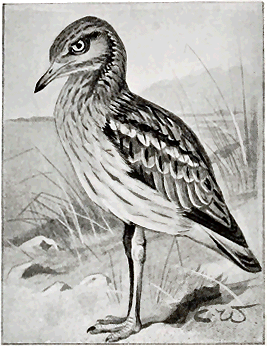
That curious bird the Stone Curlew, perhaps equally as well known as the “Thick-knee”, is to be found on certain heaths as far northwards as Yorkshire. It becomes more numerous possibly in Lincolnshire, and thence it is generally dispersed over Norfolk and Suffolk and most of the "home counties". Owing to drainage, the haunts of this bird have become much more restricted than formerly, and in not a few localities it has been exterminated completely. It loves the more open and bare heath-lands, especially such as are interspersed with stony and chalky ground and free from trees and brushwood, for cover is in no way essential to its requirements. It derives safety in another way. Its plumage of mottled brown is eminently protective on these chalky heaths, and when alarmed, if it does not take wing, it quietly crouches flat to the ground, extending its neck and head, which are also pressed close to the soil, and there, perfectly motionless, it awaits until danger is past, or until it is almost trodden under foot, when it is reluctantly compelled to disclose itself. The Stone Curlew is known by various local names, all more or less expressive of some of its characteristics or relating to the haunts it affects. That of Stone Curlew probably refers to the stony haunt and the very Curlew-like appearance of the bird itself; whilst those of Norfolk Plover and Stone Plover are indicative of a favourite resort of the species in England and a more correct determination of its affinities, for there can be no doubt that the bird is more closely allied to the Charadriinæ than to the Scolopacinæ. Less happily the bird has been called the “Thick-knee” because of the peculiar enlargement of the tibio-tarsal joint, but this is not the “knee” in an anatomical sense, but analogous to the ankle-joint in man. With more propriety, therefore, if with less euphony the bird should be termed a “Think-ankle”, or a "Thick-heel". Lastly, it is known to some as the “Thick-kneed Plover” or "Thick-kneed Bustard". In this latter case popular judgment is to some extent supported by anatomical facts, for the Stone Curlew is by no means distantly related to the Bustards, certainly more nearly than to the Curlews. It is rather a remarkable fact that the Stone Curlew is a migratory bird, when we bear in mind that on both shores of the Mediterranean it is a sedentary species, and that its food—worms, snails, beetles, frogs, and mice—might be obtained in sufficient abundance in England throughout the winter. In fact, there are many instances on record of this bird passing the winter in England, although we should scarcely feel disposed to class these individuals as indigenous to our country, but rather as lost and wandering birds from continental localities. Be all this as it may, the Stone Curlew visits us in spring to breed, arriving in April, and returns south in autumn, leaving in October. Its large eyes (bright yellow in colour) betoken it to be a nocturnal bird, and during the night it obtains most of its food. It then often wanders far from its dry parched native heath, and visits more marshy spots, especially arable lands and wet meadows; sometimes lingering, both in going and returning, to fly about the air uttering its loud and plaintive cry. The Stone Curlew seems to be fully alive to the fact that the safest hiding-place is often the most conspicuous and open one. In this matter it resembles the Missel-thrush, which often builds in safety its bulky nest in such an exposed spot that we marvel afterwards (when the young are fledged and gone) how it could have escaped notice. Acting on this principle the Stone Curlew, in May or June, lays its two eggs side by side upon the barest of ground, and where their tints and markings so closely resemble the yellow stones and pebbles scattered around them that discovery is extremely difficult. The sitting bird renders the deception more complete by running from the eggs at the least alarm and leaving them to that almost perfect safety that their protective colours ensure. These eggs are buff in ground colour, blotched, spotted, or streaked with brown and gray of various shades. We ought also to mention, by the way, that the artful bird selects, as a rule, some little eminence for its breeding-place, where it can command a good view of approaching danger and slip quietly away. We have heard countrymen insist that the Stone Curlew will remove its eggs if it becomes aware that they have been discovered, but we cannot vouch for the accuracy of the statement.
We occasionally meet with three of our most familiar Game Birds upon the heaths; perhaps we might add a fourth, as we include Lincolnshire in our area of the northern shires, for there is some evidence to suggest that the alien Red-legged Partridge is invading the latter county. On many heaths the English Partridge lives at the present time, and the harsh crow of the Pheasant is by no means an unfamiliar sound in these localities, especially when they adjoin covers. This latter bird is a confirmed wanderer, given to straying far from its usual haunts. We have repeatedly noticed fine old cock birds on the moors, miles from coverts. Whether these wanderers ever interbreed with the Grouse we cannot say, and we are not aware that hybrids between these species have ever been obtained or recorded. Lastly, the Black Grouse has a weakness for the heaths, especially in localities where a belt of timber adjoins them. Strange as it may seem, we must include the Mallard as a heath bird. To mention one locality only where this bird breeds regularly upon heaths we may name the Sherwood Forest area. We have taken nests here far from water or wet ground of any description, made amongst dead bracken; and what is also worthy of remark, these nests were by far the handsomest we have ever seen of this Duck. They were composed principally of down from the female’s body, intermixed with fronds of bracken, and were raised from eight to ten inches above the surrounding ground. Here again we had another instance of nests being most difficult to see in the barest localities. Some were made where the bracken had been cut, amongst scattered green stems of the new growth and upon green turf; and yet we can remember how we had to look long and closely before we saw them, as they were actually pointed out to us by a keeper acquaintance. In one instance—and that where the nest was the most exposed of all—we could not see the nest, and did not, until the big brown duck went lumbering off. Of course when the nests were discovered they seemed conspicuous in the highest degree, and we could do nothing but wonder how ever it was possible to overlook them.
The Short-eared Owl.
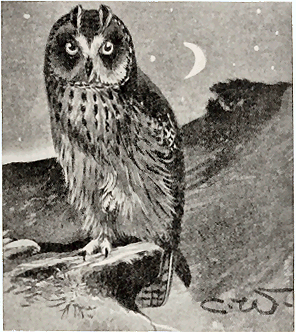
One more bird deserves notice ere we bring our survey of avine life upon the heaths to a conclusion, and that is the Short-eared Owl. This bird is quite cosmopolitan in its choice of a haunt. It is as much a fen or a marsh, a gorse covert or a moor bird as it is a heath one, apparently as much at home in one locality as another. We shall have more to say about this species, especially its migrations, when we come to deal with bird-life on the coast. But as this Owl breeds upon the heaths, amongst other places, we may as well take this opportunity of a peep at its domestic arrangements, and one or two other characteristics, distinct from its migrational movements. Owls are popularly supposed to be exclusive birds of darkness—crepuscular and nocturnal; but the Short-eared Owl is a regular day-flier, and may often be seen beating about in its own peculiar unsteady erratic way during bright sunshine without any visible sign of inconvenience. Neither does it seem ever dazed by the brilliant gleam of lighthouses, but takes advantage of the glare to catch birds more susceptible to the artificial light. During the autumn months especially we may meet with this species in the most unlikely spots, amongst the sand dunes, in turnip-fields, in wet meadows and saltings. The birds that breed on the heaths, however—especially in the English shires—seem to be sedentary. Although this Owl unquestionably feeds upon birds, say up to the size of a Missel-thrush, as its diurnal habits apparently suggest, there can be no doubt of its great usefulness to man in killing off voles, mice, reptiles, beetles, and such-like destructive pests. We need only point to the extraordinary numbers of this Owl that congregated in Scotland some few years ago during the plague of voles, and the way in which they preyed upon them, for an object-lesson of this bird’s usefulness to man. In the matter of its nesting the Short-eared Owl presents us with another anomaly. Fully in keeping with its love for open country and its partiality for daylight, it nests upon the bare ground, and in this respect differs from all the other British species. We say “nests”, but in reality there is little or no provision made for the eggs, beyond a mere hollow in which a few scraps of withered herbage are strewn. The half-dozen creamy-white eggs are, therefore, conspicuous enough in many places, though better concealed in others when they are laid under bracken or amongst heath. The sitting bird, however, crouches close over them, and shields them from observation by her own protective-coloured plumage. These eggs are usually laid in May in the northern shires, several weeks earlier in more southern localities.
With a passing glimpse at some of the more interesting phases of bird-life in the northern marshes we will bring the present chapter to a close. The Bittern, formerly a dweller in them, has long been banished from the bogs and mires not only of the northern shires, but everywhere else in our islands, and exists now as a tradition only—that is to say, as a breeding species. The Marsh Harrier—a name sufficiently suggestive of the haunts it formerly affected—has similarly disappeared from the two northern shires (Yorkshire and Lancashire), where it formerly bred. One of the most widely-dispersed birds in these marshy situations is the Water Rail—a species that is, perhaps, more overlooked, owing to its secretive habits, than any other found in our islands. It is astonishing what a small bit of marsh or bog will content a Water Rail, provided there is a sufficiency of cover. Like our old friend the Moorhen, it may also often be met with wandering from its usual boggy retreats into such unlikely places as gardens and farmyards. Although it is flushed with difficulty, it is by no means uncommonly seen on open spots or even in the branches of trees. In not a few heaths it is an almost unknown and unsuspected dweller in the marshy drains and round the rushes that fringe the shallow pools where peat or turf has been cut; indeed, we have met with it almost within hail of some of our busiest towns. Its rather bulky nest, made of a varied collection of dead and decaying herbage and aquatic plants, is always placed upon the ground in some quiet nook in its haunts, and its half-dozen or so eggs are buff in ground colour, spotted with reddish-brown and gray. Though far more local than the preceding, the Spotted Crake must also be included in our review of northern bird-life. Unlike the Water Rail, however, it is a summer migrant to the British Islands. Some individuals, however, appear to winter with us in the southern counties. The migrants appear in April in the south, several weeks later in the north. The habits of the two species are similar in many respects. The Lapwing, the Redshank, and the Common Snipe may also be met with in these situations, the Redshank in summer only, when it retires to them to breed, seeking the coasts in autumn; the others at all seasons. Amongst the Passerine birds of the marshes we may instance the Sedge Warbler—one of the most widely distributed of British species—the varied chattering music of which is a very characteristic marsh sound during the summer. At a few localities in Yorkshire and Lancashire the Reed Warbler may be met with, a migratory species like the last, but not penetrating to Scotland. Then the Reed Bunting is a familiar bird on many a marshy waste, so too is the Sky-lark and the Meadow Pipit; whilst in winter-time these places are often made lively by large congregations of Lapwings, Starlings, Rooks and Redwings, and scattered Jack Snipes from far northern haunts.
The Black-headed Gull.
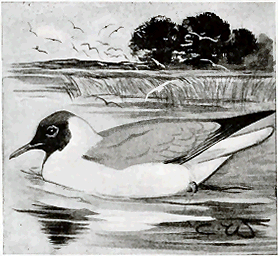
We may conclude our brief notice of marsh bird-life by a glimpse at the Black-headed Gull. This charming bird visits many a swampy piece of ground far from the sea during spring and summer to rear its young. In Lincolnshire there is an extensive gullery near Brigg—at Twigmoor—from which we have had many eggs during our long residence in South Yorkshire. There is another in South Yorkshire near Thorne; a third at Cockerham Moss in Lancashire. As we proceed northwards the colonies of this Gull increase in number, and in Scotland they are still more frequent. Many of these gulleries are situated on islands in pools in the marshes and on the heaths. Not a few of them are almost surrounded by trees of various kinds, and at the North Lincolnshire settlement nests are not unfrequently made in the branches. We have already described the colonies of the Black-headed Gull in previous works, so that but few details are needed here. In Lincolnshire the birds wander far and wide from their station near Brigg, and parties of them may be met with on the fields many miles from home. The Gulls are as regular in their habits as Rooks, with which we have often seen them fraternizing, flying out to feed on the wet meadows, and following the plough until evening, returning home in straggling streams just like their sable companions. As we get near Brigg the birds become more abundant in the fields; we remember, on one occasion, to have seen a ploughed field black and white with Rooks and Gulls, many of which when disturbed flew up from the furrows into the nearest trees; and very curious the white Gulls looked—birds that we associate with the water so closely—as they sat in the branches side by side with cawing Rooks. Early in the year, and before the birds leave the coast, the sooty-brown hood characteristic of the breeding season and of both sexes begins to be assumed. In Devonshire this takes place nearly a month earlier than in the north. In March they congregate at the old familiar stations which have been in use from time immemorial, and nest-building commences almost at once. The nests are ready for eggs by the first or second week in April. These are generally made upon the spongy ground of the marshy islands or on the marshes themselves, and in many cases are little more than hollows lined with a little dry grass. Other nests are bulkier, and these, we have often remarked, are nearest to the water, or even in the shallow pools. The three eggs are subject to much variation, but the ordinary type is brown or olive-green in ground colour, spotted and blotched with darker brown and gray. In many localities the eggs of the first laying are gathered by the tenant or proprietor of the gullery, as they are sold in vast numbers for food. Many, we know, are passed off as Plovers' eggs, but the fraud we should say would never be successful with anyone acquainted with the latter delicacy. The scene at the nests when the place is invaded by man is a very charming one, the Gulls rising in clouds into the air and wheeling about in bewildering confusion, uttering their noisy cries of remonstrance. Even more animated does the scene become when the young are hatched, for then the old birds show much greater solicitude. An inland gullery always seems to strike us as a trifle incongruous, for we are always apt to associate a Gull with the sea; yet here, miles away from the salt water, often surrounded by rural scenes, are Gulls in thousands as happy and contented as though they had never been near a coast in their lives. When the young are able to fly, however, the instinct of the sea apparently returns to them, and back they go to the salt water to wander far and wide, and lead a life of errantry until love brings them inland again in the following spring.
CHAPTER V.
IN FOREST AND COPSE.
Perhaps the avifauna of the woods and coppices, in northern and southern shires alike, is more similar in its general aspects than that of any other special localities with the same difference of latitude between them. Nevertheless there are southern species absent from these northern woodlands, and others common enough up here that are not seen in the counties of the south. Then again some species become rarer or commoner in the north, as the case may be, or exactly the reverse; or we shall find not a little difference in the habits of some of these woodland birds, as compared with those of southern haunts, and also in many cases considerable variation in the date of the arrival or departure of migratory species.
We confess at the beginning of this chapter to a very decided partiality for well-timbered districts, for woods and shrubberies, grand old forests and more youthful coppices; for, apart from the natural beauty of these sylvan spots, they are such favourite haunts of birds. For many years we lived almost surrounded by woodlands, and in some directions could wander for half a score miles or more amongst little else but trees—hence our affection for these places, which we got to know by heart, and in doing so became familiar with the rich array of bird-life that dwelt in their shady depths. We also retain many a vivid memory of wanderings in fir and pine wood farther north in quest of ornithological information; whilst grand old Sherwood Forest on one side of Sheffield, and equally attractive Wharncliffe Woods on the other, were the scene of many an exploration after knowledge relating to the bird-life of such localities. Then in other directions we had the noble woodlands at Eccleshall, Beauchief, and Totley, and along the Rivelin Valley—all of them nearer home, and all of them well favoured with bird-life in great variety. These extensive woods, however, are not favourite haunts of the smaller Passeres; rather are they the home of Hawks, Magpies, Crows, Jays, Doves, Woodpeckers, Pheasants, and so on; the coppices, plantations, smaller woods, and well-timbered bottoms, together with extensive shrubberies and tree-filled parks—these are the grand haunts of hosts of little birds of many species, the varied habits of which were to us a constant source of keenest delight. There is one charm about woodlands that scarcely any other description of scenery can claim constantly, and that is, summer and winter alike birds are plentiful amongst them. The moors and the sea-crags, the shore and the stream, the marsh and the heath, have their times of avine abundance, in summer or in winter, and then they are more or less deserted, but the woods and shrubberies, the coppices and timbered parks, are a haunt in summer and a refuge in winter of a vast and varied bird population as well as an aviary of almost perennial song!
These splendid woods ought to be the haunt of not a few raptorial birds, but unfortunately they are not, as persecution has done its disastrous work, and Kites and Buzzards and Hobbys have been practically exterminated by the gamekeeper. Now the Kestrel and the Sparrow-hawk are the only two that are left, at least in the localities we have specified above. In some of the Scottish woods the Buzzard still continues to breed; the Kite is restricted to one or two spots in Wales and Scotland; whilst the Hobby, though still a nesting species in Yorkshire and Derbyshire, is so rare that few observers will have the good fortune to meet with it. Once more we would urge our plea on behalf of these three species, all of them practically harmless and inoffensive birds, yet threatened with absolute extermination if the landed proprietors will not come to their assistance. An appeal to powerful land-owners—the owners of vast areas of woodlands—is possibly more effective than protective legislation, for in their hands lies all the machinery for the effectual protection of such species. Peremptory and strict orders to keepers should do all that is necessary; we have a lifelong experience of such men, and can therefore testify to their usual obedience to instructions, whether for good or evil, as regards the so-called feathered vermin dwelling in their preserves. We are therefore firmly convinced that the winning over of the land-owner to the side of those who seek to preserve our avifauna intact would be of more real benefit than any half-dozen acts of parliament so long as it is nobody’s business to enforce them.
The Common Buzzard.
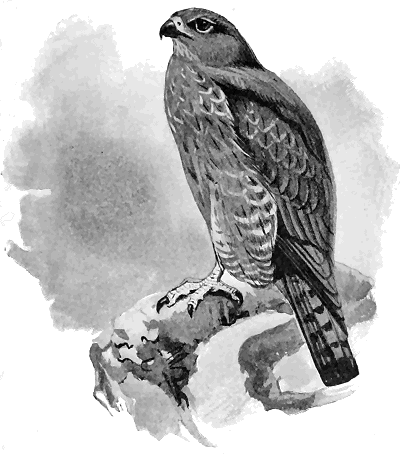
Of the three raptorial birds mentioned above the Common Buzzard (what irony of fate for such a species to possess so misleading a name!) is the only one of which we can record any personal experience within the woodlands of Notts, North Derbyshire, and South Yorkshire, specified above. This happened many years ago, notwithstanding which we retain a very vivid remembrance of all the circumstances. We had spent the day with an old poacher, who not unfrequently allowed us to accompany him on his illegal wanderings (and we flatter ourselves on that subtle if youthful diplomacy that enabled us to stand well with both gamekeepers and poachers alike), fishing in prohibited waters, and were returning homewards through a large wood, known locally as "the Rawlinson". This wood stands just on the border-line of Derbyshire and Yorkshire; in fact, the trout stream that flows through it we believe actually divides the two counties. It used to contain many grand oaks, and was always a favourite cover for Pheasants because of the many clumps of holly-trees within it. In one of these oaks we spied a huge nest of sticks, and our poacher companion, when this was pointed out to him, volunteered the information that it was a “Big Hawk’s” nest. Tired and weary as we were, but incited by the possibility of finding some hitherto unknown eggs, we set to work to climb the mast-like trunk for some sixty feet. We can recall even now our frequent pauses for breath as we slowly approached the spot; how the nest seemed to get larger and larger as each succeeding branch was passed; and then how the big brown bird slipped off with a flutter that made our heart beat fast with anticipation; and how finally we reached the forking limbs where the nest was built, and placed our arm over the rim of sticks and felt the three warm eggs lying on the smooth lining. We climbed no higher, but transferring the precious eggs to our hat, and encouraged by the old rascal below—who would not have climbed so high for all the eggs in Christendom—we got safely down. There was some outcry afterwards from the keepers respecting the robbing of this nest, for they had intended to trap the old birds, but we kept discreetly silent. During a long residence in the neighbourhood we never saw or heard of another nest of this Buzzard.
Notwithstanding persecution, the Kestrel and the Sparrow-hawk happily can still be regarded as fairly common birds in all these woodlands. Trapping and shooting do their best each year to hasten on their extermination, but fortunately both birds breed in localities where their nests are not so very easy to discover. The Kestrel is especially fortunate in this respect, for it breeds in the deserted nests of Crows, Stock Doves, and Magpies, or in the old drey of a squirrel, and a good many of these nests may be searched without finding the one selected; not only so, but the trees are generally in full foliage before the eggs are laid or the young hatched, and this fact conduces greatly to the concealment of many a nest. We can recall many occasions when we have climbed to a score or more deserted nests in a single day, amongst these grand old woods, on the off-chance of discovering Kestrels' or Long-eared Owls' eggs, and considered ourselves well rewarded if we found one or two at most occupied by these second tenants. On the other hand, many have been the times when we have seen keepers shoot into these old nests, as well as fire and kill the brooding Hawk as she sat upon her eggs or sheltered her downy young, in spite of all remonstrance upon our part. The Sparrow-hawk breeds a little earlier. We have had a long and varied experience with the domestic economy of this plucky little bird, and we have invariably found that it not only builds its own nest, but makes a new one every season. Indeed, in not a few cases we have noticed that when its eggs have been taken from one nest it has built another in the vicinity in which to lay a new clutch. The larch woods in the Rivelin Valley—around Hollow Meadows—are, or used to be, a very favourite resort of this Hawk, possibly because keepers were somewhat lax, or never visited some of the coppices from one year to another. In these larch and spruce-fir woods, many old nests of the Sparrow-hawk might be seen, the deserted tenements of years and years. It was also rather remarkable that most of these nests were in trees within a stone’s-throw of the artillery volunteers' target, and all around them were larches and spruces snapped and splintered, and the ground and rocks scored by the conical cannon-balls which lay in dozens all over the place. From one nest in this wood we obtained, by careful management, never quite emptying it, no less than fourteen eggs during a single spring. Curiously enough upon more than one occasion we have found a nest of the Goldcrest in the same spruce-fir as the nest of the Sparrow-hawk.
Nowhere else in our experience were the Magpies allowed to live in such peace as they enjoyed in this romantic valley. On the south side, from Bell Hagg onwards to Hollow Meadows, was almost one continuous woodland, coppice succeeding coppice, until they terminated in the larch and spruce woods, where the Sparrow-hawks bred, and through which Wyming Brook bored its way under a perfect archway of trees from its source on the Bamford Moors near Redmires. Within this few miles of timber we have frequently known as many as a dozen nests of the Magpie all occupied. In not a few cases the old nest was returned to each spring, renovated and used again. Some of these nests were made high up in the oak and alder trees, others were placed in birch-trees, and less frequently in a stunted white-thorn growing amidst the briars and brambles and bracken and boulders of millstone grit on the open rough land. Not a few were placed in the alder-trees that fringed the streams between the reservoirs. The Jay, on the other hand, was a scarce bird here, for the woods had little or no undergrowth, in which that bird specially delights. In most other woods of our acquaintance the Magpie was a sorely-persecuted species, and every bird and every nest were destroyed that the keepers could discover. Several times during the course of the spring many keepers hold a grand "vermin battue". A keeper will gather round him half a dozen village loafers, and then the precious party will proceed to hunt the covers, killing every Magpie, Jay, or Hawk that comes in their way, and pulling out every nest they can discover. We know the ways of these gentry only too well, for years ago we often accompanied such a party, helpless to save, yet glad to increase our knowledge of woodland bird-life. Not a few nests have we seen on these occasions and held our peace, or visited others containing young Hawks and Magpies which we have saved by a fictitious report to the expectant keeper and his murdering band below. In any case the slaughter at the close of the day was sad enough; and as the capacious game-bags were emptied, and the Jays and Magpies and Hawks, with perhaps an odd Nightjar or an Owl—beautiful creatures each one of them, and some of the fairest avine ornaments our woodlands can boast—were turned out into a heap by the kennel door, we ceased to wonder why such species in not a few localities exist as names or traditions only. Apart from any utilitarian motive that should prompt their preservation—and mind, some of these birds are perfectly harmless or of downright service to man—surely on æsthetic grounds a universal plea should be raised for their protection, and such brutal slaughter staid once and for ever.
As we previously remarked, the Jay is not so universally distributed as the Magpie; it loves cover, and delights in such woods where the undergrowth of hazel is dense and where clumps of holly-trees abound. It is also fond of the large shrubberies and copses, especially such as adjoin parks and well-timbered farm lands. We had Jays nesting more or less commonly close to our residence, in the shrubbery attached to Meersbrook Park—a famous spot for birds five-and-twenty years ago, before the builder appeared upon the scene and before it became one of the public parks of Sheffield. Here was established a fine rookery, and the densely wooded grounds round what is now the Ruskin Museum were the favourite haunts of Thrushes and Blackbirds, of Redwings and Bramblings during winter, of Greenfinches, Bullfinches, Titmice, seclusion-loving Warblers, Flycatchers, Robins, Wrens, and other birds. For many years this half-wood half-shrubbery was our constant resort. The wary Rooks got to know us most intimately, and never left the tree-tops or made any unusual noise or disturbance as we wandered under the nests. But let a stranger venture near and all was commotion and uproar at once. The sable fellows would not allow me a companion; and whenever I walked beneath the nest-trees accompanied by a friend the birds would be sure to raise a prolonged chorus of protesting cries. We never knew a spot where more birds came at nightfall during winter to roost amongst the evergreens. For years we used to conceal ourselves in some favourite spot and watch the interesting ways and doings of these mixed avine hosts as they settled themselves to rest. In spring and summer it was equally favoured as a nesting-place. Fortunately all bird-life here was respected; every species was safe and welcome within this fair domain; it was a sanctuary, a place of refuge for all birds irrespective of their ill-deeds, their bad or shady characters. No gun was ever fired within the sacred fences, and the birds could live their happy lives in peace. Small wonder then that the Jay took kindly to such a haven of safety and seclusion; and it was always a source of delight to watch the troops of young birds and their parents, that in summer-time used to troop about the underwood, patches of gaudy colour amongst the green, and noisy and impudent as is ever their wont. In the earlier years of our experience an odd Pheasant or two dwelt in this spot and added to its interest; their disappearance was a sign of that coming change that was to find its culmination in the more or less complete banishment of bird-life from this chosen spot.
The Woodcock.
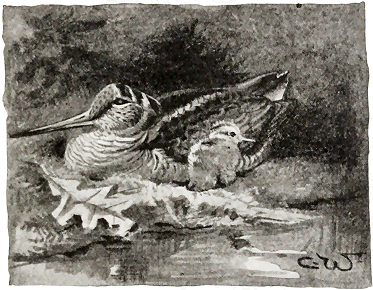
Sherwood Forest, especially in the Dukeries and round about Edwinstowe, was also another favourite woodland haunt of ours. Here, however, the conditions were somewhat different. Game reigned supreme; the deity of the woods was the Pheasant, and less favoured birds were harassed and persecuted by the keepers. Notwithstanding this there is a good deal of bird-life in the forest of surpassing interest to the ornithologist. For instance, one of the most interesting colonies of Jackdaws in our islands is established there. The birds have taken possession of the hollow and ancient oak-trees—many of them mere shells of bark, yet outwardly presenting a green and vigorous appearance and bearing their heavy crops of acorns in the autumn—which for a thousand years or more have stood in sunshine and storm upon ground made classic by Robin Hood. Indeed, it requires little stretch of the imagination to repeople these forest glades with the sturdy outlaws that tradition says dwelt amongst them once upon a time, in open defiance of the authorities, and fed sumptuously upon the deer and other game with which the Forest abounded. Then the oak-trees were in their prime; now they are gnarled and knotted and wrinkled, loaded with dead branches, and full of hollows and crevices, the result of countless storms and tempests. The adaptive Jackdaw has not been slow to seize upon such an advantageous spot, and has multiplied apace. Many hundreds of nests may be counted in one comparatively small area of the forest, and some of the tree-trunks are literally choked with sticks from root to summit, the accumulation of more years than any of us can remember. Scattered amongst these Jackdaws is an almost equally extensive colony of Starlings, many of these latter birds nesting in the same holes as them. We have repeatedly found that some of the largest piles of sticks contained no nest at the top—as if the original owners had finally succumbed to old age, yet not before they had hoarded and left as a monument to their many years of industry a cart-load or more of nest materials. We have noticed the same thing in Rooks' nests, piles of sticks a yard high or more, yet never occupied season after season, until blown out by winter gales or filched by other members of the community. The grand old timber here is also attractive to the Stock Dove; and whilst we are examining the homes of the Jackdaws and the Starlings, a Stock Dove every now and then dashes with impetuous haste out of the holes and crannies. Rarest of all, we may sometimes stumble across the home of the Tawny Owl. The keeper in this particular part of the forest takes good care that Owls shall not live in it in peace, nevertheless a fair number contrive to elude him. He had also tales to tell of Hawks (possibly Hobbys and Buzzards) that formerly bred round about his special beats, but "none of late years". More interested was he in the Wild Ducks and Woodcocks that nested up and down the forest, and much information he was disposed to impart concerning the latter birds (about which he had several theories of his own) as we used to sit in his wood-surrounded cottage and quaff his home-brewed ale, which he was never tired of assuring us would never produce any evil or intoxicating effects. Then after our chat and refreshment he would be prevailed upon to wander out into the woodlands, after first carefully taking down from its pegs the scrupulously clean pin-fire breech-loader, and whistling to his favourite dog, and conduct us by paths only known to himself to many a secluded spot where shy birds were nesting. Here it might be a Pheasant’s nest he would allow us cautiously to approach, and peer down at the brown-mottled back of the hen bird as she quietly brooded over her numerous eggs; there a Wild Duck’s nest out amongst the bracken would be pointed out; whilst on rare occasions he would wander farther abroad into the most secluded woodlands, and take us to inspect the home of the Woodcock placed snugly under the bracken and brambles. Unfortunately, like all his class, he was dead set against “vermin” of every kind, furred and feathered, even including the squirrels that leapt about in the branches overhead. Against these he had a particular aversion, for he said they were “pestering varmints” that sucked every egg they could find. In the more open parts of the forest, where the birch-trees are abundant, we often used to find a nest of the Missel-thrush; not that there was anything specially remarkable in this, but we never saw a nest of this Thrush in Sherwood Forest without thinking of the tradition that so inseparably connects the mistletoe with it. There is no other district in our islands known to us where this parasitic plant is so plentiful; it grows in huge bushes on the poplar trees, a conspicuous object for miles across the country in the Dukeries, and the white-thorns in some spots are thickly studded with it, best seen, of course, during winter. And yet we have never noticed Missel-thrushes in any exceptional numbers in this district, nor have we ever seen them feeding upon the berries. Talking of the nest of this bird brings to mind a fact we have remarked in at least two widely different localities, and that is the number of nests that are sometimes built quite close together. Along the streams in the Rivelin Valley they used to be found in the alder-trees, perhaps half a dozen within a hundred yards or so; whilst in the swampy corner of a wood at Norton we have remarked several nests in adjoining trees. The prettiest nests of this Thrush we have ever seen were from the Rivelin Valley, and composed externally almost completely of sphagnum moss, amongst which a few slender birch twigs were interwoven. We never found more than four eggs in the nest of the Missel-thrush, and always consider that this is the normal number, never less and never more. Indeed, the bird is as regular in this respect as the Snipes, and more so, perhaps, than any other Passerine species. The Carrion Crow, we are glad to say, still manages to maintain a place in these northern woodlands, but in not a few places he is yearly becoming scarcer. He is without doubt a sad thief and a plundering rascal, yet in spite of all his dark deeds we should be sorry to see him banished. His bulky well-made nest, to which he returns, when left unmolested, year by year, is generally placed far up one of the tallest trees in the wood. It is interesting to remark, however, that he is a much later breeder in these northern woods than in the southern shires. In Devonshire we have known the Carrion Crow commence building in March, but in South Yorkshire the eggs are not usually laid before the end of April or even in May. Farther north, as readers may be aware, this species is gradually and almost entirely replaced by the Hooded Crow, a bird that we have already noticed. Birds of the Pigeon tribe are common in most of these northern woods. Of these the Ring Dove is by far the most numerous—too numerous for the farmers in not a few localities. Until we came south we had scarcely any idea of how tame and trustful this species is when left unmolested. We always knew it as one of the shyest and wariest of birds, never allowing us to approach it within gunshot unless it thought itself unseen, and best shot from an ambuscade in the woods or during the evening when it came to certain favourite spots to roost. Gamekeepers shoot a great many of these birds from the rough platforms in the woods erected to scatter food upon for the Pheasants. The Stock Dove is not so common, but this is perhaps because it is not so conservative in choice of a haunt, and is therefore scattered over a much wider area. In some parts of South Yorkshire and North Derbyshire it is known as the "Rockier". We have few other birds that adapt themselves to such a diversity of haunt, from the dense woods to the bare warrens, quarries, and ocean cliffs. Both these birds are breeding right through the spring and summer, well into the autumn. On the other hand, the Turtle Dove is a summer visitor only to the woods; but it is a local and somewhat scarce bird so far north as South Yorkshire. We know it breeds regularly in the well-timbered country about Bawtry; we have seen it in the Wharncliffe Woods, and occasionally in suitable spots in North Derbyshire. It rarely reaches this northern fringe of its British habitat before May, but in Devonshire it may frequently be seen at the end of April. Its migrations, however, are somewhat rapid, for there is not much difference between the date of arrival in northern and southern counties alike. This Dove, like the Jay, loves woods with plenty of undergrowth and fields that are surrounded with tall uncut hedges full of trees. Its noisy love-cry in early summer we always think is one of the most pleasing sounds of the green woods, but unfortunately one that is not very frequent in our northern shires. Its migration south begins in September.
The Black Grouse.
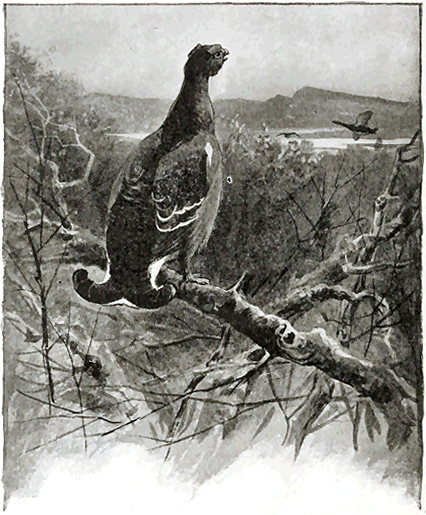
Of the Game Birds of the woodlands we shall have little to say. The Pheasant, of course, is the most familiar of all; comparatively few observers are fortunate enough to meet with the magnificent Capercailzie, and the Black Grouse is scarcely common enough to be classed as a well-known one. We often think it would have been better had the Romans left the Pheasant to its continental home, for indirectly its introduction to our islands has caused many a beautiful indigenous bird to suffer persecution. The Pheasant is by no means a harmless bird; it works a good deal of mischief amongst the crops, as many a poor struggling farmer knows; it would probably become extinct in a few years were it not strictly preserved and its numbers increased by artificial means; whilst it has been the cause of more ill-feeling, crime, and absolute human bloodshed than any other bird in the British Islands. The price we pay to maintain this alien amongst our avifauna is a high one; its presence is purchased at the cost of countless numbers of indigenous birds of greater and more effective beauty; its protection is made an excuse for the incessant butchery of some of our most interesting species. The introduction of exotic species into any country is sure, sooner or later, to affect some portion of the native fauna in a disastrous way; and yet there are writers—deeming themselves naturalists—who urge the introduction of various gaudy exotic birds, as if our woods and fields were not ornamented sufficiently by what is normally there, and which surely have the right to live—all Game Birds notwithstanding. We hear of no crusade against Hawks, and Owls, and Crows, and such-like species in wild uncivilized countries, and yet winged game is always abundant—at least until man and his breech-loader comes upon the scene; and we maintain that our indigenous Game Birds would well hold their own if all vermin were left in peace, and would be the healthier and stronger for it. The alien Pheasant we are not quite so certain about; but if not able to maintain itself against such enemies, then these islands would be all the better without it.
More interesting to the naturalist in these woods of the northern shires are the Woodpeckers. All three British species are represented in them, but the Green Woodpecker, the largest and showiest of all, is decidedly the least common. Curiously enough the exact reverse is the case in many a southern shire; in Devonshire, for instance, we may see more Green Woodpeckers in a week than we might see in a year in not a few of our northern woods. The two Spotted Woodpeckers are none the less interesting, however, although unfortunately they are much more difficult to discover, and apt to be thought much rarer than they really are. The Lesser Spotted Woodpecker is by far the most restricted in its distribution; indeed, we doubt if it is found at all north of Yorkshire. The Greater Spotted Woodpecker ranges a little farther north, but we are very near its normal limits in this direction in Yorkshire. It is somewhat remarkable that the forests of Scotland are devoid of Woodpeckers; whilst Ireland is equally unfortunate, none of the three species being known to breed there. This seems all the more extraordinary when we know that all three species breed up to much higher latitudes on the Continent, the two Spotted species going up to or beyond the Arctic circle, the Green species to a higher degree than the Shetlands. We have met with the Lesser Spotted Woodpecker in very small copses, and even in gardens and parks. During winter both species may be met with amongst timber, which they never frequent during the breeding season; in fact, they are given to wandering, and may be detected during the cold months in almost every description of well-timbered country. The habits of these birds are very similar, and they all breed in holes, and lay shining white eggs. Rarer and more local still is the curious Wryneck, a summer visitor only to our islands, and finding no habitation at all in Ireland. Its arrival in most places is usually coincident with that of the Cuckoo—hence in not a few localities it is known as the "Cuckoo’s Mate". Here again we have a bird that is much overlooked, its chaste and sober colouring (yet exquisitely beautiful in detail) and its shy and retiring ways and love for the timber all assisting in its concealment. The Wryneck is something of an anomaly. Internally it resembles the Woodpeckers (the Wrynecks form a sub-family of the Picidæ); its plumage is mottled and dusted and pencilled like that of a Nightjar; its tail-feathers are soft and flexible; it rarely, if ever, climbs the timber, and hops about the slender branches like the typical Passeres. These external characteristics are, however, quite in harmony with its ways of life.
The Greater Spotted Woodpecker.
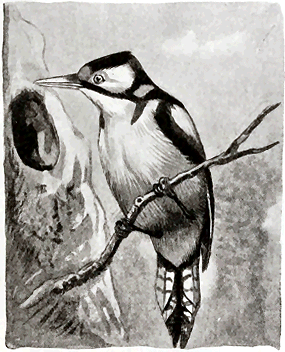
Among the more familiar Passerine birds of the woodlands we may first allude to the Titmice. They are the special small birds of the trees, and every British species—if we exclude the abnormal Bearded Titmouse—is found amongst them. Not only so, but the northern woods in certain parts of Scotland are the exclusive home of the Crested Tit—a bird that we saw on one occasion near Sheffield. Few woods in our experience more abounded with Titmice than the birch and alder coppices along the Rivelin Valley, especially in autumn, and invariably mingled with them at that season were flights of migrant Goldcrests. Allied to the Titmice we also have the soberly arrayed little Creeper, and the more showy plumaged Nuthatch. The latter, however, is exceedingly local in our Yorkshire woods, and we are not aware that it breeds to the north of the county, or that it is found at all in Ireland. The Nightingale penetrates as far north as the Plain of York, perhaps exceptionally beyond, but it is rare enough in the neighbourhood of Sheffield, and we never had the good fortune to meet with it there during a residence of nearly twenty years, although we know the Sedge Warbler has not unfrequently been mistaken for it. A member of one of the allied genera, however, is common enough, we mean the gay and lively Redstart—the showiest, perhaps, of all the migrant band. In the coppice just above Bell Hagg the Redstart was very common. The Wheatear bred in the quarries there, but the Redstart loved the range of rocks that ran bulwark-like along the valley above the copse. We used to find its nest in the crevices of these rocks, as well as in holes among the birch-trees. We remember one nest in a decayed birch that contained eight eggs ranged neatly round in rows; another beneath the rock, at the top of Blackbrook, that bears an inscription to the effect that upon it Elliott the “corn-law rhymer” used to sit and write his poetry. Both Redstart and Wheatear are only birds of summer in our islands, the latter arriving perhaps a week before the former, in April. The three species of Willow Wren must also be included in this brief résumé of bird-life in the northern woods. Commonest of this charming trio we must class the Willow Wren. Our northern woods from April onwards are a specially chosen haunt of this delicate-looking little bird. It abounds in most, from the borders of the moors right up to the suburbs of the grimy northern manufacturing towns, and its sweet little refrain is one of the most familiar songs of the spring. Next, perhaps, in order of abundance we should place the Wood Wren, the largest, and at the same time the showiest of the three species. It is interesting to know that for more than two hundred years we have records of the Wood Wren in what are now the western suburbs of Sheffield. Francis Jessop of Sheffield sent an example of the Wood Wren to Willughby, and Ray published a description of it in his Ornithologia, one of the earliest works dealing with British birds. The Wood Wren is the most attached to the woods of all the three species, and its peculiar shivering “song” is a familiar sound from the tree-tops throughout the spring and summer. Lastly, we have the Chiffchaff, certainly the rarest and most local of all. In the south-west of England the reverse is the case, and there its monotonous cry may be heard from the close of March onwards to September. It does not, however, reach the northern shires until the first or second week in April, although we have a Sherwood Forest record for March. All these birds build more or less domed nests, usually on the ground, and often in woods (the Chiffchaff sometimes makes its nest some distance from the ground), the Willow Wren and the Chiffchaff lining theirs with feathers, but the Wood Wren contents itself with fine grass and hair. The Wood Wren is the latest to arrive towards the end of April, and departs the earliest in autumn; the Willow Wren leaves us in September, the Chiffchaff not unfrequently lingering on into October. It should be remarked that not only the Willow Wren but the Chiffchaff are not by any means confined to woods, but are equally common in gardens, orchards, hedgerows, and thickets.
CHAPTER VI.
IN FARM AND GARDEN.
One of the greatest charms about bird-life of the farm and garden is its great variety. Any person who cares to go the right way to work can acquire a very fair ornithological education in such places, a large percentage of our best-known birds being found in them at one time of the year or another. It was our good fortune for a great many years to ornithologize upon several hundreds of acres of farm land of the most diversified character; whilst an additional advantage was the fact that we had to contend with no high-farming, the greater portion of it being worked on the good old slovenly plan—weedy corners, long stubbles, uncut hedges, and general untidiness—so attractive to birds. Almost every possible description of cover could be found. We had high ground, sheltered valleys, wooded bottoms, plenty of timber in field and hedgerow, trout streams and sunk fences, patches of bog, and great thickets of briar and bramble in unused corners; large stackyards, plenty of old sheds and buildings, some of them covered with ivy, and an abundance of evergreens round about the homesteads, which were in some cases surrounded by orchards and old-fashioned gardens. We have only to add that large woods adjoined here and there, together with smaller plantations and shrubberies in some of which rookeries were established, and also that gamekeepers were absent and much of the surrounding property was unpreserved as regards game, to complete the brief description of an ideal haunt for wild birds. Unfortunately we lived long enough near this avine paradise to see much of it destroyed, turned over to the builder, and bird-life banished. Those who remember the quaint old village of Heeley (now, alas! a suburb of Sheffield) in the days before the railway, when the mail-coach passed through twice a day and caused the only commotion, when the old flour-mill driven by water, with its tree-surrounded dam, stood where the railway-station does now, may perhaps recall the matchless sylvan beauty of Meersbrook, the Banks, and the old hall at Norton Lees. Much of it now has been transformed into a wilderness of bricks and mortar. There are many other similar spots about the northern shires in which the annual cycle of bird-life is much the same—at least we have found it so—and in the present chapter we propose to outline some of its most salient features.