PLANTS FURNISHING ROOT DRUGS.
Reading edition
Under each plant will be found synonyms and pharmacopœial name, if any, the common names, habitat, range, descriptions of the plant and root, and information concerning collection, prices, and uses, while in the case of goldenseal and ginseng the methods of culture are included.
MALE-FERN.
(1) Dryopteris filix-mas (L.) Schott and (2) Dryopteris marginalis (L.) A. Gray.
Synonyms.—(1) Aspidium filix-mas Sw. (2) Aspidium marginale Sw.
Pharmacopœial name.—Aspidium.
Other common names.—(1) Male shield-fern, sweet brake, knotty brake, basket-fern, bear’s-paw root; (2) marginal-fruited shield-fern, evergreen wood-fern.
Habitat and range.—These ferns are found in rocky woods, the male shield-fern inhabiting the region from Canada westward to the Rocky Mountains and Arizona. It is widely distributed also through Europe, northern Asia, northern Africa, and South America. The marginal-fruited shield-fern (Pl. I, fig. 1), one of our most common ferns, occurs from Canada southward to Alabama and Arkansas.
Description of plants.—Both of these species are tall, handsome ferns, the long, erect fronds, or leaves, arising from a chaffy, scaly base, and consisting of numerous crowded stemless leaflets, which are variously divided and notched. There is but little difference between these two species. The male shield-fern is perhaps a trifle stouter, the leaves growing about 3 feet in length and having a bright-green color, whereas the marginal-fruited shield-fern has lighter green leaves, about 2½ feet in length, and is of more slender appearance. The principal difference, however, is found in the arrangement of the “sori,” or “fruit dots.” These are the very small, round, tawny dots that are found on the backs of fern leaves, and in the male shield-fern these will be found arranged in short rows near the midrib, while in the marginal-fruited shield-fern, as this name indicates, the fruit dots are placed on the margins of the fronds. Both plants are perennials and members of the fern family (Polypodiaceæ).
12Description of the rootstock.—These ferns have stout ascending or erect chaffy rootstocks, or rhizomes (Pl. I, fig. 1) as they are technically known. As taken from the ground the rootstock is from 6 to 12 inches in length and 1 to 2 inches thick, covered with closely overlapping, brown, slightly curved stipe bases or leaf bases and soft, brown, chaffy scales. The inside of the rootstock is pale green. As found in the stores, however, male-fern with the stipe bases and roots removed measures about 3 to 6 inches in length and about one-half to 1 inch in thickness, rough where the stipe bases have been removed, brown outside, pale green and rather spongy inside.
The stipe bases remain green for a very long period, and these small, claw-shaped, furrowed portions, or “fingers” as they are called, form a large proportion of the drug found on the American market and, in fact, are said to have largely superseded the rootstock. Male-fern has a disagreeable odor, and the taste is described as bitter-sweet, astringent, acrid, and nauseous.
Collection, prices, and uses.—The best time for collecting male-fern root is from July to September. The root should be carefully cleaned, but not washed, dried out of doors in the shade as quickly as possible, and shipped to druggists at once. The United States Pharmacopœia directs that “the chaff, together with the dead portions of the rhizome and stipes, should be removed, and only such portions used as have retained their internal green color.”
Great care is necessary in the preservation of this drug in order to prevent it from deteriorating. If kept too long, its activity will be impaired, and it is said that it will retain its qualities much longer if it is not peeled until required for use. The unreliability sometimes attributed to this drug can in most instances be traced to the presence of the rootstocks of other ferns with which it is often adulterated, or it will be found to be due to improper storing or to the length of time that it has been kept.
The prices paid for male-fern root range from 5 to 10 cents a pound.
Male-fern, official in the United States Pharmacopœia, has been used since the remotest times as a remedy for worms. Grave results are sometimes caused by overdoses.
COUCH-GRASS.
Agropyron repens (L.) Beauv.
Synonym.—Triticum repens L.
Pharmacopœial name.—Triticum.
Other common names.—Dog-grass, quick-grass, quack-grass, quitch-grass, quake-grass, scutch-grass, twitch-grass, witch-grass, wheat-grass, creeping wheat-grass, devil’s-grass, durfa-grass, Durfee-grass, Dutch-grass, Fin’s-grass, Chandler’s-grass.
Habitat and range.—Like many of our weeds, couch-grass was introduced from Europe, and is now one of the worst pests the farmer has to contend with, taking possession of cultivated ground and crowding out valuable crops. It occurs most abundantly from Maine to Maryland, westward to Minnesota and Missouri, and is spreading on farms on the Pacific slope, but is rather sparingly distributed in the South.
Description of plant.—Couch-grass is rather coarse, 1 to 3 feet high, and when in flower very much resembles rye or beardless wheat (fig. 1). Several round, smooth, hollow stems, thickened at the joints, are produced from the long, creeping, jointed rootstock. The stems bear 5 to 7 leaves from 3 to 12 inches long, rough on the upper surface and smooth beneath, while the long, cleft leaf sheaths are smooth. The solitary terminal flowering heads or spikes 13are compressed, and consist of two rows of spikelets on a wavy and flattened axis. These heads are produced from July to September. Couch-grass belongs to the grass family (Poaceæ).
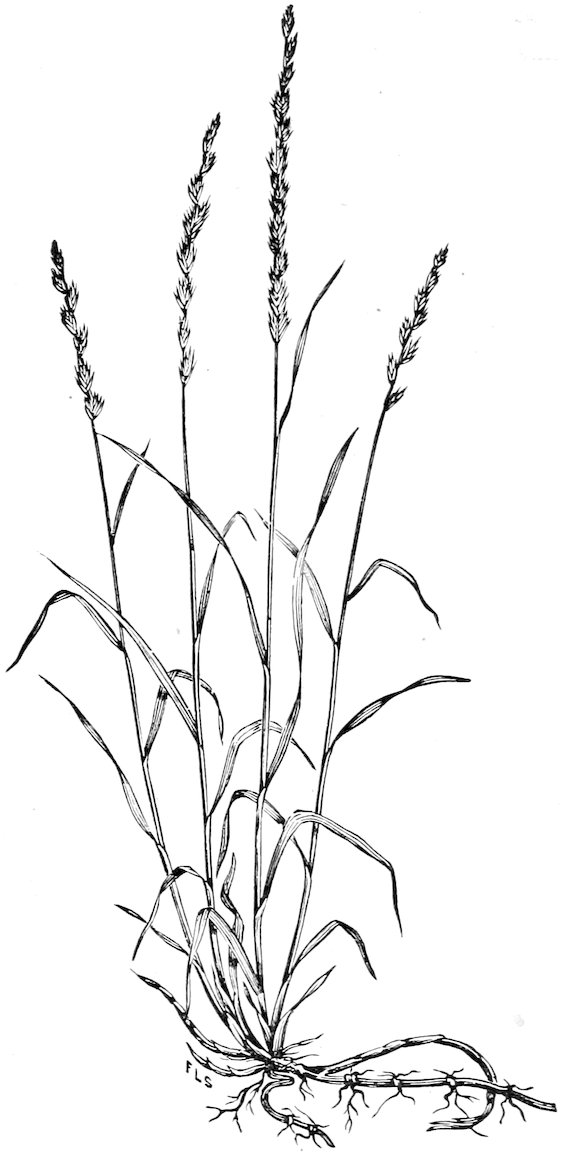
Fig. 1.—Couch-grass (Agropyron repens).
Description of rootstock.—The pale-yellow, smooth rootstock is long, tough, and jointed, creeping along underneath the ground and pushing in every direction. As found in the stores, it consists of short, angular pieces, from one-eighth to one-fourth of an inch long, of a shining straw color, and hollow. These pieces are odorless, but have a somewhat sweetish taste.
Collection, prices, and uses.—Couch-grass, which is official in the United States Pharmacopœia, should be collected in spring, carefully cleaned, and the rootlets removed. The rootstock (not the rootlets) is then cut into short pieces, about two-fifths of an inch in length, for which purpose an ordinary feed-cutting machine may be used, and thoroughly dried.
Couch-grass is usually destroyed by plowing up and burning, for if any of the joints are permitted to remain in the soil new plants will be produced. But, instead of burning, the rootstocks may be saved and prepared for the drug market in the manner above stated. The prices range from 3 to 5 cents a pound. At present couch-grass is collected chiefly in Europe.
A fluid extract is prepared from couch-grass, which is used in affections of the kidney and bladder.
WILD TURNIP.
Arisaema triphyllum (L.) Torr.
Synonym.—Arum triphyllum L.
Other common names.—Arum, three-leaved arum, Indian turnip, jack-in-the-pulpit, wake-robin, wild pepper, dragon-turnip, brown dragon, devil’s-ear, marsh-turnip, swamp-turnip, meadow-turnip, pepper-turnip, starchwort, bog-onion, priest’s-pintle, lords-and-ladies.
Habitat and range.—Wild turnip inhabits moist woods from Canada to Florida and westward to Kansas and Minnesota.
Description of plant.—Early in April the quaint green and brownish purple hooded flowers of the wild turnip may be seen in the shady depths of the woods.
It is a perennial plant belonging to the arum family (Araceæ), and reaches a height of from 10 inches to 3 feet. The leaves, of which there are only one or two, unfold with the flowers; they are borne on long, erect, sheathing stalks, 14and consist of three smooth, oval leaflets; the latter are 3 to 6 inches long, and from 1½ to 3½ inches wide, net veined, and with one vein running parallel with the margins. The “flower” is curiously formed, somewhat like the calla lily, consisting of what is known botanically as a spathe, within which is inclosed the spadix. The spathe is an oval, leaflike part, the lower portion of which, in the flower under consideration, is rolled together so as to form a tube, while the upper, pointed part is usually bent forward, thus forming a flap or hood over the tube-shaped part which contains the spadix. (Fig. 2.) In fact it is very similar to the familiar flower of the calla lily of the gardens, except that, instead of being white, the wild turnip is either all green or striped with very dark purple, sometimes seeming almost black, and in the calla lily the “flap” is turned back, whereas in the wild turnip it is bent forward over the tube. Inside of the spathe is the spadix, also green or purple, which is club shaped, rounded at the summit, and narrowly contracted at the base, where it is surrounded by either the male or female flowers or both, in the latter case (the most infrequent) the male flowers being placed below the female flowers. In autumn the fruit ripens in the form of a bunch of bright scarlet, shining berries. The entire plant is acrid, but the root more especially so.
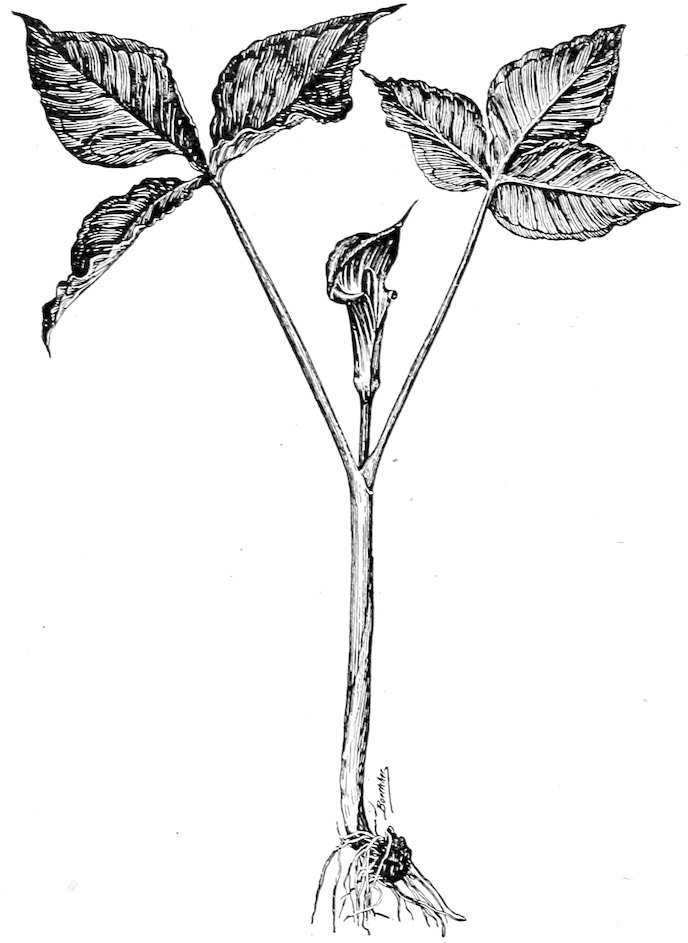
Fig. 2.—Wild turnip (Arisaema triphyllum).
Description of “root.”—The underground portion of this plant is known botanically as a “corm,” and is somewhat globular and shaped like a turnip. The lower part of the corm is flat and wrinkled, while the upper part is surrounded by coarse, wavy rootlets. The outside is brownish gray and the inside white and mealy. It has no odor, but an intensely acrid, burning taste, and to those who may have been induced in their school days to taste of this root wild turnip will be familiar chiefly on account of its never-to-be-forgotten acrid, indeed caustic, properties. The dried article of commerce consists of round, white slices, with brown edges, only slightly shrunken, and breaking with a starchy fracture.
Collection, prices, and uses.—The partially dried corm is used in medicine. It is dug in summer, transversely sliced, and dried. When first dug it is intensely acrid, but drying and heat diminish the acridity. It loses its acridity rapidly with age. Wild turnip brings from 7 to 10 cents a pound.
The corm of wild turnip, which was official in the United States Pharmacopœia from 1820 to 1870, is used as a stimulant, diaphoretic, expectorant, and irritant.
15
SKUNK-CABBAGE.
Spathyema foetida (L.) Raf.
Synonyms.—Dracontium foetidum L.; Symplocarpus foetidus Nutt.
Other common names.—Dracontium, skunkweed, polecat-weed, swamp-cabbage, meadow-cabbage, collard, fetid hellebore, stinking poke, pockweed.
Habitat and range.—Swamps and other wet places from Canada to Florida, Iowa, and Minnesota abound with this ill-smelling herb.
Description of plant.—Most of the common names applied to this plant, as well as the scientific names, are indicative of the most striking characteristic of this early spring visitor, namely, the rank, offensive, carrion odor that emanates from it. Skunk-cabbage is one of the very earliest of our spring flowers, appearing in February or March, but it is safe to say that it is not likely to suffer extermination at the hands of the enthusiastic gatherer of spring flowers. In the latitude of Washington skunk-cabbage has been known to be in flower in December.
It is a curious plant, with its hood-shaped, purplish striped flowers appearing before the leaves. It belongs to the arum family (Araceæ) and is a perennial. The “flower” is in the form of a thick, ovate, swollen spathe, about 3 to 6 inches in height, the top pointed and curved inward, spotted and striped with purple and yellowish green. The spathe is not open like that of the wild turnip or calla lily, to which family this plant also belongs, but the edges are rolled inward, completely hiding the spadix. In this plant the spadix is not spikelike, as in the wild turnip, but is generally somewhat globular, entirely covered with the numerous, dull-purple flowers. (Pl. I, fig. 2.) After the fruit has ripened the spadix will be found to have grown considerably, the spathe meantime having decayed.
The leaves, which appear after the flower, are numerous and very large, about 1 to 3 feet in length and about 1 foot in width; they are thin in texture, but prominently nerved with fleshy nerves, and are borne on deeply channeled stems.
Description of rootstock.—Skunk-cabbage has a thick, straight, reddish brown rootstock, from 3 to 5 inches long, and about 2 inches in diameter, and having a whorl of crowded fleshy roots (Pl. I, fig. 2) which penetrate the soil to considerable depth. The dried article of commerce consists of either the entire rootstock and roots, which are dark brown and wrinkled on the outside, whitish and starchy within, or of very much compressed, wrinkled, transverse slices. When bruised, the root has the characteristic fetid odor of the plant and possesses a sharp acrid taste, both of which become less the longer the root is kept.
Collection, prices, and uses.—The rootstock of skunk-cabbage should be collected early in spring, soon after the appearance of the flower, or after the seeds have ripened, in August or September. It should be carefully dried, either in its entire state or deprived of the roots and cut into transverse slices. Skunk-cabbage loses its odor and acridity with age, and should therefore not be kept longer than one season. The range of prices is from 4 to 7 cents a pound.
Skunk-cabbage, official from 1820 to 1880, is used in affections of the respiratory organs, in nervous disorders, rheumatism, and dropsical complaints.
16
SWEET-FLAG.
Acorus calamus L.
Pharmacopœial name.—Calamus.
Other common names.—Sweet cane, sweet grass, sweet myrtle, sweet rush, sweet sedge, sweet segg, sweetroot, cinnamon-sedge, myrtle-flag, myrtle-grass, myrtle-sedge, beewort.
Habitat and range.—This plant frequents wet and muddy places and borders of streams from Nova Scotia to Minnesota, southward to Florida and Texas, also occurring in Europe and Asia. It is usually partly immersed in water, and is generally found in company with the cat-tail and other water-loving species of flag.
Description of plant.—The swordlike leaves of the sweet-flag resemble those of other flags so much that before the plant is in flower it is difficult to recognize simply by the appearance of its leaves. The leaves of the blue flag or “poison-flag,” as it has been called, are very similar to those of the sweet-flag, and this resemblance often leads to cases of poisoning among children who thus mistake one for the other. However, as the leaves of the sweet-flag are fragrant, the odor will be a means of recognizing it. Of course when the sweet-flag is in flower the identification of the plant is easy.
The sheathing leaves of this native perennial, which belongs to the arum family (Araceæ), are from 2 to 6 feet in height and about 1 inch in width; they are sharp pointed and have a ridged midrib running their entire length. The flowering head, produced from the side of the stalk, consists of a fleshy spike sometimes 3½ inches long and about one-half inch in thickness, closely covered with very small greenish yellow flowers, which appear from May to July. (Pl. 1, fig. 3.)
Description of rootstock.—The long, creeping rootstock of the sweet-flag is thick and fleshy, somewhat spongy, and producing numerous rootlets. (Pl. I, fig. 3.) The odor is very aromatic and agreeable, and the taste pungent and bitter. The dried article, as found in the stores, consists of entire or split pieces of various lengths, from 3 to 6 inches, light brown on the outside with blackish spots, sharply wrinkled lengthwise, the upper surface marked obliquely with dark leaf scars, and the lower surface showing many small circular scars, which, at first glance, give one the impression that the root is worm-eaten, but which are the remains of rootlets that have been removed from the rootstock. Internally the rootstock is whitish and of a spongy texture. The aromatic odor and pungent, bitter taste are retained in the dried article.
Collection, prices, and uses.—The United States Pharmacopœia directs that the unpeeled rhizome, or rootstock, be used. It is collected either in early spring or late in autumn. It is pulled or grubbed from the soft earth, freed from adhering dirt, and the rootlets removed, as these are not so aromatic and more bitter. The rootstock is then carefully dried, sometimes by means of moderate heat. Sweet-flag deteriorates with age and is subject to the attacks of worms. It loses about three-fourths of its weight in drying.
Some of the sweet-flag root found in commerce consists of handsome white pieces. These usually come from Germany, and have been peeled before drying, but they are not so strong and aromatic as the unpeeled roots. Unpeeled sweet-flag root brings from 3 to 6 cents a pound.
Sweet-flag is employed as an aromatic stimulant and tonic in feeble digestion. The dried root is frequently chewed for the relief of dyspepsia.
17
CHAMAELIRIUM, OR HELONIAS.
Chamaelirium luteum (L.) A. Gray.
Synonym.—Helonias dioica Pursh.
Other common names.—Unicorn-root, false unicorn-root, blazingstar, drooping starwort, starwort, devil’s-bit, unicorn’s-horn.
In order to avoid the existing confusion of common names of this plant, it is most desirable to use the scientific names Chamaelirium or Helonias exclusively. Chamaelirium is the most recent botanical designation and will be used throughout this article, but the synonym Helonias is a name very frequently employed by the drug trade. The plant with which it is so much confused, Aletris farinosa, will also be designated throughout by its generic name, Aletris.
Habitat and range.—This native plant is found in open woods from Massachusetts to Michigan, south to Florida and Arkansas.
Description of plant.—Chamaelirium and Aletris (Aletris farinosa) have long been confused by drug collectors and others, owing undoubtedly to the transposition of some of their similar common names, such as “starwort” and “stargrass.” The plants can scarcely be said to resemble each other, however, except perhaps in their general habit of growth. (See Pl. II, figs. 1 and 2.)
The male and female flowers of Chamaelirium are borne on separate plants, and in this respect are entirely different from Aletris; neither do the flowers resemble those of Aletris.
Chamaelirium is an erect, somewhat fleshy herb, perennial, and belongs to the bunchflower family (Melanthiaceæ). The male plant grows to a height of from 1½ to 2½ feet, and the female plant is sometimes 4 feet tall and is also more leafy.
The plants have both basal and stem leaves, whereas Aletris has only the basal leaves. The basal leaves of Chamaelirium are broad and blunt at the top, narrowing toward the base into a long stem; they are sometimes so much broadened at the top that they may be characterized as spoon shaped, and are from 2 to 8 inches long and from one-half to 1½ inches wide. The stem leaves are lance shaped and sharp pointed, on short stems or stemless. (Pl. II, fig. 1.)
The white starry flowers of Chamaelirium are produced from June to July, those of the male plant being borne in nodding, graceful, plumelike spikes 3 to 9 inches long (Pl. II, fig. 1) and those of the female plant in erect spikes. The many-seeded capsule is oblong, opening by three valves at the apex.
Another species is now recognized, Chamaelirium obovale Small, which seems to differ chiefly in having larger flowers and obovoid capsules.
Description of rootstock.—The rootstock of Chamaelirium does not in the least resemble that of Aletris, with which it is so generally confused. It is from one-half to 2 inches in length, generally curved upward at one end in the form of a horn (whence the common name, “unicorn”) and having the appearance of having been bitten off. (Pl. II, fig. 1.) It is of a dark-brown color, with fine transverse wrinkles, rough, on the upper surface showing a few stem scars, and giving off from all sides numerous brown fibrous rootlets. The more recent rootlets have a soft outer covering, which in the older rootlets has worn away, leaving the fine but tough and woody whitish center. The rootlets penetrate to the central part of the rootstock, and this serves as a distinguishing character from Aletris, as a transverse section of Chamaelirium very plainly shows these fibers extending some distance within the rootstock. Furthermore, the rootstock of Chamaelirium exhibits a number of small holes wherever these rootlets 18have broken off, giving it the appearance of having become “wormy.” It is hard and horny within and has a peculiar odor and a very bitter, disagreeable taste, whereas Aletris is not at all bitter.
Collection, prices, and uses.—Chamaelirium should be collected in autumn. The prices paid to collectors may be said to range from about 30 to 45 cents a pound. In the fall of 1906 a scarcity of this root was reported. As already indicated, Chamaelirium and Aletris are often gathered and mistaken for each other by collectors, but, as will be seen from the preceding description, there is really no excuse for such error.
From the confusion that has existed properties peculiar to the one plant have also been attributed to the other, but it seems now generally agreed that Chamaelirium is of use especially as a tonic in derangements of women.
AMERICAN HELLEBORE.
Veratrum viride Ait.
Pharmacopœial name.—Veratrum.
Other common names.—True veratrum, green veratrum, American veratrum, green hellebore, swamp-hellebore, big hellebore, false hellebore, bear-corn, bugbane, bugwort, devil’s-bite, earth-gall, Indian poke, itchweed, tickleweed, duckretter.
Habitat and range.—American hellebore is native in rich wet woods, swamps, and wet meadows, its range extending from Canada, Alaska, and Minnesota south to Georgia.
Description of plant.—Early in spring, usually in company with the skunk-cabbage, the large, bright-green leaves of American hellebore make their way through the soil, their straight, erect leaf spears forming a conspicuous feature of the yet scanty spring vegetation. Later in the season a stout and erect leafy stem is sent up, sometimes growing as tall as 6 feet. It is solid and round, pale green, very leafy, and closely surrounded by the sheathing bases of the leaves, unbranched except in the flowering head. The leaves are hairy, prominently nerved, folded or pleated like a fan. They have no stems, but their bases encircle or sheathe the main stalk, and are very large, especially the lower ones, which are from 6 to 12 inches in length, from 3 to 6 inches in width, and broadly oval. As they approach the top of the plant the leaves become narrower. The flowers, which appear from May to July, are greenish yellow and numerous, and are borne in rather open clusters. American hellebore belongs to the bunchflower family (Melanthiaceæ) and is a perennial.
This species is a very near relative of the European white hellebore (Veratrum album L.), and in fact has by some been regarded as identical with it, or at least as a variety of it. It is taller than V. album and has narrower leaves and greener flowers. Both species are official in the United States Pharmacopœia.
Description of rootstock.—The fresh rootstock of American hellebore is ovoid or obconical, upright, thick, and fleshy, the upper part of it arranged in layers, the lower part of it more solid, and producing numerous whitish roots from all sides. In the fresh state it has a rather strong, disagreeable odor. As found in commerce, American hellebore rootstock is sometimes entire, but more generally sliced, and is of a light-brown or dark-brown color externally and internally yellowish white; the roots, which are from 4 to 8 inches long, have a shriveled appearance, and are brown or yellowish. There is no odor to the 19dried rootstock, but when powdered it causes violent sneezing. The rootstock, which has a bitter and very acrid taste, is poisonous.
Collection, prices, and uses.—American hellebore should be dug in autumn after the leaves have died, and washed and carefully dried, either in the whole state or sliced in various ways. It deteriorates with age, and should therefore not be kept longer than a year.
The adulterations sometimes met with are the rootstocks of related plants, and the skunk-cabbage is also occasionally found mixed with it, but this is probably unintentional, as the two plants usually grow close together.
Collectors of American hellebore root receive from about 3 to 10 cents a pound.
American hellebore, official in the United States Pharmacopœia, is an acrid, narcotic poison, and has emetic, diaphoretic, and sedative properties.
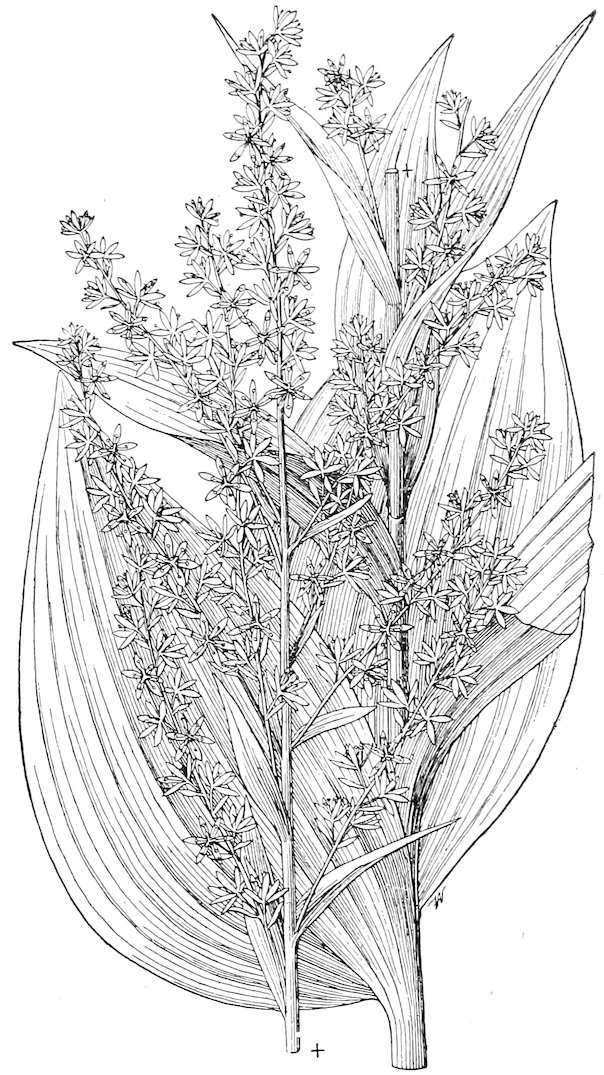
Fig. 3.—American hellebore (Veratrum viride).
ALETRIS.
Aletris farinosa L.
Other common names.—Stargrass, blazingstar, mealy starwort, starwort, unicorn-root, true unicorn-root, unicorn-plant, unicorn’s-horn, colicroot, devil’s-bit, ague-grass, agueroot, aloe-root, crow-corn, huskwort.
A glance at these common names will show many that have been applied to other plants, especially to Chamaelirium, with which Aletris is so much confused. In order to guard against this confusion as much as possible, it is best not to use the common names of this plant at all, referring to it only by its generic name, Aletris.
Habitat and range.—Aletris occurs in dry, generally sandy soil, from Maine to Minnesota, Florida, and Tennessee.
Description of plant.—As stated under Chamaelirium, this plant is often confused with the former by collectors and others, although there seems to be no good reason why this should be so. The plants do not resemble each other except in habit of growth (see Pl. II, figs. 1 and 2), and the trouble undoubtedly arose from a confusion of the somewhat similar common names of the plants, as, for instance, “stargrass” and “starwort.”
Aletris may be at once distinguished by the grasslike leaves, which spread out on the ground in the form of a star, and by the slender spikes of rough, mealy flowers.
This native perennial, belonging to the lily family (Liliaceæ), is an erect, slender herb, 1½ to 3 feet tall, with basal leaves only. These leaves are grasslike, from 2 to 6 inches long, and have a yellowish green or willowgreen 20color. As already stated, they surround the base of the stem in the form of a star. Instead of stem leaves, there are very small, leaflike bracts placed at some distance apart on the stem. From May to July the erect flowering spike, from 4 to 12 inches long, is produced, bearing white, urn-shaped flowers, sometimes tinged with yellow at the apex, and having a rough, wrinkled and mealy appearance. (Pl. II, fig. 2.) The seed capsule is ovoid, opening by three valves, and containing many seeds. When the flowers in the spike are still in bud, there is a suggestion of resemblance to the female spike of Chamaelirium with its fruit half formed.
Several other species are recognized by botanists, namely, Aletris aurea Walt., A. lutea Small, and A. obovata Nash, but aside from the flowers, which in aurea and lutea are yellow, and slight variations in form, such as a more contracted perianth, the differences are not so pronounced that the plants would require a detailed description here. They have undoubtedly been collected with Aletris farinosa for years, and are sufficiently like it to be readily recognized.
Description of rootstock.—Not only have the plants of Aletris and Chamaelirium been confused, but the rootstocks as well. There is, however, no resemblance between them.
Aletris has a horizontal rootstock from one-half to 1½ inches in length, rough and scaly, and almost completely hidden by the fibrous roots and remains of the basal leaves. Upon close examination the scars of former leaf stems may be seen along the upper surface. The rootlets are from 2 to 10 inches in length, those of recent growth whitish and covered with several layers of epidermis which gradually peel off, and the older rootlets of the rootstock showing this epidermis already scaled off, leaving only the hard, brown, woody center. The rootstock in commerce almost invariably shows at one end a tuft of the remains of the basal leaves, which do not lose their green color. It is grayish brown outside, whitish within, and breaks with a mealy fracture. It has no odor, and a starchy taste, followed by some acridity, but no bitterness.
Collection, prices, and uses.—Aletris should be collected in autumn, and there is no reason why collectors should make the common mistake of confusing Aletris with Chamaelirium. By comparing the description of Aletris with that of Chamaelirium, it will be seen that there is scarcely any resemblance. Aletris ranges from 30 to 40 cents a pound.
As indicated under Chamaelirium, the medicinal properties have also been considered the same in both plants, but Aletris is now regarded of value chiefly in digestive troubles. Aletris was official in the United States Pharmacopœia from 1820 to 1870.
BETHROOT.
Trillium erectum L.
Other common names.—Trillium, red trillium, purple trillium, ill-scented trillium, birthroot, birthwort, bathwort, bathflower, red wake-robin, purple wake-robin, ill-scented wake-robin, red-benjamin, bumblebee-root, daffydown-dilly, dishcloth, Indian balm, Indian shamrock, nosebleed, squawflower, squawroot, wood-lily, true-love, orange-blossom. Many of these names are applied also to other species of Trillium.
Habitat and range.—Bethroot is a native plant growing in rich soil in damp, shady woods from Canada south to Tennessee and Missouri.
Description of plant.—This plant is a perennial belonging to the lily-of-the-valley family (Convallariaceæ). It is a low growing plant, from about 8 to 16 inches in height, with a rather stout stem, having three leaves arranged in 21a whorl near the top. These leaves are broadly ovate, almost circular in outline, sharp pointed at the apex and narrowed at the base, 3 to 7 inches long and about as wide, and practically stemless.
Not only the leaves of this plant, but the flowers and parts of the flowers are arranged in threes, and this feature will serve to identify the plant. (Pl. I, fig. 4.) The solitary terminal flower of bethroot has three sepals and three petals, both more or less lance shaped and spreading, the former greenish, and the petals, which are 1¼ inches long and one-half inch wide, are sometimes dark purple, pink, greenish, or white. The flower has an unpleasant odor. It appears from April to June and is followed later in the season by an oval, reddish berry.
Various other species of Trillium are used in medicine, possessing properties similar to those of the species under consideration. These are also very similar in appearance to Trillium erectum.
Description of root.—Bethroot (Pl. I, fig. 4), as found in the stores, is short and thick, of a light-brown color externally, whitish or yellowish inside, somewhat globular or oblong in shape, and covered all around with numerous palebrown, shriveled rootlets. The top of the root generally shows a succession of fine circles or rings, and usually bears the remains of stem bases.
The root has a slight odor, and is at first sweetish and astringent, followed by a bitter and acrid taste. When chewed it causes a flow of saliva.
Collection, prices, and uses.—Bethroot is generally collected toward the close of summer. The price ranges from 7 to 10 cents a pound.
It was much esteemed as a remedy among the Indians and early settlers. Its present use is that of an astringent, tonic, and alterative, and also that of an expectorant.
WILD YAM.
Dioscorea villosa L.
Other common names.—Dioscorea, colicroot, rheumatism-root, devil’s-bones.
Habitat and range.—Wild yam grows in moist thickets, trailing over adjacent shrubs and bushes, its range extending from Rhode Island to Minnesota, south to Florida and Texas. It is most common in the central and southern portions of the United States.
Description of plant.—This native perennial vine is similar to and belongs to the same family as the well-known cinnamon vine of the gardens—namely, the yam family (Dioscoreaceæ). It attains a length of about 15 feet, the stem smooth, the leaves heart shaped and 2 to 6 inches long by 1 to 4 inches wide.
The leaves, which are borne on long, slender stems, are thin, green, and smooth on the upper surface, paler and rather thickly hairy on the under surface. The small greenish yellow flowers are produced from June to July, the male flowers borne in drooping clusters about 3 to 6 inches long, and the female flowers in drooping spikelike heads. The fruit, which is in the form of a dry, membranous, 3-winged, yellowish green capsule, ripens about September and remains on the vine for some time during the winter. (Pl. II, fig. 3.)
Growing farther south than the species above mentioned is a variety for which the name glabra has been suggested.
According to C. G. Lloyd (King’s American Dispensatory, Vol. I, 1898), there is a variety of Dioscorea villosa the root of which first made its appearance among the true yam roots of commerce, and which was so different in form that it was rejected as an adulteration. The plant, however, from 22which the false root was derived was found upon investigation to be almost identical with the true yam, except that the leaves were perfectly smooth, lacking the hairiness on the under surface of the leaf which is characteristic of the true wild yam. The false variety also differs in its habit of growth, not growing in dense clumps like the true wild yam, but generally isolated. The root of the variety, however, is quite distinct from that of the true wild yam, being much more knotty. Lloyd states further that the hairiness or lack of hairiness on the under side of the leaf is a certain indication as to the form of the root.
Lloyd, recognizing the necessity of classifying these two yam roots of commerce, has designated the smooth-leaved variety as Dioscorea villosa var. glabra.
Description of rootstocks.—The rootstock of the true wild yam (Pl. II, fig. 3) runs horizontally underneath the surface of the ground. As found in commerce, it consists of very hard pieces, 6 inches and sometimes 2 feet in length, but only about one-fourth or one-half of an inch in diameter, twisted, covered with a thin brown bark, whitish within, and showing stem scars almost an inch apart on the upper surface, small protuberances on the sides, and numerous rather wiry rootlets on the lower surface.
The false wild yam, on the other hand, has a much heavier, rough, knotty rootstock, with thick branches from 1 inch to 3 inches long, the upper surface covered with crowded stem scars and the lower side furnished with stout wiry rootlets. Within it is similar to the true yam root.
Collection, prices, and uses.—The roots are generally collected in autumn, and bring from 2½ to 4 cents a pound. Wild yam is said to possess expectorant properties and to promote perspiration, and in large doses proving emetic. It has been employed in bilious colic, and by the negroes in the South in the treatment of muscular rheumatism.
BLUE FLAG.
Iris versicolor L.
Other common names.—Iris, flag-lily, liver-lily, snake-lily, poison-flag, water-flag, American fleur-de-lis or flower-de-luce.
Habitat and range.—Blue flag delights in wet, swampy localities, making its home in marshes, thickets, and wet meadows from Newfoundland to Manitoba, south to Florida and Arkansas.
Description of plant.—The flowers of all of the species belonging to this genus are similar, and are readily recognized by their rather peculiar form, the three outer segments or parts reflexed or turned back and the three inner segments standing erect.
Blue flag is about 2 to 3 feet in height, with an erect stem sometimes branched near the top, and sword-shaped leaves which are shorter than the stem, from one-half to 1 inch in width, showing a slight grayish “bloom,” and sheathing at the base. This plant is a perennial belonging to the iris family (Iridaceæ), and is a native of this country. June is generally regarded as the month for the flowering of the blue flag, although it may be said to be in flower from May to July, depending on the locality. The flowers are large and very handsome, each stem bearing from two to six or more. They consist of six segments or parts, the three outer ones turned back and the three inner ones erect and much smaller. (Pl. II, fig. 4.) The flowers are usually purplish blue, the “claw,” or narrow base of the segments, variegated with yellow, green, or white and marked with purple veins.
23All of the species belonging to this genus are more or less variegated in color; hence the name “iris,” meaning “rainbow,” and the specific name “versicolor,” meaning “various colors.” The name “poison-flag” has been applied to it on account of the poisonous effect it has produced in children, who, owing to the close resemblance of the plants before reaching the flowering stage, sometimes mistake it for sweet-flag.
The seed capsule is oblong, about 1½ inches long, and contains numerous seeds.
Description of rootstock.—Blue flag has a thick, fleshy, horizontal rootstock, branched, and producing long fibrous roots. (Pl. II, fig. 4.) It resembles sweet-flag (Calamus), and has been mistaken for it. The sections of the rootstock of blue flag, however, are flattened above and rounded below; the scars of the leaf sheaths are in the form of rings, whereas in sweet-flag the rootstock is cylindrical and the scars left by the leaf sheaths are obliquely transverse. Furthermore, there is a difference in the arrangement of the roots on the rootstock, the scars left by the roots in blue flag being close together generally nearer the larger end, while in sweet-flag the disposition of the roots along the rootstock is quite regular. Blue flag is grayish brown on the outside when dried, and sweet-flag is light brown or fawn colored. Blue flag has no well-marked odor, and the taste is acrid and nauseous, and in sweet-flag there is a pleasant odor and bitter, pungent taste.
Collection, prices, and uses.—Blue flag is collected in autumn, and usually brings from about 7 to 10 cents a pound. Great scarcity of blue flag root was reported from the producing districts in the autumn of 1906. It is an old remedy, the Indians esteeming it highly in stomach troubles, and it is said that it was sometimes cultivated by them in near-by ponds on account of its medicinal value. It has also been used as a domestic remedy, and is regarded as an alterative, diuretic, and purgative. It was official in the United States Pharmacopœia of 1890.
LADY’S-SLIPPER.
(1) Cypripedium hirsutum Mill. and (2) Cypripedium parviflorum Salisb.
Synonym.—(1) Cypripedium pubescens Willd.
Pharmacopœial name.—Cypripedium.
Other common names.—(1) Large yellow lady’s-slipper, yellow lady’s-slipper, yellow moccasin-flower, Venus’-shoe, Venus’-cup, yellow Indian-shoe, American valerian, nerve-root, male nervine, yellow Noah’s-ark, yellows, monkey-flower, umbil-root, yellow umbil; (2) small yellow lady’s-slipper.
Habitat and range.—Both of these native species frequent bogs and wet places in deep shady woods and thickets. The large yellow lady’s-slipper may be found from Nova Scotia south to Alabama and west to Nebraska and Missouri. The range for the small yellow lady’s-slipper extends from Newfoundland south along the mountains to Georgia, and west to Missouri, Washington, and British Columbia.
Description of plants.—The orchid family (Orchidaceæ), to which the lady’s-slippers belong, boasts of many beautiful, showy, and curious species, and the lady’s-slipper is no exception. There are several other plants to which the name lady’s-slipper has been applied, but one glance at the peculiar structure of the flowers in the species under consideration, as shown in the illustration (Pl. III, fig. 1), will enable anyone to recognize them as soon as seen.
The particular species of lady’s-slipper under consideration in this article do not differ very materially from each other. Both are perennials, growing from 241 to about 2 feet in height, with rather large leaves and with yellow flowers more or less marked with purple, the main difference being that in hirsutum the flower is larger and pale yellow, while in parviflorum the flower is small, bright yellow, and perhaps more prominently striped and spotted with purple. The stem, leaves, and inside of corolla or lip are somewhat hairy in the large yellow lady’s-slipper, but not in the small yellow lady’s-slipper. These hairs are said to be irritating to some people, in whom they cause an eruption of the skin.
The leaves of the lady’s-slipper vary in size from 2 to 6 inches in length and from 1 to 3 inches in width, and are broadly oval or elliptic, sharp pointed, with numerous parallel veins, and sheathing at the base, somewhat hairy in the large lady’s-slipper. The solitary terminal flower, which appears from May to June, is very showy and curiously formed, the lip being the most prominent part. This lip looks like an inflated bag (1 to 2 inches long in the large lady’s-slipper), pale yellow or bright yellow in color, variously striped and blotched with purple. The other parts of the flower are greenish or yellowish, with purple stripes, and the petals are usually twisted.
Description of rootstock.—The rootstock is of horizontal growth, crooked, fleshy, and with numerous wavy, fibrous roots. (Pl. III, fig. 1.) As found in commerce, the rootstocks are from 1 to 4 inches in length, about an eighth of an inch in thickness, dark brown, the upper surface showing numerous round cup-shaped scars, the remains of former annual stems, and the lower surface thickly covered with wavy, wiry, and brittle roots, the latter breaking off with a short, white fracture. The odor is rather heavy and disagreeable, and the taste is described as sweetish, bitter, and somewhat pungent.
Collection, prices, and uses.—Both rootstock and roots are used, and these should be collected in autumn, freed from dirt, and carefully dried in the shade. These beautiful plants are becoming rare in many localities. Sometimes such high-priced drugs as goldenseal and senega are found mixed with the lady’s-slipper, but as these are more expensive than the lady’s-slipper, it is not likely that they are included with fraudulent intent, and they can be readily distinguished. The prices paid to collectors of this root range from 32 to 35 cents a pound.
The principal use of lady’s-slipper, which is official in the United States Pharmacopœia, is as an antispasmodic and nerve tonic, and it has been used for the same purposes as valerian.
CRAWLEY-ROOT.
Corallorhiza odontorhiza (Willd.) Nutt.
Other common names.—Corallorhiza, crawley, coralroot, small coralroot, small-flowered coralroot, late coralroot, dragon’s-claw, chickentoe, turkey-claw, feverroot.
Habitat and range.—Rich, shady woods having an abundance of leaf mold produce this curious little plant. It may be found in such situations from Maine to Florida, westward to Michigan and Missouri.
Description of plant.—This peculiar native perennial, belonging to the orchid family (Orchidaceæ), is unlike most other plants, being leafless, and instead of a green stem it has a purplish brown, sheathed scape, somewhat swollen or bulbous at the base and bearing a clustered head of purplish flowers 2 to 4 inches long. It does not grow much taller than about a foot in height. (Fig. 4.)
The flowers, 6 to 20 in a head, appear from July to September, and consist of lance-shaped sepals and petals striped with purple and a broad, whitish, 25oval lip, generally marked with purple and narrowed at the base. The seed capsule is large, oblong, or somewhat globular.
Description of rootstock.—The rootstock of this plant is also curious, resembling in its formation a piece of coral (fig. 4), on account of which it is known by the name “coralroot.” The other common names, such as chickentoe, turkey-claw, etc., all have reference to the form of the rootstock. As found in commerce, crawley-root consists of small, dark-brown wrinkled pieces, the larger ones branched like coral. The taste at first is sweetish, becoming afterwards slightly bitter. It has a peculiar odor when fresh, but when dry it is without odor.
Collection, prices, and uses.—Crawley-root should be collected in July or August. The price ranges from 20 to 50 cents a pound. Other species of Corallorhiza are sometimes collected and are said to probably possess similar properties. This root is said to be very effective for promoting perspiration, and it is also used as a sedative and in fever.

Fig. 4.—Crawley-root (Corallorhiza odontorhiza). After Torrey’s Flora of New York.
CANADA SNAKEROOT.
Asarum canadense L.
Other common names.—Asarum, wild ginger, Indian ginger, Vermont snakeroot, heart-snakeroot, southern snakeroot, black snakeroot, colt’s-foot snakeroot, black snakeweed, broad-leaved asarabacca, false colt’s-foot, cat’s-foot, colicroot.
Habitat and range.—This inconspicuous little plant frequents rich woods or rich soil along roadsides from Canada south to North Carolina and Kansas.
Description of plant.—Canada snakeroot is a small, apparently stemless perennial, not more than 6 to 12 inches in height, and belongs to the birthwort family (Aristolochiaceæ). It usually has but two leaves, which are borne on slender, finely hairy stems; they are kidney shaped or heart shaped, thin, dark green above and paler green on the lower surface, strongly veined, and from 4 to 7 inches broad.
The solitary bell-shaped flower is of an unassuming dull brown or brownish purple, and this modest color, together with its position on the plant, renders it so inconspicuous as to escape the notice of the casual observer. It droops from a short, slender stalk produced between the two leaf stems and is almost hidden under the two leaves, growing so close to the ground that it is sometimes buried beneath old leaves, and sometimes the soil must be removed before the flower can be seen. It is bell shaped, woolly, the inside darker in color than the outside and of a satiny texture. The fruit which follows is in the form of a leathery 6-celled capsule. (Pl. III, fig. 2.)
Description of rootstock.—Canada snakeroot has a creeping, yellowish rootstock, slightly jointed, with thin rootlets produced from joints which occur about every half inch or so. (Pl. III, fig. 2.) In the drug trade the rootstock is usually found in pieces a few inches in length and about one-eighth of an inch in diameter. These are four-angled, crooked, brownish and wrinkled on the outside, whitish inside and showing a large central pith, hard and brittle, and breaking with a short fracture. The odor is fragrant and the taste spicy 26and aromatic, and has been said to be intermediate between ginger and serpentaria.
Collection, prices, and uses.—The aromatic root of Canada snakeroot is collected in autumn, and the price ranges from 10 to 15 cents a pound. It was reported as very scarce in the latter part of the summer of 1906. Canada snakeroot, which was official in the United States Pharmacopœia from 1820 to 1880, is used as an aromatic, diaphoretic, and carminative.
SERPENTARIA.
(1) Aristolochia serpentaria L. and (2) Aristolochia reticulata Nutt.
Pharmacopœial name.—Serpentaria.
Other common names.—(1) Virginia serpentaria, Virginia snakeroot, serpentary, snakeweed, pelican-flower, snagrel, sangrel, sangree-root; (2) Texas serpentaria, Texas snakeroot, Red River snakeroot.
Habitat and range.—Virginia serpentaria is found in rich woods from Connecticut to Michigan and southward, principally along the Alleghenies, and Texas serpentaria occurs in the Southwestern States, growing along river banks from Arkansas to Louisiana.
Description of Virginia serpentaria.—About midsummer the queerly shaped flowers of this native perennial are produced. They are very similar to those of the better known “Dutchman’s-pipe,” another species of this genus, which is quite extensively grown as an ornamental vine for covering porches and trellises. Virginia serpentaria and Texas serpentaria both belong to the birthwort family (Aristolochiaceæ). The Virginia serpentaria is nearly erect, the slender, wavy stem sparingly branched near the base, and usually growing to about a foot in height, sometimes, however, even reaching 3 feet. The leaves are thin, ovate, ovate lance shaped or oblong lance shaped, and usually heart shaped at the base; they are about 2½ inches long and about 1 or 1½ inches in width. The flowers are produced from near the base of the plant, similar to its near relative, the Canada snakeroot. They are solitary and terminal, borne on slender, scaly branches, dull brownish purple in color, and of a somewhat leathery texture; the calyx tube is curiously bent or contorted in the shape of the letter S. The fruit is a roundish 6-celled capsule, about half an inch in diameter, and containing numerous seeds. (Pl. III, fig. 3.)
Description of Texas serpentaria.—This species has a very wavy stem, with oval, heart-shaped, clasping leaves, which are rather thick and strongly reticulated or marked with a network of veins; hence the specific name reticulata. The entire plant is hairy, with numerous long, coarse hairs. The small, densely hairy purplish flowers are also produced from the base of the plant.
Description of rootstocks.—Serpentaria has a short rootstock with many thin, branching, fibrous roots. (Pl. III, fig. 3.) In the dried state it is thin and bent, the short remains of stems showing on the upper surface and the under surface having numerous thin roots about 4 inches in length, all of a dull yellowish brown color, internally white. It has a very agreeable aromatic odor, somewhat like camphor, and the taste is described as warm, bitterish, and camphoraceous.
The Texas serpentaria has a larger rootstock, with fewer roots less interlaced than the Virginia serpentaria.
Collection, prices, and uses.—The roots of serpentaria are collected in autumn. Various other roots are sometimes mixed with serpentaria, but as they are mostly high-priced drugs, such as goldenseal, pinkroot, senega, and ginseng, their presence in a lot of serpentaria is probably accidental, due simply to proximity 27of growth of these plants. Abscess-root (Polemonium reptans L.) is another root with which serpentaria is often adulterated. It is very similar to serpentaria, except that it is nearly white. The price of serpentaria ranges from 35 to 40 cents a pound.
Serpentaria is used for its stimulant, tonic, and diaphoretic properties. Both species are official in the United States Pharmacopœia.
YELLOW DOCK.
Rumex crispus L.
Other common names.—Rumex, curled dock, narrow dock, sour dock. (Fig. 5.)
Habitat and range.—This troublesome weed, introduced from Europe, is now found throughout the United States, occurring in cultivated as well as in waste ground, among rubbish heaps, and along roadsides.
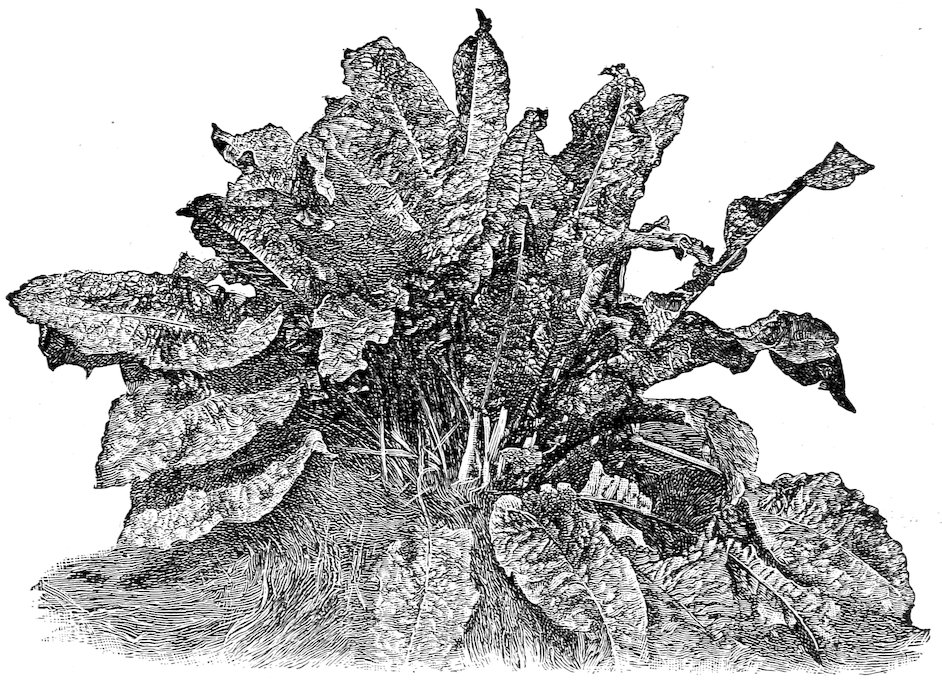
Fig. 5.—Yellow dock (Rumex crispus), first year’s growth.
Description of plant.—Yellow dock is a perennial plant belonging to the buckwheat family (Polygonaceæ), and has a deep, spindle-shaped root, from which arises an erect, angular, and furrowed stem, attaining a height of from 2 to 4 feet. The stem is branched near the top and leafy, bearing numerous long dense clusters formed by drooping groups of inconspicuous green flowers placed in circles around the stem. The flowers are produced from June to August, and the fruits which follow are in the form of small triangular nuts, like the grain of buckwheat, to which family the dock belongs. So long as the fruits are green and immature they can scarcely be distinguished from the flowers, but as they ripen the clusters take on a rusty-brown color. The leaves of the yellow dock are lance shaped, acute, with the margins strongly waved and crisped, the lower long-stalked leaves being blunt or heart shaped at the base and from 6 to 8 inches in length, while those nearer the top are narrower and shorter, only 3 to 6 inches in length, short stemmed or stemless.
28
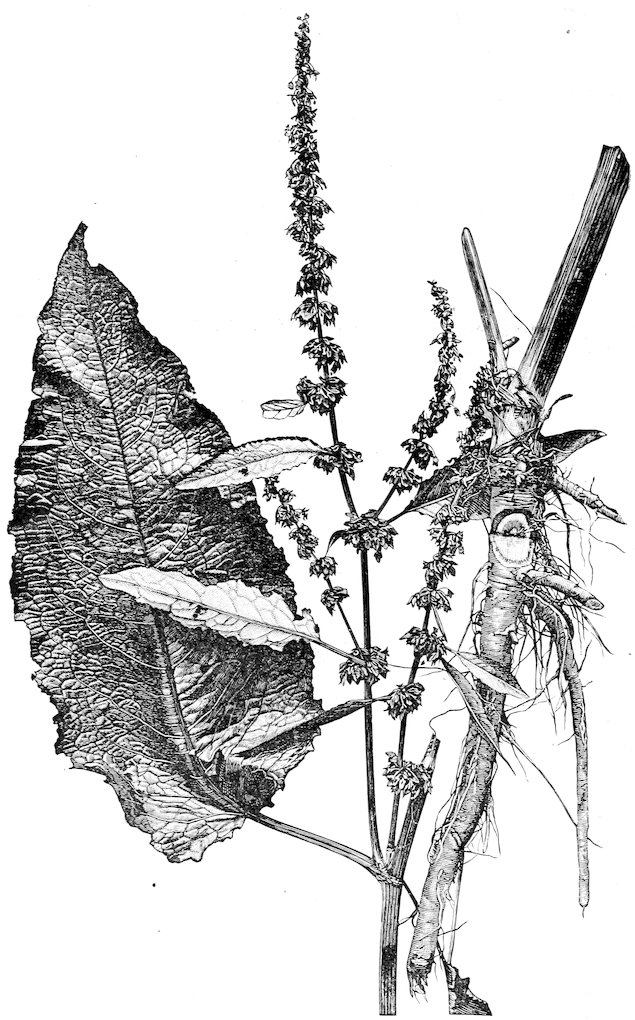
Fig. 6.—Broad-leaved dock (Rumex obtusifolius), leaf, fruiting spike, and root.
The broad-leaved dock (Rumex obtusifolius L.) known also as bitter dock, common dock, blunt-leaved dock, and butter-dock, is a very common weed found in waste places from the New England States to Oregon and south to Florida and Texas. It grows to about the same height as the yellow dock, to which it bears a close resemblance, differing principally in its more robust habit of growth. The stem is stouter than in yellow dock, and the leaves, which likewise 29are wavy along the margin, are much broader and longer. The green flowers appear from June to August and are in rather long, open clusters, the groups rather loose and far apart. (Fig. 6.)
Description of roots.—Yellow dock root is large and fleshy, usually from 8 to 12 inches long, tapering or spindle shaped, with few or no rootlets. When dry it is usually twisted and prominently wrinkled, the rather thick, dark, reddish brown bark marked with small scars. The inside of the root is whitish at first, becoming yellowish. The fracture is short, but shows some splintery fibers. The root, as it occurs in commerce, is either entire or occasionally split lengthwise.
The darker colored root of the broad-leaved dock has a number of smaller branches near the crown and more rootlets. (Fig. 6.) Dock roots have but a very faint odor and a bitter, astringent taste.
Collection, prices, and uses.—The roots should be collected in late summer or autumn, after the fruiting tops have turned brown, then washed, either left entire or split lengthwise into halves or quarters, and carefully dried. Yellow dock root ranges from 4 to 6 cents a pound.
In the United States Pharmacopœia of 1890 “the roots of Rumex crispus and of some other species of Rumex” were official, and both of the above-named species are used, but the yellow dock (Rumex crispus) is the species most commonly employed in medicine. The docks are largely used for purifying the blood and in the treatment of skin diseases.
The young root leaves of both of the species mentioned are sometimes used in spring as pot herbs.
POKEWEED.
Phytolacca decandra L.[1]
Synonym.—Phytolacca americana L.[1]
Pharmacopœial name.—Phytolacca.
Other common names.—Poke, pigeon-berry, garget, scoke, pocan, coakum, Virginian poke, inkberry, red inkberry, American nightshade, cancer-jalap, redweed.
Habitat and range.—Pokeweed, a common, familiar, native weed, is found in rich, moist soil along fence rows, fields, and uncultivated land from the New England States to Minnesota south to Florida and Texas.
Description of plant.—In Europe, where pokeweed has become naturalized from this country, it is regarded as an ornamental garden plant, and, indeed, it is very showy and attractive with its reddish purple stems, rich green foliage, and clusters of white flowers and dark-purple berries.
The stout, smooth stems, arising from a very large perennial root, attain a height of from 3 to 9 feet, and are erect and branched, green at first, then reddish. If a piece of the stem is examined, the pith will be seen to be divided into disk-shaped parts with hollow spaces between them. The smooth leaves are borne on short stems and are about 5 inches long and 2 to 3 inches wide, ovate or ovate oblong, acute at the apex, and the margins entire. The long-stalked clusters of whitish flowers, which appear from July to September, are from 3 to 4 inches in length, the flowers numerous and borne on reddish stems. In about two months the berries will have matured and assumed a rich dark-purple color. 30These smooth and shining purple berries are globular, flattened at both ends, and contain black seeds embedded in a rich crimson juice. (Fig. 7.) This plant belongs to the pokeweed family (Phytolaccaceæ).
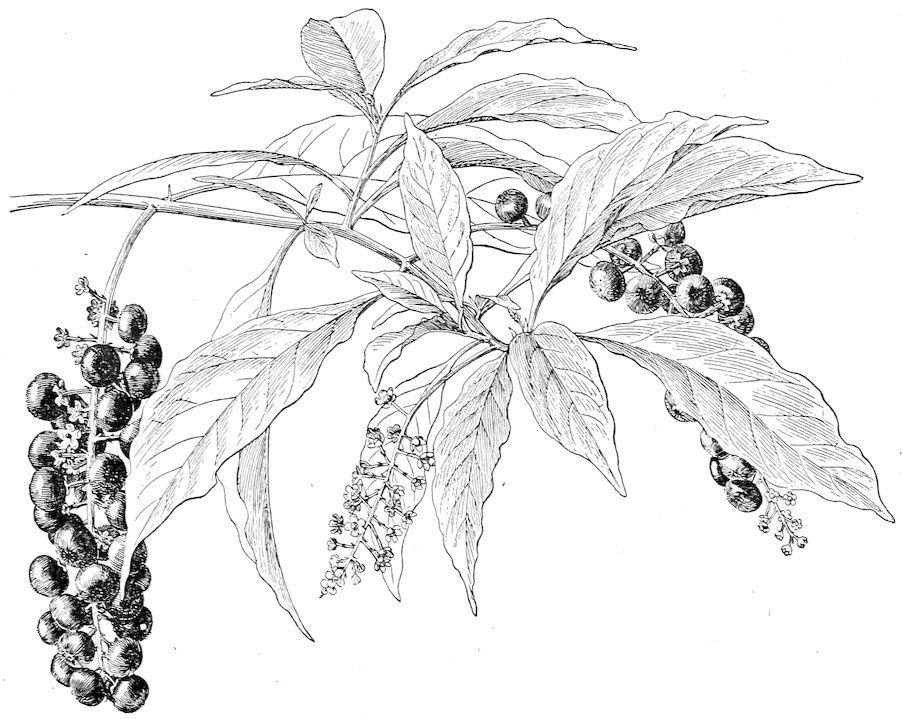
Fig. 7.—Pokeweed (Phytolacca decandra), flowering and fruiting branch.
Description of root.—Pokeweed has a very thick, long, fleshy root, conical in shape and branched (fig. 8), very much resembling that of horseradish, and poisonous. In commerce it usually occurs in transverse or lengthwise slices, the outside a yellowish brown and finely wrinkled lengthwise, and thickly encircled with lighter colored ridges. It breaks with a fibrous fracture and is yellowish gray within. The transverse slices show many concentric rings. There is a slight odor and the taste is sweetish and acrid. The root when powdered causes sneezing.
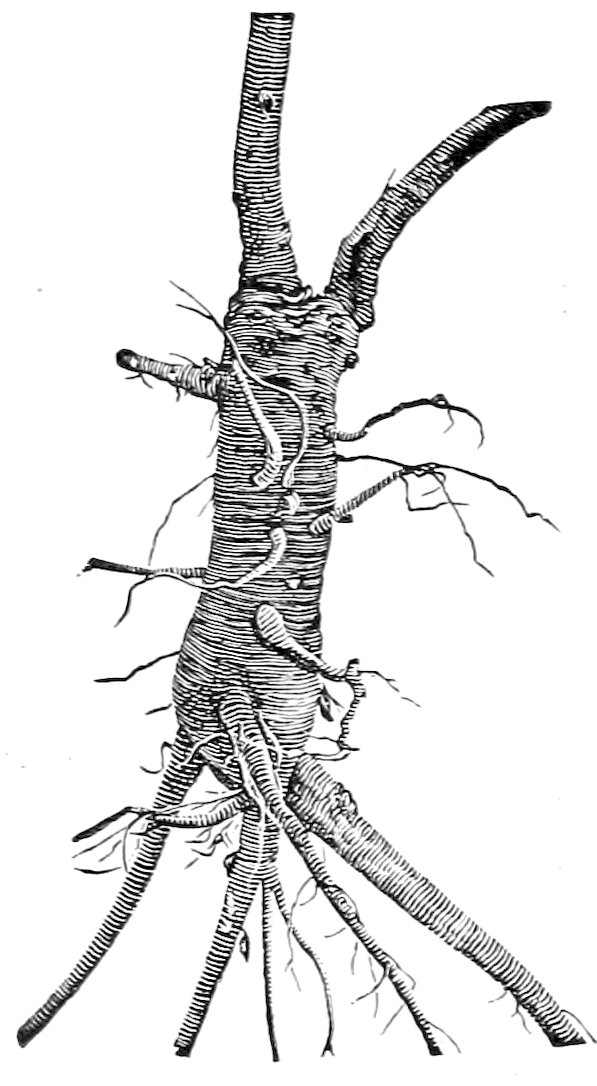
Fig. 8.—Pokeweed root.
Collection, prices, and uses.—The root of the pokeweed, which is official in the United States Pharmacopœia, is collected in the latter part of autumn, thoroughly cleaned, cut into transverse or lengthwise slices, and carefully dried. It brings from 2½ to 4 cents a pound.
The root is used for its alterative properties in treating various diseases of the skin and blood, and in certain cases in relieving pain and allaying inflammation. It also acts upon the bowels and causes vomiting.
The berries when fully matured are also used in medicine.
The young and tender shoots of the pokeweed are eaten in spring, like asparagus, but bad results may follow if they are not thoroughly cooked or if they are cut too close to the root.
31
SOAPWORT.
Saponaria officinalis L.
Other common names.—Saponaria, saponary, common soapwort, bouncing-bet, soaproot, bruisewort, Boston pink, chimney-pink, crow-soap, hedge-pink, oldmaid’s-pink, fuller’s-herb, lady-by-the-gate, London-pride, latherwort, mock-gilliflower, scourwort, sheepweed, sweet-betty, wild sweet-william, woods-phlox, world’s-wonder.
Habitat and range.—By one or another of its many common names this plant, naturalized from Europe, is known almost everywhere, occurring along roadsides and in waste places.
Description of plant.—Soapwort is a rather pretty herbaceous perennial, 1 to 2 feet high, and belonging to the pink family (Silenaceæ). Its smooth, stout, and erect stem is leafy and only sparingly branched, the leaves ovate, 2 to 3 inches long, smooth, prominently ribbed, and pointed at the apex. The bright-looking, crowded clusters of pink (or in shady localities whitish) flowers appear from about June until far along in September. The five petals of the corolla are furnished with long “claws,” or, in other words, they are narrowly lengthened toward the base and inserted within the tubular and pale-green calyx. The seed capsule is oblong and one-celled. (Pl. III, fig. 4.)
Description of root.—Soapwort spreads by means of its stolons, or underground runners. But the roots, which are rather long, are the parts employed in medicine. These are cylindrical, tapering toward the apex, more or less branched, and wrinkled lengthwise. (Pl. III, fig. 4.) The whitish wood is covered with a brownish red, rather thick bark, and the root breaks with a short, smooth fracture. It is at first sweetish, bitter, and mucilaginous, followed by a persistently acrid taste, but it has no odor.
Collection, prices, and uses.—As already indicated, the roots, without the runners, should be collected either in spring or autumn. With water they form a lather, like soap, whence the common names soapwort, soaproot, latherwort, etc., are derived. The price ranges from 5 to 10 cents a pound. The roots are employed in medicine for their tonic, alterative, and diaphoretic properties. The leaves are also used.
GOLDENSEAL.
Hydrastis canadensis L.
Pharmacopœial name.—Hydrastis.
Other common names.—Yellowroot, yellow puccoon, orange-root, yellow Indian-paint, turmeric-root, Indian turmeric, Ohio curcuma, ground-raspberry, eyeroot, eye-balm, yellow-eye, jaundice-root, Indian-dye.
Habitat and range.—This native forest plant occurs in patches in high, open woods, and usually on hillsides or bluffs affording natural drainage, from southern New York to Minnesota and western Ontario, south to Georgia and Missouri.
Goldenseal is now becoming scarce throughout its range. Ohio, Indiana, Kentucky, and West Virginia have been the greatest goldenseal-producing States.
Description of plant.—Goldenseal is a perennial plant belonging to the same family as the buttercup, namely, the crowfoot family (Ranunculaceæ). It has a thick yellow rootstock, which sends up an erect hairy stem about 1 foot in height, surrounded at the base by 2 or 3 yellowish scales. The yellow color of the roots and scales extends up the stem so far as it is covered by soil, while the portion of the stem above ground has a purplish color. The stem, which 32has only two leaves, seems to fork at the top, one branch bearing a large leaf and the other a smaller one and a flower. A third leaf, which is much smaller than the other two and stemless, is occasionally produced. The leaves are palmately 5 to 9 lobed, the lobes broad, acute, sharply and unequally toothed; they are prominently veined on the lower surface, and at flowering time, when they are very much wrinkled, they are only partially developed, but they continue to expand until they are from 6 to 8 inches in diameter, becoming thinner in texture and smoother. The upper leaf subtends or incloses the flower bud. The greenish white flower appears about April or May, but it is of short duration, lasting only five or six days. It is less than half an inch in diameter and, instead of petals, has three small petal-like sepals, which fall away as soon as the flower expands, leaving only the numerous stamens (as many as 40 or 50), in the center of which are about a dozen pistils, which finally develop into a round, fleshy, berry-like head which ripens in July or August. The fruit when ripe turns a bright red and resembles a large raspberry, whence the common name “ground-raspberry” is derived. It contains from 10 to 20 small, black, shining, hard seeds. (Fig. 9.)
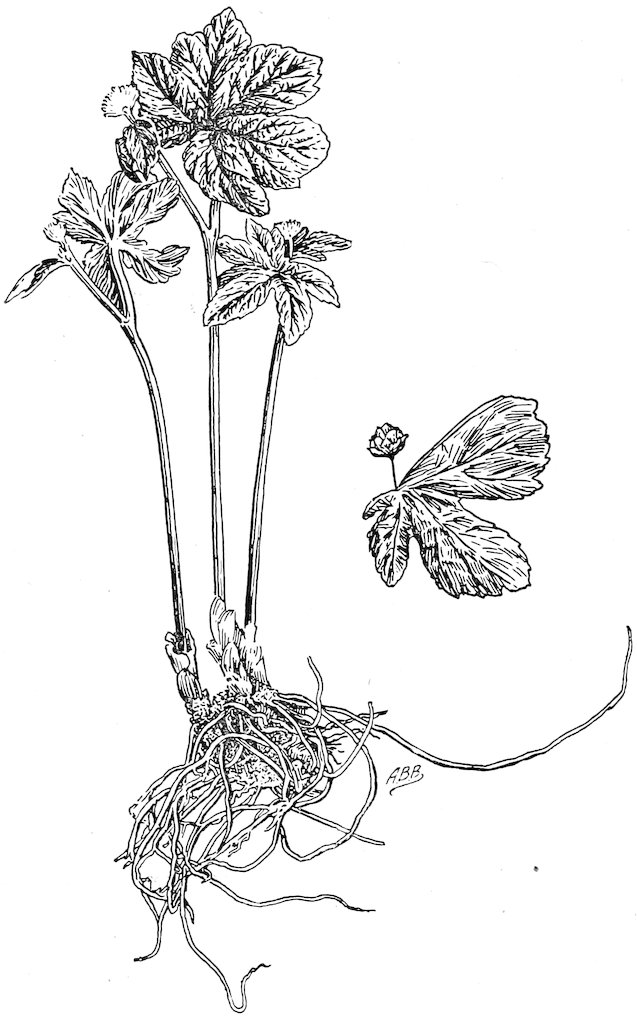
Fig. 9.—Goldenseal (Hydrastis canadensis), flowering plant and fruit.
Description of rootstock.—The fresh rootstock of goldenseal, which has a rank, nauseating odor, is bright yellow, both internally and externally, with fibrous yellow rootlets produced from the sides. It is from 1½ to 2½ inches in length, from one-fourth to three-fourths of an inch in thickness, and contains a large amount of yellow juice. (Fig. 10.)
In the dried state the rootstock is crooked, knotty, and wrinkled, from 1 to 2 inches in length, and from one-eighth to one-third of an inch in diameter. It is of a dull-brown color on the outside and breaks with a clean, short, resinous fracture, showing a lemon-yellow color inside. After the rootstock has been kept for some time it will become greenish yellow or brown internally and 33its quality impaired. The cup-like depressions or stem scars on the upper surface of the rootstock resemble the imprint of a seal, whence the most popular name of the plant, goldenseal, is derived. The rootstock as found in commerce is almost bare, the fibrous rootlets, which in drying become very wiry and brittle, breaking off readily and leaving only small protuberances.
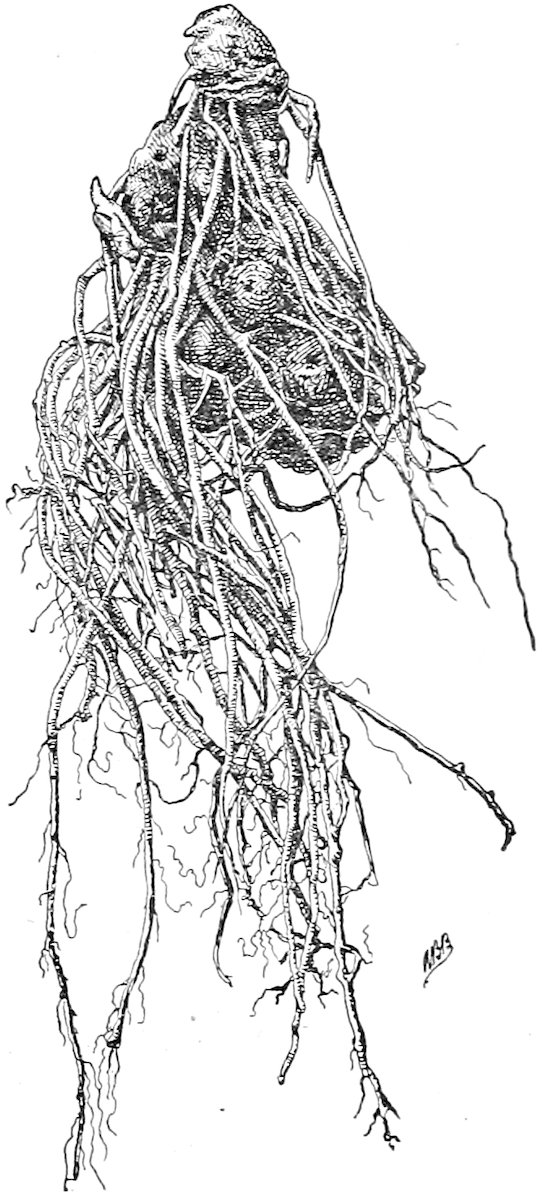
Fig. 10.—Goldenseal rootstock.
The odor of the dried rootstock, while not so pronounced as in the fresh material, is peculiar, narcotic, and disagreeable. The taste is exceedingly bitter, and when the rootstock is chewed there is a persistent acridity, which causes an abundant flow of saliva.
Collection, prices, and uses.—The root should be collected in autumn after the seeds have ripened, freed from soil, and carefully dried. After a dry season goldenseal dies down soon after the fruit is mature, so that it often happens that by the end of September not a trace of the plant remains above ground; but if the season has been moist, the plant sometimes persists to the beginning of winter. The price of goldenseal ranges from $1 to $1.50 a pound.
Goldenseal, which is official in the United States Pharmacopœia, is a useful drug in digestive disorders and in certain catarrhal affections of the mucous membranes, in the latter instance being administered both internally and locally.
Cultivation.—Once so abundant in certain parts of the country, especially in the Ohio Valley, goldenseal is now becoming scarce throughout its range, and in consequence of the increased demand for the root, both at home and abroad, its cultivation must sooner or later be more generally undertaken in order to satisfy the needs of medicine. In some parts of the country the cultivation of goldenseal is already under way.
The first thing to be considered in growing this plant is to furnish it, as nearly as possible, the conditions to which it has been accustomed in its native forest home. This calls for a well-drained soil, rich in humus, and partially shaded. Goldenseal stands transplanting well, and the easiest way to propagate it is to bring the plants in from the forest and transplant them to a properly prepared location, or to collect the rootstocks and to cut them into as many pieces as there are buds, planting these pieces in a deep, loose, well-prepared soil, and mulching, adding new mulch each year to renew the humus. With such a soil the cultivation of goldenseal is simple, and it will be necessary chiefly to keep down the weeds.
The plants may be grown in rows 1 foot apart and 6 inches apart in the row, or they may be grown in beds 4 to 8 feet wide, with walks between. Artificial shade will be necessary, and this is supplied by the erection of lath sheds. The time required to obtain a marketable crop is from two to three years.
Detailed information regarding the experiments made by the Department will be found in another publication.[2]
34
GOLDTHREAD.
Coptis trifolia (L.) Salisb.
Other common names.—Coptis, cankerroot, mouthroot, yellowroot.
Habitat and range.—This pretty little perennial is native in damp, mossy woods and bogs from Canada and Alaska south to Maryland and Minnesota. It is most common in the New England States, northern New York and Michigan, and in Canada, where it frequents the dark sphagnum swamps, cold bogs, and the shade of dense forests of cedars, pines, and other evergreens.
Description of plant.—Anyone familiar with this attractive little plant will agree that it is well named. The roots of goldthread, running not far beneath the surface of the ground, are indeed like so many tangled threads of gold. The plant in the general appearance of its leaves and flowers very closely resembles the strawberry plant. It is of low growth, only 3 to 6 inches in height, and belongs to the crowfoot family (Ranunculaceæ). The leaves are all basal, and are borne on long, slender stems; they are evergreen, dark green and shining on the upper surface and lighter green beneath, divided into three parts, which are prominently veined and toothed. A single small, white, star-shaped flower is borne at the ends of the flowering stalks, appearing from May to August. (Fig. 11.) The 5 to 7 sepals or lobes of the calyx are white and like petals, and the petals of the corolla, 5 to 7 in number, are smaller, club shaped, and yellow at the base. The seed pods are stalked, oblong, compressed, spreading, tipped with the persistent style, and containing small black seeds.
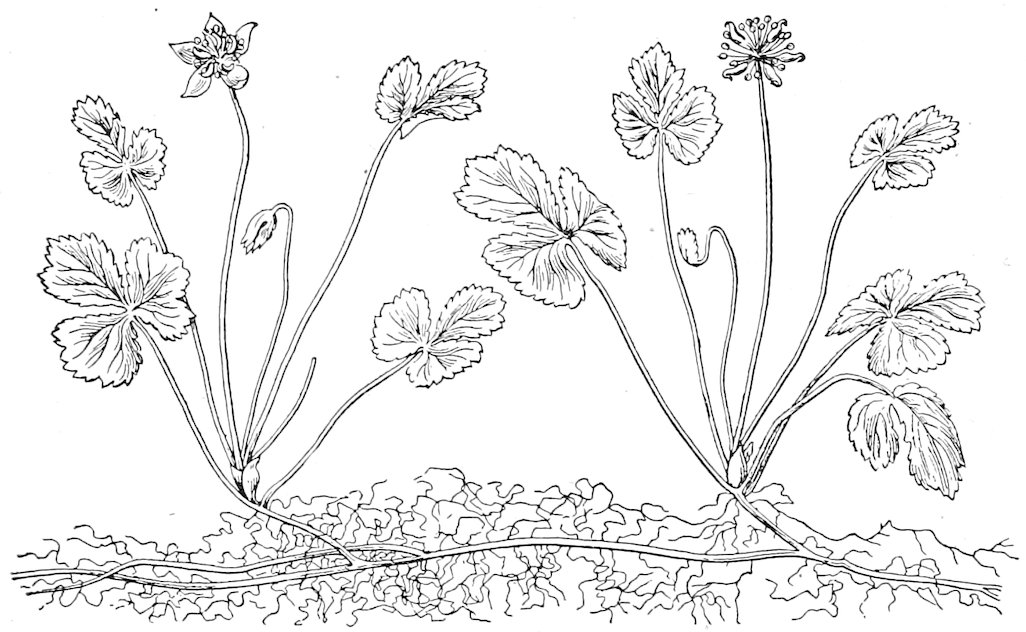
Fig. 11.—Goldthread (Coptis trifolia). After Lloyd’s Drugs and Medicines of North America.
Description of root.—Goldthread has a long, slender, creeping root, which is much branched and frequently matted. (Fig. 11.) The color of these roots is a bright golden yellow. As found in the stores, goldthread consists usually of tangled masses of these golden-yellow roots, mixed with the leaves and stems of the plant, but the root is the part prescribed for use. The root is bitter and has no odor.
Collection, prices, and uses.—The time for collecting goldthread is in autumn. After removing the covering of dead leaves and moss, the creeping yellow roots of goldthread will be seen very close to the surface of the ground, from which they can be very easily pulled. They should, of course, be carefully dried. As already stated, although the roots and rootlets are the parts to be used, the commercial article is freely mixed with the leaves and stems of the plant. Evidences of the pine-woods home of this plant, in the form of pine needles and bits of moss, are often seen in the goldthread received for market. Goldthread brings from 60 to 70 cents a pound.
The Indians and early white settlers used this little root as a remedy for various forms of ulcerated and sore mouth, and it is still used as a wash or gargle for affections of this sort. It is also employed as a bitter tonic.
Goldthread was official in the United States Pharmacopœia from 1820 to 1880.
35
BLACK COHOSH.
Cimicifuga racemosa (L.) Nutt.
Synonym.—Actaea racemosa L.
Pharmacopœial name.—Cimicifuga.
Other common names.—Black snakeroot, bugbane, bugwort, rattle-snakeroot, rattleroot, rattleweed, rattletop, richweed, squawroot.
Habitat and range.—Although preferring the shade of rich woods, black cohosh will grow occasionally in sunny situations in fence corners and woodland pastures. It is most abundant in the Ohio Valley, but it occurs from Maine to Wisconsin, south along the Allegheny Mountains to Georgia, and westward to Missouri.
Description of plant.—Rising to a height of 3 to 8 feet, the showy, delicate-flowered spikes of the black cohosh tower above most of the other woodland flowers, making it a conspicuous plant in the woods and one that can be easily recognized.
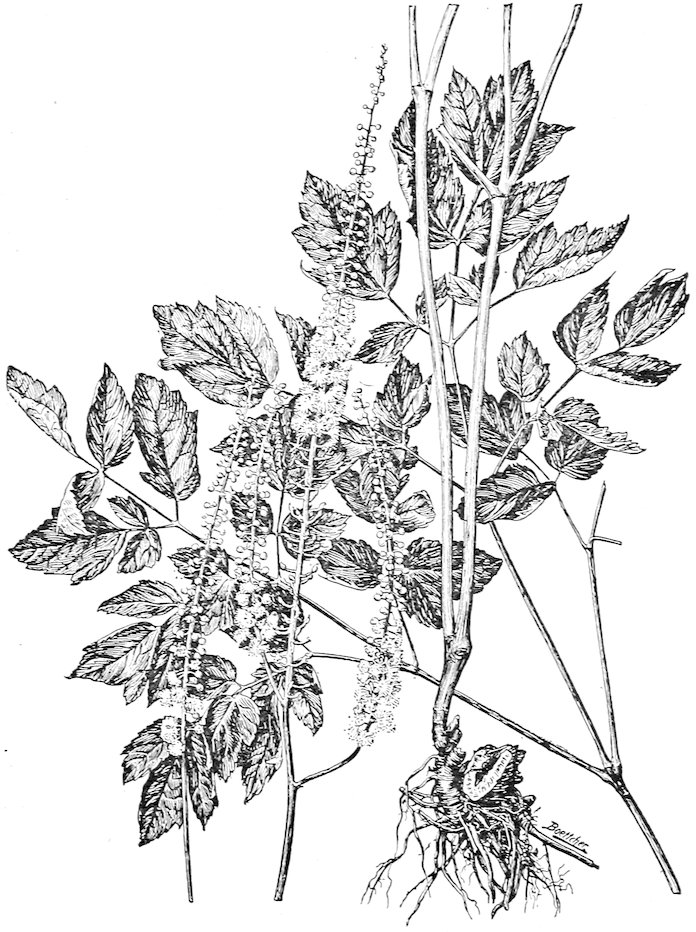
Fig. 12.—Black cohosh (Cimicifuga racemosa), leaves, flowering spikes, and rootstock.
Black cohosh is an indigenous perennial plant belonging to the same family as the goldenseal, namely, the crowfoot family (Ranunculaceæ). The tall stem, sometimes 8 feet in height, is rather slender and leafy, the leaves consisting of three leaflets, which are again divided into threes. The leaflets are about 2 inches long, ovate, sharp pointed at the apex, thin and smooth, variously lobed, and the margins sharply toothed. The graceful, spikelike terminal cluster of flowers, which is produced from June to August, is from 6 inches to 2 feet in length. (Fig. 12.) Attractive as these flower clusters are to the eye, they generally do not prove attractive very long to those who may gather them for their beauty, since the flowers emit an offensive odor, which accounts for some of the common names applied to this plant, namely, bugbane and bugwort, it having been thought that this odor was efficacious in driving away bugs. The flowers do not all open at one time, and thus there may be seen buds, blossoms, and seed pods on one spike. The buds are white and globular, and as 36they expand in flower there is practically nothing to the flower but very numerous white stamens and the pistil, but the stamens spread out around the pistil in such a manner as to give to the spike a somewhat feathery or fluffy appearance which is very attractive. The seed pods are dry, thick and leathery, ribbed, and about one-fourth of an inch long, with a small beak at the end. The smooth brown seeds are inclosed within the pods in two rows. Anyone going through the woods in winter may find the seed pods, full of seeds, still clinging to the dry, dead stalk, and the rattling of the seeds in the pods as the wind passes over them has given rise to the common names rattle-snakeroot (not “rattlesnake”-root), rattleweed, rattletop, and rattleroot.
Description of rootstock.—The rootstock (fig. 12) is large, horizontal, and knotty or rough and irregular in appearance. The upper surface of the rootstock is covered with numerous round scars and stumps, the remains of former leaf stems, and on the fresh rootstocks may be seen the young, pinkish white buds which are to furnish the next season’s growth. From the lower part of the rootstock long, fleshy roots are produced. The fresh rootstock is very dark reddish brown on the outside, white within, showing a large central pith from which radiate rays of a woody texture, and on breaking the larger roots also the woody rays will be seen in the form of a cross. On drying, the rootstock becomes hard and turns much darker, both internally and externally, but the peculiar cross formation of the woody rays in both rootstock and roots, being lighter in color, is plainly seen without the aid of a magnifying glass. The roots in drying become wiry and brittle and break off very readily. Black cohosh has a heavy odor and a bitter, acrid taste.
Collection, prices, and uses.—The root should be collected after the fruit has ripened, usually in September. The price ranges from 2 to 3 cents a pound.
The Indians had long regarded black cohosh as a valuable medicinal plant, not only for the treatment of snake bites, but it was also a very popular remedy among their women, and it is to-day considered of value as an alterative, emmenagogue, and sedative, and is recognized as official in the United States Pharmacopœia.
OREGON GRAPE.
Berberis aquifolium Pursh.
Pharmacopœial name.—Berberis.
Other common names.—Rocky Mountain grape, holly-leaved barberry, California barberry, trailing Mahonia.
Habitat and range.—This shrub is native in woods in rich soil among rocks from Colorado to the Pacific Ocean, but it is especially abundant in Oregon and northern California.
Description of plant.—Oregon grape is a low-growing shrub, resembling somewhat the familiar Christmas holly of the Eastern States, and, in fact, was first designated as “mountain-holly” by members of the Lewis and Clark expedition on their way through the western country. It belongs to the barberry family (Berberidaceæ), and grows about 2 to 6 feet in height, the branches sometimes trailing. The leaves consist of from 5 to 9 leaflets, borne in pairs, with an odd leaflet at the summit. They are from 2 to 3 inches long and about 1 inch wide, evergreen, thick, leathery, oblong or oblong ovate in outline, smooth and shining above, the margins provided with thorny spines or teeth. The numerous small yellow flowers appear in April or May and are borne in erect, clustered heads. The fruit consists of a cluster of blue or bluish purple berries, having a pleasant taste, and each containing from three to nine seeds. (Pl. IV, fig. 1.)
37Other species.—While Berberis aquifolium is generally designated as the source of Oregon grape root, other species of Berberis are met with in the market under the name grape root, and their use is sanctioned by the United States Pharmacopœia.
The species most commonly collected with Berberis aquifolium is B. nervosa Pursh, which is also found in woods from California northward to Oregon and Washington. This is 9 to 16 inches in height, with a conspicuously jointed stem and 11 to 17 bright-green leaflets.
Another species of Berberis, B. pinnata Lag., attains a height of from a few inches to 5 feet, with from 5 to 9, but sometimes more, leaflets, which are shining above and paler beneath. This resembles aquifolium very closely and is often mistaken for it, but it is said that it has not been used by the medical profession, unless in local practice.[3] The root also is about the same size as that of aquifolium, while the root of nervosa is smaller.
Some works speak of Berberis repens Lindl. as another species often collected with aquifolium, but in the latest botanical manuals no such species is recognized, B. repens being given simply as a synonym for B. aquifolium.
Description of rootstock.—The rootstock and roots of Oregon grape are more or less knotty, in irregular pieces of varying lengths, and about an inch or less in diameter, with brownish bark and hard and tough yellow wood, showing a small pith and narrow rays. Oregon grape root has a very bitter taste and very slight odor.
Collection, prices, and uses.—Oregon grape root is collected in autumn and brings from 10 to 12 cents a pound. The bark should not be removed from the rootstocks, as the Pharmacopœia directs that such roots be rejected.
This root has long been used in domestic practice throughout the West as a tonic and blood purifier, and is now official in the United States Pharmacopœia.
The berries are used in making preserves and cooling drinks.
BLUE COHOSH.
Caulophyllum thalictroides (L.) Michx.
Other common names.—Caulophyllum, pappoose-root, squawroot, blueberry-root, blue ginseng, yellow ginseng. (Pl. IV, fig. 2.)
Habitat and range.—Blue cohosh is found in the deep rich loam of shady woods from New Brunswick to South Carolina, westward to Nebraska, being abundant especially throughout the Allegheny Mountain region.
Description of plant.—This member of the barberry family (Berberidaceæ) is a perennial herb, 1 to 3 feet in height, and indigenous to this country. It bears at the top one large, almost stemless leaf, which is triternately compound—that is, the main leaf stem divides into three stems, which again divide into threes, and each division bears three leaflets. Sometimes there is a smaller leaf, but similar to the other, at the base of the flowering branch. The leaflets are thin in texture, oval, oblong, or obovate, and 3 to 5 lobed.
In the early stage of its growth this plant is covered with a sort of bluish green bloom, but it gradually loses this and becomes smooth. The flowers are borne in a small terminal panicle or head, and are small and greenish yellow. They appear from April to May, while the leaf is still small. The globular seeds, which ripen about August, are borne on stout stalks in membranous capsules and resemble dark-blue berries.
38Description of rootstock.—The thick crooked rootstock of blue cohosh is almost concealed by the mass of matted roots which surrounds it. There are numerous cup-shaped scars and small branches on the upper surface of the rootstock, while the lower surface gives off numerous long, crooked, matted roots. Some of the scars are depressed below the surface of the rootstock, while others are raised above it. The outside is brownish and the inside tough and woody. Blue cohosh possesses a slight odor and a sweetish, somewhat bitter and acrid taste. In the powdered state it causes sneezing.
Collection, prices, and uses.—The root is dug in the fall. Very often the roots of goldenseal or twinleaf are found mixed with those of blue cohosh. The price of blue cohosh root ranges from 2½ to 4 cents a pound.
Blue cohosh, official in the United States Pharmacopœia for 1890, is used as a demulcent, antispasmodic, emmenagogue, and diuretic.
TWINLEAF.
Jeffersonia diphylla (L.) Pers.
Other common names.—Jeffersonia, rheumatism-root, helmetpod, ground-squirrel pea, yellowroot.
Habitat and range.—Twinleaf inhabits rich shady woods from New York to Virginia and westward to Wisconsin.
Description of plant.—This native herbaceous perennial is only about 6 to 8 inches in height when in flower. At the fruiting stage it is frequently 18 inches in height. It is one of our early spring plants, and its white flower, resembling that of bloodroot, is produced as early as April.
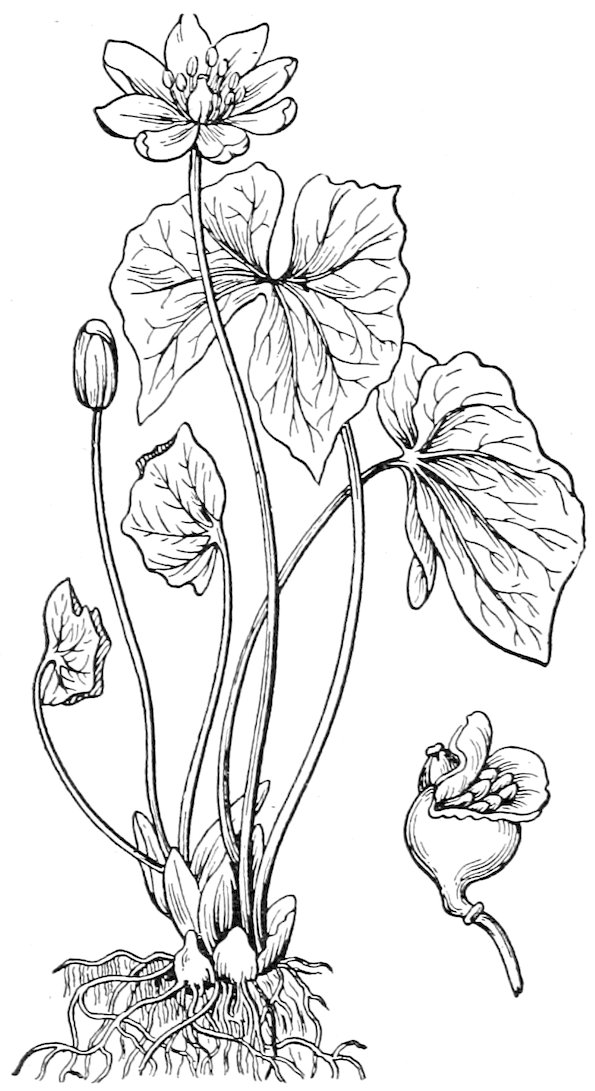
Fig. 13.—Twinleaf (Jeffersonia diphylla), plant and seed capsule. (After Britton and Brown, Illustrated Flora.)
The long-stemmed, smooth leaves, produced in pairs and arising from the base of the plant, are rather oddly formed. They are about 3 to 6 inches long, 2 to 4 inches wide, heart shaped or kidney shaped, but parted lengthwise into two lobes or divisions, really giving the appearance of two leaves; hence the common name “twinleaf.” The flower with its eight oblong, spreading white petals measures about 1 inch across, and is borne at the summit of a slender stalk arising from the root. The many-seeded capsule is about 1 inch long, leathery, somewhat pear shaped, and opening halfway around near the top, the upper part forming a sort of lid. (Fig. 13.) Twinleaf belongs to the barberry family (Berberidaceæ).
Description of rootstock.—Twinleaf has a horizontal rootstock, with many fibrous, much-matted roots, and is very similar to that of blue cohosh, but not so long. It is thick, knotty, yellowish brown externally, with a resinous bark, and internally yellowish. The inner portion is nearly tasteless, but the bark has a bitter and acrid taste.
Collection, prices, and uses.—The rootstock is collected in autumn, and is used as a diuretic, alterative, antispasmodic, and a stimulating diaphoretic. Large 39doses are said to be emetic and smaller doses tonic and expectorant. The price paid for twinleaf root ranges from about 5 to 7 cents a pound.
MAY-APPLE.
Podophyllum peltatum L.
Pharmacopœial name.—Podophyllum.
Other common names.—Mandrake, wild mandrake, American mandrake, wild lemon, ground-lemon, hog-apple, devil’s-apple, Indian apple, raccoon-berry, duck’s-foot, umbrella-plant, vegetable calomel.
Habitat and range.—The May-apple is an indigenous plant, found in low woods, usually growing in patches, from western Quebec to Minnesota, south to Florida and Texas.
Description of plant.—A patch of May-apple can be distinguished from afar, the smooth, dark-green foliage and close and even stand making it a conspicuous feature of the woodland vegetation.
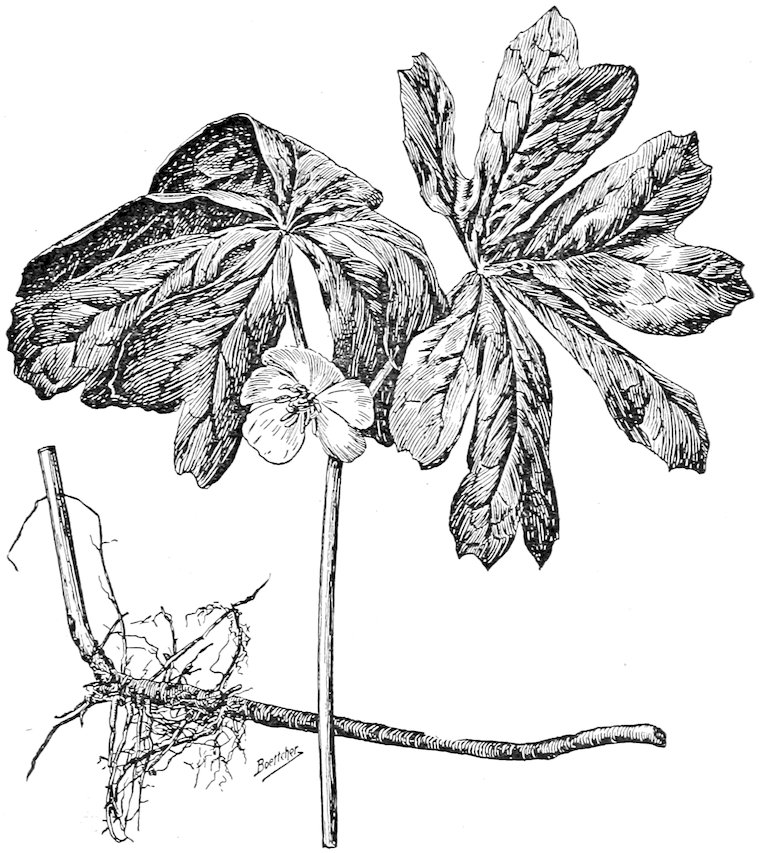
Fig. 14.—May-apple (Podophyllum peltatum), upper portion of plant with flower, and rootstock.
May-apple is a perennial plant, and belongs to the barberry family (Berberidaceæ). It is erect, and grows about 1 foot in height. The leaves are only two in number, circular in outline, but with five to seven deep lobes, the lobes 2 cleft, and toothed at the apex; they are dark green above, the lower surface lighter green and somewhat hairy or smooth, sometimes 1 foot in diameter, and borne on long leafstalks which are fixed to the center of the leaf, giving it an umbrella-like appearance. The waxy-white, solitary flower, sometimes 2 inches in diameter, appears in May, nodding on its short stout stalk, generally right between the two large umbrella-like leaves, which shade it and hide it from view. (Fig. 14.) The fruit which follows is lemon shaped, at first green, then yellow, about 2 inches in length, and edible, although when eaten immoderately it is known to have produced bad effects.
In a patch of May-apple plants there are always a number of sterile or flowerless stalks, which bear leaves similar to those of the flowering plants.
Description of rootstock.—The horizontally creeping rootstock of May-apple (fig. 14), when taken from the ground, is from 1 to 6 feet or more in length, flexible, smooth, and round, dark brown on the outside and whitish and 40fleshy within; at intervals of a few inches are thickened joints, on the upper surface of which are round stem scars and on the lower side a tuft of rather stout roots. Sometimes the rootstock bears lateral branches. The dried rootstock, as it occurs in the stores, is in irregular, somewhat cylindrical pieces, smooth or somewhat wrinkled, yellowish brown or dark brown externally, whitish to pale brown internally, breaking with a short, sharp fracture, the surface of which is mealy. The odor is slight and the taste at first sweetish, becoming very bitter and acrid.
Collection, prices, and uses.—The proper time for collecting the rootstock is in the latter half of September or in October. The price paid for May-apple root ranges from 3 to 6 cents a pound.
May-apple root, which is recognized as official in the United States Pharmacopœia, is an active cathartic, and was known as such to the Indians.
CANADA MOONSEED.
Menispermum canadense L.
Other common names.—Menispermum, yellow parilla, Texas sarsaparilla, yellow sarsaparilla, vine-maple. (Pl. IV, fig. 3.)
Habitat and range.—Canada moonseed is usually found along streams in woods, climbing over bushes, its range extending from Canada to Georgia and Arkansas.
Description of plant.—This native perennial woody climber reaches a length of from 6 to 12 feet, the round, rather slender stem bearing very broad, slender-stalked leaves. These leaves are from 4 to 8 inches wide, smooth and green on the upper surface and paler beneath, roundish in outline and entire, or sometimes lobed and resembling the leaves of some of our maples, whence the common name “vine-maple” is probably derived. The bases of the leaves are generally heart shaped and the apex pointed or blunt. In July the loose clusters of small yellowish or greenish white flowers are produced, followed in September by bunches of black one-seeded fruit, covered with a “bloom” and very much resembling grapes. Canada moonseed belongs to the moonseed family (Menispermaceæ).
Description of rootstock.—The rootstock and roots are employed in medicine. In the stores it will be found in long, straight pieces, sometimes 3 feet in length, only about one-fourth of an inch in thickness, yellowish brown or grayish brown, finely wrinkled lengthwise, and giving off fine, hairlike, branched, brownish roots from joints which occur every inch or so. The inside shows a distinct white pith of variable thickness and a yellowish white wood with broad, porous wood rays, the whole breaking with a tough, woody fracture. It has practically no odor, but a bitter taste.
Collection, prices, and uses.—Canada moonseed is collected in autumn, and brings from 4 to 8 cents a pound. It is used as a tonic, alterative, and diuretic, and was official in the United States Pharmacopœia for 1890.
BLOODROOT.
Sanguinaria canadensis L.
Pharmacopœial name.—Sanguinaria.
Other common names.—Redroot, red puccoon, red Indian-paint, puccoon-root, coonroot, white puccoon, pauson, snakebite, sweet-slumber, tetterwort, turmeric.
Habitat and range.—Bloodroot is found in rich, open woods from Canada south to Florida and west to Arkansas and Nebraska.
41Description of plant.—This indigenous plant is among the earliest of our spring flowers, the waxy-white blossom, enfolded by the grayish green leaf, usually making its appearance early in April. The stem and root contain a blood-red juice. Bloodroot is a perennial, and belongs to the same family as the opium poppy, the Papaveraceæ. Each bud on the thick, horizontal rootstock produces but a single leaf and a flowering scape, reaching about 6 inches in height (fig. 15). The plant is smooth, and both stem and leaves, especially when young, present a grayish green appearance, being covered with a “bloom” such as is found on some fruits. The leaves are palmately 5 to 9 lobed, the lobes either cleft at the apex or having a wavy margin, and are borne on leaf stems about 6 to 14 inches long. After the plants have ceased flowering the leaves, at first only 3 inches long and 4 to 5 inches broad, continue to expand until they are about 4 to 7 inches long and 6 to 12 inches broad. The under side of the leaf is paler than the upper side and shows prominent veins. The flower measures about 1 inch across, is white, rather waxlike in appearance, with numerous golden-yellow stamens in the center. The petals soon fall off, and the oblong, narrow seed pod develops, attaining a length of about an inch.
Description of rootstock.—When dug out of the ground bloodroot is rather thick, round, and fleshy, slightly curved at the ends, and contains a quantity of blood-red juice. It is from 1 to 4 inches in length, from ½ to 1 inch in thickness, externally reddish brown, internally a bright-red blood color, and produces many thick, orange-colored rootlets. (Fig. 15.)
The rootstock shrinks considerably in drying, the outside turning dark brown and the inside orange-red or yellowish with numerous small red dots, and it breaks with a short, sharp fracture. It has but a slight odor, and the taste is bitter and acrid and very persistent. The powdered root causes sneezing.
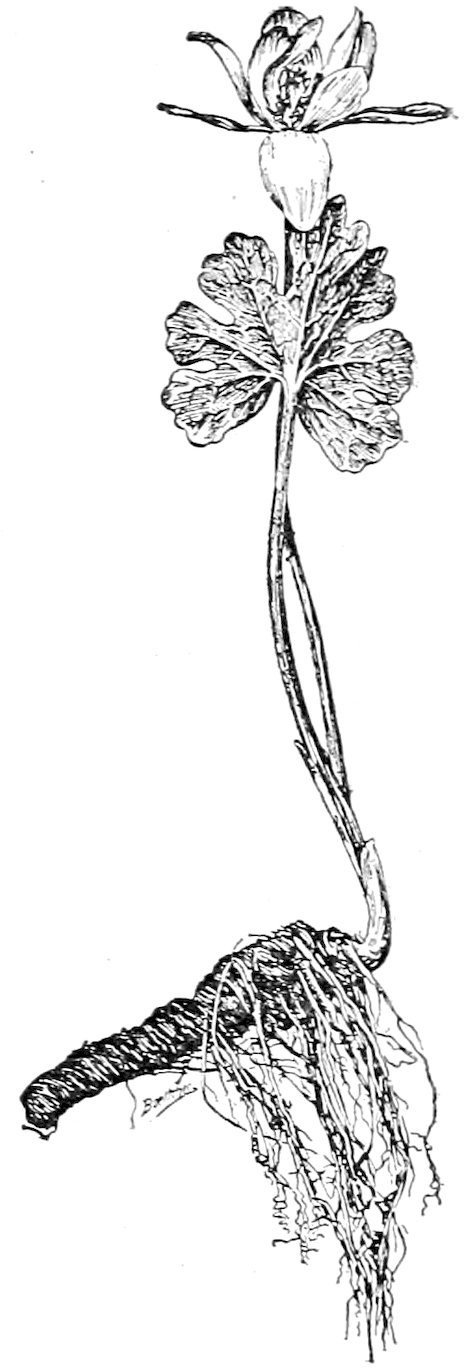
Fig. 15.—Bloodroot (Sanguinaria canadensis), flowering plant with rootstock.
Collection, prices, and uses.—The rootstock should be collected in autumn, after the leaves have died, and after curing it should be stored in a dry place, as it rapidly deteriorates if allowed to become moist. Age also impairs its activity. The price paid to collectors for this root ranges from about 5 to 10 cents a pound.
Bloodroot was well known to the American Indians, who used the red juice as a dye for skins and baskets and for painting their faces and bodies. It is official in the United States Pharmacopœia, and is used as a tonic, alterative, stimulant, and emetic.
HYDRANGEA.
Hydrangea arborescens L.
Other common names.—Wild hydrangea, seven-barks.
Habitat and range.—Hydrangea frequents rocky river banks and ravines from the southern part of New York to Florida, and westward to Iowa and Missouri, being especially abundant in the valley of the Delaware and southward.
Description of plant.—Hydrangea is an indigenous shrub, 5 to 6 feet or more in height, with weak twigs, slender leaf stems and thin leaves. It belongs to the hydrangea family (Hydrangeaceæ). The leaves are oval or sometimes heart 42shaped, 3 to 6 inches long, sharply toothed, green on both sides, the upper smooth and the lower sometimes hairy. The shrub is in flower from June to July, producing loose, branching, terminal heads of small, greenish white flowers, followed by membranous, usually 2-celled capsules, which contain numerous seeds. (Pl. IV, fig. 4.) Sometimes hydrangea will flower a second time, early in fall.
A peculiar characteristic of this shrub, and one that has given rise to the common name “seven-barks,” is the peeling off of the stem bark, which comes off in several successive layers of thin, different colored bark.
Description of root.—The root is roughly branched and when first taken from the ground is very juicy, but after drying it becomes hard. The smooth white and tough wood is covered with a thin, pale-yellow or light-brown bark, which readily scales off. The wood is tasteless, but the bark has a pleasant aromatic taste, becoming somewhat pungent.
Collection, prices, and uses.—Hydrangea root is collected in autumn, and as it becomes very tough after drying and difficult to bruise it is best to cut the root in short transverse pieces while it is fresh and still juicy and dry it in this way. The price ranges from 2 to 7 cents a pound.
Hydrangea has diuretic properties and is said to have been much used by the Cherokees and early settlers in calculous complaints.
INDIAN-PHYSIC.
Porteranthus trifoliatus (L.) Britton.
Synonym.—Gillenia trifoliata Moench.
Other common names.—Gillenia, bowman’s-root, false ipecac, western dropwort, Indian-hippo.
Habitat and range.—Indian-physic is native in rich woods from New York to Michigan, south to Georgia and Missouri.
Description of plant.—The reddish stems of this slender, graceful perennial of the rose family (Rosaceæ) are about 2 to 3 feet high, several erect and branched stems being produced from the same root. The leaves are almost stemless and trifoliate; that is, composed of three leaflets. They are ovate or lanceolate, 2 to 3 inches long, narrowed at the base, smooth, and toothed. The nodding, white or pinkish flowers are few, produced in loose terminal clusters from May to July. (Pl. V, fig. 1.) The five petals are long, narrowed or tapering toward the base, white or pinkish, and inserted in the tubular, somewhat bell-shaped, red-tinged calyx. The seed pods are slightly hairy.
At the base of the leaf stems are small leaflike parts, called stipules, which in this species are very small, linear, and entire. In the following species, which is very similar to trifoliatus and collected with it, the stipules, however, are so much larger that they form a prominent character, which has given rise to its specific name, stipulatus.
Porteranthus stipulatus (Muhl.) Britton (Syn. Gillenia stipulacea Nutt.) is found in similar situations as P. trifoliatus, but generally farther west, its range extending from western New York to Indiana and Kansas, south to Alabama, Louisiana, and Indian Territory. The general appearance of this plant is very similar to that of P. trifoliatus. It grows to about the same height, but is generally more hairy, the leaflets narrower and more deeply toothed, and the flowers perhaps a trifle smaller. The stipules, however, will generally serve to distinguish it. These are large, broad, ovate, acute at the apex, sharply and deeply notched, and so much like leaves that but for their position at the base of the leaf stems they might easily be mistaken for them.
With the exception of the name American ipecac applied to this plant, the common names of Porteranthus trifoliatus are also used for P. stipulatus. The roots of both species are collected and used for the same purposes.
43Description of roots.—The root of Porteranthus trifoliatus is thick and knotty, with many smoothish, reddish brown rootlets (Pl. V, fig. 1), the latter in drying becoming wrinkled lengthwise and showing a few transverse fissures or breaks in the bark, and the interior white and woody. There is practically no odor, and the woody portion is tasteless, but the bark, which is readily separable, is bitter, increasing the flow of saliva.
Porteranthus stipulatus has a larger, more knotty root, with rootlets that are more wavy, constricted, or marked with numerous transverse rings, and the bark fissured or breaking from the white woody portion at frequent intervals.
Collection, prices, and uses.—The roots of both species are collected in autumn. The price ranges from 2 to 4 cents a pound.
Indian-physic or bowman’s root, as these names imply, was a popular remedy with the Indians, who used it as an emetic. From them the white settlers learned of its properties, and it is still used for its emetic action. This drug was at one time official in the United States Pharmacopœia, from 1820 to 1880. Its action is said to resemble that of ipecac.
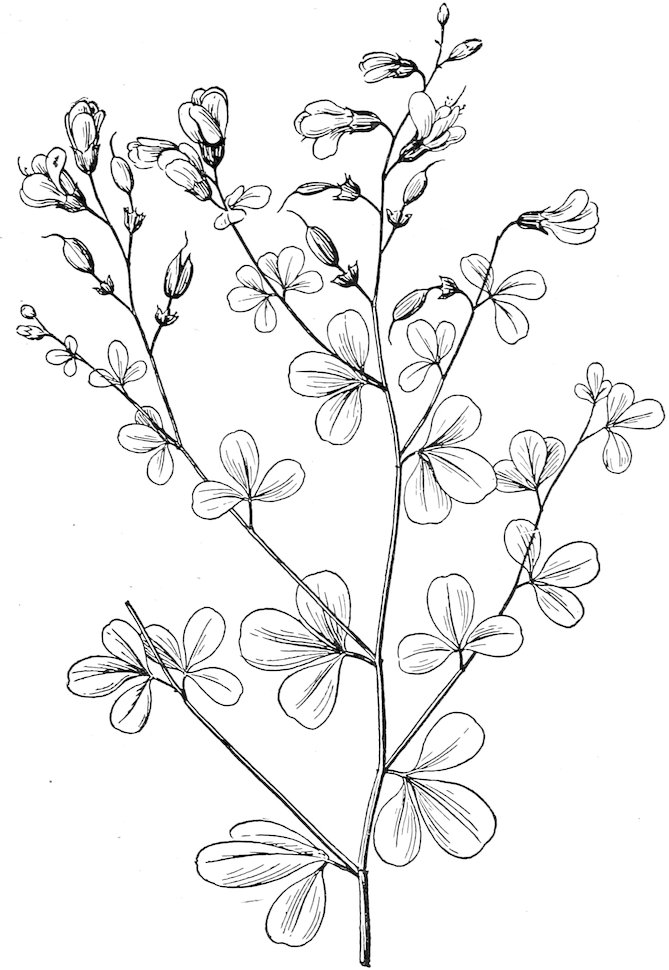
Fig. 16.—Wild indigo (Baptisia tinctoria), branch showing flowers and seed pods. (Modified from Barton’s Vegetable Materia Medica.)
WILD INDIGO.
Baptisia tinctoria (L.) R. Br.
Other common names.—Baptisia, indigo-weed, yellow indigo, American indigo, yellow broom, indigo-broom, clover-broom, broom-clover, horsefly-weed, shoofly, rattlebush.
Habitat and range.—This native herb grows on dry, poor land, and is found from Maine to Minnesota, south to Florida and Louisiana.
Description of plant.—Many who have been brought up in the country will recognize in the wild indigo the plant so frequently used by farmers, especially in Virginia and Maryland, to keep flies away from horses, bunches of it being fastened to the harness for this purpose.
Wild indigo grows about 2 to 3 feet in height, and the cloverlike blossoms and leaves will show at once that it belongs to the same family as the common 44clover, namely, the pea family (Fabaceæ). It is an erect, much-branched, very leafy plant, of compact growth, the 3-leaved, bluish green foliage somewhat resembling clover leaves. The flowers, as already stated, are like common clover flowers—that is, not like clover heads, but the single flowers composing these; they are bright yellow, about one-half inch in length, and are produced in numerous clusters which appear from June to September. The seed pods, on stalks longer than the calyx, are nearly globular or ovoid and are tipped with an awl-shaped style. (Fig. 16.)
Another species, said to possess properties similar to those of Baptisia tinctoria, and substituted for it, is B. alba R. Br., called the white wild indigo. This plant has white flowers and is found in the Southern States and on the plains of the Western States.
Description of root.—Wild indigo has a thick, knotty crown or head, with several stem scars, and a round, fleshy root, sending out cylindrical branches and rootlets almost 2 feet in length. The white woody interior is covered with a thick, dark-brown bark, rather scaly or dotted with small, wartlike excrescences. The root breaks with a tough, fibrous fracture. There is a scarcely perceptible odor, and the taste, which resides chiefly in the bark, is nauseous, bitter, and acrid.
Collection, prices, and uses.—The root of wild indigo is collected in autumn, and brings from 4 to 8 cents a pound.
Large doses of wild indigo are emetic and cathartic and may prove dangerous. It also has stimulant, astringent, and antiseptic properties, and is used as a local application to sores, ulcers, etc.
The herb is sometimes employed like the root, and the entire plant was official from 1830 to 1840.
In some sections the young tender shoots are used for greens, like those of the pokeweed, but great care must be exercised to gather them before they are too far advanced in growth, as otherwise bad results will follow.
A blue coloring matter has been prepared from the plant and used as a substitute for indigo, to which, however, it is very much inferior.
CRANE’S-BILL.
Geranium maculatum L.
Pharmacopœial name.—Geranium.
Other common names.—Spotted crane’s-bill, wild crane’s-bill, stork’s-bill, spotted geranium, wild geranium, alumroot, alumbloom, chocolate-flower, crowfoot, dovefoot, old-maid’s-nightcap, shameface.
Habitat and range.—Crane’s-bill flourishes in low grounds and open woods from Newfoundland to Manitoba, south to Georgia and Missouri.
Description of plant.—This pretty perennial plant belongs to the geranium family (Geraniaceæ), and will grow sometimes to a height of 2 feet, but more generally it is only about a foot in height. The entire plant is more or less covered with hairs, and is erect and usually unbranched. The leaves are nearly circular or somewhat heart shaped in outline, 3 to 6 inches wide, deeply parted into three or five parts, each division again cleft and toothed. The basal leaves are borne on long stems, while those above have shorter stems. The flowers, which appear from April to June, are borne in a loose cluster; they are rose purple, pale or violet purple in color, about 1 inch or 1½ inches wide, the petals delicately veined and woolly at the base, and the sepals or calyx lobes with a bristle-shaped point, soft-hairy, the margins having a fringe of more bristly hairs. The fruit consists of a beaked capsule, springing open elastically, and dividing into five cells, each cell containing one seed. (Fig. 17.)
45Description of rootstock.—When removed from the earth, the rootstock of crane’s-bill (fig. 17) is about 2 to 4 inches long, thick, with numerous branches bearing the young buds for next season’s growth, and scars showing the remains of stems of previous years, brown outside, white and fleshy internally, and with several stout roots. When dry, the rootstock turns a darker brown, is finely wrinkled externally, and has a rough, spiny appearance, caused by the shrinking of the buds and branches and the numerous stem scars with which the root is studded. Internally it is of a somewhat purplish color. Crane’s-bill root is without odor and the taste is very astringent.
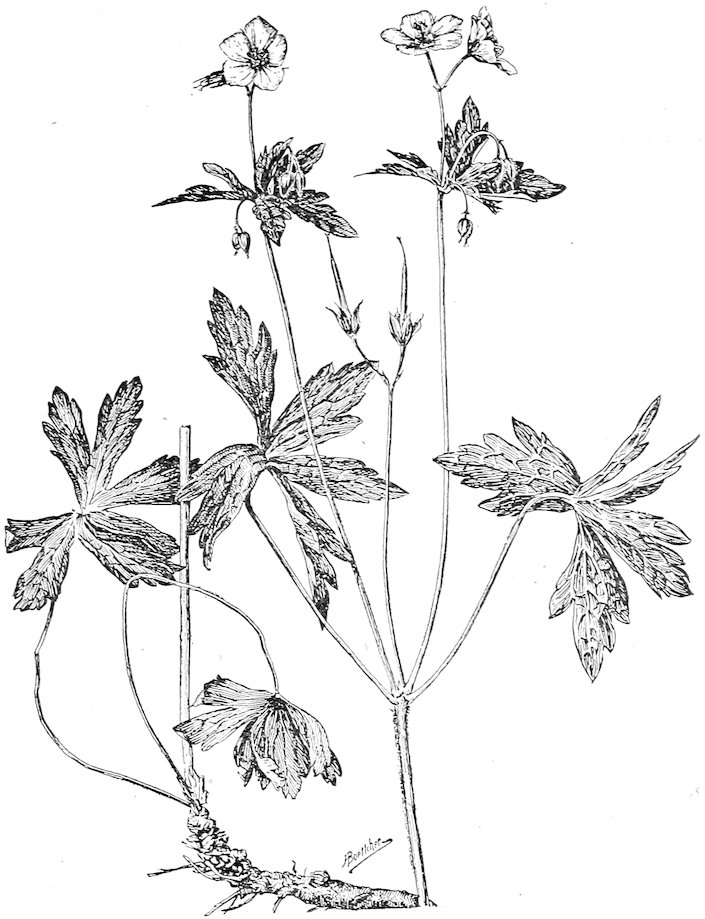
Fig. 17.—Crane’s-bill (Geranium maculatum), flowering plant, showing also seed pods and rootstock.
Collection, prices, and uses.—Crane’s-bill root depends for its medicinal value on its astringent properties, and as its astringency is due to the tannin content, the root should, of course, be collected at that season of the year when it is richest in that constituent. Experiments have proved that the yield of tannin in crane’s-bill is greatest just before flowering, which is in April or May, according to locality. It should, therefore, be collected just before the flowering period, and not, as is commonly the case, in autumn. The price of this root ranges from 4 to 8 cents a pound.