Insignia of the Uniformed Militia (continued 2)
Reading edition
BALDRIC DEVICE AND BALDRIC, C. 1850
USNM 66622-M. Figure 273.
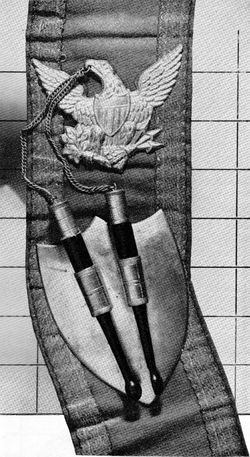
Figure 273
The device is attached to a red, gold-edged-embroidered baldric worn by the drum major of the 72d New York Militia during the Civil War but believed to ante-date 1861. The brass shield, with ebony drum sticks, is suspended from an eagle of the 1834 Regular Army pattern for wear as a cap device. The shield, convex with beveled edges, is very similar to waist-belt and shoulder-belt plates of about 1850.
GORGET, C. 1821(?)
USNM 60311-M (S-K 67B). Figure 274.
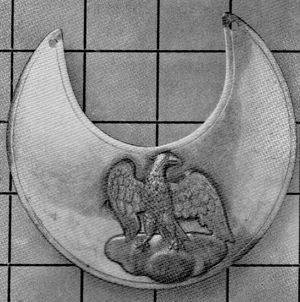
Figure 274
This gorget, of gilded brass, is of 2-piece construction. The eagle-on-clouds, very similar to cockade eagles worn in 1808-1821, is attached by four wire fasteners rather than brazed. The engraved edging on the gorget proper is rather crudely done. Although composite insignia did not come into general use until the mid-1830's, it seems reasonable to assume that this particular design of the eagle device applied to the chapeau might equally have been applied to a gorget. A similar specimen in the national collections has a silver-on-copper eagle instead of a brass one.
GORGET, C. 1830-1840
USNM 60310-M (S-K 67A). Figure 275.
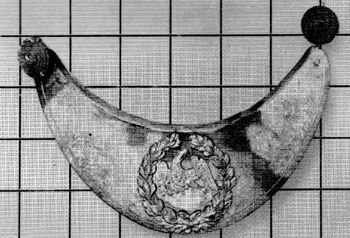
Figure 275
This gorget is of 3-piece construction, the specimen proper being of brass and the wreath and eagle of gilded brass applied with wire fasteners. Although the eagle is of the early "on-clouds" design, the feel of the piece is later, and this, together with the rather wide crescent indicate that it belongs to the period of the 1830's and 1840's.
GORGET, STATE FENCIBLES, NEW YORK, C. 1840-1850
USNM 60309-M (S-K 66). Figure 276.
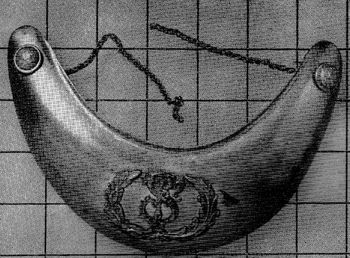
Figure 276
U.S. Government Printing Office: 1963