Trees and Shrubs Furnishing Medicinal Barks.
Reading edition
Each section contains synonyms and the pharmacopœial name, if any, the common names, habitat, range, descriptions of the tree or shrub, as well as of the bark as found in commerce, and information concerning collection, prices, and uses.
Bittersweet (Solanum dulcamara) is the only one of American medicinal plants of which the young branches alone are used, but it is nevertheless given a place with the barks, as it can more properly be included in this series than in any other.
White Pine.
Pinus strobus L.
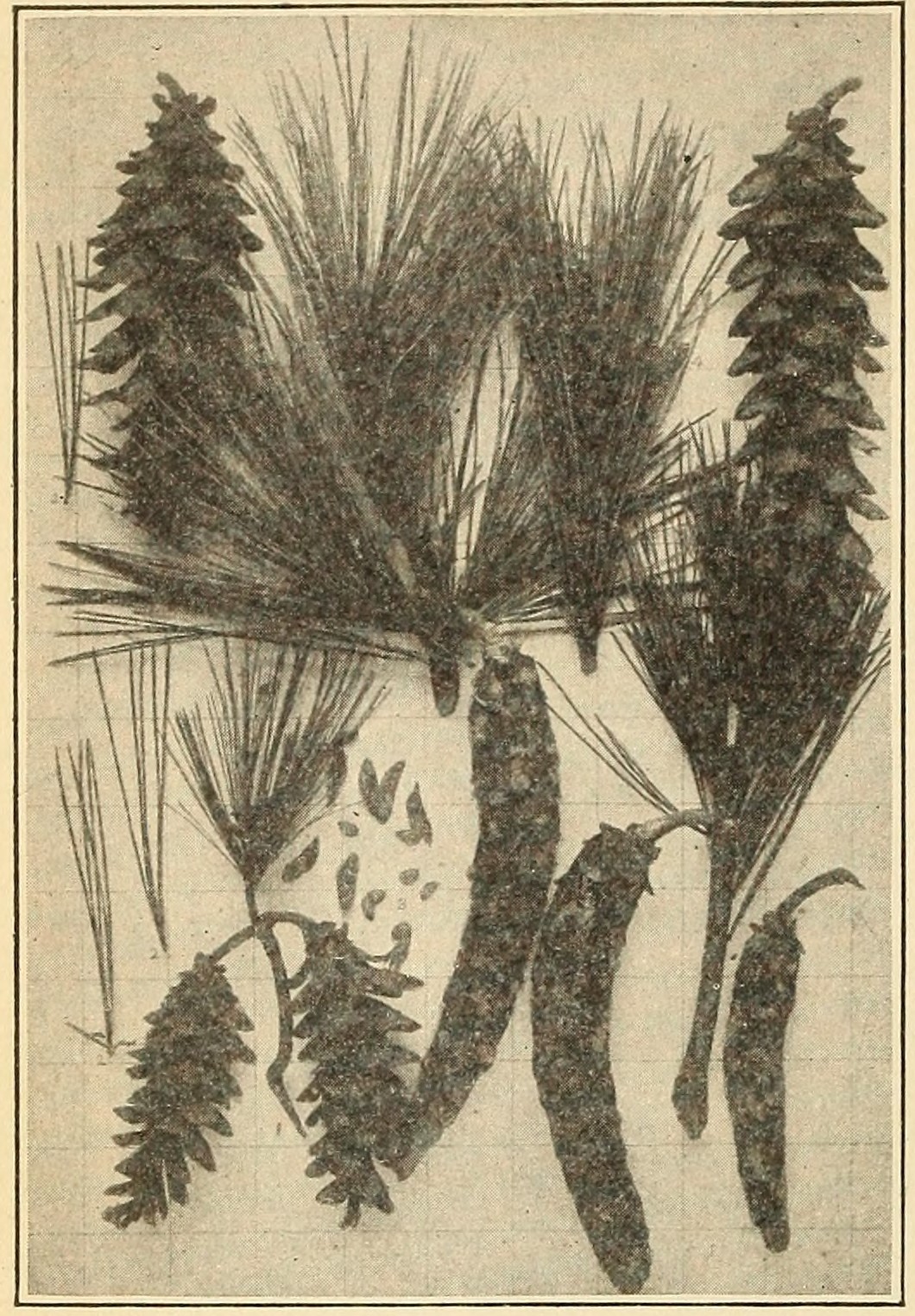
Fig.
1.
—White pine (
Pinus strobus
), leaves and cones.
Other common names.—Northern pine, Weymouth pine, American white pine, American deal-pine, soft deal-pine, spruce-pine.
Habitat and range.—The white pine, indigenous to this country, occurs in woods from Canada south to Georgia and Iowa.
Description of tree.—This large, handsome evergreen tree—sometimes 200 feet in height and with a straight trunk measuring 3 to 4 feet in diameter—has horizontal branches, both trunk and branches covered with a smooth, grayish green bark when young, becoming dark and rough with age, and longitudinally fissured. The wood is soft and white, and much used for flooring, etc.
The slender, pale green leaves, or needles, are usually five in a sheath, about 3 to 5 inches long, the flowers rather inconspicuous, and the cones cylindrical, drooping, sometimes slightly curved, resinous, about 5 to 10 inches long and about an inch in thickness, but much wider after the scales spread apart, which generally occurs in September, allowing the seeds to fall out. (Fig. 1.) It requires two seasons for the cones to mature. The white pine belongs to the pine family (Pinaceæ).
Description of bark.—The inner bark of the white pine is the part employed medicinally. It occurs in flat pieces of irregular size, about an eighth of an inch in thickness, brownish on the outside, the inner surface sometimes lighter colored and sometimes darker than the outside, smoothish, and marked with fine grooves. It breaks with a tough, fibrous fracture, and has a slight turpentine odor. The taste is described as “mucilaginous, sweetish, bitterish, and astringent.”
Prices and uses.—At present collectors are paid from about ½ to 3 cents a pound.
White pine bark is used as an expectorant, forming one of the ingredients in the sirup which bears its name, which is much used for coughs and colds to facilitate expectoration.
Tamarack.
Larix laricina (Du Roi) Koch.
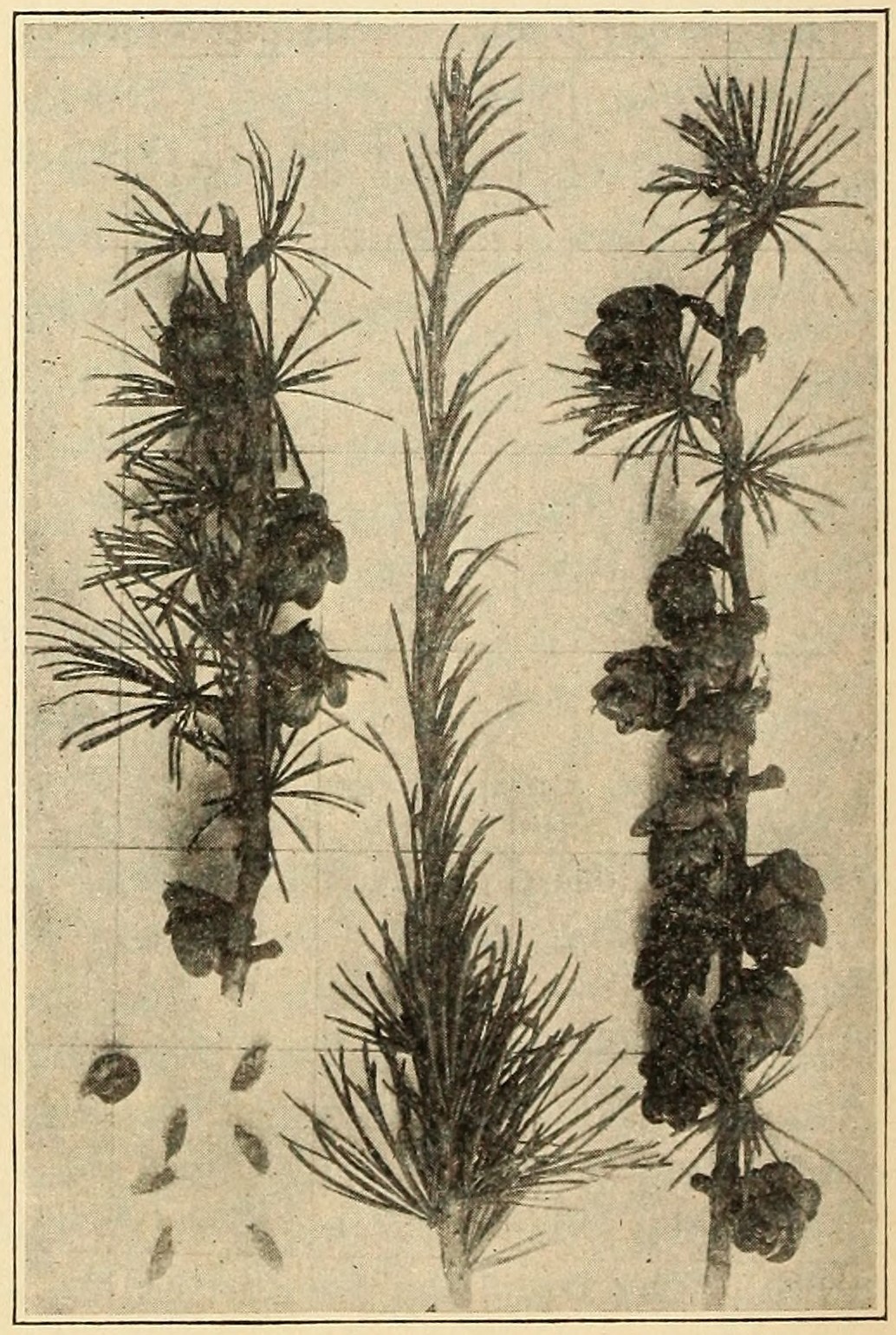
Fig.
2.
—Tamarack (
Larix laricina
), leaves and cones.
Synonym.—Larix americana Michx.
Other common names.—American larch, black larch, red larch, hackmatack.
Habitat and range.—This tree frequents swamps and moist places from Canada south to New Jersey, Indiana, and Minnesota. It is native in this country.
Description of tree.—In spring the light green, feathery appearance of the young leaves of the tamarack make it a rather conspicuous and attractive tree. It is a slender tree belonging to the pine family (Pinaceæ), but unlike other members of this family, except bald cypress, it loses its leaves upon the approach of winter. The bark is thin and close, finally becoming scaly. The wood, which is light brown in color, hard and resinous, is strong and durable.
The tamarack has horizontally spreading branches, and reaches a maximum height of 100 feet. The pale green leaves, which appear early in spring, are short, very slender, and needle shaped, from 20 to 40 together in a fascicle, or bundle, similar to the manner in which pine needles grow, except that they are without sheaths (fig. 2).
The aments, or flower clusters, are inconspicuous, and are of two kinds, staminate or male, and pistillate or female. The female clusters have a reddish and greenish tinge, and develop later into small erect cones, resembling in miniature cones of some of the pines and spruces (fig. 2).
Description of bark.—The tamarack bark, as found in the stores, is in rather large, coarse pieces or slabs, having the outer layer removed. The outer surface has a rather fibrous appearance, cinnamon brown in color, occasionally showing patches of brownish red or almost purplish where the outside layer has been imperfectly shaved off; the inner surface is smooth and light brown. The whole breaks with a somewhat woody fracture, showing ragged, splintery edges. The odor is rather strong and disagreeable.
Prices and uses.—Tamarack bark at present is paid for at the rate of from 1½ to 3 cents a pound.
The bark, in decoction, is said to be useful as a tonic and alterative, and also as a laxative and diuretic.
Aspen.
Populus tremuloides Michx.
Other common names.—White poplar, American poplar, trembling poplar, American aspen, mountain-asp, quaking asp, quiverleaf, auld-wives’-tongues.
Habitat and range.—The aspen is found in dry or moist soil from northern Canada and Alaska south to the mountains of Pennsylvania, to southern Illinois, northwestern Missouri, and in the Rocky Mountains to Lower California.
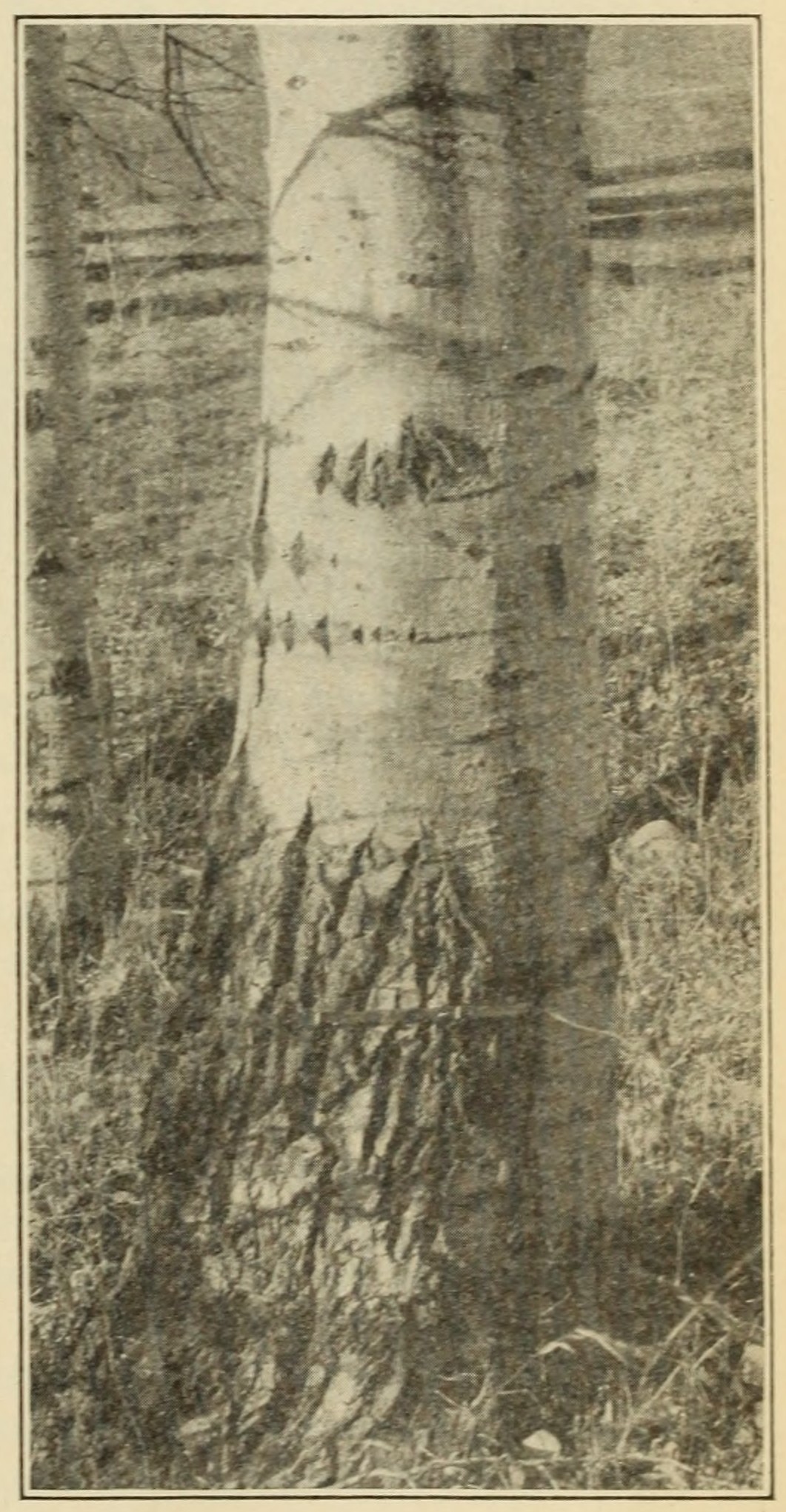
Fig.
3.
—Aspen (
Populus tremuloides
), trunk.
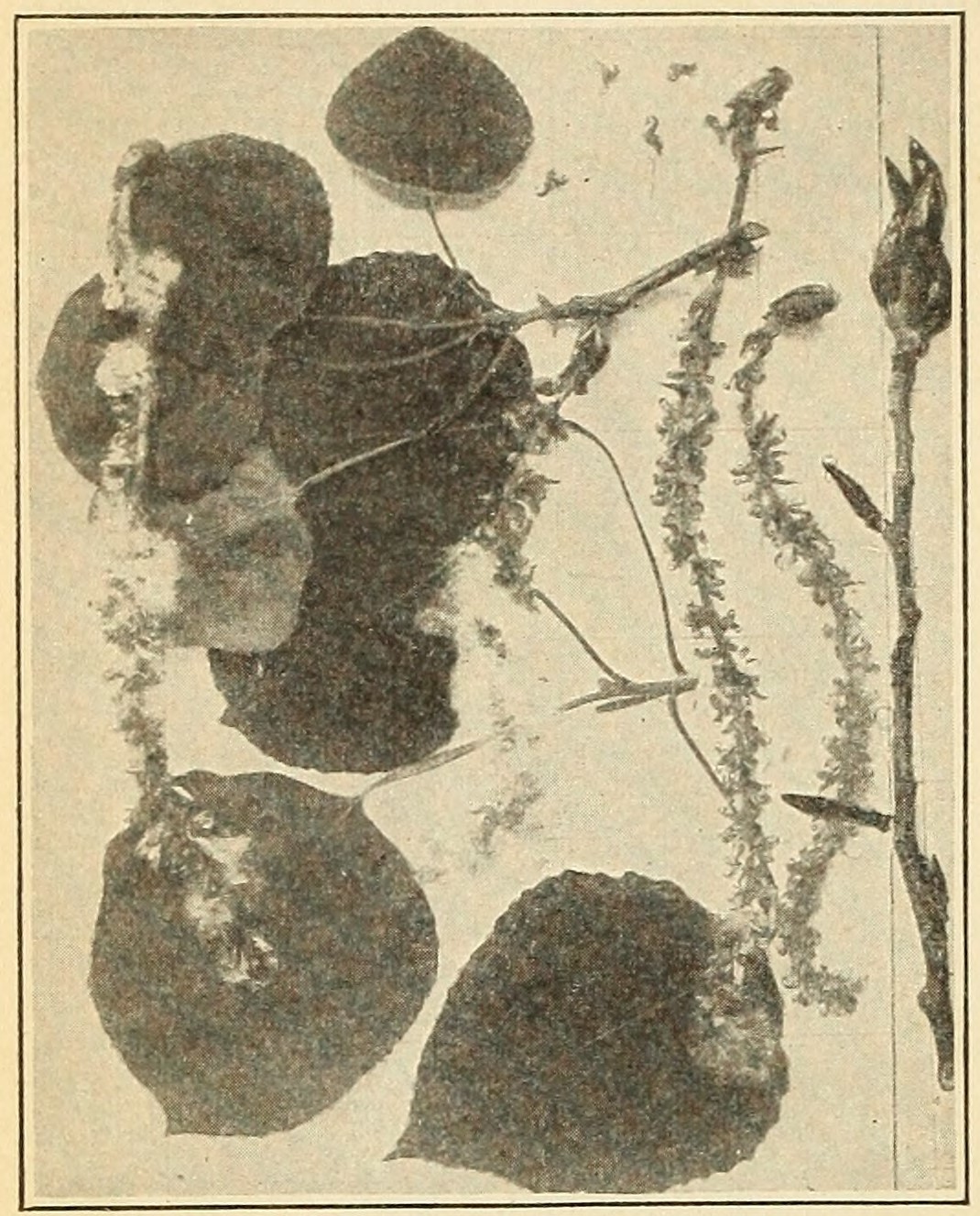
Fig.
4.
—Aspen (
Populus tremuloides
), leaves and capsules.
Description of tree.—The greatest height attained by the aspen is 100 feet, with a trunk measuring about 3 feet in diameter. It is a native of this country and belongs to the willow family (Salicaceæ). The branches and trunks of the younger trees are covered with a smooth, light grayish green bark, but on older trees the bark becomes dark and deeply fissured (fig. 3). The young unfolding leaves are whitish and woolly, but become smooth as they expand. The leaves are broadly oval or rounded, with a somewhat heart-shaped base, a short-pointed apex, and finely round-toothed or frequently saw-toothed margin (fig. 4). They are about 1½ to 2 inches in length, and are borne on long, slender stalks which are flattened on the sides, causing the leaves to be set in motion by the slightest breeze and to quiver and tremble almost continually, which has given rise to some of the tree’s common names, such as quaking asp, trembling poplar, and quiverleaf. Early in spring, before the leaves are out, the drooping catkins appear, the staminate (male) from 1½ to 2½ inches long, the pistillate (female) crowded and longer. The capsules which follow are conical in shape, pointed, and two-valved (fig. 4).
Description of bark.—This bark generally occurs in straight pieces from about 2 to 5 inches long and about one-fourth to one-half inch wide. The outside is grayish and smoothish except here and there where marked with lenticels. The inner surface is somewhat rough to the touch, light colored to brownish. The fracture is even, somewhat corky, and the odor faintly aromatic.
Collection, prices, and uses.—The bark of the aspen, or white or American poplar, as it is often known in the drug trade, is collected in spring, and collectors are paid from about 1 to 4 cents a pound.
It is used for its tonic properties, and has also been employed in the treatment of intermittent fever.
As in the case of the willows, to which family (Salicaceæ) the poplars belong, the glucoside salicin is also obtained from the barks of the various species of Populus.
White Willow.
Salix alba L.
Other common names.—Salix, common European willow, duck-willow, Huntington willow.
Habitat and range.—The white willow has been introduced into this country from Europe, and has sparingly escaped from cultivation. It occurs in wet soil along streams from Pennsylvania northward to New Brunswick and Ontario.
Description of tree.—This is a tree of very rapid growth, and attains quite a size, sometimes 90 feet in height, with a trunk perhaps 6 feet in diameter. There is a group of willows known as “crack willows,” on account of the brittleness of the twigs where they are attached to the branches, and the white willow belongs to this group, as does the “crack willow,” or “brittle willow,” (S. fragilis), mentioned farther on. All of the species described are members of the willow family (Salicaceæ).
The gray and rough-barked white willow has lance-shaped leaves, pointed at the apex and narrowed at the base, and with saw-toothed margins. When young, both sides of the leaves are covered with silky hairs, but as they mature they become less hairy and are pale green on the lower surface, or covered with a “bloom.”
The long, loose, green, cylindrical aments, or catkins, are staminate and pistillate and are borne on different trees, appearing with the leaves in spring.
A variety of this species, with yellowish green twigs and with leaves smooth on the upper surface, is known as golden osier (S. alba var. vitellina (L.) Koch), and is the most common form found in North America.
Description of bark.—The white willow bark of commerce is generally in tough, flexible strips, the outer surface smooth or slightly wrinkled, and of a yellowish brown or grayish brown color. The inner surface varies from a light brown to darker brown, and is marked with long, fine lines. White willow bark has a bitter, astringent taste, but practically no odor.
Collection, prices, and uses.—The best time to collect white willow bark is in the spring when the sap begins to flow, at which time it is easy to remove.
White willow bark should not be kept very long, as the salicin content diminishes with age. This bark itself is not official in the United States Pharmacopœia, but the glucoside salicin obtained from it is so recognized. The medicinal properties of willow bark depend upon its two most important constituents, salicin and tannin.
Salicin has tonic, antiperiodic, and febrifuge properties, and is occasionally employed in rheumatic affections.
The wood of white willow furnishes a very pure charcoal which is used in the manufacture of gunpowder. The young branches, known as osiers, are much used in the manufacture of baskets, etc.
The prices paid to collectors range from 2 to 5 cents a pound.
Other species.—Roughly speaking, the willows, or Salix species, may be said to be divided into two classes, those with yellowish twigs and those with reddish or purplish twigs. Most of the yellow-barked species belong to the “crack willows,” which have their twigs attached in such a manner that they break off very easily. It is claimed that the red or purple barked twigs contain the most salicin, while those with yellow twigs are richest in tannin.[1]
Of those containing the most salicin may be mentioned the crack willow, or brittle willow (Salix fragilis L.). This, a native of Europe, has escaped from cultivation in this country, and occurs from Massachusetts to New Jersey and Pennsylvania. It is a tall and slender tree, the trunk covered with a rough gray bark, and the twigs with reddish green bark. At the point of attachment the twigs are very fragile and break off readily. The twigs when planted grow very rapidly. The leaves are 3 to 6 inches in length, long pointed and narrowing toward the base, smooth, dark green on the upper surface, and of a lighter color underneath, and with margins slightly toothed. The flowers appear in April or May; the fruiting catkin is rather loose and about 3 to 5 inches in length, while the staminate or male catkin is only about 1 or 2 inches long.
Another species employed in medicine is the black willow, pussy-willow, or swamp-willow (Salix nigra Marsh). This is a native willow and occurs along the banks of rivers from Canada to Florida; it is not found west of the Great Plains, except in southern New Mexico and Arizona and isolated in California. It is tall and has a rough dark brown or black bark, and brittle yellowish branches. The leaves are narrowly lance shaped, and the catkins (pussy-willows) appear about the same time as the leaves, the male catkins about 1 to 2 inches long, and the female catkins as long as 3 inches, spreading apart in fruit. The bark of this species is used in medicine and the fresh aments, or catkins, are also employed.
Bayberry.
Myrica cerifera L.
Other common names.—Wax-myrtle, candleberry, candleberry-myrtle, wax-berry, tallow-bayberry, tallow-shrub, bayberry wax-tree, American vegetable tallow-tree, vegetable-tallow, American vegetable-wax.
Habitat and range.—The bayberry, which is indigenous, is found in sandy swamps or wet woods from Texas and Florida northward to Arkansas and along the coast of Maryland. In its southern home it is a small evergreen tree, but as it goes farther north it becomes, successively, a tall semideciduous shrub or a dwarfed and deciduous shrub.
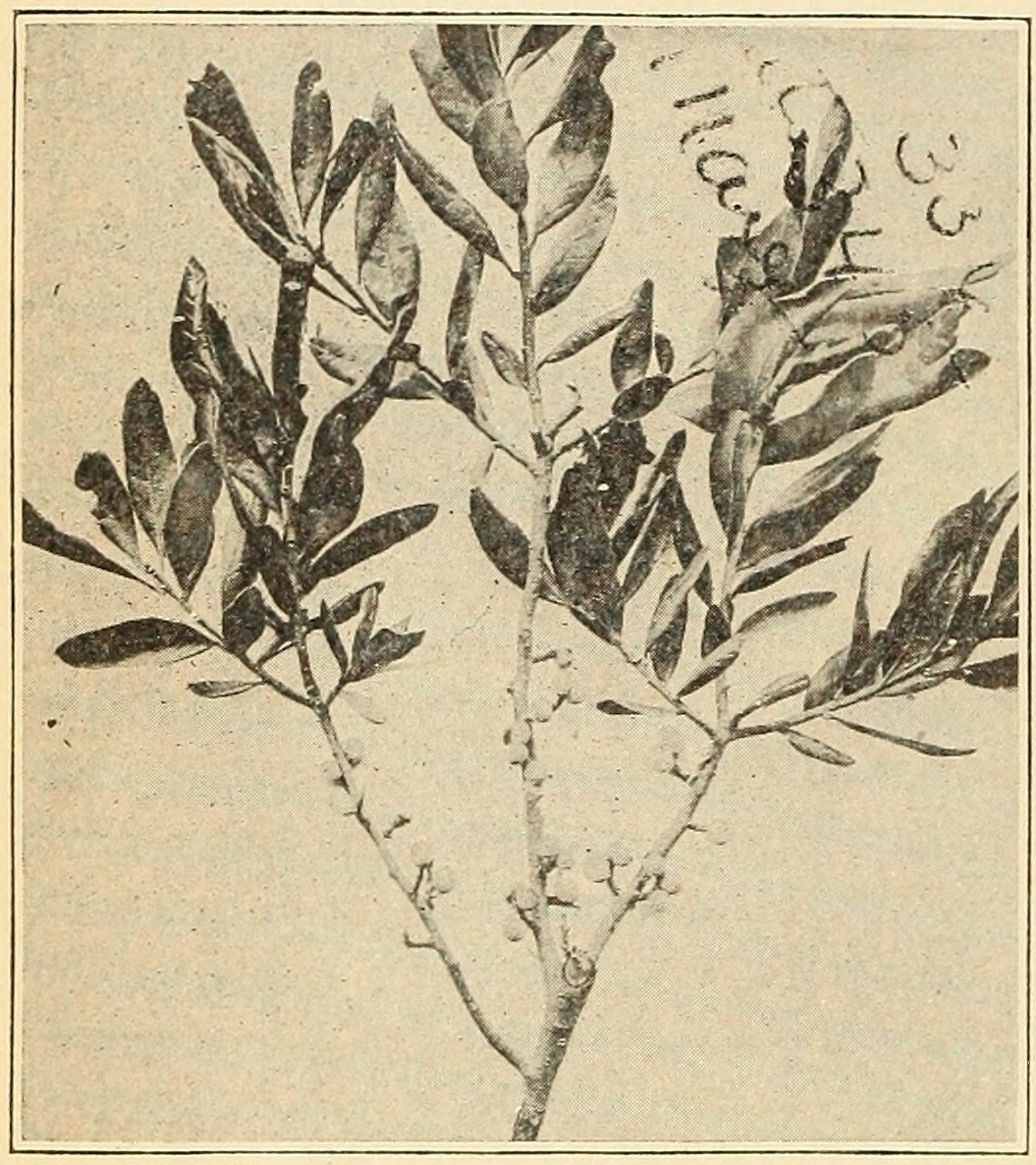
Fig.
5.
—Bayberry (
Myrica cerifera
), leaves and fruit.
Description of tree.—The greatest height attained by the bayberry is about 40 feet, but it is usually only 3 to 12 feet high. It is slender, with a gray, smoothish bark. The leaves, when crushed, have a fragrant odor, and are 1 to 4 inches long, narrow, dark green and shining above, lighter colored and dotted with resin cells beneath, and generally with margins entire (fig. 5).
The flowers appear from about March to May, according to locality, and generally before the leaves are fully expanded. They are borne in aments, or spikelike clusters, the male and female flowers being produced on separate trees. The yellowish aments bearing the staminate or male flowers are cylindrical, while the pistillate or female aments are oblong, shorter than the staminate, and greenish. The fruit, which remains on the tree for several years, consists of clusters of round, bluish white berries having a granulated appearance and covered with a greenish white wax (fig. 5). Each berry contains one seed. The bayberry belongs to the bayberry family (Myricaceæ).
Description of bark.—As found in commerce, bayberry bark occurs in curved or quilled pieces, sometimes only about an inch in length and sometimes 6 inches or more. The outside is covered with a thin corky layer, which is whitish and somewhat fissured. Underneath this layer the dark reddish brown, smooth bark may be seen. The inner surface of the bark is also reddish brown, but marked with faint lines. The fracture is light red and granular. The bark, when powdered, has a pungent, aromatic odor, causing sneezing and coughing, and the taste is bitter, pungent, and acrid.
Collection, prices, and uses.—Late autumn is the best time to collect this root, and after it has been thoroughly cleaned and while still fresh the bark is loosened and removed by beating the root with a mallet or similar instrument.
Bayberry bark brings from 2 to 5 cents a pound. It is used for its tonic and astringent properties.
The wax obtained from the berries is used for making candles.
Butternut.
Juglans cinerea L.
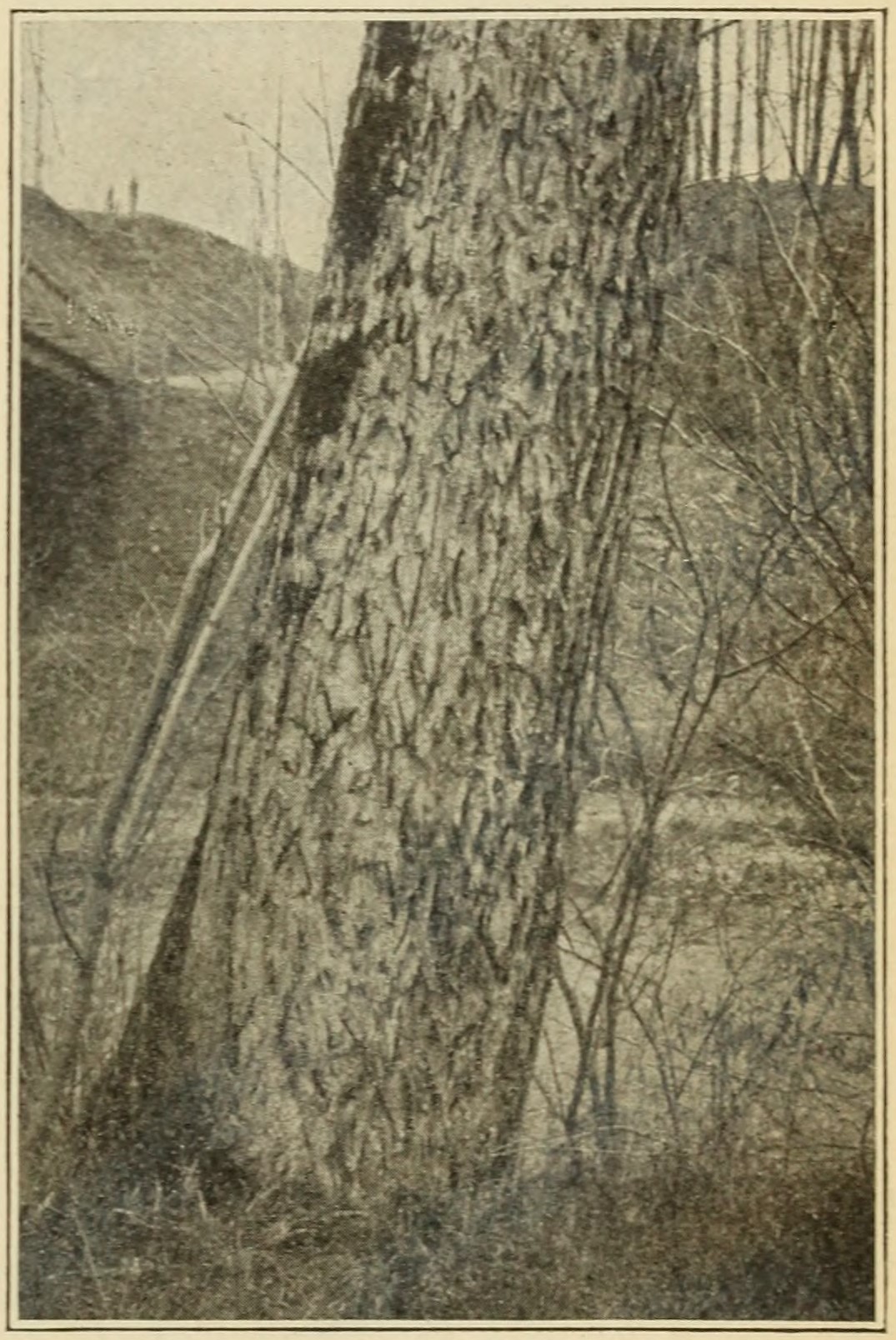
Fig.
6.
—Butternut (
Juglans cinerea
), trunk.
Other common names.—Juglans, white walnut, lemon-walnut, oilnut.
Habitat and range.—The butternut tree, which is indigenous to this country, is of common occurrence in rich woods from New Brunswick to North Dakota and south to Georgia, Mississippi, and Arkansas.
Description of tree.—This much-branched tree, belonging to the walnut family (Juglandaceæ), is generally from 30 to 50 feet in height, rarely exceeding 100 feet, and when old has a thick, rough, brownish gray, furrowed bark (fig. 6), and the twigs, leaf stems, and leaflets, especially in the early stages of growth, are furnished with sticky hairs.
The yellowish green leaves are composed of from 11 to 19 leaflets, all stemless except the terminal one; the leaflets are 2 to 3 inches long, oblong lance shaped and long pointed at the apex, rounded or blunt at the base, and toothed. The flowers are produced in May, or about the same time as the leaves, the yellowish green male catkins 3 to 5 inches in length, and the female flowers in clusters of 6 to 8 flowers each. In October the sweet and oily oblong nut matures, enveloped in a strong-smelling, sticky husk. The edible nut itself has a thick, hard shell, which is marked with deep furrows or lines.
Description of bark.—Butternut bark, from the root collected in autumn, was official in the United States Pharmacopœia for 1890. It occurs in quilled pieces varying in length, and about an eighth of an inch or a trifle more in thickness, deep brown and smoothish or somewhat scaly on the outside, the inner surface likewise brown and with parts of the thin, stringy inner layer of the bark attached. It breaks with a short, fibrous fracture, finely checkered with white and brown. The odor is faint, and the taste bitter and acrid.
Collection, prices, and uses.—Butternut bark, which will bring the collector from 1 to 4 cents a pound, is taken from the root collected in autumn. Its use in medicine is that of a mild cathartic and tonic.
Ironwood.
Ostrya virginiana (Mill.)K. Koch.
Synonym.—Carpinus virginiana Mill.
Other common names.—Hop-hornbeam, deerwood, leverwood, black hazel, Indian cedar.
Habitat and range.—The ironwood is indigenous to this country, and is common in rich woods in Canada and the eastern United States, and westward to Minnesota and Texas. It is occasionally cultivated.
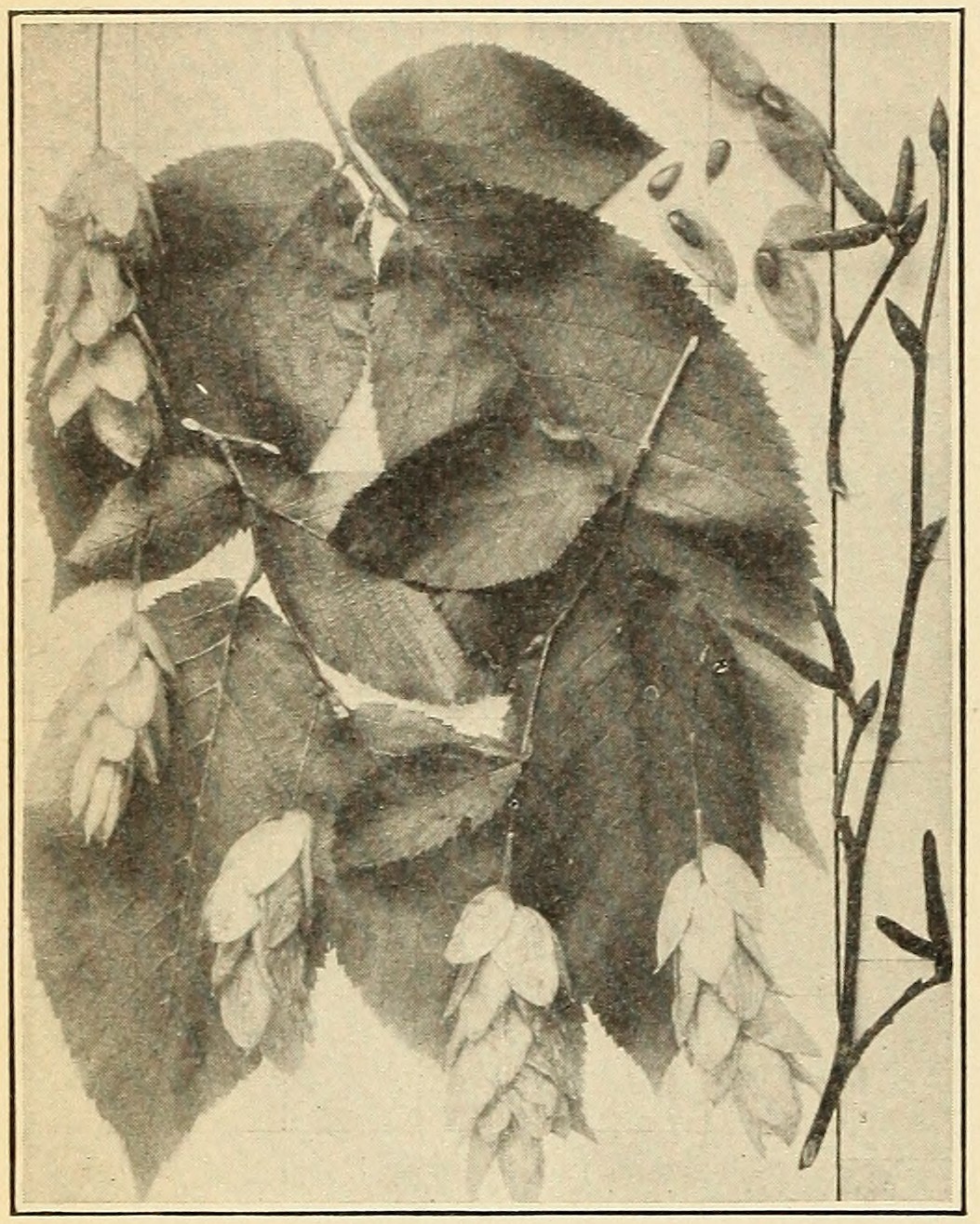
Fig.
7.
—Ironwood (
Ostrya virginiana
), leaves and fruit.
Description of tree.—This usually slender tree attains its greatest height, sometimes 50 feet, in the western part of its range, while farther eastward it grows only about 15 to 20 feet high. The brownish trunk is finely furrowed in short, lengthwise lines. The wood is very hard and heavy, and is employed in making farm implements.
The leaves somewhat resemble those of the sweet birch, to which family (Betulaceæ) this tree belongs, but they are rough to the touch, instead of smooth and shining like the birch leaf. They are from 2½ to 4 inches in length and about an inch or more in width, oval or oblong-oval in shape, long pointed at the apex, and rounded at the base, and with margins very sharply double toothed. The upper surface of the leaves is usually smooth, except sometimes slightly hairy on the veins, while the lower surface is hairy or even woolly. (Fig. 7.) The green, inconspicuous flowers are borne in catkins, male and female, and are produced from April to May. The male catkins are cylindrical, and about 1½ to 3 inches long, while the female catkins are short, maturing in July or August into large fruiting cones from 1½ to about 2½ inches in length, and very much resembling hops (fig. 7).
Description of wood and bark.—The inner wood and the bark, which are bitter, are the parts employed in medicine. The wood is white, very hard and strong, and occurs in pieces a few inches in length and of varying thickness. The bark as found in the stores is in flat pieces about 2 inches in length; the outside grayish green with thin, short scales; the inside brown, marked with long fine lines or ridges, and generally with considerable of the woody portion adhering. There is practically no odor.
Prices and uses.—At present the price paid to collectors runs from about 5 to 6 cents a pound.
Ironwood is used for its tonic, alterative, and antiperiodic properties.
Sweet Birch.
Betula lenta L.
Other common names.—Black birch, cherry-birch, spice-birch, river-birch, mahogany-birch, mountain-mahogany.
Habitat and range.—This indigenous tree occurs in rich woodlands from Newfoundland to Ontario, south to Florida and Tennessee.
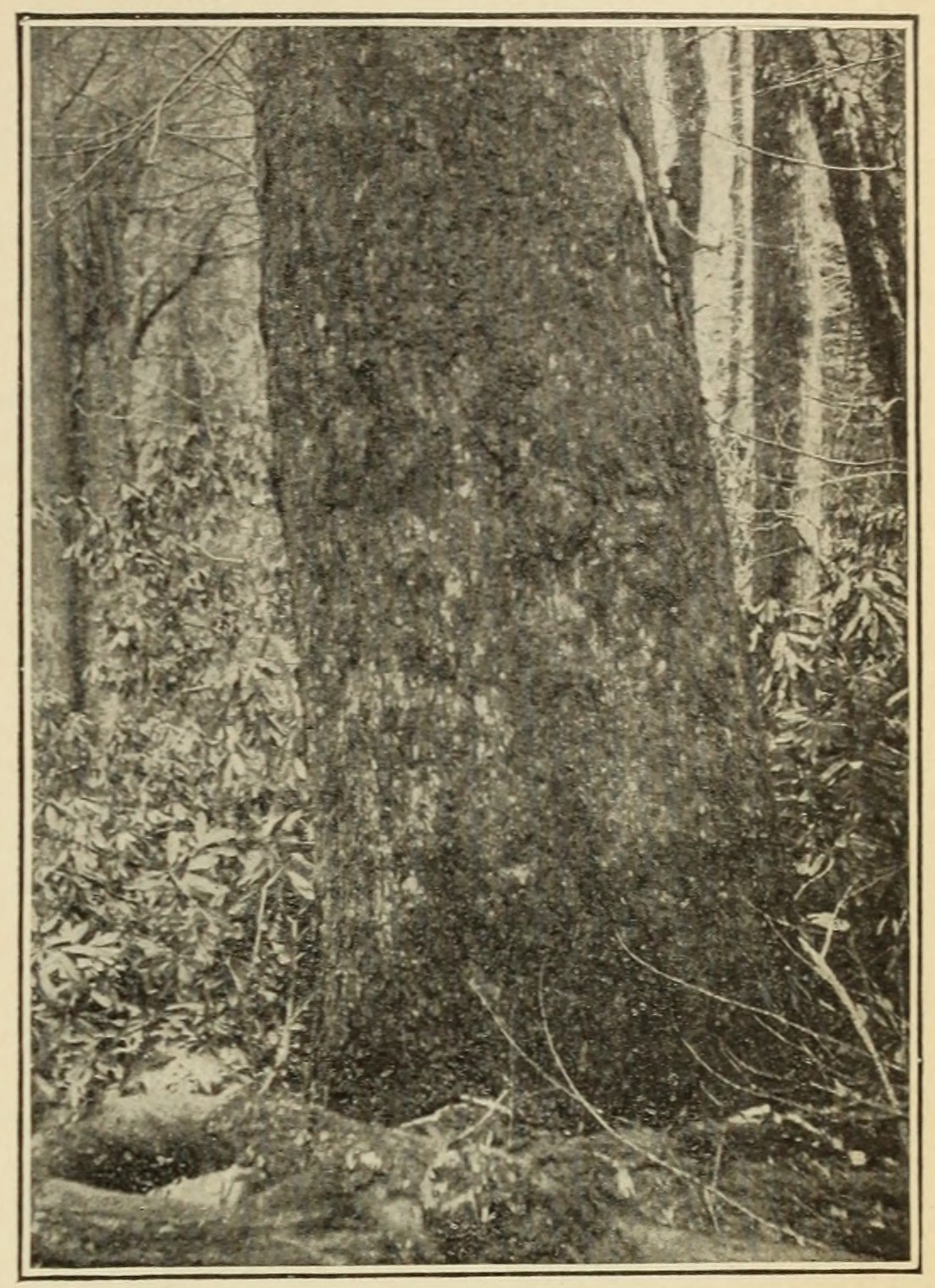
Fig.
8.
—Sweet birch (
Betula lenta
), trunk.
Description of tree.—Sweet birch, which somewhat resembles the cherry tree, attains a height of from 50 to 80 feet, and has brownish red, sweet, and aromatic bark. The bark of the trunk of older trees is rather thick, as much as one-half inch, and has rough, platelike fissures (fig. 8). The younger branches are covered with a beautiful, shining, reddish brown bark, with a layer of yellowish green beneath the surface, and furnished with numerous small, whitish spots, known technically as “lenticels,” and which may be designated as “breathing pores.” In most of the birches the bark comes off in layers, but this is not the case with the sweet birch. The youngest twigs of the sweet birch are densely hairy. The wood is much used in cabinet work, being fine and close grained, and taking on a very high polish. It has a rosy color when first cut, which becomes darker by exposure.
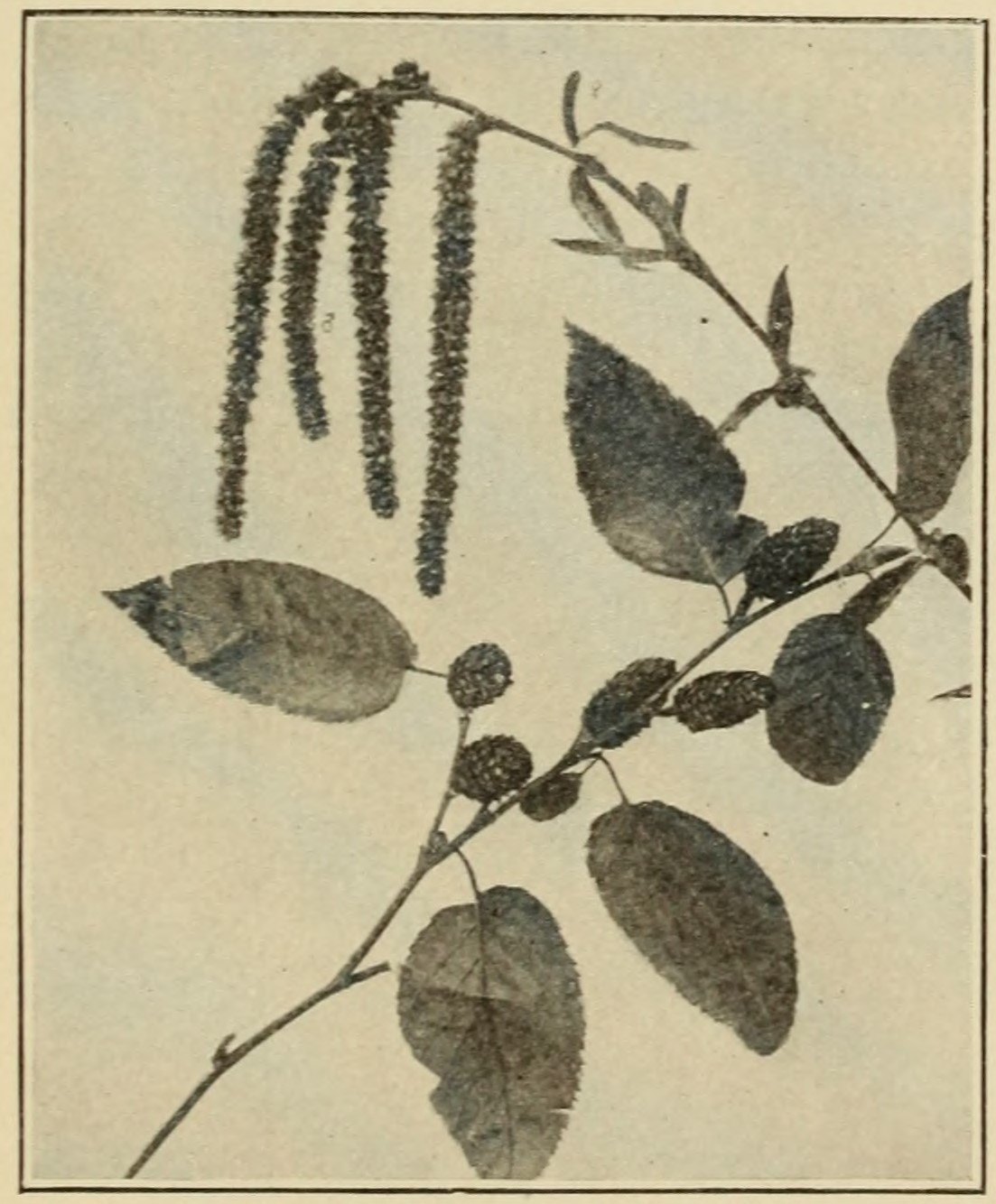
Fig.
9.
—Sweet birch (
Betula lenta
), leaves, catkins, and fruit.
The young leaves are covered with shining, silvery, silky hairs, but as they grow older these disappear almost entirely. In shape the leaves are oval or oblong-oval, acute or acuminate at the apex, somewhat heart shaped at the base, and sharply toothed; they are about 3 to 4 inches long and 1 to 2 inches wide, smooth, bright green and shining on the upper surface, and dull green on the lower surface with hairy veins. (Fig. 9.) Like the bark, the leaves are also aromatic.
The flowers are of two kinds, staminate or male and pistillate or female, and are borne in separate catkins or slender spikes. The male catkins are in drooping clusters 2 to 3 inches long, while the female catkins are shorter, only about 1 inch or less in length, thicker, stemless, and nearly erect. (Fig. 9.) They expand with the leaves or before, about April or May. The cylindrical, conelike fruit is about an inch in length. The sweet birch belongs to the birch family (Betulaceæ).
Description of bark.—The birch bark of commerce consists of pieces of irregular size, generally reddish brown and smooth on the outside, the thin outer layer having been removed, but with pieces of it sometimes adhering. The inner surface is also reddish brown and smooth. Birch bark breaks with a clean, even, somewhat granular fracture.
Collection, prices, and uses.—The bark is collected in late summer. It furnishes the oil of sweet birch or oil of Betula, official in the United States Pharmacopœia, and obtained by maceration and distillation. It is almost identical with wintergreen oil, and is employed for similar purposes. Both bark and oil are used for flavoring. Birch bark will bring from about 1 to 3 cents a pound.
The bitter, aromatic leaves are also used in domestic practice, and birch beer is made from the sweet sap.
Tag-Alder.
Alnus rugosa (Du Roi)K. Koch.
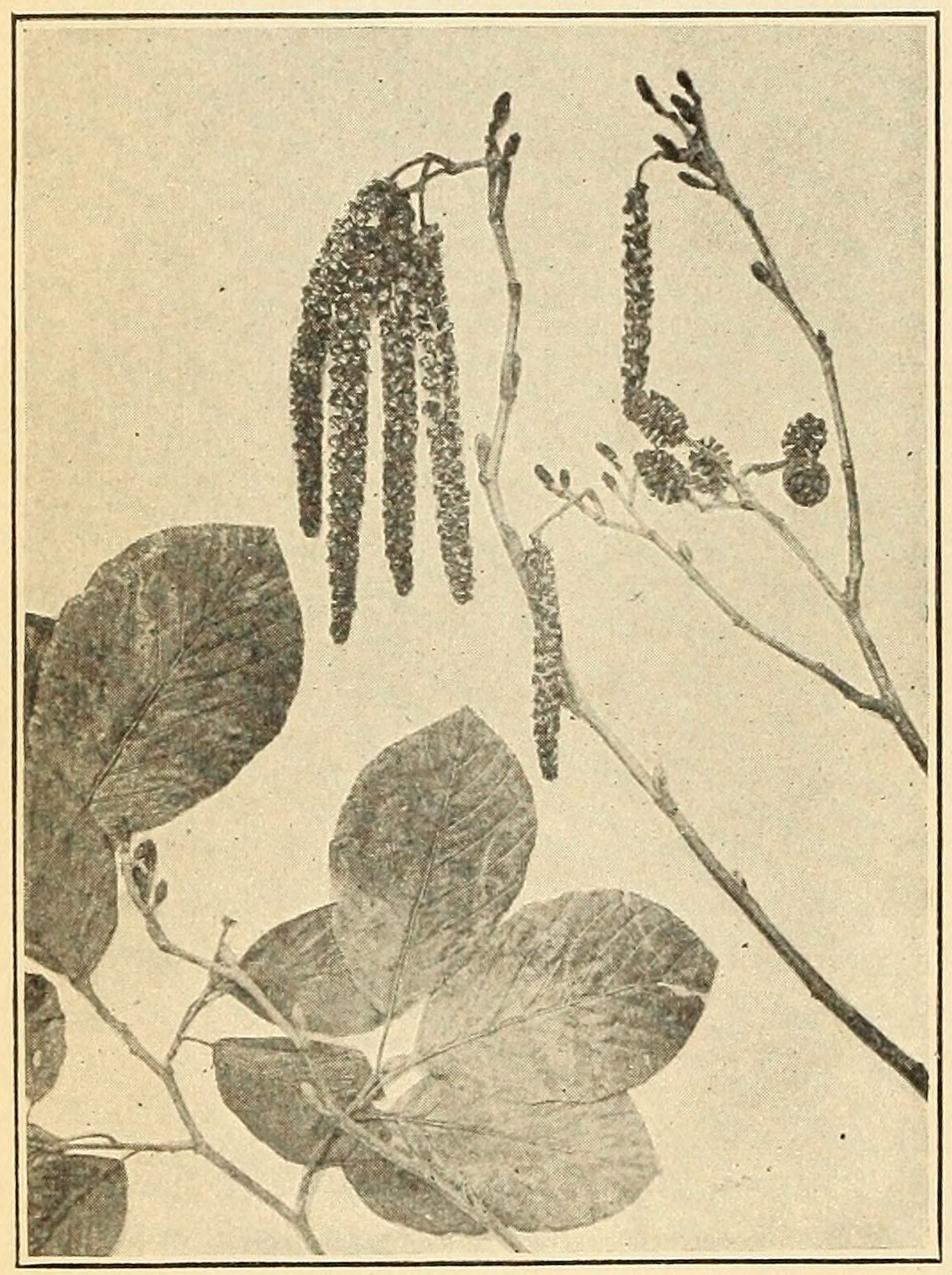
Fig.
10.
—Tag-alder (
Alnus rugosa
), leaves, catkins, and fruit.
Synonym.—Alnus serrulata Willd.
Other common names.—Common alder, red alder, smooth alder, green alder, American alder, speckled alder, swamp-alder, notch-leaved alder.
Habitat and range.—Tag-alder is found in swamps and along the marshy banks of streams from New England south to Florida and Texas, and westward to Ohio and Minnesota. It is a native of this country.
Description of tree.—Sometimes the tag-alder, which belongs to the birch family (Betulaceæ), attains the height of a tree, but more often it is only a shrub, growing from 5 to 20 feet high, with a smooth brownish gray bark. The leaves are 2 to 4½ inches long, oval, somewhat leathery, green above and below, the apex round or blunt, and the base narrowed or rounded, the margins minutely but sharply toothed. The flowers are produced before the leaves are out, early in spring, about March or April. They are reddish green, the female flowers borne in an erect catkin, while the male flowers are borne in a drooping catkin. The small, oval, conelike fruit usually remains on the shrub throughout the winter. (Fig. 10.)
Description of bark.—As it occurs in commerce, tag-alder bark is in straight, curved, or occasionally quilled pieces of varying length and width, but generally broken up into rather small pieces, the outer surface brownish gray or greenish gray and smoothish, the inside cinnamon colored and closely and coarsely ridged. It breaks with a sharp, even fracture. The odor is strong and rather aromatic, and the taste astringent and bitter.
Prices and uses.—The amount paid to collectors ranges from 1 to 4 cents a pound.
Tag-alder bark is used in medicine for its astringent, alterative, and emetic properties.
White Oak.
Quercus alba L.
Pharmacopœial name.—Quercus.
Other common names.—Stone-oak, stave-oak.
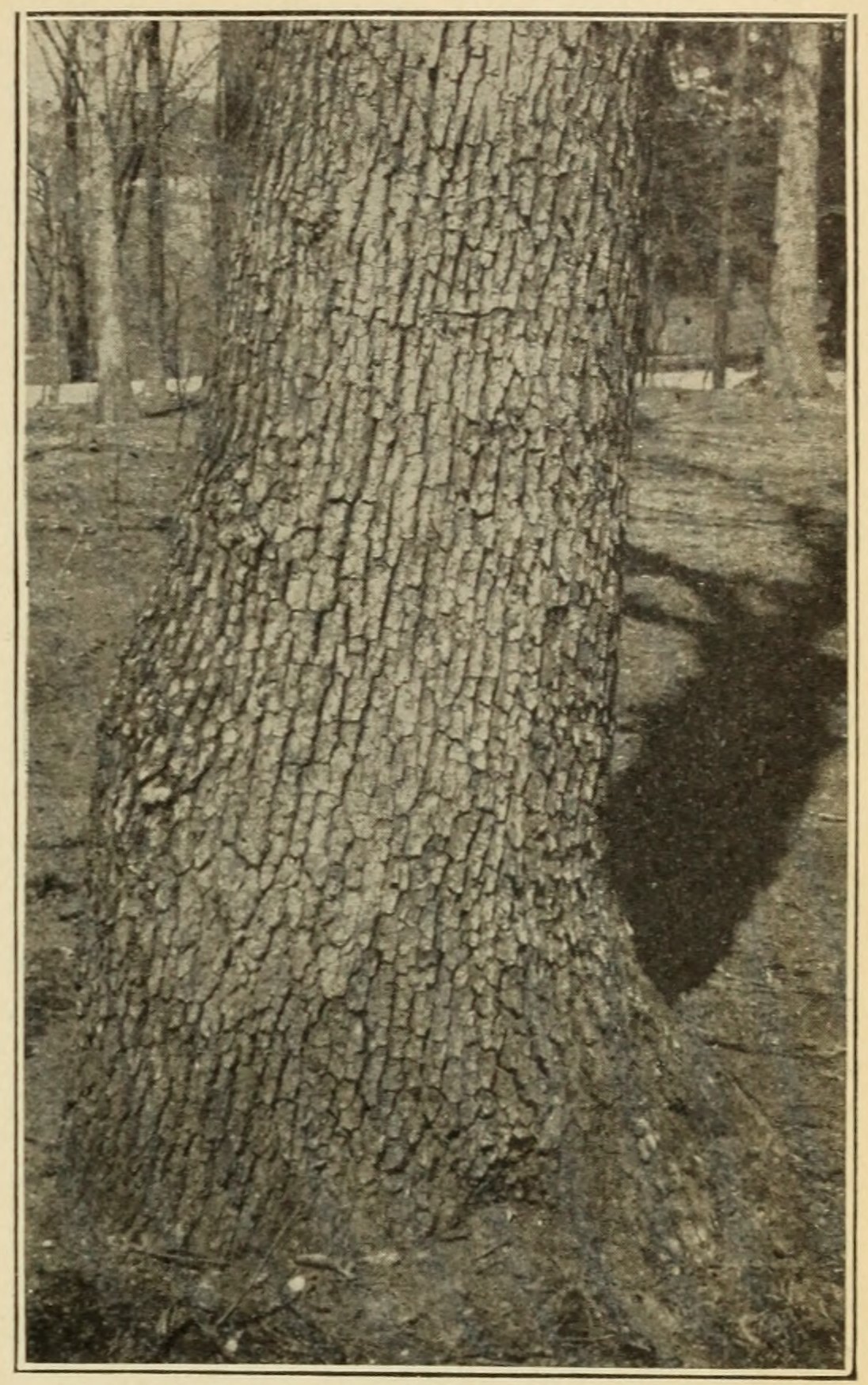
Fig.
11.
—White oak (
Quercus alba
), trunk.
Habitat and range.—The white oak is found in woods from Maine to Minnesota, south to Florida and Texas, but is most abundant in the Middle States. It is indigenous to this country.
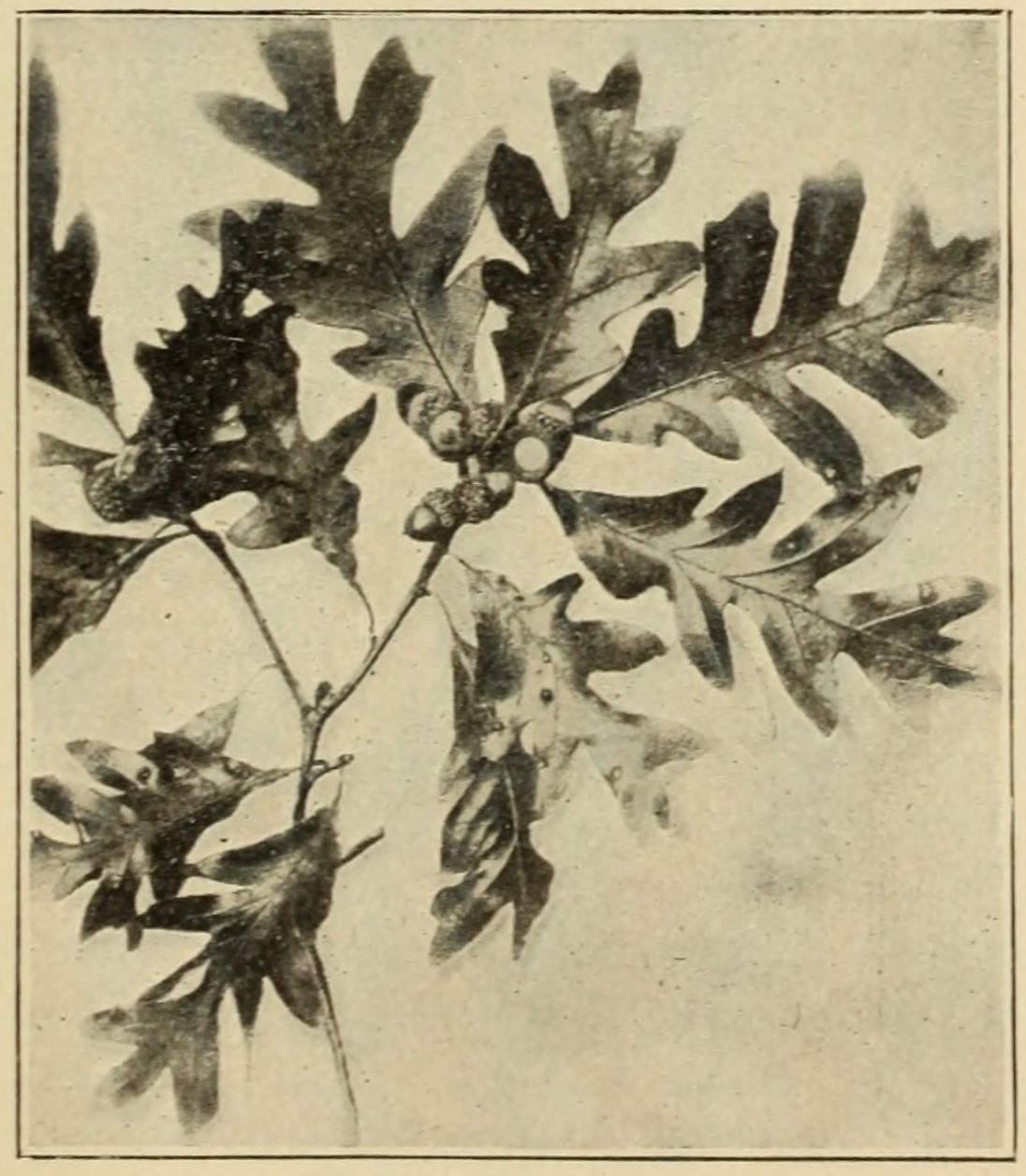
Fig.
12.
—White oak (
Quercus alba
), leaves and acorns.
Description of tree.—In dense woods this stately tree sometimes reaches a height of 150 feet. Usually it is about 60 to 80 feet high, the trunk about 3 to 4 feet in diameter, and with many wide-spreading branches. The bark is grayish and comes off in thin scales (fig. 11). When young, the leaves are red and hairy, becoming smooth and thin when older, with a light green upper surface and paler lower surface furnished with prominent veins. In autumn they turn a beautiful red. The leaves are 4 to 7 inches long, and about half as wide, borne on stems about half an inch in length; they are divided into from 3 to 9 oblong, blunt lobes, with entire or toothed margins (fig. 12). About the time that the leaves appear, the very small greenish or yellowish flowers are produced. The male flowers are borne in slender, usually drooping aments, or spikelike clusters, and the female flowers singly. The fruits (acorns) mature the first autumn, and are about 1 inch in length, about one-fourth covered by the scaly cup (fig. 12). The white oak is a member of the beech family (Fagaceæ).
Description of bark.—The dried bark of the white oak is official in the United States Pharmacopœia. As found in the stores it is in nearly flat pieces about one-eighth of an inch or more in thickness, rough and fibrous on the outside, with the outer layer removed, brownish, and the inside with short, coarse grooves, the whole breaking with a coarse, tough, and splintery fracture. The odor is rather strong, reminding one somewhat of tanbark, and the taste very astringent. The Pharmacopœia adds that it does not tinge the saliva yellow when chewed.
Collection, prices, and uses.—The best time for collecting white oak bark is in the spring, as at that time it is said to contain the greatest amount of tannic acid. The outer layer is first scraped off. As directed by the United States Pharmacopœia, the bark should be “collected from trunks or branches 10 to 25 years of age, and deprived of the periderm.”
The price paid for white oak bark ranges from 1 to 3 cents a pound.
The bark is a powerful astringent and is also antiseptic.
Slippery Elm.
Ulmus pubescens Walt.
Pharmacopœial name.—Ulmus.
Synonym.—Ulmus fulva Michx.[2]
Other common names.—Moose-elm, red elm, Indian elm, rock-elm, sweet elm.
Habitat and range.—This tree is native in woods, along streams, and on hills from Quebec to North Dakota, south to Florida and Texas. It is more common in the western part of its range.
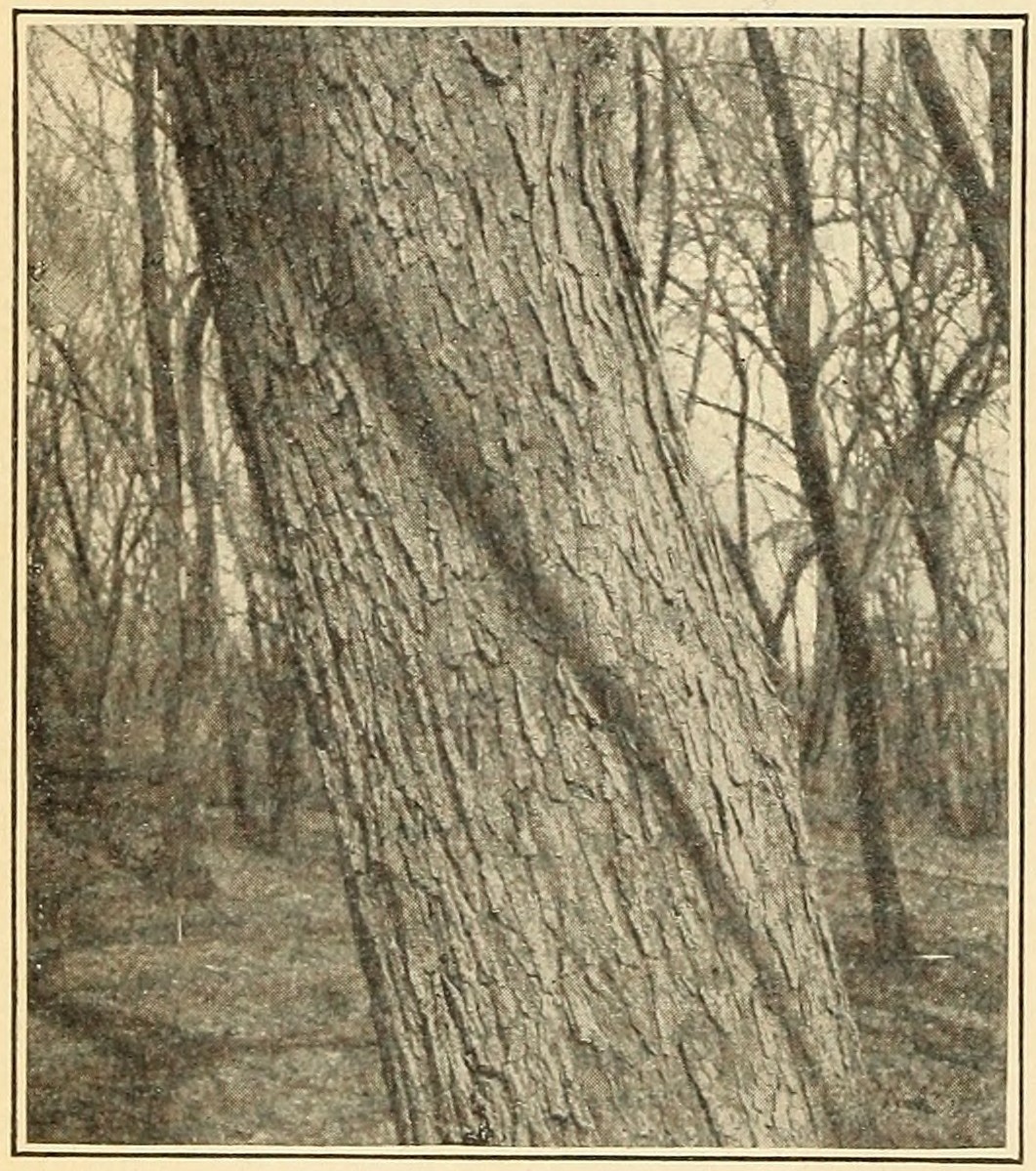
Fig.
13.
—Slippery elm (
Ulmus pubescens
), trunk.
Description of tree.—The slippery elm is usually about 40 to 50 feet in height, although it will sometimes grow as tall as 70 feet, with a trunk about 2½ feet in thickness. In dense woods it grows tall and straight, branching some distance from the ground, but in open woods and fields, where it often occurs singly, it is more spreading and irregular in growth. It has a dark, reddish wood, hard and durable, and is covered with a rough, reddish brown bark (fig 13). Even the small branches are rough and the twigs are furnished with rough hairs. The leaf buds, a few weeks before expanding, are soft and downy with rust-colored hairs. Short downy stalks support the rather large leaves, the upper surface of which is very rough and the lower hairy. The leaves are about 4 to 8 inches long and about 2 to 2½ inches wide, pointed at the apex, usually lance-shaped oval in outline, sharply toothed, and with an obtuse, unevenly shaped and generally heart-shaped base. The flowers appear very early in the spring (in March or April), before the leaves. They occur in dense, lateral clusters and consist of a bell-shaped, downy calyx, usually 7 lobed, no corolla, and 5 or 7 reddish stamens. The winged fruit which follows, known botanically as a “samara,” is flattened and circular; the seed is borne in the center, surrounded by the winged, membranous margin, which aids its dispersion by the wind (fig. 14). Slippery elm belongs to the elm family (Ulmaceæ).
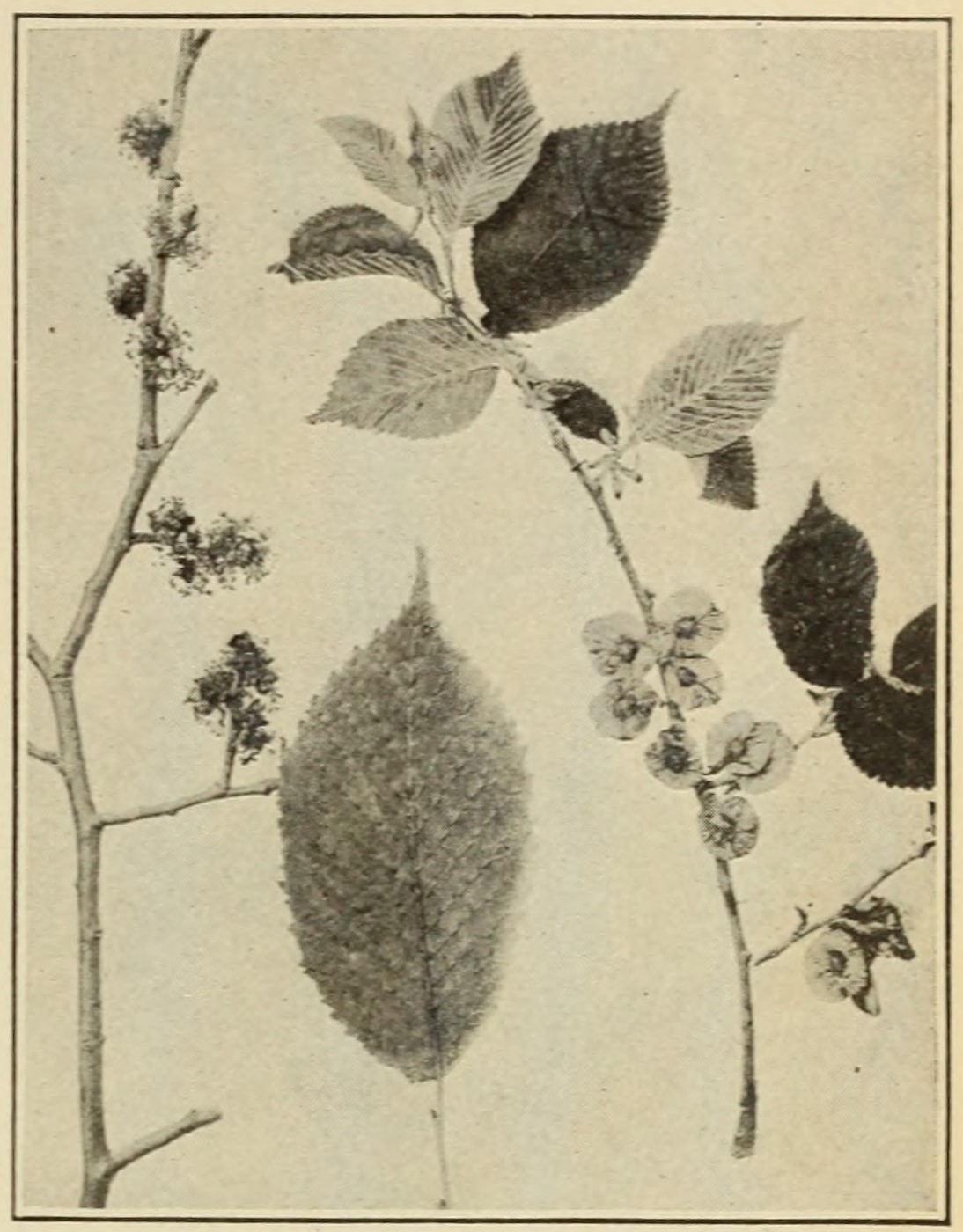
Fig.
14.
—Slippery elm (
Ulmus pubescens
), leaves, flowers, and fruits.
Description of bark.—The commercial article consists of pale brown or whitish brown flat pieces tied in bundles, and it also occurs on the market in smaller pieces of uneven size, suitable for grinding purposes, but which bring a lower price. The flat pieces are of varying length and width, about an eighth of an inch in thickness, the outer bark having been removed in accordance with the requirements of the Pharmacopœia, but sometimes patches of it are still found adhering. They are tough, and break with a fibrous fracture. The inner surface is yellowish brown and marked with fine furrows. Slippery elm has a faint, peculiar odor, and a mucilaginous but insipid taste.
Collection, prices, and uses.—The outer bark is rossed or shaved off before removing the inner bark from the tree, which alone is recognized as official in the United States Pharmacopœia. It is taken from the tree in long strips, and generally dried under pressure so that it will remain flat.
The price paid for slippery elm bark is from 3 to 10 cents a pound, depending upon quality, the small, irregular pieces having less value than the large, flat pieces.
The mucilaginous character of slippery elm bark renders it useful in relieving coughs, and it is also employed in treating diarrheal complaints. It is soothing and allays inflammation, and is also somewhat nutritious. In certain sections of the country poultices are made from the bark and applied to abscesses.
Magnolia.
(1) Magnolia acuminata L.; (2) Magnolia tripetala L.; (3) Magnolia glauca L.
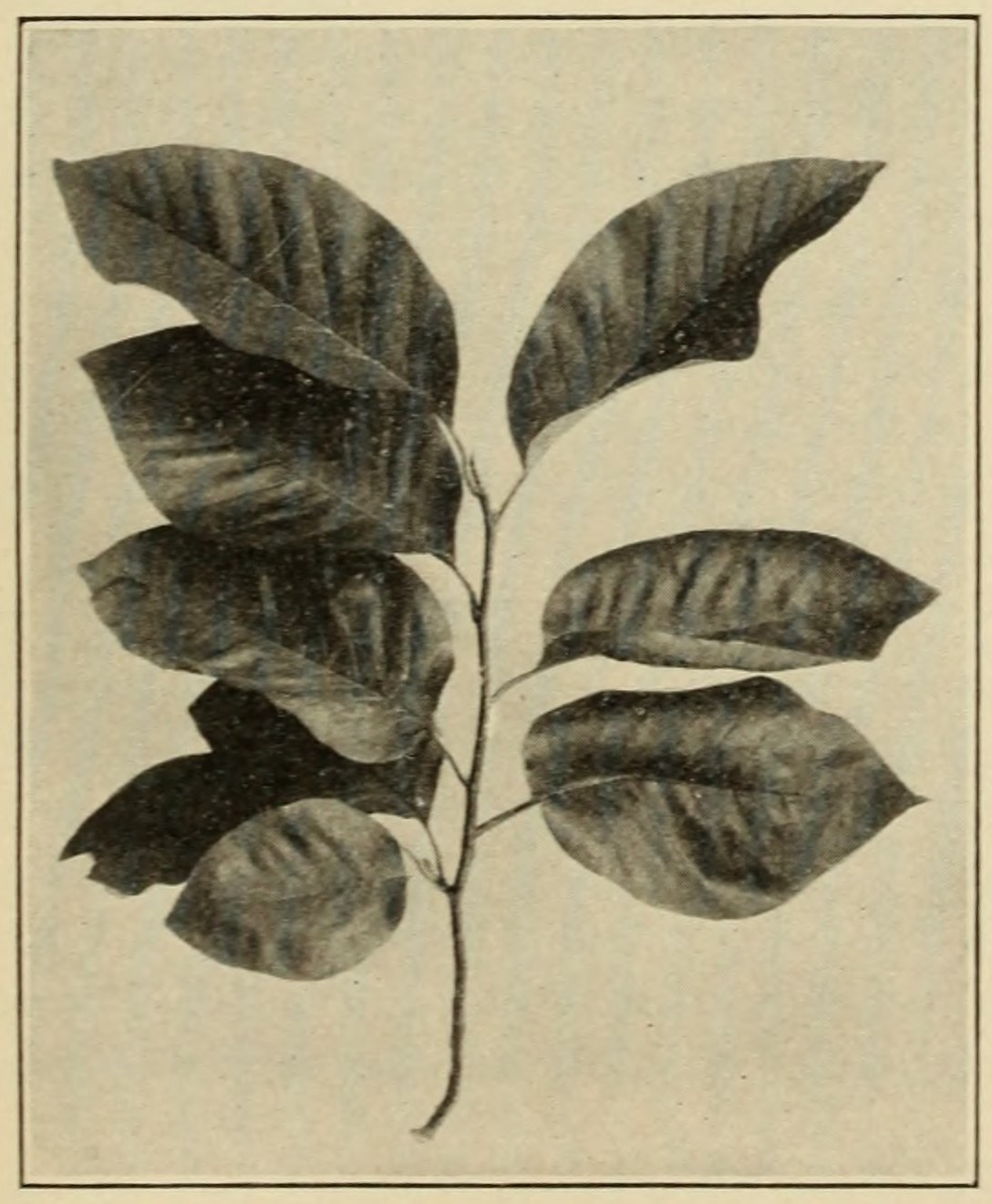
Fig.
15.
—Cucumber-tree (
Magnolia acuminata
), leaves.
Synonyms.—(1) Magnolia umbrella Lam.; (2) Magnolia virginiana L.
Other common names.—(1) Cucumber-tree, mountain-magnolia, blue magnolia; (2) cucumber-tree, umbrella-tree, elkwood; (3) sweet bay, white bay, sweet magnolia, beaver-tree, swamp-sassafras, swamp-laurel.
Habitat and range.—(1) Magnolia acuminata occurs in the mountainous regions from New York to Georgia, but is most abundant in the Southern States; (2) Magnolia tripetala grows in rather moist, rich soil; it is nowhere very common, but is widely distributed in the Appalachian Mountain region; (3) Magnolia glauca is found in swamps and swampy woods from Massachusetts to the Gulf of Mexico.
Descriptions of trees.—Magnolia acuminata, which is native in this country, reaches a height of from 60 to 80 feet, the trunk straight, from 4 to 5 feet in diameter, and with a rough, dark gray bark. The leaves are 6 to 10 inches long and about 3 inches wide, oval and thin, pointed at the apex, and generally rounded at the base; they are pale green underneath and somewhat hairy, especially along the veins (fig. 15). The numerous, slightly fragrant flowers, which appear from May to June, are rather large, measuring 5 to 6 inches across, oblong bell shaped, greenish yellow with a bluish tinge, and having 6 to 9 obovate petals. The cylindrical, fleshy fruit cone, about 3 inches in length, turns rose colored as it matures. In form it resembles a small cucumber, whence the name “cucumber-tree” is derived. When ripe, the several capsules composing these cones burst open, disclosing bright scarlet, shining seeds about the size of a pea, which after a while are suspended from the cone by means of a slender, elastic thread for some time before falling to the ground. All of the species of Magnolia here mentioned, and which belong to the magnolia family (Magnoliaceæ), bear these scarlet seeds, and the method of separating from the cone is the same. The soft heartwood is yellowish brown, while the sapwood is lighter.
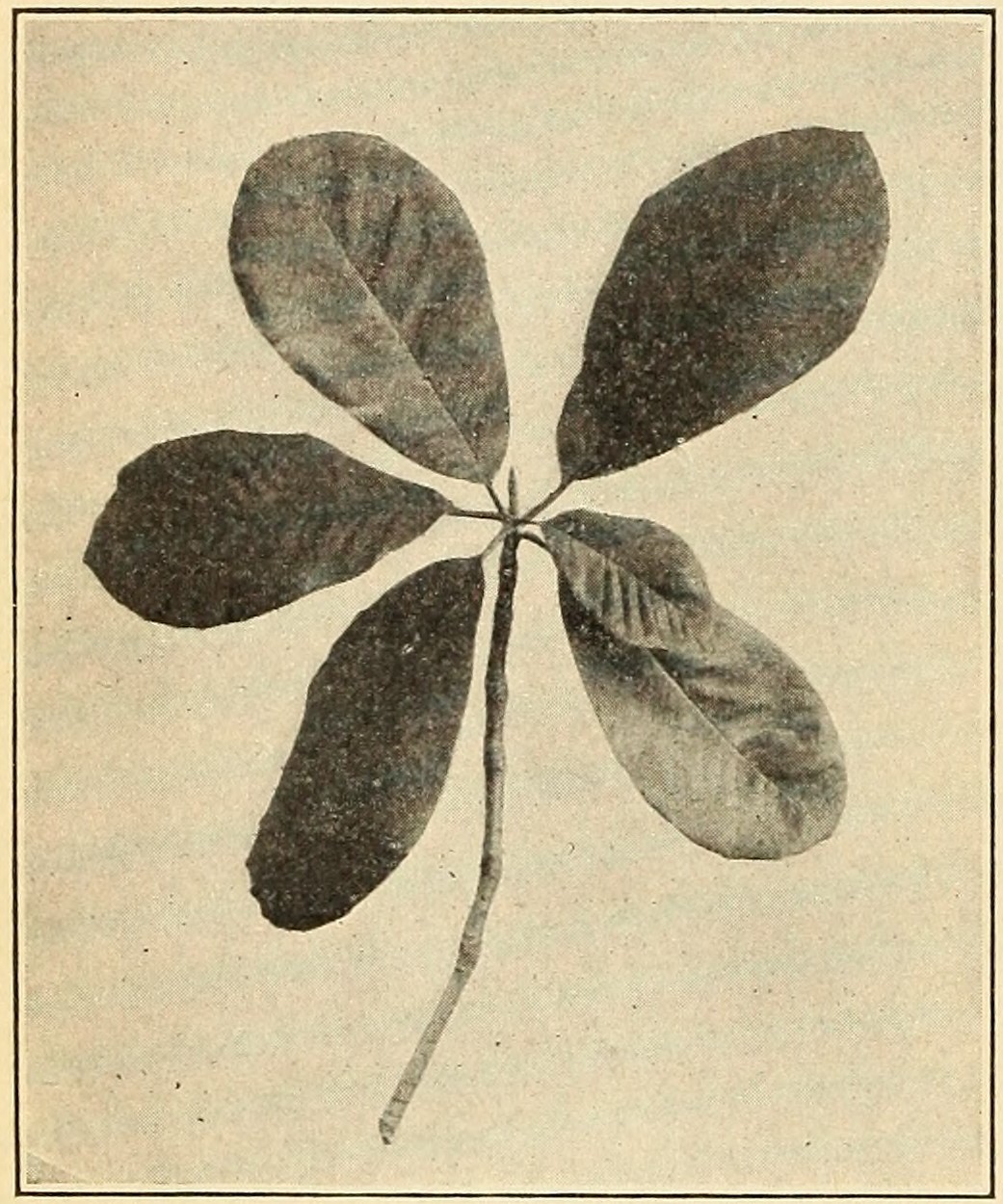
Fig.
16.
—Umbrella-tree (
Magnolia tripetala
), leaves.
Magnolia tripetala is a smaller tree, not exceeding 40 feet in height, also native; the smooth, gray, slender trunk measures from 4 to 18 inches in diameter. Its leaves are clustered at the ends of the flowering branches, and are from 12 to 18 inches long and about 4 to 8 inches wide, obovate, pointed at both ends, the upper surface dark green and smooth, the lower light green and more or less pubescent (fig. 16). The flowers are white, faintly odorous, produced in May, and are 7 to 8 inches in diameter, with 5 to 12 narrow, lance-shaped petals. The mature fruit cone is rose colored, conical, 4 to 6 inches long, and contains numerous scarlet seeds.
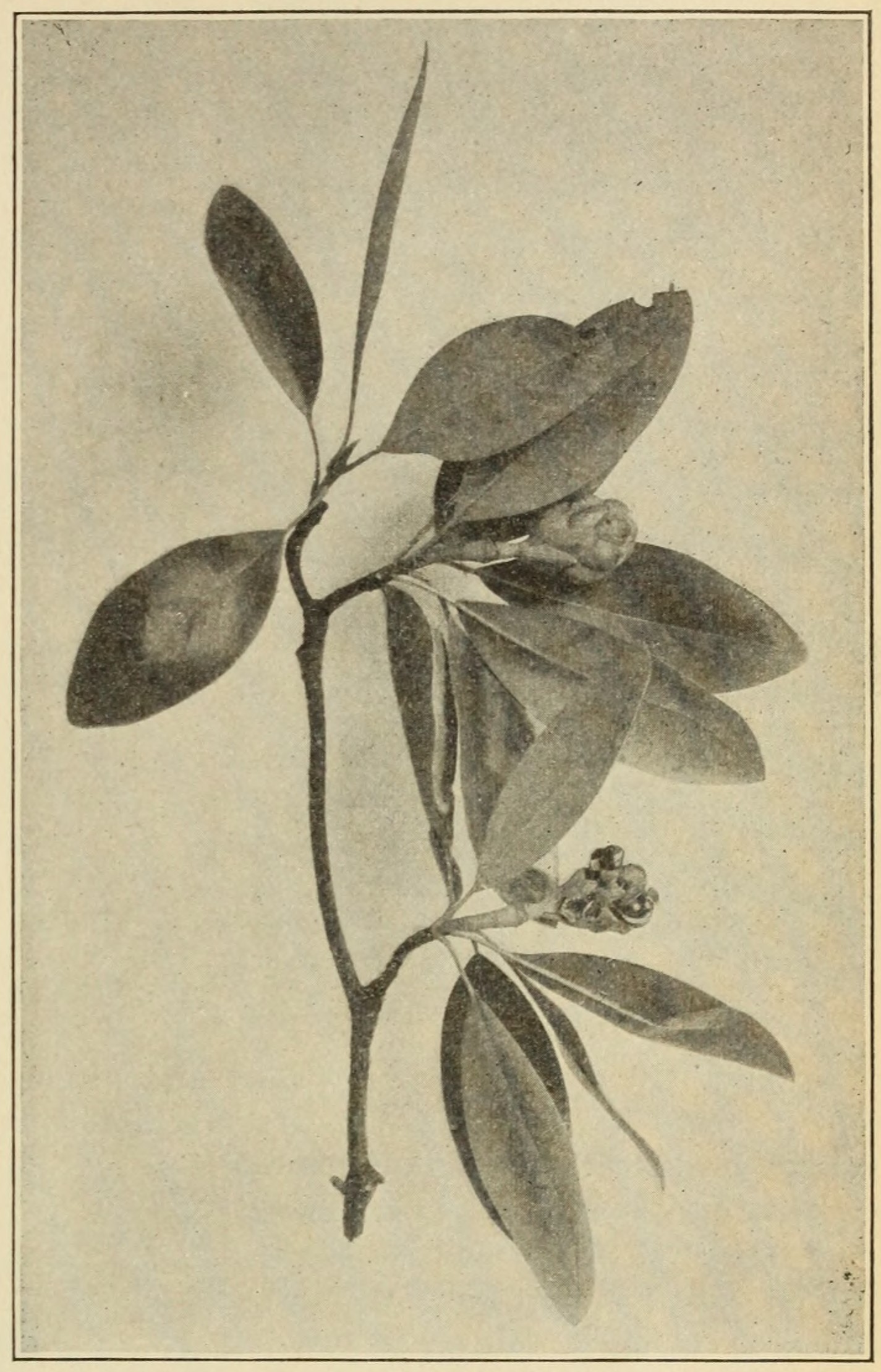
Fig.
17.
—Sweet bay (
Magnolia glauca
), leaves and fruiting cones.
Magnolia glauca averages about 25 feet in height, with a smooth whitish gray trunk from a few inches to about a foot in diameter. The leaves, which are scattered along the flowering branches, are thick and leathery, smooth, dark green above, and on the lower surface pale green and glaucous or somewhat hairy (fig. 17). The solitary flowers are large, terminal, of a creamy white color, somewhat globular in shape, with obovate, rounded petals, and a very fragrant odor; they measure about 2 to 3 inches in diameter. The fruit cone is 1½ to 2 inches in height, oblong, and pink, with numerous scarlet seeds (fig. 17.)
Description of bark.—Magnolia bark, as found in commerce, sometimes varies considerably, on account of the different species from which it is collected. They all possess similar properties, however, and the barks of the three species herein described were official from 1820 to 1890.
The last edition of the National Standard Dispensatory (1905) contains the following paragraph regarding the description of the bark:
“The commercial bark varies most widely, according to the species, the age, and the presence or absence of the corky layer, so that a general description is extremely difficult. The outer surface of old bark of all species is more or less ashy gray, due to the growth of lichens. When young, it is smooth or even glossy and of a brown color, varying more or less to orange or purplish red. With age it gradually becomes warty, the warts at length confluent into ridges and the ridges at length fissured. The inner surface is at first whitish, becoming gradually yellowish or pale brown, smooth, and very finely and closely striate, the striæ long and straight. When the bark has been deprived of the corky layer, the outer surface is almost exactly like the inner. In young bark, however, a green layer appears upon the removal of the cork. The fracture of the outer layer is smooth, short, and granular, of the inner more or less tough-fibrous. The transverse section is brownish and exhibits rather broad bast-wedges and medullary rays. The odor is slight, the taste warm, spicy, and somewhat astringent and, especially of the young bark, bitter.”
Collection, prices, and uses.—The bark of the trunk or root is removed in spring and summer.
At present there does not seem to be much demand for magnolia bark. The price paid for the collection of the bark is about 3 cents a pound.
The bark is used for its tonic properties, for exciting perspiration, and in the treatment of fevers.
Tulip-Poplar.
Liriodendron tulipifera L.
Other common names.—Liriodendron, tulip-tree, whitewood, canoewood, yellow poplar, blue poplar, hickory-poplar, lyre-tree, saddle-leaf, saddle-tree, cucumber-tree.
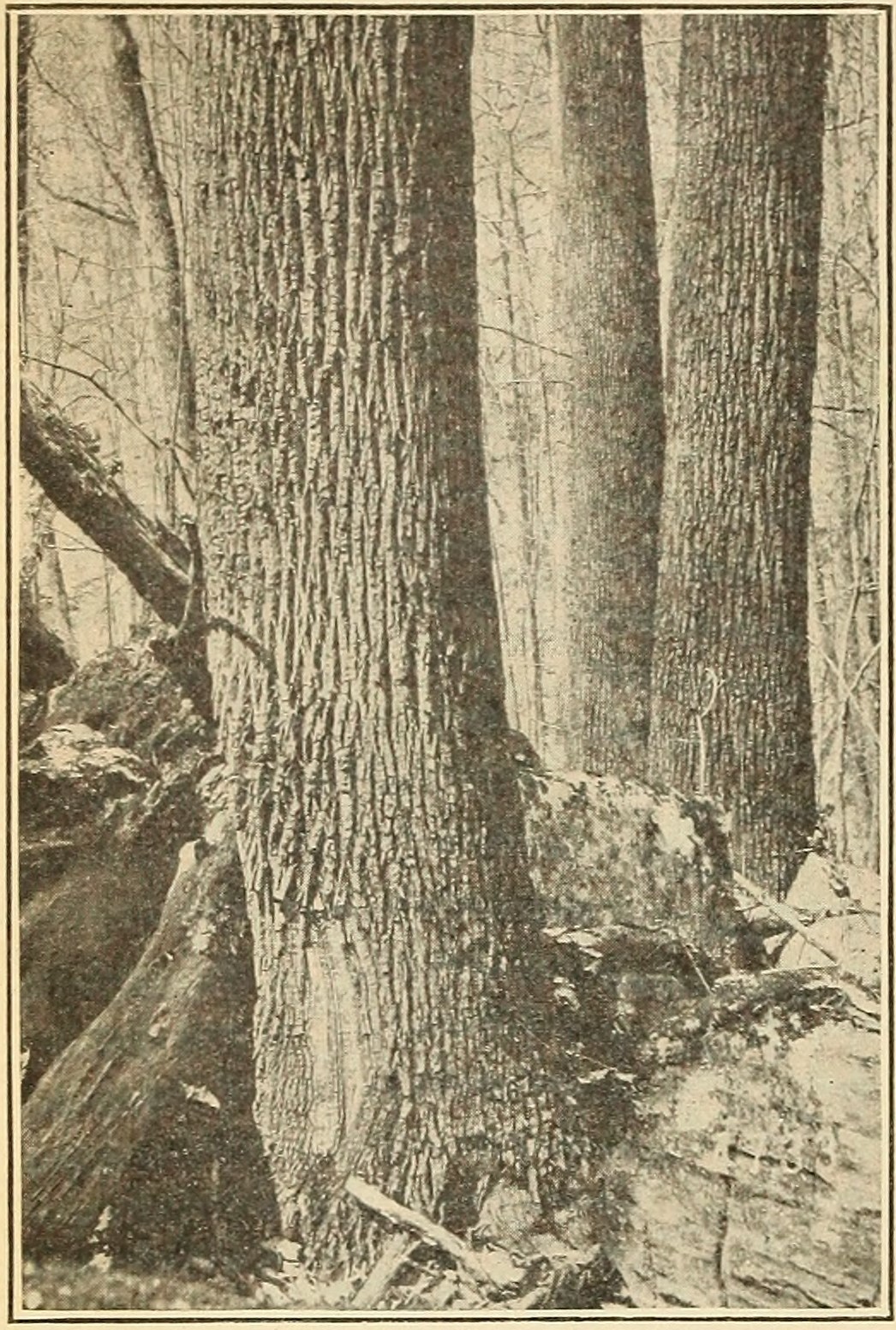
Fig.
18.
—Tulip-poplar (
Liriodendron tulipifera
), trunk.
Habitat and range.—The tulip-poplar, which occurs in rich woods, attains its greatest size in the Middle and Southern States; its range extends from New England to Florida, westward to Michigan and Arkansas. It is also cultivated.
Description of tree.—This most handsome native forest tree, a member of the magnolia family (Magnoliaceæ), is readily distinguished by its somewhat peculiarly shaped leaves, and in spring by its greenish yellow tulip-shaped flowers. It attains great height, from 60 to 190 feet, and is very symmetrical in shape, with a straight, cylindrical trunk covered with grayish brown bark which in young trees is smooth, but becoming rough and fissured as the tree grows older (fig. 18). The leaves are smooth, generally rounded at the base, the top notched, or appearing as though cut straight across. They are roundish in outline or broadly oval, from 3 to 6 inches long, and have two to four lobes at the base and two at the top, the margins between the lobes rounded out, the base rounded or abruptly obtuse. (Fig. 19.)
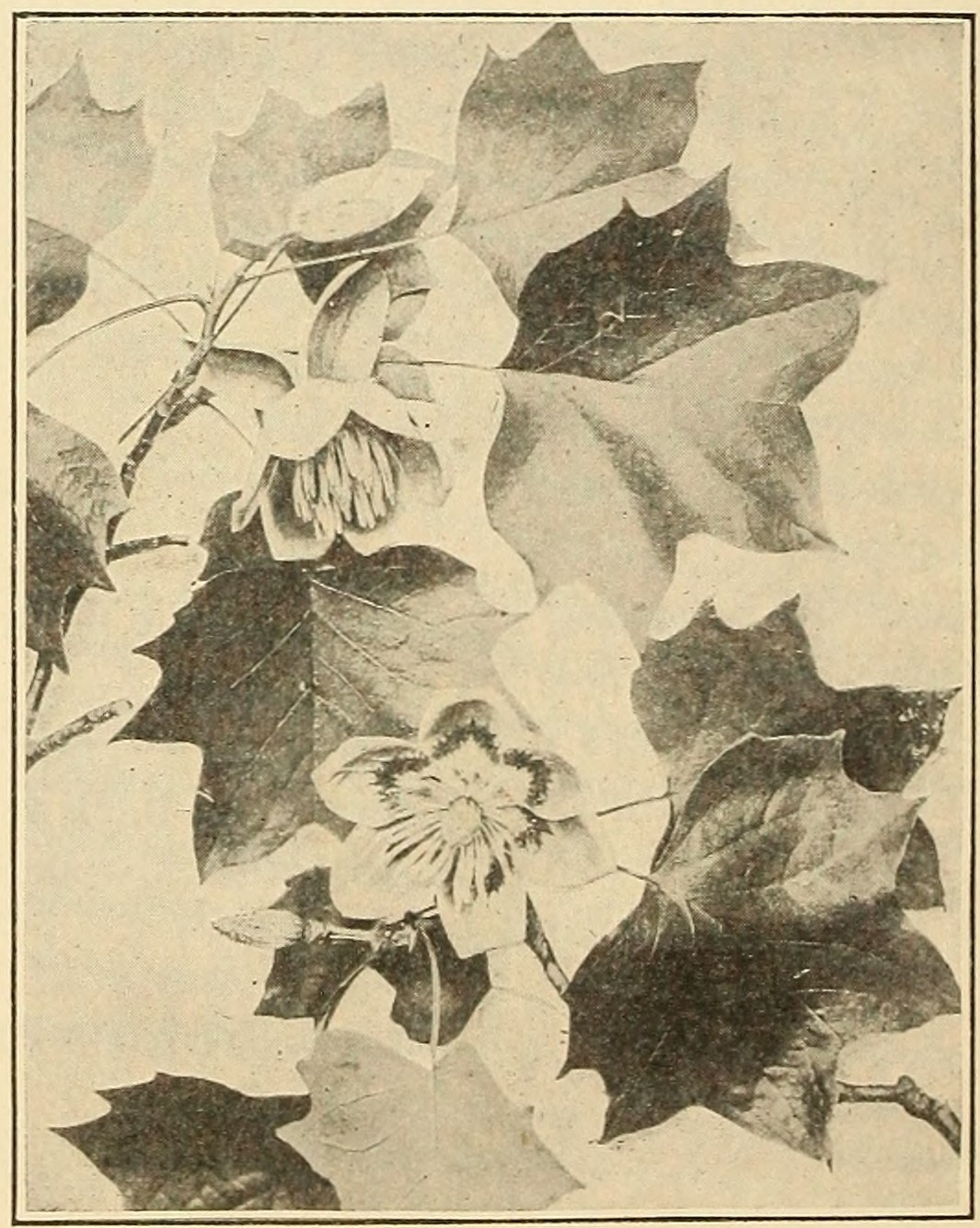
Fig.
19.
—Tulip-poplar (
Liriodendron tulipifera
), leaves, flowers, and fruit.
The erect flowers appear in spring, and although they are quite large—about 2 inches long—they are not very conspicuous for the reason that their colors so blend with the yellow-green foliage of early spring that they pass almost unnoticed. On examining these flowers more closely they will be found to resemble tulips in form, with a very modest coloring, however, of green with a slight orange tinge toward the base of the petals, and the inside of the flower orange colored. The flowers have six petals and three reflexed petal-like sepals, and numerous stamens. The fruit ripens in the form of a dry, pointed cone, about 3 inches in length. (Fig. 19.)
Description of bark.—The bark of both trunk and root, deprived of the outer layer, is used medicinally, and the tulip-poplar, or, as it is most frequently called in the drug trade, yellow poplar, or Liriodendron, was official in the United States Pharmacopœia from 1820 to 1880. It consists of slab-like pieces 3 or 4 inches long, very light, the outside as well as the inside of the inner bark yellowish white. When broken the fracture is ragged, splintery, and uneven. There is a pronounced heavy, unpleasant odor, and the taste is aromatic, pungent, bitter, and somewhat astringent. The root bark is somewhat darker than that of the tree and is considered much more powerful.
Collection, prices, and uses.—In spring the bark is easily separated from the wood; the outer layer is shaved off, and the inner bark is then peeled in large slabs about 6 inches in width and from 3 to 6 feet in length. The root bark is collected in winter.
Collectors receive from about 1¼ to 3 cents a pound.
The bark of the tulip-poplar is regarded as a bitter, stimulant tonic, and is considered useful in fevers, rheumatism, and digestive disorders.
Sassafras.
Sassafras sassafras (L.)Karst.
Pharmacopœial name.—Sassafras.
Synonyms.—Sassafras officinale Nees & Eberm.; Sassafras variifolium (Salisb.) O. Kuntze.[3]
Other common names.—Ague-tree, saxifrax, cinnamonwood, saloop, smelling-stick.
Habitat and range.—Sassafras is a native tree, occurring in rich woods from Massachusetts to Ontario and Michigan, south to Florida and Texas.
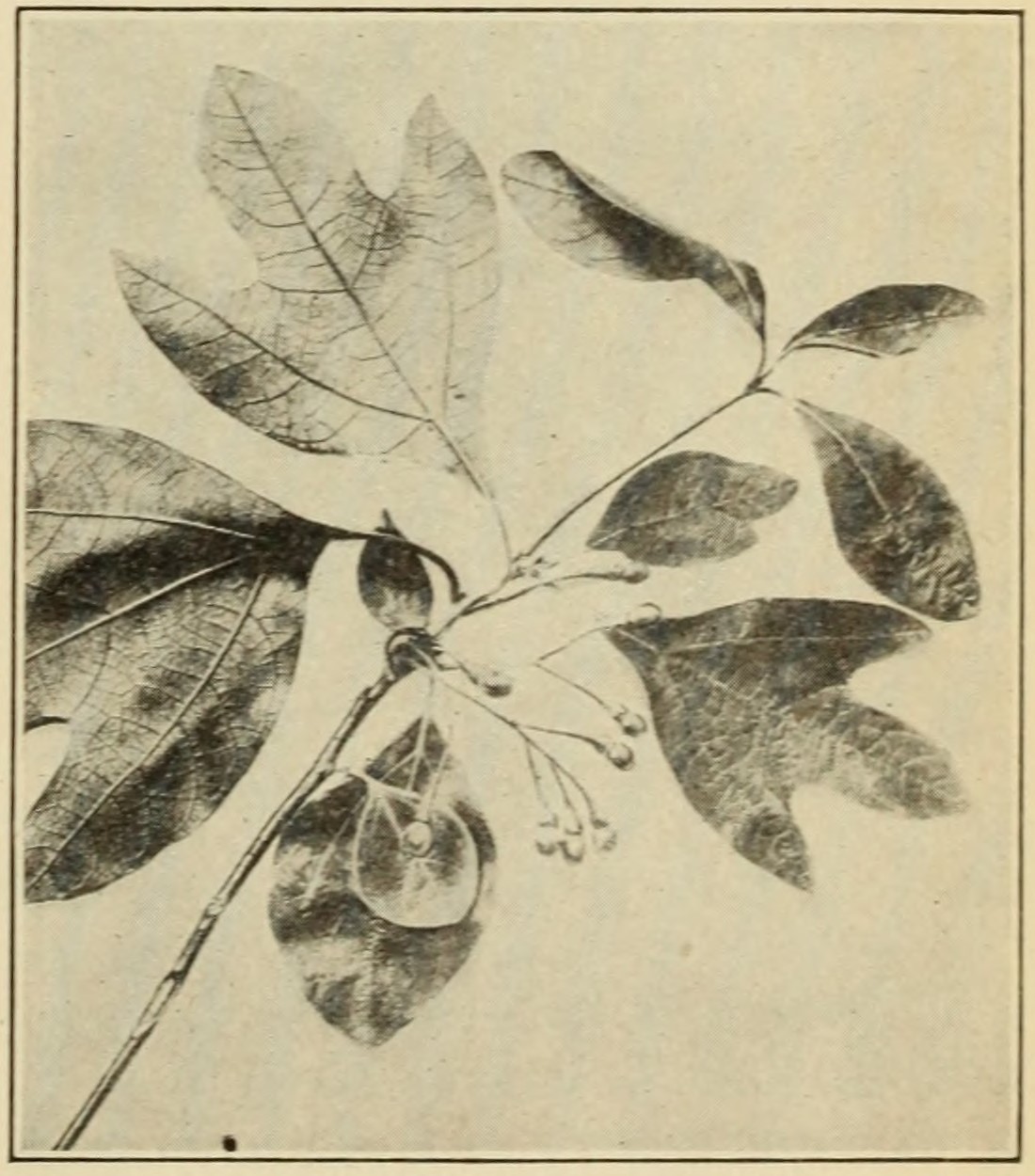
Fig.
20.
—Sassafras (
Sassafras sassafras
), leaves and fruits.
Description of tree.—Sometimes the sassafras reaches almost 100 feet in height, its greatest height being attained in the South, but in the North it occurs principally as a shrub. The bark of old trees is rough and fissured, and of a grayish color, but the young twigs are smooth and green. The leaves are very variable in outline—some oval, some with three lobes, and some with but one lobe on the side, shaped like a mitten (fig. 20). The flowers are yellowish green and fragrant, and are borne in inconspicuous clusters, the staminate and pistillate on different trees; they appear in early spring, about the time that the leaves unfold. The fruit, which ripens about September, is oblong roundish, about the size of a pea, dark blue, one seeded, and borne on a thick, club-shaped red stalk (fig. 20). All parts of the tree are aromatic. It belongs to the laurel family (Lauraceæ). The wood is light, but strong and durable, whitish or with a reddish tinge, and also aromatic, except in the older trees.
Description of bark.—The dried bark of the root of sassafras is official in the United States Pharmacopœia. As it occurs in the shops, it is in irregular curved pieces of varying length; smooth, the outer grayish layer having been removed; rusty red, soft, and breaking with a short, cork-like fracture. The inside of the bark is marked with short, indefinite lines. The odor is very aromatic, and the taste is sweetish, bitingly aromatic, and astringent.
Collection, prices, and uses.—Sassafras bark is collected in early spring or autumn from the root, and the outer layer removed.
Sassafras bark is used for its tonic properties. It forms a popular domestic “spring medicine,” and in early spring the market women display on their stands bundles of sassafras bark, to be made into a tea, by many people regarded as a useful remedy.
Sassafras oil, also official in the United States Pharmacopœia, is distilled especially from the root bark, but often also from the whole root. Maryland, Virginia, and Pennsylvania are the most important centers of production. It is used as an anodyne, also as a stimulant in neuralgia, and for the purpose of flavoring confectionery and soaps.
The dried pith (or medulla) from the branches is likewise official. It yields a mucilaginous liquid with water, and forms a soothing application for inflamed conditions.
The price paid to collectors may range from 2 to 10 cents a pound, according to quality.
Spicebush.
Benzoin benzoin (L.)Coulter.
Synonyms.—Laurus benzoin L.; Lindera benzoin Meissn.; Benzoin odoriferum Nees.
Other common names.—Feverbush, Benjamin-bush, wild allspice, spicewood, snapwood.
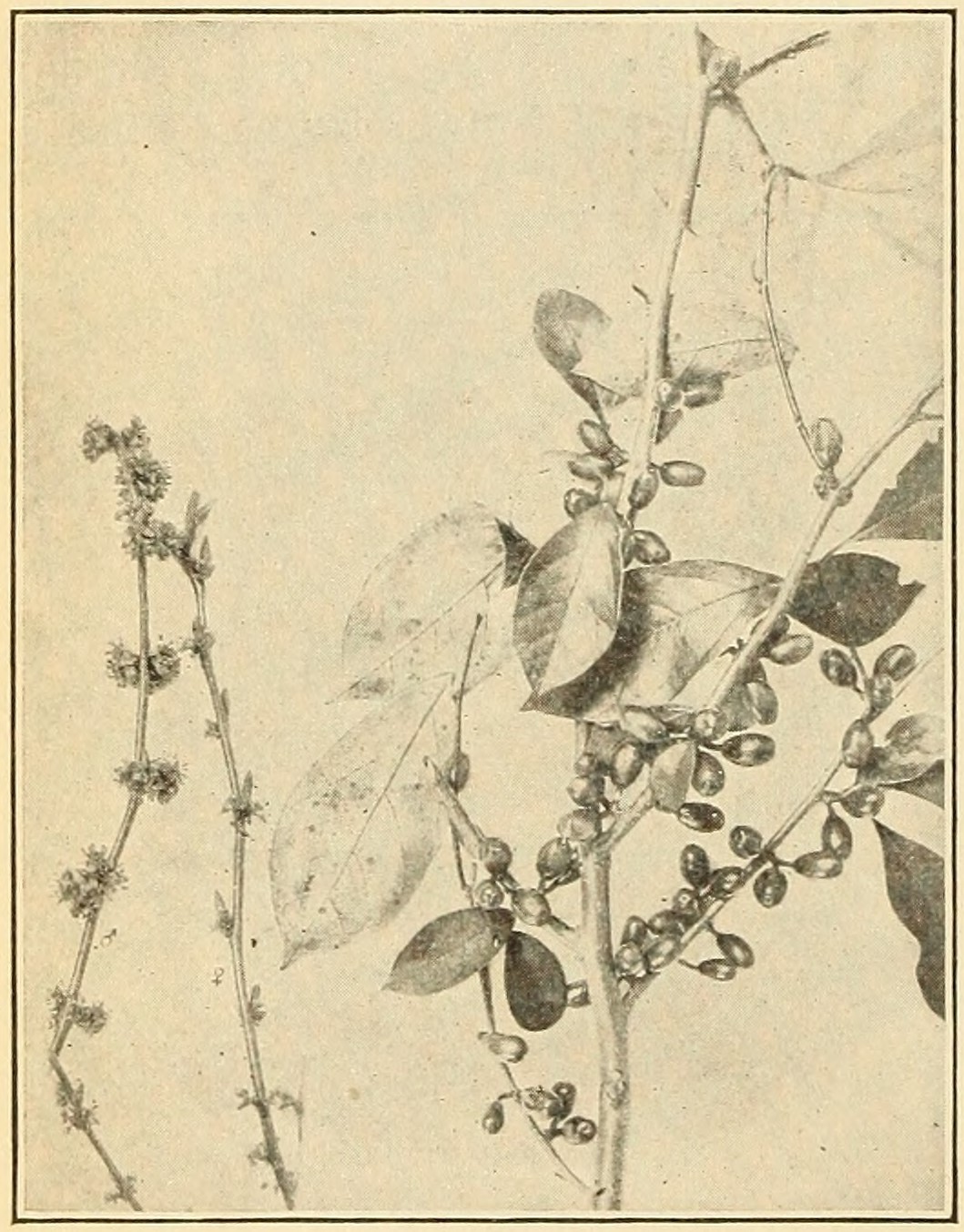
Fig.
21.
—Spicebush (
Benzoin benzoin
), leaves, flowers, and fruits.
Habitat and range.—This indigenous shrub frequents damp, shady woods and is seen along streams from Ontario south to North Carolina and Kansas.
Description of shrub.—The stemless clusters of yellow flowers of the spicebush appear very early in spring, about March or April, before the leaves. This shrub, a member of the laurel family (Lauraceæ), ranges from 4 to 20 feet in height, and has a smooth bark and slender green twigs. The leaves are oval, sharp pointed, 2 to 5 inches long, about half as wide and narrowing toward the base, lighter colored on the lower surface, and with margins entire. Some of the leaves are rounded at the top. The flowers are small, bright yellow, with a fragrant odor, and about four to six in a cluster, the staminate and pistillate flowers produced separately. The clusters of fruit ripen in autumn, and each bright red, obovate fruit contains one large white seed. (Fig. 21.)
Description of bark.—The thin quilled pieces of bark, as found in commerce, are dark brown on the outside, with small corky warts, and lighter brown and smooth on the inner surface. In older bark the corky excrescences will be found more prominent, and the color is also more ashen. The bark of the spicebush breaks with a short, granular fracture, has a faint, pleasant odor, and a warm, spicy, and astringent taste.
Collection, prices, and uses.—In the spring the bark can be readily removed in quills, and this is generally the time when it is gathered.
At present the price paid to collectors is about 3 cents a pound.
The bark is used as a remedy against worms and is also employed in the treatment of fevers.
The fruits are likewise employed in medicine.
Witch-Hazel.
Hamamelis virginiana L.
Pharmacopœial name.—Hamamelis.
Other common names.—Snapping hazel, winterbloom, wych-hazel, striped alder, spotted alder, tobacco-wood.
Habitat and range.—Witch-hazel is found in low damp woods from New Brunswick to Minnesota, south to Florida and Texas.
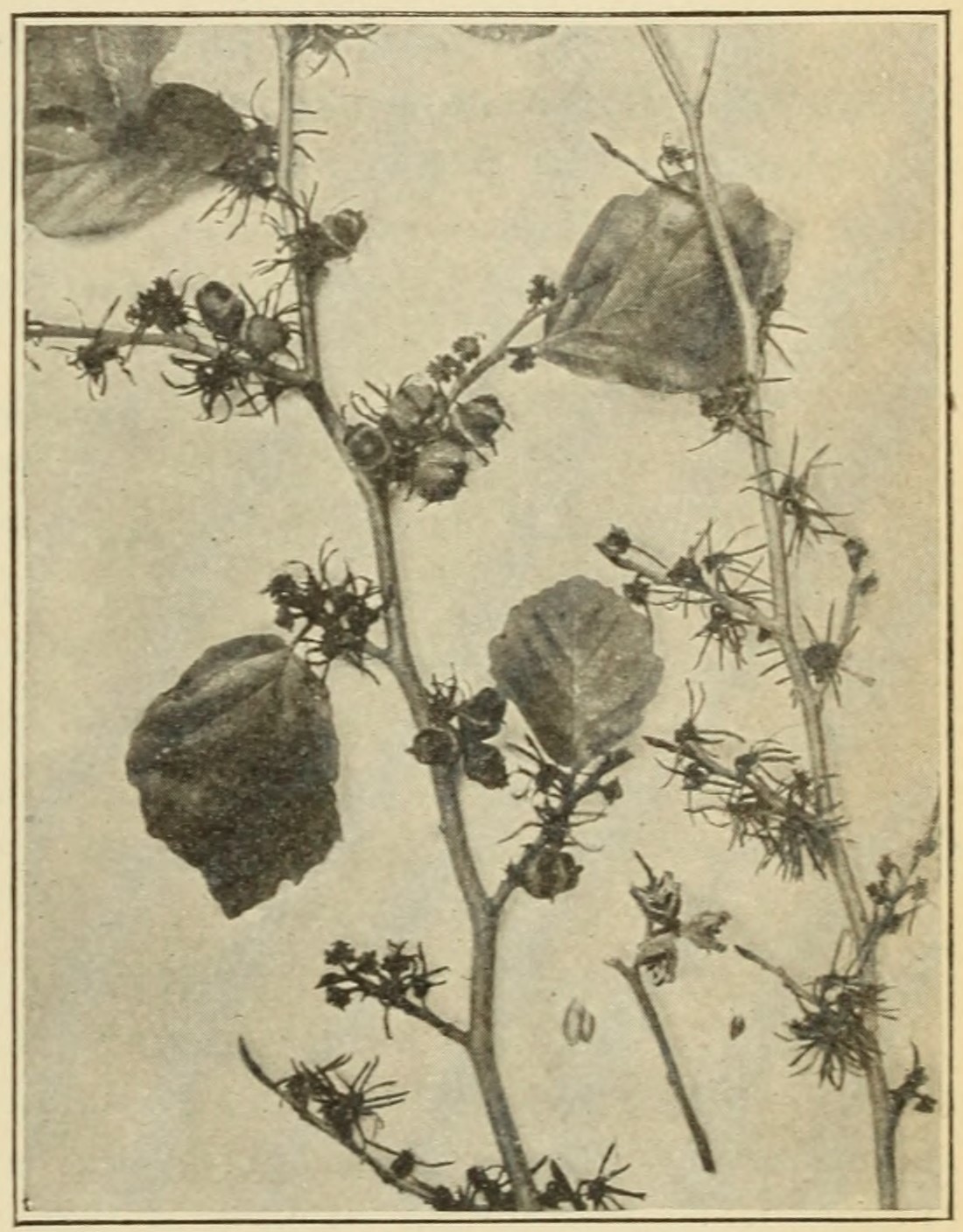
Fig.
22.
—Witch-hazel (
Hamamelis virginiana
), leaves, flowers, and capsules.
Description of shrub.—This indigenous shrub is one of our most peculiar plants, inasmuch as it begins to flower when all other trees and plants not only are through flowering, but generally have lost their foliage, namely, in November or even December. The seed is formed, but does not ripen until the following season. The peculiar, yellow, threadlike flowers among the usually bare branches at a season when most other vegetation is dead and the snow sometimes flies is a novel sight.
Witch-hazel sometimes grows to about 25 feet in height, usually only 8 to 15 feet, with a crooked stem covered with smoothish brown bark, often with a growth of lichens, and having many long, forking branches. The leaves are 3 to 5 inches long, broadly oval or heart-shaped oval, with uneven sides, wavy margins and downy hairs when young, but becoming smooth as they grow older (fig 22).
The flowers, as already stated, appear very late in autumn; they are bright yellow, and consist of a 4-parted corolla, with four long, narrow, strap-shaped petals, which are variously twisted when in full flower. The beaked, densely hairy seed capsule matures the following season, bursting open elastically, and scattering the large, black and shining, bonelike seeds for a distance of several feet. Thus, while the tree is in flower, there may be seen at the same time the mature seed capsules of the previous season. (Fig. 22.) This shrub belongs to the witch-hazel family (Hamamelidaceæ).
Description of bark.—Under witch-hazel or hamamelis bark, official in the United States Pharmacopœia, is understood the bark and twigs of the witch-hazel. The bark is found in commerce in the form of quills, varying in length and width, and is sometimes a purplish brown on the outside, sometimes a whitish or grayish brown color; occasionally it is smooth with a few warty protuberances or numerous lenticels, and again it is furrowed and scaly, or even ragged. The inside is pale brown or yellowish, usually with long, straight lines. Sometimes fragments of the whitish wood are found adhering to the inner surface, and such bark should be discarded. Witch-hazel bark breaks with a weak fracture. There is a scarcely perceptible odor, and the taste is astringent and somewhat bitter.
The tough, flexible twigs do not exceed one-quarter of an inch in diameter, are branching, yellowish brown to a very dark or purplish brown, faintly wrinkled lengthwise, and with small, round, light-colored lenticels. There is a small central pith, and the bark which surrounds the greenish white wood occupies about one-fifth of the radius. If the twigs are more than a quarter of an inch in thickness, there will be too large a percentage of wood, which is inert.
Collection, prices, and uses.—The bark and twigs are the parts designated as official in the United States Pharmacopœia. In the United States Pharmacopœia, 1890, the leaves only were official. The witch-hazel industry is carried on to a considerable extent in portions of the New England States, the farmers bringing in to the distilleries cartloads of the brush. Witch-hazel bark brings about 1 to 4 cents a pound.
Witch-hazel is generally used for relieving inflammation of various kinds, and its soothing properties were known to the American Indians. The name “witch-hazel” is derived from the fact that formerly the forked branches were used as “divining rods,” it having been the belief that these branches were endowed with a miraculous power of locating treasures, sources of water for wells, etc.
The leaves are still official in the United States Pharmacopœia.
Blackberry.
(1) Rubus villosus Ait.; (2) Rubus nigrobaccus Bailey; (3) Rubus cuneifolius Pursh.
Pharmacopœial name.—Rubus.
Synonym.—(2) Rubus villosus A. Gray, not Ait.
Common names.—(1) American blackberry, bramble high-bush blackberry, one-flowered dewberry, fingerberry; (2) high-bush blackberry; (3) sand-blackberry, knee-high blackberry.
Habitat and range.—(1) The American blackberry is found in sandy or dry soil near the coast from Maine to South Carolina; (2) the high-bush blackberry occurs in dry fields and along roadsides from the New England States to Florida, west to Arkansas; and (3) the sand-blackberry frequents sandy soil from Connecticut to Florida, west to Missouri and Louisiana.
Descriptions of plants.—The blackberries are so well known that it is unnecessary to describe them. They are very similar to each other, differing principally in their habit of growth, the American blackberry being a trailing plant with slender branches, whereas the high-bush blackberry and sand-blackberry are more shrubby plants.
Other species.—Besides the blackberries just mentioned, and which are official in the United States Pharmacopœia, Eighth Revision, there are two others which were official in the United States Pharmacopœia for 1890, and which are still collected. These are the low-running blackberry (Rubus procumbens Muhl., syn., R. canadensis T. &G., not L.), and the low-bush blackberry or southern dewberry (Rubus trivialis Michx.), both being generally trailing plants. All are members of the rose family (Rosaceæ).
Description of bark.—The three species of blackberries mentioned as official have long, horizontal rootstocks covered with a thick bark, which is the part used medicinally. In the stores it is found in long, quilled pieces, or in bands, tough and flexible, the outside a dark reddish brown or dark brownish gray, rather smooth or slightly scaly; inside pale brown, with long coarse grooves. It breaks with a tough, fibrous fracture, and has no odor, but an astringent, somewhat bitter taste.
Collection, prices, and uses.—The bark of the root is the part collected, and is stripped by making an incision lengthwise on one side of the root, after which it separates easily from the root, forming long quills.
At present the amount paid for the collection of blackberry bark ranges from 2 to 4 cents.
The blackberry barks possess tonic and astringent properties and form a popular remedy in the treatment of diarrheal complaints.
American Mountain-Ash.
Sorbus americana Marsh.
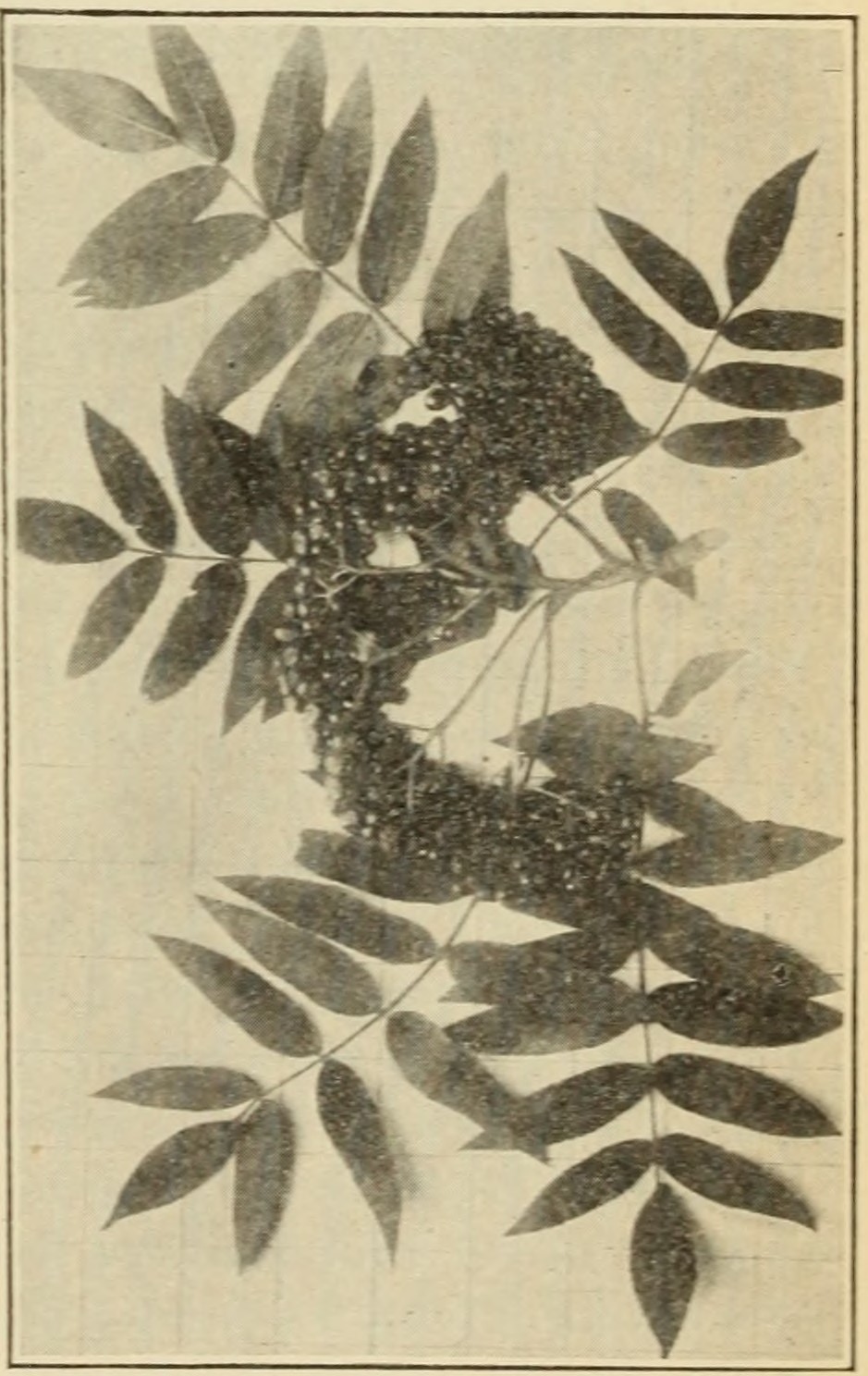
Fig.
23.
—American mountain-ash (
Sorbus americana
), leaves and fruits.
Synonym.—Pyrus americana DC.
Other common names.—Roundwood, round-tree, American rowan-tree, American service-tree, mountain-sumac, dogberry, quick-beam, wild ash, wine-tree, witchwood, life-of-man, Indian mozemize, missey-moosey, moose-misse.
Habitat and range.—The American mountain-ash occurs in swamps, low woods, or moist ground from Newfoundland south along the mountains to North Carolina, and to Michigan. It is most abundant in the northern portion of its range.
Description of tree.—This is a rather small, smooth-barked tree, very brilliant in fall and early winter with its clusters of bright red berries. Its greatest height is about 30 feet, with the trunk measuring about 18 inches in diameter, and covered with a smooth, dull brown or grayish bark. The leaves, resembling those of the sumac, consist of from 11 to 17 lance-shaped, long-pointed leaflets about 1¼ to 4 inches long (fig. 23). When young they are somewhat hairy, both sides becoming smooth later, bright green on the upper surface, but usually lighter colored on the lower, the margins sharply toothed with short, stiff teeth. The white flowers are borne in dense clusters measuring 3 to 6 inches across, and have an urn-shaped calyx, 5 rounded petals, and numerous stamens. The American mountain-ash, which belongs to the apple family (Malaceæ), flowers about May or June, and is followed later in the season by large, dense, showy clusters of round, bright red berries, about the size of peas (fig. 23). It is indigenous to this country.
Description of bark.—As found in the stores, American mountain-ash bark consists of coarse pieces of varying length, about a quarter of an inch in thickness, with the outer layer removed; the outside is yellowish or pale brown, smoothish or sometimes with faint, lengthwise wrinkles, the inside smooth and brown. It is odorless, but the taste is bitter and astringent.
Prices and uses.—At present American mountain-ash bark brings from about 3 to 5 cents a pound. It is used for its tonic, astringent, and antiseptic properties.
Wild Cherry.
Prunus serotina Ehrh.
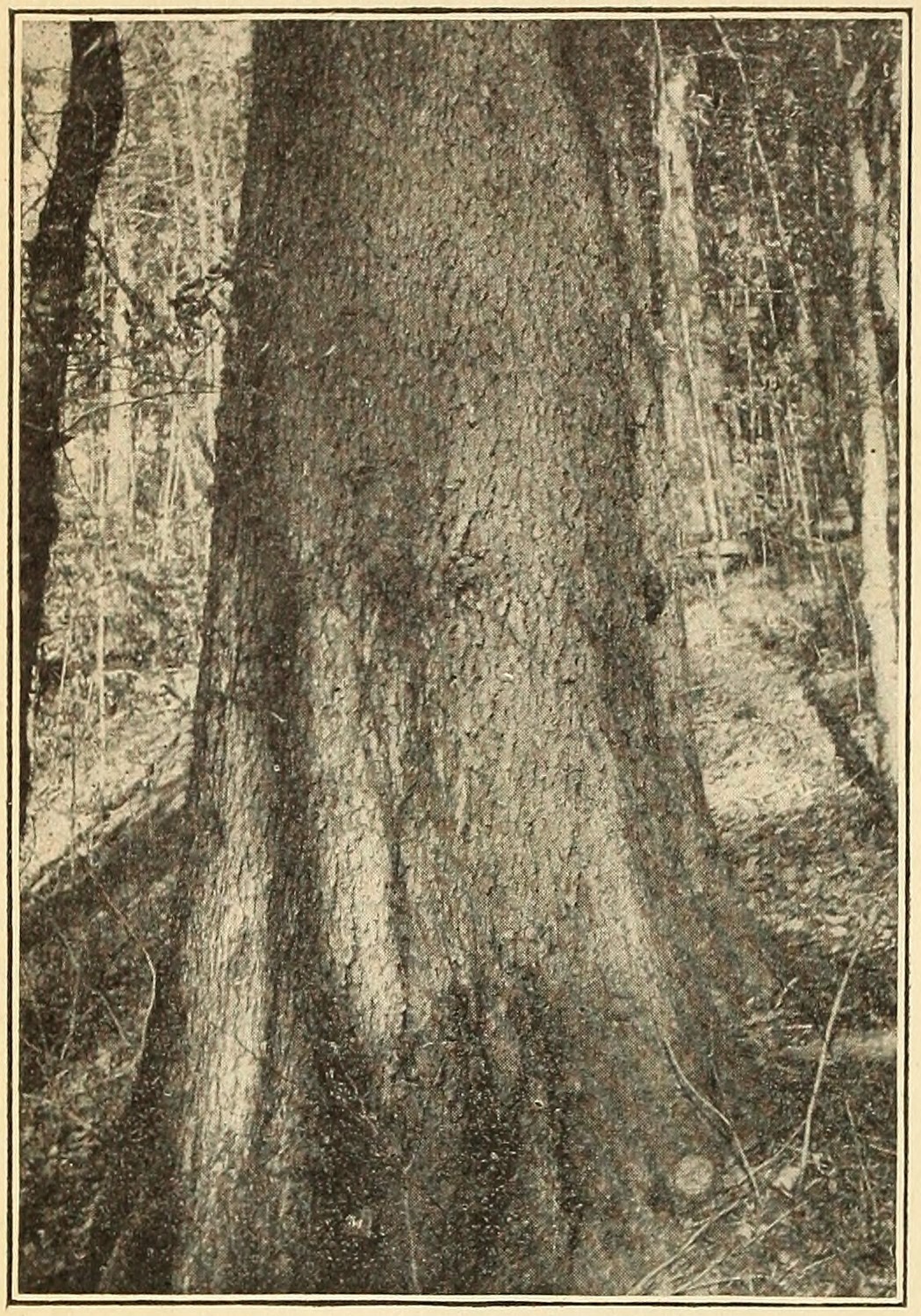
Fig.
24.
—Wild cherry (
Prunus serotina
), trunk.
Pharmacopœial name.—Prunus virginiana.
Synonym.—Prunus virginiana Mill., not of Linnæus.
Other common names.—Wild black cherry, cabinet-cherry, black choke, rum-cherry, whisky-cherry, Virginian prune-bark.
Habitat and range.—The wild cherry occurs in woods or open places, and is most abundant in the Southeastern States, but its range extends from Nova Scotia to Florida, westward to Texas, and north through Indian Territory, the eastern portions of Kansas, Nebraska, and South Dakota.
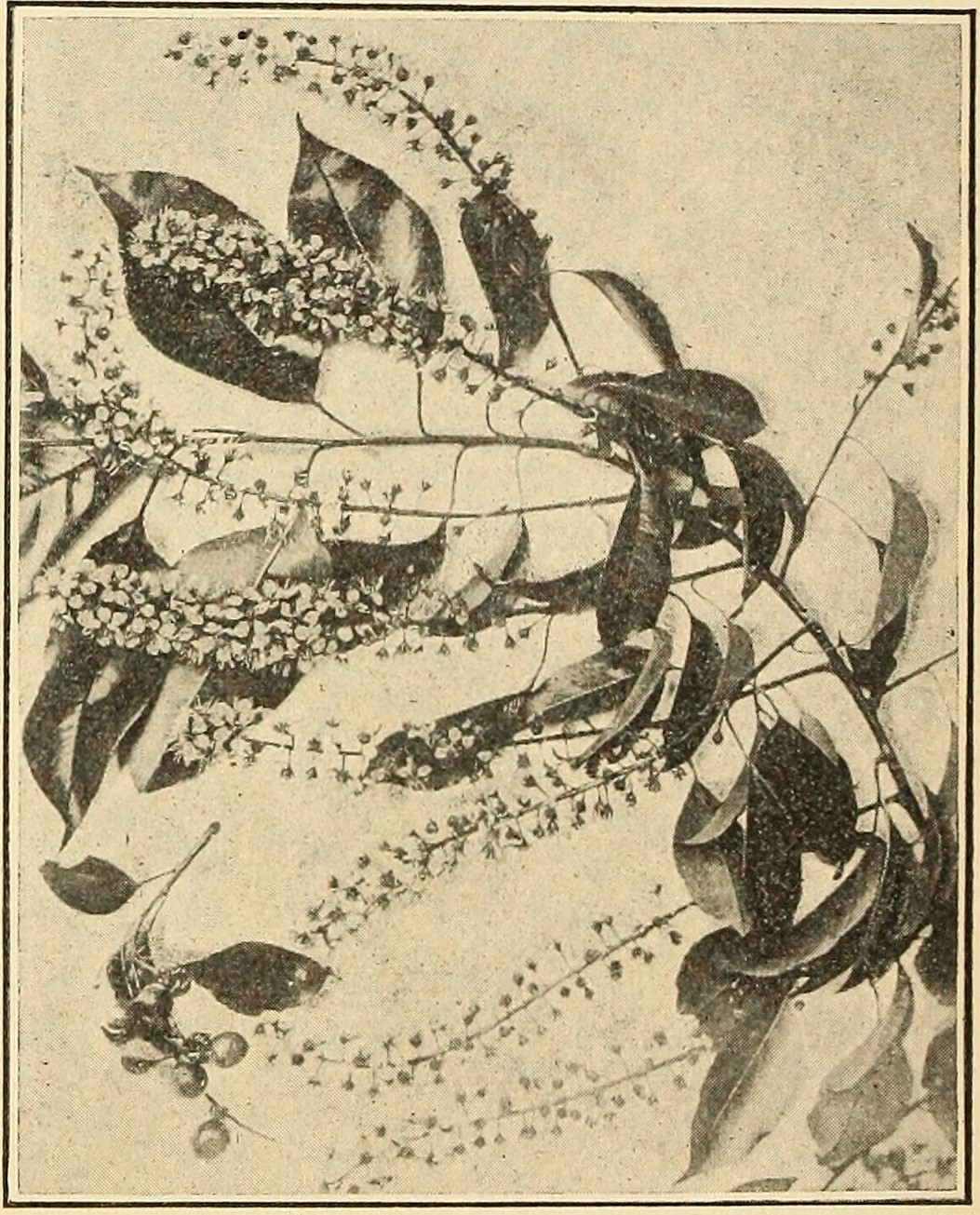
Fig.
25.
—Wild cherry (
Prunus serotina
), leaves, flowers, and fruits.
Description of tree.—The elongated, drooping, pretty clusters of white flowers of the wild cherry are usually produced in May. The tree sometimes reaches a height of 90 feet, and a maximum trunk diameter of 4 feet. The trunk is straight and covered with a rough black bark (fig. 24), the young branches, however, smooth and reddish. The reddish brown wood of the wild cherry is fine grained, hard and strong, susceptible of polish, and is used in cabinetmaking.
The leaves are thick and oval, about 2 to 5 inches long, smooth and shining, bright green above and somewhat hairy on the veins beneath, the margins furnished with callous teeth. The clusters of flowers borne at the ends of leafy branches are generally somewhat drooping, and consist of many small, white, 5-petaled flowers with numerous yellow stamens, the clusters of white against the green background making it a rather attractive tree. The cherries ripen about August or September, and are globular, black, or very dark purple, about the size of a pea, and have a sweet, somewhat astringent, and bitter taste. (Fig. 25.) The wild cherry, which is a native of this country, belongs to the plum family (Amygdalaceæ).
Description of bark.—In commerce wild cherry bark is usually found in curved or irregular pieces, the outer surface smooth and somewhat shining, of a light green or brownish green color, and showing numerous transverse, light-colored lines or grooves, or “lenticels,” as they are technically known. The inner surface is rust colored, marked with netlike grooves, or fissures. It breaks with a short, granular fracture. The taste is aromatic, astringent, and pleasantly bitter, reminding one somewhat of bitter almonds, as does the odor when the bark is soaked in water.
Collection, prices, and uses.—The bark, which is official in the United States Pharmacopœia, should be collected in autumn, as at that time it contains the greatest amount of hydrocyanic acid. The outside layer is removed, so that the green layer underneath shows, and the bark is then carefully dried and preserved. Wild cherry bark should not be kept longer than a year, as it deteriorates with age. The bark from very small or very old branches should not be used. Young, thin bark is considered superior.
The price to collectors at present ranges from 1 to 6 cents a pound, the highest amount being paid for the “thin green,” the next best price for the “thick green,” and the lowest for the “thick rossed.”
Wild cherry bark is used for its tonic properties, and it also exerts a sedative action.
Prickly Ash.
(1) Xanthoxylum americanum Mill. and (2) Xanthoxylum clava-herculis L.
Pharmacopœial name.—Xanthoxylum.
Synonyms.—(1) Xanthoxylum fraxineum Willd.; (2) Xanthoxylum carolinianum Lam.; Fagara clava-herculis (L.)Small.[4]
Other common names.—(1) Northern prickly ash, toothache-tree, toothache-bush, yellowwood, angelica-tree, pellitory-bark, suterberry; (2) southern prickly ash, toothache-tree, Hercules-club, yellow Hercules, yellowthorn, yellowwood, yellow prickly ash, prickly yellowwood, West Indian yellowwood, sea-ash, pepperwood, wild orange.
Habitat and range.—The northern prickly ash is common in woods, thickets, and along river banks from Virginia, Missouri, and Nebraska northward to Canada, while the southern prickly ash grows along streams from southern Virginia to Florida, west to Texas and Arkansas. Both are indigenous to this country, and are members of the rue family (Rutaceæ).
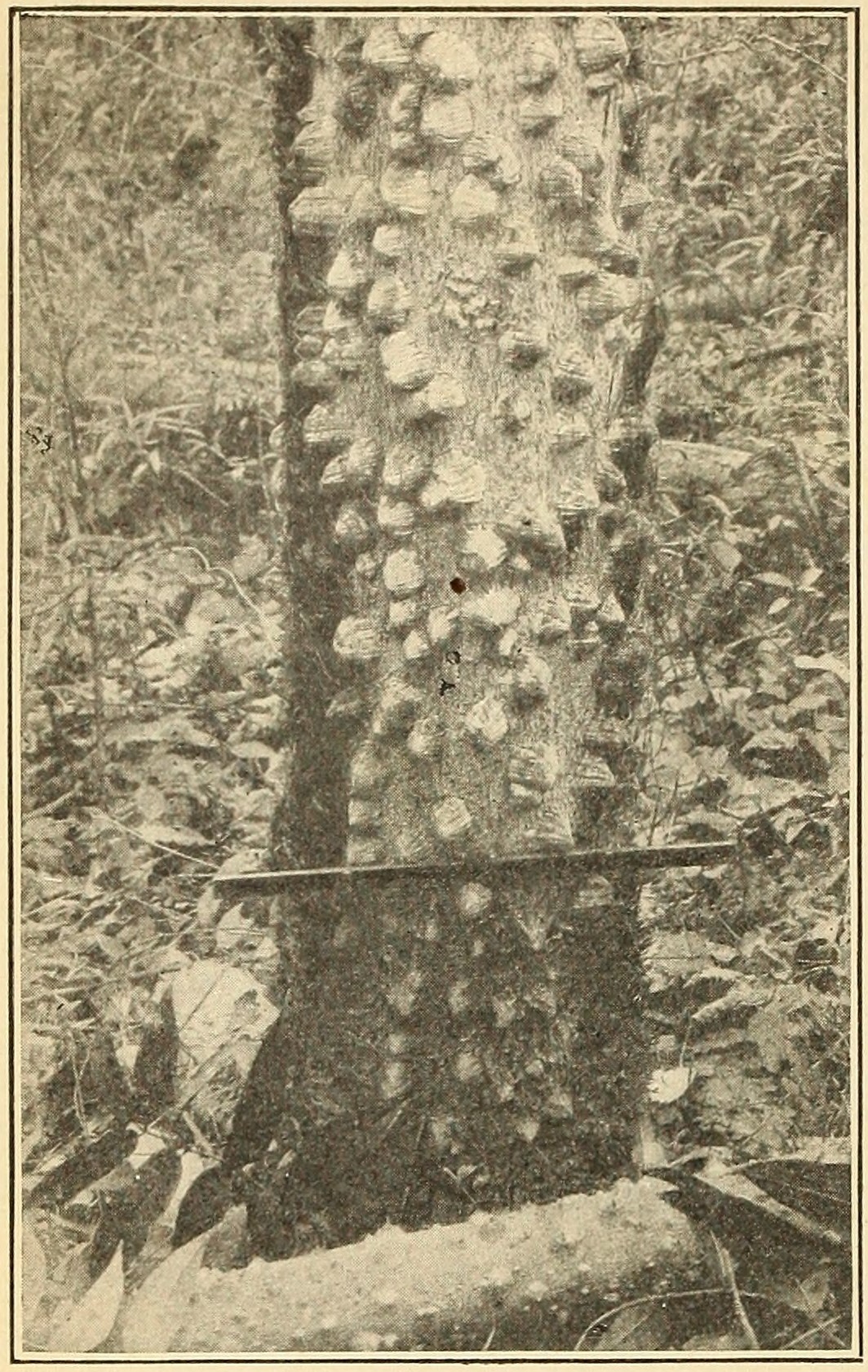
Fig.
26.
—Southern prickly ash (
Xanthoxylum clava-herculis
), trunk.
Descriptions of trees.—The northern prickly ash (Xanthoxylum americanum) is smaller than the southern, usually 10 to 12 feet and rarely exceeding 25 feet in height, the branches having brown cone-shaped prickles. The leaflets in this species number from 5 to 11, and are ovate, practically stemless, 1½ to 2 inches long, somewhat pointed at the apex, and with margins wavy toothed or entire. When young the leaflets are somewhat hairy, but later they become smooth or retain only a slight hairiness, and are dark green on the upper surface and paler underneath. The greenish yellow flowers appear before the leaves, about April or May, but instead of being borne in terminal clusters, like those of the southern prickly ash, they are produced from the axils of the branches, many crowded together in small stemless clusters. The seed capsules, containing one to two shining black seeds, are roundish or somewhat oval and greenish red, wrinkled and pitted, and have a lemon odor. The leaves and flowers are also aromatic.
The southern prickly ash (Xanthoxylum clava-herculis), although generally a taller tree than the northern, does not attain great height, not exceeding 45 feet, and sometimes it is only a shrub. The trunk is covered with a slate-gray bark, and the entire tree is furnished with sharp spines, or prickles, those of the trunk smaller and borne on broad corky excrescences which remain after the spines have fallen away (fig. 26), while those of the branches and leaf stems are larger, but also have a broad base (fig. 27).
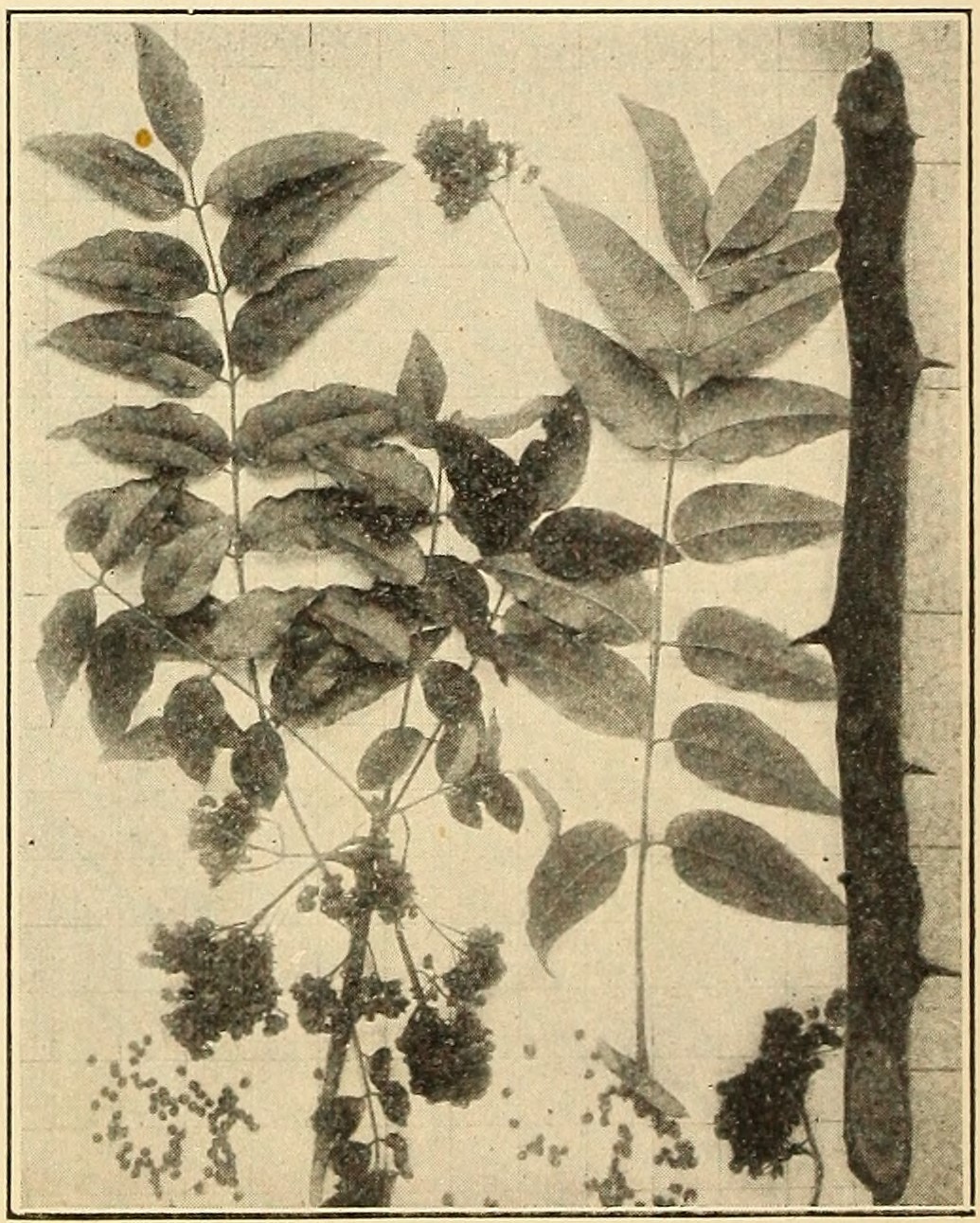
Fig.
27.
—Southern prickly ash (
Xanthoxylum clava-herculis
), leaves, fruits, and branchlet showing prickles.
The leaves consist of 5 to 17 ovate lance-shaped leaflets 1½ to 3 inches long, with pointed apex and uneven sides, smooth and shining on the upper surface, dull beneath, and margins wavy toothed (fig. 27). After the leaves are out—about June—the numerous small greenish white flowers appear, borne in large clusters at the ends of the branches, and not in axillary clusters like those of the northern prickly ash. The seed capsules are roundish-obovoid, wrinkled, and contain roundish-oblong, black, and coarsely wrinkled seeds (fig. 27).
Description of bark.—The dried bark of both of these species is official in the United States Pharmacopœia under the general name Xanthoxylum. That of the northern prickly ash occurs in commerce in small curved or quilled pieces about 2 inches in length and sometimes nearly one-eighth of an inch thick, with a brownish gray, corky outside layer showing whitish patches and small black dots, slightly wrinkled, and a few shining, brown, straight spines, or prickles, about one-fourth of an inch in length and with a base about three-fourths of an inch long. The inner surface of northern prickly ash bark is smooth, whitish, or yellowish. It breaks with a short fracture, showing the green outer layer and the yellowish inner layer. The taste is very pungent and somewhat bitter, but there is no odor.
Southern prickly ash, as found in the trade, is in large sheets or quilled pieces, the outside a bluish gray or slate gray, with patches of silvery gray and numerous large corky excrescences sometimes with the large spines still attached. In other particulars it resembles the northern prickly ash.
Prices and uses.—The price paid to collectors ranges from about 4 to 9 cents a pound for the northern prickly ash and from 3 to 8 cents for the southern prickly ash.
Prickly ash bark has alterative, stimulant, and sialagogue properties, and is used in rheumatism and for increasing the secretions, for toothache, and externally as a counterirritant.
Wafer-Ash.
Ptelea trifoliata L.
Other common names.—Ptelea, wingseed, hop-tree, shrubby trefoil, swamp-dogwood, three-leaved hop-tree, ague-bark, prairie-grub, quinine-tree, stinking ash, stinking prairie-bush, sang-tree, pickaway-anise.
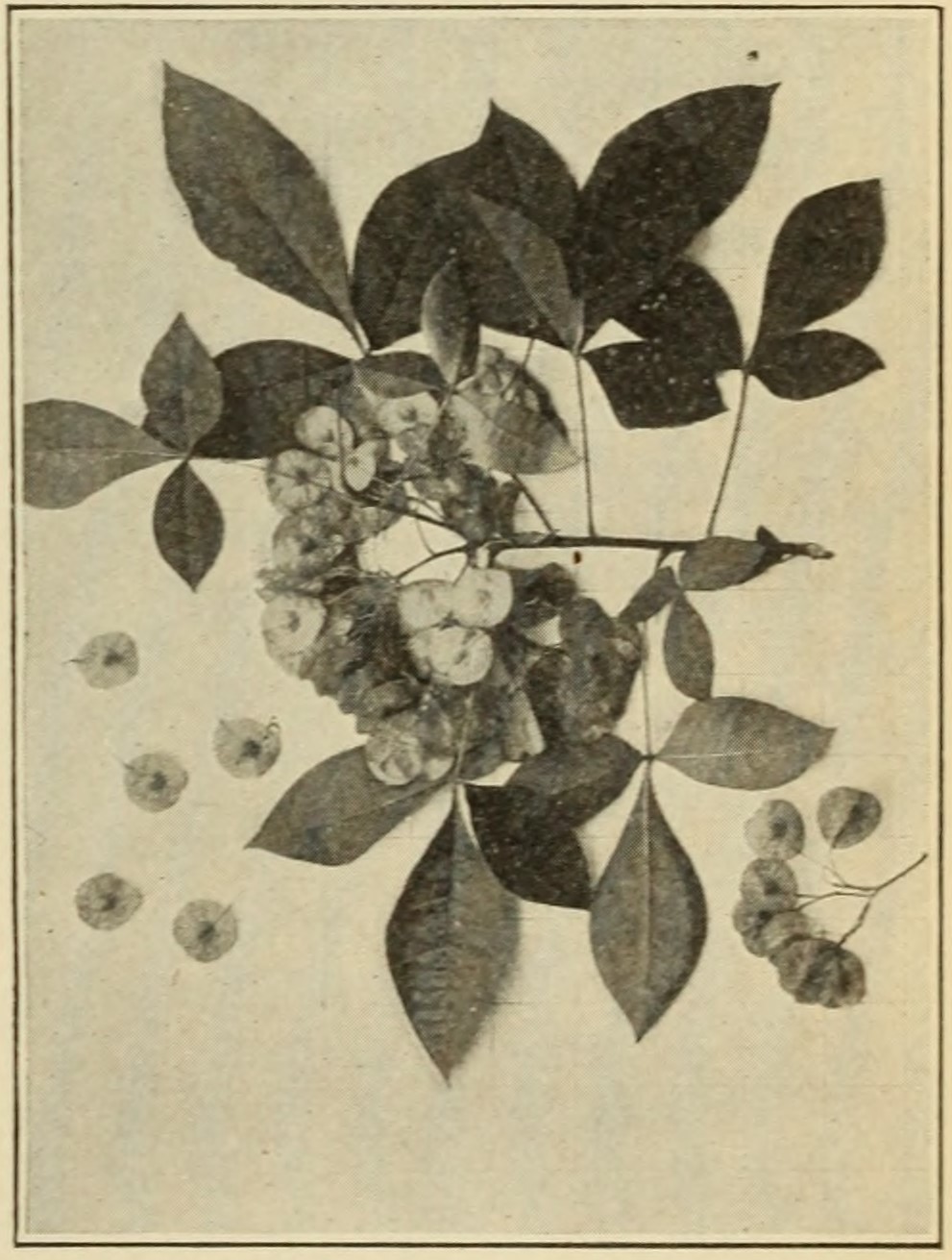
Fig.
28.
—Wafer-ash (
Ptelea trifoliata
), leaves and fruits.
Habitat and range.—This indigenous shrub is found in shady woods from New York to Florida, west to Minnesota and Texas, occurring in greatest abundance west of the Alleghanies.
Description of shrub.—The wafer-ash, belonging to the rue family (Rutaceæ), is a shrub or small tree usually from 6 to 8 feet and not more than 20 feet in height, with leaves consisting of three oval leaflets 2 to 5 inches long, dark green and shining above, paler beneath, the margins slightly round toothed (fig. 28). The leaves are borne on long stems, but the leaflets are stemless. The flowers, which appear in June, are numerous in terminal compound clusters, greenish white, and have a disagreeable odor. The foliage also has an unpleasant odor. The flowers are followed by large clusters of winged fruits, each one containing two seeds. These fruits are flat, rounded in outline, the seeds surrounded by a membranous, veined wing (fig. 28). They have a bitter taste and have been used in place of hops. The wood of the wafer-ash is light brown.
Description of bark.—The dried bark of the root is the part employed in medicine, and as found in the stores it is in quilled pieces varying in length from one to several inches. The thin cuter layer is pale brown and irregularly ridged and wrinkled. The inner surface is yellowish white, becoming darker with age. The bark, which is brittle, breaks with a smooth fracture, has a peculiar odor, and a bitter, pungent, and somewhat acrid taste.
Collection, prices, and uses.—The bark is taken from the roots. At present it brings collectors from about 4 to 8 cents a pound.
Wafer-ash bark possesses tonic properties, and is employed in fevers. It is also said to be useful as an anthelmintic.
Black Alder.
Ilex verticillata (L.) A. Gray.
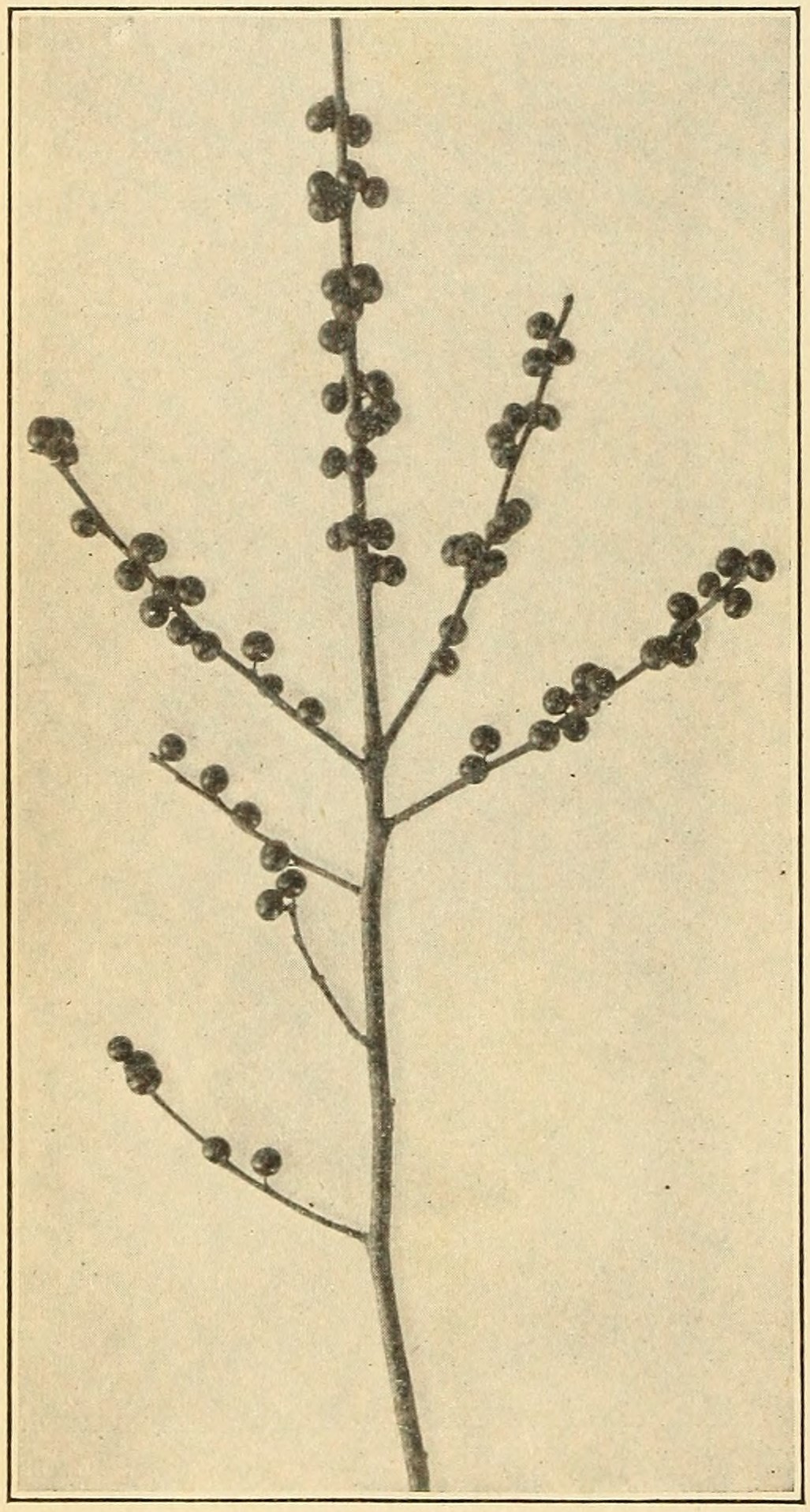
Fig.
29.
—Black alder (
Ilex verticillata
), fruits.
Synonym.—Prinos verticillata L.
Other common names.—Prinos, winterberry, common winterberry, Virginia winterberry, false alder, white alder, feverbush.
Habitat and range.—The black alder is native in swamps, moist woods, and along banks of streams, in Canada and the eastern United States, and westward to Wisconsin and Missouri.
Description of shrub.—The fruits of the black alder are a familiar sight in the Christmas markets, the bare branches with the persistent, shining, bright red berries being much used for decorative purposes during the holiday season. Black alder is a shrub usually from 6 to 8 feet high (sometimes 25 feet), with grayish bark and smooth twigs. The leaves are oval or oblong lanceolate, pointed at the apex, about 2 to 3 inches long, and about an inch in width. They are rather thick and leathery in texture, dark green and smoothish on the upper surface, hairy on the lower surface, especially along the veins, and sharply toothed. In autumn the leaves turn black.
The flowers, which appear from about May to July, are small and white, the male clusters consisting of 2 to 10 flowers, and the female of only 1 to 3. The fruits are bright red and shining, about the size of a pea, clustered around the stem, and each containing six seeds (fig. 29). Black alder belongs to the holly family (Aquifoliaceæ).
Description of bark.—The bark, which was official in the United States Pharmacopœia from 1820 to 1890, occurs in commerce in somewhat quilled strips or pieces of an ashy brown color outside, with whitish patches and round black spots and lines. The inner surface is greenish or yellowish, and marked with short lines. The fracture is short, showing a greenish tinge. It has a faint, peculiar odor and a bitter, astringent taste.
Collection, prices, and uses.—Black alder bark is collected in autumn. The amount paid to collectors ranges from 2 to about 5 cents a pound.
It is used in medicine as a tonic and astringent. The berries are employed for similar purposes as the bark.
Wahoo.
Euonymus atropurpureus Jacq.
Pharmacopœial name.—Euonymus.
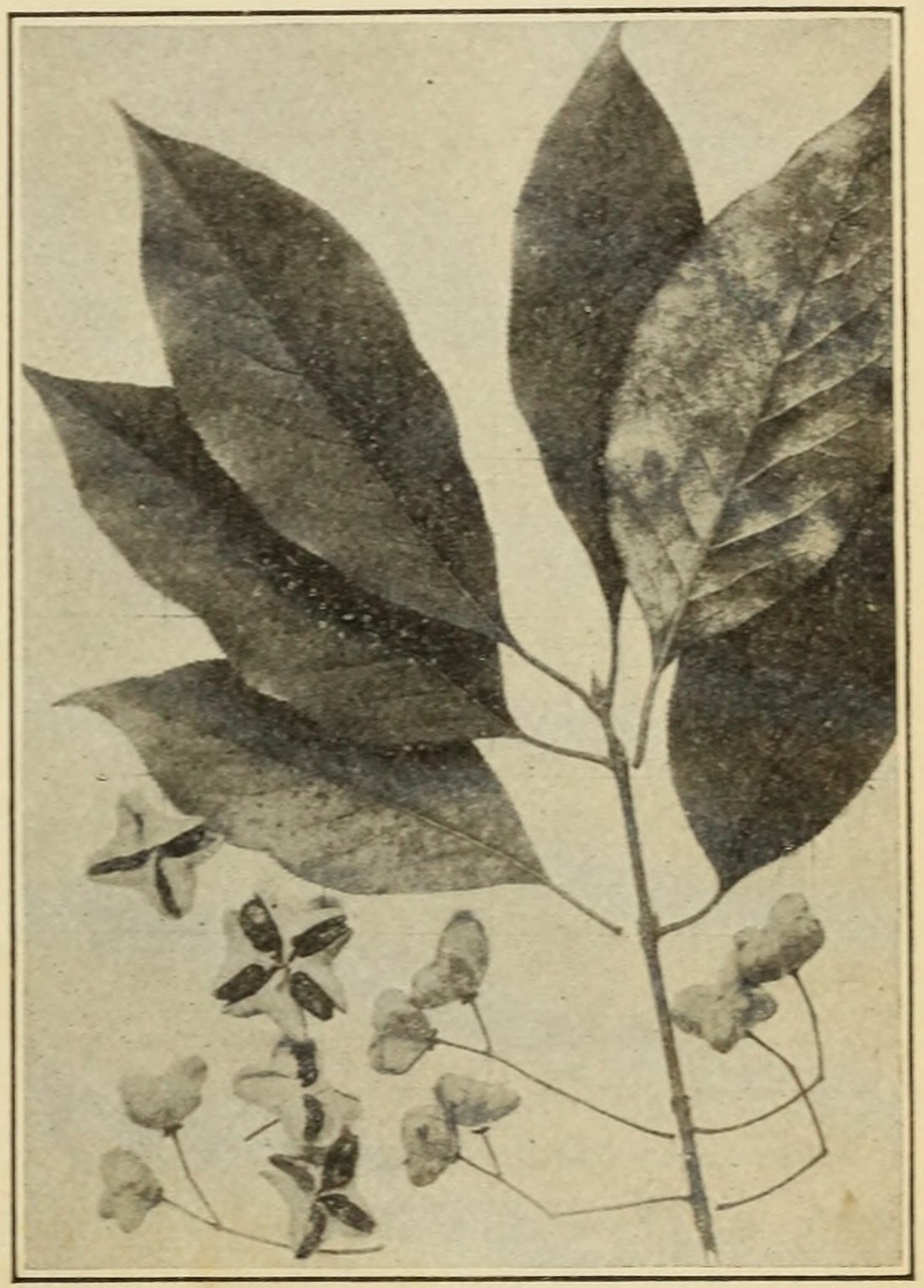
Fig.
30.
—Wahoo (
Euonymus atropurpureus
), leaves and fruits.
Other common names.—Burning-bush, spindle-tree, Indian arrowwood, bursting-heart, strawberry-tree, strawberry-bush, American spindle-tree, bitter ash, pegwood.
Habitat and range.—Wahoo is found in woods and thickets from Ontario and the eastern United States west to Montana.
Description of shrub.—This native shrub or small tree is from 6 to 25 feet in height, more often reaching only 10 feet, with an ashy gray bark, twigs somewhat 4 angled, and leaves from 1½ to 5 inches in length and about half as wide, oval-oblong or elliptical, and long pointed at the apex (fig. 30). They are rather thin in texture, with a prominent midrib, more hairy on the lower surface than above, and the margins round toothed. The 4-petaled purple flowers are produced in June, in loose, slender-stemmed clusters of from 5 to 15 flowers each, and have 4 wavy, obovate petals. The pale purple fruits are rather odd looking, consisting of 4 deeply cleft, flattened lobes, smooth, each cell containing 1 or 2 seeds (fig. 30). These capsules open after they ripen, about October, and disclose the seed surrounded by a red aril (false coat enveloping the seed), the bush at this time presenting a very bright and showy appearance.
The name “wahoo” is applied indiscriminately to Euonymus atropurpureus and E. americanus—the latter a low or trailing bush having crimson capsules, to which the appellation “burning-bush” more properly belongs. Both species, which are members of the staff-tree family (Celastraceæ), are used in medicine, although E. atropurpureus alone is recognized in the United States Pharmacopœia.
Description of bark.—The dried bark of the root of wahoo is official in the United States Pharmacopœia. It is in quilled pieces of irregular size. The outside of the bark is furrowed and ridged, of an ashy or light brownish gray color, showing a few dark patches of soft cork. The inner surface is smooth and whitish or somewhat pale brownish. The fracture is short, whitish, and shows fine silky fibers. There is a distinct odor, and the taste is sweetish, bitter, and somewhat acrid.
Collection, prices, and uses.—Although the bark from the stem is also sometimes gathered, it is the root bark only which is recognized as official.
The root bark at present brings from 9 to 20 cents a pound. It has tonic, diuretic, laxative, and antiperiodic properties; it acts on the liver, increasing the flow of bile, and is also employed in intermittent fevers and in dyspepsia.
False Bittersweet.
Celastrus scandens L.
Other common names.—Climbing bittersweet, shrubby bittersweet, fevertwig, fever-twitch, staff-tree, climbing staff-tree, staff-vine, waxwork, Roxbury waxwork, yellowroot, climbing orange-root, Jacob’s-ladder.
Habitat and range.—This woody vine or climbing shrub is found in woods and thickets, growing in rich damp soil, from Ontario to Manitoba, south to North Carolina and New Mexico.
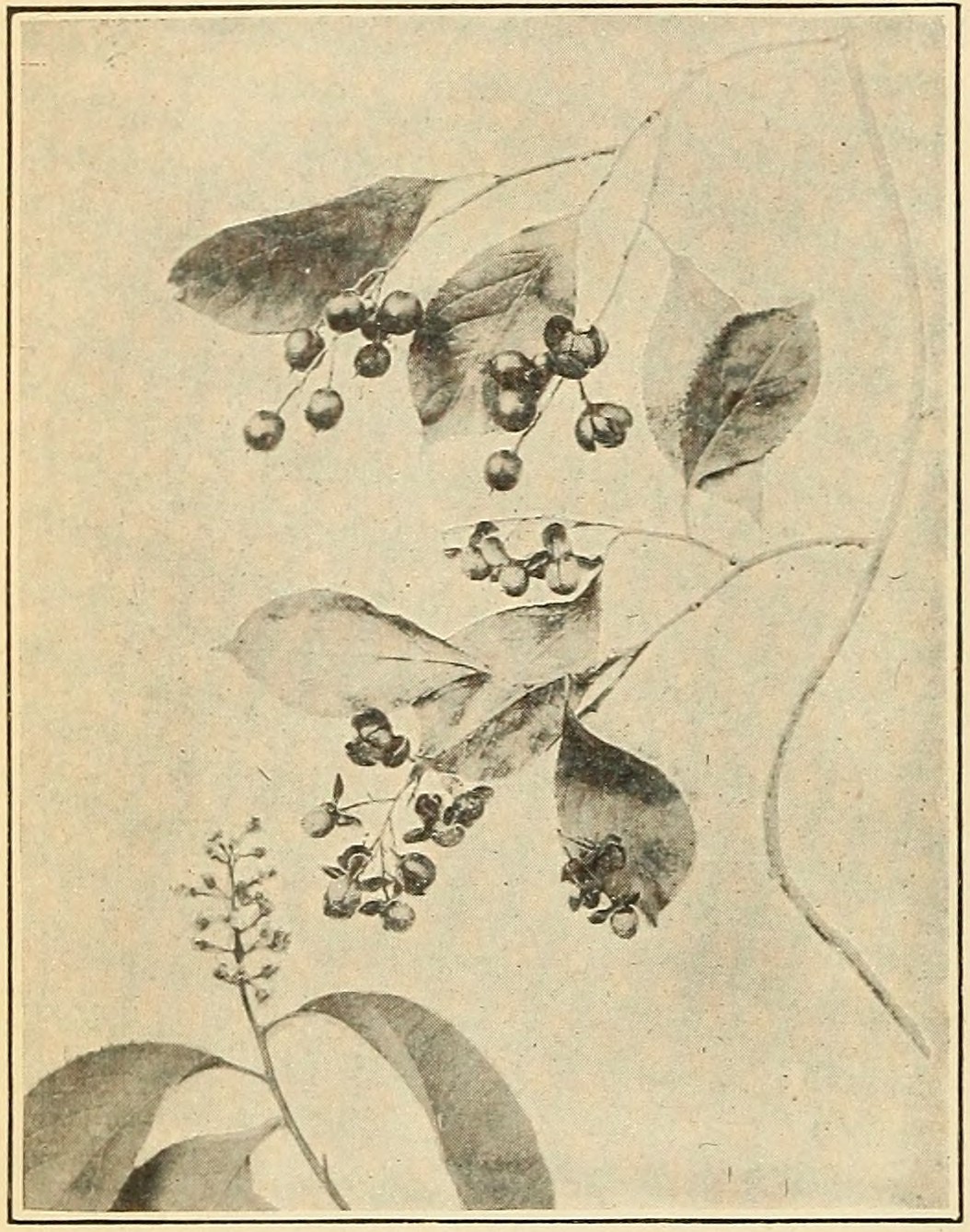
Fig.
31.
—False bittersweet (
Celastrus scandens
), leaves, flowers, and fruits.
Description of plant.—False bittersweet is a most attractive plant in the fall, with its brilliant orange-yellow and scarlet seed capsules adding a vivid dash of color to the fall and winter landscape, remaining on the vine well into the cold season.
It is an indigenous woody and shrubby climber, growing over adjacent trees or near-by fences. The leaves are thin and smooth, oval, 2 to 4 inches long, and about half as wide, pointed at the apex, and with a pointed or rounded base, the margins furnished with fine, rounded teeth. The small, greenish white or greenish yellow flowers are produced in June, in short terminal clusters, and the fruit is in the form of a roundish, 3-celled, orange-colored capsule, which opens in autumn, disclosing the scarlet-covered seed, making a very showy appearance. This covering is known as an “aril.” (Fig. 31.)
False bittersweet and true bittersweet, on account of the similarity of the common names, are often confused, but the plants do not resemble each other at all, belonging to entirely different families and possessing different medicinal properties. False bittersweet belongs to the staff-tree family (Celastraceæ), while the true bittersweet is a member of the nightshade family (Solanaceæ).
Description of bark.—The bark of both plant and root is employed, but especially that of the root. The latter is rather smooth, in small quilled pieces, the outer surface covered with a thin, papery layer of dark orange-brown and the inner surface white and finely grooved. The bark from the stem has a brown-gray color. There is practically no odor, and the taste is bitter, becoming sweet, then somewhat acrid and rather sickening.
Prices and uses.—The price paid to collectors varies from 5 to 10 cents a pound.
The bark of false bittersweet possesses alterative, emetic, diaphoretic, and diuretic properties, and some narcotic action is also attributed to it.
Horse-Chestnut.
Aesculus hippocastanum L.
Other common names.—Hippocastanum, bongay, konker-tree.
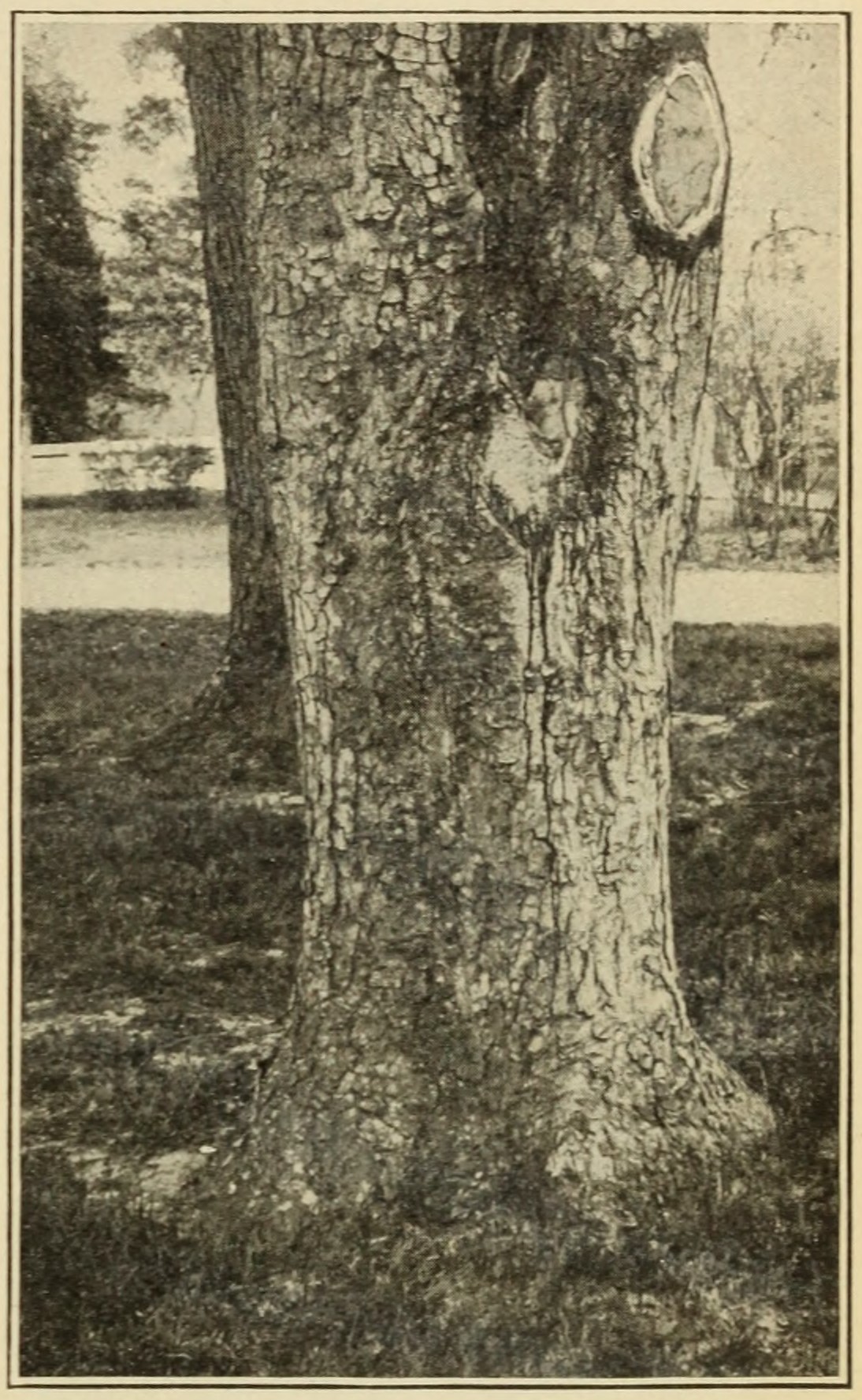
Fig.
32.
—Horse-chestnut (
Aesculus hippocastanum
), trunk.
Habitat and range.—This handsome tree is a native of Asia, largely cultivated in this country as an ornamental shade tree. In parts of New York and New Jersey it has escaped from cultivation.
Description of tree.—The horse-chestnut is a rather large tree, usually about 40 feet in height, and having many branches. Sometimes it will grow as tall as 100 feet. The bark has a brownish gray color, smoothish on the younger trees, but fissured and scaly on the older ones (fig. 32). The large, shining, resinous leaf buds are a prominent feature of the winter and early spring aspect of the tree. The leaves when mature are smooth, except perhaps for tufts of hairs on the veins of the lower surface, but the young unfolding leaf is quite hairy. The leaves are large, composed of 5 to 7 leaflets 4 to 8 inches long, pointed and broadest at the top and narrowing toward the base, with irregularly round-toothed margins (fig. 33).
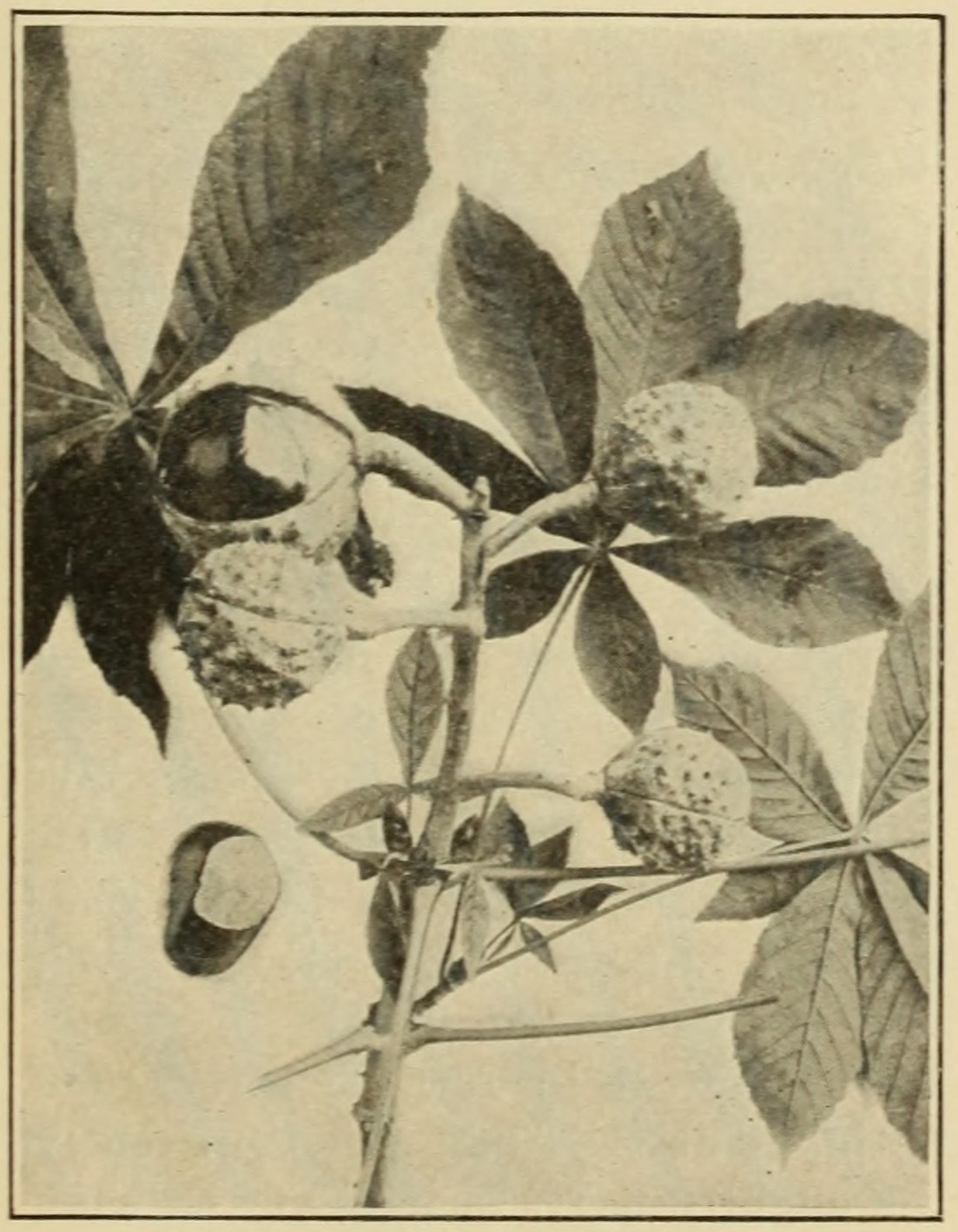
Fig.
33.
—Horse-chestnut (
Aesculus hippocastanum
), leaves and fruits.
The flower cluster, sometimes 1 foot in length, is most handsome and showy in appearance, consisting of a dense, somewhat pyramidal head of large white flowers, the petals fringed, wavy, and spotted with yellow and red, and having protruding stamens. They appear about June. The fruit is roundish and prickly, about an inch or so in diameter, and contains a large, shining brown nut (fig. 33). This tree belongs to the buckeye family (Aesculaceæ).
Other species.—The Ohio buckeye (Aesculus glabra Willd.), called also smooth buckeye and fetid buckeye, occurs in woods and along river banks from Pennsylvania south to Alabama, and westward to Michigan and the Indian Territory. It is a small tree, native in this country, and found in great abundance in Ohio. It gives off a fetid odor, and has leaves consisting of five ovate leaflets, and small insignificant yellow flowers. The bark and nut of this species are also employed in medicine, having properties similar to those of the horse-chestnut, but it is said that their action is more powerful.
Description of bark.—The horse-chestnut bark of commerce is thin, brownish gray on the outside, and with a few warty protuberances, leafscars, and lichens; the inside of the bark is smooth and whitish, and the whole breaks with a tough, fibrous fracture, showing a brownish color within. The bark has a faint, disagreeable odor, and a rough, bitter, astringent taste.
Collection, prices, and uses.—Horse-chestnut bark is collected in the autumn, and preference is given to the bark from the younger branches. From 1 to 4 cents a pound is the price paid to collectors.
This bark is used for its “tonic, astringent, febrifuge, narcotic, and antiseptic” properties. The nuts are said to have a narcotic action, and when powdered, excite sneezing.
The leaves are an old remedy in the treatment of whooping cough.
Cascara Sagrada.
Rhamnus purshiana DC.
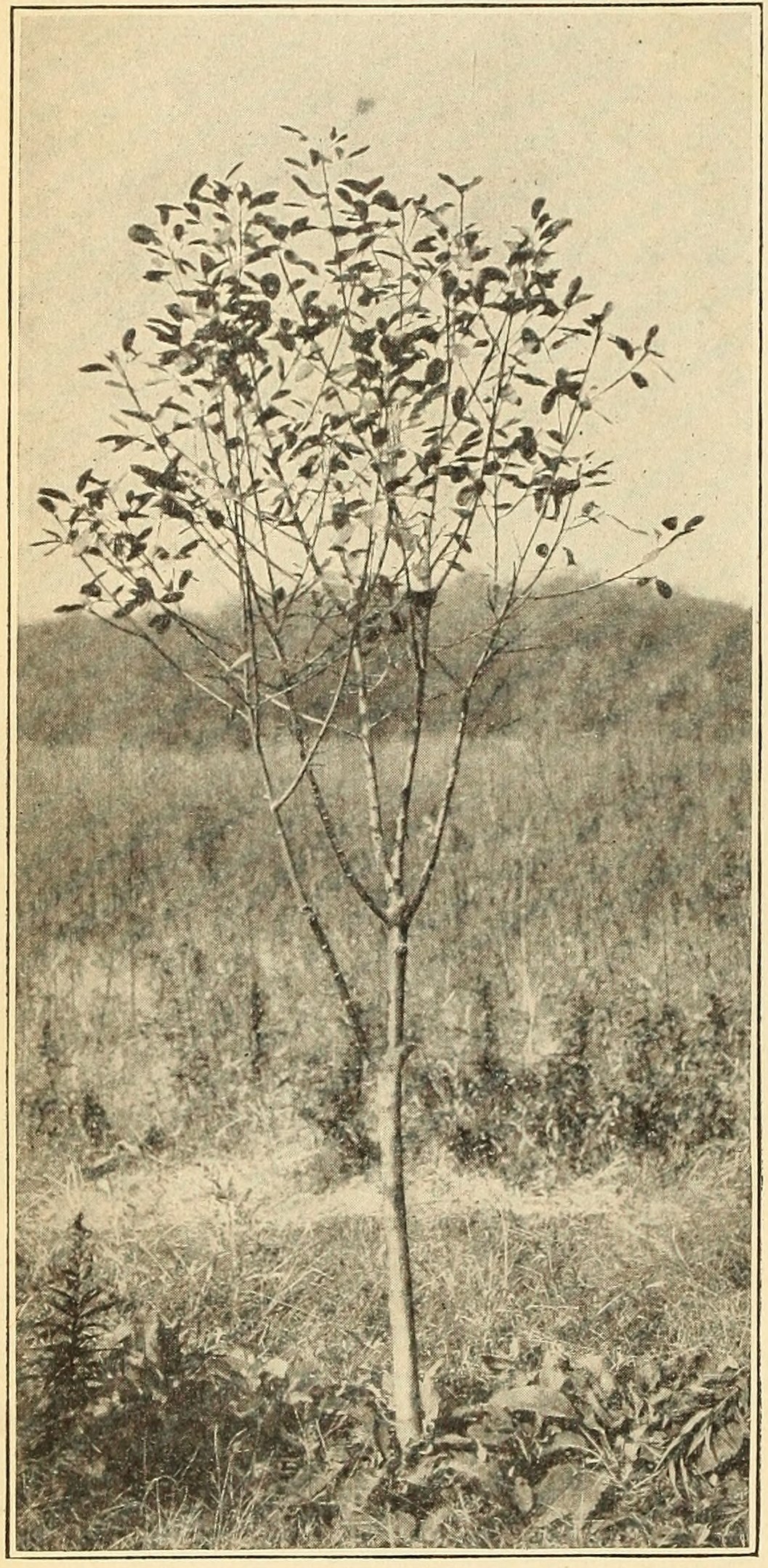
Fig.
34.
—Cascara sagrada (
Rhamnus purshiana
), five-year-old tree.
Pharmacopœial name.—Rhamnus purshiana.
Other common names.—Chittem-bark, sacred bark (a translation of the Spanish name “cascara sagrada”), bearberry-tree, bearwood, shittimwood, Purshiana bark, Persiana bark.
Habitat and range.—This indigenous tree occurs on the sides and bottoms of canyons from the Rocky Mountains to the Pacific Ocean, extending north into British America.
Description of tree.—The tree furnishing the cascara sagrada of the Pharmacopœia is of small size, usually from 15 to 20 feet in height (fig. 34), the young twigs hairy, and the leaves rather thin. It belongs to the buckthorn family (Rhamnaceæ). The dark green leaves are elliptical in form, from 2 to 6 inches long, and about 1 to 3 inches wide, blunt at the apex or with a short sharp point, finely saw toothed, rounded or slightly heart shaped at the base, somewhat hairy on the lower surface, and rather prominently veined (fig. 35).
The rather small, insignificant greenish flowers are produced in umbels, or clusters, and are followed by black, ovoid, 3-seeded berries, of a somewhat insipid taste (fig. 35).
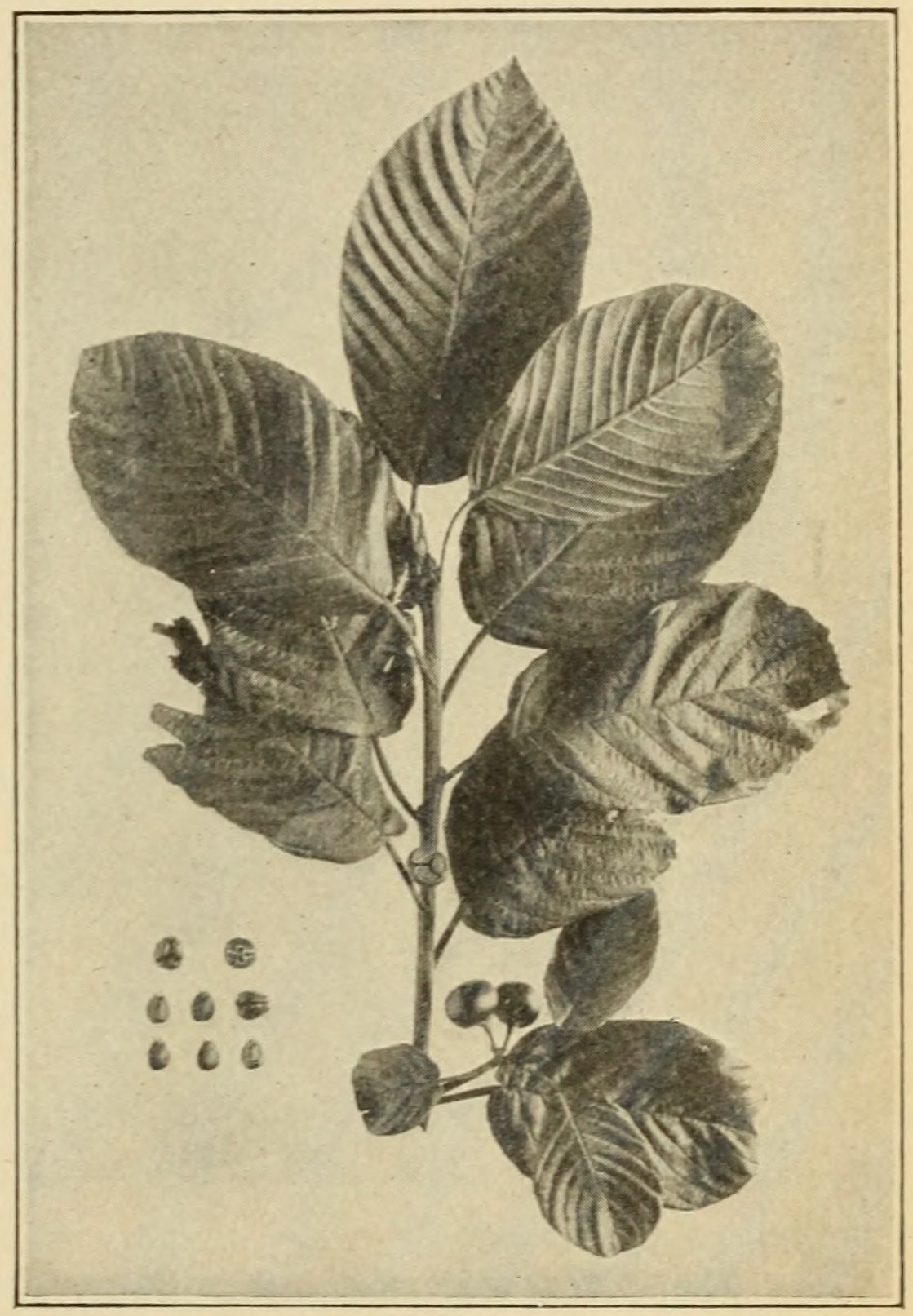
Fig.
35.
—Cascara sagrada (
Rhamnus purshiana
), leaves and fruits.
Another species.—Several species of Rhamnus occur in the cascara district, only one of which, however, may be said to enter into competition with the official cascara, and that is the one which is supposed to have been first introduced in medicine. It is known as wild coffee or coffee-berry (Rhamnus californica Esch.). At the present time, however, it is seldom collected, and then only because it may be mistaken by collectors for the official bark. According to the nineteenth edition of the United States Dispensatory (1907), R. californica “is chiefly distinguished from the official species by its leaves being thin, and when not smooth having a short close pubescence, and the primary veins of the under surface not nearly so numerous, straight, or fine as those of R. purshiana.” Rhamnus purshiana is abundant in the northern part of California and only sparingly found in the southern portion, whereas exactly the opposite is true of R. californica. Professor Rusby (United States Dispensatory, nineteenth edition, 1907) is of the opinion that as a further distinguishing mark in the leaves the channel of the midrib of R. californica is “altogether absent, or shallow, or inconspicuous.”
It is very difficult to distinguish the barks of these two species by their gross characters alone, but a microscopical examination will show structural differences sufficiently distinct to aid in the recognition of the barks.[5] In the powdered state the two species may be distinguished by means of color tests.[6]
Description of bark.—The cascara sagrada of commerce occurs in curved or quilled pieces, the outer surface of which is reddish brown, and usually covered with growths of light-colored or grayish lichen, wrinkled and somewhat fissured. The inner surface of the bark is smooth and marked with very fine lines; at first the inside is yellowish, but with age it turns a dark brown color. The whole breaks with a short, sharp, yellowish fracture, and has a somewhat aromatic odor and an exceedingly bitter taste. The saliva is colored yellow by it, and anything with which the bark comes in contact for any length of time will also be stained yellow. Cascara sagrada is official in the United States Pharmacopœia.
Collection, prices, and uses.—The collecting season for cascara opens about the end of May or early in June and closes about the end of August, just before the rainy season sets in, as bark collected after exposure to wet weather is difficult to cure properly.
After the strips of bark have been removed from the trees, they are generally strung on wires to dry, care being taken not to expose the inner surface to the sun, the object being to retain the yellow color, as the action of the sunlight tends to darken the color, an undesirable result, inasmuch as it lowers the market price. During the drying process the strips curl up, forming quills, and when sufficiently dried these are cut or broken up into smaller pieces.
Several years are generally required after collection to properly age the bark for medicinal purposes, and the United States Pharmacopœia directs that it should not be used until at least one year after it has been gathered. Some crude-drug dealers undertake the “aging” of the bark themselves rather than leave it to collectors.
Many trees are annually destroyed in the collection of cascara sagrada, as they are usually peeled to such an extent that no new bark is formed. It has been estimated that one tree furnishes approximately 10 pounds of bark, and granting a crop of 1,000,000 pounds a year, 100,000 trees are thus annually destroyed, and the world’s consumption is said to be about 2,000,000 pounds a year.
The price at present paid to collectors for cascara sagrada varies from 3 to 4½ cents a pound. On account of the fact that cascara sagrada requires several years’ aging before use, a shortage in the crop is not immediately felt.
Cascara sagrada is a most valuable laxative, differing from other drugs of this character in that it tones up the entire intestinal tract, making long-continued dosing or gradually increasing dosage unnecessary.
Cotton.
Gossypium hirsutum L. (“Gossypium herbaceum L.”)
Species.—According to the United States Pharmacopœia, cotton-root bark is obtained from “Gossypium herbaceum Linne,” or from “other cultivated species of Gossypium.”
For years the name Gossypium herbaceum has been used in botanical and other works as applying to American cotton, whereas it is really a name belonging to an Old World species, known as Levant cotton, cultivated in India and also in southern Europe, and it is stated that the American species evidently received the appellation herbaceum as a result of wrong identification by early American authors, and the assumption that it originated from European seed.[7]
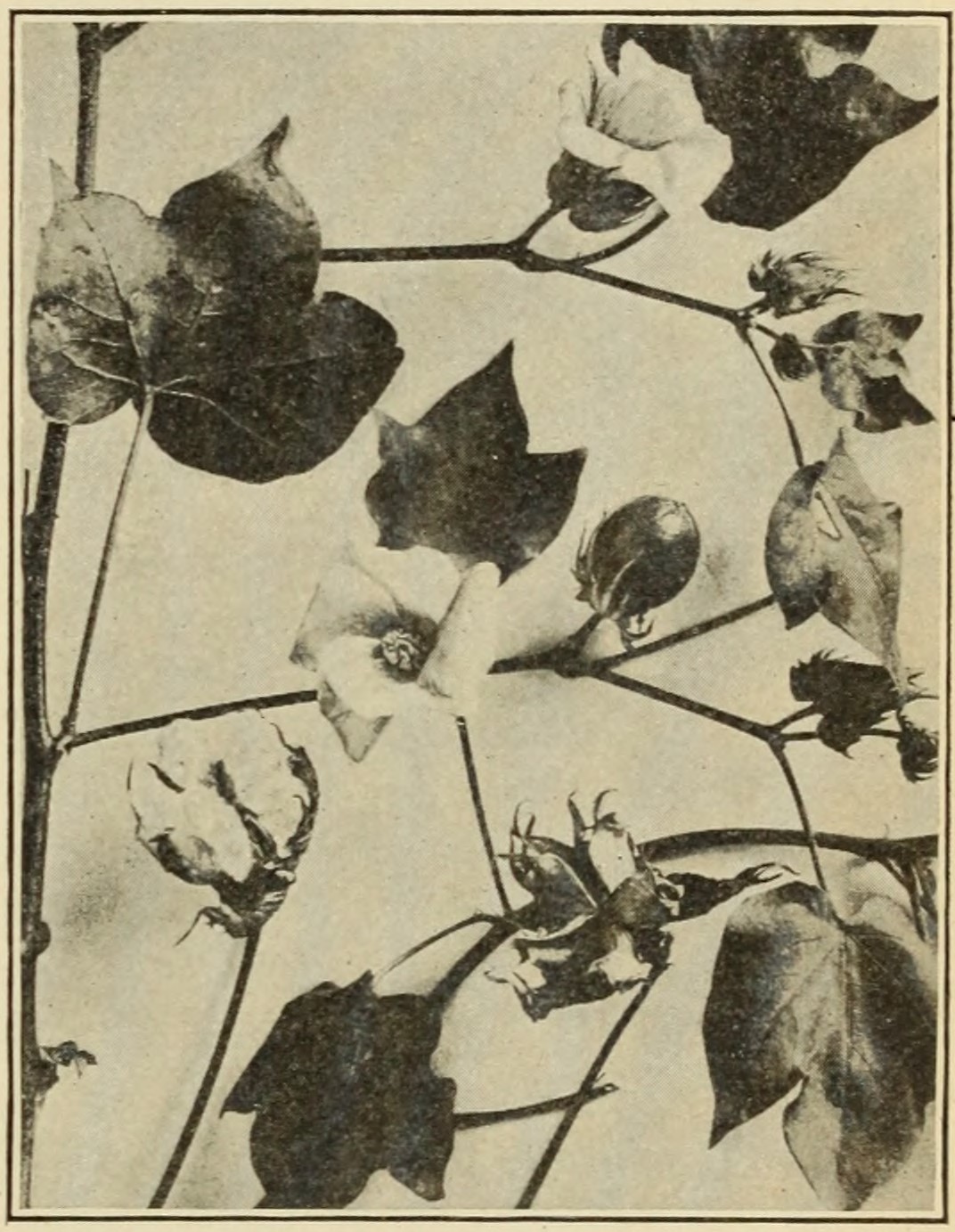
Fig.
36.
—Cotton (
Gossypium hirsutum
), leaves, flowers, and bolls.
American Upland cotton is the type most commonly cultivated in the South, from Virginia to Oklahoma and Texas, and this with its hundred or more recognized horticultural varieties all belong to one species, namely, Gossypium hirsutum L.,[8] and not to G. herbaceum, and as practically all of the supply of cotton-root bark of the United States is obtained in the United States, it can safely be asserted that Gossypium hirsutum L., and not G. herbaceum L., is the principal source of the bark found in the commerce of our country.
Description of plant.—The cotton plant in flower or with the bursting bolls showing the fluffy white fiber is very handsome. It belongs to the mallow family (Malvaceæ), and ranges from about 1 to 4 feet in height, with a woody and somewhat branching stem. The leaves of the American Upland cotton, Gossypium hirsutum, are 5 lobed, the lobes sharply pointed. The flowers when they first open are creamy white, later on turning purple, and the bracts are deeply cleft. The 4 to 5 celled cotton bolls are roundish oval, bluntly pointed at the top, green at first, but turning brown as they mature, bursting open (September to November in the Southern States), and disclosing the fine fiber that surrounds and completely hides the seeds, and which forms the “cotton” of commerce. (Fig. 36.) This cotton is picked from the bolls by hand, and sent to the cotton gins, where the seed is separated from the lint by machines known by that name. The seed, aside from its use for planting, is employed for fertilizing and feeding purposes, and an oil is also expressed therefrom.
Description of bark.—Cottonroot bark is official in the United States Pharmacopœia, and the article of commerce consists of long, thin bands, or quills, flexible, of a brownish yellow color on the outside, showing faint ridges and dots or lines. Sometimes the entire outer corky layer, which is thin, is wanting, or there are brownish orange patches where this thin layer has rubbed off or worn away. The inner surface of the bark has a whitish, silky, shining appearance, marked with fine lines. The long, tough bast fibers separate into papery layers. There is no odor, but a faintly acrid and astringent taste.
Collection, prices, and uses.—The roots are taken up as late as November or December, but before frost, washed, the bark removed with knives, and carefully dried. The fresh bark is regarded as more reliable than the old bark.
At present cotton-root bark is paid for at the rate of from 3 to 5 cents a pound.
This bark, with its emmenagogue and parturifacient properties, forms a valuable remedy in the hands of the physician.
The cotton (the hairs of the seed), freed from impurities and deprived of all fatty matter, is also official in the United States Pharmacopœia.
An oil is expressed from the seed, and various domestic uses have been made of the seed and also of the flowers and leaves.
Dogwood.
Cornus florida L.
Other common names.—Cornus, flowering dogwood, American dogwood, Virginia dogwood, Florida dogwood, boxwood, New England boxwood, false boxwood, American cornelian tree, flowering cornel, Florida cornel, white cornel, Indian arrowwood, nature’s-mistake.
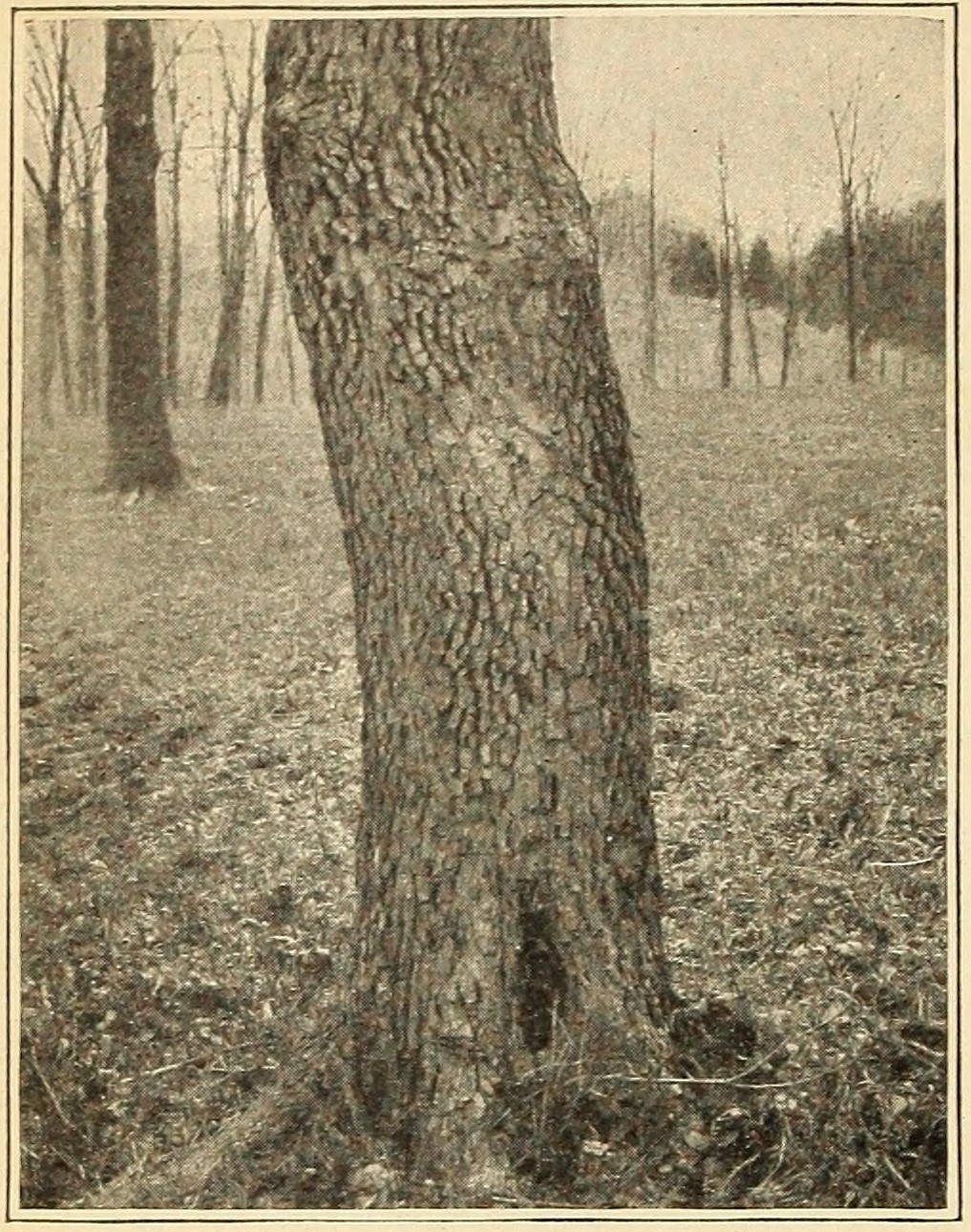
Fig.
37.
—Dogwood (
Cornus florida
), trunk.
Habitat and range.—Dogwood, native in this country, occurs in woods from Massachusetts and southern Ontario to Florida, Texas, and Missouri, but grows most abundantly in the Middle States.
Description of tree.—The dogwood, which belongs to the dogwood family (Cornaceæ), is never a large tree, its greatest height being 40 feet, and more frequently it occurs as a shrub. It is one of the most conspicuous trees in early spring, the naked, leafless branches supporting numerous large, showy white flowers, so called. The white, petal-like parts, however, which are the most showy portions, are in reality “bracts,” the “flowers” themselves being greenish yellow and inconspicuous, except for these four surrounding bracts. The four bracts, or petal-like parts, are white, sometimes pink tinged, of an inverted oval or heart shape, with prominent parallel veins, and peculiarly notched at the end, as though a piece had been torn or bitten out. (Fig. 38.)
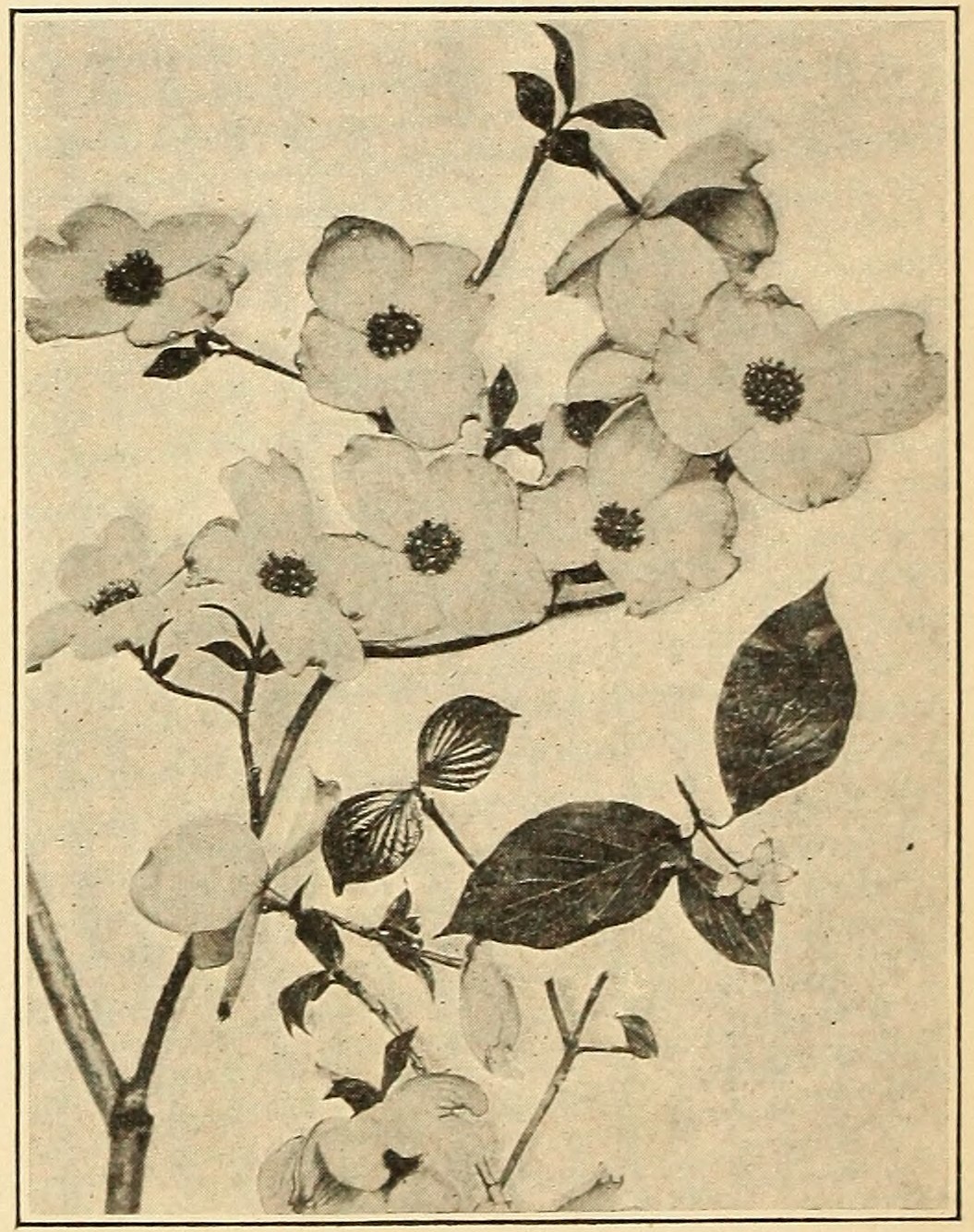
Fig.
38.
—Dogwood (
Cornus florida
), leaves, flowers, and fruits.
After the flowers have disappeared the leaves are put forth. These are generally oval, entire, from 3 to 6 inches in length, the upper surface dark green and smooth or only minutely hairy, while the under surface is lighter in color with slightly hairy veins. The leaves turn a bright red in autumn and with the scarlet fruit, or berries, form a very showy and attractive addition to the autumnal woods. (Fig. 38.)
The trunk of the dogwood is covered with a grayish brown, rough, and fissured bark (fig. 37), and the brown wood is hard and close grained.
Description of bark.—The root bark as found in the stores has had the fissured grayish brown outside layer removed and consists of short, reddish brown, curved pieces or chips about one-eighth of an inch in thickness. The inside is of a reddish purple color, with many short, broad grooves. The fracture is short. It has an astringent, bitter taste, but practically no odor.
Collection, prices, and uses.—Dogwood bark is collected from the root in the fall. It brings from 1 to 3 cents a pound.
It is used in medicine for its astringent, tonic, stimulant, and febrifuge properties and in the fresh state is said to be emetic. The root bark was official in the Pharmacopœia from 1830 to 1890. During the Revolutionary war it was much employed as a substitute for Peruvian bark or cinchona.
The flowers and fruits have properties similar to those of the bark.
Other species.—The bark of the swamp-dogwood (Cornus amomum Mill., syn., C. sericea L.), and the round-leaved dogwood (C. circinata L’Her.) are also used, being sometimes substituted for the flowering dogwood.
The swamp-dogwood, known also as red osier, silky cornel, rose-willow, blue-berried cornel, kinnikinnick, female dogwood, red-brush, red-rod, red willow, and squawbush, is a shrub native in low woods and along streams from Canada to Florida, west to Texas and the Dakotas.
The bark of this species, which was official from 1820 to 1880, is used like the flowering dogwood bark, but is said to be less bitter and astringent. It occurs in thin, quilled pieces, of a purplish brown color on the outside, with fewer warty excrescences than the following species, but otherwise similar. The price paid for this bark ranges from 4 to 6 cents a pound.
The round-leaved dogwood or cornel, called also green osier, is an indigenous shrub growing in shady places in Canada and the northeastern United States.
This bark is also used like that of the flowering dogwood, and was official from 1820 to 1880. It is said to possess less astringency than the flowering dogwood, but is more bitter. In commerce it is found in quilled or curved pieces, of a brownish gray or greenish color outside, with corky warts or marked with lengthwise lines, the inside brown. This also brings from about 4 to 6 cents a pound.
Moosewood.
Dirca palustris L.
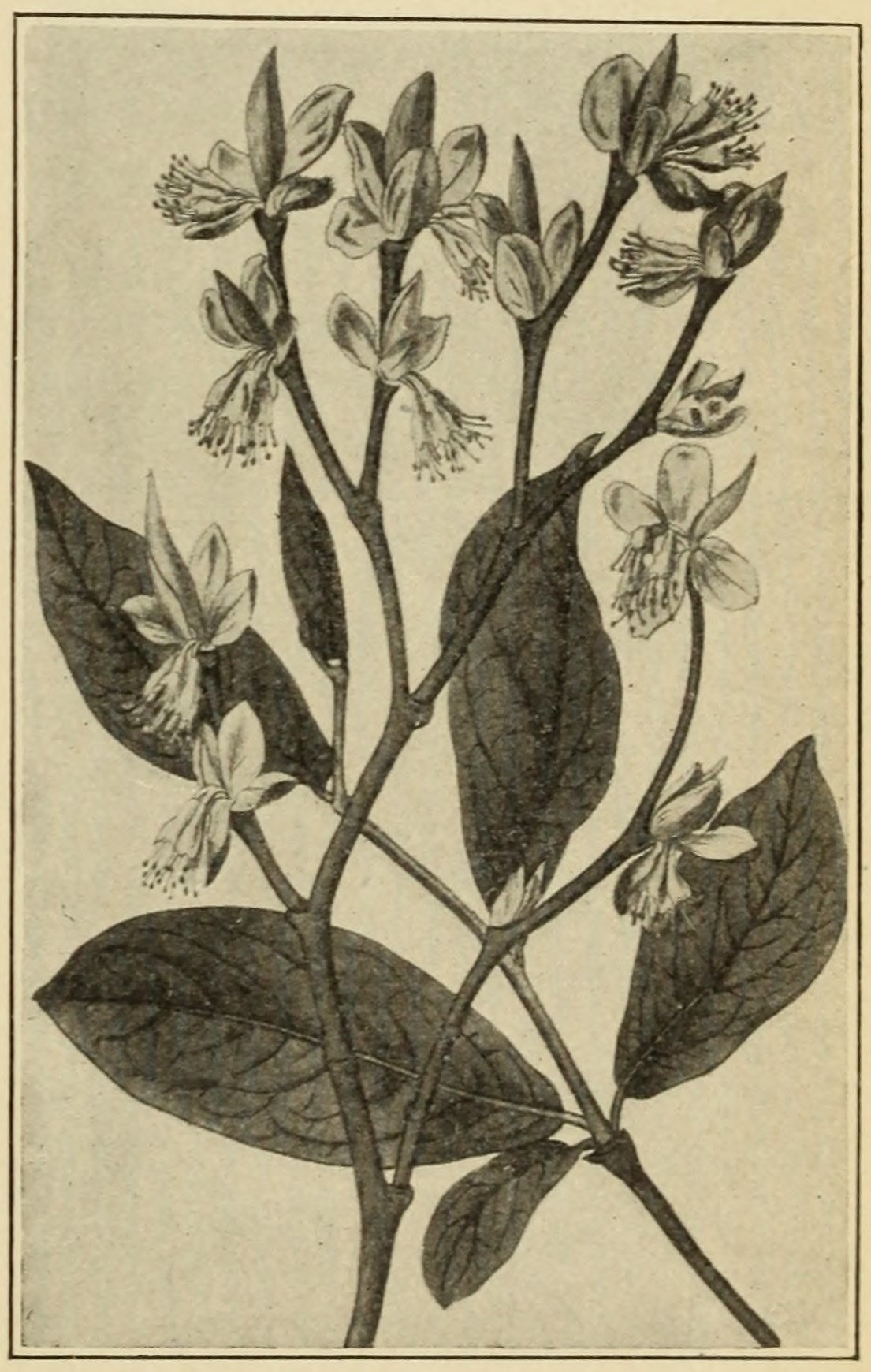
Fig.
39.
—Moosewood (
Dirca palustris
), leaves and flowers. (From Edwards’s Botanical Register.)
Other common names.—Dirca, American mezereon, leatherwood, leatherbush, leverwood, leaverwood, rope-bark, swampwood, wickopy, wickup.
Habitat and range.—This native shrub is found in wet woods and thickets from New Brunswick to Florida, west to Missouri and Minnesota, but is most common in the Northern and Eastern States.
Description of shrub.—The moosewood, a shrub belonging to the mezereon family (Daphnaceæ), is from 2 to about 6 feet in height, with tough, fibrous bark, and smooth, yellowish green twigs. The leaves, which are hairy when young, are oval with a blunt apex, rounded or narrowed at the base; they become smoother as they mature, and are from 2 to 3 inches long. The flower clusters are produced from April to May, from brown-hairy, scaly buds and consist of 2 to 4 yellowish, funnel-shaped flowers about one-half inch in length, with stamens and style protruding. (Fig. 39.) The one-seeded fruit, or berry, is small, red, oval oblong, and poisonous.
Description of bark.—Moosewood bark occurs in long, stringy, or quilled pieces, light brown or grayish brown on the outside, slightly wrinkled lengthwise, marked here and there with warty excrescences and an occasional patch of lichen growth, the inside straw colored and smooth. The bark is exceedingly tough and fibrous, and can not be broken. The odor is rather strong and aromatic, and the taste pungent and acrid.
Prices and uses.—Moosewood bark brings from 5 to 10 cents a pound.
It has emetic and laxative properties, and in decoction is used as a sudorific and expectorant. The fresh bark applied externally is very irritating to the skin, causing redness and blisters.
White Ash.
Fraxinus americana L.
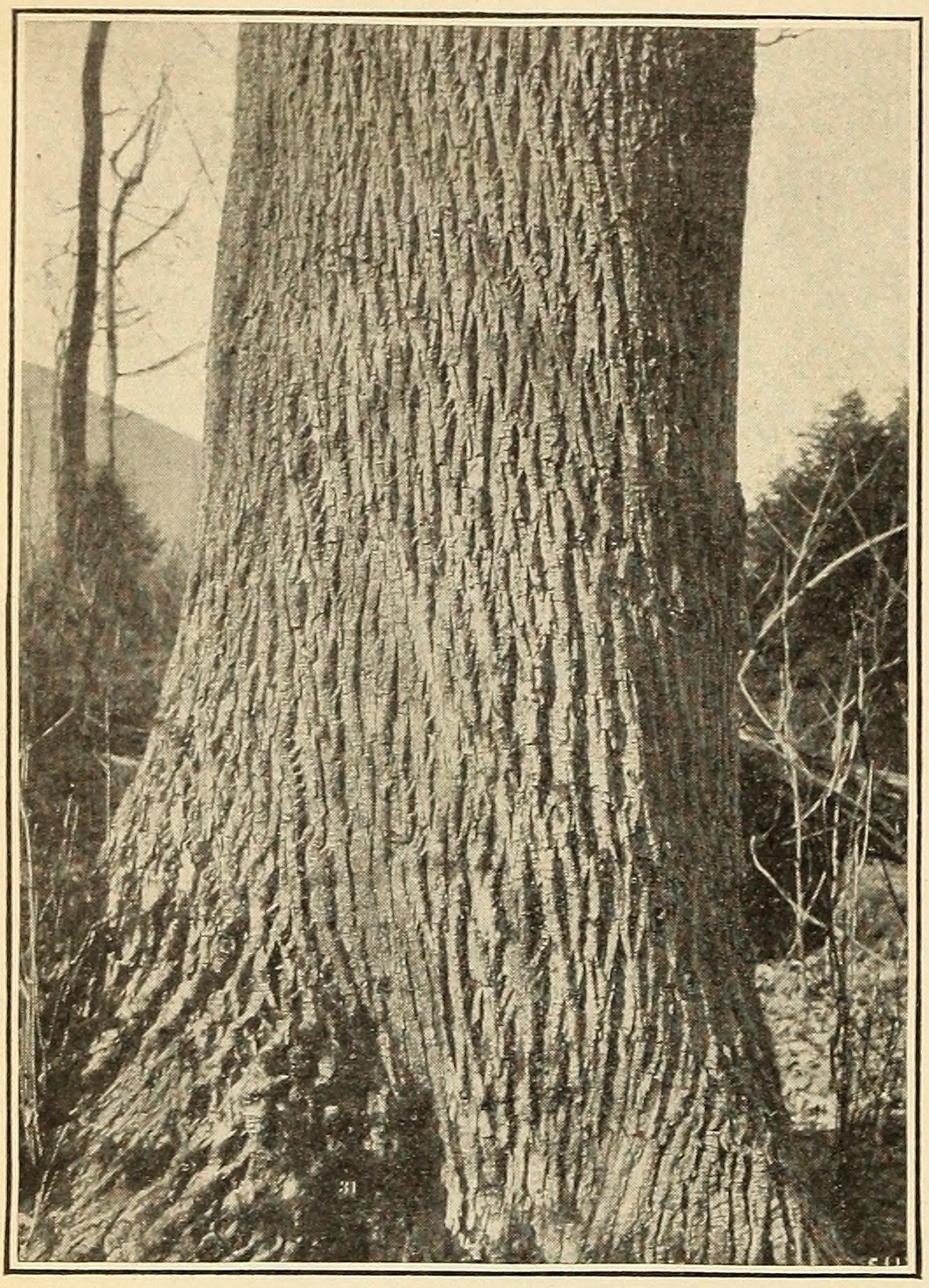
Fig.
40.
—White ash (
Fraxinus americana
), trunk.
Synonyms.—Fraxinus alba Marsh; Fraxinus acuminata Lam.
Other common names.—Ash, American white ash, cane-ash.
Habitat and range.—The white ash is native in rich woods, occurring from Nova Scotia to Minnesota, south to Florida and Texas, but chiefly in the Northern States and Canada.
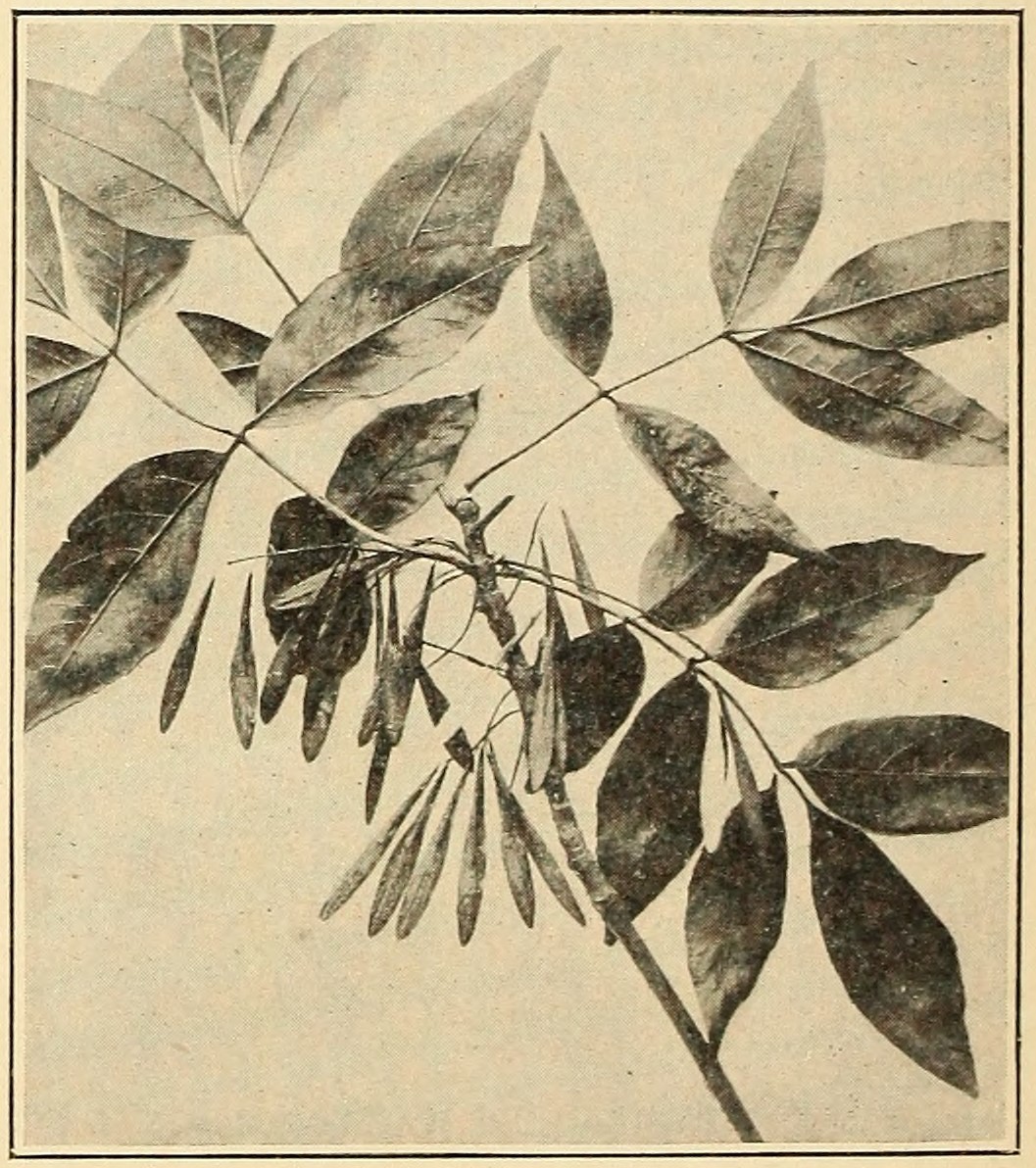
Fig.
41.
—White ash (
Fraxinus americana
), leaves and fruits.
Description of tree.—This tree, a member of the olive family (Oleaceæ), sometimes attains a height of 120 feet or so, usually, however, from 60 to 80 feet, the older trees with gray, deeply furrowed bark (fig. 40), and smooth, greenish gray branches. The leaf buds are rust colored, and the white ash is one of the latest trees to put out leaves in the spring. The leaves measure about 12 inches in length and consist of 5 to 9 leaflets; these are oval or lance-shaped oblong, the margins entire, the apex pointed, dark green above and pale green or silvery beneath, or sometimes hairy, 3 to 5 inches long, and somewhat less than half as wide (fig. 41). In autumn they change to yellow, mottled with green, and finally turn black. The small, whitish green flowers are arranged in loose clusters, appearing from about April to June, and the fruits which follow are in the form of clustered winged seeds, or “samaras” (fig. 41), which remain on the branches for a long time. Each samara is from 1 to 2 inches long, narrow, flat, and one seeded. The wood of white ash is brown, hard, and strong.
Description of bark.—The bark of white ash, as found in the stores, is whitish or inclined to yellowish brown, about one-fourth of an inch thick or less, the outside corky layer generally having been removed, but pieces of it often adhering. The inner surface is smooth and yellow. The fracture is very fibrous. White-ash bark has a faint aromatic odor and a bitter, acrid taste.
Collection, prices, and uses.—The bark of the root is preferred, although that from the trunk is also collected; the outer layer is usually removed. The amount at present paid for white-ash bark ranges from 3 to 5 cents a pound.
White-ash bark has been employed as an antiperiodic in intermittent fever, and is said to possess tonic and astringent properties. The leaves in infusion have been used in the treatment of gout and rheumatism.
Another species.—The black ash (Fraxinus nigra Marsh, syn., Fraxinus sambucifolia Lam.) is also a native, inhabiting swamps and wet woods from Canada to Virginia and Arkansas. Other names applied to it are hoop-ash, swamp-ash, water-ash, and basket-ash. Its maximum height is 100 feet, and its bark is darker gray and less fissured than that of the white ash, and its leaves are darker green. The leaves are about 16 inches in length, the 7 to 11 stemless leaflets perhaps a trifle paler green on the lower surface than above, and with rust-colored hairs on the midrib and veins of the lower surface. These leaflets are 3 to 6 inches long, narrow, oblong lance shaped, with long-pointed apex, the margins sharply toothed. The flowers appear from about April to May, and are followed by clusters of winged seeds, each flat, winged, linear-oblong fruit measuring from 1 to 1½ inches in length, narrow, with the winged portion extending all around the seed.
The bark, and also the leaves, are employed in medicine for similar purposes as those of the white ash. The bark brings about 3 to 5 cents a pound.
Fringe-Tree.
Chionanthus virginica L.
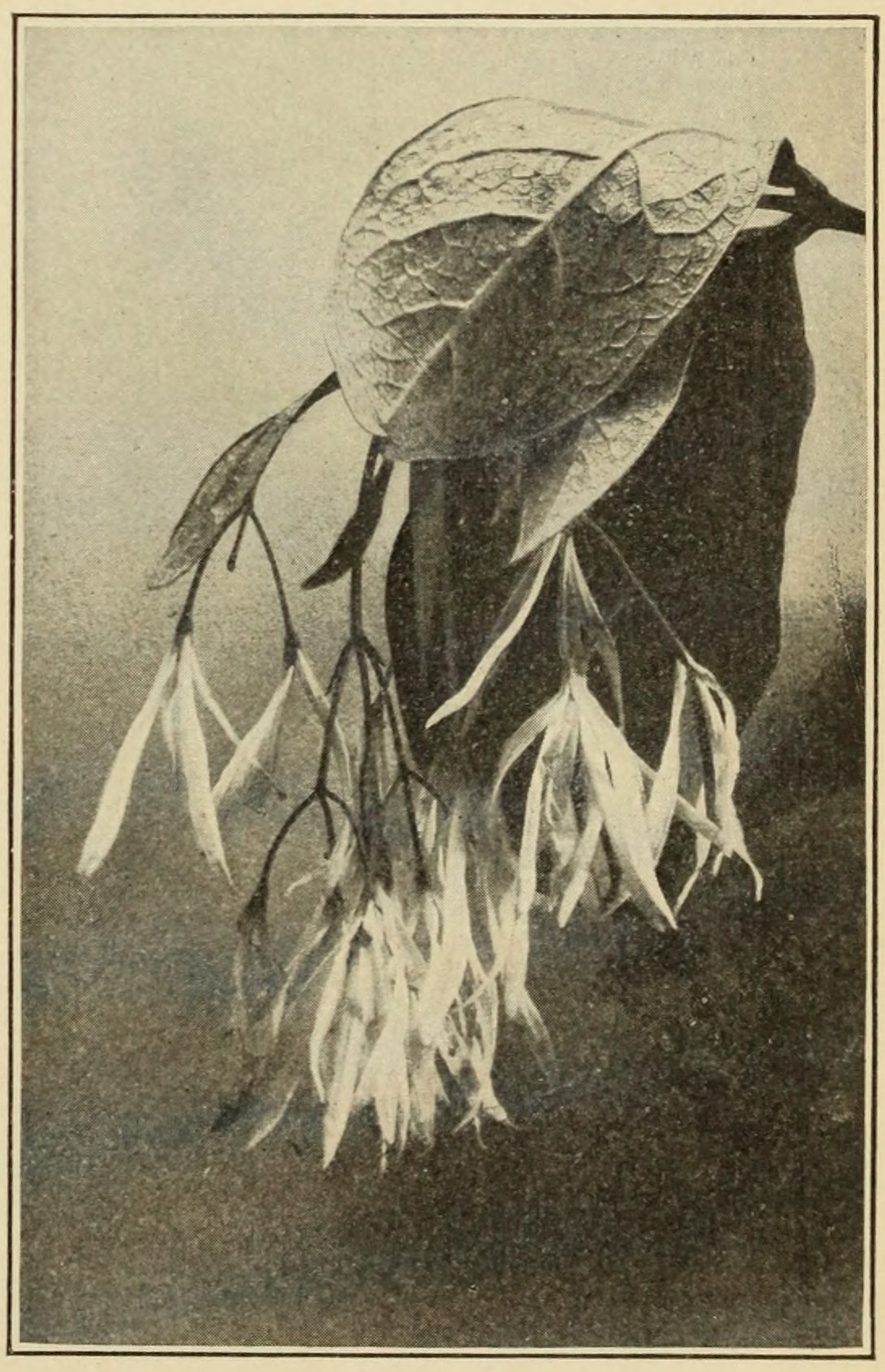
Fig.
42.
—Fringe-tree (
Chionanthus virginica
), leaves and flowers.
Other common names.—American fringe-tree, white fringe, flowering ash, poison-ash, graybeard-tree, old-man’s-beard, shavings, snowdrop-tree, snow-flower.
Habitat and range.—The fringe-tree is native in moist thickets and along streams from Delaware to Florida and Texas.
Description of shrub.—When in full flower this shrub or small tree, with its dense clusters of white, fringelike flowers, is very attractive, and is often cultivated for ornament. It is a member of the olive family (Oleaceæ), and is from 6 to 20 feet in height, the trunk covered with a light-colored bark, the leaves oval or oblong, of a leathery texture, and smooth. The flowers, which from their drooping character give a fringelike appearance, are produced in May and June, and are borne in dense clusters, each flower having four very narrow white petals about an inch in length. (Fig. 42.) The fruits which follow are fleshy, oval, and bluish black, containing a one-seeded nut.
Description of bark.—The bark of the root is the part employed in medicine, and it is in quilled or curved pieces of unequal size and shape, rather thick, the outside of a yellowish brown color, somewhat wrinkled, the inside yellowish brown or dark brown, marked with lengthwise lines. It breaks with a short, smooth fracture, and has but a faint odor.
Prices and uses.—At present collectors are paid from about 5 to 8 cents a pound.
It possesses tonic, febrifuge, and laxative properties, and is also said to have a narcotic action.
Bittersweet.
Solanum dulcamara L.
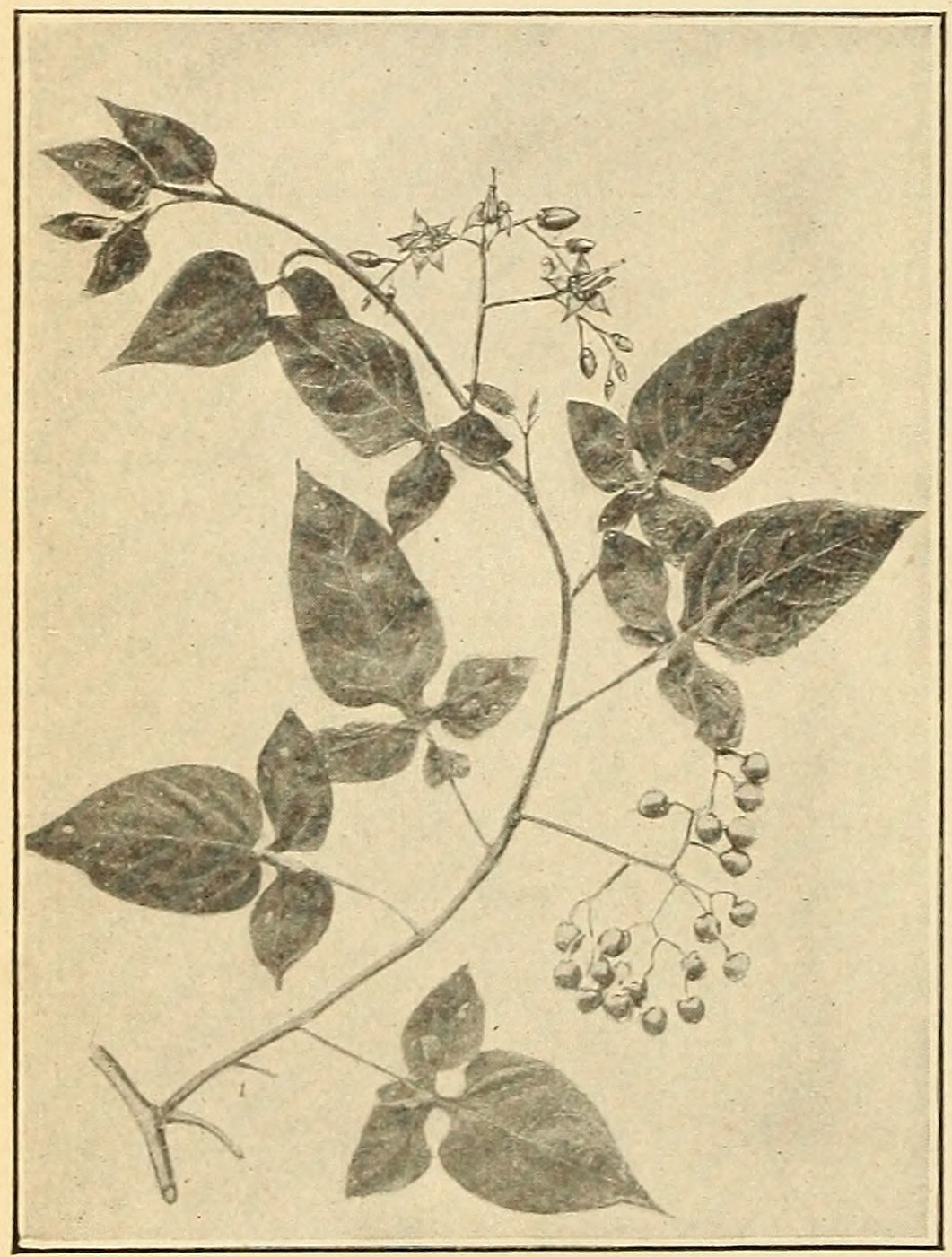
Fig.
43.
—Bittersweet (
Solanum dulcamara
), leaves, flowers, and fruits.
Other common names.—Dulcamara, nightshade, climbing nightshade, woody nightshade, amara-dulcis, fevertwig, violet-bloom, blue bindweed, felonwort, poison-berry, poison-flower, pushion-berry, morrel, snakeberry, wolf-grape, scarlet-berry, tether-devil, dwale, skawcoo.
Habitat and range.—Bittersweet has been naturalized from Europe, and occurs in low, damp grounds and moist banks of rivers from New Brunswick to Minnesota, south to New Jersey and Kansas.
Description of plant.—This climbing, shrubby perennial is often planted as an ornamental, and with its clusters of pretty purplish flowers and branches of berries ranging in color from green to yellow and orange, and finally red, occurring on the vine together, it makes a rather attractive showing. Bittersweet has a climbing, somewhat woody, branched stem, about 2 to 8 feet long, and oval leaves 2 to 4 inches long, pointed at the apex, and somewhat heart shaped at the base. Some of the leaves have one lobe at the base, some three lobes, while others are entire. The purplish flowers, resembling those of the potato (to which family, Solanaceæ, this plant belongs), are produced from about May to September, borne in compound lateral clusters. The fruits, or berries, which ripen in autumn, are oval, red, and juicy, and contain numerous whitish seeds. (Fig. 43.) The berries look very tempting, but they are poisonous, and children have been known to be poisoned by eating them.
Description of medicinal part.—The young branches of bittersweet are the parts employed in medicine, and were official in the United States Pharmacopœia for 1890. As found in commerce, they consist of cylindrical pieces of varying length and of not more than about one-fifth of an inch in thickness, with a greenish gray thin bark, marked with lengthwise lines. The woody portion is light, and the center is sometimes hollow, and sometimes shows a spongy pith. There is but a faint, somewhat narcotic odor, and the taste at first is bitter, then sweet—“bittersweet.”
Collection, prices, and uses.—Bittersweet branches are collected when they are only one or two years old and at a time when the leaves have fallen. The price paid ranges from 3 to 5 cents a pound.
Bittersweet is used for its diuretic and diaphoretic properties, and, according to the dose employed, has a quieting, hypnotic influence.
Buttonbush.
Cephalanthus occidentalis L.
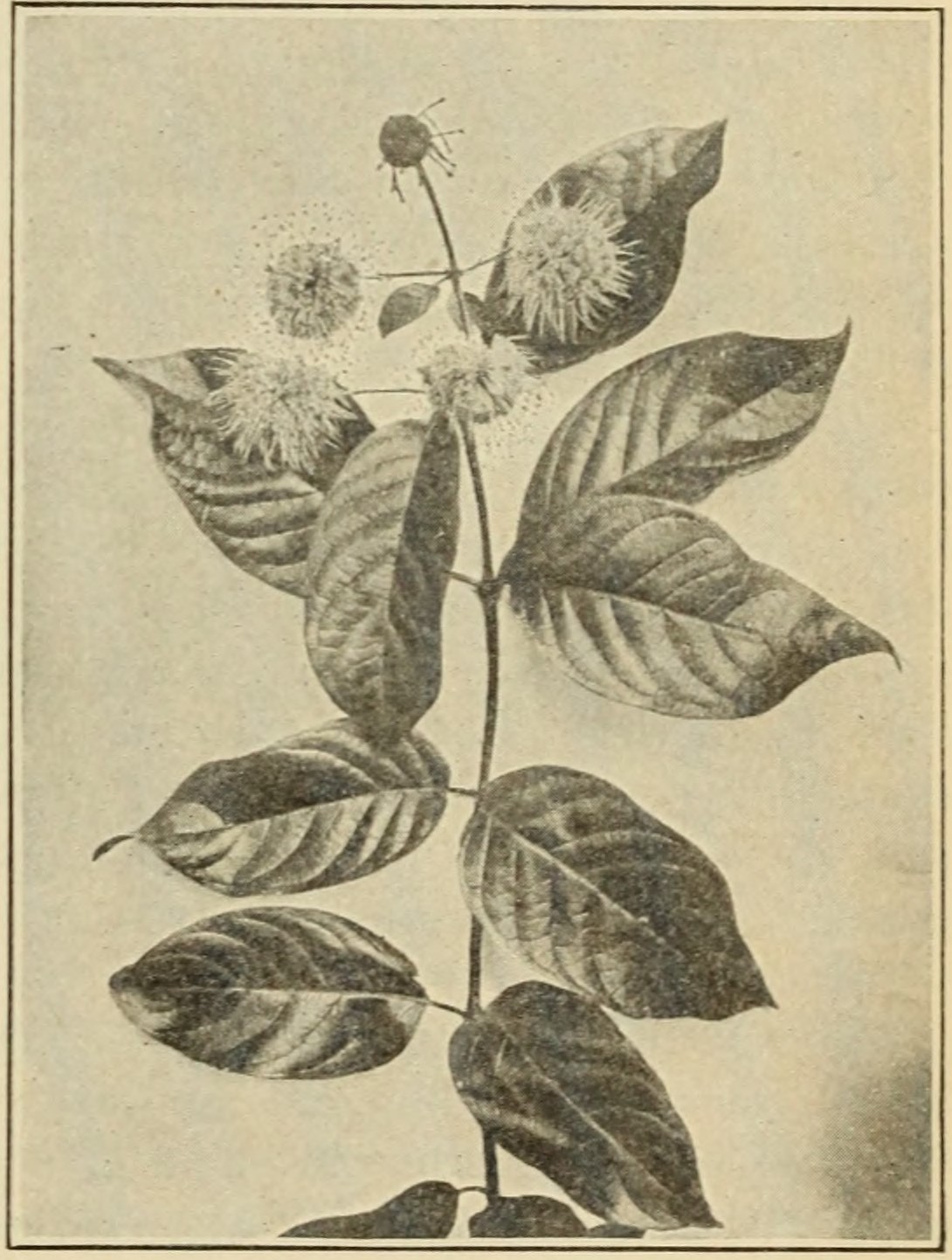
Fig.
44.
—Buttonbush (
Cephalanthus occidentalis
), leaves and flowers.
Other common names.—Buttonwood, buttonwood-shrub, button-tree, swamp-dogwood, pond-dogwood, swampwood, river-bush, honey-ball, pinball, whiteball, little snowball, globeflower, mountain-globeflower, crane-willow, wild licorice, crouper-bush.
Habitat and range.—The buttonbush is indigenous to this country, and flourishes in swamps or damp places from southern Canada to Florida and California.
Description of shrub.—This is usually a widely spreading shrub from 3 to 12 feet in height or occasionally a small tree, with large, shining, dark green leaves, and producing from June to September round heads of creamy white flowers, the protruding, threadlike styles with the small, knoblike stigmas giving them the appearance of inserted pins, whence the name “pinball.” The stems are covered with a rough yellowish bark, while the smaller branches are smooth and tinged with red. Some of the leaves are opposite, others ternate—that is, arranged in threes—and are ovate or ovate lance shaped, pointed, smooth, and glossy, with unbroken margins, and from 3 to 5 inches long. The flower heads, about 1 inch in diameter, consist of numerous creamy white, stemless flowers, densely crowded together in globular form, each flower having a funnel-shaped corolla with 4-toothed margin, from which the slender style with its globular stigma protrudes. (Fig. 44.) The small dry fruit is inversely pear shaped, splitting open into two to four cells, each containing one seed. The buttonbush belongs to the madder family (Rubiaceæ).
Description of bark.—The bark occurs commercially in small, curved pieces, smooth and grayish brown and marked with fine lines if taken from young trees, furrowed and scaly and of a dull gray color if collected from older trees. The inner root bark, which is also used, occurs in shorter pieces, and is of a reddish brown color. The inner surface of the bark is whitish and smooth, becoming a pale rust color when it is no longer fresh. It breaks with a tough, fibrous fracture, and has no odor, but a bitter and somewhat astringent taste.