Trees and Shrubs Furnishing Medicinal Barks. (continued 2)
Reading edition
Collection, prices, and uses.—The bark is collected from both stem and root. It brings about 7 cents a pound, but at present there seems to be no very great demand for it.
Buttonbush bark is used in fevers, and the inner bark is employed in coughs and as a diuretic.
Cramp-Bark Tree.
Viburnum opulus L.
Pharmacopœial name.—Viburnum opulus.
Other common names.—Cranberry-tree, high-bush cranberry, wild guelder-rose, gueldres-rose, cherry-wood, dog rowan-tree, whitten-tree, red elder, rose-elder, marsh-elder, water-elder, white elder, gadrise, gaiter-tree, gatten, love-rose, May-rose, pincushion-tree, squawbush, witch-hobble, witch-hopple.
Habitat and range.—This native shrub occurs in low rich woods and borders of fields from New Jersey, Michigan, and Oregon, northward.
Description of shrub.—The whitish flower heads of this species are borne on stems about 1 inch in length, and measure from 3 to 4 inches across; the flowers on the outside are large, sometimes an inch in diameter, and sterile (without stamens or pistils), while those on the inside of the flower cluster are considerably smaller and fertile. The cultivated variety of this species, the well-known ornamental “snowball” of the gardens, has all of its flowers sterile.
The cramp-bark tree grows from 8 to 10 feet high, with branches generally erect and smooth, and broadly oval, 3-lobed leaves. The leaves are usually smooth on the upper surface, but with the veins on the lower surface somewhat hairy, and the margins coarsely toothed. The showy white flower clusters appear about June. The red fruits, which ripen rather late in the season and remain on the bush for some time, are roundish or oval, sour, and contain a round, flat stone. As may be inferred from some of the common names applied to this shrub, the fruit in taste and appearance bears some resemblance to the cranberry. The cramp-bark tree is a member of the honeysuckle family (Caprifoliaceæ).
Description of bark.—Cramp bark, official in the United States Pharmacopœia under the name “Viburnum opulus,” is in transversely curved pieces, sometimes quilled, one-sixteenth of an inch or less in thickness, the outside grayish brown surface marked with lengthwise wrinkles and brown lenticels, and the inside pale brown, showing lengthwise lines. It breaks with a tough, fibrous fracture. There is practically no odor, and the taste is astringent and bitter.
Collection, prices, and uses.—Cramp bark is collected in the fall, and at present is paid for at the rate of about 2 to 4½ cents a pound.
Cramp bark, as this name indicates, is of use as an antispasmodic, and is also said to possess nervine, tonic, and astringent properties.
Black Haw.
Viburnum prunifolium L.
Pharmacopœial name.—Viburnum prunifolium.
Other common names.—Sloe, sloe-leaved viburnum, stagbush.
Habitat and range.—The black haw occurs in dry woods and thickets and on rocky hillsides from Connecticut to Florida, west to Michigan and Texas, but is found in greatest abundance in the South. It is indigenous to this country.
Description of shrub.—This shrub or small tree, from 10 to about 20 feet in height, has rather stout, spreading branches. The winter buds are small, short pointed, smooth, or sometimes with reddish hairs. Black haw has broadly oval or roundish-oval leaves, blunt or somewhat pointed at the top, 1 to 3 inches long, with a narrow or rounded base; they are nearly smooth, bright green, and have a finely toothed margin. The numerous stemless flower clusters are from 2 to 4 inches broad, composed of numerous white flowers appearing from April to June. The fruit, which is sweet and edible, is oval or somewhat roundish, about half an inch long, bluish black, covered with a bloom, and ripens in early autumn. It contains a somewhat flattened stone. (Fig. 45.)
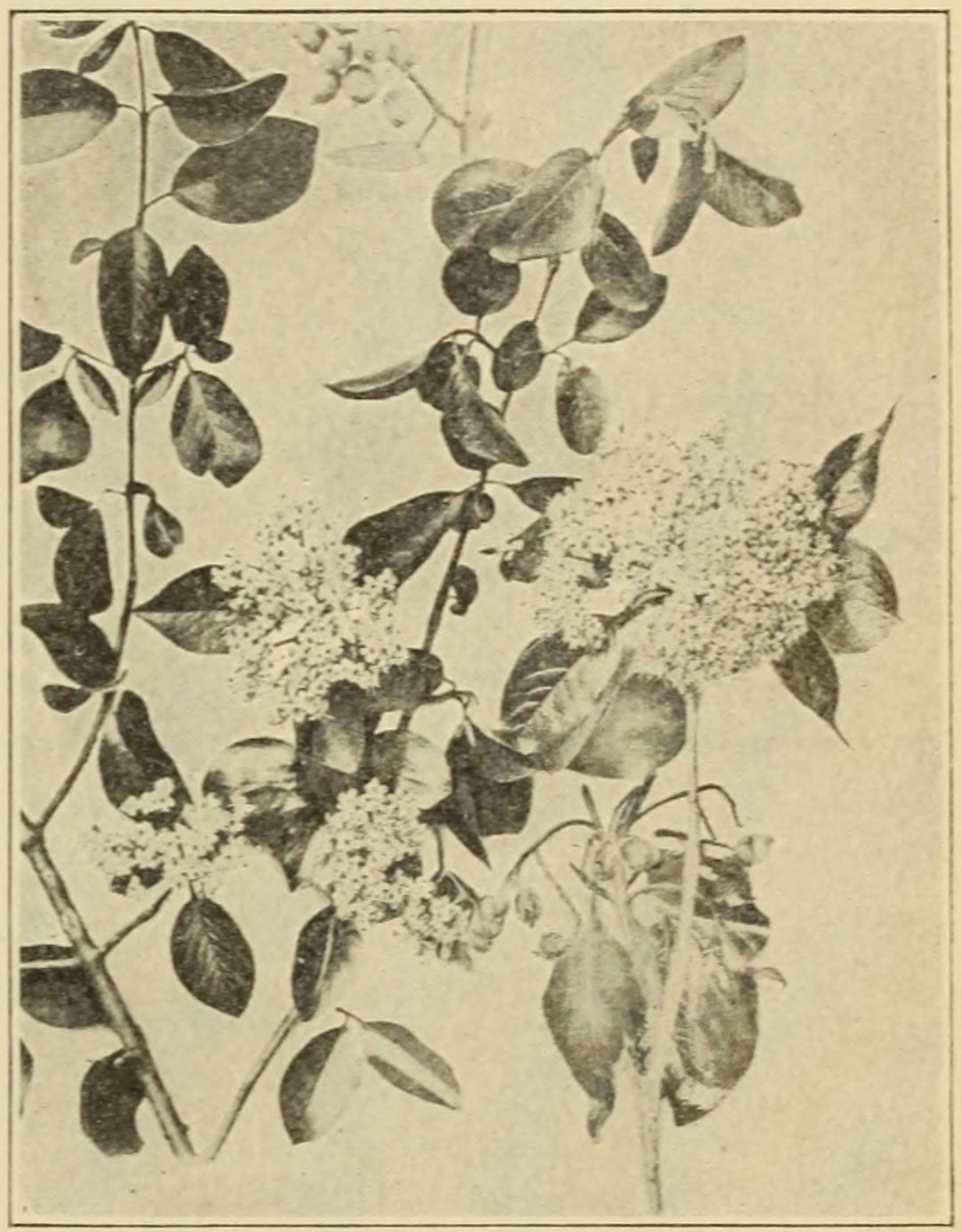
Fig.
45.
—Black haw and nanny-berry (
Viburnum prunifolium
and
V.
lentago
), leaves and flowers.
Description of bark.—The bark of the stem was formerly official, but now the dried bark of the root is the part prescribed by the United States Pharmacopœia, Eighth Decennial Revision. It is in irregular or quilled pieces, of a dull brown color on the outer surface, somewhat scaly and with shallow furrows; the inner surface reddish brown, and the whole breaking with a weak, short, uneven fracture. There is a faint peculiar odor, and a very bitter, somewhat astringent taste.
Collection, prices, and uses.—Black haw bark is collected in autumn. The present prices to collectors are from 3 to 8 cents a pound.
This bark has nervine, antispasmodic, tonic, and diuretic properties.
Another species.—The sweet viburnum (Viburnum lentago L.), known also as nanny-berry and sheepberry, is a species which is collected with prunifolium, and, with it, considered official. It grows in rich soil from Canada south to Georgia and Kansas.
Sweet viburnum is an indigenous shrub or small tree, sometimes as tall as 30 feet, and somewhat resembling prunifolium. The winter buds, however, are longer pointed and smooth, the leaves have longer slender stems and are oval, long pointed at the apex, and generally rounded at the base. They are from 2 to 4 inches long, smooth on both surfaces, and sharply toothed. The stemless flower clusters, 2 to 5 inches broad, appear about May, followed by the oval, bluish black, bloom-covered fruit, which matures about October, becoming sweet and edible. (Fig. 45.) The fruit sometimes remains on the shrub until the following spring. It contains a very flat, round or oval seed. Like the cramp-bark tree, the black haw and sweet viburnum both belong to the honeysuckle family (Caprifoliaceæ).
The bark of the sweet viburnum is also collected in autumn, and is used like prunifolium.