THE BROOKLYN BRIDGE AS A MONUMENT
Reading edition

THE total length of the bridge is 5989 feet, of which the central span between the towers is 1595 feet 6 inches, the “land spans” from the towers to the anchorages each 930 feet, the approach on the New York side 1562 feet 6 inches, and on the steeper Brooklyn side 971 feet. These dimensions do not make this the longest bridge in the world. But when it was built there was no single span which approached the central span over the East River; and though it has since been exceeded by two spans of the Forth Bridge, in Scotland (1710 feet each, sustained by cantilevers), it remains by far the largest example of a chain-bridge. It is half as long again as Roebling’s Cincinnati Bridge (1057 feet between towers), and nearly twice as long as the same engineer’s Niagara Bridge (821 feet). The span of the ill-fated bridge over the Ohio at Wheeling, which was built in 1848, and blown down in 1854, was 1010 feet. Noteworthy suspension-bridges in Europe are Telford’s, over the Menai Straits (589 feet), finished in 1825; Chaley’s bridge, at Fribourg (870 feet), finished in 1834; and Tierney Clark’s bridge over the Danube at Pesth (670 feet), finished in 1849. The longest spans bridged otherwise than by a roadway hung from cables are the central spans of Stephenson’s Britannia (box girder) Bridge (459 feet), of Eads’s St. Louis Bridge, of steel arches (520 feet), and of the beautiful Washington Bridge, of steel
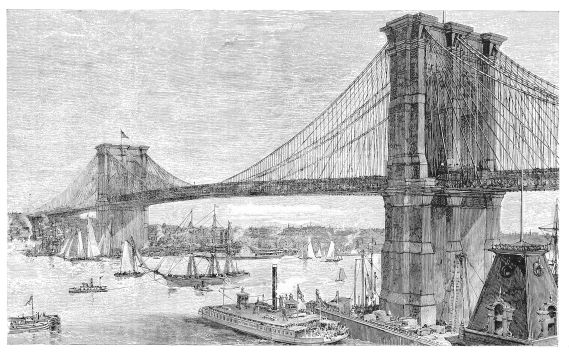
THE BRIDGE FROM THE BROOKLYN SIDE.
arches, at New York (510 feet). The largest span of an arch of masonry known to have been built in a bridge (251 feet) was in that built in the fourteenth century, and destroyed by Carmagnola in the fifteenth, which crossed the Adda at Trezzo. The largest now standing (220 feet) is an American work, the arch designed and built by General Meigs to carry the Washington Aqueduct over Cabin John Creek. The second is that of the Grosvenor Bridge at Chester (200 feet), and the third the central arch of London Bridge (152 feet).
The Brooklyn Bridge is thus one of the mechanical wonders of the world, one of the greatest and most characteristic of the monuments of the nineteenth century. Its towers, at least, bid fair to outlast every structure of which they command a view. Everybody recalls Macaulay’s prophecy of the time “when some traveller from New Zealand shall, in the midst of a vast solitude, take his stand upon a broken arch of London Bridge, to sketch the ruins of St. Paul’s.” But when our New-Zealander takes his stand above the saddles that are now ridden by the cables of the bridge, to look over the site of a forsaken city, there will be no ruins of churches—at least, of churches now in being—for him to sketch or see. The web of woven steel that now hangs between the stark masses of the towers may have disappeared, its slender filaments rusted into nothingness under the slow corrosion of the centuries. Its builders and the generation for which they wrought may have been as long forgotten as are now the builders of the Pyramids, whereof the traveller, “as he paceth amazedly those deserts,” asks the Historic Muse “who builded them; and she mumbleth something, but what it is he heareth not.” It is not unimaginable that our future archæologist, looking from one of these towers upon the solitude of a mastless river and a dispeopled land, may have no other means of reconstructing our civilization than that which is furnished him by the tower on which he stands. What will his judgment of us be?
This, or something like this, ought to be a question with every man who builds a structure which is meant to outlast him, whether it be a temple of religion or a work of bare utility like this. It so happens that the work which is likely to be our most durable monument, and to convey some knowledge of us to the most remote posterity, is a work of bare utility; not a shrine, not a fortress, not a palace, but a bridge. This is in itself characteristic of our time. It is true of no other people since the Romans, and of none before. Like the Roman remains, the duration of this work of ours will show that we knew how to build. “A Roman work,” we often hear it said of the bridge, and it is in many ways true. It is far beyond any Roman monument in refinement of mechanical skill. It is Roman in its massiveness and durability. It is Roman, too, in its disregard of art, in resting satisfied with the practical solution of the great problem of its builders, without a sign of that skill which would have explained and emphasized the process of construction at every step, and everywhere, in whole and in part, made the structure tell of the work it was doing. There have been periods in history when this æsthetic purpose would have seemed to the builder of such a monument as much a matter of course, as necessary a part of his work, as the practical purpose which animated the designer of the Brooklyn Bridge. It would have seemed so to the engineer of a bridge in Athens in the second century before our era, or to the engineer of a bridge in Western Europe in the thirteenth century of our era. The utilitarian treatment of our monument is as striking and as characteristic a mark of the period as its utilitarian purpose. It is a noble work of engineering; it is not a work of architecture.
The most strictly scientific of constructors would scarcely take the ground that he did not care how his work looked, when his work was so conspicuous and so durable as the Brooklyn Bridge, and he must be aware that a training in scientific construction alone will not secure an architectural result. It is more probable that he looks upon the current architectural devices as frivolous and irrelevant to the work upon which he is engaged, and consoles himself for his ignorance of them by contempt. Architecture is to him the unintelligent use of building material. Assuredly this view is borne out by a majority of the “architecturesque” buildings that he sees, and he does not lack express authority for it. Whereas the engineer’s definition of good masonry is “the least material to perform a certain duty,” Mr. Fergusson declares that “an architect ought always to allow himself such a margin of strength that he may disregard or play with his construction;” and Mr. Ruskin defines architecture to be the addition to a building of unnecessary features. An engineer has, therefore, some warrant for considering that he is sacrificing to the graces and doing all that can reasonably be expected of him to produce an architectural monument, if in designing the piers of a chain-bridge he employs an unnecessary amount of material and adds unnecessary features. But if we go back to the time when engineers were artists, and study what a modern scientific writer has described as “that paragon of constructive skill, a Pointed cathedral,” we shall find that the architecture and the construction cannot be disjoined. The work of the mediæeval builder in his capacity of artist was to expound, emphasize, and refine upon the work he did in his capacity of constructor, and to develop and heighten its inherent effect. And it is of this kind of skill that the work of the modern engineer, in so far as he is only an engineer, shows no trace.
Reduced to its simplest expression, and as it has actually been used for unknown periods in Asia and in South America, a suspension-bridge consists of two parallel ropes swung from side to side of a ravine, and carrying the platform over which the passenger walks. As the span increases, so that the dip makes the ropes impracticable, the land ends of the ropes are hoisted some distance above the roadway which they carry. If nothing can be found there strong enough to hold them, they are simply passed over, say, forked trees, and the ends made fast to other trees or held down with stones. This is the essential construction of the Brooklyn Bridge. The ropes become four cables sixteen inches thick, of 5541 steel wires; the forked tree becomes a tower 276 feet high, and 8260 square feet in area at the base; the bowlder to hold down the end of the rope becomes a mass of masonry of 60,000 tons’ weight; the shaky platform becomes a great street, 85 feet wide, of five firm roadways. But the man who first carried his rope over the forked tree was the inventor of the arrangement which, developed through all the refinements of modern mechanics, forms the groundwork of the Brooklyn Bridge.
This statement of the germinal idea of a chain-bridge will, perhaps, give a clearer notion of the functions of the several parts of the Brooklyn Bridge than a consideration of the complicated structure in its ultimate evolution, in which these functions are partly lost sight of. But if the structure had been architecturally designed, these things would have been emphasized at every point and in every way. The function of the great “towers,” so called, being merely to hold up the cables, it is plain that three isolated piers would have performed that
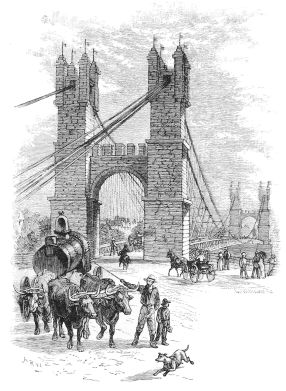
BRIDGE AT MINNEAPOLIS.
Thomas M. Griffith, Engineer.
function, and the stability of these piers, loaded as they are by the cables, would very possibly have been assured, even if they had been completely detached from each other. But in order at once to stiffen and to load them, so as to make the area of resistance to the force of the wind equal to the whole area of the towers, the openings through which the roadways run are closed above by steep pointed arches, and the spandrels of these filled with a wall which rises to the summit of the piers, where a flat coping covers the whole. There is a woful lack of expression in this arrangement. The piers should assert themselves starkly and unmistakably as the bones of the structure, and the wall above the arches be subordinated to a mere filling. It should be distinctly withdrawn from the face of the piers instead of being, as in fact it is, only distinguished from them by their shallow and ineffectual projections. It should be distinctly dropped below their summits instead of rising to the same height, and being included under a common cornice. To see what a difference in effect this very obvious differentiation of parts would have made, glance at the sketch of a suspension-bridge at Minneapolis. This is not, upon the whole, a laudable design, and it contains several survivals of conventional architectural forms meaningless in their present place. But the mere subduing of the archway to a strut between the piers explains—not forcibly, perhaps, nor elegantly, but unmistakably—the main purpose of the structure, and the functional relation of its parts. A drawing of one of the towers of the Brooklyn Bridge without its cables would tell the spectator nothing; the structure itself will tell our New-Zealander nothing of its uses. With its flat top and its level coping, indicating that the whole was meant to be evenly loaded, it would seem to be the base of a missing superstructure rather than what it is.
The flatness of the top alone conceals instead of expressing the structure. It is of the first practical necessity that the great cables should move freely in their saddles, so as always to keep the pressure upon the piers directly vertical, and very ingenious appliances have been employed to attain this end, and to avoid chafing the cables. But the design of the piers themselves
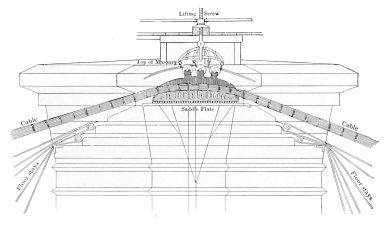
tells us absolutely nothing of all this. The cable simply disappears on one side and reappears on the other, as if it were two separate cables, one on each side, instead of one continuous chain. Look at this section of the top of the tower, and see how an exquisite refinement of mechanical arrangement may coexist with absolute insensibility to the desirableness even of an architectural expression of this arrangement. The architecture of this crowning member of the tower has nothing whatever to do with the purpose for which the structure exists. Is it not perfectly evident that an architectural expression of this mechanical arrangement would require that the line of the summit, instead of this meaningless flat coping, should, to begin with, be a crest of roof, its double slope following the line of the cable which it shelters? Here the very channel through which the cable runs is not designed, but is a mere hole occurring casually, and not by premeditation, in the midst of the mouldings which form the cornice of the tower. This is architectural barbarism.
Other opportunities offered for architectural expression in the towers themselves were in the treatment of the buttresses, in the treatment of the balconies which girdle the tower at the height of the roadway, and in the modelling of the arches. The girth of each of the towers at the water-line is 398 feet. At the roof-course it is 378 feet. The reduction is effected by means of five or six offsets, which withdraw each face of the tower four feet between the bottom and the top, and each end six feet. The counter-forts, eight in all, on the sides of the outer piers and on the faces of all the piers, are mere applied strips, very shallow in proportion to their width, and terminating in the capital-like projections which are casually pierced to receive the cables. It may make, perhaps, no serious difference in the mechanical efficiency of these counter-forts whether their area be narrow and deep or broad and shallow. But an increase of depth in proportion to width would of itself, with its higher lights and sharper shadows, have made forcible masses of what are now ineffectual features. This inherent effect would be very greatly enhanced if the offsets themselves were accentuated by sharp and decisive modelling. As it is, emphasis seems to have been studiously avoided. The offsets are merely long batterings of the wall, which do nothing to separate the piers into related parts with definite transitions, and so to refine the crudity of the masses. To see the difference between a mechanical and a monumental conception of a great structure, compare these towers with the front of Amiens, or of Strasburg, or of Notre Dame of Paris. Of course the designer of a modern bridge must not attempt to reproduce in his work “those misty masses of multitudinous pinnacle and diademed tower.” That would be a more fatal fault than the rudeness and crudeness with which we have to charge the design of the towers of the Brooklyn Bridge. The ornament of the cathedrals, so far as it is separable from their structure, has nothing for the designer of the bridge even of suggestion. But to see how masses may be modelled so as to be made to speak, look at the modelled masses of the tower of Amiens, the stark lines of essential structure framing the screen of wall between them, in contrast with the uniform deadness here of buttress and curtain wall; the crisp emphasis of lines of light and hollows of black shade which mark the transitions between parts of structure in the west front of Rheims, in contrast with the lack of emphasis in the offsets of the bridge tower; the spirit of the gargoyled balconies that belt the towers of Notre Dame, and the spiritlessness of the parapeted balconies that encircle the tower of the bridge. And note, too (we are not now speaking of the decoration of the cathedrals), that all this transcendent superiority arises merely from a development and emphasis of the inherent expression of the masses themselves, which in the bridge are left so crude, and in the cathedral towers are refined so far. It need not, and indeed should not, have been carried so far in this architecture of reason and utility as in the architecture of a poetical religion. The mere rudiments of those works would have furnished all the expression that is necessary or desirable here. But these rudiments are wanting. What can we say but that the designer of the cathedral began where the designer of the bridge left off? If our New-Zealander should extend his travels, and come upon these monuments also, what would be his surprise at finding documentary proof that the bridge was built six hundred years after the cathedrals, and that the generation which built the bridge looked backward and downward upon the generation which built the cathedrals as rude and barbarous and unreasoning in comparison with themselves!
What we have said of the towers is true also of the anchorages. The bowlder which the Peruvian rolls upon the end of his rope to hold it down is here a mass of 60,000 tons. Scientifically it is adjusted to its purpose, no doubt, with the most exact nicety. Artistically it is still but a bowlder rolled upon a rope. It would probably be impracticable to exhibit the anchor plate which takes the ultimate strain of this mile and more of cable, though we may be sure that our Greek or our Gothic bridge-builder would not have admitted its impracticability without as exhaustive an investigation as the modern bridge-builder has given to the mechanical aspects of his problem. But it was certainly practicable to indicate the function of the anchorage itself, to build it up in masses which should seem to hold the cable to the earth, or a double arch like—or rather unlike—the double arch of the main tower, turned between piers which should visibly answer the same purpose. Instead of either of these, or of any technical device for the same purpose, the weight above is a crude mass, so far from being adapted to its function in its form, that one has to look with some care to find it from the street below, and to distinguish it from the approaches.
What we have called the balconies at the level of the roadway are not “practical” balconies, since they open from the driveways, and not from the walk, and are not accessible as points of view. The purpose of a projection at this point is to secure as great a breadth as possible for the system of wind-braces under the floor of the bridge. This purpose is attained by the projection, but is only masked by the imitations of balconies, instead of being architecturally expressed, as it might have been unmistakably expressed, by the bold projection of a granite spur from the angle of the pier.
There are, probably, few arches in the world—certainly there can be none outside of works of modern engineering—of anything like the span, height, thickness, and conspicuousness of those in the bridge towers which are so little effective. Like the brute mass of wall above them, they are impressive only by magnitude. The great depth of the archway is only seen as a matter of mensuration, not felt as a poetical impression, as it would have been if the labors of the constructor had been supplemented by the labors of an artist; if the shallow strips of pier had become real buttresses, and the jamb and arch had been narrowed by emphatic successions of withdrawal, instead of being merely tunnelled through the mass; if the intrados of the arch itself had been accentuated by modelling, instead of being weakened by the actual recession of its voussoirs behind the plane of the wall.
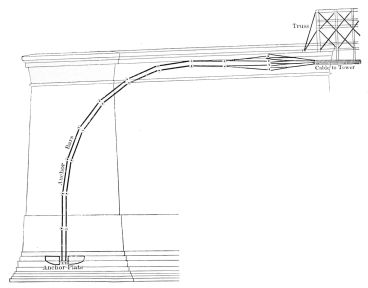
SECTION OF TOP AND BACK OF ANCHORAGE.
(SIDE VIEW.)
The approaches themselves are greatly impressive, as indeed the towers are also, by magnitude and massiveness. The street bridges are uniformly imposing by size and span, and especially attractive also by reason of the fact that through them we get what is to be got nowhere else in our rectangular city, glimpses and “bits” of buildings. The most successful of them all, and the most successful feature architecturally of all the masonry of the bridge, is the simple, massive, and low bridge of two arches which spans North William Street, in New York. The arcades between the streets are imposing by number and repetition as well as by massiveness, and by the Roman durability which marks all the work. They suffer, however, from two causes. The coping, the arches, and the piers, which are the emphatic parts of structure, are lighter in color than the unemphasized and rock-faced fields of the wall, and this is always a misfortune when it is not an error. The arches are of the form called “Florentine”—that is to say, round within and pointed without. The deepest voussoirs are thus those at the crown of the arch. This is the reverse of the disposition which would be dictated by mechanical considerations alone. Architecturally it has the drawback of interrupting at every arch the successive and diminishing wheelings which make a long arcade of great openings so impressive in a perspective view. The form seems to have been chosen on account of the facility it afforded, by lengthening the upper voussoirs, to conform the ridge line of the arches to the slope of the roadway, while keeping the springing line horizontal. This gradual diminution of the arches shoreward enhances the apparent length of the approach looking in that direction, but correspondingly shortens it looking towards the bridge; and it seems, upon the whole, that it would have been better to carry the arches through level, without attempting to dissemble the difference between their line and that of the roadway. There are some shabby and flimsy details of iron work, which mar the monumental effect of the great roadway itself, while the design of the iron stations at either end is grossly illiterate, and discreditable to the great work. Imitations in cast iron of stone capitals surmount and emphatically contradict posts profusely studded with bolt-heads; and other solecisms, alike against constructional reason and architectural tradition, are rife in these unfortunate edifices, which do what they can to vulgarize the great structure to which they give access.
Vulgarity certainly cannot be charged against any integral portion of the great work itself. There is nothing frivolous and nothing ostentatious even in the details which we have noted, and in which we have not been so much criticising the crowning work of a great engineer’s career as noting the spirit of our age. It is scarcely fair to say, even, as was said by an architectural journal when the completion of the bridge was doubtful, that if it were left incomplete its towers would stand “in unnecessary ugliness.” Its defects in design are not misdeeds, but shortcomings. They are the defects of being rudimentary, of not being completely developed. The anatomy of the towers and of the anchorages is not brought out in their modelling. Their fingers, so to speak, are all thumbs. Their impressiveness is inherent in their mass, and is what it could not help being. The ugliest of great bridges is undoubtedly Stephenson’s Britannia Bridge; and this is ugly, not because it is square and straight, but because it tells nothing of itself. It is a mere flat surface, and almost absolutely inexpressive, compared, for example, with such a piece of iron-work as the truss which carries the roadway of the bridge over Franklin Square, in which the function of every joint and member is apparent. But a far nobler thing than this is the central span of the great bridge itself, its roadway slowly sweeping upward to meet the swift swoop of its cables. We have complained of the lack of expression in the towers of their anatomy, but this is anatomy only, a skeletonized structure in which, as in a scientific diagram, we see—even the layman sees—the interplay of forces represented by an abstraction of lines. What monument of any architecture can speak its story more clearly and more forcibly than this gossamer architecture, through which its purpose, like “the spider’s touch”—
“So exquisitely fine, Feels at each thread, and lives along the line”?
This aerial bow, as it hangs between the busy cities, “curving on a sky imbrued with color,” is perfect as an organism of nature. It is an organism of nature. There was no question in the mind of its designer of “good taste” or of appearance. He learned the law that struck its curves, the law that fixed the strength and the relation of its parts, and he applied the law. His work is beautiful, as the work of a ship-builder is unfailingly beautiful in the forms and outlines in which he is only studying “what the water likes,” without a thought of beauty, and as it is almost unfailingly ugly when he does what he likes for the sake of beauty. The designer of the Brooklyn Bridge has made a beautiful structure out of an exquisite refinement of utility, in a work in which the lines of forces constitute the structure. Where a more massive material forbade him to skeletonize the structure, and the lines of effort and resistance needed to be brought out by modelling, he has failed to bring them out, and his structure is only as impressive as it needs must be. It has not helped his work, as we have seen, to trust his own sense of beauty, and to contradict or to conceal what he was doing in accordance with its dictates. As little would it have helped him to invoke the aid of a commonplace architect to plaster his structure with triglyphs or to indent it with trefoils. But an architect who pursued his calling in the spirit and with the skill of the mediæval builders of whom we have been speaking, who knew in his province the lesson the engineer has re-enforced in his, that “Nature can only be commanded by obeying her,” and that the function of an organism, in art as in nature, must determine its form—such an architect might have helped the designer of the Brooklyn Bridge to make it one of the noblest monuments of architecture in the world, as it is one of the greatest and most honorable works of engineering.