THE VALLEY OF THE DELAWARE.
Reading edition
III.
THE VALLEY OF THE DELAWARE.
Delaware Bay—Cape May—Cape Henlopen—Delaware Breakwater—Maurice River Cove—The Pea Patch—Newcastle—Mason and Dixon's Line—Fort Christina—Wilmington—The Duponts—Brandywine—William Penn—West Jersey—Pennsylvania—Upland—The Ship "Welcome"—Philadelphia—Shackamaxon—The Lenni Lenapes—The City Hall—Independence Hall—Benjamin Franklin—Betsy Ross and the American Flag—Stephen Girard—Girard College—Notable Charities and Buildings—Christ Church—Old Swedes' Church—Longfellow's Evangeline—Cathedral of St. Peter and St. Paul—University of Pennsylvania—City of Homes—John Bartram and his Garden—Fairmount Park—Laurel Hill—Wissahickon Creek—Germantown—Johannes Kelpius—The Schuylkill River—Tom Moore—Pennsylvania Dutch— Valley Forge—Reading—Port Clinton—Pottsville—Anthracite Coal-fields—New Jersey Coast Resorts—Atlantic City—Ocean Grove—Asbury Park—Long Branch—St. Tammany—Poquessing—Rancocas—The Neshaminy—The Log College—Bristol—Burlington—Pennsbury Manor—Bordentown—Admiral Stewart—Joseph Bonaparte—Camden and Amboy Railroad—Delaware and Raritan Canal—Trenton Gravel—Trenton, its Potteries, Crackers and Battle—The Swamp Angel—Morrisville—General Moreau—Princeton and its Battle—General Mercer—Princeton University—Jonathan Edwards—Marshall's Walk—Pennsylvania Palisades—Forks of the Delaware—Easton—Lafayette College—Ario Pardee—Phillipsburg—Morris Canal—Lake Hopatcong—Lehigh River—Bethlehem—Lehigh University—The Moravians—Count Zinzendorf—Teedyuscung—Allentown—Lehigh Gap—Mauch Chunk—Asa Packer—Coal Mining—Summit Hill—The Switchback—Nescopec Mountain—Wyoming Valley—Wilkesbarre—Harvey's Lake—Scranton—Wyoming Massacre—The Foul Rift—The Terminal Moraine—The Great Glacier—Belvidere—Delaware Water Gap—The Wind Gap—Minsi and Tammany—The Minisink—The Buried Valleys—Nicholas Depui—George La Bar—Stroudsburg—Pocono Knob—Bushkill—Walpack Bend—Pike County—Dingman's Choice—Waterfalls—Milford—Tom Quick, the Indian Killer—Tri-States Corner—Neversink River—Port Jervis—Delaware and Hudson Canal—High Point—The Catskill Flags—Hawk's Nest—Shohola—The Lackawaxen and its Battle—The Sylvania Society—Horace Greeley—Blooming Grove—Pocono High Knob—Hawley—The Wallenpaupack—The Indian Orchard—Honesdale—Washington Irving—The Gravity Railroad—Carbondale—Mast Hope—Narrowsburg—Cochecton—Hancock—Delaware Headwaters—Popacton River—Mohock River—Deposit—Oquaga Creek and Lake—Lake Utsyanthia—Ote-se-on-teo, Source of the Delaware.
DELAWARE BAY.
The famous navigator of the Dutch East India Company, Hendrick Hudson, was the first white man who entered Delaware Bay. He discovered it on August 28, 1609, two weeks before he entered Sandy Hook Bay and found the Hudson River. When Thomas West, Lord De La Warr, Governor of Virginia, was driven by stress of weather into the bay in 1611, his name was given the river. In 1614 another redoubtable old skipper of the Dutch East India Company, Captain Carolis Jacobsen Mey, searching, like all the rest of the navigators of those days, for the northwest passage to Asia and the Indies, came along there with a small fleet of sixty-ton frigates, and tried to give the river and its capes his names; but only one of these has survived, Cape May. The southern portal at the entrance, which he wished to make Cape Carolis, was named a few years afterwards, by the Swedes, Cape Henlopen. The Indians called the river "Lenape-wihituck," or the "river of the Lenapes," meaning "the original people," or, as sometimes translated, the "manly men," the name of the aboriginal confederation that dwelt upon its banks. It had various other names, for when the Swedes came, the Indians about the bay called it "Pantoxet." In an early deed to William Penn it is called "Mackeriskickon," and in another document the "Zunikoway." Some of the tribes up the river named it "Kithanue," meaning the "main stem," as distinguished from its tributaries, and those on the upper waters called it the "Lemasepose," or the "Fish River," for the Upper Delaware was then a famous salmon stream, and its early Dutch explorers thus came to calling it the "Fish River" also. The Delaware, from its source in the Catskills to the sea, is about three hundred and sixty miles in length.
The estuary of Delaware Bay is about sixty miles long and thirty miles broad in the widest part, contracting towards the north to less than five miles. The capes at the entrance are about fifteen miles apart. As a protection to shipping, the Government began, on the Cape Henlopen side, in 1829, the construction of the famous Delaware Breakwater. It consists of a stone breakwater about twenty-six hundred feet long facing the northeast, and an icebreaker about fourteen hundred feet long, at right angles, facing the upper bay. These were completed in 1870, there being an opening between them of about sixteen hundred feet width, which was afterwards filled up. The surface protected covers three hundred and sixty acres, and the whole work cost about $3,500,000. It was estimated in 1871 that fully twenty thousand vessels every year availed of the protection of this breakwater, the depth of water being twenty-four feet behind it—sufficient for most of the shipping of that day. But as vessels have become larger and of deeper draft, they have not been able to use it, and the Government has recently begun the construction of another and larger breakwater for a harbor of refuge in deeper water adjoining the regular ship channel, some distance to the northward. Delaware Bay divides the States of Delaware and New Jersey. The first settlement in Delaware was made by the Dutch near Lewes in 1630, but the Indians destroyed the colony; and in 1638 a colony of Swedes and Finns came out under the auspices of the Swedish West India Company, landed and named Cape Henlopen, and purchased from the Indians all the land from there up to the falls at Trenton, finally locating their fort near the mouth of Christiana Creek, and naming the country Nya Sveriga, or New Sweden. The Swedes and Dutch quarrelled about their respective rights until New York was taken by the English in 1664, after which England controlled. The first settlement in New Jersey was made by Captains Mey and Jorisz in 1623, who built the Dutch Fort Nassau a short distance below Philadelphia; but it did not last.
Delaware Bay is an expansive inland sea, subject to fierce storms, and broadening on its eastern side into Maurice River Cove, noted for its oysters. A deep ship channel conducts commerce through the centre of the bay, marked by lighthouses built out on mid-bay shoals, and, as the shores approach, by range lights on the banks, the Delaware Bay and River being regarded as the best marked and lighted stream in the country. Up at the head of the bay, years ago, a ship loaded with peas and beans sank, and this in time made at first a shoal, and afterwards an island, since known as the "Pea Patch." Here and on the adjacent shores the Government has lately erected formidable forts, which make, with their torpedo stations in the channel, a complete system of defensive works in the Delaware, first put into active occupation during the Spanish War of 1898, as a protection against a hostile fleet entering the river. Over in the "Diamond State" of Delaware, near here, on the river shore, is the aged town of Newcastle, quiet and yet attractive, having in operation, and evidently to the popular satisfaction, the whipping-post and stocks, a method of punishment which is a terror to all evil-doers, and is said to be most successful in preventing crime, as thieves and marauders give Newcastle a wide berth. This was originally a Swedish settlement, the standard of the great Gustavus Adolphus being unfurled there in 1640, when it was called Sandhuken, or Sandy Hook, it being a point of land jutting out between two little creeks. The Dutch soon captured it, changing the name to New Amstel; and about 1670 the settlement, then containing nearly a hundred houses, became New Castle, under English auspices. The northern boundary of the State of Delaware, dividing it from Pennsylvania, is an arc of a circle, made by a radius of twelve miles described around the old Court House at Newcastle, which still has in its tower the bell presented by Queen Anne.
MASON AND DIXON'S LINE.
In coming over by railroad from the Chesapeake to the Delaware, the train, after crossing the broad Susquehanna and the head of Elk, and rounding in Maryland the Northeast Arm of Chesapeake Bay, soon enters the State of Delaware near the northeastern corner of the former State. This corner is at the termination of the crescent-shaped northern boundary of Delaware. The northern boundary of Maryland here beginning and laid down due west, to separate it from Pennsylvania, is the famous "Mason and Dixon's Line," surveyed by Charles Mason and Jeremiah Dixon, two noted English mathematicians and astronomers in the eighteenth century. This boundary gained great notoriety because it so long marked the northern limit of slavery in the United States. For almost a century there were conflicts about their respective limits between the rival proprietaries of the two States, producing sometimes riot and bloodshed, until, in 1763, these men were brought over from England, and in December began laying out the line on the parallel of latitude 39° 43' 26.3" North. They were at the work several years, surveying the line two hundred and forty-four miles west from the Delaware River, and within thirty-six miles of the entire distance to be run, when the French and Indian troubles began, and they were attacked and driven off, returning to Philadelphia in December, 1767. At the end of every fifth mile a stone was planted, graven with the arms of the Penn family on one side and of Lord Baltimore on the other. The intermediate miles were marked by smaller stones, having a P on one side and an M on the other, all the stones thus used for monuments being sent out from England. After the Revolution, in 1782, the remainder of the line was laid down, and in 1849 the original surveys were revised and found substantially correct.
When the little colony of Swedes and Finns under Peter Minuet came into Christiana Creek in April, 1638, and established their fort, they began the first permanent settlement in the valley of the Delaware. It was built upon a small rocky promontory, and they named it Christina, in honor of the daughter of Gustavus Adolphus. The Dutch afterwards captured it and called it Fort Altena; but the town retained part of the original name in Christinaham, and the creek also retained the name, the English taking possession in 1664. The Swedes, however, regardless of the flag that might wave over them, still remained; and their old stone church, built in 1698, still stands, down near the promontory by the waterside, in a yard filled with time-worn gravestones. This old Swedes' Church of the Holy Trinity, the oldest now on the Delaware, was dedicated on Trinity Sunday, 1699, and Rev. Ericus Tobias Biorck came out from Sweden to take charge as rector. It was sixty by thirty feet and twenty feet high, and a little bell tower was afterwards added. The ancient church was recently thoroughly restored to its original condition, with brick floor, oaken benches, and stout rafters supporting the roof. This interesting church building is in a factory district which is now part of Wilmington, the chief city of Delaware, a busy manufacturing community of sixty-five thousand people, built on the Christiana and Brandywine Creeks, which unite about a mile from the Delaware. This active city was laid out above the old settlement, in 1731, by William Shipley, who came from Leicestershire, England. Ships, railway cars and gunpowder are the chief manufactures of Wilmington. The Brandywine Creek, in a distance of four miles, terminating in the city, falls one hundred and twenty feet, providing a great water power. Up this stream are the extensive Dupont powder-mills, among the largest in the world, founded by the French statesman and economist, Pierre Samuel Du Pont De Nemours, who, after the vicissitudes of the French Revolution, migrated with his family to the United States in 1799, and was received with distinguished consideration. He afterwards was instrumental in securing the treaty of 1803 by which France ceded Louisiana, and was in the service of Napoleon, but finally returned to America, where his sons were conducting the powder-works, and he died near Wilmington in 1817. Admiral Samuel Francis Dupont, of the American Navy, was his grandson. Farther up the Brandywine Creek, at Chadd's Ford and vicinity, was fought, in September, 1777, the battle of the Brandywine, where the English victory enabled them to subsequently take possession of Philadelphia.
WILLIAM PENN.
Above Wilmington, the Delaware River is a noble tidal stream of about a mile wide, flowing between gently sloping shores, and carrying an extensive commerce. The great river soon brings us to the famous Quaker settlements of Pennsylvania. William Penn, who had become a member of the Society of Friends, was bequeathed by his father, Admiral Sir William Penn, an estate of £1500 a year and large claims against the British Government. Fenwick and Byllinge, both Quakers, who had proprietary rights in New Jersey, disputed in 1674, and submitted their difference to Penn's arbitration. He decided in favor of Byllinge, who subsequently became embarrassed, and made over his property to Penn and two creditors as trustees. This seems to have turned Penn's attention to America as a place of settlement for the persecuted Quakers, and he engaged with zeal in the work of colonization, and in 1681 obtained from the king, for himself and heirs, in payment of a debt of £16,000 due his father, a patent for the territory now forming Pennsylvania, on the fealty of the annual payment of two beaver skins. He wanted to call his territory New Wales, as many of the colonists came from there, and afterwards suggested Sylvania as specially applicable to a land covered with forests; but the king ordered the name Pennsylvania inserted in the grant, in honor, as he said, of his late friend the Admiral. In February, 1682, Penn, with eleven others, purchased West Jersey, already colonized to some extent. Tradition says that some of these West Jersey colonists sent Penn a sod in which was planted a green twig, to show that he owned the land and all that grew upon it. Next they presented him with a dish full of water, because he was master of the seas and rivers; and then they gave him the keys, to show he was in command and had all the power.
Penn's Letitia Street House, Removed to Fairmount Park
When William Penn was granted his province, he wrote that "after many waitings, watchings, solicitings and disputes in council, this day my country was confirmed to me under the great seal of England." He had great hopes for its future, for he subsequently wrote: "God will bless and make it the seed of a nation; I shall have a tender care of the government that it will be well laid at first." Some of the Swedes from Christina had come up the river in 1643 and settled at the mouth of Chester Creek, at a place called Upland. The site was an eligible one, and the first parties of Quakers, coming out in three ships, settled there, living in caves which they dug in the river bank, these caves remaining for many years after they had built houses. Penn drew up a liberal scheme of government and laws for his colony, in which he is said to have had the aid of Henry, the brother of Algernon Sidney, and of Sir William Jones. He was not satisfied with Upland, however, as his permanent place of settlement, but directed that another site be chosen higher up the Delaware, at some point where "it is most navigable, high, dry and healthy; that is, where most ships can best ride, of deepest draught of water, if possible, to load or unload, at the bank or key-side, without boating or lightening of it." This site being selected between the Delaware and Schuylkill Rivers, and the city laid out, Penn, with about a hundred companions, mostly Welsh Quakers, in September, 1682, embarked for the Delaware on the ship "Welcome," arriving at Upland after a six weeks' voyage, and then going up to his city site, which he named Philadelphia, the "City of Brotherly Love."
The first explorers of the Delaware River found located upon the site of Philadelphia the Indian settlement of Coquanock, or "the grove of long pine trees," a sort of capital city for the Lenni Lenapes. Their great chief was Tamanend, and the primeval forest, largely composed of noble pine trees, then covered all the shores of the river. The ship "Shield," from England, with Quaker colonists for Burlington, in West Jersey, higher up the river, sailed past Coquanock in 1679, and a note was made that "part of the tackling struck the trees, whereupon some on board remarked that 'it was a fine spot for a town.'" When Penn sent out his advance agent and Deputy Governor, Captain William Markham, of the British army, in his scarlet uniform, to lay out the plan of his projected city, he wrote him to "be tender of offending the Indians," and gave instructions that the houses should have open grounds around them, as he wished the new settlement to be "a green country town," and at the same time to be healthy, and free from the danger of extensive conflagrations. Penn bought the land farther down the Delaware from the Swedes, who had originally bought it from the Indians, and the site for his city he bought from the Indians direct. They called him Mignon, and the Iroquois, who subsequently made treaties with him, called him Onas, both words signifying a quill pen, as they recognized the meaning of his name. Out on the Delaware, in what is now the Kensington shipbuilding district, is the "neutral land of Shackamaxon." This word means, in the Indian dialect, the "place of eels." Here, for centuries before Penn's arrival, the Indian tribes from all the region east of the Alleghenies, between the Great Lakes, the Hudson River and the Potomac, had been accustomed to kindle their council fires, smoke the pipe of deliberation, exchange the wampum belts of explanation and treaty, and make bargains. Some came by long trails hundreds of miles overland through the woods, and some in their birch canoes by water and portage. It was on this "neutral ground" by the riverside that Penn, soon after his arrival, held his solemn council with the Indians, sealing mutual faith and securing their lifelong friendship for his infant colony. This treaty, embalmed in history and on canvas, was probably made in November, 1682, under the "Treaty Elm" at Shackamaxon, which was blown down in 1810, the place where it stood by the river being now preserved as a park. Its location is marked by a monument bearing the significant inscription: "Treaty Ground of William Penn and the Indian Nation, 1682—Unbroken Faith." Thus began Penn's City of Brotherly Love, based on a compact which, in the words of Voltaire, was "never sworn to and never broken." It is no wonder that Penn, after he had seen his city site, and had made his treaty, was so abundantly pleased that he wrote:
"As to outward things, we are satisfied, the land good, the air clear and sweet, the springs plentiful, and provision good and easy to come at, an innumerable quantity of wild fowl and fish; in fine, here is what an Abraham, Isaac and Jacob would be well contented with, and service enough for God, for the fields here are white for harvest. O, how sweet is the quiet of these parts, freed from the anxious and troublesome solicitations, harries and perplexities of woeful Europe."
The Lenni Lenapes, it is stated, told Penn and his people that they often spoke of themselves as the Wapanachki, or the "men of the morning," in allusion to their supposed origin in the lands to the eastward, towards the rising sun. Their tradition was that at the time America was discovered, their nation lived on the island of New York. They called it Manahatouh, "the place where timber is got for bows and arrows." At the lower end of the island was a grove of hickory trees of peculiar strength and toughness. This timber was highly esteemed for constructing bows, arrows, war-clubs, etc. When they migrated westward they divided into two bands. One, going to the upper Delaware, among the mountains, was termed Minsi, or "the great stone;" and the other band, seeking the bay and lower river, was called Wenawmien, or "down the river." These Indians originated the name of the Allegheny Mountains, which they called the Allickewany, the word meaning "He leaves us and may never return"—it is supposed in reference to departing hunters or warriors who went into the mountain passes.
THE QUAKER CITY.
The great city thus founded by William Penn is built chiefly upon a broad plain between the Delaware and Schuylkill Rivers, about one hundred miles from the sea, and upon the undulating surface to the north and west. The shape of the city is much like an hour-glass, between the rivers, although it spreads far west of the Schuylkill. The Delaware River, in front of the built-up portion, sweeps around a grand curve from northeast to south, and then, reversing the movement, flows around the Horseshoe Bend below the city, from south to west, to meet the Schuylkill. The railway and commercial facilities, the proximity to the coal-fields, and the ample room to spread in all directions, added to the cheapness of living, have made Philadelphia the greatest manufacturing city in the world, and attracted to it 1,300,000 inhabitants. The alluvial character of the shores of the two rivers surrounds the city with a region of the richest market gardens, and the adjoining counties are a wealthy agricultural and dairy section. Clay, underlying a large part of the surface, has furnished the bricks to build much of the town. Most of the people own their homes; there are over two hundred and fifty thousand dwellings and a thousand miles of paved streets, and new houses are put up by the thousands every year as additional territory is absorbed. When Penn laid out his town-plan, he made two broad highways pointing towards the cardinal points of the compass and crossing at right angles in the centre, where he located a public square of ten acres. The east and west street, one hundred feet wide, he placed at the narrowest part of the hour-glass, where the rivers approached within two miles of each other. This he called the High Street, but the public persisted in calling it Market Street. The north and south street, laid out in the centre of the plat, at its southern end reached the Delaware near the confluence with the Schuylkill. This street is one hundred and thirteen feet wide, Broad Street, a magnificent thoroughfare stretching for miles and bordered with handsome buildings. Upon the Centre Square was built a Quaker meeting-house, the Friends, while yet occupying the caves on the bluff banks of the Delaware that were their earliest dwellings, showing anxiety to maintain their forms of religious worship. This meeting-house has since multiplied into scores in the city and adjacent districts; for the sect, while not increasing in numbers, holds its own in wealth and importance, and has great influence in modern Philadelphia. Afterwards the Centre Square was used for the city water-works, and finally it was made the site of the City Hall.
The bronze statue of the founder, surmounting the City Hall tower at five hundred and fifty feet elevation, clad in broad-brimmed hat and Quaker garb, carrying the city charter, and gazing intently northeastward towards the "neutral land of Shackamaxon," is the prominent landmark for many miles around Philadelphia. A blaze of electric light illuminates it at night. This City Hall, the largest edifice in America, and almost as large as St. Peter's Church in Rome, has fourteen acres of floor space and seven hundred and fifty rooms, and cost $27,000,000. It is a quadrangle, built around a central court about two hundred feet square, and measures four hundred and eighty-six by four hundred and seventy feet. The lower portion is of granite, and the upper white marble surmounted by Louvre domes and Mansard roofs. This great building is the official centre of Philadelphia, but the centre of population is now far to the northwest, the city having spread in that direction. The City Hall, excepting its tower, is also being dwarfed by the many enormous and tall store and office buildings which have recently been constructed on Broad and other streets near it. Closely adjacent are the two vast stations of the railways leading into Philadelphia, the Broad Street Station of the Pennsylvania system, and the Reading Terminal Station, which serves the Reading, Baltimore and Ohio and Lehigh Valley systems. Also adjoining, to the northward, is the Masonic Temple, the finest Masonic edifice in existence, a pure Norman structure of granite two hundred and fifty by one hundred and fifty feet, with a tower two hundred and thirty feet high, and a magnificent carved and decorated granite Norman porch, which is much admired.
The great founder not only started his City of Brotherly Love upon principles of the strictest rectitude, but he was thoroughly rectangular in his ideas. He laid out all the streets on his plan parallel to the two prominent ones, so that they crossed at right angles, and his map was like a chess-board. In the newer sections this plan has been generally followed, although a few country roads in the outer districts, laid upon diagonal lines, have been converted into streets in the city's growth. Penn's original city also included four other squares near the outer corners of his plan, each of about seven acres, and three of them were long used as cemeteries. These are now attractive breathing-places for the crowded city, being named after Washington and Franklin, Logan and Rittenhouse. The east and west streets Penn named after trees and plants, while the north and south streets were numbered. The chief street of the city is Chestnut Street, a narrow highway of fifty feet width, parallel to and south of Market Street. Its western end, like Walnut Street, the next one south, is a fashionable residential section, both being prolonged far west of the Schuylkill River. In the neighborhood of Broad Street, and for several blocks eastward, Chestnut Street has the chief stores. Its eastern blocks are filled largely with financial institutions and great business edifices, some of them elaborate structures.
INDEPENDENCE HALL.
Upon the south side of Chestnut Street, occupying the block between Fifth and Sixth Streets, is Independence Square, an open space of about four acres, tastefully laid out in flowers and lawns, with spacious and well-shaded walks. Upon the northern side of the square, and fronting Chestnut Street, is the most hallowed building of American patriotic memories, Independence Hall, a modest brick structure, yet the most interesting object Philadelphia contains. It was in this Hall, known familiarly as the "State-house," that the Continental Congress governing the thirteen revolted colonies met during the American Revolution, excepting when driven out upon the British capture, after the battle of the Brandywine. The Declaration of Independence was adopted here July 4, 1776. The old brick building, two stories high, plainly built, and lighted by large windows, was begun in 1732, taking three years to construct, having cost what was a large sum in those days, £5600, the population then being about ten thousand. It was the Government House of Penn's Province of Pennsylvania. There has recently been a complete restoration, by which it has been put back into the actual condition at the time Independence was declared. In the central corridor stands the "Independence bell," the most sacred relic in the city. This Liberty bell, originally cast in England, hung in the steeple, and rang out in joyous peals the news of the signing of the Declaration. Running around its top is the significant inscription: "Proclaim Liberty throughout the Land unto all the Inhabitants Thereof." This bell was cracked while being rung on one of the anniversaries about sixty years ago. In the upper story of the Hall, Washington delivered his "Farewell Address" in closing his term of office as President. The eastern room of the lower story is where the Revolutionary Congress met, and it is preserved as then, the old tables, chairs and other furniture having been gathered together, and portraits of the Signers of the Declaration hang on the walls. The old floor, being worn out, was replaced with tiles, but otherwise the room, which is about forty feet square, is as nearly as possible in its original condition. Here are kept the famous "Rattlesnake flags," with the motto "Don't Tread on Me," that were the earliest flags of America, preceding the Stars and Stripes. Of the deliberations of the Congress which met in this building, William Pitt wrote: "I must declare that in all my reading and observation, for solidity of reasoning, force of sagacity, and wisdom of conclusion, under such a complication of difficult circumstances, no body of men could stand before the National Congress of Philadelphia." In this building is Penn's Charter of Philadelphia, granted in 1701, and West's noted painting of "Penn's Treaty with the Indians." There are also portraits of all the British kings and queens from Penn's time, including a full-length portrait of King George III., representing him, when a young man, in his coronation robes, and painted by Allan Ramsay.
Other historic places are nearby. To the westward is Congress Hall, where the Congress of the United States held its sessions prior to removal to Washington City. To the eastward is the old City Hall, where the United States Supreme Court sat in the eighteenth century. Adjoining is the Hall of the American Philosophical Society, founded by Benjamin Franklin, and an outgrowth of his Junto Club of 1743. It has a fine library and many interesting relics. Franklin, who was the leading Philadelphian of the Revolutionary period, came to the city from Boston when eighteen years old, and died in 1790. His grave is not far away, in the old Quaker burying-ground on North Fifth Street. A fine bronze statue of Franklin adorns the plaza in front of the Post-office building on Chestnut Street. Farther down Chestnut Street is the Hall of the Carpenters' Company, standing back from the street, where the first Colonial Congress met in 1774, paving the way for the Revolution. An inscription appropriately reads that "Within these walls, Henry, Hancock and Adams inspired the delegates of the colonies with nerve and sinew for the toils of war." On Arch Street, east from Franklin's grave, is the house where Betsy Ross made the first American flag, with thirteen stars and thirteen stripes, from a design prepared by a Committee of Congress and General Washington in 1777. In this committee were Robert Morris and Colonel George Ross, the latter being the young woman's uncle. It appears that she was expert at needlework and an adept in making the handsome ruffled bosoms and cuffs worn in the shirts of those days, and had made these for General Washington himself. She had also made flags, and there is a record of an order on the Treasury in May, 1777, "to pay Betsy Ross fourteen pounds, twelve shillings twopence for flags for the fleet in the Delaware River." She made the sample-flag, her uncle providing the means to procure the materials, and her design was adopted by the Congress on June 14, 1777, the anniversary being annually commemorated as "Flag Day." Originally there was a six-pointed star suggested by the committee, but she proposed the five-pointed star as more artistic, and they accepted it. The form of flag then adopted continues to be the American standard. She afterwards married John Claypole, whom she survived many years, and she died in January, 1836, aged 84, being buried in Mount Moriah Cemetery, on the southwestern border of the city.
GIRARD COLLEGE.
The name of Girard is familiar in Philadelphia, being repeated in streets, buildings, and financial and charitable institutions. On Third Street, south from Chestnut Street, is the fine marble building of the Girard Bank, which was copied after the Dublin Exchange. This, originally built for the first Bank of the United States, was Stephen Girard's bank until his death. One of the greatest streets in the northern part of the city is Girard Avenue, over one hundred feet wide, stretching almost from the Delaware River westward far beyond the Schuylkill River, which it crosses upon a splendid iron bridge. In its course through the northwestern section, this fine street diverges around the enclosure of Girard College, occupying grounds covering about forty-two acres. Stephen Girard, before the advent of Astor in New York, amassed the greatest American fortune. He was born in Bordeaux in 1750, and, being a sailor's son, began life as a cabin boy. He first appeared in Philadelphia during the Revolution as a small trader, and after some years was reported, in 1790, to have an estate valued at $30,000. Subsequently, through trading with the West Indies, and availing of the advantages a neutral had in the warlike period that followed, he rapidly amassed wealth, so that by 1812, when he opened his bank, he had a capital of $1,200,000; and so great was the public confidence in his integrity that depositors flocked to his institution. He increased its capital to $4,000,000; and when the war with England began in that year he was able to take, without help, a United States loan of $5,000,000. He was a remarkable man, frugal and even parsimonious, but profuse in his public charities, though strict in exacting every penny due himself. He contributed liberally to the adornment of the city and created many fine buildings. He despised the few relatives he had, and when he died in 1831 his estate, then the largest known in the country, and estimated at $9,000,000, was almost entirely bequeathed for charity.
Stephen Girard left donations to schools, hospitals, Masonic poor funds, for fuel for the poor, and other charitable purposes; but the major part of his fortune went in trust to the city of Philadelphia, partly to improve its streets and the Delaware River front, but the greater portion to endow Girard College. This was in the form of a bequest of $2,000,000 in money and a large amount of lands and buildings, together with the ground whereon the College has been built. He gave the most minute directions about its construction, the institution to be for the support and instruction of poor white male orphans, who are admitted between the ages of six and ten years, and between the ages of fourteen and eighteen years are to be bound out as apprentices to various occupations. A clause in the will provides that no ecclesiastic, missionary or minister of any sect whatever is to hold any connection with the College, or even be admitted to the premises as a visitor; but the officers are required to instruct the pupils in the purest principles of morality, leaving them to adopt their own religious beliefs. The College building is of white marble, and the finest specimen of pure Grecian architecture in the United States. It is a Corinthian temple, surrounded by a portico of thirty-four columns, each fifty-five feet high and six feet in diameter. The building is one hundred and sixty-nine by one hundred and eleven feet, and ninety-seven feet high, the roof being of heavy slabs of marble, from which, as the College stands on high ground, there is a grand view over the city. Within the vestibule are a statue of Girard and his sarcophagus. The architect, Thomas U. Walter, achieved such fame from this building that he was afterwards employed to extend the Capitol at Washington. There are many other buildings in the College enclosure, some being little less pretentious than the College itself. This comprehensive charity has been in successful operation over a half-century, and it supports and educates some sixteen hundred boys, the endowment, by careful management, now exceeding $16,000,000.
Philadelphia is great in other charities, and notably in hospitals. Opposite Girard College are the magnificent buildings of the German Hospital and the Mary J. Drexel Home for the education of nurses, established by the munificence of John D. Lankenau, the widowed husband of the lady whose name it bears. The Drexel Institute, founded by Anthony J. Drexel, is a fine building in West Philadelphia, with $2,000,000 endowment, established for "the extension and improvement of industrial education as a means of opening better and wider avenues of employment to young men and women," and it provides for about two thousand students. The Presbyterian, Episcopal, Jewish, Methodist and Roman Catholic hospitals, all under religious care, are noted. Philadelphia is also the great medical school of the country, and the University, Jefferson, Hahnemann and Women's Colleges, each with a hospital attached, have world-wide fame. The oldest hospital, the Pennsylvania Hospital, occupying an entire block between Spruce and Pine and Eighth and Ninth Streets, was founded in 1752, and is supported almost entirely by voluntary contributions. In 1841 it established in West Philadelphia a separate Department for the Insane. The Medico-Chirurgical Hospital is a modern foundation which has grown to large proportions. There are many libraries—not only free libraries, with branches in various parts of the city, for popular use, supported by the public funds, but also the Philadelphia Library, founded by Franklin and his friends of the Junto Literary Club in 1731, and its Ridgway Branch, established, with $1,500,000 endowment, by Dr. James Rush—a spacious granite building on Broad Street, which cost $350,000. One of the restrictions of his gift, however, excludes newspapers, he describing them as "vehicles of disjointed thinking." The Pennsylvania Historical Society also has a fine library pertaining to early Colonial history, and many valuable relics and manuscripts, including the first Bible printed in America, and the original manuscripts of Home, Sweet Home, and the Star-Spangled Banner.
NOTABLE PHILADELPHIA BUILDINGS.
There are many notable structures in Philadelphia. The United States Mint, opposite the City Hall, and fronting on Chestnut Street, has executed nearly all the coinage of the country since its establishment in 1792, the present building having been completed in 1833. It contains a most interesting collection of coins, including the "widow's mite." A fine new mint is now being erected on a much larger scale in the northwestern section of the city. The Bourse, on Fifth Street near Chestnut, erected in 1895 at a cost of $1,500,000, is the business centre, its lower hall being the most spacious apartment in the city, and the edifice is constructed in the style of Francis I. The white marble Custom House, with fine Doric portico, was originally erected in 1819, at a cost of $500,000, for the second United States Bank, this noted bank, which ultimately suspended, having been for many years a political bone of contention. On the opposite side of the street, covering a block, is a row of a half-dozen wealthy financial institutions, making one of the finest series in existence, granite and marble being varied in several orders of architecture. The Post-office building, also on Chestnut Street, a grand granite structure in Renaissance, with a façade extending four hundred feet, cost over $5,000,000. The plain and solid Franklin Institute, designed to promote the mechanical and useful arts, is not far away.
Down nearer the river is the venerable Christ Church, with its tall spire, built in 1727, the most revered Episcopal church in the city, and the one at which General Washington and all the Government officials in the Revolutionary days worshipped. William White, a native of the city, was the rector of this church and chaplain of the Continental Congress, and in 1786 was elected the Episcopal Bishop of Pennsylvania, being ordained by the Archbishop of Canterbury at Lambeth in February, 1787. He presided over the Convention, held in this church in 1789, which organized the Protestant Episcopal Church in the United States. Christ Church still possesses the earliest chime of bells sent from England to America, and the spire, rising nearly two hundred feet, is a prominent object seen from the river. Bishop White died in 1836, aged 88. He was also, in his early life, the rector of St. Peter's Church, another revered Episcopal church at Third and Pine Streets. In its yard is the grave of Commodore Stephen Decatur, the famous American naval officer, who, after all his achievements and victories, was killed in a duel with Commodore Barron in 1820, his antagonist also dying. The most ancient church in Philadelphia is Gloria Dei, the "Old Swedes'" Church, a quaint little structure near the Delaware River bank in the southern part of the city, built in 1700. The early Swedish settlers, coming up from Fort Christina, erected a log chapel on this site in 1677, at which Jacob Fabritius delivered the first sermon. After he died, the King of Sweden in 1697 sent over Rev. Andrew Rudman, under whose guidance the present structure was built to replace the log chapel; and it was dedicated, the first Sunday after Trinity, 1700, by Rev. Eric Biorck, who had come over with Rudman. Many are the tales told of the escapades of the early Swedes in the days of the log chapel. The Indians on one occasion undermined it to get at the congregation, as they were afraid of the muskets which the men shot out of the loopholes. The women, however, scenting danger, brought into church a large supply of soft-soap, which they heated piping hot in a cauldron. When the redskins made their foray and popped their heads up through the floor, they were treated to a copious bath of hot soap, and fled in dismay. This is the "Old Swedes'" Church at Wicaco of which Longfellow sings in Evangeline. The poet, in unfolding his story, brings both Evangeline and Gabriel from Acadia to Philadelphia in the enforced exodus of 1755, and thus graphically describes the Quaker City:
"In that delightful land which is washed by the Delaware's waters, Guarding in sylvan shades the name of Penn, the Apostle, Stands on the banks of its beautiful stream the city he founded. There all the air is balm, and the peach is the emblem of beauty, And the streets still re-echo the names of the trees of the forest, As if they fain would appease the Dryads whose haunts they molested. There, from the troubled sea, had Evangeline landed an exile, Finding among the children of Penn a home and a country. Something, at least, there was, in the friendly streets of the city, Something that spake to her heart and made her no longer a stranger; And her ear was pleased with the Thee and Thou of the Quakers, For it recalled the past, the old Acadian country, Where all men were equal, and all were brothers and sisters."
In Philadelphia it is said Evangeline lived many years as a Sister of Mercy, and it was thus that she visited the ancient almshouse to minister to the sick and dying on a Sabbath morning:
"As she mounted the stairs to the corridors, cooled by the east wind, Distant and soft on her ear fell the chimes from the belfry of Christ Church, While intermingled with these, across the meadows were wafted Sounds of psalms that were sung by the Swedes in their church at Wicaco."
There she found the dying Gabriel, and both, according to the tradition, are buried in the yard of the Roman Catholic Church of the Holy Trinity, at Sixth and Spruce Streets:
"Still stands the forest primeval; but far away from its shadow, Side by side, in their nameless graves, the lovers are sleeping. Under the humble walls of the little Catholic churchyard, In the heart of the city, they lie unknown and unnoticed. Daily the tides of life go ebbing and flowing beside them, Thousands of throbbing hearts, where theirs are at rest and forever; Thousands of aching brains, where theirs no longer are busy; Thousands of toiling hands, where theirs have ceased from their labors; Thousands of weary feet, where theirs have completed their journey."
In the ancient graveyard of "Old Swedes" is buried Alexander Wilson, the American ornithologist, who was a native of Scotland, but lived most of his life in Philadelphia, dying in 1813. The largest church in the city is the Roman Catholic Cathedral of St. Peter and St. Paul, fronting on Logan Square, an imposing Roman Corinthian structure of red sandstone, two hundred and sixteen by one hundred and thirty-six feet, and crowned by a dome rising two hundred and ten feet. The chief institution of learning is the University of Pennsylvania, the most extensive and comprehensive College in the Middle States, dating from 1740, and munificently endowed, which occupies, with its many buildings, a large surface in West Philadelphia, and has three thousand students. This great institution originated from a building planned in 1740 for a place in which George Whitefield could preach, which was also used for a charity school. This building was conveyed to trustees in 1749 to maintain the school, and they were in turn chartered as a college in 1753 "to maintain an academy, as well for the instruction of poor children on charity as others whose circumstances have enabled them to pay for their learning." This charitable feature is still maintained in the University by free scholarships.
Philadelphia is eminently a manufacturing city, and its two greatest establishments are the Cramp Shipbuilding yards in the Kensington district and the Baldwin Locomotive Works on North Broad Street, each the largest establishment of its kind in America. The city has spread over a greater territory than any other in the United States, and sixteen bridges span the Schuylkill, with others in contemplation, its expansion beyond that river has been so extensive. The enormous growth of the town has mainly come from the adoption of the general principle that every family should live in its own house, supplemented by liberal extensions of electrical street railways in all directions. Hence, Philadelphia is popularly known as the "City of Homes." As the city expanded over the level land, four-, six-, eight-and ten-room dwellings have been built by the mile, and set up in row after row. Two-story and three-story houses of red brick, with marble steps and facings, make up the greater part of the town, and each house is generally its owner's castle, the owner in most cases being a successful toiler, who has saved his house gradually out of his hard earnings, almost literally brick by brick. There is almost unlimited space in the suburbs yet capable of similar absorption, and the process which has given Philadelphia this extensive surface goes on indefinitely. The population is also regarded as more representative of the Anglo-Saxon races than in most American cities, though the Teuton numerously abounds and speedily assimilates. The greatest extent of Philadelphia is upon a line from southwest to northeast, which will stretch nearly twenty miles in a continuous succession of paved and lighted streets and buildings.
FAIRMOUNT PARK AND SUBURBS.
Philadelphia, excepting to the southward, is surrounded by a broad belt of attractive suburban residences, the semi-rural region for miles being filled with ornamental villas and the tree-embowered and comfortable homes of the well-to-do and middle classes. Down the Schuylkill is "Bartram's Garden," now a public park, where John Bartram established the first botanic garden in America, and where his descendants in 1899 celebrated the two hundredth anniversary of his birth on June 2, 1699. His grandfather was one of the companions of William Penn, and John Bartram, who was a farmer, mastered the rudiments of the learned languages, became passionately devoted to botany, and was pronounced by Linnæus the greatest natural botanist in the world. Bartram bought his little place of about seven acres in 1728, and built himself a stone house, which still exists, bearing the inscription, cut deep in a stone, "John and Ann Bartram, 1731." He wrote to a friend describing how he became a botanist: "One day I was very busy in holding my plough (for thou seest I am but a ploughman), and being weary, I ran under a tree to repose myself. I cast my eyes on a daisy; I plucked it mechanically and viewed it with more curiosity than common country farmers are wont to do, and I observed therein many distinct parts. 'What a shame,' said my mind, or something that inspired my mind, 'that thou shouldst have employed so many years in tilling the earth and destroying so many flowers and plants without being acquainted with their structure and their uses.'" He put up his horses at once, and went to the city and bought a botany and Latin grammar, which began his wonderful career. He devoted his life to botany, travelled over America collecting specimens, and died in 1777. At the mouth of the Schuylkill River is League Island, where the United States has an extensive navy yard, and a reserve fresh water basin for the storage of naval vessels when out of commission. The attractive Philadelphia suburban features spread westward across the Schuylkill, and are largely developed in the northwestern sections of Germantown and Chestnut Hill, Jenkintown and the Chelten-hills. In this extensive section the wealth of the people has of late years been lavishly expended in making attractive homes, and the suburban belt for miles around the city displays most charming scenery, adorned by elaborate villas, pleasant lanes, shady lawns and well-kept grounds.
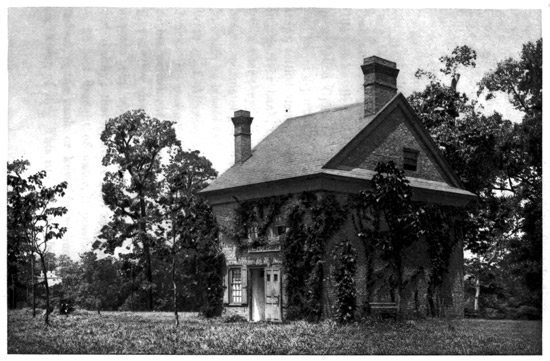
The chief rural attraction of Philadelphia is Fairmount Park, one of the world's largest pleasure-grounds. It includes the lands bordering both sides of the Schuylkill above the city, having been primarily established to protect the water-supply. There are nearly three thousand acres in the Park, and its sloping hillsides and charming water views give it unrivalled advantages in delicious natural scenery. At the southern end is the oldest water reservoir of six acres, on top of a curious and isolated conical hill about ninety feet high, which is the "Fair Mount," giving the Park its name. The Schuylkill is dammed here to retain the water, and the Park borders the river for several miles above, and its tributary, the Wissahickon, for six miles farther. The Park road entering alongside the Fairmount hill passes a colossal equestrian statue of George Washington, and beyond a fine bronze statue of Abraham Lincoln, and also an equestrian statue of General Grant. The roadways are laid on both sides of the river at the water's edge, and also over the higher grounds at the summits of the sloping bordering hills, thus affording an almost endless change of routes and views. The frequent bridges thrown across the river, several of them carrying railroads, add to the charm. An electric railway is constructed through the more remote portions, and displays their rustic beauty to great advantage. All around this spacious Park the growing city has extended, and prosperous manufacturing suburbs spread up from the river, the chief being the carpet district of the Falls and the cotton-mills of Manayunk, the latter on the location of an old-time Indian village, whose name translated means "the place of rum." In this Park, west of the Schuylkill, was held the Centennial Exposition of 1876, and several of the buildings remain, notably the Memorial Art Gallery, now a museum, and the Horticultural Hall, where the city maintains a fine floral display. William Penn's "Letitia House," his original residence, removed from the older part of the city, now stands near the entrance to the West Park.
A large part of the northeastern bank of the Schuylkill adjoining the Park is the Laurel Hill Cemetery. Its winding walks and terraced slopes and ravines give constantly varying landscapes, making it one of the most beautiful burial-places in existence. In front, the river far beneath curves around like a bow. Some of its mausoleums are of enormous cost and elaborate ornamentation, but generally the grandeur of the location eclipses the work of the decorator. Standing on a jutting eminence is the Disston Mausoleum, which entombs an English sawmaker who came to Philadelphia without friends and almost penniless, and died at the head of the greatest sawmaking establishment on the Continent. At one place, as the river bends, the broad and rising terraces of tombs curve around like the banks of seats in a grand Roman amphitheatre. Here is the grave of General Meade who commanded at Gettysburg. In a plain, unmarked sepulchre fronting the river, hewn out of the solid rock, is entombed the Arctic explorer who conducted the Grinnell expedition in search of Sir John Franklin, Dr. Elisha Kent Kane. A single shaft on a little eminence nearby marks the grave of Charles Thomson, the Secretary of the Continental Congress that made the Declaration of Independence. Some of the graves are in exquisite situations, many having been chosen by those who lie there. Here are buried Thomas Godfrey, the inventor of the mariner's quadrant; General Hugh Mercer, who fell at the head of the Pennsylvania troops in the Revolutionary battle of Princeton, the Scots' Society of St. Andrew having erected a monument to his memory; Commodore Isaac Hull, who commanded the American frigate "Constitution" in the War of 1812 when she captured the British frigate "Guerrière;" Harry Wright, the "father of base-ball," who died in 1895; and Thomas Buchanan Read, the poet-artist. At the cemetery entrance is the famous "Old Mortality" group, carved in Scotland and sent to Philadelphia. The quaint old Scotsman reclines on a gravestone, and pauses in his task of chipping-out the half-effaced letters of the inscription, while the little pony patiently waits alongside of him for his master and Sir Walter Scott to finish their discourse.
The peculiar charm of Philadelphia suburban scenery, however, is the Wissahickon—the "catfish stream" of the Indians. This is a creek rising in the hills north of the city, and breaking through the rocky ridges, flowing by tortuous course to the Schuylkill a short distance above Laurel Hill. It is an Alpine gorge in miniature, with precipitous sides rising two to three hundred feet, and the winding road along the stream gives a charming ride. Populous suburbs are on the higher ridges, but the ravine has been reserved and carefully protected, so that all the natural beauties remain. A high railway bridge is thrown across the entrance of the gorge at the Schuylkill, and rounding, just beyond, a sharp rocky corner, the visitor is quickly within the ravine, the stream nestling deep down in the winding fissure. For several miles this attractive gorge can be followed; and high up on its side, in a commanding position near the summit of the enclosing ridge, one of the residents has placed a statue of William Penn, most appropriately bearing the single word at its base—"Toleration." This splendid gorge skirts the northwestern border of the popular suburb of Germantown, and the creek emerges from its rocky confines at the foot of Chestnut Hill, where it rends the ridge in twain, and the hillsides are dotted with attractive villas. This is a fashionable residential section whose people have a magnificent outlook over the rich agricultural region of the upper Wissahickon Valley and the hills beyond.
In Germantown is the historic Chew House, bearing the marks of cannon balls, which was the scene of the battle of Germantown in October, 1777, when the British under Lord Howe, then holding Philadelphia, defeated General Washington, and the darkest period of the Revolution followed, the Americans afterwards retiring to their sad winter camp at Valley Forge. This suburb of Germantown is almost as old as Philadelphia. It was originally settled in 1683 by Germans who came from Cresheim, a name that is preserved in the chief tributary of the Wissahickon. Their leader was Daniel Pastorius, who bought a tract of fifty-seven hundred acres of land from William Penn for a shilling an acre, and took possession on October 6th. Their settlement prospered and attracted attention in the Fatherland. In 1694 a band of religious refugees, having peculiar tenets and believing that the end of the world was approaching, determined to migrate to Germantown. They were both Hollanders and Germans, and came from Rotterdam to London, whence, under the guidance of Johannes Kelpius, they sailed for America upon the ship "Sara Maria." They were earnest and scholarly men, and Kelpius, who was a college graduate, was a profound theologian. They called themselves the "Pietists." Upon their voyage they had many narrow escapes, but every danger was averted by fervent prayers. Their vessel ran aground, but was miraculously floated; they were nearly captured by the French, but, mustering in such large numbers on the deck of the "Sara Maria," they scared the enemy away; they were badly frightened by an unexpected eclipse of the sun; but in every case prayers saved them, and on June 14th they safely landed in Chesapeake Bay, marching overland to the Delaware and sailing up to Philadelphia, where they disembarked.
In solemn procession, on June 23, 1694, led by Kelpius, they walked, two and two, through the little town, which then had some five hundred houses. They called on the Governor, William Markham, representing Penn, and took the oath of allegiance to the British Crown. In the evening they held a solemn religious service on "the Fair Mount," at the verge of the Schuylkill. In it they celebrated the old German custom of "Sanct Johannes" on St. John's eve. They lighted a fire of dry leaves and brushwood on the hill, casting into it flowers, pine boughs and bones, and then rolled the dying embers down the hillside as a sign that the longest day of the year was past, and the sun, like the embers, would gradually lose its power. The next morning was the Sabbath, and they went out to Germantown, where they were warmly welcomed. They built their first house, since called the Monastery, near the Wissahickon Creek, where they worked and worshipped. Their house they called "The Woman of the Wilderness," and upon its roof, day and night, some of them stood, closely observing the changing heavens. With prayers and patience they watched for the end of the world and the coming of the Lord, and they obeyed the ministry of Kelpius. He lived in a cave, and as his colony of enthusiasts gradually dwindled, through death and desertion, he came to be known as the "Hermit of the Wissahickon." Here he dug his well two centuries ago, and the "Hermit's Pool" still exists. He constantly preached the near approach of the millennium, and exhibited his magical "wisdom stone." Finally, wearying yet still believing, he gave up, cast his weird stone into the stream, and in 1704 he died, much to the relief of the neighboring Quaker brethren, who did not fancy such mysterious alchemy so near the city of Penn. These "Pietists," or "Kelpians," as they were afterwards called, dispersed over the country, and had much to do with guiding the religious life and mode of worship among the early German settlers in Pennsylvania. Everywhere in German Pennsylvania there are traces of their influence, and especially at Ephrata and Waynesboro they have had pious and earnest followers. After the death of Kelpius, their last survivor in Germantown was Dr. Christopher DeWitt, famed as a naturalist, an astronomer, a clock-maker and a magician. He was a close friend of John Bartram, lived an ascetic life, became blind and feeble, and finally died an octogenarian in 1765, thus closing with his life the active career of the Kelpian mystics.
THE SCHUYLKILL RIVER.
One of the romances of Fairmount Park is attached to the little stone cottage, with overhanging roof, down by the Schuylkill River bank, where tradition says that the Irish poet, Tom Moore, briefly dwelt when he visited Philadelphia in the summer of 1804. This cottage tradition may be a myth, but the poet when here composed an ode to the cottage and to the Schuylkill, which is as attractive as the bewitching river scene itself. The famous ballad begins:
"I knew by the smoke that so gracefully curled Above the green elms that a cottage was near, And I said, 'If there's peace to be found in the world, A heart that was humble might hope for it here.'"
Tom Moore's letters written at that time generally showed dislike for much that he saw on his American journey, but he seems to have found better things at Philadelphia, and was delighted with the Quaker hospitality. His ode to the Schuylkill shows that its beauties impressed him, and gives evidence of his regard for the people:
"Alone by the Schuylkill, a wanderer roved, And bright were its flowery banks to his eye; But far, very far, were the friends that he loved, And he gazed on its flowery banks with a sigh. "The stranger is gone—but he will not forget, When at home he shall talk of the toil he has known, To tell with a sigh what endearments he met, As he stray'd by the wave of the Schuylkill alone!"
The Schuylkill River is the chief tributary of the Delaware, an Allegheny Mountain stream about one hundred and twenty miles long, coming out of the Pennsylvania anthracite coal-fields, and falling into the Delaware at League Island in such a lowland region that its mouth is scarcely discernible. In fact, the early Dutch explorers of the Delaware passed the place repeatedly and never discovered it; and when the stream above was afterwards found by going overland, and traced down to its mouth, they appropriately called it the Schuylkill, meaning the "hidden river." The Indian name was the "Gans-howe-hanne," or the "roaring stream," on account of its many rapids. The lowest of these, which gave the name of the "Falls" to a Philadelphia suburb, was obliterated by the backwater from the Fairmount water-works dam. The river valley is populous, rich in manufactures and agriculture, and, as it winds through ridge after ridge of the Allegheny foothills, displays magnificent scenery. Both banks are lined with railways, which bring the anthracite coal from the mines down to tidewater.
Journeying up the Schuylkill, we pass the flourishing manufacturing towns of Conshohocken and Norristown and come into the region of the "Pennsylvania Dutch," where the inhabitants, who are mostly of Teutonic origin, speak a curious dialect, compounded of German, Dutch, English and some Indian words, yet not fully understood by any of those races. These industrious people are chiefly farmers and handicraftsmen, and they make up much of the population of eastern Pennsylvania, while their "sauerkraut" and "scrapple" have become staple foods in the State. Twenty-four miles above Philadelphia, alongside a little creek and almost under the great Black Rock, a towering sandstone ridge, was the noted Valley Forge, the place of encampment of Washington's tattered and disheartened army when the defeats at Brandywine and Germantown and the loss of Philadelphia made his prospects so dismal in the winter of 1777-78, one of the severest seasons ever experienced in America. The encampment is preserved as a national relic, the entrenchments being restored by a patriotic association, with the little farmhouse beside the deep and rugged hollow, near the mouth of the creek, which was Washington's headquarters. Phœnixville and Pottstown are passed, and Birdsboro', all places of busy and prosperous iron manufacture, and then the river valley leads us into the gorge of the South Mountain.
READING AND POTTSVILLE.
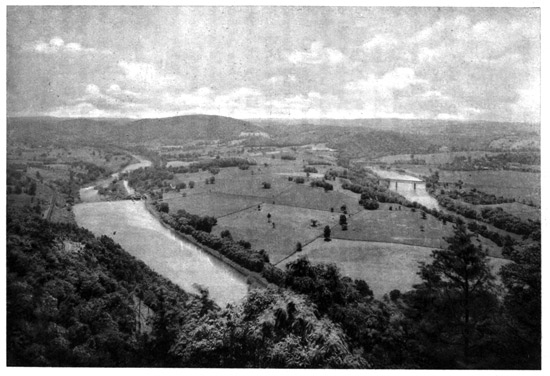
The diminutive Schuylkill breaks its passage through this elevated range, with Penn's Mount on one side and the Neversink Mountain on the other, and here is located the most populous city of the Schuylkill Valley—Reading, with seventy thousand population, a seat of iron-making and extensive railway shops, having a fertile agricultural region in the adjacent valleys. This expanding and attractive city gives its name to, and obtains much of its celebrity from the "Philadelphia and Reading Railway," the colossal financial institution whose woes of bankruptcy and throes of reconstruction have for so many years occupied the attention of the world of finance. This great railway branches at Reading, and its western line runs off through red sandstone rocks and among iron mills and out upon a high bridge, thrown in a beautiful situation across the Schuylkill, and proceeds over the Lebanon Valley to the Susquehanna River at Harrisburg. This rich limestone valley, between the South Mountain and the Blue Ridge, is a good farming district, and also a wealthy region of iron manufacture. The Reading system also sends its East Pennsylvania route eastward to Allentown in the Lehigh Valley, and thence to New York. Factory smokes overhang Reading, through which the Schuylkill flows in crooked course, spanned by frequent bridges, and puffing steam jets on all sides show the busy industries. A good district surrounds Reading in the mountain valleys, and the thrifty Dutch farmers in large numbers come into the town to trade. The high forest-clad mountains rise precipitously on both sides, with electric railways running up and around them, disclosing magnificent views. The "old red sandstone" of these enclosing hills has been liberally hewn out to make the ornamental columns for the Court House portico and build the castellated jail, and also the red gothic chapel and elaborate red gateway of the "Charles Evans' Cemetery," where the chief townsfolk expect, like their ancestry, to be buried. The visitor who wishes to see one of the most attractive views over city, river, mountain and distant landscape can climb by railway up to the "White Spot," elevated a thousand feet above the river, on Penn's Mount. This point of outlook is an isolated remnant of Potsdam sandstone, lying, the geologists say, unconformably on the Laurentian rock.
Loop of the Schuylkill from Neversink Mountains
Beyond Reading, the Schuylkill breaks through the Blue Ridge at Port Clinton Gap, eighteen miles to the northwest. The winding and romantic pass is about three miles long, and just beyond there is, at Port Clinton, a maze of railway lines where the Reading Company unites its branches converging from various parts of the anthracite coal-fields. The Little Schuylkill River here falls into the larger stream, and a branch follows it northward to Tamaqua, while the main line goes westward to Pottsville. The summit of the Blue Ridge is the eastern boundary of the coal-fields, and the country beyond is wild and broken. The next great Allegheny ridge extending across the country is the Broad Mountain beyond Pottsville, though between it and the Blue Ridge there are several smaller ridges, one being Sharp Mountain. The country is generally black from the coal, and the narrow and crooked Schuylkill has its waters begrimed by the masses of culm and refuse from the mines. Schuylkill Haven, ninety miles from Philadelphia, is where the coal trains are made up, and branches diverge to the mines in various directions. Three miles beyond is Pottsville, confined within a deep valley among the mountains, its buildings spreading up their steep sides, for here the malodorous and blackened little river breaks through Sharp Mountain. This is a city of fifteen thousand people, and the chief town of the Schuylkill or Southern coal-field, which produces ten millions of tons of anthracite annually. The whole country roundabout is a network of railways leading to the various mines and breakers, and there are nearly four hundred miles of railways in the various levels and galleries underground. We are told that in the eighteenth century John Pott built the Greenwood Furnace and Forge, and laid out this town; and afterwards, when coal-mining was developed, there came a rush of adventurers hither; but of late years Pottsville has had a very calm career.
To the northward of the Schuylkill or Southern coal-field, and beyond the Broad Mountain, is the "Middle coal-field," which extends westward almost to the Susquehanna River, and includes the Mahanoy and Shamokin Valleys. Both these fields also extend eastward into the Lehigh region; and it is noteworthy that as all these coal measures extend eastward they harden, while to the westward they soften. The hardest coals come from the Lehigh district, and they gradually soften as they are dug out to the westward, until, on the other side of the main Allegheny range, they change into soft bituminous, and farther westward their constituents appear in the form of petroleum and as natural gases. The region beyond Pottsville is unattractive. Various railways connect the Schuylkill and Lehigh regions, and cross over or through the Broad Mountain. The district is full of little mining villages, but has not much else. It is a rough country, with bleak and forbidding hills, denuded of timber by forest fires, with vast heaps of refuse cast out from the mines, some of them the accumulations of sixty or seventy years. Breakers are at work grinding up the fuel, which pours with thundering noise into the cars beneath. The surface is strewn with rocks and débris, and the dirty waters of the streams are repulsive. These blackened brooks of the Broad Mountain are the headwaters of the Schuylkill River.
THE NEW JERSEY COAST RESORTS.
The Delaware River divides Pennsylvania from New Jersey, and at Camden, opposite Philadelphia, there has grown another large city from the overflow of its population. Ferries, and at the northern end of Philadelphia harbor an elevated railway bridge, cross over to Camden, while for miles the almost level surface of New Jersey has suburban towns and villas, the homes of thousands whose business is in Philadelphia. The New Jersey seacoast also is a succession of watering-places where the population goes to cool off in the summer. The whole New Jersey coast of the Atlantic Ocean is a series of sand beaches, interspersed with bays, sounds and inlets, a broad belt of pine lands behind them separating the sea and its bordering sounds and meadows from the farming region. This coast has become an almost unbroken chain of summer resorts from Cape May, at the southern extremity of New Jersey, northeastward through Sea Isle City, Avalon, Ocean City, Atlantic City, Brigantine, Beach Haven, Sea Girt, Asbury Park, Ocean Grove, Long Branch, Seabright, etc., to Sandy Hook, where the long sand-strip terminates at the entrance to New York harbor. To these many attractive places the summer exodus takes the people by the hundreds of thousands. The chief resort of all is Atlantic City, which has come to be the most popular sea-bathing place of the country, the railroads running excursion trains to it even from the Mississippi Valley. Three railroads lead over from Philadelphia across the level Jersey surface, and their fast trains compass the distance, fifty-six miles, in an hour. The town is built on a narrow sand-strip known as Absecon Island, which is separated from the mainland by a broad stretch of water and salt meadows. Absecon is an Indian word meaning "the place of the swans." The beach is one of the finest on the coast, and along its inner edge is the famous "Board Walk" of Atlantic City, an elevated promenade mostly forty feet wide, and four miles long. On the land side this walk is bordered by shops, bathing establishments and all kinds of amusement resorts, while the town of hotels, lodging-houses and cottages, almost all built of wood, stretches inland. The population come out on the "Board Walk" and the great piers, which stretch for a long distance over the sea. It is the greatest bathing-place in existence, and in the height of the season, July and August, fifty thousand bathers are often seen in the surf on a fine day, with three times as many people watching them. Enormous crowds of daily excursionists are carried down there by the railways. The permanent population is about twenty thousand, swollen in summer often fifteen- or twenty-fold. Atlantic City is also a popular resort in winter and spring, and is usually well filled at Eastertide.
The other New Jersey resorts are somewhat similar, though smaller. Cape May, on the southern extremity of the Cape, is popular, and has a fine beach five miles long. The coast for many miles northeastward has cottage settlements, the beaches having similar characteristics. Many of these settlements also cluster around Great Egg Harbor and Barnegat Bay, both favorite resorts of sportsmen for fishing and shooting. Asbury Park and Ocean Grove are twin watering-places on the northern Jersey coast which have large crowds of visitors. The former is usually filled by the overflow from the latter, who object to the Ocean Grove restrictions. Ocean Grove is unique, and was established in 1870 by a Camp Meeting Association of the Methodist Episcopal Church. Here many thousands, both young and old, voluntarily spend their summer vacations under a religious autocracy and obey the strict rules. It is bounded by the sea, by lakes on the north and south, and by a high fence on the land side, and the gates are closed at ten o'clock at night, and all day Sunday. The drinking of alcoholic beverages and sale of tobacco are strictly prohibited, and no theatrical performances of any kind are allowed. No bathing, riding or driving are permitted on Sunday, and at other times the character of the bathing-dresses is carefully regulated. There is a large Auditorium, accommodating ten thousand people, and here are held innumerable religious meetings of all kinds. The annual Camp Meeting is the great event of the season, and among the attractions is an extensive and most complete model of the City of Jerusalem.
To the northward is Long Branch, the most fashionable and exclusive of the New Jersey coast resorts, being mainly a succession of grand villas and elaborate hotels, stretching for about four miles along a bluff which here makes the coast, and has grass growing down to its outer edge almost over the water. In the three sections of the West End, Elberon and Long Branch proper, the latter getting its name from the "Long branch" of the Shrewsbury River, there are about eight thousand regular inhabitants, and there come here about fifty thousand summer visitors, largely from New York. The great highway is Ocean Avenue, running for five miles just inside the edge of the bluff, which, in the season, is a most animated and attractive roadway. The hotels and cottages generally face this avenue. The most noted cottages are the one which General Grant occupied for many years, and where, during his Presidency in 1869-77, he held "the summer capital of the United States," and the Franklyn Cottage, where President Garfield, after being shot in Washington, was brought to die in 1881. The most famous show place at Long Branch is Hollywood, the estate of the late John Hoey, of Adams Express Company, who died there in 1892, its elaborate floral decorations being much admired.
SHACKAMAXON TO BRISTOL.
Journeying up the Delaware from Philadelphia, we pass Petty Island, where the great Indian chief of the Lenni Lenapes, Tamanend, had his lodge—the chieftain since immortalized as St. Tammany, who has given his name to the Tammany Society of politicians who rule New York City. Petty on the old maps is called Shackamaxon Island, a derivation of the original Indian name of Cackamensi. St. Tammany is described as a chief who was so virtuous that "his countrymen could only account for the perfections they ascribe to him by supposing him to be favored with the special communications of the Great Spirit." In the eighteenth century many societies were formed in his honor, and his festival was kept on the 1st of May, but the New York Society is the only one that has survived. Farther up, the Tacony Creek flows into the Delaware, the United States having a spacious arsenal upon its banks. The name of this creek was condensed before Penn's time, by the Swedes, from its Indian title of Taokanink. Beyond, the great manufacturing establishments of the city gradually change to charming villas as we move along the pleasant sloping banks and through the level country, and soon we pass the northeastern boundary of Philadelphia, at Torresdale. This boundary is made by the Poquessing Creek, being the aboriginal Poetquessink, or "the stream of the dragons."
Across the river, on the Jersey shore, formerly roamed the Rankokas Indians, an Algonquin tribe, whose name is preserved in the Rancocas Creek, which is one of the chief tributaries flowing in from New Jersey. At Beverly, not far above, is one of the most popular suburban resorts, the villas clustering around a broad cove, known as Edgewater, which appears much like a miniature Bay of Naples. Over opposite is the wide Neshaminy Creek, flowing down from the Buckingham Mountain in Pennsylvania, its Indian title of Nischam-hanne, meaning "the two streams flowing together," referring to its branches. The earliest settlers along this creek were Scotch-Irish, and their pastor in 1726 was Rev. William Tennent, the famous Presbyterian preacher, who founded the celebrated "Log College" on the Neshaminy, "built of logs, chinked and daubed between, and one story high," as it was well described. From this simple college, which was about twenty feet square, were sent out many of the famous Presbyterian preachers of the eighteenth century; and from it grew, in 1746, the great College of New Jersey at Princeton, and in 1783 Dickinson College, at Carlisle, Pennsylvania, besides many other schools which were started by its alumni. William Tennent's son, Gilbert, was his assistant and successor. The great Whitefield preached to an audience of three thousand at this College in 1739. He was attracted there by Gilbert Tennent's fame as a preacher, and of him on one occasion wrote, "I went to the meeting house to hear Mr. Gilbert Tennent preach, and never before heard I such a searching sermon; he is a son of thunder, and does not regard the face of man."
The Delaware River broadens into two channels around Burlington Island, having on either hand the towns of Bristol and Burlington, both coeval with the first settlement of Philadelphia, and Bristol at that early day having had an ambition to become the location of Penn's great city. The ferry connecting them was established two years before Penn came to Philadelphia, and in the eighteenth century they had a larger carrying trade. Bristol began in 1680 under a grant from Edmund Andros, then the Provincial Governor of New York, for a town site and the ferry, which is curiously described in the Colonial records as "the ferry against Burlington," then the chief town in West Jersey. The settlement was called New Bristol, from Bristol in England, where lived Penn's wife, Hannah Callowhill. It was the first county seat of Bucks when Penn divided his Province into the three counties—Chester, Philadelphia and Buckingham. It was for many years a great exporter of flour to the West Indies. Its ancient Quaker Meeting House dates from 1710, and St. James' Episcopal Church from 1712; but the latter, which received its silver communion service from the good Queen Anne, fell into decay and has been replaced by a modern structure. Its Bath Mineral Springs made it the most fashionable watering-place in America in the eighteenth century, but Saratoga afterwards eclipsed them, and their glory has departed. Prior to the Revolution, Bristol built more shipping than Philadelphia; and, while quiet and restful, its comfortable homes and the picturesque villas along the Delaware River bank above the town tell of its prosperity now.
OLD BURLINGTON.
The ancient town of Burlington, clustered behind its "Green Bank" or river-front street on the New Jersey shore, antedates Philadelphia five years. The Quaker pioneers are believed to have been the first Europeans who saw its site. The noted preacher George Fox, in 1672, journeyed from New England to the South, and rode on horseback over the site of Burlington at Assiscunk Creek, reporting the soil as good "and withal a most brave country." When Penn became Trustee for the insolvent Billynge, a Proprietor of West Jersey, much of his land was sold to Quakers, who migrated to the American wilderness to escape persecution at home. Thus Burlington was the first settlement founded by Quaker seekers after toleration in the New World:
"About them seemed but ruin and decay, Cheerless, forlorn, a rank autumnal fen, Where no good plant might prosper, or again Put forth fresh leaves for those that fell away; Nor could they find a place wherein to pray For better things. In righteous anger then They turned; they fled the wilderness of men And sought the wilderness of God. And day Rose upon day, while ever manfully Westward they battled with the ocean's might, Strong to endure whatever fate should be, And watching in the tempest and the night That one sure Pharos of the soul's dark sea— The constant beacon of the Inner Light."
In the spring of 1677 the "goode shippe Kent," Gregory Marlowe, master, sailed from London, bound for West Jersey, with two hundred and thirty Quakers, about half coming from London and the others from Yorkshire; two dying on the voyage. They ascended the Delaware to the meadow lands below the mouth of Assiscunk Creek, landing there in June, and in October made a treaty with the Indians, buying their lands from the Rancocas as far up as Assunpink Creek at Trenton. Their settlement was first called New Beverly, and then Bridlington, from the Yorkshire town whence many of them came, but it finally was named Burlington. They made a street along the river, bordered with greensward, and called the "Green Bank," and drew a straight line back inland, calling it their Main Street, and the Londoners settled on one side and the Yorkshiremen on the other. The old buttonwood tree, to which was moored the early ships bringing settlers, still stands on the Green Bank, a subject of weird romance. Elizabeth Powell, the first white child, was born in July, 1677. The next May, 1678, they established a "Monthly Meeting of Friends" at Burlington, of which the records have been faithfully kept. In June the graveyard was fenced in, and the old Indian chief, Ockanickon, a Quaker convert to Christianity, was among the first buried there. In August the first Quaker marriage was solemnized in meeting, this first certificate being signed by ten men and three women Friends as witnesses. In 1682, just as Penn was coming over, they decided to build their first meeting house—a hexagonal building, forty feet in diameter, with pyramidal roof, which was occupied the next year. In 1685 they decided that a hearse should be built, the entry on the record being an order for a "carriage to be built for ye use of such as are to be laid in ye ground."
Burlington grew, and was long the seat of government of the Province of West Jersey, being the official residence of the Provincial Governors, the last of whom was William Franklin, natural son of Benjamin Franklin. It had wealthy merchants and much shipping, and, despite its peacefulness, equipped privateers to fight the French. Its famous old Episcopal Church of St. Mary had the corner-stone laid in 1703 under the favor of Queen Anne, who made a liberal endowment of lands, much being yet held, and gave it a massive and greatly prized communion service. This old church is cruciform, with a little belfry, and a stone let into the front wall bears the inscription "One Lord, one faith, one baptism." In the extensive churchyard alongside is the modern St. Mary's Church, of brownstone, with a tall spire, also cruciform. This is the finest church in Burlington. When "Old St. Mary's" was built with its belfry, the Friends did not like the innovation, and long gazed askance at the "steeple house," as they called it; so that Talbot, the first rector, sturdily retaliated, calling the Quakers "anti-Christians, who are worse than the Turks." Many of St. Mary's parishioners of to-day are descended from these maligned Quakers. The early records of the Meeting are filled with entries showing that charges were brought against members for various shortcomings. One was admonished for "taking off his hat" at a funeral solemnized in the "steeple house;" others gave testimony of "uneasiness" on account of the placing of "gravestones in the burial-ground;" a query was propounded, "Are Friends in meeting preserved from sleeping or any other indecent behavior, particularly from chewing tobacco and taking snuff?" A record was also made of testimony against "a pervading custom of working on First days in the time of hay and harvest" when rain threatened. The descendants of these good people have established St. Mary's Hall and Burlington College, noted educational institutions. Probably the most famous son of Burlington was the distinguished novelist, James Fenimore Cooper, born in 1789, but taken in his infancy by his parents to his future home at Cooperstown, in Central New York. The town was bombarded by the British gunboats that sailed up the Delaware in 1778, but since then the career of Burlington has been eminently peaceful.
BORDENTOWN AND ITS MEMORIES.
Above Burlington Island the Delaware winds around a jutting tongue of flat land, "Penn's Neck," which is one of the noted regions of the river, the ancient "Manor of Pennsbury." This was Penn's country home, originally a tract of over eight thousand acres, the Indian domain of "Sepessing." His house, which he occupied in 1700-01, was then the finest on the river, but it long ago fell into decay, and the manor was all sold away from his descendants during the eighteenth century. At the eastern extremity of "Penn's Neck," on the New Jersey shore, is White Hill, with the village of Bordentown beyond, up Crosswick's Creek. Here is a region redolent with historical associations. The old buildings along the river bank were the railway shops of the famous "Camden and Amboy," whose line, coming along the Delaware shore, goes off up Crosswick's Creek to cross New Jersey on the route to New York. Above is the dense foliage of Bonaparte Park, now largely occupied by the Convent and Academy of St. Joseph. Bordentown was a growth of the railway, having been previously little more than a ferry, originally started by Joseph Borden. Its most distinguished townsman was Admiral Charles Stewart, "Old Ironsides" of the American navy, a relic of the early wars of the country, his crowning achievement being the command of the frigate "Constitution" when she captured the two British vessels, "Cyane" and "Levant." He was the "Senior Flag Officer" of the navy when he died in 1860 on his Bordentown farm, to which he had returned. The old house where he lived is on a bluff facing the river. He was the grandfather of the noted Irish leader, Charles Stewart Parnell.
To Bordentown, in 1816, Joseph Bonaparte, the ex-King of Naples and of Spain, and eldest brother of Napoleon, came to live, as the Count de Survilliers, and bought the estate known since as Bonaparte Park. It was through Stewart's persuasion, mainly, that he located there, the estate covering ten farms of about one thousand acres. Lafayette visited him in 1824, and Louis Napoleon, afterwards Napoleon III., in 1837. Joseph returned to Europe in 1839, dying in Florence in 1844. Another famous resident of Bordentown was Prince Murat, the nephew of Napoleon and of Joseph, and the son of the dashing Prince Joachim Murat, who was King of the Sicilies, and was shot by sentence of court-martial after Waterloo. Prince Murat came in 1822, bought a farm, got married, lived a rather wild life, but was generally liked, and, going through various fortunes, returned to France after the Revolution of 1848 and was restored to his honors. He was with Marshal Bazaine in the capitulation of Metz in 1870 and became a prisoner of war, and died in 1878.
THE STORY OF CAMDEN AND AMBOY.
The great memory of Bordentown, however, is of the famous railroad, originally begun there, whose managers for nearly a half-century so successfully ruled New Jersey that it came to be generally known throughout the country as "the State of Camden and Amboy." In the little old Bordentown station, which still exists, set in the bottom of a ravine, with the house built over the railroad, were for many years held the annual meetings of the corporation; and its magnates also met in almost perpetual session, to generally run things, social, political and financial, for the State of New Jersey, and semi-annually declare magnificent dividends. Not far from this station a monument marks the place of construction of the first piece of railway track in New Jersey, laid by the Camden and Amboy Company in 1831. Upon this track the first movement of a passenger train by steam was made by the locomotive "John Bull," on November 12th of that year. This granite monument, erected in 1891 to commemorate the sixtieth anniversary, stands upon a foundation composed of the stone blocks on which the first rails were laid, and two of these original rails encircle it. A bronze tablet upon the monument represents the old "John Bull," with his primitive whisky-cask tender, and the two little old-time passenger coaches which made up the first train he drew. Thus began the great railroad highway between the two chief cities of the United States.
The original method of transport between Philadelphia and New York was by steamboat on the Delaware to South Trenton, stages from Trenton to New Brunswick on the Raritan River, and then by steamboat to New York. This was the "Union Line," which for many years carried the passengers, and of which John Stevens was the active spirit. He conceived the first idea of a railway, and in 1817 procured the first railway charter in America for a railroad upon his stage route between Trenton and New Brunswick. In subsequent years there were advocates both of a railway and a canal across New Jersey, his son, Robert L. Stevens, being the railway chieftain, while Commodore Robert F. Stockton championed the canal, the rival projects appearing before the New Jersey Legislature in 1829-30, and causing a most bitter controversy. It is related that the conflict was ended in a most surprising manner. Between the acts of a play at the old Park Theatre in New York, Stevens and Stockton accidentally met in the vestibule, and after a few minutes' talk agreed to end their dispute by joining forces. The result was that on February 4, 1830, both companies were chartered—the "Camden and Amboy Railroad and Transportation Company" and the "Delaware and Raritan Canal Company." In furtherance of this compromise, what is known as the celebrated "Marriage Act" was passed a year later, creating the "Joint Companies," their stock being combined at the same valuation, though each had a separate organization. They were given a monopoly of the business, paying transit dues to the State of ten cents per passenger and fifteen cents per ton of freight carried, and this afterwards practically paid all the expenses of the New Jersey State Government. The railroad was completed between Bordentown and Amboy in 1832, and on December 17th the first passengers went through, fifty or sixty of them. It was a rainy day, and the cars were drawn by horses, for they could not in those days trust their locomotive out in the rain. The next year regular travel began, galloping horses taking the cars from Bordentown over to Amboy in about three hours, there being three relays. Later in the year the locomotive "John Bull" took one train daily, each way. In 1871 all the railway and canal properties of the two companies, which had become very extensive, were absorbed by the Pennsylvania Railroad, which pays as rental 10 per cent. annual dividends on the stocks.
The line of the Delaware and Raritan Canal begins at Crosswick's Creek in Bordentown, and is constructed alongside the Delaware River up to Trenton, and thence across New Jersey to the Raritan River at New Brunswick. This is a much-used "inside water route," and it had one of the old lines of the railroad constructed on the canal bank all the way. It was in former times a very profitable route, and is said to have made most of the dividends of the old monopoly, as it carried the greater part of the freight between the cities. It was originally projected in 1804, but the scheme slumbered for years. When the route was surveyed through Princeton, where Commodore Stockton lived, he became interested, and he induced his father-in-law, John Potter, of South Carolina, who had over $500,000 in the United States Bank, to withdraw the money and invest it in the canal, he being the chief shareholder. Thus his fortune was not only saved from the bank's subsequent collapse, but was increased by the profitable investment. The canal is forty-three miles long, with fourteen locks in its course, having an aggregate rise and fall of one hundred and fifty feet. Its enlargement to the dimensions of a ship canal is suggested.
THE TRENTON GRAVEL.
In journeying up the Delaware and approaching Trenton, we have passed through a region of most interesting geological development. All along are evidences of the deposit of the drift from above, which is popularly known as the "Trenton gravel." The Delaware flows southeast from the Kittatinny Water Gap to Bordentown, and then, impinging against the cretaceous stratified rocks of New Jersey, abruptly turns around a right-angled bend and goes off southwestward towards Philadelphia. The river has thus deposited the Trenton gravels, composed of the drift of most of the geological formations in its upper waters, throughout its course, on the Pennsylvania side from Trenton down below Philadelphia. This deposit is fifty feet deep on the river bank in Philadelphia, and underlies the river bed for nearly a hundred feet in depth. At Bristol the deposit stretches two miles back from the river, and at Trenton it is almost universal. The material, which in the lower reaches is generally fine, grows coarser as the river is ascended, until at Trenton immense boulders are often found imbedded. We are told by geologists that at the time of the great flood in the river which deposited the gravel, the lower part of Philadelphia, the whole of Bristol and Penn's Neck and almost all Trenton were under water. The gravel has disclosed bones of Arctic animals—walrus, reindeer and mastodon—and also traces of ancient mankind. The latter have been found at Trenton and on Neshaminy Creek, indicating the presence of a race of men said to have lived about seven thousand years ago. The river has also made immense clay deposits all along, which was done at a time when the water flowed at a level more than a hundred feet higher than now.
In the early geological history of the Delaware it is found that all southern New Jersey lay deep beneath the Atlantic, whose waves broke against the ranges of hills northwest and north of Philadelphia, and an inlet from the sea extended into the great Chester limestone valley behind them. This whole region, then probably five hundred feet lower than now, was afterwards slowly upheaved, and the waters retreated. Subsequently the climate grew colder, and the great glacial ice-cap crept down from Greenland and Labrador, forming a huge sea of ice, thousands of feet thick, which advanced on the Delaware to Belvidere, sixty miles north of Philadelphia. Then there came another gradual change; the land descended to nearly two hundred feet below the present level, and again the waters overflowed almost the whole region. This was ice-cold, fresh water, bearing huge icebergs and floes, which stranded on the hills, forming a shore on the higher lands northwest of Philadelphia. The river channel was then ten miles wide and two hundred feet deep all the way down from Trenton, and a roaring flood depositing the red gravel along its bed. As the torrent, expending its force, though still filled with mud and sand from the base of the glacial ice-cap, became more quiet, it laid down the clays, the stranded icebergs dropping their far-carried boulders all along the route. This era of cold water and enormous floods is computed to have occupied a period of about two hundred and seventy thousand years, and then the "Ice Age" finally terminated. The land rose about to its present level, the waters retreated, and elevated temperatures thawed more and more of the glaciers remaining in the headwaters, so that there came down the last great floods which deposited the "Trenton gravel." The river was still wide and deep, and Arctic animals roamed the banks. Mankind then first appeared, living in primitive ways in caves and holes, and hunting and fishing along the swollen Delaware ten thousand years ago. Occasionally they dropped in the waters their rude stone implements and weapons, which were buried in the gravel, and, being recently found, are studied to tell the story of their ancient owners. The river deposited its gravel and the channel shrunk with dwindling current, moving gradually eastward as it eat its way into the cretaceous measures. The primitive man retired, making way for the red Indian, and the present era dawned, with the more moderate climate, and with again a slow sinking of the land, which the geologists say is now in progress.