THE ENVIRONMENT OF CHESAPEAKE BAY.
Reading edition
AMERICA, PICTURESQUE AND DESCRIPTIVE.
I.
THE ENVIRONMENT OF CHESAPEAKE BAY.
The First Permanent Settlement in North America—Captain John Smith—Jamestown—Chesapeake Bay—The City of Washington—The Capitol—The White House—Elaborate Public Buildings—The Treasury—The State, War and Navy Departments—The Congressional Library—The Smithsonian Institution—Prof. Joseph Henry—The Soldiers' Home—Agricultural Department—Washington Monument—City of Magnificent Distances—Potomac River—Allegheny Mountains—The Kittatinny Range—Harper's Ferry—John Brown—The Great Falls—Alexandria—Mount Vernon—Washington's Home and Tomb—Washington Relics—Key of the Bastille—Rappahannock River—Fredericksburg—Mary Ball, the Mother of Washington—York River—The Peninsula—Williamsburg—Yorktown—Cornwallis' Surrender—James River—The Natural Bridge—Lynchburg—Appomattox Court-House—Lee's Surrender—Powhatan—Dutch Gap—Varina—Pocahontas—Her Wedding to Rolfe—Her Descendants, the "First Families of Virginia"—Deep Bottom—Malvern Hill—General McClellan's Seven Days' Battles and Retreat—Bermuda Hundred—General Butler—Shirley—Appomattox River—Petersburg—General Grant's Headquarters—City Point—Harrison's Landing—Berkeley—Westover—William Byrd—Chickahominy River—Jamestown Island—Gold Hunting—The Northwest Passage—First Corn-Planting—Indian Habits—First House of Burgesses—Tobacco-Growing—Virginia Planters—Importing Negro Slaves—Newport News—Merrimac and Monitor Contest—Hampton Roads—Hampton—Old Point Comfort—Fortress Monroe—Fort Algernon—Fort Wool—Elizabeth River—Norfolk—Portsmouth—Great Dismal Swamp—The Eastern Shore—The Oyster Navy—William Claiborne—Kent Island—Lord Baltimore—The Maryland Palatinate—Leonard Calvert's Expedition—St. Mary's—Patuxent River—St. Inigoe's—Severn River—Annapolis—United States Naval Academy—Patapsco River—Baltimore—Jones's Falls—Washington Monument—Battle Monument—Johns Hopkins and his Benefactions—Baltimore and Ohio Railroad—Druid Hill—Greenmount Cemetery—Fort McHenry—The Star-Spangled Banner.
CAPTAIN JOHN SMITH.
When Captain Christopher Newport's expedition of three little ships and one hundred and five men, sent out by the "Virginia Company" to colonize America, after four months' buffeting by the rough winter storms of the North Atlantic, sought a harbor of refuge in May, 1607, they sailed into Chesapeake Bay. These three little ships were the "Susan Constant," the "Good Speed" and the "Discovery;" and upon them came Captain John Smith, the renowned adventurer, who, with Newport, founded the first permanent settlement in North America, the colony of Jamestown. The king who chartered the "Virginia Company" was James I., and hence the name. As the fleet sailed into the "fair bay," as Smith called it, the headlands on either side of the entrance were named Cape Charles and Cape Henry, for the king's two sons. Their first anchorage was in a roadstead of such attractive character that they named the adjacent land Point Comfort, which it retains to this day; and farther inland, where Captain Newport afterwards came, in hopes of getting news from home, is now the busy port and town of Newport News. Sir Walter Raleigh, in the previous century, had sent out his ill-starred expedition to Roanoke, which had first entered this great bay; and at the Elizabeth River, which they had named in honor of Raleigh's queen, they found the Indian village of Chesapik, meaning "the mother of waters;" and from this came the name of Chesapeake Bay. Raleigh had landed colonists here, as well as at Roanoke, and when the "Virginia Company" sent out Newport's expedition it laid three commands upon those in charge: First, they were to seek Raleigh's lost colonists; second, they were to find gold; and third, they were to search for the "northwest passage" through America to the Pacific Ocean. So strong was the belief in finding gold in the New World that the only consideration King James asked for his charter was the stipulation that the "Virginia Company" should pay him one-fifth of the gold and silver found in its possessions.
As none of Raleigh's colonists could be found, the expedition sailed up the James River after considerable delay, and, selecting a better place for a settlement, landed at Jamestown May 13, 1607, where Smith became their acknowledged leader, and preserved the permanency of the colony. This famous navigator and colonist was a native of Willoughby, in Lincolnshire, England, born in January, 1579. When scarcely more than a boy he fought in the wars of Holland, and then he wandered through Europe and as far as Egypt, afterwards returning to engage in the conflict against the Turks in Hungary. Here he won great renown, fighting many desperate combats, and in one engagement cutting off three Turks' heads; but he was finally wounded and captured. The sober, investigating historians of a later day have taken the liberty to doubt some of Smith's wonderful tales of these remarkable adventures, but he must have done something heroic to season him for the hardy work of the pioneer who was the first to succeed in planting a colony in North America. After the Turks made him a prisoner, he was sold as a slave in Constantinople, being condemned to the hardest and most revolting kinds of labor, until he became desperate under the cruelties and escaped. Then he was for a long time a wanderer through the wilderness, traversing the forests of Russia, and pushing his way alone across Europe, until, almost worn out with fatigue and hardships, he arrived in England just at the time Newport's expedition was being fitted out; and still having an irrepressible love for adventure, he joined it.
CHESAPEAKE BAY.
There can be no better place for beginning a survey of our country than upon this great bay, which Smith and his companions entered in 1607. Chesapeake Bay is the largest inland sea on the Atlantic Coast of the United States. It stretches for two hundred miles up into the land, between the low and fertile shores of Virginia and Maryland, both of which States it divides, and thus gives them valuable navigation facilities. In its many arms and estuaries are the resting-places for the luscious oysters which its people send all over the world. It is one of the greatest of food-producers, having a larger variety of tempting luxuries for the palate than probably any other region. Along its shores and upon its islands are numberless popular resorts for fishing and shooting, for its tender and amply-supplied water-foods attract the ducks and other wild fowl in countless thousands, and bring in shoals of the sea-fishes, which are the sportsmen's coveted game. Its terrapin are famous, while its shores and borderlands, particularly on the eastern side, are a series of orchards and market-gardens, providing limitless supplies of fruits, berries and vegetables for the Northern markets. It receives in its generally placid bosom some of the greatest rivers flowing down from the Allegheny Mountains. The broad Susquehanna, coming through New York and Pennsylvania, makes its headwaters, and it receives the Potomac, dividing Maryland from Virginia, and the James, in Virginia, both of them wide estuaries with an enormous outflow; and also numerous smaller streams, such as the Rappahannock, York, Patuxent, Patapsco, Choptank and Elizabeth Rivers. Extensive lines of profitable commerce, all large carriers of food-supplies, have transport over this great bay and its many arms and affluents. Canals connect it with other interior waters, and leading railways with all parts of the country, while there are several noted cities upon its shores and tributaries.
THE CITY OF WASHINGTON.
The most famous of all these cities of the Chesapeake region is Washington, upon the Potomac, and we will therefore begin this story at the American National Capital. The striking thing about Washington is that, unlike other capitals of great nations, it was created for the sole purpose of a seat of government, apart from any question of commercial rank or population. It has neither manufactures nor commerce to speak of. After the adoption of the Federal Constitution there was a protracted conflict in Congress over the claims of rival localities for the seat of government, and this developed so much jealousy that it almost disrupted the Union at its inception. General Washington, then the President, used his strong influence and wise judgment to compromise the dispute, and it was finally decided that Philadelphia should remain the capital for ten years, while after the year 1800 it should be located on the Potomac River, on a site selected by Washington, within a district of one hundred square miles, ceded by Maryland and Virginia, and which, to avoid any question of sovereignty or control, should be under the exclusive jurisdiction of Congress. The location was at the time nearly in the geographical centre of the then thirteen original States. As the city was designed entirely on the Maryland side of the Potomac, the Virginia portion of the "Federal District of Columbia," as it was called, was retroceded in 1826, so that the District now contains about sixty-five square miles. The capital was originally called the "Federal City," but this was changed by law in 1791 to the "City of Washington." The ground plan of the place was ambitious, and laid out upon an extensive undulating plateau bordered by rolling hills to the northward and westward, and sloping gently towards the Potomac River, between the main stream and the eastern branch, or Anacostia River. This plan has been well described as "a wheel laid upon a gridiron," the rectangular arrangement of the ordinary streets having superimposed upon it a system of broad radiating avenues, with the Capitol on its hill, ninety feet high, for the centre. The Indians called the place Conococheague, or the "roaring water," from a rapid brook running through it, which washed the base of the Capitol Hill, and was afterwards very properly named the Tiber, but has since degenerated into a sewer. A distinguished French engineer of the time, Major L'Enfant, prepared the topographical plan of the city, under the direction of Washington and Jefferson, who was Secretary of State; and Andrew Ellicott, a prominent local surveyor, laid it out upon the ground. The basis of the design was the topography of Versailles, but with large modifications; and thus was laid out the Capital of the United States, which a writer in the London Times, some years ago, called "the city of Philadelphia griddled across the city of Versailles."
The original designers planned a city five miles long and three miles broad, and confidently expected that a vast metropolis would soon be created, though in practice only a comparatively limited portion was built upon, and this is not where they intended the chief part of the new city to be. Of late years, however, the newer portions have been rapidly extending. No man's name was used for any of the streets or avenues, as this might cause jealousy, so the streets were numbered or lettered and the avenues named after the States. The corner-stone of the Capitol was laid in 1793, its front facing east upon the elevated plateau of the hill, and the town was to have been mainly built upon this plateau in front of it. Behind the Capitol, on its western side, the brow of the hill descended rather sharply, and here they laid out a wide and open Mall, westward over the lower ground to the bank of the Potomac River, more than a mile away. Off towards the northwest, at the end of one of the diagonal avenues, they placed the Executive Mansion, with its extensive park and gardens stretching southward to the river, and almost joining the Mall there at a right angle. The design was to have the city in an elevated and salubrious location, with the President secluded in a comfortable retreat amid ample grounds, but nearly a mile and a half distant in the rural region. But few plans eventuate as expected; and such is the perversity of human nature that the people, when they came to the new settlement, would not build the town on Capitol Hill as had been intended, but persisted in settling upon the lower ground along and adjacent to the broad avenue leading from the Capitol to the Executive Mansion; and there, and for a long distance beyond the latter to the northward and westward, is the city of Washington of to-day. Pennsylvania Avenue, one hundred and sixty feet wide, joining these two widely-separated Government establishments and extending far to the northwest, thus became the chief street of the modern city. To Washington the Federal Government was removed, as directed by law, in 1800, the actual removal being conducted by Tobias Lear, who had been President Washington's private secretary, and was then serving in similar capacity for President John Adams. He packed the whole archives and belongings of the then United States Government at Philadelphia in twenty-eight wooden boxes, loaded them on a sloop, sailed down the Delaware, around to the Chesapeake, and up the Potomac to the new capital, and took possession. The original Capitol and Executive Mansion were burnt by the British during their invasion in 1814, when Washington had about ten thousand population; it now contains over three hundred thousand, of whom fifty thousand are army and navy officers and civil servants and their families, and about eighty thousand are colored people.
THE CAPITOL.
The crowning glory of Washington is the Capitol, its towering dome, surmounted by the colossal statue of America, being the prominent landmark, seen from afar, on every approach to the city. The total height to the top of the statue is three hundred and seventy-five feet above the Potomac River level. The grand position, vast architectural mass and impressive effect of the Capitol from almost every point of view have secured for it the praise of the best artistic judges of all countries as the most imposing modern edifice in the world. From the high elevation of the Capitol dome there is a splendid view to the westward over the city spread upon the lower ground beyond the base of Capitol Hill. Diagonally to the southwest and northwest extend two grand avenues as far as eye can see—Maryland Avenue to the left leading down to the Potomac, and carrying the line of the Pennsylvania Railroad to the river, where it crosses over the Long Bridge into Virginia; and Pennsylvania Avenue to the right, stretching to the distant colonnade of the Treasury Building and the tree-covered park south of the Executive Mansion. Between these diverging avenues and extending to the Potomac, more than a mile away, is the Mall, a broad enclosure of lawns and gardens. Upon it in the foreground is the Government Botanical Garden, and behind this the spacious grounds surrounding the Smithsonian Institution; while beyond, near the river bank, rises the tall white shaft of the Washington Monument, with its pointed apex.
On either side spreads out the city, the houses bordering the foliage-lined streets, and having at frequent intervals the tall spires of churches, and the massive marble, granite and brick edifices that are used for Government buildings. In front, to the west, is the wide channel of the Potomac, and to the south and southeast the Anacostia, their streams uniting at Greenleaf's Point, where the Government Arsenal is located. On the heights beyond the point, and across the Anacostia, is the spacious Government Insane Asylum. Far away on the Virginia shore, across the Potomac, rises a long range of wooded hills, amid which is Arlington Heights and its pillared edifice, which was the home of George Washington Parke Custis, the grandson of Mrs. Washington and General Washington's adopted son, and was subsequently the residence of General Robert E. Lee, who married Miss Custis. Spreading broadly over the forest-clad hills is the Arlington National Cemetery, where fifteen thousand soldiers of the Civil War are buried. At the distant horizon to the left rises the spire of Fairfax Seminary, and beyond, down the Potomac, is seen the city of Alexandria, the river between being dotted with vessels. To the northwest, behind the Executive Mansion, is the spacious building of the State, War and Navy Departments, having for a background the picturesque Georgetown Heights, just over the District boundary, their tops rising four hundred feet above the river. Farther to the northward is Seventh Street Hill, crowned with the buildings of Howard University, and beyond it the distant tower of the Soldiers' Home. All around the view is magnificent; and years ago, before the city expected to attain anything like its present grandeur, Baron von Humboldt, as he stood upon the western verge of Capitol Hill and surveyed this gorgeous picture, exclaimed: "I have not seen a more charming panorama in all my travels."
After the British burnt the original Capitol, it was rebuilt and finished in 1827; but the unexampled growth of the country and of Congress soon demanded an extension, which was begun in 1851. It is this extension which supplied the wings and dome, designed and constructed by the late Thomas U. Walter, that has made the building so attractive. This grand Republican palace of government, stretching over seven hundred and fifty feet along the top of the hill, has cost about $16,000,000. The old central building is constructed of Virginia freestone, painted white, the massive wings are of white marble from Massachusetts, and the lofty dome is of iron. The dazzling white marble gleams in the sunlight, and fitly closes the view along the great avenues radiating from it as a common centre. The architecture is classic, with Corinthian details, and, to add dignity to the western front, which overlooks the city, a magnificent marble terrace, eight hundred and eighty-four feet long, has been constructed at its base on the crest of the hill, which is approached by two broad flights of steps.
The Capitol is surrounded by a park of about fifty acres, including the western declivity of the hill and part of the plateau on top. Upon this plateau, on the eastern front, the populace assemble every fourth year to witness the inauguration of the President when he is sworn into office by the Chief Justice, and delivers his inaugural address from a broad platform at the head of the elaborate staircase leading up to the entrance to the great central rotunda. In full view of the President, as he stands under the grand Corinthian portico, is a colossal statue of Washington, seated in his chair of state, and facing the new President, as if in solemn warning. The rotunda is the most striking feature of the Capitol interior; it is nearly one hundred feet in diameter, and rises one hundred and eighty feet to the ceiling of the dome, which is ornamented with fine frescoes by Brumidi. Large panelled paintings on the walls just above the floor, and alti rilievi over them, represent events in the early history of the country, while at a height of one hundred feet a band nine feet wide runs around the interior of the dome, upon which a series of frescoes tell the story of American history from the landing of Columbus. But, most appropriately, the elaborate decorations, while reproducing so much in Indian legend and Revolutionary story, are not used in any way to recall the Civil War. Away up in the top of the dome there is a Whispering Gallery, to which a stairway laboriously leads.
The old halls of the Senate and House in the original wings of the Capitol are now devoted, the former to the Supreme Court and the latter to a gallery of statuary, to which each State contributes two subjects, mostly Revolutionary or Colonial heroes. Beyond, on either hand, are the extensive new wings—the Senate Chamber to the north and the Representatives' Hall to the south. Each is surrounded by corridors, beyond which are committee rooms, and there are spacious galleries for the public. Each member has his chair and desk, the seats being arranged in semicircles around the rostrum. In practice, while the House is in session, the members are usually reading or writing, excepting the few who may watch what is going on, because they are specially interested in the matter under consideration; and the member who may have the floor and is speaking is actually heard by very few, his speech being generally made for the galleries and the official stenographers and newspaper reporters. Debate rarely reaches a point of interest absorbing the actual attention of the whole House, most of the speech-making seeming to be delivered for effect in the member's home district, this method being usually described as "talking for Buncombe." The other members read their newspapers, write their letters, clap their hands sharply to summon the nimble pages who run about the hall upon their errands, gossip in groups, and otherwise pass their time, move in and out the cloak- and committee-rooms, and in various ways manage not to listen to much that goes on. Nevertheless, business progresses under an iron-clad code of procedure, the Speaker being a despot who largely controls legislation. The surroundings of the Senate Chamber are grander than those of the House, there being a gorgeous "Marble Hall," in which Senators give audience to their visitors, and magnificently ornamented apartments for the President and Vice-President. The President's Room is only occupied during a few hours in the closing scenes of a session, this small but splendid apartment, which has had $50,000 expended upon its decoration, being a show place for the remainder of the year.
THE WHITE HOUSE.
The most famous building in Washington, though one of the least pretentious, is the Executive Mansion, popularly known as the "White House," being constructed, like the older part of the Capitol, of freestone, and painted white. It stands within a park at some distance back from the street, a semicircular driveway leading up to the Ionic colonnade supporting the front central portico. It is a plain building, without pretensions in anything but its august occupancy, and the ornamental grounds stretch down to the Potomac River, which flows about two hundred yards below its southern front. It is two stories high, about one hundred and seventy feet long, and eighty-six feet deep. This building, like the Capitol, was burnt in the British invasion of 1814 and afterwards restored. Unlike the nation, or the enormous public buildings that surround and dwarf it, the White House has in no sense grown, but remains as it was designed in the lifetime of Washington. It is nevertheless a comfortable mansion, though rigid in simplicity. The parlor of the house, the "East Room," is the finest apartment, occupying the whole of that side, and is kept open for visitors during most of the day. The public wander through it in droves, walk upon the carpets and recline in the soft chairs, awaiting the President's coming to his almost daily reception and handshaking; for they greatly prize this joint occupancy, as it were, and close communion with their highest ruler. This is an impressive room, and in earlier times was the scene of various inauguration feasts, when Presidents kept open house for their political friends and admirers.
The "East Room" was a famous entertainment hall in President Jackson's time. On the evening of his inauguration day it was open to all comers, who were served with orange punch and lemonade. The crowds were large, and the punch was mixed in barrels, being brought in by the bucketful, the thirsty throngs rushing after the waiters, and in the turmoil upsetting the punch and ruining dresses and carpets. The punch receptacles were finally taken out into the gardens, and in this way the boisterous crowds were drawn off, and it became possible to serve cake and wine to the ladies. Various traditions are still told of this experience, and also of the monster cheese, as big as a hogshead, that was served to the multitude at Jackson's farewell reception. It was cut up with long saw-blades, and each guest was given about a pound of cheese, this feast being the talk of the time. Jackson's successor was Martin Van Buren, who came from New York, the land of big cheeses. Being bound to emulate his predecessor, an even larger cheese was sent him, and cut up in the "East Room." The crowds trampled the greasy crumbs into the carpets and hangings, and all the furniture and fittings were ruined. Now no guest comes unbidden to dine at the White House; but the change in the fashion aided in defeating Van Buren, who was a candidate for a second election in 1840. He stopped keeping open house in order to save the furniture and get some peace, and during several months preceding the election many persons arrived at the White House for breakfast or dinner and threatened to vote against Van Buren unless they were entertained. This, with the fact noised abroad that he had become such an aristocrat that his table service included gold spoons, then an unheard of extravagance, proved too much for him. Van Buren was beaten for re-election by "Old Tippecanoe"—General William Henry Harrison.
A corridor leads westward from the "East Room," through the centre of the White House, to the conservatories, which are prolonged nearly two hundred feet farther westward. A series of fine apartments, called the Green, Blue and Red Rooms, from the predominant colors in their decorations, are south of this corridor, with their windows opening upon the gardens. These apartments open into each other, and finally into the State Dining Hall on the western side of the building, which is adjoined by a conservatory. North of the corridor the first floor contains the family rooms, and on the second floor are the sleeping-rooms and also the public offices. The Cabinet Room, about in the centre of the building, is a comparatively small apartment, where the Cabinet meetings assemble around a long table. On one side of it, at the head of a broad staircase, are the offices of the secretaries, over the East Room; and on the other side, the President's private apartment, which is called the Library. Here the President sits, with the southern sun streaming through the windows, to give audience to his visitors, who are passed in by the secretaries. One of the desks, which is usually the President's personal work-table, has a history. The British ship "Resolute," years ago, after many hardships in the fruitless search for Sir John Franklin, had to be abandoned in the Arctic seas. Portions of her oaken timbers were taken back to England, and from these, by the Queen's command, the desk was made and presented to President Grant, and it has since been part of the furniture in the Library. An adjacent chamber, wherein the Prince of Wales slept on his only visit to America, and the chamber adjoining, are the two sleeping-rooms which have been usually occupied by the greatest Presidents. The accommodations are so restricted, however, that a movement is afoot for constructing another presidential residence, on higher land in the suburbs, so that the White House may be exclusively used for the executive offices.
ELABORATE PUBLIC BUILDINGS.
The great public buildings used for Government purposes are among the chief adornments of Washington. To the eastward of the White House is the Treasury Building, extending over five hundred feet along Fifteenth Street, enriched by a magnificent Ionic colonnade, three hundred and fifty feet long, modelled from that of the Athenian Temple of Minerva. Each end has an elaborate Ionic portico, while the western front, facing the White House, has a grand central entrance. This was the first great building constructed for a Government department, and is the headquarters of the Secretary of the Treasury. Upon the western side of the White House is the most splendid of all the department buildings, accommodating three of them, the State, War and Navy Departments. It is Roman Doric, built of granite, four stories high, with Mansard and pavilion roofs and porticoes, covering a surface of five hundred and sixty-seven by three hundred and forty-two feet. The Salon of the Ambassadors, or the Diplomatic Reception Room, is its finest apartment, and is the audience chamber of the Secretary of State, who occupies the adjoining Secretary's Hall, also a splendid room. This great building is constructed around two large interior courts, the Army occupying the northern and western wings, and the Navy the eastern side, where among the great attractions are the models of the famous warships of the American Navy. To the northward of the White House park and furnishing a fine front view is Lafayette Square, containing a bronze equestrian statue of General Jackson by Clark Mills; beyond, on the western side, is the attractive Renaissance building of the Corcoran Art Gallery, amply endowed by the late banker, William W. Corcoran, and containing his valuable art collections, which were given to the public. The foundation of his fortune was laid over a half-century ago, when he had the pluck to take a Government loan which seemed slow of sale. His modest banking house still exists as the Riggs Bank, facing the Treasury.
The most admired of the newer public buildings in Washington is the Congressional Library, on the plateau southeast of the Capitol, an enormous structure in Italian Renaissance, a quadrangle four hundred and seventy feet long and three hundred and forty feet wide, enclosing four courts and a central rotunda. It was finished in 1897, and cost about $6,200,000. Its elevated gilded dome and lantern are conspicuous objects in the view. This great Library, the largest in the country, is appropriately ornamented, and its book-stacks have accommodations for about five millions of volumes, the present number approximating one million, with nearly three hundred thousand pamphlets. The Pension Building is another huge structure, northwest of Capitol Hill, built around a covered quadrangle, which is used quadrennially for the "Inauguration Ball," a prominent Washington official-social function, which was adopted to relieve the White House from the former feasting on the inauguration night. This house, accommodating the army of pension clerks, has running around the walls, over the lower windows, a broad band, exhibiting in relief a marching column of troops, with representations of every branch of the service. Seventh Street, which crosses Pennsylvania Avenue about midway between the Capitol and the Treasury, has to the northward the imposing Corinthian Post-office Building, formerly the headquarters of the postal service. Behind this is the Department of the Interior, popularly known as the Patent Office, as a large part of it is occupied by patent models. This is a grand Doric structure, occupying two blocks and embracing about three acres of buildings, the main entrance being a magnificent portico, seen from Pennsylvania Avenue. The new General Post-office Department Building is on Pennsylvania Avenue, covering a surface of three hundred by two hundred feet, and having a tower rising three hundred feet. It has just been completed. The Government Printing Office, where the public printing is done, and the Treasury Bureau of Engraving and Printing, where all the Government money issues and revenue stamps are made, are large and important buildings, though not specifically attractive in architecture.
THE SMITHSONIAN INSTITUTION.
Upon the Mall stands the Smithsonian Institution, of world-wide renown, one of the most interesting public structures in Washington, its turrets and towers rising above the trees. The origin of this famous scientific establishment was the bequest of an Englishman, James Smithson, a natural son of Hugh Smithson, Duke of Northumberland, born in 1765. He was known as Louis Macie at Oxford, graduating under that name; early developed scientific tastes; was a Fellow of the Royal Society, the friend and associate of many of the most learned men of his time, and lived usually in Paris, where in the latter part of the last century he took the family name of his father. He died in Italy in 1829. In Washington's Farewell Address, issued in 1796, there occurs the phrase, "An institution for the increase and diffusion of knowledge," and it was well known that the Father of his Country cherished a project for a national institution of learning in the new Federal City. This was evidently communicated to Smithson by one of his intimates in Paris, Joel Barlow, a noted American, who was familiar with Washington's plan, and in this way originated the residuary bequest, which was contained in the following clause of Smithson's will: "I bequeath the whole of my property to the United States of America, to found at Washington, under the name of the Smithsonian Institution, an establishment for the increase and diffusion of knowledge among men." Upon the death of Smithson's nephew, without heirs, in 1835, this bequest became operative, and the United States Legation in London was notified that the estate, then amounting in value to about £100,000, was held in possession of the Accountant-General of the Court of Chancery. This was something novel in America, and when the facts became public opposition arose in Congress to accepting the gift, eminent men, headed by John C. Calhoun, arguing that it was beneath the dignity of the United States to receive presents. Others, however, led by John Quincy Adams, ardently advocated acceptance. The latter carried the day; Richard Rush was sent to London, as agent, to prosecute the claim in the Court of Chancery, in the name of the President of the United States; and the legacy was obtained and delivered at the Mint in Philadelphia, September 1, 1838, in the sum of 104,960 British sovereigns, and was immediately recoined into United States money, producing $508,318.46, the first installment of the legacy. There were subsequent additional installments, and the total sum in 1867 reached $650,000. This original sum was deposited in the Federal Treasury in perpetuity, at six per cent, interest, and the income has been devoted to the erection of the buildings, and, with other subsequently added sums, to the support of the vast establishment which has grown from the original gift.
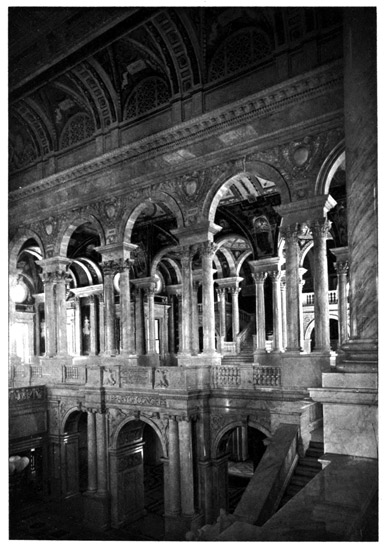
In the Congressional Library, Washington, D. C
The Smithsonian Institution was formally created by Act of Congress, August 10, 1846, the corporation being composed of the President, Vice-President, members of the Cabinet and Chief Justice, who are constituted the "establishment," made responsible for the duty of "the increase and diffusion of knowledge among men." The Institution is administered by a Board of Regents, including in addition three Senators, three members of the House, and six citizens appointed by Congress; the presiding officer, called the "Chancellor," being usually the Chief Justice, and the secretary of the board is the Executive Officer. The late eminent Professor Joseph Henry was elected secretary in 1846, and he designed the plan and scope of the Institution, continuing as its executive head until his death in 1878. His statue stands in the grounds near the entrance. Two other secretaries followed him, Spencer F. Baird (who was twenty-seven years assistant secretary), and upon his death Samuel P. Langley, in 1888. The ornate building of red Seneca brownstone, a fine castellated structure in the Renaissance style, was designed in 1847 and finished in 1855. Its grand front stretches about four hundred and fifty feet, and its nine towers and turrets, rising from seventy-five to one hundred and fifty feet, stand up prettily behind the groves of trees. This original building contains a museum of natural history and anthropology. In connection with it there is another elaborate structure over three hundred feet square—the National Museum—containing numerous courts, surrounding a central rotunda, beneath which a fountain plashes. This is under the same management, and directly supported by the Government, the design being to perfect a collection much like the British Museum, but paying more attention to American antiquities and products. This adjunct museum began with the gifts by foreign Governments to the Philadelphia Centennial Exposition in 1876, most of them being still preserved there. The Smithsonian Trust Fund now approximates $1,000,000, and there are various other gifts and bequests held in the Treasury for various scientific purposes similarly administered.
Briefly stated, the plan of Professor Henry was to "increase knowledge" by original investigations and study, either in science or literature, and to "diffuse knowledge" not only through the United States, but everywhere, and especially by promoting an interchange of thought among the learned in all nations, with no restriction in favor of any one branch of knowledge. A leading feature of his plan was "to assist men of science in making original researches, to publish them in a series of volumes, and to give a copy of them to every first-class library on the face of the earth." There is said to be probably not a scientific observer of any standing in the United States to whom the Institution has not at some time extended a helping hand, and this aid also goes liberally across the Atlantic. As income grew, the scope has been enlarged. In the various museums there is a particularly good collection of American ethnology, and a most elaborate display of American fossils, minerals, animals, birds and antiquities. There are also shown by the Fish Commission specimens of the fishing implements and fishery methods of all nations, an exhibition which is unexcelled in these special departments. Many specifically interesting things are in the National Museum. The personal effects of Washington, Jackson and General Grant are there. Benjamin Franklin's old printing-press is preserved in a somewhat dilapidated condition, and there is also the first railway engine sent from England to the United States, the original "John Bull," built by Stephenson & Son at Newcastle-on-Tyne in June, 1831, and sent out as "Engine No. 1" for the Camden and Amboy Railroad crossing New Jersey, now a part of the Pennsylvania Railroad. It weighs ten tons, and has four driving-wheels of fifty-four inches diameter. This relic, after being used on the railroad for forty years, until improved machinery superseded it, has been given the Government as a national heirloom. Among the anthropological collections is a chronologically arranged series illustrating American history from the period of the discovery to the present day. This includes George Catlin's famous collection of six hundred paintings, illustrating the manners and customs of the North American Indians. One of the most important features of the work of this most interesting establishment is its active participation in all the great International Expositions by the loan to them of valuable exhibits under Government direction and control.
THE SOLDIERS' HOME AND WASHINGTON MONUMENT.
The city of Washington, with progressing years, is becoming more and more the popular residential city of the country. It is one of the most beautiful and attractive, the admirable plan, with the wide asphalted streets, lined with trees, opening up vista views of grand public buildings, statues, monuments or leafy parks, making it specially popular. The northern and northwestern sections, on the higher grounds, have consequently spread far beyond the Executive Mansion, being filled with rows of elaborate and costly residences, the homes of leading public men. The streets are kept scrupulously clean, while at the intersections are "circles," triangles and little squares, which are availed of for pretty parks, and usually contain statues of distinguished Americans. Among the noted residence streets are Vermont, Massachusetts and Connecticut Avenues and K Street and Sixteenth Street, all in the northwestern district. Among the many statues adorning the small parks and "circles" are those of Washington, Farragut, Scott, Thomas, McPherson, Dupont, Logan, Franklin, Hancock, Grant, Rawlins and Martin Luther, the latter a replica of the figure in the Reformation Monument at Worms.
To the northward the suburbs rise to Columbia Heights, with an elevated plateau beyond, where there is a Government park covering nearly a square mile of rolling surface, and surrounding one of the noted rural retreats on the borders of the Capital, the "Soldiers' Home." This is an asylum and hospital for disabled and superannuated soldiers of the American regular army, containing usually about six hundred of them, and founded by General Winfield Scott, whose statue adorns the grounds. Its cottages have been favorite retiring-places of the Presidents in the warm weather. Amid lovely surroundings the veterans are comfortably housed, and in the adjacent cemetery thousands of them have been buried. Scott's statue stands upon the southern brow of the plateau, where a ridge is thrust out in a commanding situation; and from here the old commander of the army forty and fifty years ago gazes intently over the lower ground to the city three miles away, with the lofty Capitol dome and Washington Monument rising to his level, while beyond them the broad and placid Potomac winds between its wooded shores. This is the most elevated spot near Washington, overlooking a wide landscape. In the cemetery at the Soldiers' Home sleeps General Logan, among the thousands of other veterans. To the westward the beautiful gorge of Rock Creek is cut down, and beyond is Georgetown, with its noted University, founded by the Jesuits in 1789, and having about seven hundred students. In the Oak Hill Cemetery, at Georgetown, is the grave of John Howard Payne, the author of "Home, Sweet Home," who died in 1852. Far away over the Potomac, in the Arlington National Cemetery, are the graves of Generals Sherman and Sheridan.
Down near the Potomac, on the Mall, to the westward of the Smithsonian turrets, is the extensive brick and brownstone building representing the dominant industry of the United States, which gives the politicians so much anxiety in catering for votes—the Agricultural Department. Here are spacious gardens and greenhouses, an arboretum and herbarium, the adjacent buildings also containing an agricultural museum. As over three-fifths of the men in the United States are farmers and farm-workers, and many others are in the adjunct industries, it has become a popular saying in Washington that if you wish to scare Congress you need only shake a cow's tail at it. This department has grown into an enormous distributing office for seeds and cuttings, crop reports and farming information. Among its curiosities is the "Sequoia Tree Tower," formed of a section of a Sequoia or Big Tree of California, which was three hundred feet high and twenty-six feet in diameter at the base.
Behind the Agricultural Department, and rising almost at the river bank, and in front of the Executive Mansion, is the noted Washington Monument, its pointed apex elevated five hundred and fifty-five feet. This is a square and gradually tapering shaft, constructed of white Maryland marble, the walls fifteen feet thick at the base and eighteen inches at the top, the pyramidal apex being fifty-five feet high and capped with a piece of aluminum. Its construction was begun in 1848, abandoned in 1855, resumed in 1877 and finished in 1884, at a total cost of $1,300,000. The lower walls contain stones contributed by public corporations and organizations, many being sent by States and foreign nations, and bearing suitable inscriptions in memory of Washington. A fatiguing stairway of nine hundred steps leads to the top, and there is also a slow-moving elevator. From the little square windows, just below the apex, there is a grand view over the surrounding country. Afar off to the northwest is seen the long hazy wall of the Blue Ridge or Kittatinny Mountain range, its prominent peak, the Sugar Loaf, being fifty miles distant. To the eastward is the Capitol and its surmounting dome, over a mile away, while the city spreads all around the view below, like a toy town, its streets crossing as on a chess-board, and cut into gores and triangles by the broad, diagonal avenues lined with trees, the houses being interspersed with many foliage-covered spaces. Coming from the northwest the Potomac passes nearly at the foot of the monument, with Arlington Heights over on the distant Virginia shore, and the broad river channel flowing away to the southwest until lost among the winding forest-clad shores below Alexandria. From this elevated perch can be got an excellent idea of the peculiarities of the town, its vast plan and long intervals of space, so that there is quite plainly shown why the practical Yankee race calls it the "City of Magnificent Distances." Possibly one of the best descriptions of Washington and its characteristics is that of the poet in the Washington Post:
A city well named of magnificent distances; Of boulevards, palaces, fountains and trees; Of sunshine and moonlight whose subtle insistence is— "Bask in our radiance! Be lulled by our breeze!" A city like Athens set down in Arcadia; White temples and porticoes gleaming 'mid groves; Where nymphs glide and smile as though quite unafraid o' you, The home of the Muses, the Graces, the Loves; The centre of Politics, Letters and Sciences; Elysium of Arts, yet the Lobbyist's Dream; Where gather the clans whose only reliance is Gold and the dross that sweeps down with its stream; An isle of the lotus, where every-day business Sails on its course all unvexed by simoons; No bustle or roar, no mad-whirling dizziness O'er velvety streets like Venetian lagoons; A town where from nothing whatever they bar women, From riding a bicycle—tending a bar; Ex-cooks queen society—ladies are charwomen— For such the plain facts as too often they are. A city where applicants, moody, disconsolate, Swoop eager for office and senseless to shame; The "heeler" quite certain of getting his consulate, Although, to be sure, he can't sign his name; A town where all types of humanity congregate; The millionaire lolling on cushions of ease; The tramp loping by at a wolfish and hungry gait; And mankind in general a' go as you please. A city in short of most strange inconsistencies; Condensing the history of man since the fall; A city, however, whose piece de resistance is This—'tis the best and the fairest of all.
THE POTOMAC AND THE ALLEGHENIES.
The Potomac is one of the chief among the many rivers draining the Allegheny Mountains. It originates in two branches, rising in West Virginia and uniting northwest of Cumberland; is nearly four hundred miles long; has remarkably picturesque scenery in the magnificent gorges and reaches of its upper waters; breaks through range after range of the Alleghenies, and after reaching the lowlands becomes a tidal estuary for a hundred miles of its final course, broadening to six and eight and ultimately sixteen miles wide at its mouth in the Chesapeake. Washington is near the head of tidewater, one hundred and twenty-five miles from the bay; and for almost its entire course the Potomac is an interstate boundary, between Maryland and West Virginia and Virginia. Its name is Indian, referring to its use in their primitive navigation, the original word "Petomok" meaning "they are coming by water"—"they draw near in canoes." The Alleghenies, where this noted river originates, are a remarkable geological formation. The Atlantic Coast of the United States has a general trend from the northeast to the southwest, with bordering sand beaches, and back of them a broad band of pines. Then, towards the northwest, the land gradually rises, being formed in successive ridges, with intervening valleys, until it reaches the Alleghenies. The great ranges of this mountain chain, which is geologically known as the Appalachian System, run almost parallel to the coast for over a thousand miles, from the White Mountains of New Hampshire down to Alabama. They are noted mountains, not very high, but of remarkable construction, and are said to be much older in geological formation than the Alps or the Andes. They are composed of series of parallel ridges, one beyond the other, and all following the same general course, like the successive waves of the ocean. For long distances these ridges run in perfectly straight lines, and then, as one may curve around into a new direction, all the others curve with it. The intervening valleys are as remarkable in their parallelism as the ridges enclosing them. From the seaboard to the mountains the ranges of hills are of the same general character, but with less elevation, gentler slopes, and in most cases narrower and much more fertile valleys.
The South Mountain, an irregular and in some parts broken-down ridge, is the outpost of the Alleghenies, while the great Blue Ridge is their eastern buttress. The latter is about twenty miles northwest of the South Mountain, and is the famous Kittatinny range, named by the Indians, and in their figurative language meaning "the endless chain of hills." It stretches from the Catskills in New York southwest to Alabama, a distance of eight hundred miles, a veritable backbone for the Atlantic seaboard, its rounded ridgy peaks rising sometimes twenty-five hundred feet north of the Carolinas, and much higher in those States. It stands up like a great blue wall against the northwestern horizon, deeply notched where the rivers flow out, and is the eastern border for the mountain chain of numerous parallel ridges of varying heights and characteristics that stretch in rows behind it, covering a width of a hundred miles or more. Within this chain is the vast store of minerals that has done so much to create American wealth—the coal and iron, the ores and metals, that are in exhaustless supply, and upon the surface grew the forests of timber that were used in building the seaboard cities, but are now nearly all cut off. The great Atlantic Coast rivers rise among these mountain ridges, break through the Kittatinny and flow down to the ocean, while the streams on their western slopes drain into the Mississippi Valley. The Hudson breaks through the Kittatinny outcrop at the West Point Highlands, the Delaware forces a passage at the Water Gap, the Lehigh at the Lehigh Gap, below Mauch Chunk; the Schuylkill at Port Clinton, the Susquehanna at Dauphin, above Harrisburg, and the Potomac at Harper's Ferry. All these rivers either rise among or force their winding passages through the various ranges behind the great Blue Ridge, and also through the South Mountain and the successive parallel ranges of lower hills that are met on their way to the coast, so that all in their courses display most picturesque valleys.
HARPER'S FERRY AND JOHN BROWN.
The Potomac, having flowed more than two hundred miles through beautiful gorges and the finest scenery of these mountains, finally breaks out at Harper's Ferry, receiving here its chief tributary, the Shenandoah, coming up from Virginia, the Potomac River passage of the Blue Ridge being described by Thomas Jefferson as "one of the most stupendous scenes in nature." The Shenandoah—its name meaning "the stream passing among the spruce-pines"—flows through the fertile and famous "Valley of Virginia," noted for its many battles and active movements of troops during the Civil War, when the rival forces, as fortunes changed, chased each other up and down the Valley; and Harper's Ferry, at the confluence of the rivers, and the towering Maryland Heights on the northern side and the Loudon Heights on the Virginia side, the great buttresses of the river passage, being generally held as a northern border fortress. These huge mountain walls rise fifteen hundred feet above the town, which has a population of about two thousand.
Harper's Ferry was also the scene of "John Brown's raid," which was practically the opening act of the Civil War, although actual hostilities did not begin until more than a year afterwards. "Old John Brown of Osawatomie" was a tanner, an unsettled and adventurous spirit and foe of slavery, born in Connecticut in 1800, but who, at the same time, was one of the most upright and zealous men that ever lived. In his wanderings he migrated to Kansas in 1855, where he lived at Osawatomie, and fought against the pro-slavery party. His house was burnt and his son killed in the Kansas border wars, and he made bloody reprisals. Smarting under his wrongs, he became the master-spirit of a convention which met at Chatham, Canada, in May, 1859, and organized an invasion of Virginia to liberate the slaves. Having formed his plans, he rented a farmhouse in July about six miles from Harper's Ferry, and gathered his forces together. On the night of October 16th, with twenty-two associates, six being negroes, he crossed the bridge into Harper's Ferry, and captured the arsenal and armory of the Virginia militia, intending to liberate the slaves and occupy the heights of the Blue Ridge as a base of operations against their owners. A detachment of United States marines were next day sent to the aid of the militia, and, after two days' desultory hostilities, some of his party were killed, and Brown and the survivors were captured and given up to the Virginia authorities for trial. His final stand was made in a small engine-house, known as "John Brown's Fort," which was exhibited at the Chicago Exposition in 1893. Brown and six of his associates were hanged at the county-seat, Charlestown, seven miles southwest of Harper's Ferry, on December 2d, Brown facing death with the greatest serenity. His raid failed, but it was potential in disclosing the bitter feeling between the North and the South, and it furnished the theme for the most popular and inspiring song of the Civil War:
"John Brown's body lies mouldering in the grave, But his soul goes marching on."
THE GREAT FALLS AND ALEXANDRIA.
The Potomac continues its picturesque course below Harper's Ferry, and passes the Point of Rocks, a promontory of the Catoctin Mountain, a prolongation of the Blue Ridge. There were battles fought all about, the most noted being at South Mountain and Antietam, to the northward, in September, 1862; while it was at Frederick, fifteen miles away, during this campaign, that Barbara Frietchie was said to have waved the flag as Stonewall Jackson marched through the town, immortalized in Whittier's poem. Here is buried Francis Scott Key, author of the "Star-Spangled Banner," who died in 1843, and a handsome monument was erected to his memory in 1898. The Potomac reaches its Great Falls about fifteen miles above Washington, where it descends eighty feet in about two miles, including a fine cataract thirty-five feet high. Below this is the "Cabin John Bridge," with one of the largest stone arches in the world, of two hundred and twenty feet span, built for the Washington Aqueduct, carrying the city water supply from the Great Falls. On Wesley Heights, to the northward, the new American University of the Methodist Church is being constructed.
Below Washington, the river passes the ancient city of Alexandria, a quaint old Virginian town, which was formerly of considerable commercial importance, but is now quiet and restful, and cherishing chiefly the memory of George Washington, who lived at Mount Vernon, a few miles below, and was its almost daily visitor to transact his business and go to church and entertainments. The tradition is that Madison, who was chairman of the Committee of Congress, selected Alexandria for the "Federal City," intending to erect the Capitol on Shooters' Hill, a mile out of town, as grand an elevation as the hill in Washington; but he was overruled by the President because the latter hesitated to thus favor his native State. Had Madison had his way, the town probably would not now be so sleepy. The modest little steeple of Christ Church, where Washington was a vestryman, rises back of the town, and his pew, No. 5, is still shown, for which, when the church was built and consecrated in 1773, the records show that he paid thirty-six pounds, ten shillings. To construct this church and another at the Falls, the vestry of Fairfax parish, in 1766, levied an assessment of 31,185 pounds of tobacco, and the rector's salary was also paid in tobacco. After the Revolution, to help support the church, Washington and seven others signed an agreement in the vestry-book to each pay five pounds annual rental for the pews they owned. Robert E. Lee was baptized and confirmed and attended Sunday-school in this old church, and tablets in memory of Washington and Lee were inserted in the church wall in 1870. At the Carey House, near the river, Washington, in 1755, received from General Braddock, who had come up there from Hampton Roads, his first commission as an aide to that commander, with the rank of Major, just before starting on the ill-starred expedition into Western Pennsylvania. Alexandria has probably fifteen thousand people, and on the outskirts is another mournful relic of the Civil War, a Soldiers' Cemetery, with four thousand graves. Below Alexandria, the Hunting Creek flows into the Potomac, this stream having given Washington's home its original name of the "Hunting Creek Estate."
WASHINGTON'S HOME AND TOMB.
Mount Vernon, the home and burial-place of George Washington, is seventeen miles below the city of Washington, the mansion-house, being in full view, standing among the trees on the top of a bluff, rising about two hundred feet above the river. As the steamboat approaches, its bell is tolled, this being the universal custom on nearing or passing Washington's tomb. It originated in the reverence of a British officer, Commodore Gordon, who, during the invasion of the Capital in August, 1814, sailed past Mount Vernon, and as a mark of respect for the dead had the bell of his ship, the "Sea Horse," tolled. The "Hunting Creek Estate" was originally a domain of about eight thousand acres; and Augustine Washington, dying in 1743, bequeathed it to Lawrence Washington, who, having served in the Spanish wars under Admiral Vernon, named it Mount Vernon in his honor. George Washington was born in 1732, in Westmoreland County, farther down the Potomac, and when a boy lived near Fredericksburg, on the Rappahannock River. In 1752 he inherited Mount Vernon from Lawrence, and after his death the estate passed to his nephew, Bushrod Washington, subsequently descending to other members of the family. Congress repeatedly endeavored to have Washington's remains removed to the crypt under the rotunda of the Capitol originally constructed for their reception, but the family always refused, knowing it was his desire to rest at Mount Vernon. The grounds and buildings being in danger of falling into dilapidation, and the estate passing under control of strangers, a patriotic movement began throughout the country for the purchase of the portion containing the tomb and mansion. The Virginia Legislature, in 1856, passed an act authorizing the sale, and under the auspices of a number of energetic ladies who formed the "Mount Vernon Association," assisted by the oratory of Edward Everett, who traversed the country making a special plea for help, a tract of two hundred acres was bought for $200,000, being enlarged by subsequent gifts to two hundred and thirty-five acres. These ladies and their successors have since taken charge, restoring and beautifying the estate, which is faithfully preserved as a patriotic heritage and place of pilgrimage for visitors from all parts of the world.
The steamboat lands at Washington's wharf at the foot of the bluff, where he formerly loaded his barges with flour ground at his own mill, shipping most of it from Alexandria to the West Indies. The road from the wharf leads up a ravine cut diagonally in the face of the bluff, directly to Washington's tomb, and alongside the ravine are several weeping willows that were brought from Napoleon's grave at St. Helena. Washington's will directed that his tomb "shall be built of brick," and it is a plain square brick structure, with a wide arched gateway in front and double iron gates. Above is the inscription on a marble slab, "Within this enclosure rests the remains of General George Washington." The vault is about twelve feet square, the interior being plainly seen through the gates. It has upon the floor two large stone coffins, that on the right hand containing Washington, and that on the left his widow Martha, who survived him over a year. In a closed vault at the rear are the remains of numerous relatives, and in front of the tomb monuments are erected to several of them. No monument marks the hero, but carved upon the coffin is the American coat-of-arms, with the single word "Washington."
The road, farther ascending the bluff, passes the original tomb, with the old tombstone antedating Washington and bearing the words "Washington Family." This was the tomb, then containing the remains, which Lafayette visited in 1824, escorted by a military guard from Alexandria to Mount Vernon, paying homage to the dead amid salvos of cannon reverberating across the broad Potomac. It is a round-topped and slightly elevated oven-shaped vault. The road at the top of the bluff reaches the mansion, standing in a commanding position, with a fine view over the river to the Maryland shore. It is a long wooden house, with an ample porch facing the river. It is built with simplicity, two stories high, and contains eighteen rooms, there being a small surmounting cupola for a lookout. The central portion is the original house built by Lawrence Washington, who called it his "villa," and afterwards George Washington extended it by a large square wing at each end, and when these were added he gave it the more dignified title of the "Mansion." The house is ninety-six feet long and thirty feet wide, the porch, extending along the whole front, fifteen feet wide, its top being even with the roof, thus covering the windows of both stories. Eight large square wooden columns support the roof of the porch. Behind the house, on either side, curved colonnades lead to the kitchens, with other outbuildings beyond. There are various farm buildings, and a brick barn and stable, the bricks of which it is built having been brought out from England about the time Washington was born, being readily carried in those days as ballast in the vessels coming out for Virginia tobacco. The front of the mansion faces east, and it has within a central hall with apartments on either hand. At the back, beyond the outbuildings and the barn, stretches the carriage road, which in Washington's time was the main entrance, off to the porter's lodge, on the high road, at the boundary of the present estate, about three-quarters of a mile away. Everything is quiet, and in the thorough repose befitting such a great man's tomb; and this is the modest mansion on the banks of the Potomac that was the home of one of the noblest Americans.
THE WASHINGTON RELICS.
As may be supposed, this interesting building is filled with relics. The most valuable of all of them hangs on the wall of the central hall, in a small glass case shaped like a lantern—the Key of the Bastille—which was sent to Washington, as a gift from Lafayette, shortly after the destruction of the noted prison in 1789. This is the key of the main entrance, the Porte St. Antoine, an old iron key with a large handle of peculiar form. This gift was always highly prized at Mount Vernon, and in sending it Lafayette wrote: "It is a tribute which I owe as a son to my adopted father; as an aide-de-camp to my general; as a missionary of liberty to its patriarch." The key was confided to Thomas Paine for transmission, and he sent it together with a model and drawing of the Bastille. In sending it to Washington Paine said: "That the principles of America opened the Bastille is not to be doubted, and therefore the key comes to the right place." The model, which was cut from the granite stones of the demolished prison, and the drawing, giving a plan of the interior and its approaches, are also carefully preserved in the house.
The Washington relics are profuse—portraits, busts, old furniture, swords, pistols and other weapons, camp equipage, uniforms, clothing, books, autographs and musical instruments, including the old harpsichord which President Washington bought for two hundred pounds in London, as a bridal present for his wife's daughter, Eleanor Parke Custis, whom he adopted. There is also an old armchair which the Pilgrims brought over in the "Mayflower" in 1620. Each apartment in the house is named for a State, and cared for by one of the Lady-Regents of the Association. In the banquet-hall, which is one of the wings Washington added, is an elaborately-carved Carrara marble mantel, which was sent him at the time of building by an English admirer, Samuel Vaughan. It was shipped from Italy, and the tale is told that on the voyage it fell into the hands of pirates, who, hearing it was to go to the great American Washington, sent it along without ransom and uninjured. Rembrandt Peale's equestrian portrait of Washington with his generals covers almost the entire end of this hall. Here also is hung the original proof-sheet of Washington's Farewell Address. Up stairs is the room where Washington died; the bed on which he expired and every article of furniture are preserved, including his secretary and writing-case, toilet-boxes and dressing-stand. Just above this chamber, under the peaked roof, is the room in which Mrs. Washington died. Not wishing to occupy the lower room, after his death, she selected this one, because its dormer window gave a view of his tomb. The ladies who have taken charge of the place deserve great credit for their complete restoration; they hold the annual meeting of the Association in the mansion every May.
As the visitor walks through the old house and about the grounds, solemn and impressive thoughts arise that are appropriate to this great American shrine. From the little wooden cupola there is seen the same view over the broad Potomac upon which Washington so often gazed. The noble river, two miles wide, seems almost to surround the estate with its majestic curve, flowing between the densely-wooded shores. Above Mount Vernon is a projecting bluff, which Fort Washington surmounts on the opposite shore—a stone work which he planned—hardly seeming four miles off, it is so closely visible across the water. In front are the Maryland hills, and the river then flows to the southward, its broad and winding reaches being seen afar off, as the southern shores slope upward into the forest-covered hills of the sacred soil of the proud State of Virginia. And then the constantly broadening estuary of the grand Potomac stretches for more than a hundred miles, far beyond the distant horizon, until it becomes a wide inland sea and unites its waters at Point Lookout with those of Chesapeake Bay.
MARY, THE MOTHER OF WASHINGTON.
To the southward of the Potomac a short distance, and flowing almost parallel, is another noted river of Virginia, the Rappahannock, rising in the foothills of the Blue Ridge, and broadening into a wide estuary in its lower course. Its chief tributary is the stream which the colonists named after the "good Queen Anne," the Rapid Ann, since condensed into the Rapidan. The Indians recognized the tidal estuary of the Rappahannock, for the name means "the current has returned and flowed again," referring to the tidal ebb and flow. Upon this stream, southward from Washington, is the quaint old city of Fredericksburg, which has about five thousand inhabitants, and five times as many graves in the great National Cemetery on Marye's Heights and in the Confederate Cemetery, mournful relics of the sanguinary battles fought there in 1862-63. The town dates from 1727, when it was founded at the head of tidewater on the Rappahannock, where a considerable fall furnishes good water-power, about one hundred and ten miles from the Chesapeake. But its chief early memory is of Mary Ball, the mother of Washington, here having been his boyhood home. A monument has been erected to her, which it took the country more than a century to complete. She was born in 1706 on the lower Rappahannock, at Epping Forest, and Sparks and Irving speak of her as "the belle of the Northern Neck" and "the rose of Epping Forest." In early life she visited England, and the story is told that one day while at her brother's house in Berkshire a gentleman's coach was overturned nearby and its occupant seriously injured. He was brought into the house and carefully nursed by Mary Ball until he fully recovered. This gentleman was Colonel Augustine Washington, of Virginia, a widower with three sons, and it is recorded in the family Bible that "Augustine Washington and Mary Ball were married the 6th of March, 1730-31." He brought her to his home in Westmoreland County, where George was born the next year. His house there was accidentally burnt and they removed to Fredericksburg, where Augustine died in 1740; but she lived to a ripe old age, dying there in 1789. When her death was announced a national movement began to erect a monument, but it was permitted to lapse until the Washington Centenary in 1832, when it was revived, and in May, 1833, President Jackson laid the corner-stone with impressive ceremonies in the presence of a large assemblage of distinguished people. The monument was started and partially completed, only again to lapse into desuetude. In 1890 the project was revived, funds were collected by an association of ladies, and in May, 1894, a handsome white marble obelisk, fifty feet high, was created and dedicated. It bears the simple inscription, "Mary, the Mother of Washington."
WILLIAMSBURG AND YORKTOWN.
Again we cross over southward from the Rappahannock to another broad tidal estuary, an arm of Chesapeake Bay, the York River. This is formed by two comparatively small rivers, the Mattapony and the Pamunkey, the latter being the Indian name of York River. It is quite evident that the Indians who originally frequented and named these streams did not have as comfortable lives in that region as they could have wished, for the Mattapony means "no bread at all to be had," and the Pamunkey means "where we were all sweating." To the southward of York River, and between it and James River, is the famous "Peninsula," the locality of the first settlements in Virginia, the theatre of the closing scene of the War of the Revolution, and the route taken by General McClellan in his Peninsular campaign of 1862 against Richmond. Williamsburg, which stands on an elevated plateau about midway of the Peninsula, three or four miles from each river, was the ancient capital of Virginia, and it has as relics the old church and magazine of the seventeenth century, and the venerable College of William and Mary, chartered in 1693, though its present buildings are mainly modern. This city was named for King William III., and was fixed as the capital in 1699, the government removing from Jamestown the next year. In 1780 the capital was again removed to Richmond. This old city, which was besieged and captured by McClellan in his march up the Peninsula in May, 1862, now has about eighteen hundred inhabitants.
Down on the bank of York River, not far from Chesapeake Bay, with a few remains of the British entrenchments still visible, is Yorktown, the scene of Cornwallis's surrender, the last conflict of the American Revolution. Sir Henry Clinton, the British commander-in-chief in 1781, ordered Lord Cornwallis to occupy a strong defensible position in Virginia, and he established himself at Yorktown on August 1st, with his army of eight thousand men, supported by several warships in York River, and strongly fortified not only Yorktown, but also Gloucester Point, across the river. In September the American and French forces effected a junction at Williamsburg, marching to the investment of Yorktown on the 28th. Washington commanded the besieging forces, numbering about sixteen thousand men, of whom seven thousand were Frenchmen. Upon their approach the British abandoned the outworks, and the investment of the town was completed on the 30th. The first parallel of the siege was established October 9th, and heavy batteries opened with great effect, dismounting numerous British guns, and destroying on the night of the 10th a frigate and three large transports. The second parallel was opened on the 11th, and on the 14th, by a brilliant movement, two British redoubts were captured. The French fleet, under Count De Grasse, in Chesapeake Bay, prevented escape by sea, and Cornwallis's position became very critical. On the 16th he made a sortie, which failed, and on the 17th he proposed capitulation. The terms being arranged, he surrendered October 19th, this deciding the struggle for American independence. When the British troops marched out of the place, and passed between the French and American armies, it is recorded that their bands dolefully played "The World Turned Upside Down." Considering the momentous results following the capitulation, this may be regarded as prophetic. Yorktown was again besieged in 1862 by McClellan, and after several weeks was taken in May, the army then starting on its march up the Peninsula.
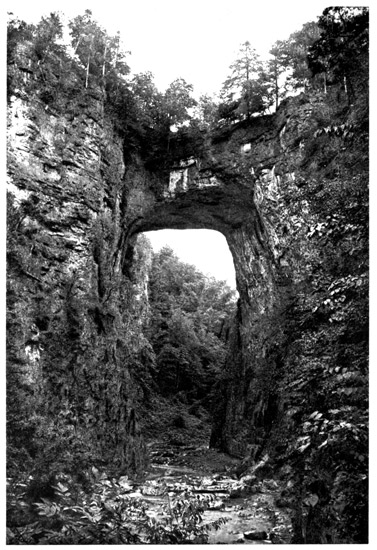
The Natural Bridge, Virginia
THE NATURAL BRIDGE.
The chief river of Virginia is the James, a noble stream, rising in the Alleghenies and flowing for four hundred and fifty miles from the western border of the Old Dominion until it falls into Chesapeake Bay at Hampton Roads. Its sources are in a region noted for mineral springs, and the union of Jackson and Cowpasture Rivers makes the James, which flows to the base of the Blue Ridge, and there receives a smaller tributary, not inappropriately named the Calfpasture River. The James breaks through the Blue Ridge by a magnificent gorge at Balcony Falls. Seven miles away, spanning the little stream known as Cedar Brook, is the famous Natural Bridge, the wonderful arch of blue limestone two hundred and fifteen feet high, ninety feet wide, and having a span of a hundred feet thrown across the chasm, which has given to the county the name of Rockbridge. Overlooking the river and the bridge and all the country roundabout are the two noble Peaks of Otter, rising about four thousand feet, the highest mountains in that part of the Alleghenies. This wonderful bridge is situated at the extremity of a deep chasm, through which the brook flows, across the top of which extends the rocky stratum in the form of a graceful arch. It looks as if the limestone rock had originally covered the entire stream bed, which then flowed through a subterranean tunnel, the rest of the limestone roof having fallen in and been gradually washed away. The bridge is finely situated in a grand amphitheatre surrounded by mountains. The crown of the arch is forty feet thick, the rocky walls are perpendicular, and over the top passes a public road, which, being on the same level as the immediately adjacent country, one may cross it in a coach without noticing the bridged chasm beneath. Various large forest trees grow beneath and under the arch, but are not tall enough to reach it. On the rocky abutments of the bridge are carved the names of many persons who had climbed as high as they dared on the steep face of the precipice. Highest of all, for about seventy years, was the name of Washington, who, in his youth, ascended about twenty-five feet to a point never before reached; but this feat was surpassed in 1818 by James Piper, a college student, who actually climbed from the foot to the top of the rock. In 1774 Thomas Jefferson obtained a grant of land from George III. which included the Natural Bridge, and he was long the owner, building the first house there, a log cabin with two rooms, one being for the reception of strangers. Jefferson called the bridge "a famous place that will draw the attention of the world;" Chief Justice Marshall described it as "God's greatest miracle in stone;" and Henry Clay said it was "The bridge not made with hands, that spans a river, carries a highway, and makes two mountains one."
THE JAMES RIVER AND POWHATAN.
Following down James River, constantly receiving accessions from mountain streams, we soon come to Lynchburg, most picturesquely built on the sloping foothills of the Blue Ridge, and having fine water-power for its factories, a centre of the great tobacco industry of Virginia, supporting a population of about twenty thousand people. Lynchburg was a chief source of supply for Lee's army in Eastern Virginia until, in February, 1865, Sheridan, by a bold raid, destroyed the canal and railroads giving it communication; and, after evacuating Richmond, Lee was endeavoring to reach Lynchburg when he surrendered at Appomattox, about twenty miles to the eastward, on April 9, 1865, thus ending the Civil War. The little village of Appomattox Court House is known in the neighborhood as Clover Hill. When Lee surrendered, casualties, captures and desertions had left him barely twenty-seven thousand men, with only ten thousand muskets, thirty cannon and three hundred and fifty wagons.
The James River, east of the Blue Ridge, drains a grand agricultural district, and its coffee-colored waters tell of the rich red soils through which it comes in the tobacco plantations all the way past Lynchburg to Richmond. In its earlier history this noted river was called the Powhatan, and it bears that name on the older maps. Powhatan, the original word, meant, in the Indian dialect, the "falls of the stream" or "the falling waters," thus named from the falls and rapids at Richmond, where the James, in the distance of nine miles, has a descent of one hundred and sixteen feet, furnishing the magnificent water-power which is the source of much of the wealth of Virginia's present capital. The old Indian sachem whose fame is so intertwined with that of Virginia took his name of Powhatan from the river. His original name was Wahunsonacock when the colonists first found him, and he then lived on York River; but it is related that he grew in power, raised himself to the command of no less than thirty tribes, and ruled all the country from southward of the James to the eastward of the Potomac as far as Chesapeake Bay. When he became great, for he was unquestionably the greatest Virginian of the seventeenth century, he changed his name and removed to the James River, just below the edge of Richmond, where, near the river bank, is now pointed out his home, still called Powhatan. It was here that the Princess Pocahontas is said to have interfered to save the life of Captain John Smith. Here still stands a precious relic in the shape of an old chimney, believed to have been originally built for the Indian king's cabin by his colonist friends. It is of solid masonry, and is said to have outlasted several successive cabins which had been built up against it in Southern style. A number of cedars growing alongside, tradition describes as shadowing the very stone on which Smith's head was laid. It may not be generally known that early in the history of the colony Powhatan was crowned as a king, there having been brought out from England, for the special purpose, a crown and "a scarlet cloke and apparrell." The writer recording the ceremony says quaintly: "Foule trouble there was to make him kneele to receive his crowne. At last, by leaning hard on his shoulders, he a little stooped, and three having the crowne in their hands, put it on his head. To congratulate their kindnesse, he gave his old shoes and his mantell to Captaine Newport, telling him take them as presents to King James in return for his gifts."
THE INDIAN PRINCESS POCAHONTAS.
The James River carries a heavy commerce below Richmond, and the channel depths of the wayward and very crooked stream are maintained by an elaborate system of jetties, constructed by the Government. Both shores show the earthworks that are relics of the war, and Drewry's Bluff, with Fort Darling, the citadel of the Confederate defence of the river, is projected across the stream. Below is Dutch Gap, where the winding river, flowing in a level plain, makes a double reverse curve, going around a considerable surface without making much actual progress. Here is the Dutch Gap Canal, which General Butler cut through the narrowest part of the long neck of land, thus avoiding Confederate batteries and saving a detour of five and a half miles; it is now used for navigation. Just below is the large plantation of Varina, where the Indian Princess Pocahontas lived after her marriage with the Englishman, John Rolfe. Its fine brick colonial mansion was the headquarters for the exchange of prisoners during the Civil War.
The brief career of Pocahontas is the great romance of the first settlement of Virginia. She was the daughter and favorite child of Powhatan, her name being taken from a running brook, and meaning the "bright streamlet between the hills." When the Indians captured Captain John Smith she was about twelve years of age. He made friends of the Indian children, and whittled playthings for them, so that Pocahontas became greatly interested in him, and the tale of her saving his life is so closely interwoven with the early history of the colony that those who declare it apocryphal have not yet been able to obliterate it from our school-books. Smith being afterwards liberated, Pocahontas always had a longing for him, was the medium of getting the colonists food, warned them of plots, and took an interest in them even after Smith returned to England. The tale was then told her that Smith was dead. In 1614 Pocahontas, about nineteen years old, was kidnapped and taken to Jamestown, in order to carry out a plan of the Governor by which Powhatan, to save his daughter, would make friendship with the colony, and it resulted as intended. Pocahontas remained several weeks in the colony, made the acquaintance of the younger people, and fell in love with Master John Rolfe. Pocahontas returned to her father, who consented to the marriage; she was baptized at Jamestown as Lady Rebecca, and her uncle and two brothers afterwards attended the wedding, the uncle giving the Indian bride away in the little church at Jamestown, April 5, 1614. A peace of several years' duration was the consequence of this union. Two years afterwards Pocahontas and her husband proceeded to England, where she was an object of the greatest interest to all classes of people, and was presented at Court, the Queen warmly receiving her. Captain Smith visited her in London, and after saluting him she turned away her face and hid it in her hands, thus continuing for over two hours. This was due to her surprise at seeing Smith, for there is no doubt her husband was a party to the deception, he probably thinking she would never marry him while Smith was living. The winter climate of England was too severe for her, and when about embarking to return to Virginia she suddenly died at Gravesend, in March, 1617, aged about twenty-two. She left one son, Thomas Rolfe, who was educated in London, and in after life went to Virginia, where he became a man of note and influence. From him are descended the famous children of Pocahontas—the "First Families of Virginia"—the Randolph, Bolling, Fleming and other families.
SHIRLEY, BERKELEY AND WESTOVER.
The winding James flows by Deep Bottom and Turkey Bend, and one elongated neck of land after another, passing the noted battlefield of Malvern Hill, which ended General McClellan's disastrous "Seven Days" of battles and retreat from the Chickahominy swamps in 1862. The great ridge of Malvern Hill stretches away from the river towards the northwest, and in that final battle which checked the Confederate pursuit it was a vast amphitheatre terraced with tier upon tier of artillery, the gunboats in the river joining in the Union defense. Below, on the other shore, are the spacious lowlands of Bermuda Hundred, where, in General Grant's significant phrase, General Butler was "bottled up." Here, on the eastern bank, is the plantation of Shirley, one of the famous Virginian settlements, still held by the descendants of its colonial owners—the Carters. The wide and attractive old brick colonial house, with its hipped and pointed roof, stands behind a fringe of trees along the shore, with numerous outbuildings constructed around a quadrangle behind. It is built of bricks brought out from England, is two stories high, with a capacious front porch, and around the roof are rows of dormer windows, above which the roof runs from all sides up into a point between the tall and ample chimneys. The southern view from Shirley is across the James to the mouth of Appomattox River and City Point.
The Appomattox originates in the Blue Ridge near Lynchburg, and flows one hundred and twenty miles eastward to the James, of which it is the chief tributary. It passes Petersburg twelve miles southwest of its point of union with the James, this union being at a high bluff thrust out between the rivers, with abrupt slopes and a plateau on the top, which is well shaded. Here is the house—the home of Dr. Epps—used by General Grant as his headquarters during the operations from the south side of the James against Petersburg and Lee's army in 1864-65. Grant occupied two little log cabins on top of the bluff, just east of the house; one his dwelling and the other his office. One is still there in dilapidation, and the other is preserved as a relic in Fairmount Park, Philadelphia. A short distance away is the little town of City Point, with its ruined wharves, where an enormous business was then done in landing army supplies. To the eastward the James flows, a steadily broadening stream, past the sloping shores on the northern bank, where, at Harrison's Landing, McClellan rested his troops after the "Seven Days," having retreated there from the battle at Malvern Hill. His camps occupied the plantations of Berkeley and Westover, the former having been the birthplace of General William Henry Harrison, who was President of the United States for a few weeks in 1841, the first President who died in office. The Berkeley House is a spacious and comfortable mansion, but it lost its grand shade-trees during the war. A short distance farther down is the quaint old Queen Anne mansion of red brick, with one wing only, the other having been burnt during the war; with pointed roof and tall chimneys, standing at the top of a beautifully sloping bank—Westover House, the most famous of the old mansions on the James. It was the home of the Byrds—grandfather, father and son—noted in Virginian colonial history, whose arms are emblazoned on the iron gates, and who sleep in the little graveyard alongside. The most renowned of these was the second, the "Honourable William Byrd of Westover, Esquire," who was the founder of both Richmond and Petersburg.
William Byrd was a man of imposing personal appearance and the highest character, and his full-length portrait in flowing periwig and lace ruffles, after Van Dyck, is preserved at Lower Brandon, farther down the river. He inherited a large landed estate—over fifty thousand acres—and ample fortune, and was educated in England, where he was called to the bar at the Middle Temple, and made a Fellow of the Royal Society. The inscription on his Westover tomb tells that he was a friend of the learned Earl of Orrery. He held high offices in Virginia, and possessed the largest private library then in America. In connection with one Peter Jones, in 1733, he laid out both Richmond and Petersburg on lands he owned, at the head of navigation respectively on the James and the Appomattox. He left profuse journals, published since as the Westover Manuscripts, and they announce that Petersburg was gratefully named in honor of his companion-founder, Peter Jones, and that Richmond's name came from Byrd's vivid recollection of the outlook from Richmond Hill over the Thames in England, which he found strikingly reproduced in the soft hills and far-stretching meadows adjoining the rapids of the James, with the curving sweep of the river as it flowed away from view behind the glimmering woods. He died in 1744. Westover House was McClellan's headquarters in 1862. The estates have gone from Byrd's descendants, but the house has been completely restored, and is one of the loveliest spots on the James. Major Augustus Drewry, its recent owner, died in July, 1899, at an advanced age. Coggins Point projects opposite Westover, and noted plantations and mansions line the river banks, bearing, with the counties, well-known English names. Here is the ruined stone Fort Powhatan, a relic of the War of 1812, with the Unionist earthworks of 1864-65 on the bluff above it. Then we get among the lowland swamps, where the cypress trees elevate their conical knees and roots above the water. The James has become a wide estuary, and the broad Chickahominy flows in between low shores, draining the swamps east of Richmond and the James. This was the "lick at which turkeys were plenty," the Indians thus recognizing in the name of the river the favorite resort of the wild turkey.
THE COLONY OF JAMESTOWN.
We have now come to the region of earliest English settlement in America, where Newport and Smith, in 1607, planted their colony of Jamestown upon a low yellow bluff on the northern river bank. It is thirty-two miles from the mouth of the James River, and the bluff, by the action of the water, has been made an island. The location was probably selected because this furnished protection from attacks. The later encroachments of the river have swept away part of the site of the early settlement, and a portion of the old church tower and some tombstones are now the only relics of the ancient town. The ruins of the tower can be seen on top of the bluff, almost overgrown with moss and vines. Behind is the wall of the graveyard where the first settlers were buried. A couple of little cabins are the only present signs of settlement, the mansion of the Jamestown plantation being some distance down the river.
When the English colony first came to Jamestown in 1607, they were hunting for gold and for the "northwest passage" to the East Indies. In fact, most of the American colonizing began with these objects. They had an idea in Europe that America was profuse in gold and gems. In 1605 a play of "Eastward, Ho" was performed in London, in which one of the characters said: "I tell thee golde is more plentifull in Virginia than copper is with us, and for as much redde copper as I can bring, I will have thrice the weight in golde. All their pannes and pottes are pure gould, and all the chaines with which they chaine up their streetes are massie gould; all the prisoners they take are fettered in golde; and for rubies and diamonds they goe forth in holidays and gather them by the seashore to hang on their children's coates and sticke in their children's caps as commonally as our children wear saffron, gilt brooches, and groates with hoales in them." The whole party, on landing at Jamestown, started to hunt for gold. Smith wrote that among the English colonists there was "no talk, no hope, no work, but dig gold, wash gold, refine gold, loade gold." They found some shining pyrites that deceived them, and therefore the first ship returning to England carried away a cargo of shining dirt, found entirely worthless on arrival. The second ship, after a long debate, they more wisely sent back with a cargo of cedar. They hunted for the "northwest passage," first going up the James to the falls at the site of Richmond, but returning disappointed. It was this same hunt for a route to the Pacific which afterwards took Smith up the Chickahominy, where he got among the swamps and was captured by the Indians.
The Jamestown colonists met with great discouragements. Most of them were unfitted for pioneers, and the neighboring swamps gave them malaria in the hot summer, so that nearly half perished. Smith, by his courage and enterprise, however, kept the colony alive and took charge, being their leader until captured by the Indians, and also afterwards, until his return to England. Among the first constructions at Jamestown were a storehouse and a church. These, however, were soon burnt, and a second church and storehouse were erected in September, 1608. This church was like a barn in appearance, the base being supported by crotched stakes, and the walls and roof were made of rafts, sedge and earth, which soon decayed. When Smith left Jamestown for England in 1609 the place contained about sixty houses, and was surrounded by a stockade. Smith early saw the necessity of raising food, and determined to begin the growing of maize, or Indian corn. Consequently, early in 1608 he prevailed upon two Indians he had captured to teach the method of planting the corn. Under their direction a tract of about forty acres was planted in squares, with intervals of four feet between the holes which received the Indian corn for seed. This crop grew and was partly harvested, a good deal of it, however, being eaten green. Thus the Indian invented the method of corn-planting universally observed in the United States, and this crop of forty acres of 1608 was the first crop of the great American cereal grown by white men. Wheat brought out from England was first planted at Jamestown in 1618 on a field of about thirty acres, this being the first wheat crop grown in the United States.
Captain John Smith, before he left Jamestown, estimated that there were about fifty-five hundred Indians within a radius of sixty miles around the colony, and in his works he enumerates the various tribes. Describing their mode of life, he wrote that they grew fat or lean according to the season. When food was abundant, he said, they stuffed themselves night and day; and, unless unforeseen emergencies compelled them to arouse, they dropped asleep as soon as their stomachs were filled. So ravenous were their appetites that a colonist employing an Indian was compelled to allow him a quantity of food double that given an English laborer. In a period of want or hardship, when no food was to be had, the warrior simply drew his belt more tightly about his waist to try and appease the pangs of hunger. The Indians, when the colonists arrived, were found to divide the year into five seasons, according to its varying character. These were, first, Cattapeuk, the season of blossoms; second, Cohattayough, the season when the sun rode highest in the heavens; third, Nepenough, the season when the ears of maize were large enough to be roasted; fourth, Taquetock, the season of the falling leaves, when the maize was gathered; and fifth, Cohonk, the season when long lines of wild geese appeared, flying from the north, uttering the cry suggesting the name, thus heralding the winter.
The colony was very unfortunate, and in 1617 was reduced to only five or six buildings. The church had then decayed and fallen to the ground, and a third church, fifty by twenty feet, was afterwards built. Additional settlers were sent out from England in the next two years, and the Virginians were granted a government of their own, the new Governor, Sir George Yeardley, arriving in the spring of 1619. The Company in London also sent them a communication "that those cruell laws, by which the ancient planters had soe long been governed, were now abrogated in favor of those free laws which his majesties subjects lived under in Englande." It continued by stating "That the planters might have a hande in the governing of themselves yt was granted that a generall assemblie should be held yearly once, whereat to be present the governor and counsell with two burgesses from each plantation, freely to be elected by the inhabitants thereof, this assemblie to have power to make and ordaine whatsoever laws and orders should by them be thought good and profitable for their subsistence." The Governor consequently summoned the first "House of Burgesses" in Virginia, which met at Jamestown, July 30, 1619, the first legislative body in America. Twenty-two members took their seats in the new church at Jamestown. They are described as wearing bright-colored silk and velvet coats, with starched ruffs, and as having kept their hats on as in the English House of Commons. The Governor sat in the choir, and with him were several leading men who had been appointed by the Company on the Governor's Council. They passed various laws, chiefly about tobacco and taxes, and sent them to England, where the Company confirmed them, and afterwards, in 1621, granted the "Great Charter," which was the first Constitution of Virginia.
The colonists got into trouble with the Indians in 1622, and having killed an Indian who murdered a white man, Jamestown was attacked and the inhabitants massacred, three hundred and forty-five being killed. Governor Butler, who visited the place not long after the massacre, wrote that the houses were the "worst in the world," and that the most wretched cottages in England were equal, if not superior, in appearance and comfort to the finest dwellings in the colony. The first houses were mostly of bark, imitating those of the Indian; and, there being neither sawmills to prepare planks nor nails to fasten them, the later constructions were usually of logs plastered with mud, with thatched roofs. The more pretentious of these were built double—"two pens and a passage," as they have been described. As late as 1675 Jamestown had only a few families, with not more than seventy-five population. Labor was always in demand there, and at first the laborers were brought out from England. There was no money, and having early learnt to raise tobacco from the Indians, this became the chief crop, and, being sure of sale in England, became the standard of value. Tobacco was the great export, twenty thousand pounds being exported in 1619, forty thousand in 1620 and sixty thousand in 1622. Everything was valued in tobacco, and this continued the practical currency for the first century. They imported a lot of copper, however, with which to make small coins for circulation. As the tobacco fluctuated in price in England, it made a very unstable standard of value. Gradually, afterwards, large amounts of gold and silver coin came into Virginia in payment for produce, thus supplanting the tobacco as a standard.