"Allison Bain" (continued 6)
Reading edition
It must be owned that it went ill with John Beaton about this time. He had been in the way of saying to himself, and of saying to others also, whom he wished to influence, that the thing which a man desired with all his heart to do, that he could do. Of course he meant only such things as were not in their nature impossible to be done. But after a while he was not so sure of himself.
While Brownrig had lingered in the town, John had been more or less occupied with thoughts of him. He had kept sight of him at most times. He had known where he was and what he was doing, and in what company. He had done this for the sake of Allison Bain, declaring to himself that whatever might be done to prevent her falling into the hands of the man who called her his wife, it was right for him to do.
But Brownrig showed no sign of knowing that Allison had been in the town, and in a few days he turned his face homeward again.
Then John had time to attend to his own affairs, and it went ill with him for a while. He faced his trouble like a man, and “had it out with himself,” as he might have “had it out” with friend or foe, with whom a battle was to be fought for the sake of assured peace to come after.
Yes, he loved Allison Bain—loved her so well that he had been willing to sacrifice a hopeful future at home, and begin a life of labour in a strange land, so that she might share it with him. He had not tried to shut his eyes as to the right and wrong of the matter. He had seen that which he had desired to do as other men would see it, and he had still spoken.
But Allison Bain did not love him. At least she did not love him well enough to be willing to do what was wrong for his sake. And now it was all past and gone forever.
What, then, was his duty and interest in the circumstances?
To forget her; to put her out of his thoughts and out of his heart; to begin at the work which he had planned for himself before ever he had seen her face; to hold to this work with might and main, so as to leave himself no time and no room for the cherishing of hope or the rebelling against despair, and he strengthened himself by recalling the many good reasons he had seen for not yielding when the temptation first assailed him.
He ought to be glad that she had refused to listen to him. She had been wise for them both, and it was well. Yes, it was well. This momentary madness would pass away, and he had his work before him.
And so to his work he determined to set himself. So many hours were to be given to Mr Swinton and so many to his books. In these circumstances there would be no leisure for dreams or for regrets, and he would soon be master of himself again.
And he must lose no time. First he must go and see his mother. He hung his head as he owned to himself how few of his thoughts had been given to her of late.
All this while she had had many thoughts concerning him; and when, one night, he came at last, wet and weary, through the darkness of a November night, she welcomed him lovingly, and uttered no word of reproach or even of surprise at his long silence, or at his seeming forgetfulness of the plan which he had himself proposed. She was just as usual, more glad to see him than she had words to tell, and full of interest in all that he had to say.
And John flattered himself that he was “just as usual” also. He had plenty to say at first, and was cheerful over it. Of his own accord he told her about the travellers, as he called them; how he had seen them at Robin’s lodgings at night, and when they went away in the morning; and of how content little Marjorie seemed to be in Allison Bain’s care, and how sure she was that she was coming home strong and well.
“You’ll need to go and tell her mother about it to-morrow,” said Mrs Beaton. “She will be glad to hear about her, though I daresay they have had a letter by this time.”
“Surely, I’ll go to tell them,” said John.
But he grew silent after that. He said a few words about how busy he had been of late, and then he owned that he was very tired, and bade his mother good-night cheerfully enough.
“For,” said he, “why should my mother be vexed by any trouble of mine, that is so sure soon to pass away?”
And his mother was saying, as she had said before:
“If he needs me, he will tell me, and if I cannot help him, silence is best between us. For oh! I fear if all were told, there might be some things said that his mother would grieve to hear.”
The next day passed as Sabbath-days at home usually passed. They went to the kirk together in the morning, and John went alone in the afternoon. He led the singing, and shook hands with a good many people, and was perhaps more friendly with some of them than was usual with him.
He went to the manse in the gloaming to tell them how he had seen the last of Marjorie, how she had been happy and bright, and how she had promised to write a letter to him and to many more; but he never mentioned Allison’s name, Mrs Hume noticed, nor did she.
He found his mother sitting by the light of the fire. She gave him her usual greeting.
“Well, John?” said she, cheerfully.
“Well, mother?” said he cheerfully also.
There was not much more said for a while. John’s thoughts were faraway, his mother saw, and she sat waiting with patience till they should come back again—with a patience which might have failed at last.
“He maybe needs a sharp word,” she thought.
It could wait, however; and in a little she said gently:
“You are looking tired, John; you have been overworking yourself, I doubt.”
John laughed.
“Oh! no, mother; far from that. I have plenty of work before me, however, and must buckle to it with a will. You are thinking of coming with me, mother? I hope your heart is not failing you at the thought of the change?”
“Failing me! by no means. Surely, I have been thinking of it and preparing for it, and it is full time the change were made, for the winter is drawing on.”
“Yes, the winter is drawing on.”
“But, John, I have been taking a second thought about the house. I must go to the town with you for the winter, and that for various reasons. Chiefly because you cannot come here often without losing your time, and I weary for you whiles, sorely. I did that last year, and this year it would be worse. But I would like to be here in the summer. If I have to part from you I would rather be here than among strangers.”
“But, mother, what has put that in your head? It is late in the day to speak of a parting between you and me.”
“Parting! Oh, no. Only it is the lot of woman, be she mother or wife, to bide at home while a man goes his way. You may have to seek your work when you are ready for it; and I am too old and frail now to go here and there as you may need to do, and you could ay come home to me here.”
John’s conscience smote him as he listened. He had been full of his own plans and troubles; he had been neglecting his mother, who, since the day he was born, had thought only of him.
“You are not satisfied with the decision I have come to—the change of work which I have been planning.”
His mother did not answer for a minute.
“I would have been well pleased if the thought of change had never come into your mind. But since it has come, it is for you to do as you think right. No, I would have had you content to do as your father did before you; but I can understand how you may have hopes and ambitions beyond that, and it is for you to decide for yourself. You have your life before you, and mine is nearly over; it is right that you should choose your way.”
John rose and moved restlessly about the room. His mother was hard on him, he said to himself. His hopes and ambitions! He could have laughed at her words, for he had been telling himself that such dreams were over forever. It mattered little whether he were to work with his head or his hands, except as one kind of work might answer a better purpose than the other in curing him of his folly and bringing him to his senses again.
“Sit down, John,” said his mother; “I like to see your face.”
John laughed.
“Shall I light the candle, mother?”
“There is no haste about it. I have more to say. It is this. You may be quite right in the decision to which you have come. You are young yet, and the time which you may think you have lost, may be in your favour. You have a stronger body than you might have had if you had been at your books all these years; and you have got experience, and I hope some wisdom, that your books could not have given you. I am quite content that you should have your will.”
“Thank you, mother. That is a glad hearing for me. I could have had little pleasure in my work, going against your wish and will.”
“Well, take pleasure in it now. If I held back for a while, it was only that I thought I saw a chance of a better kind of happiness for you. The sort of work matters less than we think. If it is done well, that is the chief thing. And you have been a good son to your mother.”
“Thank you, mother. I hope you will never have to say less of me than that. And now is it settled?”
“Now it’s settled—as far as words can settle it, and may God bless you and—keep you all your days.”
She had almost said, “comfort you!” but she kept it back, and said it only in her heart.
Though Mrs Beaton’s preparations were well advanced, there was still something to do. It could be done without John’s help, however, and he left as usual, early in the morning. It was a good while before he saw Nethermuir again.
In a few days his mother was ready to follow him. The door was shut and locked, and the key put into the responsible hand of cripple Sandy for safe keeping. It must be owned that John’s mother turned away from the little house where her son had made a home for her, with a troubled heart. Would it ever be her home again? she could not but ask herself. It might be hers, and then it would also be his in a way—to come back to for a day or a week now and then for his mother’s sake. But it could never more be as it had been.
It was nothing to grieve for, she told herself. The young must go forth to their work in the world, and the old must stay at home to take their rest, and to wait for the end. Such was God’s will, and it should be enough.
It was, in a sense, enough for this poor mother, who was happier in her submission than many a mother who has seen her son go from her; but she could not forget that—for a time at least—her son must carry a sad heart with him wherever he went. And he was young, and open to the temptations of youth, from which his love and care for his mother, and the hard work which had fallen to his lot, had hitherto saved him. How would it be with him now?
“God guide him! God keep him safe from sin,” she prayed, as she went down the street.
Mrs Hume stood at the door of the manse, waiting to welcome her, and the sight of her kind face woke within the mother’s heart a momentary desire for the easement which comes with the telling of one’s anxious or troubled thoughts to a true friend. Loyalty to her son stayed the utterance of that which was in her heart. But perhaps Mrs Hume did not need to be told in words, for she gave silently the sympathy which was needed, all the same, and her friend was comforted and strengthened by it.
“Yes,” said she, “I am coming back again in the spring. It is more like home here among you all than any other place is likely to be now; and John will ay be coming and going, whatever he may at last decide to do.”
Perhaps the silence of the minister as to John’s new intentions and plans implied a doubt in his mind as to their wisdom. Mrs Beaton was silent also with regard to them, refusing to admit to herself or to him, that her son needed to have his sense and wisdom defended.
But they loved John dearly in the manse, and trusted him entirely, as his mother saw with a glad heart. So her visit ended happily, and no trace of anxiety or regret was visible in her face when John met her at her journey’s end.
Chapter Twenty One.
“The very rod, If we but kiss it as the stroke descendeth, Distilleth oil to allay the inflicted smart.”
And so their new life began, and long before the first month was over, Mrs Beaton was apparently as content with the state of affairs as could well be desired. She had no trouble as to household matters, and sat with her book or her needle at one side of the table, while her son sat with his books and his papers at the other side, very much as they had done during those evenings which John had spent at home in Nethermuir.
Robert Hume lived in the same house, and their meals were served together. But Robert pursued his college work in his own room, and only came as a visitor to Mrs Beaton’s parlour when his books were put aside. John still spent several hours daily in Mr Swinton’s office, and all the rest of the time he was busy also with his college work. To see her son content, was enough for Mrs Beaton.
To give the history of one day would be giving the history of nearly all the days of the winter, except as the Sabbath made a break among them, Robin was reasonably industrious, but he could not be expected to satisfy himself with the unbroken routine into which John readily fell. He had his own companions and his amusements, and their meals were enlivened by his cheerful accounts of all that was happening in the world around them. At his books Robert did fairly well, but he was not likely to overwork himself.
They heard often from Marjorie by the way of the manse, and several times during the winter a little letter came to Robin or to John, written with great care and pains by her own hand. She was very happy, she said, and she had not forgotten them; and by and by she hoped to be able to tell them that she was growing strong and well.
Twice or thrice during the winter Brownrig made his appearance at the office of Mr Swinton. He had, each time, something to say about business, but apparently the laird had changed his mind about the building of the new wing, for nothing more was to be done for the present.
John could not help thinking that his chief reason for coming there was to see him, in the hope that he might hear something about William Bain. More than once he brought his name into their talk, asking if Mr Beaton had heard anything of him, and hoping that he was doing well. On his second visit, meeting John in the street, he turned and walked with him, and told him that one of the lads who had sailed with Bain had been heard from by his friends. The ship had been disabled in a storm before they were half-way over, and had gone far out of her course, but had got safely into a southern port at last.
The passengers had gone their several ways probably, and lost sight of one another, for this lad could tell nothing of Bain, though he had himself safely reached the town where Mr Hadden, the minister’s son, lived, and to which Bain had also intended to go. “I thought perhaps you or your friend might have had some word from him, as you had taken some trouble to help him,” said Brownrig.
“No, that is not at all likely,” said John, “at least as far as I am concerned. Neither likely nor possible. He never saw me, nor I him. He never, to my knowledge, heard my name, and it was only by chance that I ever heard his. But I will give you the name of the man who used to go to the tollbooth on Sunday afternoons. It is just possible, though not very likely, that he may have heard from him.”
John wrote the name and address, and gave it to him.
“Have you been at the shipping office for news?” said he.
Yes, Brownrig had been there, and had been told that the ship was refitting in the American port, and would soon be home, but that, was all he had heard. Whenever it was possible to do so, John kept out of the man’s way. He had spoken to him nothing but the truth, yet he could not help feeling like a deceiver. And though he told himself that he was ready to lie to Brownrig, rather than say anything that might give him a clue by which the hiding-place of Allison Bain might be discovered, still lying could not be easy work to unaccustomed lips, and he said to himself, “the less of it the better.” So he did not encourage Brownrig when they met, and he kept out of his way whenever it was possible for him to do so. But he pitied the man. He was sorry for the misery for which there could be no help, since Allison Bain feared him, even if she did not hate him. He pitied him, but he could not help him to gain his end. Whether it were right or whether it were wrong, it was all the same to John. He could not betray to her enemy the woman who had trusted her cause in his hands.
But while he pitied him, Brownrig’s persistence in seeking him irritated him almost beyond his power to endure. And the worst of it to John was, that he could not put it all out of his thoughts when Brownrig had turned his back upon the town, and had gone to his own place.
He grew restless and irritable. He could not forget himself in his work as he had been able to do at first, nor fix his attention upon it at all, at times. He read the same page over and over again, and knew not what he read; or he sat for many minutes together, without turning a leaf, as his mother sometimes saw, with much misgiving as to how it was all to end. And when it came to this with him, it was time for her to speak.
“John, my lad,” she said suddenly one night, and in her voice was the mother’s sharpness which is so delightful to hear and so effectual when it is heard only at long intervals; “John, my lad, shut your book and put on your coat, and take Robin with you for a run on the sands, and then go to your bed.”
John’s dazed eyes met hers for a moment. Then he laughed and rose, yawning and stretching his arms above his head.
“You are right, mother, as you always are. We’ll away to the links;” and his cheerful voice calling up-stairs for Robin to come down at once, was music to the ears of his mother.
“There’s not much wrong with him,” she said to herself hopefully. “He’ll win through, and begin again, when once he is fairly free.”
She meant that when “those weary examinations” were all over, he would have time to rest and come to himself, and be ready for his work, whatever it was to be. And—hopeful old mother that she was—she meant more than that. She meant, that before this son of hers, who was wiser and stronger and better than the sons of most mothers, lay a fair future. “The world was all before him where to choose.” He would only be the stronger for the weight of the burden which had fallen so early on his young shoulders. In time he would forget his dream, outlive his disappointment, and be not the worse, but the better for the discipline. He would go his way and serve his Master, and win honour among good men. “And I’ll bide at home and hear of him whiles, and be content,” said the anxious, happy mother, with tears in her loving eyes.
In the meantime John was on the sands, facing the wind, which drowned his voice as he sang:
“Will I like a fule, quo’ he, For a haughty hizzie dee?”
But it was not the wind which silenced his song, for Allison Bain was no “haughty hizzie” of the sort, “Who frown to lead a lover on,” but a sad and solitary woman, who might have a sorrowful life before her.
“To whom may the Lord be kind!” said John, with a softened heart. “I love her, and it is no sin to love her, since I may never see her face again.”
And many more thoughts he had which might not so well bear the telling; and all the time Robin was bawling into his inattentive ears an account of a battle of words which had taken place between two of his friends, who had agreed, since neither would acknowledge defeat, to make him umpire to decide between them.
When they, turned their backs to the wind and their faces homeward, hearing and answering became possible. They had the matter decided to their own satisfaction before they reached the house, and their merry sparring and laughter, and the evidence they gave of an excellent appetite when supper-time came, might have been reassuring to Mrs Beaton, even had she been more anxious than she was about her son.
After that John was more careful of his looks and words and ways, when in his mother’s presence. All tokens of weariness or preoccupation or depression were kept out of her sight; and, indeed, at all times he felt the necessity of struggling against the dullness and the indifference to most things, even to his work, which were growing upon him.
He did his best against it, or he thought he did so. He forced himself to read as usual, and when he “could make nothing of it,” he took long walks in all weathers, so as to keep his “helplessness” out of his mother’s sight, believing that when the necessity for exertion should be over—when he could get out of the groove into which it would have perhaps been better that he had never put himself, all would be as it had been before. And said he grimly:
“If the worse comes to the worst, I can but fall to breaking stones again.”
It ended, as it generally does end, when a man sets himself to do the work of two men, or to do in six months the work of twelve, in order to gratify a vain ambition, or to lighten a heavy heart. It took no more than a slight cold, so it was thought to be at first, to bring the struggle to an end, and the work of the winter.
There was a night or two of feverish restlessness, of “tossing to and fro until the dawning of the day,” a day or two of effort to seem well, and to do his work as usual, and then Doctor Fleming was sent for. It cannot be said that there ever came a day when the doctor could not, with a good conscience, say to John’s mother, that he did not think her son was going to die; but he was very ill, and he was long ill. The college halls were closed, and all the college lads had gone to their homes before John was able, leaning on Robert’s arm, to walk to the corner of the street; and it may be truly said, that the worst time of all came to him after that.
He had no strength for exertion of any kind; and worse than that, he had no motive, and in his weakness he was most miserable. It was a change he needed, they all knew, and when the days began to grow long and warm, something was said about returning to Nethermuir for a while.
“To Nethermuir, and the lanes where Allison used to go up and down with little Marjorie in her arms, to the kirk where she used to sit; to the hills which hid the spot where his eyes first lighted on her!”
No, John could not go there. He had got to the very depths of weakness when it came to that with him—and of self-contempt.
“There is no haste about it, mother,” said he. “The garden? Yes, but I could do nothing in it yet. Let us bide where we are for a little.”
Robert, who had refused to leave while John needed him, went home now, and Mr Hume came in for a day. Robert had “had his own thoughts” for a good while, indeed ever since the day when John had gone to his morning walk without him; but Robert had been discreet, and had kept his thoughts to himself for the most part. During John’s illness the lad had been about his bed by night and by day, and he had now and then heard words which moved him greatly—broken words unconsciously uttered—by turns angry, entreating, despairing. Foolish words they often were, but they brought tears to Robin’s “unaccustomed eyes,” and they turned his thoughts where, indeed, all true and deep feeling turned them, toward his mother.
Not that he had the slightest intention of betraying his friend’s weakness to her. How it came about he did not know—it had already happened more than once in his experience—before he was aware the words were uttered.
They were going together, by special invitation from Delvie, to see the tulips in the Firhill garden. They went slowly and rested on the way, not that they were tired, but because the day was warm and the air sweet, and the whole land rejoicing in the joy of the coming summer; and as they sat in the pleasant gloom which the young firs made, looking out on the shadows of the clouds on the fields beyond, it came into Robin’s mind that there could be no better time than this to tell his mother some things which “by rights” ought never to have happened, but which, since they had happened, his mother ought to know. They should never happen again, he said to himself, and he swore it in his heart, when he saw her kind eyes sadden and her dear face grow grave as he went on.
Then when she had “said her say,” and all was clear between them again, he began to speak about John Beaton; and before he was aware, he was telling her what he knew, and what he guessed of the trouble through which his friend was passing; then he hung his head.
“I never meant to speak about it,” said he. “It is only to your mother, Robin. And I have had my own thoughts, too. Oh! yes, many of them. I am sorry for John, but he needed the discipline, or it would not have been sent, and he’ll be all the wiser for the lesson.”
But there was no comfort in that for Robin. “It is like betraying him, mother,” said he. And when it was one night made known in the house that his father was going to Aberdeen, and that his chief reason for going was to see how it was with John Beaton, Robin’s eyes sought those of his mother in doubtful appeal. His mother only smiled. “Cannot you trust your father, Robin?” said she. “I canna trust myself, it seems,” said Robin. “There’s no harm done yet, my lad. You need not fear that ill will come from speaking your secret thoughts to your mother.”
“But other folk’s secret thoughts?” said Robin.
No ill came of it this time. Of course Mrs Hume had told her husband of Robert’s words, and of some thoughts of her own, which she had kept to herself hitherto. Her husband’s first idea was that it was a pity that she should not have a chance of a few words with John. But that was not her idea; and, besides, it was not possible, for various reasons.
“He needs a kind word from some one, but not from me. I am not well pleased with John at present. And it would hardly be wise to give him ‘a piece of my mind,’ now that he is down-hearted. It is you who must go.”
It must be remembered that at this time Mrs Hume did not know all that was to be known of John and his troubles. As for the minister, he was scarcely as much moved as his wife thought he ought to have been by the tale she had told.
“There is no fear of him, if that is all that ails him,” said he.
Still he loved John and longed to help him, and a visit might do both him and his mother good. So he made up his mind to go and see them without loss of time.
It all happened well, though it happened without forethought or planning on his part or on theirs. They rejoiced at his coming. “You have done him good already,” Mrs Beaton’s eyes said to the minister, when she came in and found them together. John sat erect and cheerful, taking his part in the conversation, and though after a little he grew weary and bent his head on his hand as the talk went on, he was more like himself than he had been yet, his mother told the minister, when she went to the door with him, as he was going away. Though he had already said good-night to John, he turned back to say it once more.
“I am afraid I have wearied you, lad,” said he; “and you were weary enough before I came—weary of time and place, and of the words and ways of other folk, and of your own thoughts. I would like well to have the guiding of you for the next month, and I have but a day. Will you put yourself into my hands, John, for one day?”
“Ay, that I will, and for as many as you like.”
“We’ll take one day of it first, if to-morrow be fair.”
The day was all that could be desired; clear, but with clouds now and then, moving before the breeze, to make shadows for their delight, upon land and sea.
They took a boat at the wharf and sailed away toward the north, having a mutual friend—“auld Boatie Tamson”—for captain and pilot and crew. There was health in the smell of the sea, strength in every breath of the salt air, and rest and peace alike in their talk and in their silence, and all went well.
After a time, when they had left the town far behind them, they turned landward to a place which Mr Hume had known in the days of his youth, and which he had sought with pleasure, more than once since then. Auld Boatie knew it also, and took them safely into the little cove which was floored with shining sands, and sheltered on three sides by great rocks, on which the sea birds came to rest; on the other side it was open to the sea. Here he left them for the day.
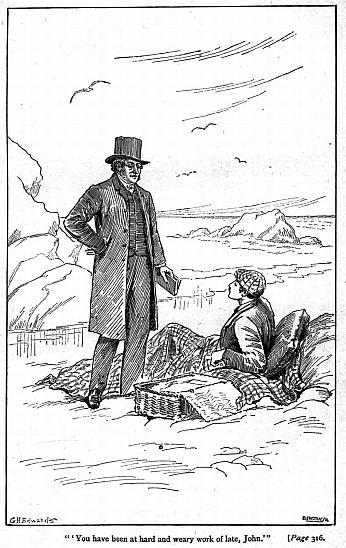
They had not many appliances for the comfort of the invalid, but they had all that were needed. A pillow and a plaid spread on the sand made his bed, and another plaid covered him when the wind came fresh. In the unexplored basket which Mrs Beaton had provided they had perfect faith for future needs, and so they rested and looked out upon the sea.
They had not much to say to one another at first. Mr Hume had brought a book in his pocket, from which he read a page now and then, sometimes to himself and sometimes to his friend; and as John lay and listened, looking away to the place where the sky and ocean met, he fell asleep, and had an hour and more of perfect repose.
How it came about, I cannot tell, but when he opened his eyes to meet the grave, kind eyes of the minister, looking down upon him, there came to him an utter softening of the heart—a longing unspeakable for the rest and peace which comes with the sympathy, be it voiced or silent, of one who is pitiful and who understands.
The minister put forth his hand and touched the hand of his friend.
“You have been at hard and weary work of late, John, or shall I say, you have been fighting a battle with a strong foe? and it has gone ill with you.”
John had no words with which to answer him. His lips trembled and the tears rose to his eyes.
That was the beginning. They had enough to say to one another after a little time; but not a word of it all is to be written down. Of some things that passed between them neither ever spoke to the other again. Before all was said, John “had made a clean breast of it” to the minister, and had proved in his experience, that “faithful are the wounds of a friend,” and that “a brother is born for adversity.” They had been friends before that day. Thenceforth they were brothers by a stronger tie than that of blood.
When John was brought home to his mother that night, she could not but be doubtful of the good which their day had done him. But he was rested and cheerful in the morning, and she was not doubtful long. As time passed, she could not but see that he was less impatient of his weakness and his enforced idleness; that he was at peace with himself, as he had not been for many a day, and that he was looking forward to renewed strength with a firmer purpose and a more hopeful heart.
Chapter Twenty Two.
“And so, taking heart, he sailed Westward, not knowing the end.”
Dr Fleming was by no means satisfied with the progress which his patient was making. He had called at the house with Mr Hume, and had expressed himself very decidedly as to the desirableness of a change for the young man, but he did not approve of Nethermuir, and he startled them all by saying:
“What you need is a sea voyage. It will take time and it will take money, but it is the very thing you need to make a new man of you. And the sooner you go the better.” And then he went away.
“You should go to America, John, where so many are going these days,” said the minister.
Mrs Beaton looked from one to the other with appealing eyes; and seeing this, John said nothing. Not a word more was spoken on the subject that day nor the next. On the third, as they sat together by the fireside in the gloaming, Mrs Beaton said:
“Well, John, what do you think?”
“Well, mother, I think the worst is over. I am growing stronger every day.”
His mother smiled and shook her head.
“You havena won far on yet,” said she. “But it was about the voyage to America that I was wishing to hear.”
“It might do me good, but it is not absolutely necessary, I suppose.”
“You might take a voyage without going so far as America.”
“Yes, that is true.”
“And the sooner the better for us both,” said his mother, after a pause.
“A voyage to America would be as safe as any other, though it would be a long one.”
“Yes, it would be a long voyage. America is far, faraway. And when you were once there, you might take it in your head to bide there.”
“And you wouldna like that, mother?”
“I mightna like it, but it might be for your good, for all that.”
“It wouldna be for my good to go away anywhere and leave my mother behind me,” said John gravely. “Would you come with me, mother?”
“No, lad; no. I couldna do that for several reasons. But if you were to go there, and should see a prospect of prosperous days, I might follow you.”
“Would you, mother dear?”
John rose and walked up and down the room a good many times. His mother waited with patience till he sat down again.
“Well, John?” said she.
“Do you mean it, mother?”
“Surely I mean it, or I wouldna say it. I should like better that you should content yourself at home. But it would be a new beginning.”
“Yes, it would be a new beginning,” said John gravely.
“It would need to be that, even here, in some ways, I suppose, and a new beginning might be easier there.”
“Have you been thinking about all that, mother?”
“Surely! What else have I to think about but that which concerns you, who have your life before you?”
“And wouldna you be afraid of the long voyage, and the going to a strange land and leaving all behind you?”
“I would have my fears, I daresay, like other folk; but I would have few to leave if you were away; and I would have you to welcome me.”
“I might come home for you in the course of a year or two.”
“You could hardly do that without interfering with your work, whatever it might be. But I might come to you with some one else. I feel strong and well now.”
“You are none the worse for the winter, mother?”
“None the worse, but much the better,” said she cheerfully. And then she paused to consider whether it would be wise to say more.
“It will hurt him, but it may help him as well,” she thought; and then she said aloud:
“I am far stronger than I was when I came here, and in better health every way. I may tell you now, since it is over, that all the last summer I was afraid—ay, sore afraid, of what might be before me. But I had a few words with Dr Fleming about myself, and he bade me put away my fears, for I had mistaken my trouble altogether. It was a great relief to my mind, and he helped my body as well. I am a stronger woman to-day than I ever thought to be.”
John, remembering the lingering illness of an aunt, knew or guessed what her fear had been, and he grew white as he met her eyes.
“Are you sure, mother,” said he hoarsely, “that you are now safe from all fear?”
“As sure as the word of a skillful doctor and honest man can make me. Yes, I think I may say I have no fear now.”
“And you kept this dread to yourself! Oh! mother! mother!” said John, covering his face with his hands.
She had been enduring this trial—this great dread, in one way worse to meet than suffering itself would have been; while he, full of himself and his own plans and disappointments, had been taking no heed.
“I have great reason to be thankful,” said Mrs Beaton softly; “and, John lad, what could I do, but keep my fears to myself till I was quite sure? You had your own trouble to bear, as I could well see, and it would have made mine none the less to add to your pain.”
“Oh! mother! mother!” was all her son could say.
“John,” said Mrs Beaton, after a time, “I think you might tell your mother!”
John raised his head and laughed, but there were tears in his eyes as he came over to her, and stooping, he softly kissed her. “Do you need to be told, mother?” said he.
These were the very first words which had passed between them concerning the sorrow which had come to them both through Allison Bain, and they were nearly all that were ever spoken.
“I grieved for you, John, and I feared for you; but I trusted Allison Bain. If she does not love him, he is in no danger, I said. If she loves him, she will withstand him for his own sake.”
“Be content, mother. She withstood me, whether she loved me or not.”
“I thank God for you both. May He ever lead you in His own way!”
Of course a voyage was to be taken. There was some hesitation as to whether John should avail himself of the opportunity offered by a ship which was to sail at once to bring home timber from Norway, or wait a little longer for the Griffin, an emigrant vessel, bound for Quebec. There were already great steam vessels crossing the ocean—not many of them, however, at this time, but the long voyage would be rather an advantage in John’s case, and he made up his mind to go by the Griffin. But he said nothing to make any one suppose that he did not intend to return with her. There would be time enough to decide as to the length of his stay, when he had seen the country.
So the mother and son bade one another farewell for a while, and Mrs Beaton was the more courageous of the two when it came to the last words between them. But they did not linger over last words. Robert Hume had come to say good-bye to his friend, and to take care of Mrs Beaton on her homeward journey to Nethermuir, and he was amazed at John’s “down-heartedness.”
“Oh! man! if I only had your chance! Or if I were going with you!” said he, and John echoed his wish.
He had been a good many days out of sight of land, before he began to take himself to task for his utter inability to feel, or to profess an interest in that which was going on about him. He was, indeed, very down-hearted, as Robert had said. He said in his foolishness:
“My days are past. My purposes are broken off, even the thoughts of my heart.”
And he told himself that, except for his mother’s sake, it did not matter whether he made his home in America or in Scotland, or whether he should ever make a home at all. But this melancholy did not continue long. Little by little the salt winds brought him health and strength. They blew away his foolish fancies, and soothed the smart of a pain real, and ill to bear. Then he began to see and to interest himself in that which was going on in the little world around him.
There were all sorts of people in it—fathers and mothers, and little children, young men and maidens. There were doubtful characters among them, it is to be supposed; some of them seemed to be poor enough, and some were evidently “well-to-do.” All were alike cheerful and not afraid of the future, for they were all looking forward to having land of their own and a fair chance in the new world.
John made acquaintance with many, and made friends with a few, and got good, and tried to do good among them. There is time to make acquaintance during a voyage which lasts for weeks, and the seventh week was over before they anchored within sight of the citadel of Quebec.
There are letters still in existence in John’s handwriting—great sheets, larger than common foolscap, written in small, even characters, like “copper-plate,” and so written that every available hairbreadth of space is covered, except that part which, when the elaborate process of folding was accomplished, was left blank for the address. There are a good many of these letters, and there is great variety both as to matter and to manner among them, some of them being addressed to his mother and others to the minister and to Robert. Altogether, they might afford material for a very full account of John’s first impression of the scenery, the climate, the character of the people, the state of morals and manners, of education and religion in the new country to which he had come.
When they fell into John’s hands many years after they were written, he enjoyed the reading of them greatly. He was very proud of the handwriting for one thing, and pleased with the evidence they gave of his patient and faithful efforts to satisfy his correspondents, both as to the quantity and the quality of the information conveyed.
His descriptions of natural scenery, of the grand river Saint Lawrence, the mountains, the islands, the great falls of Niagara, were very fine—“perhaps a little too fine”—he acknowledged. But his opinions as to the state of morals and manners, education and religion, and American institutions generally, were greatly modified by the time he read his letters again; his “first impressions” may therefore be omitted in his story, and his adventures also, which were not of extraordinary interest, even to himself, until he came to the town of Barstow in the United States, the only town in all America which at that time had any special attraction for him.
In those days Barstow used to be spoken of as a Western town; but so many new States have been made since then, and so many towns and cities have risen up far to the westward, that it is now regarded as belonging to the eastern part of the great republic. It was not a large town when John Beaton first saw it. It had a few long, tree-shaded streets, where the great square, white houses, stood far apart, with pleasant lawns and gardens about them. Even the business streets were wide and clean, and had trees growing in them; and, altogether, “the place gave one the idea of plenty of elbow room,” as John told Robert Hume in the first letter which he wrote there.
But he did not tell Robert or any one else why he had turned his face thitherward.
Before Dr Fleming had ended the sentence which declared that a sea voyage would be the best thing for his patient, John was saying to himself, that to the town of Barstow, where Alexander Hadden lived, and where William Bain was likely to go at last, wherever he might be lingering now, he should first direct his steps when his voyage was ended. If such a thing were possible, Allison’s heart should be set at rest concerning her brother.
But now that he was there, for a reason which he could not well have declared to any one, he hesitated to apply to Mr Hadden for the information which he desired. It would be more natural and more agreeable to them both, he thought, that meeting William Bain as it were by chance, he should claim him as a countryman, and strive to win his confidence first of all. Afterward, he might be able to help and influence him. And it was too likely that he would need both help and influence.
That this lad who, not through wickedness perhaps, but through weakness and folly, had brought sorrow on all who loved him, would have strength and wisdom to resist all temptation, and begin a new life in a new land, was hardly to be believed. Alone, homesick, remorseful, there was little hope of his doing well without help from some one.
“And whatever else I may do, I must first find Willie Bain and help him as he may need, for Allison’s sake.”
But time was precious, and John’s purse was not very deep; and if he were to see anything of this wonderful country, he told himself, he must not linger long in Barstow. But he did linger day after day. He did not seem to care so very much for seeing the country. He was growing well and strong, and to get health and strength was his motive for crossing the sea. He was as well here as elsewhere, and here he must stay. It seemed to be “borne in upon him,” that there was something for him to do in the place.
When several days had passed, he made up his mind that he would go to the bank and see Mr Hadden, and he went. It was too late to see him that day. Mr Hadden had gone home. On that night something happened. John met the man whom he was seeking, face to face.
It could be no one else, he said to himself. For the eyes which met his for a moment were the beautiful, sad eyes of Allison Bain. “Now, God guide me!” said John in strong entreaty, and then he followed the lad. He followed him down one street and up another, and out into the country along the lake shore. The stranger moved more slowly as he went on and stopped at last; and, leaning upon a broken fence, looked out long upon the water.
“I’m not so very strong yet,” said John to himself, as he paused also, for his heart was beating hard and his hands trembled.
While he hesitated whether he should speak at once or wait a while, the lad turned and began to retrace his steps. John addressed him as he passed. “Can you tell me if I am on the right road to—to—Jericho?” said he, at a loss for a name. “No, I cannot tell you. I am a stranger here.”
“A stranger? So am I. And you are a Scotchman, I ken by your tongue. So am I. We are both strangers in a strange land.”
If John had had time to think, he might not have spoken in this way, but it is very likely he might have said nothing which would have answered a better purpose. The lad turned and looked at him.
“Yes, I am a stranger. I have no friends—no one,” he said huskily, and the tears came into his eyes.
“I have no friends on this side of the sea, and not so very many beyond it—besides my mother.”
This, also, was a stupid sort of thing to say, he owned, when he came to think of it, and then he added:
“I have heard that this is a fine country to get on in.”
“Yes, so they say.”
They went on in silence, and very slowly, the stranger walking wearily, as John could see.
“I am done out,” said he at last, stopping and leaning against a tree.
“Yes, so I see. Have you far to go? I will go with you.”
“I have nowhere to go. I came here yesterday, and I slept last night in a boat by the wharf.”
“Then ye’ll just come with me,” said John heartily, giving him his arm to lean upon. He would have liked to ask his name, but he did not. They walked on slowly, till they came to the house where John was staying.
“I have brought a friend,” said he to the mistress of the house. “He will share my room, and I will be responsible for him.”
“He looks sick,” said the woman gravely. “I hope you realise what you are undertaking?”
John thought he “realised” it, but he did not. It would have made no difference, however, if he had. His new friend tossed and muttered all night, and in the morning was unable to raise his head from the pillow, and that was but the beginning. Many days passed before he was able to do so. He was light-headed much of the time, and uttered a great many names, some of them angrily enough, and some of them with love and longing unspeakable. It was, “Oh! mother! mother!” Or, “Oh! Allie! Allie! where are you gone?” through the whole of one painful night when he was at the worst, till the dawn brought sleep at last, and a respite.
He grew better after a while, and the visits of the doctor ceased, but his strength came slowly and his spirits failed him often. The house in which they lodged stood near the water’s edge. The heat was great in the middle of the day, and at night the wind which came from the lake was damp and chill. John saw that a change of place was needed, and he would fain have carried him away to get the fresh air of the country.
“A change is what he needs. We can manage it for a day now and then, to get somewhere,” said John to himself; “and then—I must to work again.”
He knew, or he supposed, that if he applied to Mr Hadden, who had the reputation of being a rich man who did much good with his money, all would be made easy to this stranger; but he himself had the best right to have the pleasure of helping Allison’s brother; and he said to himself:
“I’ll bide a wee. He has not mentioned Mr Hadden’s name, nor his own, for that matter. Yes, I’ll bide a wee, and we’ll manage it in some way.”
Chapter Twenty Three.
“Let us be content to work— To do the thing we can, and not presume To fret because ’tis little.”
And it was managed very much to John’s satisfaction, and very easily managed. One morning John hailed an early market-man, returning home with his empty waggon, and asked him if he would take passengers for a little way into the country. The man hesitated only for a minute.
“Well, yes, I guess so—just as well as not. Glad of your company,” said he, after a second glance at John’s face, and away they went together. It paid to have their company their new friend told them, as he took his leave of them.
“If you think of walking back to town to-night, I guess you’ve come far enough,” said he, when they came to the top of the hill.
He left them on a little knoll, sheltered by a few great maple-trees, and having a sloping, stony pasture between it and the lake, and here they spent the morning. John had a book, and he enjoyed it, while his patient slept. But he could not quite put away all anxious thoughts, and he laid it down at last to face them.
What was to be done with this silent lad, who had fallen into his hands? Since the night of their meeting, he had spoken no word about himself, except as he had muttered or cried out unconsciously while the fever was upon him. He had not asked a question or hesitated a moment in letting John do with him as he would, accepting all help and tendance as quietly and naturally as they were cheerfully given.
And John liked all this, in a way. But it could not continue. For the lad’s sake something must be said, something must be done.
“He must be made stronger, and put in the way of doing for himself, before I leave,” said John, thinking rather of the lightness of his purse than of any desire he had to see the country or even to get home again.
“Yes, we must lose no time,” he repeated, and looked up to meet the lad’s eyes fixed on him.
“You have never told me your name,” said he gravely.
John laughed.
“Have I not? Well, it is John Beaton. Did you ever hear it before?”
“No, I have never heard it.”
“And you have not told me yours. It is rather queer, too. The name is usually the first exchange made between men meeting as strangers, when they wish to become friends.”
There was no answer to this. “Well?” said John, after a little.
“I have been thinking—I mean I call myself William Leslie.”
“And is that your name?” asked John gravely.
“Yes, it is my name. It is not all of my name. But what does it matter in this new country? My name is nothing to any one.”
“But it is something to yourself. I havena a fine name, but it was my father’s before me, and my grandfather’s, and I wouldna change it to be called a lord,” said John gravely. “My lad, I hope you have done nothing to make you afraid or ashamed to own your name?”
“I have done nothing that I wouldna do again, ten times over, if it would give me my revenge!” he cried, raising himself up, while his eyes flashed angrily. “It is not for shame, but for safety that I wish to have my name forgotten, and—for Allie’s sake.”
He lay down again, and after the anger, the tears came. Then John did an extraordinary thing. When he stooped to arrange the plaid over his friend, he kissed him on his lips and on his closed eyelids. Then he rose and turned his back upon him.
While he stood thus the rain began to fall, the first drops of a summer shower, which promised to be a heavy one. What was to be done now? Where were they to find shelter? John ran up the hill to the other side of the grove and looked northward toward the threatening clouds, and down over a wide landscape, which even the glooming clouds could not make otherwise than fair. There were fields of grass and grain stretching as far as the eye could reach. There were men at work among the hay, piling high the long wagons, in haste to get it to shelter before the rain came on. A white farmhouse, half hidden by trees, stood near, and great barns with doors wide open, waiting for the coming of the wagons. It did not need a minute for John to take all this in, and in another he was speeding down the hill and over the meadow with his friend in his arms, nor did he pause till he had laid him in one of the barns on a bed of fragrant hay.
“I must go back for the plaid and the basket,” said he; and stooping down, he added gently: “My lad, if any one should ask your name, mind that you are Willie Bain.”
He came back as a great load of hay drew up at the barn door.
“Drive right in under cover, Sam,” said the farmer, who followed. “I expect we’ll have to leave it here. We can’t unload in time to do much more. Hurry up and cock up as much of the rest as you can. If it had only held up another hour!”
The man slid down from the load and made for the field.
“Well how, it begins to look as though it might hold up,” soliloquised the farmer. “I ’most wish I had let him stay. Halloo, Sam!”
But Sam was out of hearing by this time, though he was not making the greatest possible haste to the field.
“Perhaps I might help you to unload,” said John from the dimness of the barn floor. The farmer did not hesitate a second.
“I don’t know who you be, but I expect you are to be trusted to pitch the hay back as fast as I pitch it down. Go ahead.”
John could be trusted, it seemed. The farmer did not succeed in embarrassing him with the abundance of the great forkfuls which he threw down into the mow, and the team was backed out into the yard in what the farmer called “pretty considerable quick time.” And then he saw William Bain sitting with John’s plaid about him, on a bundle of hay in the corner.
“Well! it seems to me that we’re goin’ to have company,” said he.
“We have been enjoying the fresh air up among your trees yonder. But I was afraid of the rain for the lad, who has been ill of late, so we ventured to take possession of your barn.”
“All right. It’s nothing catching he’s had, is it? He’d better go right into the house, hadn’t he?”
But Bain preferred to stay where he was, among the hay. John took his place on the hay-cart, and set out with the farmer to the field.
“Well, I shouldn’t wonder if we saved most of it now. It’s just possible—with your help,” added he, nodding in a friendly way to John. As they passed the door of the farmhouse he called out:
“See here, Myra; there’s company out there in the south barn. You tell grandma she’d better have him in, and see to him. There’s nothing catching, you say? Well, the old lady will fix him up, and make him comfortable; and she’ll like nothing better.”
The rain “held up” for a while, and the farmer and his two men, with the help of John, wrought wonders. When, at last, the rain came down in torrents, the fragrant hay was all safe under cover, and the farmer was triumphant.
Of course John came to the house with him, and there he found Willie Bain sitting in a rocking-chair, content and smiling, under the guardianship of a lovely old woman, whose face told that her pleasure all her life had been found in pleasing and helping others. It was a good sight for John to see.
“He’ll do now,” said he to himself. “He has fallen into good hands. I only wish I might leave him here for a day or two. It would set him up again.”
“Be you brothers?” said the farmer, as he caught the satisfied look with which John regarded the lad sitting at his ease among them.
“We are fellow-countrymen,” said John, “and that makes brothers of us here in a strange land.”
The evening was one to be remembered by these brothers, who had been strangers less than a month ago. A good many times in the course of his life has John told the story of that first evening in Jacob Strong’s house. He has forgotten many things, and times, and places better worth remembering, perhaps, but he will never forget his first coming into that long, low room, through whose open windows shone in the afterglow from the west, when the first heavy shower was over.
There was a wide fireplace, and on high, brass andirons a bright wood fire was burning. Over it was a mantel-shelf on which were arranged candlesticks of brass and snuffer-trays, and various other things quaint and pretty. There was a tall clock in the corner, and a tall looking-glass between the windows. There was a secretary in another corner, with a book-case above it, and some pictures on the walls. The table was laid for tea, and the room and all that was in it was perfect in neatness. Grandma Strong was there waiting for them, and the farmer’s wife and his “little daughter,” as Jacob Strong called a slender girl of sixteen, who was leaning shyly on her grand mother’s chair. He might well remember it, and his friend also, for it was a good day for them both which brought them there, and Jacob Strong and his household proved true friends to them.
Jacob Strong! John told his mother long afterward, that if the Bible had been searched from end to end to find a good name for a good man, none better than that could have been found for their new friend. Not that either of the patriarch’s names fitted him exactly. He was not a “supplanter,” and though he was on the right side, as no one who knew him well would deny or even doubt, yet if one had wished to tell his character in two words, it would not have been as “a soldier of God” that one would have described him. But he was in many ways very like the patriarch, as we see him in the Bible story. He was wise, he was wily, he was patient. He could bide his time and secure his chance, and when it came to that, that he had to yield, of to humble himself, to meet loss, or to dispense beyond what was pleasing to a man who took reasonable satisfaction in getting and in holding, he could yet do it without wincing visibly. He was fortunate in being in the hands of two good women, his mother and his wife, who knew him well, and loved him well, and who were jealous for his honour before men, and for his singleness of heart before God.
Of course John’s knowledge of his character came later, and by slow degrees. But even on this first night he was greatly interested in his talk, which was at once “worldly wise and heavenly simple,” as he afterward heard one of his neighbours say. And Jacob was strong in nature as in name. He could “hold on.” He had paid every dollar which his farm had originally cost him, by the work of his own hands on other men’s farms. And with the help of his mother first, and then of his wife, “who each carried a good head on her shoulders,” as he told John, he had made it pay. By and by he added another hundred acres to the first hundred, and later, when “the Western fever” set in, and people began to talk about prairie lands, and great wheat farms to be made out there in the Far West, one of his neighbours sold out to him, and Jacob’s two hundred acres became four.
“And that is about as much as I want to have on my hands, till labour comes to cost less, which won’t be for a spell, as things look now,” said he.
All this he told to John while a second heavy shower kept him waiting. Before the rain was over, Willie Bain was at rest for the night, in Mrs Strong’s south chamber. Then John told all that was necessary for them to know about the lad,—how, though he had known friends of his at home, he had never seen the lad himself until he had met him by chance on the lake shore. Finding him alone and ill, he had taken him home and cared for him. Bain was better now, and would soon be well. Yes, he meant to stay in the country. As to himself, John could not say whether he would stay long or not; the chances were he would remain for a time.
Then when the rain seemed over, John rose to go. The folk where they lived might be troubled about them. He had something to do in the morning, but in the course of the day he would come back for his friend. And with many thanks for their kindness to the lad, he took his departure.
Since William Bain had acknowledged his name, John thought it right that Mr Hadden should be informed of his arrival in the town, and next morning he went again to see him, at his place of business. He was a good deal surprised at the manner in which Mr Hadden received him. It was not at all as one receives a stranger, he thought, but the reason was soon made clear to him.
John Beaton was not altogether a stranger to Mr Hadden. His name had been mentioned in both letters which Allison had written, as one who had been willing to befriend her brother while he was in prison, and who wished still to befriend him since he was set free. John told of his meeting with the lad, of his illness, and his good fortune in falling into the hands of the kind people out at the farm.
“It must be the Strongs you are speaking of. Certainly he could be in no better hands, if he still needs to be taken care of. And the longer he is there, the better it will be for him.”
“I would like well to leave him there for a while, if they were willing to keep him. I will see how things look when I go out for him to-night.”
Of his own affairs or intentions John said nothing. He spent the rest of the morning in looking about him, in order to ascertain what sort of work there was to be done in the town, to which he might put his hand with a hope of success. There was building going on, and he came at last to a wide yard, where stone-cutting was done, and he said to himself, that if they would but give him a chance, he would fall to, and do his best for a while at least.
But he did not go to inquire at once. He stood thinking of the day when he first tried his hand on the granite of Aberdeen, and earned his shilling before he laid the hammer down again.
“I might have done better, but then I might have done worse,” he admitted with not unreasonable satisfaction. “And if I take it up again, it need not be ‘for a continuance,’ as auld Crombie would say. I must see the lad fairly set to honest work, and then I may go my way.”
He offered himself at the place, and was taken on at once. His wages were to be decided upon when his first day’s work should be done, and it need not be said that his wages were of the best.
When he went to the Strong farm that night, he found that Mr Hadden had been there before him. Willie Bain’s first word to him was:
“Why did you never tell me that ye had seen our Allie?”
“Do ye no’ mind that, till last night you never told me your name? How was I to ken?” added John, as Willie hung his head. “I did ken you as soon as ever I saw your face. Yes, I have seen your sister. She is safe where she is. No evil hand can touch her, and in a while she is coming out here to you.”
Poor Willie Bain was but weak yet, and the tears were running down his cheeks, while John told him in few words what his sister had been doing, how she had won the respect of all who had known her, and how she had now gone away from Scotland with a good friend, but was looking forward to the time when she might join her brother, so that they might have again a home together.
“And, Willie, my lad,” added John, gravely, “if I had a sister like yours, I would make a man of myself for her sake.”
“You are a man already,” said Willie, with a sound which might have been either a laugh or a sob. “As for me—yes, I ken I havena been taking right care of myself for a while. I fell into ill hands down yonder. But now I have you, and I will be a man for Allie’s sake.”
There had been tokens visible of the fact that the young man had not been “taking care of himself,” but John had spoken no word which betrayed his knowledge.
They were in the garden at this time, sitting in a wide, green walk, between high rows of currant-bushes, a great apple-tree making a grateful shade around them. By and by they rose and walked up and down, John lending his strength to help his friend’s weakness; and he asked:
“Would you not like to stay here a little while?”
“Till I get my strength back again? Yes, I would like it well. I mean sometime to have land of my own, and could begin to learn here the new ways that are needed in a new country. Yes, I would like well to bide here for a while.”
He spoke eagerly and hopefully.
“I wish Allie were here. There would be no fear then,” said Willie, looking up at John with Allie’s wistful eyes.
“She cannot come for a time. It is likely that she might be sought for here—in Mr Hadden’s neighbourhood, I mean. But, Willie man, I think it is as well that she should not come just now, even for your sake. It is you who would be looking up to her, because she is wiser than you, and maybe stronger. She would lead, and you would follow. That might be well, in a way. But it would be better, it would be far more manly for you to learn to stand by your own strength—to walk by your own wisdom. Of course, I mean by the help of God, in all things,” said John, gravely.
“Do ye ken Allie well?” asked Willie, looking up into his friend’s face.
John hesitated a moment.
“I cannot say that I have known her long, or seen her often. But I know that she has borne much trouble well and bravely, and that she must be strong. And I know that she has walked warily and done wisely in difficult places, so that all those who do know her well, respect her, and some few people love her dearly—my mother among the rest.”
“You must tell me all about her some time,” said Willie, with glistening eyes.
“Yes,” said John. Then he paused before he added:
“I think, Willie, in speaking of your sister to any one here, you should say nothing about her marriage, since it has not been a happy one.”
Willie withdrew his hand from John’s arm, and turned upon him with a face white with anger.
“Married! Happy! I’ll swear that he has never touched her hand, nor looked in her face, since that cursed day. Call you that marriage?”
“Thank God!” said John; “and may he never touch her hand, nor look upon her face. Gently, my friend, she is safe from him now.”
Then he led him back to the shadow of the apple-tree, and told him more about his sister. He told how she had lived at the manse, and how they had valued her there. He told of little Marjorie, whom her father and mother had intrusted to Allison’s care, and of the child’s love for her, and how Allison had been helped and comforted through her love for the child. She was quite safe now, so faraway in the South, and no one would harm her while she was in Mrs Esselmont’s care. John talked on till the lad had grown quiet again, and then they were called to tea.
The first words that Grandma Strong said when they came in together were:
“You don’t think of taking that boy back to that hot place to-night, do you? I don’t think you had better—for a day or two, at least.”
It was all very easily settled after that. John was glad to agree with the dear old woman. Willie was to stay at the farm till he was a little stronger.
“We’re glad to have him stay. Don’t you say a word about it,” was the younger Mrs Strong’s answer, when John tried to thank her for all their kindness to his friend, for whom he felt responsible, he said, until he should be strong and well.
“You had better stay and help us through with haying and harvesting. You could pay your way and his too, and have something over,” said Mr Strong.
But John had his own work laid out before him, and intended to make long hours, so that he could hardly hope to come out to see his friend for a while.
“Come Saturday night and spend Sunday. You can go to meeting here as well as there.”
And John answered:
“Yes, I will be glad to come.”
Does this sudden friendship, this acceptance of utter strangers, without a word spoken in their behalf, except what they spoke for themselves, seem strange, unlikely, impossible? It did not seem strange to John, till he came to think of it afterward as he walked home. Face to face with these kind people, their mutual interest seemed natural enough. In thinking about it, as he went swiftly on in the moonlight, he did wonder a little. And yet why should he wonder? he asked himself.
“Honest folk ken one another, with few words about it. It has happened well, and—not by chance,” added he, reverently, recalling many a one at home who would have him often in their thoughts at the best place—and thinking especially of two, who, in all quiet moments, would be “remembering” both him and his friend there.
It must not be forgotten that all this happened many years ago, before all the nations of the earth had turned their faces toward the West, in search of a refuge from poverty or tyranny, disgrace or despair. There was room enough, and land enough for all who were willing to work and to live honestly. Every strong and honest man who came, while he bettered himself and those who belonged to him, did good also to his neighbours, and to the country at large. And so in those days, as a rule, new comers were well received. But beyond this, John and his friend were liked for their own sakes, and might well rejoice at the welcome which they got at the farmhouse, for a great many good things and happy days came to them through the friends they found there, before all was done.
It is possible that if John had not met in with William Bain in those circumstances, he might have travelled about for a while till he was strong again, and then he might have turned his face homeward. If he had found the lad well, and doing well, he might have contented himself with leaving him to the kindly care, or the unobtrusive supervision of Mr Hadden, who had known his family, and who had promised to befriend him. But John could not quite free himself from a sense of responsibility with regard to Willie Bain. He must keep sight of him for a while. He liked the lad from the first and soon he loved him. He would not be losing time by remaining for a few weeks. He meant to travel by and by, and see the country, and in the meantime he might do something toward helping Willie to make a man of himself for Allison’s sake.
So he went to the stone-yard, and did his day’s work with the rest. It was hard work for a while. He had got out of the way of it somewhat, and he had not got back his strength altogether. The day was long, and he was glad when night came. After the first week, however, he was himself again, and then he grew strong and brown, and was as fit for his work as ever he had been, he told his mother in the second letter which he sent her, after he began.
He told her about William Bain. But that was for herself alone. As no one else in Nethermuir had ever heard of the lad, it was not necessary to speak of him there, lest his name might be mentioned in the hearing of some who might not wish him or his sister well. He did not write to Allison about her brother. Mr Hadden did that, and the story of John’s kindness to the lad lost nothing in being told by him.
Before the summer was over, John had begun to consider the question, whether, after all, it might not be as well for him to stay where he was, and take up a new life in a new land. His mother had more than once in her letters assured him of her willingness to come out to him should he decide to remain in America. But there was to be no haste about it. He must be quite certain of himself and his wishes, and he must have won such a measure of success, as to prove that he was not making a mistake, before she joined him. It might be better for him to be alone for a while, that he might be free to come and go, and do the very best for himself. The best for himself, would be best for his mother. And in the meantime she was well and strong, in the midst of kind friends, and content to wait. And she would be more than content to join him when the right time came.
And so John followed his mother’s counsel. He kept his eyes open and “worked away,” and by the end of the first year, he began to see his way clear to “the measure of success” which his mother desired for him. He had proved himself, as a workman, worthy of the confidence of those who had employed him, and as a man, he had won the esteem of many a one besides. That he worked with his hands, did not in that country, at that time, necessarily exclude him from such society as the town of Barstow offered. But it made him shy of responding to the advances of some of the people who lived in the big white houses among the trees along the street, and who went to the same church in which, after a few weeks of wandering, here and there, John settled down.
The only people whom he came to know very well during his first year, were the Strongs at the farm, and the Haddens. Mr Hadden was friendly with him from the first, because he was a fellow-countryman, and because he was a friend of William Bain’s. Afterward, they were more than friendly, for better reasons. Mr Hadden had no cause to feel surprise in finding in a skilled workman from his native land, a man of wide reading and intelligence. He had found many such among his countrymen who had come to seek a home in his own adopted country. But John Beaton was different from most of those with whom he had come in contact, in that it was not necessary in his case, that allowance should be made for unconscious roughness of manner or speech, or for ignorance of certain ways and usages of society, which are trifles in themselves, but of which it is desirable that one should be aware.
But at this time John did not care much for society of any kind. He never had cared much for it. In Nethermuir he had “kept himself to himself,” as far as most of the townsfolk were concerned, and it must be owned, that beyond his own small circle of friends in the manse, and in one or two other houses, he had not been a very popular person. He had no time to give to anything of that sort, he had always said, but he might have found the time, if he had had the inclination. He had not much leisure in Barstow. Still, in the course of the first two years, he came to know a good many people in the way of business; and in connection with the work undertaken by the church to which he belonged, he also made friends whom he valued, but his first friends were his best friends.
All that need be told of the first three years of his residence in Barstow, may be gathered from a letter which he wrote to his mother about that time.
“You ought to be a happy woman, mother, for you have gotten the desire of your heart. Do you not mind once saying to me, that you desired for me nothing better in this life, than that I should do as my father had done, and make my own way in the world? Well, that is just what I am doing. There is this difference between us—that I have got ‘a measure of success’ on easier terms than my father did. I am not a rich man, and I have no desire to be one—though even that may come in time. But I stand clear of debt, and I see a fair way to success before me. I have ‘got on’ well even for this country, where all things move more rapidly than with us at home.
“I have had two friends who have stood by me all these years. They have helped me with their money, with their names, and with their influence. I might, in the course of time, have gotten on without their help, but they have taken pleasure in standing by me, like true friends.
“Yes, I have liked my work, and my way of life, though to you I will own that I have sometimes wearied of them—and of everything else. But one’s life must go on till God’s will brings it to an end, and I know of no other way that would suit me better now. And between whiles, as I have told you before, I find higher work which I am able to help along.
“And now, dear mother—when are you coming home?—For this is to be your home, is it not? You say you are able to come alone. But if you can wait a few months longer I will go for you. I have building going on in different parts of the city, and the foundation of your own house is laid, on the knowe (knoll), which I have told you of, beneath the maple-trees, and full in sight, the great lake into which the sun sinks every night of the year. In six months it will be ready for you, and I shall be ready to cross the sea to bring you home.
“I long with all my heart to have my mother here. I think I shall be quite content when that time comes.
“William Bain had told me about his sister before your letter came. He was wild with anger, and said, some things which he has taken back since then. I heard from Mr Hume and from Mrs Hume, as well. I cannot blame them for their advice—or rather, for their silence. And I cannot blame Allison Bain for what she has seen right to do. God bless her—Amen.”
And so the letter ends, without even his name.
Chapter Twenty Four.
“Oh! Blessed vision! happy Child.”
“Are you sure you are glad to come home, Allie dear?” said Marjorie Hume, looking up rather doubtfully into her friend’s face, for Allison had said not a word in answer to her exclamations for some time.
They were walking together through a wide street in Aberdeen, and Marjorie had been amusing herself looking at the people whom they met, and at the pretty things in the shop windows, and had been enjoying it all so much that, for a while, she had never doubted that Allison was enjoying it also. But Allison was looking away to the sea, and her face was very grave, and there was a look in her eyes that Marjorie had not seen in them for a long time now. The look changed as the child repeated the question:
“Allie, you are surely glad to be going home?”
“I am very glad to be bringing my darling home strong and well to her father and mother and them all. They will be more than glad to see us again.”
“And, Allie dear, it is your home too, till Mrs Esselmont wants you again. And you will try to be happy there? And you will not be ay wishing to win away to your brother in America—at least for a while?”
“No, not for a while. But I must go when he sends word that he needs me. That may be sooner than we ken. When he gets his own land, and has his house built, then I will go. But I am in no hurry,” said Allison, after a pause. “And now let us go and take a look at the sea. It is too early yet to see Dr Fleming.”
“But it is not the same sea that we have been looking at so long—the sea that has helped to make me strong and well.”
“It is a grand sea, however, and it is our own. And to-day it is as bonny, and smooth, and blue, as ever the Southern Sea was, and the same sun is shining upon it. And we must make haste, for we have no time to lose.”
They did not go at once, however. As they turned into the next street, a hand was laid on Allison’s arm, and looking up she met the eyes of one whom she had not seen for many a day. She had last seen him looking sorrowfully down on the face of her dying father.
“Mr Rainy!” cried she, faintly, thinking of that day.
“Eh! woman, but I am glad to see you after all this time. Where have you been since that sorrowful day? I was just thinking about you as I came down the street. I must believe in a special Providence after this. I was just saying to myself that I would give a five-pound note, and maybe twa, if I could but put my hand on Allison Bain. And lo! here ye are. And, Allison, my woman, if your father could speak to you, he would say, ‘Put yourself into my old friend’s hand, and be advised and guided by him, and ye’ll never have cause to repent it.’ And now I say it for him.”
Allison shook her head.
“I cannot do that—blindly. I need neither the help nor the guidance that you would be likely to give me. I must go my way with the child.”
“The child! Ah! yes, I see, and a bonny little creature she is,” said Mr Rainy, offering his hand to Marjorie. “And whose child may she be?”
“She is the child of my master and mistress. I have been in service all this time, and I need help from no one.”
“In service! Yes, and among decent folk, I’ll be bound! Well! well! And doubtless you will be able to account for every day and hour that has gone by since you—were lost sight of. That is well.”
“It might be well if there were any one who had a right to call me to account,” said Allison, coldly.
Mr Rainy had turned with them, and they were walking down the street together.
“A right? The less said about rights the better. But this I will say, you have a right to look upon me as a friend, as your father did before you. And I have a right to expect it from you. Your father trusted me, and it will be for your good to trust me likewise.”
“Yes, he trusted you. And if I needed help that you could give, I might come to you for it. But I have only to ask that you forget that you have seen me. Not that it matters much now; I have got over my first fear. I must bid you good-day. We are on our way to see Doctor Fleming. But first we are going down to the sands.”
And then Allison made him a courtesy which minded Marjorie of Mrs Esselmont. Then they went down another street together, and left him standing there.
Mr Rainy had been for many years the friend and legal adviser of the laird of Blackhills, and more than once, in his visits to the great house on the laird’s business, he had given counsel to Allison’s father with regard to his affairs. He had been with him when he was drawing near his end, and had done, what, at that late day, could be done, to set his affairs in order, and to secure, that which he possessed, for the benefit of those he left behind. He had known all the circumstances of Allison’s unfortunate marriage. He had not spared Brownrig when the matter was discussed between them, but in no measured terms had declared his conduct to have been cowardly, selfish, base.
But when Allison disappeared so suddenly, he had done his utmost to find her. That a woman might begin by hating a man, and yet come to love him when he was her husband, he believed to be possible. At the least Allison might come to tolerate her husband if she did not love him. She might come, in time, to take the good of her fine house and of the fine things, of which there was like to be no stint in it, and live her life like the rest, when her first anger at his treacherous dealing was over. For her own sake, for the sake of her good name, and the respect he owed to the memory of her father, Mr Rainy left no means untried, that might avail to discover her. He never imagined it possible that she would remain within a short day’s journey of the place where all her life had been spent.
Of late he had come to believe that she was dead. And he said to himself, that if she could have been laid to her rest beside her father and her mother, no one need have grieved for her death. For her marriage could hardly have been a happy one. All her life long she had forgotten herself, and lived only for her father and mother, because she loved them, and because they needed her. For the same reason she would have laid herself down in the dust, to make a way for her young scamp of a brother to pass over to get his own will. But for the man who had married her she had professed no love, and even in his fine house it might have gone ill with them both.